Showing posts with label Rome. Show all posts
Showing posts with label Rome. Show all posts
Thursday, May 09, 2019


Review: Rome: Eternal City by Ferdinand Addis — a great bloody history
By Patrick Kidd
1 September 2018

In the early days of spring just over 1,100 years ago all the big players in Rome, politicians and clergy, gathered in the city’s mother church, the Archbasilica of St John Lateran, for a macabre show trial. Two popes were in dispute. One, Stephen VI, had convened the gathering to shore up his own fragile political position. His rival, Formosus, was accused of perjury, breaking canon law and usurping the throne of St Peter. Formosus sat there as mute as the flagstones in the Forum as Stephen accused him of letting ambition lead him into villainy. There was little that he could say. Formosus had been dead for 11 months.
The exhumed pontiff was a bit whiffy, no longer looking like a man whose Latin name meant handsome, but he was kitted out in full papal vestments for what became known as the cadaver synod, from the white camelaucum on his head to his red leather sandals. These have been the traditional footwear of Rome’s leaders, right down to modern popes, since Julius Caesar started to appear in red boots, claiming it was what the ancient Latin kings had worn. An appropriate colour since, as Ferdinand Addis’s superb biography of the Eternal City reminds us, Roman politicians have often trod a bloody path.
Formosus’s counsel, a trembling deacon, put up a defence, but the verdict was never in doubt. Pope Stephen found his predecessor guilty, ordered the corpse to be stripped and for the first two fingers of Formosus’s right hand — the ones with which he gave benediction — to be snapped off, invalidating his authority. The rest of him was then cast where so many ambitious men of Rome have ended up: into the foaming waters of the Tiber.
That should have been the end of it, but political fortunes in Rome, like the original river of blood, ebb and flow. Stephen was bumped off a year later in AD897 and, mirabile dictu, Formosus’s corpse was found still bobbing around downstream. Fished out, whatever gristle was passed off by his supporters as the remains of the wronged pope was carried through the streets to what was this time his final resting place in St Peter’s. As the papal jetsam passed, the images of the saints are said to have bowed their heads in sorrow.

Jean-Paul Laurens, “Pope Formosus and Stephen VI - The Cadaver Synod” (1870) (via Musée des Beaux-Arts de Nantes)
The river gave birth to Rome. The city’s history begins, mythically at least, with a pair of twin boys, descendants of the Trojan hero Aeneas, being cast into the Tiber by a jealous great-uncle in the Alban hills and coming ashore at the foot of the Palatine hill, where they were rescued and suckled by a she-wolf before growing up to found the greatest city in the world, then squabbling over who should be prominent. Had Remus won, we might be discussing the history of Remoria. With a shovel blow to the head of his twin, Romulus got naming rights.
Rome’s history is written in blood and Addis, who has a vivid, pacey writing style, spares not the squeamish as he describes three millennia of violence, from the first kings to Il Duce. There is a lot of flesh among the gore, even if some of the story has to be glossed over for the sake of space (if Caligula, for instance, gets a mention it is only a passing one).
In 600 pages we get plenty of entertaining stories, such as the rise and violent fall of the Gracchi, the Jack and Bobby Kennedy of the 2nd century BC, loved by the poor and killed by the elite. A senator declared that whoever brought him the head of Gaius Gracchus, the younger brother, would receive its weight in gold, which led to the man who claimed it ingeniously scooping out poor Gaius’s brains and filling the skull with lead to increase his reward.
Then there is Elagabalus, a Syrian youth put on the throne in AD218 by his ambitious grandmother, but who only wanted to dance and screw. Married and divorced five times while still a teenager, he wasn’t really into women. Whoring himself out to butch men was more his thing. An athlete called Zoticus, renowned for the size of his manhood, was summoned to the imperial chamber. Zoticus bowed and hailed the emperor as his lord. Elagabalus fluttered his eyelashes and replied: “Call me not lord, for I am a lady.” Indeed, he had asked surgeons if they could swap his male genitals for something more feminine. Zoticus apparently got stage fright and couldn’t perform. After four years of this, the same grandmother arranged for Elagabalus to be bumped off. Into the sewer he went, where he acquired the nickname Tiberinus after the method of his departure.
Yet it wasn’t all just bloodshed and debauchery. Addis also sings of the magnificence of Rome: the masters of the arts, propagandists from Virgil to Fellini, who burnished its reputation, and the extraordinary engineering feats in which swamps were drained to become public spaces and aqueducts were built to carry spring water over dozens of miles, a city was famously turned by Augustus from brick to marble and, under the grand vision of Pope Julius II and the talents of Michelangelo and Raphael 1,500 years later, a renaissance flourished.
Far from being Augustine’s City of God, Rome has more often been a city of, as Addis writes, “humans trying, and often failing, to live in history”, yet it holds a powerful spell. “Civis Romanus Sum”, a passport that millions were once proud to boast, invoked by men from Cicero to Lord Palmerston, from St Paul to JFK, may have lost its usefulness when the Goths sacked the city, but the idea of Rome refused to fall.
Even in its darkest days in the late Middle Ages, after centuries of conquest and apathy, when a city of a million souls under Augustus had dwindled to the tens of thousands living in mud huts, something romantic remained for those who were called there. The poet Petrarch, growing up in the early 14th century in Avignon, where the papacy had decamped, felt its pull, as did those embarking on the pilgrimage of a Grand Tour 500 years later.
Petrarch found a scene that was more a giant farmyard than the capital of the world, with cows roaming in the Forum and the Capitoline known as the Monte Caprese, or “hill of goats”. Nonetheless, he was inspired by the ghosts he found among the ruins and urged the creation of a new Rome. Cola di Rienzo, the son of a tavern keeper and Petrarch’s friend, set himself up as a fresh Caesar, adopting the lapsed titles of tribune and senator. He revived the ancient initials SPQR — the Senate and People of Rome — placing them on his banners, just as Mussolini would put them on Rome’s manhole covers 600 years later, as if pasting these sacred letters all over the place would give them greater authority.
The mob murdered both Cola and Mussolini in the end, of course, as they always have done. Yet the dream of Rome never died.
Rome: Eternal City by Ferdinand Addis review – myth, mess and magic
By Emily Gowers
26 September 2018
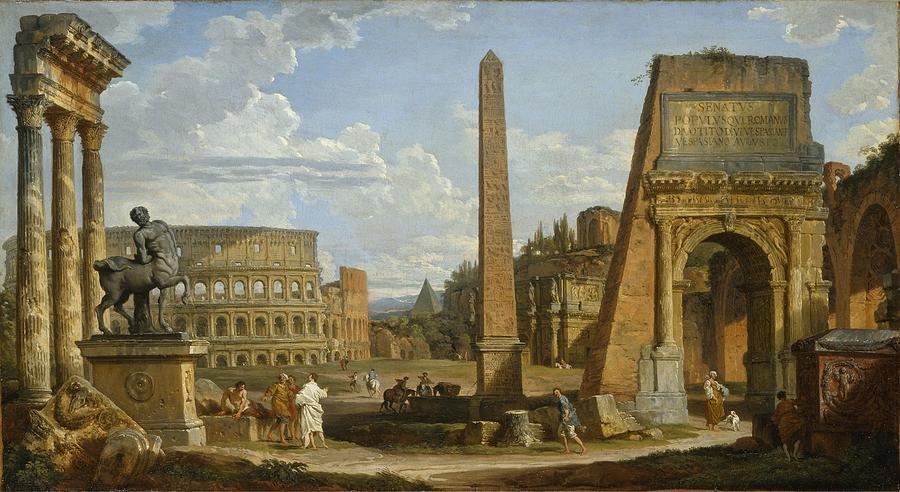
Roman Ruins by Giovanni Paolo Panini
Edward Gibbon was famously inspired to embark on his history of the Roman empire when “musing amidst the ruins of the Capitol while the barefooted friars were singing vespers in the Temple of Jupiter”. But no ruins were visible in 1764: instead, the Capitol was capped by a tidy piazza designed by Michelangelo. Nor had the friars’ church ever been a Temple of Jupiter. As Ferdinand Addis concludes in his own panoramic history, we all see the Rome we want to see.
How to condense 3,000 years of the city’s history into 648 pages? Addis is not lacking in chutzpah. He first arrived in Rome as a teenager in “too-big jeans” and remembers picnicking in traffic fumes by the Baths of Caracalla. He presents himself as just another tourist and his project as a labour of love and curiosity rather than scholarly expertise, let alone original research. But this is an energetic attempt to bring Rome’s history alive through grand narrative; the florid flights and snappy paragraphs are underpinned by serious reading. In his final pages, he muses on just how many cities it contains: “A city of God? A city of sin? A city of power? A city of decay?” As a medieval ditty put it: “Rome contains everyone and everyone’s business.”
Addis’s chosen formula is to serve up selected highlights, mostly the expected ones – Romulus and Remus, the Ides of March, the Borgias, the Sistine Chapel, Garibaldi and La Dolce Vita are all here – but to come at them from quirky angles. The Carthaginian wars with Hannibal are cleverly introduced via the jokes of Plautus’s comedy The Little Carthaginian, and the Augustan age is seen through the subversive eyes of Ovid the love poet, as he prowls in the new marble porticoes. Every chapter starts with an atmospheric mise en scène, as if leading up to the book’s finale – the golden age of 20th-century Roman cinema. The hammed-up tone works to draw the reader in, even if an introduction such as this can’t do much to lighten the complexity of the radical Gracchis’ land reforms: “Up on the Capitoline Hill, the plebeian assembly has gathered. Brown-clad figures press between the vast old pillars of Jupiter Optimus Maximus.” The dark ages appear to have been not only darker but also colder than before (the word “chill” features in two consecutive chapter-openings that introduce less well-documented eras).
As he moves through the centuries, Addis casts a keen eye over not just the big figures of history but also its crowds, mess and detritus. His focus is as much on the sordid underbelly of urban life as it is on Rome the sublime caput mundi. We are swept on by a flood of watery and intestinal metaphors: “The currents of history flowed towards that grim spring day like water to a plug hole”; “So the story of Eternal Rome’s fall was set in perpetual motion, to ripple down the stream of history in wave and counterwave.” In the 18th century, there was such interest in the great sewer, the Cloaca Maxima, that Grand Tourists went “trooping by the dozen to see the hole, like so many tiny proctologists peering solemnly into the gaping dark”.
Addis doesn’t shy away from baroque descriptions of death and decay. Pope Formosus’s body, thrown into the river, is “a disintegrating lump of Tiber gristle”; an enemy of the Gracchi is “porcupined” by metal styluses, Saint Sebastian “pincushioned with arrows”. Sometimes the transitions are clunky: “Dark clouds seemed to hunch over the Palatine”; “The city was extremely volatile in those years”; “The road would not be altogether easy. These were troubled times.” The art appreciation isn’t always subtle:Piranesi’s “shadows were always darker”, while Bernini’s Saint Teresa is summed up as “the face of ecstasy”.

Addis’s remarks on La Dolce Vita might be taken as an unkind caricature of his own book: “its endless cameos, its episodic structure, its capering progress of characters with nowhere to go”. But that would be unfair. An end-to end reading throws up many instructive continuities: sexually rapacious women who stripped off in public – from the ladies of the Borgia court to the aspiring starlet whose nudity at a high society party scandalised 1950s Rome; bodies hurled into the Tiber; syphilis; the red shoes worn by pontifical figures from Julius Caesar to latter-day popes; and visitors of all eras who have despaired of ever being able to get a handle on the city. Byron spoke of “mines of inexhaustible contemplation”. Goethe muttered enigmatically: “The more I see of this city, the more I feel myself getting into deep waters.”
Thanks to his enthusiasm, Addis succeeds in keeping his reader afloat. He relishes the highs and lows of Rome’s past in his purplest passages while pricking the bubbles of other people’s poetic licence. He appreciates that the multilayered, “palimpsestic” quality of Rome is both a cliche and a profound truth. He encourages an approach to the city’s myths that is properly sceptical but still open-mouthed. The famous Trevi fountain scene in La Dolce Vita loses none of its magic when we learn what lay beneath the icy surface: Anita Ekberg strode straight in with Nordic sang-froid, but Marcello Mastroianni was allowed to wear fisherman’s waders.
•Rome: Eternal City is published by Head of Zeus. To order a copy for £25.80 (RRP £30) go to guardianbookshop.com or call 0330 333 6846. Free UK p&p over £10, online orders only. Phone orders min p&p of £1.99.
Wednesday, February 25, 2015
How ISIS Plans to Sack Rome
Posted By Bridget Johnson On February 24, 2015 @ 6:56 pm In Homeland Security,Politics,Syria | 7 Comments

An ISIS e-book on how to accomplish their caliphate goal of sacking Rome stresses enlisting “the Islamic State’s secret weapon = secret white converts” to take on Italy.
Much of the book, “Black Flags from Rome,” is dedicated to laying out a case for why Muslims in Europe should rise up and assist ISIS from within, citing justifications for discontent from modern-day anti-immigration protests back to post-Ottoman creation of Muslim “ghettos.”
The Rome title is one of a series disseminated online that includes Khorasan, Syria, Arabia and Persia, with a forthcoming “Black Flags from Palestine” title promised.
It uses graphics from Pew Research Center’s Forum on Religion & Public Life to show Muslim distribution throughout Europe. “Starting in the early 90s, a new era would begin for Islam in Europe,” the book states. “A new quality 3rd generation of Muslims would be born who had given up the victim subservient slave mentality the previous generations had. This generation would be emboldened and more confident in their newly (re)discovered beliefs. They would see the world from a new perspective, and unlike the previous generations who only dedicated on earning money for supporting the family ‘back home’, this new generation would see the world through the eyes of a global Ummah (Muslim nation) which transcended all national boundaries.”
It offers the Irish Republican Army attacks of the ’80 and ’90s as an example of a “ruthless” guerrilla campaign in Europe, and the GIA (Group Islamique Army) in France as emblematic of the 1990s “Islamic jihad revival in Europe.” The GIA, notes the text, also trailblazed in Europe with its magazine propaganda and solicitation of donations to smuggle weapons to jihadists in Algeria.
“No doubt, if a war in Europe is to spark in the future, this whole process will be reversed and weapons will be smuggled in a similar way from the Islamic Maghrib into the heart of Europe.”
The book talks about efforts to spread Sharia law in Europe countered by “right-wing groups” and media outlets that “would spread news that Muslim males were making ‘grooming gangs’ which abuse ‘white girls’, which would make even more people join the right-wing groups.” It includes screenshots of tweets including one from Rupert Murdoch about Muslims needing to destroy “jihadist cancer” in their midst.
The Islamic State, it says, “re-awoke” in the midst of Syrian turmoil and “the exit of American troops from Iraq in 2010.”
“The Western powers would not get involved in physical ground combat because they had just withdrawn from a failed war in Iraq (their public wouldn’t be happy with it.) This opportunity gave the Islamic State to grow stronger, with more fighters and more territory and resources as the world watched on. Those who had left Europe to join the Islamic State would now be able to help other Europeans’ get into Syria… Here they could learn basic armed/shooting combat, assassination techniques, how to make explosives from homemade materials etc.”
The book doesn’t include a publish date, but it discusses the “shocking secret” revealed by the Kouachi brothers’ January attacks in France and subsequent busting up of a terror cell in Belgium: “There were small armies of the Islamic State within every country of Europe by late 2014, and the intelligence agencies didn’t even know about it!”
It states that European Muslims can ally with “a growing population of left-winged activists (people who are against; human/animal abuses, Zionism, and Austerity measures etc)” who “look up to the Muslims as a force who are strong enough to fight against the injustices of the world” in countering a growing divide between Muslims and “right-wing neo-Nazis.” It specifically cites people who are “sometimes” allied with Anonymous or anarchy groups — even though, angered by the assault on Charlie Hebdo, Anonymous is currently carrying out a hacking operation [1] to take down ISIS accounts.
 [2]“If you have ever been at a pro-Palestine / anti-Israel protest, you will see many activists who are not even Muslims who are supportive of what Muslims are calling for (the fall of Zionism).
It is most likely here that connections between Muslims and Left-wing activists will be made, and a portion from them will realise that protests are not effective, and that armed combat is the alternative,” the book states. “So they will start to work together in small cells of groups to fight and sabotage against the ‘financial elite’.”
The book predicts such “recruits” sympathetic to their cause “will give intelligence, share weapons and do undercover work for the Muslims to pave the way for the conquest of Rome.”
They’re also counting on ethnic minority soldiers defecting from European armies and passing their skills on to others as they raid weapons caches, while “lone wolves from within the community will rise” including “especially ex-gang members who also have access to weapons.”
The book gives tips on constructing a sturdy Molotov cocktail, using “turf wars” to begin seizing land at the neighborhood level, and consolidating land and armed groups “to finally have a big national armed force of Muslim fighters.”
“Muslim fighters from all European countries will continue the fight, breaking borders until they can reach Northern Rome.”
However, ISIS is also counting on another entity to break down European borders: “Europe’s main enemy” Russia.
“As Russia creeps more and more into Europe, it will project more power and weaken European nation states… militias will form because the government cannot protect all of its own territory.” Then, according to prophecy, states the book, Western Europe will “make a peace covenant with the Islamic State” as Russia “creeps closer” and remains a “threat” to Sunni Muslims as well as Europe.
“Russia has always been defeated when Muslims and Western Romans have allied together. Defeating Russia will allow Sunnis to defeat and take over Persia permanently, and that is when they will turn their eyes towards Rome.”
The book, though, predicts the mob bosses will put up tough resistance: “There is no doubt that if Muslims want to take over Italy, the Islamic State European fighters will have to ally with other militias to fight the Mafia before the conquest of Rome.” It recommends starting the fight in Bologna to choke off supply routes to the south.
It talks about seizing weapons stockpiles after defeating “puppet rulers in Muslim lands,” with an eye on Saudi and Iranian stockpiles, to disseminate to jihadis everywhere. “If AQIM in Tunisia fired missiles at Rome from its coast during the Roman [Armageddon] invasion of Syria, they could reach towards Italy (possibly even Rome) which is almost 160Km away from Tunisia.” Others, they argue, can invade Italy by boat. The country would then be “conquered by armed Muslims from all sides: 1 – European Armed Muslim Gangs from the North and West, 2 – Islamic Eastern European fighters from the Balkans (like Bosnia, Albania, Kosovo etc), and 3 – and Muslim Arab missiles and ships from the South.”
How will they craft their battle plans, including pinpointing targets and sharing missile strike coordinates? Google, the book says. “All the Islamic groups use Google Earth today to plan their attacks…. Usually only powerful countries had power to satellite technology, now everyone can use it for free.”
The strategy expects the defeat of a Russia-Iran alliance, the Roman attack on the Islamic State, and the conquest of Rome by 2020.
After adding that the antichrist is expected to show up seven months after the conquest of Rome, according to what Muhammad reportedly said, the ISIS book recommends an urban survival guide for further reading: theSAS Survival Handbook by John “Lofty” Wiseman.
 [3]
MORE: Inside an ISIS Handbook for Foreigners Running to the Islamic State [4]
[3]
MORE: Inside an ISIS Handbook for Foreigners Running to the Islamic State [4]
Much of the book, “Black Flags from Rome,” is dedicated to laying out a case for why Muslims in Europe should rise up and assist ISIS from within, citing justifications for discontent from modern-day anti-immigration protests back to post-Ottoman creation of Muslim “ghettos.”
The Rome title is one of a series disseminated online that includes Khorasan, Syria, Arabia and Persia, with a forthcoming “Black Flags from Palestine” title promised.
It uses graphics from Pew Research Center’s Forum on Religion & Public Life to show Muslim distribution throughout Europe. “Starting in the early 90s, a new era would begin for Islam in Europe,” the book states. “A new quality 3rd generation of Muslims would be born who had given up the victim subservient slave mentality the previous generations had. This generation would be emboldened and more confident in their newly (re)discovered beliefs. They would see the world from a new perspective, and unlike the previous generations who only dedicated on earning money for supporting the family ‘back home’, this new generation would see the world through the eyes of a global Ummah (Muslim nation) which transcended all national boundaries.”
It offers the Irish Republican Army attacks of the ’80 and ’90s as an example of a “ruthless” guerrilla campaign in Europe, and the GIA (Group Islamique Army) in France as emblematic of the 1990s “Islamic jihad revival in Europe.” The GIA, notes the text, also trailblazed in Europe with its magazine propaganda and solicitation of donations to smuggle weapons to jihadists in Algeria.
“No doubt, if a war in Europe is to spark in the future, this whole process will be reversed and weapons will be smuggled in a similar way from the Islamic Maghrib into the heart of Europe.”
The book talks about efforts to spread Sharia law in Europe countered by “right-wing groups” and media outlets that “would spread news that Muslim males were making ‘grooming gangs’ which abuse ‘white girls’, which would make even more people join the right-wing groups.” It includes screenshots of tweets including one from Rupert Murdoch about Muslims needing to destroy “jihadist cancer” in their midst.
The Islamic State, it says, “re-awoke” in the midst of Syrian turmoil and “the exit of American troops from Iraq in 2010.”
“The Western powers would not get involved in physical ground combat because they had just withdrawn from a failed war in Iraq (their public wouldn’t be happy with it.) This opportunity gave the Islamic State to grow stronger, with more fighters and more territory and resources as the world watched on. Those who had left Europe to join the Islamic State would now be able to help other Europeans’ get into Syria… Here they could learn basic armed/shooting combat, assassination techniques, how to make explosives from homemade materials etc.”
The book doesn’t include a publish date, but it discusses the “shocking secret” revealed by the Kouachi brothers’ January attacks in France and subsequent busting up of a terror cell in Belgium: “There were small armies of the Islamic State within every country of Europe by late 2014, and the intelligence agencies didn’t even know about it!”
It states that European Muslims can ally with “a growing population of left-winged activists (people who are against; human/animal abuses, Zionism, and Austerity measures etc)” who “look up to the Muslims as a force who are strong enough to fight against the injustices of the world” in countering a growing divide between Muslims and “right-wing neo-Nazis.” It specifically cites people who are “sometimes” allied with Anonymous or anarchy groups — even though, angered by the assault on Charlie Hebdo, Anonymous is currently carrying out a hacking operation [1] to take down ISIS accounts.
[2]“If you have ever been at a pro-Palestine / anti-Israel protest, you will see many activists who are not even Muslims who are supportive of what Muslims are calling for (the fall of Zionism).It is most likely here that connections between Muslims and Left-wing activists will be made, and a portion from them will realise that protests are not effective, and that armed combat is the alternative,” the book states. “So they will start to work together in small cells of groups to fight and sabotage against the ‘financial elite’.”
The book predicts such “recruits” sympathetic to their cause “will give intelligence, share weapons and do undercover work for the Muslims to pave the way for the conquest of Rome.”
They’re also counting on ethnic minority soldiers defecting from European armies and passing their skills on to others as they raid weapons caches, while “lone wolves from within the community will rise” including “especially ex-gang members who also have access to weapons.”
The book gives tips on constructing a sturdy Molotov cocktail, using “turf wars” to begin seizing land at the neighborhood level, and consolidating land and armed groups “to finally have a big national armed force of Muslim fighters.”
“Muslim fighters from all European countries will continue the fight, breaking borders until they can reach Northern Rome.”
However, ISIS is also counting on another entity to break down European borders: “Europe’s main enemy” Russia.
“As Russia creeps more and more into Europe, it will project more power and weaken European nation states… militias will form because the government cannot protect all of its own territory.” Then, according to prophecy, states the book, Western Europe will “make a peace covenant with the Islamic State” as Russia “creeps closer” and remains a “threat” to Sunni Muslims as well as Europe.
“Russia has always been defeated when Muslims and Western Romans have allied together. Defeating Russia will allow Sunnis to defeat and take over Persia permanently, and that is when they will turn their eyes towards Rome.”
The book, though, predicts the mob bosses will put up tough resistance: “There is no doubt that if Muslims want to take over Italy, the Islamic State European fighters will have to ally with other militias to fight the Mafia before the conquest of Rome.” It recommends starting the fight in Bologna to choke off supply routes to the south.
It talks about seizing weapons stockpiles after defeating “puppet rulers in Muslim lands,” with an eye on Saudi and Iranian stockpiles, to disseminate to jihadis everywhere. “If AQIM in Tunisia fired missiles at Rome from its coast during the Roman [Armageddon] invasion of Syria, they could reach towards Italy (possibly even Rome) which is almost 160Km away from Tunisia.” Others, they argue, can invade Italy by boat. The country would then be “conquered by armed Muslims from all sides: 1 – European Armed Muslim Gangs from the North and West, 2 – Islamic Eastern European fighters from the Balkans (like Bosnia, Albania, Kosovo etc), and 3 – and Muslim Arab missiles and ships from the South.”
How will they craft their battle plans, including pinpointing targets and sharing missile strike coordinates? Google, the book says. “All the Islamic groups use Google Earth today to plan their attacks…. Usually only powerful countries had power to satellite technology, now everyone can use it for free.”
The strategy expects the defeat of a Russia-Iran alliance, the Roman attack on the Islamic State, and the conquest of Rome by 2020.
After adding that the antichrist is expected to show up seven months after the conquest of Rome, according to what Muhammad reportedly said, the ISIS book recommends an urban survival guide for further reading: theSAS Survival Handbook by John “Lofty” Wiseman.
[3]
Article printed from PJ Media: http://pjmedia.com
URL to article: http://pjmedia.com/blog/how-isis-plans-to-sack-rome/
URLs in this post:
[1] hacking operation: http://pjmedia.com/tatler/2015/02/09/no-safe-place-for-you-online-anonymous-taking-down-isis-social-media-accounts/
[4] Inside an ISIS Handbook for Foreigners Running to the Islamic State: http://pjmedia.com/tatler/2015/02/23/inside-an-isis-handbook-for-foreigners-running-to-the-islamic-state/
Sunday, March 30, 2014
The Path in Rome
Seeing the eternal in the city.

Before Pope Francis met President Obama on Thursday at the Vatican, his @pontifex Twitter account issued a call to conversion. To miss the possibilities for conversion in Rome is to miss all which makes it the “Eternal” City.
A few years ago, before my first trip to Rome, one of the wisest and yet most practical people I know said that, for a Catholic, turning down the Via della Conciliazione — the road to St. Peter’s Basilica and the tomb of the first pope — would be like “coming home.” And so it is.
But there is no homecoming without a meal — without substance. And George Weigel’s new book Roman Pilgrimage, done in collaboration with Elizabeth Lev and his son Stephen, provides nourishment for both the inquirer and the believer, from a city whose bread and butter is Catholicism. Stephen Weigel is responsible for the photos in the book, and Elizabeth Lev provides art-history expertise. Rome, without the right tour guide, can be a dizzying succession of one church after another, all blending into a confusing uniformity. With the right guide, however, it can be a truly illuminative way.
Some of us who have tried it both ways say you have not been through the Sistine Chapel and the Vatican museums, among other Roman destinations, unless you’ve been there with Lev as your guide. Roman Pilgrimage is true to its title: A walk through the “station churches” — destinations of Lenten devotion in Rome — it’s a pilgrimage in a book. It covers art, history, and spirituality and is replete with both fact and apostolic zeal. Although long planned, and begun before Pope Francis was elected a year ago, it’s very much in line with the program of the new pope: inviting Christians to be Christian, and opening a door of welcome to all. No mere tourist map, it is an invitation to lived Christianity, with some of the saints and martyrs whom one meets in the stones and on the walls throughout Rome.
The book opens by quoting Pope John Paul II on the exercise of pilgrimage: “To go in a spirit of prayer from one place to another . . . helps us not only live our lives as a journey, but also gives us a vivid sense of a God who has gone before us and leads us on, who himself set out on man’s path, a God who does not look down on us from on high, but who has become our traveling companion.”
Roman Pilgrimage makes not just Roman churches but the Catholic faith itself come alive through an encounter with Biblical religion, what Pope Benedict XVI described as “the adventure of God.” It’s an adventure, Weigel writes, that “consists in the fact that ‘God did not remain within himself: He came out from himself.’” On pilgrimage, there is a purification, as the pilgrims are drawn into God, for the purpose of renewal — to be missionaries who live to witness to the Gospel and offer men and women “friendship with Jesus.”
The Roman Pilgrimage walk, in its most literal sense, is centered on a pilgrim tradition dating back to the fourth century and revived in recent years by seminarians based in Rome. “The Roman Christian practice of visiting the tombs of the martyrs,” Weigel writes, “praying and celebrating the Eucharist at these sites, is the foundation on which the Roman station-church pilgrimage of Lent arose.” For each day of Lent, and shortly thereafter, Weigel takes the reader into a church of Rome — from St. Sabina on Ash Wednesday to St. Mary Major on Easter Sunday and to the Basilica of St. Pancras at the top of the Janiculum on Divine Mercy Sunday a week later — and describes (and illustrates) its treasures, its history, and its lessons.
Roman Pilgrimage is, as Weigel puts it, a “rediscovery of the baptismal character of Lent.” This rediscovery is of ecumenical benefit. Lent has often been trivialized as a no-chocolate-or-booze season for Catholics; this book is an invitation to go deeper. Prayer, fasting, and charity — the disciplines of Lent — exist to help the penitent live a more integrated life in the “fabric of the life of grace.” “Lent, which had an intensely baptismal character centuries ago,” Weigel observes, “became almost exclusively penitential: a matter of what Catholics must not do, rather than a season focused on the heart of the Christian vocation and mission — conversion to Jesus Christ and the deepening of our friendship with him.”
He continues:
This revival of Lent in the Catholic Church has involved the rediscovery of the Forty Days as a season shaped by the catechumenate: the period of education and formation through which adults who have not yet been baptized are prepared to receive Baptism, Confirmation, and the Holy Eucharist, the three sacraments of Christian initiation, at the Easter Vigil. The baptismal character of Lent is not for catechumens only, however. The adult catechumenate . . . offers an annual reminder to the Church that all Christians are always in need of conversion. The Church’s conversion, the Church’s being-made-holy, is a never-ending process.
In recent decades, Catholics in America have internalized a certain secularization, a cultural belief that religion is something to compartmentalize, to privatize, to keep to a Sabbath day (and only an hour at that). Self-professed Catholics have run for office with language about being “personally opposed” on matters of human dignity. Roman Pilgrimage is an accessible coffee-table textbook for a revival of real faith.
“To make the pilgrimage of Lent is to follow an itinerary of conversion,” Weigel writes. “Lent affords every baptized Christian the opportunity to reenter the catechumenate, to undergo a ‘second baptism,’ and thus to meet once again the mysteries of God’s mercy and love.” This call to conversion takes on some added timeliness, not only because we’re all getting older and we never know our final day or hour, but also because it is the central message of the pope who has graced the covers of Time, The Advocate, and Rolling Stone: mercy, reconciliation, and healing.
While the Roman station-churches pilgrimage does have an unmistakable Lenten rigor to it, Weigel emphasizes that the book does not have to be put away come the Easter season. “The station-church pilgrimage can be, and in fact is,” Weigel writes, “walked on many levels, not unlike the city in which it takes place.” Along “the pathways of the station-church pilgrimage (and at whatever time of year it is walked), the 21st-century pilgrim or visitor passes through multiple layers of the history of Western civilization and has the opportunity to ponder the rise and fall of empires — as well as the continuities of culture that endure despite radical changes of political and economic fortune.” He adds that “this layer of the station-church pilgrimage is open to everyone, whatever an individual’s religious ‘location’ or lack thereof. It can be a deeply moving reminder of the fragility of civilization as well as of the richness of regenerative powers embedded in the West.”
There’s a groundedness to this walk, in a time of uncertainty. And it’s made all the more exciting by the fact that it is a tradition made popular since the mid 1970s by young men — mostly seminarians and student priests from the North American College in Rome — who wake up before dawn, to prayerfully participate in and to celebrate Mass throughout the city.
Roman Pilgrimage does make for a nourishing feast for the coffee table, but the younger Weigel’s photographs really jump off the screen of the e-book. However a reader accesses Roman Pilgrimage, it’s a journey of “sanctity and profound Christian conviction.” In a time that seems to have a tolerance only for nebulous spirituality and superficial religion, it provides a way of proposal and rediscovery, where at every turn is a meeting with one — a saint, a martyr, the Savior — who walked this walk before and guides anyone willing through the next step.
— Kathryn Jean Lopez is editor-at-large of National Review Online and founding director of Catholic Voices USA. This article was adapted from the April 7 issue of National Review.
Monday, July 01, 2013
Scandal and skulduggery at the Vatican
Can Pope Francis call a halt to the corruption gnawing at the heart of the Catholic Church?
By David Willey
29, June 2013

Payback: until now the Vatican has been able to hide behind a cloak of diplomatic immunity Photo: Alamy
"It’s like the end of the Berlin Wall,” said a high-ranking Vatican official last week after an invisible financial barrier marking the legal separation between the Vatican and Italy was breached for the first time.
According to officials at the Bank of Italy, the Institute for Works of Religion – the Vatican’s own offshore bank – has for years been allowing organised criminals, even terrorists, to launder money with impunity.
On Friday, Italian tax police arrested a high-ranking Italian prelate, Monsignor Nunzio Scarano, who until last month was working as a senior accountant inside the Vatican’s financial administration. They also arrested a financial intermediary and an agent from Italy’s secret services on charges of conspiring with Mgr Scarano to commit crimes of embezzlement and money laundering.
Mgr Scarano is alleged to have masterminded a plot that sounds like an airport novel. He attempted to bring €20million in cash belonging to a wealthy family of shipowners from a Swiss bank to Rome in a private plane, thereby evading customs and tax controls.
Italian prosecutors have had their eye on the Vatican bank for several years but, until now, have had great difficulty in obtaining any information from the Holy See, which has pleaded diplomatic immunity and exemption from normal international banking rules on the grounds that the Institute for Works of Religion “is not a bank in the normal sense of the word”.
After the arrest of Mgr Scarano, however, the Vatican spokesman, Father Federico Lombardi, promised “full collaboration” with Italian justice authorities.
This in itself marks a 180-degree turn from the past. Under previous popes, the Vatican has taken refuge behind the Lateran Pacts signed with Italy in 1929 that provide for the complete independence of the Vatican City State and of the institutions of the Holy See under international law. Collaboration with the Bank of Italy and with Italian justice has hitherto been considered as an attack upon the independence and sovereignty of the Vatican.
The American prelate Mgr Paul Marcinkus was in charge of the Vatican bank in the Eighties during the time of its association with dodgy Italian financiers such as Roberto Calvi, the chairman of Banco Ambrosiano, who was found hanging from Blackfriars Bridge in London in 1982. It is believed that he was a victim of a Mafia hit man taking revenge for funds lost through the bank’s collapse. The Vatican was the bank’s main shareholder, and Calvi was dubbed “God’s banker” due to his close ties with the Holy See.
Mgr Marcinkus evaded the serving of court documents by Italian justice authorities by taking refuge inside Vatican City and claiming diplomatic immunity.
Mgr Scarano, who comes from Salerno, south of Naples, had a late vocation to the priesthood. He was employed by a big Italian commercial bank before taking Holy Orders, and was nicknamed “Monsignor 500” inside the Vatican thanks to his habit of flashing his wallet to show colleagues that he only carried €500 banknotes.
Even before Mgr Scarano’s arrest, Pope Francis revealed that he was determined to clean up the Vatican bank and its highly secretive operations, which in recent decades had been engulfed in scandal. Only two days prior to the Monsignor being hand-cuffed and taken away, the Pope announced the creation of an internal commission of inquiry into the running of the bank, set up in 1943 to hold the funds of cardinals, bishops, priests, Catholic charities and religious orders from around the world.
The five-member commission includes a Harvard law professor and only one Italian – Cardinal Renato Farina, the former head of the Vatican Library and Secret Archive. Pope Francis has given the commission powers to question anyone working inside the Vatican and ordered it to report back to him personally and “promptly”.
The new Pope has already revealed himself as a person who can make quick decisions if necessary and is not easily impressed by the pomp and circumstance of time-honoured Vatican ceremonial and protocol. He finds the court-like Vatican administration suffocating and failed to turn up to a symphony concert organised in his honour earlier in the month because he had more urgent business. “I’m not a Renaissance prince,” he is reported to have said, somewhat snottily.
In 2010, former Pope Benedict set up a Financial Information Authority to monitor all the Vatican’s international transactions and to ensure that international rules relating to money laundering and the financing of terrorism were being respected.
But inspectors from Moneyval, a Council of Europe banking watchdog authority based in France, went through the bank’s books last year and reported that it sometimes failed to ensure “due diligence” in monitoring suspect transactions. There is still some way to go before the Vatican bank can be granted full “white list” status, the Moneyval report said.
Another serious problem facing Pope Francis as he prepares major reforms in the running of the Roman Curia, the headquarters of the Catholic Church, is what he referred to during a recent private meeting with clerics from Latin America as the Vatican’s “gay lobby”. “It’s true, it’s there,” he is reported to have said. “We need to see what we can do.”
He has his work cut out. Last week, Patrizio Poggio, a former Catholic priest, claimed that he had evidence of misconduct by a group of Roman priests with young Romanian male prostitutes, informing the police that he had “grave information harming the integrity of the Church” and giving them a list of alleged clients – all Roman clerics.
Poggio claimed that they had used the services of the prostitutes, who frequented a club near Rome’s main railway terminal. He alleges that a former policeman took the male escorts in a van marked “Medical emergency – blood transport” to an abandoned chapel in the suburbs, where they met with some of the clerics.
The priest, who served five years in jail for sexual crimes committed 15 years ago, was arrested on Friday on charges of criminal defamation.
But the presence within the Vatican hierarchy of gay prelates is an open secret in Rome. From time to time, stories emerge in the local media alleging affairs between monsignori and young men, and it is perhaps worth pointing out that in other reported remarks to the same group of clerics at the Vatican, Pope Francis is quoted as saying: “In the Curia, there are also holy people, really, there are holy people. But there is also a stream of corruption, there is that as well, it is true.”
The fact that Pope Francis has chosen to start his new-broom act as leader of the universal Church with a shake-up at the Vatican bank is significant. During discussions among cardinal electors that preceded the conclave at which he was chosen to succeed Pope Benedict, time and time again the cloud of scandal that has been swirling around the Vatican bank came up.
Pope Francis plans no long summer break, as has always been customary for popes and their senior Vatican functionaries. Except for a week-long journey to Rio to attend a Catholic World Youth Festival at the end of July, and brief day trips to Sardinia and to the shrine of his namesake, Saint Francis, at Assisi later in the year, he intends to be at his desk during most of the summer holidays.
The most important choice that Pope Francis now has to make is that of his number two, the Cardinal Secretary of State. The present incumbent, Cardinal Tarcisio Bertone, selected by former Pope Benedict, is unlikely to continue in his post. Cardinal Bertone has been an unpopular Secretary of State because of his lack of experience in papal diplomacy.
Earlier this month, Pope Francis called to Rome all the papal diplomats representing the Holy See in countries around the world. It is from their ranks that he is expected to choose his new Secretary of State.
The new, simpler, more frugal Vatican of Pope Francis will shortly begin to take shape – and he doubtless hopes that soon the whiff of financial and sexual scandal that has besmirched the Vatican in recent years will begin to blow away.
David Willey OBE is the BBC’s Vatican correspondent
Thursday, November 24, 2011
Book review: 'Rome' by Robert Hughes
The art critic brings his usual attention to detail to a personal history of the Eternal City, told largely through its art.
By Suzanne Muchnic, Special to the Los Angeles Times
http://www.latimes.com/features/books/
November 6, 2011
 Robert Hughes wastes no time luring readers into his love affair with Rome. After tracking the infatuation to his youth in Australia, he's off and running in the Eternal City. At his favorite piazza, the Campo Dei Fiori, he expounds upon its bronze statue of Giordano Bruno, a Renaissance hero burned alive as a heretic, then quickly moves on to glorify fountains, analyze an equestrian sculpture of emperor Marcus Aurelius and offer tips on cooking fried salt cod and Jewish-style artichokes.
Recalling the intellectual and aesthetic force of the city as he first encountered it, Hughes presents Rome as a guide to the past and the future. For the impressionable young writer who paid his first visit in 1959, it was the perfect place to learn how to look backward as well as forward. He saw a continuum of beauty and ugliness, triumph and tragedy as never before. More important, he writes, the experience "gave physical form to the idea of art." Rome made art and history real.
And that's just the prologue.
Overwhelming as the first 14 pages may be, they will not surprise followers of Hughes' work. Chief art critic of Time from 1970 to 2001, he also has written a dozen books — on modern art, the history of Australia, the city of Barcelona and artists Lucian Freud, Frank Auerbach and Francisco Goya. Like the Rome of his description, Hughes is driven by appetites and passions. His big books are feasts of information, opinion and fascinating detail — too much to digest but nourishing even in small bites.
"Rome" is one of those. It's a sweeping, personal history that races from the city's beginnings to its current state as a woefully crowded tourist attraction. Fortunately, the author pauses for Hughes-style reflection. No ordinary tour guide, he makes the story compelling by focusing on art. With typical bravado, wit and rage, he puts art and architecture in sharp social, political, religious and historical context.
Early on, he introduces the first Roman emperor not as a man but as "Augustus of Prima Porta," a marble sculpture, circa AD 15, that exemplifies artistic propaganda. The work may not be a masterpiece, but it conveys an important message. Portrayed as a military hero who projects "calm, self-sufficient power," in Hughes' words, and accompanied by a tiny figure of the love god Eros, Augustus was meant to be seen as a living god descended from Venus.
Like many other classical Roman portraits, the statue may be the work of a Greek artist and possibly produced in a factory-like system nearly 2,000 years before Andy Warhol churned out images of celebrities and heads of state. Delighting in such then-and-now correspondences, Hughes likens ancient Rome's inflated prices of fine art to today's "hysterical, grotesque pricing of Pablo Picasso, Andy Warhol, and Jasper Johns." Rome's loss of the papacy to Avignon, in the 14th century, was something like "what might happen to modern Los Angeles if the whole entertainment industry, the production and promotion of movies, TV, pop music, were suddenly wiped out."
As centuries fly by, Hughes singles out Roman cultural landmarks, including Raphael's work in the Vatican, for praise and critical analysis. The author sees Santa Maria Maggiore, an early pilgrimage church, as an emblem of the papacy's triumph over the aging Roman Empire. The ceiling of the Sistine Chapel, painted by Michelangelo, contains "the most powerful ... series of images of the human figure in the whole history of European art." Baroque sculptor Gian Lorenzo Bernini was an artistic embodiment of the Counter-Reformation, "the marble megaphone of papal orthodoxy in the seventeenth century."
Rome was a magnet for wealthy English travelers in the 18th century and for foreign artists in the 19th century. But in Hughes' view, Giorgio de Chirico was among the last influential painters to emerge in 20th century Italy. "It is depressing, but hardly unfair, to admit that, by the beginning of the 1960s, Rome, the city that had produced and fostered so many geniuses in the visual arts across the centuries, had none left — not, certainly, in the domains of painting, sculpture, or architecture," he writes. A few pages later he adds that filmmaker Federico Fellini (1920-93) "may well have been the last completely articulate genius Italy produced in the domain of the visual arts."
Hughes' laments about Rome's artistic demise and "the huge and ruthless takeover of mass tourism and mass media" ring sadly true. But as he mourns the waning of a love affair, he can't dismiss the city's connection to the past or its enduring attraction. "The Rome we have today," he writes, "is an enormous concretion of human glory and human error."
Rome
A Cultural, Visual, and Personal History
By Robert Hughes
Alfred A. Knopf: 512 pp., $35
A former Times staff writer, Muchnic is the author of "Odd Man In: Norton Simon and the Pursuit of Culture."
Copyright © 2011, Los Angeles Times
Rome by Robert Hughes – review
The Guardian

Does modern art matter? In 1980, in The Shock of the New – a BBC television series-turned-book – Robert Hughes convinced millions of sceptics that it did. Shock was a powerful antidote to the Kenneth Clark style of TV art history. Hughes was a straight-talking Australian; there was no posh, languid reverence in his presentation. His message was that you didn't have to like 20th-century art (in fact he happily pointed the finger at some that was pretentious, overvalued and bad); but you did need to see how art contributed to the great debates of the period, from technology to the politics of social change.
It must have been a hard act to follow. Since 1980 Hughes has continued to work as a critic; he has written, among other things, a bestselling account of British transportation of convicts to Australia (The Fatal Shore) and a volume of memoirs; and he has weathered accusations of plagiarism, a near-fatal car-crash and years of litigation that followed. Now in his 70s, he has brought out Rome, a cultural history of the city he first visited in 1959; it is a narrative that stretches from Romulus and Remus to Berlusconi.
Reader, be warned. Skip the first 200 pages and start this book at chapter six, "The Renaissance". By the time Hughes reaches this point, he is well in command of his material and is on characteristically cracking form. He offers some delicious pen portraits of the artists and architects who designed and made what are now the tourist high-spots of the city: the Sistine chapel, the Piazza Navona, St Peter's basilica, the Campidoglio. Particularly vivid is his discussion of Bernini, "the marble megaphone of papal orthodoxy" – who was loathed by most visitors in the 19th century ("intolerable abortions" was Charles Dickens's description of Bernini's monuments), but increasingly admired in the 20th. And he nicely captures the spirit of the 18th-century grand tour. The desire of the young milords to discover the grandeur of ancient culture was only one side of the story. Sex tourism was the other. Rome was, as Hughes observes, the Thailand of the period, and he includes plenty of revealing stories about the brash bigwigs who turned up in the city: Lord Baltimore, with his harem of eight women, or Colonel William Gordon, who (if Batoni's famous portrait is anything to go by) pranced around the Mediterranean in a kilt and swaths of his family tartan. What on earth did the locals make of these people?
In his epilogue, Hughes, the modern cultural critic, elegantly savages the mass tourism and commercial culture of Berlusconi's Italy. A visit to the overcrowded Sistine chapel has become, he insists, close to unbearable, "a kind of living death for high culture" – which can only get worse "when post-communist prosperity has taken hold in China", and the Chinese flood in by the million. The same, he might have added, is also true of St Peter's basilica itself. It may be large enough inside to hold huge numbers of visitors in relative comfort, but they now have to go through a metal detector to get into the place. When I tried to visit one afternoon last December only two of these machines were working, and people in the queue winding around the piazza would have been waiting for more than an hour.
So what is the answer if you really do want to see the Sistine chapel in some peace and quiet? It is "to pay what is in effect a hefty ransom to the Vatican". For you can now book a two-hour visit to the museum plus chapel in a small group after closing time (with a guide "whose silence", as Hughes ruefully notes, "is not guaranteed"). This gives you a full 30 minutes to view the Michelangelo ceiling, in the company of no more than 20 other people. The only trouble is that it costs €300 a head, and the enterprise is run by outside contractors who are presumably splitting the profits with the church. This is, of course, typical of 21st-century Italy's approach to its heritage (the new director of the Ministry of Culture is apparently "a former chief of McDonald's" and the restoration of the Colosseum is to be sponsored by an upmarket footwear company). "If you don't like it," Hughes shrugs, "you can always write to the Pope; or else buy some postcards and study those in the calm and quiet of your hotel."
So far, so good. In fact, the second half of the book is an engaging history of this wondrous city, very much in the tradition of The Shock of the New, packed full of sharp observation and trenchant one-liners, artfully and fearlessly told. The first half of the book, especially the three chapters dealing with the early history of Rome, from Romulus to the end of pagan antiquity, is little short of a disgrace – to both author and publisher. It is riddled with errors and misunderstandings that will mislead the innocent and infuriate the specialist.
True, the occasional mistake in detail can sometimes be a price worth paying for the kind of long view that Hughes attempts to take here, covering almost 3,000 years of history. If a book is brave enough to think big, we can perhaps forgive a few errors with the proper names (of which there are several in Rome – "Miltiades" the famous fifth-century Athenian general, for example, being curiously substituted on one occasion for "Mithridates", the first-century king of Pontus). But Hughes has made more than a few pardonable slips. The "ancient" parts of this book are littered with howlers.
Sometimes, for example, CE and BCE are confused (so that Julius Caesar's Gallic enemy Vercingetorix is said to have been beheaded in 46CE, almost a hundred years after Caesar himself was assassinated), or the correct chronology is flagrantly reversed ("a succession of autocrats, starting with Augustus himself and continuing onwards through Pompey and Julius Caesar", he writes, when in fact Pompey and Caesar preceded the emperor Augustus). On other occasions, the identity of the characters is hopelessly muddled. Hughes clearly has not been able to distinguish "Pompey the Great" from his (very different) father, also inconveniently called "Pompey".
Beyond such basic errors, there are also plenty of wider historical misunderstandings. Hughes somehow manages to attribute the foundation of the Colosseum to the wicked emperor Nero, when in fact the whole point about the Colosseum is that it was founded by Nero's successors as a propaganda coup against him. (Vespasian and Titus built it, with the spoils of the Jewish war, as a place of popular entertainment, open to all, on the very spot in the centre of Rome where Nero had established his exclusive and very private pleasure gardens.)
His characterisation of Roman pagan religion as full of "nature spirits" until the poet Ovid invented deities with personalities in the first century BC is a caricature even of the views of the antiquated text books he cites in his bibliography; and no decent scholar of Roman religion has suggested anything like that for half a century. In one of the most gratuitous howlers, he claims that the great altar of Pergamon (in modern Turkey), now on display in Berlin, was "torn asunder and looted by German archaeologists in the 19th and early 20th centuries and shipped, section by damaged section, to Berlin" – as if we should be imagining its desecration by a bunch of Teutonic Lord Elgins. In fact, the altar had been ruined for centuries when the German archaeologists arrived; they set about finding and gathering together its widely scattered fragments.
The list could go on.
We often talk about the decline of interest in the classical world. But, so far as I can see, interest in antiquity is as strong as ever (and, to give him his due, Hughes has seen that it is impossible to talk about modern Rome without acknowledging its dialogue with the ancient city). What has declined is any sense of obligation to write about the classical world with care and knowledge. Any old stuff will do and almost no one notices.
If a book about the history of the 20th century had as many mistakes as this one, I am tempted to think that it would have been pulped and corrected. It certainly would not have been widely praised and enthusiastically recommended as Rome has been.
Mary Beard's Pompeii: The Life of a Roman Town is published by Profile.
By Suzanne Muchnic, Special to the Los Angeles Times
http://www.latimes.com/features/books/
November 6, 2011

Recalling the intellectual and aesthetic force of the city as he first encountered it, Hughes presents Rome as a guide to the past and the future. For the impressionable young writer who paid his first visit in 1959, it was the perfect place to learn how to look backward as well as forward. He saw a continuum of beauty and ugliness, triumph and tragedy as never before. More important, he writes, the experience "gave physical form to the idea of art." Rome made art and history real.
And that's just the prologue.
Overwhelming as the first 14 pages may be, they will not surprise followers of Hughes' work. Chief art critic of Time from 1970 to 2001, he also has written a dozen books — on modern art, the history of Australia, the city of Barcelona and artists Lucian Freud, Frank Auerbach and Francisco Goya. Like the Rome of his description, Hughes is driven by appetites and passions. His big books are feasts of information, opinion and fascinating detail — too much to digest but nourishing even in small bites.
"Rome" is one of those. It's a sweeping, personal history that races from the city's beginnings to its current state as a woefully crowded tourist attraction. Fortunately, the author pauses for Hughes-style reflection. No ordinary tour guide, he makes the story compelling by focusing on art. With typical bravado, wit and rage, he puts art and architecture in sharp social, political, religious and historical context.
Early on, he introduces the first Roman emperor not as a man but as "Augustus of Prima Porta," a marble sculpture, circa AD 15, that exemplifies artistic propaganda. The work may not be a masterpiece, but it conveys an important message. Portrayed as a military hero who projects "calm, self-sufficient power," in Hughes' words, and accompanied by a tiny figure of the love god Eros, Augustus was meant to be seen as a living god descended from Venus.
Like many other classical Roman portraits, the statue may be the work of a Greek artist and possibly produced in a factory-like system nearly 2,000 years before Andy Warhol churned out images of celebrities and heads of state. Delighting in such then-and-now correspondences, Hughes likens ancient Rome's inflated prices of fine art to today's "hysterical, grotesque pricing of Pablo Picasso, Andy Warhol, and Jasper Johns." Rome's loss of the papacy to Avignon, in the 14th century, was something like "what might happen to modern Los Angeles if the whole entertainment industry, the production and promotion of movies, TV, pop music, were suddenly wiped out."
As centuries fly by, Hughes singles out Roman cultural landmarks, including Raphael's work in the Vatican, for praise and critical analysis. The author sees Santa Maria Maggiore, an early pilgrimage church, as an emblem of the papacy's triumph over the aging Roman Empire. The ceiling of the Sistine Chapel, painted by Michelangelo, contains "the most powerful ... series of images of the human figure in the whole history of European art." Baroque sculptor Gian Lorenzo Bernini was an artistic embodiment of the Counter-Reformation, "the marble megaphone of papal orthodoxy in the seventeenth century."
Rome was a magnet for wealthy English travelers in the 18th century and for foreign artists in the 19th century. But in Hughes' view, Giorgio de Chirico was among the last influential painters to emerge in 20th century Italy. "It is depressing, but hardly unfair, to admit that, by the beginning of the 1960s, Rome, the city that had produced and fostered so many geniuses in the visual arts across the centuries, had none left — not, certainly, in the domains of painting, sculpture, or architecture," he writes. A few pages later he adds that filmmaker Federico Fellini (1920-93) "may well have been the last completely articulate genius Italy produced in the domain of the visual arts."
Hughes' laments about Rome's artistic demise and "the huge and ruthless takeover of mass tourism and mass media" ring sadly true. But as he mourns the waning of a love affair, he can't dismiss the city's connection to the past or its enduring attraction. "The Rome we have today," he writes, "is an enormous concretion of human glory and human error."
Rome
A Cultural, Visual, and Personal History
By Robert Hughes
Alfred A. Knopf: 512 pp., $35
A former Times staff writer, Muchnic is the author of "Odd Man In: Norton Simon and the Pursuit of Culture."
Copyright © 2011, Los Angeles Times
Rome by Robert Hughes – review
Mary Beard regrets that an elegant history of Rome is marred by howlers
By Mary BeardThe Guardian

Does modern art matter? In 1980, in The Shock of the New – a BBC television series-turned-book – Robert Hughes convinced millions of sceptics that it did. Shock was a powerful antidote to the Kenneth Clark style of TV art history. Hughes was a straight-talking Australian; there was no posh, languid reverence in his presentation. His message was that you didn't have to like 20th-century art (in fact he happily pointed the finger at some that was pretentious, overvalued and bad); but you did need to see how art contributed to the great debates of the period, from technology to the politics of social change.
It must have been a hard act to follow. Since 1980 Hughes has continued to work as a critic; he has written, among other things, a bestselling account of British transportation of convicts to Australia (The Fatal Shore) and a volume of memoirs; and he has weathered accusations of plagiarism, a near-fatal car-crash and years of litigation that followed. Now in his 70s, he has brought out Rome, a cultural history of the city he first visited in 1959; it is a narrative that stretches from Romulus and Remus to Berlusconi.
Reader, be warned. Skip the first 200 pages and start this book at chapter six, "The Renaissance". By the time Hughes reaches this point, he is well in command of his material and is on characteristically cracking form. He offers some delicious pen portraits of the artists and architects who designed and made what are now the tourist high-spots of the city: the Sistine chapel, the Piazza Navona, St Peter's basilica, the Campidoglio. Particularly vivid is his discussion of Bernini, "the marble megaphone of papal orthodoxy" – who was loathed by most visitors in the 19th century ("intolerable abortions" was Charles Dickens's description of Bernini's monuments), but increasingly admired in the 20th. And he nicely captures the spirit of the 18th-century grand tour. The desire of the young milords to discover the grandeur of ancient culture was only one side of the story. Sex tourism was the other. Rome was, as Hughes observes, the Thailand of the period, and he includes plenty of revealing stories about the brash bigwigs who turned up in the city: Lord Baltimore, with his harem of eight women, or Colonel William Gordon, who (if Batoni's famous portrait is anything to go by) pranced around the Mediterranean in a kilt and swaths of his family tartan. What on earth did the locals make of these people?
In his epilogue, Hughes, the modern cultural critic, elegantly savages the mass tourism and commercial culture of Berlusconi's Italy. A visit to the overcrowded Sistine chapel has become, he insists, close to unbearable, "a kind of living death for high culture" – which can only get worse "when post-communist prosperity has taken hold in China", and the Chinese flood in by the million. The same, he might have added, is also true of St Peter's basilica itself. It may be large enough inside to hold huge numbers of visitors in relative comfort, but they now have to go through a metal detector to get into the place. When I tried to visit one afternoon last December only two of these machines were working, and people in the queue winding around the piazza would have been waiting for more than an hour.
So what is the answer if you really do want to see the Sistine chapel in some peace and quiet? It is "to pay what is in effect a hefty ransom to the Vatican". For you can now book a two-hour visit to the museum plus chapel in a small group after closing time (with a guide "whose silence", as Hughes ruefully notes, "is not guaranteed"). This gives you a full 30 minutes to view the Michelangelo ceiling, in the company of no more than 20 other people. The only trouble is that it costs €300 a head, and the enterprise is run by outside contractors who are presumably splitting the profits with the church. This is, of course, typical of 21st-century Italy's approach to its heritage (the new director of the Ministry of Culture is apparently "a former chief of McDonald's" and the restoration of the Colosseum is to be sponsored by an upmarket footwear company). "If you don't like it," Hughes shrugs, "you can always write to the Pope; or else buy some postcards and study those in the calm and quiet of your hotel."
So far, so good. In fact, the second half of the book is an engaging history of this wondrous city, very much in the tradition of The Shock of the New, packed full of sharp observation and trenchant one-liners, artfully and fearlessly told. The first half of the book, especially the three chapters dealing with the early history of Rome, from Romulus to the end of pagan antiquity, is little short of a disgrace – to both author and publisher. It is riddled with errors and misunderstandings that will mislead the innocent and infuriate the specialist.
True, the occasional mistake in detail can sometimes be a price worth paying for the kind of long view that Hughes attempts to take here, covering almost 3,000 years of history. If a book is brave enough to think big, we can perhaps forgive a few errors with the proper names (of which there are several in Rome – "Miltiades" the famous fifth-century Athenian general, for example, being curiously substituted on one occasion for "Mithridates", the first-century king of Pontus). But Hughes has made more than a few pardonable slips. The "ancient" parts of this book are littered with howlers.
Sometimes, for example, CE and BCE are confused (so that Julius Caesar's Gallic enemy Vercingetorix is said to have been beheaded in 46CE, almost a hundred years after Caesar himself was assassinated), or the correct chronology is flagrantly reversed ("a succession of autocrats, starting with Augustus himself and continuing onwards through Pompey and Julius Caesar", he writes, when in fact Pompey and Caesar preceded the emperor Augustus). On other occasions, the identity of the characters is hopelessly muddled. Hughes clearly has not been able to distinguish "Pompey the Great" from his (very different) father, also inconveniently called "Pompey".
Beyond such basic errors, there are also plenty of wider historical misunderstandings. Hughes somehow manages to attribute the foundation of the Colosseum to the wicked emperor Nero, when in fact the whole point about the Colosseum is that it was founded by Nero's successors as a propaganda coup against him. (Vespasian and Titus built it, with the spoils of the Jewish war, as a place of popular entertainment, open to all, on the very spot in the centre of Rome where Nero had established his exclusive and very private pleasure gardens.)
His characterisation of Roman pagan religion as full of "nature spirits" until the poet Ovid invented deities with personalities in the first century BC is a caricature even of the views of the antiquated text books he cites in his bibliography; and no decent scholar of Roman religion has suggested anything like that for half a century. In one of the most gratuitous howlers, he claims that the great altar of Pergamon (in modern Turkey), now on display in Berlin, was "torn asunder and looted by German archaeologists in the 19th and early 20th centuries and shipped, section by damaged section, to Berlin" – as if we should be imagining its desecration by a bunch of Teutonic Lord Elgins. In fact, the altar had been ruined for centuries when the German archaeologists arrived; they set about finding and gathering together its widely scattered fragments.
The list could go on.
We often talk about the decline of interest in the classical world. But, so far as I can see, interest in antiquity is as strong as ever (and, to give him his due, Hughes has seen that it is impossible to talk about modern Rome without acknowledging its dialogue with the ancient city). What has declined is any sense of obligation to write about the classical world with care and knowledge. Any old stuff will do and almost no one notices.
If a book about the history of the 20th century had as many mistakes as this one, I am tempted to think that it would have been pulped and corrected. It certainly would not have been widely praised and enthusiastically recommended as Rome has been.
Mary Beard's Pompeii: The Life of a Roman Town is published by Profile.
Thursday, March 17, 2011
Italy at 150
The victory of the Risorgimento seemed a defeat for the papacy. In fact, it led to a rebirth of papal power and, ultimately, the defeat of Communism.
By George Weigel
http://www.nationalreview.com/
March 17, 2011 12:00 A.M.

Rome — Italy celebrates the sesquicentennial of its birth as a unified nation today. On March 17, 1861, while Americans were preoccupied with some serious business of their own, the first Italian Parliament met in Turin and declared Rome the capital of unified Italy. That legislative act was given effect nine years later, when Italian troops took advantage of the Franco-Prussian War to enter the rump of the old Papal States.
As the Italians closed in on the city of Peter and Paul, the student body of the Pontifical North American College, the U.S. seminary in Rome, volunteered to a man to take up arms in defense of the pope. Pius IX gently thanked them and wrote back, in his own hand, that he hoped they would be victorious in fighting, not for his territory, but for the truth of Christian faith. Pio Nono ordered his own troops to fire one volley, “for honor’s sake” — to emphasize that Italy was acquiring Rome by force and not consent. And so, after a brief exchange of mis-aimed shots that prefigured Italy’s martial success in the decades to come, the papal forces retired and the Risorgimento, a secularist as well as nationalist affair, had what it wanted: the Eternal City, and the chance to try to reclaim the glory that was Rome in the days of empire. Fifty-nine years later, in the 1929 Lateran Treaty, the papacy regained a smidgeon of sovereign territory: today’s Vatican City and some extraterritorial properties like the papal summer villa at Castel Gandolfo.
For a long time, Catholics of a certain cast of mind bitterly resented all this. Their attitude was neatly captured by Guy Crouchback, the protagonist of Evelyn Waugh’s World War II trilogy, Sword of Honor. At the beginning of the third volume, Unconditional Surrender, Guy chats with his wise and aged father during the Allied campaign in Italy:
News of the King’s flight came on the day the brigade landed at Salerno. It brought Guy some momentary exhilaration.
“That looks like the end of the Piedmontese usurpation,” he said to his father. “What a mistake the Lateran Treaty was. It seemed masterly at the time — how long? Fifteen years ago? What are 15 years in the history of Rome? How much better it would have been if the Popes had sat it out and then emerged, saying, ‘What was all that? Risorgimento? Garibaldi? Cavour? The House of Savoy? Mussolini? Just some hooligans from out of town causing a disturbance. Come to think of it, wasn’t there a poor boy whom they called King of Rome?’ That’s what the Pope ought to be saying today.”
Mr. Crouchback regarded his son sadly. “My dear boy,” he said, “you’re really talking the most terrible nonsense, you know. That isn’t what the Church is like. It isn’t what she’s for.”
The fictional Gervase Crouchback was a man ahead of his time in 1943, when he set Guy straight about the “Piedmontese usurpation,” the Lateran Treaty, and the rest of it. But his view has been thoroughly vindicated in the decades since World War II, and on this sesquicentennial in Rome it would take a particular kind of obtuseness, combined with over-the-top romanticism, to think that the loss of the Papal States was anything other than a tremendous blessing for the Catholic Church. Garibaldi, Cavour, and the House of Savoy turned out to be unwitting midwives of a new papacy, one that deployed moral authority to great political effect in world affairs — far more effect, in fact, than either the Kingdom of Italy or the Repubblica Italiana has managed since 1861.
 The key figure in this, it seems ever more clear, was the immediate successor to Pius IX, Pope Leo XIII (pictured at right). Rather than behaving like a petulant dispossessed minor Italian noble, Leo set about engaging modernity in his own distinctive way, thereby laying the groundwork for the exercise of new forms of papal power. He thought through the challenges of political modernity and the modern, secular state in a series of encyclicals; their literary style tends toward the higher baroque, but the trenchancy of Leo’s thought makes them worth plowing through today. Leo fostered a Catholic intellectual renaissance by encouraging study of the original texts of Thomas Aquinas, whose political theory he himself used to launch modern Catholic social doctrine, one of the three mega-proposals for ordering the human future on offer in the world today (the others being jihadist Islam and the pragmatic-utilitarian ethos embodied in American consumerism and popular culture).
None of this would have been possible if Leo had been stuck managing a minor European state in the middle of the Italian peninsula and trying to reconcile his evangelical functions as Successor of Peter with the requirements of daily statecraft. Nor would we have seen the historic accomplishments of the man who brought the Leonine papacy to its apogee, John Paul II, the pivotal figure in the collapse of European Communism. John Paul deployed the moral weapons that Leo began to develop, and showed them to be singularly effective in bringing to an end the greatest tyranny in human history. The victory of freedom over Communism had many authors, to be sure. But in the judgment of serious Cold War historians, the pivotal moment in the drama that became the Revolution of 1989 was John Paul II’s first pilgrimage to his Polish homeland in June 1979: a moment made possible, in no small part, by the victory of Italian secularists over Pius IX in 1861 and 1870.
There are many ironies in the fire, indeed.
As for 21st-century Italy, it will try its best to celebrate today, but the fact is that it is beset by the same problems that bedevil much of the rest of Western Europe: demographic meltdown, a fiscally impossible welfare state, the loss of any work ethic, inane politics, dysfunctional public services, irresponsible unions, and unresponsive bureaucratic government. Many of those problems reflect the crisis of cultural morale that hangs over contemporary Europe like a dense fog. And that crisis of cultural morale, in its Italian form, is rooted in the arid secularism that helped shape the modern Italy born 150 years ago today. Some wise Italians, like Marcello Pera — philosopher and former president of the Italian Senate — understand this and are trying to do something about it. But theirs is a difficult task.
Pope Benedict XVI sent a congratulatory letter to Italian president Giorgio Napolitano (a former luminary of the Italian Communist party) yesterday. Being a close student of modern history, Benedict might well have been tempted (though he is too much a gentleman to do any such thing) to send a brief salute to Italian unification from the Vatican to the Quirinale: “Thanks for the favor.”
— George Weigel is distinguished senior fellow of Washington’s Ethics and Public Policy Center, where he holds the William E. Simon Chair in Catholic Studies. His new book is The End and the Beginning: Pope John Paul II — The Victory of Freedom, the Last Years, the Legacy.
By George Weigel
http://www.nationalreview.com/
March 17, 2011 12:00 A.M.

Rome — Italy celebrates the sesquicentennial of its birth as a unified nation today. On March 17, 1861, while Americans were preoccupied with some serious business of their own, the first Italian Parliament met in Turin and declared Rome the capital of unified Italy. That legislative act was given effect nine years later, when Italian troops took advantage of the Franco-Prussian War to enter the rump of the old Papal States.
As the Italians closed in on the city of Peter and Paul, the student body of the Pontifical North American College, the U.S. seminary in Rome, volunteered to a man to take up arms in defense of the pope. Pius IX gently thanked them and wrote back, in his own hand, that he hoped they would be victorious in fighting, not for his territory, but for the truth of Christian faith. Pio Nono ordered his own troops to fire one volley, “for honor’s sake” — to emphasize that Italy was acquiring Rome by force and not consent. And so, after a brief exchange of mis-aimed shots that prefigured Italy’s martial success in the decades to come, the papal forces retired and the Risorgimento, a secularist as well as nationalist affair, had what it wanted: the Eternal City, and the chance to try to reclaim the glory that was Rome in the days of empire. Fifty-nine years later, in the 1929 Lateran Treaty, the papacy regained a smidgeon of sovereign territory: today’s Vatican City and some extraterritorial properties like the papal summer villa at Castel Gandolfo.
For a long time, Catholics of a certain cast of mind bitterly resented all this. Their attitude was neatly captured by Guy Crouchback, the protagonist of Evelyn Waugh’s World War II trilogy, Sword of Honor. At the beginning of the third volume, Unconditional Surrender, Guy chats with his wise and aged father during the Allied campaign in Italy:
News of the King’s flight came on the day the brigade landed at Salerno. It brought Guy some momentary exhilaration.
“That looks like the end of the Piedmontese usurpation,” he said to his father. “What a mistake the Lateran Treaty was. It seemed masterly at the time — how long? Fifteen years ago? What are 15 years in the history of Rome? How much better it would have been if the Popes had sat it out and then emerged, saying, ‘What was all that? Risorgimento? Garibaldi? Cavour? The House of Savoy? Mussolini? Just some hooligans from out of town causing a disturbance. Come to think of it, wasn’t there a poor boy whom they called King of Rome?’ That’s what the Pope ought to be saying today.”
Mr. Crouchback regarded his son sadly. “My dear boy,” he said, “you’re really talking the most terrible nonsense, you know. That isn’t what the Church is like. It isn’t what she’s for.”
The fictional Gervase Crouchback was a man ahead of his time in 1943, when he set Guy straight about the “Piedmontese usurpation,” the Lateran Treaty, and the rest of it. But his view has been thoroughly vindicated in the decades since World War II, and on this sesquicentennial in Rome it would take a particular kind of obtuseness, combined with over-the-top romanticism, to think that the loss of the Papal States was anything other than a tremendous blessing for the Catholic Church. Garibaldi, Cavour, and the House of Savoy turned out to be unwitting midwives of a new papacy, one that deployed moral authority to great political effect in world affairs — far more effect, in fact, than either the Kingdom of Italy or the Repubblica Italiana has managed since 1861.
 The key figure in this, it seems ever more clear, was the immediate successor to Pius IX, Pope Leo XIII (pictured at right). Rather than behaving like a petulant dispossessed minor Italian noble, Leo set about engaging modernity in his own distinctive way, thereby laying the groundwork for the exercise of new forms of papal power. He thought through the challenges of political modernity and the modern, secular state in a series of encyclicals; their literary style tends toward the higher baroque, but the trenchancy of Leo’s thought makes them worth plowing through today. Leo fostered a Catholic intellectual renaissance by encouraging study of the original texts of Thomas Aquinas, whose political theory he himself used to launch modern Catholic social doctrine, one of the three mega-proposals for ordering the human future on offer in the world today (the others being jihadist Islam and the pragmatic-utilitarian ethos embodied in American consumerism and popular culture).
None of this would have been possible if Leo had been stuck managing a minor European state in the middle of the Italian peninsula and trying to reconcile his evangelical functions as Successor of Peter with the requirements of daily statecraft. Nor would we have seen the historic accomplishments of the man who brought the Leonine papacy to its apogee, John Paul II, the pivotal figure in the collapse of European Communism. John Paul deployed the moral weapons that Leo began to develop, and showed them to be singularly effective in bringing to an end the greatest tyranny in human history. The victory of freedom over Communism had many authors, to be sure. But in the judgment of serious Cold War historians, the pivotal moment in the drama that became the Revolution of 1989 was John Paul II’s first pilgrimage to his Polish homeland in June 1979: a moment made possible, in no small part, by the victory of Italian secularists over Pius IX in 1861 and 1870.
There are many ironies in the fire, indeed.
As for 21st-century Italy, it will try its best to celebrate today, but the fact is that it is beset by the same problems that bedevil much of the rest of Western Europe: demographic meltdown, a fiscally impossible welfare state, the loss of any work ethic, inane politics, dysfunctional public services, irresponsible unions, and unresponsive bureaucratic government. Many of those problems reflect the crisis of cultural morale that hangs over contemporary Europe like a dense fog. And that crisis of cultural morale, in its Italian form, is rooted in the arid secularism that helped shape the modern Italy born 150 years ago today. Some wise Italians, like Marcello Pera — philosopher and former president of the Italian Senate — understand this and are trying to do something about it. But theirs is a difficult task.
Pope Benedict XVI sent a congratulatory letter to Italian president Giorgio Napolitano (a former luminary of the Italian Communist party) yesterday. Being a close student of modern history, Benedict might well have been tempted (though he is too much a gentleman to do any such thing) to send a brief salute to Italian unification from the Vatican to the Quirinale: “Thanks for the favor.”
— George Weigel is distinguished senior fellow of Washington’s Ethics and Public Policy Center, where he holds the William E. Simon Chair in Catholic Studies. His new book is The End and the Beginning: Pope John Paul II — The Victory of Freedom, the Last Years, the Legacy.
Subscribe to:
Posts (Atom)