Showing posts with label Tolkien and Lewis. Show all posts

Wednesday, September 11, 2019

Tolkien and Lewis: Masters of Myth and Tellers of Truth


http://www.ncregister.com/blog/josephpearce/tolkien-and-lewis-masters-of-myth-and-tellers-of-truth
September 9, 2019


“I have left behind illusion,” I said to myself. “Henceforth I live in a world of three dimensions – with the aid of my five senses.”

I have since learned that there is no such world, but then, as the car turned out of sight of the house, I thought it took no finding, but lay all about me at the end of the avenue.

Charles Ryder’s thoughts upon leaving Brideshead for what he thought would be the last time, and his own later judgment on those thoughts, convey a great deal about the nature and supernature of the reality to which we are all subject. Like the young and naïve Charles Ryder, materialists insist that the supernatural is merely an illusion; only when we have “left behind illusion” are we able to see all that there is to see, the world of three dimensions – with the aid of our five senses. The problem, as Charles Ryder would come to realise, is that such a world is itself an illusion. There is no such world. The real world, as Hopkins reminds us, “is charged with the grandeur of God.” There is simply no escaping His powerful omnipresence. “For God’s sake,” exclaims Charles Ryder to the Jesuitical Bridey, “why bring God into everything?” Ryder’s question strikes the dauntlessly (theo)logical Bridey as “extremely funny.” Whether Ryder knows it or not, God is in everything and “into everything.” He is inescapable. Unavoidable.

It is the inescapable and unavoidable presence of God that makes myth such a powerful conveyer of reality. If the essential ingredients of reality, of life, are not physical but metaphysical, it follows that true stories must reflect these metaphysical realities. If goodness, truth, beauty and love are at the heart of all that is truly real, and if these things transcend the three dimensions and the five senses, it follows that stories must convey this essential transcendence in order to be real and true. Any story that fails to convey this mystical transcendence and remains solely within a world of three dimensions and five senses will not only be lacking in reality, it will be dead. Lifeless.

And so it is that J. R. R. Tolkien and C. S. Lewis are tellers of truth and masters of myth. The Ainulindalë in The Silmarillion is a hymn of praise to the Great Music of God’s Creation, as is Aslan’s singing of Narnia into Being in The Magician’s Nephew. In their powerful and poetic evocation of the beauty and harmony at the heart of the cosmos, Tolkien and Lewis are singing in creative harmony with Dante’s vision of Paradise and Lorenzo’s reverence for the Music of the Spheres in The Merchant of Venice:

Click on the link below to read the rest of the article:

http://www.ncregister.com/blog/josephpearce/tolkien-and-lewis-masters-of-myth-and-tellers-of-truth


Sunday, September 08, 2019

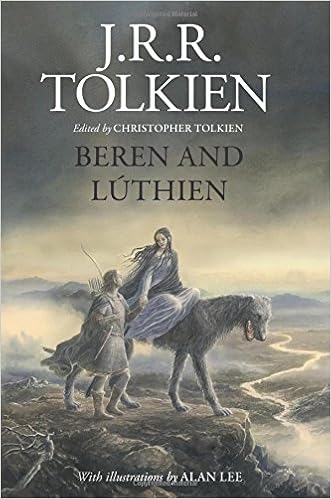
J.R.R. Tolkien’s “Beren and Lúthien”


By 
https://theimaginativeconservative.org/2019/08/jrr-tolkien-beren-and-luthien-bradley-birzer.html
August 2, 2019

Image result for beren and luthien


"The chief of the stories of The Silmarillion, and the one most fully treated is the Story of Beren and Lúthien the Elfmaiden,” Tolkien wrote Milton Waldman of Collins Publishers in 1951.[1] Along with The Children of Húrin and The Fall of Gondolin, Beren and Lúthien formed the three greatest tales of the First Age, each, in some way, deeply tied to the saga of the three silmarils. Tolkien wrote them in 1916 and 1917, beginning with The Children of Húrin, following it with the Fall of Gondolin, and completing the main three with Beren and Lúthien.[2] Of the three, Tolkien explained, Beren and Lúthien most foreshadowed The Lord of the Rings. “Here we meet, among other things, the first example of the motive (to become dominant in Hobbits) that the great policies of world history, ‘the wheels of the world,’ are often turned not by the Lords and Governors, even gods, but by the seemingly unknown and weak—owing to the secret life in creation, and the part unknowable to all wisdom but One, that resides in the intrusions of the Children of God into the Drama.”[3] Equally important for Tolkien’s entire mythology, Beren and Lúthien tells the tale of the first marriage of Elf (immortal) and man (mortal), so critical to the entire story.[4]
As with all of Tolkien’s great tales of the First Age, the story of Beren and Lúthien transformed dramatically over sixty years from its first imagining and version in 1916 and 1917 to its relatively finalized version in 1977’s The Silmarillion. During those six decades, it appeared as a long tale of the Lost Tales, as a summary in the 1926 Sketch of the Mythology (written for Tolkien’s beloved professor from King Edward’s, R.W. Reynolds), as a radically ambitious poetic lay, The Lay of Leithian (1925-1931), and as an essential story within the various versions, including the final version, of The Silmarillion.
Yet, the essence of the story has remained the same in all of its many versions. Or, as Christopher so wisely put it, “The fluidity should not be exaggerated: there were nonetheless great, essential, permanences.”[5]
A daughter of an Elf king, Thingol, and a fay (a Maia—the offspring of the angelic powers; roughly of the same power as Gandalf), Lúthien-Tinúviel expressed her joy and love through dance. One day, Beren, a heroic but displaced outlaw, spies her dancing. “Yet now did he see Tinúviel dancing in the twilight, and Tinúviel was in a silver-pearly dress, and her bare white feet were twinkling among the hemlock-stems.”[6] In Tolkien’s Lay of Leithian, he describes in terms comparable only to the Blessed Virgin Mary:
Her starry jewels twinkled bright
In the risen sun like morning dew;
The lilies gold on mantle blue
Gleamed and glistened.[7]

Enraptured, Beren followed Lúthien to her hidden kingdom, only to be mocked by her father. When Beren expressed his love for Lúthien, her father challenged him to steal one of the three silmarils, lodged and protected in Morgoth’s (the devil; also named Melko and Melkor) iron crown. Accepting the challenge, Beren heads north to Morgoth’s realm and fortress, Angband. Evil dwells throughout the North, Beren quickly finds. “Many poisonous snakes were in those places and wolves roamed about, and more fearsome still were the wandering bands of the goblins and Orcs—foul broodlings of Melko who fared abroad doing his evil work, snaring and capturing beasts, and Men, and Elves, and dragging them to their lord,” Tolkien wrote.[8] Beren becomes a captive in Morgoth’s house, a thrall and house slave. Distraught by her father’s cruel taunts, Lúthien follows Beren north to Morgoth’s realm. En route, she befriends the greatest of dogs, a dog of the angelic powers, Huan. Huan has been given permission to speak to Beren and Lúthien only three times, and, in each, he offers sagacious thought and advice. He also serves as a guardian, even challenging Morgoth’s greatest lieutenant, Sauron, to a fight.
From shape to shape, from wolf to worm,
From monster to his own demon form,
Thû [Sauron] changes, but that desperate grip
He cannot shake, nor form it slip.
No wizardry, nor spell, nor dart,
No fang, nor venom, nor devil’s art
Could harm that hound that hart and boar
Had hunted once in Valinor.[9]

Together, though, Huan and Lúthien formulate a plan, and Lúthien comes before Morgoth. In lust, he watches her dance, but her dance entrances him, putting him and his household to sleep. “Even the Orcs laugh in secret when they remember it,” the tale reveals, “telling how Morgoth fell from his chair and his iron crown rolled upon the floor.”[10] Beren and Lúthien remove one of the silmarils from Morgoth’s crown and escape, only to encounter the fell wolf, Carcharoth, who bites off Beren’s hand, consuming it and the silmaril it held. Unable to bear the goodness of the silmaril, Carcharoth goes mad, running wild into the wilderness. Having seen the folly of his words, Thingol joins Beren in the hunt for Carcharoth. They succeed in killing the wolf and removing the silmaril, but only at the cost of Beren’s life. Lúthien pleads with the god of death, Mandos, for Beren’s life.
The song of Lúthien before Mandos was the song most fair that ever in words was woven, and the song most sorrowful that ever the world shall hear. Unchanged, imperishable, it is sung still in Valinor beyond the hearing of the world, and listening the Valar are grieved. For Lúthien wove two themes of words, of the sorrow of the Eldar and the grief of Men, of the Two Kindreds that were made by Ilúvatar to dwell in Arda, the Kingdom of Earth amid the innumerable stars.[11]
Mandos, moved by the beauty of the story, agrees, but he demands, in return, that Lúthien give up her immortality as a fay-Elf. She gladly accepts Mandos’s offer, and she and Beren spend his second life in great joy and adventure.
The story of Beren and Lúthien matters profoundly in The Lord of the Rings. Not only are Aragorn and Arwen (who chooses mortality to be with Aragorn) the intellectual and spiritual descendants of Beren and Lúthien, but Arwen is, actually, a genetic and familial descendent of Beren and Lúthien. And, just as Beren lost his hand in rescuing the silmaril from Morgoth, so Frodo loses a finger in securing the fate of the ring from Sauron. Equally important, though, Aragorn chants the story of Beren and Lúthien, only moments before the Ringwraiths attack at Weathertop. The story serves as a form of prayer, preparing the Hobbits for their first real and tangible battle with evil. It remains one of the most beautiful parts of Tolkien’s entire mythology.
The story also mattered profoundly in Tolkien’s own life. His own wife, Edith, inspired the scene of Lúthien dancing, she having danced for him in “a small wood with a great undergrowth of ‘hemlock’ (no doubt many other related plants were also there) near Roos in Holderness, where I was for a while on the Humber Garrison,” during the First World War.[12] Then, Tolkien told his son, Christopher, Edith’s “hair was raven, her skin clear, her eyes brighter than you have seen them, and she could sing—and dance.”[13]
Edith Tolkien’s grave reads “Lúthien,” and J.R.R. Tolkien’s reads “Beren.”


[1] JRRT to Milton Waldman, 1951, in The Letters of J.R.R. Tolkien, Letter No. 131.
[2] JRRT to Christopher Bretherton, July 16, 1964, in JRRT Letters, Letter No. 257.
[3] JRRT to Milton Waldman, 1951, in JRRT Letters, Letter No. 131.
[4] See also, JRRT to Peter Hastings, September 1954, in JRRT Letters, Letter No. 153.
[5] Christopher Tolkien, “Preface,” to J.R.R. Tolkien, Beren and Lúthien (Boston, MA: Houghton Mifflin, 2017), 14.
[6] Tolkien, Beren and Lúthien, 42.
[7] Tolkien, Beren and Lúthien, 148.
[8] Tolkien, Beren and Lúthien, 47.
[9] Tolkien, Beren and Lúthien, 162.
[10] Tolkien, Beren and Lúthien, 137.
[11] JRRT, The Silmarillion, 186.
[12] JRRT to Christopher Bretherton, July 16, 1964, in JRRT Letters, Letter No. 257; and JRRT to Christopher Tolkien, July 11, 1972, in JRRT Letters, Letter No. 340.
[13] JRRT to Christopher Tolkien, July 11, 1972, in JRRT Letters, Letter No. 340.

Thursday, August 01, 2019

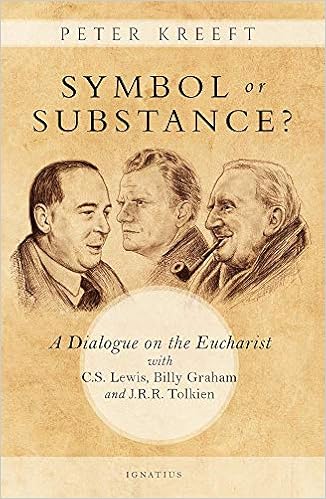
Book Review: “Symbol or Substance?: A Dialogue on the Eucharist”


By Kaitlyn Facista
https://www.teawithtolkien.com/blog/symbol-or-substance
April 16, 2019

Image result for kreeft symbol or substance


Peter Kreeft’s The Philosophy of J.R.R. Tolkien has been one of my favorite resources in understanding the role Tolkien’s Catholic faith played in the shaping of Middle-earth, so I was incredibly pumped to learn of Kreeft’s latest book, Symbol or Substance?: A Dialogue on the Eucharist with C.S. Lewis, Billy Graham, and J.R.R. Tolkien. And it was incredible. 10/10 recommend.
Kreeft is the author of over a hundred books on Christian philosophy, apologetics, and theology. He’s written extensively on J.R.R. Tolkien and C.S. Lewis, and has taken great care in accurately recreating the voices and beliefs of each of the men represented in this book. If there’s anyone I trust to write this sort of dialogue, it’s Peter Kreeft.
Rather than presenting it as a scholarly work, Kreeft introduces the book as a “supposed” dialogue between Lewis, Graham, and Tolkien which focuses on the Eucharist but also addresses several other aspects of Christian belief and the differences between their traditions. The book addresses the question:What are the differences between these theologies, and do they matter? (Yes, they do.)
Kreeft explains in the introduction, “The following conversation is fictional. It never happened, at least not in this world. However, it very well could have… So the literary genre of this book is neither simply fiction or simply nonfiction. It is what C.S. Lewis called a “supposal"…”
So that’s the whole idea of it; it’s a style Kreeft is quite good with, and I thoroughly enjoyed it as a reader. I couldn’t help but imagine these three meeting for a pint in heaven as I read along.  
Drawing from various writings and a deep understanding of each viewpoint, Kreeft presents a dialogue which represents each of these men quite well, allowing readers to be a fly on the wall for this imagined conversation. The topic at hand is the question of the Eucharist: What is it? Is it truly the Body, Blood, Soul, and Divinity of Jesus Christ as Catholics claim? Is it merely a symbol? Or something in between?
While Kreeft himself is Catholic and mentions this in the introduction, I felt that he fairly represents the Anglican and Evangelical perspective expressed by Lewis and Graham. Having been raised in an Evangelical church and later converting to Catholicism, I was the least familiar with the Anglican perspective and I enjoyed learning about Lewis’ understanding of their theology.
This charitable conversation is not meant to be a debate and no one “wins” in the end, which felt incredibly refreshing when compared to the way most people speak to one another these days (particularly online). This sort of dialogue can serve as an example for all of us, in my opinion.
Apart from the Eucharist, Kreeft also briefly brings up the issues of Apostolic Succession, Sola Scriptura, Confession, infant baptism, the role of both faith and works in salvation; I thought these made nice additions to the conversation as a whole.
Their conversation flows well and there are bits of humor sprinkled in throughout, which made the book a light-hearted yet practical read. Tolkien also drags Lewis quite a bit for not converting all the way to Catholicism while also trying not to press the issue too hard, which felt very on-brand for their friendship.
The focus of this conversation leans more toward the purpose of understanding what one another believe, rather than trying to force their beliefs on each other—since, of course, that wouldn’t make any sense at all in the context of a supposed conversation.
In the end, readers will finish the book with a deeper understanding of the differences and similarities of these three branches of Christianity and feel well-equipped to go out and have conversations of their own. This is the sort of book I’d consider giving my Evangelical family members as well as my Catholic friends because of its charitable tone, well-researched talking points, and its connection to Tolkien and Lewis (and Graham, of course).


Sunday, July 07, 2019

Friendship Among the Inklings


By 
https://theimaginativeconservative.org/2019/07/friendship-among-inklings-bradley-birzer.html
July 5, 2019

Image result for the inklings eagle and child

“Is any pleasure on earth as great as a circle of Christian friends by a fire?” C.S. Lewis once famously asked. Surely not, he continued. “Friendship is the greatest of worldly goods,” Lewis declaimed. “Certainly to me it is the chief happiness of life. If I had to give a piece of advice to a young man about a place to live, I think I should say, ‘sacrifice almost everything to live where you can be near your friends.’” Naturally, as the Zaleskis have so powerfully and persuasively argued, Lewis was referring in these and other discussions on friendship to his own friendship with that group most associated with him and the Oxford of his day, the Inklings.
Given that Lewis had presented himself in his early poetry, in his diaries, and in his letters as a radical individualist in the Nietzschean and Wagnerian fashion, the great Christian apologist almost certainly learned the immense value of friendship while at Oxford—as a student and as a professor. As a student, he learned it from Owen Barfield and, as a professor, he learned it from his colleague, J.R.R. Tolkien.

Tolkien had, after all, always loved friendship and relationships. Having lost his father and his mother at a young age and two of his three closest friends (in the TCBS) to war, he knew how precious friendship was and how fragile it could be in this world of sorrows. He not only held onto friendship for dear life, but he also incorporated it into every aspect of his literary mythology. As such, friendship is a central feature, not a quirk, of Tolkien’s stories.
In The Hobbit, the dwarves and Bilbo bond around the fire in Bilbo’s Hobbit hole and in the last homely house of the West, Rivendell. In The Lord of the Rings, Gandalf and Frodo discuss the most urgent matters imaginable nearby Frodo’s fire in his Hobbit hole. Again, the same would be true around Tom Bombadil’s fire and around Elrond’s. Bilbo even mentions that time has very little meaning in the room where tales are told.
Even in his earliest mythological writings, The Book of Lost Tales, Tolkien based the narrative around the device of the fire.
Eriol saw now that they were in a short broad corridor whose walls half-way up were arrassed; and on those tapestries were many stories pictured whereof he knew not at that time the purport. Above the tapestries it seemed there were paintings, but he could not see for gloom, for the candle-bearers were behind, and before him the only light came from an open door through which poured a red glow as of a big fire. ‘That,’ said Vairë, ‘is the Tale-fire blazing in the Room of Logs; there does it burn all through the year, for ’tis a magic fire, and greatly aids the teller in his tale—but thither we now go,’ and Eriol said that that seemed better to him than aught else.
Further, Tolkien writes, as with Elrond’s fire, the effect hits all immediately:
Then all that company came laughing and talking into the room whence came the red glow. A fair room it was as might be felt even by the fire-flicker which danced upon the walls and low ceiling, while deep shadows lay in the nooks and corners. Round the great hearth was a multitude of soft rugs and yielding cushions strewn; and a little to one side was a deep chair with carven arms and feet. And so it was that Eriol felt at that time and at all others whereon he entered there at the hour of tale-telling, that whatso the number of the folk and children the room felt ever just great enough but not large, small enough but not overthronged.
In trying to understand the importance of the Inklings, many scholars have asked if the members of that august group thought alike and arrived at the same answers. Were they all Christian? Were they all middle class? Were they all reactionary? Were they all romantic?
One younger member of the group, John Wain, even thought of the Inklings as a sort of reactionary cell. They were, he claimed, “a circle of investigators, almost of incendiaries, meeting to urge one another on in the task of redirecting the whole current of contemporary art and life.”
To be sure, though, the greater question one should ask is not at what answers did the group arrive, but, rather, what questions did they ask? It was their very questions—and the trust that comes with asking questions—that defined them. As such, they asked about the limits of heroism, the nature of beauty, the connection of the pagan to the Christian, the relationship of holiness and sanctity, the interplay of technology and magic, and the connectedness of flesh and soul. They discussed mythos (story) and logos (idea), and they shared with one another their most intimate thoughts and questions.
An American visitor, Father Chad Walsh, described the conversation of the Inklings as coherent at the moment, but somewhat bewildering in hindsight. “Only in retrospect did I realize how much intellectual ground was covered in these seemingly casual meetings,” Walsh reported. “At the time the constant bustle of Lewis racing his friends to refill empty mugs or pausing to light another cigarette (occasionally a pipe) camouflaged the steady flow of ideas. The flow, I might add, is not a one-way traffic. Lewis is as good a listener as talker.”
One might not even go too far in suggesting that, for the Inklings, friendship had a mystical element. Charles Williams and C.S. Lewis even toyed with the idea that lovers or friends might share their pain with one another, sometimes literally taking the pain away from a friend or lover.
Still, no one should ever take friendship for conformity or squishiness. On this, Warnie Lewis, Jack’s brother, should get the last word:
The ritual of an Inklings was unvarying. When half a dozen or so had arrived, tea would be produced, after which when pipes were alight Jack would say, ‘well has nobody got anything to read us?’ Out would come a manuscript and we would settle down to sit in judgement upon it. Real, unbiased judgement too, for about the Inklings there was nothing of a mutual admiration society; with us, praise for good work was unstinted but censure for bad, or even not so good, was often brutally frank. To read to the Inklings was a formidable ordeal.

Wednesday, May 29, 2019

What We’re Reading: Charles Williams


https://www.newyorker.com/books/page-turner/what-were-reading-charles-williams?fbclid=IwAR05aXslT6Dt3gBVrqiPrQGYNcKcOkY0bnxFllHIV_5ve0yV69F1MUddKTs
March 14, 2013


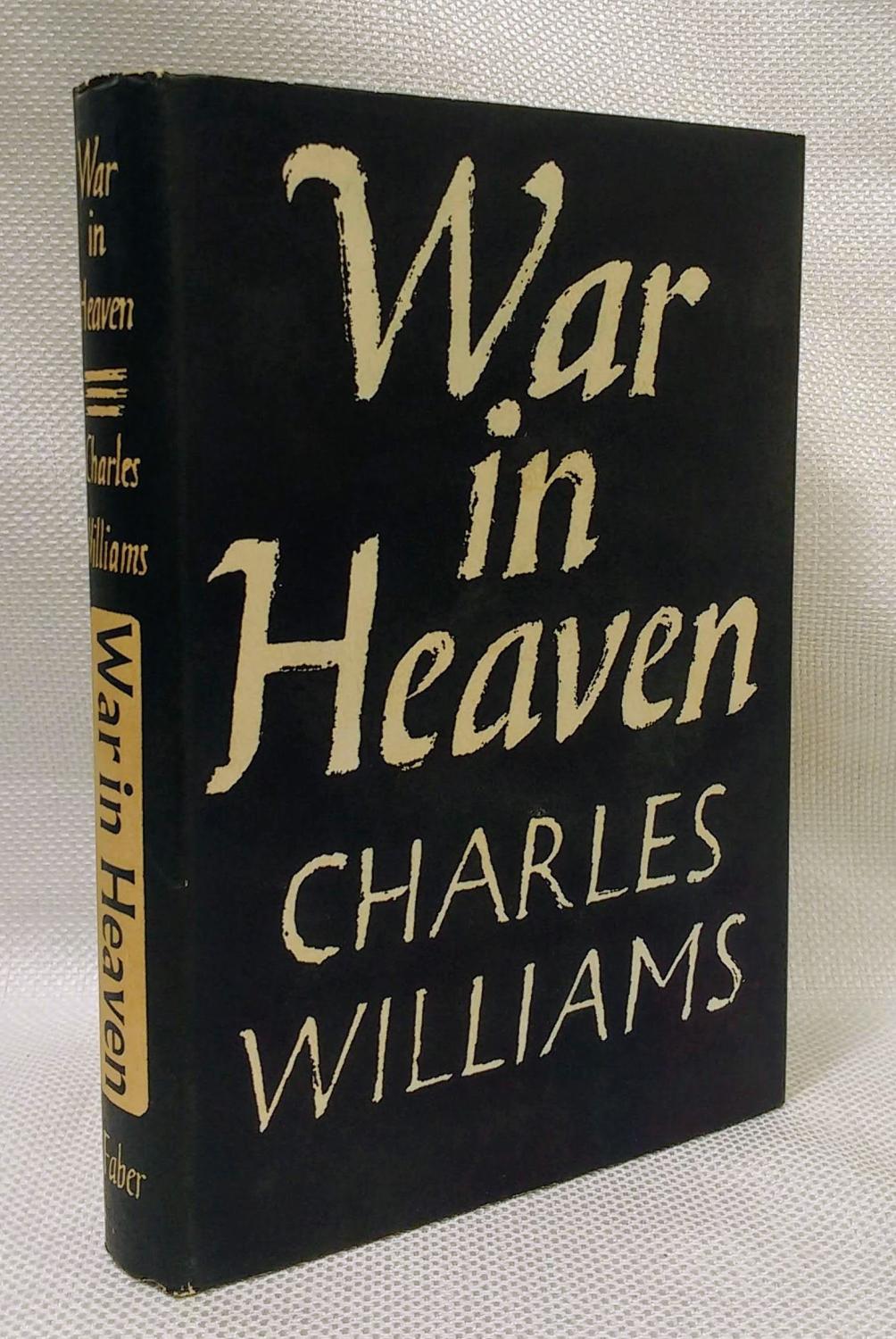
Last weekend, at a used-book store, I picked up a quaint little hardcover Faber & Faber 1954 reprint of Charles Williams’s 1930 novel “War in Heaven.” In its opening pages, a corpse is discovered under an editor’s desk at a publishing house. A chapter later, a postcard from one of the publishing house’s authors demands, with mysterious urgency, the deletion from his page proofs of a paragraph about the Holy Grail. The Grail, according to the to-be-deleted paragraph, may reside today in a church in the parish of Fardles, a short commute from the city. Are the murder and the chalice somehow linked? If Muriel Spark had drunk a little too much Sir Thomas Malory, she might have written something like this. I was incapable of resistance. I bought it.

I knew I had heard of Williams before, but I couldn’t, on the spot, remember where. The jacket copy, anonymous but evidently written by the Faber editor T. S. Eliot, described Williams’s novels as “supernatural thrillers.” The jacket also credited Williams with having written “The Descent of the Dove: A Short History of the Holy Spirit in the Church,” which—I learned when I got home to the Internet—Auden claimed to have re-read once a year. A resort to our bookshelves turned up more data. In the critical study “Later Auden,” Edward Mendelson relays Auden’s report that he felt sanctified in Williams’s presence: “I felt transformed into a person who was incapable of doing or thinking anything base or unloving.” Curiouser and curiouser. A re-perusal of “The Magician’s Book,” Laura Miller’s account of her reading of C. S. Lewis’s Narnia chronicles, reminded me where I’d heard of Williams before. He was one of the Inklings, a group that included Lewis and J. R. R. Tolkien. More precisely, Williams was a friend of Lewis’s and a rival of Tolkien’s. According to Miller, Lewis thought Williams “godlike,” and Eliot thought he approximated a saint, but Tolkien, though he liked Williams well enough as a person, thought his literary influence was baleful. He ruined Lewis’s sci-fi novel “That Hideous Strength,” in Tolkien’s opinion.

Now that I’ve read “War in Heaven”—some thirty years after reading Lewis’s “That Hideous Strength,” for the record—I have to say that Tolkien had a point. “That Hideous Strength” is deeply Williamsian. And I’m not sure that a Williamsian novel is altogether the sort of thing I enjoy. I read “War in Heaven” compulsively, I admit. Good versus evil makes for a lively story, and a person like me always wants to know what happens to the Grail. I was charmed, moreover, by the bumbling archdeacon who has written a treatise on the League of Nations, and by the way a Catholic duke and an agnostic assistant editor fall into sodality when they discover they both know George Chapman’s poetry by heart.

But the book isn’t all small-town British eccentrics. Its plot is driven by a florid sadist who has designs on a defenseless child, up to and including human sacrifice, and I found myself setting down the book out of excessive dread as often as I picked it up out of unsatifised curiosity. The logic that governs the black magic—its theology, for lack of a better word—seems muddled. At times, the archdeacon seems to believe that he needn’t worry too much if the Grail falls into the wrong hands because Satanism has no power in and of itself, and at one point, in the presence of the novel’s chief Satanist, an assistant editor goes so far as to diss Satanism as “the clerk at the brothel” of belief. Surely these are orthodox opinions, as far as Christianity and science go, but in Williams’s supernatural thriller, by generic necessity heterodox, floor chalkings can be lethal, whole buildings can be hidden by conjured-up fog, and evil people are capable of using the Grail for evil purposes. I found it quite upsetting when the bad guys tried to use the Grail to cement an eternal Mezentian gay marriage between the archdeacon and the lost soul of a masochist. The psychodynamics of the relationship are imagined with a telling and disconcerting vividness. Neither your vicar nor queer theory would approve.

The Grail that I remember from Malory was never so merely instrumental; its purity was unassailable. By the end of “War in Heaven,” I found myself sharing with Tolkien a certain aesthetic distaste for Williams’s imagination. Which made it somewhat puzzling that what Williams’s Grail most reminded me of was… Tolkien’s Ring. Like the Ring, Williams’s Grail grants to knowledgeable users the faculty of vision at a distance. Like the Ring, its possession can be sensed by others who have possessed it. And like the Ring, it is capable of imparting tremendous power. The resemblance seemed to me most striking when a nihilist in Williams’s novel urges a Satanist to destroy the Grail.

“Destroy it!” the Satanist wails in protest. “But there are a hundred things to do with it.”

“That’s the treachery,” the nihilist replies. “Keep it for this, keep it for that. Destroy it, I tell you; while you keep anything for a reason you are not wholly ours.”

The exchange could have been lifted from Gandalf and Frodo’s in the second chapter of “The Lord of the Rings.” “Do not tempt me!” Gandalf insists when Frodo offers to hand the Ring over to him. “The way of the Ring to my heart is by pity, pity for weakness and the desire of strength to do good. Do not tempt me! I dare not take it, not even to keep it safe, unused. The wish to wield it would be too great for my strength.” In these passages, the Grail and the Ring are almost perfect mirror images: Williams’s Grail is dangerous even to the most dedicated of Satanists because, though it can be used for evil, it has an inherent bent for good. And Tolkien’s Ring is dangerous even to the most virtuous of wizards because, though it can be used for good, it has an inherent bent for evil.

Had Williams sensed Tolkien’s disapproval, and was he having a laugh at Tolkien’s expense? Chronology overthrows the hypothesis. Williams published “War in Heaven” in 1930, and Tolkien wrote “The Lord of the Rings” between 1936 and 1949. Maybe the resemblance is no more than coincidence. Or maybe, once my stomach settles, I should read another Williams novel—the other one I bought last weekend seems to be about a platonically ideal lion, and happens to have been published nineteen years prior to “The Lion, the Witch, and the Wardrobe”—and see what else I find.

Friday, May 24, 2019

LIVING WITH TOLKIEN


By 
https://theimaginativeconservative.org/2019/05/living-with-jrr-tolkien-bradley-birzer.html
May 23, 2019

Related image

Though I have read The Hobbit, The Lord of the Rings, The Silmarillion, and Tolkien’s other stories and books too many times to count, I never once lost interest in anything about or by the great Oxford don. Now, with the movie Tolkien out from Fox Searchlight Pictures, I’m seeing references to him everywhere. The more I see of him and know of him, the more I continue to be astounded by his mind, his creativity, and his tenacity. For forty-one years now, he has been a constant companion in my life, a friend, as well as a mentor and an inspiration.
As I’ve had the chance to mention before, I first encountered Tolkien through his painting, The Mountain Path, when Houghton Mifflin used it for the cover of the first edition of The Silmarillion in September 1977. I turned ten on the sixth of that month, but my oldest brother, Kevin, turned eighteen on the twenty-third. The Silmarillion came out on the fifteenth. My mom gave Kevin a copy of it, but I, more or less, confiscated it. I would stare and stare at the cover, finding it not only inviting, but irresistibly so. I loved the fold-out map of Beleriand in the back, and I loved even more the opening chapter, “The Ainulindale,” the creation of the universe. Those three things connected me to a world beyond anything I had yet experienced in rather idyllic Kansas. I so desperately wanted to escape into that mountain scene, explore every nook and cranny of that invented world, and meet a God who sang the universe into existence.
Obviously, September 1977 was a great month for the Tolkien-Birzer alliance, informal though it might’ve been.
To be sure, my brothers shared my love of Tolkien, though probably not to my obsessive degree. My older brother, Todd, even made Tolkienian things for me: maps of our farm in the style of Christopher Tolkien’s map; treasure hunts with clues written in Tolkienian ruins; and even, in his wood-working class and projects, a very nice version of Sting, the ancient Elven blade Bilbo and Frodo wielded.
After devouring The Hobbit, The Lord of the Rings, and The Silmarillion, I also read everything available at the time by Tolkien—his poetry as found in The Adventures of Tom Bombadil; his short stories printed in The Tolkien Reader; and his paintings as printed in the annual Tolkien calendars. In 1980, of course, the mythology expanded dramatically with the author’s Unfinished Tales, giving much deeper histories of the three mythopoetic ages of the world.
Of those books about Tolkien, but not written or edited by members of the Tolkien Estate, I loved the works by David Day, especially his Tolkien Bestiary, featuring some of the best painted renderings of Middle-earth I have yet to overcome. My current students have the distorted images of Tolkien’s world by Peter Jackson stuck in their heads. For me, my images come from the paintings commissioned by Mr. Day. Just as important to me was cartographic treasure, Barbara Strachey’s The Journeys of Frodo.
All of this came together for me in the fall of 1980 when I discovered a role-playing game that allowed me to spend as many hours as I so desired in Tolkienian-inspired worlds, Dungeons and Dragons. Surviving a very violent domestic situation during the late 1970s and early 1980s, I can state with no hyperbole that my ability to enter in and out of Tolkienian realms at will quite definitely saved my life. I remember the bizarre motherly whisperings at the time that Dungeon and Dragons might open a child to Satanism and the dark occult. I can only laugh at such comments, especially in hindsight. For me, Dungeons and Dragons (as based on Tolkien’s mythology) not only sheltered my then pre-teenage collapsing faith from collapsing entirely, but it also allowed me sanity by giving me an escape from household terrors that so dominated those years. During my daily walks to and from Liberty Junior High, I often contemplated suicide, trying to decide not if, but when. Honestly, it sometimes seemed the only way to escape my stepfather. Tolkien’s characters and stories, as played in Dungeons and Dragons, strangely (or Providentially?) intruded, pushing aside the darkest thoughts and depressions. Fantastic worlds provided the healthier and healthiest escape in those sombre days. When my friends and I played Dungeons and Dragons, we challenged and conquered evil in all its manifestations, domestic and foreign. We had only one God, and that God was good, true, and beautiful. If some kids fell in the occult because of Dungeons and Dragons, I am truly sorry. In my case, though, it prevented the greatest darkness of all and helped me realize the precious value of life. While I might not be able to stave off the evil in my home, I could rescue others from abuse, even if only in my imagined kingdoms and fantastic republics.
In this context, I cannot help but think of the description of Gandalf (originally named Olórin) in The Silmarillion:
But of Olórin that tale does not speak; for though he loved the Elves, he walked among them unseen, or in form as one of them, and they did not know whence came the fair visions or the promptings of wisdom that he put into their hearts. In later days he was the friend of all the Children of Ilúvatar, and took pity on their sorrows; and those who listened to him awoke from despair and put away the imaginations of darkness.
Eventually, my love of Gandalf became my love of St. Michael, patron of law and good.
As I’ve had the privilege of describing elsewhere at The Imaginative Conservative, I came back to the Catholic faith in, of all places, the deserts of western Morocco, in February 1988. I was then spending my sophomore year of college (July 1987-July 1988) at the University of Innsbruck, Austria. Filled with bursting faith upon returning to Notre Dame that fall, I (again, Providentially?) took a course from a then-famous Platonist entitled “Philosophy and Fantasy.” I wrote my term paper on the Catholicism of J.R.R. Tolkien, and the professor allowed me—as one of three—to deliver it to the class as an oral presentation. It is, at least by my own poor judgment, one of the three best papers I wrote in college, and I was—for better or worse—so proud of it that I wanted it to become better.
Jump forward ten years to my conversation with Winston Elliott, Publisher of The Imaginative Conservative, who asked me, “What would you most like to write upon?” as I explained to him my exhaustion with my dissertation topic (American Indians during the American Revolution and War of 1812). When I told him about my college paper on Tolkien and how I would like to expand it to a book, he not only encouraged me but he also promised me that he would do everything in his power to get it published.
While I am not a major author, I can state that my books have all sold well—at least by the standards of a non-bestselling author. Most importantly, though, I can state that my writing career began during that third week in September 1977, staring at The Mountain Path. Throw in some childhood horrors, some healthy escapes, some great classes, and the encouragement of a best friend—and a book and a writing career are born. How fitting. And, it all began with Tolkien. Or, maybe, God. Yes, the Tolkienian answer is the proper one. It certainly began with God.
Bradley J. Birzer is the co-founder of, and Senior Contributor at, The Imaginative Conservative. He is the Russell Amos Kirk Chair in History at Hillsdale College and Fellow of the Ronald Reagan Presidential Library. Dr. Birzer is author of In Defense of Andrew Jackson (Regnery, 2018), Russell Kirk: American Conservative, American Cicero: The Life of Charles Carroll, Sanctifying the World: The Augustinian Life and Mind of Christopher Dawson,J.R.R. Tolkien’s Sanctifying Myth: Understanding Middle-Earth, co-editor of The American Democrat and Other Political Writings by James Fenimore Cooper, and co-author of The American West.

Tuesday, May 21, 2019

'Tolkien' review: Nicholas Hoult stars in sympathetic and sensitive portrait of the Lord of the Rings novelist


By Geoffrey Macnab
https://www.independent.co.uk/arts-entertainment/films/reviews/tolkien-review-nicholas-hoult-lily-collins-lord-of-the-rings-hobbit-a8895876.html
2 May 2019

Related image
Nicholas Hoult and Lily Collins
AA Milne wouldn’t have created Winnie the Pooh, George Mallory wouldn’t have attempted to climb Mount Everest, and JRR Tolkien wouldn’t have written The Hobbit if it hadn’t been for the “Great War”. The evocative new biopic Tolkien follows on from such films and books as Goodbye Christopher Robin and Wade Davis’s Into The Silence in foregrounding the effect that trench warfare had on the imaginations and aspirations of British writers, artists and explorers.
Tolkien (Nicholas Hoult) is seen early on during the Battle of the Somme. He is shell-shocked and in a very frail condition but tells his colleagues he is going “up the line” to find a friend. The friend in question is the poet, Geoffrey Bache Smith, who had been at King Edward’s School in Birmingham with him. Both were members of the Tea Club, Barrovian Society (the TCBS), the tiny society they formed together with two other friends, Robert Gilson and Christopher Wiseman.
As Tolkien and another soldier wander through the trenches, the flashbacks to his youth begin. He is shown as a boy, play fighting with his brother and their friends in the woods. His childhood in rural England after a period in South Africa appears to have been idyllic in the extreme.
“Lock this all in your heart… lock it tight and it will be there forever,” Tolkien’s ailing mother tells him as the family’s “impecunious circumstances” force them to move away from his beloved countryside to Birmingham. Thanks to the intervention of a kindly priest, Father Francis Morgan (Colm Meaney), the two brothers are able to attend King Edward’s School.
Finnish director Dome Karukoski recreates early 20th century England in an extraordinarily lavish way. Whether it’s the satanic mills and factories of industrial Birmingham, the grounds of Tolkien’s public school, the spires of Oxford or even the tea rooms where he and his friends liked to meet, everything is depicted in loving and fetishistic detail. Hoult plays Tolkien as a high spirited and idealistic figure with an obvious genius for language.
At first, Tolkien and his posh and precocious new pals seem very smug. They all want to be poets or artists or musicians. There is an excruciating scene in which one of them proposes to a waitress, seemingly unaware that he is humiliating her. However, one of the benefits of having an outsider like Karukoski telling this story is that he isn’t as obsessed with class as a British director might have been. The film develops into a period version of a rites of passage story about youngsters on the verge of adulthood – a sort of Edwardian American Graffiti.
Tolkien and his friends form such a close-knit group that it’s a small miracle he has spare time to spend with Edith Bratt (Lily Collins), the beautiful, Wagner-loving young piano teacher who lives in the same boarding house. The screenplay (by David Gleeson and Stephen Beresford) makes it very clear that Edith’s passion for Wagner’s Ring cycle rubbed off on Tolkien and helped inspire the mythology found in his own novels. Her free-spirited approach to life also influenced him.
The Lord of the Rings author’s family have already disowned the film but it’s hard to see quite why. If it has taken liberties with its subject’s life, it has done so in order to make the film richer. Tolkien’s main dilemma is whether to concentrate on his studies at Oxford or to marry Edith. Father Francis refuses to allow him to do both. On its own, this wouldn’t make much of a story but the flashback structure and the continual shots of him during the Battle of the Somme add an extra layer of drama and pathos.
Wagner fires his imagination in one way. The horror he witnesses in the trenches traumatises him in one way but (it is implied) inspires him in another. He hallucinates that he sees white horses and monsters on the battlefield. The combination of his academic brilliance, his romantic obsession with Edith and his wartime suffering, pave the way for his fantasy novels.
Peter Jackson, director of the Lord of the Rings films, exchanged Middle Earth for the First World War with his recent documentary, They Shall Not Grow Old. This biopic shows the same journey in reverse. Whether or not the film satisfies the fans of Jackson’s movies or Tolkien’s books, or keeps his family happy, this is still a sympathetic and sensitive portrait of the novelist as a young man, evolving his creative vision. If you want to know where Bilbo Baggins came from, this is a good place to start.

Monday, May 20, 2019

HOW I WAS WRONG ABOUT THE MOVIE “TOLKIEN”


By 
https://theimaginativeconservative.org/2019/05/tolkien-movie-apology-joseph-pearce.html?fbclid=IwAR1luVOEqznD85ldy6owzT_c34f-0LRQp1Ce09hft6QGYWdg3gG7dzBYWkM
May 18, 2019

Image result for tolkien film

Nicholas Hoult as J.R.R. Tolkien

I have a confession to make. Indeed, I need to make an apology. A few weeks ago, I wrote an essay entitled “Wormtongue’s Revenge”, in which I expressed my fears and misgivings about the new film, Tolkien, which focuses on the writer’s youth. I was concerned that the film would convey a homosexual and anti-Catholic agenda, weaving a fabric of lies of which Wormtongue himself would be proud. I cited the track record of the two screenwriters, David Gleeson and Stephen Beresford, and predicted the worst. “I might be wrong,” I wrote, “and will happily apologize to Messieurs Gleeson and Beresford should this be the case.” I should have added that I hoped to be proven wrong. I am, therefore, very happy to make the apology.
My fears about the film were assuaged by a couple of good and trusted friends who wrote to me after they had seen it.

“I had long shared your fears that a Tolkien biopic might make Fr Morgan into an ogre,” wrote the first friend, “but this one did not.” On the contrary, my friend continued, the priest who was the orphaned Tolkien’s legal guardian, “comes across, especially towards the end, as a father figure to Tolkien, which is definitely accurate”. My friend praised the acting of Nicholas Hoult as Tolkien, who had Tolkien’s “eccentricity and his mumbling speech pattern down to an art form”, concluding that he had enjoyed the movie much more than he had expected and expressing his hope that I would go and see it.
The other friend wrote to say that he and his wife had gone to see the film with my scathing prophecies in mind “and were mostly pleasantly surprised at the lack (as far as we could tell) of any homosexual agenda”. Far from such an agenda being evident, my friend reassured me that “the main emphasis of the movie was, in fact, the love story with Edith”. He continued to praise other aspects of the film:
The Somme scenes brought attention to the loss of wartime poets and a composer, which I thought might please you. Also, Tolkien was delirious on the battlefield at one point, and he saw visions of demons rising out the flames of bombs, and then a vision of Christ on the cross, as a kind of antidote, which pleasantly surprised us. The priest who raised him was portrayed as manly and firm, acting in his best interest to delay the marriage and who then blessed the marriage and praised Edith, when Tolkien had come of age, showing it had been the right thing to wait and the priest’s motives pure.
My friend concluded by stating that “the biggest sins of the film, were of omission”. He baulked at the suggestion, implicit in the film, that the central message of The Lord of the Rings was “fellowship,” without any suggestion that such fellowship had any deeper Christian meaning beyond male camaraderie. “I would say,” my friend concluded, “that it is not a film you should be afraid to see due to obvious problems”, adding that “it would be wonderful to read your review, if you do care to write one”.
With such endorsements from trusted friends, I rushed off to see the film.
The theatre was largely empty, which would have pleased me had my predictions proved correct, but which now saddened me as I began to warm to this warm-hearted dramatization of Tolkien’s early life, wishing that more people could see it.
The depiction of the idyllic life in the Shire-like Warwickshire countryside, with scenes of the young Tolkien and his friends playing in the woods, was juxtaposed to great effect with the family’s moving to the industrial slums of Birmingham, where the belching fumes and filth of the city’s factory chimneys reminds the viewer insistently and allusively of the scarred landscape and polluting stench of Mordor and Isengard. Tolkien’s mother is portrayed well, as is Tolkien’s closeness to her, but it is the characterization of Fr. Francis Morgan which surprised me most. There’s none of the anti-Catholic bigotry that one has come to expect in the characterization of priests in contemporary cinema. He shines forth as a compassionate father-figure, which is how Tolkien described him in his letters, who has Tolkien’s best interests in mind at all times, even and especially at those times when he appears most harsh, such as his decision to forbid Tolkien from seeing Edith.
As for Edith, the fellow orphan with whom the teenage Tolkien falls in love, she is shown to be feisty and highly cultured, which works in terms of the love story being told on the screen but lacks consistency with the real Edith whom Tolkien married, who was uncomfortable in the intellectual and academic circles in which her husband moved. The on-screen Edith is reminiscent of the characterization of C. S. Lewis’s wife, Joy Davidman, in the Hollywood version of Shadowlands, in which Debra Winger plays her as a feminist who is much smarter than Lewis’s male academic companions. In much the same vein, Lily Collins’s portrayal of Edith shows her as being much smarter than Tolkien’s male friends, and smarter than Tolkien himself. She is not only his Muse, which corresponds with the real Edith’s serving as the inspiration for the elven princess Lúthien Tinúviel, but is also his mentor, teaching him how to use his imagination fruitfully. Such tampering with the facts is within the realm of poetic license, however, and does not prevent the willing suspension of disbelief which is necessary if the film is to be enjoyed as a good story. It is, therefore, important to see it as a story based loosely upon historical facts and not as a documentary purporting to be objectively accurate in all respects. In short and in sum, this is a good yarn but a bad biography; indeed, it is a good yarn because it is a bad biography!
The homosexual agenda is inserted incognito in the characterization of Tolkien’s friend, Geoffrey Bache Smith, but in such a subtle manner that only the cognoscenti will notice it. Needless to say, there is no evidence that the real Geoffrey Bache Smith had such inclinations. Equally subtle and much more edifying are the allusions to Tolkien’s later life, especially his friendship with C. S. Lewis, in shots of Magdalen College, at which Lewis, Tolkien and their fellow Inklings met each week, and of Addison’s Walk, the footpath along the river on which Tolkien convinced Lewis of the truths of Christianity, laying the foundations for the latter’s conversion. There’s also a reference to the Eagle and Child, affectionately known by Tolkien and Lewis as the Bird and Baby, the pub in which they met with friends each week to wax lyrical and convivial on all matters pertaining to culture. Also refreshing was the relatively cerebral nature of the story, in which the importance of Tolkien’s academic work in the field of philology is treated with the necessary gravitas, and in which the role of the Church and its liturgy in comforting the afflicted is addressed with dignity.
On a less edifying note, it is true, as a reviewer in the Catholic Herald complained, that Tolkien’s Catholic faith is largely airbrushed out. The impression is given that Fr. Morgan’s presence is a consequence of the faith of Tolkien’s mother, whereas there’s no suggestion that Tolkien was himself a believer. On the contrary, the odd raised eyebrow at something that the priest has said gives the impression that the young Tolkien did not share his mother’s faith. There is, furthermore, no suggestion that Tolkien served Fr. Morgan’s Mass daily, nor that he would remain a lifelong practicing Catholic, still less is there any indication that The Lord of the Rings is, as Tolkien insisted, a “fundamentally religious and Catholic work”. And yet, laying these quibbles aside, there is no doubt that this is a good film with an adroitly crafted storyline, bereft, thankfully, of the poisonous wormtongued agenda that I feared it would have. It seems, therefore, as Treebeard might say, that I have been too hasty in my judgment. For this faux pas I offer my most heartfelt apology, adding that I have seldom been more pleased to be wrong.