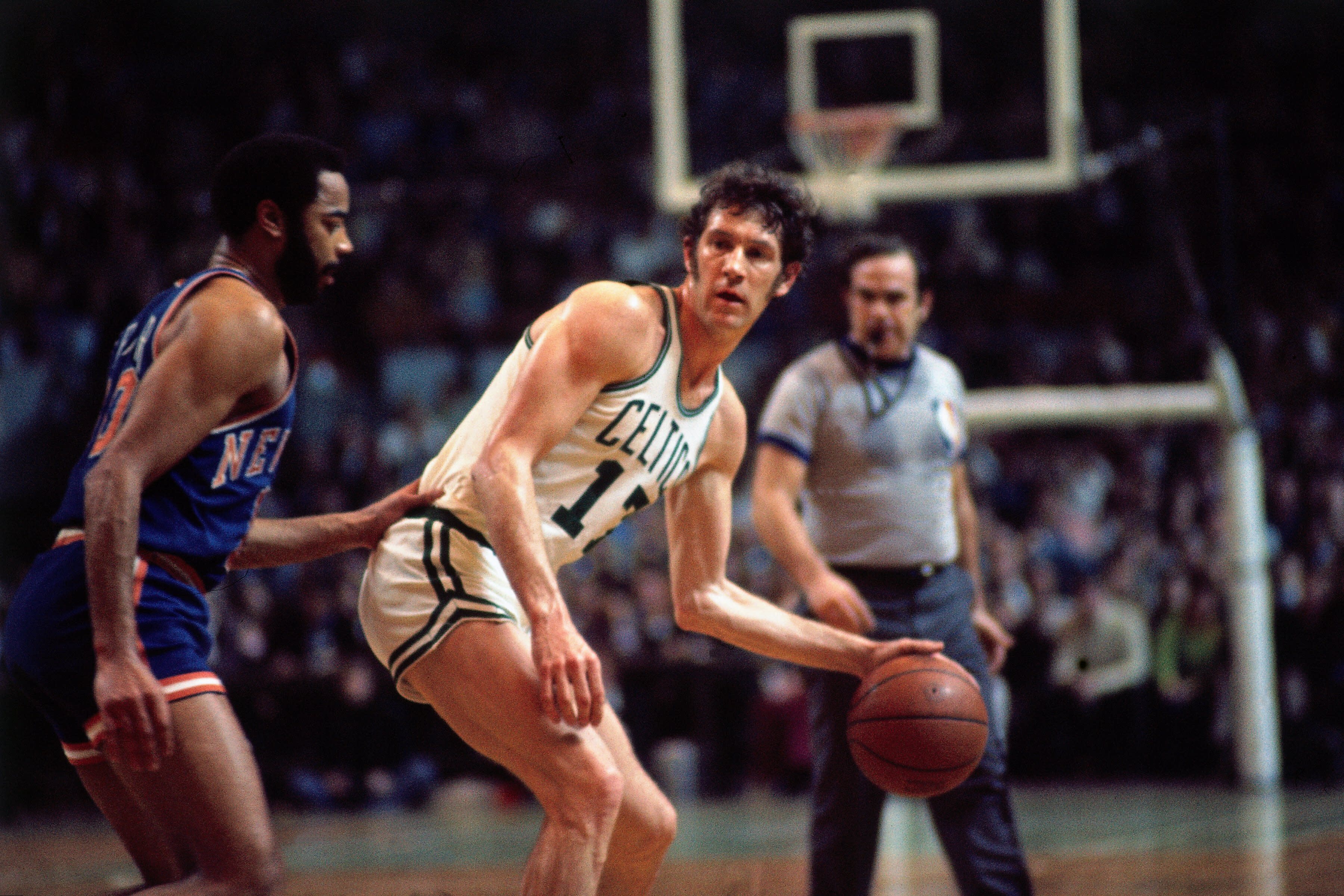
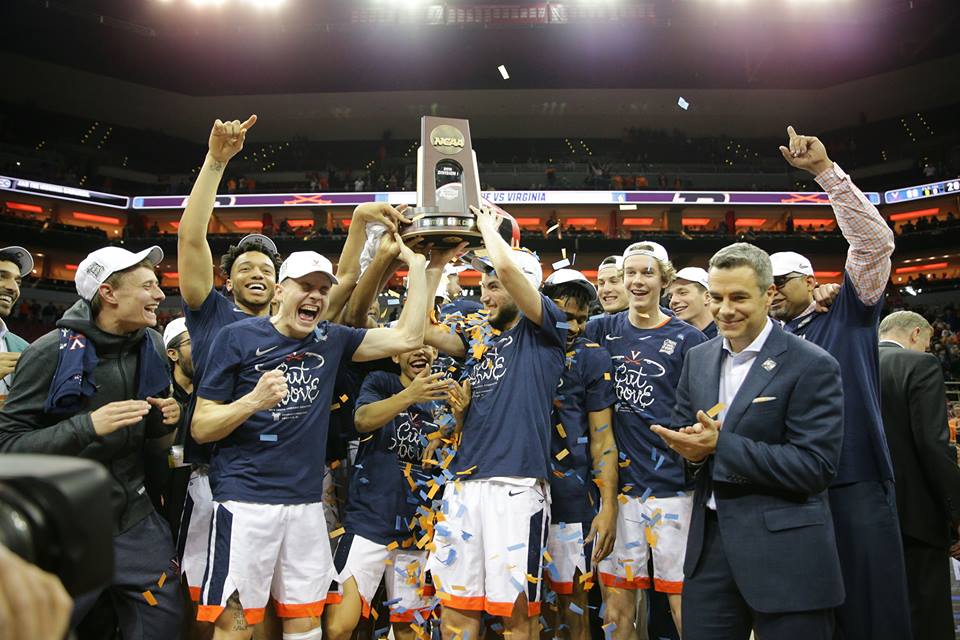
Showing posts with label Basketball. Show all posts

Monday, April 29, 2019

Remembering the great John Havlicek


By Bob Ryan
https://www.bostonglobe.com/sports/celtics/2019/04/27/remembering-great-john-havlicek/vYowjlTxVcQk4zQfbxTQ7K/story.html
April 27, 2019
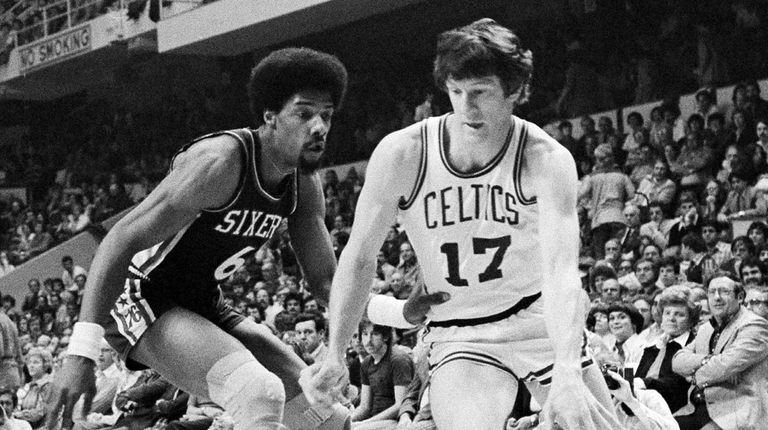
Image result for john havlicek

The Celtics' John Havlicek moves the ball past the 76ers' Julius Erving during an NBA game in Boston on April 29, 1977. Photo Credit: AP
The late David Halberstam was infatuated with Larry Bird, who, he proclaimed, was “authentic.”
Following that lead, I would label John Havlicek as “genuine.”
The listed synonyms for genuine include true, pure, actual, unaffected, sincere, and, yes, authentic.
Yes, I think that covers it. John Havlicek was a genuine superstar basketball player and an exemplary human being.
Paul Westphal, who observed Havlicek as both a teammate and an opponent, may have summed John up as well as anyone ever has. “John Havlicek,” he says, “was exactly who he was supposed to be. He deserved the respect he had.”
I can speak from the vantage point of a 23-year-old kid who found himself plopped without warning or any kind of direct preseason preparation into NBA coverage two days before the 1969-70 season opener. No one could have been more welcoming or accommodating to the rookie writer than John Havlicek, then 29 years old and in the midst of a five- or six-year span when he was, quite simply, the best basketball player in the world, and, yes, I am well aware that both Oscar Robertson and Jerry West were still quite viable. It was a professional thrill and privilege to write about Havlicek’s brilliant playing. And it was a personal thrill to make the acquaintance of a true basketball luminary who treated everyone with courtesy and respect.
He was as cooperative and helpful to a college kid with a credential as he was to, say, a Frank Deford from Sports Illustrated. No one ever came away from an encounter with John Havlicek saying, “Geez, what’s wrong with that guy?”
We wound up doing a book and, while I’m not apologizing for it, I can truthfully say I wish I had done a better job. I was flattered and honored when he asked me to work with him, but it was my first experience in the “As-told-to” business and I was still intimidated by the aura of the man. He had more to give than I ever asked for. He deserved better than me. After all, he was John Havlicek.
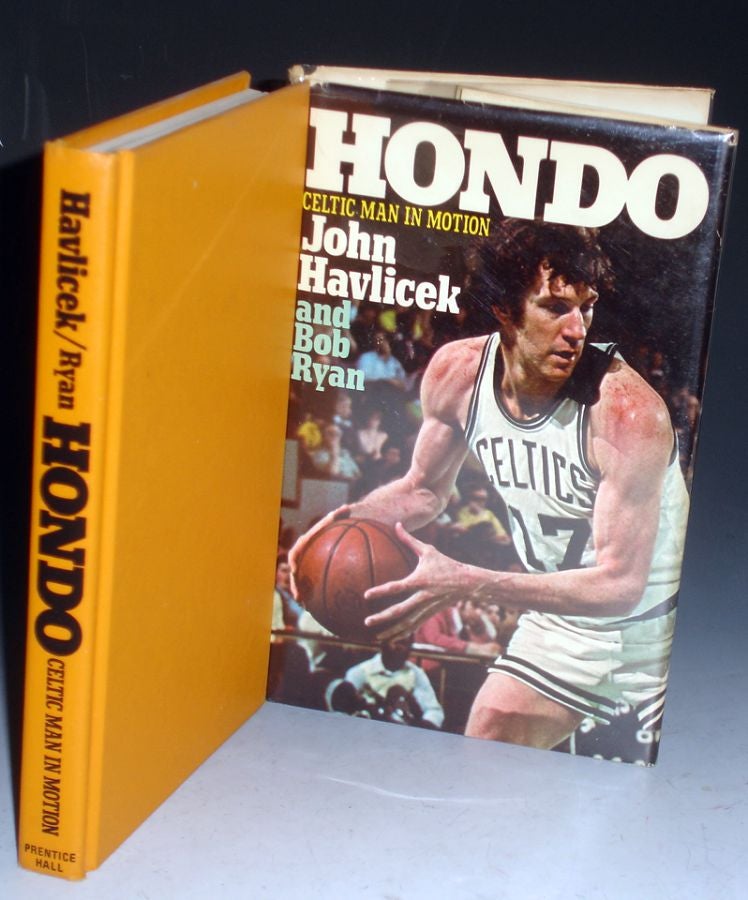
Image result for john havlicek bob ryan
OK, let’s get one thing straight right now. He will forever be acclaimed as the best sixth man in basketball history, and indeed he was. But I feel that association actually does him a grave disservice.
Remember how Red Auerbach always said that who started a game wasn’t as important as who finished it? Few people realize that while Havlicek was a sixth man in the earlier stages of his career, that as early as his rookie season in 1962-63 he was third on the Celtics in minutes played. Or that he was second in Celtics minutes the following season. Forgotten, too, is the fact that by Year 2 he was already the team’s leading scorer. Bringing John Havlicek off the bench was a winning strategy; that’s all. And there was no other team in the league that even remotely had the luxury of bringing a player such as Havlicek off the bench.
By the time he stole that famous 76ers inbounds pass on April 15, 1965, Havlicek was already identified as an elite player. But there is no question that play, and the accompanying Johnny Most call (which led to an album of Celtics highlights), gave him a distinct identity. “I was starting to make inroads,” Havlicek once explained. “But after that play people realized I was going to be around for a while. And the album definitely influenced the way people thought of me.”
The truth is the way people who knew John Havlicek thought of him was borderline awe. Take Bob Knight, for example. The first time I met the fiery coach was when John introduced me to him in Cleveland following a Cavaliers game. Bob Knight was deferential to the point of — I know how crazy this sounds — meekness. I have since been told that is the normal state of affairs when Knight was around his old Ohio State teammate. The flip side was that when they were in school John was himself in awe of Knight’s sheer worldliness. John had grown up in a very insular world, bounded by city blocks, not highways.
“Bobby Knight knew things,” John once explained.
John Havlicek was who he was and that was a shy kid of modest means from a small Ohio community located across the river from Wheeling, W.Va. There was little room for extravagance or frivolity in the Havlicek household. During the recruiting process, Ohio State basketball coach Fred Taylor called to say he was coming to town and he would take the family out to dinner. When Coach Taylor arrived, John was still playing a high school baseball game. Taylor noticed that the dinner table had been set. Mom Havlicek hadn’t quite gotten the message. She assumed Coach Taylor had said he was coming to dinner. After all, no one the Havliceks knew ever ate dinner out.
I’m sure you’ve already read or heard all the stories about John being so meticulous that he hung his executive socks on a hanger in the locker room or how his locker always looked as if the general were coming for inspection. All true. Or how he would look at you in disbelief if he thought you hadn’t trimmed every sliver of fat off that steak in front of you.
"Havlicek stole the ball!" Celtics broadcaster Johnny Most's call describing the final seconds of Game 7 of the Eastern Division Finals is one of the most memorable in NBA history. Boston held on to a 110-109 victory over the Philadelphia 76ers after John Havlicek tipped Hal Greer's inbounds pass, intended for Chet Walker, toward teammate Sam Jones. The Celtics would go on to win their seventh consecutive NBA title, defeating the Lakers in five games.
"Havlicek stole the ball!" Celtics broadcaster Johnny Most's call describing the final seconds of Game 7 of the Eastern Division Finals is one of the most memorable in NBA history. Boston held on to a 110-109 victory over the Philadelphia 76ers after John Havlicek tipped Hal Greer's inbounds pass, intended for Chet Walker, toward teammate Sam Jones. The Celtics would go on to win their seventh consecutive NBA title, defeating the Lakers in five games.(Walter Iooss Jr./Sports Illustrated)

Another aspect of the Havlicek legend was that he was, well, charmingly thrifty. In those days, first-class flyers had the option of taking little nips of whiskey to make drinks. John was famous for commandeering as many as he could, and one night we found out why.
The Celtics clinched their 1972 first-round playoff series against the Hawks on a Sunday afternoon in Atlanta and immediately flew home. John had a celebratory gathering that evening at his apartment in Melrose, and John being John, of course my wife and I were invited. He opened a cabinet and there must have been a thousand of those little nips. Drink up, fellas!
Back to basketball. It is customary in sport when someone new comes along to ask, “Well, who does he or she remind you of?” In this case the question is who is the contemporary John Havlicek?
The answer is nobody. John’s last game was on April 9, 1978. In the ensuing 41 years, no player has played the game in a manner remotely resembling John Havlicek. Ray Allen was cited for moving without the ball, as is Stephen Curry is today. The acclaim for both rests solely on offense. John Havlicek was the consummate two-way player. It is difficult to explain Havlicek to someone who never saw him play because there is no frame of reference. None.
There is a new phenomenon in the NBA called “load management.” Perfectly healthy players are withheld from games for a “rest.” So check this out: The Celtics defeated the Lakers for the title, winning in six in 1968 and seven in 1969. In those 13 games, totaling 629 minutes (Game 5 in ’68 went to OT), care to guess how many of those minutes John Havlicek played? Hmm? How about 627. No typo. He sat less than two minutes out of those 13 playoff games. This is why I don’t want him damned by the faint praise of being a great “sixth man.”
Here is how John Havlicek concluded our book: “I’d like people to think of me as a guy who moved from a humble background in an obscure area into the limelight without changing his basic nature. I would like to be thought of as an athlete who enjoyed the sport itself rather than any controversy he could create surrounding the sport. I would like people to feel I had done something to enhance not only myself but the entire sport.”
Imagine if we could clone a million John Havliceks and spread them through all organized sport. Why, we could Make Sport Great Again.

John Havlicek’s gritty determination stole our hearts


By Joe Fitzgerald
https://www.bostonherald.com/2019/04/26/john-havliceks-gritty-determination-stole-our-hearts/
April 26, 2019

Related image
(Associated Press)

Just before leaving their locker room to face Michigan in the 1976 NCAA championship game, the Indiana Hoosiers were halted by their coach, Bobby Knight.

“Fellows,” he said, “there’s somebody I want you to meet. He’s a friend of mine who’s come down from Boston to share a few words. I can’t think of anyone who’s been in more situations similar to ours tonight.”
Then he introduced his Ohio State teammate, John Havlicek, who would soon collect his eighth championship ring with the Celtics.
“After this game is over,” Havlicek told them, “you don’t want to ever look back and have to tell yourself it might have been different if only you’d tried a little harder.
“In the course of your lifetime you might live 70 years. These are just two hours of those 70 years, but they’re two hours you’ll never get back, so make them two of your very best. Don’t walk off that court with the feeling you could have given more. Give it all you’ve got.”
That’s what those Hoosiers did and they won.
Havlicek’s attitude said more than his prodigious statistics did.
When the Celts’ historic run of eight consecutive titles was snapped in 1967, joyous taunts of “Boston is dead!” reverberated throughout the Philadelphia Spectrum.
“I’ve had too many proud nights to hang my head now,” Havlicek told writers jammed around his locker. “Besides, we’re ‘dead’ only until October.”
One night during the grim 1977-78 season that saw the Shamrocks post a 30-52 record, announcer Johnny Most raved over the way Havlicek kept diving after loose balls in a clearly losing effort.
“You never want to give anyone the impression you’ve given up,” the weary captain later explained. “At some future time, maybe in a close game, it’ll be in the back of your opponent’s mind that this guy never lets up! And it’ll bother him. You never want anyone to get the feeling he’s beaten you. It’s just a matter of respect, I guess.”
That’s not a quality easily captured in numbers, yet it was the essence of this towering Celtic legend who died two days ago at 79.
“John was not the best shooter I ever saw,” Bill Russell once said. “He was not the best rebounder, not the best ball-handler. But I always thought John Havlicek was the best player I ever saw.”
“He had an incredible desire to win,” Jerry West marveled. “If one man characterized everything the Celtics stood for, John was that man.”
Indeed he was.
Goodbye, good friend, and God bless.

John Havlicek, Hall of Fame spark plug of Celtics basketball dynasty, dies at 79


By Matt Schudel
https://www.washingtonpost.com/local/obituaries/john-havlicek-hall-of-fame-sparkplug-of-celtics-basketball-dynasty-dies-at-79/2019/04/27/3e103f8a-68fd-11e9-a1b6-b29b90efa879_story.html?utm_term=.4dbee8f7bf62
April 27, 2019

Image result for john havlicek
(Getty Images)

John Havlicek, who perfected the role of the “sixth man,” or the first player off the bench, during a 16-year Hall of Fame career with the Boston Celtics in which he was a catalyst in propelling the team to eight NBA championships, died April 25 in Jupiter, Fla. He was 79.
The Celtics announced his death. He reportedly had Parkinson’s disease.
Mr. Havlicek came to Boston in 1962, after a stellar college career at Ohio State, where he helped lead the Buckeyes to a national title in 1960 and two other appearances in the NCAA’s championship game.
He had a relentless, unselfish style of play, highlighted by constant movement and tenacious defense. He joined the Celtics at a time when the team, coached by Red Auerbach, was a seemingly unbeatable dynasty. From 1957 to 1969, the Celtics won 11 NBA championships.
The first time Auerbach saw Mr. Havlicek in a practice session with the Celtics, he was “flabbergasted at what Havlicek was showing us. Here he was, not having touched a basketball for months and he was far and away the best man on the court.”
When Mr. Havlicek was growing up in a small town in Ohio, his parents did not give him a bicycle. As a result, he ran everywhere, building up remarkable stamina and speed. It was a skill that proved invaluable on the basketball court, where he was utterly tireless and never seemed to break a sweat.
“I knew from the first time I played this game,” Mr. Havlicek told Sports Illustrated in 1974, “that the toughest guy to score on was the guy who kept after me all the time, nose-to-nose, basket-to-basket. The opposite is also true. The toughest guy to defend against is the guy who keeps running. Who never lets up. Never lets you relax.”
He joined a Boston team that included such future Hall of Fame players as point guard Bob Cousy, center Bill Russell, forward Tom Heinsohn and guards Sam Jones and K.C. Jones. Even though he came off the bench, Mr. Havlicek played the third-most minutes of any player on the team, providing defensive intensity and a spark to the offense.
He became a key part of the Celtics’ signature fast-break offense, as Russell cleared the boards and fired outlet passes down the court. At 6-foot-5, Mr. Havlicek was seemingly too big to play the guard position and too small to be a forward, so he alternated between the two, practically creating a hybrid position of his own.
“No one in the league his size is even close to Havlicek in quickness,” Los Angeles coach Fred Schaus said in 1966.
Mr. Havlicek’s slashing style of play wasn’t always pretty, but it was ruthlessly effective. He was always in position to grab offensive rebounds and to make passes to open teammates. On defense, he was often called on to guard the opposing team’s top scorer.
“I prided myself on my ability to come off of the bench and change the tempo of the game, both offensively and defensively,” Mr. Havlicek told the Ohio State student newspaper in 2011. “I figured that nobody could name all of the players who started in the NBA at that time. But if I could become the best sixth man in the league, everyone would know who I was.”
Image result for john havlicek
Boston Celtics general manager Red Auerbach, center, with Bill Russell, left, and John Havlicek, right, in 1968. (AP/AP)

During his second year in Boston, as the Celtics continued to dominate the league, Mr. Havlicek led the team in scoring, while still entering the game from the bench as the sixth man. The next year, the 1964-65 season, the Celtics were pushed to the brink in the Eastern Division playoffs against the Philadelphia 76ers, led by Wilt Chamberlain.
With five seconds left in the seventh and deciding game, Boston clung to a one-point lead, 110-109, but Philadelphia had possession of the ball. The Sixers’ Hal Greer threw a long inbounds pass toward Chet Walker, which Mr. Havlicek tipped toward his teammate Sam Jones.
Radio announcer Johnny Most then made what is still the most famous broadcasting call in Celtics history: “Greer putting the ball in play. He gets it out deep and Havlicek steals it! Over to Sam Jones! Havlicek stole the ball! It’s all over! . . . It’s all over! Johnny Havlicek stole the ball!”
Ecstatic Boston fans mobbed Mr. Havlicek, tearing off his jersey. The Celtics went on to cruise past the Los Angeles Lakers in the NBA Finals.
During Mr. Havlicek’s first four years in Boston, the Celtics won four titles. Auerbach stepped down as coach after the 1966 season and was replaced by Russell, who became the NBA’s first black coach while continuing to anchor the team at center.
As other players retired, Mr. Havlicek’s role grew, and he and Russell were the core of a Celtics team that won NBA championships in 1968 and 1969. Years later, Russell said of his longtime teammate, “He is the best all-around player I ever saw.”
John Joseph Havlicek was born April 8, 1940, in Martins Ferry, Ohio. He grew up in Lansing, Ohio, a small town near the West Virginia border, where his parents ran a grocery store.
In high school, Mr. Havlicek was an all-state athlete in football, basketball and baseball and acquired his nickname, “Hondo,” after a John Wayne movie. He was was recruited by dozens of colleges but chose to attend Ohio State. Buckeye football coach Woody Hayes said Mr. Havlicek was the best quarterback on campus, but he stuck to basketball and baseball in college.
Freshmen were not eligible for varsity play in those days, but as a sophomore Mr. Havlicek started for an Ohio State team under coach Fred Taylor that won the 1960 NCAA title over California, 75-55. (His teammates included Hall of Famer Jerry Lucas, Larry Siegfried — who later played for the Celtics — and Bobby Knight, who became a Hall of Fame coach.)
Ohio State returned to the championship game in 1961 and 1962, only to lose both times to the University of Cincinnati. During Mr. Havlicek’s three years, Ohio State had a record of 78-6.
After graduating in 1962, Mr. Havlicek was drafted by the Celtics and by the NFL’s Cleveland Browns, even though he hadn’t played football since high school. He was one of the fastest players in training camp and almost made the team as a wide receiver before focusing on basketball.
In the 1970s, the Celtics rebuilt around Mr. Havlicek, who led his team to NBA titles in 1974 and 1976. The 1976 championship series over the Phoenix Suns featured a triple-overtime victory by the Celtics in Game 5 that has been called the greatest game in NBA history. Despite an injured foot, Mr. Havlicek played 58 minutes out of a possible 63, scoring 22 points in the Celtics’ epic 128-126 victory.
In his final game, Mr. Havlicek scored 29 points; his No. 17 was soon retired by the Celtics. Playing his entire career before the introduction of the three-point shot, he averaged 20.8 points per game, and he remains the Celtics’ all-time leading scorer. He was a 13-time All Star and was inducted into the Naismith Memorial Basketball Hall of Fame in 1984.
In retirement, Mr. Havlicek owned several Wendy’s fast-food franchises and was successful in other business ventures.
Survivors include his wife of 51 years, the former Beth Evans, and two children.
In 1996, the NBA named Mr. Havlicek one of the 50 greatest players in the league’s history.
“There isn’t anything on a basketball court he can’t do,” Auerbach said. “John Havlicek is what I always thought a Celtic should be.”

Wednesday, April 10, 2019

Virginia's redemption story becomes one for the ages


By Pat Forde
April 9, 2019
Image result for virginia champions
MINNEAPOLIS — Ty Jerome had just descended the ladder after cutting his souvenir strand of national championship net. He was asked a few questions by a reporter, gave a few answers. Then, when he was about to walk off and sit down and watch himself play a starring role in "One Shining Moment," he tapped me on the arm.
"You're going to have to write a different article now," the Virginia guard said with a smile.
Yes. Yes, I am.
Here's an article on the greatness of Virginia. Here's an article on one of the most remarkable one-year journeys a program has ever made. Here's an article on a group that wouldn't be denied, beating Texas Tech in a game that far exceeded its aesthetic premise, 85-77 in overtime Monday night.
From worst (loss) to first, the Virginia redemption story is one for the ages. From laughingstock to last team standing is the stuff of legend. From the historic nadir of March Madness to its zenith — in the most dramatic manner imaginable — is a profound example of what makes sports so irresistible.
When the Cavaliers gagged against No. 16 seed UMBC last year as the overall No. 1 seed in the NCAA tournament, I broke out the bayonet and ran it through Tony Bennett's team. In a regrettable flourish of overstatement, I ended the column with this declaration: "A team cannot win it all this way. It cannot come close."
Welp. So much for that opinion.
I found out Sunday afternoon how much that column dug under Jerome's skin. The starting players do individual breakout interview sessions on the day before the championship game, and I sat in on Jerome's session for a while. Right when I was leaving, he figured out who I was and made mention to the remaining reporters of reading my rip job the day after the UMBC loss while sitting in a doctor's office, waiting for an appointment to check an injured toe.
I heard about Jerome's anecdote 30 minutes later, then happened to see him as he was walking to the U.S. Bank Stadium exit. I stuck out a hand and introduced myself, saying, "I heard you were looking for me." He shook my hand and laughed.
I told him I regretted some of the tone of the column. Jerome shrugged and said, "It's nothing personal." And he's right about that — none of it was personal.
Sometimes teams play poorly. Sometimes columnists write poorly.
Fortunately, both Virginia and I got another shot at this thing. And, man, did they deliver some material. I thank the 'Hoos for that.
The details of this heart-pounding run are ridiculous. Try to wrap your head around this: Virginia trailed within the final 15 seconds of regulation in its final three games of this tourney. And still won them all.
The Cavaliers were all but dead until a buzzer-beating basket to end regulation against Purdue in the regional final, then won in overtime. They were all but dead Saturday night in the national semifinal against Auburn, until a controversial foul call sent Kyle Guy to the foul line to win it in the final second. And Monday night, they trailed Tech by three when Jerome came flashing upcourt and drove into the lane, then fired a pass to De’Andre Hunter in the corner for a 3-pointer with 12 seconds left to force OT once again.
As was the case against Purdue and Auburn, the opponent made a small but crucial error that Virginia exploited for big returns. A missed Ryan Cline free throw came back to bite the Boilermakers. A missed Jared Harper free throw did the same to the Tigers. And Monday night, the Red Raiders' defensive tenets became a problem when they collapsed on Jerome's drive.
At that point, letting Jerome score a layup and staying out on all 3-point shooters would have been the wiser play — Texas Tech would have been inbounding with the lead and Virginia would have been forced to foul. But an entire season of muscle memory and instinctive response can be hard to undo in the heat of the moment, and so Tech star Jarrett Culver dropped in to contest Jerome and left Hunter wide open for the tying shot.
Thus the final three games of this Virginia season ended regulation with a combined score of Cavaliers 201, opponents 200. They walked the precipice like few champions ever in the 80-year history of this event.
Image result for virginia champions
Virginia becomes the sixth NCAA tourney champion to endure two overtime games on the way to winning it all. (The others: North Carolina 1957, Texas Western '66, UCLA '75, Louisville '80 and Arizona '97). When you throw in the Auburn escape — and an oh-god-not-again, 14-point deficit in the opening NCAA game against No. 16 seed Gardner-Webb — this is arguably the most near-death experiences survived by a champion since North Carolina State '83.
Yet for all the escapes, there also were the blown leads, too. As if Virginia had to make this journey as difficult as humanly possible. The 'Hoos were up six with 5:52 to play against Purdue, then needed the Mamadi Diakite jumper at the buzzer to extend the game. They were up 10 with 5:24 left against Auburn, then went scoreless for five minutes. They were up eight with 6:35 left Monday night — and up four with 1:44 to play — before giving away those advantages.
Still, they persevered.
"We were built to last, and built to outlast," Guy said. "We were built to win in overtime."
Said Jerome: "We just play until that buzzer sounds."
When the buzzer sounded Monday, Hunter hurled the ball skyward. Guy sprinted nearly the full length of the court before being hug-tackled by a teammate, then tore back to midcourt to jump on Hunter. Meanwhile, the Texas Tech players filed off in various stages of grief — fifth-year senior Brandone Francis bent over and heaved sobs, stomping his right foot as he bawled.
Bennett, eternally classy in victory and defeat, sought out Culver to console him. Shortly thereafter, he came face-to-face with the most reluctant man to set foot in the stadium — his father, Dick.
The old coach, who took Wisconsin to the 2000 Final Four and largely pioneered the plodding playing style that his son now teaches, couldn't bring himself to come Saturday night. He's a stress case, and sitting in the stands watching Tony's teams play is a form of torture he largely avoids.
Dick forced himself to go to the South region final against Purdue, to see Tony's Final Four breakthrough. And he forced himself to go Monday night.
"I had to be here," Dick Bennett said. Not that it was easy.
"I can't let the game go, and I tend to look on the negative," he said. "I was always on edge, worrying about what was coming next."
What Dick Bennett has never had to worry about is how his son would handle the extreme highs and lows of his profession. The UMBC loss was devastating for many, but not so much for the head coach who took the most blame. He's just not wired to let the outcome of a game crack his worldview.
Now, that doesn't mean regrouping post-UMBC — Virginia's fifth straight ugly ouster from the NCAA tourney — was a joy ride. When your players are getting death threats and have to be escorted by law enforcement to their hotel rooms, that's a lot to process. Bennett has been open about how that loss led him to deepen his religious faith.
So, too, did the game fundamentally change his players. Guy, the Final Four Most Outstanding Player, publicly posted a couple of long and candid missives after the UMBC game, disclosing his struggles with anxiety in one of them.
Eventually, and somewhat incredibly, Virginia began referring to the UMBC debacle as a gift. The individual and collective growth from it was profound.
"I knew what we were capable of," Jerome said. "I watched us take our work ethic to a new level."
Monday night, the fruits of that labor were all on display. There was Guy, playing all 45 minutes and draining so many big shots on his way to 24 points. There was Hunter, exploding out of an extended offensive funk during this tourney for a career-high 27. And there was Jerome, racking up 16 points, six rebounds and eight assists while navigating his way through what was the No. 1 defense in America, according to Ken Pomeroy.
That junior nucleus had been the fall guys a year ago. On Monday night, they were the heroes.
"It don't feel real, bro," Guy said to Jerome on the dais in the postgame interview.
"It still don't feel real," Jerome responded. "Still doesn't feel real. Come on, bro. Talk properly."
There were laughs all around. Only one team gets to end this enthralling, three-week competition with laughter, and at long last it was Virginia.
That's a different article. And a fun one to write.

Tuesday, April 09, 2019

How extraordinary was Virginia’s title run? Just count up the miracles.

April 9, 2019
Image result for virginia champions
De’Andre Hunter and Kyle Guy embrace after winning the NCAA title game in overtime.
 Virginia saved its best for last. If they hadn’t, the Cavaliers would not have won their first national championship here on Monday night.
Trailing Texas Tech 73-70 early in overtime, Virginia went on an 11-0 run to finally take control of the national championship game and walk away with an 85-77 victory — a score that didn’t begin to reflect the extraordinary drama of the game.
Once again, they survived, having trailed a tough and talented Texas Tech team 68-65 with less than 20 seconds to go in regulation. It was a familiar script for a team that will now be known forever as the team of redemption.
The way they redeemed themselves was something straight out of a Disney movie — except if you attempted to sell the story line to Disney you would probably get laughed out of the pitch meeting.
Consider: Team becomes the first No. 1 seed ever to lose to a No. 16 seed in the NCAA tournament. Not only that, it loses by 20 points, a complete humiliation.
Then it puts together a 29-3 regular season to again become a No. 1 seed. And what happens? It falls behind another 16 seed, Gardner-Webb, by 14 points in the first half in its first game of the tournament.
“I remember thinking, ‘We can’t go through this again,’ ” Coach Tony Bennett said earlier this weekend. “At halftime, I told them I could accept losing, but I couldn’t accept anything less than every single thing they had to give.”
The Cavaliers didn’t have to go through it again. They rallied to win. Then they won a routine second-round game against Oklahoma and a tight game against Oregon in the round of 16.
After that began the story even Disney couldn’t possibly believe.
There was the escape from Purdue in the region final when freshman point guard Kehei Clark miraculously found Mamadi Diakite for the tying jumper at the end of regulation.
Call it The Pass and The Shot. The Cavaliers won in overtime. That was Miracle 1.
Then came Saturday’s national semifinal against Auburn. Virginia led by 10 late and blew the lead. The Tigers led 62-60 when Guy was fouled with less than a second to play. Or maybe he wasn’t fouled. Or maybe Ty Jerome double-dribbled a couple of seconds earlier. It didn’t matter. Guy coolly made all three free throws and U-Va. escaped, 63-62.
The Free Throws. Miracle 2.
And then came Monday night. Virginia again had a 10-point lead, but this was a team that did nothing easily. By the time the Red Raiders had taken a 68-65 lead with 22 seconds left, the Cavaliers had the Red Raiders right where they wanted them.
To lead the Cavaliers was to simply bring out the best in them. U-Va. could have settled for a two-point basket and then fouled quickly. Instead, Jerome drove to the basket and just when it looked as if he was going to go up for a layup, he flipped a pass to De’Andre Hunter in the corner.
Hunter had been awful in the first half — 1 for 8 — but he was almost perfect in the second: 7 of 8 from the field to finish with 27 points. None were as big as the three-pointer he drilled from the corner off Guy’s pass with 14 ticks left before overtime.
“We work on that play every day in practice,” Texas Tech Coach Chris Beard said. “Three things: deny the three-point line, don’t give up an and-one and get the defensive rebound. It looked like they were going for a quick shot inside but then there was a really good pass to set Hunter up.”
Texas Tech had one more chance, but Culver missed a three. Overtime. The Red Raiders actually led 73-70 but Guy made two free throws and Hunter made a three for the final lead change of the season and a 75-73 lead. Texas Tech was gassed.
This time it was The Three. And, most important, Miracle 3. Job done. Redemption complete.
Before the game began, the NCAA decided to show the final seconds of North Carolina State’s stunning victory over Houston in the 1983 championship game. That team was known as the Cardiac Kids. These will be the Cardiac Cavs.
They were a team that never lost their poise in critical moment after critical moment. U-Va.’ s three stars all starred on Monday night: Hunter was brilliant throughout the second half — not only with his shooting but his defense, holding Culver to 5-of-22 shooting for the game. Guy, the hero on Saturday, finished with 24 points. Jerome had 16 points, six rebounds and eight assists — none bigger than the final one in regulation.
In all, the three pals — all part of Virginia’s 2016 recruiting class — scored 67 of U-Va.’ s 85 points.
To say that Texas Tech was a worthy opponent is a vast understatement. Even with Hunter making life miserable for Culver; even with their best inside player, Tariq Owens, playing on an ankle sprain that needed a pregame cortisone shot just so he could play, the Red Raiders refused to go away.
Every time Virginia built a working margin, Tech dug in and battled back and had a very real chance to win. Just like Purdue did. Just like Auburn did. In fact, they almost certainly would have won against a lesser team.
A year ago, Villanova made winning the national championship look easy. This year, Virginia made it look almost impossibly hard.
Before this final game, Bennett reminded his players that perhaps no team had ever faced more pressure than they had — especially in the first half of the Gardner-Webb game when things again looked so bleak.
“All of that is why you’re ready to play on this stage,” he told his team.
Both teams were ready to play on this stage. It took more than 43 minutes of playing time before anyone blinked. It was an extraordinary game with, of course, a fairy-tale finish.
When the clock ran out and the confetti fell, Bennett, a deeply religious man, sat on a stool in Virginia’s bench area, head bowed, giving thanks.
Bennett often quotes the Bible to his players. One of his favorites is, “Don’t grow weary of doing good.”
This Virginia team, almost miraculously, never grew weary. And it did good. Historically good.
Perhaps no team has ever done more to deserve a national championship.
For more by John Feinstein, visit washingtonpost.com/Feinstein.