Wednesday, December 05, 2018

SecDef Mattis: '40 Years Is Enough' in Afghanistan


BY STEPHEN GREEN
https://pjmedia.com/vodkapundit/secdef-mattis-40-years-is-enough-in-afghanistan/
December 4, 2018

Image result for afghanistan taliban
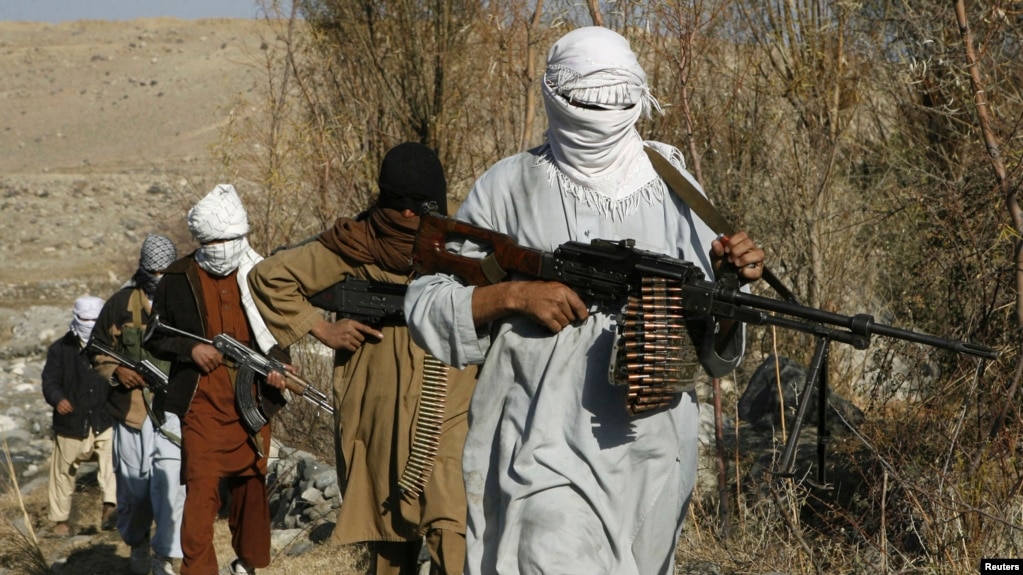
Taliban fighters near Nangarhar Province, Afghanistan in 2010. (Reuters)

I must say, "Yes, yes, a thousand times yes," to Defense Secretary James Mattis, who yesterday said that "40 years is enough" of foreign powers in Afghanistan. Speaking to reporters before a meeting with India defense chief Nirmala Sitharaman, Mattis explained that "it’s time for everyone to get on board, support the United Nations, support Prime Minister Modi, support President Ghani and all those who are trying to maintain peace and make for a better world here."

That's a nice sentiment, but you have to wonder if even Mattis fully appreciates just how wrong our Afghan mission has become -- and just how quickly it got that way.

We aren't a colonial power, although colonialism is exactly what we've been trying to do in Afghanistan since 2002 -- remake it in something like our image. Even worse, Afghanistan is not a colonizable country*. At least, not without wanton killing and destruction that would make Curtis LeMay blanch.

So it's been time to leave for a long time already.

And if the Taliban comes back and welcomes in ISIS or al Qaeda? Well, what of it? In 2001 we showed how to topple a government there, on the cheap, in six weeks or less -- or your next invasion is free!

And the "next invasion" wouldn't have been a joke.

If necessary, we could have replayed something like the 2001 invasion a half-dozen times by now, for a fraction of what we've spent in blood and treasure on our haphazard and doomed attempt at semi-colonization.

Best of all, we wouldn't have poured untold hundreds of billions of dollars into a corrupt and useless government -- which only incentivizes more bad behavior. Why make peace, or even govern decently, when the other guy keeps giving you money not to?

A sane Afghan policy would have consisted of kicking in the door, killing a bunch of bad guys, and then skedaddling until and unless we have to do it again. Eventually, the Afghans would figure out this terrorist-harboring stuff doesn't pay. What has paid for their elites, quite handsomely, is our perennial occupation.

And let's take this thought a step further.

Inexpensive automatic weapons and copious explosives have become the great democratizer of industrial-level violence. What I mean by that is this: 21st Century tech still gives us the decisive and rapid edge at toppling foreign governments, as we saw in both Afghanistan and Iraq, but easy access to 20th Century small arms makes it nearly impossible to conquer foreign peoples. That's a huge distinction, and one seemingly lost on the Pentagon, the White House, and our endlessly chattering class.

So we need to rethink what it means to win a war, and realign our military aims accordingly.
"Winning," except perhaps in the most extreme cases, should not require completely remaking our former enemies, à la Germany and Japan after WWII. In the parts of the world where we'll be fighting our small wars -- likely in the Greater Middle East and perhaps the failed-or-failing bits of Latin America -- doing so just won't be possible. And if God forbid we ever get in a war with China? Fuggidaboudit. Occupying and remodeling a nation the size of our own and with quadruple our population just ain't gonna happen.

Here's what we can do, and what we already do well: Topple enemy governments, rescue hostages, neutralize enemy movements, provide military aid and comfort, blow up bad guys from afar, etc. In other words: The high-tech, globalized version of Imperial Rome's punitive expeditions. Get in, commit maximum violence, then get back out.
ASIDE: Some missions will require longer commitments, such as rooting out the last of ISIS. But ISIS is also a good example of the importance of not letting a terrorist group fester before we get serious about doing what needs to be done. Had Obama acted aggressively in 2013, the group would have been shut down in weeks or months, rather than years. Small amounts of violence applied early on prevents larger wars later. Just ask the French troops idly watching Nazi Germany reoccupy the Rhineland in 1936.
Imperial Rome didn't have much in the way territorial ambitions -- they did their big conquering as a republic. We're in a similar position. We conquered most of the best bits of North America early in our history, and now we are, to borrow Bismarck's phrase, a satiated power. So while there's no more land we want to take, we do have global interests to protect -- and terrorists who will kill us here if we don't kill them there first. So, like Rome, we should defend what's ours and aid our allies, but without engaging in fruitless quests to Romanize the Germans or Slavs. Or in our case, try to Americanize the Afghans or Iraqis.

So Mattis is right: It's time to get out of Afghanistan. What he's wrong about is the need to negotiate first. Negotiate what, for how long, with whom, and to what achievable end?

No, it's time to pack our things and go, without leaving so much as a goodbye note on the nightstand.

*It's a convenient shorthand, but it's wrong to call Afghanistan a country. Afghanistan is a region on the map where neighboring countries aren't.

MACRON ENCOUNTERS THE WRATH OF THE FRENCH PEOPLE


Backlash protests against Macron’s globalist policies


December 5, 2018
Related image
Protesters in Paris during the third “Yellow Vest” rally on December 1, 2018.(Veronique de Viguerie/Getty Images)
French President Emmanuel Macron is learning the perils of defying the will of his own people to serve a globalist agenda. The French president has made it his mission to lead the globalist assault on fossil fuels to stem further increases in man-made greenhouse emissions. He vowed to “make our planet great again,” after sharply criticizing President Trump’s decision to withdraw the United States from the Paris Agreement on Climate Change. After convening the first One Planet Summit in Paris in late 2017 and continuing to lecture the world about the need for drastic actions to combat climate change, President Macron showed he was willing to use his own people as sacrificial lambs. He proposed steep fuel-tax increases to take effect this January, with more to come in subsequent years. The purpose was to raise the price of carbon use in France. The French people rose up in protest at a level not seen since the 1960’s. The yellow vest became the symbol of what began as protests by French drivers against higher diesel fuel prices. The protests, at times accompanied by violence, expanded to vent the grievances of ordinary people feeling squeezed by President Macron’s economic agenda. At first, President Macron would not budge. However, as the street protests in Paris and other parts of France showed no signs of abating, the Macron administration decided Tuesday to suspend the planned fuel tax increases for at least 6 months. France’s Prime Minister Edouard Philippe, not the aloof President Macron, announced the suspension decision. “No tax is worth jeopardizing the unity of the nation,” Prime Minister Philippe said in explaining the government’s decision.
President Trump had acted on the belief that the Paris Agreement on Climate Change represented a windfall to many other countries to the detriment of American workers. President Macron, on the other hand, remained oblivious to the economic plight of his own people, who have been plagued by an overall jobless rate of 8.9%. The unemployment rate for French youth (ages 15–24) has been reported to be as high 24.6 percent.
It is worth noting that Prime Minister Philippe, not President Macron, used the phrase “the unity of the nation” in announcing the suspension decision. That’s likely because Mr. Macron sees himself more as a global citizen than as a citizen of the country he was elected to lead. Unity of the world to address climate change is more important to him than preserving the unity of the French nation by focusing primarily on the economic needs of the French people.
The French president showed his disdain for nationalism in remarks he delivered during a gathering in Paris of world leaders, including President Trump, to observe 100 years since the end of World War I. In a line that only a globalist could mouth, President Macron exclaimed, “Patriotism is the exact opposite of nationalism. Nationalism is a betrayal of patriotism.” Mr. Macron thought he was being clever with his veiled attack on President Trump’s “America First” policies. However, President Trump is having the last laugh. President Trump’s approval rating stands at approximately 46 percent currently. President Macron's approval rating has fallen to 23 percent. The French people, who are suffering under President Macron’s globalist stewardship, presumably prefer a “France First” president.
“Yellow vests” protesters block the road leading to the Frontignan oil depot in the south of France on Dec. 3. (Pascal Guyot/AFP/Getty Images)
Mr. Macron repeats the same globalist tripe that we heard for eight years from former President Barack Obama and one that we hear all the time at the United Nations. It is based on the false premise of multilateralism for its own sake. Globalists make the red herring argument that the only alternative to multilateralism as they define it is what Mr. Macron in his speech to the UN General Assembly last September described as a unilateralist “survival-of-the-fittest approach.” The real choice, however, is between manic multilateralism that globalists believe in, versus rational multilateralism that respects national sovereignty.
Manic multilateralism is an uncritical deference to global norms and consensus, irrespective of the consequences. The late Charles Krauthammer described its ultimate purpose:  to “reduce American freedom of action by making it subservient to, dependent on, constricted by the will–and interests–of other nations. To tie down Gulliver with a thousand strings… the slavish pursuit of ‘international legitimacy’ – and opposition to any American action undertaken without universal foreign blessing.”
Rational multilateralism, on the other hand, strives for cooperation among sovereign nations to address issues of common concern. It seeks to promote possible practical solutions to manageable problems transcending national boundaries that are fair to all concerned. The United States remains among the most dedicated multilateralist countries in the world. Americans generally support international cooperation when effective in fighting a common threat such as global terrorism. The United States has contributed more than any other member state to the United Nations (including its specialized agencies and peacekeeping operations) to keep it in business. We work through NATO in Europe, the Organization of American States in Latin America, and U.S. alliances with Asian countries. We actively support the work of the World Bank, the International Monetary Fund, and legions of multilateral relief agencies. None of that has fundamentally changed under President Trump. What has changed, however, is that President Trump will not tolerate funding arrangements that unfairly burden American taxpayers. He also refuses to go along with UN-endorsed agreements not ratified by the U.S. Senate that he deems to be contrary to the best interests and security of the American people. As President Trump explained in his speech to the UN General Assembly on September 25, 2018, “America will always choose independence and cooperation over global governance, control, and domination.”
Globalists reject the primacy of national sovereignty. They believe, for example, that by reflecting some sort of international “consensus” in resolutions and other "official" documents the United Nations has conferred special moral, political and even legal legitimacy on the Iran nuclear deal and the Paris Agreement on Climate Change. They argue that the Trump administration cannot disavow these agreements without threatening to destroy the whole so-called “rules-based international order.”  Nonsense. President Trump saw through the fundamental flaws in both agreements, neither of which are legally binding treaties ratified by the U.S. Senate. He properly decided to act in the interests of the people who elected him.
The Iran nuclear deal provided a cash windfall to the dictatorial Iranian regime, which its leaders are using to fund their ballistic missile program and to fund terrorism. Obama’s deal kicked the Iran nuclear can down the road by not stopping altogether the regime’s ability to develop nuclear weapons and the capability to deliver them. The Paris climate agreement allowed China, the largest emitter of greenhouse gasses, to do virtually nothing of consequence to reverse the growth of its emissions until 2030. At the same time, Obama pledged further rapid cuts in U.S. emissions with job-destroying new regulations. He also agreed to a redistributionist funding scheme that would have picked American taxpayers’ pockets to the tune of billions of dollars a year starting in 2020. The fact that other nations’ leaders are either too stupid to heed President Trump’s warnings, or have too much a stake in selfishly reaping economic gains for their own countries, does not mean that President Trump must accede to their wishes.
President Trump by word and deed has laid out a vision that lauds international cooperation where warranted but under which he “will never surrender America’s sovereignty to an unelected, unaccountable, global bureaucracy.”  President Macron, in his own speech to the UN General Assembly last September, claimed that he does not believe “in one great globalized people.” He believes deeply, he said, “in the sovereignty of peoples.” Note that he uses the expression “sovereignty of peoples” rather than “national sovereignty.” He said in the same speech that “in no way will I yield the principle of the sovereignty of peoples to nationalists.” The French people rioting in the streets of France against President Macron’s proposed globalist fuel tax increases want a more nationalist president who shows true concern for their well-being as French nationals. Mr. Macron should start taking a lesson from Mr. Trump’s playbook if he wants to remain president of the sovereign French nation.

The Ministry of Trans Truth


The language of transgenderism is designed to silence dissent

By Heather Brunskell-Evans
5 December 2018
Image result for 1984 movie
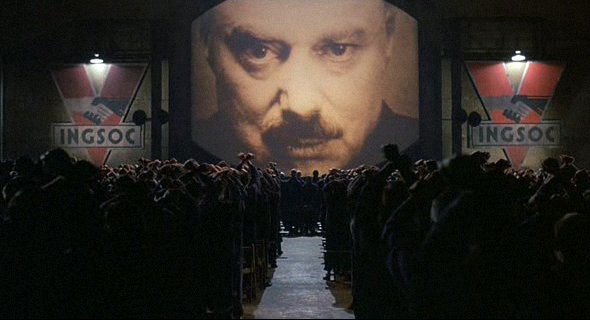
1984
I’m fascinated by the way that concepts apparently arise from nowhere, take hold in the popular imagination, then become naturalised and beyond question.
One such idea is that individuals can be ‘born in the wrong body’, so that men can be women. Since there is no scientific evidence,neuroscientific or otherwise, that an unambiguously biological male can in fact be female, how can society have arrived at a stage where people who question the claim ‘trans women are women’ are routinely labelled Nazis, bigots and transphobes?
A new nomenclature has arisen which bifurcates women into two groups, ‘cis’ (biological women) and ‘trans’. This performs a linguistic sleight of hand that enables the idea that some men can actually be women. But no matter how cultivated their ‘feminine’ outward appearance, ‘trans women’ (as opposed to transsexuals) have penises.
The concept that ‘trans women’ are women, and that we must believe this is so because they affirm it, is further translated into the idea that ‘trans women’ are even more oppressed by the patriarchy than their ‘cis’ sisters. Progressives routinely turn with vitriol on women who challenge this newly minted ‘Truth’, labelling them ‘trans-exclusionary radical feminists’ (TERFs), no matter how moderate, thoughtful, or indeed trans-friendly those women are.
This new definition of womanhood is having bizarre effects on our political institutions. The Labour Party now admits men who identify as women on to all-women shortlists, without any necessity for a gender-recognition certificate. A number of these men have successfully applied to the Jo Cox Women in Leadership programme.
Then there’s the misogyny. Labour continues to support Lily Madigan in the role of women’s officer for Rochester and Strood, despite his bullying of gender-critical feminists and other women. One of his latest Twitter missives states that TERFs ‘can go fuck themselves’, and he is allowed to say this with impunity not only by the party but by Twitter itself.
Labour also (briefly) appointed the ‘trans woman’ Munroe Bergdorf to an LGBT working group. Bergdorf had recently been quoted inGrazia saying that many feminists are biological essentialists, because we apparently ‘summarise women as walking vaginas… a similar approach to that of misogynists’.
A kind of informal Ministry of Truth has emerged around the trans issue – or rather, a Ministry of Propaganda, since it is responsible for the falsification of historical events and biological facts. In keeping with the concept of doublethink, the ministry creates and then spreads ‘Truth’ through the new language of ‘cis’ and ‘trans’.
And in a chilling twist, it is now feminists who are the alleged extremist misogynists, purely because they don’t allow human beings with penises to control the political narrative. The statement – both mundane and tautological – that women don’t have penises is now considered inflammatory. When a feminist group distributed stickers making this observation recently in Liverpool, the police opened an investigation.
A cold wind of authoritarianism is blowing through our allegedly progressive, liberal-democratic society. When telling the truth becomes hate speech, when oppression becomes ethics, when non-facts become Truth, we all better look out.
Heather Brunskell-Evans is an academic philosopher and spokeswoman for FiLiA. Her latest book, Transgender Children and Young People: Born In Your Own Body, is available now. Follow her on Twitter: @brunskellevans

Tuesday, December 04, 2018

One-Eyed-Jack Law

By Victor Davis Hanson
December 4, 2018
Image result for robert mueller
Robert Mueller’s legal team may write a damning report on Trump’s ethics, based mostly on flipping minor former business associates of Trump’s and transient campaign officials by threatening them with long prison sentences.
So far, we know that the U.S. government decided to intervene in a political campaign to help one candidate and to smear the other — under the pretext of Russian “collusion.” And so it hired or made use of spies and informants including Hank Greenberg, Stefan Halper, Felix Sater, and others to contact Trump campaign officials to catch them in supposed collusion traps. It enlisted the help of foreign intelligence agencies, specifically the British and Australians. It misled FISA courts into granting warrants to spy on Americans and, post factum, threatened long prisons sentences with those surveilled and interviewed. And as a result, it has so far found no collusion but may well find some misleading statements in hundreds of hours of testimonies from the likes of Michael Cohen, Michael Flynn, Paul Manafort, George Papadopoulos, Paul Manafort, and perhaps Jerome Corsi and Roger Stone.
Mueller cannot fulfill the hype of the past 18 months, which forecast that the “all-stars,” the “dream-team,” and the Mueller “army” would make short work of the supposedly buffoonish Trump by proving that he colluded with Russia to swing an election. Collusion, remember, was hyped as doing what the Logan Act, the emoluments clause, the 25th Amendment, impeachment, media frenzy, and assassination-chic rhetoric had not.
By indicting a number of minor characters on charges that so far have nothing to do with collusion — for purported crimes mostly committed after the special-counsel appointment — Mueller has emphasized the quantity rather than the quality of indictments.


Mueller was tasked to find collusion (itself not a crime) committed during 2015 and 2016, not to prompt more purported crimes by setting perjury traps, and purported obstruction-of-justice liabilities. If in May 2017 the frenzied media had known that 18 months later Mueller would end up targeting the provocateur Roger Stone and Inforwars’ Jerome Corsi, it would have been sorely humiliated.
Mueller has already weaponized politics, making a crime out of the tawdry business of opposition research — but only sort of, since his interests in doing so are highly selective. And so his chief legacy will have little to do with whatever he finds on Donald Trump. He has already established the precedent that there is now no real equality under the law, at least as Americans once understood fair play and blind justice.
Once Mueller deviated from his prime directive of determining whether Donald Trump colluded — sought help from the Russian to win the 2016 election in exchange for the promise of later benefits — and turned to indicting political operatives for supposedly giving false testimonies about political shenanigans and engaging in illegal business practices, lobbying, and tax avoidance, he either knowingly or unknowingly established a precedent that the serial misdeeds of 2016 would be treated unequally under the law.

Russian Collusion
The 13 Russian nationals whom Mueller symbolically indicted will not come to the U.S. to face trial, and they will certainly not be extradited, a fact known by Mueller.
Yet Christopher Steele, a British subject and de facto unregistered foreign agent, is imminently indictable and extraditable. He was paid through two firewalls (Fusion GPS and Perkins Coie) by Hillary Clinton to tap Russian sources to compile a smear dossier on her opponent, with the intent of warping the U.S. election — a classic example of foreign-agent interference in an American campaign. If we were to take away that one purchased document, then the FISA court warrants, the informants, and all the CIA, FBI, and DOJ machinations would likely have disappeared or never arisen.
Obama-administration officials Bruce Ohr (whose wife worked on the dossier) at Justice, James Comey at the FBI, and John Brennan at the CIA all in some manner colluded with Steele, either directly or indirectly, to monitor the Trump campaign and then to seed the dossier among government agencies and courts, both to ensure its leakage and to brand it with a stamp of official seriousness, warranting investigations and media sensationalism.


Speaking of FBI informants, quite a different one has testified that Putin’s Russia had sent millions of dollars to a U.S. lobbying firm, in hopes of persuading Secretary of State Hillary Clinton to use her influence with federal officials to close the so-called Rosatom Uranium One deal. At roughly the same time, Bill Clinton was given a lucrative half-million-dollar fee for speaking in Moscow, while millions of dollars from Uranium One investors had poured into the Clinton Foundation — which after Clinton’s 2016 defeat has seen its contributions precipitously decline.
In another related matter of Russian collusion, Barack Obama in a hot-mic exchange with then–Russian president Dmitry Medvedev, in March 2012, eight months before Obama’s reelection, asked Medvedev to give Putin the assurance that if Putin would give Obama “space” during his reelection campaign, then Obama in turn would have “more flexibility” on issues such as missile defense “after my election.” That quid pro quo was clarified six months later when an unusually quiet Putin darkly announced to the world that any deployment of U.S.-led NATO missile-defense systems would be targeted against Russia in a Romney administration — as compared with the actions in supposedly less bellicose Obama presidency. And after expressing no interest in interfering in an American election, Putin clearly made it evident that he preferred an Obama victory.

Most observers now laugh off this entire sordid incident. But in the present climate, if Donald Trump had been caught in a similar hot-mic exchange with a top Russian official, and had Putin later expressed the idea that he preferred a Trump presidency to a Democratic one, and had U.S.-led missile-defense efforts abruptly stalled in Eastern Europe, then Robert Mueller would be hot on Trump’s trail — given that such an overt quid pro quo, benefiting a candidate’s reelection campaign, is far more explicit than anything Mueller’s 18-month investigation has yet turned up.

Perjury and False Testimony
Bruce Ohr filed a false federal disclosure affidavit, in that he did not reveal, as required, that his wife was employed by Fusion GPS to work on the Steele dossier. Nor did he disclose that after the election he had been in contact with Steele, offering his help in the effort to find proof of collusion.


James Comey, along with Andrew McCabe, Rod Rosenstein, and Sally Yates, at various times submitted requests to a FISA court that deliberately never disclosed that their chief evidence for such surveillance was 1) paid for by Hillary Clinton (instead, the applications claimed vaguely that it was a product of generic opposition research, likely and by design confusing its Republican-primary origins with its maturity under Clinton auspices), 2) used as a circular source for news accounts produced in turn to establish its fides, 3) unsubstantiated and either not fact-checked or found to be impossible to verify, 4) compiled by an author already dismissed by the FBI as a unreliable asset.
Either Andrew McCabe or James Comey has likely perjured himself; or both may have. Their conflicting testimonies about leaking information to the media, and the relative importance of the Steele dossier for FISA court warrants, cannot be reconciled.
Comey deliberately leaked memos of presidential conversations to a friend in the media; these memos were classified as secret or confidential and perhaps in at least one case actually contained classified info. His intent, according to his own testimony, was to alter the nature of a Department of Justice investigation by having a special counsel appointed. A short time later Robert Mueller, a friend and former working associate of Comey’s, was appointed as the special counsel.
John Brennan has never fully or honestly explained his conversations with Senator Harry Reid concerning the Steele dossier, or Reid’s purported version that Brennan was briefing Reid in order to make sure that such intelligence — leaked widely — would be seeded with the FBI. And the FBI has never explained whether, at the height of a presidential campaign, it hired informants to be inserted into the Trump campaign or to associate with minor Trump officials in order to draw them out about the Steele dossier or set perjury traps for them.
Brennan has never faced consequences for admittedly lying under oath to Congress about collateral drone damage and surveillance of Senate staff computers; James Clapper likewise admittedly lied to Congress about NSA surveillance and faced no consequences. Has any administration ever had its two top intelligence officials admit to lying under oath on matters of national policy and security, and with impunity to a congressional committee?
Both Huma Abedin and Cheryl Mills likely lied to FBI investigators about the extent of their knowledge of Clinton’s private email server. In Orwellian fashion, FBI investigator Peter Strzok claimed that Abedin and Mills were not truthful to the federal investigators, while he concluded that General Michael Flynn, Trump’s first national-security adviser, had been.
Yet Flynn was targeted for giving false information to federal officials, while Abedin and Mills never were. Of course, Clinton herself lied when she insisted that she had transmitted no classified information over the server, and she destroyed over 30,000 emails Congress had subpoenaed — all without any criminal liability.

Obstruction of Justice and Conflicts of Interests
Bruce Ohr, while a Justice official, was negotiating with Fusion GPS on a variety of matters, while his spouse was employed by Fusion founder Glenn Simpson to research the Steele dossier.
Glenn Simpson deliberately misled a congressional investigation about his post-election efforts to collect anti-Trump information, and he sought to disguise the fact that he was actively operating with donors and activists to smear the Trump team during their transition to the White House.
No one has ever seriously investigated the activities of Daniel Jones, who worked for Fusion GPS and was apparently a former FBI agent and staff investigator for Senator Dianne Feinstein, and who as a freelancer received millions of dollars from anti-Trump donors (reportedly Silicon Valley activists and George Soros) and, after Trump was president, in March 2017, met with FBI officials to share information gathered by his Penn Quarter Group designed to harm the Trump presidency.
Andrew McCabe’s spouse was a recipient of huge contributions from a Clinton-affiliated super PAC for her 2016 candidacy in Virginia, and not much later her husband was tasked to exercise key oversight in the Clinton email scandal.
Rod Rosenstein, who appointed Robert Mueller as special counsel, signed a dubious FISA warrant request. Such surveillance was apparently useful to his appointee Robert Mueller’s ability to issue indictments against some minor Trump officials. Was Mueller ever going to examine whether Rosenstein improperly helped produce a FISA court warrant that was central to Mueller’s own investigation?
The Podesta brothers had long had ties with Russian business interests approximating Paul Manafort’s own Russian connections, and John Podesta occupied a key role in Hillary Clinton’s reelection bid (analogous to Manafort’s in the Trump campaign) — with the difference that he was never fired but played an increasingly important role in Clinton’s campaign efforts.

Leaking and Improper Transfer of Classified Information
In addition to the leaking by the FBI’s two top officials, James Comey and Andrew McCabe, we know that several top Obama officials requested the unmasking of names of U.S. citizens swept up in FISA surveillance. And some names then found their way into the media cycles before the election and during the presidential transition.
In the voluminous text correspondence between Lisa Page and Peter Strzok, there is also reference to a planned joint “media leak strategy with DOJ” to smear Carter Page. Again, no one has been charged with the deliberate leaking of government documents and communications to the media for the expressed intent of harming a presidential campaign and transition.
CNN, relying on government and congressional officials’ leaks, falsely reported a number of damaging Trump stories: that transition official Anthony Scaramucci had colluded with a Russian financial official about easing sanctions; that Donald Trump knew in advance of a meeting that his son had agreed to with a Russian operator; that Trump Jr. knew in advance of the contents of the WikiLeaks Podesta trove; and that James Comey would testify to Congress that he never had assured Trump he was not under investigation.
These were all fake news stories, prompting retractions or resignations, and they came from deliberate government leaks floated to harm the Trump administration — in the manner later outlined in a September 5, 2018 op-ed by a Trump-administration official who admitted to actively impeding, with other veritable saboteurs, the actions of the president, in the belief that many of the “resistance” like him in the executive branch had a moral duty to thwart the actions of a duly elected president.

One-Eyed Jacks
In sum, a group of Obama-administration officials and appointees in 2016 colluded with Clinton-campaign personnel to ensure that Donald Trump would not be elected in 2016 and, later, to make sure that his transition and early presidency would fail or be aborted.
Such officials took great risks (some 25 FBI and DOJ officials subsequently retired or were fired or reassigned) in working with foreign interests such as Christopher Steele and by extension his Russian sources to break U.S. laws and to attempt to warp an election — in the belief that there was almost no chance that Trump would be elected. In a Clinton presidency, their beyond-the-call-of-duty insurance work would be rewarded rather than punished.
These efforts failed to stop Trump from winning, and they did not derail his transition. Yet deliberate leaking to the media of the now-stale Steele dossier, “research” from FBI informants planted among minor Trump campaign officials, and improperly warranted government surveillance of former Trump-related officials created a media frenzy, out of which a fired James Comey helped engineer a new lever against Trump: the special-counsel investigation.
In the subsequent 18 months, Robert Mueller assembled a highly partisan team of lawyers and investigators that included a number of Clinton donors; lawyers who had represented either the Clinton Foundation, a Clinton aide, or an Obama official; and rank anti-Trump partisans such as Lisa Page and Peter Strzok. Their task was to investigate the charges of Russian collusion as planted by those in government and Christopher Steele and his abettors.
Such skullduggery poses the question of whether Mueller’s investigation has been simply derailed by partisanship. Or has it effectively served as a deliberate distraction from the felonious behavior of dozens of Obama-administration and Clinton-campaign officials — all determined to ensure, by any means necessary, that Trump would never be president?

Monday, December 03, 2018

America Is Headed For Military Defeat in Afghanistan


November 30, 2018
Related image
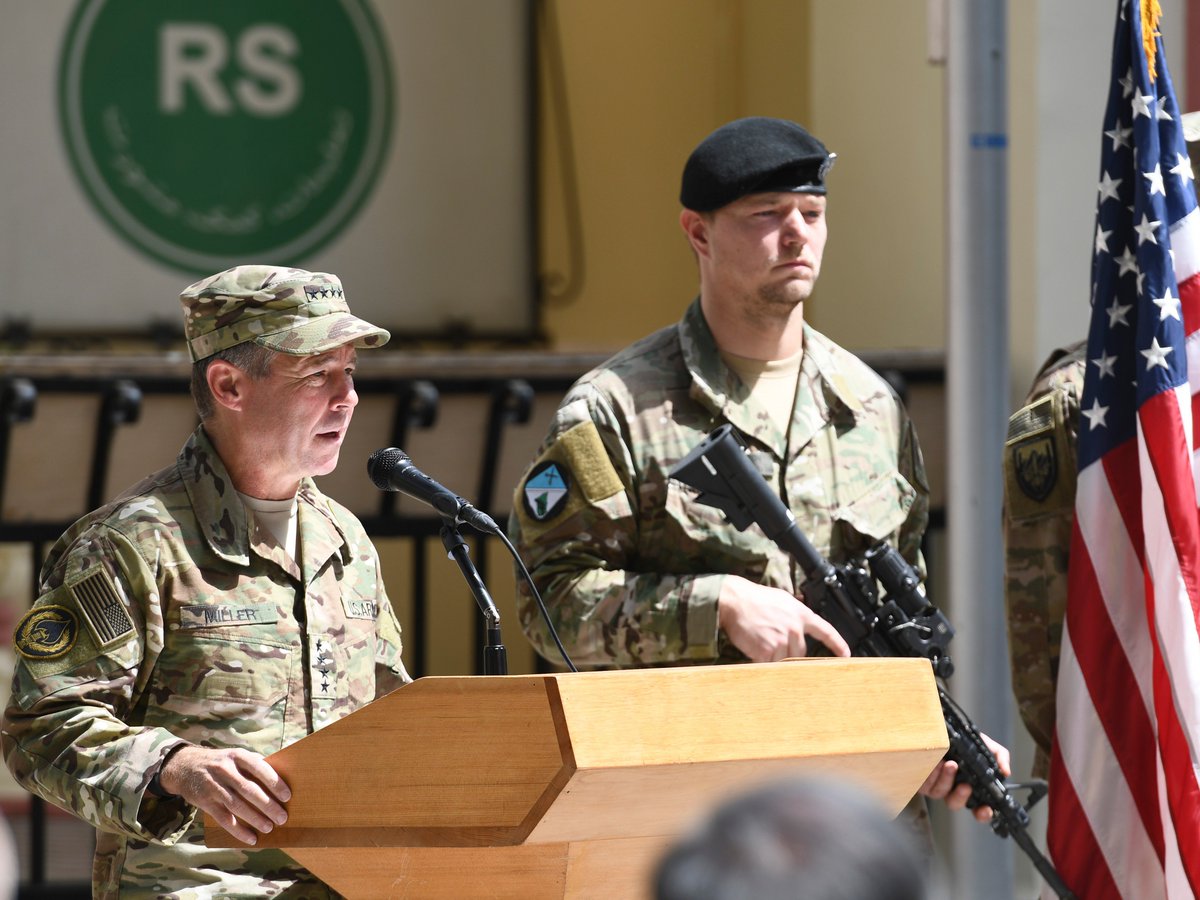
General Scott Miller, the top U.S. commander in Afghanistan
There’s a prevailing maxim, both inside the armed forces and around the Beltway, that goes something like this: “The U.S. can never be militarily defeated in any war,” certainly not by some third world country. Heck, I used to believe that myself. That’s why, in regard to Afghanistan, we’ve been told that while America could lose the war due to political factors (such as the lack of grit among “soft” liberals or defeatists), the military could never and will never lose on the battlefield.
That entire maxim is about to be turned on its head. Get ready, because we’re about to lose this war militarily.
Consider this: the U.S. military has advised, assisted, battled, and bombed in Afghanistan for 17-plus years. Ground troop levels have fluctuated from lows of some 10,000 to upwards of 100,000 servicemen and women. None of that has achieved more than a tie, a bloody stalemate. Now, in the 18th year of this conflict, the Kabul-Washington coalition’s military is outright losing.
Let’s begin with the broader measures. The Taliban controls or contests more districts—some 44 percent—than at any time since the 2001 invasion. Total combatant and civilian casualties are forecasted to top 20,000 this year—another dreadful broken record. What’s more, Afghan military casualties are frankly unsustainable: the Taliban are killing more than the government can recruit. The death rates are staggering, numbering 5,500 fatalities in 2015, 6,700 in 2016, and an estimate (the number is newly classified) of “about 10,000” in 2017. Well, some might ask, what about American airpower—can’t that help stem the Taliban tide? Hardly. In 2018, as security deteriorated and the Taliban made substantial gains, the U.S. actually dropped more bombs than in any other year of the war. It appears that nothing stands in the way of impending military defeat.
Then there are the very recent events on the ground—and these are telling. Insider attacks in which Afghan “allies” turn their guns on American advisors are back on the rise, most recently in an attack that wounded a U.S. Army general and threatened the top U.S. commander in the country. And while troop numbers are way down from the high in 2011, American troops deaths are rising. Over the Thanksgiving season alone, a U.S. Army Ranger was killed in a friendly fire incident and three other troopers died in a roadside bomb attack. And in what was perhaps only a (still disturbing) case of misunderstood optics, the top U.S. commander, General Miller, was filmed carrying his own M4 rifle around Afghanistan. That’s a long way from the days when then-General Petraeus (well protected by soldiers, of course) walked around the markets of Baghdad in a soft cap and without body armor.
More importantly, the Afghan army and police are getting hammered in larger and larger attacks and taking unsustainable casualties. Some 26 Afghan security forces were killed on Thanksgiving, 22 policemen died in an attack on Sunday, and on Tuesday 30 civilians were killed in Helmand province. And these were only the high-profile attacks, dwarfed by the countless other countrywide incidents. All this proves that no matter how hard the U.S. military worked, or how many years it committed to building an Afghan army in its own image, and no matter how much air and logistical support that army received, the Afghan Security Forces cannot win. The sooner Washington accepts this truth over the more comforting lie, the fewer of our adulated American soldiers will have to die. Who is honestly ready to be the last to die for a mistake, or at least a hopeless cause?
Now, admittedly, this author is asking for trouble—and fierce rebuttals—from both peers and superiors still serving on active duty. And that’s understandable. The old maxim of military invincibility soothes these men, mollifies their sense of personal loss, whether of personal friends or years away from home, in wars to which they’ve now dedicated their entire adult lives. Questioning whether there even is a military solution in Afghanistan, or, more specifically, predicting a military defeat, serves only to upend their mental framework surrounding the war.
Still, sober strategy and basic honesty demands a true assessment of the military situation in America’s longest war. The Pentagon loves metrics, data, and stats. Well, as demonstrated daily on the ground in Afghanistan, all the security (read: military) metrics point towards impending defeat. At best, the Afghan army, with ample U.S. advisory detachments and air support, can hold on to the northernmost and westernmost provinces of the country, while a Taliban coalition overruns the south and east. This will be messy, ugly, and discomfiting for military and civilian leaders alike. But unless Washington is prepared to redeploy 100,000 soldiers to Afghanistan (again)—and still only manage a tie, by the way—it is also all but inevitable.
The United States military did all it was asked during more than 17 years of warfare in Afghanistan. It raided, it bombed, it built, it surged, it advised, it…everything. Still, none of that was sufficient. Enough Afghans either support the Taliban or hate the occupation, and managed, through assorted conventional and unconventional operations, to fight on the ground. And “on the ground” is all that really matters. This war may well have been ill-advised and unwinnable from the start.
There’s no shame in defeat. But there is shame, and perfidy, in avoiding or covering up the truth. It’s what the whole military-political establishment did after Vietnam, and, I fear, it’s what they’re doing again.
Danny Sjursen is a U.S. Army officer and a regular contributor to The American Conservative. He served combat tours with reconnaissance units in Iraq and Afghanistan and later taught history at his alma mater, West Point. He is the author of a memoir and critical analysis of the Iraq War, Ghostriders of Baghdad: Soldiers, Civilians, and the Myth of the Surge. Follow him on Twitter @SkepticalVet.
Note: The views expressed in this article are those of the author, expressed in an unofficial capacity, and do not reflect the official policy or position of the Department of the Army, Department of Defense, or the U.S. government.
Related:

US commander unscathed in shooting that killed top Afghan official-

Sunday, December 02, 2018

George H.W. Bush, 41st president of the United States, dies at 94


By Karen Tumulty
https://www.washingtonpost.com/local/obituaries/george-hw-bush-41st-president-of-the-united-states-dies-at-94/2018/11/30/42fa2ea2-61e2-11e8-99d2-0d678ec08c2f_story.html?utm_term=.abb4bbf590ee
November 30, 2018


Image result for george h w bush
Former president George H.W. Bush arrives at Jeb Bush's inaugural prayer breakfast at Florida A&M University in Tallahassee, Fla. on Jan. 5, 1999. He is accompanied by his wife Barbara and son George W. Bush.
George H.W. Bush, the 41st president of the United States and the father of the 43rd, was a steadfast force on the international stage for decades, from his stint as an envoy to Beijing to his eight years as vice president and his one term as commander in chief from 1989 to 1993.
The last veteran of World War II to serve as president, he was a consummate public servant and a statesman who helped guide the nation and the world out of a four-decade Cold War that had carried the threat of nuclear annihilation.
His death, at 94 on Nov. 30, also marked the passing of an era.
Although Mr. Bush served as president nearly three decades ago, his values and ethics seem centuries removed from today’s acrid political culture. His currency of personal connection was the handwritten letter — not the social media blast.
He had a competitive nature and considerable ambition that were not easy to discern under the sheen of his New England politesse and his earnest generosity. He was capable of running hard-edge political campaigns, and he took the nation to war. But his principal achievements were produced at negotiating tables.
“When the word moderation becomes a dirty word, we have some soul searching to do,” he wrote a friend in 1964, after losing his first bid for elective office.
Despite his grace, Mr. Bush was an easy subject for caricature. He was an honors graduate of Yale University who was often at a loss for words in public, especially when it came to talking about himself. Though he was tested in combat when he was barely out of adolescence, he was branded “a wimp” by those who doubted that he had essential convictions.
This paradox in the public image of Mr. Bush dogged him, as did domestic events. His lack of sure-footedness in the face of a faltering economy produced a nose-dive in the soaring popularity he enjoyed after the triumph of the Persian Gulf War. In 1992, he lost his bid for a second term as president.
“It’s a mixed achievement,” said presidential historian Robert Dallek. “Circumstances and his ability to manage them did not stand up to what the electorate wanted.”
His death was announced in a tweet by Jim McGrath, his spokesman. The cause of his death was not immediately available. In 2012, he announced that he had vascular parkinsonism, a condition that limited his mobility. His wife of 73 years, Barbara Bush, died on April 17.
The afternoon before his wife’s service, the frail former president summoned the strength to sit for 20 minutes in his wheelchair before her flower-laden coffin and accept condolences from some of the 6,000 people who lined up to pay their respects at St. Martin’s Episcopal Church in Houston.
Mr. Bush reached the Oval Office under the towering, sharply defined shadow of Ronald Reagan, a onetime rival whom he had served as vice president.
No president before had arrived with his breadth of experience: decorated Navy pilot, successful oil executive, congressman, United Nations delegate, Republican Party chairman, envoy to Beijing, director of central intelligence.
Over the course of a single term that began Jan. 20, 1989, Mr. Bush found himself at the helm of the world’s only remaining superpower. The Berlin Wall fell; the Soviet Union ceased to exist; the communist bloc in Eastern Europe broke up; the Cold War ended.
His firm, restrained diplomatic sense helped assure the harmony and peace with which these world-shaking events played out, one after the other.
In 1990, Mr. Bush went so far as to proclaim a “new world order” that would be “free from the threat of terror, stronger in the pursuit of justice and more secure in the quest for peace — a world in which nations recognize the shared responsibility for freedom and justice. A world where the strong respect the rights of the weak.”
Mr. Bush’s presidency was not all swords-to-plowshares. He ordered an attack on Panama in 1989 to overthrow strongman Manuel Antonio Noriega. After Iraqi dictator Saddam Hussein invaded Kuwait in the summer of 1990, Mr. Bush put together a 30-nation coalition — backed by a U.N. mandate and including the Soviet Union and several Arab countries — that routed the Iraqi forces with unexpected ease in a ground war that lasted only 100 hours.
However, Mr. Bush decided to leave Hussein in power, setting up what is widely regarded as the worst and most fateful decision of his son’s presidency a dozen years later.
In the wake of that 1991 victory, Mr. Bush’s approval at home approached 90 percent. It seemed the country had finally achieved the catharsis it needed after Vietnam. A year and a half later, only 29 percent of those polled gave Mr. Bush a favorable rating, and just 16 percent thought the country was headed in the right direction.
The conservative wing of his party would not forgive him for breaking an ill-advised and cocky pledge: “Read my lips: No new taxes.” What cost him among voters at large, however, was his inability to express a connection to and engagement with the struggles of ordinary Americans or a strategy for turning the economy around.
That he was perceived as lacking in grit was another irony in the life of Mr. Bush. His was a character that had been forged by trial. His was an exemplary story of a generation whose youth was cut short by the Great Depression and World War II.
The early years
George Herbert Walker Bush was born in Milton, Mass., on June 12, 1924. He grew up in tony Greenwich, Conn., the second of five children of Prescott Bush and the former Dorothy Walker.
His father, an Ohio native and business executive, became a Wall Street banker and a senator from Connecticut, setting a course for the next two generations of Bush men to follow. His mother, a Maine native, was the daughter of a wealthy investment banker.
At a prep school party during the 1941 Christmas season, he spotted a girl in a red-and-green dress. He asked another boy to introduce him to Barbara Pierce, whose father was head of the McCall’s publishing empire.
“I thought he was the most beautiful creature I had ever laid eyes on. I couldn’t even breathe when he was in the room,” Barbara Bush would later say, adding, “I married the first man I ever kissed.”
Prescott Bush wanted his son to go right to Yale upon graduation from Andover. But Mr. Bush said his father had also insisted that privilege carried a responsibility to “put something back in, do something, help others.”
Related image
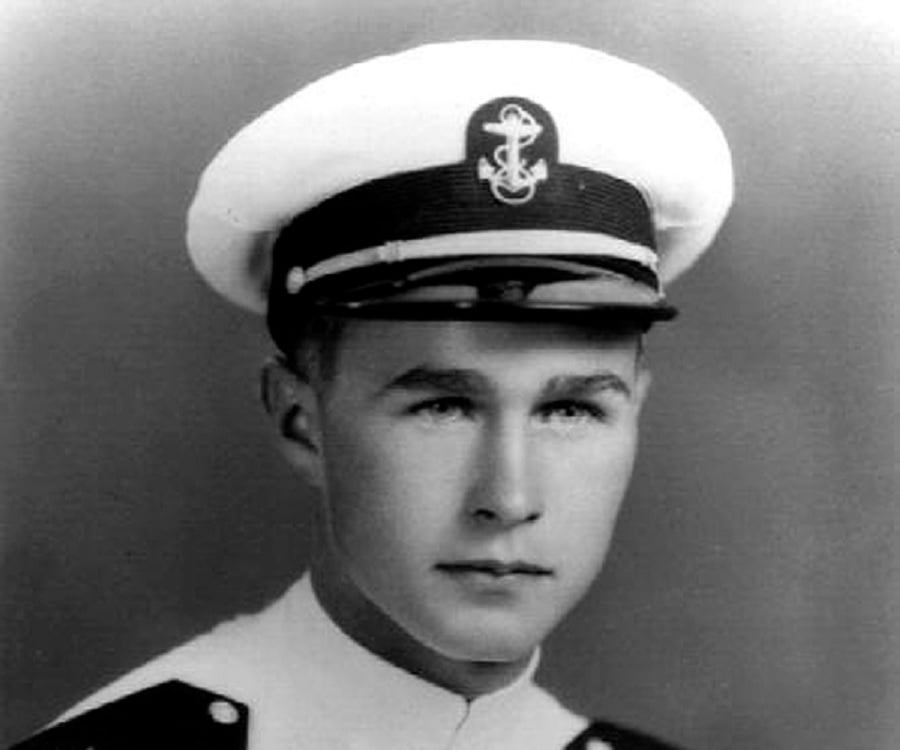
His own time to serve came on his 18th birthday, when he enlisted in the Navy; within a year, he received his wings and became one of the youngest pilots in the service.
Sent to the Pacific, he flew torpedo bombers off the aircraft carrier San Jacinto. On Sept. 2, 1944, his plane was hit by Japanese ground fire during a bombing run on Chichi Jima in the Bonin Islands in the western Pacific. He pressed the attack even though his plane was aflame.
Mr. Bush bailed out over the ocean and was rescued by a submarine. His two crewmen were killed. The future president was awarded the Distinguished Flying Cross.
After the war, he went to Yale, where he was a member of Skull and Bones, the university’s storied secret society, and captain of the baseball team. Barbara took their baby son, George W., to the games.
In 1948, following his graduation, he was rejected for a post he wanted with Procter & Gamble. So he moved to Texas to go into the oil business and snagged an entry-level job through a family connection.
His political career
Mr. Bush began his political career as chairman of the Harris County Republican Party at a time when being a Republican in Texas was as much an electoral liability as having Northeastern roots.
In 1964, he ran for the U.S. Senate and was defeated by Democrat Ralph Yarborough. In 1966, after selling his interest in his oil company, Mr. Bush was elected to the first of two terms in Congress from a House district in Houston.
In 1970, at the request of President Richard M. Nixon, who wanted to shore up Republican fortunes in Texas and elsewhere in the Sun Belt, he made a second run for the Senate and lost to DemocratLloyd Bentsen.
Mr. Bush recruited his longtime friend James A. Baker III — a nominal Democrat with little interest in politics — to run that campaign, in part to help Baker get through his bereavement after the death of his wife. Baker switched parties, and their friendship became an alliance that would help shape policy and politics for decades.
After Mr. Bush’s 1970 Senate defeat, there came a rapid progression of high-profile jobs that began when Nixon named him ambassador to the United Nations. In 1973 and 1974, Mr. Bush served as chairman of the Republican National Committee during the waning days of the Watergate scandal that would result in Nixon’s resignation.
After former Georgia governor Jimmy Carter (D) defeated Ford in the 1976 presidential election, Mr. Bush returned to private life and began preparing for his most audacious move yet: a run for president.
During the 1980 primaries, Mr. Bush positioned himself as a moderate, pragmatic alternative to Reagan, and he derided as “voodoo economics” the former California governor’s vow to simultaneously cut taxes, boost defense spending and balance the budget.
Mr. Bush pulled off a surprise win in the Iowa caucuses and declared that he had “big mo’  ” that would carry him to the nomination. Ultimately, he proved no match for Reagan and the conservative forces that had come to dominate the party.
Yet he found another opening at the Republican National Convention that year, when he emerged as the consensus choice to be Reagan’s running mate, after party elders botched an effort to put together a Reagan-Ford ticket.
It took no small amount of adjustment for Mr. Bush to remold himself according to Reagan’s brand of conservatism. Among other things, he changed to Reagan’s positions on abortion and supply-side economics. The comic strip “Doonesbury” later described him as having put “his political manhood in a blind trust.”
The ticket won in back-to-back landslides in 1980 and 1984. Once elected, Mr. Bush maintained a relatively low-profile role as vice president — chairing a number of task forces, offering counsel on foreign policy — while sharpening his bona fides and his political organization to make another run for the presidency.
Mr. Bush was barely brushed by Iran-contra, the major scandal of the Reagan presidency. He said he had been “out of the loop” when decisions were made to sell military equipment to Tehran to gain the release of U.S. citizens held hostage by pro-Iranian terrorists in Lebanon. This was contrary to Reagan’s declared policy of never dealing with terrorists. The profits from the sales were used to provide aid to the anti-communist contra rebels in Nicaragua, which was a violation of U.S. law.
Never fully accepted into the Reagan inner circle, Mr. Bush established some distance from his former boss in his 1988 Republican National Convention speech, when he promised a “kinder, gentler nation.” Reagan’s wife, Nancy, was widely reported to have bristled, asking: “Kinder and gentler than whom?”
In the 1988 election, Mr. Bush’s Democratic opponent was Massachusetts Gov. Michael S. Dukakis, who captured his party’s nomination largely on the strength of the “Massachusetts Miracle,” a surge of technology-driven economic growth.
The Bush campaign turned Dukakis into an object of scorn, raising questions about his patriotism, his competence, his environmental and fiscal records and, most damaging, his attitude toward criminals.
Dukakis had supported a program that allowed convicted murderers in Massachusetts prisons to earn furloughs for good behavior. One such inmate was Willie Horton, who, while on furlough, went to Maryland and raped a woman after beating and knifing her fiance. Dukakis was appalled and promptly shut the program down.
Mr. Bush won the election with 53 percent of the vote. He carried 40 states and received 426 electoral votes. He was the first sitting vice president elected to the nation’s highest office since Martin Van Buren succeeded Andrew Jackson in 1837.
'The vision thing'
As president, Mr. Bush worked long hours and had a penchant for detail. Fred Malek, his campaign manager in 1992, described him as “a guy who wanted to do everything well.” But in stark contrast to his predecessor, Mr. Bush failed to articulate an overarching view of the principles by which he governed.
“The vision thing,” as he called it, eluded him. “Some wanted me to deliver fireside chats to explain things, as Franklin D. Roosevelt had done,” he confided to his diary. “I am not good at that.” He was, he said, a “practical man,” who preferred “what’s real,” not “the airy and abstract.”
Mr. Bush espoused generally conservative economic and social programs: lower taxes, regulatory reform, more support for commercial development and access to foreign markets. He negotiated the North American Free Trade Agreement with Canada and Mexico, a measure that was ratified by the Senate in President Bill Clinton’s first term.
Mr. Bush supported voluntary prayer in public schools and adoption rather than abortion. He also supported gun owners’ rights. “Let’s not take away the guns from innocent citizens,” he said in a speech. “Let’s get tougher on the criminals.”
Faced with Democratic control of both houses of Congress, Mr. Bush followed what became known as his “veto strategy.” In all, he vetoed 44 bills. Ten of them were intended to ease restrictions on abortions. The others concerned various regulatory, tax and spending measures. All but one of his vetoes — of a bill to regulate the cable television industry — were sustained.
But Mr. Bush could not allay suspicions in some quarters that he lacked core beliefs. To critics, particularly in the right wing of the GOP, he seemed willing to say whatever was necessary to get elected.
His was a team of seasoned advisers who forged an active but pragmatic foreign policy and set a less divisive and less ideological course on domestic matters.
Mr. Bush placed a high value on loyalty and on cultivating relationships that became part of the through line of his career.
Chief among those relationships was his friendship with Baker, who at various points served as Mr. Bush’s campaign manager, secretary of state and White House chief of staff. Baker also did stints as Reagan’s chief of staff and treasury secretary, and in the messy aftermath of the 2000 presidential election, led the Republican team monitoring the Florida recount that put Mr. Bush’s eldest son, George W. Bush, over the finish line.
Other relationships would also link the two Bush presidencies. After his first choice for defense secretary, Sen. John G. Tower (R-Tex.), failed to be confirmed by the Senate, Mr. Bush tapped another old friend, Richard B. Cheney, a conservative Republican congressman from Wyoming, for the job. For chairman of the Joint Chiefs of Staff, he picked Gen. Colin L. Powell, who had been national security adviser in the Reagan White House.
Baker, Cheney and Powell played central roles in U.S. interventions in Panama and the Persian Gulf during Mr. Bush’s presidency. Cheney and Powell went on to hold high office in George W. Bush’s administration: Cheney as vice president and Powell as secretary of state.
One of Mr. Bush’s more impulsive selections was his choice of Dan Quayle, the junior senator from Indiana, to be his running mate in 1988. Mr. Bush made the move without consulting even his closest aides, leaving his campaign unprepared for what followed.
There were immediate questions about Quayle’s service in the Indiana National Guard during the Vietnam War. He also attended law school at Indiana University during that period. Critics noted that he had never practiced law and suggested that he had used the Guard to avoid the draft.
Quayle never fully laid to rest those questions or the broader doubts about his qualifications for stepping into the presidency. While the vice president earned high marks as the administration’s emissary to conservatives, Mr. Bush wrote in his diary that he “blew” the decision on Quayle in 1988. But in 1992, he refused to replace him on the ticket.
Mr. Bush made two nominations to the Supreme Court. The first was David H. Souter, a federal appeals court judge, who was confirmed without difficulty. The second was Clarence Thomas, an African American who was a member of the U.S. Court of Appeals for the District of Columbia Circuit.
Thomas was appointed to succeed Thurgood Marshall, the first African American to serve on the high court. Anita Hill, a former aide to Thomas, accused him of sexual harassment. After rancorous hearings by the Senate Judiciary Committee in 1991, the full Senate confirmed him by a vote of 52 to 48, the closest margin since the 19th century.
Foreign policy triumphs
It is not possible to appreciate the signature foreign policy achievements that occurred on Mr. Bush’s watch without viewing them in the context of the four decades that preceded them.
In the era after World War II, the United States sought to contain Soviet influence around the world. The nation fought divisive and demoralizing wars in Korea and Vietnam, headed the NATO alliance that stood against Warsaw Pact forces in Europe and engaged in a global nuclear standoff with the Soviet Union that infused the era with existential dread.
Within a year of Mr. Bush’s inauguration, the international situation changed almost beyond recognition. What Reagan had called “the evil empire” was collapsing, and the Soviet Union was lurching toward dissolution.
Mr. Bush approached the changing world with a view that was pragmatic rather than ideological. He had little faith in the so-called Star Wars anti-ballistic missile system that Reagan believed would protect the nation from nuclear attack, so he signed two nuclear disarmament agreements with Moscow.
Related image
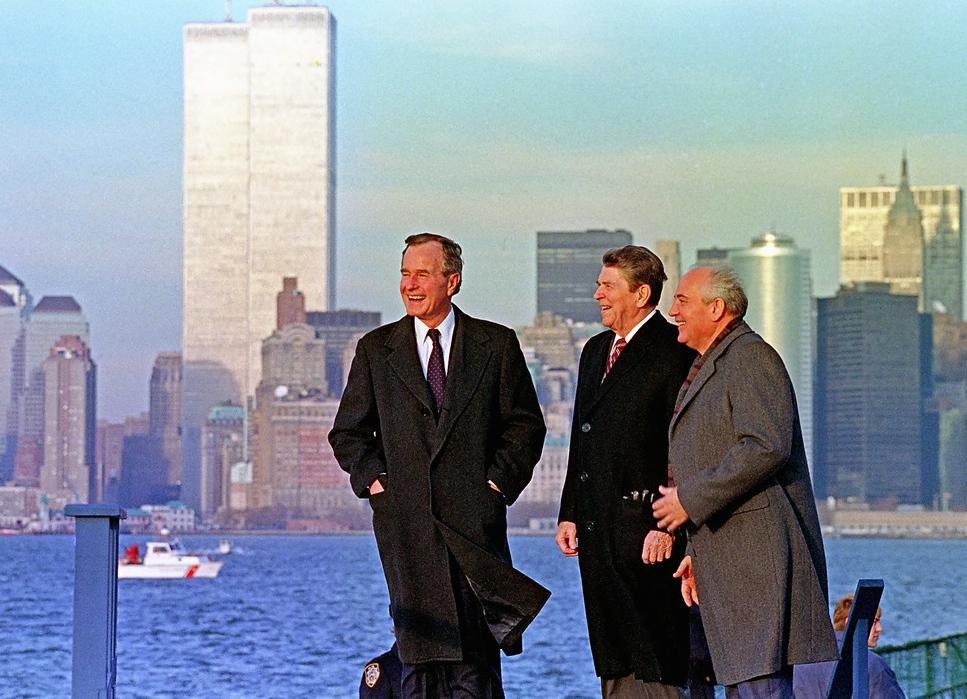
As Reagan had, Mr. Bush saw an ally and a kindred spirit in Mikhail Gorbachev, the leader who tried to reform the Soviet system through “glasnost” (openness) and “perestroika” (economic reform). Mr. Bush said that he “could sit down and just talk. I thought I had a feel for his heartbeat. Openness and candor replaced the automatic suspicions of the past.”
In June 1989, Gorbachev announced that he would not enforce the Brezhnev Doctrine, under which Moscow reserved the right to intervene in satellite countries. Poland, Hungary and Czechoslovakia were escaping Soviet domination; the Baltic states were moving toward independence. Hungary opened its frontier with Austria. Thousands of East Germans used this route to defect to the West.
On Nov. 9, 1989, the Berlin Wall, a symbol of communist oppression, was breached. East Germany collapsed. Two years later, the Soviet Union voted itself out of existence.
Mr. Bush played a quiet role as Gorbachev and Chancellor Helmut Kohl of West Germany settled terms for the reunification of Germany. The deal was sealed when Kohl agreed to pay billions of dollars to shore up the Soviet economy and cover the cost of removing Soviet forces.
Mr. Bush helped convince Kohl that a reunited Germany should stay in NATO. Similarly, he agreed with French President François Mitterrand that German reunification was a matter for the Germans to decide and that only a “united Europe” could keep Germany in check. Prodded by former president Nixon, Mr. Bush gave economic aid to Moscow.
He was always mindful of Russian sensibilities. When the Berlin Wall came down, he told reporters that he did not “think any single event is the end of what you might call the Iron Curtain.”
Mr. Bush also put a high premium on stability, as evidenced by his measured — critics said inadequate — reaction to the Chinese crackdown on demonstrators in Tiananmen Square in June 1989. He suspended military sales and contacts with China but sent national security adviser Brent Scowcroft and Lawrence Eagleburger, the undersecretary of state, to Beijing to discuss the situation with Chinese leaders.
“What I certainly did not want to do was completely break the relationship we had worked so hard to build since 1972,” when Nixon opened relations with China, Mr. Bush wrote in his memoirs. “We had to remain involved, engaged with the Chinese government, if we were to have any influence or leverage to work for restraint and cooperation. While angry rhetoric might be temporarily satisfying to some, I believed it would deeply hurt our efforts in the long term.”
In Latin America, Mr. Bush ended U.S. support for the contra guerrillas in Nicaragua. In exchange for economic aid, the leftist Sandinista government agreed to free elections. A year later, the Sandinistas were voted out of power.
Reagan’s preoccupation with communism in Central America had been a major factor in the Iran-contra scandal. As Mr. Bush left office, he issued pardons for Caspar W. Weinberger, Reagan’s secretary of defense, and five other officials who had faced charges for their Iran-contra roles.
Invading Panama
Although he had an affinity for diplomacy, Mr. Bush’s legacy will also be defined by his decisions to go to war.
In Panama, Noriega had once been a valued anti-communist asset of the United States, and for several years, he was on the CIA payroll. As his power grew, he enriched himself at the expense of the Panamanian public, and he became a kingpin in the drug trade. In 1988, he was indicted on drug charges by a U.S. grand jury.
On May 7, 1989, Noriega overturned an election in which his slate was defeated. Three days later, the opposition staged a protest.
The Bush administration moved to protect the Panama Canal and U.S. civilian and military personnel living in the canal zone. In October, a Panamanian major staged an anti-Noriega coup. It was immediately suppressed. Tensions between the United States and Panama escalated, as U.S. forces in the canal zone were beefed up.
On Dec. 16, 1989, one day after Panama passed a resolution saying a state of war existed between the two countries, a U.S. Marine officer was killed by Panama Defense Force troops as he and three other officers drove away from a PDF roadblock. A Navy officer and his wife who witnessed the incident were taken into custody, interrogated and threatened with death before being released.optional trim ends
On Dec. 17, 1989, Mr. Bush ordered U.S. forces to invade. The action began Dec. 20 with air attacks and a nighttime parachute assault.
The fighting was over in a matter of hours. On Christmas Eve, Noriega took refuge in the residence of the papal nuncio, where he remained for 10 days, during which time U.S. forces surrounded the Vatican Embassy and blasted it with ultra-loud rock music. Noriega surrendered Jan. 3, 1990. He was flown to Miami, tried and convicted of an array of drug offenses.
Desert Storm
Mr. Bush met his greatest international challenge in the Persian Gulf, where U.S. policy was driven by an insatiable need for oil. In 1990, about a quarter of U.S. oil imports came from the gulf states. A quarter of that total came from Iraq.
With stability in the region a paramount concern, Iran was regarded as the primary threat to U.S. interests after the revolution that overthrew the shah and brought the Ayatollah Khomeini to power in the late 1970s. The United States turned to Iraq as a counterweight to Tehran and supported it throughout an eight-year war with Iran.
The Bush administration continued the pro-Iraqi policy, and in 1989 the United States provided $500 million in agricultural credits to the Baghdad regime, with plans for more. The aid continued despite increasingly hostile statements directed toward Israel by Saddam Hussein, the Iraqi dictator.
Hussein had long coveted Kuwait, Iraq’s tiny neighbor to the south, which held 10 percent of the world’s known oil reserves. In the summer of 1990, Hussein massed troops on the Kuwaiti border, and in August he invaded.
The United States was caught by surprise, but the response of the Bush administration was quick. Comparing Hussein to Hitler, the president vowed the invasion would not stand. Working the telephones and relying on his personal contacts, he organized the 30-nation Desert Shield coalition.
He obtained a mandate from the United Nations and another from a divided Congress that was haunted by the role it had played in getting the United States into Vietnam. The resolution supporting the war passed the Senate by five votes, with all but 10 Democrats voting against it. Israel was persuaded to stay on the sidelines for fear of offending the Arabs.
The ground war commenced Feb. 24, and Iraqi forces were quickly routed. Mr. Bush ordered a cease-fire 100 hours after the fighting began. He had the support of Cheney, the defense secretary;Gen. H. Norman Schwarzkopf, the allied commander; and Powell, the chairman of the Joint Chiefs.
Iraq agreed not to develop nuclear, chemical and biological weapons, and U.N. inspectors were to monitor compliance. Schwarzkopf let the Iraqis keep their armed helicopters. The fighting had scarcely ended when Mr. Bush came under criticism for not pushing on to Baghdad and deposing Hussein. It was also said that he had urged the Iraqis to revolt and then abandoned the Shiites and the Kurds to a brutal fate.
In the eyes of the American public and its military, the seemingly effortless victory marked the turning of a page from the national mortification endured in Vietnam.
But Hussein remained in power. He still had at his disposal the formidable Republican Guard, which had not been involved in the fighting. When Shiite Muslims in southern Iraq and Kurds in the north revolted, the guard used the helicopters to crush them.
The president’s answer was that the U.N. mandate called for expelling Iraq from Kuwait, not for invading Iraq or eliminating Hussein. “Trying to eliminate Saddam, extending the ground war into an occupation of Iraq,” Mr. Bush wrote in his memoirs, “would have violated our guideline about not changing objectives in midstream, engaging in ‘mission creep,’ and would have incurred incalculable human and political costs.”
Ultimately, it was Mr. Bush’s son who achieved Hussein’s removal from power, with a war that he launched in 2003, on what turned out to be inaccurate information that the Iraqi dictator had weapons of mass destruction.
The second Iraq conflict was part of what the younger Bush called the “war on terror,” launched in the wake of attacks on New York and the Pentagon on Sept. 11, 2001. It led to prolonged military engagements in both Iraq and Afghanistan. Foreign policy experts say the effort had the unintended consequence of further destabilizing the Muslim world, leading to the growth of new terrorist movements.
Mr. Bush bristled at the often-made suggestion that one of his son’s motivations was taking care of the family’s unfinished business. The elder Mr. Bush told Time magazine in 2003 that whether to go to war is a lonely call for any commander in chief: “It is the toughest decision a president has to make, to send the sons and daughters of Americans into harm’s way.”
The Gulf War was not the end of Mr. Bush’s foreign policy legacy. He subsequently sponsored talks in Madrid between Israel and the Palestine Liberation Organization that formed the basis of a decade-long effort to forge peace in the Middle East. In his last days in office, he ordered U.S. troops to Somalia, an African country in political chaos, to deal with devastating famine.
'No new taxes'
As the 1992 presidential election approached, the attention of the American public was turning homeward, and Mr. Bush’s political standing came crashing to earth. Eighteen months after his triumph in Iraq, his approval rating plummeted, and only 16 percent of those polled thought that the country was headed in the right direction.
Mr. Bush had promised a “kinder, gentler” America. He signed into law the Americans With Disabilities Act, a broad civil rights measure that prohibited discrimination in employment, public services and public accommodations on the basis of physical or mental disability. Among his other accomplishments were far-reaching amendments to the Clean Air Act that had been stalled in Congress for years.
But he also was confronted with threats on the economic front, one of which was a menacing budget deficit, which grew from the Reagan years and clouded every aspect of the Bush presidency, domestic and foreign. The president acknowledged as much in his inaugural address when he told the nation, “We have more will than wallet.”
Another major economic problem inherited from the Reagan era was a savings-and-loan industry crisis, which threatened the stability of the banking system. (It was also a source of embarrassment to the president because of his son Neil’s connection to a Denver S&L that failed.) Mr. Bush quickly organized a rescue package.
The deficit proved a greater challenge. Holding the line on taxes was a basic tenet of the conservative wing of the Republican Party, and Mr. Bush made it the centerpiece of his 1988 campaign. Although he feared that it might tie his hands as president, he made a pledge to cheering delegates at the GOP nominating convention:
“The Congress will push me to raise taxes, and I’ll say no, and they’ll push, and I’ll say no, and they’ll push again. All I can say to them is: Read my lips. No new taxes.”
But the nation’s accounts continued to hemorrhage red ink, and Mr. Bush decided he had to act. In 1990, he made a budget deal with the Democratic-controlled Congress, which raised taxes.
When he ran for reelection in 1992, Mr. Bush said the 1990 budget had been “a mistake,” but the damage was done. Conservatives never forgave him.
Meanwhile, as recession ravaged the economy, the president’s efforts to connect with the struggles of average Americans came off as hollow and sometimes laughable. During the Christmas season of 1991, his White House staged an infamous photo op of the president buying four pairs of socks at J.C. Penney and exhorting Americans to shop their way out of bad times. At one point, he told a town hall meeting in hard-hit New Hampshire: “Message: I care.”
In November 1992, Mr. Bush was defeated by a relative newcomer to the national scene, then-Gov. Bill Clinton of Arkansas, whose campaign took as its major theme, “It’s the economy, stupid.”
In a three-way race that included independent candidate H. Ross Perot, Clinton received 43 percent of the vote, to Mr. Bush’s 38 percent and Perot’s 19 percent.
Eight years after Mr. Bush moved out of the White House, however, he and Clinton were on a platform together at a presidential inauguration at the U.S. Capitol — this time at the swearing-in of Mr. Bush’s eldest son, George Walker Bush, as Clinton’s successor.
Only once before had the offspring of a president been so elevated, when John Quincy Adams, the son of John Adams, took office in 1825.
The inauguration of the younger Bush was a triumphant and moving occasion for members of one of the nation’s most prominent political families. Mr. Bush’s second son, Jeb Bush, served as governor of Florida from 1999 to 2007.
Jeb Bush was considered an early front-runner for the 2016 Republican presidential nomination. He lost to New York billionaire Donald Trump, who then defeated another dynastic candidate, Democratic nominee and former first lady Hillary Clinton, to be elected the nation’s 45th president. The elder Bush did not publicly support Trump and was reported to have voted for Clinton. A spokesman declined to confirm those reports, saying that Mr. Bush’s ballot was a private matter.
His private side
In 1988, Mr. Bush gave a list of the qualities he most cherished to Peggy Noonan, who wrote his speech accepting that year’s Republican presidential nomination. They were: “family, kids, grandkids, love, decency, honor, pride, tolerance, hope, kindness, loyalty, freedom, caring, heart, faith, service to country, fair (fair play), strength, healing, excellence.”
Mr. Bush viewed his family as part of his legacy. He was intensely proud of the sons who followed him into public service.
One of his greatest assets was his earthy and blunt first lady. Barbara Bush’s openness and wit made good copy for the media. Answering a question about her matronly appearance, she said, “My mail tells me a lot of fat, white-haired, wrinkled ladies are tickled pink.”
Mr. Bush enjoyed the perquisites of the presidency: Marine helicopters and Air Force One, Camp David, the Oval Office with its view of the Rose Garden in summer and blazing logs in the fireplace in winter.
He was also a hunter, fisherman and dedicated jogger, who was known to run between holes on the golf course for extra exercise. He loved barbecue, horseshoes and country music. He told reporters that he had never liked broccoli and that because he was president, he did not have to eat it.
He possessed a legendary Rolodex and called aides and colleagues at all hours of the day and night. He wrote thousands of notes to world leaders, friends, reporters and ordinary citizens.
The Bushes had six children. In addition to George W. Bush and Jeb Bush, their offspring included Neil Bush, Marvin Bush and Dorothy Bush Koch.
A daughter, Pauline Robinson “Robin” Bush, died of leukemia in 1953, two months before her fourth birthday. Her parents considered her death the greatest sorrow they ever experienced.
“There was about her a certain softness,” Mr. Bush wrote to his mother. “Her peace made me feel strong, and so very important. . . . But she is still with us. We need her and yet we have her. We can’t touch her, and yet we can feel her.”
In the years after the White House, Mr. Bush wrote his memoirs and divided his time between Houston and the family compound in Kennebunkport, Maine, where he was a vestryman of St. Ann’s Episcopal Church. He chose College Station, the home of Texas A&M University, as the site of the George Bush Presidential Library and Museum.
After the earthquake and tsunami that devastated African and Asian nations in 2005, Mr. Bush collaborated with Bill Clinton, his former adversary, to lead private relief efforts that raised nearly $2 billion in the United States.
So close did the unlikely friendship of the 41st and 42nd presidents become, that the 43rd joked, “My mother calls him my fourth brother.”
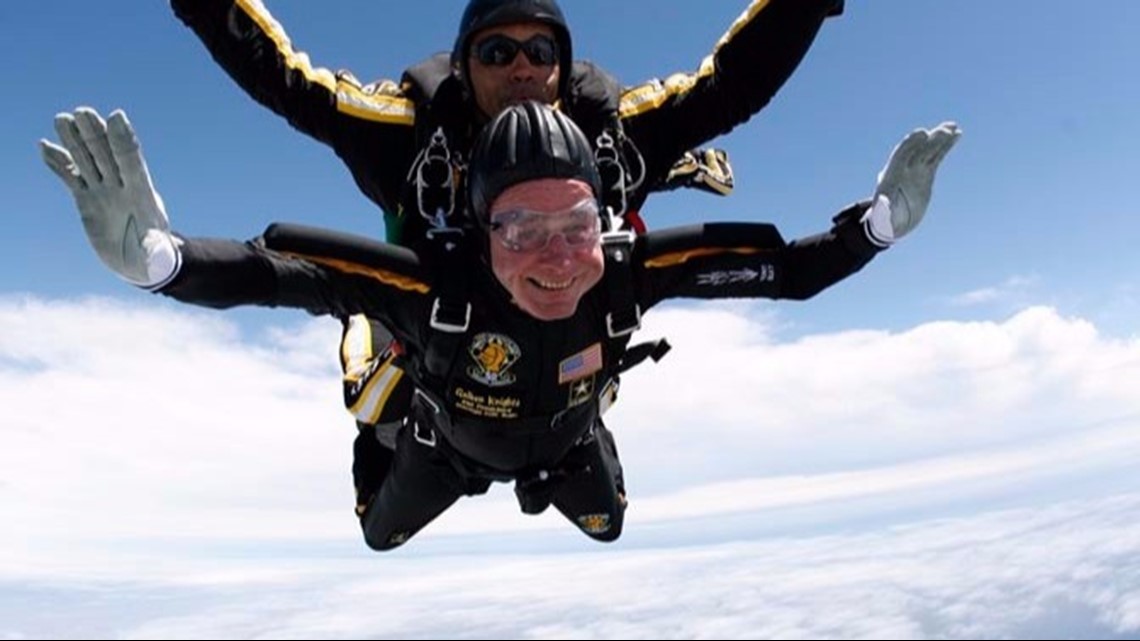
In 1997, Mr. Bush made a parachute jump for the first time since bailing out over the Pacific. He did it again in 2000 to mark his 75th birthday — and still again for his 80th, 85th and 90th ones.
“Old guys can do neat things,” he said.
Image result for george h w bush skydiving
President George H.W. Bush made seven post-presidential parachute jumps, the most recent of which took place on June 12, 2014 in honor of his 90th birthday
J.Y. Smith, a former Washington Post staff writer who died in 2006, contributed to this report.