Monday, April 30, 2018

Macron vs. Reality


Slippery words from a shameless Islam appeaser.


April 20, 2018
Image result for macron congress
House Speaker Paul Ryan and Vice President Mike Pence listen as French President Emmanuel Macron addresses a joint meeting of Congress inside the House chamber in Washington on April 25, 2018. 
(Mandel Ngan / AFP/Getty Images)

Last week, Emmanuel Micron, I mean Macron, visited Washington, had dinner at the White House, and gave a speech on Capitol Hill in which he referred to Hemingway's memoir A Moveable Feast as a novel, identified the French architect of Washington, D.C., whom Americans know as Pierre L'Enfant, by his middle name, Charles, and attributed a famous line by Ronald Reagan to Teddy Roosevelt. The line in question was the one about how freedom is never more than one generation from extinction. 
There was, in fact, a good deal of rhetoric in his speech about freedom – and the threats thereto. Given what's going on in France these days, that would only make sense. But his approach to his country's – and the West's – current travails was, to say the least, curious. On 9/11, asserted Macron, “many Americans had an unexpected rendezvous with death.” How poetic! How French! And how inappropriate a way to refer to thousands of people being evaporated one fine Tuesday morning. He made it sound as if death by jihad had been their divinely ordained destiny – as if the hijackers of those planes had been instruments of some cosmic will. 
Macron went on to mention the “terrible terrorist attacks” that have struck his own country in recent years. “It is a horrific price,” he pronounced, “to pay for freedom, for democracy.” Meaning what? In what sense are such attacks the “price” we “pay for freedom”? Did Macron mean something like what London mayor Sadiq Khan meant when he said that living with terrorism is “part and parcel of living in a big city”? I'd say the people who died on 9/11 were paying for American leaders' blithe indifference to the existential danger of Islam – and that those who've died in more recent terror attacks in Europe were paying for their own leaders' cowardly irresolution (or outright defeatism) on the subject.
Macron might have said something gutsy about his fellow politicians' culpability in the violent deaths of terrorist victims. But no. Like every other European-establishment political hack, he posed as a hero of freedom. Some hero: he didn't dare breathe the word Islam or Muslim or even jihad. But what else to expect from a man who, as French author Guy Millière noted in March, has called for Arabic to taught in every French high school, for “cathedral mosques” to be built in every major French city, and for enhanced measures to be taken against critics of Islam?
In any event, Macron's grandiose Gallic gush about freedom – and about the cherished centuries-long friendship between the American and French people (yeah, tell that to the cab drivers in Paris) – was really just throat-clearing before he got around to the Paris climate-change accords, the Iran deal, and trade. 
Yes, there was this, somewhat later in his oration: “Both in the United States and in Europe, we are living in a time of anger and fear because of these current global threats, but these feelings do not build anything....Closing the door to the world will not stop the evolution of the world. It will not douse but inflame the fears of our citizens.” Qu'est-ce que c'est? The French claim to love logic. But where's the logic here? By “current global threats,” Macron presumably meant jihadist violence and Islamization. But what was Macron telling us to do about them? Nothing. Fear is bad. Anger is wrong. And stronger border controls? They won't work, because they won't stop the world's “evolution.” Is evolution his euphemism for Islamization? 
Macron proceeded to denounce “extreme nationalism.” Clearly, he wasn't talking about actual far-right fascists. No, he meant “America first.” He meant Brexit. “Personally, if you ask me,” he said, “I do not share the fascination for new, strong powers, the abandonment of freedom, and the illusion of nationalism.” In short, he was equating “freedom” with rule by the EU and UN (for which he worked in a plug) and indicting ordinary folks who actually think their countries belong to them. During his rant about climate change, Macron proclaimed that we need to save the Earth because, as he put it, “there is no planet B!” Well, I couldn't help thinking, there's no France B, either. And the fact is that his own country is going down the tubes – and fast. But if you believed his speech, the only threat to liberté, égalité, et fraternitéin the West isn't Islam but “fake news.” 
Yes, he actually used those words. Unlike Trump, however, he wasn't referencing the left-wing distortions of CNN, the New York Times, and their European equivalents. Here's what he said: “To protect our democracies, we have to fight against the ever-growing virus of fake news, which exposes our people to irrational fear and imaginary risks.” Irrational fear? Imaginary risks? Plainly, here was yet another craven European pol who, even as Rome is burning, insists that the problem isn't the arsonists or the fire but the firefighters. How many of the House and Senate members applauding him on Capitol Hill knew that Macron recently called for a law in France that would summarily close down online sources of “fake news” – by which (he's made clear) he means news sources critical of Islam?
Macron's Washington speech, as it happened, came only days after the release of the most comprehensive study yet of Islam in France. Co-sponsored by the Sorbonne, it concluded that the country's second- and third-generation Muslims, who make up seven or eight percent of its population, are increasingly Islamized. Most have no respect for French law and culture; most approve of the Charlie Hebdo massacre. Researcher Olivier Galland said his results were, “to put it mildly, harrowing” – reflective of community values in stark contrast with those of la belle Republique. 
France's mainstream news media reacted to the study with outrage. Galland and his team, charged Le Monde, were “stimatizing Muslims.” But for those not interested in whitewashing Islam, the study only affirmed a grim reality that has been reported worldwide for years in what Macron would call “fake news” media – a reality of no-go zones, mass car burnings, large-scale gang riots, police who are scared to arrest Muslims, firefighters who hesitate to enter Muslim neighborhoods, anti-Semitic attacks that are driving Jews from France, historians who feel compelled to write “Islamically correct” textbooks, and high-school teachers who (as Millière puts it) “go to work with a Qur'an in their hands, to make sure that what they say in class does not contradict the sacred book of Islam.” Oh, and a tiny cohort of brave fools who are put on trial for daring to speak the truth about all this. 
Another recent document is of interest here. On March 19, Le Figaro published a statement signed by about one hundred French intellectuals, among them Alain Besançon, Pascal Bruckner, Alain Finkielkraut, Bernard Kouchner, Robert Redeker, Pierre-André Taguieff, and Ibn Warraq. “Islamist totalitarianism,” they warned, is gaining ground in France by, among other things, representing itself “as a victim of intolerance.” It has demanded – and received – “a special place” in French society, resulting in an “apartheid” that “seeks to appear benign but is in reality a weapon of political and cultural conquest.” The signatories declared their opposition to this silent subjugation and their wish “to live in a world where women are not deemed to be naturally inferior....a world where people can live side by side without fearing each other....a world where no religion lays down the law.”
On the one hand, it was a powerful manifesto – nothing less than a j'accuse for the twenty-first century – whose power lay in its courageous candor about the real threat facing the Republic of France. On the other hand, my response upon reading it was: Well, good luck with that. Some of these intellectuals have been saying these things for a long time; others have joined the chorus more recently. All praise to every last one of them. But nothing will change in France until public proclamations by intellectuals give way to meaningful nationwide action by ordinary citizens – who, alas, in the second and deciding round of last year's presidential election, gave Macron, this would-be Marshal Pétain, twice as many votes as the woman who, whatever her imperfections and her unfortunate parentage, is the closest their poor broken country has to a potential Saint Joan.
Bruce Bawer is the author of “While Europe Slept,” “Surrender,” and "The Victims' Revolution." His novel "The Alhambra" has just been published.

Sunday, April 29, 2018

Alfie Evans Foreshadows a Dark American Future


By David French 
April 26, 2018
Image result for alfie evans vigil
Tom Evans, Alfie, Candle light vigil at the Vatican
How? How does a nation reach a point where it will essentially kidnap a child from a loving, functioning family, yank that same child off life support, deny him care as he unexpectedly fights to stay alive, and then block attempts by a foreign government to rescue him and provide him top-notch care free of charge? How does a great civilization sink to such barbarism and tyranny?
There are two stories one could tell — one about policy, the other about philosophy. The policy story traces events like the nationalization of health care, the evolution of family law, and changing doctrines of individual liberty. It is far less important. Policy flows from philosophy, and the philosophy of government is the central reason for the monstrous injustice in Great Britain.
The scary thing is that the same philosophy could well bring the same injustice to the United States.
Let’s back up a bit — all the way to July 1776. That’s the month when the members of the second Continental Congress signed a Declaration stating the fundamental founding principle of a new republic: that “all men are created equal” and “endowed by their Creator with certain unalienable rights,” including “Life, Liberty, and the Pursuit of Happiness.” Critically, the Declaration of Independence also stressed that governments are instituted “to secure these rights.” [Emphasis added.]
You’ll notice two things right away. First, there is a fundamentally religious element to America’s founding. The primacy of the “Laws of Nature and Nature’s God” is clear and explicit. Second, the state is thus inherently and inescapably subordinate to these laws, existing mainly to protect the rights God grants.
But there are now millions of secularized Americans who have a quite different worldview, as well. The religious element of the founding rings false and hollow to them. They find that the very concept of the “Laws of Nature and Nature’s God” should be subordinate to human-defined morality, which — when stripped of its theistic elements — places even the right to life up for debate. While there are many secularists who revere life and treasure the founding values, there is nothing inherent in secularism itself that protects individual liberty.
With no God over the state, the state then becomes not the defender of liberty but the definer of liberty. You have no freedoms except those bestowed by the state, and those freedoms are defined entirely by the various branches of government. There is no inherent parental authority. There is no inherent right to life. There is only the justice the state gives according to the standards the state dictates.
Marry statism to utopianism, and you create an alluring vision that empowers a host of self-righteous evils, centralization and authoritarianism chief among them. If government defines the good, then where is the room for dissent? Does it not merely impede and complicate the administration of social justice?
Consider what’s happened in Britain. Rather than defending a right to life, the state has decided to define which lives are worth living. Rather than protecting the rights of the child only when the parents have manifestly failed, the state has decided that it is the greater, better parent.
The long-term threat to the American experiment isn’t found in any given policy, but rather in a lost philosophy. Americans are shedding a belief in God at an alarming rate. In elite circles, fundamental liberties like free speech and due process are scorned and mocked as tools of white supremacy or oppressive patriarchies. Federalism has been reduced to a tactic of political opposition, not a bipartisan principle of self-governance.
If you don’t want America to become Britain — if you don’t want to wake up one morning to find the American state defying loving and prudent parents to declare that death is in a child’s “best interests” — I would suggest that you not wait until America is secularized, centralized, and authoritarian. I’d suggest that you not wait until the moment when the state has seized the power to act like Britain, and you’re reduced to arguing, “I know the government can do this, but it shouldn’t.”
Because if you wait until then, you’ve already lost.
Across Twitter, I’ve seen conservatives talk about Alfie’s case and discuss “Second Amendment remedies.” Something about that case has unlocked the revolutionary spirit in some American hearts. And rightfully so. Because if our nation reaches the point where it treats children and families the way Britain has treated Alfie and his parents, then the promise of American liberty will be broken. Is Britain’s present a preview of America’s future? It should grieve us greatly to know that the answer to that question is in serious doubt.
NOW WATCH: ‘Alfie Evans Ordered to Die’

Alfie Evans, R.I.P. -

Thomas Sowell's Last Word?


April 28, 2018

Image result for sowell discrimination and disparities
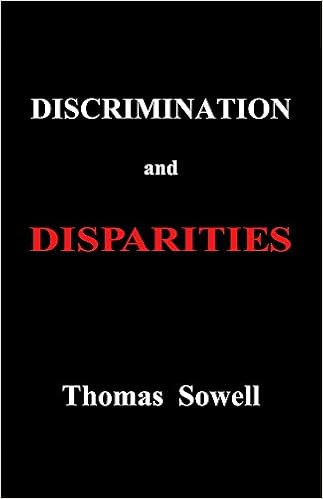
Discrimination and Disparities by Thomas Sowell, Basic Books, New York, March 20, 2018 (143 pages, $28.00, hardcover)   
"Just the facts, ma'am."  That was Joe Friday's interrogation refrain on Dragnet.  The same comment could serve as the subtitle of Thomas Sowell's recent book, Discrimination and Disparities.  Few works on politically explosive topics maintain such a consistent focus on empirical evidence while avoiding rhetorical jabs at opponents.  On the other hand, empirical evidence cuts deep, especially when critics can't protest the author's "nasty" style.  As radio talker Larry Elder observes, "[f]acts are to liberals what kryptonite is to Superman."
Sowell's title, if employed by a member of the leftist intelligentsia, would doubtless imply a causal link between statistical disparities and some form of discrimination – usually racial.  Sowell, by contrast, marshals an abundance of evidence to show that this automatic assumption isn't justified.  Focusing simply on statistical probabilities, Sowell notes that if five prerequisites are needed for success in a particular field, and if the chances are two out of three that any person will have each characteristic, the chance of possessing all five characteristics are still only one in eight – a calculation that helps explain why most pro golfers have never won a PGA tournament while Arnold Palmer, Jack Nicklaus, and Tiger Woods have collectively won over 200 times.  Consequently, "[g]iven multiple prerequisites for many human endeavors, we should not be surprised if economic or social advances are not evenly or randomly distributed among individuals, groups, institutions or nations at any given time."
Among leftists, assumptions about the random distribution of characteristics stand at the heart of various discrimination suits.  Thus, if proportionately more blacks than whites are given tickets for speeding, this statistic provides for them prima facie evidence of racial discrimination.  Sowell, however, offers clear counter-evidence that black drivers are more likely to exceed the speed limit than white drivers.  Similarly, the assumption that racial discrimination is the primary reason blacks are overrepresented in the prison system is countered by noting that blacks are vastly overrepresented as both perpetrators and victims of murder – a crime that's hard to ignore.  Sowell further observes that fatherlessness clearly increases the likelihood that a person will end up in prison since a majority of prisoners "were raised with either one parent or no parent" – a domestic circumstance that applies to well over half of all black kids in the U.S.  
In short, Sowell shows that many or most of the disparities that afflict black Americans are due to behaviors to which even other blacks have objected.  In the early twentieth century, for example, longtime black residents in Chicago publicly chastened new arrivals from the South for behaviors that would, and eventually did, have negative repercussions for the entire community.  Today, however, most black leaders ignore the plain fact that merchants in high-crime areas, for example, must charge higher prices to squeeze out lower profits than stores in safer parts of town – preferring to blame the proprietors' racist-fueled greed.  Only blacks who have moved to safer suburbs can be counted on to protest government policies that again place large groups of unsavory characters near them under the failed assumption that a middle-class environment will alter bad habits.     
Sowell also provides surprising examples of cases where the desire for profit actually won out over racial discrimination.  Early in the twentieth century, for instance, attempts to maintain a white Harlem were foiled by the sheer economic advantages available to landlords who ignored the neighborhood's segregation policy.  Likewise, privately owned municipal transit groups and railroads both protested and often ignored laws that mandated segregated facilities.  Indeed, railroad management actively worked with Homer Plessy to overturn segregation mandates in that industry – a legal effort that ended unsuccessfully with the Supreme Court's Plessy v Ferguson "separate but equal" decision in 1896.  Amazingly, Sowell shows how the profit motive often trumped segregation laws and compacts even in Apartheid South Africa and in the post-bellum South.  Put succinctly, it was racist politicians, not transit owners, who insisted that Rosa Parks sit at the back of the bus.
Sowell focuses additional attention on well intended government policies that succeeded in increasing, not decreasing, racial disparities.  In this regard, significant space is devoted to the negative consequences of minimum wage legislation.  Sowell notes that in 1948, when the minimum wage was economically inconsequential, black teen unemployment was actually lower than white teen unemployment and a fraction of its rate when the minimum wage was substantially increased.  Sowell also laments the destruction of a traditionally stellar black educational institution, Dunbar High School in Washington, D.C., when self-sorting, education-focused black families and students were subjected to politically driven and empirically destructive fantasies that involved bussing and the abolition of selective institutions like Dunbar.
Similarly, in order to racially "unsort" neighborhoods (as they "unsorted" schools), politicians ignored economic facts that explain why banks (including black-owned banks) disproportionately rejected blacks' mortgage applications.  Instead, legislators insisted that financial institutions lower lending standards to achieve the politically desired "random" racial distribution of house ownership – a misbegotten policy whose economic chickens came home to roost in 2009.  Meanwhile, various government laws that decreased the supply of housing and increased prices were "successful" at reducing the Bay Area's black population in 2005 to less than half its number in 1970.
Throughout the book, Sowell discusses a number of other factors that clearly lead to "disparities," leaving aside the kneejerk assumption of racist motives.  Being first-born or an only child, for example, has immense advantages – benefits indicated by the fact that twenty-two of the twenty-nine original Apollo astronauts fell into one of those two categories.  Additionally, in a chapter titled "The World of Numbers," the author debunks several beliefs about disparities rooted in false assumptions about statistics and the lack of economic mobility.  Thus, one study found that 95% of the people in the bottom income quintile were no longer there fifteen years later and that 29% of them had risen to the top quintile.  Elsewhere, Sowell explains how falling "household" incomes are consistent with rising "personal" incomes simply because the average size of a household has fallen substantially.  (A two-person household where each individual earns $20,000 represents a household income of $40,000.  But if both members of the household begin to earn $30,000 and establish separate residences, the income of each one-person household is now 25% below what it was before.)
Much of Sowell's book is recapitulated in his final chapter – and with a bit more rhetorical intensity than previously exhibited.  A few new topics, like the destructive consequences of a grievance mentality and "black English," are also addressed.  
Overall, Sowell's book is a protest against the unfounded assumption that "there would be no disparate outcomes unless there were disparate treatment."  Sowell observes that this ideologically driven assumption "seems almost impervious to evidence."  Accordingly, those who cling to this dogma with religious fervor will likely avoid Sowell's fact-filled book like kryptonite.  Folks with less dogmatic proclivities, however, would do well to peruse this concise work.
Richard Kirk is a freelance writer living in Southern California whose book Moral Illiteracy: "Who's to Say?" is available on Kindle.

Saturday, April 28, 2018

'The Best Cook': In Rick Bragg's book about Momma's table, it's all over but the eatin'


By David Holahan
https://www.usatoday.com/story/life/books/2018/04/23/best-cook-rick-braggs-new-book-mommas-table-its-all-over-but-eatin/490711002/
April 23, 2018

636598424663131566-BEST-COOK-IN-WORLD-jkt.jpg

Those who use Rick Bragg’s latest meander into Southern life as a cookbook will need to gird their culinary loins — and not be a scared of liberal doses of Crisco, fatback drippings, lard, bacon grease, cracklin’ meat and such.

Never mind recipes for indigenous fare like “Squirrel Brains and Scrambled Eggs” or “Baked Possum and Sweet Potatoes.” The latter requires not simply the acquisition of a marsupial, but a live one to be fed “for a week or so” to “flush the nastiness from its system.” Talk about long prep time.

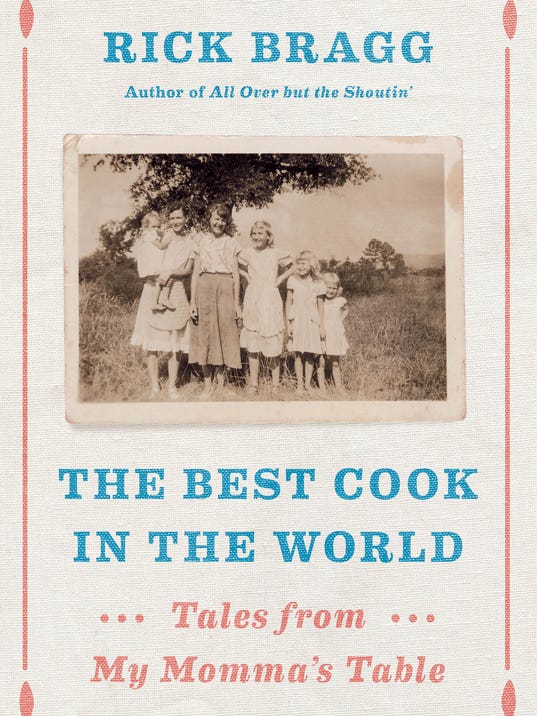
But this isn’t really a cookbook, or even a “food memoir” exactly, as the author suggests. The Best Cook in the World: Tales from My Momma’s Table (Knopf, 512 pp., ★★★★ out of four) is a collection of stories — wonderful, rollicking, poignant, sometimes hilarious tales about how generations of Bragg’s extended family survived from one meal to the next.

To families like his, in the hardscrabble foothills of northeastern Alabama, food was a many-splendored thing. It was love and reward, survival and joy, identity and adventure — an example of the last being the practice of “noodling,” or catching big river catfish barehanded.

Food from the skillets of cooks like the author’s mother, Margaret Bragg, was akin to an established religion: for her the greatest sin, according to her son, was “bland food carelessly prepared, devoid of salt, seasoning, and crisping fat.”

Bragg, a best-selling author (All Over But the Shoutin') and previously a Pulitzer Prize-winning journalist, is a storyteller of the first water. But translating his mother’s meals into recipes presented a challenge, even to a person who grew up on her cooking.

She never opened a cookbook, not once, didn’t own one; her recipes were all in her head, passed down generations, some from before the Civil War. Plus, she didn’t measure out ingredients by cups and teaspoons, but rather by dabs and smidgens and handfuls. She had no use for a timer: she could tell when the cracklin’ cornbread, or what all, was done by smell.

Somehow her son got it all down on paper, sitting with his mother, watching her cook and listening to the stories of who taught her what when, and who taught it to the people who taught it to her. 

In fact, the reader can skip the recipes altogether and concentrate on the stories wrapped lovingly around them — and still get a cooking lesson, how Margaret Bragg made plain food, well-seasoned, taste like a preview of kingdom come.

Take the story of Clem Ritter. Margaret’s father, Charles, was racing home with her and her siblings one evening, hoping against hope not to be too awful late for a dinner his wife had been laboring over most of the day.

Well, wham, he ran straight over Clem Ritter as she was crossing the road, his tire going directly over her head, which Margaret described as being “all whomp-sided.” There wasn’t much they could do for her. So they laid her down by the side of the road, and made a beeline for dinner. Such was the allure of Southern home cooking.

The story startles the author, hearing it for the first time from his 80-year-old mother, as it does the reader. They just laid her by the side of the road? And Clem Ritter, it is revealed at the tail end of the telling, was part of the family. She was Margaret’s dog, named after the victim in a true-crime magazine story.

And, happy to report, Clem Ritter was up and around after dinner, although she was whomp-sided for a spell. 

Today's Tune: Waylon Jennings - The Lost Outlaw Performance

Today's Tune: Waylon Jennings - Rose in Paradise (Live 1987)

An Appreciation of Waylon Jennings


His Mickey Mouse Ways

By Dave Hickey
https://www.texasmonthly.com/articles/his-mickey-mouse-ways/
June 2004 Issue

Related image


So how would you feel? It’s 1958. You’re 21 years old, spinning wax at a two-bit radio station in the middle of West Texas, just happy to be out of the cotton patch and not knowing nothing about nothing but Ernest Tubb, Pepsi-Colas, drive-in movies, and Moon Pies. That’s you, and one day your good friend, who is also your mentor and role model, who also sees a lot more in you than you see in yourself, waltzes into the booth at the radio station, tosses you an electric bass guitar, and tells you to learn how to play it. He’s taking you on a rock and roll tour, starting next month, January of 1959. A week later, your friend flies you to New York City and puts you up in his Greenwich Village apartment. You sleep on the couch, learn the bass, rehearse with the band, and explore Manhattan. The two of you have your picture made in a Grand Central photo booth. Then you climb on the bus, and in a wink, you’re crisscrossing the frozen Midwest in the dead of winter with a bunch of one-hit wonders, playing rock and roll shows in high school auditoriums and basketball gyms.

By the end of January you’ve played twenty shows. Your friend has decided to take you to London as his opening act, which is nice, but that’s a few weeks away, and right now it’s forty below in Duluth and the heat on the bus is out. The tour moves from Duluth to Clear Lake, Iowa, and nobody has any more clean clothes. West Texas boys (on account of their dirty minds) require clean clothing, so your friend charters a plane from Clear Lake to Fargo so you can all find a laundromat before the next night’s show. After the gig in Clear Lake, however, you and the guitar player get wangled out of your seats on the plane.
“You’re not going with me tonight?” your friend asks. “Chicken out?”
You say no, that the Bopper wanted to fly.
“Well, I hope your damned bus freezes up again,” your friend says.
“Well, I hope your ol’ plane crashes,” you say, and, of course, it does.
Your friend is dead, slammed into a frozen wheat field, and you are sitting in a Minnesota truck stop, staring out at the frozen morning, realizing that, just for a minute there, you were sort of about to feel free. Then you feel bad about even thinking that. You’re nothing now in the middle of snowy nowhere, and the promoters don’t want the band to go home. They offer to fly you to your friend’s funeral, first-class. They offer you more money if you’ll stay on the tour. What decides it, though, is that you are a West Texas boy, a bad-weather cowboy, and a man of your word. So, like a fool, you stay, but you get no tickets, first-class or coach. You get no money, and at the end of the tour, in a daze, you go home. You’ve got no friend and you’ve got no future. How do you feel?
Well, first, you’re extremely angry, and second, you don’t care anymore. About some things (like businessmen, lawyers, and bourgeois respectability), you will never care again. You’ve just been awarded a thirty-day doctorate in the music industry, so, from Jump Street, you trust no one except out of laziness and make few friends because, somehow, it seems, you kill your friends, and anyway, you are too far gone for any but the farthest out. From now on you will sit a long way back from the screen and see yourself acting out the roles that life requires of you—son, friend, lover, husband, music star, culture hero—but you will never take any of them very seriously.
You’re plenty screwed up, in other words, and if you had a shrink, if anybody in West Texas had ever heard of a shrink, he would probably diagnose a permanent case of low-grade depression, dissociation, and survivor’s guilt, along with a heavy dose of the old And Suddenly syndrome. He would probably prescribe the pills you’re taking anyway, because at this point, you are morally certain that the better things get, the more likely they are to blow up in your face; that the brighter the sun, the softer the woman, the sweeter the song, the darker the oncoming storm. The future closes like a shutter in these moments, so you live in the music, which has its own time. You can strip it down, tighten it up, clean it off, and ride it like a rising wave. The music, in the moment of its making, sets you free, but it doesn’t cure anything—and, really, it never will.
Related image
With Johnny Cash
ON FEBRUARY 13, 2002, in Chandler, Arizona, Waylon Jennings died in his sleep, at the age of 64, of having lived. Six months later, we gathered in Lubbock at the second annual Buddy Holly Music Festival and Symposium, to remember him together. Waylon’s son, Buddy, was there, as were Richie Albright and Billy Ray Reynolds, his primal rhythm section. Billy Joe Shaver, who wrote the archetypal Waylon songs, showed up, and Lenny Kaye, who co-wrote Waylon, the autobiography, flew in from New York, on leave from his gig with Patti Smith. I flew in from Las Vegas to reminisce about my years as an embedded journalist in the outlaw music movement. We all sat at a long table in a white conference room, like a posse without the sheriff.
In ragtag fashion, we projected the man we knew back onto the things we had heard and, in doing so, imagined the narrative that opens this essay. It seems a plausible one to me, and all the more plausible since we had known Waylon Jennings at various times and in varying circumstances, and clearly, we knew the same man. We recognized his preternatural, ironic self-awareness, although we didn’t all call it that. Billy Joe, in fact, looked at me funny when I used the phrase, but we all located the trick of his charm in his benign sense of his public persona as a crazy cartoon of himself. Somehow, he could throw bullshit at you with one hand and wipe it off with the other. In a world full of evil dudes pretending to be good guys, Waylon was a good guy pretending to be an evil dude and never quite succeeding.
You would see him driving around Music Row in some butterscotch, gold-trimmed, East L.A. pimpmobile, dressed up like the “third outlaw” in a spaghetti western, and you would smile, knowing that no one bore less malice in his heart. Onstage, he would step up to the mike, swinging that Telecaster from his hip, and glare out into the lights, projecting an aura of dark, unrepentant machismo with so much good-hearted irony that the aggression bore only the faintest hint of real menace. Out in the audience, you got the buzz of his sexual charisma, but you knew you were one of the gang, that Waylon was sincere in his insincerity. But it was not all a joke. Some things were taken very seriously indeed, and if you crossed the line, you quickly saw the glint, and things got a little, uh, gritty.
You had to violate the code for this to happen, and those who did invariably thought that it was all a joke, that Waylon was totally inside the ongoing party. Eventually, you figured out that, onstage or off, Waylon Jennings loved the party, the performance, and the costumes. He loved the distance they put around him, but part of him was always standing outside, leaning against the proscenium, watching from the wings and keeping things in line. Proper distinctions had to be drawn, because Waylon had rules. He knew the difference between being a man and being an animal, between being crazy and being insane, between being bad and being mean, between being an outlaw musician, a thieving crook, or just a plain old scuzzball, predatory criminal. He never confused these modes of transgression, and although he lived by the Code of the West—as all West Texans must—Waylon never confused cowboys on the stage and cowboys on the range. He insisted, in his music and in his presence, that these distinctions be observed as a hedge against self-delusion.
It’s clear to me now that Waylon’s discomfort derived in large degree from the self-awareness that made him so appealing.
Having said this, of course, I must concede that guarding oneself against self-delusion has never been a high priority among drug addicts of my acquaintance, myself included. Among this delusional legion, however, Waylon Jennings was by far the least deluded. I remember once, not long after I arrived in Nashville, asking Waylon why the locals took speed rather than smack and barbiturates, like us Manhattan sophisticates did. He said, “Hillbillies and hairdressers take speed because they’re not comfortable, but they still have to work.” That, I thought, just about said it, although it’s clear to me now that Waylon’s discomfort derived in large degree from the self-awareness that made him so appealing.
One night on the highway, in his new shiny bus, on the teetering brink of his pop success, I asked him how he liked his new audiences. “Well, it ain’t exactly living in the love of the common people,” he said dryly. He went on to explain that when you start performing, you play for people who are just like you, and that’s not really performing. Then you perform for people who just like you, and that’s really fun. Then, “if you’re lucky,” you end up performing for people who want to be you, and that’s really not as much fun because these people who want to be you always hate you a little because they’re not you. They secretly want you to fail so you can know how it feels to be them. “Actually,” he said, “it’s not that complicated. There’s a lot of people in a room. One guy’s got the microphone. Everybody else’s got the beer. They’re all having about the same amount of fun.”
I sat there and thought that knowing this much about yourself and your audience was probably not much of a benison for a performer. It does, however, account for some of Waylon’s special virtues. In “Good Hearted Woman,” for instance, there is a line that goes “She loves him in spite of his wicked ways she don’t understand.” Waylon never sang it that way onstage. He always sang “She loves him in spite of his Mickey Mouse ways that she don’t understand.” Because, I think, Waylon knew what wickedness was. He knew he wasn’t it, and his comic vision of Mickey Mouse machismo let everyone in on the joke. He could characterize himself—in a phrase at once self-deprecating and deftly cosmopolitan—as “too dumb for New York City, too ugly for L.A.,” and no other singer in Nashville would even dare.
He could stand in the wings, watching himself onstage, and write, “I’ve seen the world with a five-piece band looking at the backside of me.” I can’t imagine another country performer confident enough in his own masculinity to acknowledge that he knows the band is looking at his butt. And what other leather-clad, asphalt cowboy could walk up to a fellow who’s bitching about somebody being “a goddam queer,” drape his arm around the fellow’s shoulder, snuggle up close to him, and say, sotto voce, “Aw, come on, Hoss. We all just grab onto something warm and worry ’bout the details later.” If you were familiar with the pathological caginess of most Nashville singers, this cowboy hipster candor was scary at first. Then you realized how profoundly Waylon did not care, and ultimately, I think, the magic cloak of this not caring kept him alive for more than six decades. Because the truth was that if Waylon wasn’t on the stage, in the studio, on the bus, or having dinner with his wife, Jessi, he was in trouble or about to be.
His gift to us, of course, had nothing to do with being in trouble, although it got him into some. He made strong music. He sang great songs that said things beautifully and spoke with some precision to the times for which they provided the soundtrack. More than that, of all the artists with whom he is associated, Waylon Jennings had the most passionate sense of how you put things together and what things you leave on the bus. He was an artist, in other words, and an artist of his time. At the exact moment that American painters and sculptors were cutting away the obfuscation and expressive nonsense that had accrued around American art during the post-war period, at the very instant that the kids at CBGB’s were beginning to jettison the pretentious theater that was drowning rock and roll, Waylon was taking country music back where it never had been.
He stripped away the decorative bric-a-brac that had plagued Nashville product for decades and created contemporary roots music in the minimalist tradition—a music that was not really simpler, just stronger, better organized, and more totally focused than anything that came before it. Dispensing with virtually everything but the rhythm track and the vocal, he changed the focus of the sound from the orchestral grandeur of the setting to the sinuous muscularity of the music’s forward drive. Abandoning the pop-hillbilly flummery of contemporary country songs, he embraced the poetic license and compression of lyrics like Billy Joe Shaver’s. In the end, he made a new music that, like the singer of Billy Joe’s song, “left a long string of friends, some sheets in the wind, and some satisfied women behind.”
The trick was in the bass and drums, and Waylon’s producer, Jack Clement, helped with this. As Richie’s drums got sharper and cleaner and the bass got louder, the tempo could get slower and the vocals softer, so everything fell into balance. The songs rode on the bong-bong of this “Cajun march” that Richie and Waylon invented—it sounded like an old four-four but bounced like a bluesy twelve-eight, with hidden triplets flowing through the drum track, accentuated by Waylon’s Telecaster. To Nashville ears, it sounded like nothing or, even worse, like rock and roll, but it moved like a new wheel on an empty highway and still does, although there are no more empty highways and no more hipster cowboys at the Dairy Queen. Even so, history keeps a special place for artists like Waylon who scrape off the paint and carry out the trash, who bet their whole heart on the unadorned shape of the music. You have to be crazy to do it, of course. You know that soon enough the vehicle will be repainted, that stripes, chrome, and all manner of gewgaws will ultimately accrue, but what you have done doesn’t go away. It survives at the heart of the music.
Image result for waylon jennings
AND WAYLON SURVIVES AS WELL, on his records, of course, but most profoundly in the memory of fading gypsies like those who gathered in Lubbock, who never saw bad done so well. This is the picture of Waylon that I carry with me today: We are milling around the crowded greenroom after a show in Atlanta. Waylon is flopped down in the middle of a leather couch, flanked by two exquisitely coiffed, extremely plump white ladies. The ladies are attired in pastel pantsuits, and the three of them make a nice tableau—the gaunt King of Darkness bracketed by two painted and powdered Easter eggs. Waylon sits forward with his elbows on his knees, grinning and soaked with sweat. His hair hangs in wet, greasy ropes, some of it plastered across his forehead. His shirt is stuck to his body, and his wristband is stained with dark blotches. He sinks heavily into the pillows of the couch while the fat ladies seem to float weightlessly. I am imagining the strain the ladies are putting on their knees, trying not to look heavy, when I realize that, at that moment, they are not heavy at all. They are in heaven.
I sit down on the arm of the couch and find the three of them in a deep discussion about the almost insurmountable difficulty of running a beauty salon in Atlanta, Georgia, what with taxes, zoning, sorry help, and the burgeoning complexities of interracial hairstyling. Waylon is contributing what he can, which is more than I would have expected. His limited experience of beauty salons, I surmise, has been considerably enhanced by his wide experience with beauticians. Also, Waylon is a small businessman himself. As he points out, he started off as a very small businessman, picking Texas cotton and getting paid by the pound. The ladies chatter away, giddy but perfectly at ease. They are telling this dangerous outlaw things they have never told anyone, but they are not complaining, as they are wont to do, because Waylon is not a complainer and he is contagious.
Whatever they expected as they tiptoed backstage, it was never this! They are having a conversation with Waylon Jennings! It’s better than the sex they fantasized about and thought they wanted but didn’t really. Waylon knows this. He knows that, as a culture, beauty-salon ladies are incurably romantic and less worldly than they like to pretend. They are not prudes, exactly. They will have sex with you if they must, but what they want is Scarlett and Ashley. They want the rituals of courtly flirtation, and Waylon, with his devil smile and attentive gaze, is giving them that. It occurs to me, as I blatantly eavesdrop, that Waylon is selling a hell of a lot of records with this little gesture. Then I feel bad for having thought it, because Waylon Jennings, in that moment, is clearly happy as hell to be chatting with the fat ladies, behaving like the perfect young cowboy, being thoughtful and curious and whimsically generous, living in the love of the common people.

Friday, April 27, 2018

Politics as a Weapon in the Cause of Islam


April 27, 2018

Image result for keith ellison swearing in
Keith Ellison takes his oath of office with Speaker of the House Nancy Pelosi and his wife, Kim. (Getty Images)

In 2007, in a highly controversial move, Keith Hakim Ellison, the first Muslim congressman, swore his oath of office on a copy of the Koran.  In effect, Ellison rejected the values that unify Americans and instead pledged to follow a religious text that commands Muslims to wage war against secular legal systems.
Today, swearing the oath of office on the Koran and even simultaneously praising Allah have become almost commonplace.  In 2016, Minneapolis Park Board member and Somalian refugee, A.K. Hassan took his oath on a massively oversized Koran and proclaimed his commitment to serve "in the name of Allah."  In 2015, another Somali refugee, Ilhan Omar, elected to the Minnesota House of Representative, swore on the Koran, as did Carolyn Walker-Diallo, the first Muslim woman judge elected to Brooklyn's 7th Municipal District, andAbdullah Hammoud, a Michigan state representative.  
In "Muslim Brotherhood Political Infiltration on Steroids," I described how as early as 1987, FBI information revealed that the Muslim Brotherhood – a Middle East political organization considered a terrorist organization by five Arab countries and Russia – was seeking to "peacefully get inside the United States Government" and accomplish "the ultimate goal of overthrowing all non-Islamic governments."  Several M.B. front groups, including Project Mobilize; the United States Council of Muslim Organizations (USCMO); and Jetpac, Inc., had been created to politically exploit America's Muslim community to achieve supremacist goals set forth in the Muslim Brotherhood's strategic plan, the Explanatory Memorandum.
As if taking a cue from the memorandum, the executive director of the Council on American Islamic Relations (CAIR), Nihad Awad, spoke in January 2016, at the 14th annual Muslim American Society-Islamic Circle of North America (MAS-ICNA) conference in Chicago.  He urged Muslims to "[t]urn your centers, Islamic centers, mosques into registration centers for voters, into polling stations during election time."
Awad intoned that American Muslims can determine "not only the future of you here but the future of America itself."  In 2014, the United Arab Emirates identified CAIR and MAS as terrorist organizations.  CAIR, referred to as "Hamas doing business as CAIR" by former FBI supervisor and M.B. expertJohn Guandolo, had been previously identified as an unindicted co-conspirator in the HLF-Hamas funding trial.  ICNA was listed in the Explanatory Memorandum as one of the Muslim Brotherhood's likeminded "organization of our friends" with the shared goal of destroying America and transforming it into a Muslim nation.
In Canada and Europe and to a more limited degree in the U.S., once devout Muslims are installed in political office, they push for anti-hate speech and anti-Islamopobia laws and even prohibitions against verbatim citing of Islamic texts.  In addition, since sharia-adherent Muslims are commanded to reject man-made law such as the U.S. Constitution, they must endeavor to replace secular law with Islamic doctrine under a caliphate or Islamic government.
Muslims in office also take positions against U.S. interests.  For example, Ellison represents "Little Mogadishu," a neighborhood in Minneapolis with one of the highest concentrations of Somali Muslim refugees.  In 2015, despite active recruiting in his district by the East African terrorist group Al-Shabaab, and the arrest of several Somalis for attempted travel to Syria to join ISIS, Ellison ignored terrorist financing concerns and opposed efforts to curb cash transfers to Somalia.
Meanwhile, new Muslim candidates of questionable motivation and affiliation continue to run for office.  Since my previous article, two are in upcoming races, and one, who was momentarily unsuccessful, is likely to run again.
In Florida's Broward County, Altaf Ahmed is running for county commissioner in an election to be held later this year.  In 2016, he tweeted his attendance at CAIR Florida's 16th annual gala and included a photo of himself with Siraj Wahhaj, an unindicted co-conspirator in the 1993 World Trade Center bombing.  In 1992, Wahhaj said, "If only Muslims were clever politically, they could take over the United States and replace its constitutional government with a caliphate."
Ahmed also praised the gala's organizer, Nezar Hamze, a CAIR leader and Broward County sheriff's deputy.  Hamze has denied the threat of Islamic terrorism and has conducted active shooter training at an al-Qaeda-associated Florida mosque.  He has been actively involved in Islamic Relief Worldwide, anorganization banned by the UAE, Israel, and several Swiss banks for funding al-Qaeda and Hamas.
Another questionable candidate for office, Ammar Campa-Najjar, is running for the 50th Congressional District in eastern San Diego County and Temecula, the seat currently held by Duncan Hunter.  Campa-Najjar's grandfather headed the intelligence wing of Fatah, the organization responsible for the 1972 Munich Olympics massacre and other terrorist attacks against Israelis. 
Campa-Najjar attended an Islamic school at the Masjid Abu Bakr in San Diego but claims to have converted to Christianity.  His views on the Middle East are confounding.  He says he appreciates Israel's need for security but also proclaimsthat "Israel will have to acknowledge its wrongdoings as the sovereign state" and "Palestinians will have to renounce violence and fanaticism, acknowledge their Jewish neighbors and accept new realities."
In the most recent presidential election, Campa-Najjar supported Bernie Sanders, who criticized Israel for its offensive war against Gaza following thousands of rocket attacks and questioned America's level of support for Israeli security.
A third Muslim would-be politician, Dilara Sayeed, ran unsuccessfully as a Democratic candidate for the Illinois House's 5th District and was endorsed by M.B. operative Ellison.  Sayeed recently spoke at a Muslim religious festival (Eid) dinner at the Loyola University Chicago Muslim Student Association and washonored by the Council of Islamic Organizations of Greater Chicago (CIOGC) at an event that featured M.B. and sharia-advocate, Dalia Mogahed, as the keynote speaker.
The Muslim Student Association, a rabidly anti-U.S., anti-Semitic, and anti-Israel group, is the first national Islamic organization established by the Muslim Brotherhood to indoctrinate and recruit Muslim students for terrorist organizations.  Meanwhile, CIOGC members include many M.B. front organizations, such as the Mosque Foundation (M.F.), which has held fundraisersfor individuals and groups associated with the terrorist organization Palestinian Islamic Jihad and Hamas; Islamic Relief USA, which has funded al-Qaeda; and the Muslim American Society, which has propagated materials that degrade women, curse Christians, and call for the murder of Jews and homosexuals.
With endorsements from the Chicago Sun Times and the Chicago Tribune and as a fellow of JetPac, an organization established as an "open call for American Muslims to immerse themselves in local politics," Sayeed is likely to seek political office again and succeed. 
Given the new Muslim candidates and their affiliations, and the likely emergence of even more such office-seekers, Ellison's address at a 2010 MAS fundraiser, hosted by jihad supporter Esam Omeish, now seems an ominous warning.  Said Ellison, "And I am telling you, that with your help, we are able to take the Muslim presence on Capitol Hill from zero to a real player.  And this is what we're trying to do and we got to do it in every state house in America ... positioning Muslims in general to help steer the ship of state in America."
Surely, the ongoing attempt to penetrate American society through political office so clearly documented in Muslim Brotherhood strategic documents published decades ago is proceeding apace.  Despite a stated objective to destroy the United States from within and replace its system of laws and values with Islamic doctrine or sharia, ignorance or willful blindness on the part of Americans insures that their goal is dangerously within reach.

Thursday, April 26, 2018

How to stop the West from committing cultural suicide


By John Podhoretz
https://nypost.com/opinion/
April 25, 2018

Image result for jonah goldberg suicide

It might seem odd to say a book with the alarming title of “Suicide of the West” is an exhilarating call to arms in defense of what is highest and best in our civilization, but Jonah Goldberg’s extraordinary new bestseller is exactly that.
Goldberg says if we don’t veer from the cultural glide path we’re on, with both left and right committed to factually misleading and emotionally suppurating narratives about the innate cruelty and inborn injustice of this country, the greatest force for prosperity and freedom the world has ever known is likely to die. That is the “suicide” of Goldberg’s title.
But since this is something we’re doing to ourselves — a perverse effort to set fire to our own cultural patrimony — it’s also something we can correct.
The key factoid animating “Suicide of the West” is this: For 2,000 years, everywhere on earth, the large mass of humanity lived on the equivalent of $1.90 a day. “Near subsistence living,” Goldberg writes, “defined human habitats for almost all of human history.”
Then something happened. In the 18th century. In Great Britain. It was a complex phenomenon Goldberg calls the Miracle — a new way of thinking about humanity and human achievement and personal liberty that unlocked a hidden door in the possibilities of the species.
The results of the Miracle are astounding. Where once 94 percent of the people on earth survived on less than $2 a day, today only 9.6 percent does. “Around the world, the number of people considered poor has decreased both relatively and absolutely — an incredible feat, given massive increases in population,” Goldberg writes.
We have come to take most of this for granted, so much so that many of us believe the benefits of material prosperity are of little meaning because they’re not shared equally across all societies. We lament our failings rather than dwell on the astonishing fact that, as Goldberg puts it, “If the 200,000-year life span of homo sapiens were a single year, the vast majority of human economic progress would have transpired in roughly the last fourteen hours.”
We do this, as Goldberg observes in the most original observation in his very original book, because the Miracle is unnatural. It’s a human construct. It’s a new thing, and it remains a radical thing, even though we call its loudest expostulants today “conservative.”
Meanwhile, though we tend to think of those who reject the democratic capitalism at the heart of the Miracle as being “progressives,” they are in fact reactionaries seeking to restore a lost way of life and return humanity to a more natural path.
The political liberty we were granted by the Miracle has freed humankind to pursue individual achievement — and it’s a series of unbroken individual achievements that have led the world to unprecedented bounty. But these achievements involve harnessing nature and improving on it. And it’s this aspect of the Miracle that creates a cognitive dissonance in us. It’s not so easy to transcend humanity’s hard-wired pre-modern drives.
As Goldberg says, we’re tribal creatures, intensely social and innately hierarchical, and we find greater meaning within groups. The great ideological fight in the Age of the Miracle is between those who see the rise of the West as a fulfillment of humankind’s potential and those who cannot reconcile themselves to the ways it seems to go against what they think is natural.
The problem is that the rejecters are themselves creating unnatural constructs to try and restore the existence that seems most real to them. They’re building fake tribes through the vehicle of what we now call “identity politics.” And these fake tribes and the demand that we adhere to the arbitrary rules they establish for who is in and who is out are the true drivers of the West’s suicidal impulses.
Goldberg’s answer is so simple it seems too easy, and yet so difficult it seems unachievable. We need to teach and experience gratitude for what we have been given, which means reacquainting ourselves with the philosophical and scientific roots of the Miracle and then passing them on to our posterity. So much is arrayed against this effort, and yet we Americans, we tribal Americans, do long to belong to the American tribe.
In his pathbreaking book, Goldberg makes it clear all we need do to find our place is to understand that we are the beneficiaries of a great tradition that not only speaks the truth about us, but has rewarded us with gifts once beyond imagining. This is the book of the year.