Wednesday, February 14, 2018

So Long, Huck Finn and Atticus Finch


The desire to stamp out disturbing expression is illiberal.

By Kyle Smith — February 14, 2018
Image result for mockingbird huckleberry finn

When the censors come, it will be with a smile on their face and unctuous talk about your feelings on their lips. It’s for your own good, they’ll say. Art that takes a stand against hatred will be confused with hate speech. In the spirit of inclusion they’ll exclude. Don’t you know this isn’t safe? They’ll say, as they rip the book out of your hands.

Yanking The Adventures of Huckleberry Finn and To Kill a Mockingbird from school curricula, the Duluth School District in Minnesota is citing the offensive words they contain. This isn’t censorship, quite: The books will still be available in school libraries. They will simply be removed from lists of required reading lists. Nevertheless, the decision is motivated by the censorious impulse, the desire to stamp out this or that disturbing expression.

Nearly all of the fuel for that impulse is these days provided by the protective Left rather than the outraged Right: “We felt that we could still teach the same standards and expectations through other novels that didn’t require students to feel humiliated or marginalized by the use of racial slurs,” the district’s director of curriculum, Michael Cary, told the Bemidji Pioneer.

No specific complaint triggered the decision, Cary added, but for “a number of years” some students have said the racial slurs make them feel uncomfortable. The Duluth school district thinks so little of its students’ ability to cope with texts containing bad words and bad people that it is acting like the genteel pretend prince in Dirty Rotten Scoundrels who requires his mentally deficient brother, Ruprecht, to put a cork on the end of his fork so he won’t stab himself in the eye with it.

The local NAACP chapter has apparently been pressing for the move for years. Its president, Stephan Witherspoon, told the paper that the books are “just hurtful” and use “hurtful language that has oppressed the people for over 200 years.” But the hurtful language is part of the reason the books have the impact they do. The whole point is to transport the reader to the shameful eras of slavery and Jim Crow. To capture the feel of racist oppression in a bygone day is hardly tantamount to continuing to oppress. You might as well argue that those notoriously graphic (and highly instructive) Drivers’ Ed safety videos many of us saw in high school are making students bleed because they depict bleeding. Yet Witherspoon avers that “there are a lot more authors out there with better literature that can do the same thing that does not degrade our people.”

You could argue that To Kill a Mockingbird isn’t a great book — that it’s schematic, or dated, or that its white-savior storyline is patronizing to black readers. A case could be made that today’s young people findHuckleberry Finn boring or unreadable or too far removed from today’s discussions about race. But if you think Mark Twain and Harper Lee are degrading to black people because their characters use racist language, you’re doing literature wrong.

The Duluth-area NAACP finds itself creating an unlikely echo of Jim Crow fans who sought to kill To Kill a Mockingbird because it made white people feel bad about themselves. 
Denouncing the book as “immoral” and “improper,” the Hanover County School Board in Virginia voted unanimously to remove it from schools in 1966. Lee replied tartly of the board:  “What I’ve heard makes me wonder if any of its members can read. Surely it is plain to the simplest intelligence that To Kill a Mockingbird spells out in words of seldom more than two syllables a code of honor and conduct, Christian in its ethic, that is the heritage of all Southerners.”

Fifty years later in the same state, the Accomack County Public Schools Board yanked the same book and Huckleberry Finn from classrooms and libraries after a single individual, the mother of a student, complained, “There is so much racial slurs in there and offensive wording that you can’t get past that, and right now we are a nation divided as it is.” She added that the books amounted to “validating that these words are acceptable.”

Huckleberry Finn has been subject to removal and bowdlerization since the month after it was published: In 1885, the public library in Concord, Mass., banished the book for its “coarse language.” The Brooklyn Public Library booted it from the juvenile section two decades later, and in 1955, a television production for CBS expunged Jim and any mention of slavery from the story. The American Library Association lists it as the 14th-most banned or challenged book in the United States for the decade ending in 2009. In 2011, a new edition was published that removed the racial slurs.

Literature is supposed to help readers accomplish what Atticus Finch famously advised his daughter Scout to do: “You never really understand a person until you consider things from his point of view . . . until you climb into his skin and walk around in it.” It is doing no favors for young people to quarantine them from books that consider other ages, other mores, other viewpoints — some of which were vile. Learning to grapple with such discomfiting truths is a part of growing up, or used to be. Now the push to turn the whole of literature into a safe space is reinforcing the urge to postpone adulthood indefinitely. As Twain once said, “Censorship is telling a man he can’t have a steak just because a baby can’t chew it.”

— Kyle Smith is National Review’s critic-at-large.

WHEN ELLISON BROKE BREAD WITH FARRAKHAN


Brotherhood-linked congressman publicly rejected Nation of Islam -- but it was all for show.


February 14, 2018

Iranian President Hassan Rouhani, left, invited Rep. Keith Ellison, center, and Louis Farrakhan, right, among others to a dinner in 2013.

Iranian President Hassan Rouhani, left, invited Rep. Keith Ellison, center, and Louis Farrakhan, right, among others to a dinner in 2013.  (Reuters)


After publicly repudiating his former colleagues at the Nation of Islam, DNC deputy chairman Keith Ellison dined with the group’s notorious leader Louis Farrakhan and Iranian President Hassan Rouhani in 2013, according to reports.
The jihadist-friendly Ellison, a Democrat congressman representing Minnesota, is a former co-chairman of the Communist-linked Congressional Progressive Caucus.
Although Ellison was not a senior Democratic Party official in 2013, now that his DNC post makes him much more than a fringe figure in his party, the meeting takes on a greater, darker significance for Democrats, putting them in bed with raging genocidal anti-Semites, Muslim terrorists, and other enemies of the United States.
The private Sept. 24, 2013, event at the One UN Hotel in Manhattan, across the street from the United Nations complex, was reported in the Oct. 2, 2013, issue of the Nation of Islam newspaper, Final Call. Rouhani was in New York for the 68th UN General Assembly. “The dialogue revolved around the Iranian president’s speech and how to move forward in regard to relations with the United States,” according to the newspaper. “Translators were included in the meeting to facilitate communications in English and Farsi.”
"Abdul Akbar Muhammad, international representative of the Nation of Islam, and Supreme Capt. Mustapha Farrakhan were part of the Nation of Islam delegation," the report stated.
Democrat lawmakers attending the event included Ellison, a Muslim, Andre Carson of Indiana, also a Muslim, and Gregory Meeks of New York. Ellison’s participation in the 2013 event was referenced by the Wall Street Journallast week, based on the Final Call article.
Rouhani is president of the Islamic Republic of Iran, which conducts daily “Death to America” and “Death to Israel” rallies, and maintains a repressive police-state apparatus to crush dissent. Members of religions other than Islam are persecuted in Iran and homosexuality is punishable by death. Ellison, of course, is an outspoken supporter of Iran and its nuclear ambitions.
Farrakhan makes no effort to hide his racism, viewing it as an essential component of his religion and as something of which one should be proud.
He has spoken of "white devils" and of “the white man” as the “anti-Christ.” Whites are “vicious beasts” and “the skunks of the planet,” according to Farrakhan. “White people are potential humans ... they haven’t evolved yet.” In a 1997 interview on “Meet the Press,” he stated, “It is not accidental that the black male is in the condition he is in,” and he claim there was a “conspiracy of our government against the black male.”
Farrakhan calls Jews "bloodsuckers" who in his view somehow undermine American blacks. He calls Judaism, which antedates Islam by at least 2,000 years, a "gutter religion," and describes Adolph Hitler as "a very great man."
Farrakhan is an intellectual inspiration to Ellison. Not surprisingly, Ellison has a long, well-documented history of defending Farrakhan and the Nation of Islam, which have been tracked by Discover the Networks.
As early as 1989, Ellison was denying the Nation of Islam was racist. In the 1990s, he served as a spokesman for the group.
In a 1995 column, Ellison heaped praise on Farrakhan:
Minister Farrakhan is a role model for black youth”; “is not an anti-Semite”; “is a sincere, tireless, and uncompromising advocate of the black community and other oppressed people around the world”; and is regarded by “most black people” as “a role model for youth and, increasingly, a central voice for our collective aspirations.
But Ellison’s political ambitions forced him to disavow Farrakhan and his group, insincerely, as it now turns out.
In 2006 during a run for Congress, Ellison tried to distance himself from his past involvement with the Nation of Islam, writing a letter to a Jewish group. He apologized to Jewish leaders, writing, "I have long since distanced myself from and rejected the Nation of Islam." In the letter he falsely claimed he had been involved with the group for a mere 18 months around the time of the Million Man March in 1995, when in fact the period was closer to 10 years in duration. He also claimed not to have known about the Nation of Islam’s anti-Semitic views, saying he “did not adequately scrutinize” those views, and added that he had never expressed or defended such views. Around that time, he reportedly used the aliases Keith Hakim, Keith X Ellison, and Keith Ellison-Muhammad.
In 2016 while he was running for the DNC chairmanship, he tried to turn the tables on his critics, accusing them of trying to smear him by bringing up his association with Farrakhan and Nation of Islam.
Reports of his ties to Farrakhan were “bad reporting” and a distraction, Ellison said with a straight face on MSNBC. "I have a 10 year record in Congress," he said. "It is just that kind of reporting that is not quality and doesn't help people understand the real issues."
"What does he have to do with anything going on in this race?" Ellison asked about Farrakhan. "Absolutely nothing."
"We're talking about something that happened in 1995. This is a year when the Million Man March took off -- people were attacking it. I was very proud to be a part of it. But here I am having to answer questions about this, and I'm not talking about what our country needs to do and what the Democratic Party needs to do, because of this smear campaign from 20 years ago."
Left-wing radicalism, anti-Americanism, and sympathy for Islamofascism aren’t exactly new in Democrat circles, but it is unusual for someone as high in the hierarchy of the Democratic National Committee as Ellison now is to be so associated with odious racist figures such as Farrakhan and the president of a country committed not only to the extermination of Jews, but to wiping the United States and Israel off the map.
But times have changed, and not for the better. Nowadays those who urge the extinguishing of American democracy and the murder of police officers are considered legitimate activists. Over the years Ellison has defended Kwame Ture (formerly known as Stokely Carmichael), as well as cop-killers and leftist icons Mumia Abu Jamal, Assata Shakur, and Geronimo Pratt.
Last month Ellison implicitly expressed support for the use of violence against President Trump in a tweet as he posed for a selfie with the cover of Antifa: The Anti-Fascist Handbook, by Mark Bray. “I just found the book that strike[s] fear in the heart of @realDonaldTrump[.]” Antifa is short for anti-fascist. Members of the movement use physical violence against conservatives and anyone else they lump in with the purported fascists they claim to oppose.
Ellison’s deficient character, as well as his ties to very bad people who want to hurt Americans, should worry patriots, especially with polling showing Democrats may be on the verge of recapturing Congress this November.

Tuesday, February 13, 2018

Obama's Portrait Artist Is Known for Paintings of Black People Beheading White People

February 12, 2018

The official portraits of the Obamas were unveiled today to much buzz and criticism. The artist who painted Barack Obama's portrait is Kehinde Wiley, a well-known, far-left gay painter whose work is racially charged. Anyone with eyes can see Wiley uses race as his main subject. The New York Times pontificated endlessly about his edgy and important work highlighting injustice.

"He redresses the absence of nonwhite faces in museum masterpieces, 'using the power of images to remedy the historical invisibility of black men and women,' as Eugenie Tsai, the curator of the Brooklyn Museum show, observes in the accompanying catalog," the Times wrote.

Wiley's shtick appears to be taking famous paintings and recreating them with black people in order to represent blacks in Western masterpieces. (This, of course, begs the question of whether Wiley thinks white people are underrepresented in Asian art or in African art where very few white people are depicted.) His version of "Judith Beheading Holofernes" is raising eyebrows on social media.

The original painting by Caravaggio is a depiction of the apocryphal tale of Judith, who saved the Jewish people from death at the hands of Assyrian general Holofernes by seducing him and then cutting off his head in his sleep. In Wiley's painting, a black woman is holding the decapitated head of a white woman. Media Matters thinks white people should not be alarmed at this depiction because it's just art, stupid.

"As a response to the unveiling of former President Barack Obama’s official portrait, pro-Trump trolls launched a smear campaign against artist Kehinde Wiley, claiming a painting of his symbolizes an attack against white people and that the artist 'seems racist,'" reported Media Matters. 

Judith Beheading Holofernes by Caravaggio (via Wikipedia)

But on close inspection, it does indeed seem racist. In the story of Judith, the brave woman sees that the Assyrians are going to starve out her people and so she goes to the oppressor and tricks him and seduces him until she has the opportunity to kill him. In reworking this painting, Wiley chose his victim carefully. It wasn't an Assyrian male he chose but a white woman. If the painting is supposed to mirror Caravaggio's masterpiece, then the white woman is the oppressor and the black Judith is the hero destroying her. It doesn't take a genius or even an art major to figure out what the artist is inferring.

The message is clear: not only are whites oppressors in history but also on canvas. It isn't enough for minority artists to create art, they must remake the great Western works in their own image in an effort to erase Western greatness. All of this is in the pursuit of fairness and equality, of course. It isn't fair the masters didn't paint black subjects or weren't black themselves and so Wiley seeks to even those odds by desecrating the famed Western works and pushing the "blacks as victims" narrative in riotous colors. How boring. 

This race-baiting, virtue-signaling leftist is the painter that Barack Obama selected to paint his likeness. Why am I not surprised? This is the same man who couldn't choose a normal pastor in Chicago but chose the one who was a black liberation theologian. Obama sat through 20 years of messages steeped in deep racism, anti-semitism, and anti-Americanism. Wiley's worldview is a reflection of his subject's views. Obama reveled in race-baiting throughout his presidency. He stoked the fires of hatred and division at every opportunity, never calling for calm or facts, but elevating minorities with grievances regardless of facts.

His choice of an artist who turns out to be controversial and divisive and heavily into black victim culture is hardly surprising or avant-garde. It is, quite simply, predictable.

Book Review: ‘The Kremlin’s Candidate’ by Jason Matthews

By Ryan Steck
February 13, 2018
Image result for jason matthews kremlin candidate
Jason Matthews closes out his Red Sparrow trilogy with a bang, taking readers on another nail-biting ride through the shadows occupied by spies from Russia and the US, who put all their cards on the table during an epic, modern-day Cold War-like showdown.
In 2005, then-twenty-four-year-old Dominika Egorova, one of the best assets Russia’s Sparrow program has ever produced, was tasked with going to work on an American target located at the bar inside the Metropol Hotel. The target, a US Navy Lieutenant Junior Grade named Audrey Rowland, never stood a chance against Dominika’s charm, skills, and raw sexuality. Soon, their encounter moves to a private suite, and Audrey, like many before her, falls victim to Dominika’s sensual energy. 
Later, Audrey learns that their entire encounter was recorded, and she’s blackmailed into spying for the Russians. 
In the present day, Dominika continues to catch the eye of Russian President Vladimir Putin for her work during her time as a Sparrow. Sparrows, trained in the art of “sexpionage,” a form of sexual entrapment, use their bodies to seduce their targets, luring them in close before killing them or convincing them to join the SVR and spy for Russia. Dominika, a former world-class dancer, traded in her ballet career for life in the SVR after sustaining an injury back in Matthews’ Red Sparrow, the first book in his critically-acclaimed trilogy. 
Now, Dominika has risen to the rank of colonel and is highly respected in the counterintelligence section of the SVR. Secretly, she’s a mole for the CIA, and in love with her American handler, Nathaniel Nash, who desperately wants her to defect and come safely to the United States while she still has the chance. Nash’s superiors at the CIA, however, see Dominika as too valuable of an asset to simply remove her from the chess board when she still has moves to make. 
While Dominika continues her ascent within the SVR, Audrey Rowland’s star slowly rises within the CIA, who has no clue she was flipped and began spying for Russia more than a decade ago. When Audrey delivers the Kremlin top-secret information about America’s weapons system, they hatch a bold plan to assassinate the current CIA director, with the goal of having Rowland replace her. If they succeed, the Russians will have unlimited access to America’s treasure trove of classified documents and top-secret information. 
That poses a dangerous scenario for Dominika, code-named DIVA, because her identity as an American asset would then reach back to the Kremlin — who is already busy searching for the mole within their ranks. Once her true identity is revealed, it’s game over, in more ways than one, for both her and the CIA. With the clock ticking down, Nash and Dominika put their relationship on hold while they try desperately to locate DIVA’s American counterpart, leading to a nerve-wracking, heart-pounding final act that will blow readers away and stay with them long after they turn the final page. 
Jason Matthews took the thriller world by storm when Red Sparrow first came out back in 2013. Provocative, daring, and unlike anything else the genre has to offer, readers and critics have raved about Matthews’ first two novels while anticipating his third installment, one of the year’s most sought-after books. Now, his trilogy comes to a close with The Kremlin’s Candidate, and Matthews holds nothing back. 
Newcomers to this series should be aware of the sometimes graphic sexual content, as Dominika’s job is, quite literally, to get targets into bed. While there’s less of that in this book than the previous two, the story does open with a pretty descriptive, hard-R sequence that’ll make more than a few readers blush. 
When it comes to authenticity about the inner workings of America’s foreign intelligence service, nobody comes close to Jason Matthews, who’s been with the CIA for three decades and writes with gripping realism. He combines his intimate knowledge of tradecraft with world-class writing talent and a frighteningly realistic plot that feels a tad too real for comfort. By making Putin a central character in the book, things are clearly set in today’s world. And given certain recent events, it seems as if Matthews’ latest novel could play out in next week’s headlines.
Chilling, timely, and emotionally-charged from beginning to end, The Kremlin’s Candidate is another masterpiece from Jason Matthews, and a sure bet to leave readers absolutely stunned. . . this trilogy is the new gold standard for espionage thrillers moving forward, and a top contender for best spy book of the year. 
(Note: The film adaption of Red Sparrow, starring Jennifer Lawrence (The Hunger Games) as Dominika Egorova, comes out in theaters on March 2, 2018.)
Book Details
Author: Jason Matthews
Series: Red Sparrow #3
Pages: 448 (Hardcover)
ISBN: 1501140086
Publisher: Scribner
Release Date: February 13, 2018
Book Spy Rating: 8.5/10

Monday, February 12, 2018

How ‘Uncultured Multiculturalism’ Unravels The Problems Of Retelling Tolkien’s Tales

J.R.R. Tolkien's tales of Middle-earth remain as beloved as ever. Yet, as our superficial culture rushes to absorb and adapt his work, it continually fails to understand the themes that make his work meaningful.

February 9, 2018
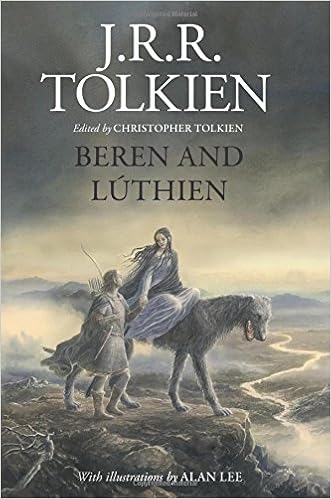
Image result for beren and luthien
The story of Middle-earth is not complete, but it is nonetheless at an end. Last year, Christopher Tolkien published Beren and Lúthien, presumably the last of his efforts to edit his father’s unfinished work. He then resigned as director of the Tolkien Estate.
The material in Beren and Lúthien was previously published in the edited volumes of Tolkien manuscripts, but this book organized and collected it, making it easier to follow as both a narrative and a literary project. The story itself may be the fundamental legend of Middle-earth. It was certainly the most personal of J.R.R. Tolkien’s mythic creations—he even had “Beren” and “Lúthien” inscribed on the gravestone he and his wife share.
Fans of Lord of the Rings may recall Aragorn providing a summary of the tale, which tells of the mortal man Beren and the immortal elf-maiden Lúthien, their struggles against the great enemy Morgoth (of whom Sauron was but a servant), and the tragedy and triumph that came of their love. This story, like many J.R.R. Tolkien never published, was revisited and revised many times over the years, but it was never given a final form in prose or verse.
It fell to Tolkien’s son, Christopher, to edit his father’s multitude of incomplete manuscripts for publication. Through his efforts, a more comprehensive history of Middle-earth, including a version of the story of Beren and Lúthien, became available in The Silmarillion. While some readers are deterred by the ponderous elven mythology at the beginning of that book, it remains the best entry point to Middle-earth after “The Hobbit” and The Lord of the Rings.
Many other volumes followed, providing dedicated readers with a wealth of knowledge about Middle-earth’s history, peoples, languages, and more. Finally, Christopher Tolkien turned to the task of preparing expanded versions of the most important legends of the Elder Days of Middle-earth. The Children of Húrin successfully presented one of these stories as a single coherent prose narrative. Unfortunately, this apparently was not possible for Beren and Lúthien, which alternates between the various prose and verse manuscripts in which Tolkien developed the tale. It is still a book Tolkien fans should have (the Alan Lee illustrations alone are worth it), but it does not stand by itself so easily as its predecessor did.

Brace Yourselves, Adaptations and Spin-Offs are Coming

While this may disappoint those who hoped for a definitive version of the story, it is inextricable from Christopher Tolkien’s fidelity to his father’s work. He has done a masterful job of editing his father’s incomplete writings, but since he would not attempt to complete them himself, the legends of Middle-earth will never be told in full.
This does not mean there will not be attempts. It appears that the Tolkien Estate’s new leaders are more eager to cash in on the Tolkien name, with some television rights already sold to Amazon. In addition toThe Lord of the Rings and The Hobbit, we can expect adaptations (and subsequent merchandizing) based on the incomplete works Christopher Tolkien so carefully curated.
The various adaptations and spin-offs may or may not be any good, though I suspect that Peter Jackson’s good-but-not-great film version of The Lord of the Rings will remain the high point. The problem will not be a lack of material (there is plenty), nor a need for rigid adherence to the books. There is space for writers and directors to fill in the gaps and offer their own distinct visions of Middle-earth; even a relatively developed story like that of Beren and Lúthien has a multitude of opportunities to expand everything from dialogue to action sequences. And these additions need not be the sort of desecrations that Tolkien fans fear.
But they probably will be. The problem is that Tolkien’s creation will not be understood by those working on adapting it. Consider the mediocrity of Jackson’s film adaptations of The Hobbit, which resulted not only from various production difficulties but also from Jackson’s taste for spectacle, which ill-suited most of the story. The insertion of various Hollywood clichés also made the films worse. Tolkien was not a writer for another silly superhero series or formulaic action film. The tropes of popular culture, and the mindset they derive from and pander to, have little place in Middle-earth.

A Culture Not Our Own

The superficial trappings of Tolkien’s world can be duplicated. Indeed, they have been copied so often that they define much of the fantasy genre: elves, dragons, orcs, wizards, kingdoms, and quests. What sets Tolkien’s work above its imitators is not just that he was a better writer, or that his world-building was more in-depth. Rather, Tolkien created and conveyed a world that was different from our own in ways that go beyond the presence of elves and wizards. His characters and cultures do not have modern mindsets and values.
Samwise Gamgee, who is the most relatable character of The Lord of the Rings and is at its moral and emotional center, is still culturally remote from us, as seen in his almost feudal loyalty to his master. Ancient and powerful elves like Elrond and Galadriel, who were meant to be somewhat alien, are even more so. And the posthumously published works edited by Christopher Tolkien are perhaps yet more removed from our culture tropes.
For example, terrible deeds done to fulfill an oath have little resonance within our culture, though they are crucial to the story of Beren and Lúthien. Contrary to modern attitudes, the heroes of Middle-earth do not teach us to believe in ourselves, or find the power within, or any of the other trite clichés of our entertainment culture.
This cultural distance makes Tolkien’s work fundamentally different not only from most current fantasy, but also from the many costume dramas and period pieces that offer us modern characters in old clothing (this genre basically is the PBS Masterpiece lineup). Our entertainment culture is filled with characters, ostensibly from other times and places, whose thoughts, dialogue, and dilemmas map neatly onto our own. It is multicultural narcissism—our own preoccupations mirrored onto everyone and everywhere else.
Despite their talk of multiculturalism, few of our cultural and entertainment leaders have much ability to understand cultures and perspectives other than their own. Their attempts to present something different tend to be caricatures, like homework done for an introductory anthropology course. There is little to no sensitivity for (or even awareness of) the rich experience of being contained within the compact symbols that express the order of existence in other cultures. They also rarely seek true understanding of different cultures or common human ground—that would require hard intellectual and imaginative work. They just want vaguely exotic spectacle.
Such uncultured multiculturalists will likely be the ones to adapt Tolkien’s works. This will be a shame, not only because of the missed opportunity for great and entertaining art, but also because the distance between Tolkien and us makes his works salutary to those willing to engage with them.

Transcendent Glory

Tolkien, who survived the trenches of the First World War, wrote fairy-tales that, like most classics of the genre, were grim. The stories of the Elder Days were mostly of tragedy, ruin, and betrayal. Not only did evil lurk in the hearts of men, elves, and dwarves, it was physically incarnated by the dark lord and his thralls and servants. Well-nigh overwhelming physical and spiritual evil is a persistent presence in Tolkien’s writing, and while it must be resisted, there is no surety, or even likelihood, of victory.
Tolkien weaves tales not only of the triumph of good over evil, despite dreadful odds, but of beauty and glory despite sorrow and suffering. The essential tragedy of Beren and Lúthien is not in the suffering of the protagonists, nor is it found in the greed, pride, and cruelty of the various villains they confront. Neither is the triumph in their heroic deeds, even in wresting one of the great jewels, a Silmaril, from Morgoth’s iron crown. The tragedy is of mortality, and the triumph is of love despite the reality of death. Beren in a mortal man; Lúthien is immortal—elven and divine.
In Tolkien’s mythology, the spirits of elves, if they are slain, remain in the world and may be reincarnated, while the spirits of men leave the world, and no one knows where they go. Lúthien, being immortal, could live in bliss in Valinor, the home of the angelic guardians of the world, until the world’s end. She rejects this, and she and Beren are instead returned to the world, to live out a mortal life together. Lúthien’s choice to become mortal (echoed by Arwen in The Lord of the Rings) is thus not simply a sacrifice of immortality, but of all contact with her family and kind, made so she might follow Beren on the unknown paths that the souls of men take after death.
Tolkien has left us something much more than an adventure story or a tale of good triumphing over evil. His writing invoked the longing for transcendent glory, beauty, and love that aches within us. His greatness lies in showing us a glimpse of Valinor, a scintillating Silmaril in the darkness, and, at the end of Middle-earth, a story of love beyond the end of the world.
Nathanael Blake has a PhD in political theory. He lives in Missouri.