How do you legally spy on your political opponents?
At some point in time that question was asker speaking tours. It wasn’t exactly asked that way.d in the White House, at the DNC or in the hotel suites where Hillary and her staff were staying during he
But it was asked. And now we know more of the answer.
What Hillary and Obama did wasn’t Watergate. That was amateur hour. Its sophistication is a tribute to the left’s deep knowledge and control of the workings of Washington, D.C. The men and women who planned this and carried it out understood not only government, but had an intimate familiarity with the loopholes in the laws and the networks of contacts that could realize their highly illegal plans.
The eavesdropping on Trump officials carried the ‘fingerprints’ of an administration that bypassed Congress to fund left-wing groups by blackmailing banks into huge settlements paid out to political allies in a billion dollar slush fund and sent pallets of foreign currency to Iran on unmarked planes. A complete lack of ethical norms was combined with the careful use of legal loopholes to protect the actions of the perpetrators even while they were engaging in a criminal conspiracy.
The revolutionary cell is embedded into left-wing organizing. These cells combined into networks across government, the media and the non-profit sector to pursue a collective agenda. The latest revelations about the Trump dossier give us greater insight into how Obama and Hillary’s people conspired to legally eavesdrop on political opponents by breaking up that eavesdropping into a series of legal actions carried out across different cells.
The road that led to Susan Rice and Samantha Power ‘unmasking’ Trump officials began with the Clinton campaign and the Democratic National Committee funding a dossier pushing Trump-Russia conspiracies. The dossier was sourced through Fusion GPS which is notorious for handfeeding material to reporters.
The Clinton campaign was seeing to it that whatever Fusion GPS produced would make its way into media stories without having Hillary’s fingerprints on it. Indeed the only reason we learned that Hillary and the DNC were ultimately behind the dossier was a congressional subpoena that risked exposing other Fusion GPS clients.
But the second reason was far more devious and devastating.
Fusion GPS’ man for the job was Christopher Steele. The former British intelligence figure had connections with FBI people. Hillary Clinton wasn’t just doing “opposition research” as her former press secretary has claimed. The best way to do opposition research in an American election doesn’t involve hiring a Brit in London with contacts in Russian intelligence and the FBI.
That is however the best way to independently produce information that can be injected into an intelligence investigation. (It’s also, perhaps not coincidentally, a great way for the Russians to inject their own material into a presidential election without getting their fingerprints on it.)
Hiring Fusion GPS and then Steele created two degrees of separation between the dossier and Hillary. A London ex-intel man is a strange choice for opposition research in an American election, but a great choice to create a plausible ‘source’ that appears completely disconnected from American politics.
What would an ex-M.I.6 agent have to do with Hillary, Obama or Trump?
The official story is that Steele was a dedicated whistleblower who decided to message an FBI pal for reasons “above party politics” while the Fusion GPS boss was so dedicated that he spent his own money on it after the election. Some figures in the FBI decided to take Steele’s material, offering to pay him for his work and reimbursing some of his expenses. Portions of the dossier were used to justify the FISA eavesdropping on Trump officials and were then rolled into the Mueller investigation.
That is how cells coordinate by breaking up a larger plot into a series of individual actions that just happen to produce the ideal result. Hillary and the DNC hire Fusion GPS. Fusion GPS hires Steele. Steele contacts an FBI pal. The FBI takes up the dossier. And then it’s turned into a pretext for eavesdropping.
But there isn’t supposed to be a link between the Democrats and the eavesdropping.
That’s why Marc Elias, the Clinton campaign and DNC lawyer who hired Fusion GPS, had denied it in the past. It’s why Fusion GPS fought the investigation so desperately. Opposition research isn’t a crime. A conspiracy to eavesdrop on your political opponents however is very much a criminal matter.
A forensic examination of the dirty dossier’s journey shows us that this modern Watergate was a collaborative effort between an outgoing Democrat administration and its expected Dem successor. The effort was broken up into two big pieces. The Clinton side would generate the material. The Obama side would make use of it. Steele was positioned as the interface between the two sides of the effort.
The London detour created and laundered the dossier. Moving the operation offshore tangled the connection between the Clinton side and the Obama side. This was important because what Steele produced wasn’t really opposition research, but a pretext for a government investigation.
That pretext couldn’t come directly from Hillary. But the FBI was too politically divided to generate it.
Obama Inc. needed that pretext, but it also didn’t want to generate it internally. Any investigation of the political opposition was inherently explosive. It was better if the intelligence came from outside and especially overseas. That was why Fusion GPS brought in Steele.
The first FISA request was filed in June. It was shot down by the Foreign Intelligence Surveillance Court. That was the same month we were told that Fusion GPS hired Steele. The second FISA request came through in October. That was the month, Steele did his first media interview with Mother Jones.
Two birds were being killed with one stone.
Obama's Watergate depended on extensive compartmentalization. The process that led to the eavesdropping on Trump officials and their unmasking at the hands of his officials had to appear as ‘clean’ as possible. Susan Rice and Samantha Power could make unmasking requests to the NSA, but they couldn’t be involved in generating the investigation that led to those requests.
Seeding the media with an astroturf campaign through Fusion GPS created the appearance of an organic push to investigate Trump-Russia ties. Targeting the lefty fringe of the media, Mother Jones, The Guardian, would bake in the narrative among a demographic already prone to conspiracy theories.
The operation was vastly more sophisticated than the crude ugliness of Watergate. But it was not unique in that regard. The fusion of government loopholes, political campaigns, media operations, opposition research and covert funding had occurred more than once during the Obama era.
The most recent example of such a fusion before Trump-Russia was the Iran Deal in which members of Congresswere eavesdropped on, money was moved around through non-profits to influence the media, a White House operation planted stories in the media and billions were smuggled to Iran. This mixture of influence operation, propaganda, eavesdropping and laundering has likely happened far more often in the previous administration than we know.
The IRS targeting of conservatives, shutdown theater and the Libyan War offer more examples.
Obama’s eavesdropping on Trump didn’t break the norms. They had already been thoroughly broken. The network that is being uncovered, the interfaces between media insiders, top government officials and private interests, demonstrates why Obama Inc. believed that it could get away with it.
It had gotten away with all its old abuses. There was no reason to doubt it could do so again.
America still has elections. The rule of law exists. In theory. But the network being uncovered in the dossier investigation looks very much like something that would be found in a totalitarian state.
The combination of media propaganda, government surveillance and contrived investigations of political opponents is the sort of thing you would expect to find in… Russia. The key players were wary enough that they compartmentalized their conspiracy, breaking it up across the private and public sector, the media, private firms, law enforcement figures and even another country. But that just makes it look like a cross between terrorist cells and organized crime.
And that is what we are dealing with here.
The left’s networks are becoming increasingly malignant. They executed a sophisticated attack on the political process while contriving to blame it on their victims. What the attack reveals is just how much the levers of power in our political system are embedded in the shadowy networks that operate in and around government. And what those networks are willing to do to win.
The European Federation of Journalists (EJF), "the largest organization of journalists in Europe, represents over 320,000 journalists in 71 journalists' organizations across 43 countries," according to its website. The EJF, a powerful player, also leads a Europe-wide campaign called "Media against Hate."
"counter hate speech[1] and discrimination in the media, both on and offline... media and journalists play a crucial role in informing...policy ... regarding migration and refugees. As hate speech and stereotypes targeting migrants proliferate across Europe... #MediaAgainstHate campaign aims to: improve media coverage related to migration, refugees, religion and marginalised groups... counter hate speech, intolerance, racism and discrimination... improve implementation of legal frameworks regulating hate speech and freedom of speech..."
Gone is all pretense that journalism is about reporting the facts. These are the aims of a political actor.
A very large political actor is, in fact, involved in the "Media against Hate" campaign. The campaign is one of several media programs supported by the EU under its Rights, Equality and Citizenship Programme (REC). In the REC program for 2017, the EU Commission, the EU's executive body, writes:
"DG Justice and Consumers [the EU Commission's justice department] will address the worrying increase of hate crime and hate speech by allocating funding to actions aiming at preventing and combating racism, xenophobia and other forms of intolerance... including dedicated work in the area of countering online hate speech (implementation of the Code of Conduct on countering illegal hate speech online)... DG Justice also funds civil society organisations combatting racism, xenophobia and other forms of intolerance".
This political player, the EU, the biggest in Europe, works openly at influencing the "free press" with its own political agendas. One of these agendas is the issue of migration into Europe from Africa and the Middle East. In his September State of the Union address, the president of the EU Commission, Jean-Claude Juncker, made it clear that whatever Europeans may think -- polls repeatedly show that the majority of Europeans do not want any more migrants -- the EU has no intention of putting a stop to migration. "Europe," Juncker said, "contrary to what some say, is not a fortress and must never become one. Europe is and must remain the continent of solidarity where those fleeing persecution can find refuge".
The European Union's REC Program also recently financed the publication of a handbookwith guidelines for journalists on how to write about migrants and migration. The guidelines form part of the RESPECT WORDS project -- also EU-financed -- which "aims to promote quality reporting on migrants and ethnic and religious minorities as an indispensable tool in the fight against hate". The new guidelines are "aimed at strengthening quality media coverage of migrants and ethnic and religious minorities". The handbook was launched on October 12 by the International Press Institute (IPI) -- an association of media professionals" representing leading digital, print and broadcast news outlets in more than 120 countries. IPI boasts that it has been "defending press freedom since 1950". (Being bought and paid for by the EU apparently counts as "press freedom" these days.) Seven other European media outlets and civil society groups based in Europe participated in the project and presented it at an event at the European Parliament in Brussels attended by MEPs and civil society experts. According to the press release, the guidelines are "supplementary to standards already in place at news outlets".
The guidelines state that, "journalism cannot and should not 'solve' the problem of hate speech on its own" but that it can help to prevent its "normalisation". However, "meeting this challenge requires the involvement of many actors, in particular the European Union, which must reinforce existing mechanisms and support new tools designed to combat hate speech..."
Why do journalists, who claim to fight for the freedom of the press, now appeal to the EU to help bring an end to freedom of speech in Europe?
According to the guidelines, journalists should, among other things:
"Provide an appropriate range of opinions, including those belonging to migrants and members of minorities, but... not... extremist perspectives just to 'show the other side'... Avoid directly reproducing hate speech; when it is newsworthy to do so, mediate it by...challenging such speech, and exposing any false premises it relies on. Remember that sensitive information (eg race and ethnicity, religious or philosophical beliefs, party affiliation or union affiliation, health and sexual information) should only be mentioned when it is necessary for the public's understanding of the news".
Is that why news reports always refer to perpetrators of rape or terrorism simply as "men"?
Specifically, with regard to Muslims, the guidelines recommend:
"Challenge existing anti-Muslim stereotypes that have become pervasive in public discourse... Increase the visibility of Muslim men and women in your general reporting... Take care not to further stigmatise terms such as 'Muslim' or 'Islam' by associating them with particular acts... Don't allow extremists' claims about acting 'in the name of Islam' to stand unchallenged. Highlight... the diversity of Muslim communities... where it is necessary and newsworthy to report hateful comments against Muslims, mediate the information. Challenge any false premises on which such comments rely".
Not even Orwell could have made that up.
Judith Bergman is a columnist, lawyer and political ana
Scott Yenor at Boise State in 2012 (Image via Facebook)
A Boise State University professor’s recent essay exploring the intellectual history of the meaning of gender has roiled the campus, with claims by administration officials that the article represents “the root of genocide.”
Scott Yenor, a professor of political science, wrote theessayfor the Heritage Foundation website; it traces the development of contemporary transgender theory to the seminal early-feminist workThe Second Sex, by Simone de Beauvoir. Yenor demonstrates that a key premise of transgender discourse—the disassociation of biological sex from gender identity—is rooted in Beauvoir’s effort to show that femininity is not a biological fact but is imposed by society. He traces the development of this idea through first- and second-wave feminist thought, culminating in today’s radical claims that small children should be allowed to choose their gender identity and even receive hormone therapy, and that everyone should be free to use the bathroom or locker room that suits his or her identity.
Yenor’s essay is an intellectual history, not a diatribe. He concludes that the objective of transgender theory is to stop treating “gender dysphoria” in children as “a pathological syndrome requiring counseling and preventive parenting.” Rather, its “ultimate goal is public recognition of queer theory’s view of the human landscape”—an aim that leads to a fundamental conflict. In demanding that children be free to choose their gender, transgender activists would condemn as child abuse parental actions that fail to respect their child’s gender selection. Ontario’s Minister of Children and Youth Services Michael Coteau took such a position earlier this year.
In response to Yenor’s scholarly inquiry, Boise State officials reacted in a fashion now familiar on campuses nationwide. The university’s Director for Diversity and Inclusion charged in a statement that Yenor and others sharing his views have a “pathetic fear of change,” and that his essay “includes a seed of hate that needs to be labeled for what it is, the spirit of an ideological animal called supremacy.” Members of the faculty senate concurred that Yenor’s scholarship was fascistic “hate speech.” Just publishing the essay represented a violation of women’s and transgender rights, they suggested.
Meantime, students have gathered over 2,100 signatures on a petition demanding that the university fire Yenor. His scholarship, they allege, threatens “the existence of queer and non-binary folks.” Under pressure of condemnation from fellow students and potentially damaged career prospects, a would-be student defender of Yenor’s academic freedom has redacted his column in the student newspaper and relented in his support for the professor’s right to academic freedom. Other supporters, fearing similar reprisals, have silenced themselves.
No counterargument to the professor’s scholarship has been presented. Instead of rational debate, Boise State authorities demand that certain questions be removed from the sphere of legitimate scholarly analysis—a betrayal of the purpose of any university. Satisfying these directives would mean, for Yenor, no further scholarship concerning the family, religious liberty, or the nature of human sexuality.
Tenure may protect Yenor’s academic freedom, for now. Boise State dean Corey Cook says that he’s “not willing to condemn” him. Yet, on campuses, an empowered vanguard’s demand for unflinching reverence for “collegiality, caring, tolerance” increasingly overwhelms intellectual liberty. Will freedom of thought trump “tolerance”? It might—but outside academia, its prospects are growing more uncertain. After all, unlike Yenor, few Americas enjoy tenure protection and the intellectual independence that it safeguards.
In September at the University of Virginia, which was founded by Thomas Jefferson, roughly 100 students, faculty and local residents assaulted the statue of Jefferson on the campus rotunda, covering it with a black shroud, hanging a banner on it that read “Black Lives Matter” and “F**k White Supremacy,” and holding a sign reading “Thomas Jefferson is a racist and a rapist.”
Our nation's leftist progressives have long sought to undermine the American values expressed in our Declaration of Independence and Constitution. Though typical Democrats and Republicans do not have this leftist hate for our nation, they have been willing accomplices in undermining the most basic value the Founding Fathers sought to promote — limited government. Leftists have had their greatest successes in undermining American values on the nation's college campuses. Derelict and dishonest college administrators, professors and boards of trustees have given them carte blanche. Let's look at some of it.
Students at the University of Virginia desecrated the statue of Thomas Jefferson, the university's founder. Students at the University of Missouri want Jefferson's statue gone. Why? He was a slave owner. Many in the college community supported Sen. Bernie Sanders' presidential bid. They welcomed Sanders' belief that the United States was founded on "racist principles." There have also been calls for the removal of George Washington's and Abraham Lincoln's statues. Some have called for the renaming of schools that honor Washington, Jefferson and 11 other slave-owning presidents. Leftists have called for the renaming of streets named after slave-owning presidents. There have been many leftist calls for the elimination of Columbus Day. Their success at getting Confederate statues taken down has emboldened them.
What goes unappreciated is just why America's leftists' movement attacks the Founders. If they can delegitimize the Founders themselves, it goes a long way toward their agenda of delegitimizing the founding principles of our nation. If the leftists can convince the nation that men such as George Washington, Thomas Jefferson and James Madison were good-for-nothing slave-owning racists, then their ideas can be more easily trashed. We find the greatest assaults on our founding documents on the nation's college campuses.
The average parent, taxpayer and donor has absolutely no idea of the bizarre lessons that college professors are teaching students. Professor Adam Kotsko of Shimer College teaches, "Whether or not your individual ancestors owned slaves, you as a white person have benefitted from slavery and are complicit in it." Dr. Micah Johnson, a research assistant and graduate student instructor in the University of Florida's department of sociology and criminology and law, teaches that the American notion of patriotism is "drenched in whiteness" and that patriotism implies that black people are "un-American."
These types of attacks on American values have reached one of our most prestigious institutions of higher learning — the U.S. Military Academy. The administration at West Point knew of 2nd Lt. Spenser Rapone's disqualifying insubordination at the academy, extremist political views and regulation-breaking online activity. Proof has surfaced that West Point leadership knew as early as 2015 that Rapone was an avowed communist and held Marxist anti-American beliefs (http://tinyurl.com/ybnppvm6). One of his Facebook posts read, "F—- this country and its false freedom." Despite Rapone's conduct and demonstrated hatred of our nation, the U.S. Military Academy's administration saw fit to allow Rapone to graduate in 2016.
But the rot at our premier military academy goes beyond the traitorous ideas of Rapone's. That was revealed in an open letter written by retired Army Lt. Col. Robert Heffington, once a professor of history at West Point (http://tinyurl.com/yb6dljy8). Heffington's letter exposed widespread corruption, cheating and falling standards at the academy to which the administration has turned a blind, politically correct eye. In response to Heffington's widely circulated letter, the superintendent of the U.S. Military Academy, Lt. Gen. Robert L. Caslen Jr., released a standard bureaucratic letter saying the administration will address the concerns raised in Heffington's letter about falling standards. It will also investigate the revelations that it not only managed to graduate Rapone but also sent him on to Army battlefield units, thus enabling him to spread his anti-American ideas.
The American people need to stop being sheeple and put a halt to the undermining of our nation taking place in our institutions of higher learning.
A German court recently gave journalist Michael Stürzenberger (pictured) a six-month suspended jail sentence for posting on his Facebook page a historical photo of the Grand Mufti of Jerusalem, Haj Amin al-Husseini, shaking the hand of a Nazi official in Berlin, in 1941. The prosecution accused Stürzenberger of "inciting hatred towards Islam" and "denigrating Islam" by publishing the photograph. (Image Source: PI News video screenshot)
A new German law introducing state censorship on social media platforms came into effect on October 1, 2017. The new law requires social media platforms, such as Facebook, Twitter, and YouTube, to censor their users on behalf of the German state. Social media companies are obliged to delete or block any online "criminal offenses" such as libel, slander, defamation or incitement, within 24 hours of receipt of a user complaint -- regardless of whether or the content is accurate or not. Social media companies receive seven days for more complicated cases. If they fail to do so, the German government can fine them up to 50 million euros for failing to comply with the law.
This state censorship makes free speech subject to the arbitrary decisions of corporate entities that are likely to censor more than absolutely necessary, rather than risk a crushing fine. When employees of social media companies are appointed as the state's private thought police and given the power to shape the form of current political and cultural discourse by deciding who shall be allowed to speak and what to say, and who shall be shut down, free speech becomes nothing more than a fairy tale. Or is that perhaps the point?
Meanwhile, the district court in Munich recently gave a German journalist, Michael Stürzenberger, a six-month suspended jail sentence for posting on his Facebook page a historical photo of the Grand Mufti of Jerusalem, Haj Amin al-Husseini, shaking the hand of a senior Nazi official in Berlin in 1941. The prosecution accused Stürzenberger of "inciting hatred towards Islam" and "denigrating Islam" by publishing the photograph. The court found Stürzenberger guilty of "disseminating the propaganda of anti-constitutional organizations". While the mutual admiration that once existed between al-Husseini and German Nazis is an undisputed historical fact, now evidently history is being rewritten by German courts. Stürzenberger has appealed the verdict.
Germany has made no secret of its desire to see its new law copied by the rest of the EU, which already has a similar code of conduct for social media giants. The EU Justice Commissioner, Vera Jourova, recently said she might be willing to legislate in the future if the voluntary code of conduct does not produce the desired results. She said, however, that the voluntary code was working "relatively" well, with Facebook removing 66.5% of the material they had been notified was "hateful" between December and May this year. Twitter removed 37.4%, and YouTube took action on 66% of the notifications from users.
While purportedly concerned about online "hate speech," one EU organization, the EU Parliament, had no qualms about letting its premises be used to host a convicted Arab terrorist, Leila Khaled, from the Popular Front for the Liberation of Palestine (PFLP) at a conference about "The Role of Women in the Palestinian Popular Struggle" in September. (The EU, the US, Canada, and Australia, have all designated the PFLP a terrorist organization). The conference was organized by, among others, the Spanish delegation of Izquierda Unida (United Left) as part of the European United Left/Nordic Green Left bloc in the European Parliament.
In the UK, Prime Minister Theresa May also said that she will tell internet firms to tackle extremist content:
"Industry needs to go further and faster in automating the detection and removal of terrorist content online... ultimately it is not just the terrorists themselves who we need to defeat. It is the extremist ideologies that fuel them. It is the ideologies that preach hatred, sow division and undermine our common humanity. We must be far more robust in identifying these ideologies and defeating them -- across all parts of our societies."
Prime Minister May keeps insisting that "these ideologies" are spread "across all parts of our societies" when in reality, virtually all terrorism is Islamic. Meanwhile, her own Home Secretary, Amber Rudd, has refused to ban the political wing of Hezbollah. Hezbollah's hate speech, apparently, is perfectly acceptable to the British authorities. So is that of South African Muslim cleric and hate preacher Ebrahim Bham, who was once an interpreter to the Taliban's head legal advisor. He was allowed to enter the UK to speak in the Queen Elizabeth II Centre, a government building, at the "Palestine Expo" a large Jew-hate event in London in July. Bham isknown for quoting Nazi Propaganda Minister Goebbels and saying that all Jews and Christians are "agents of Satan". Meanwhile, a scholar such as Robert Spencer is banned from entering the UK, supposedly on the grounds that what he reports -- accurately -- is "Islamophobic".
The British Crown Prosecution Service (CPS) also recently stated that online "hate crimes" will be prosecuted "with the same robust and proactive approach used with offline offending". The decision to treat online offenses in the same way as offline offenses is expected to increase hate crime prosecutions, already at the highest recorded level ever. Prosecutors completed 15,442 hate crime cases in 2015-16.
Jews in Britain, who have experienced a dramatic increase in anti-Semitism over the past three years, are frequently on the receiving end of hate crimes. Nevertheless, their cases constitute less than a fraction of the statistics. In 2016/17, the CPS prosecuted 14,480 hate crimes. According to the Campaign Against Antisemitism:
"we have yet to see a single year in which more than a couple of dozen anti-Semitic hate crimes were prosecuted. So far in 2017, we are aware of... 21 prosecutions, in 2016 there were 20, and in 2015 there were just 12. So serious are the failures by the CPS to take action that we have had to privately prosecute alleged anti-Semites ourselves and challenge the CPS through judicial review, the first of which we won in March. Last year only 1.9% of hate crime against Jews was prosecuted, signaling to police forces that their effort in investigating hate crimes against Jews might be wasted, and sending the strong message to anti-Semites that they need not fear the law... Each year since 2014 has been a record-breaking year for anti-Semitic crime: between 2014 and 2016, anti-Semitic crime surged by 45%".
Almost one in three British Jews have apparently considered leaving Britain due to anti-Semitism in the past two years.
British authorities seem far more concerned with "Islamophobia" than with the increase in hate crimes against Jews. In fact, the police has teamed up with Transport for London authorities to encourage people to report hate crimes during "National Hate Crime Awareness Week", which runs from October 14-21. Transport for London and the Metropolitan Police will hold more than 200 community events to "reassure communities that London's public transport system is safe for everyone". The events are specifically targeted at Muslims; officers have visited the East London Mosque to encourage reporting hate crimes.
Last year, London mayor Sadiq Khan's Office for Policing and Crime (Mopac) announced it was spending £1,730,726 of taxpayer money policing speech online after applying for a grant from the Home Office. Meanwhile, Khan said that he does not have the funds to monitor the 200 jihadists estimated to be in London, out of the 400 jihadists who have so far returned to the capital from Syria and Iraq. (He also implicitly admitted that he does not know the whereabouts of the jihadists who have returned). When asked by the journalist Piers Morgan why the mayor could not have them monitored, Khan answered:
"Because the Met Police budget, roughly speaking, 15 percent, 20 percent is funded by me, the mayor. The rest comes from central government. If the Met Police is being shrunk and reduced, they've got to prioritize and use their resources in a sensible, savvy way."
When Morgan asked what could possibly be a bigger priority than, "people coming back from a Syrian battlefield with intent to harm British citizens", Khan did not answer. Perhaps because it is hard to admit in public that fighting "Islamophobia" is now a higher priority than fighting terrorism?
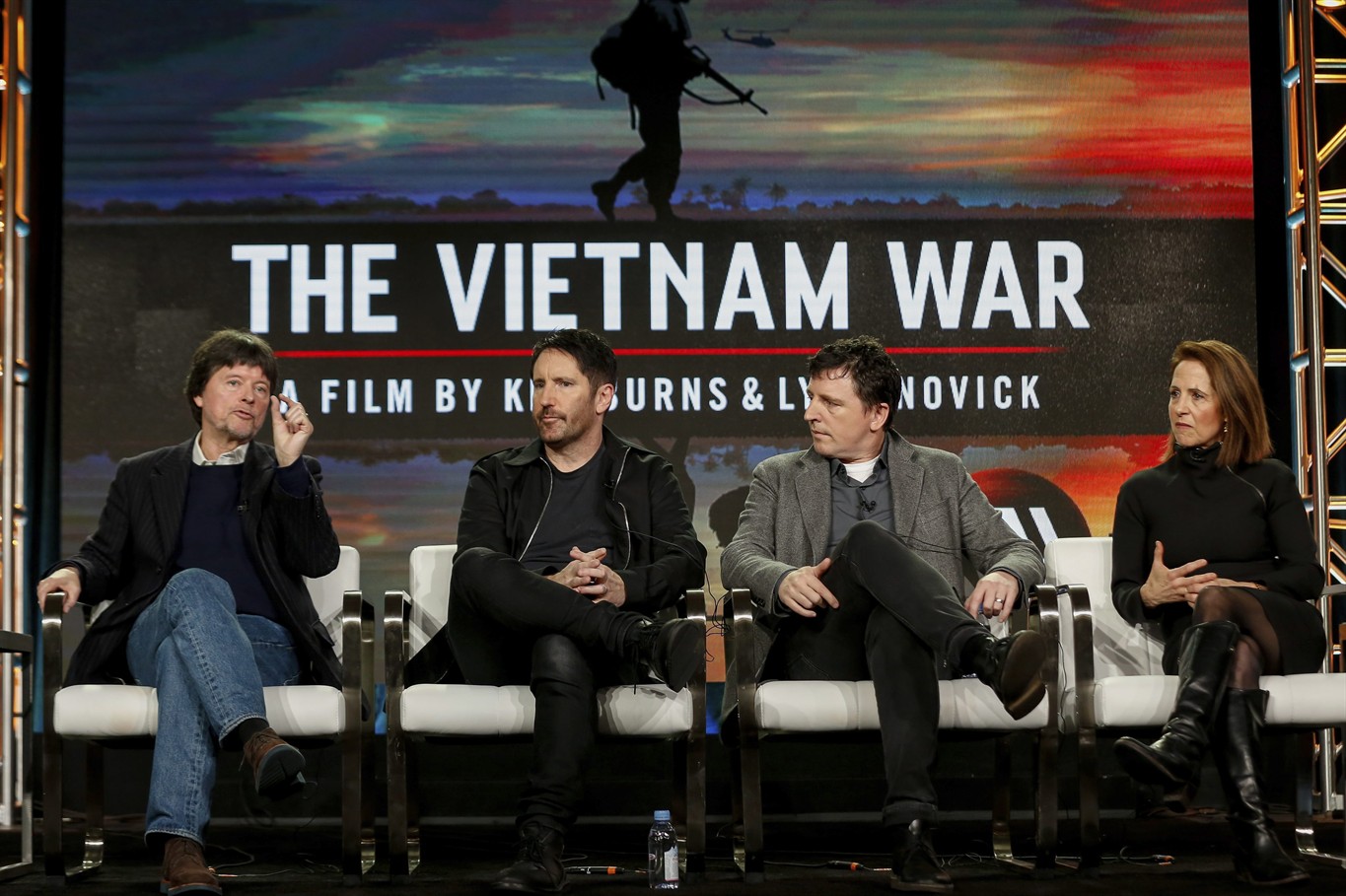
Ken Burns, from left, Trent Reznor, Atticus Ross and Lynn Novick speak at PBS' "The Vietnam War" panel at the 2017 Television Critics Association press tour on Sunday, Jan. 15, 2017, in Pasadena, Calif. (Photo by Willy Sanjuan/Invision/AP)
Twenty-seven years ago, Ken Burns mesmerized American audiences with The Civil War, an 11-hour documentary that took five years to produce. Forty million Americans watched the initial airing, and many more watched reruns or read the companion book. The series rekindled popular interest in the Civil War, stimulating a flood of books and battle reenactments that continues to this day.
Burns and co-director Lynn Novick spent ten years and $30 million producingThe Vietnam War, an 18-hour, ten-episode production. Anyone tuning in to media coverage or attending one of the public panels featuring Burns and Novick is likely to conclude that the new documentary has equaled The Civil War in historical and artistic virtuosity. But if one listens to American or South Vietnamese veterans of the conflict—more easily heard today, thanks to the Internet—the verdicts are less complimentary.
During the months-long publicity blitz preceding the documentary’s release, Burns and Novick vowed that The Vietnam War would not malign American veterans of Vietnam or blame them for the war, as had happened so often in the past. Instead, the film would portray veterans as patriotic Americans who answered their nation’s call to duty. The documentary would support the troops, without necessarily supporting the war. As for the war itself, the production would not promote a particular viewpoint. “We don’t have an agenda,” Burns told the media. “We’re just umpires calling balls and strikes.” So why aren’t veterans as enthused about The Vietnam War as they should be?
The foremost reason is that Burns and Novick are not actually impartial referees, but instead use the documentary to promote an agenda, in ways glaringly obvious to veterans though not readily apparent to those too young to have lived through the war. Burns and Novick wish to show that America fought a war that was unnecessary and unwinnable, and that it did so out of national hubris.
With the consistency of a jackhammer, the documentary highlights the events most conducive to a negative interpretation of American involvement, while ignoring those supporting more positive interpretations. During 1962 and 1963, for instance, the Vietnamese Communists lost nearly every battle, yet the only battle from this period that Burns and Novick cover is the Communist victory at Ap Bac. Compounding the distortion, the documentary characterizes Ap Bac as historically representative.
During 1966 and 1967, American forces inflicted hundreds of lopsided defeats on the North Vietnamese, but the six battles that Burns and Novick feature in the episodes devoted to those years belong to a small minority of engagements where both the American and North Vietnamese forces suffered heavy losses. In the battles that it covers, the documentary takes little note of the heroism of American veterans, aside from a few fleeting references. Nothing is said of the 259 Americans who won the Congressional Medal of Honor, or the tens of thousands who won other combat awards, or the many more whose valor was recognized only by their comrades.
It’s as if a football team won 150 games, tied 10, and lost 2 over seven seasons, but its video chronicler focused only on the ties and losses. The players on that team would hardly be expected to view that videographer as their supporter, no matter how much he professed to be one, and no matter how often he claimed to have no agenda.
U.S. Army and Marine Corps officers generally committed more errors in the battles where the Americans sustained the most casualties; Burns and Novick consistently emphasize these errors as evidence that American military leaders were inept. John Del Vecchio, one of the finest novelists of the Vietnam War, blasted Burns and Novick for vilifying American officers in his online rebuttal of the documentary. “I wish here to openly thank leaders and commanders of 101st Airborne Division (Airmobile) units from platoons to brigades for their leadership which was so vastly superior to what I’ve seen portrayed by Mr. Burns and Ms. Novick,” Del Vecchio wrote. “Surely I was blessed to soldier under such NCOs and officers.”
Burns and Novick restricted their on-camera interviews to individuals who participated in the war, leaving out historians, aside from those who were also veterans. The first-person perspectives are highly valuable, but sole reliance upon them is problematic when it comes to larger issues of military strategy and politics. Most of the senior military and political leaders are now dead, and thus unable to respond to criticisms from the narrator, or from people who observed the war on the ground—where they could see the trees but not necessarily the forest.
Among the disgruntled veterans featured so prominently by Burns and Novick, a favorite complaint is the fighting of battles for terrain that gets abandoned after the Americans gain control of it. The veteran of a fierce hill fight says, “To take tops of mountains in the triple canopy jungle along the Cambodian-Laotian border accomplished nothing of any importance.” Fighting for remote mountains made sense, though, if one took into account the constraints that U.S. political leadership imposed upon the war. President Lyndon Johnson prohibited his generals from conducting ground operations in Cambodia, Laos, and North Vietnam, based primarily on fears of Chinese intervention in the conflict. Given this prohibition, the U.S. had to choose between fighting for the remote hills or waiting for the North Vietnamese to move into the populous regions closer to the coast. Experience showed that when the North Vietnamese came near the population, the presence of civilians greatly impeded the use of American air power and artillery, to such an extent that defeating the North Vietnamese was at least as costly as defeating them in remote areas.
The fears that drove Johnson to confine the ground war to South Vietnam proved to be misplaced, according to what we have since learned about Chinese foreign policy and North Vietnamese strategy. The Chinese, it turns out, were not willing to intervene in North Vietnam or Laos, as they had done in North Korea in 1950. General Vo Nguyen Giap reportedly said that if the United States had conducted operations in Laos and North Vietnam, it could have stymied Hanoi’s war effort with 250,000 troops—less than half of what the United States ultimately deployed. It’s one of several instances where poor decisions by U.S. political leaders squandered opportunities to preserve South Vietnam at an acceptable cost. Other errors include the overthrow of Diem in 1963 and the breaking of promises to support and protect South Vietnam after 1972. The war’s outcome was not the inevitable result of superior North Vietnamese dedication or American arrogance, as Burns and Novick would have us believe, but of errant U.S. strategic choices—and, in the last case, the antiwar sentiments of American members of Congress.
Veterans also object to the production’s favorable depiction of antiwar activists. Burns and Novick lead the audience to believe that the men who stayed home and protested against the war were as well-intentioned as those who served in Vietnam, and were actually supporting the better cause. Their opposition is presented as principled revulsion at the war, untainted by selfish desires to avoid the dangers of military service. Veteran Charles Krohn,writing about the ninth episode as a guest contributor on Tom Ricks’s Best Defense blog, lamented that the episode “favors those who opposed the war more than those who fought it. Soldiers’ sacrifices seem trivialized, compared to the energy and idealism of the demonstrators.”
Burns and Novick give inordinate weight to the words of antiwar veterans, with at least one-third of those appearing onscreen having expressed antiwar views or supported antiwar causes prior to filming. Few of the series’ other veterans express support for the war—at least not in the interview segments that were aired—even though supporters far outnumber opponents among the general population of Vietnam veterans. This distortion rankled the veterans whom reporter Tatiana Sanchez interviewed for a Mercury Newsarticle. “A lot of us have a tremendous sense of pride for what we attempted to do and defend,” said veteran Jim Barker. On the New York Sun website, veteran and author Phil Jennings berates Burns for failing to include the huge numbers of veterans who “wholly supported the war, [were] proud to have appeared in arms, and sickened by the United States’ abandonment of its freedom-seeking ally.”
Many of the antiwar interviewees express disillusionment not only with the American cause in Vietnam but also with the United States more generally. Several state that the Vietnam War convinced them that the concept of American exceptionalism was a fallacy. This theme is a particularly sore point among veterans who believe that they fought in a worthy war for a worthy country. During a panel discussion on the PBS series at the Center for Strategic and International Studies, Vietnam veteran and historian Lewis Sorley said that Burns was “profoundly wrong” for “referring disparagingly to what he called Americans’ ‘puffed-up sense of exceptionalism.’” Sorely added, “Clearly, Burns does not much like America.”
Though Burns and Novick resisted putting historians on screen, they did make use of an historical advisory panel. Consisting almost entirely of scholars on the left, the advisory panel makes its influence felt throughout the production, particularly in those parts read by narrator Peter Coyote (himself an antiwar activist). Reviewers for NPR, NBC, and the Washington Post who lavished praise on Burns and Novick for their evenhandedness ignored the panel’s lack of balance; one suspects that they would have taken a different view of a supposedly neutral 18-hour documentary on abortion that relied almost entirely on historians who considered abortion morally repugnant.
One veteran on the advisory panel, James Willbanks, submitted his resignation to Burns several years ago after seeing a preliminary version of the script that merely rehashed the antiwar movement’s narrative. Promising to take his concerns into account, Burns convinced Willbanks to stay on. To his credit, Burns included intermittent statements from Willbanks that provide valuable correctives to the production’s content and tone. Willbanks is seen disputing the notion that the “Tiger Force” atrocities were in any way representative of the conduct of U.S. forces in Vietnam. In the episode covering the 1972 Easter Offensive, Willbanks says that the South Vietnamese ground forces, not just U.S. air power, were essential to the defeat of the North Vietnamese. Unfortunately, these momentary expressions of views prevalent in the veteran community are overwhelmed by countervailing testimony and imagery.
The filmmakers’ bias is most evident in what is omitted. The documentary stresses the Communists’ success in marshalling Vietnamese civilians to move supplies and equipment during the Battle of Dien Bien Phu in 1954 but makes no mention of the massive logistical support provided by the Chinese, including 1,000 trucks and tens of thousands of troops. This omission fools viewers into believing that the Vietnamese Communists were self-reliant, in contrast with the anti-Communists, who are depicted as puppets and dependents of the United States.
Narrator Coyote tells us that an international consensus held that Ho Chi Minh would have won a national election had it been held in 1956, as called for in the 1954 Geneva Accords. South Vietnamese president Ngo Dinh Diem’s refusal to participate in such elections, therefore, appears to have been an abrogation of the will of the Vietnamese people. What goes unsaid is that most South Vietnamese and American observers believed that Ho would have intimidated the North Vietnamese population into voting for him, which would have guaranteed his victory because the North was more populous than the South. In a subsequent segment, Burns and Novick criticize the Diem government for manipulating elections and winning 98 percent of the vote, but they’re silent on the North’s equally flagrant election-rigging.
The documentary accuses Diem of sending troops to round up Buddhists at their pagodas in August 1963, after he had promised to avoid repressive measures. His heavy-handed duplicity, it seems, precipitated the military coup that took his life. What’s missing here is the crucial fact that Diem authorized these raids at the urging of the same generals who later overthrew him. The generals turned against Diem because Ambassador Henry Cabot Lodge and an American press corps led by David Halberstam and Neil Sheehan badly misread the situation and promoted a coup. The film also neglects to mention that the Buddhist protests persisted long after Diem’s death, convincing even their initial American supporters that the militant Buddhists were Communist pawns, rather than selfless champions of religious liberty, as American reporters originally portrayed them.
The episode on 1966 includes clips of a congressional hearing in which diplomat George Kennan, founder of the American containment strategy, expresses doubt about the war’s value in containing Communism. “We would do better,” Kennan says, “if we really would show ourselves a little more relaxed and less terrified of what happens in certain of the smaller countries of Asia and Africa, and not jump around like an elephant frightened by a mouse every time these things occur.” Kennan, the film implies, viewed the war as hopeless, and saw withdrawal as the only viable choice. Most of the film’s heroes, in fact, allegedly recognized early on that the American effort was doomed, reinforcing the aura of inevitability that hangs over the production.
In truth, Kennan, like many others, was not adamantly opposed to the war, nor so confident of its outcome. In sections of his testimony that the film does not show, senators press Kennan to explain how the United States could extricate itself from Vietnam without doing great damage to American interests. Kennan acknowledges that he did not favor immediate withdrawal because it could facilitate Communist expansionism in neighboring countries and endanger world peace. He advocates a negotiated settlement that would allow the U.S. to withdraw without giving the appearance of selling out an ally.
In the most telling exchange, Democratic senator Frank Lausche of Ohio confronts Kennan on the question of how negotiations would produce the desired outcome. “Have not the U.S. government and the people of the United States,” asks Lausche, “probed every avenue through which there could be discussion toward reaching a settlement, and has there not been constant rebuttal of those efforts by China and by Hanoi?”
Kennan: “It is correct that we have gotten nowhere.”
When Lausche asks what the Johnson administration should do, Kennan says, “I would propose that we limit our aims and our military commitment in this area, that we decide what we can safely hold in that region with due regard to the security of our forces, that we dig in and wait and see whether possibilities for a solution do not open up.”
“There are many, many people who believe that this is exactly what our nation is trying to do,” Lausche responds.
Burns and Novick further mislead through selective use of tape recordings of the Nixon administration. Those who hear only the excerpts presented here will conclude that, for reasons of political self-interest, Richard Nixon and Henry Kissinger were planning to stand by the South Vietnamese until the 1972 election and then cut them loose soon thereafter. Historian Luke Nichter, a leading authority on the Nixon tapes, has faulted Burns and Novick for excerpting “carefully chosen segments of the tapes to fit a preconceived notion, or a larger point sometimes taken out of context, while not giving evidence to the contrary a similar degree of attention.” As Nichter notes, Nixon often expressed multiple positions as he pondered an issue, and many of his words and deeds on the issue of South Vietnam suggested a commitment to the long-term survival of the Saigon government.
The documentary devotes five minutes to the story of the Vietnamese girl Kim Phuc, photographed moments after an errant South Vietnamese napalm strike burned her skin during the 1972 Easter Offensive—one of the war’s iconic images. At the end of the segment, Coyote says that Kim Phuc “eventually left Vietnam and settled outside Toronto.” He does not mention that she fled Vietnam, seeking and obtaining asylum from its repressive Communist regime. A larger historical transgression is the film’s omission of the deliberate killing of civilians by the North Vietnamese during the same offensive. As South Vietnamese civilians fled south from Quang Tri for fear of a massacre like that inflicted by the Communists at Hue in 1968, North Vietnamese troops opened artillery fire on their slow-moving columns. Thousands of civilians were killed or wounded in these attacks. Likewise absent is any mention of the South Vietnamese civilians killed during the 1975 offensive, the estimated 65,000 South Vietnamese killed shortly after the war ended, and the tens of thousands who died in reeducation camps.
Burns and Novick repeatedly depict the South Vietnamese military and government as less committed to their cause than their North Vietnamese counterparts. Several interviewees invoke this alleged inferiority to argue that “we supported the wrong side,” evidently without concern that the other side was fighting for the pernicious ideology of Communism. As history has demonstrated repeatedly, commitment to a cause alone does not confer virtue. The Germans were more dedicated than the Poles in 1939 and the French in 1940, but no American would say that the United States should have sided with Nazi Germany.
At one point, Coyote notes that 250,000 South Vietnamese troops were killed in the war, but we’re never told why so many South Vietnamese were willing to die for a government as corrupt and unpopular as the documentary suggests. Whereas Burns and Novick explore the ideology of Ho Chi Minh at length, they ignore the nationalism and anti-Communism that motivated so many of South Vietnam’s leaders to fight to the death for their government. This disinterest in the South Vietnamese cause has galled South Vietnamese veterans as well as the Americans who fought alongside them.
“We, Vietnamese, have a crystal clear understanding of the reasons why we fought,” Nguyen van Thai and Nguyen Phuc Lien wrote in a blistering critiqueof the PBS series. “We fought because we understood the cruelty and dictatorship of the communists. We fought because we did not wish the communists to impose a barbarous and inhuman regime upon us. More than 1,000,000 people from North Vietnam fled their native land and emigrated to the South in 1954 in order to escape totalitarianism, which is ample evidence for this point. The second exodus of the 70’s, 80’s and early 90’s also corroborated this fact.”
The series disregards the Viet Cong’s massive loss of support in the war’s later years. In 1967, Communist recruitment of South Vietnamese youth began plummeting, and it never recovered. As the war turned increasingly against Hanoi, an estimated 200,000 of those supposedly zealous Communist troops defected to South Vietnam.
While no history of the Vietnam War can fully satisfy everyone, Burns and Novick could have achieved something close to the impartial account they promise, presenting facts and stories within their proper context and including contrasting examples that support the competing schools of thought on the war. They could have refrained from taking sides on controversies like the validity of the domino theory, the moral rectitude of the South Vietnamese government, and the merits of American exceptionalism. They could have sought advice from more than a handful of people who did not share their contempt for the war.
For evidence of what might have been, one need look no further than the Vietnam War exhibit that opened earlier this month at the New York Historical Society. As someone who served on the exhibit’s advisory panel, alongside many people with diametrically opposed viewpoints, I can attest that great effort went into ensuring the exhibit’s evenhandedness. Those dissatisfied with the polemical nature of the PBS series will find this treatment a refreshing and fair-minded alternative.