Tuesday, February 21, 2017

Omar Abdel Rahman, the ‘Blind Sheikh,’ Is Dead


Abdel Rahman, the Blind Sheikh, was responsible for much of the last quarter century of terrorism.

By Andrew C. McCarthy — February 18, 2017
Related image
(Reuters)

Omar Abdel Rahman, the notorious “Blind Sheikh” who died on Friday night while serving his life sentence in federal prison, was never shy about being a terrorist. As he put it:
What kind of name is this? Why are we afraid of it? Why do we fear the word terrorist? If the terrorist is the person who defends his right, so we are terrorists. And if the terrorist is the one who struggles for the sake of God, then we are terrorists. We . . . have been ordered with terrorism because we must prepare what power we can to terrorize the enemy of Allah and your enemy. The Koran says “to strike terror.” Therefore, we don’t fear to be described with “terrorism.” . . . They may say, “He is a terrorist, he uses violence, he uses force.” Let them say that. We are ordered to prepare whatever we can of power to terrorize the enemies of Islam.
Before there was an al-Qaeda or an ISIS, there was the Blind Sheikh, known to his worldwide following as “the emir of jihad.” And he bears much of the responsibility — he would think of it as the credit — for what followed him. Indeed, bin Laden credited Sheikh Abdel Rahman with the fatwa (the sharia-law edict) that approved the 9/11 jihadist attacks in which nearly 3,000 Americans were murdered. Abdel Rahman had indeed issued such a fatwa:
Muslims everywhere to dismember their nation, tear them apart, ruin their economy, provoke their corporations, destroy their embassies, attack their interests, sink their ships, . . . shoot down their planes, [and] kill them on land, at sea, and in the air. Kill them wherever you find them.
Having been the lead prosecutor in the trial at which he was convicted, I find that barely a day goes by that I don’t ruefully think about this. For all the praise we received for a job well done — and I am immensely proud of the work we did — we only managed to imprison him. We did not stop him.

Abdel Rahman was the central character in a memoir I wrote about the case nearly a decade ago, Willful Blindness. The title has become something of catch phrase describing the wayward American approach to counterterrorism. I meant it as something more than that — a contrast: the steely determination that underlay Abdel Rahman’s clarity of purpose that the world be ruled by Islamic law, versus our own conscious avoidance of the sharia-supremacist ideology that drives the jihadist threat, and diffidence about whether our own liberty culture is worth defending.

He was raised in the tiny Nile Delta town of al-Gamalia, where he lost his sight to juvenile diabetes in 1942, at the age of four. The sickly boy was a prodigy, memorizing the Koran at an early age and developing into a renowned scholar of Islamic jurisprudence — the discipline in which he earned a doctorate, with distinction, at storied al-Azhar University, the seat of Sunni Islamic learning since the tenth century. Abdel Rahman was deeply influenced by Ibn Taymiyyah, the 14th-century docent who had come of age in a soul-searching time for Islamic fundamentalism: after invading Mongols routed the Abbasid Caliphate, laying Baghdad to waste. Taymiyyah championed a return to basics: a literalist interpretation of scripture and the notion that the original Islamic communities forged by the prophet Mohammed were the ideal to which all humanity must aspire.

Abdel Rahman was also affected by contemporary followers of Taymiyyah. Interestingly, one was the Shiite jihadist icon, Ayatollah Ruhollah Khomeini. Notwithstanding their theological differences, Abdel Rahman perceived in Khomeini the possibilities of Islamic revolution and the exploitation of what he saw as American weakness — particularly by Hezbollah, Khomeini’s forward jihadist militia that, among other atrocities, killed 241 U.S. Marines in their Beirut barracks in 1983. “If Muslim battalions were to do five or six operations to the Americans in surprise attacks like the one that was done against them in Lebanon,” the Blind Sheikh urged, “the Americans would have exited [the Persian Gulf] and gathered their armies and gone back . . . to their country.” It was a recruitment speech he delivered hundreds of times.

Abdel Rahman also revered Sayyid Qutb, his fellow Egyptian and a Muslim Brotherhood hero long imprisoned and eventually executed by the hated Nasser regime. From the premise of Taymiyyah’s teaching, and building on the foundation laid by Brotherhood founder Hassan al-Bannah, Qutb taught that Islam is “a declaration that sovereignty belongs to God alone”; that the “freedom” God offers is submission to His law, sharia; and that supplanting man’s dominion with Allah’s could never be achieved by “preaching” alone — it would require jihad “to wipe out tyranny” and impose this Orwellian conception of “freedom” on mankind.

Echoing Ibn Taymiyyah, Qutb’s jihad targeted not only declared non-believers but also those rulers who professed to be Muslim but did not adhere to sharia. Qutb also infused his teaching with visceral anti-Semitism, portraying the Jew as the instantiation of all that is anti-Islamic and treacherous. Abdel Rahman drank deeply from this noxious well.

The Blind Sheikh completed his master’s degree in Cairo in 1967, in the aftermath of Qutb’s execution and what Muslims still see as the humiliation of the Six-Day War. By the time he earned his doctorate in 1971, he already had a following of young budding jihadists. By 1973, the firebrand “cleric” (he is better thought of as a sharia jurist) was the emir of a jihadist organization, Gama’at al-Islamia (the Islamic Group). Essentially, it was a spinoff of the Brotherhood, comprised of young Muslims who had been lured into the Brotherhood’s sharia-supremacist ideology but were impatient with the Brotherhood’s methodical pace, which — in their view – too often failed to live up to the militant violence of its rhetoric, and too often played a double game of collusion with the secular regime Muslims were obliged to overthrow.

Abdel Rahman became most notorious for issuing the fatwa relied upon by the jihadists who murdered Egyptian president Anwar al-Sadat at a military parade in 1981 — for the unforgivable offense of making peace with Israel. The Blind Sheikh was acquitted at his Egyptian trial when he defended himself with a stirring recitation of Islamic-law principles, exceedingly effective before a hypocritical authoritarian regime that nominally claims fidelity to sharia but does not actually enforce it. As he argued to the court, Allah’s commands hold that society must be governed by sharia; if it is not, it becomes the individual duty of every Muslim to perform jihad against the regime until it either is overthrown or enforces God’s law. This self-evident truth, he elaborated, required no scholarly fatwa. Thus, Sadat’s slayers were performing a sacred duty, and it was pointless to quibble over whether it had been authorized by him or by any man; it was dictated by the Koran.

It was the same defense the Blind Sheikh would later attempt to posit at his American trial. Suffice it to say that it did not have the same traction with a jury of New Yorkers sitting in a courthouse six blocks from the World Trade Center.

Though acquitted in Egypt, Abdel Rahman delighted in claiming credit for Sadat’s murder. Years later, safely out of Egypt and stoking new recruits, he would reflect that, of the “many jihad operations” carried out by his Islamic Group, the “most famous” one was “killing . . . the atheist, the oppressor and the profligate, . . . Anwar Al-Sadat.” But what about the result, someone asked. Hadn’t getting rid of Sadat only given Muslims Mubarak, who was worse?

Abdel Rahman would hear none of it. God “ordered us to eliminate” Sadat, he insisted, “even if this had to be done by killing him[,]” and even though Mubarak proved to be worse. Mubarak — “the third traitor, backstabber who became the loyal dog to America, . . . and was at the forefront of the treachery caravan to give to Israel and then America everything” — would, the Blind Sheikh assured, be dealt with in “another operation.”

While Abdel Rahman never managed to have Hosni Mubarak killed, he spent many years trying — and we ultimately convicted him on a count of conspiracy to murder the then-president of Egypt (one plan included trying to assassinate him near the U.N. in the early 1990s). Abdel Rahman could not fail to be pleased by Mubarak’s overthrow and replacement, in 2011, by a Muslim Brotherhood government whose platform included demanding that the United States transfer their beloved Blind Sheikh back home — a hope that was dashed when the Brotherhood government was ousted.

By the time he settled in the United States in late 1990, Abdel Rahman was a globally recognized . . . menace. He was deeply involved in recruiting and fundraising for the “Arab-Afghan” contingent that joined the anti-Soviet jihad (and to this day regards its service to Allah as responsible for the demise of the Soviet empire). His network of associates included Gulbuddin Hekmatyar, the Afghan warlord and former prime minister to whom much of the funding of the Arab fighters was channeled; Sudanese leader Hassan al-Turabi; and such founding figures of al-Qaeda as Ayman al-Zawahiri (Abdel Rahman’s Egyptian contemporary and sometime rival, who is now the international terror network’s leader) and Abdullah Azzam, the charismatic Palestinian who, like Abdel Rahman, graduated with a doctorate from al-Azhar and taught for a time in Saudi Arabia — where both Azzam and Abdel Rahman profoundly influenced a young student named Osama bin Laden.

Even before he settled in the New York metropolitan area (thanks to a tragicomedy of errors by American immigration authorities, who failed to notice he was on terrorism watch lists), the Blind Sheikh had an ardent following. His acolytes included Sayyid Nosair, Mohamed Salameh, Mahmud Abuhalima, and Nidal Ayyad — to name just a few. They used mosques and Islamic community centers as hubs for recruitment, fundraising, and paramilitary training — including shooting sessions in Calverton, Long Island, and drills involving explosives and close combat in remote areas of New York, New Jersey, Connecticut, and Pennsylvania. They would report on their activities in overseas phone calls to Abdel Rahman, which were recorded and used to draw young Muslims to the cause.

In 1990, Nosair murdered Rabbi Meir Kahane, the controversial founder of the Jewish Defense League, at a hotel in midtown Manhattan. On February 26, 1993, Salameh, Abuhalima, and Ayyad, along with Ramzi Yousef, carried out the bombing of the World Trade Center — a plot long in the making, much of which was planned during visits to Nosair at Attica state prison in New York.

By then, for well over a year, Abdel Rahman had been urging jihad against the United States from within the United States. America, he declared, was “the head of the snake,” the world’s leading enemy of Islam. A notebook kept by Nosair and recovered after the Kahane murder contained such teachings as this:
Before announcing the establishing of the state of Abraham in our holy land . . . to break and to destroy the morale of the enemies of Allah. (And this is by means of destroying) (exploding) the structure of their civilized pillars. Such as the touristic infrastructure which they are proud of and their high world buildings which they are proud of and their statues which they endear and the buildings in which gather their heads (their leaders).
In the run-up to the bombing, Abdel Rahman was in constant touch with the plotters. Just a few weeks before the explosion that killed six adults (including a pregnant woman) and caused billions of dollars in damage, he spoke at a jihadist conference, thundering that “God has obliged us to perform jihad,” and thus that “the battalions of Islam and its divisions must be in a state of continuous readiness to hit their enemies with strength and power.” Reminding the crowd that “the enemies at the foremost of the work against Islam are America and its allies,” he continued with one of his favorite themes:
If those who have the right [to have something] are terrorists then we are terrorists. And we welcome being terrorists. And we do not deny this charge to ourselves. And the Koran makes it among the means to perform jihad for the sake of Allah, which is to terrorize the enemies of God and our enemies too. . . . Then we must be terrorists and we must terrorize the enemies of Islam and frighten them and disturb them and shake the earth under their feet.
In the summer of 1993, we arrested the Blind Sheikh and eleven of his followers as they conspired to carry out an even more ambitious plot against New York City landmarks: simultaneous bombing of the Lincoln and Holland Tunnels and the U.N. complex. Other potential targets under consideration were American military installations — which Abdel Rahman quite explicitly ordered attacks against — and the FBI’s headquarters in lower Manhattan. In October 1995, after a nine-month trial, they were convicted of conspiring to levy a terrorist war against the United States, including the WTC bombing, as well as the additional bombing plots and plans for various political assassinations. The presiding judge, Michael B. Mukasey — a peerless jurist who later served as U.S. attorney general in the Bush administration — sentenced the Blind Sheikh to life imprisonment.

As I said, we imprisoned him, but we failed to put an end to his reign of terror. Besides the fatwa that paved the way for 9/11, Abdel Rahman issued guidance to his Egyptian terrorist organization to end a truce with the Mubarak government. Lynne Stewart, the radical lawyer who had represented him at the trial, was eventually convicted of material support to terrorism for transmitting his directives from jail.

As I recounted in 2012, when the Egyptian press was reporting that the Obama administration was considering transferring Abdel Rahman back to Egypt:
In 1997, Gama’at al-Islamia threatened to “target . . . all of those Americans who participated in subjecting [Abdel Rahman’s] life to danger” — “every American official, starting with the American president [down] to the despicable jailer.” The organization promised to do “everything in its power” to obtain his release. Six months later, Gama’at jihadists set upon 58 foreign tourists and several police officers at an archeological site in Luxor, Egypt, brutally shooting and slicing them to death. The terrorists left behind leaflets — including in the mutilated torso of one victim — demanding that the Blind Sheikh be freed. 
Gama’at subsequently issued a statement warning that its forcible struggle against the Egyptian regime would proceed unless Mubarak met its three demands: the implementation of sharia, the cessation of diplomatic relations with Israel, and “the return of our Sheikh and emir to his land.” In March 2000, terrorists associated with the Abu Sayyaf group kidnapped a number of tourists in the Philippines and threatened to behead them if Abdel Rahman and two other convicted terrorists were not freed. Authorities later recovered two decapitated bodies (four other hostages were never accounted for). 
On September 21, 2000, only three weeks before al-Qaeda’s bombing of the U.S.S. Cole [killing 17 members of the U.S. Navy], al-Jazeera televised a “Convention to Support the Honorable Omar Abdel Rahman.” Front and center were Osama bin Laden and Ayman al-Zawahiri (then bin Laden’s deputy, now his successor as emir of al-Qaeda). They warned that unless Sheikh Abdel Rahman was freed, jihadist attacks against the United States would be stepped up. At the same event, Mohammed Abdel Rahman, an al-Qaeda operative who is one of the sheikh’s sons, exhorted the crowd to “avenge your Sheikh” and “go to the spilling of blood.”
Omar Abdel Rahman was physically incapable of doing anything that would be useful to a terrorist organization: He couldn’t build a bomb, hijack a plane, or carry out an assassination. The only thing he could do for a terrorist organization was lead it. His life is a testament to the centrality of sharia-supremacist ideology to modern jihadism and to the broader Islamist movement in which it thrives. His death reminds us why we must fight everything he represented.

— Andrew C. McCarthy is a senior policy fellow at the National Review Institute and a contributing editor of National Review.

Thursday, February 16, 2017

TRUMP, NETANYAHU SEEK COMMON GROUND


Iran emerges as a central uniting issue.


February 16, 2017

Image result for trump netanyahu
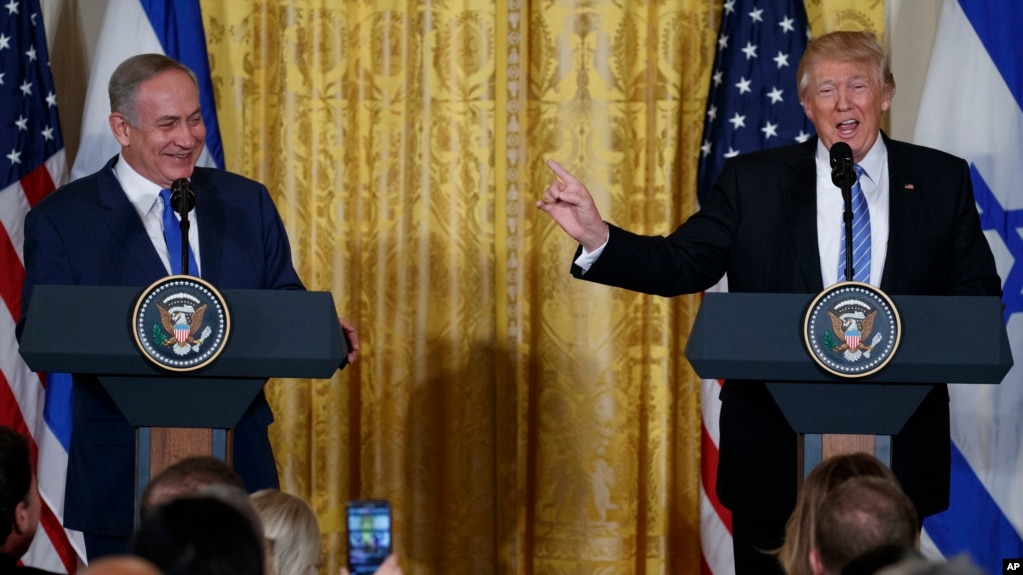
President Donald Trump speaks during a news conference with Israeli Prime Minister Benjamin Netanyahu in the East Room of the White House in Washington, Feb. 15, 2017. (AP)
At Wednesday’s White House press conference for President Donald Trump and Prime Minister Benjamin Netanyahu, both leaders clearly had a lot on their minds—in addition to the matters at hand.
For Trump it was, of course, the Flynn imbroglio. For Netanyahu there were two things. One involves unfortunate, inane investigations to which he’s being subjected in Israel, which could lead to an indictment. One investigation concerns alleged illicit receipt of gifts—cigars and champagne; the other concerns talks he held with a newspaper publisher—which mentioned possible shady deals that were never, however, acted upon.
In addition, Netanyahu is under heavy pressure from the right wing of his coalition—to renounce the two-state solution, to build settlements. At the press conference Netanyahu, in particular, sounded flustered and awkward at times, glancing for succor at his script, speaking without his usual assurance and aplomb.
On substance the two leaders’ words, too, raised problems at times.
The Palestinian issue appears, unfortunately, to have returned to center stage. It’s unfortunate because it remains an issue no more amenable to a solution that at any time in the past.
“The United States,” Trump told the reporters, “will encourage a peace, and really a great peace deal.” He also said, “I think the Palestinians have to get rid of some of that hate they’re taught from a very young age. They have to acknowledge Israel. They have to do that.”
The problem is that the Palestinians have “had to” do those things—stop hating; acknowledge the legitimacy of a Jewish political entity—since the Palestinian issue first arose almost a century ago. 
They have “had to,” but are no closer to doing so today than they were in the 1920s; meanwhile the remedy for an entire generation raised in hate—a reality that Netanyahu, in his flustered way, tried to emphasize—is no closer to being found by any of the putative wizards in the West.
Indeed, neither the president nor the prime minister mentioned Gaza—where a leader who is radical even by Hamas standards has taken the helm; as usual, it was not explained how a solution could be found when the Palestinians west of the Jordan are themselves divided into two mutually antagonistic entities. Trump and Netanyahu’s words about a “regional deal” on the Palestinian issue, involving Arab states along with Israel, likewise fail to take into account intractable Palestinian reality.
Instead, Trump engaged in vague talk of “two states” and “one state,” not explaining what a “one-state solution” to the Israeli-Palestinian issue would be—Israel granting citizenship to at least two million mostly intensely hostile Arabs?—while Netanyahu, desperate to avoid the term “two states,” reiterated his insistence on Israeli security control and Palestinian recognition of Israel, but mainly appeared terrified of riling his right-wing critics at home. 
On a matter vastly more important than the Palestinian issue, Trump’s words—“My administration has already imposed new sanctions on Iran, and I will do more to prevent Iran from ever developing—I mean ever—a nuclear weapon”—were more encouraging to Israeli ears.
The words appeared to jibe with a report that the Trump administration is working to create a “NATO-like mutual defense pact” of moderate Arab states that would “share intelligence with Israel and the US to counter the rising threat of Iran.” 
Israel’s role, according to an unnamed diplomat, “would likely be intelligence sharing, not training or boots on the ground. They’d provide intelligence and targets. That’s what the Israelis are good at.”
In other words, what sounds like a sophisticated plan—taking regional realities into account—to form a bulwark against Iranian expansionism that threatens to engulf the region in war. 
It can be hoped that, in their hours-long powwow after the press conference, the U.S. president and Israeli prime minister focused much more on the Iranian issue, which is incomparably more urgent and can be resolved with determined action, than on the Palestinian issue, which is relatively minor and cannot—for now—be resolved.
If Trump, nonetheless, has delusions of grandeur on the Palestinian issue, expect Netanyahu to play along with his policy. It will be a relatively small price to pay for dealing with the Iranian menace. 
P. David Hornik is a freelance writer and translator living in Beersheva and author of the book Choosing Life in Israel. His memoir, Destination Israel: Coming of Age and Finding Peace in the Middle East, is forthcoming from Liberty Island later this year.

Wednesday, February 15, 2017

Former Obama Officials, Loyalists Waged Secret Campaign to Oust Flynn


Sources: Former Obama officials, loyalists planted series of stories to discredit Flynn, bolster Iran deal


February 14, 2017

Image result for michael flynn

National security adviser Michael Flynn resigns
The abrupt resignation Monday evening of White House national security adviser Michael Flynn is the culmination of a secret, months-long campaign by former Obama administration confidantes to handicap President Donald Trump's national security apparatus and preserve the nuclear deal with Iran, according to multiple sources in and out of the White House who described to the Washington Free Beacon a behind-the-scenes effort by these officials to plant a series of damaging stories about Flynn in the national media.
The effort, said to include former Obama administration adviser Ben Rhodes—the architect of a separate White House effort to create what he described as a pro-Iran echo chamber—included a small task force of Obama loyalists who deluged media outlets with stories aimed at eroding Flynn's credibility, multiple sources revealed.
The operation primarily focused on discrediting Flynn, an opponent of the Iran nuclear deal, in order to handicap the Trump administration's efforts to disclose secret details of the nuclear deal with Iran that had been long hidden by the Obama administration.
Insiders familiar with the anti-Flynn campaign told the Free Beacon that these Obama loyalists plotted in the months before Trump's inauguration to establish a set of roadblocks before Trump's national security team, which includes several prominent opponents of diplomacy with Iran. The Free Beacon first reported on this effort in January.
Sources who spoke to the Free Beacon requested anonymity in order to speak freely about the situation and avoid interfering with the White House's official narrative about Flynn, which centers on his failure to adequately inform the president about a series of phone calls with Russian officials.
Flynn took credit for his missteps regarding these phone calls in a brief statement released late Monday evening. Trump administration officials subsequently stated that Flynn's efforts to mislead the president and vice president about his contacts with Russia could not be tolerated.
However, multiple sources closely involved in the situation pointed to a larger, more secretive campaign aimed at discrediting Flynn and undermining the Trump White House.
"It's undeniable that the campaign to discredit Flynn was well underway before Inauguration Day, with a very troublesome and politicized series of leaks designed to undermine him," said one veteran national security adviser with close ties to the White House team. "This pattern reminds me of the lead up to the Iran deal, and probably features the same cast of characters."
The Free Beacon first reported in January that, until its final days in office, the Obama administration hosted several pro-Iran voices who were critical in helping to mislead the American public about the terms of the nuclear agreement. This included a former Iranian government official and the head of the National Iranian American Council, or NIAC, which has been accused of serving as Iran's mouthpiece in Washington, D.C.
Since then, top members of the Obama administration's national security team have launched a communications infrastructure after they left the White House, and have told reporters they are using that infrastructure to undermine Trump's foreign policy.
"It's actually Ben Rhodes, NIAC, and the Iranian mullahs who are celebrating today," said one veteran foreign policy insider who is close to Flynn and the White House. "They know that the number one target is Iran … [and] they all knew their little sacred agreement with Iran was going to go off the books. So they got rid of Flynn before any of the [secret] agreements even surfaced."
Flynn had been preparing to publicize many of the details about the nuclear deal that had been intentionally hidden by the Obama administration as part of its effort to garner support for the deal, these sources said.
Flynn is now "gone before anybody can see what happened" with these secret agreements, said the second insider close to Flynn and the White House.
Sources in and out of the White House are concerned that the campaign against Flynn will be extended to other prominent figures in the Trump administration.
One senior White House official told the Free Beacon that leaks targeting the former official were "not the result of a series of random events."
"The drumbeat of leaks of sensitive material related to General Flynn has been building since he was named to his position," said the official, who is a member of the White House's National Security Council. "Last night was not the result of a series of random events. The president has lost a valuable adviser and we need to make sure this sort of thing does not happen again."
Other sources expressed concern that public trust in the intelligence community would be eroded by the actions of employees with anti-Trump agendas.
"The larger issue that should trouble the American people is the far-reaching power of unknown, unelected apparatchiks in the Intelligence Community deciding for themselves both who serves in government and what is an acceptable policy they will allow the elected representatives of the people to pursue," said the national security adviser quoted above.
"Put aside the issue of Flynn himself; that nameless, faceless bureaucrats were able to take out a president's national security adviser based on a campaign of innuendo without evidence should worry every American," the source explained.
Eli Lake, a Bloomberg View columnist and veteran national security reporter well sourced in the White House, told the Free Beacon that Flynn earned a reputation in the Obama administration as one of its top detractors.
"Michael Flynn was one of the Obama administration's fiercest critics after he was forced out of the Defense Intelligence Agency," said Lake, who described "the political assassination of Michael Flynn" in his column published early Tuesday.
"[Flynn] was a withering critic of Obama's biggest foreign policy initiative, the Iran deal," Lake said. "He also publicly accused the administration of keeping classified documents found in the Osama bin Laden raid that showed Iran's close relationship with al Qaeda. He was a thorn in their side."
Lake noted in his column that he does not buy fully the White House's official spin on Flynn's resignation.
"For a White House that has such a casual and opportunistic relationship with the truth, it's strange that Flynn's ‘lie' to Pence would get him fired," Lake wrote. "It doesn't add up."
White House Press Secretary Sean Spicer stated in his daily briefing that "the evolving and eroding level of trust as a result of this situation and a series of other questionable incidents is what led the president to ask General Flynn for his resignation."
A third source who serves as a congressional adviser and was involved in the 2015 fight over the Iran deal told the Free Beacon that the Obama administration feared that Flynn would expose the secret agreements with Iran.
"The Obama administration knew that Flynn was going to release the secret documents around the Iran deal, which would blow up their myth that it was a good deal that rolled back Iran," the source said. "So in December the Obama NSC started going to work with their favorite reporters, selectively leaking damaging and incomplete information about Flynn."
"After Trump was inaugurated some of those people stayed in and some began working from the outside, and they cooperated to keep undermining Trump," the source said, detailing a series of leaks from within the White House in the past weeks targeting Flynn. "Last night's resignation was their first major win, but unless the Trump people get serious about cleaning house, it won't be the last."

How Obama is scheming to sabotage Trump’s presidency


February 11, 2017
Image result for trump obama inauguration
Melania Trump, Donald Trump, Barack Obama and Michelle Obama stand on the steps of the Capitol. (Rob Carr/ Reuters)
When former President Barack Obama said he was “heartened” by anti-Trump protests, he was sending a message of approval to his troops. Troops? Yes, Obama has an army of agitators — numbering more than 30,000 — who will fight his Republican successor at every turn of his historic presidency. And Obama will command them from a bunker less than two miles from the White House.
In what’s shaping up to be a highly unusual post-presidency, Obama isn’t just staying behind in Washington. He’s working behind the scenes to set up what will effectively be a shadow government to not only protect his threatened legacy, but to sabotage the incoming administration and its popular “America First” agenda.
He’s doing it through a network of leftist nonprofits led by Organizing for Action. Normally you’d expect an organization set up to support a politician and his agenda to close up shop after that candidate leaves office, but not Obama’s OFA. Rather, it’s gearing up for battle, with a growing war chest and more than 250 offices across the country.
Since Donald Trump’s election, this little-known but well-funded protesting arm has beefed up staff and ramped up recruitment of young liberal activists, declaring on its website, “We’re not backing down.” Determined to salvage Obama’s legacy, it’s drawing battle lines on immigration, ObamaCare, race relations and climate change.
Obama is intimately involved in OFA operations and even tweets from the group’s account. In fact, he gave marching orders to OFA foot soldiers following Trump’s upset victory.
“It is fine for everybody to feel stressed, sad, discouraged,” he said in a conference call from the White House. “But get over it.” He demanded they “move forward to protect what we’ve accomplished.”
“Now is the time for some organizing,” he said. “So don’t mope.”
Far from sulking, OFA activists helped organize anti-Trump marches across US cities, some of which turned into riots. After Trump issued a temporary ban on immigration from seven terror-prone Muslim nations, the demonstrators jammed airports, chanting: “No ban, no wall, sanctuary for all!”
Run by old Obama aides and campaign workers, federal tax records show “nonpartisan” OFA marshals 32,525 volunteers nationwide. Registered as a 501(c)(4), it doesn’t have to disclose its donors, but they’ve been generous. OFA has raised more than $40 million in contributions and grants since evolving from Obama’s campaign organization Obama for America in 2013.
OFA, in IRS filings, says it trains young activists to develop “organizing skills.” Armed with Obama’s 2012 campaign database, OFA plans to get out the vote for Democratic candidates it’s grooming to win back Congress and erect a wall of resistance to Trump at the other end of Pennsylvania Avenue.
It will be aided in that effort by the Obama Foundation, run by Obama’s former political director, and the National Democratic Redistricting Committee, launched last month by Obama pal Eric Holder to end what he and Obama call GOP “gerrymandering” of congressional districts.
Obama will be overseeing it all from a shadow White House located within two miles of Trump. It features a mansion, which he’s fortifying with construction of a tall brick perimeter, and a nearby taxpayer-funded office with his own chief of staff and press secretary. Michelle Obama will also open an office there, along with the Obama Foundation.
Critical to the fight is rebuilding the ravaged Democratic Party. Obama hopes to install his former civil rights chief Tom Perez at the helm of the Democratic National Committee.
Perez is running for the vacant DNC chairmanship, vowing, “It’s time to organize and fight . . . We must stand up to protect President Obama’s accomplishments,” while also promising, “We’re going to build the strongest grassroots organizing force this country has ever seen.”
The 55-year-old Obama is not content to go quietly into the night like other ex-presidents.
“You’re going to see me early next year,” he told his OFA troops after the election, “and we’re going to be in a position where we can start cooking up all kinds of great stuff.”
Added the ex-president: “Point is, I’m still fired up and ready to go.”
Paul Sperry is the author of “The Great American Bank Robbery,” which details the link between race-based housing policies and the mortgage crisis.
FILED UNDER  ,   ,   ,   ,  

Tuesday, February 14, 2017

No Thug Left Behind


Obsessed with “racial equity,” St. Paul schools abandoned discipline—and unleashed mayhem.
Winter 2017
St. Paul Public Schools superintendent Valeria Silva speaks during a Feb. 11, 2014, press conference.  (Pioneer Press file photo: John Autey)
St. Paul Public Schools superintendent Valeria Silva speaks during a Feb. 11, 2014, press conference. (Pioneer Press file photo: John Autey)
In the Obama years, America’s public education system embarked on a vast social experiment that threatened to turn schools into educational free-fire zones. The campaign—carried out in the name of “racial equity”—sought to reduce dramatically the suspension rate of black students, who get referred for discipline at much higher rates than other students. From the top down, the U.S. Department of Education drove the effort; from the bottom up, local educational bureaucrats have supported and implemented it.
“Racial equity” has become the all-purpose justification for dubious educational policies. Equity proponents view “disparate impact”—when the same policies yield different outcomes among demographic groups—as conclusive proof of discrimination. On the education front, “equity” does not seek equal treatment for all students. Instead, it demands statistical equivalence in discipline referrals and suspensions for students of every racial group, regardless of those students’ actual conduct.
Equity advocates’ central premise is that teachers, not students, are to blame for the racial-equity discipline gap. They claim that teachers’ biases, cultural ignorance, or insensitivity are the gap’s primary causes. The key to eliminating disparities, they maintain, is to change not students’ but adults’ behavior. Equity supporters justify their agenda on grounds that the racial-equity discipline gap severely hampers black students’ chances of success in life. Kids who get suspended generally fail to graduate on time and are more likely to get caught up in the juvenile-justice system, they say.
President Obama’s Department of Education made racial equity in school discipline one of its top priorities. “The undeniable truth is that everyday educational experience for many students of color violates the principle of equity at the heart of the American promise,” according to Arne Duncan, who served as education secretary until early 2016. “It is adult behavior that must change,” Duncan stated repeatedly. “The school-to-prison pipeline must be challenged every day.”
Donald Trump’s Department of Education won’t have to wait to see how this project has played out in the real world. The public schools of St. Paul, Minnesota, are ahead of the curve in the racial-equity crusade. The violence and chaos that racial-equity policies have produced there should sound alarms across the nation about what can be expected by pursuing this course.
Valeria Silva, who became superintendent of the St. Paul Public Schools in December 2009, was an early and impassioned proponent of racial-equity ideology. In 2011, she made the equity agenda a centerpiece of her Strong Schools, Strong Communities initiative. The district’s website lauded the program as “the most revolutionary change in achievement, alignment, and sustainability within SPPS in the last 40 years.”
Demographically, the St. Paul schools are about 32 percent Asian, 30 percent black, 22 percent white, 14 percent Hispanic, and 2 percent Native American. In 2009–10, 15 percent of the district’s black students were suspended at least once—five times more than white students and about 15 times more than Asian students. In Silva’s view, equity required that the black student population be excluded from school at no more than twice the rate of Asian-Americans, the group with the lowest rate of suspensions.
Silva attacked the racial-equity discipline gap at its alleged root: “white privilege.” Teachers unfairly punish minority students for “largely subjective” behaviors, such as “defiance, disrespect and disruption,” she told theMinneapolis Star Tribune in 2012. To overcome their biases, teachers must learn “a true appreciation” of their students’ cultural “differences” and how these can “impact interactions in the classroom,” she said.
Silva hired a California-based diversity consultant, the Pacific Educational Group (PEG), to compel St. Paul school staff—from principals to janitors to bus drivers—to confront their own bigotry and to achieve “cultural competence” in working with “black and brown” students. In PEG-inspired “courageous conversations” about race, teachers were instructed to begin every statement with a phrase like “as a white woman, I believe,” or “as a black man, I think.” They learned that “shouting out” answers in class and lack of punctuality are black cultural traits and that what may seem to be defiant student behavior is, in fact, just a culturally conditioned expression of “enthusiasm.”
After implementing “white privilege” training, Silva moved to eliminate what she called the “punishment mentality” undergirding the district’s discipline model. In an effort to cut black discipline referrals, she lowered behavior expectations and dropped meaningful penalties for student misconduct. In 2012, the district removed “continual willful disobedience” as a suspendable offense. In addition, to close the “school-to-prison pipeline,” Silva adopted a new protocol on interactions between schools and the police. The protocol ranked student offenses on five levels and required schools to report only the worst—including arson, aggravated assault, and firearm possession—to police. School officials were strongly encouraged to handle other serious offenses—such as assault, sexual violence, and drug possession—on their own. For a time, the district administration actually tied principals’ bonuses to their track record on reducing black discipline referrals.
In 2011–12, disorderly conduct charges for district students dropped 38 percent from the previous school year. School-based offenses referred to the Ramsey County attorney’s office for charges also plunged. In 2006, school officials made 875 referrals for misdemeanor and felony offenses. In 2011, they made 538.
Silva also championed “Positive Behavior Interventions and Supports” (PBIS), an anti-suspension behavior-modification program that focuses on talking and mediation. Under PBIS, unruly students met for about ten minutes with a “behavior specialist” before returning to class or moving to another classroom or school, where they were likely to misbehave again. The “overwhelming majority” of behavior specialists are black, and “it’s not clear to me what their qualifications are,” wrote Aaron Benner—a former fourth-grade teacher who is black himself—in the St. Paul Pioneer Press in 2015. Some specialists “even reward disruptive students by taking them to the gym to play basketball,” he added. “There is no limit to the number of times a disruptive student will be returned to your class.”
PEG-trained “cultural specialists” reinforced the administration’s “blame-the-teacher” approach. They advised that if kids cussed teachers out, those teachers should investigate how their own inability to earn students’ trust had triggered the misconduct. The end result of a discipline infraction “should be more than just kids apologizing,” Kristy Pierce, a cultural specialist at Battle Creek Middle School told City Pages, which ran a series of articles on the mounting chaos in the St. Paul schools. “When you use the word ‘black’ versus ‘African American’ and the student flips out, understand where that might be coming from.”
In 2013, Silva made a final policy change. In the name of equity, she sent thousands of special-education students with “emotional and behavioral disorders”—disproportionately black—into mainstream classrooms. Teachers received no extra support to deal with this unprecedented challenge.
We have a segment of kids who consider themselves untouchable,” said one veteran teacher as the 2015–16 school year began. At the city’s high schools, teachers stood by helplessly as rowdy packs of kids—who came to school for free breakfast, lunch, and WiFi—rampaged through the hallways. “Classroom invasions” by students settling private quarrels or taking revenge for drug deals gone bad became routine. “Students who tire of lectures simply stand up and leave,” reported City Pages. “They hammer into rooms where they don’t belong, inflicting mischief and malice on their peers.” The first few months of the school year witnessed riots or brawls at Como Park, Central, Humboldt, and Harding High Schools—including six fights in three days at Como Park. Police had to use chemical irritants to disperse battling students.
“We are seeing more violence and more serious violence,” warned Steve Linders, a St. Paul police spokesman. “Fights at schools that might have been between two individuals are growing into fights between several individuals or even melees involving up to 50 people.” In September, a massive brawl erupted at Como Park High School. Police had to call for backup, as “the scene became very chaotic with many people fighting,” Linders said. “These are not . . . a couple of individuals squaring off with the intent of solving their private dispute,” teacher Roy Magnuson told the Pioneer Press. “These are kids trying to outnumber and attack.” In October 2015, 30 to 40 students clashed in a stairwell at Humboldt High School. Police tried to break up the brawl, as staff strained to hold a door closed to prevent dozens of students from forcing their way through to join the fight.
As the school year progressed, some high schools increasingly came to resemble war zones. Teachers suffered injuries while resisting classroom invasions or intervening in fights; police were compelled to Taser a disruptive student; and one teen brought a loaded gun to school, saying that he needed it to defend himself against rival gang members. At Harding High School, teacher Becky McQueen found her own solution to the chaos. McQueen—who had been threatened with death and shoved into a shelf by classroom interlopers—told City Pages that, to keep invaders out, she now asks her students to use a “secret knock” to enter her classroom.
Silva’s administration put the blame for the escalating mayhem squarely on adults. Jackie Turner, the district’s chief engagement officer, said that in response to the violence, the district would consider more training for staff and school resource officers on “how to appropriately de-escalate situations.” Fights might not have escalated, she said, “if some of the adults would have reacted differently.” Asked if students should be expelled for fighting, Turner replied: “You’re not going to hear that from me, you’re not going to hear that from the superintendent, you’re not going to hear that from any of the administrators.”
Meanwhile, at many elementary schools, anarchy reigned. Students routinely spewed obscenities, pummeled classmates, and raced screaming through the halls, Benner wrote in his 2015 Pioneer Press article. Elementary school teachers, like their high school counterparts, risked physical danger. Teacher Donna Wu was caught in a fight between two fifth-grade girls and knocked to the ground with a concussion. “I’ve been punched and kicked and spit on” and called “every cuss word you could possibly think of,” fourth-grade aide Sean Kelly told City Pages.
Parent Daeona Griffin told City Pages that a visit to her second-grader’s classroom at Battle Creek Elementary School had left her speechless:
My second-grader’s class is the most dysfunctional classroom I have ever witnessed with my own two eyes. I have never even heard of classrooms like Ms. [Tina] Woods’. She has maybe six extreme behavior students in one class. I’ve seen them punch her. I’ve seen them walk around the halls. I’ve seen her try to read to the class and it took her an hour and a half to read two pages. It’s too much.
David McGill, a science teacher at Capitol Hill Gifted and Talented Magnet School, told the St. Paul school board that a black fourth-grade bully had “significantly compromised an entire year of science instruction” for his fellow students. But teachers and administrators had avoided disciplining him because of the new equity policy, McGill said. Worst of all, some teachers pointed out, the policy removed teachers’ power to require offending students to apologize or to clean up the messes they made. As a result, teachers lamented, these children never had the opportunity to improve self-control and learn from their mistakes. As the first semester came to an end, teachers were in crisis over the challenges they faced. “Many of us . . . often go home in tears,” one told Pioneer Press columnist Ruben Rosario. “Please, don’t give us more staff development on racism or . . . how to de-escalate a student altercation. . . . We teachers feel as if we are drowning.”
December 4, 2015, marked a turning point. That day, at Central High School, a 16-year-old student body-slammed and choked a teacher, John Ekblad, who was attempting to defuse a cafeteria fight. Ekblad was hospitalized with a traumatic brain injury. In the same fracas, an assistant principal was punched repeatedly in the chest and left with a grapefruit-size bruise on his neck. At a press conference the next day, Ramsey County Attorney John Choi branded rising student-on-staff violence “a public health crisis.” Assaults on St. Paul school staff reported to his office tripled in 2015, compared with 2014, and were up 36 percent over the previous four-year average. Attacks on teachers continued unabated in the months that followed. In March, for example, a Como Park High teacher was assaulted during a classroom invasion over a drug deal, suffered a concussion, and required staples to close a head wound.
In 2014, Benner—a leader among teachers critical of the racial-equity policies—spoke forthrightly to the St. Paul school board. “I believe we are crippling our black children by not holding them to the same expectations as other students,” he told its members. St. Paul students, Benner wrote the following year, “are being used in some sort of social experiment where they are not being held accountable for their behavior.” Safety, not teaching, had become his “number one concern,” he said.
“There are those that believe that by suspending kids we are building a pipeline to prison,” said Harding High’s McQueen. “I think that by not [suspending], we are. I think we’re telling these kids, you don’t have to be on time for anything, we’re just going to talk to you. You can assault somebody, and we’re gonna let you come back here.” District leaders, however, adamantly denied the charge that escalating violence and disorder were connected with recent disciplinary changes. The district took steps to mask the extent of the mayhem and to intimidate and silence teachers who criticized Silva’s policies.
Teachers reported, for example, that administrators often failed to follow up when students were referred for discipline. Benner says that this is a common tactic to keep referral and suspension numbers low. Likewise, parents faulted school officials for failing to report dangerous student-on-student violence to police. One mother told the Pioneer Press that her seventh-grade son was viciously kicked in the groin. But “when I asked the principal why she had not contacted police, she told me, ‘That’s your job.’ ” Another mother told the paper that her son had been cut with an X-ACTO knife at school. When she asked why police had not been told, an administrator drew a map to the nearest station on the back of a business card, she said. After the mother contacted the police, the first assailant was charged with misdemeanor assault and the second with a felony.
Teachers who publicly questioned the new discipline policy risked serious repercussions. “There is an intense digging in of heels to say there is no mistake,” said Roy Magnuson, a social studies teacher who leads the political arm of the St. Paul teachers’ union. The common response, he said, is “that people like me have issues with racial equity and that is the reason we are challenging them. That makes for a very convenient way of barring the reality of the situation.”
Sometimes, the penalty for dissent went well beyond race-shaming. Benner says that district leaders pushed him out of his school and fired his aide. He now works at a private school. Candice Egan, a 63-year-old substitute teacher, has also accused the district of retaliation. After a student shoved her and pinned her to a wall in March 2016, she went to urgent care with shoulder and neck pain. Egan reported the assault to police after school authorities failed to do so—though the district’s handbook required them to do so. She also spoke to a reporter. Shortly afterward, she was informed that she could not work in the district again. Egan told the Star Tribune that Teachers on Call, which arranges her subbing engagements, had told her that district officials wanted “distance” from her “because of the way the incident was handled.”
Social-media comments can also endanger teachers’ jobs. On March 9, special-education teacher Theo Olson was placed on paid administrative leave after he, in two Facebook posts, criticized the administration’s lack of support for teachers. Olson made no mention of race. Nevertheless, Silva put him on leave after Black Lives Matter St. Paul threatened to “shut down” Como Park High School unless Olson was fired.
The district’s strong-arm tactics were highly effective. Most teachers kept their frustration and distress to themselves, fearing damaging entries in their personnel file or a retaliatory transfer. In a social-media post, one veteran teacher estimated the number of educators “squashed” at more than 100, those “scared and intimidated into silence” in the thousands, and the number of “parents ignored” as “too many to count.”
As 2015 drew to a close, violence and anarchy had increased so dramatically that suspensions—though a last resort—finally began to rise. In December, Silva announced that first-quarter suspensions were the highest in five years. Seventy-seven percent involved black students, who make up 30 percent of the district’s student population. As public outrage mounted, families of all races began flooding out of the St. Paul district to charters and suburban schools. Many families are saying that “their children . . . don’t feel safe even going to the bathroom,” Joe Nathan of the St. Paul–based Center for School Change told the Star Tribune in 2016. Parents were also troubled by district students’ declining reading and math scores. The district lost thousands of students, adding up to millions of dollars in lost state aid.
Asians, the St. Paul district’s largest minority, especially resented the new discipline regime. These students—primarily of Hmong and other Southeast Asian backgrounds—tend to be well-behaved and respectful of authority, though many struggle academically. Harding High School teacher Koua Yang said that he had lost about 20 Hmong students to the exodus. “All we hear is the academic disparity between the whites and the blacks,” he complained. “This racial equity policy, it’s not equitable to all races . . . . Why do we have to leave?”
In November 2015, St. Paul voters vented their frustration with Silva’s policies in a dramatic way. They overwhelmingly elected a new school board with a strong anti-Silva majority. Caucus for Change, a teachers’-union-organized group, engineered the victory.
A few weeks after the election, however, the new board faced its first crisis. The vicious assault on Ekblad occurred on December 4, and union leadership—calling the attack a “breaking point”—threatened to strike over school safety issues. In March 2016, the board averted a strike by approving a new teachers’ contract. The contract gave teachers what could be called hazard pay—the highest in the state, according to the Star Tribune. But St. Paul citizens’ confidence in Silva had evaporated. Teachers launched a petition demanding her resignation, and black, white, and Asian community leaders echoed that call in an op-ed in the Pioneer Press. At last, on June 21, 2016, the school board announced Silva’s departure after buying out her contract at a cost of almost $800,000.
In its new contract, the union also won funding for 30 new school counselors, nurses, social workers, and psychologists. But unless district leaders resolve to adopt and enforce high standards of student conduct, a significant long-term improvement in school safety appears unlikely.
At the federal level, the Obama administration also made “racial equity” in school discipline a top priority. In January 2014, the Departments of Education and Justice issued a “Dear Colleague” letter, laying out guidelines intended to compel school districts to adopt Silva-style discipline policies. Currently, federal investigations are under way in districts around the country. Some districts have entered into consent decrees; the feds threatened to sue others or withhold funds if their racial numbers didn’t pass muster. Federal officials have seemed unconcerned that violence and disorder have followed implementation of racial-equity-inspired discipline policies—not only in St. Paul but also in districts such as Oklahoma City and New York. With Donald Trump taking office in January 2017, these initiatives could be rolled back—but the incoming president has described his top priorities as immigration, health care, and jobs, and whatever changes might be in the offing will likely take time.
St. Paul’s experience makes clear that discipline policies rooted in racial-equity ideology lead to disaster. This shouldn’t be surprising, considering that the ideology’s two major premises are seriously flawed. The first premise holds that disparities in school-discipline rates are a product of teachers’ racial bias; the second maintains that teachers’ unjustified and discriminatory targeting of black students gives rise to the school-to-prison pipeline.
In 2014, a groundbreaking study in the Journal of Criminal Justice by J. P. Wright and others discredited both these claims. The study utilized the largest sample of school-aged children in the nation. Unlike almost all previous studies, it controlled for individual differences in student behavior over time. Using this rigorous methodology, the authors concluded that teacher bias plays no role in the racial-equity suspension gap, which, they determined, is “completely accounted for by a measure of the prior problem behavior of the student.” Racial differentials in suspension rates, they found, appeared to be “a function of differences in problem behaviors that emerge early in life, that remain relatively stable over time, and that materialize in the classroom.”
Why do black and white students, as groups, behave differently at school? Black students, on average, “are less academically prepared for school entrance” and bring with them deficits in many social and emotional skills, the study found, over which their parents do not exert control. The authors point out that, while a number of earlier studies have suggested pervasive teacher bias as a factor in the racial-equity discipline gap, “some scholars and activists” show “clear motivations” to present the discipline gap as a civil rights issue, “with all the corresponding threats of litigation by the federal government.”
As for the school-to-prison pipeline, the authors appear to view the concept largely as an effort to link “racial differences in suspensions to racial discrimination.” Under these circumstances, they emphasize, “where careers are advanced, where reputations are earned, and where the ‘working ideology’ of scholars is confirmed, the usual critical and cautionary sway of scholarly investigation, critique, and insight becomes marginalized or usurped.” Schools should make efforts to correct the problem behaviors of young students, the authors say. If they fail to do so, early patterns of “disruptive and unregulated behavior” can become entrenched, and lead eventually to school failure, dropping out, and potentially to encounters with the justice system. In the St. Paul schools, however, equity ideology makes such constructive correction impossible.
The deepest source of the racial-equity discipline gap is profound differences in family structure. Young people who grow up without fathers are far more likely than their peers to engage in antisocial behavior, according to voluminous social-science research. Disordered family life often promotes the lack of impulse control and socialization that can lead to school misconduct. The City of St. Paul does not make out-of-wedlock birth data public. However, Intellectual Takeout, a Minnesota-based public-policy institution, has determined through a FOIA request to the Minnesota Department of Health that 87 percent of births to black, U.S.-born mothers in St. Paul occur out of wedlock, compared with 30 percent of white births. Tragically, the problem we confront is not so much a school-to-prison pipeline as a home-to-prison pipeline.
Who pays the greatest price for misguided racial-equity discipline policies? The many poor and minority students who show up at school ready to learn. The breakdown of order that such policies promote is destined to make these children’s already-uphill struggle for a decent education even more daunting.