Wednesday, January 11, 2017

Former players, volleyball world pay tribute as John Dunning retires as Stanford coach


By Lee Feinswog
January 9, 2017
Image result for john dunning stanford madi bugg
(Stanford Athletics)
John Dunning hadn’t seen his Stanford women’s volleyball team since the Cardinal celebrated winning the NCAA championship the night of December 17. They hauled the trophy out of the arena in Columbus, Ohio, about 1:30 in the morning and then most of them headed to the airport a few hours later.
School was out, it was the holiday season, and everyone went in different directions.
So there was a lot to catch up on when they gathered in Palo Alto on Monday afternoon for the first team meeting of 2017.
And the coach for the past 16 years at Stanford told his staff and players, “We’re going to add new recruits to our team, there are people who are not going to be with our team, and I’m not going to be with our team, either.”
He had to pause while recounting the moment.
“Then it was really hard. I’m an emotional person but I’d like to be a little more in control than I was, but I didn’t do a good job of that today,” Dunning said Monday with a laugh.
“I really like the people who were sitting in the room with me today. It was really, really hard and now I’ve got to deal with what’s next. We’ll see what happens when I wake up tomorrow.”
Among other things, one of the top programs in the sport will have to find a new coach because Dunning ended his 32-year career by announcing his retirement just three weeks and two days after winning it all with a team that had a magnificent run the second half of the season.
“One of the hardest things I’ve ever done was go in and talk to the team,” Dunning said. “That means I’ve had a blessed life because I haven’t had to tell a lot of people in my life a lot of hard things. That was really hard and had I had to do some calling and had to make sure everyone who needed know first-hand knew and then came home to my wife and she was in tears and it was a hard day, but it’s not confusing.“
Soon after that meeting, Stanford sent out a news release.
“Not a lot of people in any vocation get a chance to go out on top, so it’s special,” said Penn State coach Russ Rose, college’s all-time winningest coach who has had some epic battles with Stanford over the years. “In addition to the fact that he’s a great coach and family man and terrific friend, he had the ability to go out on top.”
Dunning won NCAA titles in 1985 and ’86 as the coach at Pacific and then three at Stanford, in 2001, 2004 and the four-set victory over Texas last month.
The 2011 AVCA hall of fame inductee never missed the postseason in 32 years as a head coach.
Dunning, who turned 66 in November, will retire with a record of 888-185 — 451-83 at Stanford — and leaves the school tied with Penn State for the most NCAA titles overall, seven.
The AVCA national coach of the year said he’d been thinking about retirement a while and recalled his own father, who worked hard, did well, and retired at 59.
“And he lived in retirement for 34 years until he died at 93.”
Dunning and Julie have two daughters, Lisa and Lauren, both of whom played college volleyball, and Lisa and husband Matt have two children.
“My life has been around working hard and having my family be taken care of and creating opportunities for them and after working having the where with all to enjoy it in a different way, where you’re not going to work every day. And my job is not a job you can do half time. My job, if you take it seriously, which I do, is not a job where you can have friends for half the year because you’re just too occupied.
“So I’m looking forward to a time where Julie, who’s been aside a coach for 43 years, since 1973 when I started coaching boys basketball at Fremont High in Sunnyvale, she’s my wonderful partner in life and has been with me that whole time and I’ve never seen the Grand Canyon, I’ve never seen Yellowstone, I’ve never seen a lot of things and she hasn’t either. And we’d like to see a lot of things that are different than going to the gym every day, which I absolutely love coaching and I love volleyball.”
Not that he’s getting out of the sport. Dunning, who likes to play golf, is a big part of the Art of Coaching with Rose and another retired coaching legend, Terry Liskevych, who wrote this piece about his friend.
“I love the Art of Coaching and I love working with Russ and Terry and the people included beyond that and I love the idea that there are really experienced old-ish people who are involved in that who are very different who are just wanting to share experience and provide a resource for any coach that is different from when I was growing up.”
Dunning replaced Don Shaw at Stanford, who stayed another five years as the Stanford men’s coach and does some volleyball TV commentary.
“We played against basketball each in junior college,” said Shaw, who’s also 66. “I have the program from the Christmas tournament from Santa Monica College and De Anza College was in that tournament and the team picture is in there and Dunning’s in that picture.
“John is a class act and a great guy. He’s a teacher first and foremost. He was a math teacher who learned how to coach volleyball. Didn’t play volleyball. And I can recall when he was teaching at Fremont High School and Fred Sturm and I coaching both the women and the men at Stanford and we did some exhibitions at De Anza just to generate some interest in volleyball. So I go back to those days with John and he’s just one of the best guys ever. And that’s the first thing that comes out of anyone’s mouth when you ask about John Dunning, what a great guy.
“But he’s figured it out and he’s a great teacher and he did a great job of continuing the success that Fred and I had.”
Pac-12 rival and USC coach Mick Haley, 73, laughed at a guy retiring so young.
“It was always fun to compete against him because his teams were always competitive and always well prepared,” Haley said. “And we will sure miss that. He was a credit to Stanford because he maintained the tradition and we had many good battles.”
The dean of Pac-12 coaches, Dave Rubio of Arizona, was also taken aback by his friend’s announcement and praised the job he did this year, especially with so many freshmen.
“That was an unbelievable run at the end,” Rubio said. “I thought for sure he would finish out the next four years with that group, but if you’re going to go out, now that I think about it, why not go out with that finish he had? But I’m surprised.”
AVCA executive director Kathy DeBoer knows the profession is losing a great coach.
“A friend of mine used to say, ‘I can’t define class, but I know it when I see it.’  This would be my description of John Dunning, a man with class who ran a program with class.” DeBoer said. “We all knew it; we could all see it.
“I want to be more happy for him than I am sad for us, but I’m struggling to get there. John was one of those coaches that you listened to, even when he was upset with you, because his point or complaint was never about him, it was always about others and what was good for the sport.
“Success has ruined a lot of coaches and even worse ruined a lot of relationships between coaches. John Dunning handled immense success as well as anyone; if he ever felt paranoid or arrogant or just like a major, big shot, he never let us see it.  He took his role seriously but managed to take himself lightly.”
Dunning had three Stanford Olympians in Logan Tom (2000, 2004, 2008, 2012), Ogonna Nnamani (2004, 2008) and Foluke Akinradewo (2012, 2016), and many others who played on USA national teams.
“I joined Stanford with only three years of playing the sport under my belt,” Akinradewo wrote by email from Switzerland. “I was tall, athletic and highly unskilled. John coached me with an immense amount of determination, patience and care which I believe are a few of the many qualities he possesses that has allowed him to lead a successful and storied career. His presence on the sidelines will be greatly missed.”
Nnamani — now Silva — played on Stanford’s 2001 and 2004 title teams.
“I am so fortunate to have had John Dunning as my coach,” said Nnamani now an M.D. candidate at the University of California, San Francisco School of Medicine. “His kindness, patience and approach to the game made a lasting impact on my life.
“He always has been there for us and his leadership during my formative years played a huge part in making me the person I am today. He’s had a great career and deserves to go out on top as one of the sport’s greatest.”
This year’s VolleyballMag.com national player of the year, Stanford’s Inky Ajanaku, had high praise for her former coach, whom she credited for not only helping her become a better player, but getting her through missing the 2015 season with a knee injury and coming back strong in 2016.
“As a coach for me, with all the pressure and the history that Stanford has with its athletic greatness, he kept the players‘ development as a person at the forefront of all of his goals,” Ajanaku said.
“For him to be able to do that in such a challenging job with the pressure to win and pressure to achieve that excellence and the athletic side of what he was graded on, it didn’t matter to him. He wanted to develop great players and great people and that’s not your average big-time college coach. I know a lot of people who will look back at what he did for them — and it might not have been on the court — and realize a lot of things that John taught them were more valuable off the court.
“That he could keep that the focus the calling of his career for so many years is remarkable in a world that wants you to focus on the things that are going to give you accomplishment and accolades. You might not hear a lot about those little things, but I think that was the biggest success of his career.”
Madi Bugg was a four-year (2012-15) starter at setter for Dunning.
“College is hard. Stanford is a wonderful place, but it is HARD. My senior season was ugly. There’s no denying that, especially after going to the final four the year before,” Bugg emailed Tuesday from Neuchâtel, Switzerland, where she plays for Viteos NUC.
“I will never forget a meeting I had with John in the lobby of our hotel after we lost to North Carolina (my hometown trip). I was frustrated and I was trying so hard to shut everyone out because I knew was going to lose it big time if I showed how upset I was. I missed having my best friend on the court with me and life was hard in that moment.
“And John held me back after everyone left to shower and just asked me what was up. And I tried SO HARD to not let him in. But, as per usual, twenty minutes into the meeting I ended up crying and pouring my heart out. And the thing I’ll always remember is that he cried with me. My pain was his pain. He cared that we lost, but the tears were for me. He cared. He always cared. That is his superpower. It’s his legacy. Not the numbers, but the people that he cared for and how much we love him for it.”
And beach superstar Kerri Walsh Jennings, who play at Stanford just before Dunning arrived, said Dunning was a key part of her love for the sport.
“When I was 10, I went to his setters camp at Pacific and from then on it was over for me,” said Walsh Jennings, who played for Shaw at Stanford and was part of the 1996 and 1997 NCAA title teams. “I was a lifer in the sport.
“John made the game extremely fun and was genuinely enthusiastic about the athletes in his camps and in their individual progress. He made a huge impact on me and I will be forever grateful. I am proud of John and all he has accomplished in our great sport. His teams always were contenders and that doesn’t just happen. Consistency is a sign of greatness in sports and coach Dunning has been nothing but consistent throughout his coaching career. I’m so happy he is retiring at the very top of his game. What a special place to finish and what a special career.”
Dunning said he went to Stanford athletic director Bernard Muir, who in turned told him to think about for a couple of days, just as Dunning said he has always done with recruits after they commit. Dunning was certain.
Muir, of course, now needs to hire a new coach and the Stanford news release said he will conduct a national search. Dunning leaves behind a veteran and talented staff, including one of the most well-liked and respected coaches in the sport in associate head coach Denise Corlett, and assistant coach Cassidy Lichtman, a former Stanford player. He also leaves behind a team that won the title with four freshmen, so the new coach won’t inherit a bare cupboard.
“He deserves it,” Ajanaku said. “Coaches never get time off. He deserves some time to go golfing and hang out and hang out with Julie and spend time with his kids and his grandkids and I’m really thankful he stayed this past year, because everybody knows we couldn’t have done it without him.”
Dunning knows the 2016 season was special and not a bad one on which to go out, but said that didn’t influence his decision.
“This decision was hard and didn’t have to do with anything. I love the team I had this year, I loved our staff, it was as good or better than any staff I’ve ever coached with in terms of how worked together. So what a joy. I’m a lucky guy,” Dunning said.
“I’ve had three jobs, starting after the 7-Elevens and the jobs in college. A high school teacher for a period of time, was the coach at two different schools and all three jobs have been amazing.”

Monday, January 09, 2017

Missing from the Intelligence Report: The Word ‘Podesta’


Disclosure of embarrassing information should not be confused with disinformation.

By Andrew C. McCarthy — January 8, 2017
Image result for podesta emails
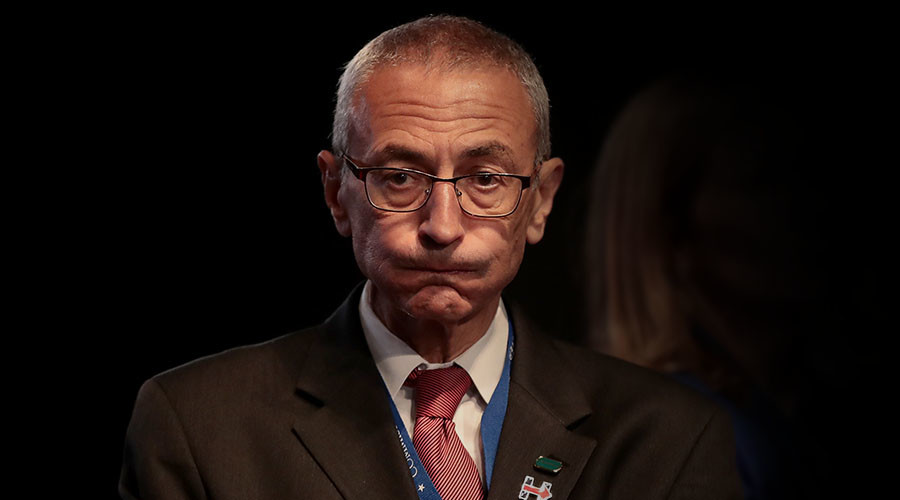
Democratic presidential nominee Hillary Clinton's Campaign Chairman John Podesta. © Drew Angerer / Getty Images / AFP

There is a word missing from the non-classified report issued Friday, in which three intelligence agencies assess “Russia’s Influence Campaign Targeting the 2016 US Presidential Election.” The FBI, CIA, and NSA elide any mention of . . . “Podesta.”

Seems like a pretty significant omission — not just because of how the 2016 campaign played out but also in light of the intelligence community’s recent history of politicizing its analyses.
The report is replete with references to Russian “cyber espionage,” “covert intelligence,” “false-flag,” “propaganda,” and “influence” operations by which Vladimir Putin is alleged to have tried to put his thumb on the electoral scale. Very sinister stuff, to be sure. But when the public hears these terms, it thinks of spies, misdirection, disinformation campaigns — i.e., schemes intended to deceive the target audience. People don’t instantly think, “Oh, you mean an effort to publicize true but embarrassing information”; they don’t read “covert operation” and say to themselves, “That must mean they subjected only one side of a political contest to a high level of scrutiny.” That’s the kind of behavior people associate with the American media, not the Kremlin.

The three intelligence agencies’ report pointedly declines to tell us what specific information gives them such “high confidence” that they know the operation of Vladimir Putin’s mind. They plead that the nature of their work does not allow for that: To tell us how they know what they purport to know would compromise intelligence methods and sources.

Fair enough. The problem, though, is that if you’re essentially going to say, “Trust us,” you have to have proven yourself trustworthy over time.

Here, we are talking about a community whose own analysts have complained that their superiors distort their reports for political purposes. In just the past few years, they have told us that they had “high confidence” that Iran suspended its nuclear weapons programs in 2003; that the NSA was not collecting metadata on millions of Americans; and that the Muslim Brotherhood is a moderate, “largely secular” organization. We have learned that the Obama administration intentionally perpetrated a disinformation campaign — complete with a compliant media “echo chamber” — to sell the public on the Iran nuclear deal (and the fiction that Iran’s regime was moderating). We have seen U.S. intelligence and law enforcement complicit in the Obama administration’s schemes to convince the public that “violent extremism,” not radical Islam, is the explanation for terrorist attacks; that a jihadist mass-murder attack targeting soldiers about to deploy to Afghanistan was “workplace violence”; that al-Qaeda had been “decimated”; that the threat of the ISIS “jayvee” team was exaggerated; and that the Benghazi massacre was not really a terrorist attack but a “protest” gone awry over an anti-Muslim video.

I can attest that the intelligence agencies overflow with patriotic Americans who do the quiet, perilous, thankless work that saves American lives. We can acknowledge this incontestable fact and still observe that, on this record, the intelligence community as an institution cannot very well expect that “Trust us” is going to get them very far.

Which brings us back to what the new report studiously avoids mentioning.

The vaporous assertion that Putin’s regime was up to “espionage” and “covert ops” in order to “denigrate” Mrs. Clinton might naturally be presumed to imply that Putin was promoting smears. Such an impression — if that’s what the agencies were aiming to create — would have been contradicted by mentioning “Podesta,” as in John Podesta, the top Obama White House and Clinton-campaign official whose private e-mails were hacked. To bring up Podesta might remind the public that this was not a disinformation campaign. What was revealed here was true information that Podesta and his correspondents would understandably have preferred to keep private.

As President Obama likes to say, let me be clear. I am not endorsing hacking, cyber-theft, and the publication of private information. Unlike some conservatives now infatuated with scoundrels like Julian Assange (and even Putin!), I continue to regard enemies of the United States as, well, enemies of the United States. They are not to be trusted, regardless of whose ox they happen to be goring as their allegiances and calculations twist and turn.

My point is that Putin did not plant a slanderous story that top Clinton aides were, say, spouting anti-Catholic bigotry. What he did was orchestrate the release of authentic e-mails, in one of which top Clinton aides were in fact spouting anti-Catholic bigotry.

I will give Democrats the benefit of the doubt that, if the shoe were on the other foot, they would condemn the theft — a benefit they probably do not rate given their praise of Edward Snowden and their historic efforts (the Carter administration, Ted Kennedy) to seek Soviet interference in the American political system when it stood to help their electoral prospects. But I am quite certain Democrats would have no sympathy for Republicans over any political damage if the latter were caught saying unsavory things. In such an instance, victorious Democrats would not tolerate a suggestion that the “the election had been hacked”; they’d say, “Republicans got caught being Republicans.”

The new report may be entirely right — I think it is — that Putin tries to meddle in American and European elections and that he has preferences about the outcomes. Yet it is written in a way that enables the Left to spin it as support for the fallacy that Putin “hacked the election.” It gives Democrats ammunition to continue prattling about how the Russians used “espionage” and “covert operations” “aimed at the US election” in order to “influence” the result; and that Putin wanted Trump to win, according to our “highly confident” agencies. The Left can even cite the agencies’ intriguing but inchoate conclusion that the Kremlin “accessed elements of multiple state or local electoral boards” — a conclusion that a cynic, believing the intelligence community might be just a teensy bit political, might figure was included in the report to undercut Trump’s refrain that the hacking had nothing to do with the electoral process.

The agencies, of course, would deny any political agenda. And perhaps they don’t have one — personally, I don’t have “high confidence” that I can read their minds as well as they can apparently read Putin’s. Nevertheless, when you read the report carefully, it is like a media report: It feeds the “hack the election” theme, but it does not actually say Putin hacked the election.

Indeed, when you look for the fire under all the smoke, you find the agencies saying, “We did not make an assessment of the impact that Russian activities had on the outcome of the 2016 election.” And while the report repeatedly asserts that Russia wanted to “influence” the election, it elaborates that Russia’s main aim is to “undermine the U.S.-led democratic order” and “faith in the US democratic process” (an unremarkable finding that, by the way, is of a piece with the contention of Trump national-security adviser Mike Flynn that the Russian regime is anti-American principally because it opposes democracy).

The report concludes that while Putin appears to have been rooting for Trump, the Russians assumed Clinton was going to win and were mainly trying to undermine the effectiveness of her anticipated presidency, not swing the election to Trump. And even the conclusion that Putin was rooting for Trump is partially based on speculation (“Putin most likely wanted to discredit Secretary Clinton because” he blames her for protests against his regime), along with heavy doses of hypothesis (Putin is said to have: liked “Trump’s stated policy to work with Russia”; seen Trump’s election as a potential pathway “to achieve an international coalition against the Islamic State”; “had many positive experiences working with Western political leaders whose business interests made them more disposed to deal with Russia”; etc.).

Note: all this agency guesswork appears to be based on publicly available information that you and I — without any access to super-secret intelligence sources and methods — could have done on our own. It doesn’t really tell us anything we didn’t already know, or couldn’t already have surmised.

And what about those dark suggestions about Russian penetration of “multiple state or local electoral boards,” and that “since early 2014, Russian intelligence has researched [ooh!] US electoral processes and related technology and equipment”? Well, if you read on, you find that the report is at pains to concede that the Department of Homeland Security “assesses that the types of systems we observed Russian actors targeting or compromising are not involved in vote tallying.”

In other words, Putin did not hack the election.

In light of the report’s emphasis on Mrs. Clinton as the “espionage” victim, it is worth noting a couple of other nuggets. The agencies acknowledge that Kremlin spies “conducted cyber operations against . . . targets associated with both major US political parties” (emphasis added). In fact, Russia “collected against” anyone and everyone “viewed as likely to shape future US policies” — including “US primary campaigns, think tanks, and lobbying groups.”

In making the concession that “Russia collected on some Republican-affiliated targets,” the agencies are quick to caveat that, whatever Putin may have done to Republicans, it was not “comparable” to his “disclosure campaign” against Democrats. But is that necessarily because he wanted the Republicans to win?

Again, reading the report closely, we learn that while the Russians apparently “targeted” the Republican party, they actually succeeded in “gain[ing] access to Democratic National Committee (DNC) networks” — access they maintained for about a year. And note that, just as the agencies refrain from any discussion of the Podesta motherlode, they also choose not to tell us anything about the quantity or quality of the information obtained from Republicans. We’re just vaguely told that Russia’s Republican disclosures were not “comparable” to its Democratic disclosures. But that might be indicative of a motive only if the information acquired from each party was comparable. Isn’t it possible that the disclosures were not comparable because the stuff Putin got on the GOP was not nearly as copious or juicy as what he got on the Dems?

Or . . . let’s assume for argument’s sake that the information Russia acquired was comparable — let’s assume that they have something on Trump, or on some Republican as relatively high-level as Podesta, that would stoke the same kind of press frenzy as the tens of thousands of Podesta e-mails. If the report is correct that Putin was convinced Hillary would win and wanted to cripple her presidency from the start, wouldn’t it be logical that he’d more heavily disclose what he had on the Dems? What would be the point of trying to cripple the anticipated Republican loser? Wouldn’t Putin keep his powder dry on the GOP — hold whatever he’s got for future damage or blackmail purposes, save it for a time when it would be more useful?

I’m speculating about Putin’s motives, and I don’t have “high confidence” that I know what they were. But that’s kind of the point, isn’t it?

Before the agencies’ report was issued, most of us knew that Russia is an adversary obsessed with America, that it aggressively spies against us and endeavors to influence any aspect of American affairs that could advantage it. We also knew Russia did not “hack the election.” The underwhelming intelligence report on Russia’s meddling in our election changes none of that.

— Andrew C. McCarthy is a senior policy fellow at the National Review Institute and a contributing editor of National Review.

A Window Into a Depraved Culture


January 8, 2017
Image result for chicago torture Tesfaye Cooper
Clockwise from upper left, Brittany Covington, 18, of Chicago; Tesfaye Cooper, 18, of Chicago; Jordan Hill, 18, of Carpentersville; and Tanishia Covington, 24, of Chicago, face charges of aggravated kidnapping, hate crime, aggravated unlawful restraint and aggravated battery with a deadly weapon.
Chicago Police Department
Anti-police activists and the mainstream media are incensed at the suggestion that the Black Lives Matter movement could have influenced the behavior of the four individuals in Chicago who tortured a disabled white man for hours last week while yelling “Fuck white people” and “Fuck Donald Trump.” In one sense, the activists and media are right: The influences were broader than that. They include the reign of racial victimology, inner-city gang culture, and black anti-white animus.
We live in Ta-Nehesi Coates’s America, characterized by the assumption that blacks are the eternal targets of lethal white oppression. Coates’s central thesis in Between the World and Me, his acclaimed phantasmagoria of racial victimology, is that America continuously aspires to the “shackling” and “destruction” of “black bodies.”
Chicago’s four torturers certainly have not read Between the World and Me. But the book’s worldview echoes throughout our society, including in the inner city. Michelle Alexander’s equally publicized book, The New Jim Crow, argues that the U.S. seeks to reimpose de facto segregation on blacks via the criminal justice system. Alexander has been a staple on black media, among many other outlets. President Obama has insisted, even up to his last days in office, that blacks are the victims of a racist criminal-justice system. The press routinely disseminates phony statistics that purport to demonstrate a police war on blacks. These ideas matter.
Black Lives Matter ideology is just a more in-your-face manifestation of the Coatesian conceit that blacks are living in a system determined to destroy them. The Chicago Black Lives Matter chapter embraces the motto “Stop killing us,” aimed at the Chicago Police Department. It chants: “CPD, KKK: How many children did you kill today?” (The answer is: Virtually none. Last year, over 3,400 people in Chicago were shot, overwhelmingly black. Victims included 24 children 12 years of age or younger. The Chicago cops shot 25 people, virtually all armed and dangerous, or .6 percent of the total.) The Chicago Black Lives Matter chapter disseminates inflammatory lies about the Chicago police, such as that BLM activist Ja’Mal Green was beaten for 30 hours following an arrest for battery against an officer and trying to disarm an officer. Increasing the size of the Chicago Police department, per the Chicago BLM, will simply result in “more killings by police, more police torture and violence.”
These anti-law enforcement claims reinforce existing anti-white animus in the inner city. The notion that the dominant or exclusive racism in America today is white anti-black racism is absurd. Though many urban residents harbor no racial animosity, the recurrent “Fuck Whitey” and “Kill the cops” themes in rap music are not accidental. (Sample: “Kill the White people; we gonna make them hurt; kill the White people; but buy my record first,” by Apache; “The White man is the devil… Drive-by shooting on this White genetic mutant,” by Menace Clan.) I have been warned by residents of one East Harlem housing project not to go to a neighboring project because “they really hate whites there.”
Even if there weren’t already a strain of racial hostility in inner-city culture, the constant establishment refrain that whites oppress blacks at every opportunity would create it. Every highly publicized cop assassination in the last two years has triggered gloating on social media. Ja’Mal Green told the New York Times that the assassination of five Dallas police officers was “not a setback at all” for Black Lives Matter. The Dallas gunman had said he wanted to kill white people and white cops. Though Green insisted that he was not encouraging violence, he said that the assassination showed “the people of this country that black people are getting to a boiling point. We are tired of watching police kill our brothers and sisters. We are tired of being tired.” At some point, there “comes a time when black people will snap,” he said. While one is grateful for Green’s avowal not to be encouraging violence, such sentiments come close to rationalizing it.
The establishment typically looks the other way at manifestations of black anti-white animus. Racism in rap music is usually ignored. The Associated Press excluded any reference to the race of the victim and assailants in its initial report on the Chicago torture episode, as John Hinderaker observed at Powerline, and merely noted that police were investigating a “beating” captured on social media. The AP’s follow-up report acknowledged that someone in the video appeared to use profanities about “white people” and that the victim “appeared to be white,” while “others shown in the video appeared to be black.”
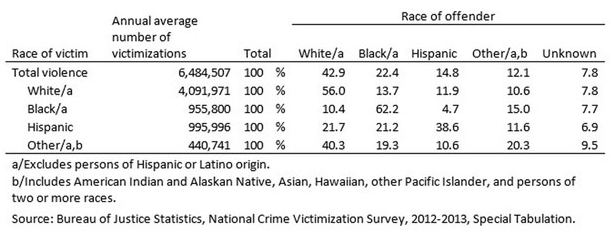
Radley Balko rushed to tweet out that the Chicago kidnapping is not a trend because since 2001, 80–85 percent of white murder victims were killed by whites. True, but the percentage of blacks killed by blacks is higher. From 1980 to 2008, 93 percent of black victims were killed by blacks. White-on-black homicides are much rarer than black-on-white homicides. The vast bulk of interracial violence is committed by blacks. In 2012, blacks committed 560,600 acts of violence against whites, and whites committed 99,403 acts of violence against blacks, according to data from the National Crime Victimization Survey provided to the author:
Distribution of violent victimizations, by race/Hispanic origin of victim and perceived race/Hispanic origin of offender, 2012–2013

Blacks, in other words, committed 85% of the interracial crimes between blacks and whites, even though they are 13 percent of the population. This data accords with the last published report on interracial crime from the Bureau of Justice Statistics; the Bureau stopped publishing its table on interracial crime after 2008, the first year of the Obama presidency. 
Some portion of those black-on-white crimes may be driven by the same racial hostility that gives rise to urban flash mobs and the knockout game. As Dead Prez rapped: “We gonna order take out and when we see the driver/We gonna stick the 25 up in his face . . . White boy in the wrong place at the right time.” Even if the higher rate of black-on-white violence is simply a product of blacks’ higher rate of violence generally, that violent crime rate is another fact suppressed by the mainstream media whenever possible. In response to the Chicago torture video, Callum Borchers of the Washington Post sneered at conservatives’ supposed delusions, such as that “Chicago is a war zone.” This idea struck Borchers as so preposterous that he repeated it later in his column: “Oh, and by the way, Chicago (the part inhabited mostly by black people, anyway) is a super-dangerous place, just like Trump said.”
One wonders how quickly Collum would move his family out of the allegedly pacific South and West Sides of Chicago if he actually had to live there. The following is a partial sampling of crime headlines from Chicago papers over the last few weeks, in reverse chronological order:
FAMILY SINGALONG ENDS AS BULLETS FLY THROUGH CAR WINDOW ON PULASKI ROAD
SHOOTINGS KILL 4 PEOPLE, WOUND 24 SINCE SATURDAY, POLICE SAY[referring to the 24-hour period from December 31, 2016 to January 1, 2017]
TWO BOYS, 16, KILLED IN SHOOTING THAT ALSO WOUNDED 65-YEAR-OLD WOMAN
A VIOLENT CHRISTMAS IN A VIOLENT YEAR FOR CHICAGO: 11 KILLED, 50 WOUNDED
BROTHERS KILLED, 5 OTHER PEOPLE WOUNDED IN CHRISTMAS SHOOTING
3 KILLED, 17 WOUNDED IN CITY SHOOTINGS
4 DEAD IN FERNWOOD ATTACK, 15 OTHERS WOUNDED IN SHOOTINGS
3 WOUNDED IN PARTY BUS SHOOTING NEAR LAKE SHORE DRIVE
WOMAN RAPED BY ARMED MEN AFTER ROBBERY IN HUMBOLDT PARK
MAN WHO ATTACKED, ROBBED 94-YEAR-OLD GARFIELD RIDGE WOMAN SOUGHT BY POLICE
47 SHOOTINGS SO FAR ON EXPRESSWAYS IN CHICAGO, 10 ABOVE ALL OF LAST YEAR
BOY, 16, SHOT ON HIS WAY TO SCHOOL — BUT WENT TO CLASS ANYWAY
INBOUND EISENHOWER SHUT DOWN AFTER SHOOTOUT BETWEEN CARS
MEN CHARGED WITH ROBBING WOMEN WALKING ALONE IN LAKEVIEW, POLICE SAY
SHOOTINGS KILL 9, WOUND 66 OVER THANKSGIVING HOLIDAY, POLICE SAY
Or maybe Borchers is only interested in the white areas of Chicago, which are not yet a “war zone.”
Black Lives Matter activist Shaun King, responding to the Chicago torture, rejected the idea of speaking out “on crimes committed by black folk because nobody in this country is held more responsible for the crimes they commit, and even the crimes they don’t commit, than black folk in America. . . . American prisons are full of black folk who are being held responsible for every mistake they’ve ever made.” Try telling that to Chicago Police Superintendent Eddie Johnson. Johnson regularly bemoans the fact that convicted gun felons in Chicago have little to fear from the criminal-justice system, because they are so quickly back on the streets following a shooting. The Illinois Black Caucus has blocked stiffer penalties for gun crime.
The victims of a November 2016 robbery spree in Chicago may also disagree with King that the criminal-justice system is vindictive against black criminals. Isaiah Scaife had already been convicted of theft, attempted theft, criminal trespass, and possession of a stolen motor vehicle before he turned 18, according to DNAInfo. He continued to commit gun crimes as a young adult. At age 19, after a conviction for aggravated unlawful use of a weapon, Scaife was already out on parole. That’s when he began his five-day crime spree on November 18, robbing a Subway store’s customers after sticking his gun in a baby’s face and trying to manhandle his way behind the restaurant’s counter. A few minutes later, he robbed a man leaving a Citgo gas station, beating the victim unconscious with his gun before shooting him in the face. The next day, Scaife returned to the same Subway, where he robbed and choked a man while a juvenile accomplice pointed a gun at the victim. A few days later, Scaife pulled a gun on a man at another gas station and stole his possessions and car. At his arraignment, he yelled at the court deputies: “I’m going to spit on your ass.”
Scaife is hardly unique. A huge percentage of violent crime is committed by people with serious criminal histories who are free to continue terrorizing the innocent. And, pace King, if you commit a drug crime, you’ll get more leniency in a large urban jurisdiction than in a rural county, where sentences for white drug dealers dwarf those of inner-city traffickers, according to the New York Times.
At least one of the Facebook torture assailants belonged to the gang culture that produces Chicago’s violent crime. Tesfaye Cooper posted a video on his YouTube channel in October in which he points a rifle at the camera and says: “I’ll put a bullet in your ass,” reports DNAInfo Chicago. Cooper’s Facebook page glorifies him posing with guns and paying homage to local murderers. His raps threaten to kill people who disrespect him and his crew.
The violence in the Chicago torture video does not arise in a vacuum. Most residents of inner-city areas are hardworking bourgeois citizens longing to live in safety and in racial harmony. But the video opens a window into a culture that America would prefer to turn its eyes away from—and which it has helped create.

Sunday, January 08, 2017

On Meeting Sally Read: Poet, Writer, Convert from Atheism


December 7, 2016

web-sally-read-poet-supplied-photo-sally-read
Sally Read

As I entered Soho Square the bell of St. Patrick’s Church started to toll.

It was three o’clock in the afternoon. The bell rang out three times and then continued tolling. It was the hour of Great Mercy. It was to this sound of a tolling bell that I entered the church. There the Blessed Sacrament was exposed upon the altar. It was here also where, as arranged, I met Sally Read.

Ignatius Press has just published a remarkable book: Night’s Bright Darkness: A Modern Conversion Story by Sally Read. It is a memoir of the author’s conversion from atheism to the Catholic faith. It is a tale skilfully told and beautifully written. No doubt it will speak to many of her generation, witnessing as it does to an escape from a life where pleasure was the guiding principle to one re-imagined by an encounter with the Living God.

Shortly after meeting, we walked through the square to a nearby café. As we did so, I asked her what it was like being back in London. She said she found her former homeland more materialistic than ever, more than her adopted home near Rome where today she lives with her husband and daughter. By way of response, I suggested that, perhaps, it was much the same as when she lived here some twenty years ago, while, privately, I wondered if it wasn’t so much London that had changed as Sally Read. It was of this change I had come to speak to her.

She had been a psychiatric nurse two decades earlier in this city. Her memoir makes clear that during that period of her life she saw much: madness, despair and death, and all at close q
uarters. That former time working in London’s psychiatric hospitals is now history, however. Today Sally Read is very much a writer, with a newly published book that is already gaining attention.

Maybe this is not so surprising as Sally Read is also an award-winning poet. For now, however, poetry is not on her agenda. Sitting drinking tea together, I ask her why. She sees her former poetry now as a form of ‘mysticism’. However obliquely, she felt it was somehow in touch with something greater, though that ‘something’ the then poet did not fully understand. Nevertheless, poetry, she says, reflects contemporary culture, is closely attuned to it; the culture we live in is so poisoned morally, culturally and spiritually that the toxicity is too much for her to change. She accepts her creative limits in this regard.

In Night’s Bright Darkness the narrative line is so compelling that I asked if she had considered writing fiction. For a fleeting moment she appeared surprised. Then she admitted that she was halfway through completing her first novel. It is in this genre that Sally Read now wishes to explore her vision. She is cautious about speaking of this latest venture. This is not because she wishes to withhold information so much as because she is still feeling her way. Her present work, however, is a literary novel, she says, one that explores ‘life in all its rawness’. Having read her memoir, one would expect nothing less.

Sally Read may be a writer, but she is quick to point out that she is not a ‘Catholic writer’. Like many, she prefers to see herself instead as a writer who became a Catholic. In this case, her awareness of the desire to write came long before any consciousness of God. The vocation to be a storyteller—what she describes as a ‘truth teller’—is paramount. From a young age, she felt this artistic calling, whether expressed through poetry, composing essays, a memoir, or, now, fiction—for her, all of this has a single purpose: the greater glory of God. Her conversion, she says, has only crystallised this pre-existing sense of vocation.

The writers she claims that have influenced her are some one might expect, such as Graham Greene and Flannery O’Connor; others are less obvious such as Virginia Woolf. When Sally Read speaks of literary and spiritual matters, there is no dichotomy. They are parts of the same whole. 
Since her conversion, she has discovered the world of Catholic spiritual writings. Her favourite conversion story, she says, is that of Thomas Merton. It was while reading The Seven Storey Mountain that any doubts she had about putting her own faith journey down on paper evaporated.

Read is still a relatively recent Catholic convert. The publication of her book makes that event seem more recent than it is. In fact, it was in 2010 that she was received into the Catholic Church. Then in the summer of 2014, she started to write the story of her conversion, completing it the following year, before its eventual publication this year.

Had there been changes in her life since the publication of Night’s Bright Darkness, I asked her? ‘None at all’, she said, surprised by the question. The book, she pointed out, has only just been published in America; it has not yet been translated into Italian; and the media round in which she is currently involved has been solely aimed at the US market. In Italy, she is as unknown as she ever was. She may be a writer exciting interest in the English-speaking world, but in her Italian home she is a wife and mother, in her local parish just one more member of the congregation. I sensed she was relieved at that.

For all her years in Italy, Read’s demeanour and manner remain British. Her family background is rooted in these islands—part East Anglia, part Ulster, all Protestant. This makes her conversion to Rome from a mix of atheism and anti-Catholicism all the more remarkable.

One of the questions I wanted to ask was about the reactions of others to her conversion. She told me that the response of her family was mixed but is now no longer hostile and, if anything, merely indifferent. New Catholic friends have appeared as many of her old friends disappeared. There have also been some welcome surprises. A close friend from her former life in London has also now found her way into the Church. Chatting with Sally Read, in a crowded cafe, I was struck by the mystery of the faith. It is full of the unexpected and unlooked for, and all the more wondrous for that.

Read has a small, close spiritual support network. Fr. Gregory Hrynkiw, the priest who played such a pivotal part in her conversion, and who is central to the book, is still her spiritual guide. Beyond and more important than anything else, however, of course, is the Eucharist. She is clear that when any Catholic receives Holy Communion, this is a mystical experience. Night’s Bright Darkness records how the mystics, such as St. John of the Cross, helped draw her closer to the Truth. She continues to read the mystics, some of these from closer to home: English mystics such as Julian of Norwich and Margery Kempe. She feels that a mystical awareness is at the heart of her new found faith.

We walked back to the church through streets that are as far from God as any in this Metropolis. Minutes later, we said goodbye outside the large red brick neo-Gothic structure of St. Patrick’s. As she entered the darkness within, I glimpsed in the distance, still exposed upon the altar, the Blessed Sacrament

Soho Square is marked to the East by St. Patrick’s church. To the North side of the square there is a plaque to a now famous resident who lived there in the nineteenth century. Mary Seacole was a black nurse who cared for soldiers in the Crimea War. She was also a convert to Catholicism and lies buried in London’s main Catholic cemetery. More curious still, facing the church on the far side to the West, lived, and eventually died, another nurse, who served in that same conflict. Her name was Frances Margaret Taylor. Upon her return from Crimea, she also converted to the Catholic faith. Many decades later, she was declared Venerable.

And now, in 2016, for a new generation, a former nurse speaks of her conversion to the Catholic faith. Sally Read is indeed home.

Night had fallen, but walking out of the square, I was conscious more than ever that within it, and indeed throughout this city, a ‘bell’ tolls yet, telling of a Merciful Heart that waits for all.