Tuesday, November 08, 2016

Why We Still Don’t Know the Whole Pearl Harbor Story

Author Craig Nelson talks to TIME about his new book Pearl Harbor: From Infamy to Greatness—and how that famous day remains a mystery

September 20, 2016


Image result for pearl harbor craig nelson
The 75th anniversary of a major historical event is a tricky one, saysCraig Nelson, author of best-selling books like Rocket Men and The Age of Radiance. Those who remember that event first-hand were young when it happened and are elderly now. “You’re sort of on the border between journalism and history,” he says. “You have to make a giant effort to capture this material before it goes away for good.”
That was part of the reason why Nelson turned his attention to the Dec. 7, 1941, attack on Pearl Harbor, the subject of his new book Pearl Harbor: From Infamy to Greatness, available Tuesday.
He talked to TIME about what it’s like to take on a topic that has been so thoroughly dissected, and how it’s possible that there’s still more to learn about that infamous day.
When you’re researching something so huge, where do you start?
The guy who sort of did the big definitive book before me was Gordon Prange, and he wrote At Dawn We Slept. He had been given orders by General MacArthur to interview all of the Japanese captured as part ofOperation Hawaii and Operation Z. He went so far overboard in his research that he died before being able to finish the book. So that’s the kind of research that’s involved. I ended up hiring about a dozen people—some worked on Japanese material, some worked with me in New York, some worked in Washington, and we produced over a million pages of research to start from. It was just overwhelming. At first I thought, I should really just give up. It was the most written-about thing in American history.
That sounds daunting.
Part of what we researched was, What were the major books that people had written already and was there something new? A lot of the people, the survivors, were very young [at the time], and they were so traumatized. No one knew about PTSD then, and they didn’t have any kind of treatment for it. So a lot of these people never really talked about it, and then you have people who were ignored, such as most of the Air Force and the civilians and the whole Japanese-American side of the story. You end up finding out that there’s an enormous amount of material that isn’t commonly known or hasn’t been published before. There’s a lot more research to do and there’s a lot of stuff we can do that’s new.
Was there a most surprising research moment that you had during this process?
I guess the big surprise to me was all the horrible things that people would live with and they wouldn’t tell anybody.
That idea, that people were expected to just deal with it and not process their emotions, is that part of the reason why there remains more to be said about something that’s been so studied?
Yes, all of this stuff is new because people wouldn’t talk about it. Remember after 9/11, they had the pictures of people jumping off the towers, and how they made this effort to sort of scrub all that away? Something sort of similar happened with Pearl Harbor, where they tried not let people know how devastating it was. Roosevelt announced that 300 people had died when it was 2,403. There’s almost a protective quality the government wants to have, to go, ‘Oh, this wasn’t as bad as you think,’ when it’s much worse than any one of them thought.

How has our popular understanding of that day evolved over these last 75 years?

Well, of course, for the war years it was the great inspiration for winning World War II, to remember Pearl Harbor and honor the memory of those who died and get revenge and get payback. It became as popular as ‘Remember the Alamo.’ Even though it was very distant to people, it also seemed as though the Japanese might appear in California at any minute. Then, after World War II, people really forgot about it. They deliberately tried to put it out of their minds. I had one veteran tell me that the first time he talked about it with his children was when he became a grandparent. He didn’t mention a word of Pearl Harbor for 30 years. Other ones would say, well, who wants to remember that? It was traumatizing.

Is there anything you found that, over time as these different narratives evolved, got messed up? Something that everyone thinks they know but it’s wrong?

The view that we had of the Japanese government during this period was that we thought that they were like Germany, where the head [of the government] was a maniac and the government was practically a religious cult group operation. And this was pretty much our image of the 1930s Japanese government for 50 years. And just now, the new stuff is coming out, showing how they constantly wavered back and forth on whether or not to attack the United States. What’s a shame is that, because the military had told Roosevelt that Japan would never attack the United States, that he and his Secretary of State Cordell Hull were pretty belligerent in dealing with the Japanese during this period. If they had lightened up a little bit, we probably might have never had a Pearl Harbor or a Pacific war.

Really?

The Americans were insisting that the Japanese had to pull out of China. If the Americans had said, O.K., how about you do this in 10 years, this in 15 years and this in 25 years, it probably would have worked. China for the Japanese was kind of like Vietnam for Americans. It was a quagmire and it wasn’t doing anything for them, but they couldn’t get out of it.

One of the most interesting points you make in the book is that if the Pearl Harbor strike had hit the nearby petroleum tanks, there wouldn’t have been enough fuel for the American Navy to fight the war in the Pacific.

It would have been very difficult. They had to ship all of their oil for running every engine from the west coast.

Are there other “what if” moments from that day that could have changed the course of the war?

It’s my whole favorite thing about this story. It seems to me that it was very close to never having a Pearl Harbor, and if that were true America wouldn’t have fought a Pacific war, and if that were true and there’s only fighting Italy and Germany, would we even be a global superpower? Pearl Harbor is this amazing trigger. You can say that even though Americans didn’t want to face the gruesome things they had seen in war, they made a lot of effort to make sure it didn’t happen again.


Monday, November 07, 2016

Clinton Foundation Probe Continues


November 6, 2016
Michael Loccisano/Getty Images)
In the days since FBI Director James Comey wrote to congressional leaders revealing new information in the Hillary Clinton email investigation, Clinton defenders have been spinning furiously in an attempt to mitigate the potential political damage. They have attacked Comey, blamed a rogue band of anti-Clinton FBI officials, suggested the FBI itself has a culture that lends itself to political conservatism, downplayed the Clinton email investigation and denied the existence of a Clinton Foundation investigation. While there are legitimate concerns about the lack of detail accompanying Comey's letter, some of efforts to downplay the seriousness of the FBI investigations, plural, and the professionalism of those conducting them are deeply political and misleading. And the reporting on an investigation of the Clinton Foundation is conflicting and somewhat contradictory.
On Friday, two Democratic congressmen wrote to the FBI requesting an investigation of "leaks" about the case, specifically citing the reporting of my Fox News colleague, Bret Baier. Representatives Elijah Cummings and John Conyers wrote:

For example, on Wednesday, Fox News anchor Bret Baier claimed on national television—based on multiple leaks—that the FBI was "actively and aggressively" investigating the Clinton Foundation and that an indictment was "likely." This morning, however, Mr. Baier was forced to correct his report, admitting that it was "a mistake."
They're half right. Baier's comment about a possible indictment came not during his lengthy account of Clinton investigations on "Special Report," the show he anchors, but in a Q&A during a subsequent appearance with Brit Hume. Baier later amended his comment on the "indictment" language he'd used, calling it a mistake, but Fox News is standing by the key claim in Baier's reporting on his show: There is an ongoing investigation into the Clinton Foundation. (Baier's other scoop in the same package, that the FBI has retained the electronic devices it was thought to have destroyed as part of immunity deals with Clinton, remains unchallenged.)

Other reporters at Fox have reporting that backs up Baier's reporting on the Clinton Foundation investigation. (I have one source who says the same thing). And Baier is hardly alone in reporting that the FBI is investigating the Clinton Foundation. Richard Pollock of The Daily Caller has been reporting the same since the summer. And CNN Senior Law Enforcement Analyst Tom Fuentes, a former top FBI official, cited conversations with "several" senior FBI officials when reported three times last weekend that the FBI investigation of the Clinton Foundation was "ongoing."
"The FBI has an intensive investigation ongoing into the Clinton Foundation," Fuentes said. "The FBI made the determination that the investigation would go forward as a comprehensive unified case and be coordinated. So that investigation is ongoing and Huma Abedin and her role in the foundation and possible allegations concerning the activities of the Secretary of State in the nature of the Foundation and possible pay-to-play, that's still being looked at."
Fuentes said the that the discovery of emails on Anthony Weiner's computer led the FBI to reopen the investigation into Clinton's use of email, which had been closed. "That part's being reopened. The Clinton Foundation case didn't need to be reopened. It's never been closed – that's ongoing."
When anchor Poppy Harlow asked Fuentes whether what he was relating were "facts you know from the FBI," Fuentes responded: "Yes, I do. Senior officials at the FBI, several of them."
A Wall Street Journal article published Wednesday provided details of the dispute between the FBI and the Department of Justice over the Clinton Foundation. The article notes that the investigation into the Clinton Foundation began in the summer of 2015 and reports that FBI officials on the investigation believed they had collected enough evidence to intensify their probe. Officials at the Justice Department disagreed and the dispute continued as the presidential nominating contests got underway. As FBI agents pushed to do more, Justice Department officials discouraged their efforts. On August 12, according the WSJ, a senior Justice Deparment official called FBI Deputy Director Andrew McCabe to complain that FBI agents were "disregarding or disobeying" instructions from DOJ. "The conversation was a tense one, they said, and at one point Mr. McCabe asked, 'Are you telling me that I need to shut down a validly predicated investigation?' The senior Justice Department official replied: 'Of course not.'"
Despite these details, NBC's Pete Williams questioned whether an investigation into the Clinton Foundation ever happened. "There really isn't one," Williams told Chuck Todd in an exchange on MSNBC. "Few want to call it an investigation. That's a term of art in the FBI. There was an initial inquiry that was opened a couple months ago based largely on media reports and a book called Clinton Cash."
Williams timeline contradicts the one reported by the Wall Street Journal, which put the start of the investigation in the summer of 2015 – not "a couple months ago." From the Journal: "Agents, using informants and recordings from unrelated corruption investigations, thought they had found enough material to merit aggressively pursuing the investigation into the foundation that started in summer 2015 based on claims made in a book by a conservative author called "Clinton Cash: The Untold Story of How and Why Foreign Governments and Businesses Helped Make Bill and Hillary Rich," these people said.
Whether the source of confusion is semantics or politics, a few things are clear: the FBI launched an inquiry of some kind into the Clinton Foundation; some DOJ officials didn't approve of the FBI investigation; and numerous current and former FBI and law enforcement officials continue to insist that the investigation into the Clinton Foundation is active and continuing.
Tom Fuentes is one of them. He tells THE WEEKLY STANDARD that he stands by his comments last week. Fuentes says the FBI's Clinton Foundation probe is "ongoing" and looking at Foundation activities in light of "the recent Wikileaks and Judicial Watch FOIA revelations, which require additional investigation."

THOSE BENGHAZI STINGERS


Yes, they did exist, but….


November 7, 2016
Image result for benghazi attack
More than a dozen people have sent me the same email over the past couple of weeks, purporting to tell the “REAL story on Benghazi.”
Like a lot of information circulating on the Internet, it contains an important kernel of truth, namely a reference to the July 25, 2012 Taliban attack on a U.S. Chinook helicopter in Afghanistan, using a U.S.-supplied Stinger missile.
That attack really did take place, as I reported in my 2014 book Dark Forces: The Truth About What Happened in Benghazi.
I learned about the helicopter downing from early Wikileaks disclosures known as the Afghan war logs, and corroborated the information with a senior U.S. military officer working an intelligence billet in support of U.S. special forces operations overseas.
The officer explained that the Stinger never exploded – not because “the stupid Taliban didn’t arm the missile,” as the email claims (if you can fire it, the missile is armed) – but because of a malfunction, most likely in the impact fuze and the guidance system.
Instead of exploding against the body of the helicopter, as designed, the missile lodged and broke apart in the engine nacelle. The alert pilot managed a hard-landing, and everyone on board the Chinook walked away. Crash investigators subsequently discovered pieces of the Stinger lodged in the engine nacelle, including a portion of the missile casing that included a serial number.
That serial number tracked back to a lot of Stingers that had been “signed out” to the CIA in Camp Arifjan, Kuwait, in early 2011, and transferred to the government of Qatar, my U.S. Special Forces informant told me.
The email, which is now the subject of a Reddit thread, begins with a breathtaking claim:
“Ambassador Stevens was sent to Benghazi, post haste, in order to retrieve US-made Stinger missiles supplied to Ansar al Sharia without Congressional oversight or permission. Hillary brokered the deal through Stevens and a private arms dealer named Marc Turi. Then some of the shoulder-fired missiles ended up in Afghanistan used against our own military.”
The only true statement in that opener is the final sentence. (The Justice Department recently dropped all charges against Marc Turi because they knew full well he never consummated any arms sales to the Libyan rebels and bowed out once his arms export license request for Qatar was denied).
Ambassador Stevens was sent to Benghazi for two reasons. The first, as noted by his number two in Libya, State Department career diplomat Greg Hicks, was to certify that the State Department could officially open Benghazi as a “permanent constituent post.” Hillary Clinton wanted to travel to Benghazi for a photo op, to take a victory lap for her “success” in ousting Colonel Qaddafi.
But Mrs. Clinton did not want to ask Congress for a special appropriation for Benghazi, since that would have led to an investigation into security procedures at the facility. So she instructed Stevens to travel to Benghazi as soon as he returned from his European vacation in early September. The plan was to use leftover funds from Iraq to operate Benghazi as a full-fledged consulate. But those funds “had to be obligated by September thirtieth” to avoid Congressional scrutiny, Hicks testified.
No arms deal. No Stingers. No “do-or-die” mission, as the lurid email claims. Just a Hillary Clinton vanity project that cost the lives of four Americans.
“It was the State Department, not the CIA that supplied [the Stingers] to our sworn enemies, because Petraeus wouldn’t supply these deadly weapons due to their potential use on commercial aircraft,” the email goes on.
I am still unclear as to who authorized the transfer of the Stingers to the CIA, and from the CIA, to the Qataris. That would be an excellent subject for a Freedom of Information Act request.
However, I am pretty certain of what happened next. The Qataris brought a small number of them – my sources said, fifty or sixty – into Libya through Chad in late March or early April 2011. This was before the U.S. and NATO had fully committed to helping the anti-Qaddafi rebels.
While they were en route, they encountered a French military patrol in northern Chad. The French asked the Qatari Special Forces commander in charge of the convoy, who had been trained in France, what he thought he was doing. He replied that he was taking Stinger missiles to the Libyan rebels.
After a lengthy palaver and communications with Paris, and via Paris with Washington, the French officer was instructed that the U.S. government wanted the Stingers to reach Libya.
As I reported in Dark Forces (p92), Qaddafi’s intelligence service picked up the communication between the French officer in northern Chad and his commanders. How do we know this? Because a copy of the intercept, dated April 4, 2011, turned up several months later in the just-vacated headquarters of Libyan intelligence chief Abdallah Senoussi, where it was discovered by a reporter from the Wall Street Journal.
All this said, there were no reports that any Stingers were fired in Libya, or ever reached the hands of Libyan rebel groups, let alone Ansar al-Sharia.
The second reason Ambassador Stevens traveled to Benghazi remains a matter of speculation – and would also make an excellent subject for a Freedom of Information Act request (although my own inquiries in this area have been rejected until now).
Just two weeks before Stevens went to Benghazi, a shipment of weapons intended for Syrian rebels reached Iskanderun, Turkey. The weapons had been purchased by jihadi sympathizers in Benghazi, possibly with U.S. assistance or at least the knowledge of the CIA station in Benghazi.
The arms shipment intended for the Syrian rebels was a  “liaison” operation, since it was carried out by a friendly intelligence service, most likely the Turkish MIT. These type of intelligence operations fall within a grey area of what must be reported to Congress.
Almost as soon as the Libyan fishing boat, Al Entisar (Victory) docked in Iskenderun on August 25, 2012, all hell broke loose. Rival Syrian rebel groups began squabbling over who would take custody of the 400 tons of weapons and “humanitarian supplies” it had brought.
Even worse: Western reporters started nosing around.
On September 2, 2012, CIA Director David Petraeus made an unannounced trip to Ankara to straighten out the mess. Petraeus was worried that reporters would blow the wraps off what was supposed to be a covert operation.
Petraeus was unsuccessful. And so he recommended that Secretary Clinton dispatch “their man in Libya” to speak with the jihadi leaders in Benghazi, whom Stevens knew intimately.
In fact, Chris Stevens had closer ties to the Benghazi jihadis than anyone in the U.S. government, because he had been sent there as Special Envoy during the revolution to cultivate them. He knew them by name; he knew their families; and he probably knew where they kept their bank accounts.
He was the “cleaner,” as I called him in my book. His job was to clean up the arms smuggling operation, perhaps shut it down; or at least, make sure mistakes like Iskanderun didn’t happen again.
We know from his schedule, recovered by journalists after his murder by Iranian agents in Benghazi, that he had been planning to meet with a Libyan shipping agent known for his close ties to jihadi leaders.
Do you think the State Department dispatched the Ambassador from Tripoli to meet with a shipping agent to set up USAID shipments? I think he was looking for a more trusted shipping agent for future arms shipments to the Syrian rebels. (The shipping agent freaked out when I called to ask him about this).
Stevens also met with the Turkish Consul General in Benghazi, accompanying him out to the front gate of the diplomatic compound shortly before the attacks began. Again, why him? I believe it was because the gentleman was the resident agent of the Turkish MIT in Benghazi, in charge of the arms smuggling operation.
So yes, there are still a lot of secrets surround what actually happened in Benghazi. I exposed many of them in Dark Forces, most notably the involvement of Iran’s Revolutionary Guards Corp in recruiting, training, and equipping the jihadis who actually carried out the murderous September 11, 2012 attacks.
Those secrets involve covert U.S. arms shipments, directly or through proxies, to both Libyan and Syrian jihadi groups. They involve Iran’s ongoing covert war against America. And they involve U.S. Stinger missiles that went missing.
All of these help to understand why Mrs. Clinton and her inner circle were so eager to deflect attention from Benghazi to a pathetic YouTube video they knew had nothing to do with the attacks. I call it the Benghazi Deception.
But please, let’s skip the conspiracy theories, and the lurid admixture of fantasy with fact. The facts by themselves are enough to hang a fish. Or a presidential wannabe like Mrs. Clinton, who belongs in jail.
 Tags: Benghazi, Hillary, Lies

Saturday, November 05, 2016

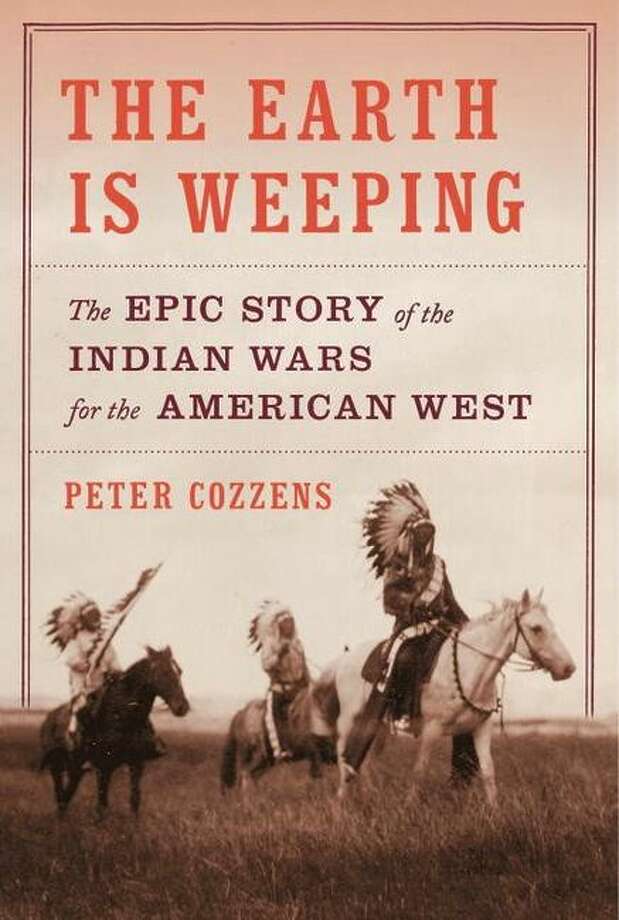
Book Review: ‘The Earth Is Weeping' by Peter Cozzens


By Dan Cryer
http://www.sfchronicle.com/books/
November 3, 2016


When I was a boy playing cowboys and Indians in the backyard, I invariably signed up with the cowboys. I knew darn well who the bad guys were. I knew which side represented civilization, and which, savagery. Later, as a serious student of history, I knew better. America’s treatment of the continent’s native inhabitants had been no less shameful than its treatment of African slaves and their descendants.

After all, how “civilized” could perpetrators of genocide be?

While in no way minimizing the devastating impact on Native Americans, Cozzens contends, contrary to revisionist works like Dee Brown’s “Bury My Heart at Wounded Knee” (1970), that official U.S. policy was never genocide. It was cultural assimilation. Indians were pushed and prodded to shed traditional ways, adopt Christianity and be transformed into settled farmers and ranchers. Though some may regard this as cultural genocide, a distinction without a difference, the author disagrees.

Confronted with the reality of fierce Indian resistance, Army officers learned to respect their enemies’ martial skills. The Lakota were unmatched horsemen, the Apaches masters of lightning guerrilla strikes. Their courage was never in doubt. Tribal unity, however, was their Achilles’ heel, not only among tribes but within the same one. Resisting wiser voices counseling restraint, youngbloods sometimes lashed out in fury and hurt their own cause.

The troops arrayed against them tended to be underfunded, poorly trained, badly paid and undisciplined. Only the overpowering force of greater numbers, the devastation of the buffalo herds, the railroads that knifed through Indian territory and the unstoppable in-migration of white settlers (fueled by the Homestead Act of 1863) allowed the soldiers to prevail. Using a divide-and-conquer strategy, the Army split off one group from another, and eventually saddled up Indian warriors to ride side by side with bluecoats.

Treaties, Cozzens notes, were “mere legal veneer to conceal wholesale land grabs.” As whites poured into the West, as gold was discovered, pacts signed but not fully understood by the tribes were overruled by government agencies. Once Indians were corralled onto reservations, the granting or withholding of rations proved an effective tool of pacification. If the only options were to acquiesce, depart in search of vanishing game or starve, tribal leaders usually knew what they had to do.

As Spotted Tail, chief of the Brule Sioux, accused, “Your words are like a man knocking me in the head with a club.” He signed up his band for rations anyway.
Without implying any false equivalence, Cozzens emphasizes history’s tangled complexity. Outbreaks of violence were sometimes provoked by Indians, sometimes by whites. Neither side had a monopoly on cruelty.

General Phil Sheridan represented the majority Army view, imposing a blame-the-victim interpretation on every misunderstanding between whites and Indians. Yet even Gen. George Crook, who battled Indians for decades, turned advocate for their rights. “All tribes tell the same story,” he wrote late in his career. “They are surrounded on all sides, the game is destroyed or driven away, they are left to starve, and there remains but one thing to do — fight while they can.”

Not all tribal leaders chose to fight. Cozzens sees dignity in two great Lakota chiefs: Red Cloud, who concluded that accommodation was the only path to survival, as well as Sitting Bull, who fought as long as he could. Likewise, Cochise of the Chiricahua Apaches laid down his arms after a decade of struggle, while Geronimo kept eluding his captors by slipping away to Mexico until his luck ran out.

Cozzens excels at crisp, muscular prose that offers clear pictures of men at war. (Numerous maps also aid our understanding.) His account of the Battle of Little Big Horn, for instance, portrays with scorching vividness the doomed George Custer and his Seventh Cavalry: “Calhoun’s men were easy targets. They knelt or stood, silhouetted along the barren hilltop. Arrows rained down on them. Bullets kicked up dust or entered flesh with a sickening thud.”

If individual battles are described with clarity and brio, the reader’s overall sense of things can nonetheless be blurred. So many tribes and chiefs, so many Army officers and Indian agents parade across these pages in pursuit of each other that it’s hard to keep them straight. The book is heavy on action, light on personality. Just when we think we’ve grasped a figure, he is whisked offstage and others take over.

One can’t help thinking, by way of contrast, of S.C. Gwynne’s masterful “Empire of the Summer Moon,” whose focus on the Comanches in Texas and Oklahoma made for a scintillating reading experience.

In the final analysis, “The Earth Is Weeping” doesn’t seem that far removed from the spirit of “Bury My Heart at Wounded Knee.” Both throb with the pain of Indian defeat and humiliation; both honor varied Indian cultures; both grieve at the inevitability of cultural clash.

Cozzens’ account begins and ends with massacres by U.S. troops. At Sand Creek, Colo., in 1864, some 200 Cheyennes, including women and children, were killed. Never mind that Chief Black Kettle had raised a white flag. Col. John Chivington did not want any prisoners.

At Wounded Knee, in South Dakota, Army cannons raked over a band of Miniconjou Lakota led by Big Foot preparing to surrender their weapons; 82 men and 64 women and children were killed.

Dee Brown has been updated and improved, but hardly countermanded.

Dan Cryer is author of “Being Alive and Having to Die: The Spiritual Odyssey of Forrest Church.” Email: books@sfchronicle.com


EUROPEAN MEDIA JIHAD AGAINST GEERT WILDERS


As they lose their grip, the political and media elites are getting desperate.


November 4, 2016
Wilders
(Getty Images)
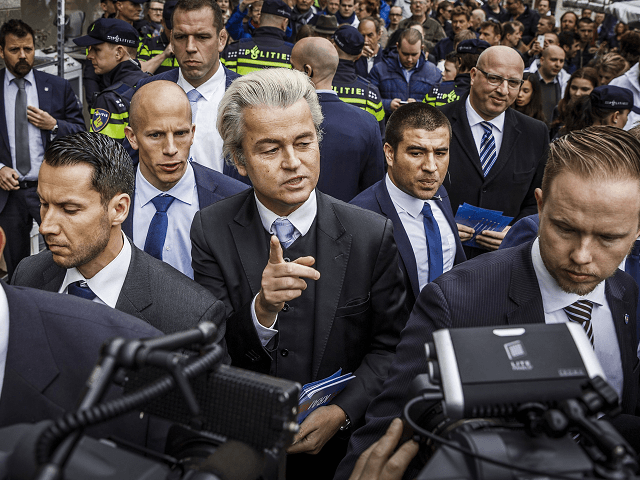
The mainstream media in Western Europe and North America isn’t even pretending to be an objective news source anymore; instead, “journalists” are working openly to quell what looks increasingly, on both sides of the Atlantic, like a popular revolution against the hegemony of the self-appointed political and media aristocracy that seems hell-bent on driving Western civilization over the cliff. And so it’s time for another round of their Two-Minutes Hate against Dutch politician and freedom fighter Geert Wilders.
Wilders has yet again gone on trial in the Netherlands for “hate speech,” and this time the case against him is especially flimsy: as Europe is roiled by the criminal activity of Muslim migrants, he is being accused of “hate speech” for saying that the massive influx of immigrants from Morocco (from which most of the Muslim migrants in the Netherlands come) has to be stopped. 
This trial could very easily backfire on the Dutch inquisitors, and make Wilders more popular than ever with the people of the Netherlands and Europe in general, as they are increasingly fed up with the political and media elites’ forcing them to accept a massive influx of Muslim migrants that ensures a future only of civil strife, bloodshed, and Sharia oppression. 
Consequently, those elites are trying desperately to shore up their position. Wilders chanted “No more Moroccans” at a rally. The horror! To any sane person, this means “Stop the influx of Moroccan immigrants who only inflate crime rates and welfare rolls.” To the media, which at this point is quite insane, insofar as insanity means an inability or refusal to accept reality, this means “Genocide!”
And so, in this Deutsche Welle (DW) piece by freelance “journalist” Teri Schultz, we’re told that European Parliament lawmaker Cecile Kyenge, who was born in Congo, had “numerous racial slurs - not to mention, bananas, literally - thrown at her, along with suggestions she go back to ‘her country.’” Does this have anything to do with the crime and civil strife that are the foundations for Wilders’ position? Of course not, but Wilders, Schultz tells us, is (of course) “far-right,” that all-purpose and meaningless semaphore that serves only to signal to right-thinking Deutsche Welle readers that Wilders is, as far as the media elites are concerned, unsavory, and must be opposed and shunned, his positions left unexamined. 
Schultz contacted me to serve as the villain of her piece, being sure to tell her hapless readers that I am “known for extreme anti-Islam views,” to make sure that if any of them are foolish enough to find themselves agreeing with me, they will immediately reverse themselves and get their minds right. The term “extreme” also, since the Western governing class unanimously refers to jihad terrorists as “extremists,” also implies that I am a terrorist. 
After the article came out, I challenged Schultz on this; she replied: “I don’t think even you would consider your views ‘mainstream’, do you?” I responded: “Absolutely yes. My views were the broad mainstream in the Western world from 632 AD until the 1960s. What changed? Not Islamic teaching.” To that she said: “Okay. You’d have to argue it with another expert, which I am not. But thanks again for contributing.” Indeed, she is just a mouthpiece for the views the political and media elites want us to hold. 
In any case, Schultz’s article merely reveals the desperation of the ruling class and the self-appointed opinion-shapers. They can call those of us who wish to defend the people and culture of Europe and North America “far-right” and “extreme” every day (and they do), but the public can see with their eyes what is happening. Wilders’ popularity isn’t growing because he is a charming fellow (which is, of course, not to say that he isn’t). It’s growing because he speaks the truths that the political and media elites are in a frenzy to obscure. 
And it’s only going to get worse for them: the Brexit vote and the Trump candidacy (whether he wins or loses) shows that their hegemony is beginning to be challenged. Those challenges will continue, and grow. They will before too long be decisively voted out and repudiated.

Thursday, November 03, 2016

You knew it couldn’t come easy, but the Cubs are World Series champions

 The Chicago Cubs won the World Series here Wednesday night for the young, the old and the long dead, too. Of course these Cubs beat the Cleveland Indians, 8-7, in 10 thrilling, brain-warping innings in Game 7 for themselves, for their own joy and glory.
But as they have been reminded endless times in the past seven months of this baseball season, they also won the Cubs’ first title since 1908 for the citizens of a nation without borders. They lifted the silly “curse” of Murphy the Goat and roused the spirits of a worldwide legion of interwoven sufferers who share a passion and an affliction — a lifelong freely chosen Cubness.
Because this game went beyond the baseball surreal, because it provided forgetfulness and forgiveness for several Cubs who might have been enormous goats, including reliever Aroldis Chapman and Manager Joe Maddon, it seemed to encapsulate the team’s long history of staring into the abyss. Only this time, at long last — it only took a century or so — the abyss blinked.
With a 6-3 lead and just four outs required to clinch this series, the Cubs brought on Chapman, who, earlier this year, threw a 105-mph fastball. Cubs fans all over the world thought they knew what would happen when he entered with a man on first base and two outs in the eighth. He would slam the door on the Indians and extend Cleveland’s own World Series drought, which dates from 1948.
So much for assumptions.
With two of the most unexpected swings in World Series history, the baseball worlds of these two cities flipped. Obscure Brandon Guyer smashed an RBI double off the center field wall on a 97.9-mph fastball. Then on the seventh pitch of his at-bat, 35-year-old journeyman Rajai Davis launched a two-run homer into left on a 97.1-mph fastball. His blast, fair by less than 10 feet and a few rows deep into the bleachers, might as well have traveled 600 feet — and the score was 6-6.
For 108 years, this is when the “curse” arrives and gags the life out of the choking Cubs. But, finally, not this time. Chapman finished the eighth, then he pitched a scoreless ninth to send the game into extra innings. Next, it rained. Honest. For a 17-minute rain delay. Was that the baseball gods’ idea of an appropriate amount of time for prayer, begging and unspeakable promises to all available deities?
When the tarp was removed, the sun rose on the Cubs, even though it was past midnight. Kyle Schwarber greeted losing pitcher Bryan Shaw with a single. Soon World Series MVP Ben Zobrist had sliced a double into the left field corner to break the tie, then Miguel Montero singled home an insurance run.
Finally, in the 10th inning, reliever Carl Edwards Jr., who had dressed as Mr. Incredible on a Cubs Halloween plane ride, tried to get the save. He allowed one run, but Mike Montgomery finally put out the blaze — the largest, perhaps, in the view of Chicagoans since Mrs. O’Leary’s barn had that little accident in 1871. At 12:47 a.m., after 4 hours 28 minutes, the mound mob scene began. Just a guess: It was better than the one in 1908.
Actor Bill Murray reacts on the field after the Chicago Cubs defeated the Cleveland Indians 8-7 in Game Seven of the 2016 World Series at Progressive Field on November 2, 2016 in Cleveland, Ohio. The Cubs win their first World Series in 108 years.(Ezra Shaw/Getty Images)
The happiest Cub may have been Maddon, who, in the view of many — okay, almost the whole baseball universe — had overused Chapman unnecessarily in Game 6, allowing him to pitch in all or parts of the seventh, eighth and ninth innings, even though he had already gotten an eight-out save, the longest of his career, in Game 5. Now all that will be forgiven, though probably not forgotten.
This whole night and early morning seemed jammed with Cubs symbolism. When Dexter Fowler hit the third pitch of the game over the center field fence, then danced backward between first and second base, exhorting his teammates, he was, by his spontaneous jubilation, honoring so many great Cubs of the past who never played in a single World Series game, like the late Ernie Banks, Mr. Cub.
When Javier Baez and David Ross, 39, playing his last game, also hit solo homers, perhaps they were not just high-fiving teammates as they returned to the jumping Cubs dugout but also saluting a long tradition of baseball affection on the North Side of Chicago that is so powerful and authentic that it has withstood a century of frustration while keeping alive a powerful multigenerational baseball love affair.
How fitting, after all of this, that the Cubs would become the first team since 1985 to have the fortitude to come back from a 3-1 deficit to win a World Series. And the first since 1979 to win the final two games on the road.
How ironic — but suitably sweet — that the 2016 Cubs will be known for playoff grit in all three rounds of this postseason. In their division series, they trailed San Francisco, 5-2, in the ninth inning of Game 4 and seemed certain to face scary Johnny Cueto in a decisive fifth game. Yet they scored four in the ninth to kill the Giants.
The Dodgers shut them out back-to-back to take a 2-1 lead in the National League Championship Series. Then, with their first pennant since 1945 at stake, the Cubs stomped Los Angeles flat, winning three straight games by a combined score of 23-6.
No one season erases a century of lousy teams, bad management and a half-dozen famous choke jobs, including defeats in the NLCS in 1984 and 2003 when the Cubs held three-run leads but lost and did it with haunting misplays, whether by first baseman Leon Durham or one of their own fans. But this season, with its balm and blessings aplenty, will have to serve — and considering the style with which this whole affair was completed, including three relief innings by ace Jon Lester — it should more than suffice.
From now on, wherever two or three Cubs fans are gathered together and still wonder, smacking their foreheads, how Jose Cardenal once missed a game because his eyelids were stuck together, there will be joy and relief whenever Nov. 2, 2016, is recalled. And there will be amazement, too, that they were resilient and hopeful for so long — and perhaps just a touch dopey for sticking with America’s biggest bunch of baseball losers.
Poor Cleveland. Now it is the leader in frustration, without a World Series title since 1948. Unless, of course, you count a city, rather than a continuous one-town franchise, in the futility calculation. Then, Washington, with no such celebration since 1924, takes the bitter prize.
Chicago Cubs' Ben Zobrist watches his RBI-double against the Cleveland Indians during the 10th inning of Game 7 of the Major League Baseball World Series Thursday, Nov. 3, 2016, in Cleveland.(Charlie Riedel/AP)
Perhaps there has never been a World Series in which there was as much or perhaps more focus on the fans of the two teams, both living and long departed.
In the past 40 years, there has certainly never been a World Series crowd so divided in loyalty. The cause: Enormous numbers of Cubs fans paid huge prices for tickets on the secondary market. Some, if they risked buying from scalpers who might have bogus tickets, got “bargains” as low as $1,200. But one pair of tickets behind the Cubs’ dugout was sold on StubHub for $23,000 — apiece.
“[Cubs fans] might have more money than us,” Indians Manager Terry Francona conceded.
Among the reveling Cubs fans was Kevin O’Brien, a Chicago lawyer wearing a vintage Bruce Sutter jersey. “If you count from birth, which I do, I’ve been a Cubs fan for 55 years,” he said. “My mom’s 82, and she’s been a Cubs fan all her life, too. She used to clean the Wrigley Field bleachers after games in the ’40s and ’50s to get free tickets to the next game.
“So I was stuck. The whole family are Cubs fans — brothers, sisters, cousins,” said O’Brien, who was asked how much he had paid for his ticket since he was, in a sense, representing all branches of his family. “Too much. Not going to say,” he said. “But my wife is happy it was less than her engagement ring 26 years ago.”
When the Cubs fell behind 3-1 in this series, some Cubs fans simply hoped this series would be extended back to Cleveland for a sixth game so that they could glimpse their team in a World Series for the first time since 1945 even if the Cubs ultimately lost.
“In Wrigley Field, tickets were $3,000, $4,000 or $5,000. I live there, and I couldn’t get into my own park,” said Eddie Opitz, 58, a truck driver from Mt. Prospect, Ill., who found a much cheaper ticket here for the Cubs’ victory in Game 6. “I called my wife this morning. Last week was our 25th wedding anniversary. She said, ‘So you’re coming home today, right?’ I said, ‘Errrrrr. . . . ’ ”
“I wish it wasn’t Cleveland we had to beat. What they’ve gone through all these years is so much like us,” Opitz said long before that final winning pitch. “Wish it could’ve been the Yankees.”
But after 108 years, the Cubs and their fans have come to a decision: They won’t be picky. They will just take this World Series — and its incredible final Game 7 — in their loving arms and toddle off into a long and blissful winter.