Wednesday, August 03, 2016

Today's Tune: Wilco - California Stars (Live at Farm Aid 1998)

Hillary Clinton’s Benghazi Debacle: Arming Jihadists in Libya . . . and Syria


Looking ahead to the next installment of e-mails from WikiLeaks

By Andrew C. McCarthy — August 2, 2016
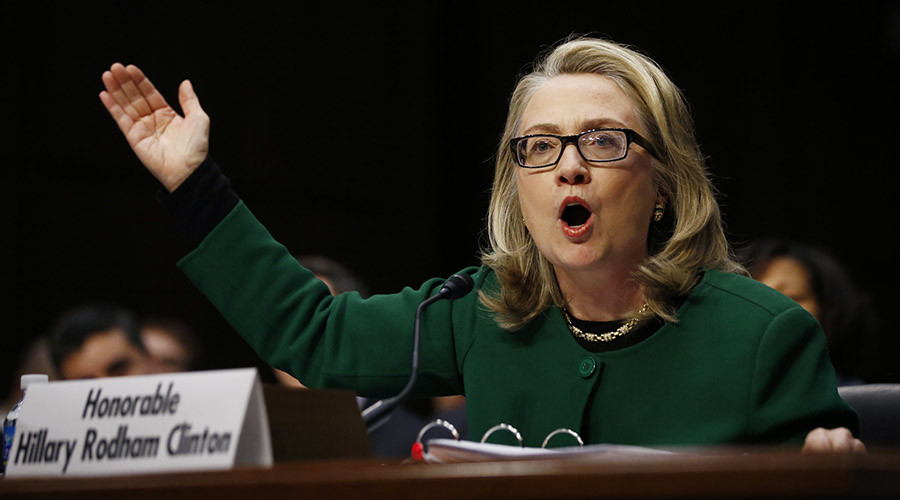
Secretary of State Hillary Clinton testifies on the Benghazi, Libya attack during a hearing held by the Senate Foreign Relations Committee on January 23, 2013. © Jason Reed / Reuters


As U.S. armed forces attack ISIS in Libya, WikiLeaks is poised to remind us that ISIS is in Libya — indeed, that ISIS is ISIS — thanks to disastrous policies championed by Hillary Clinton as President Obama’s secretary of state. Also raised, yet again, is the specter of Mrs. Clinton’s lying to Congress and the American people — this time regarding a matter some of us have been trying for years to get answers about: What mission was so important the United States kept personnel in the jihadist hellhole of Benghazi in 2012?

Specifically, did that mission involve arming the Syrian “rebels” — including al-Qaeda and forces that became ISIS — just as, at Mrs. Clinton’s urging, our government had armed Libyan “rebels” (again, jihadists) to catastrophic effect?

It has been less than two weeks since WikiLeaks rocked the Clinton campaign on the eve of the Democratic convention by leaking hacked e-mails illuminating DNC efforts to rig the nomination chase in Clinton’s favor. Now the organization’s founder, Julian Assange, has announced that WikiLeaks is soon to publish highly sensitive government e-mails that demonstrate Hillary Clinton’s key participation in efforts to arm jihadists in Syria. Just as in Libya, where Mrs. Clinton championed the strategy of arming Islamist “rebels,” the Syrian “rebels” who ultimately received weapons included the Muslim Brotherhood, al-Qaeda, and ISIS.

The Daily Wire and other outlets are reporting on Assange’s comments, published by Democracy Now. Clearly, we should not take Assange’s word for what is to be gleaned from the hacked records, which he says include some 17,000 e-mails “about Libya alone.” Let’s see if he has what he says he has. But it is worth setting the stage, because what is known is outrageous and has not been given nearly enough attention — largely because Beltway Republicans were complicit in the Obama-Clinton policy of allying with Islamists, and thus have shown no interest in probing the inevitably disastrous fallout.

As I have been pointing out for years, for example, we have never gotten to the bottom of why the State Department, under Mrs. Clinton’s direction, had an installation in Benghazi, one of the world’s most dangerous places for Americans.

The Obama administration, like the Bush administration, had touted Qaddafi as a key counterterrorism ally against rabidly anti-American jihadists in eastern Libya. Nevertheless, Secretary Clinton led the policy shift in which our government changed sides in Libya — shifting support to the Muslim Brotherhood and its allies, just as Mrs. Clinton had urged shifting U.S. support to the Muslim Brotherhood in Egypt. In Libya, this included arming “rebels,” who naturally included a heavy concentration of jihadists.

As I’ve recounted, to topple Qaddafi on behalf of the Islamists, the Obama administration — which did not seek congressional authorization for its offensive war (and preposterously maintained that bombing another country’s government was not really “war” anyway) — had to flout a United Nations resolution. The U.N. had agreed only to military operations for the purpose of protecting civilians, not offensive operations against the regime. Besides arming jihadists, the administration took no meaningful steps to make sure that Qaddafi’s military arsenals did not fall into terrorist hands. The regime was toppled and Qaddafi was brutally murdered — prompting Secretary Clinton’s bizarrely giddy quip, “We came, we saw, he died.” 

As some of us not-so-giddy types had warned would happen, Libya then became a safe haven for terrorists who turned on the American and Western forces that had cleared the path for them.
In small compass, this is the story of J. Christopher Stevens, the U.S. ambassador killed in the Benghazi massacre. As Business Insider’s Michael B. Kelley recounts, before becoming ambassador, Stevens was the Obama administration’s official liaison to Qaddafi’s Islamist opposition in Libya, including its al-Qaeda-linked groups. The latter included the Libyan Islamic Fighting Group (LIFG). Stevens worked directly with a top LIFG leader, Abdelhakim Belhadj.
When the Qaddafi regime was ousted, Belhadj took control of the Tripoli Military Council. In 2011, Belhadj met with anti-Assad “rebels” in Turkey to plan weapons shipments from Libya to Syria. As Mr. Kelley explains, in September 2012 the Times of London reported that “a Libyan ship ‘carrying the largest consignment of weapons for Syria . . . has docked in Turkey.’” According to that report:
The shipment reportedly weighed 400 tons and included SA-7 surface-to-air anti-craft missiles and rocket-propelled grenades. Those heavy weapons are most likely from Muammar Gaddafi’s stock of about 20,000 portable heat-seeking missiles — the bulk of them SA-7s — that the Libyan leader obtained from the former Eastern bloc. Reuters reports that Syrian rebels have been using those heavy weapons toshoot down Syrian helicopters and fighter jets. The ship’s captain was “a Libyan from Benghazi and the head of an organization called the Libyan National Council for Relief and Support,” which was presumably established by the new government.
Fox News subsequently reported that the ship, a Libyan-flagged vessel, Al-Entisar (The Victory), docked in the Turkish port of Iskenderun, only 35 miles from the Syrian border, on September 6, 2012. That was just five days before jihadists conducted the patently coordinated terrorist attack on the mysterious State Department and CIA compounds in Benghazi, killing four Americans including Stevens — who had been promoted to ambassador in May.

It is incontestable that the Obama administration has worked closely with the Islamist government of Turkey in efforts to arm and train “rebels” in Syria. Stevens’s last meeting on the night of September 11, 2012, right before the State Department’s Benghazi compound was attacked, was with Turkey’s consul general, Ali Sait Akin.

In the months leading up to the attack on the State Department facility, and on the even more shadowy CIA outpost a little over a mile away, jihadists in eastern Libya conducted a series of attacks against Western targets — including, on June 6, 2012, a bomb detonated just outside the State Department compound. The British government and the International Red Cross pulled their personnel out; yet the Obama administration left U.S. government personnel in, despite grossly inadequate security precautions.

Why? I believe that one significant mission was the coordination of weapons transfers from Libya to Syrian jihadists.

Remember the state of play in mid 2012. Obama was locked in a tight reelection race. He was falsely claiming that he had “decimated” al-Qaeda (which was actually thriving); that he was ending American wars (which were actually intensifying as he drew troops down despite ground conditions); and that his pro-Islamist policies were helping forge democracy in places like Egypt (then under Muslim Brotherhood rule) and Libya (which had disintegrated into a failed state under domination by Islamist militias). Prior to the November election, if Obama had openly announced that his administration was arming Syrian Islamists, it would have been highly controversial. It would have spotlighted how that same policy had failed in Libya, a fact to which neither the media nor Republicans had called public attention. This, no doubt, is why reports that Obama was “launching a covert operation to send weapons to Syrian rebels for the first time” (as the Times of London’s Christina Lamb put it) did not appear until immediately after Obama had won a second term.

Were Obama, Clinton, and others in the administration steering arms to Syrian jihadists before that time?

Recall that in mid 2012, Obama was also feeling heat — from the Islamist regimes he was appeasing, from Beltway Republicans, and even from some in his own administration, apparently including Secretary Clinton — for not doing enough to help the “rebels” drive Assad from power in Syria. There was a good explanation for this reluctance: Our government knew that the Syrian “rebels,” like the Libyan “rebels,” teemed with jihadists. Not only has this fact long been notorious; Judicial Watch managed to wangle from the government an August 2012 Defense Department memo that flatly states, “The Salafist [sic], the Muslim Brotherhood, and AQI [i.e., al-Qaeda in Iraq] are the major forces driving the insurgency in Syria.” The memo elaborates that its reference to AQI incorporates both Jaish al-Nusra (which is al-Qaeda’s main affiliate in Syria) and the Islamic State (the breakaway “caliphate” spawned by AQI).

There was no defensible security arrangement or diplomatic need for the State Department facility in Benghazi (U.S. diplomatic functions were handled in Tripoli). Was its real purpose to give diplomatic cover to covert intelligence operations (such as those at the nearby CIA compound)? If so, did those operations include aiding and abetting the arming of the Syrian rebels?

Unnamed U.S. government sources furtively described the CIA facility as, according to Reuters, “a base for, among other things, collecting information on the proliferation of weaponry looted from Libyan government arsenals, including surface-to-air missiles” (my italics). Putting aside the administration’s recklessness in failing to keep Qaddafi’s arsenals out of jihadist hands, what are the “other things” that the State Department and the CIA were up to?

We know, as detailed above, that Ambassador Stevens’s jihadist contact, Belhadj, moved an enormous shipment of weapons from Benghazi to the Syrian “rebels” in Turkey. And we know that, while claiming not to be directly arming those “rebels,” the Obama administration was working with Turkey, the Saudis, and other Islamist governments to determine which Syrian “rebels” should be armed. As the New York Times reported in June 2012, some three months before the Benghazi massacre:
A small number of C.I.A. officers are operating secretly in southern Turkey, helping allies decide which Syrian opposition fighters across the border will receive arms to fight the Syrian government, according to American officials and Arab intelligence officers. The weapons, including automatic rifles, rocket-propelled grenades, ammunition and some antitank weapons, are being funneled mostly across the Turkish border by way of a shadowy network of intermediaries including Syria’s Muslim Brotherhood and paid for by Turkey, Saudi Arabia and Qatar, the officials said.
The Times elaborated that “the Obama administration has said it is not providing arms to the rebels, but it has also acknowledged that Syria’s neighbors would do so.” To repeat, however: Soon after Obama’s reelection, the Times was explaining that “with help from the C.I.A., Arab governments and Turkey have sharply increased their military aid to Syria’s opposition fighters in recent months, expanding a secret airlift of arms and equipment.” And by June 2013, the Times reported that the administration had begun directly supplying the Syrian “rebels” with “small arms and ammunition.”

Right after Stevens and three other Americans were killed in Benghazi, the U.K.’s Telegraph reported that the CIA’s facility there was an operation “to supply missiles from Libyan armouries to Syrian rebels.” Simultaneously, CNN’s Jake Tapper reported that enormous pressure was being brought to bear on CIA operatives not to reveal what the agency had been doing in Benghazi.

When Mrs. Clinton testified about the Benghazi massacre before a Senate committee in early 2013, she claimed to have no knowledge of any transfers of weapons from Libya to Turkey, Syria, or any other countries. As the The Daily Signal report details, Clinton was pointedly asked by Senator Rand Paul (R., Ken.) whether the U.S. had been “involved in any procuring of weapons, transfer of weapons, buying, selling, anyhow transferring weapons to Turkey out of Libya.” She initially tried to deflect the question, claiming that “nobody’s ever raised that with me.” But Senator Paul kept pressing:
It’s been in news reports that ships have been leaving from Libya and that they may have weapons. And what Id’ like to know is, that [CIA] annex that was close by [the State Department facility], were they involved with procuring, buying, selling, obtaining weapons, and were any of these weapons being transferred to other countries? Any countries, Turkey included?
When Mrs. Clinton again tried to deflect, suggesting that he instead put the question “to the agency that ran the annex” — as if the State Department had had no knowledge of what the CIA was doing next door — Senator Paul countered that he was asking about what Clinton herself knew. Mrs. Clinton answered, “I don’t know. I don’t have any information on that.”

Was she telling the truth? Were U.S. personnel stationed as sitting ducks in Benghazi in order to help supply weapons to Syria, where it was inevitable they would fall into the hands of America’s enemies? Perhaps we’ll soon find out.

— Andrew C. McCarthy is as senior policy fellow at the National Review Institute and a contributing editor of National Review.


Tuesday, August 02, 2016

J.D. Vance and the Anger of the White Working Class

The author of ‘Hillbilly Elegy’ on his tough upbringing, his new life as one of the ‘elites’ and what communities can do to help


ALEXANDRA WOLFE
July 29, 2016
J.D. Vance (PHOTO: TIMOTHY ARCHIBALD FOR THE WALL STREET JOURNAL)
J.D. Vance didn’t encounter anyone else with a personal story like his when he arrived at Yale Law School six years ago. His early family life in a poor town in eastern Ohio was tough, with a mother who became a drug addict and a partially absent father. He and his sister spent a lot of time with his grandparents, evangelical Christians who were originally from Kentucky and inspired Mr. Vance to do more with his life.
His experiences are the basis of his new memoir, “Hillbilly Elegy.” The book started out as a quest to answer questions about his own upbringing but developed into a broader conversation about social divisions in the U.S. and feelings of disenfranchisement among the white working class.
Now a principal at an investment firm in San Francisco, Mr. Vance, 31, decided to start writing a memoir while he was at Yale, feeling like he was “culturally foreign.” “I’m a straight, white, conservative male, and I’d never felt out of place in my entire life. But I did at this weird educational institution, and I started to ask myself why,” he says. “Why is it that there aren’t many people—or any people—from a background like mine at places like Yale?”
He describes how his mother got pregnant at 18, was divorced by 19 and remarried four times. She got angry at him one time when he was 11 and threatened to crash the car they were riding in and kill them both. (When reached for comment by The Wall Street Journal, his mother confirmed the book’s account.)
In high school, he moved in with his grandmother, a caring but tough woman who once set his grandfather on fire after he came home drunk one night. Going back further in his family’s history, an ancestor was locally famous for brutally killing a Union soldier during the Civil War. Family was a priority: His grandparents taught him never to start a fistfight—unless someone insults your relatives.

He credits his grandparents, religion and his time in the Marine Corps from 2003 to 2007 for helping him to get his life together. Whereas many of the people around him growing up seemed to have a feeling of “learned helplessness” and didn’t think their decisions mattered, he says, he learned the opposite in the Marines: “My decisions did matter and I did have some control over my own life.”
After the military, he went to Ohio State University, where he got his bachelor’s degree in political science and philosophy, and then Yale. There he met the woman he would eventually marry, but at first, he says, he had no idea what a normal relationship was like.
“In the family life that I grew up in, the way you handled conflict resolution with your spouse or your partner was by screaming and yelling, and if things got really bad, maybe throwing stuff or hitting and punching them,” he says. He only later realized that rather than fighting to win, he should try to solve problems in a relationship. “It sounds so obvious, but it was such a revelation to me,” he says.
After law school, Mr. Vance worked at a law firm and then became an executive at a biotech company. From there, he left to join Mithril Capital, an investment firm. He and his wife, a lawyer, live in San Francisco with their two dogs.
His book, which came out a month ago, has struck a nerve. The trials of the white working class have been much discussed this election year: disappearing manufacturing jobs, stagnant wages, opioid addiction. Mr. Vance sees the appeal of Donald Trump for people who have “this sense that things are kind of apocalyptically bad,” he says.
He’s been surprised by the book’s positive reception and is grateful for it. “I think it speaks to a couple of things: First, that people are really curious about the anger and frustration of the white working class; second, that members of the white working class have been hungry to have someone tell their story,” he says.
He hopes that his experiences and path upward with the help of religion, discipline and family will inspire communities to promote those values. “Concretely, I want pastors and church leaders to think about how to build community churches, to keep people engaged, and to worry less about politics and more about how the people in their communities are doing,” he says. “I want parents to fight and scream less, and to recognize how destructive chaos is to their children’s future.”
He thinks that school leaders could help by being more cognizant of what’s going on in students’ home lives. But most of all he wants people to hold themselves responsible for their own conduct and choices. “Those of us who weren’t given every advantage can make better choices, and those choices do have the power to affect our lives,” he says.
Mr. Vance goes back to Ohio a few times a year to see his aunt, sister and father (with whom he reconnected when he was 12), and tries to go back to Kentucky regularly. “I don’t feel at all like I can’t go back home,” he says. “The weird thing about my life is that I always feel a little out of place in both Ohio and among the elites, but I’m always most comfortable when I’m around my family.”
In his new life, it feels “like my spaceship crash-landed in Oz,” he adds. “Seriously, I love my life, but I’ll always feel a little out of place among lawyers and bankers and doctors, and a part of me wishes I was back home, chasing frogs and fishing.”
Write to Alexandra Wolfe at alexandra.wolfe@wsj.com

RELATED READING


KHIZR KHAN’S SAUDI TIES


Is Saudi Arabia trying to manipulate the U.S. presidential election?


August 2, 2016


Khizr Khan at the DNC last week (Reuters)

Are the Saudis trying to make sure that the candidate of their choice is elected President of the United States this November?
Khizr Khan is more than just the father of slain Muslim U.S. serviceman Humayun Khan and the mainstream media’s flavor of the moment in its ongoing efforts to demonize and destroy Donald Trump. As far as the Obama administration and Hillary campaign are concerned, he is a living validation of the success of their strategy against “extremism”: by refusing to identify the enemy as having anything to do with Islam, they draw moderate Muslims to their side and move them to fight against terrorism. By contrast, Trump, in their view, alienates these moderates and drives them into the arms of the terrorists.
That all sounds great. There’s just one catch: Khizr Khan, and the Clinton campaign, have extensive ties to the Saudis – far more extensive than any possible connection that Donald Trump’s campaign may have had to Russia’s alleged involvement in the leak of emails that revealed that the entire Democratic Party presidential nominating process was rigged from the start. Not that the mainstream media will pause from speculating about Trump and the Russians long enough to tell you any facts about Khizr Khan, Hillary and the Saudis.
Intelius records that Khizr Khan has worked at Hogan Lovells Llp. According to the Washington Free Beacon, “Hogan Lovells LLP, another U.S. firm hired by the Saudis, is registered to work for the Royal Embassy of Saudi Arabia through 2016, disclosures show. Robert Kyle, a lobbyist from the firm, has bundled $50,850 for Clinton’s campaign.”
The Free Beacon added that the Saudi government has “supplied the Clinton Foundation with millions. The Kingdom of Saudi Arabia has given between $10 and $25 million to the foundation while Friends of Saudi Arabia has contributed between $1 and $5 million.”
And so we were treated to the spectacle of an employee of a firm that is registered to work for the Royal Embassy of Saudi Arabia lambasting Donald Trump at the Democratic National Convention, and then (lo and behold!) becoming a media darling as he excoriates Trump for his “black soul.”
Might the government of Saudi Arabia, which has spent countless bullions of dollars spreading the virulent and violent Wahhabi strain of Islam around the world, have any interest in making sure that a presidential candidate who speaks more forthrightly about the Islamic terror threat than any presidential candidate has since John Quincy Adams, and who has vowed to take concrete steps to counter that threat, is defeated? Is that why Khizr Khan, brimming with self-righteous indignation and misleading disinformation about the relationship of Islamic jihad terrorism to Islam, was not only featured at the Democratic National Convention but has dominated the news cycle ever since?
This has gone on long enough. The 28-page section of the 9/11 report detailing Saudi involvement in the September 11, 2001 jihad attacks were just finally released (albeit with substantial portions still redacted), after being kept classified for fifteen years by one President who held hands with the Saudi King and another who bowed to him. And for fifteen years, the U.S. has done little or nothing to free itself from dependence upon Saudi oil and develop alternative energy sources. Why not? We know the Saudis have kept the Clintons’ palms abundantly greased. Who else’s?
The big story of foreign influence in this presidential election is not some vague imaginings about the Russians supposedly hacking Democratic National Committee emails showing the Democrats engaged in indisputably unethical behavior. The real foreign influence story in this election involves the Saudis and the Democrats. Saudi influence in Washington must end. Khizr Khan represents an all-out effort by the mainstream media and the Democratic Party establishment to maintain that influence. In light of that, Donald Trump was right to answer his attacks, and should have been even stronger in his responses. It’s time for the United States of America to regain its independence.

Sunday, July 31, 2016

Douglas MacArthur’s Brilliant, Controversial Legacy


A new biography examines the many sides of the versatile American general.

By Victor Davis Hanson — July 30, 2016
Of all the great American captains of World War II, none remains more controversial than General Douglas MacArthur, whose genius and folly have taken on mythic proportions. MacArthur alone among them fought in all of America’s major 20th-century wars as a general — World War I, World War II, and Korea — and he was the most versatile military figure since Ulysses S. Grant, as a combined tactician, strategist, geostrategist, diplomat, and politician.
Yet history has not with the same zeal sought to balance the strengths and weaknesses of the often hard-to-like MacArthur as it has with, for example, Dwight D. Eisenhower, who was a brilliant organizer but often strategically obtuse; George S. Patton, who was a dazzling field general but mercurial; and Omar Bradley, who was a media favorite but often plodding.

There are a number of writs against MacArthur, but perhaps three stand out. First, there is no doubt that his narcissism could reach obnoxious proportions. His ego was more than just superficial vanity that characteristically led him to stare endlessly in the mirror, pepper his speech liberally with first-person pronouns, and choreograph his public image with corncob pipe, shiny khakis, gold-braided cap, aviator sunglasses, and leather coat. At times his sense of self led to hubris — and nemesis often followed. He certainly proved personally reckless in a way at odds with his public persona of a ramrod-straight devout Christian. In 1930, the 50-year-old, divorced MacArthur had an affair with the underage 16-year-old Isabel Rosario Cooper and brought the young Filipina mistress back with him to Washington — only to be both blackmailed by columnist Drew Pearson into dropping his libel suit concerning Pearson’s allegations about the 1932 Bonus March and eventually leveraged into paying Cooper $15,000 to go away.

The more experienced MacArthur saw himself as intellectually superior to younger presidents and so talked down to both Franklin D. Roosevelt and Harry S. Truman. He thought the wisdom of his strategy of island hopping through the Philippines should be judged by all as his personal redemption for his earlier loss of the archipelago. And by 1943, his “I shall return” press releases seemed to conflate his huge land, air, and naval forces with his own person, in a manner that had already irked Eisenhower, worried George Marshall, and frightened Roosevelt. Early on, MacArthur saw himself as a figure uniquely favored by God. In World War I, all on his small patrol near the Côte de Châtillon were killed by a surprise artillery barrage — a disaster known only by MacArthur’s own testimony, which would later be questioned. MacArthur remarked of his amazing survival: “It was God, He led me by the hand, the way He led Joshua.”

Second, MacArthur’s most brilliant victories — the Operation Cartwheel reconquest of much of the Japanese-held South Pacific and the brilliant Inchon landings near the Korean DMZ — were bookended by equally disastrous failures. He was ultimately responsible for, despite warnings, allowing his newly supplied air forces on Luzon to be caught by surprise hours after the bombing of Pearl Harbor. His incautious approach to the Chinese border in November 1950 — albeit approved by almost everyone in Washington — downplayed growing warnings about the bitter cold, the difficult terrain, and the likelihood of the entrance of the huge Chinese Red Army across the Yalu River. MacArthur for the most part claimed the strategic breakthroughs as his own virtuoso performances but fobbed off the disasters on subordinates and politicians.

Third, MacArthur was not just a controversial man of the Right — so were Generals Curtis LeMay and George S. Patton — but was actually, for nearly 20 years, seriously considered a possible ultra-conservative Republican candidate for the presidency. His unwavering Manifest Destiny notion of an ascendant capitalist, democratic, and Christian America as savior of the world was at odds with almost all the major political currents of his time — the post-Versailles romance with world government and disarmament, then the 1930s Depression-era flirtations with socialist redistribution, and finally the late-1940s naïveté that considered the Soviet Union a misunderstood socialist country rather than a grasping Stalinist empire with the blood of millions on its hands. At one time or another, MacArthur found himself at odds with members of the pantheon of liberal heroes — FDR, Truman, Marshall, Dean Acheson, and George Kennan. As a result, no other general in American history has been judged as much on his political beliefs as on his performance on the battlefield.

Arthur Herman, the polymath popular historian and author of a number of incisive studies on subjects ranging from Western notions of decline to the rivalry between Churchill and Gandhi, applies his trademark sterling prose and engaging narrative skills to rehabilitate MacArthur in Douglas MacArthur: American Warrior. The result is a nearly 1,000-page volume that revisits the most egregious charges against MacArthur and summarily refutes them. Herman’s aim is not to offer newly found archival evidence for MacArthur’s genius, but to retell MacArthur’s epic life in a fashion that is generous, fascinating, and balanced — and he does all that quite well.

MacArthur returns to the Philippines, October 20, 1944. (National Archives)

MacArthur was derided as “Dugout Doug” for his retreat to Corregidor and subsequent flight from the Philippines, but he was also, we often forget, felt to have been irreplaceable, as the sole senior ground commander in the Pacific in 1942 with substantial military experience and knowledge of the vast theater from Hawaii to the Chinese coast. He was often on the front lines; Herman reminds us that few officers in World War I had been more personally courageous and so often deliberately exposed themselves to fire alongside their men. The story of MacArthur between his late thirties and his early seventies was often one of walking into fire, flying over combat zones, and cruising through enemy waters.

His superb leadership in World War I should have earned him even speedier promotions and a Medal of Honor, but he had gotten on the wrong side of a vindictive General John J. Pershing — whose animus MacArthur did not reciprocate when, as Depression-era chief of staff of the Army, he fought successfully to ensure Pershing’s generous pension. Herman believes that many of America’s key weapons — including the M-1 rifle and the B-17 bomber — were used early in the war, and in force, thanks to MacArthur’s earlier advocacy.

MacArthur was reviled for using excessive force to break up the veterans’ Bonus March of 1932; in fact, he had had little desire for violence and took the fall for his far more impatient political overseers in the Hoover White House. In both 1941 and 1950, he was not well served by his intelligence officers, who downplayed enemy threats. Far from being a loose cannon, he worked well with almost all of his prominent contemporaries, especially Admirals William Halsey, Ernest King, and Chester Nimitz, who had personalities as powerful as his own. He was the model of restraint and decorum while conducting the Japanese surrender ceremonies in Tokyo Bay, and professional and liberal-minded throughout his long proconsulship in Japan. Herman’s point is not that MacArthur was a saint, only that, by the standards of the age, and in comparison with his often more highly regarded contemporaries, he was as gifted as any of the best. His earlier tenures as superintendent at West Point and as Army chief of staff were inspired and innovative.

At times, however, Herman’s fascinating story seems to outrace details and a number of slips pop up, both fundamental and incidental. A few examples: General Lewis Brereton could not have requested a preemptive attack in December 1941 on Formosa “using his B-29s” — given that the plane’s first prototype did not fly until nearly a year later, in September 1942. The Royal Navy did not have “only one modern battleship, the King George V, and two fleet carriers” after the disaster at Singapore. In fact, apart from a number of serviceable battleships, battlecruisers, and carriers, it also had the modern battleship Duke of York, of the King George V class, and four relatively new Illustrious-class fleet carriers. It was likely that General LeMay himself, rather than “one B-29 pilot,” grumbled that the B-29 had “more bugs than the Smithsonian Museum.” Lieutenant General Tomoyuki Yamashita’s 25th Army was not responsible for Japan’s “70-day blitzkrieg that had captured Manila and Singapore”; Manila fell to General Masaharu Homma and his 14th Army. General Matthew Ridgway was called “Iron Tits” not because he wore two grenades but because he wore one, alongside a medical kit. “George” Pershing must refer to General John J. Pershing.

MacArthur (left) at the surrender of Japan aboard USS Missouri, September 2, 1945.

On larger issues: In many ways the retaking of the Philippines was, pace Herman, a costly detour; the Marianas, Okinawa, and Iwo Jima were equally bloody conquests, but one could at least argue that they led to the establishment of B-29 fields within reach of Japan, a valuable halfway base for damaged bombers and escort fighters, and a final launch pad for an envisioned invasion of the Japanese mainland.

And, contrary to Herman’s suggestions, the relationship between General Ridgway and MacArthur was always rocky, owing mostly to MacArthur’s ego and his inability to square a political and military circle of his own making: Paradoxically, he hoped that the brilliant Ridgway could save his nearly lost Korean campaign, while resenting that the White House and the Pentagon were using Ridgway’s epic restoration of the theater to contradict MacArthur’s serial gloomy predictions of catastrophe. Ridgway later displayed genuine surprise and hurt that MacArthur had so often praised him to his face only to criticize his brilliant salvation behind his back — “a puzzle,” Ridgway later lamented, “for which I have no satisfactory answer.”

Contra Herman, the split-force advance up to the Yalu was poorly planned and conducted and was ultimately MacArthur’s responsibility, however distant he often was in Tokyo. And the pell-mell Army retreat — the longest withdrawal in U.S. military history — was even more wildly and poorly led.

MacArthur observes the landings at Inchon, September 15, 1950. (US Army)

Regarding MacArthur’s dismissal by Truman, it may be true, as Herman asserts, that MacArthur technically never disobeyed a clearly written, direct order, but he had created a politicized climate in which his entire staff scoffed that Washington was not only foolish but dangerous. This was perhaps accurate, but such views created an unsustainable situation for a five-star general in the midst of a Cold War theater war that threatened to engulf much of Asia. After MacArthur was relieved of his command, his star faded because he could not articulate to Congress a coherent strategy that would unite the Koreas, win the support of the American people, and not lead to the use of nuclear weapons or a wider war with China and the Soviet Union, all while securing the continued commitment of United Nations forces and the support of the European allies. There may well have been a way to thread that needle, but the relieved MacArthur soon proved unable to present a convincing argument to Congress and the public.

Arthur Herman’s aim was not necessarily to litigate these endless controversies that surround the long career of Douglas MacArthur, but rather to offer an engaging and balanced reassessment of one of the most mystifying figures in 20th-century American history, by exploring another side that we now rarely encounter. And he largely succeeds — by showing that the flawed MacArthur was not just exasperating, vain, and sometimes lax but, more, more often, professional, brave, and competent during some of the nation’s darkest moments.

— Victor Davis Hanson is a classicist and historian at the Hoover Institution, Stanford University, and the author, most recently, of The Savior Generals. A version of this piece originally appeared in the August 1, 2016, issue of National Review.

Saturday, July 30, 2016

Emasculated West Primed For A Muscular, Muslim Takeover


Ilana Mercer
http://townhall.com/
July 30, 2016


Sheikh Muhammad Ayed: “This dark night will be over, and soon, we will trample them underfoot, Allah willing.”(screen capture: YouTube, MEMRI-TV)

Programmed as they are in feminist myth-making, journalists, young and old, often ask incredulously, “Why would Western girls travel to join ISIS fighters?” “ISIS men don’t believe in equality between the sexes.”

At heart, neither do women. Not when hormones rage.

Islamic State projects strength. Strength is an aphrodisiac. Women are biologically programmed to be attracted to powerful men. That’s one reason some girls willingly put on black nose bags and flock to become ISIS brides.

Brainwashed to think biology is incidental, and that men and women are essentially interchangeable; younger readers will likely find it harder to grasp something as primordial and important as the male-female biological category.

Sheikh Muhammad Ayed has no such problem. Speaking in a deep, sonorous voice; in what sounds like classical Arabic, this imam can be observed on YouTube delivering a sermon from East Jerusalem’s Al-Aqsa Mosque. The object of Sheikh Ayed’s coruscating derision is the emasculated West. It is primed for a muscular, Muslim takeover, he argues.

Said Ayed (as translated by The Middle East Media Research Institute):

“But they have lost their fertility, so they look for fertility in their midst. We will give them fertility! We will breed children with them, because we shall conquer their countries—whether you like it or not, oh Germans, oh Americans, oh French, oh Italians, and all those like you. Take the refugees! We shall soon collect them in the name of the coming Caliphate. We will say to you: These are our sons. Send them, or we will send our armies to you.”

On its side, Islam has ascetic evangelists such as Ayed, who bow to no one.

On our side we have Father Michael Pfleger! He’s the too-hideous-to-behold, standard issue, Western preacher-cum-Obama idolater.
Pray tell: Who looks and sounds more impressive to the young and the impressionable? The impassioned, unapologetic, manly imam in flowing, Lawrence-of-Arabia robes, who channels the Word of his Prophet? Or,Father Pfleger, the soft face of the West’s ultra-liberal faith; a tool of liberal public administration; a man more eager to prostrate himself to Caesar than to serve a higher authority?

Pfleger’s ilk—the West’s priesthood—are in the four corners of the earth preaching hate for their own kind. Thus, in a week in which fifteen blacks wielding Kalashnikovs killed two white farmers in KwaZulu-Natal; another excuse-for-a-man—man-of-the-cloth Michael Vorster—was at a South-African pulpit puling about “the controlling ways of whiteness.”

More so than girls do boys need strong men in their lives—men who affirm their masculinity. When a vulnerable Anglo-American boy hears preachers, parents, pedagogues and politicians pounding on about our country’s Founding Fathers as the archetypical pale, patriarchal oppressors—he quickly learns to reject his country’s heritage and look elsewhere for masculine inspiration, maybe even at Muhammad. After all, American boys, K through Twelve, are mired in an estrogen-infused, cloistered world, where strong men in authority are an endangered minority.

Religious or irreligious, the generic Western guy is instructed to ooze psychological correctness, but sublimate manliness. He never takes charge; he consults and cooperates. He's not necessarily effeminate, but he's safely androgynous (and he’s most certainly not guy-like in the Trumpian sense). As personalities go, this Generic Guy and his wife (oops, “life partner”) are indistinguishable.

The feminization and regulation of Western society over decades has meant that life-saving manliness is confined, increasingly, to corners upon which women are less likely to encroach: the cockpit or combat.
Perhaps this blurring of biological boundaries accounts for why, in Europe, there are no men left to defend the women folk. From Cologne to Hamburg to Stuttgart, the mass molestation of German women by Muslim refugees elicits very little outrage from their natural protectors: the remaining 50 percent of the population.

Why, a decadent dilatant named Ralf Jaeger (interior minister for North Rhine-Westphalia), even ventured that “right-wing poisoning of the climate of our society” is “at least as awful as the acts of those assaulting the women.” Father Pfleger and the head of the Roman Catholic Church, Pope Francis, would concur. The last scurried to wash the feet of his Christ-like victims: the refugees, not the raped.

Although none was in attendance at the 2016 Democratic National Convention, America still has magnificent men who’re unwilling to relinquish their natural, individual right to proceed against evil.

Men like Mark Vaughan.

In September of 2014, a woman at a Vaughan Foods factory, in Moore, Oklahoma, was beheaded by one Alton Nolen, a young, hateful black man, convert to Islam, who was terrorizing co-workers into doing the same.

Another woman, poor Traci Johnson, was also doing an honest day’s work, when Nolen approached her and began sawing at her throat. Suddenly something marvelously American happened. The boss and CEO, Mr. Vaughan, stopped Nolen in his tracks with a bullet. (What a shame Vaughan didn’t stop the butcher dead in his tracks.)

Survival—of the species of the culture of the faith—has a biological dimension. What would have befallen our Hominid ancestors had they implemented gender parity in their hunter-gatherer societies—sometimes the women hunt while the men forage and mind the kids, and vice versa? 

In the service of statist sameness, the male-vs.-female biological imperatives are rapidly, if reflexively, being dissolved. Dissolving “The Constitution of Man” is dangerous to civilization, for a subservient, effete civilization will not survive the onslaught of Islam.

Friday, July 29, 2016

WELCOME TO THE COMMUNIST PARTY, U.S.A.


How Hillary’s scary speech revealed her mistake in wearing a white pants suit to her coronation.


July 29, 2016

Hillary Clinton at the Democratic National Convention on July 28, 2016 in Philadelphia. (Photo credit SAUL LOEB/AFP/Getty Images)

Wearing a white pantsuit, Hillary Clinton plodded out on stage to accept the nomination that she had schemed, plotted, lied, cheated, rigged and eventually fixed a series of elections to obtain.
Then she claimed that she was accepting the nomination of a race she had rigged with “humility”.
Humility is not the first word that comes to mind when thinking of Hillary Clinton. It is not even the last word. It is not in the Hillary dictionary at all. But this convention was a desperate effort to humanize Hillary. Everyone, including her philandering husband and dilettante daughter, down to assorted people she had met at one point, were brought up on stage to testify that she really is a very nice person.
This wasn’t a convention. It was a series of character witnesses for a woman with no character. It was an extensive apology for the Left’s radical agenda cloaked in fake patriotism and celebrity adulation.
Sinclair Lewis famously said, "When Fascism comes to America, it will be wrapped in the flag and carrying a cross". More accurately, when Communism comes to America, it will be wrapped in the flag and carrying a cross. That’s what the Democratic National Convention was.
This night presented Hillary Clinton as all things to all people. She was a passionate fighter who found plenty of time to spend with her family. She is for cops and for cop-killers. She likes the Founding Fathers and political correctness. She wants Democrats to be the party of working people and of elitist government technocrats. And, most especially, she cares about people like you.
The convention, like everything about Hillary, was awkward and insincere.
There was Bernie glaring into the camera just as Hillary was thanking him for rallying a bunch of young voters whom she hoped to exploit. There was Chelsea Clinton reminding everyone that the Clintons are a dynasty and that everyone in it gets a job because of their last name, right before introducing her mother whose only real qualification for her belated entry into politics was her last name. And there was Jennifer Granholm who got an opportunity to have an incoherent public meltdown at the convention.
There’s the mandatory video explaining how Hillary Clinton personally hunted down Osama bin Laden while sitting in a chair. “She’s carrying the hope and the rage of an entire nation,” Morgan Freeman intones. Coming in November 2016. And Hillary Clinton will be played by Meryl Streep. Donald Trump is compared to Nurse Ratched from One Flew Over the Cuckoo’s Nest. It’s rather obvious even to the handful of Hillary supporters that their candidate fits the Ratched role much better than Trump does.
The audience was told incessantly that Hillary Clinton loves small children. Once would have been enough. Twice would have been enough. By the millionth repetition, it seems more like Hillary is the witch trying to lure children into her gingerbread house.
Helping out with that task were a continuing parade of young female celebrities. If you thought that Elizabeth Banks and Lena Dunham were awkward, just wait for Katy Perry and Chloe Moretz urging their cohort to go out there and vote for Hillary right after a bunch of ex-military people claim that the woman who helped ISIS take over two countries and the Muslim Brotherhood even more countries than that will be good for national security.
General John Allen, formerly of the Marine Corps, currently employed by Qatar’s pet Brookings think tank, insisted that only Hillary Clinton could defeat ISIS. That’s like saying that only Mrs. O’Leary’s cow could put out the Great Chicago Fire which she started. Furthermore Qatar played a major role in the expansion of Islamic terrorism that helped culminate in the current crisis.
There were treasonous Republicans, confused celebrities and a weirdly lifelike Nancy Pelosi. There was yet another New York politician likely to be indicted, Andy Cuomo, trying much too hard. But topping them all was Hillary Clinton who was in her manic mode, trying too hard to be human, and failing.
Eyes wide, looking suspiciously from side to side, shrilly barking lines into the microphone that stripped them of their emotional context, Hillary delivered both sides of her personality in one speech.
And both sides of her agenda.
The radical agenda of the Left was clumsily cloaked in references to the Founding Fathers. The same group of people whose names the Left want to see ground into the dirt. Hillary’s call for collectivism, the insistence that none of us can do anything as individuals, was dressed up in E Pluribus Unum and the Founding Fathers.
Sinclair Lewis was almost right. When Communism comes to America, it will be wrapped in the flag.
The old Elizabeth Warren-Barack Obama theme of “You didn’t build that” had become Hillary’s theme once again. No one does anything on their own. It takes a village of bloated bureaucrats to do anything. And Hillary has to be appointed to run this village of bloated bureaucrats who, like her, never actually do anything but sing their own praises and then give themselves pay raises and more power to abuse.
Donald Trump, we are told, is a terrible person who actually believes in individualism. While good progressives like Hillary know that individualism is a pernicious lie told by running dog capitalists.
And Hillary will be a “a President for Democrats, Republicans, and Independents”. She’ll be such a good president that we won’t even need elections anymore. Just like the Democrats dispensed with them. There will just be one “village” under Hillary and Huma and the rest of their ridiculous neo-Reds.
Then Hillary will fix the economy by banning people from giving money to Republicans and promoting voter fraud. She will legalize illegal aliens to “grow our economy” by destroying still more American jobs. And she will see to it that companies “share profits” to working people. And by working people, she means the Clintons. College will be free. And the “super-rich” will pay for it all.
The “super-rich” are the really rich. Not flat broke paupers like the Clintons.
Half of Hillary’s new positions were things that she had rejected as too radical when Bernie proposed them. Now they’re not too radical anymore. Because the Democrats always keep turning Left.
Yesterday’s crazy radical idea is tomorrow’s Democratic slogan. Yesterday’s Alinsky disciple is tomorrow’s moderate Democrat. Yesterday’s Communist notion is tomorrow’s DNC speech.
And so Hillary Clinton embraced wealth redistribution and re-appropriation from people who aren’t her. She embraced it with verve and gusto. She pushed Communism dressed up in references to the Founding Fathers. It takes a village to take away all our political and economic freedoms.
Bernie Sanders lost, but he won. Or rather it didn’t matter which of them won since they both shared the same radical agenda. The only difference was that Bernie was willing to be honest about it.
Hillary wasn’t. Until now.
This was a speech that could have been given in Moscow during the Cold War. Instead it was delivered to an enthusiastic audience of Democrats who love the idea of taking away someone else’s money. Beneath all the distractions, the celebrities and family stories, is the fundamental idea that Hillary has more of a right to your money than you do because she is “humbly” more enlightened than you are.
There’s a name for that ideology. It comes with a hammer and sickle, with the color red, with gulags and firing squads, with little red books and big black prisons, and the death of the human soul.
Hillary made a mistake by wearing a white pants suit to her coronation. She should have worn red.
 Tags: Convention, DNC, Hillary