Monday, November 17, 2014

Gruber’s Deception


There’s a reason the Left is recoiling from him. 

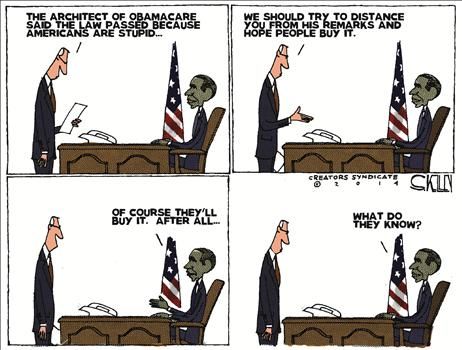
In Washington, D.C. it is said that the cover-up is almost always worse than the crime. Certainly, the tortured attempts by supporters of Obamacare to explain away the comments of health analyst Jonathan Gruber — that the law only passed because of a “lack of transparency” that became a “huge political advantage” because of “the stupidity of the American voter” — are more preposterous than even the worst parts of Obamacare.

President Obama himself tried to dismiss Gruber on Sunday by claiming he was just “some adviser who never worked on our staff.” He insisted his comments are “not a reflection on the actual process that was run.”

Hmmm. Gruber visited the White House nearly twenty times, according to official visitor logs. The White House actively promoted his work on Obamacare and touted his testimony to Senate committees as “objective analysis.” The Washington Post reported that Gruber’s model of the law’s costs was “the coin of the realm” in the debate and “a very powerful tool for administration officials,” for which he as paid nearly $400,000 in taxpayer money.

In reality, an analysis of media coverage by The Weekly Standard concluded “an overwhelming number of the ostensibly independent statements or scores that were made or published in support of Obamacare . . . were traceable to the support of one man and his model. And that man was Jonathan Gruber, who was secretly under contract with the Obama administration.”

This is serious. There have been flim-flam attempts to sell legislation in the past — the Left is now trying to distract attention from Gruber’s comments by citing passage of the Bush administration’s Medicare prescription-drug benefit in 2003. But there are some key differences. Despite its many shortcomings, the Bush prescription-drug benefit wound up being that rare government program that wound up costing substantially less than the predictions that were made at the time of its passage. And it didn’t involve the sweeping stranglehold on one-sixth of the nation’s economy that Obamacare entailed.

Democrats are now recoiling from efforts to get them to comment on Gruber the way Dracula recoils from a cross. Representative Nancy Pelosi, the House Democratic leader, flabbergasted reporters last week. “I don’t know who he is,” Pelosi said of Gruber. “He didn’t help write our bill.” But she herself had touted his analysis on her website in at least seven places, praised him at congressional meetings, and opened doors to him on Capitol Hill. Video has surfaced of her in 2009 praising “Jonathan Gruber of MIT’s analysis of what the comparison is to the status quo versus what will happen in our bill.”

Faced with these facts, Drew Hammill, a Pelosi spokesman, told the Washington Post that “she said she doesn’t ‘know who he is,’ not that she’s never heard of him.”

Enough. We are now being subjected to what Springer’s Blog calls “Gruberish,” which it defines as “any bewildering deluge of falsehoods designed to confound an audience based on the speaker’s awareness that the truth must be concealed by any means necessary.”

The new Congress just elected by the American people should peel back this Gruberish. It should launch hearings into just how the Congressional Budget Office was manipulated to provide misleading cost figures for Obamacare, even as the GOP appoints a new CBO director who can bolster confidence in the office. It can pick up on an idea promoted by Representative Fred Upton of Michigan that Congress should send President Obama a simple bill of just a few lines codifying his frequently repeated pledge that “if you like your health-care plan, you’ll be able to keep your health-care plan, period.” Democrats may have to block it through a Senate filibuster, but the exercise and accompanying debate would be illuminating.

Finally, the media should be shamed into looking more carefully into the bona fides and honesty of the “outside experts” that are trotted out in support of dubious schemes like Obamacare. It should be embarrassing to national media outlets that the growing number of Gruber videos should have been unearthed by a Pennsylvania blogger.

It turns out that far from being disinterested analysts, “outside experts” brought in by government are often highly compensated players whose statements easily slide into propaganda. Gruber supplemented his $400,000 payments from the Obama administration with some $2 million in contracts helping states set up health-care exchanges, much as Mike Leavitt, a former Health and Human Services secretary and adviser to Mitt Romney, did on the Republican side. But as Byron York of the Washington Examiner notes, Jonathan Gruber is a special case worthy of special attention: “He is, by his own account, a man who intentionally deceived the public in order to pass a measure from which he stood to profit handsomely.”

That’s why liberals are scrambling to disassociate themselves from Gruber while at the same time denying the realities of Obamacare’s failures. And that’s precisely why the cover-up of Jonathan Gruber’s remarks — by President Obama, Representative Pelosi, and others — can’t be allowed to stand and must be exposed.

— John Fund is national-affairs correspondent for NRO.

Sunday, November 16, 2014

Bettina Stangneth: Eichmann before Jerusalem

 | 


Wikimedia Commons
Adolf Eichmann’s fame surpasses even that of SS leader Heinrich Himmler and holocaust architect Reinhard Heydrich. So why write another book? It was the simplest of questions: I wanted to find out who knew Adolf Eichmann before the Mossad famously snatched him from Argentina and put him before a court in Israel.

Allan Gould: The Eichmann effect

Today, the first of June, marks exactly 50 years since one of the most infamous men of the past century, Adolf Eichmann, was hung by the State of Israel — the first and only time that the death penalty was civilly imposed in that country. Following his execution, the body of the Nazi henchman promptly was cremated, and his ashes were scattered over the Mediterranean Sea.
As a young man, passing through Israel on a youth pilgrimage during the summer of 1961, I witnessed Eichmann’s trial, and have been haunted by what I witnessed ever since. But I also have come to realize that the Eichmann trial eventually raised the consciousness of the world, and thereby changed humanity for the better.
When Adolf Eichmann was captured by the Mossad in 1961 and flown to Israel, most of the world was furious. The Washington Post condemned Israel’s implementation of “jungle law” and for “wreak[ing] vengeance.” And Time magazine attacked the young nation’s “high-handed disregard of international law.” Perhaps these pundits already had forgotten the flaws that vitiated an earlier exercise in international law, merely 16 years before: the Nuremburg Trial.
Eichmann’s answer, given in Israel, is not hard to find: ”Until1946, I had next to no public profile, until [I] was branded [as] the murderer of 5 or 6 million Jews.” We should not be surprised to hear these words from an accused man — and this one in particular. Eichmann, after all, is famous for saying that he had been “just a small cog in Adolf Hitler’s extermination machine.” What is surprising is that, until now, the secondary literature on Eichmann has dutifully parroted this view. Other great controversies might surround the man behind the genocide, but everyone is agreed that until his trial in Jerusalem, the name Eichmann was known only to a small circle of people.
The suspicion that something was amiss, both in Eichmann’s story and in the research, arose when I started to read old newspapers. On May 23, 1960, the Israeli prime minister, David Ben-Gurion, unexpectedly announced to the world that Adolf Eichmann had been captured and was to stand trial. What followed was not a puzzled silence but pages and pages of detailed articles describing a man about whom, supposedly, very little was known, by very few people. A glance at some even older publications confirmed my suspicion unequivocally. Long before the start of his trial, this “unknown” man already had more nicknames than most other Nazis: Caligula; Czar of the Jews; Manager of the Holocaust; Grand Inquisitor; Engineer of the Jewish Genocide; the Final Solutionist; the Bureaucrat; the Mass Murderer.
The evidence raises the questions: How had this knowledge come to be lost? How could a man cause himself to disappear, retrospectively, from the eyes of the world? The answer leads us to the problematic heart of the singular crime against humanity that we call the Holocaust, the Shoah, the extermination of the Jews.
Depending on whose account you read, Eichmann comes across variously as an ordinary man who was turned into a thoughtless murderer by a totalitarian regime; a radical anti-Semite whose aim was the extinction of the Jewish people, or a mentally ill man whose innate sadism was legitimated by the regime. We have a multitude of irreconcilable images of Eichmann, made even more so by the controversy around Hannah Arendt’s Eichmann in Jerusalem: A Report on the Banality of Evil. The public view, however, largely remains an empty shell. We are still missing a view of the “Eichmann phenomenon” before Jerusalem: the way Eichmann was perceived during the different periods of his life.
If we are to believe what Eichmann said in Israel, his real life — the one he had always longed for — began only in 1945, when the madness of the Thousand Year Reich lay in ruins. That was when the Adviser for Jewish Affairs became a harmless rabbit breeder, as he always had been at the bottom of his heart. It was the regime that had been evil, and his stellar career under Adolf Hitler had really been just a bizarre twist of fate.
But because Eichmann was aware that a lot of other people might see things differently, he carefully avoided using the name Adolf Eichmann, even making his wife call him by his first forename, Otto, which had also been his grandfather’s name.
While the others were capitulating, he disappeared among the prisoners of war, becoming “Adolf Karl Barth.” Before he managed to escape, he was tried as “Otto Eckmann.” Then he was “Otto Heninger,” a forester on the Lüneberg Heath in northern Germany, working alongside other men who had new names. After that, he bred chickens, enchanting the female population of his rural backwater in the evenings with his violin playing. The life of Otto Heninger, which was already so very like that of the Argentine rabbit breeder, had only two distinct disadvantages: he couldn’t contact his family and he was wanted for war crimes. “In the five years I spent underground, living as a ‘mole,’ it became second nature to me, whenever I saw a new face, to ask myself a few questions, like: Do you know this face? Does this person look like he has seen you before? Is he trying to recall when he might have met you? And during these years, the fear never left me that somebody could come up behind me and suddenly cry: ‘Eichmann!’”
His hope that, in time, grass would grow over the National Socialist genocide, just as it does over other graves, remained unfulfilled. Ultimately, he could see no solution but to flee the country, and so in 1950 Otto Heninger disappeared as well. “Ricardo Klement” left Europe from Genoa, receiving a new identity and new papers in Argentina. He was then able to begin the life he had always wanted: He found work on a hydroelectric power station project, and led a troop of surveyors across Tucumán, a subtropical area in the north of Argentina where the mountains and valleys are reminiscent of the Alps.
Wikimedia Commons
Wikimedia CommonsAdolf Eichmann's passport, on which he is listed as "Ricardo Klement'
He had plenty of time to make trips on horseback too, exploring the mountains, crossing the pampas, and even twice attempting to climb Aconcagua, the Americas’ highest mountain. Two years later, when his wife and their three sons were finally able to join him, he began taking the boys with him on his expeditions, teaching them to ride and fish and imparting to them his own love of nature. For a while, the collapse of the project’s firm somewhat dampened the family’s blissful existence: Ricardo Klement had to look for work, and he wasn’t always successful, but by 1955 at the latest, his happiness must have been complete. He was handed not only the manager’s job at a rabbit farm but also a fourth son, even though his wife was over 40. Little “Hasi” was the apple of his father’s eye. No wonder Klement then decided to build his own house, to accommodate his lovely wife, his four sons, Fifi the dachshund, Rex the German shepherd, the cuckoo clock, and the paintings of alpine scenes. If he hadn’t been kidnapped by Mossad, he would still be living the harmless life of Ricardo Klement.
This moving tale had just one major flaw: Ricardo Klement might have been the name on his passport, but the reformed Nazi and nature lover, a man who was now entirely apolitical, had never arrived in Argentina. Rural idylls were not Eichmann’s thing. For him, the war — his war — had never ended. In the evenings, he read and wrote, and his work was anything but introspective. This was no contented man in his 50s, reading for pleasure: the peaceable rabbit farmer was capable of throwing books against the wall and tearing them to pieces, filling them with aggressive marginalia, insults, and invectives, and covering mountains of paper with his commentaries, writing like a man possessed. Pencils snapped under the force of his scribbling; his fighting spirit was unbroken. The ideological warrior had not been defeated, and he was by no means alone.
The reason we know so much about his life in Argentina today is due to a happy coincidence. Over the last two years, documents have surfaced in several archives and are now available to researchers. For the first time, the Argentina Papers — Eichmann’s own notes made in exile — can be examined in conjunction with the taped and transcribed conversations known (slightly misleadingly) as the Sassen interviews. Suddenly, we are able to make connections that could never have been made before. And one thing in particular stands out: Not once during his escape and exile did Eichmann seek the shadows or try to act in secrecy. He wanted to be visible in Argentina, and he wanted to be viewed as he once had been: as the symbol of a new age.
Those who seek out the light will be seen. Clearly more people had dealings with Eichmann after 1945 than was previously thought. Tracing his route into the underground and into exile, we come across not only Nazi hunters and hit squads, but people who helped and sympathized with him and even became his friends — though for a long time afterward, they denied ever having known him, or said they had met him only briefly. Willem Sassen, a Dutch volunteer in the Waffen-SS and a war propagandist, spent decades claiming only to have been Eichmann’s “ghostwriter.” Like him, most of Eichmann’s friends denied most of their contact with the wanted man. Their denials no longer carry any weight. The Argentina Papers reveal the names of the people who sought Eichmann out to talk about old times and, more important, to discuss political plans for the future. For in spite of all attempts to ignore them, there they were: the Nazis in Argentina. They had escaped the Allied courts and were regrouping, with much bigger plans than to be left in peace to start new lives.
From a safe distance, the men around Eichmann used their freedom in exile to comment on developments in Germany and the rest of the world. They pursued ambitious plans for political overthrow, busily putting together a network of like-minded people. They even started counterfeiting documents designed to defend their view of glorious National Socialism against reality. And in their midst was Adolf Eichmann: self-assured, dedicated, and in demand as a specialist (with millions of murders to prove his expertise) — exactly what a man who had had his own department in the Head Office for Reich Security was used to.
If Eichmann ever really wanted to be the placid, harmless Ricardo Klement, it was not until he was sitting in an Israeli prison cell. In Argentina, he proudly signed photos for his comrades “Adolf Eichmann — SS-Obersturmbannführer (retired).”
National Post

Excerpted from Eichmann Before Jerusalem.  Copyright © 2014 .  Published by Knopf, a Penguin Random House Company. Reproduced by arrangement with the Publisher. All rights reserved.
A murderer’s warped idealism


November 14, 2014
Western reflection about human nature and the politics of the human condition began with the sunburst of ancient Greece 2,500 years ago, but it lurched into a new phase 70 years ago with the liberation of the Nazi extermination camps. The Holocaust is the dark sun into which humanity should stare, lest troubling lessons be lost through an intellectual shrug about “the unfathomable.”
Now comes an English translation of a 2011 German book that refutes a 1963 book and rebukes those who refuse to see the Holocaust as proof of the power of the most dangerous things — ideas that denigrate reason. The German philosopher Bettina Stangneth’s “Eichmann Before Jerusalem: The Unexamined Life of a Mass Murderer” responds to Hannah Arendt’s extraordinarily and perversely influential “Eichmann in Jerusalem: A Report on the Banality of Evil.”
Although, or perhaps because, Arendt was a philosopher, in her report on Israel’s trial of Adolf Eichmann, the organizer of industrialized murder, she accepted the facade Eichmann presented to those who could, and in 1962 would, hang him: He was a little “cog” in a bureaucratic machine. He said he merely “passed on” orders and “oversaw” compliance. Arendt agreed.
She called Eichmann “terribly and terrifyingly normal,” lacking “criminal motives,” “a buffoon,” “a typical functionary” who was “banal” rather than “demonic” because he was not “deep,” being essentially without “ideology.” Arendt considered Eichmann “thoughtless,” partly because, with a parochialism to which some intellectuals are prone, she could not accept the existence of a coherent and motivating ideological framework that rejected, root and branch, the universality of reason, and hence of human dignity.
It was odd for Arendt to suppose that the pride Eichmann took in his deportations — especially of the more than 430,000 Hungarian Jews when the war was already lost and even Heinrich Himmler, hoping for leniency, was urging it for the Jews — was merely pride in managerial virtuosity. Arendt, however, did not have, as Stangneth has had, access to more than 1,300 pages of Eichmann’s writings and taped musings among Argentina’s portion of the Nazi diaspora, before Israeli agents kidnapped him in 1960.
Eichmann was proudly prominent in preparations for the “final solution” even before the Wannsee Conference (Jan. 20, 1942) formalized it. “His name,” Stangneth notes, “appeared in David Ben-Gurion’s diary only three months after the start of the war” in September 1939. On Oct. 24, 1941, a newspaper published by German exiles in London identified Eichmann as leader of a “campaign” of “mass murder.”
“I was an idealist,” he told his fellow exiles, and he was. In obedience to the “morality of the Fatherland that dwells within,” a.k.a. the “voice of blood,” his anti-Semitism was radical because it was ideological. Denying that all individuals are created equal entailed affirming the irremediable incompatibility of groups, which necessitated a struggle to settle subordination and extermination.
“There are,” Eichmann wrote, “a number of moralities.” But because thinking is national, no morality is universal. Only war is universal as the arbiter of survival. So, Stangneth writes, “Only thinking based on ethnicity offers a chance of final victory in the battle of all living things.”
Eichmann, a premature postmodernist, had a philosophy to end philosophizing. To him, Stangneth says, “philosophy in the classical sense, as the search for transcultural categories” was absurd. She says his ideology was “the fundamental authorization for his actions.”
In 1996, Daniel Jonah Goldhagen’s “Hitler’s Willing Executioners: Ordinary Germans and the Holocaust” argued that Germany was saturated with “eliminationist anti-Semitism” that produced much voluntary participation in genocide. This made Hitler a mere product and trigger of cultural latency. But in 1992, Christopher Browning in “Ordinary Men,” a study of middle-aged German conscripts who became willing mass murderers, had noted that the murders of millions of Cambodians by the Khmer Rouge and tens of millions of Chinese by Mao’s Cultural Revolution could not be explained by centuries of conditioning by a single idea.
Martin Amis’s new novel “The Zone of Interest” — set in Auschwitz, it is a study of moral vertigo — contains a lapidary afterword in which Amis abjures “epistemological rejection,” the idea that an explanation of Hitler and his enthusiasts is impossible. An explanation begins with Eichmann’s explanation of himself, rendered in Argentina.
Before he donned his miniaturizing mask in Jerusalem, Eichmann proclaimed that he did what he did in the service of idealism. This supposedly “thoughtless” man’s devotion to ideas was such that, Stangneth says, he “was still composing his last lines when they came to take him to the gallows.”
Read more from George F. Will’s archive or follow him on Facebook.

The Great Immigration Betrayal


By Ross Douthat
http://www.nytimes.com/
November 15, 2014
IN the months since President Obama first seem poised — as he now seems poised again — to issue a sweeping executive amnesty for millions of illegal immigrants, we’ve learned two important things about how this administration approaches its constitutional obligations.
First, we now have a clear sense of the legal arguments that will be used to justify the kind of move Obama himself previously described as a betrayal of our political order. They are, as expected, lawyerly in the worst sense, persuasive only if abstracted from any sense of precedent or proportion or political normality.
Second, we now have a clearer sense of just how anti-democratically this president may be willing to proceed.
The legal issues first. The White House’s case is straightforward: It has “prosecutorial discretion” in which illegal immigrants it deports, it has precedent-grounded power to protect particular groups from deportation, and it has statutory authority to grant work permits to those protected. Therefore, there can be no legal bar to applying discretion, granting protections and issuing work permits to roughly half the illegal-immigrant population.
This argument’s logic, at once consistent and deliberately obtuse, raises one obvious question: Why stop at half? (Activists are already asking.) After all, under this theory of what counts as faithfully executing the law, all that matters is that somebody, somewhere, is being deported; anyone and everyone else can be allowed to work and stay. So the president could “temporarily” legalize 99.9 percent of illegal immigrants and direct the Border Patrol to hand out work visas to every subsequent border crosser, so long as a few thousand aliens were deported for felonies every year.
The reality is there is no agreed-upon limit to the scope of prosecutorial discretion in immigration law because no president has attempted anything remotely like what Obama is contemplating. In past cases, presidents used the powers he’s invoking to grant work permits to modest, clearly defined populations facing some obvious impediment (war, persecution, natural disaster) to returning home. None of those moves even approached this plan’s scale, none attempted to transform a major public policy debate, and none were deployed as blackmail against a Congress unwilling to work the president’s will.
And none of them had major applications outside immigration law. No defender of Obama’s proposed move has successfully explained why it wouldn’t be a model for a future president interested in unilateral rewrites of other areas of public policy (the tax code, for instance) where sweeping applications of “discretion” could achieve partisan victories by fiat. No liberal has persuasively explained how, after spending the last Republican administration complaining about presidential “signing statements,” it makes sense for the left to begin applying Cheneyite theories of executive power on domestic policy debates.
Especially debates in which the executive branch is effectively acting in direct defiance of the electoral process. This is where the administration has entered extraordinarily brazen territory, since part of its original case for taking these steps was that they supposedly serve the public will, which only yahoos and congressional Republicans oppose.
This argument was specious before; now it looks ridiculous. The election just past was not, of course, a formal referendum on the president’s proposed amnesty, but it was conducted with the promise of unilateral action in the background, and with immigration as one of the more hotly debated issues. The result was a devastating defeat for Obama and his party, and most polling on unilateral action is pretty terrible for the president.
So there is no public will at work here. There is only the will to power of this White House.
Which is why the thinking liberal’s move, if this action goes forward, will be to invoke structural forces, flaws inherent in our constitutional order, to justify Obama’s unilateralism. This won’t be a completely fallacious argument: Presidential systems like ours have a long record, especially in Latin America, of producing standoffs between executive and legislative branches, which tends to make executive power grabs more likely. In the United States this tendency has been less dangerous — our imperial presidency has grown on us gradually; the worst overreaches have often been rolled back. But we do seem to be in an era whose various forces — our open-ended post-9/11 wars, the ideological uniformity of the parties — are making a kind of creeping caudillismo more likely.
But if that evil must come, woe to the president who chooses it. And make no mistake, the president is free to choose. No immediate crisis forces his hand; no doom awaits the country if he waits. He once campaigned on constitutionalism and executive restraint; he once abjured exactly this power. There is still time for him to respect the limits of his office, the lines of authority established by the Constitution, the outcome of the last election.
Or he can choose the power grab, and the accompanying disgrace.

Friday, November 14, 2014

Today's Tune: Sturgill Simpson - The Promise

The Gruber Confession


By Charles Krauthammer
http://www.washingtonpost.com/opinions

November 13, 2014


It’s not exactly the Ems Dispatch (the diplomatic cable Bismarck doctored to provoke the 1870 Franco-Prussian War). But what the just-resurfaced Gruber Confession lacks in world-historical consequence, it makes up for in world-class cynicism. This October 2013 video shows MIT Professor Jonathan Gruber, a principal architect of Obamacare, admitting that, in order to get it passed, the law was made deliberately obscure and deceptive. It constitutes the ultimate vindication of the charge that Obamacare was sold on a pack of lies.
“Lack of transparency is a huge political advantage,” said Gruber. “Basically, call it the stupidity of the American voter or whatever, but basically that was really, really critical to getting the thing to pass.” This was no open-mic gaffe. It was a clear, indeed enthusiastic, admission to an academic conference of the mendacity underlying Obamacare.
First, Gruber said, the bill’s authors manipulated the nonpartisan Congressional Budget Office, which issues gold-standard cost estimates of any legislative proposal: “This bill was written in a tortured way to make sure CBO did not score the mandate as taxes.” Why? Because “if CBO scored the mandate as taxes, the bill dies.” And yet, the president himself openly insisted that the individual mandate — what you must pay the government if you fail to buy health insurance — was not a tax.
 
 
Worse was the pretense that Obamacare wouldn’t cost anyone anything. On the contrary, it’s a win-win, insisted President Obama, promising that the “typical family” would save $2,500 on premiums every year.
Skeptics like me pointed out the obvious: You can’t subsidize 30 million uninsured without someone paying something. Indeed, Gruber admits, Obamacare was a huge transfer of wealth — which had to be hidden from the American people, because “if you had a law which . . . made explicit that healthy people pay in and sick people get money, it would not have passed.”
Remember: The whole premise of Obamacare was that it would help the needy, but if you were not in need, if you liked what you had, you would be left alone. Which is why Obama kept repeating — PolitiFact counted 31 times — that “if you like your plan, you can keep your plan.”
But of course you couldn’t, as millions discovered when they were kicked off their plans last year. Millions more were further shocked when they discovered major hikes in their premiums and deductibles. It was their wealth that was being redistributed.
As NBC News and others reported last year, the administration knew this all along. But White House political hands overrode those wary about the president’s phony promise. In fact, Obama knew the falsity of his claim as far back as February 2010, when, at a meeting with congressional leaders, he agreed that millions would lose their plans.
Now, it’s not unconstitutional to lie. Nor are laws enacted by means of deliberate deception thereby rendered invalid. But it is helpful for citizens to know the cynicism with which the massive federalization of their health care was crafted.
It gets even worse, thanks again to Gruber. Last week, the Supreme Court agreed to hear a case claiming that the administration is violating its own health-care law, which clearly specifies that subsidies can be given only to insurance purchased on “exchanges established by the state.” Just 13 states have set up such exchanges. Yet the administration is giving tax credits to plans bought on the federal exchange — serving 37 states — despite what the law says.
If the plaintiffs prevail, the subsidy system collapses and, with it, Obamacare itself. Which is why the administration is frantically arguing that “exchanges established by the state” is merely sloppy drafting, a kind of legislative typo. And that the intent all along was to subsidize all plans on all exchanges.
Re-enter Professor Gruber. On a separate video in a different speech, he explains what Obamacare intended: “If you’re a state and you don’t set up an exchange, that means your citizens don’t get their tax credits.” The legislative idea was to coerce states into setting up their own exchanges by otherwise denying their citizens subsidies.
This may have been a stupid idea, but it was no slip. And it’s the law, as written, as enacted and as intended. It can be changed by Congress only, not by the executive. Which is precisely what the plaintiffs are saying. Q.E.D.
It’s refreshing that “the most transparent administration in history,” as this administration fancies itself, should finally display candor about its signature act of social change. Inadvertently, of course. But now we know what lay behind Obama’s smooth reassurances — the arrogance of an academic liberalism, so perfectly embodied in the Gruber Confession, that rules in the name of a citizenry it mocks, disdains and deliberately, contemptuously deceives.

Thursday, November 13, 2014

Obama’s Bogus Climate Deal with China


Economic factors will make the Chinese ignore it, and should do the same for the U.S.