Tuesday, October 01, 2013

A Response to Richard Dawkins


He and his supporters have a right to their atheism, but not to intellectual dishonesty about it. 

Monday, September 30, 2013

The ‘Historic’ Phone Call Was a Hostage Negotiation


Posted By Michael Ledeen On September 29, 2013 @ 3:21 pm In Uncategorized | 16 Comments
http://pjmedia.com/


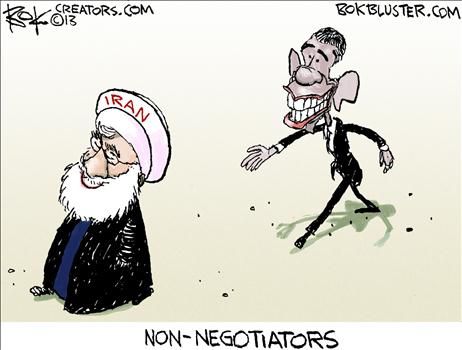
Political Cartoons by Chip Bok

As advertised, Hassan Rouhani was the star of the week at the Great UN Circus.  He knew it, and he treated his American hosts with arrogance and contempt, and was duly hailed as a peace-seeker.  He spent hours and hours with diplomats (just not American ones), journalists, academic apologists such as Gary Sick, and anti-American rabble rousers like Louis Farrakhan, but he didn’t have time for President Obama.

No matter.  When the Iranians told the White House that Rouhani could squeeze in a few words on the phone, Obama eagerly called him up, thereby giving the journalists and apologists the opportunity to use their prepared language about “historic conversation,” etcetera etcetera and so forth.

Rouhani’s basic message was to say “you’d better be nice to me, or you’ll get the hardliners,” and some nasties from central casting duly appeared on cue at the Tehran airport when Rouhani returned from satanic New York City, shouting at the president and even throwing a shoe.  A couple of the demonstrators were arrested, underscoring their presumed menace (anyone who believes the “protest” was spontaneous badly needs a lower-school refresher course in totalitarianism).  It was overkill;  Obama wants a deal.  He doesn’t need further convincing.

And he’s willing to pay for it.  Quite a lot, in fact.  Even before Rouhani deigned to take Obama’s call, we had given the Islamic Republic an ancient treasure, a cup crafted two millenia before Mohammed, said to be worth at least a million dollars.

Remember that Obama gave the Brits a collection of his favorite speeches.
Why such largesse?  It’s a shocking present, way beyond the normal.  Orders of magnitude greater, in fact.  What had the Iranians done to deserve it?

I don’t know, but if I were forced to answer, I’d reply with another question:  what did Obama and Rouhani talk about?  Yes, I know they exchanged pleasantries about wanting a happier world, but there was one subject raised by Obama.  A “senior administration official” told the press on background about it: [1]
The fate of three U.S. citizens who have disappeared or been imprisoned in Iran was discussed during Friday’s historic conversation between the two nations’ presidents, a senior U.S. administration official said.
U.S. President Barack Obama, during his phone call with Iranian President Hassan Rouhani, “noted our concern about three American citizens who have been held within Iran — Robert Levinson, Saeed Abedini, and Amir Hekmati — and noted our interest in seeing those Americans reunited with their families,” the official said.
Levinson is a former FBI agent who was disappeared from Kish Island several years ago.  He was said to be investigating cigarette smuggling.  Abedini is an Iranian-American Christian minister arrested and charged with subversion.  Hekmati is an Iranian-American Marine who was said to be visiting relatives in Tehran, and was arrested and charged with espionage.
Hostage negotiations are not unusual in this world–the United States has ransomed at least one such person in the last few months, but so far as I can tell, no journalist is interested in the story–indeed, it is one of the leitmotifs of the secret diplomacy that has been conducted ever since the Revolution of 1979.  What is unusual is the direct involvement of the president, and a White House that publicizes the activity.

Do you think the million-dollar “gift” is actually ransom?  I don’t, but with this crowd, most any silliness is possible.  I don’t believe it’s ransom because it’s not what the Iranians want from us (and a pre-Muslim artifact is certainly not high on their wish list).  They want us to lift sanctions, and they want some of their people released from our prisons.

So what are we to make over all this:  Two things:

First, the Rouhani circus was just that;  a show to elevate him to star celebrity status, and two gestures toward Obama, the first to insult him, the second to lure him on to believe that something good may yet come from negotiating with the Iranian regime.

Second, that the “historic” phone chat was a pretty empty event, save for the surprising revelation that the president himself is engaged in hostage negotiations.  But nobody wants to think about what that means.

Article printed from Faster, Please!: http://pjmedia.com/michaelledeen
URL to article: http://pjmedia.com/michaelledeen/2013/09/29/the-historic-phone-call-was-a-hostage-negotiation/
URLs in this post:
[1] told the press on background about it:: http://edition.cnn.com/2013/09/28/us/iran-detained-americans/?hpt=hp_t2

Sunday, September 29, 2013

Climate change: this is not science – it’s mumbo jumbo


The IPCC’s call to phase out fossil fuels is economic nonsense and 'morally outrageous’ for the developing world


Rajendra Pachauri, the head of the U.N. Intergovernmental Panel on Climate Change , left and co-chairman Thomas Stocker present the U.N. IPCC climate report, in Stockholm,  on Friday Sep. 27, 2013.
Rajendra Pachauri, the head of the U.N. Intergovernmental Panel on Climate Change , left and co-chairman Thomas Stocker present the U.N. IPCC climate report, in Stockholm, on Friday Sep. 27, 2013.(TT News Agency)

On Friday, the UN published its landmark report into climate change, which claimed with “95 per cent” certainty that global warming is man-made.
The Intergovernmental Panel on Climate Change’s report, compiled by 259 leading scientists, warned that without “substantial and sustained reductions” of greenhouse gas emissions, the world will experience more extreme weather.
However, critics have questioned the scientists’ use of computer forecasting, which, they say, has produced fatalistic scenarios that fail to take into account fully that atmospheric temperatures have barely changed in the past 15 years.
Here, former chancellor Lord Lawson, now chairman of the Global Warming Policy Foundation, a climate sceptic think tank, gives his verdict on the report.

By Nigel Lawson
28 September 2013

The Intergovernmental Panel on Climate Change, which published on Friday the first instalment of its latest report, is a deeply discredited organisation. Presenting itself as the voice of science on this important issue, it is a politically motivated pressure group that brings the good name of science into disrepute.
Its previous report, in 2007, was so grotesquely flawed that the leading scientific body in the United States, the InterAcademy Council, decided that an investigation was warranted. The IAC duly reported in 2010, and concluded that there were “significant shortcomings in each major step of [the] IPCC’s assessment process”, and that “significant improvements” were needed. It also chastised the IPCC for claiming to have “high confidence in some statements for which there is little evidence”.
Since then, little seems to have changed, and the latest report is flawed like its predecessor.
Perhaps this is not so surprising. A detailed examination of the 2007 report found that two thirds of its chapters included among its authors people with links to the World Wildlife Fund (WWF) and there were many others with links to other 'green’ activist groups, such as Greenpeace.
In passing, it is worth observing that what these so-called green groups, and far too many of the commentators who follow them, wrongly describe as 'pollution’ is, in fact, the ultimate in green: namely, carbon dioxide – a colourless and odourless gas, which promotes plant life and vegetation of all kinds; indeed, they could not survive without it. It is an established scientific fact that, over the past 20 years, the earth has become greener, largely thanks to increased atmospheric carbon dioxide.
Be that as it may, as long ago as 2009, the IPCC chairman, Dr Rajendra Pachauri – who is a railway engineer and economist by training, not a scientist, let alone a climate scientist – predicted that “when the IPCC’s fifth assessment comes out in 2013 or 2014, there will be a major revival of interest in action that has to be taken. People are going to say: 'My God, we are going to have to take action much faster than we had planned.’” This was well before the scientific investigation on which the latest report is allegedly based had even begun. So much for the scientific method.
There is, however, one uncomfortable fact that the new report has been – very reluctantly – obliged to come to terms with. That is that global warming appears to have ceased: there has been no increase in officially recorded global mean temperature for the past 15 years. This is brushed aside as a temporary blip, and they suggest that the warming may still have happened, but instead of happening on the Earth’s surface it may have occurred for the time being in the (very cold) ocean depths – of which, incidentally, there is no serious empirical evidence.
A growing number of climate scientists are coming to the conclusion that at least part of the answer is that the so-called climate sensitivity of carbon – the amount of warming that might be expected from a given increase in atmospheric carbon dioxide (caused by the use of fossil fuels: coal, oil, and gas) – is significantly less than was previously assumed to be the case.
It is no doubt a grudging acceptance of this that has led the new report to suggest that the global warming we can expect by the end of this century is probably rather less than the IPCC had previously predicted: perhaps some 2.7F (1.5C) What they have not done, however, is to accept that the computer models on which they base all their prognostications have been found to be misleading. These models all predicted an acceleration in the warming trend throughout the 21st century, as global carbon dioxide emissions rose apace. In fact, there has been a standstill.
The true scientific method is founded on empirical observation. When a theory – whether embedded in a computer program or not – produces predictions that are falsified by subsequent observation, then the theory, and the computer models which enshrine it, have to be rethought.
Not for the IPCC, however, which has sought to obscure this fundamental issue by claiming that, whereas in 2007 it was 90 per cent sure that most of the (very slight) global warming recorded since the Fifties was due to man-made carbon emissions, it is now 95 per cent sure.
This is not science: it is mumbo-jumbo. Neither the 90 per cent nor the 95 per cent have any objective scientific basis: they are simply numbers plucked from the air for the benefit of credulous politicians and journalists.
They have thrown dust in the eyes of the media in other ways, too. Among them is the shift from talking about global warming, as a result of the generally accepted greenhouse effect, to 'climate change’ or 'climate disruption’. Gullible journalists (who are particularly prevalent within the BBC) have been impressed, for example, by being told now that much of Europe, and in particular the UK, is likely to become not warmer but colder, as a result of increasing carbon dioxide emissions interfering with the Gulf Stream.
There is nothing new about this canard, which has been touted for the past 10 years or so. Indeed, I refer to it explicitly in my book on global warming, An Appeal to Reason, which first came out five years ago. In fact, there has been no disruption whatever of the Gulf Stream, nor is it at all likely that there could be. As the eminent oceanographer Prof Karl Wunsch has observed, the Gulf Stream is largely a wind-driven phenomenon, and thus “as long as the sun heats the Earth and the Earth spins, so that we have winds, there will be a Gulf Stream”.
So what is the truth of the matter, and what do we need to do about it?
The truth is that the amount of carbon dioxide in the world’s atmosphere is indeed steadily increasing, as a result of the burning of fossil fuels, particularly in the faster-growing countries of the developing world, notably China. And it is also a scientific fact that, other things being equal, this will make the world a warmer place. But there are two major unresolved scientific issues: first, are other things equal?, and second, even if they are, how much warmer will our planet become? There is no scientific basis whatever for talking about 'catastrophic climate change’ – and it is generally agreed that if the global temperature standstill soon comes to an end and the world is, as the IPCC is now suggesting might well be the case, 1.5ºC warmer by the end of the century, that would be a thoroughly good thing: beneficial to global food production and global health alike.
So what we should do about it – if indeed, there is anything at all we need to do – is to adapt to any changes that may, in the far future, occur. That means using all the technological resources open to mankind – which will ineluctably be far greater by the end of this century than those we possess today – to reduce any harms that might arise from warming, while taking advantage of all the great benefits that warming will bring.
What we should emphatically not do is what Dr Pachauri, Lord Stern and that gang are calling for and decarbonise the global economy by phasing out fossil fuels.
Before the industrial revolution mankind relied for its energy on beasts of burden and wind power. The industrial revolution, and the enormous increase in prosperity it brought with it, was possible only because the West abandoned wind power and embraced fossil fuels. We are now – unbelievably – being told that we must abandon relatively cheap and highly reliable fossil fuels, and move back to wind power, which is both unreliable and hugely costly.
This is clearly an economic nonsense, which would condemn us to a wholly unnecessary fall in living standards.
But what moves me most is what this would mean for the developing world. For them, abandoning the cheapest available form of energy and thus seriously abandoning the path of economic growth and rising prosperity on which, at long last, most of the developing world is now embarked, would mean condemning hundreds of millions of their people to unnecessary poverty, destitution, preventable disease, and premature death.
All in the name of seeking to ensure that distant generations, in future centuries, might be (there is no certainty) slightly better off than would otherwise be the case.
Not to beat about the bush, it is morally outrageous. It is just as well that the world is unlikely to take the slightest notice of the new IPCC report.

Related Articles

Saturday, September 28, 2013

Book Review: 'Race with the Devil' by Joseph Pearce


By Austin Ruse
September 20, 2013


Not all roads lead to God. Many – maybe  most – lead to perdition. All genuine conversion stories, though, lead to the Church. All conversion stories fascinate but some, maybe for their drama and the tremendous arc of someone’s life, fascinate more than others.
Joseph Pearce came onto the Catholic radar screen sixteen years ago with a biography called Wisdom and Innocence: A Life of G.K. Chesterton. There’s hardly a faithful Catholic that has not been touched by Chesterton. William Buckley used to hand out Orthodoxy to anyone writing to him about the faith. He sent one to me.
Pearce followed up with Literary Converts: Spiritual Inspiration in an Age of Unbelief. What joy! Here was a guy working that special British vein of literary Catholicism and conversion that American Catholics love so well. From Campion to Newman to Chesterton, even Oscar Wilde. And here was a guy picking and scratching at that vein and still finding ore. And he kept it up. A biography of Tolkien followed, one on Belloc, one on Wilde. Pearce became a small family-owned industry of quite remarkable books.
But all along we heard the strangest things about him. We heard he spent time in prison. Yeah, well I heard he killed a guy. Like Gatsby, we looked forward to the day he would tell his story. That day has come.
Race with the Devil: My Journey from Racial Hatred to Rational Love recounts Pearce’s life from small town England to national racist leader to prison – and then to God through the Church. First, he did not kill anyone. He would say, but for the grace of God he didn’t, because he was certainly in a position to kill and even more to be killed.
Born in the shadow of the Second World War, into that bleak post-war not-yet-swinging England, Pearce nonetheless lived at least part of his youth in an Eden of fields and forests, in a village sixty-five miles north of London.
His father taught him to love literature and to hate the Catholic Church. His father also hated the Irish and the wave of brown-skinned immigrants that began flooding into Great Britain with the 1949 British Nationality Act, which allowed citizens of Commonwealth countries to move to the motherland.
Pearce learned early and well.
When he was twelve, the family moved from their idyllic village to a London suburb and were thrust into the beginnings of what has become multicultural England. He recalls torturing a Pakistani teacher. One of the things that led him into racist politics seems to have been a quite proper dislike of Communism, also learned at his father’s knee.
Pearce submitted an article to Spearhead, a magazine published by the chairman of the racist National Front. His article Buckley-like criticized “the Marxist orientation” of his high school education. He chaffed at the fact that his school did not teach about the great English victories in battle but concentrated instead on British “social history.”
His descent into racist politics began in earnest when he lied about his age and at fifteen joined the National Front. In that long, hot summer of 1976, “My photograph appeared in the local paper on my first [National Front] paper sale in Barking town centre and to this day I remember the look of fanatical anger on my face. I had metamorphosed into a political extremist.”
Pearce describes roving bands of white youths prowling the streets “looking for isolated Sikhs or Muslims to attack.” Some local gangs were “said to dress in SS uniform and would shoot any non-whites they came across with air pistols.” There were gangs of “Nazi-hippies who would listen to music by Hawkwind and Frank Zappa and get high on LSD, before setting out on nights of psychedelic and psychopathic violence against hapless immigrants.”
Pearce did not join the roving gangs of “Paki-bashers,” gangs that focused on hurting the innocent, preferring instead open warfare with the guilty, that is, Marxist youth gangs. The left and right seem to follow each other around and squared off in vicious public fights that were barely controlled or not controlled at all by the local constabulary. 
Pearce became fond of Nazism and learned Nazi marching songs. In one comical incident, he found himself in a German skinhead bar. Identified as a hated Brit, he saved himself by belting out the banned in Germany Horst Wessel song. Instead of beating him they bought him beers.
In 1977, Pearce founded a youth magazine called Bulldog: “Although I would deny the charges in court, it would be true to say that Bulldog’s ultimate purpose was to incite racial hatred.” He was eventually convicted of inciting racial hatred and sent to prison, not once but twice.
Ironically and providentially, Pearce was saved from that life by an aspect of his radicalism, his hatred of large government and his love of the small and the local. He discovered Chesterton and Belloc and Distributism, and through them came to know and to love the Church.
This is why all conversion stories are so interesting. Who would have thought that God would lead a man through racism and hatred and into the Church by reading economics?
There is much more in this book than a thousand words can convey. There is a long section about his time spent raising hell in Northern Ireland – where he came close to death many times. There are stories about his pals from those days who have risen to positions in the European Parliament. And there is much more to say about his conversion.
Today Pearce is writer-in-residence at the Thomas More College of Liberal Arts in New Hampshire where he lives with his wife and children. He has written twenty books and at the tender age of fifty-two, with God’s grace, will write many more.

Austin Ruse is the President of the New York and Washington, D.C.-based Catholic Family & Human Rights Institute (C-FAM), a research institute that focuses exclusively on international social policy. The opinions expressed here are Mr. Ruse’s alone and do not necessarily reflect the policies or positions of C-FAM.


© 2013 The Catholic Thing. All rights reserved. For reprint rights, write to: info@frinstitute.org
The Catholic Thing is a forum for intelligent Catholic commentary. Opinions expressed by writers are solely their own.

Friday, September 27, 2013

Worse Is the New Normal


Mid-20th-century assumptions of generational progress no longer obtain. 

Political Cartoons by Glenn Foden

A few years ago, after the publication of my book America Alone, an exasperated reader wrote to advise me to lighten up, on the grounds that “we’re rich enough to be stupid.” That’s to say, Western democracies and their citizens are the wealthiest societies ever known, and no matter how much of our energies are wasted on pointless hyper-regulation for the business class and multigenerational welfare for the dependency class and Transgender and Colonialism Studies for our glittering youth, we can afford it, and the central fact of our wealth will ensure that our fortunes do not change. Since the collapse of Lehman Brothers in 2008, we have been less rich, and our stupidity ought in theory to be less affordable. Instead, it’s been supersized. To take only the most obvious example, President Obama has added six-and-a-half trillion bucks to the national debt, and has nothing to show for it. As Churchill would say, had his bust not been bounced from the Oval Office, never in the field of human spending has so much been owed by so many for so little.

The West’s rivals do not think like this. China is now the second-biggest economy on the planet, but it has immense structural problems: As I’ve been saying for years, it will get old before it gets rich. Thanks to its grotesque “one-child” policy, it has the most male-heavy demographic cohort in history — no chicks and millions of guys who can’t get any action, which is not normally a recipe for social stability. Despite being extremely large, the country is resource-poor. But you can’t say it’s not thinking outside the box. The Daily Telegraph in London reported this week that the Chinese have just signed a deal to lease five percent of Ukraine (or an area about the size of Belgium) to grow crops and raise pigs on. And I’d doubt it will stop with post-Soviet republics on the Euro-fringe: It’s not impossible to imagine China buying, say, the Greek islands. Beijing thinks the half-millennium blip of Euro-American dominance is coming to an end and the world is returning to its natural state of Chinese preeminence. The West assumes it can endure as a kind of upscale boutique unaffected by the changes beyond. Like, say, the frozen-yogurt shop at the Westgate mall in Nairobi — until last weekend.

China’s Ukraine deal may sound kinda wacky, but the People’s Republic consumes about 20 percent of the world’s food yet has (thanks to rapid industrialization) only 9 percent of its farmland. As Big Government solutions go, renting 5 percent of a sovereign nation to use as your vegetable garden and pig farm is a comparatively straightforward answer to the problem at hand. By contrast, try explaining American “health” “care” “reform” to the Chinese: You could rent the entire Ukraine for about 3 percent of the cost of Obamacare, and what does it solve? My colleague Michelle Malkin revealed this week that her family has now joined the massed ranks of Obamacare victims: Anthem Blue Cross Blue Shield sent her a “Dear John” letter explaining why they’d be seeing less of each other. “To meet the requirements of the new laws, your current plan can no longer be continued beyond your 2014 renewal date.”

Beyond the president’s characteristically breezy lie that “if you like your health-care plan, you will be able to keep your health-care plan” is the sheer nuttiness of what’s happening. For years, Europeans and “progressive” Americans have raged at the immorality of the U.S. medical system: All those millions with no health coverage! But Michelle Malkin had coverage and suddenly, under what Obama calls “universal health care,” she doesn’t. The CBO’s most recent calculations estimate that in 2023, a decade after the implementation of Obamacare, there will still be over 30 million people uninsured — or about the population of Canada. That doesn’t sound terribly “universal,” and I would bet it’s something of a low-ball figure: As many employers are discovering, one of the simplest ways “to meet the requirements of the new laws” and still stay just about solvent is to shift your workers from family plans to individual plans, and tell their spouses and children to go look elsewhere. Does it achieve its other goal of “containing costs,” already higher than anywhere else? No. Avik Roy reports in Forbes that Obamacare will increase individual-market premiums by 62 percent for women, 99 percent for men. In America, “insuring” against disaster now costs more than you’d pay in most countries for disaster.

No one has ever before attempted to devise a uniform health system for 300 million people — for the very good reason that it probably can’t be done. Britain’s National Health Service serves a population less than a fifth the size of America’s and is the third-largest employer on the planet after the Indian National Railways and the Chinese People’s Liberation Army, the last of which is now largely funded by American taxpayers through interest payment on federal debt. A single-payer U.S. system would be bigger than Britain’s NHS, India’s railways, and China’s army combined, at least in its bureaucracy. So, as in banking and housing and college tuition and so many other areas of endeavor, Washington is engaging in a kind of under-the-counter nationalization, in which the husk of a nominally private industry is conscripted to enforce government rules — and ruthlessly so, as Michelle Malkin and many others have discovered.

Obama’s pointless, traceless super-spending is now (as they used to say after 9/11) “the new normal.” Nancy Pelosi assured the nation last weekend that everything that can be cut has been cut and there are no more cuts to be made. And the disturbing thing is that, as a matter of practical politics, she may well be right. Many people still take my correspondent’s view: If you have old money well managed, you can afford to be stupid — or afford the government’s stupidity on your behalf. If you’re a social-activist celebrity getting $20 million per movie, you can afford the government’s stupidity. If you’re a tenured professor or a unionized bureaucrat whose benefits were chiseled in stone two generations ago, you can afford it. If you’ve got a wind farm and you’re living large on government “green energy” investments, you can afford it. If you’ve got the contract for signing up Obamaphone recipients, you can afford it.

But out there beyond the islands of privilege most Americans don’t have the same comfortably padded margin for error, and they’re hunkering down. Obamacare is something new in American life: the creation of a massive bureaucracy charged with downsizing you — to a world of fewer doctors, higher premiums, lousier care, more debt, fewer jobs, smaller houses, smaller cars, smaller, fewer, less; a world where worse is the new normal. Would Americans, hitherto the most buoyant and expansive of people, really consent to live such shrunken lives? If so, mid-20th-century America and its assumptions of generational progress will be as lost to us as the Great Ziggurat of Ur was to 19th-century Mesopotamian date farmers.

George Orwell, after attending a meeting of impoverished but passive miners, remarked sadly that “there is no turbulence left in England.” The Democrats, and much of the Republican establishment, have made a bet that there is no turbulence left in America, and the citizenry will stand mute before Obamacare’s wrecking ball. Unless they’re willing to accept a worse life for their children and grandchildren, middle-class Americans need to prove them wrong.

— Mark Steyn, a National Review columnist, is the author of After America: Get Ready for Armageddon. © 2013 Mark Steyn

Mariano Rivera caps career with emotional Yankee Stadium moment


Rivera grabbed some dirt on his way out, wiped the tears with his No. 42 jersey. He’d managed one last perfect line score. There was no better way to leave the place, and it made everyone who was watching feel both very old and very grateful at the same time.

By Filip Bondy
September 27, 2013


If there was a dry eye in the house, it certainly didn’t belong to Mariano Rivera. For the first time ever in a baseball stadium, Rivera was having trouble locating his emotions, and maybe even his pitches. The ninth inning awaited, his final ninth inning in the Bronx, and there was no institutional memory for anything like this.

So Rivera retreated to the trainer’s room, to a place he often visits after games, but rarely during one.

“I was alone, trying to put some warm on my arm,” Rivera said. “Everything started hitting me, all the flashbacks.”

The Braves . . . the Red Sox . . . When Rivera went back on the mound for the ninth, the hormones and the tangled synapses wouldn’t leave him alone. “I was bombarded by emotions,” he said. Closing time wouldn’t be easy. 
Somehow, he got two outs, and then here came two invaders: by special permission of crew chief Mike Winters, Derek Jeter and Andy Pettitte walked to the mound to pull their pal from the game.

“He broke down and gave me a bear hug. I bear-hugged him back,” Pettitte said. “He was really crying. He was weeping.”


Rivera grabbed some dirt on his way out, wiped the tears with his No. 42 jersey. He’d managed one last perfect line score. There was no better way to leave the place, and it made everyone who was watching feel both very old and very grateful at the same time.

More than 20 years ago, more than two decades before this occasion on Thursday night, things did not look all that promising for Rivera at spring training in Fort Lauderdale. His fastballs were topping out in the 80s back then, his arm hurt a lot and the general manager, Gene Michael, thought this might be the end of the kid’s career.

“He was just another prospect, a baby with us,” Michael was remembering in a corner of the clubhouse. “I put him in the car, drove him from Fort Lauderdale to Vero Beach to see Dr. Frank Jobe, and I was trying to tell him everything would be all right. He looked overwhelmed. I told him, ‘Let’s see what happens.’ He didn’t speak much English, so I put a Spanish station on the radio.”

The arm got better, the fastball climbed into the mid-90s, Rivera developed a slider and then that cutter of his. The Yanks sent him down to the minors two more times before it all came together. But through it all, Michael said, Rivera always had two things going for him: He had remarkable location on his pitches, and he had a personality to die for. Everyone wished him, sincerely, the very best.

The best is what followed, right to the end. “He made my job fun, he made my job easy,” Joe Girardi said, his voice cracking. “More important, he made our lives better. The humility he has. . . . He just says thank you.”

Andy Pettitte and Derek Jeter walk to the mound to take the ball from Rivera for the final time at Yankee Stadium in his career.

BILL KOSTROUN/AP

Andy Pettitte and Derek Jeter walk to the mound to take the ball from Rivera for the final time at Yankee Stadium in his career.


Nothing is quite perfect this season in the Bronx, so Rivera came into his second straight game Thursday with the Yanks losing big, this time on their way to a 4-0 defeat to Tampa Bay. An old Bob Sheppard recording and “Enter Sandman” heralded his arrival from the pen. The Stadium pulsated. He got Delmon Young to fly out, Sam Fuld to ground back to the mound, stranding two Rays runners.

That was the eighth. In the ninth, Jose Lobaton grounded back to Rivera, Yunel Escobar popped to second. The cutter was flying at 89 mph.

Two outs, nobody on. Pettitte and Jeter came to the mound to take him out of there, to hug him. The Rays gave him a standing ovation, like everyone else in the park. Job done.

Rivera always took this job of baseball seriously, played with an economy of emotion, an innate dignity. He kept playing that way, right through five championships and then again through a carefully choreographed farewell season. This last night, though, was special, more organic. Credit goes to Girardi for much of that.

There are no circuses with Rivera, not like there have been this season with Alex Rodriguez and now suddenly, in a different way, with Robinson Cano and his agent’s reported $305 million demand. It has always been important to Rivera that his career avoid getting bogged down in such loud nonsense. A closer is like an umpire in a way. If he’s doing his job, doing it well, nobody is supposed to notice him.


When Girardi suggested that he might put Rivera in center field for an inning this weekend in Houston, the closer suddenly didn’t sound very enthusiastic about an idea that had always been a fantasy for him.

“This is not a joke, it’s serious business,” Rivera said. “I put in a request a long time ago, and now my knees are not the same. If my body permits it, if I can do it, I do it.”

He doesn’t want to look silly out there, ever. This last game at the Stadium was difficult enough. Hard on him and on everybody. Twenty years after the car ride from Michael, Rivera speaks English better, his arm is healthier and his cutter is a refined weapon. He’s still the same man, though.

“Amazing I got those last two outs,” Mariano said of the evening. “I wouldn’t call it magical. I would call it blessed.”
Then he thanked the media. Who does that?


Read more: http://www.nydailynews.com/sports/baseball/yankees/bondy-rivera-tears-caps-emotional-night-bronx-article-1.1469187#ixzz2g6EQ1vlc

Mariano gets sendoff befitting the best ever


September 26, 2013
Mariano gets sendoff befitting the best ever
Mariano Rivera takes a curtain call after pitching for the final time at Yankee Stadium. (Charles Wenzelberg)

The first stirrings arrived at 9:18 p.m., the observant sectors of the crowd of 48,675 noticing a tall figure in the distant bullpen loosening his arms, the same ritual Mariano Rivera had conducted before each of his previous 1,114 appearances, shaking them like a couple of fire hoses.
The chant began a few seconds later.
“MAH-REE-AHHH-NOOOOO!”
By 9:20 he was throwing in earnest, and the press box announcer dutifully reported, “Joining Matt Daley in the Yankees bullpen …” and a few more thousand spectators fixed their glances on the mound out beyond the 385-foot sign in right-center field, beyond the red sign for New York Presbyterian.
The season, as a baseball poet once said, was already exhausted. The ballgame, No. 159, was rapidly spinning out of control for the Yankees, already down 2-0, Tampa runners scattered on the basepaths. In the first-base dugout, Joe Girardi frowned: What to do? He wanted to reserve the ninth inning for Rivera.
But nobody wanted to see him walk into an 8-0 blowout.
“It’s not hard to pick up the phone,” Girardi would say later, “and wonder who you’d want to call.”
It was 4-0 when Girardi hopped out of the dugout at last, two more men on base, only one out, the crowd about to boo poor Dellin Betances. But Girardi changed the mood. He was getting Betances, and he was pointing to the bullpen, and the thunder landed at once.
So that would be Mariano Rivera’s final uncredited save in The Bronx, saving an overmatched kid from wrath, reminding everyone that they’d come for a celebration. Soon Bob Sheppard’s preserved voice came tumbling out of the P.A. speakers: “COMING IN TO PITCH FOR THE YANKEES, NUMBER FORTY-TWOOOO …”
It was 9:27 p.m. There wasn’t one occupied seat in the entire house, and that included the Tampa Bay dugout, where all 44 men with “RAYS” across their jerseys were themselves standing, saluting, applauding. This game, this outcome, still mattered for them, still mattered to their playoff hopes.
The Yankees? Officially this was the first meaningless game played in the Bronx since Oct. 3, 1993, Yankees 2, Tigers 1. And yet somehow, suddenly, these next few moments felt as meaningful as any yet housed in the new yard. Delmon Young flied to left on the first pitch Rivera threw. Sam Fuld bounced back to Rivera a few seconds later.
One more jam crushed. One more inning closed.
One more to go. Or so it seemed.
The Yankees threatened in the bottom of the eighth but in keeping with their year, it was an idle threat. Some booed the futility out of a sense of duty and so nobody much noticed Girardi consulting the umpiring crew, letting them in on one of the great bursts of baseball inspiration ever. Rivera jogged to the mound.
“MAH-REE-AHHH-NOOOOO!”
Jose Lobaton bounced another one back to Rivera. On his 13th pitch + every one of which, duly noted by the big scoreboard in center field, was labeled: CUTTER — he ran one in on Yunel Escobar, and he popped it meekly to Robinson Cano. Four up. Four down. Perfect. Pristine.
And one more surprise.
Now, out from the dugout, out from a thousand shared memories, hundreds of shared victories, five shared championships, came Derek Jeter and Andy Pettitte, both cloaked in blue hooded sweatshirts on this frosty fall night. This was Girardi’s scheme: Let Rivera’s longest contemporaries, his dearest comrades, take him back to the dugout with them.
It was a genius plan. The umpires, to their credit, agreed. The Rays, again, stood in front of their dugout and applauded wildly.
“Thank God they came out,” Rivera would say. “I’m not sure I would have made it on my own.”
Rivera — who famously collapsed in a puddle of tears and emotion on the mound across the street seconds after the Aaron Boone Homer won the ’03 ALCS — now fell into Pettitte’s arms, sobbing. Pettitte squeezed him.
“It’s been an honor to play alongside you,” Pettitte said, needing to say something before he lost it, too. Together, the three iconic Yankees returned to the dugout. And by then, Girardi was gone, too, the tough-guy skipper weeping openly and not minding even a little bit.
“He made my job fun,” Girardi would say. “He made my job easy. And he made all of our lives better.”
Later, Rivera would return to the mound one last time, grab a handful of dirt, take one final look around, enjoy one last roar from an adoring crowd. One last time, Rivera was reminded how much he meant to this game.
And also, tellingly, how much the game meant to him.