Wednesday, October 17, 2012

The Murders in Libya, The Presidential Debate, and The Pattern of Obama Foreign Policy

By Barry Rubin
PJ Media
October 17, 2012


While foreign policy did not figure large in the second presidential debate, the Middle East again emerged as the overwhelming international issue.
In the beginning of the debate, President Barack Obama claimed that he put a high priority on energy independence, an assertion well refuted by Governor Mitt Romney. A president who wants energy independence from the unreliability of Middle East supplies has many options: he could easily expand oil drilling on federal land, promote the use of new technology to produce oil and gas, approve a major pipeline from Canada, and continue production and use of coal for generating power. To do none of these things and put his effort into restricting traditional energy sources and pushing hard for untested, long-term, and failed “green energy” schemes subverts energy independence.
But the main emphasis in the debate was on the Benghazi assassinations. Obama said:
So as soon as we found out that the Benghazi consulate was being overrun, I was on the phone with my national security team, and I gave them three instructions. Number one, beef up our security and — and — and procedures not just in Libya but every embassy and consulate in the region. Number two, investigate exactly what happened, regardless of where the facts lead us, to make sure that folks are held accountable and it doesn’t happen again. And number three, we are going to find out who did this, and we are going to hunt them down, because one of the things that I’ve said throughout my presidency is when folks mess with Americans, we go after them.
In other words, Obama said let’s increase security — after the attack was made — and then investigate and find those responsible for the attack. This is all rather obvious and anyone would have done that. But the real questions are different ones: How about investigating why there was such a security breach and the reasons for the attack?
And how about what happened beforehand?
The official story of what led up to the attack is just plain weird. Supposedly, the U.S. ambassador arrived back in the country and immediately ran off to Benghazi virtually by himself allegedly to investigate building a new school and a hospital there yet without any real security. His protection was to be provided by relatively untrained Libyans who a few months earlier had been rebels in the civil war.
It is quite true that the State Department and ultimately Secretary of State Hillary Clinton bear responsibility for the ambassador being in Benghazi and for ensuring his protection. The president would not be consulted on such a “minor” event. But the story hinges on why the ambassador was in Benghazi that day.
If he was, as accounts by sources in the U.S. intelligence community suggested, negotiating with a terrorist, anti-American group to obtain the return of U.S. weapons provided during the civil war, that would have been a much higher-priority matter. I have been asked by sources not to reveal the specific weapons system that was Washington’s highest priority to buy back, but the details make sense. The fact that the ambassador was not accompanied by a delegation of foreign aid experts to evaluate these alleged projects shows that the reason for the ambassador’s presence in Benghazi is being covered up. This situation transcends State Department jurisdiction and brings in the CIA and higher-level national security officials. The plan would have been in the presidential briefing and it is quite conceivable he would have been called on to approve of it.
Obama and his administration immediately lied to the American people about the cause of the attack, what happened, and who appeared to have done it.
– They said the attack was due to the video rather than a revolutionary Islamist attempt to hit at the United States and subvert the regime in Libya.
– They said the attack was a spontaneous act in the context of a peaceful demonstration when it was a planned assault.
– They said that there was no idea who was responsible when it was almost certainly al-Qaeda.
In the debate, Obama charged:
While we were still dealing with our diplomats being threatened, Governor Romney put out a press release trying to make political points. And that’s not how a commander in chief operates. You don’t turn national security into a political issue, certainly not right when it’s happening.
Yet all three of the above lies were precisely a matter of turning “national security into a political issue,” and that is what Obama has done throughout his term.
To acknowledge the cause of the attack would have been to acknowledge the real threat in the Middle East and the embarrassing fact that American weapons had been given to terrorist, anti-American groups. Incidentally, far from learning anything in Libya, Obama is now doing precisely the same thing in Syria.
To acknowledge the nature of the attack would be to show the depth of the security failure — on September 11 of all days — in not recognizing the danger in Benghazi. This includes the fact that the guards were untrained; that they had — according to one of them — been aware of the danger and not told any Americans; that they had fled; that Libyan regime sources had apparently tipped off the attackers to where Americans were hiding; and that there had been no U.S.-provided security. Was that last shortcoming due to an attempt not to “offend” the Libyans by showing they weren’t trusted? If so, that arises directly from the themes Obama has set in his foreign policy.
In addition, attributing the event to a video produced in the United States — a clear and obvious lie — put a large part of the blame on America itself. No, huge forces aren’t seeking to create radical Islamist regimes in every country in the Middle East; there are just folks offended by a slur on their religion.
To admit that al-Qaeda is still very much in business would show that Obama’s claim the group had been defeated was false and demonstrate the limited value of killing Osama bin Laden. Al-Qaeda is, of course, still strong in Yemen and Somalia as well as having active groups in the Gaza Strip, Iraq, Syria, and other places.
Obama continues in the debate:
But when it comes to our national security, I mean what I say. I said I’d end the war in Libya — in Iraq, and I did. I said that we’d go after al-Qaida and bin Laden. We have. I said we’d transition out of Afghanistan and start making sure that Afghans are responsible for their own security. That’s what I’m doing.
What Obama should have said is that he would end U.S. combat presence in these countries. Yet the wars continue. The assassination of the U.S. ambassador to Libya was an event in that war.
And contrary to Clinton’s statement, Obama affirmed: “…I am ultimately responsible for what’s taking place [in Libya]….”
But what is taking place? The debate ultimately focused on the rather narrow question of whether Obama had or had not immediately called the assassination a “terrorist attack.” This is a red herring. Inasmuch as Americans were murdered for non-criminal reasons, the attack was by definition terrorist. Yet if this was a spontaneous deed in the midst of a peaceful demonstration of people upset because their religion had been slandered, then it was not so much a “terrorist attack” — first-degree murder — but rather some combination of self-defense and passions bubbling over in a spontaneous way.
The real questions, however, were raised by Romney in his response:
There were other issues associated with this —with this tragedy. There were many days that passed before we knew whether this was a spontaneous demonstration or actually whether it was a terrorist attack. And there was no demonstration involved. It was a terrorist attack, and it took a long time for that to be told to the American people. Whether there was some misleading or instead whether we just didn’t know what happened, I think you have to ask yourself why didn’t we know five days later when the ambassador to the United Nations [Susan Rice, acting of course on administration directives] went on TV to say that this was a demonstration. How could of we not known?
In other words, the Obama administration deliberately lied to the American people.
But I find more troubling than this that on…day following the assassination of the United States ambassador — the first time that’s happened since 1979 — when we have four Americans killed there, when apparently we didn’t know what happened, that the president the day after that happened flies to Las Vegas for a political fundraiser, then the next day to Colorado for another event, another political event.
In this regard, Obama didn’t so much “make political points” or “turn national security into a political issue.” He simply put his own political benefit ahead of national security. Since, according to his own claim, Obama didn’t know what happened and there was a wave of other attacks developing, he should have put the priority on dealing with a crisis.
And as for the way Obama behaved, to quote his own words, “that’s not how a commander in chief operates.” That is why this specific issue is so emblematic of Obama’s foreign policy performance.
Romney continued:
This calls into question the president’s whole policy in the Middle East. Look what’s happening in Syria, in Egypt, now in Libya. Consider the distance between ourselves and Israel, where the president said that…he was going to put daylight between us and Israel. We have Iran four years closer to a nuclear bomb. Syria — Syria’s not just the tragedy of 30,000 civilians being killed by a military, but also a… strategically significant player for America. The president’s policies throughout the Middle East began with an apology tour and pursue a strategy of leading from behind, and this strategy is unraveling before our very eyes.
Quite true. The assassinations in Libya and how Obama handled them are one more example of that pattern. A region involving hundreds of millions of people and the main international source for American energy is going down the drain and Obama is, figuratively, heading off for Las Vegas.

Let them go hungry

By Mark Steyn


 Print Send RSS

10 reasons why we still love 'The Hobbit'


Martin Freeman plays Bilbo Baggins in a scene from the fantasy adventure 'The Hobbit: An Unexpected Journey,' the first of three in the film adaptation of J.R.R. Tolkien's classic.
James Fisher, AP
Martin Freeman plays Bilbo Baggins in a scene from the fantasy adventure 'The Hobbit: An Unexpected Journey,' the first of three in the film adaptation of J.R.R. Tolkien's classic.
America can be divided into two groups nowadays. Forget donkey vs. elephant. For untold millions, Dec. 14 marks a day of pop culture rapture. In breathless anticipation, devotees are counting down the hours and scanning the Web for signs. No, we're not talking about the Dec. 21 Mayan prophecy. We're talking about the opening of
The Hobbit: An Unexpected Journey, Peter Jackson's film adaptation (Part 1) of J.R.R. Tolkien's classic novel.
One of most popular and beloved trilogies in film history, Jackson's Lord of the Rings movies – based on the three Tolkien titles that came after The Hobbit - have inspired a quasi-religious fervor in fans.
But perhaps you don't keep a cardboard Legolas in your bedroom. Maybe you read The Hobbit as a child and recall a little dude with furry feet and some fat dwarves.
To help you navigate the coming Middle-earth mania, here are 10 reasons we're still hooked on The Hobbit as it celebrates its 75th anniversary. Written by an Oxford professor for his children, it was published on Sept. 21, 1937, with a first printing of 1,500 copies. An immediate success, it has gone on to sell 100 million copies worldwide -- and burrow deep into the hearts of countless generations.
1. Action a-go-go. Dragons, trolls, danger, a child-sized sword call "Sting" -- The Hobbit is stuffed with precisely the kind of literary red meat that turns kids into book carnivores. (Just ask C.S. "Chronicles of Narnia" Lewis or J.K. "Harry Potter" Rowling.)
In fact, The Hobbit got its start with a thumb's up from a kid: a rave review from 10-year-old Rayner Unwin. In 1936, Rayner's father -- a British book publisher -- asked his son to read the manuscript. (He was paid a shilling.)
Here's the plot: Bilbo Baggins is a respectable hobbit -- think a half-sized human with a penchant for pipes and colorful waistcoats -- who hits the road with 13 dwarves and a wizard named Gandalf. The goal: retrieving treasure stolen by a dragon called Smaug. Bilbo encounters goblins, Wargs and a host of other creatures, including Gollum and his precious ring. The Hobbit sets up the story line for Tolkien's more complex Lord of the Rings, which stars Frodo Baggins, Bilbo's nephew.
2. Home sweet hobbit-hole. Fans just don't read The Hobbit, they yearn to be hobbits, or at least live like them. No creatures in fiction are such cozy comfort seekers with their snug hobbit-hole homes and obsessively tended gardens. They are also the original foodies long before the term was even invented, insisting that "Second breakfast is the best breakfast." In his new book, The Wisdom of the Shire: A Short Guide to a Long and Happy Life (St. Martin's), author Noble Smith notes that "Tolkien crafted Middle-earth in his mind, but the Hobbits sprang from his heart." Smith urges hobbit-wannabes to embrace the original small-is-beautiful lifestyle -- grow your own food, walk everywhere. And sing. ​Even to love Tolkien-style! The British writer met his wife of 54 years when he was 16 and she was 19.
3. The original show-me, don't tell me moralist. Bookstores groan with tedious and usually unsold tomes aimed at children written by earnest adults eager to instill moral virtue: Cruelty is wrong, courage and hope are crucial, riches won't make you happy. Without a whiff of finger wagging, The Hobbit has effortlessly imparted those messages for 75 years. Just listen to the dwarf Thorin's dying words to Bilbo: "If more of us valued food and cheer and song above hoarded gold, it would be a merrier world."
4. Little folk, big themes. "It is not just a simple story," says Corey Olsen, AKA "The Tolkien Professor" and author ofExploring J.R.R. Tolkien's The Hobbit (Houghton Mifflin Harcourt). Growing numbers of academics and theologians agree. In addition to hilarious scenes involving bickering dwarves stuffed into barrels and scary encounters with dragons,The Hobbit also illuminates how the journey transforms Bilbo, making him more compassionate and generous. According to the new The Hobbit and Philosophy: For When You've Lost Your Dwarves, Your Wizard, and Your Way (Wiley) edited by William Irwin, Gregory Bassham and Eric Bronson, there are parallels with Plato's "The Allegory of the Cave" as well as the writings of St.Thomas Aquinas, Ralph Waldo Emerson and Chinese Taoists.
5. Gateway drug for geeks. Did Tolkien linger in obscurity until Peter Jackson's movies? Not exactly. The OxfordBeowulf expert was inspiring obsessive adoration back when Jackson was a New Zealand schoolboy. Hippies in the 1960s embraced Tolkien while in 1971 Led Zeppelin released the song Misty Mountain Hop (referring to the gloomy mountain range Bilbo and company must cross).
The Complete Tolkien Companion by J.E.A. Tyler (St. Martin's) offers a 712-page A-to-Z guide to Middle-earth minutiae. First published in 1976, it has, no doubt, been saddening countless parents ever since who wish their teenagers pored over their SAT study guides with the same demented fervor. For many readers, Tolkien is the first author to introduce them to the joy of living in a magical alternative world (for which Tolkien, a self-taught artist, created the visuals). Once hooked on fantasy fiction, they devour writers like Robert "Wheel of Time" Jordan and George R.R. "Game of Thrones" Martin.
6. Friends with no benefits. Well, other than affection, companionship and plenty of belly laughs. For modern readers living in a sex-saturated society, The Hobbit is the asexual pause that refreshes. Friendship -- and only friendship -- is the name of the game in The Hobbit. Wizard with hobbit. Hobbit with dwarves. Even the bearish man Beorn and his beloved animal companions. Unmet sexual needs? Secret erotic tension? Not at this address! Friends were enormously important to the orphaned Tolkien. (His father died of rheumatic fever when Tolkien was 6 and his mother died of diabetes when he was 12.) Two of his closest school friends were killed in World War I. Later he became part of "The Inklings," a famed group of literary pals that included C.S. Lewis.
7. Rebel on a bike. If you don't believe the modern mantra of change is good, technology is great and we must all embrace the future or get left behind, you've got company with a certain nature-loving, progress-hating British contrarian. In 1944, Tolkien wrote to his son Christopher, "How I wish the 'infernal combustion' engine had never been invented!" The contrast between Bilbo's verdant Shire and the desolation of Smaug's mountain has hatched countless ecological warriors.
8. Ultimate mentor. Bilbo might be the hero, but the real love object in The Hobbit is the old man with the staff and pointy blue hat, Gandalf the wizard. It's not just his magical powers that make him a star, it's his humor, psychological insight. and, yes, occasional bouts of grumpiness. Like Merlin and Star Wars' Obi-Wan Kenobi, Gandalf is the wise sage we all wish stood at our side, guiding us through life.
9. "No Girls Allowed"? Not at this hobbit-hole. Seeing The Lord of the Rings: The Fellowship of the Ring had a major impact on Arwen Kester -- yes, Arwen as in LOTR (the character played by Liv Tyler). She went out and read all of Tolkien's books and later founded Middle-earth News, which tracks all things Tolkien. "Most of my staff are women," says the Raleigh, N.C., mother of two. "They love the lore." Kester, 31, doesn't need female characters to adore The Hobbit(although Jackson is adding some to the movie). "There's so much history! The language, the passion. It draws you in!"
10. The Anti-Arnie. A fussy 50-year-old bachelor who considers adventures to be "Nasty disturbing uncomfortable things! Make you late for dinner!" -- that's Bilbo Baggins, who lacks the usual alpha male DNA. Throughout The Hobbit, Bilbo is cold, hungry, terrified and painfully homesick. Yet by the end, Bilbo accesses his inner warrior and proves himself brave, loyal, wise and ingenious. Which is perhaps the novel's deepest appeal, since all of us - no matter what our age - secretly hope we too could be heroes, if called upon.
Single PageMultiple Pages

Tuesday, October 16, 2012

The Shores of Tripoli

By Michael Walsh
PJ Media
October 15, 2012


Well, Benghazi, anyway. My New York Post column today examines the unfolding mess that is the Libyan situation:
How is the Obama White House going to fit the entire State Department and the intelligence community under the bus?
Last month’s Benghazi fiasco saw four Americans — including our ambassador to Libya — murdered by elements of al Qaeda in a military-style assault timed to coincide with the 11th anniversary of 9/11.
The weeks afterward saw the administration blaming a video that, even the White House now admits, had nothing to do with it. And the months before the attack saw Washington adamantly reducing security in Benghazi — despite pleas for reinforcements from the folks on the ground.
Yet President Obama’s top spokesman — and Vice President Joe Biden, in last week’s debate — have been busy pointing fingers of blame at State and the IC.
It won’t work. Neither Foggy Bottom nor the intel community’s legion of spooks, analysts and secret-keepers is likely to go quietly.
And that’s an understatement. Behind the scenes — in Langley, Fort Meade, Anacostia, and elsewhere in the Intelligence Community — spooks and analysts are sharpening their knives for the Obama administration, which, having chosen to pick a fight both with the IC and the Clintons, apparently has some sort of death wish.
The national media’s still doing its level best to keep Benghazi off the front pages, but its effort is doomed to failure. It’s worth repeating: our ambassador to Libya was (it now seems) lured to Benghazi and assassinated; that night, Barack Hussein Obama, evincing not the slightest interest in or sympathy for Chris Stevens’ fate, flew off to Las Vegas for a fundraiser. Instead, his increasingly desperate administration issued a squid-ink fog of confusion, blaming an obscure YouTube video for what the IC knew almost immediately was a terrorist assault on American soil. And then, when that legend collapsed, blamed the State Department and the IC for letting it down.
They knew it because — and perhaps this is just the thriller writer in me — there may have been double agents within State or the IC itself who lured Stevens back to Benghazi with a false sense of security, and thus to his death.
This shouldn’t surprise anybody; after all, in Afghanistan, trusted locals shoot our troops in the back on a near-weekly basis. And it certainly explains the comment, which went largely unremarked by incurious newspaper stenographers and DNC media flunkies, by a State Department regional security officer, Eric Nordstrom, that “the Taliban is on the inside of the building” — by which he meant Foggy Bottom.
Further, one of the ambassadorial duties, especially in third-world backwaters like Libya, is the supervision of the local CIA operation. (In real countries, that oversight is usually delegated to a consul general.) It should come as no surprise that Stevens would be actively working with Agency personnel, especially given that the “safe house” to which the consular staff tried to flee was also the CIA station.
So the real question is not political — what did the president know and when did he know it? — but geo-political. Someone in State, or its Bureau of Intelligence and Research, or in the IC (and most likely the CIA) very likely burned Chris Stevens and sent him to his death.
If the administration has a better explanation for what really happened, we’d all be very happy to hear it.
UPDATE: Hillary Clinton says the buck stops with her, sort of:
Lima, Peru (CNN) — Secretary of State Hillary Clinton on Monday tried to douse a political firestorm around the deadly assault on a U.S. diplomatic mission in Libya, saying she is responsible for the security of American diplomatic outposts.
“I take responsibility” for the protection of U.S. diplomats, Clinton said during a visit to Peru. But she said an investigation now under way will ultimately determine what happened in the attack that left four Americans dead…
Clinton said President Barack Obama and Vice President Joe Biden are not involved in security decisions.
“I want to avoid some kind of political gotcha,” she added, noting that it is close to the election.
In other words: shut up, she explained.

Dying by entitlements

By Janice Fiamengo
http://frontpagemag.com
October 15, 2012


Mark Steyn has done a spate of interviews recently on the occasion of the paperback release of his 2011 bestseller After America: Get Ready For Armageddon. A few weeks ago, he remarked to Canadian television host Michael Coren that, contrary to those who claimed his predictions about American collapse were alarmist, he now finds that, in the wake of American credit downgrades and the murder of the American ambassador in Benghazi, his warnings were actually rather moderate. In hundreds of pages of outraging and depressing detail, Steyn shows how the United States of America has mortgaged its future, put ideological conformity above all other values—whether of knowledge, prosperity, national security, or cultural survival—and is declining into a state of moral lassitude that heralds catastrophe.

Such decline is not only an American story, as Steyn’s title indicates. The whole world will be affected by the loss of American influence, as aggressive yet unstable regimes step into the breach. When Britain ceased to be the dominant power following World War II, the transition of leadership to the United States was all but seamless, but that will not be the case when nations shaped by illiberal values assert their dominance. And unlike the gradual unraveling of countries such as France and Italy, the American collapse could well be swift and brutal. As the only great nation in the world founded on an idea, the United States is unlikely to stay together once that idea has died. With its strength sapped by intrusive bureaucracy, economic torpor, and loss of moral purpose, it could in a short time begin to break up. The ensuing leadership vacuum will, Steyn predicts, be disastrous for the world, producing not a new world order but world disorder, “a fractious planet of hostile forces.”

How did things come to such a pass? Simply put, America stopped being a nation founded on the ideals of freedom, self-reliance, and local government, with the self-confidence that came with those. Almost imperceptibly at times—and in dramatic, contentious lurches at others (the New Deal, ObamaCare)—it shifted towards collectivism, cradle-to-grave security, and control of its subjects’ lives; the shift has resulted in a precipitous decline in personal responsibility and productivity. Within a decade, as Steyn calculates, it will be “spending more of the federal budget on its interest payments than on its military,” and many in leadership positions will be glad to have it so, believing the exercise of power in the world to be a bad thing. But domestic spending in the name of “compassion” is not only unsustainable but fundamentally unreal, as Steyn points out: “There’s nothing virtuous about ‘caring,’ ‘compassionate’ ‘progressives’ demonstrating how caring and compassionate and progressive they are by spending money yet to be earned by generations yet to be born.” And the spending is not even the main issue—though certainly a pressing one—but is rather a symptom of a more profound societal sickness.

As such a summary suggests, After America is a disquieting book, an angry lament for a once-proud nation on a course to disaster. And no one is better equipped to write it than Steyn, syndicated journalist and well-known conservative commentator whose earlier book, America Alone, chronicled the problems of Western Europe and the increasing isolation of the United States. An articulate nay-sayer both admired and reviled for his willingness to explore unpopular subjects, he became the subject of a human rights complaint for his writing inMaclean’s, a Canadian magazine, about the threat posed by Islamic fundamentalism. Although he was not found guilty, the incident illustrated the West’s current peril, in which Islamists use the tools of rights protection against those who seek to safeguard and exercise rights, and it consolidated Steyn’s credentials as a defender of free speech. What he has to say in After America has been said by others before him, but his version of the story is particularly robust and riveting.

The title notwithstanding, After America is most valuable not for its predictions about the imminent future but for its magisterial account of what has gone so wrong—and so suddenly—with America. After the extraordinary technological advances of the first half of the twentieth century, invention and innovation have now been largely replaced by government regulation. Almost all that remains of the American can-do spirit is “a memory of faded grandeur” in a country that no longer aims for the moon, literally, or has the will to secure its borders, prevent crime, or prosecute war against its enemies. In a dramatic symbol of its loss of purpose, it cannot even rebuild the World Trade Centre in a timely manner. In its dithering and defeatism, the once exceptional nation is following in Europe’s footsteps, for “The story of the western world since 1945,” Steyn laments, is that “invited to choose between freedom and government ‘security,’ large numbers of people voted to dump freedom.” In return for comfort, such people have been happy to relinquish their right to make their own decisions and to speak their minds on controversial issues. The more their government has grown, the more inexorable and irresistible has become its power and the more taken-for-granted the belief that individuals cannot manage their own lives. As Steyn explains:
Government health care is not about health care, it’s about government. That’s why the Democrats spent the first year of a brutal recession trying to ram ObamaCare down the throats of a nation that didn’t want it. Because the governmentalization of health care is the fastest way to a permanent left-of-center political culture. It redefines the relationship between the citizen and the state in fundamental ways that make small government all but impossible ever again. In most of the rest of the western world, it’s led to a kind of two-party one-party state: right-of-center parties will once in a while be in office, but never in power, merely presiding over vast left-wing bureaucracies that cruise on regardless. All such ‘technocratic’ societies slide left, into statism and stasis.
It follows logically that the more people become dependent on government, whether through government jobs, government contracts, or government handouts, the less they will be inclined to vote to reduce its size.
Once in place, moreover, big government enforces a monopoly on ideas and seeks not only to marginalize but even to medicalize dissent. When Juan Williams was fired from National Public Radio for admitting that he felt nervous when Muslims in fundamentalist garb boarded an airplane, NPR executive Vivian Schiller suggested he should see a psychiatrist. In universities, in newsrooms, on government committees, many forms of diversity are touted except the only one that really matters: diversity of ideas. Moreover, the diversity mantra has become a thin cover for the mediocrity of intellect that now cripples America’s young people. Public schooling is largely about feeling good, while college education in the humanities and social sciences provides “a leisurely half-decade immersion in the manners and mores of American conformism.” Steyn’s analysis of Michelle Obama’s undergraduate thesis offers a sobering example of the diminishment of elite education since the 1970s: as he shows, her major project was a record of imprecisely expressed grievance, navel-gazing, and self-righteousness.
Steyn is particularly effective in emphasizing the moral impact of burgeoning government and its culture of dependence. Though conservatives are often damned for their supposed selfishness, he points out that government largesse itself tends to produce selfishness and anarchic violence, as the protests in Greece revealed. Far from enabling citizens to live well, as its proponents claim, welfare produces instead a lack of purpose and reduced life-satisfaction. As Steyn phrases it with his characteristic wit and concision, “Big Government means small citizens: it corrodes the integrity of a people, catastrophically.”
The only hope for America’s survival, Steyn contends, is to drastically reduce the size of government and return decision-making power to individuals at the local level. The United States is still different enough from Europe that this may be possible: it is the one place in the world where, after the 2008 economic collapse, crowds of citizens took to the streets demanding not that government do more for them—continue entitlements, borrow even more heavily—but that it get out of the way. According to Steyn, that’s the America that has a fighting chance, the one that stands for economic dynamism and individuality. It now faces the choice to live free or die of the nanny state.
Steyn’s feisty intelligence and panache are everywhere on display in this extraordinarily readable book. His riff on President Obama’s self-satisfied address to the German people on the twentieth anniversary of the fall of the Berlin Wall had me gasping with laughter, as did his response to a media pundit’s claim that Tea Party opposition to ObamaCare was merely an expression of redneck bigotry. His dissection of how political correctness enabled Nidal Hasan to kill thirteen men and women at Fort Hood—and how the mainstream media immediately attempted to deny he was motivated by Islam—is a masterly feat of analysis, the outrage perfectly calibrated with wit. One can only feel grateful that there exist political writers with Steyn’s ability, chutzpah, energy, and courage. Unfortunately, purveyors of serious warnings are rarely welcomed, and their difficult advice is almost never followed.

Monday, October 15, 2012

A League Outlaw With an Endearing Scowl

By Bill Morris
The New York Times
http://www.nytimes.com
October 13, 2012


For me, Alex Karras will always be a pink giant with a towel wrapped around his waist. He will always have a scowl on his face, a cigar in one paw and a cold beer in the other.
That’s how I still see him half a century after I, as a wide-eyed kid, slipped into the Detroit Lions’ locker room after home games. Karras, who died Wednesday at the age of 77, was pink because he had just finished washing away the mud and the blood from a long day in the trenches. He was scowling through the cigar smoke because, more often than not, the Lions had just lost another game.
I got into the locker room because my father had season tickets in a little third-deck aerie beside the press box. Our seats were perched above the gridiron that had been painted on the field where the Tigers played baseball during the warm months and where the Lions played a bruising brand of football during the season of rain, sleet and snow. As cold as it was in those stands, I’ve got to believe the playing field was as forgiving as a sidewalk.
My father had those choice tickets because he worked at Ford’s, as Detroiters say. Specifically, he worked for the man who bought the Lions in 1963 and still owns the team, William Clay Ford Sr., whose grandfather gave the world the Model T and the $5 workday.
Karras, at 6 feet 2 inches and about 250 pounds, looked as big as a building to my boyhood eyes but was considered small for a defensive lineman even then. If you wanted big, you went with Roger Brown, his neighbor on the Lions’ Fearsome Foursome defensive line of the 1960s. Brown weighed more than 300 pounds, when 300-pound football players and 7-foot basketball players were anomalies and when domed stadiums, luxury suites and multimillionaire athletes did not exist.
But Karras, skinny legs and all, played with a murderous intensity that endeared him to me and many other fans in the bare-knuckle city of Detroit. He was known for hating all quarterbacks, even his own. He dismissed them as “milk drinkers.” One story has it that after Lions quarterback Milt Plum threw a late interception, turning a 7-6 lead into a 9-7 loss to the despised Green Bay Packers, an infuriated Karras hurled his helmet across the locker room at Plum’s skull. He missed the target by 10 inches, give or take.
As I was to learn later, Karras had another admirable characteristic: an abiding disdain for authority. He got along so poorly with his coach at the University of Iowa, Forest Evashevski, that the two wouldn’t speak to each other off the field. Even so, Karras was runner-up for the Heisman Trophy in 1957 and a first-round draft pick by the Lions. He did not have many kind words for the team’s front office, and he was furious and unrepentant when, in 1963, N.F.L. Commissioner Pete Rozelle suspended him and Packers running back Paul Hornung for gambling on games.
“I don’t like Pete Rozelle,” Karras said in a 1977 interview, recalling his one-year suspension for placing half a dozen bets of $50 or $100.
Hornung apologized, publicly and profusely. Karras never did. I always admired him for that, for his unwillingness to bow to authority, doubly so because it carried consequences. Hornung was inducted into the Hall of Fame in 1986. Despite four Pro Bowl appearances, despite being voted to the All-Decade Team of the 1960s, despite a consensus that he was one of the best defensive linemen ever to play the game, Karras was shunned by the Hall of Fame.
Karras played his entire career for Detroit, from 1958 to 1970, missing one game to injury. During his suspension, he took up pro wrestling, including a hyped bout against Dick the Bruiser. Karras told an interviewer in 2003 that he was paid $17,000 for that night, $4,000 more than he made the previous season playing for a team owned by a man who was then worth millions.
It may be fashionable nowadays to moan that athletes make outrageous money — and I moan as much as any fan — but we tend to forget that before professional athletes became organized and began to assert leverage, the team owners tended to treat players like serfs. After Joe DiMaggio made $17,000 during his second sensational season with the Yankees, he asked for $40,000 in 1938. He eventually caved in and accepted management’s offer of $25,000. For this he was booed in the Bronx.
Karras played in one playoff game in his career, his last game, a 5-0 loss to the Dallas Cowboys. I’ve got to believe all that losing ate up a competitor like Karras, the scowling pink giant with the cigar and the beer. But he didn’t turn into a bitter old jock. To his credit, he was successful in broadcasting and in acting. And he kept fighting the authorities to the end. He had dementia during the last decade of his life, and in April he joined the more than 3,000 former players who are suing the N.F.L. for failing to protect them from the long-term effects of head injuries.
In one of his most memorable movie roles, as the thick-skulled cowpoke Mongo in the 1974 comedy “Blazing Saddles,” Karras said, “Mongo only pawn in game of life.”
Alex Karras was anything but a pawn, in the game of football or in the game of life.
Bill Morris, who grew up in Detroit, is the author of the novels “Motor City” and “All Souls’ Day.”

Yankees deserve boo-birds and empty seats after looking like $200M bust in ALCS

By Jeff Passan
Yahoo! Sports
October 14, 2012


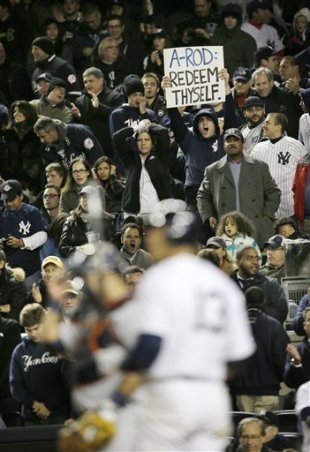
Alex Rodriguez was a target of frustration for Yankees fans on Sunday. (AP)Alex Rodriguez was a target of frustration for Yankees fans on Sunday. (AP)NEW YORK – Gone are mystique and aura, the two temptresses of the Bronx, who blessed old Yankee Stadium with kismet and joy and brilliant baseball. In their stead are apathy and malaise, a couple of hags from Yonkers. They embody the new Yankee Stadium, a sarcophagus if ever there was one: no matter how gorgeous and ornate the outside, it remains filled with lifelessness.
No wonder Game 2 of the ALCS featured thousands of empty seats, like Game 1 before it, and like the do-or-die Game 5 of the ALDS, too. New Yorkers understand a fraud when they see it. They pay for expensive seats, drink overpriced beers, buy exorbitant merchandise and fund a $200 million joke, a team that for the second straight game couldn't score a measly run off the Detroit Tigers' Nos. 3 and 4 starting pitchers. These Yankees earned every last boo.
The vitriol that has evolved here over the last week apexed Sunday with a 3-0 loss in which Robinson Cano extended his record playoff hitless streak to 26 at-bats, Curtis Granderson struck out three more times in three at-bats and Alex Rodriguez whiffed twice. Something is different here. Very different. Not only are the Yankees searching for their identity with a series deficit of 2-0 and three games beckoning in Detroit, their ravenously loyal fan base is revolting against an old, overmatched, passionless team.
"Our fans haven't had much to cheer about, so you can't blame them," Rodriguez said. "You've got to blame us. If I was sitting there, I'd be perplexed, too. We didn't score any runs. What the hell are you going to cheer about?"
A Rodriguez hit. Seriously. That's what drew the evening's loudest ovation. A single up the middle, just his third hit in 23 postseason at-bats. That's the new standard. That's what the most feared and hallowed place in baseball has come to. Yankee Stadium: Where they roar for a single.
Don't think this went unnoticed, either. It wasn't just the ushers instructed to fill in empty seats so the crowd looked better on TV. The players can tell, too.
"This is a very easy place to play now," Tigers outfielder Quintin Berry said. "Coming from Oakland, the fans there were so rowdy. It was easier to come here."
Oakland Coliseum, where tarps cover the upper deck, more electric than Yankee Stadium.
Every other playoff stadium filled to capacity, and Yankee Stadium with entire sections empty, thousands of unsold tickets, even ones as cheap as $15 through resellers.
No matter how the Yankees spin this – team president Randy Levine had the hubris to blame StubHub – the swiss-cheese crowd is a stunning indictment on their failures to transition the atmosphere of the old stadium to the new one. The cratering secondary ticket market bears out the criticism that face-value ticket prices are excessively high – that the Yankees priced out the average fan in search of corporate blood money.
This is their comeuppance: a bloated team, another playoff flameout at hand with Justin Verlander primed to carve them up Tuesday in Game 3 and a fan base so disenchanted it spent far more time booing its own than its opposition.
Here's how far it has degenerated: Nick Swisher said some fans blamed him for Derek Jeter's broken ankle, suffered toward the end of Game 1 following a misplay in which Swisher lost a Delmon Young fly ball in the lights.
"That's the last thing I ever thought would be in this ballpark: that people would get on you that bad," Swisher said. "Especially your home, man, where your heart is, where you're battling and grinding all year long. It's just frustrating, man. You never want to be in that spot. It's not like you're trying to go out there and do bad on purpose.
"It hurts."
To which the hags say: Boo freaking hoo.
Swisher is 4 for 26 this postseason, contributing to a Yankees offense hitting .202. New York has scored seven earned runs in 43 2/3 innings thrown by opposing starters. The ugliness has metastasized throughout the lineup.  Its sudden appearance in October is the starkest reminder that no matter how many division championships the Yankees win and playoff berths they earn, fans judge them on how they finish. And while the Yankees' one championship since 2000 is one more than 20 teams can boast, it cost nearly $2 billion, money siphoned from fans who expect a far greater return on investment. If they're going to pay silly subscriber fees for YES and take a plundering with each trip to the Bronx, they expect better than $114 million of that money owed to a 37-year-old who is 0-for-19 with 13 strikeouts against right-handed pitching this postseason.
"Nothing against our environment here, but a change of scenery sometimes helps a little bit," Rodriguez said. "Maybe some of our guys will relax a little bit and go out and have some fun."
No, it's not easy playing when a support system turns so vociferously. Yeah, well, it's not easy being asked to support a team that performs so badly at the most important time of the year, either. The Yankees are staring into a deep abyss. Their core keeps getting older. Their pitching woes remain palpable. Their farm system – especially the upper-level arms that were supposed to be here by now – has dried up considerably. It's not like Jeter's injury was some sort of sign. It was just a reminder of what was – and what is no longer.
Jeter represents the era in which the Yankees could do no wrong. They won so much only a contrarian could view the franchise with cynicism. Those Yankees earned every ounce of pride.
It's easy to wonder how much of this traces back to the passing of George Steinbrenner, their bombastic owner. While he presided over more than a decade of misery that preceded the late '90s dynasty, his presence throughout the winning cannot be overstated. The culture under Steinbrenner was about the team. The culture today is about the business. Yankees fans loved Steinbrenner. Yankees fans don't know his sons. The urgency then was palpable. The urgency now is questionable.
Oh, manager Joe Girardi tried as he may, first with a pregame speech to rouse the team from its Jeter-related depression and then by getting ejected from Game 2 when reminding umpire Jeff Nelson just how badly he mangled an important call at second base. Neither stirred the somnambulant Yankees. They shrugged their shoulders.
"There's no explanation," Cano said.
Maybe not for the sudden inability to hit. There's a plenty good one for everything that permeated the stadium Sunday. Apathy and malaise didn't just show up this week. They've festered for a while, building, growing, readying for the proper moment to explode. And here they came, those old hags, happy to let this embarrassing Yankees team understand.
They earned this. Every last bit of it.

Sunday, October 14, 2012

The Moral Giant and the Leftist Creep

By Jeff Jacoby
http://www.townhall.com
October 14, 2012


I REGRET that it was only upon reading his obituary this month that I first learned of Nguyen Chi Thien. He was a courageous Vietnamese dissident who had spent nearly 30 years in prison for his opposition to communist repression, cruelty, and lies. Much of Nguyen's opposition was expressed in poetry, most famously "Flowers from Hell," a collection of poems he memorized behind bars, and only put down on paper after being released from prison in 1977.
The poems were published after he audaciously handed off the manuscript to British diplomats at their embassy in Hanoi, the AP obituary recalled. As he walked out of the embassy, "security agents were awaiting him, and he was promptly sent back to prison." He spent the next 12 years in Hoa Lo, the notorious Hanoi Hilton. While he was in captivity, "Flowers from Hell" was published; it earned the International Poetry Award in 1985. By the time he emigrated to the United States in 1995, his poems had achieved wide renown. His stanzas "became as familiar as songs," wrote Anh Do in The Los Angeles Times, and "continue to move the Vietnamese immigrant generation – and their sons and daughters."
By coincidence, the same newspaper page that carried Nguyen's obituary also ran a much longer story about Eric Hobsbawm, the famous British historian who died on Oct. 1 of pneumonia at age 95. The two men could hardly have been less alike.
Nguyen defied communist totalitarianism, sacrificing his freedom in defense of the truth. He refused to pretend that there could be anything noble or uplifiting – let alone ideal – about a revolutionary movement that pursued its ends through mass slaughter and enslavement. Like so many other dissidents, from Andrei Sakharov to Liu Xiaobo, he was a champion of liberty, sustaining hope and keeping conscience alive in the teeth of regime that persecutes decent men for their decency.
Hobsbawm, on the other hand, was a lifelong Marxist, a card-carrying member of the Communist Party from his teens until the collapse of the Soviet Union in 1991. Long after it was evident to even true believers that the Bolshevik Revolution had unleashed a nightmare of blood, Hobsbawm went on defending, minimizing, and excusing the crimes of communism.
Interviewed on the BBC in 1994 – five years after the fall of the Berlin Wall – he was asked whether he would have shunned the Communist Party had he known in 1934 that Stalin was butchering innocent human beings by the millions. "Probably not," he answered – after all, at the time he believed he was signing up for world revolution. Taken aback by such indifference to carnage, the interviewer pressed the point. Was Hobsbawm saying that if a communist paradise had actually been created, "the loss of 15, 20 million people might have been justified?" Hobsbawm's answer: "Yes."
Imagine that Hobsbawm had fallen in love with Nazism as a youth and spent the rest of his career whitewashing Hitler's atrocities. Suppose he'd refused for decades to let his Nazi Party membership lapse, and argued that the Holocaust would have been an acceptable price to pay for the realization of a true Thousand-Year Reich. It is inconceivable that he would have been hailed as a brilliant thinker or basked in public acclaim; no self-respecting university would have hired him to teach; politicians and pundits would not have lined up to shower him with accolades during his life and tributes after his death.
Yet Hobsbawm was fawned over, lionized in the media, made a tenured professor at a prestigious university, invited to lecture around the world. He was heaped with glories, including the Order of the Companions of Honour – one of Britain's highest civilian awards – and the lucrative Balzan Prize, worth 1 million Swiss francs. His death was given huge play in the British media – the BBC aired an hour-long tribute and the Guardian led its front page with the news – and political leaders waxed fulsome. Former prime minister Tony Blair called him "a giant … a tireless agitator for a better world."
Such adoration is sickening. Unrepentant communists merit repugnance, not reverence. Compared with a true moral giant like Nguyen Chi Thien, Hobsbawm was nothing but a dogmatic leftist creep, and the toadies who worshiped him were worse.
Nguyen knew all about such toadies, as a few tart lines from his 1964 poem, "Today, May 19th" – written about Ho Chi Minh – make clear:
Let the hacks with their prostituted pens
Comb his beard, pat his head, caress his arse!
… The hell with him!

Saturday, October 13, 2012

Chevy Volts For War-Torn Vienna, Nothing For Benghazi

Investors Business Daily
http://www.investors.com
October 12, 2012


Priorities: While our consulate in Benghazi was guarded by unarmed Libyan contractors making $4 an hour, our embassy in Vienna received an expensive charging station for its new electric cars to help fight climate change.
Even MSNBC's Andrea Mitchell says Vice President Joe Biden lied during Thursday's debate when he said twice that no one in the Obama administration knew that requests for extra security had been made by our Libyan ambassador, Christopher Stevens, and other members of our consulate in Benghazi. The State Department knew "in real time," as Mitchell put it in her post-debate analysis, that requests had been made.
The requests were denied, despite 230 security incidents in Libya between June 2011 and July 2012. With 48 taking place in Benghazi, two at the U.S. diplomatic compound where Ambassador Stevens and three other Americans were murdered on Sept. 11, 2012, a date that by itself should have prompted enhanced security.
What Biden was denying was pointed out by Eric Nordstrom during his testimony before the House Committee on Oversight and Government Reform last Wednesday. Nordstrom, a regional security officer of the U.S. Mission to Libya from September 2011 to July 2012, said that, among other things, he was told in a phone call in July that the deployment of the site security team, a 16-member American military unit based in Tripoli, could not be prolonged.
According to Nordstrom, the State Department not only refused his requests for greater security, but also actually reduced the number of Diplomatic Security Service (DSS) agents assigned to foreign service officers based in Libya. Security was left to one DSS agent, four armed members of the 17th of February Martyrs Brigade and unarmed Libyan contractors employed by the British-based Blue Mountain Group.
In a May 3, 2012, email on which Ambassador Stevens was copied, the State Department denied a request by a group of Special Forces assigned to protect the U.S. Embassy in Libya to continue their use of a DC-3 airplane for security operations throughout the country.
Four days after the use of an ancient DC-3, along with other security requests, was being denied, on May 7, 2012, the State Department authorized the U.S. Embassy in Vienna to purchase a $108,000 electric-vehicle charging station for the embassy motor pool's new Chevrolet Volts.
As Biden and President Obama proclaim the war on terror is over, al-Qaida is "back on its heels" and Osama bin Laden is dead, climate change remains in their view the greatest threat America and the world face.

Denying the Libya scandal


By Andrew C. McCarthy
http://www.nationalreview.com
October 13, 2012

The desultory vice-presidential debate underscored that, even if there were not a thousand other reasons for denying President Obama a second term, the Libya scandal alone would be reason enough to remove him.

By the time the ineffable Joe Biden took center stage Thursday night, Obama operatives had already erected a façade of mendacity around the jihadist murder of our ambassador to Libya and three other U.S. officials. The vice president promptly exploited the debate forum to trumpet a bald-faced lie: He denied the administration’s well-established refusal to provide adequate security for the diplomatic team. Just as outrageously, he insisted that the intelligence community, not the election-minded White House, was the source of the specious claim that an obscure, unwatched video about Islam’s prophet — a video whose top global publicists are Barack Obama and Hillary Clinton — spontaneously sparked the Benghazi massacre.

Our emissaries in Libya understood that they were profoundly threatened. They communicated fears for their lives to Washington, pleading for additional protection. That is established fact. Yet Biden maintained that it was untrue: “We weren’t told they wanted more security again. We did not know they wanted more security again.”

Shameful: so much so that even Jay Carney, no small-time Libya propagandist himself, would feel compelled to walk Biden’s denial back the next morning. But the vice president was far from done. His assertion that “the intelligence community told us” that protests over the video had sparked the murders of our officials was breathtaking, even by Biden standards.

For a moment, let’s pretend that there is no historical context — meaning, no Obama-policy context — in which to place what happened in Benghazi on September 11. Let’s just stick with the freshest intelligence.

In recent months, Benghazi has been the site of several jihadist attacks. The International Red Cross offices there were bombed in May by an al-Qaeda affiliate called the “Imprisoned Omar Abdul Rahman Brigades” — named in honor of the “Blind Sheikh,” whose detention in the U.S., on a life sentence for terrorism convictions, al-Qaeda has repeatedly vowed to avenge.

On June 4, four missiles fired from an unmanned U.S. drone killed 15 people at a jihadist compound in Pakistan. The most prominent was al-Qaeda’s revered Libyan leader, Hassan Mohammed Qaed, better known by his nom de guerre, Abu Yahya al-Libi. It was a severe blow to the terror network, and the intelligence community instantly knew al-Qaeda was determined to avenge it.

The following day, the Abdul Rahman Brigades detonated an explosive outside the American consulate in Benghazi.According to CNN, the attack was specifically “timed to coincide with preparations for the arrival of a senior U.S. State Department official.” The Brigades recorded the attack on video, interspersing scenes of the mayhem with footage of al-Qaeda leaders and 9/11 carnage. In claiming responsibility, the jihadists brayed that they were targeting U.S. diplomats in retaliation for the killing of al-Libi. A week later, the Brigades shot rockets at the British ambassador’s convoy as it moved through Benghazi.

By midsummer, al-Qaeda’s emir, Ayman al-Zawahiri, recorded an acknowledgment of al-Libi’s death that exhorted jihadists, particularly in Libya, to retaliate: “His blood urges you and incites you to fight and kill the crusaders.” Naturally, Zawahiri was targeting September 11 as the moment for vengeance. His recording was released on that morning, intimating that a revenge strike would be the most fitting way for Libyans to mark the day when, eleven years earlier, al-Qaeda killed nearly 3,000 Americans. Obligingly, al-Qaeda affiliates carried out the Benghazi massacre later that day.
Not only did the intelligence community have reason aplenty to anticipate trouble in Benghazi on September 11 — reason having nothing to do with the Mohammed video. We now know, thanks to reporting by the Daily Beast’s Eli Lake, that the diplomatic compound’s surveillance cameras recorded “an organized group of armed men attacking the compound.” Mr. Lake adds that the intelligence community had a surveillance drone taking video “for the final hour of the night battle at the consulate compound and nearby annex.” Moreover, U.S. intelligence officials figured out, within a day of the attack, that the operation was pre-planned and several participants were tied to al-Qaeda affiliates.
Yet, the administration continued, day after day, blaming the massacre on the video. The claim was absurd on its face. Plus, it contradicted an intelligence tapestry signaling a well-planned jihadist operation, to say nothing of the manner of the attack — the timing, preparation, and cruelty of which veritably screamed, “al-Qaeda!” Still, even now, Biden and the Obama administration claim that the intelligence community actually believed our people were killed over a video — that Obama officials were simply repeating what they were told, not spouting what they audaciously hoped to deceive Americans into believing.
Why the deception? Because if you conclude the Benghazi massacre had nothing to do with a cockamamie video no one has seen, you soon realize Obama’s favorite campaign theme — namely, that killing bin Laden decimated the terror network — is nonsense. And you realize that what happened in Benghazi on September 11 is directly traceable to Obama’s Middle East policy.
As noted above, the recent intelligence we’ve just reviewed arose in a historic context. Beginning in 2009, the Obama administration, echoing the Republican establishment, told Americans that Qaddafi had become a key ally of the United States against terrorism. Obama even substantially increased the American aid the Bush administration had begun providing to Qaddafi’s regime. The rationale for embracing the dictator was straightforward: Not only had Qaddafi abandoned his nuclear program; he was providing vital intelligence about jihadist cauldrons throughout his country. By percentage of population, more Libyans traveled to Iraq to wage terrorist war against American troops than did citizens of any other country. And in Libya, Benghazi was the epicenter of the jihad.
In 2011, however, President Obama initiated an unprovoked war against the Qaddafi regime. Though Qaddafi had taken no intervening hostile action against the United States, and though no vital American national interest would be served by Qaddafi’s removal, Obama chose to side with the Islamist rebellion against him. Why? As demonstrated in my new book,Spring Fever: The Illusion of Islamic Democracy, the president was determined to sell the “Arab Spring” fantasy of a Middle East seized by the desire for freedom rather than strangled by the ambitions of freedom-killing Islamic supremacists.
In Libya, Islamists were the backbone of the rebellion: the Muslim Brotherhood partnering, as it is wont to do, with violent jihadists — in this instance, al-Qaeda and its affiliates. Toppling Qaddafi would necessarily result in their empowerment. They’d insinuate themselves into any new government. They’d set up sharia enclaves where they were strong enough to do so. And they’d strengthen themselves by seizing chunks of Qaddafi’s arsenal of high-powered weaponry. Being incorrigibly anti-American, they’d use their new influence and power against the United States.
That is why some of us implored Obama not to intervene. As I argued at the time (responsively quoting a Fox News anchor):
I am not “suggesting that we would be better off with the Qaddafi dictatorship still in effect.” I am saying it outright. If the choice is between an emerging Islamist regime and a Qaddafi dictatorship that cooperates with the United States against Islamists, then I’ll take Qaddafi. If the choice is between tolerating the Qaddafi dictatorship and disgracing ourselves by . . . turning a blind eye to the atrocities of our new Islamist friends . . . then give me the Qaddafi dictatorship every time.
The “atrocities” of note at the time were twofold: the massacres Libya’s Islamists carried out against black Africans suspected of allying with Qaddafi’s regime, and the barbaric murder of Qaddafi himself — when he was abused and displayed as a trophy, just like Ambassador Christopher Stevens would later be. These opened a ready window on the type of savages Obama’s policy was guaranteed to abet.
The straight line from Obama’s Libya policy of empowering Islamists to the Benghazi massacre is rarely discussed. Maybe it would be clearer if the Republican establishment had not ardently supported Obama’s war against Libya. Maybe it would be clearer if Romney and Ryan stopped sounding nearly as delusional about the “Arab Spring” as Obama and Biden do. Maybe it would be clearer if Romney and Ryan stopped talking about reprising the Libya debacle in Syria, joined at the hip to what they call “our ally Turkey” — Hamas’s new sugar daddy and staunchest defender. It would surely be welcome if the GOP ticket started diagnosing “spring fever” instead of manifesting its symptoms.
In Benghazi, we see the wages of the disease. The pathogen was not a video. Want to know why our people were left unprotected and why mounds of intelligence foreshadowing peril were ignored? Don’t look to Obama’s vice president, look to Obama’s policy.
— Andrew C. McCarthy is a senior fellow at the National Review Institute and the executive director of the Philadelphia Freedom Center. He is the author, most recently, of Spring Fever: The Illusion of Islamic Democracy, which was recently published by Encounter Books.