Monday, January 23, 2012

Joe Paterno dies, leaving a record for others to debate


By , Published: January 22
The Washington Post
http://www.washingtonpost.com


Joe Paterno could outtalk anybody in that Brooklyn beat cop’s voice of his. But the lung cancer and the chemo had left him breathless, and what emerged in two days of conversations with him, the last interview he would give, sounded like a series of sighs. Some of them satisfied, some of them regretful, all of them aware that his life was drawing to a close and 85 years were being relentlessly and reductively defined.

Paterno studied his own end, and knew it wasn’t going to be storybook. So much for the old-fashioned narrative he had built, of bookish yet vigorous young men filling a stadium in the Alleghenies, men he had uplifted such as Franco Harris and Lydell Mitchell and Brandon Short, autumn leaves swirling softly over their heads.

“There’s the kind of stories I wish we could tell,” Paterno whispered.

But a modern grotesquery intervened, and there were too many other boys who allegedly had been damaged.

For most of his 61 years as a football coach at Penn State, Paterno built a record of thorough decency and good intention. He loved his wife, reared five nice children, taught his students well. He turned down big money for the role of a tenured professor, and strolled every day from his modest home to his unpretentious office. He acquired real power, and generally tried not to abuse it, and if sometimes he did, he covered for it by insisting on paying for his ice cream cones. He set out to prove that staying in one place could be as rewarding as climbing to the next rung. He meant to walk away sooner. He stayed too long.

He stayed so long that he became more of an ideal to his followers than a person. Then the horrific happened, and the quaint success story in the peaceful hamlet was destroyed by allegations that Jerry Sandusky, Paterno’s assistant coach for 30 years, was a serial child molester and that Paterno, when told of an incident involving Sandusky and a small boy in the Penn State showers, did his duty but no more, passing the report to his superiors. The only way to give the tragedy the gravity it deserved was to topple the icon who behaved so fallibly.

“You got what you got,” he says he told himself, after he was fired by the board of trustees in November. “You did about as much as you can do, on the field and off the field.”

Yet Paterno also understood he was the face of a terrible inaction. He had done more than some people, yet less than he should have when he failed to press his superiors about Mike McQueary’s report of seeing Sandusky doing something sexual to a small boy in the Lasch football building.
“I should have said ‘Hey where are we with this thing?’ ” Paterno said. He described himself as paralyzed by the unthinkable subject matter. He had “backed away,” he said, and trusted his bosses to handle it.

“I didn’t know which way to go,” he said. “And rather than get in there and make a mistake . . .”

A week ago, Paterno invited this reporter into his home because he wanted to defend his record and give his version of events in the Sandusky case. He often seemed to be trying to explain his actions to himself as much as to others. It was a difficult conversation because it was not only his first interview on the subject of Sandusky but quite possibly the last interview he would ever give. His health was clearly precarious, and his answers often trailed off or wandered. Shortly afterward, he failed badly, and slipped in and out of consciousness over the next few days.

The enraged who demand hard answers as to why Paterno didn’t do more will have to wait until eternity. Why didn’t he follow up? “I don’t know,” he said.

You will have to decide for yourself if Paterno could have reached the age of 85 in modern society without ever really knowing what man-boy sodomy was. “I had never heard of, of, rape and a man,” he said.

For what it’s worth, there was genuine distress in his voice when he said it. And it’s hard to overstate just how insulated Paterno was. His home was a time warp, all old wood and creaking floorboards. But he most likely overstated his ignorance. He did, after all, belong to a Catholic Church wracked by pedophilia scandals.

Still, I thought I understood what he meant. He seemed to reflexively recoil from such deviancy; it baffled him, and to connect it to a longtime colleague was almost impossible.

“It was shocking for me, and too, sadness,” Paterno said. “Was he sick? I don’t know. I don’t even know if he’s guilty.”

It would be a mistake to think that Paterno didn’t care enough about the potential victims. “I’m sick about it. I think about a 12-year-old boy, a 10-year old boy. In the shower, a physical touching, it’s sickening.”

According to Paterno’s wife Sue, the two of them spent agonized hours talking about whether, if Sandusky is guilty, they should have noticed something.

If nothing else, Paterno said, maybe the Sandusky scandal would help drag the subject out of its dark corner. It was one of the last sentiments he expressed. On the final morning he would ever spend at home, he sat propped in bed and insisted on answering a few more questions — that’s how important it was to him to talk. In just a few hours he would be taken to the hospital, and remain there until he died Sunday morning.

“I’m happy in one sense that we called attention, throughout this state, and throughout the country probably, that this is going on,” he said. “It’s kind of been like a hidden thing. So maybe that’s good.”
According to a family spokesperson, it was among his last lucid remarks to anyone outside of his immediate family.

Paterno’s critics will say his inaction in the Sandusky case ruined his legacy and that he had the power to do more. But Paterno denied he was the ultimate moral authority in Happy Valley. He had always tried to refrain from flexing his muscle, he insisted. “In all the years I’m here, we went the way the university wanted,” he said.

One reason I suspect Paterno decided to talk with me, as opposed to another writer, was because it brought his career full circle. In 1968 a Sports Illustrated writer named Dan Jenkins went to State College to do a story on a rising coach who had turned a cow college into a national football power, yet who emphasized academics like an Ivy Leaguer. No fewer than five times, Paterno asked, “How’s your father?” I replied that my father is 82 and still typing, and didn’t like the idea of retirement either.

Back in 1968, Paterno told my father, “We’re trying to win football games; don’t misunderstand that. But I don’t want it to ruin our lives if we lose. I don’t want us ever to become the kind of place where an 8-2 season is a tragedy. Look at that day outside. It’s clear, it’s beautiful, the leaves are turning, the land is pretty, and it’s quiet. If losing a game made me miserable, I couldn’t enjoy such a day.”

Had that perspective gotten lost? Did Paterno feel that somewhere along the line, football had become too important — and somehow allowed a real tragedy to go overlooked?

“Well, I don’t think it got lost,” he said. “I just think there was a series of situations that maybe people, a little bit, maybe they neglected something, and maybe they got a little bit frustrated. Whether they had good intentions or not, you’d have to ask them.”

His record will show that he was a great, indomitable champion who amassed a record 409 victories, as well as an intelligent advocate who worked tirelessly for poor and minority athletes his whole career. It will show that he was utterly devoted to his players, regularly graduated more than 75 percent of them, and had 47 academic all-Americans. It will show that he made mistakes and omissions, one of them possibly truly costly. It will show that he mostly maintained his perspective and remained true to himself.

“He didn’t preach one thing and live a different way,” Sue said.

It will show that he was not a statue made of bronze, and that he was defined as much by what he failed to do and say, as by what he did. Which merely made him, in the end, human.

For Sally Jenkins’s previous columns, go to www.washingtonpost.com/jenkins


Sunday, January 22, 2012

Film Reviews: 'Haywire'

 
Girl Fight: Soderbergh and His MMA Star Make Impact With Haywire

By Nick Pinkerton
The Village Voice
http://www.villagevoice.com/
Wednesday, Jan 18 2012

There's a point in Haywire when the film's protagonist, ex-Marine Mallory Kane (Gina Carano), gone rogue from her job as hired muscle for a private government subcontractor, takes a fall while scaling down a drainpipe and hits the ground with a crunch that knocks the wind out of you.

It's a short drop, but that landing hurts. As cartoonish live-action and photorealistic cartoons reign at the multiplex, all but obsoleting the laws of gravity, Haywire puts the impact back into screen violence, brings it back to earth.

Haywire's plot is boilerplate triple-cross, cloak-and-dagger stuff, written in pulpy blank verse by The Limey screenwriter Lem Dobbs, picking up with his old collaborator, director Steven Soderbergh, who evinces a second-sense ability to frame every shot for maximal effect. Mallory is introduced evading her old employer's attempt to corral her, in a scene that establishes the film's tendency to ambush assault. After half-kidnapping a teenage escape driver, she flashes back to the hectic last week that has put her on the lam: two jobs that shuttled her between Barcelona and Dublin and ended in a setup.

Mallory looks for answers from her boss and former lover, Kenneth, played by Ewan McGregor; the rest of his network is played by famous faces, including shadowy operative Antonio Banderas; Channing Tatum as Mallory's sometimes partner, Aaron; Michael Douglas as Kenneth's liaison to Washington; and Michael Fassbender as a freelance agent, Paul, with whom Mallory is reluctantly partnered. Haywire is, however, very much a vehicle for Carano, the retired MMA fighter and former American Gladiator regular, now appearing in her first film. The casting is more than a stunt, for Haywire makes full use of Carano's particular physical capabilities (something decidedly not true of porn star Sasha Grey's casting in Soderbergh's The Girlfriend Experience). There are several long, unbroken shots of Carano hustling along city streets in foot chases and bounding across rooftops like a muscular Irma Vep, and, of course, there are fights. Soderbergh makes ingenious use of confined spaces—corridors, hotel rooms, the narrow aisle of a boxcar diner—with combatants using walls for leverage and as ready bludgeons. The music of fist on face, the punting kicks, all have a rib-cracking resonance that recalls the days when Phil Karlson (Walking Tall) was directing actioners.

Carano is also photogenic: The symmetry of her sharp features has survived her fighting days, though she carries a scar on her jawline as a souvenir. This is important because Haywire is, after a fashion, a slapstick-violent, mercenary sex comedy, with Mallory romantically involved, however fleetingly, with each of her major opponents in turn: In addition to her history with Kenneth, she has an on-the-job FWB relationship with Aaron, while she's attached to Paul as a decoy date. ("MI6 wants me to be eye candy?" she asks, incredulous.) The combat duets don't have the weight of moral outrage behind Karlson's punch, but, as Soderbergh jauntily outlines the combatant's business/pleasure interactions, each fight takes on an individual chemistry, as any couple does. With Aaron, it's a brutal spat. The prelude to their confrontation—him hungover, Mallory marked up—reads like an abusive boyfriend coming to collect his woman, an assumption that Soderbergh quickly upends. Mallory's outing with Paul is a parody of a swank first date, complete with a consummation in which he gets more than he bargained for. (The only bit that doesn't quite register is Mallory impersonally dispatching two Irish GardaĆ­ officers, precisely because it's impersonal.)

Where faux-empowering The Girl With the Dragon Tattoo confines sexual power play to the old rape-revenge matrix, Haywire is a real war-of-the-sexes tournament, briskly paced with a tickling sense of black humor. (One encounter concludes with a smothering thigh lock that leaves its victim with a priceless sated and insensate expression before his black-widow goodnight kiss.) In contrast to Rooney Mara's overkill Hot Topic pout, Carano can play dom femme and express vulnerability, backed up by her physique.

How'd she get so tough? Bill Paxton shows up as Mallory's ex-leatherneck father, teasing the pop-psych explanation that she has never found somebody who can measure up to Daddy—but Daddy's expression when witnessing Mallory at work shows he knows he has been surpassed. Mallory might find her culprit, but she doesn't find anyone on her level.

Details

Haywire
Directed by Steven Soderbergh
Relativity Media
Opens January 20
ALSO: Gina Carano and Channing Tatum Talk Haywire with Karina Longworth

Related Content


Haywire


BY ROGER EBERT / January 18, 2012

There must be Freudian insights explaining why so many young males respond positively to superwomen as heroines. At science fiction and comics conventions, a woman wearing a fetishistic superhero costume will almost certainly be the focus of a circle of intent fanboys. Maybe there's the prospect of an all-protecting mom. Or the promise of a cool female buddy. The possibility of sex seems to be secondary.

Mallory Kane, the heroine of "Haywire," is a splendid example of the character type. Her first name springs from a Latin root for evil, and her last name evokes associations with British pornography ("Strict instruction for naughty schoolboys. Call Miss Kane"). Steven Soderbergh's latest film is a thriller that has next to nothing to do with sex, except as an implement of distraction, but under the surface, there's an appeal coiling to that part of many men that feels kinda needy about Lara Croft.

Mallory is played by Gina Carano, a retired mixed martial arts fighter. Her range is suggested by having placed No. 5 on a Most Influential Women list on Yahoo! and No. 16 on Maxim's Hot 100. On the basis of "Haywire," I expect her to become a considerable box-office success, because the fact is, within a limited range, she's good. In the movie's first scene, she walks into a little cafe in upstate New York, sits down, sips a little tea and had me hooked. She has the no-nonsense beauty of a Noomi Rapace, Linda Fiorentino or Michelle Monaghan.

She plays an employee of a murky special contractor of the U.S. government; it's a firm that specializes in performing dirty work on assignment. Its own agents and enemy agents, who sometimes seem interchangeable, spend a great deal of time deceiving and double-crossing one another, and Mallory discovers during the course of the film that (spoiler, I guess) she can't trust anyone. Why so many people want to kill her is a mystery, because she is so gifted at her job.

Carano is wonderfully athletic, which is just as well, because she spends most of the film being wonderful athletic. Although you never know in this age of special affects exactly what is real in a martial arts scene, let it be said she really does seem to be personally performing some impressive fight moves; there are the same elegant moments we remember from Bruce Lee and Jackie Chan, who were blindingly fast and ingenious in the way they improvised using walls, angles, furniture and the bodies of others.

Soderbergh is a master craftsman whose work moves almost eagerly between genres. This is his first martial arts film, and he correctly assumes that the audience isn't interested in hearing a lot of dialogue. Lesser directors would use that as an excuse to rely entirely on action and lowball the words. Not Soderbergh and his screenwriter, Lem Dobbs, who wrote "Dark City," is the son of the famous painter R.B. Kitaj and lifted his pen name from the Bogart character in "Treasure of the Sierra Madre."

What they do is craft very precise words for a large group of supporting characters and fill those roles with surprisingly big names. The result is that the film (although its plot is preposterous nonsense) has weight and heft and places Mallory at the center of a diabolical labyrinth. Consider that a relatively little-known actress co-stars with Michael Fassbender, Ewan McGregor, Bill Paxton, Channing Tatum, Antonio Banderas and Michael Douglas, and you realize that (1) Carano can hold her own, and (2) like Woody Allen, Soderbergh is one of those directors who can get just about anybody he wants to act in his movies.

I call the plot nonsense. Ask yourself this: How could any organization or "contractor" survive for long with the death rate we see here? At the end of a year, no one would be left alive, except a few mail-room clerks. Soderbergh seems to be amusing himself with the variety of his locations: Barcelona, Dublin, New Mexico, New York State and executive offices in unnamed cities. A film like "Haywire" has no lasting significance, but it's a pleasure to see an A-list director taking the care to make a first-rate genre thriller.

Haywire

http://www.rollingstone.com/
January 19, 2012


Director Steven Soderbergh, actress Gina Carano, and actor Ewan McGregor attend Relativity Media's premiere of "Haywire" after party co-hosted by Playboy held at DGA Theater on January 5, 2012 in Los Angeles, California.
( January 4, 2012 - Photo by Frazer Harrison/Getty Images North America) more pics from this album »
 
Into the cinematic dead zone of January comes Haywire to kick off the new movie year on a sexy action high. I shouldn't be surprised, since Steven Soderbergh, the Oscar-winning director of Traffic, is the prankster behind the camera. This is Soderbergh working lean and mean outside the mainstream comforts of the Ocean's franchise. Shooting digitally on the 4K Red One camera, Soderbergh gives Haywire B-movie oomph without sacrificing his fluid elegance. Plus, there's no keeping your eyes off his star attraction. She's Gina Carano, 29, the face of women's mixed martial arts and just the five-foot-eight cage fighter you need to beat the crap out of male movie stars, such as Ewan McGregor, Michael Fassbender and Channing Tatum.

OK, Carano's on-camera experience has been limited to crushing the competition on NBC's American Gladiators. But she more than holds her own with the big boys, including evil suits played by Antonio Banderas and Michael Douglas. Did I mention that Haywire is a spy thriller? It is, and the nonstop dazzle and momentum are boosted by frisky camerawork and editing by Soderbergh under the aliases of Peter Andrews and Mary Ann Bernard (don't ask).

Carano plays Mallory Kane, a covert-ops specialist who finds her shady government bosses are out to whack her. Dumb move. This Muay Thai kickboxer and weapons expert doesn't go down easy, not even when her chief contact, Kenneth (McGregor, thoroughly enjoying his slide into slimeball villainy), pulls out all the stops.

Lem Dobbs (The Limey, Kafka) sparks his script with droll wit, but I wouldn't bother much with the plot details. As the scene shifts across the globe, propelled by a vibrant David Holmes score, Mallory is the only guide we need. Carano is poetry in kickass motion, as she and ex-lover Aaron (Tatum) duke it out in a rundown diner. This leads to a flashback of Mallory and Aaron teaming up in Barcelona to rescue a Chinese journalist. Just when you think Soderbergh can't top himself for pyrotechnics, Mallory – decked out in heels and designer wear – tangles with Paul (Fassbender, oozing subversive charm), a partner she's meant to trust. Ha! The two destroy a posh Dublin hotel room, and Soderbergh can't contain his joy. Why should he? And why should we? As foxy Mallory takes on her enemies in the beach house she shares with her father (Bill Paxton), Haywire comes close to achieving Soderbergh's goal of creating "a Pam Grier movie made by Alfred Hitchcock."


ESPN college basketball analyst Jay Bilas talks softly by TV standards

But his words resonate with audiences full of varied, complex agendas


By J. Brady McCollough, Pittsburgh Post-Gazette
http://www.post-gazette.com/sports/
Sunday, January 22, 2012

ESPN College GameDay basketball analyst Jay Bilas, dressed for the waist up on camera shots, goofs around on a partially broken-down set Friday, a day before the show goes live. The show travels around the country to a new destination each week, and Saturday's show featured the Pitt vs. Louisville matchup at Petersen Events Center. (Bill Wade/Post-Gazette)


Jay Bilas' parents schooled him to embrace opportunity, so, when officials at Duke nominated him to sit on the NCAA's long-range planning committee as an undergraduate in the early 1980s, Bilas said yes.

Then a 20-year-old standing 6 feet 8 with a full head of brown hair, Bilas was the starting center on Duke's basketball team and had not met much resistance in life. He was a Southern Californian with a quick wit, and, in the Blue Devils' locker room, there was a feeling that Bilas could do just about anything he wanted.

But Bilas ran into a wall in those meetings with the NCAA. He had ideas about how to improve the life of a college athlete, but it felt like nobody in that room was listening.

One time, Bilas had brought up a grievance about NCAA transfer rules. For instance, if a head coach was fired or left for another job, Bilas did not feel the coach's players should have to sit out a year if they were to transfer from the school.

"You would have thought I said every athlete should be paid a million dollars," Bilas recalled.

He was told that an athlete's commitment was "a marriage between player and school," but Bilas pleaded his case.

"When I got to campus," Bilas said, "I was picked up by the coach. I was shown the university through the eyes of the coach.

"I understand the marriage analogy, but, if I were to get divorced, that doesn't mean I have to stay and live with my wife's parents after she leaves me."

Thing is, Bilas was not saying half of what he felt. He understood that it would have been a futile exercise to tell the committee that players should be compensated for the money they bring into universities.

When Bilas left the NCAA committee, he was discouraged, but he has spent much of the past three decades acquiring experiences that have combined to make him one of the most powerful voices in college athletics.

His platform as an ESPN college basketball analyst is big enough on some nights that he can be heard by millions, and Bilas does not want to abuse that power.

He is meticulous in his preparation and fearless in saying what he thinks about any topic -- a refreshing quality in a world where talking heads just keep talking louder and louder.

Bilas rarely turns up the volume, and his words hold more weight among fans with each passing year. In 2010, Sports Illustrated named Bilas college basketball's best game analyst. His Twitter page has 227,000 followers.

All day Saturday, it was Bilas' job to prepare the nation for the Pitt-Louisville game at the Petersen Events Center on ESPN College GameDay. It is a role he relishes because it keeps him on the inside with the coaches and the players -- the scene he gave up in 1992 when he took a job as an attorney at a large, corporate Charlotte firm.

"I don't look at myself as a broadcaster," said Bilas, 48.

"I look at myself as a basketball guy, and this is my avenue."

If Bilas could cut off his brain from everything else and just think about basketball, his life certainly would be simpler. He would love to do nothing but sit around and diagram plays as he did at one point Friday afternoon, but Bilas cannot shake the big picture.

Friday night, he settled into a booth in a seafood restaurant at the Westin Convention Center and relaxed with a glass of pinot noir. Saturday morning, he would take his place in the machine, promoting a sport that brings in billions for the NCAA and pays the organization's president $2 million a year.

Bilas and the crew will talk glowingly about Pitt's Ashton Gibbs and Tray Woodall, whose skills on the court make lots of other people money.

"We cover them like pros," Bilas said, "and they're not pros. But they should be pros."

Bilas said it would be a lot easier for him to be an NBA analyst.

"Only 30 teams," Bilas said, "and everybody is getting paid; nobody's got amateurism violations."

But Bilas said he would never cover another sport, no matter the money someone offered him. He is a basketball guy, after all. And, while he is living very comfortably off the game with his wife and two kids, he is willing to go with less if the right decisions are made.

"It's better for me if the players are never compensated," Bilas said. "In my job, if the players were allowed to be compensated, I would make less money.

"It's way better for me if they don't get a nickel. But I don't think it's right."

Bilas is a noted NCAA critic, and, for those on his side, they could not have a more well-rounded guy leading the charge. He has a Duke law degree, litigated cases for seven years before going into broadcasting full time and is a card-carrying member of the Screen Actors Guild. In 1990, Bilas played an alien cop in "Dark Angel," a movie starring Dolph Lundgren, the actor who played Russian boxer Ivan Drago in "Rocky IV."

Trying cases taught him how to argue a point without losing his cool, and acting made him unafraid of the spotlight.

"He's very talented," said Harvard coach Tommy Amaker, Bilas' teammate at Duke and a lifelong friend. "He can talk in different languages to a lot of different people."

Last summer, ESPN aired a show called "College Football: Blueprint For Change," which featured a roundtable of important voices. Bilas was the only person with no affiliation to football who was invited to join the panel.

Surrounded mostly by skeptical ears, Bilas described his plan to fix college athletics: an Olympic model in which players are not paid directly by their schools but can benefit from outside sources using their name or likeness.

"A music student who's on a full music scholarship can cut a record," Bilas said that day, "can play at Carnegie Hall, can be on TV, can be in a movie, whatever they want. Regular students get paid all the time."

At one point, Alabama coach Nick Saban, who makes more than $4 million a year, said "It's not a business. ... Nobody's really making money. I mean, we get paid salaries."

Bilas responded, "I'll say."

ESPN analyst Rece Davis recalls Urban Meyer leaning over to him as Bilas was speaking and saying, "I don't really agree with anything he's saying, but, boy, he's got a heck of a way of making you think he's right."

When reminded of Meyer's comment, Bilas said, "That's what my wife calls 'that lawyer [BS].' "

It may not work on Wendy Bilas, but the people at NCAA headquarters in Indianapolis are beginning to pay attention.

Last fall, Bilas got a call from NCAA president Mark Emmert, asking if he could spend some time with Bilas talking about the issues his organization faces. Bilas gladly agreed and welcomed Emmert and two other officials to his country club in Charlotte for lunch and a round of golf.

"I didn't expect anything to come out of it," Bilas said. "It was a wonderful opportunity for me.

"He doesn't have to talk to me or acknowledge me."

Just like when he was a student nearly 30 years ago, Bilas always will say yes to an opportunity -- especially one for discourse. He is open to being convinced that he is wrong about the future of college sports. It just has not happened.

"I'm not one of those that would say, 'See, I told you so,' " Bilas said. "Whoever wants on this bandwagon, welcome."

Saturday, January 21, 2012

Etta James: 10 classic performances

Richard Williams remembers the great blues and soul singer at her absolute finest

The Guardian
20 January 2012
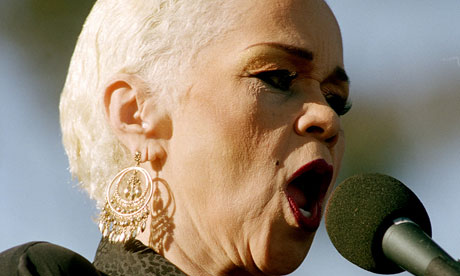
Etta James
Soul legend … Etta James. Photograph: Eamonn Mccabe

Etta James was born in Los Angeles and spent some of the key years of her professional life in San Francisco and Chicago, but there have been few more convincing interpreters of soul music associated with the southern states. Many of her classics were indeed cut in Muscle Shoals and Memphis, but it didn't really matter where she was standing at the time. In LA or the Windy City, Etta could dig out the heart of a good song and present it raw, with the blood still running red. So this list of 10 personal favourite Etta James tracks contains a preponderance of deep-soul ballads with a southern accent.

1. Let's Burn Down the Cornfield (1974)

Etta turns Randy Newman's great song into an epic portrait of sexual conspiracy. Gabriel Meckler's restrained production sets her suplhurous voice against Lowell George's slide guitar, which takes centre-stage for a piercing solo that ends with a gorgeous dying fall. From the album Come a Little Closer.

2. Almost Persuaded (1968)

Co-written by Billy Sherrill, produced by Rick Hall at the Fame studios in Muscle Shoals, this is a piece of prime late-60s Memphis soul: a black singer taking a country song and turning it inside out. Etta meets a man at a party, and they take a shine to each other. They drink and talk. He puts his hand on hers. Come away with me, he says. Then she looks into his soft brown eyes, and sees the reflection of her wedding ring. "I was almost persuaded …" One of her finest 45s.


3. Damn Your Eyes (1988)

Another country song taken for a walk through the shadows on the other side of town. This one is by Barbara Wyrick and Steve Bogard, and comes from the album Seven Year Itch, its title referring to her prolonged absence from the recording scene. Produced by Barry Beckett in Muscle Shoals, it features Reggie Young's guitar. Etta could shout the blues with the best of them, but she could also under-sing when necessary, and she pitches this one perfectly. Impossible to play just once.


4. Pushover (1963)

A playful slice of pre-Beatles black pop, co-written (with Roquel Davis) by Tony Clark, a Northern Soul hero ("Ain't Love Good Ain't Love Proud", "Landslide", "The Entertainer"). "Pushover" itself was an early favourite with that audience, and demonstrates Etta's versatility.


5. I'd Rather Go Blind (1968)

In her 1995 autobiography, Rage to Survive, Etta wrote that she heard an early version of this song from its writer, her friend Ellington Jordan, before helping him to complete it. Recorded with Rick Hall at FAME, it ended up on the B-side of "Tell Mama". A year later Christine Perfect sang it with Fleetwood Mac, paving the way for countless cover versions. The original is still the greatest, by a country mile.


6. Misty Blue (2011)

Bob Montgomery, Buddy Holly's songwriting partner, wrote this yearning ballad in 1966 for Brenda Lee, who wasn't interested. Ten years later Dorothy Moore gave it the soul treatment and had a huge worldwide hit. This heartfelt version comes from The Dreamer, Etta's final album, sensitively produced by her sons Donto and Sametto – long a part of her road band, on drums and bass respectively – to minimise the limitations of a voice losing its range and flexibility but none of its intelligence and interpretive power. "Listen to me good," she urges.


7. If I Can't Have You (1960)

After her initial run of hits dried up, Etta signed with the Chess brothers in Chicago. This wailing duet with Harvey Fuqua takes its place in a tradition running from Brook Benton and Dinah Washington to Marvin Gaye and Tammi Terrell.


8. Lovin' Arms (1975)

Tom Jans was a folk singer from southern California who toured and recorded with Mimi Farina, Joan Baez's sister, and died of an overdose in 1984, aged 35, a year after a serious motorbike crash. He left this wonderful song, which exists in powerful versions by Elvis Presley and Millie Jackson but also drew the best out of Etta, even though she insists on changing "Looking back and longing for the freedom of my chains" – the key line – to "Looking back and hoping for the freedom of my chains".


9. I Worship the Ground You Walk On (1968)

Written by Dan Penn and Spooner Oldham, in the grand tradition of their majestic country-soul ballads ("Out of Left Field", "Dark End of the Street" and so on). Produced by Rick Hall and released as the B-side of Etta's cover of Sonny and Cher's "I Got You, Babe".


10. In the Evening (2011)

Another track from The Dreamer, this stately and perfectly understated version of the old Ray Charles song goes deep into Etta's heritage, with an excellent band purring through the altered 12-bar changes as she meditates on the most basic verities of the blues: in the evening, when the sun goes down, and your good lover is not around … No more to be said.

Etta James dies at 73; acclaimed blues and R&B singer

Etta James, perhaps the quintessential R&B diva, was equally at home singing unadulterated blues, searing R&B and sophisticated jazz. She was inducted into the Rock and Roll Hall of Fame, and her biggest hit, 'At Last,' has been enshrined in the Grammy Hall of Fame.

By Randy Lewis
Los Angeles Times
http://www.latimes.com/
January 20, 2012

Muhammad Ali chats with Etta James at the piano at the Kinshasa Hotel in Zaire in September 1974. James and other African American musicians were in the country to perform at the Zaire 74 music festival. The concert was organized as a promotional event to coincide with the heavyweight championship boxing match between Ali and George Foreman. (Horst Faas / Associated Press)

Etta James, the earthy blues and R&B singer whose anguished vocals convinced generations of listeners that she would rather go blind than see her love leave, then communicated her joy upon finding that love at last, died Friday. She was 73.

She died at Parkview Community Hospital in Riverside, said her sons, Donto and Sametto James. The cause was complications from leukemia, according to her personal physician.

James had been in failing health for years. Court records in the singer's probate case show she also suffered from dementia and kidney failure. Her two sons had battled their stepfather for control of her $1-million estate but in December agreed to allow him to remain as conservator.

James spent time in a detox facility for addiction to painkillers and over-the-counter medications, Donto told Reuters in 2010. And she had wrestled with complications since undergoing gastric bypass surgery in 2002 to remedy a lifelong struggle with her weight.

After that procedure, which actress Roseanne Barr had recommended to her, James lost 200 pounds. Before the surgery, her weight had gone past 400 pounds. When she performed, she often had to be escorted on and off the stage in a wheelchair. "I was constantly worried that I was going to have a heart attack," she told Ebony magazine in 2003.

Perhaps the quintessential R&B diva, James, who was born and lived much of her life in Los Angeles, was equally at home singing unadulterated blues, searing R&B and sophisticated jazz, the latter receiving special attention in her recordings over the last decade. Her dusky voice, which could stretch from a sultry whisper to an aching roar, influenced generations of singers who came after, from Tina Turner to Bonnie Raitt to Christina Aguilera. And pop-R&B singer Beyonce carefully studied James before portraying her in the loosely historical 2008 film "Cadillac Records."

"Etta James was one of the greatest vocalists of our time," Beyonce said in a statement on her website. "Her musical contributions will last a lifetime. Playing Etta James taught me so much about myself, and singing her music inspired me to be a stronger artist. When she effortlessly opened her mouth, you could hear her pain and triumph. Her deeply emotional way of delivering a song told her story with no filter. She was fearless, and had guts."

Multiple Grammy-winner Raitt said Friday: "I don't know that there's ever been a singer that knocked me out as much as Etta. The mark she made was setting the bar so high for the depths someone can sing from. The ache and the pain and the ferocity and the soul and the sexiness — it all came through in the space of one three-minute song."

Despite her early commercial success, James wrestled for much of her life with her weight, addictions to drugs and alcohol and with her tumultuous relationship with her mother, who was just 14 when she gave birth to Jamesetta Hawkins on Jan. 25, 1938.

She was adored by rock's elite, including the Rolling Stones, who drafted her as an opening act on their 1978 U.S. tour, and voters at the Rock and Roll Hall of Fame, who inducted her in 1993.

"Etta James was a pioneer," said Terry Stewart, president and chief executive of the Rock and Roll Hall of Fame. "Her ever-changing sound has influenced rock 'n' roll, rhythm and blues, pop, soul and jazz artists, marking her place as one of the most important female artists of our time. From Janis Joplin to Joss Stone, an incredible number of performers owe their debts to her. There is no mistaking the voice of Etta James, and it will live forever."

James' six-decade recording career began at the top of the R&B charts when her bawdy 1955 single "The Wallflower," better known as "Roll With Me Henry," quickly made her a national star.

In the rollicking early days of rock 'n' roll, James' saucy song answered Hank Ballard's then-recent hit "Work With Me Annie," a ribald, thinly veiled invitation to a woman to have sex. James' response, in which she assertively put forth the same offer on her own terms, was wildly popular but equally controversial coming from a 17-year-old girl long before the sexual revolution of the '60s upended traditional sex roles.

She is best known for "At Last," the powerhouse ballad that became a hit in 1961 and which has been enshrined in the Grammy Hall of Fame. Bending and stretching the notes of the bluesy melody to reflect the hard-won realization of a lifelong desire, and channeling a sense of joy that sounded as though the gates of heaven had just opened to welcome her in, James sang: "At last, my love has come along/My lonely days are over/My life is like a song."

The other song with which she became inextricably connected was "I'd Rather Go Blind," which she said she co-wrote in 1968 with her friend Ellington Jordan while he was in prison. He outlined the song and James finished it, but for tax reasons she gave the co-writing credit to Medallions singer Billy Foster, to whom she was briefly married. It conveys the desperation of a woman who prefers losing her sight to seeing her man with someone else. Rolling Stone critic Dave Marsh included it in his 1999 book "The Heart of Rock and Soul: The 1001 Greatest Singles Ever Made." It was subsequently recorded by artists including Rod Stewart, B.B. King, Koko Taylor and Beyonce in "Cadillac Records," but it remains most closely associated with James.

Etta James performs at L.A.'s Cocoanut Grove nightclub in 1976. Despite her early commercial success, she struggled for much of her life with her weight, with addictions to heroin, cocaine and alcohol and with her tumultuous relationship with her mother, who was just 14 when she gave birth to Jamesetta Hawkins on Jan. 25, 1938. (Los Angeles Times)

James, the child of a single teenage mother growing up in South Los Angeles during World War II, never knew her father but remained convinced throughout her life that he was pool shark Minnesota Fats.

With her blond curls and light complexion, she stood out in the African American community, and she started to make a mark singing in the choir of St. Paul Baptist Church. The church's music minister, a prominent figure in gospel circles known as Professor James Earle Hines, quickly singled her out for solos when she was just 5 or 6, said David Ritz, who collaborated on her 1995 autobiography "Rage to Survive."

The church was frequented by Hollywood stars such as Lana Turner and Robert Mitchum and had a weekly radio broadcast that helped spread word of the girl's talents. James' mother left her to be raised by foster parents, but when her foster mother died when James was about 12, she was reunited with her biological mother and they lived for a time in San Francisco.

"One of the peculiar things about Etta's story — one that's a twist on the idea of the reverend-preacher who doesn't want his child to sing rhythm and blues — is that her prostitute mother, the sophisticated prostitute mother, didn't want her to sing raunchy rhythm and blues, but wanted her to sing jazz like Ella Fitzgerald and Billie Holiday and Sarah Vaughan," Ritz said.

As a teen, James formed a trio called the Peaches, which was discovered by R&B musician and promoter Johnny Otis (who, coincidentally, died Tuesday at age 90). Soon, she was in a duo called Etta & Harvey with Harvey Fuqua of the Moonglows, the R&B group behind the 1955 hit "Sincerely."

Early on, she toured with Johnny Guitar Watson, the Texas singer, songwriter and guitarist, in an association that figured prominently in her approach to music for the rest of her life.

"Her real role model was not a woman, it was Johnny Guitar Watson," said Ritz. "Johnny also could do all three things: blues, R&B and jazz. ... Where he really influenced her was in his vocals. He would sing standards and then kind of bluesify them. Just as Nancy Wilson modeled herself on Little Jimmy Scott — a man — Etta James modeled herself on Johnny. ... He had an enormously healthy and rich influence on her."

She also fell under the positive and negative influences of musicians she revered, such as Billie Holiday, as well as some with whom she crossed paths on the road, including Ray Charles and Chet Baker, all of whom struggled with addiction.

"All of my role models at that time, the ones I looked up to most, were heroin addicts," she told The Times in 1993. "I think subconsciously I thought that was a cool thing."

In the mid-1970s, after getting caught writing bad checks to support her drug habit, James was offered a choice between prison or rehab. She chose the latter and kicked heroin, but she started using cocaine a few years later. A spiritual epiphany led her to give up cocaine and alcohol, and in the 1980s she began a personal and professional renaissance, reestablishing her credibility in the music world.

She coaxed esteemed R&B producer Jerry Wexler, who had been pivotal in the careers of Aretha Franklin, Ruth Brown, Otis Redding and many others, out of retirement to oversee her 1992 album "The Right Time."

At the time, Wexler said, "I've never done anything better, and I've done a lot of records."

In 1994, James saluted Holiday with an album of jazz standards called "Mystery Lady," which yielded the first Grammy Award of her career, for jazz vocal performance. She collected two more Grammys: for the 2003 contemporary blues album "Let's Roll," and 2004's "Blues to the Bone," named best traditional blues album.

Those works became family affairs when she enlisted her two sons as co-producers. The family moved to Riverside in the 1980s because James said she had had enough of gang violence and other troubles in South Los Angeles. She lived in a simple ranch-style home.

In addition to her two sons, James is survived by Artis Mills, her husband of 42 years;and several grandchildren.

Her sons were unaware of the scope of their mother's fame until seeing her perform at the 1983 Grammys. Donto, then a young teen, was sitting next to members of rap group Run-DMC, and they went wild when James took the stage.

"That's when I realized my mother was truly a star," he said.

randy.lewis@latimes.com

Los Angeles Times staff writer Phil Willon contributed to this report.

Today's Tune: Etta James - Something's Got A Hold On Me

No more ‘women and children first'

When Western civilization hits the iceberg, will the response be more like that of the crew on the Titanic or that on the Costa Concordia?


By MARK STEYN
The Orange County Register
http://www.ocregister.com/
January 20, 2012

Abe Greenwald of Commentary magazine tweets:

"Is there any chance that Mark Steyn won't use the Italian captain fleeing the sinking ship as the lead metaphor in a column on EU collapse?"

Oh, dear. You've got to get up early in the morning to beat me to civilizational-collapse metaphors. Been there, done that. See page 185 of my most recent book, where I contrast the orderly, dignified and moving behavior of those on the Titanic (the ship, not the mendacious Hollywood blockbuster) with that manifested in more recent disasters. There was no orderly evacuation from the Costa Concordia, just chaos punctuated by individual acts of courage from, for example, an Hungarian violinist in the orchestra and a ship's entertainer in a Spiderman costume, both of whom helped children to safety, the former paying with his life.

The miserable Captain Schettino, by contrast, is presently under house arrest, charged with manslaughter and abandoning ship. His explanation is that, when the vessel listed suddenly, he fell into a lifeboat and was unable to climb out. Seriously. Could happen to anyone, slippery decks and all that. Next thing you know, he was safe on shore, leaving his passengers all at sea. On the other hand, the audio of him being ordered by Coast Guard officers to return to his ship and refusing to do so is not helpful to this version of events.

In the centenary year of the most famous of all maritime disasters, we would do well to consider honestly the tale of the Titanic. When James Cameron made his movie, he was interested in everything except what the story was actually about. I confess I have very little memory of the film except for Kate Winslet's lush full breasts and some tedious sub-Riverdance prancing in the hold, but what I do recall traduced the memory of honorable men: In my book, I cite First Officer William Murdoch. In real life, he threw deckchairs to passengers drowning in the water to give them something to cling to, and then he went down with the ship – the dull, decent thing, all very British, with no fuss. In Cameron's movie, Murdoch takes a bribe and murders a third-class passenger. The director subsequently apologized to the First Officer's hometown in Scotland and offered £5,000 toward a memorial, which, converted into Hollywood dollars, equals rather less than what Cameron and his family paid for dinner after the Oscars.

On the Titanic, the male passengers gave their lives for the women and would never have considered doing otherwise. On the Costa Concordia, in the words of a female passenger, "There were big men, crew members, pushing their way past us to get into the lifeboat." After similar scenes on the MV Estonia a few years ago, Roger Kohen of the International Maritime Organization told Time magazine: "There is no law that says women and children first. That is something from the age of chivalry."

If, by "the age of chivalry," you mean our great-grandparents' time.

In fact, "women and children first" can be dated very precisely. On Feb. 26, 1852, HMS Birkenhead was wrecked off the coast of Cape Town while transporting British troops to South Africa. There were, as on the Titanic, insufficient lifeboats. The women and children were escorted to the ship's cutter. The men mustered on deck. They were ordered not to dive in the water lest they risk endangering the ladies and their young charges by swamping the boats. So they stood stiffly at their posts as the ship disappeared beneath the waves. As Kipling wrote:

"We're most of us liars, we're 'arf of us thieves, an' the rest of us rank as can be,

But once in a while we can finish in style (which I 'ope it won't 'appen to me)."

Sixty years later, the men on the Titanic – liars and thieves, wealthy and powerful, poor and obscure – found themselves called upon to "finish in style," and did so. They had barely an hour to kiss their wives goodbye, watch them clamber into the lifeboats, and sail off without them. They, too, 'ope'd it wouldn't 'appen to them, but, when it did, the social norm of "women and children first" held up under pressure and across all classes.

Today there is no social norm, so it's every man for himself – operative word "man," although not many of the chaps on the Titanic would recognize those on the Costa Concordia as "men." From a grandmother on the latter: "I was standing by the lifeboats and men, big men, were banging into me and knocking the girls."

Whenever I write about these subjects, I receive a lot of mail from men along the lines of this correspondent:

"The feminists wanted a gender-neutral society. Now they've got it. So what are you complaining about?"

And so the manly virtues (if you'll forgive a quaint phrase) shrivel away to the so-called "man caves," those sad little redoubts of beer and premium cable sports networks.

We are beyond social norms these days. A woman can be a soldier. A man can be a woman. A 7-year-old cross-dressing boy can join the Girl Scouts in Colorado because he "identifies" as a girl. It all adds to life's rich tapestry, no doubt. But I can't help wondering, when the ship hits the fan, how many of us will still be willing to identify as a man.

A day or two after the cruise wreck, I read the obituary of a man called Ian Bryce, who found himself at Dunkirk in 1940, when an ad hoc flotilla of English fishing boats, pleasure cruisers and other "little ships" evacuated Allied troops cut off by the advancing Germans. Young Bryce, a 17-year-old midshipman, singlehandedly rescued 109 British soldiers, eight Belgian officers, two Frenchmen and two Jewish refugees in multiple trips in a motor boat under Luftwaffe fire. Nobody asked Captain Schettino to do anything extraordinary, only his duty.

Abe Greenwald isn't thinking big enough. The Costa Concordia isn't merely a metaphor for EU collapse but – here it comes down the slipway – the fragility of civilization. Like every ship, the Concordia had its emergency procedures – the lifeboat drills that all crew and passengers are obliged to go through before sailing. As with the security theater at airports, the rituals give the illusion of security – and then, as the ship tips and the lights fail and the icy black water rushes in, we discover we're on our own: from dancing and dining, showgirls and saunas, to the inky depths in a matter of moments.

Today the wealthiest nations in human history build cruise ships rather than battleships, vast floating palaces dedicated to the good life – to the proposition that, in the plump and complacent West, life itself is a cruise, sailing (as the Concordia's name suggests) on a placid lake of peace and harmony. Since the economic downturn of 2008, the Titanic metaphor – of a Western world steaming for the iceberg but unable to correct course – has become a little overworked, the easiest clichĆ© for any politician attempting to project urgency. But let's assume they're correct, and we're heading full steam for the big 'berg. When we hit, what's the likelihood? That our response will be as ordered and civilized as those on the Titanic? Or that we will descend into the hell of the Concordia?

The contempt for "women and children first" is not a small loss. For soft cultures in good times, dispensing with social norms is easy. In hard times, you may have need of them.

©MARK STEYN

Friday, January 20, 2012

The Land of Obama Make-Believe

By Michelle Malkin
http://michellemalkin.com/
January 20, 2012     


U.S. President Barack Obama unveils a strategy aimed at boosting tourism and travel in front of Cinderella's Castle at Disney World's Magic Kingdom in Orlando January 19, 2012.

Where did President Obama go after killing off thousands of Keystone XL pipeline construction and manufacturing jobs? Why, Disney World, of course. Sabotaging work is hard work for Goofy and his pals.

And where’d he head after that? Why, up to Manhattan for more high-priced campaign fundraisers charging up to $38,500 per partier. The business of wining and dining politically connected donors ain’t child’s play, you know.

Obama touted a White House foreign tourism initiative on Thursday with Cinderella’s castle as his backdrop. “America is open for business,” he proclaimed chirpily to the rest of the globe.

Tell that to the Keystone managers in Canada whom Obama and his State Department rebuffed — after years of planning and review — in order to appease militant environmentalists and Hollywood celebs. The Animatronic Divider robotically lambasted Republicans for pushing him to make a decision this week. But Senate and House Democrats issued the sharpest rebukes to White House obstructionism:

“President Obama’s decision on the Keystone XL pipeline is a major setback for the American economy, American workers, and America’s energy independence,” Sen. Joe Manchin, D-W.V., said.

“The rejection of the Keystone XL pipeline permit is a missed opportunity to drastically turn this economy around. This pipeline would have created thousands of new jobs and helped to ensure our energy independence,” Rep. Jason Altmire, D-Pa., lamented.

“This delay is just playing politics with American jobs and American energy security,” Rep. Jim Matheson, D-Utah, pointed out.

Lawmakers on both sides of the aisle scratched their heads as the job-snuffer-in-chief bolted to Orlando’s fantasyland to promote economic growth. But there’s no more fitting place on Earth for the man whose escapist administration occupies the land of make-believe and no consequences. (Bonus moment: Obama got to shake hands with Mickey Mouse, who infamously turned up on a Florida ACORN voter registration form in 2008. Constituent outreach at its most surreal.)

On the very same day he quashed Keystone, Obama released his first campaign ad of 2012 — hyping his stellar record on energy jobs. It’s Opposite Day at 1600 Pennsylvania Avenue, 365 days a year. Even more comically, the ad touted his exemplary ethics record by quoting a moldy three-year-old endorsement from left-leaning Politifact. And as bipartisan Capitol Hill outrage over the half-billion-dollar Solyndra solar stimulus bust mounts, Obama had the nerve to sprinkle his inaugural campaign spot with — wait for it — solar panels.

Instead of supporting new infrastructure jobs in America through an energy independence-enhancing project that has bipartisan legislative support on Capitol Hill, the president flew to Disney World to peddle looser visa restrictions in China and Brazil by executive order. He also will expand the Visa Waiver Program (a security loophole-ridden program that was suspended temporarily after the 9/11 terrorist attacks) to speed foreign travel.

In case anyone needs reminding, it was the relentless drive of the tourism industry and kowtowing State Department bureaucrats that led to the Bush-era Visa Express Program, which relaxed visa policies, eliminated in-person consulate interviews and opened the door to the 9/11 hijackers. Brazil is just the latest base for al-Qaida and other Islamic jihadi groups. It does not consider Hezbollah or Hamas terrorist groups, and it disbanded its anti-terrorism force in 2009.

The Visa Waiver Program and other efforts to expedite the tourist visa process also pose continuing security risks because — as the Government Accountability Office itself admitted last year — there is still no comprehensive, systematic way to track the 70 million-plus foreign visitors who enter the country on tourist and other short-term visas. Indeed, half of the nation’s estimated 20 million illegal aliens are visa overstayers.

How many of the new Disney foreign tourists whom Obama is touting as America’s economic salvation will fail to return to their home countries after their Obama World visas expire? We’ll likely never know. And Team Obama doesn’t care.

In his opening campaign ad salvo, Obama accuses his opponents of being “untethered to facts.” But this is an administration that believes lowering visa standards and risking homeland security to pump up Disney foreign tourism is a better path to economic recovery than supporting direct American job creation and enhancing energy security. Like the Disney characters he posed with this week, our cartoonish president is wholly untethered to reality.

~ For the latest breaking news, be sure to join Michelle's e-mail list ~

He Wrote the Book on Raylan Givens

But FX’s Justified understands Elmore Leonard’s greatest character better than Leonard does.

By
http://www.slate.com/
January 17, 2012


How good is FX’s Justified, returning for its third season tonight? Some TV series inspire conventions, cosplay, and speculative fiction from their fans. Justified may be the first show to inspire fanfic from its creator. Elmore Leonard introduced U.S. Marshal Raylan Givens in the novel Pronto, but hadn’t revisited the character since “Fire in the Hole,” the 2001 novella which became the basis for Justified. The show reignited his interest, and Leonard’s new novel Raylan—so inextricable from Justified that the cover image is of actor Timothy Olyphant in character—is out this week.

Leonard has explained that he wrote the book to give Justified producer Graham Yost more story ideas for the second season and seasons to come. Given that the writers of Justified wear bracelets reading WWED (What Would Elmore Do?), you might think they’d slavishly followed Leonard’s lead. But Raylan, surprisingly, reads like an alternate-universe version of Justified, Season 2, with tantalizing possibilities for Season 3. The changes Yost made, in fact, led to a much better story. It’s possible that the writers of Justified understand Elmore Leonard’s best character better than Elmore Leonard does.
First of all, if Yost and the Justified writers had followed Leonard’s blueprint exactly, viewers would have been cheated out of the series’ best character and juiciest storyline. Mags Bennett is not even a character in Raylan; in the book, the crime-bossing parent of hapless nitwits Coover and Dickie is their dad, one Pervis Crowe. For the show, of course, Yost crafted a rich yet tragic story for Mags (Margo Martindale, who won an Emmy for the role), the alternately diabolical and soft-hearted criminal mastermind who contrived a way to steal the daughter she always wanted.
Leonard is known for his laconic style, and in Raylan, little space is given over to the hero’s reflection upon his own motivations. But the author’s reluctance to devote much of his work to describing a look, or a pause, or the tension of a moment—all three of which are trademarks of Olyphant’s Raylan—requires Leonard to ... make his Raylan talk. Book Raylan is taciturn by any reasonable measure, but compared to TV Raylan, he’s a chatterbox. Right from the book’s first chapter, this essential difference is inescapable. “Give me his name,” Raylan asks a victim whose kidneys have been stolen and are being held for ransom. “I swear on my star you won’t have to pay for either one.” “I swear on my star”? Try to imagine Olyphant’s Raylan saying anything so melodramatic. I sure can’t.
Leonard’s economy of prose does help to give Raylan the same propulsive pace fans enjoy on Justified. That said, when one subplot puts Raylan in the compromising position of facing down a perp while wearing only cowboy boots, some readers might wish Leonard would, you know, slow down just a little and paint more of a picture. Sure, one of the conspirators does take a moment to admire the figure Raylan cuts when he’s unconscious and naked and lying vulnerable and exposed in a bathtub, but since the book jacket has already put Olyphant’s likeness in some readers’ heads, if Leonard devoted more detail to the scene, some readers probably wouldn’t complain. This scene didn’t appear in Season 2—trust me, you’d remember—but Leonard’s told an interviewer it might be used in the show, so … those readers who’d enjoy seeing Olyphant play it out can hope that Yost will make it happen.
My own prurient preferences aside, Raylan offers Justified producers plenty of story ideas that could lend themselves to TV, like a grabby subplot that revolves around a trio of bank-robbing strippers. There’s also a 23-year-old woman putting herself through Butler University with the proceeds from her poker winnings; her plotline culminates—as all poker stories must—with a climactic showdown at the gaming table.
If Justified producers do pluck those characters from Raylan, though, it won’t be right away; the explosive Season 2 finale left numerous messes that will need to be cleaned up in the early episodes of Season 3. Coming off the shootout of “Bloody Harlan,” the Season 2 finale, Raylan and Boyd Crowder (Walton Goggins) are still in an uneasy truce—that is, until the season 3 premiere, “The Gunfighter.” Harsh words between Raylan and Boyd quickly escalate to a physical fight—and as tends to be the case when Boyd is concerned, his anger is not what it seems. Still, both the exchange and its outcome neatly lay out both the conflict between these two characters and the ways their shared Harlan background continues to inform their lives into the present. All this is to say that there’s plenty on Justified’s plate before it trots out the felonious gyrators.
What’s the best evidence that, at least right now, Yost and the Justified writers have Raylan Givens and his world pegged in a way even Leonard can’t match? It wasn’t Leonard who wrote a storyline bringing the awesome Karen Sisco to Kentucky. Oh, sure, she’s named Karen Goodall when she appears in episode 2, and mentions a name change following a brief marriage, but given that she’s played by Carla Gugino, it’s clear she’s meant to be the heroine of Gugino’s sadly short-lived ABC series Karen Sisco. (Though Leonard created Sisco, who was also played by Jennifer Lopez in the movie Out of Sight, interviews suggest they’ve changed her name for legal reasons.)
Anyway: Regardless of her maiden name, Gugino’s Karen is an intriguing addition to the show. In both Raylan and Justfied, Raylan’s (justified) shooting of gangster Tommy Bucks (Peter Greene) didn’t just catalyze Raylan’s return to Kentucky; it’s become a kind of legend that precedes Raylan everywhere he goes. Every crook whose path he crosses has heard about it. Karen’s return into Raylan’s life suggests the possibility that we could learn more about what else happened to Raylan in the time between his leaving Harlan and his return. Plus, Karen’s just a great character, with both coolness under pressure and fire smoldering under the surface to match Raylan’s. Bringing her to Justified is a fantastic idea, and it’s Yost who made it happen.
There are hints that Raylan and Karen shared A History when they were both posted to Miami—a development which could the Justified door to any number of indelible Leonard characters—but the start of Season 3 finds Raylan still planning a future with Winona (Natalie Zea) and their unborn baby. But while Leonard’s Raylan ends with the hero (somewhat implausibly) finding a measure of happiness and peace, the story isn’t near over for the Raylan of Justified—which means Yost will be able to continue borrowing from Leonard’s plots, and continue improving upon them.

Thursday, January 19, 2012

'Abortion Is as American as Apple Pie'

Meet abortion provider Merle Hoffman, who has her own way of marking the Roe v. Wade anniversary.

By
The American Spectator
http://spectator.org
January 19, 2012


Merle Hoffman: "Abortion is as American as apple pie."

In 2004, Planned Parenthood began selling T-shirts emblazoned with the declaration, "I Had An Abortion." This was part of its campaign to "demystify and destigmatize" the practice. Prominent abortion advocates felt at the time that their movement had grown too timid.

Alexander Sanger, the grandson of Planned Parenthood founder Margaret Sanger, argued that feminists needed to go beyond the rhetoric of "choice," jargon he regarded as cowardly and vague. They should celebrate abortion directly and unapologetically, he said. After all, the unborn child, as an annoying interloper, deserves to die. "The unborn child is not just an innocent life," he wrote, but a "liability, a threat, and a danger to the mother and to the other members of the family."

Amidst such comments, the website Imnotsorry.net sprung up. The founders of the site explained that it "was created for the purpose of showing women that exercising their legal right to terminate their pregnancy is not the blood-splattered guilt trip so many make it out to be." Space was provided on it for women to post testimonials expressing their "relief" and "joy" after an abortion.

Ron Fitzsimmons, president of the National Coalition of Abortion Providers, also found "choice" rhetoric insipid. "We have nothing to hide," he said to the press. "The work we're doing is good. We are there to help women, and it's important to talk about abortion so that it's not a stigma."

Abortion, he said, is more than just a choice. It is a good choice: "We can no longer respond to [pro-life arguments] with 'it's your right to choose.' We need to recapture the notion that abortion is a difficult moral choice for women, but one that is, in fact, a moral choice."

These days abortion advocates are considerably more circumspect, returning to the "safe, legal, and rare" formula that Bill Clinton popularized. But a few still hunger for raw honesty. In apparent anticipation of the upcoming Roe v. Wade anniversary, Salon interviewed one of them on Monday. Merle Hoffman, a New York "abortion provider," told the online publication that the "pro-choice movement is uncomfortable with itself," as it still treats abortion as a regrettable act. "I've always said that, and I've always believed that," she said. "We're not comfortable with the banner we're under."

This makes no sense to Hoffman, given the large number of Americans implicated in abortion. "You know how many women have had abortions?" she said. "Abortion is as American as apple pie. I think it's one in three. But we'll go on TV and say, 'I just had my tits done or had a bikini wax,' but not had an abortion. If you could see that constituency rise up at one point in time -- but they don't, because there's this cloud."

Hoffman bluntly acknowledged that abortion involves killing an unborn child: "In the beginning [pro-lifers] were calling it a baby. We were saying it was only blood and tissue. Let's agree this is a life form, a potential life; you're terminating it. You don't have to argue that abortion stops a beating heart. It does." Nor does she insist that abortion is a minor medical procedure: "I can't say it's just like an appendectomy. It isn't. It's a very powerful and loaded decision."

Like Alexander Sanger, Hoffman sees abortion as a laudable act of self-defense against the encroaching unborn child. Referring to her own abortion, Hoffman writes in a soon-to-be-released memoir, Intimate Wars: "With my choice I was fighting for the right of all women to define abortion as an act of love: love for the family one already has, and just as important, love for oneself. I was fighting to reclaim abortion as a mother's act. It was an act of solidarity as significant as any other I had committed."

Hoffman's career as a founder and owner of an abortion clinic has been lucrative. Salon describes her as a bejeweled millionaire: "Impeccably coiffed -- signaling more Upper East Side doyenne than die-hard boomer activist -- she wears an enormous glittering ring she designed with the symbol of Choices, combining the caduceus and infinity symbols." The "Choices" to which the ring refers is the euphemistic name of the abortion clinic Hoffman runs. So her brutal honesty evidently has limits.

The subtitle of her memoir is: "The Life and Times of the Woman Who Brought Abortion from the Back Alley to the Board Room." Last January, abortion advocates marked the anniversary of Roe more mutely, as they dealt with fallout from the life and times of a man who brought abortion from the back alley to main street Philadelphia. Remember Kermit Gosnell? Shortly before the nostalgic remembrances of the Roe ruling were set to begin, a grand jury in Pennsylvania charged the longtime Philadelphia abortionist with seven acts of infanticide and the killing of one adult.

Gosnell's specialty was late-term abortions bordering on infanticide. He practiced his craft in the open. Prosecutors blamed the lack of investigation into his clinic on the "pro-choice" atmosphere in the state. Nail salons are more closely monitored than abortion clinics, they said. Indeed, local abortion advocates knew all about Gosnell, only badmouthing him in public after the indictment came down.
At his bail hearing, Gosnell appeared puzzled. He had performed the very late-term abortions pro-choicers urged George W. Bush not to ban. "Is it possible you could explain the seven counts?" he asked the judge. In a culture that lionizes late-term abortionists as bravely defiant, the answer to his question remains unclear. Perhaps he should have called his clinic "Choices."

- George Neumayr is a contributing editor to The American Spectator.