Wednesday, August 06, 2008

Beneath the Surface, Something in the Air

By Thomas Boswell
The Washington Post
http://www.washingtonpost.com/
Sunday, August 3, 2008; D01

BEIJING- You don't have to be here long to grasp the plot line of these Olympics. It's writ large everywhere. A few days give you the message. From the moment you land at Terminal 3 in the largest and perhaps most beautiful airport in the world, from the instant you glimpse the seminal, glowing-red "Bird's Nest" stadium and the translucent, heart-catching Water Cube, you know that China is about to knock the world's eyes out.

For 17 days starting Friday, viewers around the world, and millions here, will be riveted by what should be the most vividly spectacular and maniacally efficient Olympics ever organized. From the day in '01 when Beijing was awarded the Games, this has been conceived as the ultimate TV extravaganza and subliminal political infomercial. That's why NBC paid $2 billion to show it and China spent $40 billion to stage it.

That is one Olympics -- so visible that 4 billion will watch it.

However, there is another Olympics that no one will see because it is invisible, hidden, abstract. It is, rather, a contest of ideas, a comparison of systems, a contemplation of two versions of the future.

To pretend that these Games are primarily about the 100-meter dash, or an American swimmer who wants to win eight gold medals, or a glamorous Chinese hurdler would be incredibly obtuse. We can, and will, enjoy all that. But this month is about China. This Olympics will be remembered as a worldwide multi-week debate on the historic experiment that evolved by accident here over the past 25 years.

In that quarter century, China has improvised a hybrid political and economic system that the world has never before seen, at least not on such scale -- authoritarian capitalism.

The largest nation on earth has unexpectedly evolved to the point where it is capitalist in every practical sense, including an entrenched elite every bit as ruthless as America's robber barons. Yet China has kept its strict, one-party, often-thuggish Communist rule.

Here, the billionaires and the party bureaucrats are in bed together while human rights, freedom of the press, the environment -- make your own list of issues -- go by the boards. This stuns proponents of democracy, yet fascinates other nations that weigh what seems a devil's bargain between freedom or fortune.

"The West has assumed that capitalism must lead to democracy, that free markets inevitably result in free societies," Philip P. Pan wrote in "Out of Mao's Shadow." "But by embracing market reforms while continuing to restrict political freedom, China's Communist leaders have presided over an economic revolution without surrendering power."

From Darfur to Tibet to the pollution engulfing this city, we see the harsh implications. But in many other ways, which Olympic viewers will recognize at the most basic human level, this society has gone from poverty to boom times. Is the much-publicized, ever-growing list of Chinese billionaires, now up to 106 (measured in the Chinese currency known as RMB) simply a measure of an immature McMansion society that has wealth but not weight?

No answers provided. But prepare yourself for two entirely different Olympics -- one about sport, splendor and profit; the other about China's impact on 21st-century politics and economics. The stakes are that high.

How much should democracies engage such a one-party state? Has giving Beijing the Olympics helped open Chinese society a notch, as many believe, or has it merely given a rising power a chance to ignore promises to Olympic officials about greater "openness" and do as it pleases?

With every step you take here, you feel the undercurrent of that other ideological Olympics. The instant you step into an authoritarian state, whether it's China or Cuba, you know the feeling. Everybody's nice. Nobody dresses very differently from anyone else. The entire atmosphere in Olympic Beijing feels as wholesome as a Rotary convention in Omaha. Well, a convention for 15 million people. Yet you know that someone may be watching you, monitoring your e-mails or, at least, influencing all that you see with the omnipresent machinery of the state.

If there is a metaphor for this ambiguous double-edged Olympics, it is Beijing's polluted, throat-burning air. High-handed environmental indifference is China's trademark; hyper-growth, at this stage of China's economic life, is essential, so the argument goes. Later, there'll be time to grow a conscience. And the devil take any biased foreigner who disagrees.

Some days, like Thursday of this past week, you can literally see the air. It looks gray. It tastes metallic, seasoned with -- is that sulfur? You can't see far or clearly. The sun is a rumor. In the slightest breeze, you can feel the air pecking at your eyes, coating your throat. No day in Los Angeles that I've ever experienced approached it.

Yet that day's pollution reading was only 69. Beijing says less than 100 is okay. So a beach day hereabouts! However, by the Opening Ceremonies, the world may witness what a state-controlled country can do, even to its air. As we landed, eight days before the Games, the roads near Beijing at noon were as deserted as 5 a.m. on a Sunday morning in Kansas. All those filthy cars? Gone. Once in the city, only half the city's autos -- divided by odd-even license plate numbers -- were allowed to drive.

Do such restrictions on cars and factories actually work in such a short time frame? You wouldn't think so. But on our second day here, you could see the sky. It didn't hurt to breathe -- much. And by Saturday, we might as well have awakened on a Caribbean island. Warm, cloudlessly sunny. Let the Games begin?

This is the China conundrum. With luck and the right wind patterns, the world may think Beijing is a health spa, inhabited by helpful smiling citizens, many of whom appear affluent, if not rich.

What don't you see? All the migrant workers -- there are 100 million in China -- who have been swept out of town like unsightly litter. Nor do you see all the homes knocked down by edict to make room for venues.

What we also may not see is very much protesting. For decades, who has repressed dissent better than Chinese Communists? Now, they forgot how? At one level, the only response to China's accomplishment in preparing these Games is amazement and respect. To a vast nation, these Olympics are nothing less than vindication for hundreds of years of humiliation, often at foreign hands. Far from hiding this motivation, this country rejoices in it. For great China, with its 5,000 years of history, this is no coming-out party but the greatest imaginable "coming back" to prominence as a civilization.

The British colonialists and the Japanese occupiers are gone. Memory of the famine of 1959-61 that may have killed 35 million has receded. The purges of the Cultural Revolution officially have been erased from public discourse. Don't mention the Tiananmen Square massacre; scapegoats were found.

Perhaps no people can match the Chinese for their anguished ability to forget a painful past and instantly create an utterly different present. If China's history were a massive manuscript, then it might be a medieval palimpsest -- a parchment off which an earlier text had been scraped away to allow a new text to be written on top.

The current incarnation of Chinese culture has so many such layers of rewritten text, with hidden taboo histories underneath, that it makes the mind swim. Which former leaders' names can be mentioned safely? How much enthusiasm for democracy is it safe to express? Or is China breeding a cynical narcissistic generation, obsessed with mimicking Western fashion? For money-mad materialists, they sure seem friendly.

As great nations rise to power they often leave a moral mess in their wake. That doesn't mean their sins should be ignored or tolerated. But in the long arc of history, much that distracts us now will probably fade. And the broad profound outlines of this Olympics will emerge.

In New York City from the 1880s into the Roaring Twenties, the city's population, wealth and iconic architecture exploded. The time frame and pace of growth is not so different from Beijing's.

Now, a hundred years and half a world away, another city is bursting at the seams, feeling its power, changing its shape before our eyes. The world arrives here this month -- in the form of 4 billion pairs of eyes -- to inspect the behemoth that is being born.

Everything you see will blow you away. Everything you don't see should make you think.

Forgetting the Evils of Communism

The amnesia bites a little deeper.

By Jonah Goldberg
National Review Online
http://www.nationalreview.com/
August 06, 2008, 0:00 a.m.

Alexander Solzhenitsyn is dead. Peter Rodman is dead. And memory is dying with them.

Over the weekend, Solzhenitsyn, the 89-year-old literary titan, and Rodman, the American foreign-policy intellectual, passed away. I knew Rodman and liked him very much. We were partners in a debate at Oxford University last year. He provided the gravitas. A former protege of Henry Kissinger and high-ranking official in two Republican administrations, Rodman was one of the wisest of the wise men of the conservative foreign-policy establishment. Calm, elegant, dryly funny, brilliant, but most of all gentlemanly. He died too young, at 64, of leukemia.

Alexander Solzhenitsyn

Solzhenitsyn was, of course, a landmark of the 20th century, one of the few authors capable of elevating literature to the stuff of world affairs.

What I admired most in both men was their memory. They remembered important things, specifically the evil of Communism. And, perhaps nearly as important, they remembered who recognized that evil and who did not.

Rodman, for example, was an architect of the Reagan Doctrine in places such as Angola and Afghanistan. One of his books, More Precious Than Peace: The Cold War and the Struggle for the Third World, was the quintessential defense of thwarting the Soviets in ugly spots of the globe where Americans were understandably reluctant to spend blood or treasure.

In Berlin on July 24, Barack Obama’s history of the Cold War sounded cheerier. There was a lot of unity and “standing as one,” and we dropped some candy on Berlin, and now we need to be unified like we were then.

But unity was hardly the defining feature of the Cold War. There were supposed allies reluctant to help and official enemies who were eager to do their share. There were Russians — like Solzhenitsyn — who bravely told the world about Soviet barbarity. Here at home, there were a great many Americans, including intellectual heirs to the “useful idiots” Lenin relied on, who rolled their eyes at self-styled “cold warriors” such as Rodman. And from Vietnam through the SANE/Freeze movement, liberal resolve and unity were aimed most passionately against America’s policies — not the Soviet Union’s.

Having recently published a book on fascism, I think I understand why so many people refused to see the evil in communism. It was well-intentioned. The Soviets were our allies in World War II. Communists spoke of socialism and liberation, and their agents, friends, and apologists in the U.S. were comrades in arms with Americans battling racism. But it’s worth remembering how evil Communist governments really were. Stalin murdered more people than Hitler. The hammer-and-sickle’s stack of bones towers high above the swastika’s. “The Black Book of Communism,” a scholarly accounting of communism’s crimes, counts about 94 million murdered by the supposed champions of the common man (20 million for the Soviets alone), and some say that number is too low.

Peter Rodman

If, after the moral cataclysm that was the Holocaust, you wish to say that the Nazis were more evil than the Soviets, fine. But don’t roll your eyes at serious people who consider anti-communism no less honorable and righteous than anti-Nazism. Look to the Holomodor in Ukraine, where 4 million to 6 million people were murdered and a culture largely erased. Terror, purges, massacres, assassinations, and the forced starvation of millions — these are all horrors that we rightly associate with Nazism but somehow fail to correlate with communism.

In 1974, when the New Yorker reviewed Solzhenitsyn’s The Gulag Archipelago, George Steiner wrote: “To infer that the Soviet Terror is as hideous as Hitlerism is not only a brutal oversimplification but a moral indecency.” When Ronald Reagan denounced the “evil empire” — because it was evil and it was an empire — he too was accused of absurd oversimplification.

The real brutal oversimplification is the treacle we hear from Obama, that victory in the Cold War was some Hallmark-movie lesson in global hand-holding. The reality is that it was a long slog, and throughout, the champions of “unity” wanted to capitulate to this evil, and the champions of freedom were rewarded with ridicule.

“This is the moment,” Obama proclaimed, “when every nation in Europe must have the chance to choose its own tomorrow free from the shadows of yesterday.” Rodman and Solzhenitsyn understood that such talk was dangerously naive. People free from the “shadows of yesterday” forget things they swore never to forget.

Solzhenitsyn and Rodman are gone now, and a generation that learned such hard lessons is leaving us too quickly. The amnesia bites a little deeper.

— Jonah Goldberg is the author of Liberal Fascism: The Secret History of the American Left from Mussolini to the Politics of Meaning and editor-at-large of National Review Online.

From Joliet to Powerful D.C. 'Prince'

BY NEIL STEINBERG
Chicago Sun-Times
Staff Reporter
August 5, 2008

Just as resilient Yankee slugger Lou Gehrig eventually played his last game, just as every perennial Broadway hit one day rings down the final curtain, so Robert Novak has written his last newspaper column. The dramatic and unexpected end to Novak's newspaper career was announced Monday after a "dire diagnosis" of brain cancer.

Novak's hugely influential run -- after the passing of William F. Buckley, he became the longest-running syndicated political columnist in America -- began May 15, 1963, in a column written with Rowland Evans Jr. Evans' boss at the New York Herald-Tribune had been pressing Evans to write a six-day-a-week news column and, concerned about the workload, Evans had reached out to Novak, then a 31-year-old Washington correspondent for the Wall Street Journal.

Within a year, Esquire magazine was listing Evans and Novak among the most powerful journalists in America. Their combination of tenacious reporting and sharp perspective made their "Inside Report" a fixture on the Washington scene.

Robert Novak, February 2007

"Everybody reads it," said commentator Fred Barnes.

Their influence grew as they became a presence on TV -- "Evans and Novak" was an early hit for the fledgling CNN, and Novak became a fixture on "The McLaughlin Group," an early political gabfest, as well as other shows -- "The Capital Gang," "Meet the Press" and "Nightline."

They made a natural team, balancing each other -- Evans was 10 years older, patrician, a Philadelphia blue blood, Yale graduate and friend of John F. Kennedy. Novak was born in Joliet, attended the University of Illinois, was Jewish (at the time; he eventually converted to Catholicism) and, perhaps ironically, the more conservative of the two.

Despite their differences, together they wrote magazine articles and three books -- collaborating on Lyndon B. Johnson: The Exercise of Power; Nixon in the White House: The Frustration of Power and The Reagan Revolution -- and issued newsletters, creating a "cottage industry" of news and commentary.

"Evans and Novak have practiced a form of journalism unlike anyone else's -- simultaneously fact-based and axe-grinding, far-ranging and arcane," the Washington Post noted on the 25th anniversary of their column in 1988. "Deliberately melding their styles and even their ideologies, they have broken news and possibly careers."

Evans retired from the column five years later, but Novak carried on, carving a reputation for himself as the "Prince of Darkness" for his ability to find inside information and put it to maximum effect.

The epitome of Novak's influence as "the troll under the bridge of American journalism," was the Valerie Plame affair, a political firestorm that Novak ignited on July 14, 2003, when he ran a column asking why former diplomat and Bush administration critic Joseph C. Wilson had been sent to Africa to investigate a government report alleging that Saddam Hussein had been trying to buy yellowcake uranium.

"Wilson never worked for the CIA, but his wife, Valerie Plame, is an agency operative on weapons of mass destruction," Novak wrote. "Two senior administration officials told me his wife suggested sending Wilson to Niger to investigate the Italian report."

Revealing the name of a CIA agent could be a federal crime, and the identity of those officials who spoke to Novak became a political and legal question that resonated for years. The Justice Department launched an investigation. A special prosecutor -- Chicago U.S. Attorney Patrick Fitzgerald -- was named, and Vice President Dick Cheney's chief of staff, Lewis "Scooter" Libby, ended up sentenced to prison for 30 months -- not for anything he told Novak, but for his conduct during the investigation -- though George Bush eventually pardoned him.

Last year Novak chronicled the episode, and his amazing career, in his memoir, The Prince of Darkness: 50 Years Reporting in Washington.
Novak began his newspaper work in 1948 as a reporter on the Joliet Herald-News. He moved to the Champaign-Urbana Courier in 1951, while still in college. After the Korean War -- where he served in the Army and rose to the rank of lieutenant -- he joined the Associated Press in 1954, where he stayed for four years, covering statehouse politics in Nebraska and Indiana before joining the Wall Street Journal.

Though he was based in Washington, Novak's column was originally syndicated through the Chicago Sun-Times, which he considered his home, with pride and loyalty.

"Bob has boundless enthusiasm for political journalism, an unmatched capacity for work and an enduring affection for the Sun-Times," said Sun-Times columnist Steve Huntley, who worked closely with Novak, first as metro editor, then as editorial page editor. "Although he wrote three columns a week, a newsletter and books and appeared regularly on television, he always was ready to do more for Sun-Times readers. Whenever big news broke, Bob was there volunteering to write an extra article for the paper. Whenever I asked him to do something special for us, he had only one response: 'When do you need it?' He always got it in before that deadline, and it always reflected the superb reporting and analytical and interpretive talents he demonstrated in his columns across four and a half decades."

Novak's column ran in as many as 250 newspapers around the world. His last column appeared in the Sun-Times July 27, and fittingly parsed the nuances of the presidential election, still written with the sharp style that Novak recognized as controversial and reveled in.

"This column has been accused, before and after Evans retired, of being Red-baiter, Arabist, Chinese Communist and U.S. corporate apologist, labor-baiter, homophobe, war monger, isolationist -- and most recently, unpatriotic conservative," Novak wrote on the 40th anniversary of his column in 2003. "All these are base canards, but they reflect the tensions of our era. The truth is that in every column, we were reporters."

Related Blog Posts
Long-time Washington Journalistic Icon Robert Novak Calls It Quits
From DigitalJournal.com
Bob Novak, Over and Out

Today's Tune: The Alarm - Spirit of '76


(Click on title to play video)

Tuesday, August 05, 2008

Drill, Drill, Drill Is Working

By Lawrence Kudlow
http://www.realclearpolitics.com/
August 05, 2008

As Sen. John McCain and the GOP leadership nationalize the drill, drill, drill message, the Republican party might conceivably be riding a summer political rally. The question of offshore drilling, along with expanded domestic energy production, has suddenly become the biggest political and economic wedge issue of this election. Is there a Republican tsunami in the making?

According to the major polls, Sen. McCain has overcome a big deficit to pull even with Obama. Meanwhile, according to a Rasmussen survey, Democratic party identification has slumped.

While Republicans on the House floor shouted "vote, vote, vote" and "lower gas prices," the Democratic majority turned off the lights, cameras, and microphones. Determined Republican Senate leader Mitch McConnell offered unanimous-consent requests to vote on lifting the ban on deep-water exploration, and the Democrats objected. When McConnell asked Democrats if they'd overturn the ban at $4.50 a gallon, they replied "no." When he raised the price to $5, $7, and $10, they cried "no," "no," and "no."

On the Stephanopoulos Sunday news show, House Speaker Nancy Pelosi underscored her refusal to allow a drilling vote. Asked about the Republican rebellion in the House, she said, "What you saw in the Congress this week was the war dance of the handmaidens of the oil companies." She went on to say, "We are spending all of this time on a parliamentary tactic, when nothing less is at stake than the planet, the air we breathe, our children breathe."

Oh really? Voters have a much different view. Polls suggest that two-thirds to three-quarters of the nation wants to drill. To wit, while a just-released Obama campaign ad attacks McCain as a tool of big oil, McCain has taken his first-ever lead in a Rasmussen tracking poll.

There is a voter revolt going on, and it reminds me of the anti-tax rebellion that lifted Ronald Reagan into office twenty-eight years ago. Is the conventional wisdom about to be swept away? As Republicans press home the drill, drill, drill message, might they pick up seats in Congress this year? And might the national clamor for a more realistic and balanced energy policy -- one that includes more oil, natural gas, clean coal, nuclear, and the alternatives of wind, solar, and cellulosic -- carry John McCain to a convincing victory over Obama?

Without even realizing it, the GOP drilling offensive has become a new contract with America. And it appears to be working. The public is putting aside global warming and choosing instead new-energy production, a stronger economy, and more job creation. Voters want growth, not austerity. They want Ronald Reagan, not Thomas Malthus. And by resisting this grassroots call, the Democratic party is digging itself into one of the biggest political dry holes in history.

New economic statistics highlight the damage done by the unprecedented oil-price shock. Only a year ago real gross domestic product was growing at 4 to 5 percent. Then came the dramatic rise of energy prices and down came the economy.

GDP contracted slightly late last year and rose a miniscule 0.9 percent in this year's first quarter. And although real growth picked up to nearly 2 percent in the second quarter, that number is suspect since the government does not count surging import prices from food and energy.

Wall Street blames everything on the housing slump and the sub-prime credit crisis. Of course, these are significant. But the drop in housing starts, sales, and prices has been going on for nearly two years, without crunching down the economy.

It's the oil shock that has brought us perilously close to recession. In fact, despite a slight rise in GDP, nonfarm corporate payrolls have declined for seven consecutive months while private payrolls have fallen for eight straight months. A year ago the unemployment rate was 4.5 percent. Today it's 5.7 percent. Topping it off, the inflation rate has climbed from 2 to 4 percent over the past year.

Right now the recession call is still an open question. But the economic damage caused by skyrocketing energy prices is a no-brainer.

When President George W. Bush eliminated the executive moratorium on offshore drilling a month ago, effectively launching the drill, drill, drill offensive, oil was close to $150 a barrel. Since then, the barrel price has dropped to nearly $120 as futures-market traders anticipate a major shift in federal drilling policy.

Over at the Intrade pay-to-play prediction market, the probability of an offshore drilling bill passing in 2008 is now handicapped at 50 percent, up from 25 percent only a few days ago. Clearly, investors know market prices will move well before we see actual new energy supplies from offshore drilling. The likelihood of greater energy supply will incentivize those much-vilified traders to slash barrel prices much more, bringing relief at the pump and earning the gratitude of a whole nation.

At the same time, those wrongheaded Democratic leaders, from Obama to Reid to Pelosi, will see their political fortunes plummet deep into bear-market territory.

- Lawrence Kudlow is a former Reagan economic advisor, a syndicated columnist, and the host of CNBC's Kudlow & Company. Visit his blog, Kudlow's Money Politics.

Roman Catholics for Obama '08

Some ignore his pro-abortion voting record, others rationalize it.

by Paul Kengor
The Catholic World Report
http://www.ignatius.com/Magazines/CWR/kengor_june08.htm
June 2008

The first time I learned about the practice I was horrified. It was the mid-1990s. The source was Sharon Dunsmore, a nurse in a hospital NICU (Neonatal Intensive Care Unit) who wrote a small booklet about the experience. One day on the job she had been summoned “stat” to the delivery room to deal with an “oops abortion”—a failed abortion in which the baby unexpectedly survived, or, as Dunsmore quoted the pediatrician on the scene, “had the audacity to survive.”

The team struggled as to whether to continue intubating the child—now a little boy, not a “fetus”—who clearly was not going to make it, mangled and destroyed as he was. He gasped for air as the doctor left the room, allowing nature to take its cruel course, leaving the boy with Dunsmore. No further medical care would be administered.

Typically in these situations, the infant is left alone—on a cold metal table, in a corner, on a bare bed, in a trash can. Dunsmore did not have the heart to do that. She stayed with the boy.

In her account, Dunsmore went into painstaking detail about what happened next—the breathing, the wetting—with such vividness that I, a mere distant reader, couldn’t decide whether to cry or vomit. Recalling the scene she described never ceases to make me sad. She wrote of how she named him “Tiny Tim,” took him in her arms, held his little hand, and sang to him: “Jesus loves the little children….” The little boy fought as best he could, but to no avail. She whispered “goodbye” to him, and told him he “did matter to someone.”

I have never forgotten that story and since then have even met some of these abortion survivors, one of whom visited Grove City College to speak before a spellbound group of our students at the campus chapel a few years ago.

OBAMA’S STANCE ON ABORTION

The United States Congress has also learned about this grisly reality, and finally, in 2002, passed the Born Alive Infants Protection Act, requiring that babies like Tiny Tim who survive abortions receive medical care from the medical professionals in their midst—medical professionals who suddenly must morph from killers to their traditional roles of healers and helpers.

The bill was so obviously necessary and became so popular that it faced no real opposition, even from the most fanatical of Congress’ pro-abortion extremists, including Hillary Clinton, Barbara Boxer, and Ted Kennedy. Even NARAL, the National Abortion Rights Action League, supported the legislation.

Indeed, who could ever oppose such legislation? Actually, there is someone: Barack Obama, who appears as of May to be the frontrunner for the Democratic Party’s presidential nomination, and possibly the next president of the United States.

Obama was not a member of the US Senate at the time that the Born Alive Infants Protection Act passed unanimously through both chambers of Congress. But he was a member of the Illinois state legislature, where similar legislation was introduced at the state level. There, Obama twice voted against the legislation, in 2002 and 2003, and as chair of the Health and Human Services Committee blocked another attempt to bring the legislation to the floor of the Illinois Senate.

The pro-life community in the state of Illinois was aghast, and pro-life Catholics were horrified. Yet today Catholics around the country are lining up to endorse Barack Obama’s candidacy for president of the United States. They are stumping hard for Obama, who, if elected, has promised to do whatever he can to appoint justices and support legislation guaranteeing decades of protection for Roe v. Wade.

CATHOLICS IN HIS CAMP

Who are these Catholics? They are an eclectic bunch, from politicians like Senator Chris Dodd (D-Conn.), Democratic Governor Tim Kaine (Va.), Democratic Governor Bill Richardson (N.M.), Representative Patrick Kennedy (D-Mass.), Senator John Kerry (D-Mass.), and Senator Ted Kennedy (D-Mass.) to Dan Rooney, owner of the Pittsburgh Steelers football team.

The support of the Kennedys and Kerrys is no surprise; they are pro-abortion party hacks. But the endorsement of Dan Rooney, known to be a daily communicant, is bizarre. Among other reasons, his team’s brutal Steel Curtain and Blitz-burg defenses do not call to my mind the image of the man that National Journal ranks as the most liberal member of the US Senate.

There are also, of course, the predictable “Catholic” colleges that, in defiance of repeated warnings by the bishops regarding Catholic institutions and pro-abortion politicians, have offered platforms to Obama in the form of on-campus political rallies: St. Peter’s College in New Jersey (in January) and Loras College in Iowa (in March).

But no group of Catholics seems quite as odd as the one titled “Roman Catholics for Obama ’08,” which dubs Barack Obama “the best and right candidate for Catholic voters.” The group asserts: “[W]e, as Catholics, believe Catholics can and should vote for Barack Obama because his platform aligns well with Catholic Social Teaching.”

Their website (http://www.romancatholicsforobama.com/) leads with a long quote from the US Conference of Catholic Bishops, which states, “The Catholic Church proclaims that human life is sacred and that the dignity of the human person is the foundation of the moral vision for society … In our society, human life is under direct attack from abortion and euthanasia.”

But the group completely ignores the fact that Obama’s record contradicts this statement, instead underscoring Obama’s stance on the death penalty, terrorism, Iran, American diplomacy, regional diplomacy, nuclear weapons, the “21st century military,” gun policy, global poverty, the Israeli-Palestinian conflict, “new partnerships in Asia,” Darfur, and “the culture of secrecy.” In short, the group focuses on everything except the primary moral principles taught authoritatively by the Catholic Church.

Navigating one’s way around the website of “Roman Catholics for Obama ’08” is a dispiriting immersion in inanity, moral equivalency, and delusional thinking. This is likewise true for another (ecumenical) website, http://www.faith.barackobama.com/, which has posted a number of endorsements from Catholics like “Tamara S.” of Roswell, Georgia, who says, “I’m disturbed by the hijacking of the Republican party by far-right Christians.” Or take this one: “I have no interest in living in a theocracy,” writes Father Michael Pfleger of St. Sabina Church in Chicago, who is most concerned with “issues of poverty and issues of justice and equal access and opportunity, especially when dealing with children and education and healthcare.”

CASEY SUPPORTS OBAMA

Many of these Catholics dismiss or downplay the Church’s teachings on the sanctity and dignity of human life. But what about the explicitly pro-life Catholics who are supporting Obama? The two most high-profile, Catholic pro-life endorsers of Barack Obama for president are Bob Casey, Jr. and Doug Kmiec.

Senator Robert P. Casey, Jr. is the son of and heir to the great pro-life stalwart, Governor Robert P. Casey of Pennsylvania. It was hard to find a pro-life Democrat as principled as the late governor, who was named in the title of the 1992 court case Planned Parenthood v. Casey. The late Casey was shocked by the abortion stridency of his party, so much so that in 1996 he considered a run for the presidency against the incumbent president from his own party, Bill Clinton. In 2006, the younger Casey, who is likewise considered a pro-life Catholic Democrat, unseated the strongest pro-lifer in the US Senate, Senator Rick Santorum. Since then, Casey has been a grave disappointment, not at all picking up the torch from Santorum.

Consequently, it was not surprising to learn that in the thick of the crucial Pennsylvania primary, Casey endorsed Barack Obama for president. He then announced he would be touring Pennsylvania cities with Obama, including, incidentally, those small towns in rural areas that Obama said were comprised of “bitter” folks who “cling” to God and guns out of frustration at the federal government’s failures.

If Obama had won Pennsylvania on April 22 rather than losing to Hillary Clinton by 10 points, he would have been propelled to the Democratic Party nomination in Denver. So, Casey jumped into the fray to do his part.

Casey was also there with Obama at the April 13 “Compassion Forum” at Pennsylvania’s Messiah College, broadcast by CNN. Abortion rights fell into the category of “compassion” for Obama, who fenced a question about whether he believes life begins at conception by saying, “I don’t presume to know the answer to that question.” Earlier in the campaign Obama had made the stunning remark that if one of his young daughters got pregnant out of wedlock, he would not want her to be “punished with a baby.”

THE CASE OF DOUG KMIEC

If any of this bothers Casey, he hasn’t expressed it. Casey’s endorsement of Obama demonstrates that he is first and foremost a Democrat who places party loyalty above moral principle. The same cannot be said, however, of the endorsement of Obama by Douglas W. Kmiec, who has long been thought to be a conservative Catholic Republican.

Kmiec, a former counsel to Presidents Ronald Reagan and George H.W. Bush, was the dean of the Catholic University of America School of Law. He is currently chair of constitutional law at Pepperdine University in Malibu, California. He recently was an adviser to Republican presidential candidate Mitt Romney.

Kmiec calls Obama “a natural for the Catholic vote.”

“Today I endorse Barack Obama for president of the United States,” announced Kmiec in a March 23 statement posted at Slate.com. “I believe him to be a person of integrity, intelligence, and genuine good will.”

Unlike other Catholics who ignore the issue altogether, Kmiec addressed his difference with Obama over abortion. But he deals with the difference unconvincingly. Kmiec acknowledges that he believes life begins at conception, “and it is important for every life to be given sustenance and encouragement,” then renders this stance meaningless with a vague hope about Obama’s openness: “In various ways, Sen. Barack Obama and I may disagree on aspects of these important fundamentals, but I am convinced, based upon his public pronouncements and his personal writing, that on each of these questions he is not closed to understanding opposing points of views and, as best as is humanly possible, he will respect and accommodate them.”

To which public pronouncements is Kmiec referring? Recall Obama’s remarks to a screaming Planned Parenthood crowd last July, to whom he promised, “The first thing I’d do as president is sign the Freedom of Choice Act,” which would overturn state pro-life laws nationwide and make abortion the supreme law of the land. In that speech, he told the appreciative women that Planned Parenthood was a “safety net provider” that needed to be given “discounted drugs” so that “all women” would have access to “affordable contraception.” In the speech, he hailed Margaret Sanger—eugenicist, racist, and Planned Parenthood founder—as a voice in the “struggle for equality.”

Amazingly, Kmiec read this speech and points to it as an example of Obama’s alleged flexibility. Kmiec sees the speech as lacking the vituperation of so many speeches by pro-choice Democrats to abortion groups, an interpretation that mistakenly assumes that style and tone trumps substance and policy for Obama.

Behind Obama’s smile is an uncompromising advocacy for unfettered abortion rights. Obama is committed to appointing strictly pro-abortion judges to the US Supreme Court. As for Reaganesque pro-life judges recently promoted to the court by President George W. Bush—namely, Justice Roberts and Justice Alito, both of whom Kmiec commends—Obama boasts of his votes against these two judges.

Obama has said that Ruth Bader Ginsburg, the most stalwart abortion crusader on the high court, is his ideal justice. Kmiec, given his expertise as a legal scholar, knows this.

To be blunt, Kmiec’s perception of Obama’s openness to accommodation on abortion is pure projection. There is absolutely no reason to conclude that a President Obama would be receptive to a pro-life message. Obama himself has repeatedly made it clear that his stance on this issue will be unyielding. As president, he might say he is open to pro-lifers and that he respects them, but he would not be expected to join them on any meaningful pro-life action.

There is a psychological-emotional attraction to Obama that goes beyond the traditional reasons explaining why people, Catholics included, support certain candidates. What’s more, the Roman Catholics in Obama’s camp are largely typical of the religious left generally and left-leaning Catholics specifically who identify with and support a liberal Democrat for president. The abortion issue simply loses out to a wider swath of “social justice” issues that for them take precedence.

The Church continues to exhort Catholics to reject this moral equivalency in their voting, but Obama’s Catholic supporters don’t care, and from this atmosphere of dissent Obama hopes to ride a wave of millions of Catholic votes all the way to the White House.

- Paul Kengor has most recently published God and Hillary Clinton (HarperCollins, 2007) and The Judge: William P. Clark, Ronald Reagan’s Top Hand (Ignatius Press, 2007). He is professor of political science at Grove City College.

Witness

Solzhenitsyn vs. evil.

By Paul Kengor
National Review Online
http://www.nationalreview.com
August 04, 2008, 0:00 a.m.

Alexander Solzhenitsyn, a great figure of the 20th century, is dead at the age of 89.

How does one adequately honor the man? It’s impossible to capture in one tribute what Solzhenitsyn meant, experienced, and how he went about translating it to the West in an unprecedented way. Professors everywhere will struggle to fully convey his impact to their students. I will point to just a few things that stand out in my mind.


Despite being decorated twice during the Second World War for bravery, he was arrested for writing a letter in which he criticised Stalin and, like thousands of his countrymen, sentenced to eight years in forced labour camps.(Getty Images)

First was his creative, trenchant opening to his majestic, The Gulag Archipelago, the shocking firsthand account of the Soviet forced-labor-camp system, where tens of million innocents perished and countless more, like Solzhenitsyn himself, were held captive. Solzhenitsyn began his work with a mundane but instructive example: He cited an article in the journal Nature, which informed its readers, in a strictly scientific fashion, about a group of fleeing, desperate men in Siberia who, starving, happened upon a subterranean ice lens that held a perfectly preserved prehistoric fauna.

“Flouting the higher claims of ichthyology,” narrated Solzhenitsyn, and “elbowing each other to be first,” they chipped away the ice, hurried the fish to a fire, cooked it, and bolted it down. No doubt, said Solzhenitsyn, Nature impressed its readers with this account of how 10,000-year-old fish could be kept fresh over such a long period. But only a narrower group of readers could decipher the true meaning of this “incautious” report. That smaller club was the fellow gulag survivors — the “pitiable zeks,” as Solzhenitsyn called them. When your goal is survival, you survive, even if it means hurriedly devouring something that in a normal world would be carefully rushed to a museum.

As Solzhenitsyn knew, however, and proceeded to make clear in the pages that followed, Soviet Communism was no normal world. His groundbreaking work unearthed gem after gem to an outside world not yet fully acquainted with the “horror house” (Boris Yeltsin’s characterization) that was the Soviet Union.

Among the many other items worthy of mention from The Gulag Archipelago was how Solzhenitsyn literally did the Lord’s work by reporting on the Moscow “church trials” of the 1920s — classic, prototype communist show trials, aimed specifically at the Russian church. These were outrageous miscarriages of justice, the outcome always predetermined, and the goal to undermine communism’s most despised foe: God. Solzhenitsyn’s reporting on these trials, including excerpts of exchanges between saintly priests and stooge apparatchiks, offered only one glimmer of solace each time another good man was sentenced to execution: Every priest could identify with Christ’s passion.

There was never a need for witnesses. Guilty as charged.

Some, like Severian Baranyk, were killed with a cross-shaped slash across their chests, or, like Zenobius Kovalyk, in mock crucifixions.

The Gulag Archipelago, plus other Solzhenitsyn masterpieces such as A Day in the Life of Ivan Denisovich, may get a half-day-news-cycle worth of attention from our superficial media. That’s too bad, since Solzhenitsyn’s unfiltered voice in our press frequently exploded like cannon fire at the Iron Curtain.

The Soviets recoiled each time Solzhenitsyn’s words were broadcast in the West. A striking case that enraged them twice over was when his words were (spiritually) employed inside the USSR by the visiting American president. This occurred on May 30, 1988 at the Moscow Summit, when President Ronald Reagan — who had been quoting Solzhenitsyn since the 1970s — met with Soviet religious leaders at the 700-year-old Danilov Monastery. Reagan said:

There is a beautiful passage that I’d just like to read, if I may. It’s from one of this country’s great writers and believers, Alexander Solzhenitsyn, about the faith that is as elemental to this land as the dark and fertile soil. He wrote: “When you travel the byroads of central Russia, you begin to understand the secret of the pacifying Russian countryside. It is in the churches. They lift their bell-towers — graceful, shapely, all different — high over mundane timber and thatch. From villages that are cut off and invisible to each other, they soar to the same heaven…. [T]he evening chimes used to ring out, floating over the villages, fields, and woods, reminding men that they must abandon trivial concerns of this world and give time and thought to eternity.”

In our prayers we may keep that image in mind: the thought that the bells may ring again, sounding through Moscow and across the countryside, clamoring for joy in their new-found freedom.

The Soviets hated this. For Reagan to invoke Solzhenitsyn inside the USSR was bad enough, but to do so in behalf of religious liberty was galling. They wasted no time blasting this passage in editorials in their government-controlled newspapers. Reagan had dared cite Solzhenitsyn in the House of Lenin, an unacceptable blasphemy to the Gospel of Marx.

If a man’s achievements can be measured by the vicious un-holiness of his persecutors, then Alexander Solzhenitsyn will now enjoy a lifetime of heavenly rewards. Spared the martyrdom of the dead Russian believers who could not live to blow the whistle, it was left to him to witness to the outside world. It was a job that this faithful servant did better than any other zek. May he rest in peace, free from pain and elevated high above his tormentors.

— Paul Kengor is professor of political science and executive director of the Center for Vision & Values at Grove City College. His books include God and Ronald Reagan: A Spiritual Life, The Judge: William P. Clark, Ronald Reagan's Top Hand, and The Crusader: Ronald Reagan and the Fall of Communism.

Dreams From My Farmer

If Obama is a reformer, why doesn’t he vote like one?

By David Freddoso
National Review Online
http://www.nationalreview.com/
August 5, 2008 7:00 AM

When conservatives complain about the Obamalovefest all around, it’s not all a reaction to the messianism. The more down-to-earth complaint is that mainstream-media organs have uncritically bought a key idea promoted by Obama’s well-crafted media campaign: that he is a reformer, a positive agent of change who reaches across partisan divides and bucks parochial interests for the common good.

This idea is a great lie, and there is a long record to prove it in Springfield and in Chicago. Obama has a similar record in Washington, where the bearer of the “new politics” is a consistent supporter of the same old corrupt, bipartisan systemic arrangements that have dominated the federal government for decades.

In The Audacity of Hope, Obama worries about the ugly image that Americans project to the world in the area of trade. We demand, he writes, that “developing countries eliminate trade barriers that protect them from competition, even as we steadfastly protect our own constituencies from exports that could help lift poor countries out of poverty.”

This laudable concern did not prevent him from voting for the farm bill, whose entire purpose was to “protect our own constituencies from exports that could help lift poor countries out of poverty.” By supporting the bill, Obama was voting to increase subsidies for American crops that make other nations’ crops uncompetitive (additionally, the majority of the money goes to commercial farms with an average net worth of nearly $2 million).. His vote increased the price support that causes Americans to pay double the world price for sugar. He also helped keep in place tariffs and import limits against certain crops from developing countries — especially against sugar from developing countries like Brazil and the Caribbean nations.

The bill that Obama voted for even bars the U.S. government from purchasing crops in the poor nations where we are providing food aid. When President Bush vetoed the bill, demanding at least that this last provision be changed, Sen. Obama voted to override the veto.

Liberals and conservatives generally agree that direct farm subsidies, loans, and price supports are damaging, wasteful, and perhaps even morally wrong. These items enjoy bipartisan support only because a large number of legislators put parochial interests ahead of the common good. Barack Obama is one of them.

Nowhere is this truer than on the issue of ethanol subsidies, which act as a price support for American corn. It is a rare policy on which National Review’s editors agree with Paul Krugman, the liberal columnist at the New York Times. Krugman wrote about ethanol on his Times blog in February 2008: “Bad for the economy, bad for consumers, bad for the planet — what’s not to love?”

Whenever ethanol comes to the Senate floor, a coalition of liberal and conservative senators always rises up against it. Liberal Senator Charles Schumer argued correctly in 2005 on the Senate floor that his constituents in New York were being robbed by U.S. ethanol subsidies:

It hurts drivers and it hurts the free market. It is a boondoggle because it takes money out of the pockets of drivers and puts it into the pockets of the big ethanol producers. … It is so unfair to do this. It is wrong to do this…[T]o put a few pennies — and that is all it will be — in the pocket of the family farmer, we charge drivers around the country billions of dollars.

Schumer was here attacking Sen. Obama’s policy. Obama, as a corn-state senator and a presidential aspirant, has had both parochial and presidential interests in mind — Iowa interests, to be specific — when he champions the waste of taxpayers’ money on ethanol subsidies. The same day Schumer made that argument, Obama voted for ethanol (twice) and then closed his land deal with Tony Rezko. Not only does he vote for ethanol subsidies and mandates, without which no one would buy or sell ethanol at all — but his energy plan would outlaw new cars that can’t run on high-ethanol blends (including most cars sold today).

When Obama came to Washington in January 2005, ethanol already enjoyed a special income-tax credit, protective tariffs, occasional ad hoc federal subsidies, and a bevy of statewide subsidies for production, processing, and dispensing. Since then, the subsidies have ballooned, and Obama is pushing for more.

In The Audacity of Hope Obama brags about how he inserted a new and additional ethanol subsidy into a 2006 tax bill. He gushes over ethanol as the next big thing:

The bottom line is that fuel-efficient cars and alternative fuels like E85, a fuel formulated with 85 percent ethanol, represent the future of the auto industry. It is a future American car companies can attain if we start making some tough choices now. …

Weeks after being sworn in, Obama traveled back to Illinois for a stop at the ethanol plant of Aventine Renewable Energy, where he endorsed the federal ethanol mandate that has since gone into effect. Current law requires the use of 15 billion gallons of ethanol by 2015. According to an Associated Press account of the event, “Obama said boosting the nation’s ethanol output is a ‘no-brainer’. … ”

Indeed, it is a “no-brainer,” but not in the sense Obama meant it.

In 2008, ethanol’s ravages started to make headlines — this “green fuel” was contributing to record-high food prices and causing food riots in the developing world. It was exhausting water supplies, driving up gasoline prices, and exacerbating smog. Environmentalists, who almost universally oppose ethanol, even complained that its production process is driving up emissions from coal (Mark Clayton, “Carbon cloud over a green fuel,” Christian Science Monitor, March 23, 2006).

More importantly, ethanol makes no substantive contribution to American energy independence. Given the energy content of ethanol, together with the fact that the process of making ethanol has a net 25 percent energy output, America’s enormous 6.5 billion-gallon ethanol production in 2007 created the net-energy equivalent of just 2.2 days’ worth of American gasoline consumption.

In exchange for that minuscule output, federal and state governments provide between $6.3 billion and $8.7 billion in annual direct and indirect subsidies, according to a 2006 study by Doug Koplow the environmentalist group Earth Track. The ethanol industry receives more in subsidies each year than it spends buying corn. When our government subsidized corn-ethanol production in 2007, it was like spending ten dollars to create a gallon of gasoline, and doing it 853 million times.

Think of it this way: If you could turn gold into lead, would you do it? Obama would — as long as he can use your money to do it.

— David Freddoso is a National Review Online staff reporter and author of The Case Against Barack Obama.

Monday, August 04, 2008

True Colors Shine at Shrine

By P.J. Harmer
Oneonta Daily Star Staff Writer
Published: August 04, 2008 04:00 am

North Carolina women's soccer coach Anson Dorrance watches from the sidelines in this Oct. 2001 photo in Chapel Hill, N.C. (AP Photo/Bob Jordan

ONEONTA- It's not often you'll catch Anson Dorrance wearing red.

The University of North Carolina women's soccer coach made an exception Sunday at the National Soccer Hall of Fame Induction Ceremony when former player Mia Hamm presented Dorrance with a red jacket that honored his induction.

Dorrance entered the Hall with former U.S. National Team midfielder Hugo Perez inside the Hall's museum in front of a gathering Hall officials estimated at 400. Ike Kuhns, a former writer with the Newark Star-Ledger, was honored with the Colin Jose Media Award.

Jacket aside, Dorrance found a touch of Carolina blue _ his gold Hall of Fame ring sported a UNC logo.

"That's to offset this North Carolina State red," Dorrance said with a laugh after the ceremony. "It was difficult, but obviously with all those people watching, it wouldn't have been an appropriate time to reject the color. But the jacket feels good. As long as I don't have to look at it, I'm not suffering."

Former UNC standout and U.S. National Team star Hamm, a 2007 inductee, gave an emotional introductory speech for Dorrance, pausing several times to compose herself.

"I have a big task here today," Hamm said. "... We all know he's a master motivator. Carla Overbeck (a 2006 inductee who also played at North Carolina) said he could motivate a rock. But his motivation isn't limited to the field of play.

"He taught us to appreciate and respect the differences in each other," she continued. "He made us more than a team. He made us a family."

Dorrance's 21-minute speech closed the 1:15 ceremony.

He covered his long career, spoke of his birth in Bombay, India, and his travels throughout the world as a child. He thanked family, friends, former players, and for several minutes early in his speech, he spoke directly to Hamm, who he first saw play soccer at 14.

By the time Hamm was 15, she had made the national squad and by 16, she was attending the UNC, where Dorrance served as her legal guardian after her parents moved to Rome.

"What she shared was so poignant and articulate," Dorrance said after the ceremony. "I wanted to let her know I appreciated it, so the only way, of course, is to thank her that way."

Dorrance, elected in the Builders category, presented Hamm last year _ the third person he had introduced in recent years, following Shannon Higgins-Cirovsky in 2002 and Michelle Akers in 2004.

Hamm said speaking on behalf of Dorrance was harder than making her induction speech last year.

"It's much tougher to introduce him," Hamm said. "Just because of that responsibility. It's not like he called me up and said Here it is.' It's just I know the players I played with that went to Carolina and played on the national team. I know how I feel about them and I know how they feel about him."

Dorrance, 57, is 648-32-19 over 29 years with the UNC women. His teams have won 18 NCAA Division I championships, the last coming in 2006. He also led the Tar Heels to the Association for Intercollegiate Athletics for Women title in 1981, the only year the tournament was held.

He coached the UNC men's team from 1977-88, leading the Tar Heels to the Atlantic Coast Conference crown in 1987. From 1979-88, he coached the men's and women's teams.

Dorrance led the U.S. Women's National Team from 1986-94, going 65-22-5 and winning the 1991 World Cup championship.

"Thank you for inviting me here. No, I'm not in the thoroughbred category," Dorrance said with a smirk as he turned to the wall behind him and pointed to a banner showing an image of Dorrance coaching and one of Perez playing. "I can see the difference in how the thoroughbreds dress from the Clydesdales. I appreciate being included."

Dorrance said he never worried about gender growing up because his sister and mother were strong athletes.

As a youth, Dorrance said he won a boxing tournament at school. So his father told his younger sister, Maggie, to get some gloves. One punch from Maggie sent a tooth flying down Dorrance's throat, a punch he said ended his boxing days.

"When I was growing up, I never had any preconceived notions that men and women were different, athletically," he said. "I didn't have any real sports heroes. I was never really a spectator. In my sports world, people played, they didn't watch."

Dorrance remained solid throughout his speech, getting emotional only when talking about meeting his wife, M'Liss. He then composed himself thanked her for standing by him.

"She encouraged me, long before I could see it, to chase and exceed my dreams," Dorrance said.

Perez's speech lasted 3:50.

"I've been very fortunate to play this game," said Perez, a Veterans Committee selection who scored 13 goals in 73 international games for the United States. "I tell my children there's no better way to spend life than as a professional athlete. ... I was very excited (about being inducted), but now I realize how important and beautiful this is. I don't know if I belong here, but I'm thankful."

A skilled midfielder with strong ball-handling skills, Perez, 44, played in the 1994 World Cup. He also played three seasons in the North American Soccer League and four years in the Major Indoor Soccer League, including 1998 when he earned MVP honors for San Diego in the MISL championship series.

His brother, Nelson, presented him Sunday.

"I was the one who had to sacrifice and stay home," Nelson Perez said with a smile. "I was the one that cleaned up for him and after him. I resented it for years. Now, I know the reason for that _ the Soccer Hall of Fame. I used to mop, sweep and do dishes while he was out playing soccer. Maybe I didn't play soccer, but he did and he did it right."

After presenting Hugo Perez with the red jacket, the brothers embraced.

After the ceremony, Perez said he didn't realize his brother would mention the past.

"It's true. I played soccer all day, so he was the one doing other things that I probably should have been doing," he said. "But I thank him. We're very close now, more than when we were little kids because I was always on the street playing and he was at home."

Kuhns joined the Newark Star-Ledger in 1965 and remained there until retiring in 2001. He covered the New York Knicks and New York Jets, and said he had to fight to cover soccer. His soccer beats included the New York Generals, New York Skyliners, the New York Cosmos, the New Jersey Eagles and the MetroStars between 1967-2000. He also covered World Cups in 1966, 1970 and 1994.

"Soccer was not considered a major beat," Kuhns said. "... I came late to soccer. I didn't play it as a kid. I became a fan and a writer of soccer as an adult. I've had a wonderful time and it's been a wonderful ride."

Fourteen Hall of Famers returned for this year's ceremony, including 2007 inductee Bobby Smith, who sat next to Hamm during the event. Fifteen were expected, but Jerry Yeagley left Saturday night, said Jack Huckel, the Hall's director of museum and archives.

P.J. Harmer can be reached at pharmer@thedailystar.com or 607-432-1000, ext. 229.

http://www.thedailystar.com/localsports/local_story_217040010.html

Boss brings thunder to 50,000 at Gillette

By Marc Hirsh
Boston Globe Correspondent / August 4, 2008
http://www.boston.com/bostonglobe/

Bruce Springsteen performed past curfew at Gillette Saturday. (TRAVIS DOVE FOR THE BOSTON GLOBE)

FOXBOROUGH - "Sorry about the delay" said Bruce Springsteen by way of explaining why he and the E Street Band hit the Gillette Stadium stage nearly two hours late. "We were dodging lightning bolts on the way here." They weren't the only ones, as the ushers were instructed to temporarily clear the floor seats after a brief (no more than 10 minutes) but torrential downpour, possibly out of concern that keeping everyone on a football field-size aluminum surface surrounded by light towers during a thunderstorm might not be the sharpest move.

And so, faced with a substantial delay (not to mention an audience that was drenched to the bone), Springsteen did the only thing he could do, which was blast past Gillette's noise curfew by 70 minutes. That gave him just under three hours from the opening thump of "Summertime Blues" to itchily hormonal closer "Rosalita (Come Out Tonight)," and while a person could sink into a deep funk by fixating on the list of no-shows (no "Thunder Road," no "The River," no "Girls in Their Summer Clothes," and so forth), someone far more reasonable would have had a hard time arguing with the wide-ranging set.

Somewhere along the way, Springsteen seems to have decided that 2002's "The Rising," his reemergence after the longest dormant period of his career, and last year's "Magic," his best album of the past decade, were companion pieces. "Radio Nowhere" and "Lonesome Day" were played back to back early on, and the albums' other songs were bundled up into a five-song stretch that included the evening's most overtly political numbers ("Livin' in the Future" and "Last to Die") as well as its most testifying ("Mary's Place").

The snaky "Spirit in the Night" nearly bested the righteous fervor of the latter, with Springsteen singing the opening verse splayed on stage against the mike stand in his best "lying in the gutter, looking at the stars" pose. He revisited his debut album once more when he collected request signage and enthusiastically agreed to play "Does This Bus Stop at 82nd Street?" If the audience listened to it closely enough, they could hear the Hold Steady being born.

Those signs also paved the way for "I'm Goin' Down" (introduced as "The rarely played and even more rarely requested . . .") and "Jungleland," which, from pianist Roy Bittan's familiar street-ballerina intro to Clarence Clemons's iconic saxophone solo to the conclusion like an open door flooding a dark lounge with the bright light of morning, caught the Boss at his most epic.

Then again, Springsteen hardly worked small-scale. ("Nebraska" and "Devils & Dust" went unrepresented, while the lone selection from "The Ghost of Tom Joad" was the raucous, Richard Thompson-like "Youngstown.") Launching into "Hungry Heart," he ceded the entire first verse and chorus to the crowd . . . and then sang them from the top himself. There may have been over 50,000 people at Gillette, but there was only one who everybody came to hear sing.

photograph by Alan Chitlik

Setlist:

Summertime Blues
Tenth Avenue Freeze-out
Radio Nowhere
Lonesome Day
The Promised Land
Spirit in the Night
Tunnel of Love
Little Latin Lupe Lu
Does This Bus Stop at 82nd Street?
Hungry Heart
Who'll Stop the Rain
Youngstown
Murder Incorporated
She's the One
Livin' in the Future
Mary's Place
The Rising
Last to Die
Long Walk Home
Badlands
* * *
I'm Goin' Down
Jungleland
Born to Run
Glory Days
Dancing in the Dark
American Land
Rosalita

Braves announcer Skip Caray dies

Son and fellow broadcaster, Chip, recalls last conversation with dad

By TIM TUCKER
The Atlanta Journal-Constitution
http://www.ajc.com/sports/content/sports/index.html
Published on: 08/03/08

Braves announcers Skip and Chip Caray were one of the few father and son teams that broadcast major sports teams. The two worked Braves' radio broadcasts together, and did their first Father's Day game on June 10, 2005. Johnny Crawford / AJC

Skip Caray made the call when the Atlanta Braves won the World Series in 1995: "Yes! Yes! Yes! The Atlanta Braves have given you a championship! Listen to this crowd!"

He made the call when Sid Bream scored on Francisco Cabrera's pinch-hit to win the National League Championship Series for the Braves in 1992: "Here comes Bream! Here's the throw to the plate! He iiiiiiiisssssssss ... safe! Braves win! Braves win! Braves win! Braves win! ... Braves win!"

And he made the call in the late innings of a lousy game in the lost season of 1979: "You have our permission to turn off the TV and go to bed now ... as long as you promise to patronize our sponsors."

Harry Christopher "Skip" Caray Jr. moved from St. Louis to Atlanta in the 1960s partly to escape the professional shadow of his father, the iconic and inimitable baseball broadcaster Harry Caray. Over the next four decades, with a style very much his own, Skip Caray became as much the voice of baseball in the Southeast as his father had been in the Midwest.

Caray died in his sleep Sunday at his Atlanta home, the Braves announced. He was 68.

"I got to talk to him yesterday and I told him I loved him and he started laughing because I was stuck in New York," said Chip Caray, who flew from New York to Atlanta after he got the news on Sunday, rather than joining the Braves in San Francisco. "It was our own private little joke. I at least got to tell him I loved him which was the last thing I said to him, so I'm grateful for that."

Chip Caray said the thought of his father with other relatives who had passed away gave him some comfort.

"I hope and pray he's not hurting anymore," Chip Caray said. "I hope and pray he's sitting on a barstool somewhere with his dad arguing about baseball, and his mom and his brother who he misses dearly. I hope he's at peace. Because I know he wasn't the last couple years. And he battled and fought and didn't do a whole lot of complaining. He knew he wrote some checks that were getting cashed and he didn't complain about it once."

Skip Caray first came south to broadcast Atlanta Crackers minor-league baseball games in 1964, returned for good to broadcast Atlanta Hawks basketball games in 1968 and made his mark broadcasting Braves games on radio and television from 1976 until his death. This season was his 33rd in the Braves' booth. He was inducted into the Braves Hall of Fame, along with long-time broadcast partner Pete Van Wieren, in 2004.

With his nasally voice, wry and witty delivery, and tongue often in cheek, Caray became an enduring sound of summer in the South. He described more than 4,000 Braves games — from the last-place finishes of the 1970s and '80s through the 14 consecutive division titles of the 1990s and beyond.

He often said he would think of truck drivers as he called a game, doing his best to keep them entertained — and awake — as they made their way across the South.

Caray missed several weeks of work late in the 2007 season because of mounting health problems, and he reduced his broadcast schedule to home games at the start of the 2008 season. He was battling diabetes, congestive heart failure, an irregular heartbeat and reduced kidney and liver functions, he said in April 2008.

"I almost died in October [2007]," Caray told an Atlanta Journal-Constitution reporter at the Braves' 2008 home opener. But he was on the air that night, vowing to call as many games as he could for as long as he could do the job well.

"When I'm working, I'm fine," he told the AJC. "You know intellectually that you're exhausted, but so what? Concentrate on the game. I know this: I'm not going to embarrass myself. If I can't do this, I'll be the first to know it. I've had a hell of a run, so I've got nothing to complain about. If I die tonight, I've had a great life."

Over the decades, Caray was both the opinionated curmudgeon and the fun-loving prankster on the air. In the 1970s and '80s, he got a kick out of ridiculing the TBS movies that followed Braves telecasts. In the '90s, he was famously impatient with callers on his pre-game radio show before eventually declaring himself a changed and mellowed man. In recent years, he continued his shtick of pretending to know the hometowns of fans who caught foul balls in the stands.

In 1991, three generations of Carays called the same game. Hall of Fame baseball announcer Harry Caray (center) did the Cubs' broadcast while son Skip (right) and grandson Chip pulled the Braves duties. AJC File

Caray swore off alcohol as he became concerned about his health in 2000. But seven years later, amidst yet another meltdown by the Braves bullpen, he said: "The bases are loaded again, and I wish I was, too."

Although clearly a Braves fan — prone to refer to the team as "we" -- Caray could be tough on the club. Once, decades ago, his boss Ted Turner told him he was being too tough. Caray pointed out the team's last-place record. "Good point," replied Turner, then the Braves' owner. "Say whatever you want." And he did.

"Skip was always off the wall," his long-time friend and broadcast partner Ernie Johnson Sr. once said, recalling their years together in the booth. "You never knew what he was going to say."

There was another side of Caray not necessarily known to TV viewers, Johnson noted when Caray was inducted into the Braves Hall of Fame: "a bigger heart than anyone can imagine."

Stan Kasten, former president of the Braves and Hawks, once observed that Caray reveled in "testing the boundaries" but always stopped well short of malice.

Born Aug. 12, 1939, in St. Louis, where his father was the voice of the baseball Cardinals, Skip Caray knew from childhood that he wanted to go into broadcasting. His father often took him to spring training and on summer road trips, and as a kid he was on a first-name basis with Cardinals players, including the great Stan Musial. By junior high school, he was on the air, doing high-school sports reports on the powerful radio station, KMOX, that carried Cardinals games.

His first job after earning a journalism degree from the University of Missouri was calling the games of the Tulsa Oilers minor-league baseball team. The station didn't send him to road games, so Caray would recreate the action on the air from pitch-by-pitch details provided by a Western Union ticker tape.

To simulate the sound of bat meeting ball, he'd tap a piece of balsa wood with a pencil. He came to Atlanta in 1964, two years before the Braves, to call Crackers games from old Ponce de Leon Park. He returned in 1968 to call the games of the city's new NBA franchise, the Hawks, who like Caray moved here from St. Louis.

"I've just kind of grabbed on to the people of Atlanta, and they've made me feel at home," Caray said in 2000.

He recalled in a later interview that one reason he moved here was to find an audience, pre-cable-TV, largely unfamiliar with Harry Caray, the late legendary voice of the Cardinals, Chicago White Sox and Chicago Cubs. As much as Skip Caray idolized his father, he wanted no part of ceaseless comparisons to him.

"I wanted to be judged for my own ability, my own style," he once said.

While Harry Caray, who died in 1998, was known for a bombastic style that included cries of "Holy cow!" after home runs, his oldest son became known for a lower-key style punctuated by dry wit and caustic humor. Or as Skip Caray once described it: "I'm the wise-ass cynic."

He was wrapping up his first season as a Braves broadcaster in 1976 when Turner had seemingly zany idea of bouncing the games off a satellite and airing them on cable systems nationwide.

"I said, 'You want to do what?' " Caray recalled decades later. " 'Are you nuts?' "

Beginning with the 1977 season, Caray and fellow TBS announcers Ernie Johnson Sr. and Pete Van Wieren helped make the Braves "America's Team," drawing large coast-to-coast audiences in the days before ESPN and FSN and the like.

The team was bad, but the broadcasts were good.

For almost two decades Caray was joined by Joe Simpson (from left), Don Sutton and Pete Van Wieren in the booth for Atlanta Braves games. Joey Ivansco / AJC

"It's like we were on the first wagon train west," Caray recalled in a 2007 interview. "We didn't know where we were going, but we were having a lot of fun getting there."

It was a trip that lasted for 30 years, from the last-place finishes of the 1970s and '80s through the pennant races of the 1990s and beyond. On Sept. 30, 2007, the Braves played for the last time as national programming on TBS, their long run ended by the very trend they started: a proliferation of baseball on cable TV. Caray got the last word, struggling to say goodbye to fans who had watched for three decades in 50 states:

"The people all over the country who send you Christmas cards every year; the people who when Dad passed, 5,000 of them sent notes or condolence cards; when I lost my brother the people all over the country who sent condolence cards as well -- how do you thank those people, and how do you say goodbye to those people? I don't know, but I'm going to try.

"... To all you people who have watched the Braves for these 30 years ... thank you. We appreciate you more than you will ever know. ... When we first came on the air on TBS, which was then WTCG, the big TV shows were 'M.A.S.H,' 'Dallas,' 'Laverne & Shirley,' 'Happy Days' and 'Charlie's Angels.' We outlasted them all. The only one that beat us was '60 Minutes.'

"We don't want to get all maudlin here, but thank you folks and God bless you. And we're going to miss you every bit as much as you miss us."

Caray and Van Wieren's popularity with Braves fans was conclusively proven in 2003, after Turner Broadcasting executives benched the duo from the national TBS telecasts and relegated them to radio and regional television.

The theory was that Caray and Van Wieren were too identified with the Braves and that the telecasts needed a more neutral, national feel.

But the fan backlash was so severe that, halfway through the season, TBS reversed itself and returned Caray and Van Wieren to the national telecasts. In recent years, his biggest professional thrills seemed to come from working with family.

Oldest son Chip rejoined the Braves broadcast lineup in 2005, often working with the man he called "my dad and my hero." Youngest son Josh became the radio announcer for the Braves' minor-league team in Rome in 2007.

One Sunday, Caray and his wife of 32 years, Paula, drove from their Atlanta home to Rome so that Skip could join Josh in the booth to call a minor-league game. "I've got to be able to say I've worked with all of them," Skip Caray said that day, referring to his father and both sons. "I just hope I don't cry, to be honest with you."

He said he tried to pass along to his broadcaster sons the same lesson his father emphasized to him: "My dad always told me to be honest on the air -- and to be yourself. Don't try to be anybody else."

Skip Caray: one of a kind.

-- Staff writer Carroll Rogers contirbuted to this article.

Empire-Slayer: Aleksandr Solzhenitsyn

http://www.nationalreview.com
August 04, 2008, 0:00 a.m.

An NRO Flashback

Editor’s note: This piece by Daniel J. Mahoney appeared in the Dec. 19, 2005, issue of National Review. Aleksandr Solzhenitsyn died this weekend at the age of 89.

Solzhenitsyn’s massive Gulag Archipelago was published in English in three volumes between 1974 and 1978. It is one the indispensable books of the last fifty years not least because it undermined the moral and political legitimacy of the entire Communist enterprise. This unique experiment in literary investigation” brilliantly wove together Solzhenitsyn’s personal experience and the testimony of 256 former prisoners with historical research and spiritual reflection. It allowed readers on both sides of the Iron Curtain to encounter totalitarian oppression as though for the first time, “to hear and see what it was all like: search, arrest, interrogation, prison, deportation, transit camp, prison camp ... hunger, beatings, labor, corpses,” to cite the words of the Russian writer Lydia Chukovskaya. Moreover, Solzhenitsyn’s multifaceted, often sardonic authorial voice served as powerful instrument for indicting Communism and all its works.

At their root was mankind’s and Solzhenitsyn’s nemesis: ideology. Unlike the conventional analyses of academic historians and political scientists, Solzhenitsyn’s understanding never treated the Soviet Union as merely one tyranny among others. Rather, it was an ideological regime built upon the twin pillars of violence and lies. It was “thanks to ideology” that the 20th century experienced “evildoing on a scale calculated in the millions.” Ideology allowed tyrants and intellectuals alike to justify the unjustifiable and to amplify violence to nearly unimaginable levels.

This central focus of Solzhenitsyn’s work made it much more difficult to blame the Soviet tragedy on Stalin’s “cult of personality” or on local conditions that were somehow peculiar to an “authoritarian” Russia. As the late Martin Malia argued in an analysis profoundly indebted to Solzhenitsyn, every Communist regime has manifested a nearly identical “genetic code.” Despite important cultural differences between Russian, Asian, and Caribbean Communism, every Communist experiment has been marked by a single-party regime based on a mendacious ideology that demonizes real or imagined enemies of socialism. Solzhenitsyn’s insight was to highlight the insidious nature of ideology, and to make its absurdities fully visible to the Western imagination.

Gulag takes aim at the Manicheanism inherent in every project for the revolutionary transformation of man and society. The ideologist denies the permanence of the imperfection inherent in the human condition. Using the full force of his artistry Solzhenitsyn defends the timeless distinction between good and evil against its pernicious replacement by the ideological dichotomy between Progress and Reaction. The bitter experience of the Soviet camps led Solzhenitsyn to recover the age-old insight that “the line between good and evil passes not through states, nor between classes, nor between political parties either—but right through every human heart.” More broadly, Solzhenitsyn returned to the wisdom of philosophical Christianity through reflection on his personal experience of human nature in extremis.

The Gulag Archipelago established beyond any doubt that 20th-century totalitarianism originated with Lenin, the founding father and spiritual icon of the Bolshevik party-state. Faithful to his Marxist inspiration, Lenin initiated a nihilistic project for (in his words) “purging Russia of all sorts of harmful insects.” In this, he was faithfully followed by Stalin. In Gulag Solzhenitsyn shifts the attention away from the high-profile Communists who were victims of Stalin’s purges and terror to those ordinary Russians and Ukrainians who perished by the millions as a result of the insane effort to create a new man and a new society. Solzhenitsyn provides a riveting account of the “metastasization” of Soviet terror from its beginnings in Lenin’s “Red Terror” and the first concentration camps on the Arctic Solovetsky islands. He rightly deems collectivization and the war against the independent Russian and Ukrainian peasantry to be the most terrible crime of the Soviet regime. The targeting of the “kulaks” was the first experiment in mass totalitarian democide — “one that was repeated by Hitler with the Jews and again by Stalin with nationalities that were disloyal to him or suspected by him.”

The second and third volumes of Gulag are animated by an invigorating and instructive tension between Solzhenitsyn’s appreciation of the prospects for spiritual “ascent,” even amidst the degradation of prison and the camps, and his equally profound recognition that ideological tyranny mutilates the bodies and souls of most human beings. Solzhenitsyn does justice to both the rare experience of spiritual growth through redemptive suffering and the pressing need to defend human dignity against every device of soul-destroying tyranny. Political liberty is by no means the most important thing for Solzhenitsyn. But, in his view, it is a crucial precondition for the moral development of human beings.

For this reason, Gulag has an indestructible place in our political, moral, and human self-understanding. To be sure, from the early 1920s through the late 1960s, there had been no shortage of books written about totalitarianism or the Soviet camp system. But none had come close to moving hearts and minds the way The Gulag Archipelago did upon its publication. Gulag is replete with facts and contains many instructive passages of historical, legal, and philosophical import related to the rise of the Soviet “sewage-disposal system.” But it took a great work of art to capture precisely what was entailed in the ideological deformation of reality.

There is every reason to welcome new works of historical scholarship that draw on previously inaccessible material from the Soviet archives. Solzhenitsyn has certainly done everything to encourage and support such endeavors. But an excellent work of recent scholarship such as Anne Applebaum’s Gulag: A History (2003) will never displace The Gulag Archipelago because they serve different, if complementary, purposes. Because Solzhenitsyn brought beauty as well as philosophical reflection to bear upon the truth, The Gulag Archipelago was able to convey the monstrousness of the ideological Lie. It illumined the truth about “the soul and barbed wire” precisely because it transcended the concerns of historical scholarship, narrowly understood. To his great credit, Solzhenitsyn understood that the elaborate ideological fictions that defined Soviet Communism were vulnerable to a truly artful rendering of “the soul of man under socialism.” With the publication of The Gulag Archipelago on December 30, 1973, Solzhenitsyn could plausibly maintain that this was the moment foretold by the “foul midnight hags” of Macbeth, the fateful moment “when Birnam Wood shall walk.” Having done its initial work, Gulag continues to be of much more than historical interest since it illumines enduring truths and serves as our best antidote against the recurrence of the totalitarian temptation.

— Daniel Mahoney is a professor of political science at Assumption College in Worcester, Mass. He is the author of Aleksandr Solzhenitsyn: The Ascent from Ideology and of Bertrand de Jouvenel: The Conservative Liberal and the Illusions of Modernity.

Sunday, August 03, 2008

Aleksandr Solzhenitsyn Dies at 89

By MICHAEL T. KAUFMAN
The New York Times
http://www.nytimes.com
August 4, 2008

Mr. Solzhenitsyn in Germany in 1974, a few days after being deported and stripped of his citizenship. Since the publication of "A Day in the Life of Ivan Denisovich," Mr. Solzhenitsyn's fame had spread throughout the world as he drew upon his experiences of totalitarian duress to write evocative novels like "The First Circle" and "The Cancer Ward" and historical works like "The Gulag Archipelago," his masterpiece which led to his expulsion from his native land.
Photo: Agence France-Presse -- Getty Images


Aleksandr Solzhenitsyn, whose stubborn, lonely and combative literary struggles gained the force of prophecy as he revealed the heavy afflictions of Soviet Communism in some of the most powerful literary works of the 20th century, died late on Sunday at the age of 89 in Moscow. His son Yermolai said the cause was a heart ailment.

Mr. Solzhenitsyn outlived by nearly 17 years the Soviet state and system he had battled through years of imprisonment, ostracism and exile.

Mr. Solzhenitsyn had been an obscure, middle-aged, unpublished high school science teacher in a provincial Russian town when he burst onto the literary stage in 1962 with “A Day in the Life of Ivan Denisovich.” The book, a mold-breaking novel about a prison camp inmate, was a sensation. Suddenly he was being compared to giants of Russian literature like Tolstoy, Dostoyevski and Chekov.

Over the next five decades, Mr. Solzhenitsyn’s fame spread throughout the world as he drew upon his experiences of totalitarian duress to write evocative novels like “The First Circle” and “The Cancer Ward” and historical works like “The Gulag Archipelago.”

“Gulag” was a monumental account of the Soviet labor camp system, a chain of prisons that by Mr. Solzhenitsyn’s calculation some 60 million people had entered during the 20th century. The book led to his expulsion from his native land. George F. Kennan, the American diplomat, described it as “the greatest and most powerful single indictment of a political regime ever to be leveled in modern times.”

Mr. Solzhenitsyn was heir to a morally focused and often prophetic Russian literary tradition, and he looked the part. With his stern visage, lofty brow and full, Old Testament beard, he recalled Tolstoy while suggesting a modern-day Jeremiah, denouncing the evils of the Kremlin and later the mores of the West. He returned to Russia and deplored what he considered its spiritual decline, but in the last years of his life he embraced President Vladimir V. Putin as a restorer of Russia’s greatness.

In almost half a century, more than 30 million of his books have been sold worldwide and translated into some 40 languages. In 1970 he was awarded the Nobel Prize in Literature.

Mr. Solzhenitsyn owed his initial success to the Soviet leader Nikita S. Khrushchev’s decision to allow “Ivan Denisovich” to be published in a popular journal. Mr. Khrushchev believed its publication would advance the liberal line he had promoted since his secret speech in 1956 on the crimes of Stalin.

But soon after the story appeared, Mr. Khrushchev was replaced by hard-liners, and they campaigned to silence its author. They stopped publication of his new works, denounced him as a traitor and confiscated his manuscripts.

A Giant and a Victim

But their iron grip could not contain Mr. Solzhenitsyn’s reach. By then his works were appearing outside the Soviet Union, in many languages, and he was being compared not only to Russia’s literary giants but also to Stalin’s literary victims, writers like Anna Akhmatova, Iosip Mandleshtam and Boris Pasternak.

At home, the Kremlin stepped up its campaign by expelling Mr. Solzhenitsyn from the Writer’s Union. He fought back. He succeeded in having microfilms of his banned manuscripts smuggled out of the Soviet Union. He addressed petitions to government organs, wrote open letters, rallied support among friends and artists, and corresponded with people abroad. They turned his struggles into one of the most celebrated cases of the cold war period.

Hundreds of well-known intellectuals signed petitions against his silencing; the names of left-leaning figures like Jean-Paul Sartre carried particular weight with Moscow. Other supporters included Graham Greene, Muriel Spark, W.H. Auden, Gunther Grass, Heinrich Boll, Yukio Mishima, Carlos Fuentes and, from the United States, Arthur Miller, John Updike, Truman Capote and Kurt Vonnegut. All joined a call for an international cultural boycott of the Soviet Union.


Mr. Solzhenitsyn at a news conference in Zurich, shortly after he was deported in 1974. In exile, he kept writing and thinking a great deal about Russia. Many in the West didn't know what to make of the man. He was perceived as an undeniably great writer and hero who had been willing to stand up to the leadership of a totalitarian state. Yet he seemed willing to stand up and lash out at everyone else as well -- democrats, secularists, capitalists, liberals and consumers.
Photo: Bernard Frye/Associated Press


That position was confirmed when he was awarded the 1970 Nobel Prize in the face of Moscow’s protests. The Nobel jurists cited him for “the ethical force with which he has pursued the indispensable traditions of Russian literature.”

Mr. Solzhenitsyn dared not travel to Stockholm to accept the prize for fear that the Soviet authorities would prevent him from returning. But his acceptance address was circulated widely. He recalled a time when “in the midst of exhausting prison camp relocations, marching in a column of prisoners in the gloom of bitterly cold evenings, with strings of camp lights glimmering through the darkness, we would often feel rising in our breast what we would have wanted to shout out to the whole world — if only the whole world could have heard us.”

He wrote that while an ordinary man was obliged “not to participate in lies,” artists had greater responsibilities. “It is within the power of writers and artists to do much more: to defeat the lie!”

By this time, Mr. Solzhenitsyn had completed his own massive attempt at truthfulness, “The Gulag Archipelago.” In more than 300,000 words, he told the history of the Gulag prison camps, whose operations and rationale and even existence were subjects long considered taboo.

Publishers in Paris and New York had secretly received the manuscript on microfilm. But wanting the book to appear first in the Soviet Union, Mr. Solzhenitsyn asked them to put off publishing it. Then, in September 1973, he changed his mind. He had learned that the Soviet spy agency, the KGB, had unearthed a buried copy of the book after interrogating his typist, Elizaveta Voronyanskaya, and that she had hung herself soon afterward.

He went on the offensive. With his approval, the book was speedily published in Paris, in Russian, just after Christmas. The Soviet government counterattacked with a spate of articles, including one in Pravda, the state-run newspaper, headlined “The Path of a Traitor.” He and his family were followed, and he received death threats.

On Feb. 12, 1974, he was arrested. The next day, he was told that he was being deprived of his citizenship and deported. On his arrest, he had been careful to take with him a threadbare cap and a shabby sheepskin coat that he had saved from his years in exile. He wore them both as he was marched onto an Aeroflot flight to Frankfurt. .

Mr. Solzhenitsyn was welcomed by the German novelist Heinrich Böll. Six weeks after his expulsion, Mr. Solzhenitsyn was joined by his wife, Natalia Svetlova, and three sons. She had played a critical role in organizing his notes and transmitting his manuscripts. After a short stay in Switzerland, the family moved to the United States, settling in the hamlet of Cavendish, Vt.

There he kept mostly to himself for some 18 years, protected from sightseers by neighbors, who posted a sign saying, “No Directions to the Solzhenitsyns.” He kept writing and thinking a great deal about Russia and hardly at all about his new environment, so certain was he that he would return to his homeland one day.

His rare public appearances could turn into hectoring jeremiads. Delivering the commencement address at Harvard in 1978, he called the country of his sanctuary spiritually weak and mired in vulgar materialism. Americans, he said, speaking in Russian through a translator, were cowardly. Few were willing to die for their ideals, he said. He condemned both the United States government and American society for its “hasty” capitulation in Vietnam. And he criticized the country’s music as intolerable and attacked its unfettered press, accusing it of violations of privacy.

Many in the West did not know what to make of the man. He was perceived as a great writer and hero who had defied the Russian authorities. Yet he seemed willing to lash out at everyone else as well — democrats, secularists, capitalists, liberals and consumers.

David Remnick, the editor of The New Yorker, who has written extensively about the Soviet Union and visited Mr. Solzhenitsyn, wrote in 2001: “In terms of the effect he has had on history, Solzhenitsyn is the dominant writer of the 20th century. Who else compares? Orwell? Koestler? And yet when his name comes up now, it is more often than not as a freak, a monarchist, an anti-Semite, a crank, a has been.”


Mr. Solzhenitsyn waved as he got on a train in 1994 in Vladivostok bound for Khabarovsk. Mr. Solzhenitsyn returned to Russia from two decades in exile in 1994, after the fall of the Soviet Union.
Photo: Michael Estafiev/European Pressphoto Agency


In the 1970s, Secretary of State Henry A. Kissinger warned President Gerald R. Ford to avoid seeing Mr. Solzhenitsyn. “Solzhenitsyn is a notable writer, but his political views are an embarrassment even to his fellow dissidents,” Mr. Kissinger wrote in a memo. “Not only would a meeting with the president offend the Soviets, but it would raise some controversy about Solzhenitsyn’s views of the United States and its allies.” Mr. Ford followed the advice.

The writer Susan Sontag recalled a conversation about Mr. Solzhenitsyn between her and Joseph Brodsky, the Russian poet who had followed Mr. Solzhenitsyn into forced exile and who would also become a Nobel laureate. “We were laughing and agreeing about how we thought Solzhenitsyn’s views on the United States, his criticism of the press, and all the rest were deeply wrong, and on and on,” she said. “And then Joseph said: ‘But you know, Susan, everything Solzhenitsyn says about the Soviet Union is true. Really, all those numbers — 60 million victims — it’s all true.’ ”

Ivan Denisovich

In the autumn of 1961, Aleksandr Solzhenitsyn was a 43-year-old high school teacher of physics and astronomy in Ryazan, a city some 70 miles south of Moscow. He had been there since 1956, when his sentence of perpetual exile in a dusty region of Khazakstan was suspended. Aside from his teaching duties, he was writing and rewriting stories he had conceived while confined in prisons and labor camps since 1944.

One story, a short novel, was “A Day in the Life of Ivan Denisovich,” an account of a single day in an icy prison camp written in the voice of an inmate named Ivan Denisovich Shukov, a bricklayer. With little sentimentality, he recounts the trials and sufferings of “zeks,” as the prisoners were known, peasants who were willing to risk punishment and pain as they seek seemingly small advantages like a few more minutes before a fire. He also reveals their survival skills, their loyalty to their work brigade and their pride.

The day ends with the prisoner in his bunk. “Shukov felt pleased with his life as he went to sleep,” Mr. Solzhenitsyn wrote. Shukov was pleased because, among other things, he had not been put in an isolation cell, and his brigade had avoided a work assignment in a place unprotected from the bitter wind, and he had swiped some extra gruel, and had been able to buy a bit of tobacco from another prisoner.

“The end of an unclouded day. Almost a happy one,” Mr. Solzhenitsyn wrote, adding: “Just one of the 3,653 days of his sentence, from bell to bell. The extra three days were for leap years.”

Mr. Solzhenitsyn typed the story single spaced, using both sides to save paper. He sent one copy to Lev Kopelev, an intellectual with whom he had shared a cell 16 years earlier. Mr. Kopelev, who later became a well known dissident, realized that under Mr. Khrushchev’s policies of liberalization, it might be possible to have the story published by Novy Mir, or The New World, the most prestigious of the Soviet Union’s so-called thick literary and cultural journals. Mr. Kopelev and his colleagues steered the manuscript around lower editors who might have blocked its publication and took it to Aleksandr Tvardovsky, the editor and a Politburo member who backed Mr. Khrushchev.

On reading the manuscript, Mr. Tvardovsky summoned Mr. Solzhenitsyn from Ryazan. “You have written a marvelous thing,” he told him. “You have described only one day, and yet everything there is to say about prison has been said.” He likened the story to Tolstoy’s moral tales. Other editors compared it to Dostoyevski’s “House of the Dead,” which the author had based on his own experience of incarceration in czarist times. Mr. Tvardovsky offered Mr. Solzhenitsyn a contract worth more than twice his teacher’s annual salary, but he cautioned that he was not certain he could publish the story.

Mr. Tvardovsky was eventually able to get Mr. Khrushchev himself to read “A Day in the Life.” Mr. Khrushchev was impressed, and by mid-October 1962, the presidium of the Politburo took up the question of whether to allow it to be published. The presidium ultimately agreed, and in his biography “Solzhenitsyn” (Norton, 1985), Michael Scammell wrote that Mr. Khrushchev defended the decision and was reported to have declared: “There’s a Stalinist in each of you; there’s even a Stalinist in me. We must root out this evil.”

The novel appeared in Novy Mir in early 1963. The critic Kornei Chukovsky pronounced the work “a literary miracle.” Grigori Baklanov, a respected novelist and writer about World War II, declared that the story was one of those rare creations after which “it is impossible to go on writing as one did before.”

Novy Mir ordered extra printings, and every copy was sold. A book edition and an inexpensive newspaper version also vanished from the shelves.

Mr. Solzhenitsyn was not the first to write about the camps. As early as 1951, Gustav Herling, a Pole, had published “A World Apart,” about the three years he spent in a labor camp on the White Sea. Some Soviet writers had typed accounts of their own experiences, and these pages and their carbon copies were passed from reader to reader in a clandestine, self-publishing effort called zamizdat. Given the millions who had been forced into the gulag, few families could have been unaware of the camp experiences of relatives or friends. But few had had access to these accounts. “A Day in the Life” changed that.
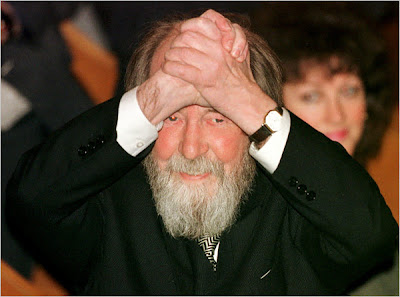

Mr. Solzhenitsyn reacted before a concert given in honor of his 80th birthday in Moscow in 1998. He had been an unknown high school science teacher in a provincial Russian town when he burst onto the literary stage in 1962 with "A Day in the Life of Ivan Denisovich." The book, a mold-breaking novel about a prison camp inmate, was a sensation.
Photo: Viktor Korotayev/Reuters


Born With the Soviet Union

Aleksandr Isayevich Solzhenitsyn was born in the Caucasus spa town of Kislovodsk on Dec. 11, 1918, a year after the Soviet Union arose from revolution. His father, Isaaki, had been a Russian artillery officer on the German front and married to Taissa Shcherback by the brigade priest. Shortly after he was demobilized and six months before his son’s birth, he was killed in a hunting accident. The young widow took the child to Rostov-on-Don, where she reared him while working as a typist and stenographer. By Mr. Solzhenitsyn’s account, he and his mother lived in a dilapidated hut. Still, her class origins — she was the daughter of a Ukrainian land owner — were considered suspect, as was her knowledge of English and French. Mr. Solzhenitsyn remembered her burying his father’s three war medals because they could indicate reactionary beliefs.

He was religious. When he was a child, older boys once ripped a cross from his neck. Nonetheless, at 12, though the Communists repudiated religion, he joined the Young Pioneers and later became a member of Komsomol, the Communist youth organization.

He was a good student with an aptitude for mathematics, though from adolescence he imagined becoming a writer. In 1941, a few days before Germany attacked Russia to expand World War II into Soviet territory, he graduated from Rostov University with a degree in physics and math. A year earlier, he had married Natalia Reshetovskaya, a chemist. When hostilities began, he joined the army and was assigned to look after horses and wagons before being transferred to artillery school. He spent three years in combat as a commander of a reconnaissance battery.

In February 1945, as the war in Europe drew to a close, he was arrested on the East Prussian front by agents of Smersh, the Soviet spy agency. The evidence against him was found in a letter to a school friend in which he referred to Stalin — disrespectfully, the authorities said — as “the man with the mustache.” Though he was a loyal Communist, he was sentenced to eight years in a labor camp. It was his entry into the vast network of punitive institutions that he would later name the Gulag Archipelago, after the Russian acronym for the Main Administration of Camps.

His penal journey began with stays in two prisons in Moscow. Then he was transferred to a camp nearby, where he moved timbers, and then to another, called New Jerusalem, where he dug clay. From there he was taken to a camp called Kaluga Gate, where he suffered a moral and spiritual breakdown after equivocating in his response to a warden’s demand that he report on fellow inmates. Though he never provided information, he referred to his nine months there as the low point in his life.

After brief stays in several other institutions, Mr. Solzhenitsyn was moved to Special Prison No. 16 on the outskirts of Moscow on July 9, 1947. This was a so-called sharashka, an institution for inmates who were highly trained scientists and whose forced labor involved advanced scientific research. He was put there because of his gift for mathematics, which he credited with saving his life. “Probably I would not have survived eight years of the camps if as a mathematician I had not been assigned for three years to a sharashka.” His experiences at No. 16 provided the basis for his novel “The First Circle,” which was not published outside the Soviet Union until 1968. While incarcerated at the research institute, he formed close friendships with Mr. Kopelev and another inmate, Dmitry Panin, and later modeled the leading characters of “The First Circle” on them.

Granted relative freedom within the institute, the three would meet each night to carry on intellectual discussions and debate. During the day, Mr. Solzhenitsyn was assigned to work on an electronic voice-recognition project with applications toward coding messages. In his spare time, he began to write for himself: poems, sketches and outlines of books.

He also tended toward outspokenness, and it soon undid him. After scorning the scientific work of the colonel who headed the institute, Mr. Solzhenitsyn was banished to a desolate penal camp in Kazakhstan called Ekibastuz. It would become the inspiration for “A Day in the Life of Ivan Denisovich.”

At Ekibastaz, any writing would be seized as contraband. So he devised a method that enabled him to retain even long sections of prose. After seeing Lithuanian Catholic prisoners fashion rosaries out of beads made from chewed bread, he asked them to make a similar chain for him, but with more beads. In his hands, each bead came to represent a passage that he would repeat to himself until he could say it without hesitation. Only then would he move on to the next bead. He later wrote that by the end of his prison term, he had committed to memory 12,000 lines in this way.

‘Perpetual Exile’

On Feb. 9, 1953, his term in the camps officially ended. On March 6, he was sent farther east, arriving in Kok-Terek, a desert settlement, in time to hear the announcement of Stalin’s death broadcast over loudspeakers in the village square. It was here that Mr. Solzhenitsyn was ordered to spend his term of “perpetual exile.”

He taught in a local school and secretly wrote poems, plays and sketches with no hope of having them published. He also began corresponding with his former wife, who during his incarceration had divorced him. He was bothered by stomach pains, and when he was able to visit a regional clinic, doctors found a large cancerous tumor.

His life as a restricted pariah struggling with the disease would lead to his novel “The Cancer Ward,” which also first appeared outside the Soviet Union, in 1969. He finally managed to get to a cancer clinic in the city of Tashkent and later described his desperation there in a short story, “The Right Hand.”

“I was like the sick people all around me, and yet I was different,” he wrote. “I had fewer rights than they had and was forced to be more silent. People came to visit them, and their one concern, their one aim in life, was to get well again. But if I recovered, it would be almost pointless: I was 35 years of age, and yet in that spring I had no one I could call my own in the whole world. I did not even own a passport, and if I were to recover, I should have to leave this green, abundant land and go back to my desert, where I had been exiled ‘in perpetuity. ’ There I was under open surveillance, reported on every fortnight, and for a long time the local police had not even allowed me, a dying man, to go away for treatment.”


Aleksandr Isayevich Solzhenitsyn, the Nobel Prize-winning author who chronicled the horrors of the Soviet gulag system, died on Sunday. He was 89. Left, in 2007, Mr. Solzhenitsyn received the visit of Russian President Vladimir Putin at his home outside Moscow.
Photo: Ria Novosti/Reuters


After acquiring medical treatment and resorting to folk remedies, Mr. Solzhenitsyn did recover. In April 1956, a letter arrived informing him that his period of internal exile had been lifted and that he was free to move. In December, he spent the holidays with his former wife, and in February 1957, the two remarried. He then joined her in Ryazan, where Natalia Reshetovskaya headed the chemistry department of an agricultural college. Meanwhile, a rehabilitation tribunal invalidated his original sentence and found that he had remained “a Soviet patriot.” He resumed teaching and writing, both new material as well as old, reworking some of the lines he had once stored away as he fingered his beads.

Twenty-two months elapsed between the publication of “Ivan Denisovich” and the fall of Mr. Khrushchev. Early in that period, the journal Novy Mir was able to follow up its initial success with Mr. Solzhenitsyn by publishing three more short novels by him in 1963. These would be the last of his works to be legally distributed in his homeland until the Soviet Union began to collapse in 1989.

When Leonid I. Brezhnev replaced Mr. Khrushchev as party leader in October 1964, it was apparent that Mr. Solzhenitsyn was being silenced. In May 1967, in an open letter to the Congress of the Soviet Writers Union, he urged that delegates “demand and ensure the abolition of all censorship, open or hidden.”

He told them that manuscripts of “The First Circle” and “The Cancer Ward” had been confiscated, that for three years he and his work had been libeled through an orchestrated media campaign, and that he had been prevented from even giving public readings. “Thus,” he wrote, “my work has been finally smothered, gagged, and slandered.”

He added, “No one can bar the road to truth, and to advance its cause I am prepared to accept even death.”

The letter touched of a battle within the writers union and in broader intellectual and political circles, pitting Mr. Solzhenitsyn’s defenders against those allied with the party’s hard-line leadership. Two years later, on Nov. 4, 1969, the tiny Ryazan branch of the U.S.S.R. Writers Union voted five to one to expel Mr. Solzhenitsyn. The decision ignited further furor at home. In the West, it intensified a wave of anti-Soviet sentiment that had been generated in 1968 when Soviet troops invaded Czechoslovakia to suppress the liberal reforms of the Prague spring.

The conflict grew 11 months later with the announcement that Mr. Solzhenitsyn had won the Nobel Prize for literature. The Soviet press responded with accusations that the award had been engineered by “reactionary circles for anti-Soviet purposes.” One newspaper belittled the author as “ a run of the mill writer”; another said it was “a sacrilege” to mention his name with the “creators of Russian and Soviet classics.”

But there were also Russians willing to defend Mr. Solzhenitsyn. The eminent cellist and conductor Mstislav Rostropovich wrote to the editors of Pravda, Izvestia, and other leading newspapers praising the writer. Mr. Rostropovich, who had taken some risk in inviting Mr. Solzhenitsyn to live at his dacha near Moscow for several years, suffered official disfavor after his letter was published abroad.

Even greater risks were taken by the inmates of the Potma Labor camp. They smuggled out congratulations to Mr. Solzhenitsyn, expressing admiration for his “courageous creative work, upholding the sense of human dignity and exposing the trampling of the human soul and the destruction of human values.”

Private Turmoil

At the time, Mr. Solzhenitsyn’s private life was in turmoil. As news of the prize was announced, his marriage was dissolving. Two years earlier he had met Natalia Svetlova, a mathematician who was involved in typing and circulating samizdat literature, and they became drawn to each other. As Mr. Solzhenitsyn explained, “She simply joined me in my struggle and we went side by side.” He asked his wife, Natalia Reshetovskaya, for a divorce. But she refused, and continued to do so for several years. At one point, shortly after he had won the prize, she attempted suicide, and he had to rush her to a hospital, where she was revived.

In the meantime, Natalia Svetlova gave birth to Yermolai and Ignat, Mr. Solzhenitsyn’s two oldest sons. Finally, in March 1973, Natalia Reshetovskaya consented to a divorce. Soon afterward, Mr. Solzhenitsyn and Natalia Svetlova were married in an Orthodox church near Moscow.

His skirmishes with the state only intensified. While the authorities kept him from publishing, he kept writing and speaking out, eliciting threats by mail and phone. He slept with a pitchfork beside his bed. Finally, government agents who had tried to isolate and intimidate him arrested him, took him to the airport and deported him. Mr. Solzhenitsyn believed his stay in the United States would be temporary. “In a strange way, I not only hope, I am inwardly convinced that I shall go back,” he told the BBC. “I live with that conviction. I mean my physical return, not just my books. And that contradicts all rationality.”


Mr. Solzhenitsyn played tennis at Norwich University in Northfield, Vt., in 1975. Mr. Solzhenitsyn spent most of his exile in the hamlet of Cavendish, Vt. There, he kept mostly to himself, protected from sightseers by neighbors.
Photo: Associated Press


With that goal, he lived like a recluse in rural Vermont, paying little attention to his surroundings as he kept writing about Russia, in Russian, with Russian readers in mind.

“He wrote, ate, and slept and that was about all,” Mr. Remnick wrote in 1994 after visiting the Solzhenitsyn family in Cavendish. “For him to accept a telephone call was an event; he rarely left his 50 acres.” In contrast to the rest of his family, he never became an American citizen.

His children — a third son, Stepan, had been born six months before Mr. Solzhenitsyn was deported — went to local schools, but they began their day with prayers in Russian for Russia’s liberation, and their mother gave them Russian lessons. She also designed the pages and set the type for the 20 volumes of her husband’s work that were being produced in Russian by the YMCA Press in Paris. And she administered a fund to help political prisoners and their families. Mr. Solzhenitsyn had donated to the fund all royalties from “The Gulag Archipelago,” by far his best-selling book.

As for the author, he would head each morning for the writing house, a wing the Solzhenitsyns had added to the property. There he devoted himself to a gigantic work of historical fiction that eventually ran to more than 5,000 pages in four volumes. The work, called “The Red Wheel,” focused on the revolutionary chaos that had spawned Bolshevism and set the stage for modern Russian history. It has been compared, at least in it’s sweep and intentions, with Tolstoy’s “War and Peace.”

Mr. Solzhenitsyn started work on the first volume, “August 1914,” in 1969, though he said he had begun thinking about the project before World War II, when he was a student in Rostov. “August 1914” was spirited out of the Soviet Union and published in Paris before Mr. Solzhenitsyn’s expulsion.

He believed that his account, which challenged Soviet dogma about the founding period, was as iconoclastic as his earlier writings about the gulag.

In the United States, “August 1914” reached No. 2 on best-seller lists, but the subsequent volumes, “November 1916,” “March 1917,” and “April 1917,” all completed in Cavendish, have not been widely bought or read.

Mr. Solzhenitsyn was displeased by the Russian reaction to “The Red Wheel,” which he spoke of as the centerpiece of his creative life. He expressed the hope that it would gain importance with time.

Aloof in America

In Mr. Solzhenitsyn’s 18 years in Vermont, he never warmed to Americans beyond his Cavendish neighbors. On the eve of his return to Russia in 1994, he acknowledged he had been aloof. “Instead of secluding myself here and writing ‘The Red Wheel,’ I suppose I could have spent time making myself likable to the West,” he told Mr. Remnick. “The only problem is that I would have had to drop my way of life and my work.”

But even when he stepped outside Cavendish, as he did when he addressed the Harvard graduates in 1978, his condemnations of American politics, press freedoms and and social mores struck many as insensitive, haughty and snobbish.

There were those who described him as reactionary, as an unreconstructed Slavophile, a Russian nationalist, undemocratic and authoritarian. Olga Carlisle, a writer who had helped spirit the manuscript of “The Gulag Archipelago” out of Moscow but who was no longer speaking to Mr. Solzhenitsyn, wrote in Newsweek that the Harvard speech had been intended for a Russian audience, not an American one.

“His own convictions are deeply rooted in the Russian spirit, which is untempered by the civilizing influences of a democratic tradition,” Ms. Carlisle said. And Czeslaw Milosz, generally admiring of his fellow Nobel laureate, wrote, “Like the Russian masses, he, we may assume, has strong authoritarian tendencies.”

Mr. Solzhenitsyn returned to Russia on May 27, 1994, first landing in the Siberian northeast, in Magadan, the former heart of the Gulag. On arrival, he bent down to touch the soil in memory of the victims.


At a news conference in Vladivostok in 1994. Upon his return to Russia, Mr. Solzhenitsyn began to voice his pessimism, deploring the crime, corruption, collapsing services, faltering democracy and what he felt to be the spiritual decline of Russia. During his 20 years exile, he never doubted he would be able to return to his homeland.
Photo: Michael Estafiev/Agence France-Presse -- Getty Images


He flew on to Vladivostok, where he and his family began a two-month journey by private railroad car across Russia, to see what his post-Communist country now looked like. The BBC was on hand to film the entire passage and pay for it.

On the first of 17 stops, his judgment was already clear. His homeland, he said, was “tortured, stunned, altered beyond recognition.” As he traveled on, encountering hearty crowds, signing books and meeting dignitaries as well as ordinary people, his gloom deepened. And after settling into a new home on the edge of Moscow, he began to voice his pessimism, deploring the crime, corruption, collapsing services, faltering democracy and what he felt to be the spiritual decline of Russia.

In Vermont, he had never warmed to Mikhail S. Gorbachev and his reform policies of perestroika He thought they were the last-ditch tactics of a leader defending a system that Mr. Solzhenitsyn had long known to be doomed. For a while he was impressed by Boris N. Yeltsin, Russia’s first freely elected leader, but then turned against him. Mr. Yeltsin, he said, had failed to defend the interests of ethnic Russians, who had become vulnerable foreign minorities in the newly independent countries that had so suddenly been sheared off from the Soviet Union. Later, he criticized the advent of Vladimir V. Putin as antidemocratic.

Russians initially greeted Mr. Solzhenitsyn with high hopes. On the eve of his return, a poll in St. Petersburg showed him to be the favorite choice for president. But he soon made it clear that he had no wish to take on a political role in influencing Russian society, and his reception soon turned tepid.

Few Russians were reading “The Red Wheel.” The books were said to be too long for young readers.

Michael Specter, then The New York Times correspondent in Moscow, observed, “Leading intellectuals here consider his oratory hollow, his time past and his mission unclear.”

Nationalists, who had once hoped for his blessing, were alienated by his rejection. Democratic reformers, who wanted his backing, were offended by his aloofness and criticism of them. Old Communists reviled him as they always had.

In October 1994, Mr. Solzhenitsyn addressed Russia’s Parliament. His complaints and condemnations had not abated. “This is not a democracy, but an oligarchy,” he declared. “Rule by the few.” He spoke for an hour, and when he finished, there was only a smattering of applause.

Mr. Solzhenitsyn started appearing on television twice a week as the host of a 15-minute show called “A Meeting With Solzhenitsyn.” Most times he veered into condemnatory monologues that left his less outspoken guests with little to do but look on. Alessandra Stanley, writing about the program for The Times, said Mr. Solzhenitsyn came across “as a combination of Charlie Rose and Moses.” After receiving poor ratings, the program was canceled a year after it was started.

As the century turned, Mr. Solzhenitsyn continued to write. In a 2001 book, he confronted the relationship of Russians and Jews, a subject that some critics had long contended he had ignored or belittled in his fiction. A few accused him of anti-Semitism. Irving Howe, the literary critic, did not go that far but maintained that in “August 1914,” Mr. Solzhenitsyn was dismissive of Jewish concerns and gave insufficient weight to pogroms and other persecution of the Jews. Others noted that none of the prisoners in “Ivan Denisovich” were definitively identified as a Jew, and the one whose Jewish identity was subtly hinted at was the one who had the most privileges and was protected from the greatest rigors.

Mr. Remnick defended Mr. Solzhenitsyn, saying he “in fact, is not anti-Semitic; his books are not anti-Semitic, and he is not, in his personal relations, anti-Jewish; Natalia’s mother is Jewish, and not a few of his friends are, too.”

In the final years of his life,, Mr. Solzhenitsyn had spoken approvingly of a “restoration” of Russia under Vladimir V. Putin, and was criticized in some quarters as increasingly nationalist.

In an interview last year with Der Spiegel, Mr. Solzhenitsyn said that Russians’ view of the West as a “knight of democracy” had been shattered by the NATO bombing of Serbia, an event he called “a grave disillusion, a crushing of ideals.” He dismissed Western democracy-building efforts, telling the Times of London in 2005 that democracy “is not worth a brass farthing if it is installed by bayonet.”

In 2007, he accepted a State Prize from then-President Putin — after refusing, on principle, similar prizes from Gorbachev and from Yeltsin. Mr. Putin, he said in the Der Spiegel interview, “inherited a ransacked and bewildered country, with a poor and demoralized people. And he started to do what was possible — a slow and gradual restoration.”

Anne Barnard contributed reporting from Moscow, and Ellen Barry from New York.