Tuesday, January 28, 2014

St. Peter, Lost and Found

       
By Brad Miner
http://www.thecatholicthing.org/
27 January 2014


        It occurred to me as I began reading Thomas J. Craughwell’s new book, St. Peter’s Bones: How the Relics of the First Pope Were Lost and Found . . . and Then Lost and Found Again, that true knowledge is ever harder to acquire in the Media Age. There is so much information coming at us that it is very difficult to block out the static and cut through to what may reasonably be called the truth.

Accordingly, I find myself having to reject the study of many subjects that interest me, simply because I know I haven’t time to do them justice. What a pleasure then to have Mr. Craughwell’s succinct survey of the historical, archaeological, and spiritual stories of the post-mortem journey of Catholicism’s first leader.

The book is well timed too, in that Pope Francis decided at the end of the Year of Faith to place the relics of St. Peter on display for all of us. To venerate, we remind our non-Catholic brethren: to be more directly connected to the history of the Church: to its suffering and its triumph.

Peter, especially, it has long seemed to me, is worthy of veneration, because he was so obviously human in ways familiar to all of us, and yet, despite his many failures, he found sanctity through faith in the Master. His legacy is hope – for all of us.

We jump forward in time to the papacy of Pius XII and his decision to renovate the Vatican Grottoes, the catacombs beneath St. Peter’s Basilica. A wrinkle in the story was the pope’s declaration that while archaeological work could proceed in many areas beneath the great church, the area directly under the main altar – where the body of St. Peter was believed to rest – was to remain off-limits.

As excavations began, the archaeologists were rewarded with discovery after discovery, much of it utterly unexpected yet not surprising, given that St. Peter’s sits atop layer upon layer of ancient Roman history stretching back several millennia.

Mr. Craughwell interrupts this narrative of discovery with gems of historical background, such as a glimpse of the Big Fisherman’s death – in agonizing detail – and of the rise of anti-Christian sentiment after the great fire (64 A.D.) that destroyed so much of Rome during Nero’s imperial reign and was the efficient cause of the persecution that killed so many Christians, Peter among them. The author points out that one of the most visible landmarks in St. Peter’s Square, the pink granite obelisk imported from Egypt in 37 A.D., marks one spot in the former Circus of Gaius and Nero – a sight Peter would have seen in the arena on the last day of his life.

But back in those Vatican catacombs, the archaeologists and thesampietrini (Vatican “maintenance” workers who are rather more expert at what they do than your local church janitor) kept making discoveries, including (in 1943) the burial place of one Christian, near which was this inscription: “Peter, pray to Jesus Christ/For the holy/Christian men/Buried near your body.” (Those words, protected by soil for more than 1600 years, have since faded away.)

The pope agreed to amend his prohibition of excavations under the altar, but with the proviso that the way forward now be undertaken with the greatest secrecy. He did not want any announcement that the discovery of Peter’s final resting place was imminent, just in case nothing was subsequently found.

A part of the history that complicated the ongoing dig was the tendency of successive generations to treat of each previous site as worthy of preservation by the expedient of building over it, so that you end with an archaeological version of a Russian matryoshka doll. Opening a wall, the sampietrini would find another wall, and behind it a third, and then a fourth. Oddly, or so it seemed at the time, the closer they actually got to Peter, the fewer references to him were written on sarcophagi walls.

I’ll not dwell here much more on the process or the results, which anyway are known, but along the way there are some utterly intriguing details, almost throw away lines, as for instance when the archaeologists find lying on the floor of a crypt “a coin from the Duchy of Aquitaine in France, minted sometime before 900.”

The treasures of the Vatican are so great that priceless finds are made even in the dust – a coin likely dropped by someone who was moving relics during another renovation more than a thousand years before.

The great hero of this story is actually a heroine, Prof. Margherita Guarducci (1902-1999). Her work in deciphering epigraphy in and around Peter’s tomb provided key evidence that finally allowed the identification of remains found in the tomb as those of Peter, a tale hinted at in Mr. Craughwell’s subtitle – in the lost and found and lost and found again.

Of course, there were doubters at every step along the way: people who questioned not only the archaeology but the theology, the history, the martyrology. And in a field in which the issue of provenance is so essential, such doubts and questions are inevitable. Mr. Craughwell’s book ends with an apposite quote from George Weigel: “Archaeology isn’t algebra; it yields probabilities rather than certainties.”

In the end, all the probabilities lead us to conclude that St. Peter’s bones are exactly where you’d expect them to be.
 
Brad Miner is senior editor of The Catholic Thing, senior fellow of the Faith & Reason Institute, and a board member of Aid to the Church In Need USA. He is the author of six books and is a former Literary Editor of National Review. His book, The Compleat Gentleman, read by Christopher Lane, is available on audio.
 
© 2014 The Catholic Thing. All rights reserved. For reprint rights, write to:  info@frinstitute.org
 
The Catholic Thing is a forum for intelligent Catholic commentary. Opinions expressed by writers are solely their own.

Clinton “Regrets” Benghazi


Posted By Arnold Ahlert On January 28, 2014 @ 12:34 am In Daily Mailer,FrontPage | No Comments
http://www.frontpagemag.com/

Former U.S. Secretary of State Hillary Clinton speaks at the 10th National Automobile Dealers Association Convention on January 27, 2014 in New Orleans, Louisiana. Clinton said during a Q&A session, she had regrets about attack on Americans in Benghazi.
Former U.S. Secretary of State Hillary Clinton speaks at the 10th National Automobile Dealers Association Convention on January 27, 2014 in New Orleans, Louisiana. Clinton said during a Q&A session, she had regrets about attack on Americans in Benghazi. (Photo by Sean Gardner/Getty Images)

At a keynote appearance before the National Automobile Dealers Association on Monday, Hillary Clinton began laying the groundwork for how she will respond to the Benghazi scandal during her likely 2016 presidential run. “My biggest, you know, regret is what happened in Benghazi,” she answered in response to a question asking her to identify “do-overs” during her stint as Secretary of State. She then proceeded to double down. “I mean, you know, you make these choices based on imperfect information,” she contended. “And you make them to, as we say, the best of your ability. But that doesn’t mean that there’s not going to be unforeseen consequences, unpredictable twists and turns.”

One is left to wonder what “imperfect information” Clinton was vaguely referring to in her response. The alleged “imperfect information” that led Clinton and company to lie for weeks about the nature of the attack? The “fog of war,” as Clinton previously described it? Of course, “imperfect information” had nothing to do with the Obama administration’s deceitful portrayal of the terrorist attack to the public. Declassified documents made public two weeks ago reveal that AFRICOM commander Gen. Carter Ham told members of the House Armed Services subcommittee that he learned about the “terrorist attack” on the consulate compound only 15 minutes after it commenced. ”My first call was to [Joint Chiefs of Staff General chairman] General Dempsey, General Dempsey’s office, to say, ‘Hey, I am headed down the hall. I need to see him right away,’” Ham testified on June 26, 2013. “I told him what I knew. We immediately walked upstairs to meet with Secretary [of Defense] Panetta.” Ham further testified that Dempsey and Panetta “had the basic information as they headed across for the meeting at the White House.”

The meeting to which Ham referred was a pre-scheduled session with President Obama at 5 p.m. EST. A Defense Department timeline reveals that this meeting occurred one hour and 18 minutes after the attack began. The meeting lasted half an hour. That means that Obama knew it was a terrorist attack on September 11, 2012, before the battle that lasted approximately eight hours was less than two hours old.

According to White House Press Secretary Jay Carney, Obama phoned Clinton at 10 p.m. that same night, more than six hours after that attack began, but more than an hour before Navy SEALS Tyrone S. Woods and Glen A. Doherty were killed. “Like every president before him, he has a national security adviser and deputy national security adviser,” Carney told CNSNews.com on Tuesday. Feb. 19, 2013. “He was in regular communication with his national security team directly, through them, and spoke with the Secretary of State at approximately 10 p.m. He called her to get an update on the situation.”

Carney’s statement contradicts a letter released to Congress by the White House five days earlier. It claimed Obama made no phone calls at all the night of the attack. Carney was forced to “amend” the record because Clinton had testified before the Senate Foreign Relations Committee a month earlier that she learned of the attack on Benghazi at 4 p.m. In the ensuing hours, Clinton testified, “we were in continuous meetings and conversations, both within the department, with our team in Tripoli, with the interagency and internationally.” One of those conversations was with the president. “I spoke with President Obama later in the evening to, you know, bring him up to date, to hear his perspective,” she revealed.

Thus, unless one is willing to believe that no one, including Obama, told Clinton it was a terrorist attack, the words “imperfect information” are nothing more than an attempt to again revive the “fog of war” canard that the former Secretary of State relied on to initially explain away the administration’s false account of the attack and changing story.

As for “unforeseen consequences” and “unpredictable twists,” a scathing report released Jan. 15 by the Senate Intelligence Committee concludes that the attack in Benghazi was preventable. Clinton’s State Department was singled out for its failure to bolster security in response to an increasing threat level. The report states that the intelligence community “produced hundreds of analytic reports” in the months preceding the attack that “militias and terrorists … had the capability and intent to strike U.S. and Western facilities and personnel in Libya.” There were “at least 20 security incidents involving the Temporary Mission Facility,” including one in which an “IED exploded near the main gate of the Mission facility in Benghazi, creating a 9×12 hole in the exterior wall.” 
Responsibility for this attack was claimed by followers of the “Blind Sheikh,” united under the banner of the “Imprisoned Sheikh Omar Abdul-Rahman Brigade.” 

Ambassador Stevens himself was seriously concerned with the rapidly deteriorating security situation and made requests for support, which were not heeded. Stevens sent numerous cables regarding the vulnerability of the mission. In late June, Stevens wrote, “that the attacks were the work of extremists who are opposed to western influence in Libya. A number of local contacts agreed, noting that Islamic extremism appears to be on the rise in eastern Libya and that the Al-Qaeda flag has been spotted several times flying over government buildings and training facilities in Derna.”

However, according to Gregory Hicks, deputy chief of mission at the U.S. Embassy in Tripoli, who was privy to intimate details of the security decision process, Stevens’ ”requests for additional security were denied or ignored. Officials at the State and Defense Departments in Washington made the decisions that resulted in reduced security.”

“When I arrived in Tripoli on July 31, we had over 30 security personnel, from the State Department and the U.S. military, assigned to protect the diplomatic mission to Libya. All were under the ambassador’s authority. On Sept. 11, we had only nine diplomatic security agents under Chris’s authority to protect our diplomatic personnel in Tripoli and Benghazi,” Hicks wrote.

By all accounts, what happened in Benghazi was the result of extreme negligence on the part of Clinton and her cohorts. It was not “unforeseen” or “unpredictable” — precisely the opposite. Sen. Ted Cruz (R-TX) was willing to take Clinton to task for her latest remarks, contending she needs to back up her “regrets” regarding an attack for which no one has been fired, and none of the attackers has been captured. “If she was really sorry–talk is cheap, she needs to stand up and demand action,” he told Fox News. Cruz’s idea of action is a call for her to join him and other lawmakers in convening a select committee to fully investigate what happened.

With all due respect to Cruz, Clinton knows what happened. She’s known it for a long time. And it is more than likely the only regret she truly harbors at this point in time is the reality that, despite her best efforts, along with those of her fellow Democrats, and a mainstream media fully invested in her 2016 election, Benghazi is not going to be the irrelevant issue they are trying to make it. When four Americans have been killed in a preventable tragedy, “shaping the narrative” isn’t going to cut it.

Freedom Center pamphlets now available on Kindle: Click here.

Article printed from FrontPage Magazine: http://www.frontpagemag.com
URL to article: http://www.frontpagemag.com/2014/arnold-ahlert/hillary-spins-benghazi/

Music Review: 'This Is Lone Justice: The Vaught Tapes, 1983'

Twelve songs recorded straight to two-track, the adrenalized country music on "This Is Lone Justice: The Vaught Tapes, 1983" captures a fiery band at the beginning of its impressive run. The L.A. country rock band, birthed by vocalist Maria McKee and guitarist Ryan Hedgecock, is best known for its run of near-misses (despite being managed by a young Jimmy Iovine) in the mid-'80s, but before signing with Geffen Records it buzzed through town on the wings of McKee's soprano.

Recorded in the San Fernando Valley, "This Is Lone Justice" introduces McKee & Co. with a combination of covers and originals. Among the classics they tackle are Merle Haggard's "Working Man's Blues," the George Jones/Roger Miller song "Nothing Can Stop My Loving You" and the oft-recorded "Jackson." The song selection suggests a band that had internalized a heck of a lot of country ideas at a young age.


McKee, after all, was only 18 when this stuff was recorded, and her youth is most obvious in the cut-and-paste Dust Bowl-themed lyrics that dot the originals here. Still, the virtuosity within "The Grapes of Wrath," "Dustbowl Depression Time" and "Soap, Soup and Salvation" presents a confident mix of yowling twang and a heavy backbeat (courtesy of drummer Don Heffington and bassist Marvin Etzioni) that eclipses lesser lines.

Overshadowing all, though, is McKee, whose voice sounds like that of a young Dolly Parton fueled by Exene Cervenka's passion. "Working Man's Blues" especially reveals her natural-born way around a line. It's one thing to hit the notes, another thing altogether to manifest them so completely.
---------------------
Lone Justice
"This Is Lone Justice: The Vaught Tapes, 1983"
(Omnivore Recordings)
31/2 stars


http://www.latimes.com/entertainment/music/posts/la-et-ms-this-is-lone-justice-album-review-20140113,0,2008035.story#ixzz2rhG8aQ00


Monday, January 27, 2014

Book Review: 'Wounded' by Emily Mayhew

Casualties of War

http://www.weeklystandard.com/

How Scott Walker and the conservatives saved Wisconsin. America, take note

http://blogs.telegraph.co.uk/news/timstanley
27 January 2014
There was a time when Wisconsin was headline news. You must remember the story? Wisconsinites elected some caveman called Scott Walker as their governor on a platform of drowning government in the bath. He wanted to reform the unions and bring spending under control – and the public sector came out onto the streets to stop him. It was a kind of velvet revolution led by teachers and social workers and the folks who shoot bears when they start eating out of trash cans. They tried to remove Walker from office, but that didn't work because he somehow won the recall vote, making him the only governor in US history to do so. And then it all went oddly quiet from the Badger state…
Which is a pity because it turns out that Scott Walker's conservative agenda has actually worked. Really, really worked. The American Spectator reports:
In 2011, Wisconsin had a whopping deficit of $3.6 billion dollars. But a corporate tax cut and collective bargaining reforms invigorated the state economy. Now, the state is boasting a $911 million surplus, credited to “good stewardship of the taxpayers’ money.”
How did he do it? With a mix of conservatism and pragmatism. Walker's first moves were resolutely Republican. The controversial 2011 "budget repair bill" proposed major cuts with the goal of saving $300 million in two years, including welfare reform and changes to public sector employees' contracts. More recently, however, his fiscal policy has been cautious – a mix of targeted tax cuts and small rises in spending in the areas of workforce training and education. The fact is that Wisconsin's recovery is real but fragile, and Walker has balanced the books without trying to impose on his state the kind of pure libertarian economics that his opponents feared. It's an example of sensible conservative governance – not, as so much of the liberal media seemed to imagine, a Tea Party coup d'etat. No wonder he beat the recall effort.
Not only has he delivered the goods but (this is the best bit) Walker now wants to give those goods back to the voters in the form of a tax break. So the message to America, and the rest of the world, is this: get spending under control, cut business taxes, create a welfare system that encourages people to seek work and you will balance the budget, reduce unemployment and be able to let people keep more of their money. It turns out that conservative economics, applied with determination and care, can work.
Can Walker translate all of this into a run for the presidency? We know he probably wants to because he insists that the next commander-in-chief should be a governor and because he's written a book about how great he is – the necessary first step for someone to run. But he doesn't feature highly (if at all) in early primary polling and his national profile has dimmed since 2011-12. Nevertheless, it would be nice to think that practical people who do their job well can still be viable candidates for the presidency. So, many Republicans will be keeping their fingers crossed…

Dr Tim Stanley is a historian of the United States. His biography of Pat Buchanan is out now. His personal website is www.timothystanley.co.ukand you can follow him on Twitter @timothy_stanley.

Friday, January 24, 2014

Hollywood’s Muslim Lies

Posted By Daniel Greenfield On January 24, 2014 @ 12:49 am In Daily Mailer,FrontPage | 9 Comments
http://www.frontpagemag.com/

In real life, terrorists are almost always Muslim. In the movie theater, they are anything but. America’s fictional secret agents, covert operatives and rogue cops who play by their own rules have spent more time battling Serbian terrorists than Muslim terrorists. 

Before September 11, 24′s Jack Bauer was fighting the international menace of Serbian terrorism. Serbian terrorists also showed up in 1999′s Diplomatic Siege when their “Serbian Liberation Front” took over a US embassy and in 1997′s The Peacemaker with George Clooney rushing to stop a Serb from detonating a nuke in New York City.

The United States has remained unscathed by Serbian terrorism, though the same can’t be said for Peter Weller, the star of Diplomatic Siege, and Mimi Leder, the director of The Peacemaker, but not by Muslim terrorist attacks. Despite September 11, the Fort Hood Massacre and the Boston Marathon bombings, Hollywood has resolutely kept its eye on the real threat.
Serbian terrorism.

This weekend, Ride Along, which features Ice “F___ the Police” Cube playing a cop, knocked Lone Survivor out of the top spot at the box office, and once again takes on the terrible threat of… Serbian terrorism.

When the Serbs aren’t available, the Russians have to step in. The Russians are more likely to appear as villains after the fall of the Soviet Union than during the Communist era. It’s as if the end of Soviet Communism finally set Hollywood free to join in the fun of Boris and Natasha villains without any of the guilt about red-baiting.

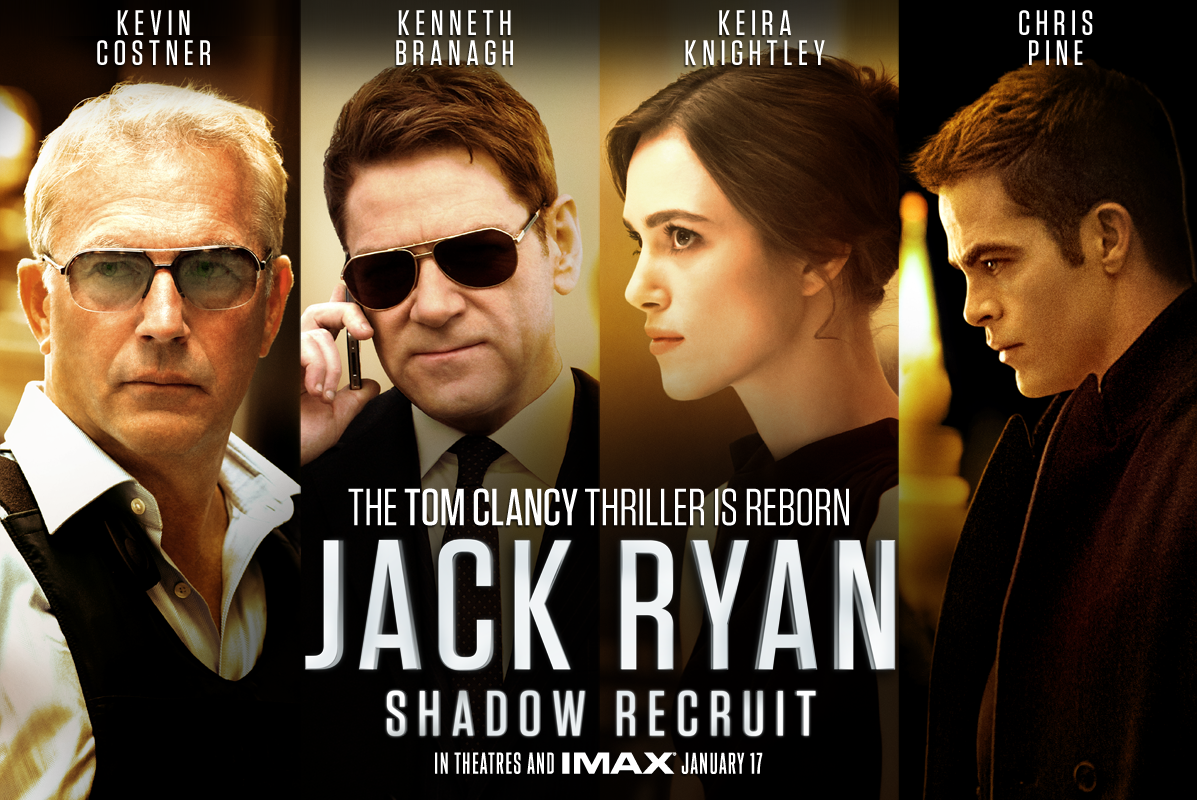
When Jack Ryan: Shadow Recruit featured a terrorist cell in Dearborn, even though Muslims  dominate the area, the villains were shown operating out of a Russian Orthodox church and getting their cues from a priest reading the bible while the terrorists cried out, “Slava Bogu” or “Praise God.”

It would have been unrealistic to show them praising Allah instead.

Jack Ryan: Shadow Recruit is the latest attempt at making a Tom Clancy movie without the Tom Clancy part. Sum of All Fears, one of the first movies about terrorism to come out after September 11, jettisoned Clancy’s Muslim villains.

Its writer Dan Pyne dismissed Islamic terrorism as a “cliche”; even though a plot can’t be a cliche when it never appears in movies, only in real life. Pyne however found a more realistic villain. “I think, there was some neo-nationalist activity in Holland, and there was stuff going on in Spain and in Italy. So it seemed like a logical and lasting idea that would be universal.”

Nothing is more universal than the threat of neo-nationalists in Holland. Dutch neo-nationalism is an enduring world menace that everyone can relate to.

The neo-nationalists of the Netherlands that Pyne had discovered were probably Pim Fortuyn’s party. Fortuyn was a Sociology professor who favored drug legalization, gay marriage and less Muslim immigration. The neo-nationalist threat of the Netherlands did not prove lasting when around the time that Sum of All Fears was playing in theaters; Fortuyn was murdered by a leftist who, like Pyne, worried about the plight of the Muslims.

In an even bigger cliche, Theo van Gogh, who had just finished directing May 6th, a movie about the assassination of Pim Fortuyn, was murdered by Mohammed Bouyeri, a Muslim immigrant from Morocco who told the victim’s mother that he could have no empathy for her because she was a non-Muslim.

It was the sort of ridiculous cliche that Dan Pyne would never have put into a script.

Instead Dan Pyne went on to write a remake of the Manchurian Candidate in which Communist China was replaced by the “Manchurian Corporation”. He’s currently working on a movie featuring a Syrian rescue worker who gets mistaken for a terrorist while trying to save lives during Hurricane Katrina.

It’s a cliche, but it’s the kind of cliche that Hollywood likes.

If a movie is made about September 11 a decade from, now, the villains will probably be Serbian nationalists. It would be a cliche to have 19 Muslim hijackers murder 3,000 people. And then the camera will linger meaningfully on a Muslim rescuer wrongly taken into custody by a bigoted NYPD cop who is overlooking the real Serbian/Dutch neo-nationalist corporate villains.

The Serbians, Russians and Netherlands neo-nationalists are only the understudies who get called in when the usual villains, right-wing extremists who want to false flag America into a war with the Muslims, are on vacation.

After 24 got done with the Serbian terror threat, it defaulted to the real threat of government warmongers trying to fake a Muslim terror threat. After 9/11, 24′s second season’s story was about an evil government conspiracy to fake a Muslim terrorist attack. Anything else would have been a cliche. And to avoid cliches, the series used variations of the same plot in three seasons.

When the Serbs went on strike last year, White House Down brought in a villainous Speaker of the House with a Jewish last name to assassinate a black president in order to sabotage his treaty with Iran. The movie lost so much money that Sony blamed its quarterly $197 million loss on it.

Serbian terrorism had struck again.

When a straightforward presentation flops, Hollywood finds ways of embedding the same old message into more fantastic fare. Last summer, Iron Man 3, Star Trek Into Darkness and the Lone Ranger all had minor variations of the same story about false flag attacks that were orchestrated by governments or powerful interests connected to them. This Trutherism explosion was just another case of Hollywood carefully avoiding cliches.

Nowhere in all these tales of evil corporations and governments is there a movie about an entertainment industry so intertwined with government that it not only helped pick the country’s current leader, but it constantly releases propaganda films attempting to revise reality according to his worldview. That would be a cliché; much like the idea of that industry filming false flag movies depicting the favorite villains of the Clinton Administration carrying out ridiculously implausible acts of terror to retroactively justify its focus on the Serbs instead of Al Qaeda.

Hollywood stands as firmly against depicting Muslim terrorism as Hollywood Communists after the Hitler-Stalin pact did against anti-Nazi films. If they had been positioned further up the ladder back then, instead of mainly being relegated to writing scripts, we would no doubt have a catalog of movies featuring Yankee warmongers plotting to stage fake Nazi attacks on America.

Hollywood’s ideological hostility to reality however has not proven to be very profitable.

The Peacemaker, a movie written and co-produced by the Cockburns, whose politics are slightly to the left of Stalin, was the inaugural feature from the failed Spielberg-Geffen-Katzenberg Dreamworks studio and disappointed critics and audiences. The Cockburns would never try their hand at film fiction again unless you count American Casino, their “documentary” about the financial collapse, which had a financial collapse of its own with an opening weekend of $1,397.

Sum of All Fears, the movie inspired by the Netherlands neo-nationalist threat, was the weakest performer of the Tom Clancy movies when accounting for ticket price inflation and full budget. And it still had a much better opening weekend than Jack Ryan: Shadow Recruit.

Failure however won’t stop Hollywood from alerting the nation to the terrorist threat lurking in Orthodox Churches or the Dutch neo-nationalists trying to nuke our cities. Hollywood’s handpicked leaders were the ones who made the country vulnerable to Islamic terrorism and their industry has gone on covering up for them with movies in which the villains can be anyone and everyone except the real killers.

Benghazi and the Smearing of Chris Stevens

January 22, 2014

Last week the Senate Select Committee on Intelligence issued its report on the Sept. 11, 2012, terrorist attacks in Benghazi, Libya. The report concluded that the attack, which resulted in the murder of four Americans, was "preventable." Some have been suggesting that the blame for this tragedy lies at least partly with Ambassador Chris Stevens, who was killed in the attack. This is untrue: The blame lies entirely with Washington.
The report states that retired Gen. Carter Ham, then-commander of the U.S. Africa Command (Africom) headquartered in Stuttgart, Germany, twice offered to "sustain" the special forces security team in Tripoli and that Chris twice "declined." Since Chris cannot speak, I want to explain the reasons and timing for his responses to Gen. Ham. As the deputy chief of mission, I was kept informed by Chris or was present throughout the process.
On Aug. 1, 2012, the day after I arrived in Tripoli, Chris invited me to a video conference with Africom to discuss changing the mission of the U.S. Special Forces from protecting the U.S. Embassy and its personnel to training Libyan forces. This change in mission would result in the transfer of authority over the unit in Tripoli from Chris to Gen. Ham. In other words, the special forces would report to the Defense Department, not State.
Chris wanted the decision postponed but could not say so directly. Chris had requested on July 9 by cable that Washington provide a minimum of 13 American security professionals for Libya over and above the diplomatic security complement of eight assigned to Tripoli and Benghazi. On July 11, the Defense Department, apparently in response to Chris's request, offered to extend the special forces mission to protect the U.S. Embassy.
However, on July 13, State Department Undersecretary Patrick Kennedy refused the Defense Department offer and thus Chris's July 9 request. His rationale was that Libyan guards would be hired to take over this responsibility. Because of Mr. Kennedy's refusal, Chris had to use diplomatic language at the video conference, such as expressing "reservations" about the transfer of authority.
At a memorial service for U.S. Ambassador Chris Stevens in San Francisco, Oct. 16, 2012. Reuters
Chris's concern was significant. Transferring authority would immediately strip the special forces team of its diplomatic immunity. Moreover, the U.S. had no status of forces agreement with Libya. He explained to Rear Adm. Charles J. Leidig that if a member of the special forces team used weapons to protect U.S. facilities, personnel or themselves, he would be subject to Libyan law. The law would be administered by judges appointed to the bench by Moammar Gadhafi or, worse, tribal judges.
Chris described an incident in Pakistan in 2011 when an American security contractor killed Pakistani citizens in self-defense, precipitating a crisis in U.S.-Pakistani relations. He also pointed out that four International Criminal Court staff, who had traveled to Libya in June 2012 to interview Gadhafi's oldest son, Saif al-Islam al-Qadhafi, were illegally detained by tribal authorities under suspicion of spying. This was another risk U.S. military personnel might face.
During that video conference, Chris stressed that the only way to mitigate the risk was to ensure that U.S. military personnel serving in Libya would have diplomatic immunity, which should be done prior to any change of authority.
Chris understood the importance of the special forces team to the security of our embassy personnel. He believed that by explaining his concerns, the Defense Department would postpone the decision so he could have time to work with the Libyan government and get diplomatic immunity for the special forces.
According to the National Defense Authorization Act, the Defense Department needed Chris's concurrence to change the special forces mission. But soon after the Aug. 1 meeting, and as a complete surprise to us at the embassy, Defense Secretary Leon Panetta signed the order without Chris's concurrence.
The SenateIntelligence Committee's report accurately notes that on Aug. 6, after the transfer of authority, two special forces team members in a diplomatic vehicle were forced off the road in Tripoli and attacked. Only because of their courage, skills and training did they escape unharmed. But the incident highlighted the risks associated with having military personnel in Libya unprotected by diplomatic immunity or a status of forces agreement. As a result of this incident, Chris was forced to agree with Gen. Ham's withdrawal of most of the special forces team from Tripoli until the Libyan government formally approved their new training mission and granted them diplomatic immunity.
Because Mr. Kennedy had refused to extend the special forces security mission, State Department protocol required Chris to decline Gen. Ham's two offers to do so, which were made after Aug. 6. I have found the reporting of these so-called offers strange, since my recollection of events is that after the Aug. 6 incident, Gen. Ham wanted to withdraw the entire special forces team from Tripoli until they had Libyan government approval of their new mission and the diplomatic immunity necessary to perform their mission safely. However, Chris convinced Gen. Ham to leave six members of the team in Tripoli.
When I arrived in Tripoli on July 31, we had over 30 security personnel, from the State Department and the U.S. military, assigned to protect the diplomatic mission to Libya. All were under the ambassador's authority. On Sept. 11, we had only nine diplomatic security agents under Chris's authority to protect our diplomatic personnel in Tripoli and Benghazi.
I was interviewed by the Select Committee and its staff, who were professional and thorough. I explained this sequence of events. For some reason, my explanation did not make it into the Senate report.
To sum up: Chris Stevens was not responsible for the reduction in security personnel. His requests for additional security were denied or ignored. Officials at the State and Defense Departments in Washington made the decisions that resulted in reduced security. Sen. Lindsey Graham stated on the Senate floor last week that Chris "was in Benghazi because that is where he was supposed to be doing what America wanted him to do: Try to hold Libya together." He added, "Quit blaming the dead guy."
Mr. Hicks served as Deputy Chief of Mission at the U.S. Embassy in Tripoli from July 31 to Dec. 7, 2012.

Stop jerking Canada around

http://www.washingtonpost.com/opinions
Political Cartoons by Lisa Benson
Fixated as we Americans are on Canada’s three most attention-getting exports — polar vortexes, Alberta clippers and the antics of Toronto’s addled mayor — we’ve somewhat overlooked a major feature of Canada’s current relations with the United States: extreme annoyance.
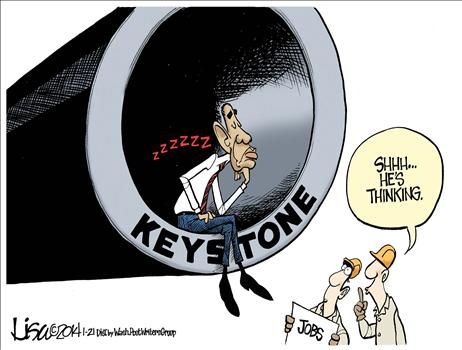
Last week, speaking to the U.S. Chamber of Commerce, Canada’s foreign minister calmly but pointedly complained that the United States owes Canada a response on the Keystone XL pipeline. “We can’t continue in this state of limbo,” he sort of complained, in what for a placid, imperturbable Canadian passes for an explosion of volcanic rage.
Canadians may be preternaturally measured and polite, but they simply can’t believe how they’ve been treated by President Obama — left hanging humiliatingly on an issue whose merits were settled years ago.
Canada, the Saudi Arabia of oil sands, is committed to developing this priceless resource. Its natural export partner is the United States. But crossing the border requires State Department approval, which means the president decides yes or no.
After three years of review, the State Department found no significant environmental risk to Keystone. Nonetheless, the original route was changedto assuage concerns regarding the Ogallala Aquifer. Obama withheld approval through the 2012 election. To this day he has issued no decision.
The Canadians are beside themselves. After five years of manufactured delay, they need a decision one way or the other because if denied a pipeline south, they could build a pipeline west to the Pacific. China would buy their oil in a New York minute.
Yet Secretary of State John Kerry fumblingly says he is awaiting yet another environmental report. He offered no decision date.
If Obama wants to cave to his environmental left, fine. But why keep Canada in limbo? It’s a show of supreme and undeserved disrespect for yet another ally. It seems not enough to have given the back of the hand to Britain, Israel, Poland and the Czech Republic, and to have so enraged the Saudis that they actually rejected a U.N. Security Council seat — disgusted as they were with this administration’s remarkable combination of fecklessness and highhandedness. Must we crown this run of diplomatic malpractice with gratuitous injury to Canada, our most reliable, most congenial friend in the world?
And for what? This is not a close call. The Keystone case is almost absurdly open and shut.
Even if you swallow everything the environmentalists tell you about oil sands, the idea that blocking Keystone would prevent their development by Canada is ridiculous. Canada sees its oil sands as a natural bounty and key strategic asset. Canada will not leave it in the ground.
Where’s the environmental gain in blocking Keystone? The oil will be produced and the oil will be burned. If it goes to China, the Pacific pipeline will carry the same environmental risks as a U.S. pipeline.
And Alberta oil can still go to the United States, if not by pipeline then by rail, which requires no State Department approval. That would result in far more greenhouse gas emissions — exactly the opposite of what the environmentalists are seeking.
Moreover, rail can be exceedingly dangerous. Last year a tanker train derailed and explodeden route through Quebec. The fireball destroyed half of downtown Lac-Megantic, killing 47, many incinerated beyond recognition.
This isn’t theoretical environmentalism. This is not a decrease in the snail darter population. This is 47 dead human beings. More recently, we’ve had two rail-oil accidents within the United States, one near Philadelphia and one in North Dakota.
Add to this the slam-dunk strategic case for Keystone: Canadian oil reduces our dependence on the volatile Middle East, shifting petroleum power from OPEC and the killing zones of the Middle East to North America. What more reliable source of oil could we possibly have than Canada?
Keystone has left Canada very upset, though characteristically relatively quiet. Canadians may have succeeded in sublimating every ounce of normal human hostility and unpleasantness by way of hockey fights, but that doesn’t mean we should take advantage of their good manners.
The only rationale for denying the pipeline is political — to appease Obama’s more extreme environmentalists. For a president who claims not to be ideological, the irony is striking: Here is an easily available piece of infrastructure — privately built, costing government not a penny, creating thousands of jobs and, yes, shovel-ready — and yet the president, who’s been incessantly pushing new “infrastructure” as a fundamental economic necessity, can’t say yes.
Well then, Mr. President, say something. You owe Canada at least that. Up or down. Five years is long enough.

Thursday, January 23, 2014

The Heroism of Wendy Davis

By Ann Coulter
http://www.anncoulter.com/
January 22, 2014


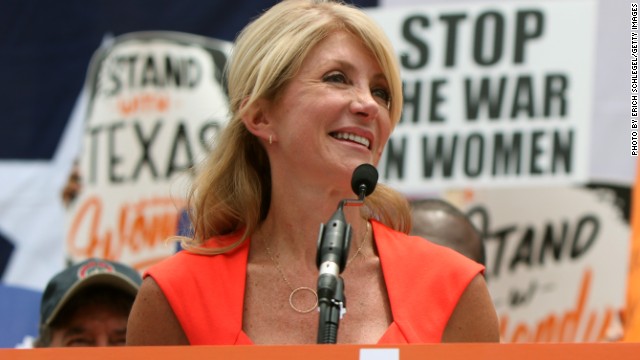
Wendy Davis, the Texas state senator running for governor, became a liberal superhero last June when she filibustered a bill to prohibit abortions after 20 weeks. (This was the good filibuster, not that awful filibuster three months later by Ted Cruz -- that was just grandstanding.)

Apart from her enthusiasm for abortion (and you have to admit, abortion is really cool), the centerpiece of Davis' campaign is her life story. Also the fact that she's a progressive woman who doesn't look like Betty Friedan.

In a typical formulation, Time magazine said Davis was someone who could give the Democrats "'real people' credibility," based on "her own personal story -- an absent father, a sixth-grade-educated mother, a teen pregnancy, followed by life as a single mom in a mobile home, then community college and, at last, Harvard Law School."

The headlines capture the essence of Wendy-mania:

CNN: Wendy Davis: From Teen Mom to Harvard Law to Famous Filibuster

Bloomberg: Texas Filibuster Star Rose From Teen Mom to Harvard Law

The Independent (UK): Wendy Davis: Single Mother From Trailer Park Who Has Become Heroine of Pro-Choice Movement

Cosmopolitan: Find a Sugar Daddy to Put You Through Law School!

Actually, that last one I made up, but as we now know, it's more accurate than Davis' rags-to-riches life story.

The truth was gently revealed in the Dallas Morning News this week. Far from an attack, this was a puff-piece written by Wayne Slater, rabid partisan Democratic hack and co-author of the book, "Bush's Brain." (He is not an admirer of Bush's brain.) It would be like Sean Hannity breaking a scandal about Ted Cruz.

The first hint that Slater was trying to help Davis get ahead of the story and tilt it her way is his comment that Davis' life story is "more complicated" than her version -- i.e., completely the opposite -- adding, "as often happens when public figures aim to define themselves."

Actually, the truth is much simpler than her story. Also, be sure to look for that "as often happens" excuse the next time a Republican gets caught lying about his resume.

Slater's peculiar obsession with whether Davis was 19 or 21 when she got her first divorce, and exactly how long she lived in a trailer home, is meant to deflect attention from something much more problematic: the huge whoppers Davis told.

Her big lies were about the obstacles she had to overcome and how she overcame them, not about how old she was at the time of her first divorce.

She claims she was raised by a single mother, went to work at age 14 to support her family, became a single mother herself in her teens, and then -- by sheer pluck and determination -- pulled herself out of the trailer park to graduate from Harvard Law School!

The truth is less coal-miner's daughter than gold-digger who found a sugar daddy to raise her kids and pay for her education.

Point No. 1: Davis' family wasn't working-class. Her father owned a sandwich shop and a dinner theater, which puts Davis solidly into middle-class land.

Point No. 2: No one who works at MSNBC would know this, but everyone whose parents run a family business starts work at age 14, if not sooner.

Point No. 3: Her parents were separated, but that is not the commonly accepted meaning of "single mother."

Point No. 4: As for being a single mother at age 19 -- she wasn't a "single mother" in the traditional sense, either. She was married at age 18, had a child at 19 and divorced her first husband, a construction worker, at 21. (He couldn't afford tuition at Harvard.)

So she got married young? That isn't a hard-luck story. Well into the 1950s, nearly half of all first-born children were born to married women under the age of 20.

But Wendy Davis' harrowing nightmare of poverty and sacrifice wasn't over yet.

Just a few years after her first divorce, Wendy was on the make, asking to date Jeff Davis, a rich lawyer 13 years her senior, who frequented her father's dinner club. In short order, they married and had a child together.

The next thing Jeff Davis knew, he was paying off her college tuition, raising their kids by himself and taking out a loan to send her to Harvard Law School.

(Feminists rushed to the stores to buy the shoes Davis wore during her famous filibuster. I'd like the shoes she was wearing when she met her sugar daddy.)

Then Wendy left her kids with the sugar daddy in Texas -- even the daughter from her first marriage -- while she attended Harvard Law.

Slater says Davis' kids lived with Jeff Davis in Texas while she attended law school. Wendy Davis claims her girls lived with her during her first year of law school. Let's say that's true. Why not the other two years? And what was the matter with the University of Texas Law School?

Sorry, MSNBC, I know you want to fixate on how many months Davis spent in the trailer park and her precise age when the first divorce went through. And that would be an incredibly stupid thing for conservatives to obsess on, if they were, in fact, obsessing on it. But I'm still stuck on her leaving her kids behind while she headed off to a law school 1,500 miles away.

The reason Wendy Davis' apocryphal story was impressive is that single mothers have to run a household, take care of kids and provide for a family all by themselves. But Wendy was neither supporting her kids, nor raising them. If someone else is taking care of your kids and paying your tuition, that's not amazing.

Hey -- maybe Jeff Davis should run for governor! He's the one who raised two kids, including a stepdaughter, while holding down a job and paying for his wife's law school. There's a hard-luck story!

Mr. Davis told the Dallas Morning News that Wendy dumped him as soon as he had finished paying off her Harvard Law School loan. "It was ironic," he said. "I made the last payment, and it was the next day she left."

In his defense, a lot of people are confused about the meaning of "ironic." That's not "ironic." Rather, it's what we call: "entirely predictable."

It's ironic -- my car stopped running right after I ran out of gas.

It's ironic -- my house was broken into, and the next thing I knew all my valuables were missing.

It's ironic -- I was punched in the face right before my nose broke.


In his petition for divorce, Mr. Davis accused his wife of adultery. The court made no finding on infidelity, but awarded him full custody of their underage child and ordered Wendy to pay child support.

Wendy boasted to the Dallas Morning News: "I very willingly, as part of my divorce settlement, paid child support." Would a divorced dad get a medal for saying that?

In response to Wayne Slater's faux-"expose," naturally Davis put out a statement denouncing ... her probable Republican opponent, Greg Abbott. Again, Slater wrote the story. But Davis blathered on, blaming Abbott for the Dallas Morning News story and complaining that he hasn't "walked a day in my shoes."

About that she's certainly right. Greg Abbott could never walk a day in her shoes or anyone else's. He's a paraplegic confined to a wheelchair.

I guess Wendy could teach him a lot about suffering.

Davis also said these attacks "won't work, because my story is the story of millions of Texas women ..." Yes, for example, Anna Nicole Smith. Though at least Smith had the decency not to ask for a paid education.

COPYRIGHT 2013 ANN COULTER