Showing posts with label Johnny Cash. Show all posts
Showing posts with label Johnny Cash. Show all posts
Friday, June 28, 2019


Tuesday, February 26, 2019
Friday, December 09, 2016
Johnny Cash, the Poet in Black
By Ben Sisario
http://www.nytimes.com/
November 11, 2016
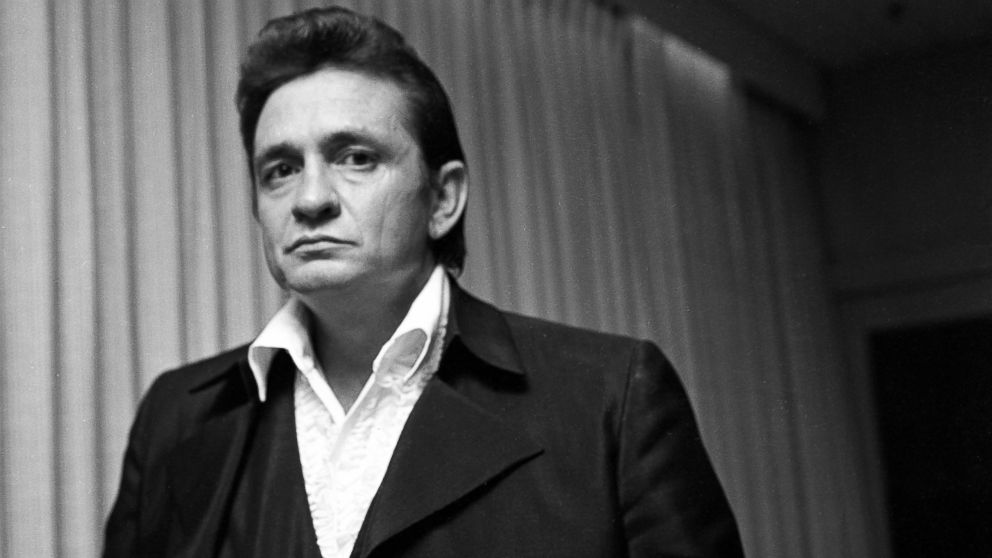
Shortly before he died, Johnny Cash scrawled down eight short lines in a shaky hand, mortality clearly on his mind.
“You tell me that I must perish/Like the flowers that I cherish,” he wrote. He considered the hell of “nothing remaining of my name,” before concluding with an affirmation of his own legacy:
But the trees that I planted
Still are young
The songs I sang
Will still be sung
That poem, “Forever,” is part of a new collection, “Forever Words: The Unknown Poems” (Blue Rider Press), to be published next week. Edited by Paul Muldoon, a Pulitzer Prize-winning poet and Princeton professor, the book includes 41 works from throughout Cash’s life — the earliest piece, “The Things We’re Frightened At,” was done when he was 12 — that were among the papers left behind when Cash died in September 2003.
In some ways the poems mirror Cash’s songwriting, with terse ballads of outsiders in love, and parables drawn from the Bible; Cash’s version of Job is a wealthy cattleman who “cried out in agony/When he lost his children and his property.” And for Cash, who in his last years drew a new audience with a set of stark and fragile recordings, the poems present yet another look at a legend of American music.
“I want people to have a deeper understanding of my father than just the iconic, cool man in black,” said John Carter Cash, his son. “I think this book will help provide that.”
Some poems in “Forever Words” are unmistakably personal. “You Never Knew My Mind,” from 1967, captures Cash’s bitterness as he was going through his divorce from Vivian Liberto. (He married June Carter the next year.) “Don’t Make a Movie About Me” rejects the Hollywood machine but then slyly gives advice on a film treatment. “Going, Going, Gone,” from 1990, is a painfully detailed catalog of the ravages of drug abuse: “Liquid, tablet, capsule, powder/Fumes and smoke and vapor/The payoff is the same in the end.”
At other times, Cash seems to tinker with his own body of work. “Don’t Take Your Gun to Town,” dated to the 1980s, rewrites his classic 1958 song “Don’t Take Your Guns to Town,” in which a headstrong young cowboy dies when he ignores his mother’s advice. In the new version, a jaded man plans a “Taxi Driver”-like rampage against “people/Who need silencing,” but this time he listens.
“I believe he wanted to make a statement,” the younger Mr. Cash said. “He owned guns. But he definitely believed that you do not need to carry a gun in your pocket to town.”
Even so, Cash kept that version private, although, along with a handful of the poems in this collection, the manuscript for “Don’t Take Your Gun” was sold at auction.
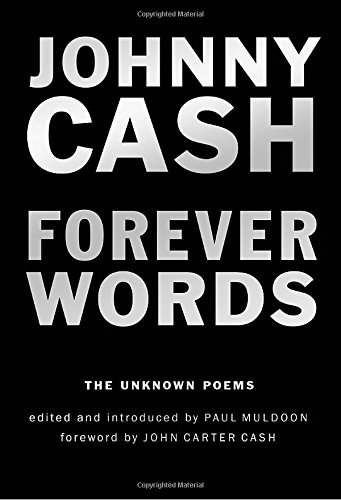
In his introduction, Mr. Muldoon places Cash in a poetic tradition that comes out of Scotch ballads, and also raises a point that was hotly debated after Bob Dylan won the Nobel Prize in Literature last month: Are song lyrics really the same as poetry? Do lyrics lose something when removed from their musical context?
Like Cash’s lyrics, the poems in “Forever Words” are written in plain language, usually with a clear rhyming meter. There are strikingly evocative images (“The dogs are in the woods/And the huntin’s lookin’ good”), as well as some well-worn phrases about soaring eagles and hell’s fury that might pass unnoticed in a song but jump out on the page.
In an interview, Mr. Muldoon put Cash alongside Leonard Cohen, who died on Monday, and Paul Simon as examples of songwriters whose words hold up on their own. Even so, he added, the “pressure per square inch” on lyrics “can be a wee bit lower than in a conventional poem.”
“But that’s not necessarily a bad thing,” he continued. There are occasions when the simple, direct phrase is the one that works.”
Taken together, Mr. Muldoon said, Cash’s poems have a broad sweep.
“You still see the same scenes — love, death, loss, joy, sadness,” Mr. Muldoon said. “The great themes of popular songs, and, indeed, poetry, which we welcome hearing about and making sense of as we go through our lives.”
The poems in “Forever Words” were chosen from about 200 pieces left by Cash in varying states of completion. Some may have been intended as lyrics, his son said, but it was not always clear. His father’s papers, Mr. Cash said, included biblical studies and even a dog-eared copy of Gibbon’s “Decline and Fall of the Roman Empire.”
“They weren’t hoarders,” Mr. Cash said of his parents, “but they really didn’t like to throw things away.”
The Cash estate has released a number of posthumous albums, including “Personal File,” in 2006, a collection of intimate home recordings. A couple of years ago, Mr. Cash said, he was considering new projects with Steve Berkowitz, a producer and record executive who has worked extensively with the estate, and they began sifting through the poems.
Looking to recruit Mr. Muldoon as editor, Mr. Berkowitz said he met him for an “all-Irish breakfast” at an Upper East Side diner and read him excerpts from the poems without revealing the author.
“‘This is pretty strong stuff,’” Mr. Berkowitz recalled Mr. Muldoon’s saying. “‘Who is it?’ I told him, ‘This is Johnny Cash.’” (In an email, Mr. Muldoon said he did not remember the meeting, “which is not to say it didn’t happen.”)
The Cash estate is already at work on an album of songs based on the poems, with musicians including Kris Kristofferson, Jewel, Chris Cornell and Jamey Johnson, in a project similar to Billy Bragg and Wilco’s work with Woody Guthrie lyrics. The album is planned for release next fall.
Over the last year, the Cash estate has brought on a new management and marketing team, and the album is one of many new projects. Also planned are a Broadway show and a Johnny Cash slot machine, and the trust recently registered trademarks for phrases like “What would Johnny Cash do?” to place on clothing memorabilia.
When asked about these plans, Mr. Cash said that he and the managers of the trust — of which he is a beneficiary — strove to avoid crass commercialization, and also wanted to follow his father’s wishes.
“We try to live by the moral guide that he laid down,” Mr. Cash said, which, among other things, means no alcohol or tobacco ads. “But he also did Taco Bell commercials.”
The goal of “Forever Words,” Mr. Cash said, was to establish his father as a major poet and a “cultural American literary figure.”
There is also a personal benefit.
“When I read these things, it puts me back in touch with the man,” he said. “It lets me communicate with my father again.”
http://www.nytimes.com/2016/11/12/books/johnny-cash-the-poet-in-black.html
Thursday, September 01, 2016
Wednesday, July 30, 2014
Monday, April 28, 2014
Wednesday, April 02, 2014
Tuesday, March 25, 2014
Music Review: 'Out Among the Stars' by Johnny Cash
Johnny Cash’s 'Out Among the Stars', the crooner’s latest dispatch from beyond the grave, reminds us of an era of country long gone
By Jason Rehel
March 24, 2014

In 2002, Johnny Cash released American IV, with its haunting covers of Martin Gore’s Personal Jesus, Hank Williams’ I’m So Lonesome I Could Cry and especially Trent Reznor’s Hurt, which came packaged with a video that acted over the following months as a self-eulogy for Cash, who would die the following year, shortly after his wife, June Carter.
That video and song, and the acclaim it received, also ensured that the “philosopher-prince of American country music” would see his torch passed to a younger fan base, too. Suddenly (and the process went on till at least the release of the acclaimed Walk the Line biopic in 2005) it weighed heavy on the American pop cultural consciousness across the board just how much this flawed Baptist crooner — he of deep crevices in his face, and even deeper ones in his voice, having lived a contradictory life that oscillated between the sacred and profane — represented a certain universal mirror of the American experience. Life after Cash (he’d left behind an incredible amount of material in his final years and even just months) meant reckoning always with his washed out self and the ultimate image of loneliness he’d seared on us at the end of his life. Those pre-death punches to the existential gut were followed by two (American V and VI) posthumous ones that largely failed to add anything to Cash’s legacy, and may have, in the most cynical sense, cheapened it.
Which is probably why it is so exciting, liberating and downright joyous to hear the Man in Black being anything but funereal on the posthumous studio album Out Among the Stars, a different sort of album-after-death — this one coming as if from an archeological dig into the much-loved singer’s recording past.
Culled from lost 1980s sessions with legendary country producer Billy Sherrill — famous for his work with both George Jones and Tammy Wynette (he co-wrote Stand By Your Man with her) and credited with creating country’s version of Phil Spector’s “wall of sound” — these 12 tracks are a snapshot of Cash still riding high, in 1981 and 1984, after his induction in the Country Music Hall of Fame as its youngest living member, but before he’d join Waylon Jennings (who appears here singing alongside Cash on one of the best tracks, I’m Movin’ On) for heart surgery in 1988. If this was truly the time when Cash felt “invisible” because his record label, Columbia, was ignoring him, then it surely wasn’t because Cash himself wasn’t busy — and some of what Cash’s son with June, John Carter, has uncovered here are true Johnny Cash gems. Others? Not so much.
I Drove Her Out of My Mind for instance, for all its silly, bouncy, Baptist beat, includes that common lyrical strain of nasty teeth-knashing misogyny that often popped up in Cash’s other murder ballads (it’s not as bad as Cocaine Blues, or Delia’s Gone, but in some senses the sentiment is more insidious as he attempts to hide his hate behind self-improvement). And yeah, sure, Cash didn’t write most of these lyrics, but the vocal gravitas he always brought to violence against women, normalizing it as simply a necessary narrative evil of country music, is surely still open to criticism and condemnation here, no less so because he’s dead.
There’s plenty to love, though, among the warts. Tennessee is Cash at his sweetest, Baptist best, writing a letter to his mom about how wonderful life is, bursting into a chorus where he and his “blue-eyed girl” head to the county fair with their “taters they sell by the pound” getting “naturally high” chopping wood. Rock and Roll Shoes is the kind of track that reminds you Cash cut his teeth at Sun Records around the same time as a fella named Presley. And She Used to Love Me A Lot, the album’s single, for all its maudlin, pained regret at a love lost, is classic Cash — being rejected, but taking it like a man, standing up, singing, and letting her go:
“This memory that I’ve had / It’s more good than bad,” Cash croons on the next song, the slinky and earnest After All — and that’s easily what fans and newcomers alike have here: A rough country gem, transported without adornment from a lost set of moments in the 1980s.
Tuesday, December 24, 2013
Friday, December 13, 2013
Concert preview: Show pays tribute to Johnny Cash and Patsy Cline
BY ED CONDRAN
http://www.newsobserver.com
December 12, 2013

http://www.newsobserver.com
December 12, 2013
The Johnny Folsom 4, a Johnny Cash cover band, will play a Johnny Cash-Patsy Cline tribute show at Southland Ballroom in Raleigh. (Willa Stein)
David Burney didn’t intend to front a Johnny Cash cover band. “It’s something that just happened,” Burney says while calling from his Raleigh office.
While delivering an array of covers with his prior band, the Swingin’ Johnsons, Burney, 57, and his mates tossed in some Cash songs.
“The Cash tunes went over very well,” Burney said. “Some people came up to me after the show and said, ‘you sound like Johnny Cash’ and one thing led to another.”
Burney put the Johnny Folsom 4 together five years ago. The band, which will perform Friday at the Southland Ballroom as part of a Johnny Cash-Patsy Cline tribute, enjoys performing the Man in Black’s material.
“It’s so much fun partly because it’s so varied,” Burney said. “We go back to Johnny’s early years. We have a blast with the classic Sun Studio material and go all the way up to his American Records days.”
Toward the end of his career, Cash signed with American and Sony honcho/producer Rick Rubin urged the icon to record covers of contemporary artists, such as Soundgarden, Nine Inch Nails and Tom Petty.
“The American material he recorded is some of my favorite Cash songs to do,” Burney says. “He absolutely owns (Soundgarden’s) ‘Rusty Cage.’ It sounds like his song. I love doing Petty’s ‘I Won’t Back Down’ like Johnny did it.”
The Folsom 4 also render some Gospel tunes as well. “Johnny recorded some great Gospel numbers,” Burney said. “We’ll do some of those and some songs Johnny sang with June Carter Cash. Thankfully Eleanor Jones joins us, and she sings just like June Carter Cash.”
The Folsom 4 draw from a 90-song list of Cash tunes. “That way it’s not the same every time we do a show,” Burney says.
The Raleigh-based band plays about 20 times a year, since each member of the group has a full-time gig. Burney is the CEO of a design company; guitarist David Gresham is a firefighter; bassist Tom Mills spends the day as a programmer; and drummer Randy Benefield is a dentist.
“It’s a great outlet for us,” Burney says. “We get to play to a varied audience. It ranges from college kids to seniors. The thing that’s great about it is you never run into anyone who doesn’t like Johnny Cash. He really hit it with that boom-chicka-boom sound. It’s basic and primal and it connects with everyone.”
Just don’t expect Burney to ever try to look like Cash. “I wear black but I have facial hair and I have some gray hair,” Burney says. “We don’t go for the Cash look. We go for the sound.”
Unfortunately, Burney never experienced Cash live.
“I had the chances to see him but unfortunately never did,” Burney says. “I might not have seen him, but I get the opportunity to sing his songs whenever we play, and that’s not a bad thing at all.”
- DetailsWho: The Johnny Folsom 4 with the Canady Thomas BandWhen: 8 p.m. FridayWhere: Southland Ballroom, 614 N. West Street, RaleighCost: $8
Tuesday, November 12, 2013
Book Review: 'Johnny Cash: The Life' by Robert Hilburn
By Eddie Dean
November 3, 2013
In the pantheon of American cool, it's tough to top Johnny Cash. He's right up there with Marlon Brando, Miles Davis and Jesse James. Cash has had die-hard fans of every stripe, from the Rev. Billy Graham, who for decades featured him on his evangelical crusades, to director Quentin Tarantino, who champions Cash songs like "Folsom Prison Blues" as "poems to the criminal mentality." Ten years after his death at 71, he is still a hero for millions allergic to any other country music, and his legacy as a rebel has inspired countless regrettable tattoos.
For his followers, Cash was more prophet than entertainer, offering a message of redemption as deep and alluring as his signature voice, his timeless music and his tormented life. "People believed in Johnny Cash," said his longtime bass player Marshall Grant. "They didn't just like his music. They believed in him."
Johnny Cash: The Life
By Robert Hilburn
Little, Brown, 679 pages, $32
Little, Brown, 679 pages, $32

Johnny Cash at the Columbia Recording Studio in Los Angeles in 1961, the year the Carter family (including future wife June) joined him on the road. Copyright Leigh Wiener
Cash's notorious struggles with drug addiction and his outlaw ways only made him more believable, and forgivable, to his core audience. No matter how many motel rooms he trashed or how many drunken nights he spent in jail, he was always welcomed into the living rooms of middle America. Who else could get away with singing "When Uncle Bill Quit Dope" on a prime-time TV show (as he did in 1971) or serenading Richard Nixon at the White House with his antiwar protest song "What Is Truth"?
In a musical genre known for its simplicity and sincerity, Cash was a complex, conflicted Renaissance man and a restless searcher who spent much of his life on the run from the small-town heartland he championed in his songs. He was a self-mythologizer and storyteller who never let the facts ruin a good yarn. Despite two memoirs written decades apart, he never set the record straight on many of the legends and myths he helped forge through the years.
"Time and again," writes Robert Hilburn in "Johnny Cash: The Life," "he said he wanted people to know his entire story—especially the dark, guilt-ridden, hopeless moments—because he believed in redemption." But such disclosure "was a goal that John didn't always live up to in his own autobiographies because, he said, he didn't want to hurt those close to him."
A former pop-music critic for the Los Angeles Times, Mr. Hilburn got as close to the Cash inner circle as any journalist could. He was the only reporter present at the historic Folsom Prison show in 1968, and he interviewed Cash over the years up to his final days. The result is the most authoritative and revealing portrait to date of the most chronicled figure in country-music history. Having conducted extensive interviews with family members and intimates, Mr. Hilburn uncovers affairs and relapses and car wrecks, but he focuses mainly on his subject's empathetic art, exploring how "someone from a cotton patch in Arkansas could develop such a deep sense of compassion and purpose in his music."
Mr. Hilburn makes a strong case that Cash was, at heart, a writer. He had a love of words and knack for versifying that intensified after the death of his most important boyhood influence, his brother, Jack, killed at 14 in a woodsaw accident, who had aspirations to be a preacher. But Cash's efforts as a fledgling author were overshadowed by "the gift" recognized by his mother when she heard the tall and lean 15-year-old through an open window singing a gospel song. "You've got a gift, J.R. . . . ," she told him. "God's got his hand on you." It was a pronouncement he took as infallible.
When Cash auditioned for Sam Phillips of Sun Records in Memphis in 1954, his singing caught the ear of the producer who had discovered Elvis. Phillips was drawn by the "understated force" and "authority" of Cash's husky baritone, seasoned beyond his 22 years. It came from the deep well of the American folk tradition, conjuring a bygone frontier of tobacco auctions and tent revivals and levee camps, resounding with echoes of hellfire preachers and medicine-show hawkers.
Just as crucial, though, was that Cash had something to say and said it with conviction. He wrote his own material, and he identified with the characters who peopled his songs, from the joyous shoeshine boy of "Get Rhythm" to the coldblooded, haunted killer of "Folsom Prison Blues" to the proud, patriotic veteran in "Ragged Old Flag." His themes stayed the same for six decades, championing the downtrodden and the outcast and the hopeless.
For his backing band, Cash recruited a pair of young novices, Luther Perkins and Marshall Grant, dubbed the Tennessee Two. Their uncluttered, rudimentary playing on lead guitar and stand-up bass complemented their leader's commanding vocals and rhythm guitar. The trio's primitivist, bare-bones approach propelled Cash originals like "I Walk the Line" from the country charts onto the pop Hit Parade. "Unlike most singers on the radio at the time, he didn't just sing along with the beat," notes Mr. Hilburn. "He treated every line as if it mattered."
By the time Cash signed with Columbia in 1958, he had a national following, a growing family and a drug habit. By his own account, Cash's dependence on amphetamines—and later on, barbiturates and painkillers—was immediate and lasting and had little to do with the rigors of touring, which is what most musicians of the era used benzedrine and other pep pills for. "I honestly believed the bennies were God-sent to help me be a better performer," he wrote in his first memoir; but "inside that bottle of white pills, which only cost eight or ten dollars for 100, came at no extra cost a demon called Deception."
The drugs triggered a dark side of Cash's already mercurial personality. One of the best testimonials (oddly, not referenced by Mr. Hilburn) of Cash's Jekyll-and Hyde temperament came from another polymath and fellow pillhead, Merle Travis, who mentored Cash and also taught him how to throw a Bowie knife. "I'm impressed with him like a snake behind glass," he said. "There ain't no twilight and there ain't no dusk to Johnny Cash. He's like a sunny day, or he's completely dark."
After his debut for the label, "The Fabulous Johnny Cash," proved a hit on the charts, Columbia let its new star pursue his own musical agenda despite his escalating personal problems. He recorded gospel albums, in part to fulfill a vow that he had made when his brother died, to spread Jesus' promise of salvation as a singer. At Sun, Phillips had discouraged Cash's sacred music, saying it didn't sell, and he proved right.
What galvanized Cash was a series of ambitious concept albums he made in the early 1960s. Inspired by Travis's seminal 1947 LP, "Folk Songs of the Hills," he wove together recitations and spoken segues with folk ballads and original compositions, creating brilliant narratives of word and song. In "Ride This Train" (1960), "Blood Sweat and Tears" (1963) and "Bitter Tears" (1964), he celebrated the pioneers' westward migration, working people and their struggles, and the plight of American Indians. In these albums, still regarded as classics, the singer and the poet fused into a consummate storyteller. All sold poorly.
To research the double-LP "Ballads of the True West," Cash went on drugged-out forays alone in the desert, a landscape so merciless that he imagines God giving it to the devil in "Mean as Hell," a poem he recites on the album. "I slept under mesquite bushes and in gullies," he wrote in the liner notes. "I ate mesquite beans and squeezed the water from a barrel cactus. I was saved once by a forest ranger, lying flat on my face, starving." Along with the drugs, these exercises in physical and psychic extremes, Mr. Hilburn shows, gave Cash what he needed for his art, at great cost to his health and home life.
Cash's overidentification with his subject matter spurred much of his mythmaking, as when he falsely claimed Cherokee blood or when he said that he crawled into Nickajack Cave in 1967 near the Tennessee River intent on never leaving alive. Mr. Hilburn questions the circumstances of this "suicide tale," which Cash said ended with a miraculous escape to freedom.
As the book recounts in meaty but not salacious detail, Cash's empathy for the forlorn and oppressed did not extend to his family, including his first wife and four daughters, as well as friends and band members and managers, who bore the brunt of his drug-induced rampages. "When Cash described himself as a 'C+ Christian' at various times in his life, most thought this American icon was just being humble," writes Mr. Hilburn. "To those who'd been close to him at various points, it appeared he was being a bit generous with his evaluation."
Through most of the '60s, many dismissed Johnny Cash as a lost cause and believed his days were numbered. One chapter in Mr. Hilburn's book is titled "The Deathwatch." But not only did Cash keep cheating death, he found ways to keep salvaging a career on the brink, as when he had a dream about mariachi horns that helped make 1963's "Ring of Fire" his biggest hit yet.
Along with the drugs, Cash took shortcuts in search of his muse, as when he lifted hefty chunks of a 1953 record, "Crescent City Blues," without credit, for his own "Folsom Prison Blues," a theft that later forced him to settle a lawsuit. Mr. Hilburn seems to give Cash a free pass, citing the "breakthrough" of the key line that Cash added, which gives the song its signature shock value: "I shot a man in Reno just to watch him die."
When Cash sang those words in his opening number at Folsom Prison in 1968, he won over the hardened convicts and earned himself an 11th-hour reprieve from his label bosses who had all but given up on their strung-out, unbankable star. The book reveals that he was nervous before the 9:40 a.m. show, which he had persuaded Columbia to record for a live album. With his career at stake, he gobbled a hidden stash of pills, despite knowing how the drugs had sabotaged his voice many times before. Producer Bob Johnston told Mr. Hilburn that, when he "later asked him, [Cash] said, 'I took more pills that morning than I ever had in my life.' He was scared."
The dosage apparently gave Cash the edge he needed to connect like a live wire to his audience. As Mr. Hilburn recalls, "the atmosphere was electric as Cash prowled the stage between verses with the pent-up tension of a caged panther." "At Folsom Prison" sold three million copies and catapulted the 35-year-old has-been to new heights of fame.
Cash's second wife, June Carter, often caricatured as a sort of hillbilly Florence Nightingale, gets her due here. If she indeed saved Cash's life and, as Cash always averred, helped to save his soul as well, she took her sweet time about it. Their stormy courtship from 1961 to 1968, conducted mostly on the road while Cash was still married to his first wife, Vivian, featured Cash's worst binges and best post-Sun recordings. It was a chaotic but creative period when he was breaking commandments like hotel furniture. June was the rock that Cash clung to, even as he had an affair with her younger sister, Anita, a singer and member of the Cash troupe. The trysts began shortly after Johnny and June wed in 1968; it remained a guarded family secret until 2003, when an unnamed "insider" told a tabloid that Anita, "on her deathbed in 1999, asked for June's forgiveness for the affair."
After the Folsom album, the couple became country-music royalty. Onstage, June's zany down-home humor lightened her husband's brooding gravitas. Offstage, she played a gracious hostess to an adoring public. Meanwhile, he struggled with relapses, and June herself became hooked on prescription drugs. As Mr. Hilburn shows, they were both more addicted to the road and the roar of the fans than anything else.
His popular TV show secured Cash's status as the Man in Black, and his compulsive mythmaking continued when he debuted a song of that name for a live broadcast audience in 1971. The lyrics are a litany of the social causes he fought for and the underdogs for whom he donned his somber attire. Critics pointed out that he had been wearing black stage clothes since the Sun years, because, as he had said often, dark outfits didn't show dirt stains.
"Johnny Cash: The Life" traces the long descent from the artistic summit of Folsom. In the years between, there were some triumphs, like the gospel album "The Holy Land" (1969). A kind of narrative pilgrimage, it featured tape-recorded impressions that he had made while on location (in Israel) visiting the places that he first heard about as a boy when his mother read to him from the Bible. But there were also embarrassments, such as "Look at Them Beans" (1975), whose cover featured Cash sprawled in a pile of green beans, and the self-parody "Chicken in Black" (1984).
These debacles didn't stop him from starring in a steady supply of made-for-TV movies and ads for gasoline and money machines. He was dropped by Columbia and shunned by country radio. Undaunted, he published a novel about the Apostle Paul, some of which he wrote while in rehab at the Betty Ford Center.
Then, in the early 1990s, came redemption in the form of an unlikely career comeback. Now ailing and in his 60s, Cash summoned his reserves to make a series of stripped-down albums with indie-rock producer Rick Rubin. Mr. Hilburn tends to overrate the uneven quality of this late output, but it did make Cash a darling of the grunge generation and a grizzled symbol of defiance against the music-industry establishment.
As Cash weakened and various illnesses forced him to retire from touring, Mr. Rubin encouraged him to press on in the studio. In this unrelenting documentation of a dying artist, there was a sort of ghoulishness. Some critics cried exploitation. If such was the case, Cash was a willing participant. Smote like Job, he found refuge from the pain in his music, and it gave him purpose. Most important, the nearness of his impending demise inspired him to write again.
In 2002, a year before his death, he worked feverishly for months and composed "The Man Comes Around," a humble elder's unsparing Jeremiad. Along with his devastating mea-culpa cover version of "Hurt" and its vanity-be-damned video, which depicted Cash in his ruined shell of a body, it would help to "cement Cash's legacy," Mr. Hilburn writes near the end of his finely wrought biography. "The Man Comes Around" is a dire warning about Judgment Day, set to an insistent Sun-era guitar riff and framed with a recitation intoned by Cash's ragged voice, as if already emanating from beyond the grave.
Cash considered it his final testament and said as much in one of his last interviews with the author. "I called upon Jesus," he said. "I tried to praise Him with 'The Man Comes Around.' If someone is still listening to my music fifty years from now, I hope they're listening to that song."
—Mr. Dean collaborated with Ricky Skaggs on "Kentucky Traveler: My Life in Music," just published by It Books.
Sunday, October 27, 2013
Book Review: 'Johnny Cash: The Life' by Robert Hilburn
Robert Hilburn balances vice and virtue in 'Johnny Cash: The Life'
The many facets of Johnny Cash are captured in this biography of a complicated man.
By Amanda Petrusich
October 25, 2013
There are few figures in the whole of pop music that as conveniently summarize American Identity — how we grapple with virtue and vice, how we labor to be both devoted and free — as Johnny Cash. Biographer Robert Hilburn is deeply aware of his subject's heavy symbolism: how his shortcomings became assets, how his struggles defined him.
Hilburn worked as a critic and a music editor at the Los Angeles Times from 1966 to 2005, and in 1968, while on a freelance assignment for the paper, he attended Cash's famed Folsom Prison concert. (Remarkably, Hilburn was the only music journalist in the room.) That familiarity — coupled with decades of keen observation and extensive interviews with Cash, his family and his colleagues — allows for a remarkable vantage from which to recount a life. Hilburn's book is a comprehensive and thoughtful biography, cognizant always of how hard it is for heroes to make it in America.
Still, why write a Cash biography now, after two autobiographies, an Oscar-winning feature film and dozens of published accounts by players both primary and unknown?
In his nearly 50-year career, Johnny Cash penned more than 1,000 songs and released dozens of albums, but he was most often heralded for his rebelliousness, a characteristic that somehow eclipsed both his Gospel leanings and often sentimental songwriting. While Hilburn doesn't aspire to recast the Cash mythology — that mythology, after all, is as true and as essential to Cash's story as anything else — he does take considerable care to point out his subject's longstanding penchant for narrative embellishment.
Johnny Cash, in the grand spirit of his Opry predecessors, was quick with a yarn; mostly, the fudging was decorative, but occasionally more mendacious claims were broadcast and recorded, particularly regarding the depth and constancy of his nearly lifelong prescription-drug use.
Hilburn gives equal consideration to both the Cash we were handed (the strutting outlaw, the brooding man in black) and the Cash who chose to name his firstborn daughter after his pet names for his wife's breasts ("Rose" and "Anne"), the Cash who replaced the whipped cream on a slice of truck-stop pie with shaving cream, reducing a young Elvis to giggles, and the Cash who liked to sit around eating hot dogs and reading history books.
"Johnny Cash: The Life" succeeds at both expanding and complicating its subject. Hilburn does an artful, enviable job of reconciling all the facets — the man Cash wanted to be (a pious, steadfast, fearless figure) and who he more often was (a loving prankster with a weakness for women and pills).
The former characterization is so entrenched and so appealing, it's easy to see why Cash and his many chroniclers were seduced by it; Cash, for his part, did everything he could to perpetuate it, even if that meant extended silences or denials (as Marshall Grant, the bassist in the Tennessee Two, Cash's original backing band, told Hilburn, Cash "had a way of just slamming the door on unpleasant topics").
But Hilburn writes with a remarkably steady hand, and Cash's weaknesses are neither ignored nor romanticized. Addressing the composition of "Folsom Prison Blues," which was adapted from a song by Gordon Jenkins, Hilburn writes: "He wanted to write not just about someone who was lonely for his girl, but someone so empty inside that he felt cut off from both his family and his faith." Cash had a complicated relationship with the people and institutions he loved. Even his marriage to June Carter, so often celebrated as a redemptive, passionate affair, is revealed here as tumultuous — marred by infidelity (on his part) and addiction.
Hilburn understands that, however unlikely it sounds, devotion and betrayal can authentically co-exist — and often do.
For Cash, the tension between his hedonistic urges (in his 1975 autobiography, he called himself "awfully carnal") and his religious devotion fueled most of his career. He often looked to songwriting as both confession and penance.
Still, that fundamental contradiction — the old Saturday night/Sunday morning axis — was also his undoing, at least commercially. By the late 1970s, it had become nearly impossible for audiences to accept that the prison-performing iconoclast — the guy with the scowl and the extended middle finger — was also into palling around with Richard Nixon and Billy Graham, riding for God and not the Devil.
By the late 1980s, Cash's career seemed to be slowing down. Then, in 1993, he met producer Rick Rubin (who was still best known for his collaborations with metal and rap artists) and began work on "American Recordings," the collection that would alter his professional arc in then-unforeseeable ways.
Here, Hilburn's book takes on new energy, recounting Cash's sudden resurgence in popularity among young rock fans (Cash joked about wanting to say "Hello, grandchildren" at his late-career shows) and his repositioning as a maverick figure. Hilburn understands how complicated and exhausting those years were for Cash (most of his old fans and the Nashville establishment were appalled by Rubin), and treats his late-career material with as much reverence as he does the creation of early hits like "I Walk the Line."
Ultimately, "Johnny Cash: The Life" is measured and mindful, allowing of all the paradoxical bits that constitute a human life. Hilburn writes in clear-headed, informative prose about the myriad ways his subject struggled against his own wild impulses — both the times in which he was destroyed by them and the times in which they saved him.
Petrusich is the author of "It Still Moves: Lost Songs, Lost Highways, and the Search for the Next American Music" and "Do Not Sell at Any Price," a forthcoming book about collectors of rare 78rpm records.
Johnny Cash
The Life
The Life
Robert Hilburn
Little, Brown and Company: 688 pp., $32
Thursday, September 12, 2013
Remembering Johnny Cash 10 Years After His Death
By Chris Willman
http://www.hollywoodreporter.com
September 12, 2013

I've heard my share of eulogies at celebrity funerals over the years, but I don't think I've ever felt a moment of heartbreak at one quite the way I did when Rosanne Cash wrapped up her tribute to her father at his funeral in Nashville 10 years ago this week. Johnny Cash "was not famous when he was teaching us to fish or to water-ski," his eldest daughter pointed out. "He was not an icon when he told us how proud he was of us. … I can live with the idea of a world without the icon Johnny Cash, because there will never be a world without him. I cannot, however, imagine a world without Daddy."
Those grief-stricken words put to shame the lesser sorrow felt by those of us who only thought of him as a father figure during his nearly 50 years in the limelight. But a decade without the public Johnny Cash has still been something to mourn in its own right. Now, as then, I think of Rosanne's words and transpose them into the old hit that Paul McCartney wrote for Peter and Gordon: "I don't care what they say/I won't stay/In a world without Cash."
He died around 1 a.m. on the morning of Sept. 12, 2003. Later that same day, I got Kris Kristofferson on the phone to talk about his buddy, and he mentioned what was on everyone's mind: that it had only been three months since Cash's wife, June Carter Cash, had passed. "He was a fighter, and he had a strong spirit, but it was the hardest thing that he probably ever faced in his life," Kristofferson told me. "His kids told me that he still cried all the time at night. Which is …" Kristofferson paused. "Hell, I've never seen Johnny Cash cry, you know."
Three days later, I got to see Kristofferson softly weeping, out of the corner of my eye, as both of us stood silently over Cash's open casket at a visitation the night before the funeral. I felt it was a moment too sacred for me to share, so I made my way out of the room, but not without feeling as if I'd stood next to Jesse Jackson at a visitation for Martin Luther King Jr., or been witness to Muhammad Ali mourning Joe Louis.
(If that seems like an odd analogy, I credit Kristofferson for giving me boxers on the brain, since he'd told me a few days before that Cash had "evolved into this beloved figure, all over the world. I know -- I've been all over the world with him -- and they love him, just like they love Muhammad Ali.")
I spoke to others who knew him in the days between Cash's death and his funeral. "The last time I saw him, 10 days before he died, he looked really good to me," said Rodney Crowell, Rosanne's ex-husband. "He really was looking like he was gaining some wind and starting to perk up. But I think diabetes is always a lot more nasty disease than we think, and there was quite a bit of that diabetic stuff that was really ripping him up. If you're in your 70s and really in good health when you lose a longtime partner, you can kind of endure the grief and maybe go on and build a new life, of some sort, even if it'll never be the same. Paul McCartney has done that [after Linda], in his way. And I was kind of hoping for that for Johnny. But that was kind of selfish, and I was just thinking, 'You know what? He's gotten tired,' and I think better to cash it all in, you know? And get a break."
He might have been grave-tired, but he hadn't lost his levity. Kristofferson told me, "He kept his humor right up through the darkest stuff. When I went to see him last, when they were having a visitation at the funeral home for June, I sat down next to him there. People were coming by to shake his hand and everything. One guy came by and when he saw me there, he said, 'Oh, listen, you are a great singer! You're one of my favorite singers.' And then he moved on. And John looked down at me and said, 'Well, that's one.' "

Ironically, at the time of his death, Cash was enjoying more acclaim that he had in years … for revealing his mortality, in the video he made for his cover of Nine Inch Nails' "Hurt," which won him plaudits at both the MTV and CMA awards. Trick Pony's Ira Dean told me that in their last conversation, he'd "called him about his CMA nomination, and I said 'It's about damn time.' He started laughing. I said, 'You're selling some records, aren't you?' He said, 'Finally, again. You know, they just turned over a stone, and there I was.' "
The day of the funeral, I drove to Cash's home on Caudill Drive in Hendersonville, Tenn., where at any given time that week a couple of dozen fans stood outside the gates, stone-faced, as if they expected Cash to emerge at any moment and drive a tractor into Old Hickory Lake. (Walk the Line was still a year away from being filmed, but the faithful hardly needed a biopic to learn the lore surrounding the homestead.)
The funeral was an amalgam of public and private. Unlike George Jones' recent sendoff, which was held at the Opry House, open to the public, and streamed and telecast live, Cash's was actually held at a church, and you won't find any clips on YouTube. (Although technically a closed affair, members of the public were not turned away.) As mourners entered, the pianist played "I Walk the Line" in the style of a chipper Southern gospel hymn. Then came probably the first and last video montage at the First Baptist Church of Hendersonville ever to include a clip of the deceased appearing on Dr. Quinn, Medicine Woman. The vocal hymnody was an all-star affair. Emmylou Harris and Sheryl Crow harmonized together on "The Old Wooden Cross" and Bob Dylan's "Every Grain of Sand" after Kristofferson sang his original composition "A Moment of Forever."
Kristofferson said that "John once accused me of having written 'The Pilgrim Chapter 33' about him," and although he didn't explicitly confirm or deny that the "walking contradiction/partly truth, partly fiction" song was about Cash, he did describe his loved mentor in contradictory terms as "deeply spiritual," "something of a holy terror," and "Abraham Lincoln with a wild side." (The presidential theme clearly resonated with Kristofferson as much as the boxing one, since he'd told me days earlier that touring with Cash as part of the country supergroup the Highwaymen "was like finding yourself on Mount Rushmore every night.")
Family members waxed and waned between irreverent and divine. "I'm pretty sure I represent the longest list of ex-son-in-laws ever [from] one family on this planet," joked Rodney Crowell. He recalled going down to Johnny and June's second home in Jamaica, back when he thought he was a "world-class bad boy," expecting to share a bed with then-fiancee Rosanne Cash. Although "his social politics were liberal and forgiving," Crowell quickly learned that his future father-in-law had his conservative side, as Cash reacted to the presumed sleeping arrangement by saying, "Son, I don't know you well enough to miss you if you're gone."
"I know he's up there with Mama," said Carlene Carter. "She's got cheesecake in one hand and a charge card in the other. And he's an Indian," she said, referring to her stepfather's lifelong fascination with Native Americans. Rosanne, who never quite took to her parents' strong Christian convictions, called her father "a Baptist with the soul of a mystic … who was more alive to the subtleties of this world and worlds beyond than anyone I've known or even heard of." Concerning the afterlife, she ended her eulogy on a hopefully agnostic note: "The best thing I can wish for him now is that all his beliefs are coming true."

It was a typical Tennessee funeral really only in one way, in that it featured a lengthy fire-and-brimstone sermon by a preacher who barely knew the late honoree. Although Al Gore and some family members had invoked Jesus Christ during the funeral, evangelist Franklin Graham really laid into the salvation theme, after a brief introduction in which he talked about being introduced to Cash as a kid by his father, Billy. Not all of the show-business types at the funeral were impressed by Graham giving such an altar call of a eulogy, but inasmuch as Cash was a traditionalist, he might have enjoyed the younger Graham carrying on that time-honored custom of boilerplate evangelism, however impersonal it felt in regard to the decedent.
Tagging along with a family friend, I joined the small procession of cars taking a few dozen people out to the Hendersonville Memory Gardens. Along the way, the road was lined with mourners who presumably had heard the funeral was closed and figured this was as close as they'd get to country music's most beloved figure. I remember in particular one young man standing by the side of the boulevard, guitar at his feet, an arrow sign pointed toward heaven raised above his head. You know what color he was wearing.
At the grave site, a nephew spoke and imagined that Johnny's first impulse upon arriving in heaven would be to run and look for his older brother Jack, who -- as anyone who saw Walk the Line knows -- died after a childhood accident involving a cotton machine. But no, the nephew corrected himself: Cash would run to meet his maker first, then his long-lost brother. The casket was lowered into the ground, topped by agapanthus, spray orchids, and -- in honor of the tragic Johnny/Jack connection -- cotton boughs. Before departing, the two or three dozen assembled sang the national anthem of country funerals: "Will the Circle Be Unbroken."
The sad answer to that hymn's rhetorical question hung in the air: On earth, not as in heaven, the circle of country greatness had been irretrievably snapped, soon to be replaced by studly young hunks who would sing songs called "Johnny Cash" without a moment's thought as to what combination of attitudes a tune with that title ought to signify. Ten years later, as the Dixie Chicks prophetically sang, "They got money, but they don't have Cash." Now, as then, we remain … hurt.
We listen to the radio to hear what's cookin'
But the music ain't got no soul
Now they sound tired but they don't sound Haggard
They got money but they don't have Cash
Twitter: @ChrisWillman
Subscribe to:
Posts (Atom)