Showing posts with label Catholic Sex Abuse Scandal. Show all posts

Saturday, September 14, 2019

Adventures In Christian Grift


By ROD DREHER
https://www.theamericanconservative.com/dreher/adventures-in-christian-grift-falwell-bransfield/
September 12, 2019

Image result for jerry falwell jr
Jerry Falwell Jr. (Alex Wong/Getty Images)

If not, you should. It’s about how Falwell Jr. runs the Christian college as a family fief, a de facto dictatorship, and a vehicle to enrich the family’s coffers, even at the expense of the university’s mission and reputation. The piece once again forces the question: where on earth is the university’s board of trustees? They remind me of a colorful phrase of my late father, who was once a farmer:  “useless as teats on a boar.”
Well, apparently some of them are speaking to Ambrosino. From the piece:
But these new revelations speak to rising discontent with Falwell’s stewardship. The people interviewed for this article include members of Liberty’s board of trustees, senior university officials, and rank-and-file staff members who work closely with Falwell. They are reluctant to speak out—there’s no organized, open dissent to Falwell on campus—but they said they see it as necessary to save Liberty University and the values it once stood for. They said they believe in the Christian tradition and in the conservative politics at the heart of Liberty’s mission.
Most of the long story is about business shenanigans that appear to violate, or come close to violating, the university’s tax-exempt status, and certainly are at odds with the school’s Christian mission. But the juiciest stuff has to do with Jerry Jr.’s life as a player. Ambrosino got his hands on 2014 shots of Jerry Jr., his wife Becki, their son Trey and Trey’s wife partying at a Miami nightclub. Ambrosino writes:
According to several people with direct knowledge of the situation, Falwell—the president of a conservative Christian college that frowns upon co-ed dancing (Liberty students can receive demerits if seen doing it) and prohibits alcohol use (for which students can be expelled)—was angry that photos of him clubbing made it up online. To remedy the situation, multiple Liberty staffers said Falwell went to John Gauger, whom they characterized as his “IT guy,” and asked him to downgrade the photos’ prominence on Google searches. Gauger did not respond to requests for comment.
Jerry Jr. denied to Ambrosino that the photos were real, and claimed that his image had been photoshopped. The photographer who snapped them was so incensed by the claim that he released more of them the next day. 
And there’s this:
In May 2019, Reuters reported that Cohen helped Falwell contain the fallout from some racy “personal” photos.Later that month, Falwell took to Todd Starnes’ radio talk show to rebut the claims.
“This report is not accurate,” Falwell said. “There are no compromising or embarrassing photos of me.”
Members of Falwell’s inner circle took note of the phrasing.
“If you read how Jerry is framing his response, you can see he is being very selective,” one of Falwell’s confidants said. Racy photos do exist, but at least some of the photos are of his wife, Becki, as the Miami Herald confirmed in June.
Longtime Liberty officials close to Falwell told me the university president has shown or texted his male confidants—including at least one employee who worked for him at Liberty—photos of his wife in provocative and sexual poses.
At Liberty, Falwell is “very, very vocal” about his “sex life,” in the words of one Liberty official—a characterization multiple current and former university officials and employees interviewed for this story support. In a car ride about a decade ago with a senior university official who has since left Liberty, “all he wanted to talk about was how he would nail his wife, how she couldn’t handle [his penis size], and stuff of that sort,” this former official recalled. Falwell did not respond to questions about this incident.
More than simply talking with employees about his wife in a sexual manner, on at least one occasion, Falwell shared a photo of his wife wearing what appeared to be a French maid costume, according to a longtime Liberty employee with firsthand knowledge of the image and the fallout that followed.
Ewgh. If you think Politico is just making this stuff up, let me assure you that charges like this don’t make it into print unless they’ve been lawyered to death. That doesn’t mean that they’re true, but it does mean that Ambrosino and his editors almost certainly had to prove to the publication’s lawyers that these allegations could withstand a court challenge. If you’ve ever had to deal as a writer with your newspaper or magazine’s lawyers — I have — you know that they are a very conservative (not necessarily in the political sense) bunch who try to rein their clients in to reduce their potential legal exposure. Again, the fact that Politico published these allegations do not make them true, but it does show that the magazine is so confident in their factual accuracy that they are prepared to face down a very wealthy plaintiff in a libel suit, if it comes to that. That’s not nothing.
Read the whole thing. The final paragraphs are harsh. You should know, if you don’t already, that unlike his father, Jerry Jr. is not a preacher. But he is the head of an Evangelical Christian university. So, here:
One source pointed to a tweet Jerry Falwell Jr. sent out in June 2019 criticizing David Platt, an evangelical Virginia pastor who apologized for welcoming Trump to his church. “I only want to lead us with God’s Word in a way that transcends political party and position, heals the hurts of racial division and injustice, and honors every man and woman made in the image of God,” Platt said. “Sorry to be crude,” wrote Falwell in a since-deleted tweet, “but pastors like [David Platt] need to grow a pair.”
After Falwell came under criticism for his tweet about Platt, he responded to critics with a two-part Twitter thread, which, in the words of one current high-ranking Liberty official, “a lot of people found troubling.”
“I have never been a minister,” Falwell tweeted. “UVA-trained lawyer and commercial real estate developer for 20 yrs. Univ president for last 12 years-student body tripled to 100000+/endowment from 0 to $2 billion and $1.6B new construction in those 12 years. The faculty, students and campus pastor @davidnasser of @LibertyU are the ones who keep LU strong spiritually as the best Christian univ in the world. While I am proud to be a conservative Christian, my job is to keep LU successful academically, financially and in athletics.”
To those who worked for Liberty under the late Rev. Falwell, the sentiment appeared to signal a serious departure from his father’s legacy. “Bragging about business success and washing his hands of any responsibility for spiritual life at the university—that was frankly a pretty Trumpian line of commentary,” said one former university official with longstanding ties to both Liberty and the Falwell family.
Jerry Jr. says he has asked the FBI to investigate whether employees who leaked his e-mails to journalists broke the law. He’s not denying their content, so I guess that’s all he has left — that, and claiming that he’s being targeted from within because he’s a defender of Donald Trump.
As he complains of being targeted by critics, Reuters has found that Falwell himself was disparaging Liberty students, staff and parents for years in emails to Liberty administrators.
The several dozen emails reviewed by Reuters span nearly a decade-long period starting in 2008. In the emails, Falwell insults some Liberty students, calling them “social misfits.” In others, he blasts faculty members and senior Liberty staff:
-Ronald Sones, then the dean of the engineering school, was “a bag of hot air” who “couldn’t spell the word ‘profit,’” Falwell wrote in 2011. Sones is no longer the dean and could not be reached for comment.
-Richard Hinkley, the campus police chief, was “a half-wit and easy to manipulate” and shouldn’t be allowed to speak publicly. Hinkley could not be reached for comment.
-Of Kevin Keys, then Liberty’s associate athletics director, Falwell wrote in 2012: “Only get Kevin involved in something if you want it not to work.” Contacted by Reuters, Keys said: “I don’t know anything about that and I would prefer not to comment.”
More:
The selection of emails provides a glimpse of the management style Falwell employs to run the nonprofit Christian university, which reports $2.8 billion in assets. Several of the emails take a derogatory tone toward Liberty parents, students, and other university officials.
In one 2012 email, Falwell dismisses Liberty parents who begged the school not to move their kids from on-campus dorms to off-campus housing in the middle of their freshman year when Liberty sought to raze some dorms to build new ones.
In response to one mother’s letter expressing concern for how the move could affect her daughter, emails show, a top Liberty administrator sent a reassuring letter. Falwell struck a less sympathetic tone. “Tell them, if they keep complaining, we’ll tear them down over Thanksgiving break!” Falwell wrote to Liberty officials.
Who wants their kid to attend a Christian (!) college under the stewardship of a creep like that? How can you be president of a Christian university, but then claim that you have nothing to do with its spiritual quality? Falwell Jr. may not be a pastor, but he is unquestionably a Christian leader. Seems to me that the board of directors ought to be doing more to defend the university than speaking without attribution to reporters, and leaking e-mails.
Meanwhile, in other Religious Leaders Behaving Badly, the Washington Post has a new piece up about the lush life of former Bishop Michael Bransfield of Wheeling, W. Va. It begins like this:
It was billed as a holy journey, a pilgrimage with West Virginia Bishop Michael J. Bransfield to “pray, sing and worship” at the National Shrine in Washington, D.C. Catholics from remote areas of one of the nation’s poorest states paid up to $190 for seats on overnight buses and hotel rooms.
Unknown to the worshipers, Bransfield traveled another way. He hired a private jet and, after a 33-minute flight, took a limousine from the airport. The church picked up his $6,769 travel bill.
That trip in September 2017 was emblematic of the secret history of Bransfield’s lavish travel. He spent millions of dollars from his diocese on trips in the United States and abroad, records show, while many of his parishioners struggled to find work, feed their families and educate their children.
 Pope Francis has said bishops should live modestly. During his 13 years as the leader of the Diocese of Wheeling-Charleston, Bransfield took nearly 150 trips on private jets and some 200 limousine rides, a Washington Post investigation found. He stayed at exclusive hotels in Washington, Rome, Paris, London and the Caribbean.
Last year, Bransfield stayed a week in the penthouse of a legendary Palm Beach, Fla., hotel, at a cost of $9,336. He hired a chauffeur to drive him around Washington for a day at a cost of $1,383. And he spent $12,386 for a jet to fly him from the Jersey Shore to a meeting with the pope’s ambassador in the nation’s capital.
You have to read the whole thing. This Bransfield is extravagantly corrupt — and the diocese’s own investigation (the source of the Post‘s report) documents it with receipts. His reputation from his lengthy tenure at the Basilica in DC was that of a player, and not just in matters of luxury. Matthew B. O’Brien’s powerful, detailed First Things piece back in April, detailing the corruption at the Papal Foundation involving then-cardinal Ted McCarrick, Cardinal Donald Wuerl, and Bishop Bransfield, explains how sexual corruption is tied up with financial corruption in the Catholic hierarchy. Along these very same lines, one prominent Catholic layperson who worked at a very high level within the Church (though not with Bransfield) told me earlier this year that they had never imagined that there was such a close connection between sexual and financial corruption until they took a job working closely with the hierarchy.
It’s about the sex and the money. It was like that with Bishop Bransfield, it seems, and in a different way, it might be about that with Jerry Falwell Jr. Though no one has alleged that he has committed adultery, the weird photo thing with his wife (supposedly photos of her in a position unbefitting the wife of a conservative Christian university president), and this allegation that Jerry Jr. brags in the workplace about his sexual prowess, indicates profound moral and spiritual disorder.
How can the churches, and church institutions, minister to the world when they cannot clean up their own messes, and hold their own leaders accountable? It’s a more than fair question. It’s also a necessary one.
The Rev. Ryszard Biernat is by the side of Bishop Richard Malone as Malone celebrates Mass at St. Joseph Cathedral in 2017. (Sharon Cantillon/Buffalo News)

UPDATE: A Catholic reader sends me updates I missed about the unfolding gay sex scandal engulfing the Diocese of Buffalo and its bishop, Richard Malone. Here the successor of the apostles in Buffalo meets the press to discuss the disclosure of a love letter between Father Ryszard, his assistant, and a seminarian with whom Father Ryszard was intimate:
In the midst of an ongoing crisis surrounding Bishop Richard Malone’s governance of the Diocese of Buffalo, newly revealed correspondence suggests a romantic relationship between the bishop’s priest secretary and a former diocesan seminarian who resigned last month.
In a press conference on Wednesday, Malone called the content of the letter “a bit concerning” and the entire situation “a very complex, convoluted matter.”
Yeah — it involves a gay love triangle with two priests and a seminarian. You can read the entire 2016 love letter here. 
It’s the morning of Friday, Aug. 2, and Bishop Richard J. Malone hasn’t slept for two nights.
“We are in a true crisis situation,” Malone said. “True crisis. And everyone in the office is convinced this could be the end for me as bishop. It could force me to resign if in fact they make a story…”
Malone is at his sprawling residence on Buffalo’s East Side for a one-on-one meeting with his trusted secretary, Rev. Ryszard Biernat, and the embattled bishop is concerned about a brewing story regarding Christ the King Seminary, allegations of love letters and claims of sexual harassment by a diocesan priest.
“I think we’re gonna blow this story up into something like an atom bomb if we start talking about that. You know?” Malone said to Biernat. “Cause then it sounds like, it sounds like a soap opera. It sounds like a love triangle. And you know what the media can do with that.”
Biernat goes on to say that he made the secret recording and released it because the bishop sees these messes, but never acts on them, or acts too late. It turns out that the third member of the alleged love triangle was a Father Nowak, at the seminary, who tried to blackmail Biernat’s apparent lover, seminarian Bojanowski, into having a sexual relationship with him. The blackmail allegedly included going through Bojanowski’s private things, finding the love letter, and photographing it.
Get this: even though Malone knew back in January what Nowak was up to, and is on tape worrying that a guy he believed used information gathered in the confessional for sexual blackmail might be dangerous to leave in parish ministry … he left him in parish ministry.
The big thing that Bishop Malone is worried about, according to the August 2 recording, is whether or not he will be allowed to keep his own job.
So: three clerical queens are engaged in a knife fight, and the do-nothing bishop is worried that the people will find out what’s really going on, and push him out.
Why would anybody want to be priest of that diocese? Why would anybody want their sons to be a priest of that diocese? Why do people still believe that the Catholic Church scandals are only incidentally about gay men having sex behind the veil of holy orders?

Saturday, June 08, 2019

Cardinal Pell & The Mafia


By ROD DREHER
https://www.theamericanconservative.com/dreher/cardinal-pell-the-mafia/
June 6, 2019


Cardinal George Pell arrives at the Supreme Court of Victoria in Melbourne, Australia, June 5, 2019. Pell was at the court for a two-day hearing to appeal his conviction on five counts of child sexual abuse. (CNS/Julian Smith, AAP Image via Reuters)

I hear great news out of Australia, where Cardinal George Pell’s appeal on his child abuse conviction was heard by a court tribunal today. Daily Telegraph journalist Miranda Devine writes that the government’s case collapsed. Her column is behind a paywall, but here is an excerpt:
Cardinal George Pell and his supporters were relieved that his appeal of his child sexual assault conviction was live-streamed on Wednesday.
The intense seven-hour courtroom argument was the first time the public has heard first-hand the flimsiness of the evidence against him.
Three judges of the Victorian Appeals Court are reviewing the jury’s verdict in which Cardinal Pell was convicted of sexually assaulting two choir boys after Sunday Mass at St Patrick’s Cathedral in Melbourne in December 1996. One of the boys has since died and told his mother he never was molested.
So that leaves the conviction to be based on the word of one man against Cardinal Pell’s, with no corroborating evidence, no forensic evidence, no witnesses, and against a mountain of contrary evidence which showed that the allegations were highly improbable, if not impossible.
The jury verdict has troubled legal experts and lay people around the world ever since. The evidence seen so far leads to the conclusion that an innocent man was jailed to atone for the sins of others in a church plagued by sexual abuse scandals.
From what I’m told, the state’s case was routed, though we won’t know the verdict for months. Meanwhile, Cardinal Pell remains jailed in Melbourne.
In 2014, Pell was given by Pope Francis responsibility for cleaning up the infamously corrupt Vatican Bank. When that news broke, I thought, “They’ll find some way to take him out. They won’t let him do it.” When the child abuse charges were brought against Pell in 2017, I thought, “So that’s how they did it.” But I didn’t go further, because how would I prove that Pell was set up? It was just a hunch.
When I was in Australia last month, I found myself in a conversation one evening with someone about all this. (I had a lot of Pell conversations, as you might imagine.) I shared with my interlocutor my suspicion that Pell was set up to take him off the Vatican Bank case. The man across the table said, “That’s interesting. You may not know it, but the ‘Ndrangheta is quite well established in Australia, especially in Victoria. That’s where the cardinal was charged.”
The ‘Ndrangheta is the Calabrian mafia, and yes, they are well established in Australia.  They control organized crime on Australia’s East Coast, and are said to have infiltrated every part of the Australian establishment. With that in mind,here’s an interesting bit of news, from the Irish Times, Nov. 16, 2013:
Senior Calabrian Mafia investigator Nicola Gratteri, whose investigative zeal has forced him to live with police protection since 1989, has said the pope’s plans to reform Vatican structures, including the Vatican bank, the IOR, could prove a problem for the ’Ndrangheta, Italy’s most powerful Mafia.
He said that while Pope John Paul II called on the “military” mafiosi to “repent” in 1993, Pope Francis has gone further, perhaps hitting the ’Ndrangheta where it hurts.
“He has named his G8 [council of cardinals] to overhaul the entire structure of the Vatican, including a review of the Vatican’s economic affairs and in particular, the IOR,” Gratteri says.
“For those with real economic power it is obvious this could be a huge disadvantage . . . Given that in the past we’ve had collusion at the highest level between church and Mafia, this exposes the pope.”
Months after this report, Cardinal George Pell was named by Francis to reform the IOR. In 2014, Pell said his team found nearly two billion euros hidden away in various Vatican accounts, off the balance sheets.  In November 2015, with the Pope’s approval, Pell issued new guidelines for running all Vatican offices, to bring them up to international standards for financial transparency.
In April 2016, without consulting Pell, the Vatican Secretary of State suspends an external audit of Vatican finances. The National Catholic Register quotes an unnamed source as saying that officials are afraid of what the audit will find, and want to get rid of Pell.  A year later, Pell was charged in Melbourne with sexual abuse. And that was the end of the Pell threat to the Vatican Bank insiders.
This mafia thing, it could all be a coincidence, and in any case, there are other factors in play in the persecution of George Pell, who was widely hated by Australian anti-clericalists. But it’s curious all the same. George Pell was the No. 1 enemy of the ‘Ndrangheta in the Vatican, and he showed early on in his tenure, when he uncovered all the hidden euros, that he meant business. Now George Pell sits in solitary confinement in a prison cell in Melbourne, convicted on pathetically shabby charges. The old guard in the Vatican won. The world is as it always was.
UPDATE: I have been told by someone very much in a position to know that the current head of the Vatican Bank is from Calabria. For what it’s worth…

Friday, May 31, 2019

Lying For God


By Rod Dreher
https://www.theamericanconservative.com/dreher/lying-for-god-catholic-bishops-pope-francis-vigano/
May 29, 2019

Image result for father benedict groeschel
Father Benedict Groeschel

Last night I was texting with a Catholic friend, and told him about how the late Father Benedict Groeschel lied to cover himself. Groeschel, trained in psychology, had a lot to do with recycling sexually predatory priests back into the community, via his treatment center. Because he was known to be theologically conservative, and was an EWTN star, he was untouchable among conservatives. I wrote last year, when the McCarrick scandal broke:
I am personally aware of a case in which a conservative superstar priest, the late Father Benedict Groeschel, manipulated the conservative Catholic public’s suspicion of the news media to hide from legitimate questions about his own role in covering up abuse. I wrote about it here. In brief, Groeschel, a psychologist, ran a factory that recycled sexually abusive priests. In 2002, or perhaps early 2003, Brooks Egerton, a reporter for the Dallas Morning News, tried to contact Groeschel to ask him about some of these cases, Groeschel refused to speak to him. Egerton called me at National Review, asking me why Groeschel wouldn’t return his calls, and asking if I knew any way to reach him. Eventually, Egerton published a story … which Groeschel promptly denounced as filled with lies and distortions. He said, in particular:
Mr. Egerton’s article is a prime example of the hostility, distortion and planned attack on the Catholic Church in the United States by certain segments of the media.
Groeschel’s words were disgraceful. Again, Egerton tried multiple times to get Groeschel on the phone to explain his side of the story. Groeschel refused to talk to him, and then when the story came out, denounced it as a “planned attack on the Catholic Church.” It was a lie, but a lot of people wanted to believe that lie. That’s how aiders and abetters of the scandal, like Benedict Groeschel, got away with it.
One of the lasting effects of the church abuse scandal, at least for me, is to learn how eagerly and easily cardinals, bishops, and influential priests will lie for the sake of preserving a false front, and hiding their own guilt. For example, Cardinal Ted McCarrick was named by the Vatican to lead its response to the initial wave of scandal. Here he is from a 2002 interview with the USA Today editorial board:
If after all we’ve gone through, someone would still violate the kind of relationship we need with children, with young people, that person should be out of the ministry immediately. So looking forward, I think there is no difference of opinion among the cardinals. Or among the bishops. Everyone I’ve spoken to feels anyone who would do this now — after we’ve passed through all this — is either sick, therefore should not be a priest, or defiant, and therefore should not be in the ministry.
Cardinal McCarrick is now Mr. McCarrick. He was defrocked for sex abuse last year. McCarrick was filthy, and there is evidence that high-level people in Rome knew he was filthy before he was made cardinal archbishop of Washington.
Last year there was intense controversy over Vatican diplomat Archbishop Carlo Maria Viganò’s allegations that Rome had long known of McCarrick’s behavior — and that Benedict XVI had placed McCarrick on restriction, which the arrogant cardinal ignored with impunity. Viganò said that he personally told Pope Francis about McCarrick, but that made no difference. Francis brought McCarrick, a key ally, out of the cold, and put him to work as an envoy.
Related image
Wuerl and McCarrick
Well, newly released correspondence shows that the Vatican had, in fact, put McCarrick on restriction — and McCarrick’s successor, Cardinal Donald Wuerl, knew about this. Excerpts from the Crux report:
In one letter, McCarrick suggests the Vatican wanted to “avoid publicity” and thus kept the restrictions confidential.
The correspondence also shows that despite the restrictions, McCarrick gradually resumed traveling and playing prominent diplomatic roles under both Popes Benedict XVI and, to a greater extent, Francis, including talks with China that may have helped shape a controversial 2018 deal between Rome and Beijing over the appointment of bishops.
McCarrick’s activities were not carried on in secret, as he regularly wrote to Pope Francis between 2013 and 2017 to brief him on his trips and activities.
In the correspondence, McCarrick denies any sexual misconduct.
“I have never had sexual relations with anyone,” he wrote, but he does admit to “an unfortunate lack of judgment” in sharing his bed with seminarians in their twenties and thirties.
More:
From an examination of the correspondence, which involves emails and private letters from McCarrick over the period 2008-2017, it appears that senior Church officials, including the Vatican’s Secretary of State under Pope Benedict XVI, the head of the Congregation for Bishops, and the pope’s ambassador in the U.S., were aware of the informal restrictions, and whatever their response may have been as McCarrick resumed his activities, it did not prevent him from doing so.
McCarrick also writes that he discussed the restrictions with Wuerl in 2008, saying Wuerl’s “help and understanding is, as always, a great help and fraternal support to me.” In a 2008 letter to the papal ambassador in the U.S., McCarrick said he had shared a Vatican letter outlining the restrictions with Wuerl.
Wuerl, who resigned as McCarrick’s successor as the Archbishop of Washington last October amid criticism in a Pennsylvania Grand Jury report of his handling of abuse cases as the Bishop of Pittsburgh, initially denied knowing of abuse charges against McCarrick until they became public in 2018, though in January he admitted to a “lapse in memory” with regard to one allegation that reached him in 2004.
Read the whole thing. Wuerl is still denying.
Here’s the source of that reporting: a website written by McCarrick’s former personal secretary, Msgr Antonio Figueiredo.  Crux says it had an expert examine the original correspondence, and determined them to be authentic. The monsignor writes:
In the subsequent sections, I present facts from correspondence that I hold relevant to questions still surrounding McCarrick. These facts show clearly that high-ranking prelates likely had knowledge of McCarrick’s actions and of restrictions imposed upon him during the pontificate of Benedict XVI. They also clearly show that these restrictions were not enforced even before the pontificate of Francis. It is not my place to judge to what extent the fault lies with the failure to impose canonical penalties, instead of mere restrictions, at the start, or with other Church leaders who later failed to expose McCarrick’s behavior and the impropriety of his continued public activity, and indeed may have encouraged it. My intention throughout this report is to present facts – not judgments or condemnation of anyone – for the protection of minors and vulnerable persons, the salvation of souls, and the good of the Church Universal. As a priest ordained by then Archbishop McCarrick and one who served him closely, I reflect often upon how much damage to the physical, psychological and spiritual lives of so many might have been avoided had the restrictions been made public and enforced as soon as they were imposed.
Neither Benedict nor Francis come off looking good here. There is written evidence from McCarrick himself that he was put on informal restriction. When he flouted the restrictions, nothing happened to him.
Image result for pope francis mccarrick
Pope Francis and then-Cardinal Theodore Edgar McCarrick (Vatican Media/CNA)
Figueiredo seems to have been motivated by personal repentance. He was arrested in a drunk-driving accident last year, and indicates that he became addicted to alcohol. He has now embraced a life of sobriety. Whatever the monsignor’s motivations, the documents are judged to be authentic. He goes on:
It is clear that for far too long, a culture has existed in the Church that allowed those like McCarrick to continue their public activity after serious and even settled allegations had come to the attention of Church leaders. Moreover, it is all too evident that Cardinals, Archbishops, and Bishops – in their cover up – until quite recently have enjoyed the propitious benefit of a more “forgiving” and “lenient” standard of evaluation as compared to those applied to lower ranking clerics and religious. A double standard and non-independent accountability harm the credibility of Church leadership and impede efforts to reestablish fundamental trust in the Catholic clergy.
Speaking of re-establishing fundamental trust, the Vatican press office initially released a transcript of Francis’s May 21 interview, omitting the part where he said he’s not sure if he was told about McCarrick. The version the press office put out featured a flat denial by the Pope. Only when reporters questioned the press office did it release a corrected version, in which Francis said he wasn’t sure if Viganò told him about McCarrick, and just forgot about it.
Responding to the original, full Spanish language transcript of the interview, Archbishop Viganò pulled no punches:
In comments to LifeSite following the release of the interview, Archbishop Viganò said: “What the Pope said about not knowing anything is a lie. […] He pretends not to remember what I told him about McCarrick, and he pretends that it wasn’t him who asked me about McCarrick in the first place.”
More:
In the May 28 interview, Alazraki presses Pope Francis further on whether or not he knew about former cardinal Theodore McCarrick’s misdeeds.
“I didn’t know anything about McCarrick, obviously, nothing, nothing,” he says. “I’ve said that several times, that I didn’t know, I had no idea.”
It’s unclear as to what Pope Francis is referring to when he says that he denied knowledge of McCarrick’s immoral activities on several occasions as his refusal to comment one way or another has been a particularly notable element of the scandal.
Pope Francis continues: “When [Archbishop Viganò] says that he spoke to me that day [on June 23, 2013], that he came … I don’t remember if he told me about this, whether it’s true or not, no idea! But you know that I didn’t know anything about McCarrick; otherwise I wouldn’t have kept quiet, right?”
Archbishop Viganò observed of this remark: “He tries to be clever, claiming that he doesn’t remember what I told him, when he was the one who asked me about McCarrick.”
Who has more credibility in this matter: Viganò or Francis? At this point, how is this even a serious question?!
Cardinal George Pell at the Vatican in 2015 (Paul Haring/CNS)
UPDATE: I want to add that this toxic climate of deception contributes to what I consider to be a true injustice against Cardinal George Pell, apparently railroaded by an Australian court on trumped-up abuse charges. I could be wrong about this, but it seems to me that Pell was made a scapegoat.  I don’t say this because Pell is known as a conservative; I say it because this trial and conviction were so bizarre. See here for more details. Again, I might be wrong about this, but I believe that Cardinal Pell did not lie here, but his credibility was savaged because so many high-ranking churchmen did lie about abuse, and accepted public alibis that they knew to be lies.

Saturday, May 11, 2019

Pope Francis’ move on abuse leaves out the vital role of lay Catholics


By JD Flynn
https://nypost.com/2019/05/09/pope-francis-move-on-abuse-leaves-out-the-vital-role-of-lay-catholics/
May 9, 2019

Image result for pope francis sex abuse

Pope Francis on Thursday introduced the Catholic Church’s most comprehensive plan yet for dealing with bishops accused of sexual abuse or negligence. While the plan is a step forward, it doesn’t ­address lay ­involvement, procedural transparency or outside accountability. The US bishops can address these shortcomings — and should.
The plan, Vos Estis Lux Mundi (“You Are the Light of the World”), is the first major policy document to be issued since former Cardinal Theodore McCarrick’s history of abuse came to light last summer. The plan addresses several questions brought to light by the McCarrick scandal: It requires bishops to report the sexual misconduct of their colleagues, it protects whistleblowers inside the church and it makes clear that bishops who neglect their civil or church responsibilities to report or address abuse will be held accountable.
Most important, the plan recognizes explicitly that imbalances of power can be exploited for sexual coercion, and it censures those who abuse their positions of influence and trust.
McCarrick, who serially coerced seminarians and young priests and used his credibility as a priest to abuse minors, isn’t the only recent figure to wield influence for sexual gratification. Pope Francis’ plan takes seriously the lessons about power and consent learned from the misdeeds of figures in Hollywood, tech, politics and other realms of life.
The church’s plan, in that sense, is a step other institutions would do well to imitate.
The plan deviates, though, from proposals the US bishops have made for dealing with abuse or negligence among their ranks. Their plans put independent lay experts at the center of investigations, charged with using their experiences in law enforcement, criminal prosecution, management and psychology to dig in to serious complaints against bishops.
The American episcopate hoped that seeking recommendations from autonomous lay bodies would ensure a measure of ­accountability for their own actions and bring at least some transparency to internal church discipline processes. The US bishops know that McCarrick’s misdeeds were reported to church officials multiple times, to little ­effect, and they understand how much that has damaged their credibility as pastors of souls.
In the US, lay people have been involved in investigations of priestly abuse since 2002. The bishops know that such ­involvement has led to a cultural shift in the church on child protection and transformed Catholic environments into some of the safest anywhere for minors.
But the pope’s new policy, while allowing for “qualified” lay Catholics to assist in the investigation of bishops, is a process mostly reserved to senior bishops. Although the Holy Father has condemned “clericalism” for enabling abuse, his plan is largely a clerical one and doesn’ t require lay collaboration, involvement or accountability.
The pope’s plan, of course, is ­intended for a global church, and emphasizing lay involvement is a decidedly Western approach to church governance.
Mandating lay involvement in these matters in some parts of the world would be ineffective. In some jurisdictions, lay voices would simply be ignored. Still, lay involvement, where encouraged, has made for a stronger Church.
Would the pope’s new policy, ­absent a commitment to independent lay involvement, stop another perpetrator like McCarrick? Maybe. But maybe not. The influence of a man like McCarrick on the bishops he shaped and mentored can’t be overstated.
The US bishops will meet in Baltimore next month, where they will continue to discuss the abuse crisis. There they have an opportunity to demonstrate their own commitment to lay involvement in addressing abuse and negligence in office: They can resolve among themselves to involve lay review boards in the investigations of bishops and to take the recommendations of those boards seriously.
That decision would help them regain the trust of frustrated Catholics and show their counterparts around the globe that lay involvement is nothing to be afraid of.
Pope Francis, and the US bishops, have promised accountability, integrity and transparency to Catholics scandalized or harmed by perpetrators like McCarrick. The pope’s plan is a good first step. American bishops now have the chance to take another one, following the pope’s strong lead.

JD Flynn is a canon lawyer and editor of the Catholic News Agency. Twitter: @JDFlynn

Thursday, April 11, 2019

The Former Pope Speaks, Candidly and Acidly, On Abuse


By 
https://www.nationalreview.com/2019/04/pope-emeritus-benedict-letter-child-abuse-catholic-church/
April 11, 2019

Related image


Pope Emeritus Benedict has allowed the publication of a letter he addressed to bishops and cardinals who met in February to discuss the problem of child abuse. The letter is a collection of personal remembrances and acid observations about other churchmen, theologians, and recent Church history wrapped around an argument.
The Emeritus Pope’s argument is explosive. (The full text can be read here.) In summary, Benedict charges that a revolutionary spirit from the world entered the Church in the 1960s. Possessed by that spirit, arrogant theologians determined on creating “another Church” destroyed the traditional moral theology of the Faith, leading to a complete breakdown of moral discipline in the clergy and even a generalized spirit of blasphemy, which Benedict intimately and unforgettably connects with the phenomenon of child abuse. Along the way, he points out how, having abandoned a traditional understanding of the Catholic faith, bishops and cardinals felt no compulsion to protect the Faith itself, and allowed the rights of accused clergy to develop in such a way that they totally obliterated the prerogative of serving God and passing on the faith to the next generation. “The Church is dying in [people’s] souls,” he observes in a spirit that reads equally mordant and mournful.
Although he does explain his own view that abuse can be adjudicated as a crime against the Faith, the former pope tries to transcend a debate that he views as too focused on managerial or technical solutions. Benedict XVI argues that churchmen themselves must be converted into believers who fear and honor a living God. “Why did pedophilia reach such proportions? Ultimately, the reason is the absence of God.”
Benedict begins with a denunciation of “the revolution of 68,” and attributes to that time a lawless spirit that entered into the Church itself, and that would bring havoc for decades. The former pope illustrates this with stories about the lax atmosphere of seminaries, and even the wave of dissent from leading moral theologians and bishops against the intention of John Paul II to reiterate Catholic teaching that some acts were intrinsically immoral and could never “become good” by being placed in different circumstances. This may seem like the most basic understanding of moral law common to revealed monotheistic religion, but it was fiercely contested in the times. Benedict writes with a good bit of acid:
I shall never forget how the then-leading German moral theologian Franz Böckle, who, having returned to his native Switzerland after his retirement, announced in view of the possible decisions of the encyclical “Veritatis splendor” that if the encyclical should determine that there were actions which were always and under all circumstances to be classified as evil, he would challenge it with all resources at his disposal. It was God, the Merciful, that spared him from having to put his resolution into practice; Böckle died on July 8, 1991. The encyclical was published on August 6, 1993 and did indeed include the determination that there were actions that can never become good.
He also reports, “Perhaps it is worth mentioning that in not a few seminaries, students caught reading my books were considered unsuitable for the priesthood.” But he also talks about the failures of the Vatican’s furtive efforts to rectify the culture of the clergy. He says that Vatican visitations to American seminaries (investigations, for the lay reader), were thwarted in their attempt to get to the truth, or in their recommendations for reform.
“What must be done?” The former pontiff asks, before mordantly writing: “Perhaps we should create another Church for things to work out? Well, that experiment has already been undertaken and has already failed.” Benedict says that the demand for “collegial” bishops after the Second Vatican Council exacerbated the problem of rooting out abuse because it deprived bishops of their authority and responsibility to govern effectively.
In this way, Benedict has weighed in decisively and clearly in a roiling debate that is often murky. Progressive-minded Catholics tend to view the abuse crisis as a problem of “clericalism.” That is, they think the problem is the separation of the clergy from lay people, and their conception of authority that has made them high-handed. Conservatives tend to view the crisis as the abandonment of authority in the face of obvious laxity of practice and immoral cronyism, in which networks of sexually compromised priests protect each other or fail to confront one another.
By the end of his letter, Benedict reaches for another level. And it is worth quoting at length. He begins to connect the moral anarchy within the Church to a spirit of blasphemy. He critiques a certain casual or flippant attitude toward God within the Church “We Christians and priests also prefer not to talk about God, because this speech does not seem to be practical.” he writes.
And later expands on this, in a passage worth quoting at length.
The Eucharist is devalued into a mere ceremonial gesture when it is taken for granted that courtesy requires Him to be offered at family celebrations or on occasions such as weddings and funerals to all those invited for family reasons. The way people often simply receive the Holy Sacrament in communion as a matter of course shows that many see communion as a purely ceremonial gesture. Therefore, when thinking about what action is required first and foremost, it is rather obvious that we do not need another Church of our own design. Rather, what is required first and foremost is the renewal of the Faith in the Reality of Jesus Christ given to us in the Blessed Sacrament.
In conversations with victims of pedophilia, I have been made acutely aware of this first and foremost requirement. A young woman who was a [former] altar server told me that the chaplain, her superior as an altar server, always introduced the sexual abuse he was committing with her with the words: “This is my body which will be given up for you”. It is obvious that this woman can no longer hear the very words of consecration without experiencing again all the horrific distress of her abuse. Yes, we must urgently implore the Lord for forgiveness, and first and foremost we must swear by Him and ask Him to teach us all anew to understand the greatness of His suffering, His sacrifice. And we must do all we can to protect the gift of the Holy Eucharist from abuse.
Benedict’s intervention in this debate is powerful and a sad one. The very fact of this letter — its lucidity and depth of thoughts — can’t help but inspire a question from Catholics. Why did this man resign from the office of the papacy? The stated fears were ones of incapacity, but in this letter, he demonstrates an acute view of the Church. For many Catholics who disagree with Benedict’s diagnosis of the problem, it will occasion the question about Benedict’s supposed commitment to retiring into silence. What does it mean to have a former pope who is so loquacious and opinionated?
And yet, reading this occasionally acerbic and aggrieved letter, this writer felt gratitude for Benedict’s papacy and for a God who, in this time of exile, preserves one righteous man as a living promise of many more saints to come.

Monday, February 25, 2019

Pope Francis Declares War On Sex Abuse


February 24, 2019
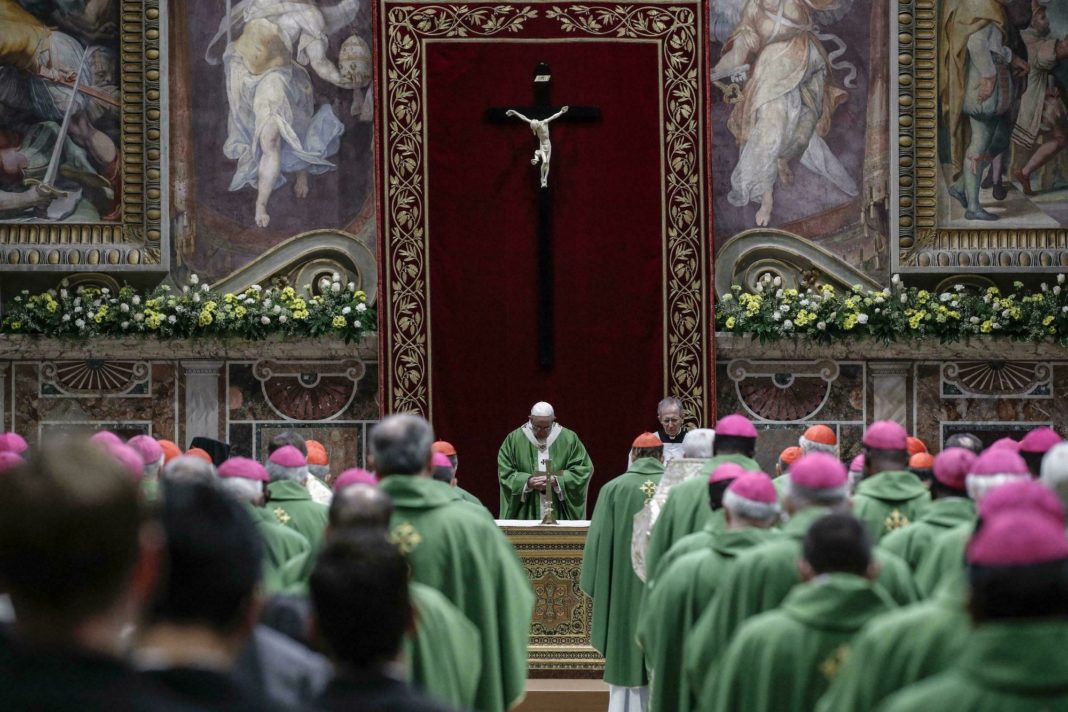
Pope Francis celebrates Mass at the Vatican, Sunday, Feb. 24, 2019. Pope Francis celebrated a final Mass to conclude his extraordinary summit of Catholic leaders summoned to Rome for a tutorial on preventing clergy sexual abuse and protecting children from predator priests. The Mass was celebrated Sunday in the Sala Regia, one of the grand, frescoed reception rooms of the Apostolic Palace. (Giuseppe Lami/Pool Photo via AP)
Pope Francis ended a landmark Vatican meeting on clerical sexual abuse with an appeal “for an all-out battle against the abuse of minors,” which he compared to human sacrifice, but his speech did not offer concrete policy remedies demanded by many of the faithful.
In the speech at the end of a Mass in the Apostolic Palace’s frescoed Sala Reggia hall, Francis argued that “even a single case of abuse” in the Roman Catholic Church — which he said was the work of the devil — must be met “with the utmost seriousness.” He said that eradicating the scourge required more than legal processes and “disciplinary measures.”
“To combat this evil that strikes at the very heart of our mission,” the pope said, the church needed to protect children “from ravenous wolves.”
Right. You been following the new scandal with Francis protege Bishop Gustavo Zanchetta of Argentina? Francis knew that this guy was a sex maniac, but brought him to Rome anyway. The other day, an Argentine newspaper published photos proving that the matter went all the way to Rome — in other words, that the Pope knew that he was dealing with a bishop who, among other things, molested seminarians under his authority.
True, Francis in his Rome speech today focused on the sexual abuse of minors. And, according to reporting in National Catholic Register, the guidelines the pontiff offered in his speech are sensible. They are:
Building upon the World Health Organization’s “Seven Strategies for Ending Violence against Children,” the pope presented eight guidelines to aid the Church in “developing her legislation” on the issues.
The eight guidelines can be summarized as follows:
1. A “change of mentality” to focus on protecting children rather than “protecting the institution.”
2. A recognition of the “impeccable seriousness” of these “sins and crimes of consecrated persons.”
3. A genuine purification beginning with “self-accusation.”
4. Positive formation of candidates for the priesthood in the virtue of chastity.
5. Strengthening and reviewing of guidelines by episcopal conferences, reaffirming the need for “rules.”
6. The accompaniment of those who have been abused with an emphasis on listening.
7. Ensure that seminarians and clergy are not enslaved to an addiction to pornography.
8. Combat sexual tourism around the world.
Fine. But as we know from the McCarrick story, seminarians are at the complete mercy of their bishop. Who gains by Francis focusing narrowly and exclusively on priests who prey on minors, and only on minors?
Just before this meeting, the Catholic journalist Phil Lawler wrote about how it was going to be primarily a public relations exercise, and identified the aspects of the scandal that Francis and his Rome meeting would avoid talking about:
  • homosexual influence within the clergy;
  • why the Vatican has eased penalties on abusive priests;
  • why the Pope himself has promoted bishops accused of covering up—and in some cases actively engaging in—sexual abuse;
  • canonical structures to hold bishops accountable for negligence;
  • how Theodore McCarrick rose to ecclesiastical influence, and who protected him.
We are seventeen years past the Boston scandal revelations, which brought this crisis to public view. There have been many good words spoken by popes. Here’s Pope John Paul II, from his address to the US cardinals on April 23, 2002, with the abuse scandal mushrooming in the US:
The abuse which has caused this crisis is by every standard wrong and rightly considered a crime by society; it is also an appalling sin in the eyes of God. To the victims and their families, wherever they may be, I express my profound sense of solidarity and concern…
It must be absolutely clear to the Catholic faithful, and to the wider community, that Bishops and superiors are concerned, above all else, with the spiritual good of souls. People need to know that there is no place in the priesthood and religious life for those who would harm the young. They must know that Bishops and priests are totally committed to the fullness of Catholic truth on matters of sexual morality, a truth as essential to the renewal of the priesthood and the episcopate as it is to the renewal of marriage and family life.
At this point, though, do people take words from popes seriously? I’m not asking in a trolling way. How are people to believe that the pope is really serious this time about cracking down on clerical sex abuse when he behaves the way he has done in the Zanchetta affair. It suggests pretty clearly that the abuse Francis cares about is abuse of minors. If bishops want to force themselves on seminarians, well, that’s not such a big deal, is it? Just to make clear you understand what the Zanchetta affair involves, the Associated Press reports today:
The Associated Press has reported that the Vatican knew as early as 2015 about Bishop Gustavo Zanchetta’s inappropriate behavior with seminarians. Yet he was allowed to stay on as bishop of the northern Argentine diocese of Oran on until 2017, when he resigned suddenly, only to be given a top job at the Vatican by Francis, his confessor.
New documents published by the Tribune of Salta newspaper show that the original 2015 complaint reported that Zanchetta had gay porn on his cellphone involving “young people” having sex, as well as naked images of Zanchetta masturbating that he sent to others.
The age of the “young people” isn’t clear. But Francis told his summit Sunday that Vatican legislation criminalizing possession of child porn involving children under age 14 should change to include older victims.
“We now consider that this age limit should be raised in order to expand the protections of minors and to bring out the gravity of these deeds,” Francis said.
It wasn’t clear if Francis was referring to the Zanchetta case, which is now under investigation by both the Vatican and Argentine judicial authorities after alleged victims came forward accusing Zanchetta of sexual abuse.
The Vatican has insisted that Zanchetta was only facing “governance” problems at the time of his 2017 resignation and appointment at the Vatican, and that the first sexual abuse allegation was made in late 2018.
The documents, however, make clear that the Vatican was aware of inappropriate sexual behavior by Zanchetta two years before he resigned.
For those keeping score, I am getting close to the end of Frederic Martel’s In The Closet Of The Vatican. His reporting on corruption under the pontificate of John Paul II is at times based on more solid ground than what I’ve read previously in this book, but the whole thing is still deeply compromised by Martel’s stunning lack of journalistic professionalism. A small note: I know almost nothing about Spain, but I found three errors of fact in his chapter on the Spanish church. He keeps reminding us in his narrative about how many researchers he had on this book. Either he’s lying about that, or they did a very poor job, or the publisher rushed it to publication.
I’ll write more about the book when I complete it, but here is a harsh critique of it from the Catholic left; I am not a fan of Michael Sean Winters’s commentaries, but in this case, he’s right about how bad this book is. I predicted — wrongly, as it turns out — that In The Closet Of The Vatican would overshadow coverage of the Rome meeting. Had it been a more credible book, it would have. But it didn’t for the same reasons that The New York Times is not the same thing as the National Enquirer.
Anyway, I recognize that I’m very, very jaded about this topic, but I don’t understand how Catholics can take their leadership seriously on this issue anymore. If you are a Catholic who does believe that the pope and the bishops can be trusted now to get it right, I invite you to explain why. To be perfectly clear: I’m not taunting at all; I honestly want to know.
The loss of credibility of the hierarchy is one reason why I believe faithful Catholics have got to take some form of the Benedict Option. That’s what the young Catholic of the self-described “Resistance” in Spain are doing. They do not repudiate the institutional Church — if they did, they would cease to be Catholics — but they no longer expect anything from them. Instead, they are taking responsibility for educating and forming themselves as faithful orthodox Catholics, and building community. From that post:
“We used to be the defender of all this,” Ramon said. “The church is mediocre. The church was the first to betray the true Spanish spirit. … The Church has been unfaithful to its mission many times. Who abandoned the Cristeros? The Church. We know the Church is made of men, and they betray Christ constantly. We are men, and we betray Christ constantly. We have a lot of history of the betrayal of clerics. We don’t care now.”
We don’t care now. Those words struck me like a gong. These young men struck me as pious and sincere Catholics who, because of their piety and sincerity, don’t really care what their bishops think of them.
In his speech in Rome today, Francis called for an “all-out battle” against sexual abuse of minors, but the metaphor rings hollow for these young Spanish Catholics I talked to last month. More:
Ramon told me that “the deeper battle is the one people can’t see.” The battle for authority, he says, is lost. Though all the young men I spoke with are strongly Catholic, they have given up expecting their bishops to do anything about the crisis. They feel like spiritual orphans.
“We have no shepherds right now,” he said. “What would a soldier do if he can’t see the captain? He would be a guerrilla. He would assemble all those who fight for the flag, even if they’re under different uniforms. [For us, it’s] the Cross, and Spain, and Tradition.”
UPDATE: Ramon e-mails to emphasize that he and his friends are faithful Catholics who believe the Church is holy. It’s only that they have no faith in the competence of the current generation of hierarchical leadership. That is not the same thing as disbelieving in the authority of the hierarchy itself. As Catholics, they accept the legitimacy of the hierarchy … but think the current hierarchy is a mess.
It seems to me that this, and some version of the Benedict Option, is the only reasonable conclusion left to Catholics who still believe in Catholicism, and want to see it prevail through this great crisis, of which the sexual corruption of the clergy is only one manifestation. Tell me what you think. Catholic readers, did the Rome meeting, and the pope’s closing speech, make you more confident that the institutional Church is going to get itself sorted out?