Showing posts with label U.S. History. Show all posts

Tuesday, September 03, 2019

How To Replace Howard Zinn’s Communist Account Of U.S. History For American Kids


By Joy Pullman
https://thefederalist.com/2019/08/28/replace-howard-zinns-communist-account-u-s-history-american-kids/
August 28, 2019
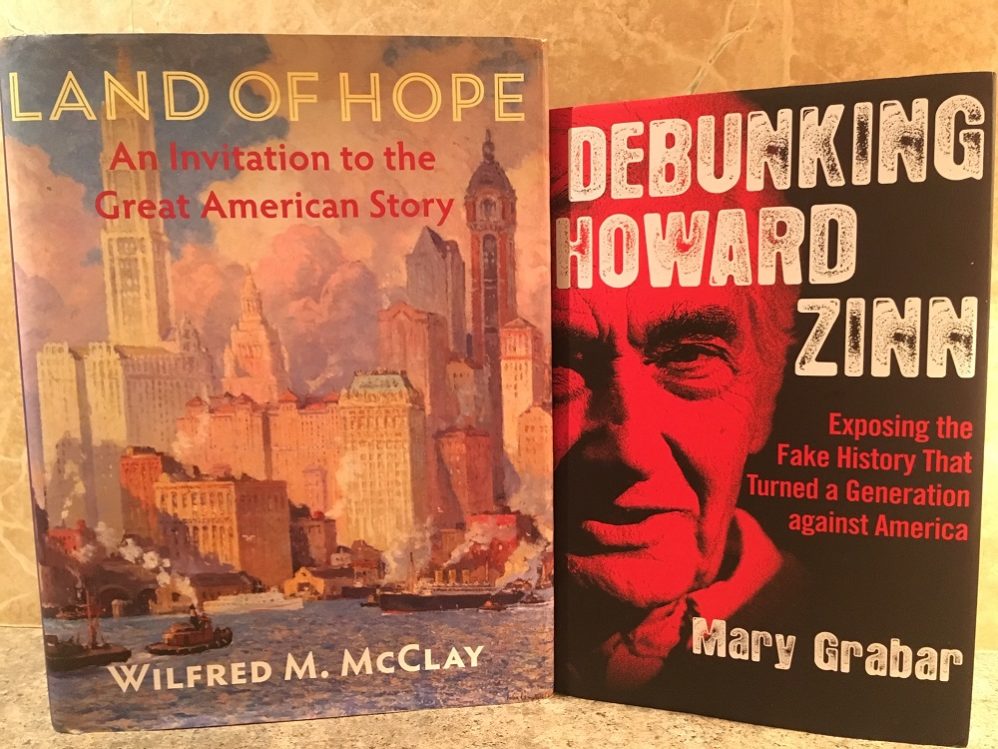
Image result for mary grabar zinn

The perfect companion accompanied my family’s trip West this summer in the modern covered wagon: A new, single-volume book of U.S. history. As our RV motored across the plains, I read of how they were discovered and settled. I looked across the prairies, the badlands, and the mountains and imagined myself coming in an ox-drawn cart instead of a motor vehicle with a gas stove and bathroom.
“Land of Hope: An Invitation to the Great American Story,” by University of Oklahoma historian Wilfred McClay, is extremely readable. It’s written in a conversational but not casual tone, and thus approachable to readers from around age ten onward (if the ten-year-old is accustomed to reading large books like “The Lord of the Rings,” as mine is). An attractive writing style may be its first virtue, because an open door is required for people to enter.
A second virtue is the book’s brevity. To be sure, it is a large and somewhat heavy volume, of 429 pages not including the end material. But that is not too much gas for racing across approximately 500 years of history. I found myself constantly wishing to hear more about the people and ideas in the book, and sad but understanding to instead be whisked away to the next set. Thankfully, McClay provides an extensive “additional reading” list to help satisfy a problem inherent to writing a one-volume overview of American history.
Considering a new book of American history requires, however, more than structural basics like these. Context is extremely pertinent. “Land of Hope” is published in a year in which hatred of America seems bigger than ever.
To take a recent and prominent example, The New York Times, once the United States’ paper of record, has newly released the “1619 Project,” named after the year in which African slaves first arrived on American shores. The project purports to be a work of history: “aim[ing] to reframe the country’s history, understanding 1619 as our true founding, and placing the consequences of slavery and the contributions of black Americans at the very center of the story we tell ourselves about who we are.”
But it is better described as anti-history propaganda. To take just one demonstration of this, its premise and name fully ignores that Native Americans frequently enslaved each other on this continent long before Europeans arrived. It also sidelines the fact that most of the African slaves brought to the Americas were sold by enemy African tribes, who also routinely held their fellow man in slavery going back centuries. Native Americans held black slaves. African Americans held black slaves. The whole world has held slaves.
In other words, if America was founded on slavery, so was just about every civilization. Should they all be razed right now? Just how does one propose to do that, exactly, without creating mass murder and mayhem? Since America is not unique in its regrettable past allowance of chattel slavery, it does not deserve to be singled out as an object of hatred, largely for the left’s political advancement. We can and need to have a conversation about how to judge one’s country for its sins and recover from them, but that requires starting from factual instead of ideological grounds.
Yet surveys have shown for decades that most Americans today know nearly nothing about their history, and when it is taught in public schools and universities it is usually either influenced by or saturated with leftist politics. Most Americans thus have no intellectual defenses against such lies. Knowledge is the starting point for wise reflection and substantive conversation. It is the antidote to propaganda.
This is likely the reason McClay’s history is billeted in marketing materials as “the long-awaited antidote to Howard Zinn anti-Americanism.” “[E]xisting accounts simply fail to tell our country’s story with energy and conviction,” the press release says. “They also disproportionately reflect the outlook of radical critics of American society, whose one-sided accounts lack the balance of a larger perspective and have had an enormously negative effect upon the teaching in high schools and colleges.”
This is all true. But this might make readers expect to read something more polemical, a sort of mirror image of Zinn’s bestselling anti-American propaganda textbooks used in countless U.S. public schools. McClay’s book is not one bit polemical. If anything, it is genial, open-minded, and when critical it is critical out of love for its subject matter, rather than hatred.
It is not a work of advocacy, but of history. McClay presents accusations against America in their context but without covering up genuine wrongs such as slavery. “Land of Hope” comes across more as a balanced and honest account than a specific response to a work that spreads Communist messaging.
As such, it is a good starting point on what should be all American patriots’ quest to revive respect for our country’s achievements and ideals through a better knowledge of their effects and development in history. But its approach is not in itself sufficient to achieve that purpose. More is needed.
To make an analogy, Americans’ affections for and knowledge of their country need to be fed. “Land of Hope” does so. What it does not provide, however, is an antidote to poisoned food. It may strengthen minds enough to toughen them against diseases, but already diseased minds, and minds susceptible to disease, need something stronger than nourishment. They need medicine, an antidote to the poison.
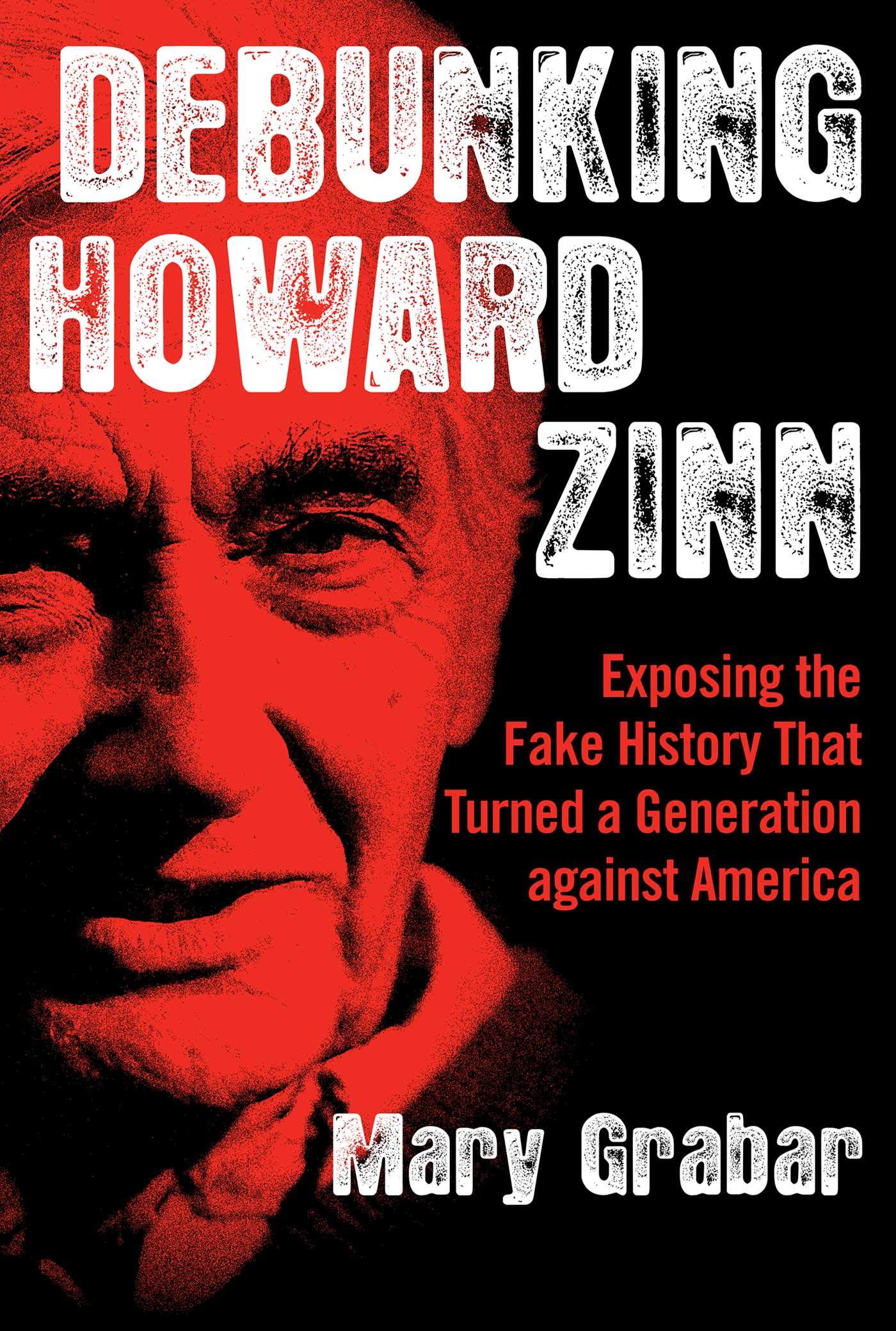
Next on my reading list for books of that character is Victor Davis Hanson’s “Carnage and Culture.” Also recommended as antidote reading, as Joshua Lawson notes in his excellent list here, is Thomas G. West’s “Vindicating the Founders” and “The Political Theory of the American Founding.” Another new book deserves a place on this stack to help minds switch from defense to offense for America’s ideals, history, and traditions: “Debunking Howard Zinn,” by Mary Grabar.
Grabar, whose essays on education I’ve edited for many years now at several publications, does a meticulous takedown of Zinn’s lavishly selling, Hollywood-vaunted work of so-called history, “A People’s History of the United States.” Zinn’s book was first published in 1980 and is now estimated to have sold some 2.6 million copies. College Board’s rewrite of its Advanced Placement U.S. history course features Zinn’s book and embeds his anti-American philosophy.
The tragedy of all this, of course, is that Zinn’s book is concentrated poison. Using a careful review of his source materials and claims, as evidenced by her nearly 1,000 footnotes, Grabar documents quite clearly and conclusively that Zinn is not only a plagiarist but a liar. His presentation of key events and figures of American history, such as Christopher Columbus, slavery, the NAACP, World War II, and the civil rights movement, also straight-up regurgitates Communist propaganda.
Here’s just one example, from page 222 and 223 in Grabar’s book. She shows how Zinn selectively quoted from American documents to make it look like the United States was interested getting Vietnam’s natural resources, not in defending it from a communism our nation understood to be evil and dangerous. The very same documents Zinn quotes actually prove the opposite of the points he makes with them when one reads the material he left out.
“One wonders if Zinn had simply not read the volumes that he presumably edited [of the Pentagon Papers],” Grabar writes. “Either that or he deliberately left out key information.” As she shows, he used this falsifying tactic so many times in “A People’s History” it becomes hard to believe it’s an accident.
Thus not only is Zinn’s book a pack of slipshod lies that even leftist historians will not stand behind, it is a pack of slipshod lies that appear to be told purposefully to set Americans at each others’ throats. And it has been quite effective. Many Americans believe the false and self-immolating narrative that their nation is fundamentally and unreformably racist, sexist, and genocidal.
For all its faults, the United States and the Western civilization that created it have been the best protector of people’s rights and freedoms the world has ever known. We definitely have done many evils. We continue to allow great evils today. But worse societies fill the earth, and historically have been far more common. People who don’t know this gravely endanger what is and has been for hundreds of millions of people the last, best hope of a broken earth.
One of the other sobering reflections upon reading Grabar’s work is this: Why has it taken nearly 40 years to get a systematic, scholarly debunking of Zinn’s evil, destructive lies? How is it that two generations of history teachers and professors lacked the knowledge and love of America to keep this poison book out of the hands of millions of American school children? How was “Land of Hope” not written and used in classrooms 40 years ago instead of this Molotov cocktail barrage aimed at the greatest country in world history? How is it that as governor of Indiana Mitch Daniels was unable to get this book yanked from public school classrooms, and that no other Republican politicians have tried?
Not only did they not stop it, and force taxpayers to pay for their own children’s and the next generation of voters’ mental destruction, legions of these people in positions of authority enthusiastically welcomed a book they should have instantly realized is full of politically motivated falsehoods that are destructive of the country that pays their salaries and made possible just about every good thing in their lives. Can leaders who so terribly fail American children, taxpayers, and the nation deserve any credibility or respect?
Joy Pullmann (@JoyPullmann) is executive editor of The Federalist, mother of five children, and author of "The Education Invasion: How Common Core Fights Parents for Control of American Kids." She identifies as native American and gender natural. Her latest ebook is a list of more than 200 recommended classic books for children ages 3-7 and their parents.

Book Review: 'Debunking Howard Zinn: Exposing the Fake History That Turned a Generation Against America' by Mary Grabar


Zinns of Omission
https://www.frontpagemag.com/fpm/274799/zinns-omission-bruce-bawer
September 3, 2019

Image result for mary grabar zinn


[Order Mary Graber's new book, Debunking Howard Zinn: Exposing the Fake History That Turned a Generation against America: CLICK HERE.]


Perhaps the nicest thing you can say about Howard Zinn’s People’s History of the United States is that it shows that even in the era of the Internet a book can continue to have an immense social impact. In Zinn’s case, however, that impact could hardly be more dangerous. Published in 1980, Zinn’s book has for some time been, as Mary Grabar notes in her definitive new study of it, Debunking Howard Zinn, both the bestselling trade history of America and the bestselling American history textbook. When Zinn wrote it, he intended it to provide a skeptical (shall we say) alternative to previous accounts of US history, which Zinn, hardcore America-hater that he was, saw as excessively pro-American. Today, Zinn’s book isn’t just an insidious alternative; it is the reigning book in the field, and its once alternative take on US history has become received wisdom on the establishment left. Not a few of the students who read the book years ago when they were college students, and who fell for Zinn’s take on US history hook, line, and sinker, are now teachers who are using the same book to indoctrinate their own charges.
Many of us have been aware for years of Zinn’s perfidious influence – and have fretted over it in print. But to read Grabar is to realize that the situation is even worse than many of us thought – and to learn things about Zinn that one didn’t know before. One of the things I learned from Grabar is that Matt Damon – who, in the 1997 movie Good Will Hunting (which he co-wrote and starred in) worked in a plug for Zinn’s book that gave it a major boost – grew up with Zinn as a neighbor and was sucked in by People’s History by the age of ten.
Grabar supplies a useful catalog of major historians who, although left-wing themselves, have given Zinn’s book an unambiguous thumbs-down. Eugene Genovese considered it nothing but “incoherent left-wing sloganizing”; Arthur Schlesinger called Zinn “a polemicist, not a historian.” Yet no amount of cogent criticism has dislodged the book from its pedestal. One reason is that teachers who use the book reflexively reject any criticism of it; another is that ignorant mainstream journalists routinely cite it as if it’s a legitimate, reliable work, and a constellation of even more ignorant showbiz Zinn fans, like Damon, have prominently sung its praises. Among the many highly disturbing examples of this misguided promotion was the 2006 publication of the book’s Russian translation – by, believe it or not, the US Embassy in Moscow. Imagine Russians getting their US history from Howard Zinn!
One of the big achievements of Zinn’s book was his utter discrediting of Christopher Columbus. Once regarded as a hero, Columbus is now commonly viewed as having initiated the genocidal destruction of a peaceful paradise. In her first chapter, by going carefully through Zinn’s account of the great navigator, Grabar demonstrates that it is based not on original sources but is heavily dependent on, indeed almost copied straight out of, the work of an earlier Columbus-basher, Hans Koning, who, for ideological reasons, engaged in extremely selective quotation and in wholesale misrepresentation. Ultimately, Grabar shows convincingly that Zinn, in his effort to smear the discoverer of America and to depict American Indians as noble savages, repeatedly ignores historical context, suppresses inconvenient facts, cites exceedingly dubious statistics, and so on. In short, Grabar thoroughly discredits Zinn’s discrediting of the Admiral of the Ocean Sea.
As Zinn progresses beyond Columbus to the British settlement of North America, he routinely deplores relatively minor anti-Indian actions by colonists while defending or ignoring huge, brutal massacres by Indians – whom he insists, against all evidence but in accordance with the historical revisionism of know-nothing Sixties radicals, on portraying as gentle and innocent, indeed, as proto-Communists who lived in hippie-type communes and had no concept of private ownership or gender inequality. In short, Zinn transforms violent warriors into flower children. In one instance, he accuses early Virginia settlers of wanting to “exterminate” local tribes when in fact the latter sought to wipe out the former. Of course, in the encounters between natives and settlers there were misdeeds on both sides, but Zinn reduces the entire history of colonization as a simple matter of genocidal whites constantly going to war against peace-loving Indians. Nor does Zinn just make virtual saints out of the Indians of the Caribbean and North America; he also whitewashes the Aztecs, Mayans, and Incas. Though he does, surprisingly, mention the Aztecs’ “ritual killing of thousands of people as sacrifices to the gods,” he claims that these bloodthirsty savages nonetheless exhibited “a certain innocence.” Neat trick!
Then there’s Zinn on slavery. In typical fashion, as Grabar notes, he “acknowledges that slavery existed in Africa…but presents it as a kinder, gentler kind of slavery” and is mum on the fact that it predated American slavery by centuries. In his effort to portray slavery, or at least the bad kind of slavery, as distinctively American, Zinn ignores the fact that it was without question opposition to slavery that was distinctively Western, whereas slavery itself had existed in every known African and Asian civilization since the beginning of recorded history. Far from recognizing the war to emancipate slaves as a uniquely American act of virtue, Zinn laments that the Civil War sought to free slaves rather than to overthrow capitalism, and maintains that blacks were, in any case, no better off after the war than before. He also fails to admit that America’s success in banishing slavery inspired emancipation movements around the Western world, even as he deep-sixes the role of Muslims in the slave trade and the fact that slavery continues to be practiced in the Islamic world.
Zinn manages even to make America’s role in World War II look perfidious. Here, as Grabar says quite rightly, he “hits a new low,” drawing moral equivalence between the US and Nazi Germany, painting Japan as America’s victim, and attributing America’s participation in the war entirely to “imperialist” motives. As for the Cold War era, Zinn dismisses Americans’ fear of Soviet Communism as “hysteria” and describes Americans’ demonstrably legitimate concern about Communist influence in Washington and Hollywood as “paranoid.” He even depicts the Marshall Plan – another unique act of American virtue – as a nefarious effort to prepare “the European capitalist countries for all-out war against the USSR and the People’s Democracies of Eastern Europe.”
Anyway, on it goes. Castro’s Cuba is great; Ho Chi Minh was a hero. Then there’s Grabar’s illuminating account of Zinn’s life. Not only was he almost certainly a card-carrying member of the Communist Party; he also belonged to several CPUSA front groups. Teaching in the late 1950s at the historically black Spelman College, which was “emphatically Christian,” he sought to turn it into a “school for protest.” In 1960, he co-founded the Student Nonviolent Coordinating Committee, one of the major radical groups of that decade; years later, he co-founded the New Party, which Grabar identifies as “the socialist party that helped Barack Obama win his Illinois Senate seat.” Other groups with which he was associated included ACORN, the Democratic Socialists of America, a “Marxist-Maoist collective” called STORM, and International ANSWER.
This, then, is the man who has shaped the twisted picture of American history – and of America itself –that exists inside the heads of tens of millions of Americans. Grabar’s subtitle is Exposing the Fake History that Turned a Generation against America; my only problem with this subtitle is that in place of “a Generation” she could arguably have said “Generations,” because Zinn’s book, now almost forty years old, has poisoned the minds not only of countless college students today but also of many of their parents. In her introductory note, Grabar points out that there exist valuable challenges to Zinn, such as A Patriot’s History of the United States (2004) by Larry Schweikart and Michael Allen, which, I have been informed to my delight, is used in conjunction with Zinn in a number of history courses; it would be nice to see Grabar’s own, equally invaluable book find its way onto such curricula. A generation – or generations – of Americans raised on Howard Zinn can result only in an America that turns against its own founding values, in all their nobility, and that follows the likes of Bernie Sanders, Elizabeth Warren, and, God help us, Alexandria Ocasio-Cortez down the path to socialist disaster.
Bruce Bawer is the author of “While Europe Slept,” “Surrender,” "The Victims' Revolution," and "The Alhambra." "Islam," a collection of his essays on Islam, has just been published.

Wednesday, July 24, 2019

Speaking Ill of the Ted


By Mark Steyn
https://www.steynonline.com/9565/speaking-ill-of-the-ted
July 22, 2019

Image result for ted kennedy chappaquiddick

This weekend we were busy marking the demi-centennial of Apollo 11's moon landing with some thoughts onThe Lost Frontier and some appropriately lunar music. But 1969's giant leap for mankind coincided with one almighty flying leap for a very different kind of man: with his usual exquisite timing, Senator Edward Kennedy chose the day before Messrs Armstrong, Collins and Aldrin reached the Sea of Tranquility to drive Mary Jo Kopechne into a pond of tranquility, at least until he came flying off that bridge. And, by the time America was paying attention, Teddy had been fitted with his neck brace and the minders had everything under control.

Last year there was, very belatedly, a fine feature film about Chappaquiddick, which I reviewed here, and which contains a dialogue exchange taken almost verbatim from a ten-year-old column of mine:
As Joan Vennochi wrote in The Boston Globe: 
'Like all figures in history – and like those in the Bible, for that matter – Kennedy came with flaws. Moses had a temper. Peter betrayed Jesus. Kennedy had Chappaquiddick, a moment of tremendous moral collapse.' 
Actually, Peter denied Jesus, rather than 'betrayed' him, but close enough for Catholic-lite Massachusetts. And if Moses having a temper never led him to leave some gal at the bottom of the Red Sea, well, let's face it, he doesn't have Ted's tremendous legislative legacy, does he?
That bit turns up in the movie:
Joan Vennochi's words are put in Ted's mouth: He says defensively that all men are flawed - 'Moses had a temper, Peter betrayed Jesus.' And my cheap riposte - 'Moses didn't leave a girl at the bottom of the Red Sea' - is given to the outraged Joe Gargan, already on his way out, supplanted by better, colder, harder fixers. When the guy gets out and leaves the girl at the bottom of the sea, it offends the natural order: Joe is telling him he's not a man.
He wasn't - and nor were those who went along with it. I have rarely been more disgusted by the public discourse of a free society than by the obsequies that attended Kennedy's passing a decade ago. Yet, even so, I would not have bothered re-posting the column below were it not for the fact that they're still doing it. On this fiftieth anniversary, the Associated Press, purveyors of unreadable J-school sludge to America's dying monodailies, are still reflexively playing oleaginous courtiers to a dynasty that no longer exists. In a country that now vaporizes careers for an infelicitous tweet, Ted Kennedy killed a woman and dared us to call him on it. Thanks to the likes of the Associated Press, America failed that test:

~from Mark Steyn's syndicated column, August 28th 2009:


We are enjoined not to speak ill of the dead. But, when an entire nation – or, at any rate, its "mainstream" media culture – declines to speak the truth about the dead, we are certainly entitled to speak ill of such false eulogists. In its coverage of Senator Edward M Kennedy's passing, America's TV networks are creepily reminiscent of those plays Sam Shepard used to write about some dysfunctional inbred hardscrabble Appalachian household where there's a baby buried in the backyard but everyone agreed years ago never to mention it.

In this case, the unmentionable corpse is Mary Jo Kopechne, 1940-1969. If you have to bring up the, ah, circumstances of that year of decease, keep it general, keep it vague. As Kennedy flack Ted Sorensen put it in Time magazine:
Both a plane crash in Massachusetts in 1964 and the ugly automobile accident on Chappaquiddick Island in 1969 almost cost him his life.
That's the way to do it! An "accident," "ugly" in some unspecified way, just happened to happen – and only to him, nobody else. Ted's the star, and there's no room to namecheck the bit players. What befell him was a thing, a place. As Joan Vennochi wrote in The Boston Globe:
Like all figures in history – and like those in the Bible, for that matter – Kennedy came with flaws. Moses had a temper. Peter betrayed Jesus. Kennedy had Chappaquiddick, a moment of tremendous moral collapse.
Actually, Peter denied Jesus, rather than "betrayed" him, but close enough for Catholic-lite Massachusetts. And if Moses having a temper never led him to leave some gal at the bottom of the Red Sea, well, let's face it, he doesn't have Ted's tremendous legislative legacy, does he? Perhaps it's kinder simply to airbrush out of the record the name of the unfortunate complicating factor on the receiving end of that moment of "tremendous moral collapse." When Kennedy cheerleaders do get around to mentioning her, it's usually to add insult to fatal injury. As Teddy's biographer Adam Clymer wrote, Edward Kennedy's "achievements as a senator have towered over his time, changing the lives of far more Americans than remember the name Mary Jo Kopechne."

You can't make an omelet without breaking chicks, right? I don't know how many lives the senator changed – he certainly changed Mary Jo's – but you're struck less by the precise arithmetic than by the basic equation: How many changed lives justify leaving a human being struggling for breath for up to five hours pressed up against the window in a small, shrinking air pocket in Teddy's Oldsmobile? If the senator had managed to change the lives of even more Americans, would it have been OK to leave a couple more broads down there? Hey, why not? At The Huffington Post, Melissa Lafsky mused on what Mary Jo "would have thought about arguably being a catalyst for the most successful Senate career in history. Who knows – maybe she'd feel it was worth it." What true-believing liberal lass wouldn't be honored to be dispatched by such a death panel?

We are all flawed, and most of us are weak, and in hellish moments, at a split-second's notice, confronting the choice that will define us ever after, many of us will fail the test. Perhaps Mary Jo could have been saved; perhaps she would have died anyway. What is true is that Edward Kennedy made her death a certainty. When a man (if you'll forgive the expression) confronts the truth of what he has done, what does honor require? Six years before Chappaquiddick, in the wake of Britain's comparatively very minor "Profumo scandal," the eponymous John Profumo, Her Majesty's Secretary of State for War, resigned from the House of Commons and the Queen's Privy Council and disappeared amid the tenements of the East End to do good works washing dishes and helping with children's playgroups, in anonymity, for the last 40 years of his life. With the exception of one newspaper article to mark the centenary of his charitable mission, he never uttered another word in public again.

Ted Kennedy went a different route. He got kitted out with a neck brace and went on TV and announced the invention of the "Kennedy curse," a concept that yoked him to his murdered brothers as a fellow victim – and not, as Mary Jo perhaps realized in those final hours, the perpetrator. He dared us to call his bluff, and, when we didn't, he made all of us complicit in what he'd done. We are all prey to human frailty, but few of us get to inflict ours on an entire nation.

His defenders would argue that he redeemed himself with his "progressive" agenda, up to and including health care "reform." It was an odd kind of "redemption": In a cooing paean to the senator on a cringe-makingly obsequious edition of NPR's "Diane Rehm Show," Edward Klein of Newsweek fondly recalled that one of Ted's "favorite topics of humor was, indeed, Chappaquiddick itself. He would ask people, 'Have you heard any new jokes about Chappaquiddick?'"

Terrific!

Who was that lady I saw you with last night?

Beats me!

Why did the Last Lion cross the road?

To sleep it off!

What do you call 200 Kennedy sycophants at the bottom of a Chappaquiddick pond?
A great start, but bad news for NPR guest-bookers! "He was a guy's guy," chortled Edward Klein. Which is one way of putting it.

When a man is capable of what Ted Kennedy did that night in 1969 and in the weeks afterward, what else is he capable of? An NPR listener said the senator's passing marked "the end of civility in the U.S. Congress." Yes, indeed. Who among us does not mourn the lost "civility" of the 1987 Supreme Court hearings? Considering the nomination of Judge Bork, Ted Kennedy rose on the Senate floor and announced that "Robert Bork's America is a land in which women would be forced into back-alley abortions, blacks would sit down at segregated lunch counters, rogue police could break down citizens' doors in midnight raids, schoolchildren could not be taught about evolution."

Whoa! "Liberals" (in the debased contemporary American sense of the term) would have reason to find Borkian jurisprudence uncongenial but to suggest the judge and former solicitor-general favored resegregation of lunch counters is a slander not merely vile but so preposterous that, like his explanation for Chappaquiddick, only a Kennedy could get away with it. If you had to identify a single speech that marked "the end of civility" in American politics, that's a shoo-in. And in fact setting a new moral standard in which a drunken adulterer's appetites can cause a woman's death and he pays no price is also an end to civility.

If a towering giant cares so much about humanity in general, why get hung up on his carelessness with humans in particular? For Kennedy's comrades, the cost was worth it. For the rest of us, it was a high price to pay. And, for Ted himself, who knows? He buried three brothers, and as many nephews, and, as the years took their toll, it looked sometimes as if the only Kennedy son to grow old had had to grow old for all of them. Did he truly believe, as surely as Melissa Lafsky & Co do, that his indispensability to the republic trumped all else? That Camelot – that "fleeting wisp of glory," that "one brief shining moment" – must run forever, even if "How To Handle A Woman" gets dropped from the score. The senator's actions in the hours and days after emerging from that pond tell us something ugly about Kennedy the man. That he got away with it tells us something ugly about American public life.

We had a busy weekend at SteynOnline, starting and finishing with the aforementioned lunar commemorations, The Lost Frontier and Fly Me to the Moon. Kathy Shaidle's film column celebrated The Life and Death of Colonel Blimp, and our marquee presentation was a brand new edition of The Mark Steyn Show, with former presidential candidate Michele Bachmann and Mrs Thatcher's former speechwriter John O'Sullivan discussing populism and globalism, both generally and more particularly - as in the Somalification of Minnesota. If you were too busy visiting the new madrassah at Lake Wobegon this weekend, I hope you'll want to check out one or three of the foregoing as a new week begins.

As the third year of The Mark Steyn Club cranks into top gear, we're very appreciative of all those who signed up in our first flush and have been so eager to re-re-subscribe for another twelve months. We thank you all, and hope to see at least a few of you to thank personally on our Second or Third Steyn Cruise. For more information on the Club, see here.

Saturday, July 20, 2019

The most memorable moments from the Apollo 11 mission

The Lost Frontier


By Mark Steyn
July 20, 2019

Related image
Neil Armstrong

Fifty years ago today man landed on the moon, in the persons of Neil Armstrong and Buzz Aldrin and courtesy of a lunar module from Apollo 11. The most I've ever written about the "space race" was in my book After America, and the passage attracts criticism both from the Nasa types and those who think the whole man-on-the-moon thing was a crashing bore. Nevertheless, the modern world was built by the men who ventured beyond the edge of the map, and in that sense the stasis of the last half-century is both unusual and a little disturbing. To mark the anniversary, The New York Times wondered when a woman might reach the moon - which sounds a humorless rewrite of the old feminist gag that "if they can put a man on the moon, why can't they put them all there?" So here's a few of my thoughts on the subject over the years:
The Wright brothers' first flight was in 1903. Fifty-nine years later, John Glenn became the first American to orbit the earth, and seven years after that Buzz Aldrin became the first man to fly to the moon and play "Fly Me To The Moon" on the moon - thanks to the portable cassette recorder he took with him. In a certain sense, the moon landing was the culmination of the tremendous inventive energy of the nineteenth century (if I had to pick a so-called "greatest generation" it would be somewhere in the latter half thereof). Half a century from the Wright Brothers to The Right Stuff - from nosediving into the neighbor's cornfield to walking the surface of the moon - followed by half a century devoid of giant leaps and even small steps.
When After America came out, I was booked on "Fox & Friends" to talk it over with Brian Kilmeade. Sitting next to Brian on the couch waiting to get going, I watched Steve Doocy across the studio link to an item on the space shuttle Enterprise beginning its journey to whichever museum it's wound up at. Steve called it "historic", and, as I remarked to Brian, pity the nation whose greatness becomes "historic" - whose spacecraft exist only in museums. There's a passage in After America on just that theme:
In 1961, before the eyes of the world, President Kennedy had set American ingenuity a very specific challenge—and put a clock on it:
'This nation should commit itself to achieving the goal, before this decade is out, of landing a man on the moon and returning him safely to the earth.' 
That's it. No wiggle room. A monkey on the moon wouldn't count, nor an unmanned drone, nor a dune buggy that can't take off again but transmits grainy footage back to Houston as it rusts up in the crater it came to rest in. The only way to win the bet is with a real-live actual American standing on the surface of the moon planting the Stars and Stripes. Even as it happened, the White House was so cautious that William Safire wrote President Nixon a speech to be delivered in the event of disaster: 
'Fate has ordained that the men who went to the moon to explore in peace will stay on the moon to rest in peace...' 
Yet America did it.
It was not a sure thing. In 1961 the Soviets had it all over the Americans in the space race: They had already reached the moon, with the unmanned flight Luna 2, and they had put a man in space, Yuri Gagarin. Gagarin and the cosmonauts were inspirational figures well beyond the Warsaw Pact. By contrast, all the US unmanned missions had been failures, and their astronauts were earthbound - or sub-orbital at best. Kennedy was cautioned against his moon speech on the grounds that he was setting America up for very public humiliation.

But he chose to go ahead.

And now? From After America:
Four decades later, Bruce Charlton, professor of Theoretical Medicine at the University of Buckingham in England, wrote that "that landing of men on the moon and bringing them back alive was the supreme achieve- ment of human capability, the most difficult problem ever solved by humans." That's a good way to look at it: the political class presented the boffins with a highly difficult and specific problem, and they solved it—in eight years. Charlton continued:
'Forty years ago, we could do it—repeatedly—but since then we have not been to the moon, and I suggest the real reason we have not been to the moon since 1972 is that we cannot any longer do it. Humans have lost the capability.
'Of course, the standard line is that humans stopped going to the moon only because we no longer wanted to go to the moon, or could not afford to, or something.... But I am suggesting that all this is BS. . . . I suspect that human capability reached its peak or plateau around 1965-75—at the time of the Apollo moon landings—and has been declining ever since.' 
Can that be true? Charlton is a controversialist gadfly in British academe, but, comparing 1950 to the early twenty-first century, our time traveler from 1890 might well agree with him. And, if you think about it, isn't it kind of hard even to imagine America pulling off a moon mission now? The countdown, the takeoff, a camera transmitting real-time footage of a young American standing in a dusty crater beyond our planet blasting out from his iPod Lady Gaga and the Black-Eyed Peas or whatever the twenty- first-century version of Sinatra and the Basie band is. ... It half-lingers in collective consciousness as a memory of faded grandeur, the way a nineteenth-century date farmer in Nasiriyah might be dimly aware that the Great Ziggurat of Ur used to be around here someplace.
How long will it even half-linger? Great civilizations can survive a lot of things, but not impoverishment of spirit. That's one reason I didn't join in the media sniggers at Donald Trump's new Space Force - because I'd like it to be true. Here's me and Michio Kaku taking it seriously:


As I commented a year or so back:
Those "Space Age" astronauts were men of boundless courage and determination: they strapped themselves in and stared not just death in the face but death in hideous and unknown ways. Yet they were also ordinary men, who were called upon to do extraordinary things and rose to the challenge. These days we are unmanned in more than merely the sense of that Luna 2 expedition. Glenn and Armstrong are gone, and their surviving comrades are old and stooped and wizened, and yet the only giants we have. Space may still be the final frontier, but today, when we talk about boldly going where no man has gone before, we mean the ladies' bathroom. Progress.
~adapted from Mark's bestseller After America. Personally autographed copies areexclusively available from the SteynOnline bookstore.

As the third year of The Mark Steyn Club cranks into top gear, we're very appreciative of all those who signed up in our first flush and have been so eager to re-re-subscribe for another twelve months. We thank you all, and hope to see at least a few of you to thank you personally on our Second or Third Steyn Cruise. For more information on the Club, see here.

The Apollo 11 Moon Landing Was A Triumph Of American Exceptionalism


By 
https://thefederalist.com/2019/07/18/apollo-11-moon-landing-triumph-american-exceptionalism/
July 18, 2019

File:NASA AS-11-40-5875.jpg
Edwin Aldrin poses for a photo beside the U.S. flag on the moon (July 20, 1969, Neil Armstrong)

In the 2008 space documentary “When We Left Earth,” while addressing the success of the Apollo 11 moon landing, Apollo 8 astronaut Bill Anders remarked that Neil Armstrong and Buzz Aldrin were “humans” who “just happened to be Americans.”
Last year, Canadian actor Ryan Gosling played Neil Armstrong in Damien Chazell’s biopic “First Man.” In an echo of Anders’s comments from a decade earlier, Gosling raised the eyebrows of many Americans when he said the moon landing was “widely regarded in the end as a human achievement” and that’s how the team making “First Man” chose to view it.
These statements are part of a trend of historical revisionism that paints every American achievement as universal and global while portraying the nation’s past sins as exclusively American. In truth, NASA’s missions in general—and the Apollo 11 moon landing in particular—represent an odds-defying triumph of American exceptionalism.

The NASA Missions Awoke America’s Competitive Spirit

Like many of the most inspiring adventures in history, the American moon landing is a comeback story. The United States began the space race trailing the Soviet Union. In 1957, the U.S.S.R. stunned the world when they successfully launched the Sputnik satellite into orbit. The first man in space was not an American but Soviet Yuri Gagarin.
Those involved in the first days of NASA were flabbergasted at the early Soviet success. Space correspondent Jay Barbree recalls the sentiment of the time: “These people couldn’t build a refrigerator…how can they get into orbit?”
Rather than looking at the initial score in the space race and giving up, Americans saw the deficit they had to overcome and were emboldened. The Soviets touched a nerve. Unknowingly, they reinvigorated the determined, persevering, and rugged streak embodied in the very nature of the United States. In the drive to remain the preeminent leader in science and engineering, the NASA missions tapped into something deep within the American character.
The space program that led to men landing on the surface of the moon is part of the grand narrative of Americans braving forth and conquering the unknown. The Apollo program and the Mercury and Gemini missions that preceded them were victories of innovation, adaptation, and a hungry (and distinctively American) competitive instinct. Although there were certainly some non-American-born engineers and scientists working for NASA in the 1960s, the entire endeavor was fundamentally American in its ethos.

Americans Have Never Been Afraid of Challenges

When remembering the role of President John F. Kennedy in imploring Americans to reach for the stars, most remember his famous “moonshot” challenge to a joint session of Congress on May 25, 1961. More revealing, however, is Kennedy’s underappreciated Rice University speech in September 1962. Kennedy spoke about one of the core aspects of America’s spirit:
This city of Houston, this State of Texas, this country of the United States was not built by those who waited and rested and wished to look behind them. This country was conquered by those who moved forward…
As Edward R. Morrow had reminded the nation eight years earlier, if you dig into the nation’s history, you will find that Americans are not descended from fearful men. The pillar of American exceptionalism most relevant to the NASA missions is America’s embrace of competition and the fearless, enterprising spirit that accompanies it. The most famous line of Kennedy’s speech at Rice strikes at the heart of the matter:
We choose to go to the moon. We choose to go to the moon in this decade and do the other things, not because they are easy, but because they are hard … [the] challenge is one that we are willing to accept, one we are unwilling to postpone, and one which we intend to win…
As Kennedy explained, pursuing challenge head-on and accepting the hardships that come with exploring new frontiers was part of the American ethos well more than a century before the nation’s founding. Writing on his establishment of America’s first successful colony in New England, Plymouth governor William Bradford remarked:
…all great and honourable actions are accompanied with great difficulties, and must be both enterprised and overcome with answerable courages…all of them, through the help of God, by fortitude and patience, might either be borne, or overcome.
Plymouth has been called “America’s hometown,” a moniker it deserves in more ways than one. Not just the site of the first Thanksgiving, Plymouth, like the Apollo program, had a history of early struggles. The challenges of founding and sustaining the burgeoning New England settlement were met directly—even embraced. So it was with the moon landing.

The Old West Forged the Keys to Win the Space Race

Kennedy was on to something when he harnessed the idea of a “New Frontier” during the 1960 presidential election race. After the U.S. Census of 1890 reported the closing of the American frontier in the West, historian Frederick Jackson Turner revealed that much of what made America so exceptional and successful could be tied to the exploration of its expansive frontier.
This perennial rebirth, this fluidity of American life, this expansion westward with its new opportunities … furnish the forces dominating American character. … At the frontier the environment is at first too strong for the man. He must accept the conditions which it furnishes, or perish. …Early Western man was an idealist withal. He dreamed dreams and beheld visions. He had faith in man, hope for democracy, belief in America’s destiny, unbounded confidence in his ability to make his dreams come true.
In the roughest days of the American West, the harsh, unforgiving, and trying experience of trying to eke out a living was a baptism of fire. The nation’s character was both forged and revealed in the conditions of the Old West.
Turner observed that America owes its most striking attributes to the frontier. It took a particular brand of dogged determinism to fight against the unforgiving climate, an often-hostile native population, and the ever-present threat of failure.
That coarseness and strength combined with acuteness and inquisitiveness; that practical, inventive turn of mind, quick to find expedients; that masterful grasp of material things, lacking in the artistic but powerful to effect great ends; that restless, nervous energy; that dominant individualism … withal that buoyancy and exuberance which comes with freedom—these are traits of the frontier.

These were the perfect combination of civilizational traits needed to win the space race. The characteristics required to land men on the moon and return them safely to earth were fostered in the West and ingrained in the culture of the United States.
Apollo 11 Flight Director Gene Kranz recalls how the early days of NASA were like “learning to drink from a fire hose.” Kranz and his entire team had to learn about trajectories, orbits, and “retrofire” essentially from scratch. “We had to virtually invent or adapt every tool that we used,” he says.
When NASA began project Mercury in 1958, they were driving blindly into the dark. Yet Kranz had confidence in his team. “We had the knowledge, the moxie, and the will to not only catch up but surpass at beat them [the Soviets] in the business of space flight.” Fifty years ago, on July 20, 1969, that victory was cemented in the annals of history.

America Cannot Afford a Lack of Pioneers and Explorers

Besides the American astronauts who took part in the Mercury, Gemini, and Apollo missions, at the peak of the Apollo program, NASA employed more than 400,000 American men and women.
Not to be forgotten are the three Americans who gave their lives in the pursuit of the dream of putting a man on the moon. Gus Grissom, Ed White, and Roger B. Chaffee perished in a tragic fire during the Apollo 1 mission, marking the first fatalities suffered by NASA, and sadly, were not the last. President Ronald Reagan reminded the nation after the Challenger disaster in 1986, “The future doesn’t belong to the fainthearted; it belongs to the brave.”
As NASA and American private enterprise work together to return Americans to the moon, and then onward to Mars and beyond, we would do well to recall and pay tribute to the American spirit that got us to the moon 50 years ago. The challenge of discovery, the conquest of the unknown, and a thirst for adventure are part of the American ethos.
America is at its best when it embraces the pioneering ideals revealed by Bradford and Turner and articulated so movingly by President Kennedy. When John Glenn returned to earth after becoming the first American in orbit, Kennedy described space as “the new ocean,” remarking that the United States should “sail on it and be in a position second to none.”
The far reaches of space remain an uncharted frontier of limitless potential. As the world’s most indispensable and exceptional nation, America must always be ready to venture forward and explore what lays beyond the next horizon.
Joshua Lawson is a graduate student at the Van Andel School of Statesmanship at Hillsdale College. He is pursuing a masters degree in American politics and political philosophy.

Thursday, July 18, 2019

The War Over America’s Past Is Really About Its Future


By Victor Davis Hanson
https://townhall.com/columnists/victordavishanson/2019/07/18/the-war-over-americas-past-is-really-about-its-future-n2550201
July 17, 2019

Related image

The summer season has ripped off the thin scab that covered an American wound, revealing a festering disagreement about the nature and origins of the United States.

The San Francisco Board of Education recently voted to paint over, and thus destroy, a 1,600-square-foot mural of George Washington's life in San Francisco's George Washington High School.

Victor Arnautoff, a communist Russian-American artist and Stanford University art professor, had painted "Life of Washington" in 1936, commissioned by the New Deal's Works Progress Administration. A community task force appointed by the school district had recommended that the board address student and parent objections to the 83-year-old mural, which some viewed as racist for its depiction of black slaves and Native Americans.

Nike pitchman and former NFL quarterback Colin Kaepernick recently objected to the company's release of a special Fourth of July sneaker emblazoned with a 13-star Betsy Ross flag. The terrified Nike immediately pulled the shoe off the market.

The New York Times opinion team issued a Fourth of July video about "the myth of America as the greatest nation on earth." The Times' journalists conceded that the United States is "just OK."

During a recent speech to students at a Minnesota high school, Rep. Ilhan Omar (D-Minn.) offered a scathing appraisal of her adopted country, which she depicted as a disappointment whose racism and inequality did not meet her expectations as an idealistic refugee. Omar's family had fled worn-torn Somalia and spent four years in a Kenyan refugee camp before reaching Minnesota, where Omar received a subsidized education and ended up a congresswoman.

The U.S. Women's National Soccer Team won the World Cup earlier this month. Team stalwart Megan Rapinoe refused to put her hand over heart during the playing of the national anthem, boasted that she would never visit the "f---ing White House" and, with others, nonchalantly let the American flag fall to the ground during the victory celebration.

The city council in St. Louis Park, a suburb of Minneapolis, voted to stop reciting the Pledge of Allegiance before its meeting on the rationale that it wished not to offend a "diverse community."

The list of these public pushbacks at traditional American patriotic customs and rituals could be multiplied. They follow the recent frequent toppling of statues of 19th-century American figures, many of them from the South, and the renaming of streets and buildings to blot out mention of famous men and women from the past now deemed illiberal enemies of the people.

Such theater is the street version of what candidates in the Democratic presidential primary have been saying for months. They want to disband border enforcement, issue blanket amnesties, demand reparations for descendants of slaves, issue formal apologies to groups perceived to be the subjects of discrimination, and rail against American unfairness, inequality, and a racist and sexist past.

In their radical progressive view — shared by billionaires from Silicon Valley, recent immigrants, and the new Democratic Party — America was flawed, perhaps fatally, at its origins. Things have not gotten much better in the country's subsequent 243 years, nor will they get any better — at least not until America as we know it is dismantled and replaced by a new nation predicated on race, class and gender identity-politics agendas.

In this view, an "OK" America is no better than other countries. As Barack Obama once bluntly put it, America is only exceptional in relative terms, given that citizens of Greece and the United Kingdom believe their own countries are just as exceptional. In other words, there is no absolute standard to judge a nation's excellence.

About half the country disagrees. It insists that America's sins, past and present, are those of mankind. But only in America were human failings constantly critiqued and addressed.

America does not have to be perfect to be good. As the world's wealthiest democracy, it certainly has given people from all over the world greater security and affluence than any other nation in history — with the largest economy, largest military, greatest energy production, and most top-ranked universities in the world.

America alone kept the postwar peace and still preserves free and safe global communications, travel and commerce.

The traditionalists see American history as a unique effort to overcome human weakness, bias, and sin. That effort is unmatched by other cultures and nations, and explains why millions of foreign nationals swarm into the United States, both legally and illegally.

These arguments over our past are really over the present — and especially the future.

If progressives and socialists can at last convince the American public that their country was always hopelessly flawed, they can gain the power to remake it based on their own interests. These elites see Americans not as unique individuals but as race, class and gender collectives, with shared grievances from the past that must be paid out in the present and the future.

We've seen something like this fight before, in 1861 — and it didn't end well.