Friday, May 03, 2013


Thursday, May 02, 2013
Guantanamo’s Hunger Artists
Would shutting the detention camp satisfy them?
By Clifford D. May
May 2, 2013
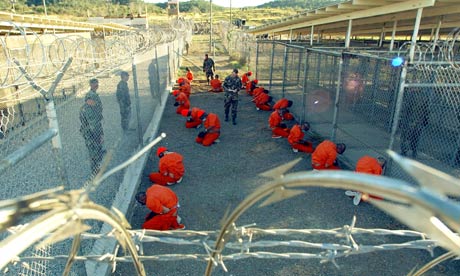
A photograph released on 11 January 2002 shows detainees accused of being Taliban and al-Qaida fighters in Guantánamo Bay prison. Photograph: Getty Images
The detention camp at Guantanamo Bay was established in 2002 to hold the most dangerous of those captured in what the Bush administration called the Global War on Terrorism. Controversy over the facility has simmered ever since. In recent days, it has begun to boil. One hundred detainees, at last count, are staging a hunger strike.
Their lawyers, along with self-proclaimed human-rights activists, are insisting that the U.S. respond by closing Guantanamo, something President Obama has long been eager to do. The questions seldom asked: How would that be accomplished? And what would it solve?
Closing Gitmo would, fairly obviously, require moving out those now detained. But where would they go? We could transfer them to prisons in the U.S., but is there anyone who seriously believes that once on American soil these detainees would become hearty eaters and happy campers?
More likely, having learned that refusing food brings concessions, they would use that strategy again and again. U.S. prison officials would respond as have U.S. military authorities at Gitmo: letting the prisoners protest by not eating (that’s their right), but not letting them die — instead, restraining them, if necessary, and administering the nutrition their bodies require. The not-so-nice term for that: force feeding.
In any case, the option of sending detainees from Gitmo to American prisons is moot for now because Congress, on a bipartisan basis, is adamantly opposed. Four years ago this month, the Senate voted 90 to 6 against spending the money necessary to close the facility in Guantanamo.
A second option: Let the detainees go. A little background may clarify why this, too, is not feasible. The Bush administration brought 779 prisoners to Guantanamo. By the time Obama became president there were 240 left — about two-thirds had been transferred to their home countries or to a third country willing to take responsibility for them. But in some cases, neither of those options was available because it is U.S. policy not to turn detainees over to regimes that might summarily execute or otherwise abuse them. (Remember the Uighur detainees who ended up in Bermuda because U.S. authorities would not send them to China?)
During Obama’s tenure in office, additional detainees have been shipped out. Of the 166 who remain, 46 are considered too dangerous to release or transfer. That leaves 86 detainees who have been “designated for transfer if security conditions can be met.” There has been confusion — and disingenuousness — about what that means. It does not imply that they are innocent. It does not even imply that U.S. authorities are convinced they no longer pose a threat. On the contrary, of those released from Gitmo to date, an estimated 27 percent have returned to terrorist activities.
Of the 86 “designated for transfer” about 50 come from Yemen. As the New York Times has reported, “Mr. Obama himself has indefinitely barred further repatriations [to Yemen] . . . because of Yemen’s active al Qaeda branch.” That branch, al-Qaeda in the Arabian Peninsula, targets both Americans and the Yemeni government that we’re attempting to support. You’ll recall it was AQAP that gave us the Christmas 2009 “underwear” bomber.
Obama’s decision seems sensible to me but not to the Washington Post’s Max Fisher, who calls the situation “almost Kafkaesque in its cruel absurdity.” He asks if there isn’t something “distasteful and unsettling about imprisoning people not because they’ve done anything wrong but because they might in the future?” He does not appear to understand that he’s talking about members of al-Qaeda, the Taliban, and affiliated groups apprehended on foreign fields of battle — not goat herders who were on their merry way to a cousin’s wedding in Afghanistan when they got caught up in the malevolent maw of the U.S. military.
In times of war, presidents have the authority to kill the enemy. In the past, those captured rather than killed were considered lucky. Those doing the capturing rather than the killing were considered humane. It makes no sense — legally, morally, logically — to say that an enemy whom the president can kill with a drone or a SEAL team suddenly undergoes a metamorphosis — speaking of Kafka — transforming into an innocent-until-proven-guilty suspect in a criminal investigation if he is handcuffed rather than buried. Never in the history of armed conflict have prisoners been given such a privilege.
And should our troops come to understand that anyone they capture rather than kill is likely to be pointing a gun at them again before long, they will be incentivized to use lethal force with increased frequency. Would that be preferable from a human-rights perspective? From an intelligence perspective? From any perspective?
Something else you should know: Since taking office, Obama has not sent a single al-Qaeda or Taliban member captured in Afghanistan to Guantanamo. Instead, those captured rather than killed in that country have been detained at a facility that was recently given over to Afghan authority. How do you think the living conditions in Afghan prisons compare to those at Gitmo?
Final point: When Max Fisher referred to Kafka, he was doubtless thinking of The Trial, the story of a man arrested by a shadowy authority that conceals the nature of his crime. But Kafka also wrote “The Hunger Artist,” about a performer who sits in a cage for weeks on end without eating. Eventually, the public loses interest in his “art,” and he dies unnoticed and unmourned. I’m not suggesting that should influence U.S. policy. I am suggesting that Fisher read it.
— Clifford D. May is president of the Foundation for Defense of Democracies, a policy institute focusing on national security.
Wednesday, May 01, 2013
Book Review: ‘Bunker Hill’ by Nathaniel Philbrick
By David M. Shribman
The Boston Globe
April 27, 2013

MUSEUM OF FINE ART
Heroic death of Joseph Warren at Bunker Hill was immortalized in this painting by John Trumbull.
Everyone in these precincts knows this story, or apocryphal strains of it: that the Battle of Bunker Hill really was fought on Breed’s Hill, that June 17 forevermore would be a red date on local calendars, that the heroic Joseph Warren died in battle as a nation was being born. Yet this is but the skeleton of the story Nathaniel Philbrick tells in “Bunker Hill,” a masterpiece of narrative and perspective by an author who has helped us look anew at the voyage of the Mayflower and the passage of George Armstrong Custer.
This time he has produced a Boston book, about a revolution that started in Boston and spread, about a battle that changed the city even as it changed the country, about men who came of age in Boston and in turn prompted Boston to come of age.
There are several unforgettable characters in this book — Warren, immortalized in portraits by John Singleton Copley and John Trumbull, along with Sam and John Adams, British generals Thomas Gage and William Howe, and many others. And seminal events: the fighting in Lexington and Concord, occupation of Boston, Battle of Bunker Hill, and British withdrawal. But the central focus is Boston itself: besieged, beleaguered, brave.
Philbrick portrays the city in vivid terms. “Boston had always been a town on tiptoe,” he writes in a beautiful and evocative sentence that has the little-cat-feet whiff of Sandburg. He says that “the town was just one in a huge amphitheater of humped and jagged islands,” and he explains that “[w]hether it was from a hill, a steeple, or a cupola, Bostonians could plainly see that they were surrounded by two deep and endless wildernesses: the ocean to the east and the country to the west.”
Then he establishes the truth on the ground, that America was growing and would soon outgrow Britain, and he sets forth the fundamental and fateful conviction of many in Massachusetts, where 300,000 people were dispersed in 250 towns:
“There were no unintended consequences in the eighteenth century. If something had happened, someone caused it to happen, and Boston was now the victim of a more-than-decade-old plot on the part of the British ministry to enslave America, to drain this bounteous land of all her resources so that England, an island lost to luxury and corruption, could sustain the fraudulent lifestyle to which it had become accustomed.”
No one really expected war in the period we now regard as the run-up to the conflict at Lexington and eventually Bunker Hill. But gradually much of Massachusetts rose up against the British. At the same time the British army presence in Boston was growing, and Boston was witnessing what Warren called “the power but not the justice, the vengeance but not the wisdom of Great Britain.”
And this, of real importance: The country people outside Boston were becoming radicalized.
What stirred so many wasn’t any specific grievance, but a general sense of diminishing freedom and possibility.
What followed at Lexington — really, a skirmish more than a battle — and then at Concord, and then elsewhere, threw much of New England into tumult.
Boston itself was occupied, a city under siege. “A city had been turned inside out: flushed of its inhabitants and artificially stuffed,” Philbrick writes, “as if by a taxidermist, with a British army that, as military transports continued to arrive in Boston Harbor, eventually approached 9,000 men.”
As the British prepared an offensive on Dorchester Heights the patriots prepared an assault on the high ground above Charlestown, unoccupied and thus impossibly alluring. They ascended Bunker Hill and traversed a ridge over to Breed’s Hill. Charlestown lay empty beneath them. The movement to Breed’s Hill was far more provocative, as it put the rebels in range of British shipping.
With axes and shovels they built a roofless fort that couldn’t stay undetected for long. Cannonballs began to rain in on the patriots, an amateur army without even a horse, with artillerymen not quite sure how to fire a cannon. Warren was killed, along with 114 other Americans. The British, whose dead and wounded numbered 1,054, were the victors, but, as Howe wrote, “The success is too dearly bought.”
At the heart of this volume are two abiding opposites that are not irreconcilable: how isolated, and how central, Boston was during this early period of the Revolutionary War.
For the enduring meaning of Bunker Hill was that it awakened both sides to the breadth and depth of the struggle unfolding in and around Boston. And it prompted one of the most remarkable stories of warfare on this continent or any other, the transport of 42 sledges carrying 59 cannons and other pieces of artillery from the mountain fastnesses of New York to Boston in the dead of winter.
Permit the reviewer to linger on this for a moment, as Philbrick does, for there is hardly any story of New England grit and grandeur to match this one. The hope was for snow (the easier to slide the sledges), but there was more than hope involved. There was Yankee ingenuity: piercing the surface of the Hudson River, for example, so small gushers of water leaked upward, resulting in much-thicker ice. There were great dangers, especially on downslopes of the Berkshire Hills (the cannons outran their escorts).
Many of these weapons ended up on Lechmere Point, with a growing patriot threat in and around Dorchester. Eventually the British determined their position was perilous and indicated they would refrain from razing Boston if the patriots let them escape, which they did. Off to Halifax they sailed, no goodbyes, many good-riddances.
So here the story comes full circle. “By purging itself of loyalists,’’ Philbrick argues, “Boston had, in a sense, reaffirmed its origins.’’ The original settlers were alone on these shores because they wanted to pray as they liked. The later Bostonians now also were alone, to govern themselves (or to tax themselves) as they liked.
“They were no longer fighting simply to preserve their ancient liberties,’’ Philbrick writes, but “were fighting to create a new nation.’’ Thus this is not only a story about Bunker Hill (which in truth occupies only about 15 percent of the book), nor is it only the greatest American story. It is also the American story.
Book Review: 'Bunker Hill' by Nathaniel Philbrick
Monument to a Rout
The British won the 1775 Battle of Bunker Hill, but sustained so many casualties that the Americans also claimed victory.
By THOMAS FLEMING
The Wall Street Journal
April 26, 2013
After writing lapidary narratives about Americans facing disaster and death at sea, Nathaniel Philbrick turned to telling twice- and even thrice-told tales of bravery and ordeal on land. His books on the early Pilgrim settlers and on Custer's Last Stand breathed new life into their dramas, with fresh research and a readiness to admit the worst as well as portray the best about history's heroes and heroines. With "Bunker Hill," Mr. Philbrick turns to one of the most retold tales in the American historical lexicon—how Boston started the American Revolution.
The book opens in June 1775, with 7-year-old John Quincy Adams standing beside his mother, Abigail, in Braintree, Mass., while the thunderous battle of Bunker Hill is in bloody progress 10 miles away. Roughly seven decades later Adams remembered his family's fear that the victorious British army might sally out from Boston and slaughter everyone in its path. An even more painful memory was the later report that their beloved family physician, Dr. Joseph Warren, was among the battle's dead.
Bunker Hill
By Nathaniel Philbrick
Viking, 398 pages, $32.95
Viking, 398 pages, $32.95
Pyle, Howard/Private Collection/Peter Newark American Pictures/The Bridgeman Art Library


Redcoats Howard Pyle's 'The Battle of Bunker Hill' (1898) depicts British troops marching up the smaller Breed's Hill, where most of the actual fighting occurred.
Boston-born Mr. Philbrick, during his years of education, wandered to Pittsburgh and Providence, R.I., but he has been a resident of a Boston outpost, Nantucket Island, since 1986. Such propinquity no doubt accounts for the enthusiasm with which he tells how the hotheaded Yankees launched a revolution that would change the rest of America and the world. He views the Yankees' flaws from all angles, not all of them flattering.
There are vivid descriptions of the brutality of the Yankees' favorite form of public ridicule, coating those whose politics they disliked with bubbling-hot tar and feathers. There is a terrorist named Joyce Jr. who roams Boston wearing a ghastly death mask, warning those who continue to resist the gospel of revolutionary righteousness that they will be the next to writhe beside the tar barrel. There are patriot leaders, like Dr. Benjamin Church, who are in secret correspondence with Gen. Thomas Gage, the British commander of Boston's occupying army. Even the book's hero, Dr. Warren, writes Gage conciliatory letters that might have won him a visit from Joyce Jr. if his words had ever become public.
Only with Boston's chief agitator, Sam Adams, does Mr. Philbrick relent a little. He is content with telling us about Adams's secret determination to win America's independence, long before anyone else dared to utter the word. He plays down the rest of Sam's less than charming persona, which won him the nickname "Judas Iscariot" in the Continental Congress. High on his list of dislikes was George Washington, against whom he plotted tirelessly.
Fame-hungry young George III and his pea-brained advisers chose to magnify Sam's act of defiance, the Boston Tea Party, into virtual treason. They inserted Gen. Gage and his regiments and tried to delete self-government from the colony's charter—a move that united the rest of the colonies on Boston's side. Mr. Philbrick's masterly narrative takes us swiftly through the ensuing 14 months of rising rage to the deadly confrontation on Lexington's green. This bloodshed was followed by more sudden death on Concord's bridge and on the British retreat to Boston. Much after the fact, Ralph Waldo Emerson claimed that Concord's shots were heard around the world. "Bunker Hill" makes it clear that Emerson was not a historian. The shots that reverberated were yet to come.
Dr. Warren displayed reckless courage leading men against the flanks and rear of the retreating British column. With Sam Adams and John Hancock in Philadelphia at the Second Continental Congress, the handsome 34-year-old physician became the patriots' spokesman as musket-toting volunteers from all over New England rushed to Boston to besiege the outnumbered Redcoats.
Simultaneously, Mr. Philbrick informs us, widower Warren, while proposing marriage to the woman who was caring for his four children, may have impregnated a 17-year-old "vixen" whom he frequently visited at a nearby country inn. Here Mr. Philbrick may have carried his fondness for flaws too far. The evidence of Warren's guilt he presents seems weak—mostly second-hand, without a single eye-witness statement from anyone, including the principals.
And so we come to the book's climax, the battle of Bunker Hill. Mr. Philbrick tells the complex story superbly, from the American and British points of view. Again there is that emphasis on the flaws that afflicted both sides. The British commander, William Howe, planned to outflank the Americans by sending his light infantry up the Mystic River beach, on the northern side of the Charleston Peninsula on which Bunker Hill was situated. They would then attack the Americans from behind. But Howe could not persuade the mutton-headed British admiral who controlled Boston harbor to risk one of his sloops-of-war to clear away the 150 New Hampshiremen defending the beach. The light infantry were driven back in slaughterous disarray, and Howe was forced to commit his remaining troops to a costly frontal assault.
The three American colonels in command were from different colonies and barely on speaking terms. A dire shortage of gunpowder loomed with every volley. While the men in the fort on Breed's Hill fought for their lives, several hundred others skulked on nearby Bunker Hill and did nothing to prevent the battle from ending in a rout. In the final melee, with desperate defenders wielding their powderless rifles as clubs, Joseph Warren died from a point-blank gunshot in the face. He had arrived late in the day and made no attempt to give any orders, beyond encouraging the men to stand their ground. It was hardly the performance of a gifted military leader.
There seems little doubt that Dr. Warren was deeply ambivalent about the decision to march men onto Bunker Hill. He knew it was an act of war. Mr. Philbrick tells how, on the morning of the battle, he was stricken by a migraine, which left him disabled for hours. Thomas Jefferson frequently succumbed to this malaise when he confronted a duty he wished he did not have to perform.
Newly appointed Gen. George Washington arrived in Cambridge, Mass., two weeks after the battle. By that time the Yankees had discovered the horrendous British casualties and were calling their rout a victory. Mr. Philbrick appraises the new commander coolly, noting the military disasters of his early career and his less than enthusiastic reaction to the haphazard New England army he had acquired. He quotes with seeming approval a Bostonian who said that if Gen. Warren had "conquered" at Bunker Hill, Washington would have remained in obscurity.
Nevertheless, Mr. Philbrick notes Washington's intention to create a disciplined "Continental" army. Unlike many Bostonians, the general had no illusory hopes of reconciliation with the Mother Country. Mr. Philbrick more or less admits that it was Washington who saw the direction that the revolution must take to win a struggle that would consume seven more see-saw years. Washington's determination to attack finally persuaded the British to negotiate a humiliating, bloodless evacuation that ended the siege of Boston on a note of triumph.
Mr. Philbrick attempts to sum up the past and future by returning to John Quincy Adams. An immense crowd is celebrating the 1843 erection of a monument to the battle of Bunker Hill. The 85-year-old Adams has refused to attend. He denounces the chief orator, Daniel Webster, and his colleague, President John Tyler. Adams considers both of them soft on the issue of slavery. "My life must be militant to its close," he tells his diary. The scene omits a great deal about Adams and the intervening decades, but like most of this gripping book, the core of truth is powerfully evident.
—Mr. Fleming has written more thana dozen books about the American Revolution and many more about America's other wars.
A version of this article appeared April 27, 2013, on page C7 in the U.S. edition of The Wall Street Journal, with the headline: Monument to a Rout.
Rick Atkinson's new book looks at Pa.'s 28th Infantry, war in western Europe
Updated: 04/14/2013 09:28:43 PM EDT

In a famed photograph, members of Pennsylvania's 28th Infantry Division triumphantly march down the Camps Elysees in Paris, with the Arc de Triomphe in the background. (Submitted)
The photo of Pennsylvania's own 28th Infantry Division triumphantly marching down the Champs Elysees in Paris past cheering crowds was so inspiring it ended up on a postage stamp.
According to a new book by Pulitzer Prize-winning military historian Rick Atkinson, the decision to have the 28th march through the French capital was made solely by a "bemused" Gen. Dwight Eisenhower, the Supreme Allied Commander.
In "The Guns at Last Light: The War in Western Europe, 1944-1945," Atkinson explains that French President Charles De Gaulle pleaded with Eisenhower for two American divisions to be sent to Paris as a "show of force."
Instead,

Author Rick Atkinson, whose 'The Guns at Last Light,' is the third of his World War II 'Liberation' trilogy. Part of the book focuses on Pennsylvania's 28th Infantry Division. (Submitted)
"I don't think he put a lot of thought into what unit was chosen," Atkinson said in a phone interview. "I think it was a target of opportunity. The 28th was nearby. De Gaulle had pressed him for two divisions for security in Paris. Eisenhower decided to divide the baby in half. He wasn't going to have two divisions. The 28th was told to get spiffy. They went to the Bois de Boulogne, a big park outside Paris, and then spent a rainy night getting ready."
The photo is ironic, Atkinson said, because while it appears the 28th is marching victoriously through the French capital at or near the war's end, they actually went on to participate in some of the fierecest fighting in the European Theatre, including the Battle of Hurtgen Forest and the Battle of the Bulge.
"It is ironic because proud as they are, glorious as they look, their destiny is very harsh," Atkinson said. "The Hurtgen Forest and the Bulge, among other things, await them.
"The Guns at Last Light", which will hit bookstores on May 14, is the third book in Atkinson's "Liberation Triology" about World War II. The first book in the series, "An Army at Dawn: The War in North Africa, 1942-1943," won a Pulitzer Prize for history and was a New York Times best-seller. The second book, "The Day of the Battle: The War in Sicily and Italy, 1943-1944," also was a New York Times best-seller.

An images of the cover of the book "The Guns at Last Light' by Rick Atkinson. (Submitted)LightLight," which will hit bookstores on May 14, is the third book in Atkinson's "Liberation Triology" about World War II. The first book in the series, "An Army at Dawn: The War in North Africa, 1942-1943," won a Pulitzer Prize for history and was a New York Times best-seller. The second book, "The Day of the Battle: The War in Sicily and Italy, 1943-1944," also was a New York Times best-seller.
His new book covers the Western European campaign, starting in May 1944 with the planning of Operation Overlord, the Allied invasion of Normandy, and ending on Victory in Europe Day, or V-E Day, in May 1945. The book comes in at a whopping 851 pages, but notes and a source list account for more than 200 pages.
"The war gets so much bigger," Atkinson said of the Western European campaign. "It's really industrial-strength by this point. There's roughly 60 American divisions in Western Europe. I started in North Africa with company-sized engagements."
In addition to the battles, Atkinson said he is always drawn to the characters in war, including Eisenhower, Gen. George Patton and British Prime Minister Winston Churchill.
"The thing I enjoy the most about writing about war are the figures, and they're pretty extraordinray in this book," he said.
Another character from the European campaign that does not get much credit is Maj. Gen. Norman Cota, the 28th ID's commander, Atkinson said. Cota is a great example of the "fickleness of fate," he said.
"He's a guy who leads a parade through Paris, and then he's in a hellhole that is the Hurtgen Forest and essentially shot to pieces," Atkinson said. "The next thing he knows he's got the Fifth Panzer Army falling on his division, and the division is fighting for its life. Here's a guy who's really extraordinary at Omaha Beach, he's extraordinary at St. Lo, he's doing all the things right ... then life turns on a dime, and he's fighting for his career."
The 28th ID also deserves more credit than it sometimes gets, Atkinson said.
"I think their performance in the Battle of the Bulge was quite remarkable," he said. "I think the 28th, as difficult as the war is for them in the Hurtgen and the Ardennes, is really to be lauded."
Atkinson, who lives in Washington, D.C., was a staff writer and editor at The Washington Post for more than 20 years. He spent about 14 years researching and writing the Liberation Trilogy.
In addition to the triology, his other books include "The Long Gray Line," "Crusade" and "In the Company of Soldiers," about the invasion of Iraq in 2003, during which he was embedded with the 101st Airborne Division.
He said he plans to continue to write about the military, but he said his next book will probably be about a war other than World War II.
"I think 14 years in World War II is probably enough," he said.
bradrhen@ldnews.com; 272-5611, ext. 145
Buying the book
"The Guns at Last Light" will be available May 14. The 851-page hardcover edition will cost $40. The audio version will be $29.99.
What Should We Do about Guns?
NRO Interview: John R. Lott
http://www.nationalreview.com
May 1, 2013

KATHRYN JEAN LOPEZ: Gabby Giffords has accused the Senate of being in the grips of the gun lobby. Is there another explanation for the defeat of the Manchin-Toomey bill?
LOPEZ: What’s wrong with the Manchin-Toomey bill?
LOPEZ: What kind of legislation would you propose?
LOPEZ: You write that “not a single multiple-victim public shooting has involved a machine gun.” So should they be widely accessible?
LOPEZ: How are large-capacity ammunition magazines “misunderstood”?
LOPEZ: “Obama not only disagreed with me about gun control, he acted as if my views were evil,” you write. Is it possible they are? Do you worry that you are contributing to a culture of violence?
http://www.nationalreview.com
May 1, 2013
After the defeat of the Manchin-Toomey background-check bill, and the subsequent demonization of the Senate, Senators Manchin and Toomey are reportedly back at work on bipartisan legislation addressing gun control. John R. Lott, author of the new book At the Brink, who has been researching gun policy for decades, talks about the state of the debate with National Review Online’s Kathryn Jean Lopez.
KATHRYN JEAN LOPEZ: Gabby Giffords has accused the Senate of being in the grips of the gun lobby. Is there another explanation for the defeat of the Manchin-Toomey bill?
JOHN R. LOTT: Yes, there is. The politicians were simply representing the voters in their districts.
The accusation that politicians were attempting to please the gun lobby at the expense of their constituents, which is based on the oft-repeated assertion that 80 to 90 percent of the public say they favor background checks, is simply not credible. The survey questions on which this statistic is based proved nothing more than that respondents wished to disarm criminals. The questions posed were about a hypothetical, idealized system of background checks, not about the actual legislation facing Congress.
A better survey was recently released by the Pew Research Center. It asked: “What word best describes how you feel about the Senate voting down new gun control legislation that included background checks on gun purchases?” Many voters were upset that the bill didn’t pass, but a very substantial group were relieved. Overall, 47 percent were disappointed and 39 percent were relieved. Not surprisingly, opinions varied drastically across political affiliation. Among Republicans, 51 percent were relieved and 34 percent were disappointed. Among independents, the split was 48 percent relieved and 41 disappointed. In sharp contrast, only 22 percent of Democrats were relieved, while 67 percent were disappointed.
These numbers show that Republican senators were representing their constituents’ views. The Democratic voters who supported the legislation were never going to support Republicans in any event.
LOPEZ: What’s wrong with the Manchin-Toomey bill?
LOTT: Senator Joe Manchin got it backwards this past weekend when he told Fox News Sunday: “If you’re a law-abiding gun owner, you’ll love this bill. If you’re a criminal, if you’ve been mentally adjudicated through a court, you probably won’t like it.” On the contrary, the current background-check system is one in which law-abiding citizens, not criminals, are delayed needlessly. Expanding background checks and adding millions more names to this system will just make this problem worse. The current system needs to be fixed before being expanded.
Unfortunately, if you believe Senator Manchin, the New York Times, Vice President Joe Biden, and Senator Harry Reid, the Senate will be voting on the Manchin-Toomey bill again before the end of the year.
The bill doesn’t live up to its lofty promises. In the days before the vote, President Obama asserted: “As many as 40 percent of all gun purchases take place without a background check.” He also claimed that “background checks have kept more than 2 million dangerous people from buying a gun.” But both stats are false.
Start with the 40 percent figure. That number (which is actually 36 percent) comes from a very small study covering purchases from 1991 to 1994. Not only are those data two decades old, but they covered sales before the federal Brady Act took effect on February 28, 1994. That act required federally licensed dealers to perform background checks.
And what is more, President Obama conveniently forgets that the researchers included transfers, not just guns sold, in this number. Most significantly, the vast majority of these transfers involved within-family inheritances and gifts. Counting only guns that were sold gives a very different perspective, with only 14 percent of sales not going through federally licensed dealers.
But even that number is much too high, as there were biases in the survey. For example, two-thirds of federally licensed dealers at the time were so-called kitchen-table dealers who sold guns out of their homes, and most buyers surveyed were probably unaware that these individuals were indeed licensed.
The survey also found that all gun-show sales went through federally licensed dealers. If Obama really trusts this survey, he should stop raging about the “gun-show loophole.”
The truth is that the databases the government uses to determine eligibility for gun purchases are rife with errors. This is the same problem we’ve experienced with the “no fly” list. Remember the five times that the late senator Ted Kennedy was “initially denied” flights because his name was on the list? His name was similar to that of someone we really did want to keep from flying. By Obama’s method of counting, that means the “no fly” list stopped five flights by terrorists.
So do background checks catch many criminals? The answer is: No. Almost everybody the system catches is a “false positive” — somebody who actually has a right to own a gun.
For gun purchases, the Bureau of Alcohol, Tobacco, Firearms and Explosivesdropped over 94 percent of “initial denials” after just the first preliminary review. The annual National Instant Criminal Background Check System report explains that these cases were dropped either because the additional information showed that the wrong people had been stopped or because the covered offenses were so many decades old that the government decided not to prosecute. At least a fifth of the remaining 6 percent were still false positives.
All these denials mean delays for law-abiding gun buyers. Although this is merely an inconvenience for most people, initial denials cause dangerous delays for people who suddenly legitimately need a gun for self-defense, such as a woman who is being stalked by an ex.
Beyond these initial denials, another 6 percent of checks fail to be completed within two hours, with most of they delayed checks taking up to three days.
Manchin and Obama ignore what happens to those who suddenly feel threatened. A gun really can make a huge difference in being able to defend oneself against assailants. Indeed, my own research suggests that these delays from the background-check system probably increase violent crime, even if ever so slightly. Perhaps not too surprisingly, rape appears to be the crime most sensitive to these delays.
LOPEZ: What, if anything, does the bill get right?
LOTT: The bill undoubtedly contains positive features. It makes it easier for people with concealed-handgun permits to buy guns. As they have already gone through background checks, the Manchin-Toomey bill would do away with the additional background check at the time of purchase that is currently required. This is in line with what some states already do, but the bill would expand that practice to cover all concealed-permit holders, who currently numberover 9.3 million.
Another useful feature of the bill is that people will be able to buy guns outside their home states. And veterans who have suffered from post-traumatic-stress disorder would have a better chance of being able to restore their right to own a gun.
But even if people feel good about “doing something,” they shouldn’t delude themselves into thinking that this bill would reduce crime. Background checks simply aren’t stopping criminals. The numbers for 2010, the last year with available statistics, are instructive. With 76,142 denials, prosecutions were justified in only 42 cases, and there were only 13 convictions.
Nor does research find that federal or state background checks have reduced crime. A 2004 National Academy of Sciences panel concluded that the Brady background checks didn’t reduce any type of violent crime. And later studies by criminologists and economists have continued to fail to find a beneficial effect.
LOPEZ: What kind of legislation would you propose?
LOTT: If we really want to stop mass public shootings – the type of attack that motivated the Manchin-Toomey bill – we need to get rid of dangerous “gun-free zones.”
I have long warned about the dangers of gun-free zones, and my latest book, At the Brink, provides additional detailed discussion. If a violent criminal were stalking you, would you put up a sign in front of your home stating that your home was a gun-free zone? My guess is that you wouldn’t. Indeed, I have debated a lot of gun-control advocates, and I have never met someone who would put up such a sign in front of their home. Why? Because instead of deterring crime, such a sign would be an invitation to the criminal to attack.
Yet we put up these signs in front of all sorts of other places. At some point, Americans are going to have to face the obvious. With just two exceptions, all the multiple-victim public shootings in the U.S. since at least 1950 have taken place in places where guns are banned. All the shootings in Europe have occurred in places where guns are banned.
Take the tragic attack in Aurora, Colo., last July. There were seven movie theaters showing the premiere of the Batman movie within a 20-minute drive of the killer’s apartment. Only one of those posted signs banning permitted concealed handguns. The killer didn’t go to the movie theater closest to his home. He didn’t go to the movie theater that advertised it had the largest auditoriums in the state of Colorado — surely something that would be attractive to someone who wanted to kill as many people as possible. Instead, the killer went to the one movie theater where the victims weren’t allowed to defend themselves.
From attacks at malls to attacks at schools, the killers in these mass shootings continually pick for their targets places where victims can’t defend themselves.
LOPEZ: You write that “not a single multiple-victim public shooting has involved a machine gun.” So should they be widely accessible?
LOTT: I try to limit my advice to policies that we can study, and that means laws that have been changed in enough different locations in recent years that we can actually test what impact the different rules have on crime rates. There have been only a couple of national changes in these laws since the beginning of the 1930s. That’s not enough to disentangle all the other factors that were changing at the same time. It might make sense to let some states try out different rules just so we can do research on these types of questions, but absent that there is simply not enough information to do anything more than guess about what effects a policy dealing with machine guns would have.
LOPEZ: How are large-capacity ammunition magazines “misunderstood”?
LOTT: The same misperceptions keep on popping up again and again, even though we have tried restrictions on magazine size in the past, and they have clearly failed. There has been extensive research by criminologists and economists showing this, and even the research funded by the Clinton administration didn’t find evidence of any beneficial effect.
As with so many other restrictions on guns, banning high-capacity magazines will primarily affect law-abiding gun owners. The reason is technical: Magazines are the simplest part of a gun to make — a magazine is just a box with a spring in it.
A potential mass shooter can easily take along a large number of magazines, and it takes only a second or two to swap in a new magazine. By contrast, the over 9.3 million concealed-handgun permit holders are unlikely to carry more than the magazine that they have in their gun.
LOPEZ: “I don’t believe that people should be able to own guns,” Obama told you in a private conversation in the ’90s. Why do you keep bringing this up? There’s no evidence that he believes it today, is there?
LOTT: Don’t take my word on Obama’s views on guns; look at the positions he took on guns during his time in Chicago. Obama supported a ban on handguns in 1996, and a ban on the sale of all semiautomatic guns in 1998 (a ban that would have encompassed the vast majority of the types of guns sold in the U.S.). In 2004, he advocated banning gun sales within five miles of a school or park (essentially a ban on virtually all gun stores), and he has worked in other ways to support bans. He was on the board of directors of the Joyce Foundation, the largest private funder of research supporting the goal of banning gun ownership in the United States. Since he was reelected last November, Obama’s rhetoric and the extremely inaccurate claims he has made show how intensely he feels about this issue.
LOPEZ: “Just as [Obama] used the financial crisis of 2008 to push governmental intervention in the economy to a previously unimaginable level,” you write, “he took advantage of the fear and outrage after Sandy Hook to pursue a goal he has cherished for many years — the disarmament of American civilians.” Is that a realistic scenario?
LOTT: Obama and congressional Democrats understand that there is not enough popular support for simply confiscating people’s guns. Instead, they aim to gradually reduce the number of guns through imposing various taxes and fees and other restrictions that they increase over time.
While Democrats fight against taxes on the poor and oppose requiring even free photo IDs from voters because they impose too much of burden, they seem to be doing everything possible — fees, expensive training requirements, and requiring photo ID — to make it next to impossible for the poor to own guns.
The Obama administration made the extremely unusual move of lobbying Democrats in the Colorado state house for a bill that would charge people a fee when they purchase a gun. The day before I went to Colorado to start my book tour for At the Brink, Vice President Biden promised Democratic state legislators help from the White House next year if they voted the right way on gun control. He also threatened that the White House would help recruit primary opponents to run against those who voted the wrong way. Democrats voted down Republican amendments that would have exempted poor people from paying the fee and capped the transfer fee at a maximum of $35.
LOPEZ: “Obama not only disagreed with me about gun control, he acted as if my views were evil,” you write. Is it possible they are? Do you worry that you are contributing to a culture of violence?
LOTT: I don’t believe that anyone would consciously support regulations that would increase violence. Reducing crime and increasing safety motivate my research and writings, and I think that the overwhelming evidence supports the positions that I take.
Obama obviously feels strongly about gun control. I am not the only one he has viewed as evil on the subject. Sharing the stage with some of the heartbroken families from Newtown, Conn., after the Senate had voted down more gun regulations, he attacked Republicans as being unwilling to “protect the lives of all our children.”
It is one thing for Obama to claim that he disagrees with others about what works. It is something entirely different to say that Republicans don’t care about the deaths of young children or that they are purposefully letting those deaths happen.
People who oppose Obama’s policies could just as easily say that by not fixing the background-checks system that stops 2 million law-abiding citizens from buying guns, and delays an additional 12 million, that Obama also wants people to die — that he wants to prevent people who quickly need guns for protection from obtaining them.
But would demonizing our president that way be useful? Would it really help get everyone together to make a deal?
To me, the debate has always been about safety. The vast majority of academic research supports my findings. The debate has been between those who argue that there is a benefit from those who own guns and those who claim that there is no significant effect on crime.
— Kathryn Jean Lopez is editor-at-large of National Review Online.
Tuesday, April 30, 2013
How true is 'Pain & Gain'?
By David Haglund and Forrest Wickman
http://www.slate.com
April 26, 2013





http://www.slate.com
April 26, 2013
At the opening of Pain & Gain, the new Michael Bay movie starring Mark Wahlberg, we are told that, “unfortunately,” what follows is a true story. It’s meant as a joke, of course, but it calls your attention to the movie’s supposed fidelity to the facts. Later, during an outlandishly gruesome scene, some superimposed text says, “This is still a true story.” During the credits, we get where-are-they-now photos of the principals, reminding us that these are all real people. And the movie’s poster declares flatly, in all caps, “THIS IS A TRUE STORY.”
Is it? By Hollywood standards, perhaps. In late 1994 and early ’95, a crew of thugs led by bodybuilder Daniel Lugo (Wahlberg) did kidnap a Miami businessman and get him to sign over all his worldly possessions. What follows in the film more or less adheres to a very rough outline provided by the novella-length, three-part, highly detailed series written by Pete Collins and published in the Miami New Times over a decade ago. Not surprisingly, many details, and a number of significant characters, are dropped from the movie. A lot of new, fictional detail—and one largely made-up character—takes its place. When the movie first tells us that it’s a true story, we’re seeing something that didn’t happen. When we’re told it’s “still a true story,” we’re watching one invented character watch a semi-fictional character do something that sorta kinda took place.
In addition to the usual Hollywood streamlining and the amping up of certain scenes, the changes seem largely designed to make the central criminals more sympathetic. Whether you think that’s a respectable thing to do will depend on what you think of their actual story—and, perhaps, of the movies in general.
Obviously, lots of spoilers follow.
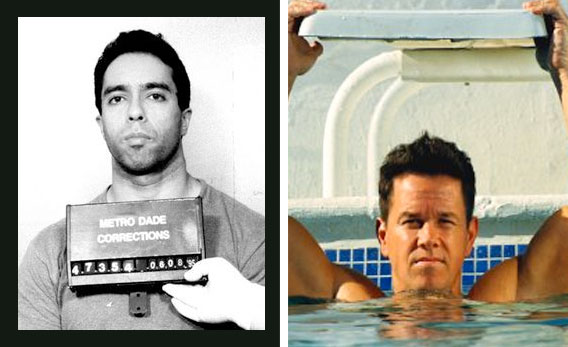
Daniel Lugo
(L) Daniel Lugo by Metro Dade Corrections, (R) Photo courtesy of © 2013 Paramount Pictures. All Rights Reserved.
The then 30-year-old from New York, played by Wahlberg, rose quickly up the management chain at Sun Gym, got the gang together—which, in real life, included several bit players—and spearheaded their violent schemes. His criminal activities were more various than the movie depicts: In addition to his prior fraud conviction, he was running a lucrative Medicare scam, in which he bought information about Medicare recipients and bilked the government for bogus medical services. Movie-Lugo appears to be single; the real Lugo was married—twice. Both his wife and his ex-wife played tangential roles in the gang’s crimes, as did Lugo’s girlfriend (about whom more below). Most notably, unlike Wahlberg’s character, the real Lugo was not stupid. He “was a smart-ass criminal,” according to the P.I. who helped take him down. “He wasn’t some brute street guy.” He did not, as far as I can tell, attend any self-help seminars, nor have I found instances in which he cited Rocky or Michael Corleone as role models. If he ever wore vanilla-scented cologne, Pete Collins doesn’t mention it. The victim of his first kidnapping recognized him by the sound of his voice.
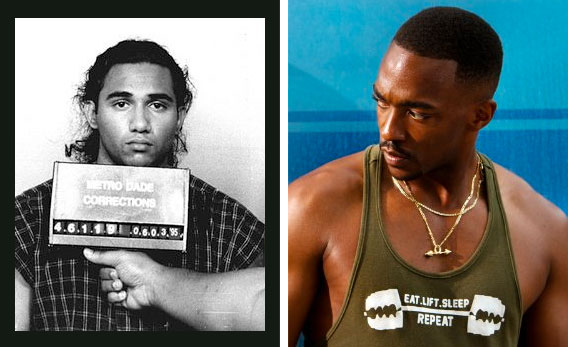
Adrian Doorbal
(L) Adrian Doorbal by Metro Dade Corrections, (R) Photo courtesy of © 2013 Paramount Pictures. All Rights Reserved.
Doorbal (Anthony Mackie), whose given first name was Noel, was a handsome bodybuilder whose steroid use had indeed rendered him impotent. He saw a doctor for hormone injections to fix that problem, but he did not meet his future wife, Cindy Eldridge (called Robin Peck in the movie), at those appointments. (She did recommend the doctor, though.) The need to fund those injections did not motivate Doorbal’s crimes; he was reportedly in good shape financially, because Lugo had given him a cut of profits from the Medicare scam. The movie depicts Doorbal as fairly timid, but, according the gang’s first target, “Doorbal just loved violence,” and seemed like “the kind of guy you’d imagine had fun killing cats and dogs as a kid.” It was Doorbal, not Lugo, who murdered Frank Griga, the gang’s second target. Doorbal and his wife did not have a whirlwind romance: She turned down his first proposal of marriage, and he began dating a stripper; later he and Cindy got back together and married at a courthouse. Cindy helped Doorbal clean up the blood in his townhouse after the Griga murder, though she apparently did not know exactly what had transpired at the time. As in the movie, she divorced Doorbal during the trial and testified against him.
“Paul Doyle” - Carl Weekes (and others)
(L) Metro Dade Corrections, Carl C. Weekes by Mugshots.com, (R) Still from "Pain and Gain"/© 2012 - Paramount Pictures
The character played by Dwayne Johnson is a composite, based primarily on Carl Weekes, with shades of Jorge Delgado (bottom left in the photo above) and Mario Sanchez (top left). Weekes was a recovering addict and ex-con who’d found Jesus and moved to Miami to get help from a cousin who worked at Sun Gym. (He never went to work at a church; no elderly gay priest came onto him.) Both were roped into Lugo’s scheme, but they only helped out with the kidnapping of the gang’s first victim. They declined to participate in subsequent crimes. Weekes, like Doyle, was much kinder to that first victim than the other men. He was also quite small—unlike Mario Sanchez, a weightlifting instructor Lugo paid to serve as an intimidator during the first kidnapping, and who appears to be another inspiration for Doyle. In real life, the third key member of the gang was Jorge Delgado (about whom more below). Like Doyle in the movie, Delgado testified against Doorbal and Lugo and received a 15-year sentence. (Lugo and Doorbal got the death penalty.) Pain & Gain shows a mugshot of “Doyle” at the end of the movie; it’s not clear to us who that mugshot is. (It does not resemble the three men pictured above.)
“Sorina Luminita” - Sabina Petrescu
Bar Paly.
Paramount Pictures.
The Romanian stripper in Bay’s film comes off as a busty, blonde cliché, but her character is taken faithfully from the pages of the Miami New Times. A former runner-up for Miss Romania, Sabina Petrescu—portrayed in the film as Sorina Luminita, by model and actress Bar Paly—snuck into the U.S. across the Mexican border, in the trunk of a car. By the time Lugo approached her to (as Lugo said) appear in a music video, when she was about 25, she had become an exotic dancer and had modeled for Penthouse. Lugo pawns her off on Doyle in the film, but the real-life Petrescu stuck with the married Lugo through the bitter end, even fleeing with him (and his parents) to the Bahamas. And Lugo really did convince her he was in the CIA, asking her to work for them as a “honey pot” to lure their prey. Why did she believe this crazy story? Collins writes that “she was … dim.” One of the prosecutors, after the scheme, made a similar assessment: “You see, God blessed Sabina Petrescu with a beautiful face and a beautiful body,” the prosecutor said, “but not with any book smarts or common sense.
“Victor Kershaw” - Marc Schiller
Tony Shalhoub.
Paramount Pictures.
Tony Shalhoub’s character is more superficially detestable than the man in the Collins articles who inspired him, Marc Schiller. Unlike the man we meet in those pieces, Kershaw is a scrawny slimeball who’s arrogant about his money. Kershaw drives a BMW with a license plate that says “Miami Bitch,” while Schiller drove a Toyota 4Runner. Kershaw meets Lugo at the gym; Schiller never went. He was targeted first not by Lugo, but by a former employee and associate named Jorge Delgado, a Sun Gym member who had fallen under Lugo’s sway (one of the reasons Delgado and Schiller had a falling out). But Bay leaves out the real story’s final twist: After testifying against his assailants, Schiller was arrested by the FBI for organizing his own Medicare scam that siphoned off about $14 million. He pled guilty, and served 46 months in jail—though he now insists he was innocent, and just too exhausted to defend himself. (For what it’s worth, the judge from the Lugo case made the highly unusual gesture of testifying on Schiller’s behalf in that trial.) Schiller also believes he’s been unfairly depicted in the media before. As for Pain & Gain, “There is no resemblance to me at all,” he said, after watching the trailer. “I was always a humble, family person.” He has written a book about the ordeal.
Ed Du Bois
Ed Harris.
Paramount Pictures.
Portrayed in the film by Ed Harris, the real-life Ed Du Bois was not retired with his beautiful wife when he got the call from the Sun Gym gang’s first victim, Marc Schiller. Rather, he was working for the NFL as a security consultant for Super Bowl XXIX in Miami, in addition to operating his P.I. firm, inherited from his father. As in the movie, Du Bois wasn’t sure whether to believe Schiller at first, but soon proved instrumental in compiling evidence against the gang, while the police remained skeptical. “How does it feel,” he later asked one police investigator, “to have blood on your hands?” Though the movie does not show this, Du Bois also had a leg up in investigating the case because he knew the owner of Sun Gym, John Mese (played by Rob Corddry), who conspired with Lugo. According to the New Times, Du Bois is still working as a private investigator.
Their Crimes and Capture
The Sun Gym gang carried out the Schiller kidnapping in much the way the film depicts, though the movie borrows their ridiculous costumes from an idea they never carried out: posing as trick-or-treaters and nabbing him on Halloween. The real gang does not seem as bumbling as the movie’s trio for the most part, though they did try and fail to carry out their missions on several occasions. They held Schiller for weeks not because he was resisting, but because the paperwork took time. Their failed attempt to finish him off is portrayed pretty accurately in the film—though there is no indication in the Collins story that either Lugo or Doorbal felt squeamish about killing him.
The movie murders of Frank Griga and Krisztina Furton also seem fairly true to life, though, as noted above, Doorbal killed Griga—and not, as far as we know, accidentally. The Sun Gym gang disposed of their bodies roughly as they do in the movie. Lugo (not Delgado) briefly incinerated the bodies outdoors, but he did not use a grill, and no one saw him.
None of the men were involved in shootouts with the cops. No one lost a toe, and no dog walked around carrying the toe of a Sun Gym gang member in its mouth. Doorbal and Delgado were arrested at their homes; Lugo was tracked to a hotel in the Bahamas. He was handcuffed and returned to Miami on a commercial flight.
Subscribe to:
Posts (Atom)