Tuesday, June 21, 2016

MysteryPeople Q&A with J. Todd Scott


June 8, 2016
J. Todd Scott
J. Todd Scott’s debut, The Far Empty, tells about a deputy pulled into the cold emotional war of Stanford “Judge” Ross, a crooked Texas sheriff and his son, Caleb, who believes he murdered his mother. It is an uncompromising look at masculinity, western society, and emotion. Mr. Scott was kind enough to talk about the novel, its Texas setting, and writing. He’ll be at BookPeople to speak and sign his debut, joined by fellow novelist of the Southwest C.J. Howell, this Friday, June 10th, at 7 PM. 
MysteryPeople Scott: I was telling some retired Texas lawmen about The Far Empty and they recalled events it reminded them of. Is it based on an actual situation?
J. Todd Scott: The story of former Presidio County Sheriff Rick Thompson, who was originally given a life sentence for his role in smuggling more than a ton of cocaine from the small Mexican village of San Antonio del Bravo to a ranch outside of Alpine, Texas (and that was ultimately discovered in a seized horse trailer in Marfa) is well-known in the region, and is definitely echoed in The Far Empty. Sheriff Thompson was an iconic lawman recognized as an anti-drug crusader and a pillar of his community, and claimed at the time of his arrest that he was actually conducting his own reverse undercover sting operation to catch drug traffickers in Dallas! While there are some conscious similarities, my Sheriff Stanford Ross was not specifically based on Thompson, whose life sentence was cut to thirty years in January of this year.
MPS: You were a DEA agent working in South Texas. What did you want to get across to the reader about the area?
JTS: I came to Texas (and El Paso) sight unseen; I knew nothing about the area, but quickly fell in love with its rich cultural heritage, the history, and the austere beauty. It’s a unique place, and even now still has a certain “wild west” feel unlike any other place I’ve lived. I wanted the reader to experience that if possible.
MPS: Why did you give Caleb the only first person voice in the book?
JTS: I definitely had Caleb’s voice in my head from the beginning. In fact, I had the first line: My father has killed three men…written down for almost a year before I wrote the book itself. Because of that, it was only natural to keep that voice throughout the narrative; plus, it gave Caleb’s character a certain amount of intimacy for the reader. One question throughout the book is how much of what Caleb remembers – and is writing down in his diaries, which is the actual narrative mechanism for his first person voice – is actually true? There’s the view everyone else in Murfee has about his father and his mother, and then there are his own, perhaps very shaky memories.
MPS: You use a lot of Texas legends and history, particularly in the beginning. What was the particular use of that tool for you?
JTS: I wanted this to be a “Texas” book, because I very much wanted Stanford Ross to be a “Texas” character. He sees himself in almost this mythic way, carrying on the traditions of all the hard men and lawmen that came before him: men who “tamed” the West, one bullet at a time. Also, the entire region is steeped in fascinating history, and I couldn’t imagine writing a book set there and not draw on that.
MPS: The Far Empty has drawn comparisons to Cormac McCarthy, Dennis Lehane, and Jim Thompson. As a first time author, did you draw from any influences or just draw from your own experience?
JTS: Well, those are wonderful but undeserving comparisons. They are great writers, and in many ways, I’m just a guy who wrote a book, and am still learning how to do it. As a first time author (and this is only the second full novel I’ve ever completed), you’re desperately searching for your own voice, but I’d be lying if I said those writers weren’t influences. As a reader I’m a huge fan of all three of them, and my “Judge” Ross was meant to consciously recall McCarthy’s character in Blood Meridian.
MPS: Do you have another book in the works?
JTS: I actually have three books coming down the pipe. There are already two more “Big Bend” books scheduled, tentatively titled High White Sun and This Side of Night. They’re due out next year and the year after, and they continue the stories of some (but not all) of the characters in The Far Empty, and introduce some new ones as well. After those, I have a completely new stand-alone novel for Putnam, titled Thirteen Days. It’s another Texas crime/suspense novel set in and around Midland/Odessa.
J. Todd Scott will be speaking and signing his debut this upcoming Friday, June 10th, at 7 PM. He’ll be joined by C. J. Howell, speaking and signing his new book, Hundred Mile View. You can find copies of The Far Empty on our shelves and via bookpeople.com. 
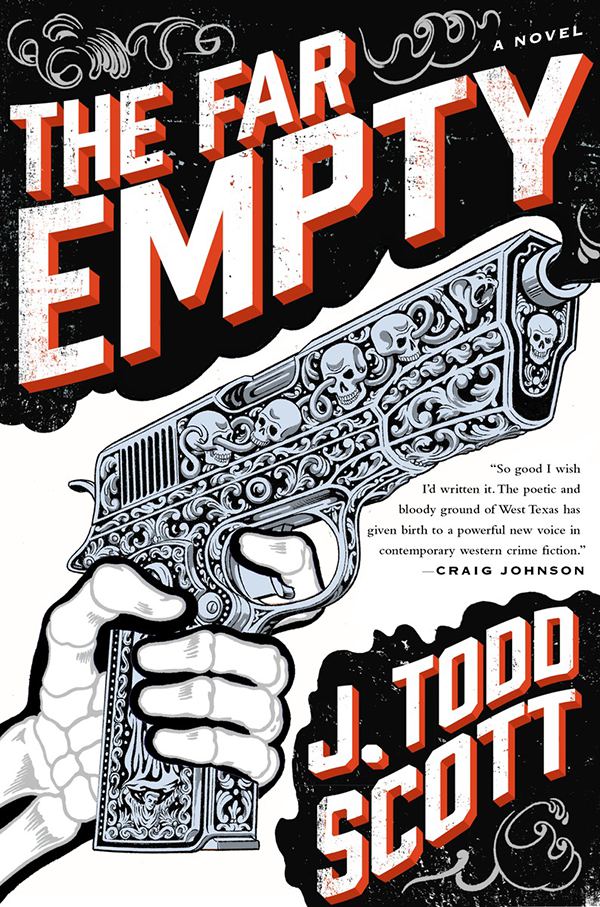
MysteryPeople Pick of the Month: THE FAR EMPTY by J Todd Scott

The Southwest has become a popular backdrop for crime fiction of late. It operates in both the parallel worlds of modern drug trafficking and historic legend of the old west. Authors utilize a brutal landscape and its history in combination with the brutality of humanity. J Todd Scott, a former DEA agent who worked in that area, uses it to full effect in his debut novel, The Far Empty.
Each chapter follows the point of view of one of the citizens of of the fictional Murfee, Texas or one of their neighbors on the other side of the border. The first one is if Caleb Ross, an awkward teenager and the only person whose side gets told in first person. He discusses his life and the disappearance of his mother. Caleb believes it was murder and knows who the killer is, his father Stanford “Judge” Ross, Murfee’s mythic sheriff.
New deputy Chris Cherry, a young man who returns home after his football career and marriage have been waylaid by an injury, discovers a decomposed, flex-cuffed body. Caleb is convinced it is his mother. Soon, they are in a deadly dance with the judge, pulling a school teacher, drug runners, and others into their tempest of violence.
Scott’s Murfee appears to be a stand in for Marfa, Texas, a town that shares some of its sordid history and mysterious light formations. He uses the state’s legends, history, and its legacy of bloodshed. He examines violence by what parks it and creates a circle of it, avoiding literary distance by tying violence to his characters and making it utterly human.
The Far Empty is is a look at a land and how its history shapes those who live on it today. It’s a place where even the innocent become corrupted. The big land is empty of many things, especially mercy.
The Far Empty comes out Tuesday, June 7th. Pre-order now! J Todd Scott, joined by C J Howell, will be speaking and signing his debut on Friday, June 10th, beginning at 7 PM. All BookPeople events are free and open to the public. 

Monday, June 20, 2016

Loretta Lynch: ‘Islam,’ ‘ISIS’ to be Scrubbed from Orlando 911 Tapes


June 19, 2016


U.S. Attorney General Loretta Lynch revealed Sunday that the government will release the transcripts of the 911 calls made by the Orlando terrorist during the attack last Sunday — scrubbed of any references to Islam or the Islamic State (ISIS).

She told Chuck Todd on NBC News’ Meet the Press that the “FBI is releasing a partial [printed] transcript of the killer’s calls with law enforcement, from inside the club,” but added: “What we’re not going to do is further proclaim this man’s pledges of allegiance to terrorist groups, and further his propaganda.”
Todd responded, incredulously: “We’re not going to hear him talk about those things?”
Lynch added: “We will hear him talk about some of those things, but we are not going to hear him make his assertions of allegiance and that.”
It is widely known that the terrorist, Omar Mateen, pledged allegiance to the Islamic State — also known as the Islamic State in Iraq and Syria, or ISIS — during the attack.
CNN reported last Sunday, citing a U.S. official: “Mateen called [911] dispatchers about 20 minutes into the attack, pledging allegiance to ISIS and mentioning the Boston Marathon bombers.”

Last week, the Washington Post reported that Mateen had called a local news station and said: “I did it for ISIS” and “I did it for the Islamic State.”
President Barack Obama himself has acknowledged that Mateen referred to ISIS (or “ISIL,” as the Obama administration insists on calling the group, swapping “Levant” for “Syria” for unknown reasons). However, he has insisted that Mateen likely was a “lone wolf,” and that any connection between the terror attack and radical Islam is either false or unhelpful to identify.
He defended his refusal to use the phrase “radical Islam,” saying that “there is no magic to the phrase “radical Islam.” He argued that connecting terrorists to Islam only furthered the interests of groups like the Islamic State, which wish to foment a war between the Islamic world and the West.
Lynch appears to be carrying out that instruction to an absurd extreme. While she claimed that “we’re trying to get as much information about this investigation out as possible,” she and the rest of the administration are deliberately suppressing any evidentiary link between Mateen and radical Islam, even though she has acknowledged that he did not mention other purported motives, such as prejudice against gays.
President Obama has also insisted that the culprit in Orlando was weak gun control laws — and, indirectly, the Republican Party, which has resisted further infringements on the Second Amendment.
Joel B. Pollak is Senior Editor-at-Large at Breitbart News. His new book, See No Evil: 19 Hard Truths the Left Can’t Handle, will be published by Regnery on July 25 and is available for pre-order through Amazon. Follow him on Twitter at @joelpollak.

Why the ‘lone-wolf’ terrorist is a myth


June 18, 2016
Terrorists Mohammad Youssef Abdulazeez, Omar Mateen and Syed Farook.Photo: AP (3)
President Obama says don’t worry, the Orlando terrorist was just another “lone actor” operating in isolation, unconnected to any larger group of supporters. In fact, these so-called “lone wolves” are running in packs, and suggesting otherwise gives the public a false sense of security.
Yet Homeland Security Secretary Jeh Johnson echoed Obama, saying Omar Mateen was “self-radicalized” without any religious, ideological or operational support from friends, family or others in the Muslim community.
“What we do know at this point is it appears this was a case of self-radicalization,” Johnson said. “He does not appear to have been part of any group.”
A more accurate picture is that Mateen, an Afghan-American, was part of a disturbingly large Muslim family of sympathizers, supporters and even co-conspirators.
For starters, his wife could face criminal charges in the attack on the gay Orlando nightclub, the deadliest act of terrorism in the US since 9/11. Noor Zahi Salman, who wed Mateen in 2011, reportedly told the FBI she knew about her husband’s planned attack and even drove him to the site of the massacre as part of a scouting operation. She also is said to have helped him case the Disney Springs shopping complex. What’s more, Salman allegedly was with Mateen when he bought ammo and a holster used in the attack.
Prosecutors have convened a grand jury to present evidence against Salman, a Palestinian immigrant, who ultimately could be indicted as an accessory to the murders of 49 people and the attempted murders of 53 others. Possible other charges include failing to report a terrorist attack and lying to federal agents.
It appears the seeds of Mateen’s hatred were planted at home.
His Afghan immigrant father, who founded a nonprofit group to support the Taliban, preached gays should be punished. In a video Seddique Mir Mateen posted on the Web, he expresses gratitude toward the Afghan Taliban, who stone homosexuals to death, calling them “our warrior brothers.”
Other statements make it clear the elder Mateen could have passed anti-gay views onto his son.
“God will punish those involved in homosexuality,” the elder Mateen said in the wake of his son’s rampage. He seemed to rationalize the targeting of gays by pointing out that his son was offended by two gay men kissing in front of his 3-year-old son during a recent family trip to Miami.
Other Mateen videos are full of anti-US rhetoric regarding America’s military role in Afghanistan. That influence may have showed up in his 29-year-old son’s statement to a 911 operator during the mass shooting.
“He said the reason he was doing this was he wanted America to stop bombing his country,” said a survivor who overheard the conversation.
His father’s anti-American views may have seeped into the terrorist’s psyche at an earlier age. High-school classmates recall a 14-year-old Mateen jumping up and down and cheering the attacks on 9/11. “That’s what America deserves,” he reportedly exclaimed, while praising Osama bin Laden.
Mateen likely absorbed more anti-gay and anti-US messaging at the small Fort Pierce, Fla., mosque his father helped run. Authorities say the radical Islamic center has been a “breeding ground” for terrorists, including the first American suicide bomber in Syria, alongside whom Omar Mateen prayed. Mateen worshipped there for more than a dozen years, praying up to four times a week. State incorporation records show the senior Mateen served as the mosque’s vice president and sat on its board for several years.
Seddique Mateen insists he did not know his son was radicalized and was angered by his actions. “If I did know, 1 percent, that he was committing such a crime myself, I would have arrested him myself,” he claimed. Also serving on the board of his pro-Taliban nonprofit, The Durand Jirga Inc., are two daughters and an Afghan-born son-in-law, who’s also active in politics in Afghanistan.
Just weeks before the attack, property records I’ve obtained show Omar Mateen transferred his interest in a Fort Pierce condo over to one of the sisters and and the Afghan brother-in-law, a possible indication the family could have had some knowledge of his martyrdom plans. Authorities say the fatally wounded Mateen clearly was prepared to die in a gun battle.
The mysterious brother-in-law — Mustafa Abasin, aka Mustafa Aurakzai, who shows an intense hatred for Donald Trump on social media — has been questioned by federal investigators, along with other family members. I’m also told FBI agents have expanded the investigation overseas to family connections in Afghanistan. On Friday, both Mateen’s widow and father were placed on the federal no-fly list.
This family radicalization echoes other recent “homegrown terror” cases:
December 2015: San Bernardino terrorist Syed Farook’s father shared his hatred for Jews and even knew his son followed ISIS, while his mother lived with him and his accomplice wife in their bomb factory they called home, and was an active member of an extremist Pakistani front group. Investigators found targets and GoPro camera packaging in mom Rafia Farook’s car. Both parents were placed on a federal terrorist watchlist. Meanwhile, his sister took target practice with him. Most recently, the FBI arrested Farook’s brother, sister-in-law and another relative on terrorism and immigration fraud charges.
July 2015: The Chattanooga, Tenn., military base shooter, Mohammad Youssef Abdulazeez, was influenced by his devout Muslim father who appeared at one point on a federal terrorist watch list and is said to also have been radicalized by a pro-jihad Muslim Brotherhood uncle in Jordan who was under terrorism investigation. In addition, Abdulazeez attended a local mosque founded and controlled by the radical Brotherhood, according to property records I’ve obtained.
April 2013: The Boston Marathon bombers, Dzhokhar and Tamerlan Tsarnaev, were radicalized by their devout, America-hating Chechen mother, who forced them to go to an extremist mosque and study hardcore Islamic texts.
“I told Tamerlan that we are Muslims, and we are not practicing our religion, and how can we call ourselves Muslims,” Mrs. Tsarnaev said. “And that’s how Tamerlan started reading about Islam, and he started praying, and he got more and more and more into his religion.”
The change was dramatic in both boys, who stopped partying and started hating — Jews, Christians, America. Suddenly they were growing out Islamic beards and saying they were “willing to die for Islam.”
As you can see, the bad apple doesn’t fall far from the terror tree.
Tamerlan Tsarnaev appeared to have a sympathetic wife, moreover. He stored pressure cookers and bomb parts at the home where he lived with his Muslim convert spouse, who investigators suspect helped purchase the equipment from Macy’s. On the day of the bombings Katherine Tsarnaev expressed no sympathy for the victims, texting a friend that “a lot more people are killed every day in Syria and other places . . . Innocent people,” according to court testimony.
In a WhatsApp message, Dzhokhar and Tamerlan’s mother also said America “is the real terrorist” and will burn “in the flames of an eternal and terrifying fire.”
Obama’s “rogue” homegrown Muslim terrorist is a myth. In virtually every case, the terrorist suspect’s radicalization spokes off into family, local mosques and the larger Muslim community. Family and friends knew they were radicalized. And in some cases, they even helped them pull off their evil plots. The shock and denials from relatives and clergy are for the most part for public consumption.
In fact, suspects in all but a handful of the roughly 90 ISIS terror cases prosecuted in America since 2014 were part of a group of up to 10 co-conspirators who met in person to discuss their plans or who made contact via text messaging or e-mail, Reuters found in a recent review of Justice Department case files. Only 11 percent of cases involved a terrorist acting entirely alone. “Wolf dens, not lone wolves, [are] the norm in US Islamic State plots,” the wire service concluded, further casting doubt on the official White House line.
“The relationships between accused co-conspirators range from casual acquaintances to lifelong friends, from married couples to cousins and from roommates to college buddies,” said the report, which did not examine connections in the Orlando attack. In virtually every case, the co-conspirators attended the same mosques. In fact, mosques are the connective tissue in all these attacks and plots.
The president is desperately trying to disconnect these dots, but the hard truth is there’s a much broader network of support for these so-called “lone wolf” terrorists within their Muslim families and the larger Muslim community than the public is being told.
“If there’s anyone out there who thinks we’re confused about who our enemies are,” Obama lectured Americans last week in a post-Orlando speech, “that would come as a surprise to the thousands of terrorists who we’ve taken off the battlefield.”
What he still doesn’t get is, “the enemies” aren’t just terrorists overseas but terrorists at home — along with their friends and relatives — and “the battlefield” is in our own communities. Until we grasp that shocking reality, we won’t be able to stop this cancer from spreading deeper into our own back yards.

Ultimate Triumph: Ohio’s LeBron James delivers Cavs’ first title

June 20, 2016
LeBron James #23 of the Cleveland Cavaliers blocks a shot by Andre Iguodala #9 late in the fourth quarter of Game 7 in Oakland on Sunday night. (Credit: Thearon W. Henderson)
OAKLAND, Calif. — The cozy basketball locker room at Akron’s St. Vincent-St. Mary High School is loaded with motivation in every corner. There are bible verses in the lockers and along the side walls, a John Wooden quote along the back wall and blow-up photographs of the program’s most famous alum plastered everywhere. But the first thing visitors see upon entry is a simple, tall poster with Fighting Irish green lettering that reads: “Discipline: Do what has to be done; when it has to be done; as well as it can be done; do it that way all the time.”
Four virtues are built into the message: Responsibility, timeliness, excellence and consistency. Those same four virtues carried LeBron James, the alum whose photos grace the locker room’s walls, to the greatest achievement of his career: his first NBA championship in his native Ohio, the first title in the Cavaliers’ 46-year history, andthe first title in 52 years for the cursed city of Cleveland.
The Cavaliers defeated the Warriors 93–89 in Game 7 at Oracle Arena on Sunday, pulling off the greatest comeback in Finals history by digging out of a 3–1 deficitand spoiling the most successful regular season the league has seen.
“Our fans ride or die, no matter what’s been going on,” said James, who broke into tears on the court after the final buzzer sounded and was named Finals MVP for the third time in his career. “No matter the Browns, the Indians, the Cavs. They continue to support us. For us to be able to end this drought, our fans deserve it. They deserve it. It was for them.”
The Cavaliers did it thanks to some resourcefulness from rookie coach Tyronn Lue, a gigantic late-game three-pointer from Kyrie Irving and unexpected contributions from the much-maligned Kevin Love. They had a little help from Draymond Green’s Game 5 suspension and multiple shaky outings from Stephen Curry.
Most of all, though, the Cavaliers shocked the world because James did what had to be done, when it had to be done, as well as it could be done, and he did it that way all the time.
James did it in Game 5, pouring in 41 points on the road to spoil Golden State’s party. James did it again in Game 6, scoring 41 points again and dishing 11 assists, while blocking Curry in emphatic fashion. And James did it again in Game 7, posting 27 points, 11 rebounds and 11 assists, to notch the seventh triple double in his Finals career and the first triple double in a Finals Game 7 since James Worthy in 1988.
“I watched Beethoven tonight,” Irving said. “LeBron James composed a game. He had a freakin’ triple double in Game 7 of an NBA Finals game.”
The play that will live for years on the highlight tapes came with just under two minutes left. For nearly three tense minutes, neither team scored, but the Warriors broke out on a two-on-one fast break, threatening to get an easy go-ahead bucket. Andre Iguodala dribbled hard to half-court and then passed to Curry on the left wing, who returned the pass in textbook fashion without dribbling. Iguodala took the ball in full stride, with a crease to the basket past J.R. Smith, and tossed up a double-clutch layup off the glass.
As that sequence unfolded, James, who had been in the right corner, found himself trailing the play, caught up briefly by Klay Thompson. When Curry received the ball, near the three-point line, James had only just crossed half-court, and yet he already had a vision for how the play would end. When Curry returned the ball to Iguodala, James gathered in stutter-step fashion, preparing to plant for a swooping block attempt. He leapt from outside the protected circle, floating across the paint to pound the shot against the backcourt and keep it in play.
The Cavaliers needed a block, they needed a block at that exact moment and only a superhuman effort would make it happen. James delivered on all counts, just as he had all series, just as he has throughout his 13-year career. No one else on the Cavaliers could make that play. No one else would even think to make that play. James thought about it, made it and made it look easy.
James has been a bigger, stronger and faster physical force since his prep school play landed him on the cover of Sports Illustrated at age 17, but he’s always been smarter too. A huge part of his basketball intelligence is his vision, which manifests itself in many ways. He saw that it was time to take a backseat to a scorching hot Irving late in Game 5. He saw the impossible passing angles throughout Game 6. He saw the chasedown block opportunity in Game 7.
His vision, unlike any other current athlete, has extended well outside his 94' by 50' office. James saw that he made a mistake with how he executed The Decision in 2010, he saw what it took to win a title in Miami, he saw the possibility of a return to Cleveland when many others didn’t, and he saw that he could use his leverage as a player to build a roster and reshape a coaching staff to his liking. James saw that he had no equal in the Eastern Conference, he saw Irving’s precocious talent, he saw Love’s desire to start fresh outside Minnesota, he saw Tristan Thompson’s undervalued skills and he saw that Dion Waiters and former coach David Blatt weren’t going to be a part of the equation.
“I came back for a reason,” James said, wearing the net around his neck, his Finals MVP trophy in front of him, his daughter in his arms and his two sons by his side. “I came back to bring a championship to our city. I knew what I was capable of doing. I knew what I learned in the last couple years that I was gone, and when I came back, I knew I had the right ingredients and the right blueprint.”
That blueprint and those maneuverings put James and the Cavaliers in position to strike when the Warriors’ dream season fell to pieces with Green’s suspension and Curry’s subpar play.
Down the stretch, as James blocked Iguodala and Irving broke the long-standing tie with an incredible three-pointer, Golden State missed nine straight shots and didn’t score in the final 4:38. During the regular season, the Warriors had been the league’s most clutch team; here, in a winner-take-all Game 7, they spent crunch time back on their heels, overwhelmed. Curry, who finished with 17 points on 6-of-19 shooting, said he was “aggressive, but in the wrong ways,” as he went 1 of 6 in the final period and carelessly flipped a behind-the-back pass out of bounds down the stretch.
“We’re stunned,” Warriors coach Steve Kerr said. “We thought we were going to win. I was extremely confident coming into tonight. This is why you can’t mess around. … James is one of the great players of alltime and obviously he was the key to the turnaround. He had a great series.”
This championship is a long time coming: 16 years after his first high school state title, 14 years after the Chosen One” SI cover, 13 years after he was Cleveland’s No. 1 pick, six years after The Decision and three years after his most recent title with the Heat. James has, without hyperbole, spent more than half of his life in direct preparation for this moment. So too has Akron, Cleveland and the rest of Ohio.
There’s no doubt that this is and will be remembered as the high point of his career to date, and nothing that comes afterward will be able to top it. This is the peak, the pinnacle, the ultimate triumph.
“He deserves it,” Lue said. “He’s a hard worker. He’s been the face of the NBA for 13 years. To leave Miami to come to Cleveland to give the city of Cleveland a championship, just shows you who he is. He’s a giver. He’s always looking to take care of people. He’s always been nice to everyone. If anyone deserves it, LeBron James definitely deserves it.”
Back at St. V, James has donated enough money to fund a new gymnasium, dubbed The LeBron James Arena. His No. 23 jersey is everywhere—from the backs of the school’s students, to the student store, to the gym rafters—and his old basketball teammate Willie McGee is the school’s athletic director.
“I can’t wait to get back home,” James said from Oracle, thousands of miles from the Akron high school gym that put him on the map and then on the globe. Halfway across the country and more than a decade later, his play had perfectly embodied the message that can be found next to his old green, metal locker.
James put the Cavaliers on his shoulders. He saved their season from elimination three straight times in unprecedented fashion. He played the best and most complete basketball of his first-ballot Hall of Fame career, earning unanimous Finals MVP honors by leading all players in points, rebounds, assists, steals and blocks. And, on Sunday, he played 46-plus minutes in the 199th postseason game of his career—that’s 199 out of a possible 199 games, because he’s never once missed a playoff game due to injury.
Responsibility, timeliness, excellence, consistency.

Cleveland Cavaliers make fans proud winning a title for the ages


June 19, 2016
NBA Commissioner Adam Silver hands the Finals MVP trophy to LeBron James after the NBA Finals Game 7 between the Cleveland Cavaliers and the Golden State Warriors played in Oakland on Sunday, June 19, 2016. (Thomas Ondrey/The Plain Dealer)
OAKLAND, Calif -- Has your heart stopped pounding yet?
Were there tears in your eyes when you saw the Cavaliers raise that trophy at midcourt of Oakland's Oracle Arena?
The Cleveland Cavaliers are champions. Let's repeat that: THE CLEVELAND CAVALIERS JUST WON THE NBA TITLE!
As I write those words, I'm still having a hard team believing it.
Final score: Cavaliers 93, Golden State 89. Game 7 of the NBA Finals. As the players danced and embraced and stomped and screamed and cried ... Cleveland fans were doing the same thing.
And the Clevelanders who somehow secured tickets for this game were chanting: LETS GO CAVS ... LETS GO CAVS!!!
This was all happening on the court of the team that was 73-9 in the regular season, best ever in the NBA. This was happening on a court where the Warriors had lost only two home games in the regular season.
This was happening on the road ... and remember how the Warriors won the 2015 Finals and celebrated at Quicken Loans Arena. That turnaround was very sweet to the Cavs' players and coaches.
This was happening because a team from Cleveland didn't just make history, it changed history.
IT'S TRULY HISTORIC
The Cavaliers put up a stop sign to a streak of 164 seasons in which no major Cleveland sports franchise has won a title -- the last being the 1964 Cleveland Browns. Fans watched their team do something that has never happened in NBA history -- come back from a 3-1 deficit to win The Finals.
They watched their team do it behind the leadership of their native son -- LeBron James. He is the MVP of the The Finals, and no one else was a close second.
Yes, this is why he came back ... to bring a title home. As he said on the court after the game, "Cleveland, this is for you."
James did it in MVP fashion: 27 points, 11 rebounds, 11 assists. He had three tremendous blocks, including one late in the game when he put on his cape and flew seemingly out of nowhere to block an Andre Iguodola layup.
James played 47 of the 48 minutes.
After six games, each team had scored exactly 610 points. And this one wasn't decided until James swished a free throw with 11 seconds left to put the Cavs ahead by four points.
James scored 11 of the Cavs' 18 points in the fourth quarter. And the defense held the Warriors to 13 points in that final period.
JAMES HAD HELP
But there was more.
There was Kyrie Irving showing that he is worthy of the moment, a prime-time playoff performer, putting 26 points next to his name. There was Irving swishing a 3-pointer with 53 seconds left to break an 89-89 deadlock.
There was Irving showing James, "You don't have to do all this alone."
There was Kevin Love ... the Cavalier who has received the harshest criticism ... showing up to grab 14 rebounds and score nine points.
There was J.R. Smith scoring 12 points and playing gritty defense on Klay Thompson, who scored an ugly 14 points on 6-of-17 shooting.
IT'S INCREDIBLE
You want a label for this -- something besides The Drive or The Fumble? It's gotta be THE COMEBACK.
In Finals Game 7s, the home team was 15-3 entering Sunday, with the 1978 Washington Bullets (over Seattle) being the last road team to win.
Entering the Finals, the Warriors were 9-1 on their homecourt. The fans were insanely loud, standing the entire game -- often chanting WAR-YOURS ... WAR-YOURS.
"If you don't feel pressure in a Game 7, you're probably not human," said Golden State coach Steve Kerr. "I told our guys that. Of course, they're going to feel pressure. Of course, there's going to be some anxiety. But how lucky are we to feel that pressure? You could play on a lottery team your whole career and just make a bunch of money and go watch playoffs every year."
It was pressure. Players were nervous. But in the end, the Cavs prevailed.
"People ask when is the right time for LeBron to step up and take over," said Cavs coach Tyronn Lue. "He's really done that in The Finals. He's put us on his back. We were down 3-1 and our backs were against the wall. He understood that he had to do more, and he took it upon himself to do that."
Before the game, Lue told his players: "You've been leading up to this moment your whole life, your whole career -- to be put in position where you're in the NBA Finals, Game 7. And with a chance to win it all. You couldn't ask for a better or bigger time."
James has now won three titles. He's been to The Finals in each of the last six seasons.
"Everybody counted us out," said James. "When everyone counts us out and we come back to win ... this is why I came back home."