Tuesday, March 05, 2019

Detroit Red Wings' Ted Lindsay dies: A badass on ice, a gentleman off


By Bill McGraw
https://www.freep.com/story/sports/nhl/red-wings/2019/03/04/ted-lindsay-dies-detroit-red-wings/579477002/
March 4, 2019
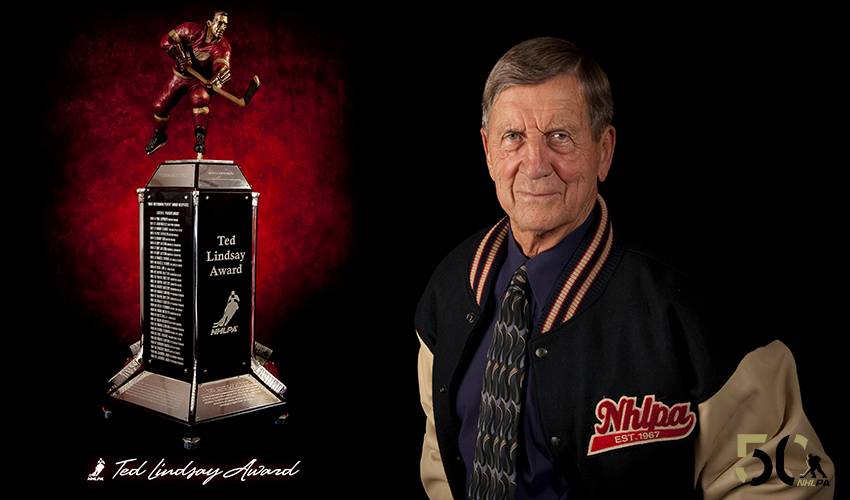
Image result for ted lindsay

Ted Lindsay’s nicknames were “Terrible Ted” and “Old Scarface” because Lindsay played tough and sometimes dirty.

That hell-bent style was reflected in the tiny ridges, bumps, wrinkles and puffy marks on his cheeks and chin that gave his face a hang-dog look.

Lindsay, one of the greatest Detroit Red Wings of all time, received some 600 stitches during his hall-of-fame career, most of them in his face.

One day, an acquaintance, holding the hand of his 2-year-old daughter, ran into Lindsay on the street.

Lindsay kneeled to say hello to the smiling little girl, who burst into tears when Lindsay’s face appeared next to hers.

“It’s not the first time that’s happened,” Lindsay said, laughing. 

“Terrible Ted had a face only a hockey mom could love,” John Finley, the Red Wings’ longtime physician who had stitched up Lindsay many times, wrote in his memoir. Recalling the man behind the scars and how different he was away from the game, Finley added: “I have many fond memories of the grace, respect, and special effort he took with all those close to him.”

And that was the paradox of Ted Lindsay, who died at 93 years old, while under hospice care, on Monday morning, according to his family. Off the ice, he was a gentleman who had many friends. And he was a philanthropist who became deeply involved in his community.

On the ice, Lindsay was cocky and abrasive and would do anything to win. He was a highly unusual player in the post-World War II National Hockey League, a brainy boat-rocker who repeatedly challenged the conservative league establishment. Those qualities — plus his enormous talent — made him one of the most memorable and controversial players in NHL history and a fan favorite for decades in metro Detroit, where he lived for more than 70 years.

“I hated everybody I played against, and they hated me,” Lindsay was fond of saying.  “That’s the way hockey should be played.”

Away from the game Lindsay was patient, generous and even tender. Despite his super-star status, he drove through winter nights to appear at countless sports banquets across Michigan and Ontario, and thought nothing of driving even to Sault Ste. Marie for the night to make a speech about hockey. He devoted a lot of time to charity. When the 9-year-old son of a friend was diagnosed with autism, Lindsay established a foundation to raise money for autism research.

“Ted never let fame go to his head,” said Joe Lapointe, a longtime sportswriter for the Free Press and New York Times.

Lindsay was only 5-foot-8 and 165 pounds, and people who met him often expressed surprise someone so small could be such a terror. “When I put my skates on I’m 6-foot-5,” he told them.

Lindsay punched far above his weight for 14 seasons with the Red Wings and three seasons with the Chicago Blackhawks between 1944 and 1965. When Lindsay was at his peak, in the early 1950s, the Wings were the team to beat in the NHL, winning four Stanley Cups in six years.

In 1964, four years after he retired as a Blackhawk, he made a one-season comeback with the Wings at 39, surprising critics with his skills and endurance.

Rebel with a cause

During his prime, Look magazine described Lindsay, darting about the ice in the crimson Detroit uniform, as “a blood-red flash of cold fury” and “a picture of unmitigated villainy.”

The Free Press wrote that hockey fans pictured Lindsay “as a cross between Jack the Ripper and Al Capone.”

Lindsay mocked opponents, pushed referees and argued with Jack Adams, the tyrannical Detroit coach and general manager whom most players feared. Lindsay blasted the disciplinary hearings of NHL president Clarence Campbell, a former war-crimes prosecutor, as a “kangaroo court” and shocked NHL owners when he filed an anti-trust lawsuit against the league during his attempt to form a players’ association in the late 1950s.

The suit was a daring move, and while the union effort fell short, it set the stage for the founding of the NHL Players’ Association in 1967. Adams traded Lindsay for masterminding the union drive (with Montreal’s Doug Harvey), and it soured the once-close friendship between Lindsay and Gordie Howe, who voted against the union.

“Lindsay represented everything Clarence Campbell abhorred in a hockey player: cockiness, irreverence and disrespect,” wrote the authors of “Net Worth,” an authoritative book on NHL finances that was turned into a 1995 Canadian movie in which Lindsay was the hero and Adams the villain.

By 1958 the campaign for an association had ended, though the NHL met some of the players’ demands.  A permanent players’ association was formed in 1967, and today, the association bestows the Ted Lindsay Award annually to the NHL’s most outstanding player, as voted by association members.

“When I did it the NHL was a dictatorship. I just wanted to give us a voice. We had no voice,” Lindsay told the authors of “Net Worth.”

“I’d do it again. I was not a crusader, I wasn’t trying to change hockey. It was just something we as players needed as a vehicle to be able to discuss things. The effort was not a failure, because we did make a few gains and we paved the way” for the players’ association.

In retirement, Lindsay was estranged from the Wings, owned at the time by Bruce Norris, who bitterly fought Lindsay during the unionization drive. But in 1977, Norris hired him to be general manager and, later, coach.

At the time, the Florida-based Norris, the dissolute scion of the family that had owned the team since 1932, was bankrupting the family fortune, and the “Dead Wings” were one of the NHL’s worst teams. Lindsay set off a buzz among Detroit fans with his initial marketing slogan, “Aggressive Hockey is Back in Town,” but his three years in the front office were a failure in almost every respect, the opposite of his storied career.
Related image
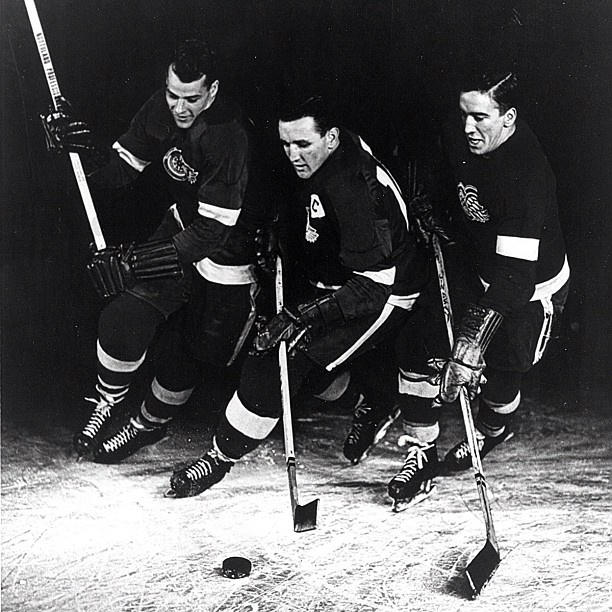
Gordie Howe, Sid Abel and Ted Lindsay


The Production Line

In 1,068 regular season games, Lindsay scored 379 goals and had 472 assists for 851 points. He added 47 goals for 96 points in 133 playoff games. When he retired for the first time in 1960, the only players who had amassed more points than him were two all-time greats, Howe and Montreal’s Maurice (The Rocket) Richard.

In 2017 an NHL panel named Lindsay one of the 100 best players in league history. He was inducted into the Hockey Hall of Fame in 1966. The Red Wings retired his No. 7 jersey in 1991 and unveiled a statue in his honor in Joe Louis Arena in 2008.

Lindsay’s aggressiveness as a player and insolence toward NHL authority figures endeared him to hockey fans in rough-and-tumble Detroit during the city’s postwar go-go years. Fans in other NHL cities heckled Lindsay, and he heckled them back. On at least one occasion, Lindsay tussled with a spectator.

During Lindsay’s 14 seasons with the Red Wings, they won 10 league championships in addition to their four Stanley Cups. Lindsay, who served as team captain even though Adams worried about his influence on other players, was often among league leaders in both scoring and penalty minutes. Beyond his belligerence, he was an excellent skater, shooter and passer. He was, in many respects, the perfectly well-rounded NHL player: a highly skilled leader who is the craziest and hardest-working guy on the team.

Lindsay starred with center Sid Abel and right wing Howe on the Wings’ famed Production Line, one of the league’s greatest trios, which tormented the NHL from 1947 to 1952.

In the 1949-50 season, Lindsay, Abel and Howe finished 1-2-3 in league scoring, and the Wings won their first Cup of the decade.  In 1949, during a seven-game semifinal playoff series against Montreal, the line accounted for 12 of 17 Red Wing goals. After Abel was traded in 1952, Lindsay and Howe continued their tear, accounting for roughly one-third of all Red Wing goals over a nine-year period.

"They are both unorthodox, crisscrossing on the ice so that no one really is a right wing, a center or left wing,” Abel said in 1957.

As a player, Lindsay stopped at little. Even elbowing and kneeing were part of his arsenal until the NHL made them two-minute penalties. He used his stick as a cudgel and a sword.

One of Lindsay’s most infamous confrontations took place in January 1951 with Bill Ezinicki of the Boston Bruins, a frequent opponent since junior hockey. The two, the most penalized players in the NHL the previous season, started with shoving, then moved on to swinging sticks at each other’s heads before they slugged it out — for a full minute.

The clash finished when Ezinicki charged Lindsay from behind. Lindsay suddenly spun, flattening Ezinicki with one lightning punch. Ezinicki was left unconscious on the ice and needed 19 stitches in his face. He also suffered a broken nose and lost a tooth. Lindsay had bleeding knuckles.

Referee George Gravel handed Lindsay and Eziniki rare match penalties for “deliberately injuring an opponent.” Campbell suspended each player for the next three games between their two teams.

“It was a rousing battle as hockey fights go, but was a sickening and disgusting display of sportsmanship,” wrote Marshall Dann, the Free Press hockey writer.

Lindsay’s assertive attitude also is behind a celebrated NHL tradition — the parading of the Stanley Cup on the ice by players after they win the post-season playoffs. It first happened at Olympia Stadium in Detroit in 1950 after the Wings defeated the New York Rangers in seven games, including a double-overtime victory in the seventh game. Lindsay spontaneously hoisted the shining trophy and skated around so fans could see it. 

"I recognized who was paying my salary. It wasn't the owners,” Lindsay told the Toronto Globe and Mail in 2013. "I saw all the people sitting there so I picked it up and took it to them.” 

Lindsay took the initiative in his private life, too. In the early 1950s, when many hockey players worked menial jobs to earn extra cash in the summer, Lindsay saw a way to make real money, and he established a plastics businesses in Livonia with teammate Marty Pavelich and, for a time, Howe.

Lindsay had lived in southeast Michigan since the mid-1940s. Multiple generations of Detroiters came to know him as an approachable presence at Red Wings’ games, local rinks, restaurants and charity functions, always willing to strike a humorous pose with his fist clenched against the jaw of a smiling fan.

Lindsay was calm and serious, but he laughed easily. He sometimes sounded gruff when he talked, often expressing belief in such old-fashioned virtues as hard work and honesty. He criticized modern athletes — and hockey itself — for being soft.

He was generous with his time. Over the years, Lindsay served as chairman of the Easter Seals campaign and coached the hockey team at Hillsdale College, driving frequently to Jackson, where the team practiced, charging only expenses. 

Since 2001, the Ted Lindsay Foundation has raised more than $4 million for autism research, while using only 13 percent of its donations for operating expenses, the foundations says. In December, the foundation pledged $1 million to support Oakland University’s autism outreach efforts. 

Lindsay was a physical fitness devotee who for years after his final NHL game continued playing hockey, in men’s leagues or pick-up games, just like legions of metro Detroiters have done for years. At one point, he was rising at 3 a.m. to make an early game in Windsor.

In the late 1970s, when Lindsay was the Wings’ general manager, he joined a weekly pickup game at Olympia for anyone who worked in the building, from media to Zamboni drivers. Lindsay was more than twice the age of some players, but he still dominated the games with his skating and puck control. He bought beer for the players after games yet never stayed around to drink it with them.

“Ted Lindsay would check you into the boards!” said Tom Henderson, a veteran journalist who played in those games. “If you grew up in Detroit — that was unbelievable. That was like Ty Cobb spiking you.”

At one morning game in Southfield in 1976, Ted and his 21-year-old son, Blake, skated on opposing teams. At one point, Blake complained about getting high-sticked by another player.

“What’s wrong, cant you take it?” his father yelled at him.

“You’re a good one to say that,” Blake responded. “What did you do, leave your brains in your locker?”

Ted stalked off the ice, showered, left the rink and refused to speak to Blake for three weeks.

“He did that only because he loves you,” Marty Pavelich, a former Wing and close Lindsay friend, told Blake. “He would have killed anybody else for saying that.”

Image result for ted lindsay
(AP)

Taunting Toronto fans

Lindsay gained a national audience in the 1970s when he served as a color commentator for games on NBC. He also hosted his own sports show on Saturday evenings before Hockey Night in Canada telecasts on what was then CKLW-TV in Windsor. Even on television, Lindsay had a polarizing effect, not unlike commentator Don Cherry in recent times. One of Lindsay’s memorable expressions was “laying on the lumber,” a phrase he used when a player hit another player with his stick.

“Since NBC signed him up, Lindsay’s devotion to violence, brutality and mayhem on the ice has been drummed into American living rooms with all the subtlety of a sledgehammer,” a Philadelphia sportswriter wrote in 1975.

As a player, Lindsay defended his tactics as necessary to survive at his size in the six-city NHL, in which teams played each other 14 times a season, traveled by train and no one — not even goalies — wore helmets or face shields.

“I’ve been slashed, speared, elbowed, board-checked, butt-ended and hit on the head as much as anyone,” Lindsay said in a 1976 interview. “I just like to keep the ledger balanced.”

One game that encapsulated Lindsay’s nerve, ability and flamboyance took place in Toronto on March 24, 1956, during a tough playoff series against the Maple Leafs.

The Wings led, 2-0, after two games in Detroit. Leafs’ fans seethed after Toronto’s Tod Sloan was injured during a run-in with Howe. As the series shifted to Maple Leaf Gardens, an unidentified man called Toronto newspapers and said, “Don’t worry about Howe and Lindsay tonight. I’m going to shoot them if they play.”

Authorities took no chances. The Gardens was crawling with police that night, and the threat was big news, intensifying the tension that surrounded the series. Howe and Lindsay suited up, and Lindsay got revenge by scoring the tying goal late in the third period and then notching the winner in overtime, when he took a pass from behind the net from Bob Goldham and shot it past goalie Harry Lumley.

After the final buzzer, Lindsay taunted Toronto fans by putting his stick blade under his shoulder and holding the shaft as if it were a long gun. Skating around the ice, he mimicked a machine gun, yelling, “rat-tat-tat-tat.”

“We figured it was a crank call and didn’t take it seriously,” Lindsay said at the time. Added Howe: “We were lucky nobody threw a firecracker or Ted and I would have dug a fox hole in the ice.”

'Aggressive hockey is back in town'

Robert Blake Theodore Lindsay was born in Renfrew, Ontario, near Ottawa, July 29, 1925. The youngest of nine children, Lindsay moved with his family during the Depression to Kirkland Lake, Ontario, a small gold-mining town 600 miles north of Detroit that produced several NHL players, including Mickey Redmond, the Red Wings broadcaster. As a child, Lindsay listened to Wings’ games via the powerful signal of Detroit’s WJR-AM that reached northern Ontario on cold, clear nights.

Lindsay’s father, Bert, was a goalie for the Montreal Wanderers and Toronto Arenas in the early years of the NHL. Ted was the first player in the NHL who was the son of a former player.

By 1944, the 19-year-old Lindsay was a star for Toronto St. Michael’s in Ontario junior hockey, and in those pre-draft days, NHL clubs signed players directly from Canadian junior teams. But the Maple Leafs managed to overlook Lindsay, despite his playing in their backyard. Adams, the Red Wings’ coach and general manager, swooped in and asked Lindsay to sign a Detroit contract. Even as a teenager, Lindsay was bold, demanding he play four-fifths of the Wings games and not be sent to the minors. Adams put it in writing, and gave him a $2,000 bonus.

Conn Smythe, the Leafs’ principal owner, fumed for years over Lindsay’s signing with Detroit. To rub it in, Lindsay would point to Smythe’s seat, smirking, whenever he scored or tangled with a Maple Leafs player.

Lindsay’s first retirement lasted fours seasons. In 1964, Abel, then the Wings coach and general manager and always a big-brother figure to Lindsay, suggested he consider making a comeback with the Wings. Lindsay came to camp and made the team.  

“It’s the blackest day in hockey,” said Campbell, the NHL president, “when a 39-year-old man thinks he can make a comeback in the world’s fastest sport.”

Lindsay played in all but one game that season, scoring 14 goals and 14 assists, and was instrumental in the Wings’ finish atop the NHL for the first time since he was traded to Chicago eight years earlier.

Campbell apologized.

In the final game of his career, Lindsay scored a goal and received a 10-minute misconduct for yelling at referee Art Skov.

In the mid-1970s, a decade into Lindsay’s retirement, the once-mighty Wings found themselves in disarray. The Norris family had owned the franchise since 1932, but the family business was careening toward financial collapse and a sense of entropy permeated the hockey organization. The Wings had qualified for the playoffs only twice in 17 seasons and burned through eight coaches — many of them former Detroit players — in as many years. Jimmy Skinner, a former coach who hung on as an assistant general manager, said later he often sought advice from the portrait of Adams, who died in 1968.

Pressure grew from fans and Detroit sportswriters to hire Lindsay. Finally, late in the 1976-77 season — when the team had won only three of its previous 40 games — Norris relented and made Lindsay the general manager. In his first news conference, Lindsay slammed Norris, the front office, the players and the scouts, but he begged the fans to stick with the Wings.

“Don’t give up on us,” he said. “I don’t expect to instill in these modern-day athletes the pride we had in our great days here — we were a different animal — but somewhere along the line, I’d like to instill it a little.”

Hockey fever — along with cascades of octopus and other sea creatures — returned to Detroit in 1977-78 as the Wings made the playoffs for the first time in nine years and won a playoff series for the first time in 12 years. Lindsay was named executive of the year.

The next season, though, the Wings reverted to pre-Lindsay form, finishing third worst in the NHL.

As criticism mounted, Lindsay was demoted to coach at the end of the 1979-80 season, and stripped of his general manager duties after he had put an excessive number of players under contract and blundered by signing goalie Rogie Vachon from the Los Angeles Kings without settling on compensation. That led to the Wings temporarily losing star center Dale McCourt, which resulted in a complex and time-consuming legal battle and a poisoned atmosphere in the Detroit locker room. 

In November 1980, when the Wings had won only three of their first 20 games, Norris fired Lindsay.

Learning how to treat others

In “Seven,” a tribute book published in Lindsay’s honor by the Red Wings in 2008, Lindsay discussed people who had helped him in his career, both as a player and a person. He brought up Larry Aurie, a Red Wing from 1927 to 1938 who was small, like Lindsay.

“He showed me a lot of things about hockey,” Lindsay recalled. “He showed me how a little guy could survive. He showed me how a little guy could go out there and make little guys out of big guys.

“But the most important thing he taught me was how to treat others. I’ve tried to live that way. You see, the people in my sport are very gifted. I was one of the gifted. I had a chance to make a living at the thing I love, and I have always appreciated that and I have always wanted to give something back.”

Bill McGraw worked as a reporter, sportswriter, editor and columnist for the Free Press for 32 years. He covered the Red Wings from 1979 to 1983.

Decline and Fall: Classics Edition


March 4, 2019
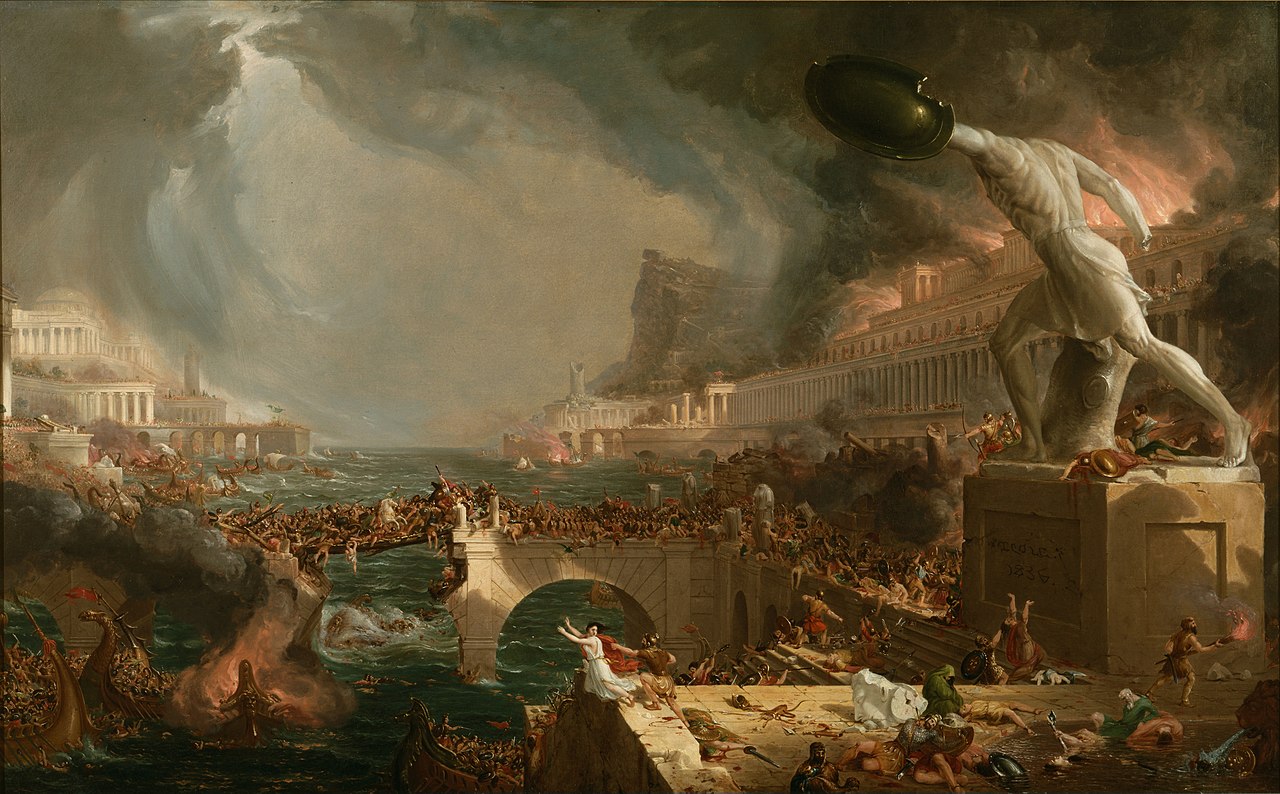
'Destruction' by Thomas Cole (1836)
For the study of classics, it is (if we may adapt Dickens) the best of times and the worst of times. It is the best of times because there are multiple popular initiatives, mostly outside the academy, introducing people young and old to the riches of Greek and Latin. There are even a few bright spots inside the academy, for example, Princeton University’s new Latin 110, a course taught entirely in Latin: the students and teacher do not speak in English about Latin but instead conduct the entire class in the ancient but still-living language. Impressive.
But such bright spots are few and far between. Indeed, even that class at Princeton has been castigated on Twitter for catering to students who are too “fit,” too male, and probably too heterosexual. More and more, it seems, the study of classics—like the study of the humanities generally—has fallen under the spell of grievance warriors who have injected an obsession with race and sexual exoticism into a discipline that, until recently, was mostly innocent of such politicized deformations—largely, we suspect, because of the inherent difficulty of mastering the subject. (In this sense, classics is different from pseudo-disciplines like women’s studies, black studies, LGBTQ studies, and the like, because classics can never be entirely reduced to political posturing. You actually have to know something.)
Consider the fate of Eidolon, an online journal that was started in 2015 to demonstrate the relevance of classics to modern life. It wasn’t long before Donna Zuckerberg, the sister of the personal data magus and surveillance guru Mark Zuckerberg, engineered a palace coup and declared that henceforth Eidolon would “err on the progressive side,” dedicating itself to “the spirit of bringing politics into Classics.” Because, you know, the humanities have not been sufficiently tainted by signing up for every trendy progressive cliché going. From now on, Zuckerberg said, Eidolon would forgo objectivity—“often nothing more than a cover for upholding the status quo, and to hell with the status quo”—in its quest to become “a progressive, feminist publication with a commitment to social justice.” And how was this goal to be achieved?
Well, this year, Zuckerberg noted, the magazine would aim to make sure that “at least [at least] 70 percent of our contributors be women and 20 percent of our writers be poc,” i.e., “people of color,” i.e., not white. (But isn’t race merely a “social construction”? No, silly, that was last year.) And just how are those percentages going to be achieved? Well, going forward, Eidolon will ask people pitching stories for “demographics,” i.e., are you black or white? Male or female? “I have no interest,” Zuckerberg sermonized, “in providing bland and false reassurances that we only care about good ideas and good writing and not who our authors are.” Who would doubt it? And what about merit? “[A]ppeals to merit,” she said, are “often . . . white supremacist dog-whistles.” So: “If you’re white and we publish you, you will know, for maybe the first time in your career, that it was because of the merit of your idea and not because you’re white.”
We’d like to know if there are any cases of anyone anywhere being published in a classics journal because he (or even she) was white. Still, Zuckerberg’s destruction of Eidolon as a serious journal does raise an interesting question about the level of masochism among white classicists, especially white male classicists. Why would anyone of that description who was not a masochist submit work to a journal that is self-confessedly hostile to them? Indeed, why would anyone not a masochist read it?
But the fate of Eidolon is only one symptom of the toxic substitution of identity politics for humanistic learning in classics. An episode that took place at the annual Society for Classical Studies conference in January further dramatized the rot affecting the discipline . . .
Read the rest at The New Criterion.

Monday, March 04, 2019

Today's Tune: Johnny Flynn - Detectorists Theme Song - Extended Edit

Why More TV Shows Should Learn from the Beautiful Simplicity of ‘Detectorists’


By Allison Keene
January 25, 2019
Related image
Towards the end of Detectorists, the president of the Danebury Metal Detecting Club (DMDC) digs up a small artifact. He waves to his wife who is sitting and reading nearby, and calls out proudly that it is a button from the Welsh guard. Though it is a small find, he tears up a little, perhaps both from happiness (he is a button collector), but also out of a grateful acknowledgement towards his understanding wife. That balance of sweetness and sly humor is what makes the quiet loveliness of Detectorists such a Peak TV treasure.
This gentle series is created, written, and directed by Mackenzie Crook (familiar to most as starring in the U.K. Office), and its three seasons and a Christmas special are available in the U.S. on Hulu and Acorn TV. It follows the tales of two men, Andy (Crook) and Lance (Toby Jones), who live seemingly unremarkable lives in a tiny English town. But they are united by a passion for metal detecting, which they pursue as a serene hobby across the farmlands of Essex. Both have working-class day jobs; Andy is employed at various places through a temp agency when the series starts, and Lance is a forklift driver. As for their personal lives, Lance is divorced but still obsessed with his New Age-y ex-wife Maggie (Lucy Benjamin), who dumped him for the manager of a pizza restaurant; Andy is in a long-term relationship with a sarcastic but empathetic school teacher (Rachel Stirling). They spend most evenings at the pub with the other detectorists, talking about their finds and getting involved in each other’s personal lives.
Detectorists is a show that focuses on life’s smallest moments, with the unhurried pace of the fictional village in which it’s set. There is a great joke in the series where a character drops their keys one evening and swears five lights came on down the street as people ran to their windows. Later, it turns out that everyone in town eventually heard about it, and are concerned the keys were lost (“just dropped and then picked back up,” Lance reassures them). But the show also knows that these moments are some of life’s most important. Even as Lance and Andy sit under a tree in a field and talk about last night’s episode of University Challenge, repeating the same jokes and stories they have for years, there is a wonderful familiarity to it that makes the conversational feel essential. Episodes often begin with close-ups of the caterpillars, butterflies, and other tiny creatures that populate the fields where the men detect, highlighting that same theme. The show’s beautiful intro is also a paired down song by Johnny Flynn, and it really says it all:
Will you search through the lonely earth for me?
Climb through the briar and bramble.
I will be your treasure;
I’m waiting for you.
Crook uses the song to help augment teases for some of the treasure that lies in those fields, which Lance and Andy do not yet see for themselves. It’s excruciating — you want them to immediately find gold and be rewarded for the love they show to their hobby and the appreciation of the earth they search. But the men also get plenty of joy out of their unremarkable finds (again, on theme), including old pop tops or bits of scrap metal. Crook is a gifted storyteller, one who knows the right timing to orchestrate meaningful reveals for characters who become almost instantly beloved, despite their foibles. And while there are aspects of Detectorists that can feel almost like a storybook in the way they unfold, it’s never saccharine or sentimental. It’s often hilarious (Jones in particular is such a gifted comedic actor, and Crook brings a winning shyness to his part), but mostly it’s just wonderfully sincere.
One of the most refreshing parts of the series is how quiet it is. There are long stretches of silence, save for the rustling of the wind, or birdsong, or even the low din of the background noise in the pub. The music is mostly restricted to rifts on the theme song, and there are no loud musical cues or quick cuts. Nothing aboutDetectorists is quick, and while that might frustrate some TV viewers, it’s a welcome respite from over-produced series where everything is big. This show is about things that are small, and people who might otherwise be overlooked (Crook and Jones certainly make for nontraditional leading men, and it’s wonderful). Crook is excellent at crafting characters who are incredibly quirky but still believable, and the word play in the script is reliably sharp and smart. Andy and Lance have plenty of faults, some of which get them in hot water, but the stakes are never high enough to give you palpitations (their constant, low-key war with their detecting nemeses, “Simon and Garfunkel,” is also a great recurring gag). You come to trust the storytelling, that things will come to pass in their own time, and usually in ways that you feel just fine about.
There’s not a TV category that’s analogous to indie film, but if there were, Detectoristswould be there. It’s a trend more series should follow, competing with the noise of Peak TV by becoming quieter, simpler, and more thoughtful. In each six-episode season (and one half-hour Christmas Special, as is the British way), Detectorists delivers a complete story that has given us a magical bit of access to the lives of these men and the people they know and love. It’s funny, strange, and somewhat mystical from time to time. You can see how Crook adjusts those elements slightly with each new season, finding even more soulful ways to tell these simple yet incredibly full stories — about metal detecting, of all things. You need not search far for this TV treasure. “Pub?” “Go on then.”

Detectorists: a rich portrait of unremarkable lives gone slightly awry

9 December 2017

Related image
Toby Jones and Mackenzie Crook 

Metal detecting is the closest you’ll get to time travel,” reflects Lance in the final episode of Detectorists (13 December, 10pm, BBC4). “See, archaeologists, they gather up the facts, piece the jigsaw together, work out how we lived and find the buildings we lived in. But what we do … that’s different. We unearth the scattered memories. Mine for stories. Fill in the personality … We’re time travellers.”
It’s hard to think of a more exquisite TV creation than Mackenzie Crook’s Bafta-winning comedy-drama following the fortunes of Lance (Toby Jones) and Andy (Crook), dedicated treasure hunters, crumpled nearly men and members of the Danebury Metal Detecting Club. If their gentle exploits haven’t made your heart sing and your stomach go fuzzy then, well, we can never be friends.
In its final act, Detectorists has brought us a rich portrait of unremarkable lives gone slightly awry. Weary disappointment hovers like a rain cloud over Lance and Andy – the former as he negotiates domesticity with his grownup daughter; the latter struggling without a steady income and squeezed in a small house with his wife, son and mother-in-law – though, as ever, there is staunch optimism in their conviction that they’re on the cusp of subterranean discovery, that relief from their humdrum existence is around the corner.
Detectorists is about nothing and everything. Made with palpable love, it’s about people and their passions; camaraderie and community. As a portrait of male friendship, it is closer to documentary than drama, delving beneath the topsoil of mid-life ennui via the sparsest of exchanges. You won’t find a laughter track, or smart-arse punchlines or an oh-so-subtle veil of irony here; instead of begging for your attention, Detectorists is notable for its avoidance of snark. It’s the drama least likely to culminate in alpha plonkers blowing up cars, taking down baddies or ravishing beautiful women.
Instead, it lingers lovingly over dewdrops on grass, magpies on gateposts, scudding clouds and gently fluttering leaves. Even an alfresco wee takes on a painterly aspect, viewed solely through the steam cloud billowing from behind a sunlit tree. Meanwhile, the camera makes high art out of Lance’s face in closeup, crestfallen as he unearths a scaffolding bracket instead of an Anglo-Saxon nugget, and from Andy’s silent incredulity when a colleague jokes about Richard Attenborough when he means David.
Detectorists isn’t afraid of silence, either, a quality seldom found in contemporary drama. Watching our protagonists ensconced under their favourite oak, Thermoses in hand and intermittently reflecting on last night’s University Challenge, brings with it a rare and enveloping tranquility. Testament to the mood-altering powers of television, Detectorists allows us, in its moments of bucolic loveliness, to tune out our grimly fractious world.
Sad as it is that Crook has called time on the series, it’s exactly as it should be. Many is the show that, feted early on, loses its mojo and enacts a slow, public death as we watch through our fingers in agony. By departing early, Detectorists leaves an unblemished record, the sweetest of memories and a clear affection for the unsung hobbyists quietly unearthing our history. Pub? Yeah, go on then.

British Sitcom ‘Detectorists’ Is TV’s Buried Treasure


By 
https://www.theringer.com/tv/2018/1/15/16890616/detectorists-mackenzie-crook
January 15, 2018

Image result for detectorists
Toby Jones and Mackenzie Crook

Early last year, English actor Mackenzie Crook found gold on the farm where he filmed the second season of Detectorists, the BBC comedy that he wrote, directed, and costarred in with Toby Jones. Subsequent research by the British Museum revealed what he’d detected: a penny-sized pendant or earring, dropped, perhaps, by a careless Roman nearly 2,000 years ago. When Jones’s Detectorists character, Lance, unearths gold in the show’s second-season finale, he does the metal-detecting community’s traditional gold dance. Crook wrote that reaction to Lance’s fictional find, but he didn’t dance in real life. “It literally was the last signal of the day,” Crook tells me by phone, referring to the bleep and bloop from his metal detector. “It was getting dark, and I didn’t realize what I had until I got it back home. I didn’t want to dance in my kitchen on my own late at night.”

As much as any other pastime, metal detecting seems made for metaphor. When Crook’s headphones-clad characters spend their days sweeping fields with their wands, listening for a signal, he says, they’re “actually searching for love and for where they belong and all these other things in their life.” If the 46-year-old Crook can see the symbolism in his characters’ ceaseless search, then maybe we can spot a parallel in his own unwitting gold discovery at the end of a day. By the time Crook started writing Detectorists in 2013, the longtime caricature actor was running out of time to play a regular guy. And until he developed the idea, he didn’t know how precious the project would turn out to be.

Even after 19 half-hour episodes, Detectorists is difficult to describe. That becomes clear when I ask Crook for his synopsis of the series, whose third and final season finished airing in the U.K. last month and premieres in the U.S. today on Acorn TV, a streaming service that produces and ports international programming from Great Britain and other English-speaking countries. (The first two seasons are also available via Netflix.) “I guess I’d say it’s a comedy about ordinary people and their hobbies,” Crook answers, confidently at first. “That’s initially what I set out to do.” He pauses. “But it’s actually turned out to be much more than that. And in hindsight, I can’t really claim that I set out to create this thing that explored so deeply these ordinary lives. Essentially it’s about two friends who just spend their time out in the fields metal detecting. I just totally proved your point there. I can’t really describe it.”

Crook, whose haunted eyes and gaunt frame American audiences will recognize from his roles as the wildling warg Orell on Game of Thrones and comic-relief Ragetti in the Pirates of the Caribbean series, hardly had to describe it to the BBC, with whom he’s worked for close to 20 years, beginning with his breakout role as officious, prank-prone assistant Gareth Keenan on the U.K. edition of The Office. (For U.S.-only Office viewers, Gareth begat Dwight.) Crook says that the BBC wasn’t bothered by the fact that “nothing much happens” in the typical Detectorists episode, which also had the virtue of cutting down costs. Bolstered by his preexisting relationship with the network, Crook’s pilot script sold the idea, despite his lack of experience on the other side of the camera. “They didn’t ever meddle with it, try to increase the joke count or speed it up or anything like that,” he says. “They sat back and let me do what I wanted and create what I had in my head.”

What he had in his head was more humdrum than most shows that get a green light. Jones’s Lance, a small-town forklift-truck driver and amateur musician who fears performing publicly, lets himself be bullied by the ex-wife who left him for a manlier man. Crook’s Andy, who does dispiriting and menial temp work—as Crook did before he began acting—in support of a fledgling family, dreams of becoming an archaeologist and aspires to own a shed. Neither has prime-time-TV looks or leads a life of high stakes. But when they’re wearing their gear and walking the countryside, they’re transformed into time travelers and explorers, experts in their specialized field and upstanding representatives of the Danebury Metal Detecting Club, a collection of misfits run with military ardor by a retired policeman named Terry, who’s always alert to the risk of rival detectors encroaching on their claims.
Although they’re convinced that their favorite territory contains a Saxon treasure trove, Lance and Andy usually go home empty-handed, with few trophies to display at the weekly DMDC meeting besides buttons and ring pulls. But amid the mundanity of digging up dirt, discussing quiz shows, and retiring to the pub, they exchange advice and support and immerse themselves in the extended, easy silences that unfold between true friends. As the two comb the countryside, the camera pulls back until they and the tools of their trade blend into timeless, eye-pleasing pastoral landscapes, whose glowing greenery Crook, a first-time writer-director, attributes to cinematographers Jamie Cairney and Mattias Nyberg. Silence between characters rarely leads to silence on screen, thanks to a soothing score by English actor and folk singer-songwriter Johnny Flynn (Lovesick, Genius), whose plaintive theme song resurfaces so often that Crook calls it “almost another character in the show.”
Detectorists won a BAFTA for Best Scripted Comedy in 2015, and it gets glowing reviews—albeit not enough of them for the show to appear on Rotten Tomatoes or Metacritic. (The show does crack the all-time TV top 200 based on IMDb user ratings.) “It’s been so well-received, by not a huge amount of people, but those people that have found it have taken it to their hearts, and it’s had this quite emotional response,” Crook says. Like Parks and Recreation and an assortment of lower-profile sitcoms with small but devoted audiences—Party Down, Slings & Arrows, Mozart in the Jungle—Detectorists provokes such strong attachment in part because it concerns a subculture that’s so far from the worlds of doctors, lawyers, and law enforcement that take up a disproportionate amount of our TV time. There’s no high-concept sci-fi or fantasy here, no mystery box to unlock in essay-length theories on Reddit. Detectorists is ostensibly smaller in scope and ambition than the bigger-budget shows that shoulder it out of the spotlight, but few other sitcoms can compete with the pathos that comes from its loving look at a little-loved pursuit, and the people who find that pursuit fulfilling.

According to Crook, members of the detecting community were wary when they heard that the BBC would be basing a show on their hobby. “As soon as it was announced, before it had been shown, people just assumed that oh, it’s going to be portraying them as losers,” Crook says. “But as soon as the first episode went out, it was clear that that’s not what I intended to do.” Detectorists deftly finds the humor in its characters’ quirks without portraying them as pitiful. They’re outcasts, in some respects, but the script never strips them of their dignity. Crook found that balance after first straying too far in a more mocking direction. “When we started writing it, I had a different character dynamic,” Crook says. “They were a little bit more laughable, and Lance’s character, especially, was a bit of a dick and a bit more mercenary. … But as soon as Toby came on board, that character changed, and I realized that these guys are guys that I wanted to hang out with.”

No one on Detectorists is irredeemable, and every dispute is leavened with love. Andy’s relationship with his wife, Becky—played by Rachael Stirling, the real-life daughter of Diana Rigg, who plays her mother on the show—which Crook says he based on his own marriage, is tense at times, strained by Andy’s constant detecting. But in a welcome contrast to so many series about troubled men and their spoilsport significant others, Andy understands his duty to his family, and Becky supports his quixotic quest. “I deliberately try to steer away from those sorts of clichés, the nagging wife,” Crook says. “Also, when Andy has to move in with his mother-in-law, I thought it would be easy to make her insufferable, this horrible dragon. And I thought, no, it would be far cleverer, surely, to have them essentially getting on with each other, just in too close a proximity.”
The compassion that softens so many of Detectorists’ gentle jabs is a giant departure from the mockumentary that launched Crook’s career. The Office, a classic cringe comedy, was driven by David Brent’s unwilling outsider status and obliviousness to his own brutishness. Maybe being the butt of so much scripted abuse during his days as Brent’s sidekick contributed to Crook crafting Detectorists’ disarmingly earnest tone, which he says was inspired by the “very English” sitcoms created by the comedy writing duo Esmonde and Larbey in the ’70s and ’80s. “They were very uncynical and there was no cruelty in them, and I was sort of harkening back to them,” Crook says. “I wanted to see if a sitcom could be done without this awkward, painful humor that is so prevalent these days.” Detectorists’ neurotic characters aren’t trying to fit into a world where they’re perpetually picked on. In this show, they have the home-field advantage.
Crook acknowledges that creating Andy was an attempt to escape the strictures imposed by his previous roles. “I don’t know if I’ve actually thought about that before, but yeah,” he says. “The parts I get offered are either caricatures or the quirky funny part or the dick or whatever, so I think you’re right that I just wanted to play a regular guy. … Andy’s really just a more pathetic version of me. It was quite a breath of fresh air to do that.”

After sampling that air for the first time in his 40s, Crook wants to keep breathing it, even if it means that he has to supply his own “regular guy” parts. Having brought one passion project to a satisfying end, he’s currently writing an as-yet-unannounced film (also set in a rural area) for the BBC, which he describes as “an evolution of Detectorists.” But before he can close the book on one brainchild, Lance and Andy have to finish their last season stateside, where viewers who’ve discovered them have welcomed them warmly. Metal detecting is different here; as Crook notes, “Your country’s spread out over such a massive area that the finds are less concentrated.” With scripted content on so many different channels and streaming services, good TV is becoming less concentrated, too. Anyone who discovers Detectorists’ delights amid the many false signals owes themselves the gold dance that Crook couldn’t do.

'Islam: The Essays,' Bruce Bawer's Magnum Opus on 'The Religion of Peace'


March 2, 2019

Image result for mosque islam

It is perhaps fitting that on the day I was to begin my review of Bruce Bawer’s magnum opus on Islam, Islam: the Essays, that Facebook would send me a notice stating that my "Free Tommy Robinson Philadelphia" page had been deleted because of “hate speech.” My Robinson page criticized Islam as an ideology but it did not attack individual Muslims at all. Still, why should I have been surprised at the censorship? We’re living in a new world where criticizing a group — in this case, Islam — is tantamount to the worst obscenity. For me it was an epiphanous moment that brought Bawer’s new book of essays to life. It also got me thinking about other brave writers who aren’t afraid to tell the truth about Islam: Oriana Fallaci in The Rage and The Pride; Pat Buchanan; and James V. Schall, S.J., whose little book, On Islam, published by Ignatius Press, was released last year.

“The first is that the West insists on seeing Islam through the lenses of its own modern, liberal theories about religion, freedom, and human motivation. Islam is just another religion; we are told that it acts like other religions, even when it does not,” Schall writes.

Salman Rushdie, author of Satanic Verses, which got the Ayatollah Khomeini to put a fatwa on his head in 1989, not long ago told France’s L’Express, “We are living in the darkest time I have ever known. I’ve since had the feeling that, if the attacks against Satanic Verses had taken place today, these people would not have defended me, and would have used the same arguments against me, accusing me of insulting an ethnic and cultural minority.”

Let’s get back to Bawer, whose 817-page opus is as thick as Jean-Paul Sartre’s Being and Nothingness and weighs as much as the cornerstone of a building. The weight of the book alone might be said to symbolize what it will take to "smack awake" the blindness of many in the West to the inherent dangers of the Religion of Peace. Islam: The Essays (Swamp Fox Books/Amazon) is a collection of the writer’s articles on the topic since 2002, especially from the pages of PJ Media, FrontPage, and City Journal. Some of the essays in the book later appeared in Bawer’s books, While Europe Slept, Surrender, and The New Quislings.  

Bawer, who grew up in New York but moved to Western Europe (Amsterdam) in 1998, soon discovered that “European Muslims are more likely than their American counterparts to live in tightly knit religious communities, to adhere to a narrow fundamentalist faith, and to resist integration into mainstream society.” One evening he expressed these thoughts to a Dutch writer friend who had boasted that the Netherlands was in better shape than the U.S. because it did not have a Religious Right. “I knew very well, of course, that the Netherlands did indeed have a Religious Right, that it consisted of Islamic, not Christian, fundamentalists,” Bawer writes. That Bawer’s Dutch friend did not see the writing on the wall in his own birth country is one of those astounding facts that make books like Islam: The Essays necessary reading.

After leaving Amsterdam for Norway, where Bawer resides today, he returned to Amsterdam to visit his old neighborhood but is told by a police officer that he had better not do that. Why? Because a journalist’s car had been smashed by Muslims displeased with something the journalist had written about Islam. “Later,” Bawer writes, “I learned that the Rotterdam police had destroyed a street mural featuring the words, 'Thou shalt not kill,' a picture of an angel, and the date of Mr. van Gogh’s murder [filmmaker van Gogh, a critic of Islam, was stabbed to death by Mohammed Bouyenon the morning of November 2, 2004, as he cycled to work] because the leader of a nearby mosque reportedly considered it racist.” Even though Islam is a religion, not a race — although the Left would have you believe that they are one and the same.

In 2010, another critic of Islam, Dutch parliament member and Freedom Party founder Geert Wilders, looked like he would become that nation’s new prime minister. Wilders had tremendous popular support but, as Bawer notes, “he was despised by the Dutch political, cultural, educational, media, and business establishment, which has plainly decided not to fight the Netherlands’ Islamization.”

Fighting Islamization in Europe or even in Dearborn, Michigan, can be risky business. It can get you thrown in prison without an able defense in the form of an attorney, which is what happened to the UK’s Tommy Robinson during his Facebook live-stream coverage of a Muslim child gang-rape trial.

Bawer’s book is a World Atlas of Islamization. Pick a country, any country, and Bawer has a story for you — whether it’s Jew- or gay-bashing in the Netherlands, Jew-hate in Sweden, the American TSA industry (“Many of them are, not to put too fine a point on it, incredibly rude, stupid, and slovenly individuals who have been handed a degree of power that they never imagined in their wildest dreams that they would ever wield.”), Islam apologists like Karen Armstrong, Norwegian schools preaching the wonders of the niqab, or how Israel hosts gay pride marches while Muslim countries host gay executions. You’ll read something wonderful about that most unusual of beings: a real feminist who writes honestly about Islam, Phyllis Chesler. You’ll get a case of jeepers creepers when you read about the growing sharia mindset in Dearborn, Michigan. It’s in Dearborn, by the way, where a number of gay Arabs told a reporter in 2013 that “it can be less difficult for an Arab to be openly gay in Beirut than in Dearborn.”

Islam: The Essays is not the kind of book to be read from cover to cover. You may, of course, do that over time, or you may find it extremely useful as a permanent desk reference and a more-than-quotable source of wisdom. I found it useful to flip through the book backwards; that way I wasn’t daunted by the volume’s size. You’ll also need a well-sharpened No. 2 pencil because this tome is an underliners dream. The last essay entries date from 2018 and cover the Tommy Robinson case in the UK, what Bawer calls the “lockstep lies of the British media,” and theNew York Times Book Review, “which has systematically ignored honest books about Islamic ideology." Then there are the follies of French president Emmanuel Macron, whom Bawer calls “a political hack posing as a hero of freedom.

“Some hero,” Bawer explains, “he didn’t dare breathe the word Islam or Muslim or even jihad [after the rash of terrorist attacks in France]. But what else to expect from a man who has called for Arabic to be taught in every French high school, for ‘cathedral mosques’ to be built in every major French city, and for enhanced measures to be taken against critics of Islam?”

The author, finally, lays it on thick when he writes about Muslims over gays in the Left’s new victimization pecking order. To that end he quotes Delaware psychologist Michael Hurd: “Neither Madonna nor Meryl Streep will stand before mass audiences and sob over the brutal execution of gays by Muslims in Mosul, because this assaults their ideological narrative of political correctness. And that ideological narrative is what matters most to them, not the gays or others they claim to love.”

Sunday, March 03, 2019

Trump Knows When to Fold ‘Em


By 
https://amgreatness.com/2019/03/01/trump-knows-when-to-fold-em/
March 1, 2019

Image result for trump vietnam
President Donald Trump speaks during a press conference after he failed to strike a deal with North Korean leader Kim Jong Un in Hanoi, Vietnam, on February 28, 2019.
 Evan Vucci/AP

In the course of a high-stakes negotiation, the player who walks away from the table is the one with the least to lose. Ronald Reagan did it to Mikhail Gorbachev at Reykjavik in 1986, and Donald Trump did it to Kim Jong-un this week in Vietnam. Good for the president.

A lot of people have brought up Reykjavik; I discussed the similarities on the Hugh Hewitt radio show with guest host Kurt Schlichter on Thursday. Reagan met Gorbachev in Iceland in the fall of 1986 and the two men were approaching an agreement that might have included the abolition of all nuclear weapons. But the Soviet premier wanted the Americans to drop the Strategic Defense Initiative, colloquially known as “Star Wars.” That was a bridge too far for Reagan, who abandoned the talks and went home.
Naturally, the hostile press was appalled—the abolition of all nukes! And this cowboy won’t give up a pet program that probably won’t work anyway! Warmonger! Reagan was widely viewed at the time as an “amiable dunce” who didn’t understand the first thing about the complexities of international diplomacy; why, the doddering old fool actually thought “We win, they lose” was a strategy.
As I wrote in my most recent book, The Fiery Angel:
Quick: would you rather read a think-tank white paper from around the time of the Reagan-Gorbachev Reykjavik summit in 1986, assuring the Boston-Washington corridor that the Soviet Union would remain the only other superpower indefinitely, and that its stability was vital to the balance of power, or watch “Rocky IV,” released in 1985? Which better predicted the events of November 1989?
Consider, for example, this review of Strobe Talbott’s 1984 book on arms control, “Deadly Gambits.” Talbott, then a writer for Time Magazine—he later left to join the Clinton administration as Deputy Secretary of State, and parlayed that into becoming president of the Brookings Institution—undertook in a widely unread book to contrast the arms-control policies of the Jimmy Carter and Ronald Reagan administrations, to the latter’s detriment, of course. This concluding passage from the contemporaneous New York Times review provides a flavor:
Mr. Talbott, who is diplomatic correspondent at Time, had previously written “Endgame: The Inside Story of SALT II.” What is striking about the two books is that ‘‘Endgame’’ was about how President Carter and his top aides—Zbigniew Brzezinski, Secretary of State Cyrus R. Vance, and Defense Secretary Harold Brown—were directly in charge of the arms control process. “Deadly Gambits” shows how President Reagan, Secretary of State George P. Shultz, Mr. Weinberger, and the three different national security advisers, had little to do with making arms control policy because they lacked the intellectual tools or interest in the subject.
He is particularly mocking of Mr. Reagan, who, Mr. Talbott writes, liked to give speeches on arms control, “but behind the scenes, where decisions were made and policy was set, he was to remain a detached, sometimes befuddled character.” Mr. Talbott says that even though Mr. Reagan presided at 16 meetings of the National Security Council on strategic arms talks, “there was ample evidence, during those meetings and on other occasions as well, that he frequently did not understand basic aspects of the nuclear weapons issue and of policies being promulgated in his name.” (Emphasis mine.)
A year later, the Russians were back at the bargaining table, this time in Washington, the result of which was the INF treaty, which regulated intermediate-range missiles (and which Trump recently scuttled, complaining that the Russians had long been violating the terms of the agreement). Two years after the signing, the Berlin Wall came down and the Soviet Union collapsed and disappeared in 1991.
We won, they lost. And the media fell utterly silent.
The point is that Reagan’s refusal to give up the SDI was instrumental in helping topple the USSR of late, unlamented memory. Because, for all the scoffing in the American media about it at the time, it plainly terrified the Russians, and had been doing so for several years. In February 1985, I heard East German party chief Erich Honecker denounce it vociferously in an outdoor speech before the re-opening of the Semper Opera House in Dresden, which had been destroyed by the Allied bombing raids 40 years earlier. Honecker did nothing without the Kremlin’s approval, so you knew it was on their minds.
Signs of the imminent Russian collapse were everywhere. In April 1986, I was in Leningrad when Chernobyl—Soviet technology at its finest—blew up; I didn’t find out about it until a few days after I had left the country because the Russians blacked out the news from their own people. But my first visit to Russia taught me a lot about countries in decline: everyone was a criminal. Russian women freelanced as prostitutes, while the men could be bribed easily (and stay bought), and everybody trafficked in contraband to make extra money on the side. The unofficial unit of exchange was not the worthless ruble, but a pack of Marlboro cigarettes.
When your women are selling themselves and your men are offering boosted tins of Beluga from the trunks of their cars, you know your country is in trouble.
Most of the media missed that, of course, preferring to stick to the eastern establishment narrative that the Soviet Union was the other superpower, with military parity with the United States and superior socialist domestic benefits—hey, they had free healthcare, right? And yet it was gone in the blink of an eye.
Reagan sensed it; Gorbachev knew it. The fragility of the system, brought on by the moral evil at its core, could be rouged and mascaraed but underneath the makeup still was a diseased trollop on her way to becoming the cheapest whore in town. When Reagan walked, the Russians panicked. And in that moment, the Cold War was won.
Trump’s job is actually easier: to bring a negotiated end to the Korean War, which has been in limbo since 1953, when hostilities ceased and an armistice was signed. Ever since, North and South Korea have faced off over a heavily armed border, and while the south has prospered and grown rich, the north is a Stalinist basket case ruled by a family of Communist thugs. It won’t last because it can’t last: Kim’s embarrassment at the hands of the American president will only make him more eager for another summit. At the same time, though, it weakens him in the eyes of his countrymen, thus making him even more vulnerable to a revolution when the times comes, which it will.
So Kim, a dead man walking now, gets back in his armored train while Trump flies back to freedom aboard Air Force One, knowing that it’s just a matter of time before the phone rings again. And this time, his terms for what in effect will be North Korea’s final surrender will be even tougher than the ones he offered now.