Wednesday, March 26, 2014

My Trip to the Pot Shop

Medical marijuana is quite literally a life saver. 

In dark moments, three coaches shine light on right way to lose

By 
http://www.cbssports.com/
March 24, 2014

Kentucky showed us how to win: Size, athletes, shooting. That's one way to do it. Iowa State showed another: Resilience, refusal to wilt, playing for an injured teammate.
In all, 16 teams showed us 16 different ways to win this past weekend at the NCAA Tournament.
Three coaches showed us how to lose.
Losing matters, see. Anyone can do it, and eventually everyone will do it -- and not just in basketball or sports. In life. You apply for a job, you don't get it. Guess what? You lost. It happens, and it will happen over and over, and when it does happen, try to be like Greg McDermott or Roy Williams or Mike Krzyzewski.
Yeah, you read those three names correctly. Don't like one or more of those three guys? Fine by me, but consider this your warning. Because if you keep reading and decide that you just might like them after all, well, that's on you.
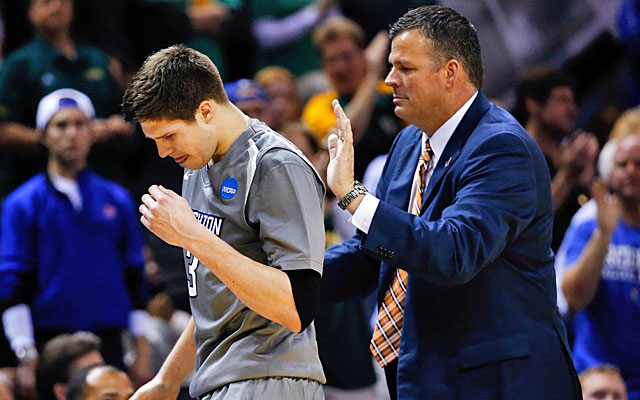
After watching his son's college career end, Greg McDermott made time to ask after a colleague. (USATSI)

After watching his son's college career end, Greg McDermott made time to ask after a colleague. (USATSI)

Bigger than basketball


There's defeat, and then there's what Creighton's Greg McDermott lost on Sunday: His son on his team.
Creighton was crushed 85-55 by Baylor, ending not just Creighton's season but also the college career of Creighton senior Doug McDermott, Greg's son. All of that was swirling through the elder McDermott's head roughly 10 minutes after the final horn when it was time to speak about this game, this humiliation, with the media.
McDermott was walking to the interview room when he bumped into someone in Baylor gear -- the father of Baylor coach Scott Drew, ex-Valparaiso coach Homer Drew.
Homer Drew knows about coaching his son. It was Bryce, who replaced his father as the coach at Valpo in 2011, who authored one of the more memorable March Madnessmoments in 1998 with a buzzer-beater that lifted 13th-seeded Valpo past fourth-seeded Ole Miss. There they were on Sunday, two fathers acknowledging their shared experiences, when Greg McDermott had to go. The news conference was waiting.
But wait. This was more important than a news conference, this question Greg McDermott needed to ask the father of the coach whose Baylor team had just ended Creighton's season.
"How's your family?"
Homer Drew's wife was diagnosed in 2011 with cancer. That was just a few days after Homer himself had been diagnosed with cancer. Both underwent surgery. Both are doing as well as can be expected after such an ordeal.
Greg McDermott found out, because he cared enough to ask. Ten minutes after a loss ended his son's career at Creighton.
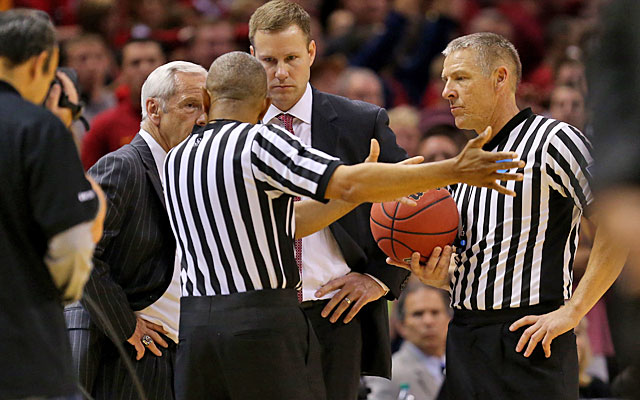
Roy Williams was told his season was over, then he calmly congratulated Fred Hoiberg. (Getty Images)

Roy Williams was told his season was over, then he calmly congratulated Fred Hoiberg. (Getty Images)

Going out with dignity


Iowa State beat North Carolina with a late shot and then ... confusion. If you saw the game,or the highlight, you know what happened: Iowa State's DeAndre Kane hit a driving layup with 1.6 seconds left for an 85-83 lead, and then North Carolina inbounded the ball to Nate Britt, who dribbled across half-court and called timeout just before the buzzer.
So it seemed. Officials huddled, studied the monitor, huddled some more. UNC coach Roy Williams was coaching his team for one last shot when he and Iowa State's Fred Hoiberg were called to midcourt to hear exactly how much time would be put on the clock:
None. Game over.
That's what you saw if you were watching live on TV -- and if you were, congratulations. Because here's what you saw next:
Roy Williams accepting that decision without hesitation. Not an angry face, not an angry word, nothing. Roy Williams listened to the referee telling him that all hope was gone, that his season was over, and he responded by shaking Hoiberg's hand and heading down the sideline to congratulate the rest of the victorious Cyclones.
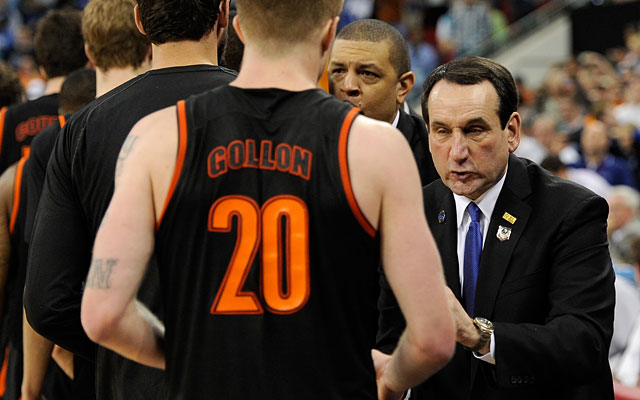
Coach K did the handshake line on the court, then had kind words in the Mercer locker room. (Getty Images)

Coach K did the handshake line on the court, then had kind words in the Mercer locker room. (Getty Images)

'Pretty unbelievable'


Saved the best for last, because it's Krzyzewski. No, Coach K's reaction to defeat wasn't any better than that of Greg McDermott or Roy Williams -- wasn't any worse, either -- but this is the best because it's Coach K. And unless you're a Duke fan, you probably don't like Coach K. He wins too much, curses too much, works the officials too much. Whatever. You don't like him.
And during the Mercer game Friday, he was dislikable. Hey, that's the way he coaches and it works for him and it gives bragging rights to his fan base -- but when the game's going and he's pounding on the officials from the opening tap because working the ref is psychological warfare and Coach K is all about getting any advantage for his team, well, the rest of us aren't going to like it. Or him for doing it.
But these people aren't one-dimensional characters. They're complicated, good and bad, and if Coach K was at his worst during the game, so be it.
But he was at his best after it.
Fourteenth-seeded Mercer had just upset his third-seeded Blue Devils, and Coach K's voice was hoarse, but he had one more thing to say. And he had to say it to the Mercer Bears. So he walked into their locker room after the game and uncorked the following verbal masterpiece:
"You guys have a hell of a basketball team," he said, then started tapping the spot above his heart. "I love the game -- and you guys play the game really, really well and your coach coaches it well. If we had to be beaten, I'm glad we got beaten by a hell of a basketball team. So good luck to you."
This is how Mercer's Daniel Coursey reacted to that: By smiling and blurting out two words:
"My god."
And then Coursey continued.
"That's huge," he said. "Coach K is one of the most famous basketball coaches -- ever -- and for him to just come in here and tell us we're a great basketball team ... that's pretty unbelievable to tell you the truth."

Tuesday, March 25, 2014

Music Review: 'Out Among the Stars' by Johnny Cash

Johnny Cash’s 'Out Among the Stars', the crooner’s latest dispatch from beyond the grave, reminds us of an era of country long gone


March 24, 2014

QUICK SPINS

In 2002, Johnny Cash released American IV, with its haunting covers of Martin Gore’s Personal Jesus, Hank Williams’ I’m So Lonesome I Could Cry and especially Trent Reznor’s Hurt, which came packaged with a video that acted over the following months as a self-eulogy for Cash, who would die the following year, shortly after his wife, June Carter.
That video and song, and the acclaim it received, also ensured that the “philosopher-prince of American country music” would see his torch passed to a younger fan base, too. Suddenly (and the process went on till at least the release of the acclaimed Walk the Line biopic in 2005) it weighed heavy on the American pop cultural consciousness across the board just how much this flawed Baptist crooner — he of deep crevices in his face, and even deeper ones in his voice, having lived a contradictory life that oscillated between the sacred and profane — represented a certain universal mirror of the American experience. Life after Cash (he’d left behind an incredible amount of material in his final years and even just months) meant reckoning always with his washed out self and the ultimate image of loneliness he’d seared on us at the end of his life. Those pre-death punches to the existential gut were followed by two (American V and VI) posthumous ones that largely failed to add anything to Cash’s legacy, and may have, in the most cynical sense, cheapened it.  
Which is probably why it is so exciting, liberating and downright joyous to hear the Man in Black being anything but funereal on the posthumous studio album Out Among the Stars, a different sort of album-after-death — this one coming as if from an archeological dig into the much-loved singer’s recording past.
Culled from lost 1980s sessions with legendary country producer Billy Sherrill — famous for his work with both George Jones and Tammy Wynette (he co-wrote Stand By Your Man with her) and credited with creating country’s version of Phil Spector’s “wall of sound” — these 12 tracks are a snapshot of Cash still riding high, in 1981 and 1984, after his induction in the Country Music Hall of Fame as its youngest living member, but before he’d join Waylon Jennings (who appears here singing alongside Cash on one of the best tracks, I’m Movin’ On) for heart surgery in 1988. If this was truly the time when Cash felt “invisible” because his record label, Columbia, was ignoring him, then it surely wasn’t because Cash himself wasn’t busy — and some of what Cash’s son with June, John Carter, has uncovered here are true Johnny Cash gems. Others? Not so much.
I Drove Her Out of My Mind for instance, for all its silly, bouncy, Baptist beat, includes that common lyrical strain of nasty teeth-knashing misogyny that often popped up in Cash’s other murder ballads (it’s not as bad as Cocaine Blues, or Delia’s Gone, but in some senses the sentiment is more insidious as he attempts to hide his hate behind self-improvement). And yeah, sure, Cash didn’t write most of these lyrics, but the vocal gravitas he always brought to violence against women, normalizing it as simply a necessary narrative evil of country music, is surely still open to criticism and condemnation here, no less so because he’s dead.
There’s plenty to love, though, among the warts. Tennessee is Cash at his sweetest, Baptist best, writing a letter to his mom about how wonderful life is, bursting into a chorus where he and his “blue-eyed girl” head to the county fair with their “taters they sell by the pound” getting “naturally high” chopping wood. Rock and Roll Shoes is the kind of track that reminds you Cash cut his teeth at Sun Records around the same time as a fella named Presley. And She Used to Love Me A Lot, the album’s single, for all its maudlin, pained regret at a love lost, is classic Cash — being rejected, but taking it like a man, standing up, singing, and letting her go:
“This memory that I’ve had / It’s more good than bad,” Cash croons on the next song, the slinky and earnest After All — and that’s easily what fans and newcomers alike have here: A rough country gem, transported without adornment from a lost set of moments in the 1980s.

Timothy Olyphant on ‘Justified’ Final Season: ‘It Has to Come Down to Ava, Boyd and Raylan’

Events Editorhttp://variety.com/@varietyjl


Timothy Olyphant was very clear about how he wants FX’s “Justified” to end its run. “It has to come down to Ava and Boyd and Raylan,” he said.

Castmembers and producers Fred Golan and Dave Andron discussed the show at “An Evening With Justified” Wednesday at the Television Academy. ”Justified,” currently in its fifth season, has been renewed for a sixth and final season.
“I would be very curious to how those three points of view, those three storylines can sustain an entire series and allow the other characters to simply support them,” Olyphant said, as co-star Nick Searcy feigned uproar and got up from his seat and the cast cracked up. “I don’t mean that to lessen the other characters!” Olyphant said.
Searcy enjoyed more joking at Olyphant’s expense as the cast was asked about memorable scenes. “Most of my scenes are with Tim. Every time I’m not with him it’s like a breath of fresh air,” Searcy said.
Walton Goggins, however, sincerely tipped his hat to Olyphant’s Raylan Givens, saying, “I don’t know if there’s another No. 1 on the call sheet who gives the joke to the other actors.”
Golan recalled a scene with recurring star Neal McDonough, whose arm gets amputated by Limehouse in season three (played by Mykelti Williamson). Creator Graham Yost told Olyphant about it, but Olyphant thought it was so cool, he wanted Raylan to be the one wielding the cleaver, so they rewrote the scene. “On the day, Tim said, ‘It’s gotta be Limehouse,’” Golan said. “I hate telling nice stories about you, Tim, but it’s true, you give it away.”
The cast discussed at length the fluid and collaborative process between the actors and the writing staff to create the crackling dialogue worthy of Elmore Leonard. “We all made studying Elmore a project,” Golan said. “And when we veer from the path, we have the cast to keep us honest.”
“It takes a village to raise Elmore Leonard on a week-to-week basis,” Goggins said.
As for the current season, moderator Tom O’Neill asked a question from Twitter: Will Ava ever get out of jail? “Am I allowed to say?” said Joelle Carter.
“The thing is to get to the expected place in an unexpected way,” Andron said. “We want Ava out.”
Any future plans for the cast? “How about ‘Justified: The Movie’?” Carter suggested. Searcy one-upped her with “Justified: The Animated Series” — “Then we just have to do voices!” he said.
“I’m gonna need a job for sure,” Olyphant said.
Go to the Television Academy site to watch a replay of the show.

FILED UNDER:


Film Review: 'Noah'

Rocking the boat: The first major big-studio Bible film in decades is a provocative take on the venerable story of the Flood.
BY STEVEN D. GREYDANUS
March 21, 2014


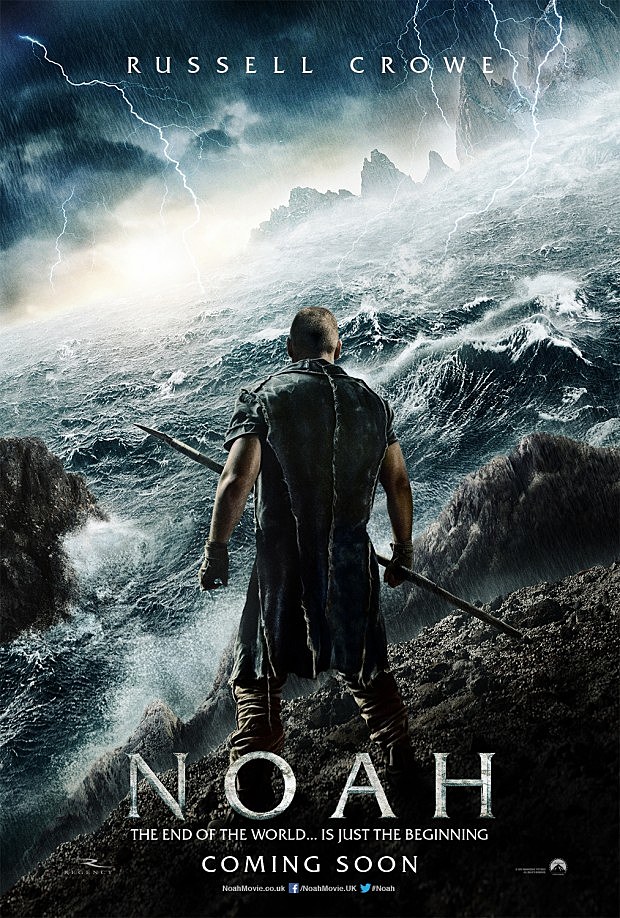
Darren Aronofsky’s Noah pays its source material a rare compliment: It takes Genesis seriously as a landmark of world literature and ancient moral reflection, and a worthy source of artistic inspiration in our day.

It is not a “Bible movie” in the usual sense, with all the story beats predetermined by the text, and actors in ancient Near Eastern couture hitting their marks and saying all the expected things. It is something more vital, surprising and confounding: a work of art and imagination that makes this most familiar of tales strange and new: at times illuminating the text, at times stretching it to the breaking point, at times inviting cross-examination and critique.

For many pious moviegoers, I suspect some of the film’s more provocative flourishes will be a bridge too far. Less pious viewers, meanwhile, may be put off by the biblical subject matter. Have Aronofsky (raised with a Jewish education) and co-writer Ari Handel made a film that’s too religious for secular viewers and too secular for religious ones? Who is the audience?

Well, I am, to begin with. For a lifelong Bible geek and lover of movie-making and storytelling like me, Noah is a rare gift: a blend of epic spectacle, startling character drama and creative reworking of Scripture and other ancient Jewish and rabbinic writings. It’s a movie with much to look at, much to think about and much to feel; a movie to argue about, and argue with.

It’s certainly not the picture-book story that most of us grow up with, all cheerful ark-building, adorable animals and a gravely pious, white-bearded protagonist. Noah, played by a flinty, authoritative Russell Crowe, is the hero, but that doesn’t make him saintly. Or, if he is saintly, it’s worth recalling that some of the saints could be off-putting, harsh, even ruthless. We want our heroes to be paragons of virtue and enlightenment. Yet when you get down to it, the difference between Moses or David and corrupt Hophni and Phineas is one of degree, not kind. We are all made of the same fallen stuff.

For millennia, Judeo-Christian imagination has been haunted by the idea of the primordial world before the Flood: a world so close to paradise, with Eden itself around some forbidden corner, guarded by cherubim with a flaming sword. Men lived many hundreds of years, Genesis tells us, and chapter 6 suggests that giants walked the earth — offspring, on one interpretation, of human women and fallen angelic beings.

Some of these motifs inspired elements in J.R.R. Tolkien’s tales of the earlier ages of Middle-Earth, an imaginative portrait of the primeval world. Tolkien’s best-known works, The Hobbit and The Lord of the Rings, resound with echoes of this lost world. Aronofsky’s Noah includes imaginative flourishes akin to Tolkien: grim portents, grotesque Entish creatures called Watchers, battles in a Mordor-like blasted waste and a dark family struggle not unlike that of Denethor and his sons.

Yet the story’s biblical framework is taken seriously, even literally. There are glimpses of Eden, Adam and Eve in glory, the serpent, the forbidden fruit and the crime of Cain. Though paradise is lost, the Earth has not yet forgotten it, as Tolkien’s rocks and woods remembered the elves after they had gone. In a key sequence, an echo of Eden bursts forth in a rapturous effect recalling Genesis 2:9–10.

Among the highlights is a recounting of the week of creation, not in a prologue, but strategically positioned at a key moment when characters have reason to look back. This soaring sequence, in which the six days are artfully dovetailed with imagery of the origins of the cosmos and life on earth that would be at home in a nature documentary, is, for me, the film’s theological pinnacle.

We meet venerable Methuselah (Anthony Hopkins), Noah’s great-grandfather, who seems to carry some vestige of Adam’s Edenic glory and preternatural power. In Genesis, a patriarch’s blessing was a potent thing; here, there is something almost wizardly about Methuselah, whom even the Watchers call “the old one.” There are hints, too, of what will be after the deluge, notably the Tower of Babel, in the proud boast of the film’s embodiment of human corruption, tyrannical Tubal-cain (Ray Winstone): “Men united are invincible!”

This poses a dilemma for the story of the flood and for Noah. God sent the flood to wipe out human wickedness. Yet after the flood human wickedness immediately reasserts itself. It’s as if the flood accomplished nothing — or, alternatively, as if allowing Noah’s family to continue and replenish the Earth defeated the purpose.

Noah feels deeply the Creator’s grief and wrath over sin and violence — far more deeply than he feels his mercy or love of mankind. The Creator speaks to Noah, not in a voice from heaven, but in visions and portents, and at times Noah’s understanding of the Creator’s will may be deeply, even shockingly, flawed.

Noah presents biblical characters facing challenges, dilemmas and uncertainties as knotty as those we face today. Compared to figures in most ancient dramas, they are both more recognizably human, yet also more persuasively other. I appreciate a costume drama being willing to let the characters’ milieu push back on audience expectations with cultural sensibilities different from ours.

If it seems hard to imagine Moses or David contemplating some of the choices Noah makes, recall Moses’ horrific response to the worship of the golden calf. Consider, also, that Moses and David, living later in salvation history, had more to go on: Noah’s God had not brought his people out of Egypt, revealed his name at the burning bush or spoken to Abraham on Mount Moriah, commanding him to spare the son Abraham was willing to slay in obedience to God.

Although Noah’s domestic conflict centers initially around middle-son Ham, it’s the women in Noah’s life — his wife Naameh (Jennifer Connelly) and daughter-in-law Ila (Emma Watson), the wife of son Shem (Douglas Booth) — who ultimately take center stage. Yet the story’s ethos is frankly patriarchal; Noah’s word is law for his family, and even venerable Methuselah upholds Noah’s sole right to choose the path for his family and for the whole human race. Still, both women are strong, vivid characters, and their strongest scenes brought tears to my eyes.

As the drama plays out, it looks as if the story might have muddled the count of characters at the center of the story, one way or another. In the end, though, the filmmakers can claim to have satisfied the text — just barely. Will that be enough to satisfy religious viewers? That may be the most debated question about the film.

What about pre-release concerns that Noah would be rife with themes of environmentalism and overpopulation? Thankfully, overpopulation concerns (which would undermine the biblical text’s critique of other ancient Near Eastern flood-type stories) are a non-issue, and the biblical theme of “Be fruitful and multiply” is affirmed. There’s a definite environmental slant, at times heavy-handed, that is still broadly consistent with the biblical principle that “In the beginning, God entrusted the earth and its resources to the common stewardship of mankind to take care of them” (Catechism of the Catholic Church, 2402).

I could easily write an essay just on Aronofky’s Watchers and the film’s reworking of Genesis 6 and the Books of Enoch and Jubilees. (I don’t want to write a review of this film — I want to write a commentary.) The film’s Watchers are creatures of heaven and earth, beings of light bound in rock, with six misshapen, rocky limbs corresponding to the six wings of the seraphim.

The Book of Enoch describes both good Watchers, or angels, and rebels, who offered human beings advanced technological and occult knowledge, perpetuating human decadence. These Watchers are seemingly of this ilk, and the knowledge they transmitted to Cain’s descendants leads to an antediluvian civilization spreading corruption across the face of the Earth.

The film’s division between the wicked civilization of Cain and the righteous line of Seth corresponds to the other interpretation of that strange verse in Genesis 6 about the “sons of God” and the “daughters of men”: On this reading, these are not angels and human women, but sons of Seth led astray by daughters of Cain. Noah borrows from both readings, so whichever you prefer, it’s got you covered.

Theological correctness is not an absolute necessity for movie angels (think of It’s a Wonderful Life), but some might wonder whether the film’s morally shaded depiction of the Watchers borders on sympathy for the devil. I prefer to think of it another way. The satanic presence in Noah is the serpent in the garden, who has no ties to the Watchers. They are best thought of, it seems to me, as a fictional class of semi-fallen angels, estranged from the Creator but not wholly corrupted.

The serpent is connected with one of the film’s odder bits: a snakeskin, shed in Eden by the serpent, preserved as a family heirloom by the righteous line of Seth and passed down to Noah by his father. Doesn’t the snakeskin represent evil? Not necessarily. The serpent was created good and then shed that goodness to become the tempter. The skin it wore when God created it is not a token of evil, but of original goodness — and thus a true relic of paradise and a token that evil is always a corruption of goodness, never a thing unto itself.

My main theological quarrel with Noah, and it’s an important one, is nothing the filmmakers put in, but something they left out: Genesis’ clear vision of mankind as the pinnacle of God’s creative work. In Genesis 1, it is only after God creates man in his image that we get the summary benediction, “God saw everything that he had made, and, behold, it was very good” (Genesis 1:31).

Noah’s retelling alters this, with a ringing summary benediction of the glory and balance of creation (“a jewel in the Creator’s hand”) coming before the creation of man. This gives man an ambiguous status in the narrative — particularly since Noah omits the words “in his image.”
Fortunately, Noah does ultimately affirm the imago Dei, as does his father Lamech at the outset. When the heroes talk about man being in God’s image, it’s always immediately tied to responsibility for creation. There’s an implicit naturalism side-by-side with the film’s religious elements. Only wicked Tubal-cain seems really persuaded of the “greatness” of man; only he uses (or misuses) the biblical language of “subduing” and “dominion” to justify his rapacious ways.
Yet Tubal-cain also echoes the serpent in the garden, comparing himself to God in having power over life and death. “A man isn’t ruled by the heavens,” he says, “a man is ruled by his will.” Noah, meanwhile, says, “Strength comes from the Creator.” There is a challenge to the secular mindset that, in context, is more resonant than standard Bible-movie pieties.

Aronofsky has been pondering the story of Noah for decades and working on this film for more than 15 years. Somehow he has brought the first major big-studio Bible film in decades to the screen. The work of an uncompromising filmmaker who makes dark, divisive, personal films without concession to audience expectations, it’s an outlier for the genre, to be sure. It’s not often that a movie with giant rock monsters has me pondering ancient and modern cosmologies, rabbinic literature and Tolkien — and also makes me cry.


Steven D. Greydanus is the Register’s film critic and creator of Decent Films.
He is studying for the permanent diaconate for the Archdiocese of Newark, New Jersey.
Follow him on Twitter.

Caveat Spectator: Action violence and battle mayhem; disturbing images; a childbirth scene (nothing explicit); brief sensuality; theological ambiguities requiring critical thought. Might be fine for thoughtful, mature teens.

Monday, March 24, 2014

More Distortion from the Ed Department on Racial Discipline Disparities

March 23, 2014

The U.S. Education Department released yet another study Friday documenting the fact that black students are suspended and expelled at higher rates than white students. The Obama administration and civil-rights advocates routinely trot out this disparity to justify a strong federal hammer against allegedly racist school districts.

This latest Civil Rights Data Collection Snapshot includes preschool suspension rates for the first time, and they, too, are racially skewed: Black preschoolers are 42 percent of the students suspended once, and 48 percent of the students suspended more than once though they are only 18 percent of preschool enrollment. Pre-K suspensions are exceedingly rare, however: Fewer than 5,000 students out of over 1 million preschoolers were suspended once in the 2011 school year, 2,500 students more than once. 
The media and the civil-rights complex responded on cue with the usual handwringing about racial “inequity.”

“To see that young African-American students — or babies, as I call them — are being suspended from pre-K programs at such horrendous rates is deeply troubling,” Leticia Smith-Evans, interim director of education practice at the NAACP Legal Defense and Educational Fund, told the New York Times. (Ms. Smith-Evans ignored the fact that “such horrendous rates” only affect a little over a thousand black “babies” nationwide.) “It’s incredible to think about or fathom what pre-K students could be doing to get suspended from schools.” 

Actually, what Ms. Smith-Evans should be trying to fathom is the black crime rate, which explains the school-suspension rate. Black males between the ages of 14 and 17 commit homicide at ten times the rate of white and Hispanic males of the same age combined. Given such high crime rates, what do the civil-rights advocates and the Obama administration think is going on in the classroom — docile obedience and strict self-discipline? In fact, the same weak impulse control that leads to such high crime rates among young black males inevitably means more disruptive behavior in school. 

Also on Friday, the New York media reported that a 14-year-old boy riding a bus in Brooklyn the previous night had opened fire on the bus and fatally shot an innocent 39-year-old passenger in the head. Did anyone doubt the race of the killer, even though the media did not disclose it? Blacks commit nearly 80 percent of all shootings in New York City, even though they are only 23 percent of the population; whites commit less than 2 percent of all shootings in New York City, though they are 35 percent of the population. The chance that that young bus killer was a model pupil, quietly paying attention in class and not disturbing his fellow students and teacher, is close to zero. (Follow-up stories revealed that the shooter was a member of Bedford Stuyvesant’s Stack Money Goons crew, and had been moved to open fire when three members of the rival Twan Family boarded the bus.)

If the civil-rights industry refuses to acknowledge the behavior that leads to disparate discipline rates, it is even more resistant to confronting the root of both the black school discipline and crime problems. In many urban areas, the black illegitimacy rate is well over 80 percent. Boys growing up without fathers are overwhelmingly more likely to lack self-discipline and the ability to control their anger than boys growing up with married parents. And those behavioral problems show up early. School administrators have been reporting rising violence among ever younger students for years. “We see aggressive behavior from kindergarten up,” Lawrence Jointer, the director of hearings for the Alexandria, Va., school district told the Washington Post in 2012.  Student behavior has been worsening over the last four decades, he said. 

None of the federal studies mention or control for single-parent households, of course. Instead, we are supposed to believe that well-meaning teachers, who have spent their entire time in ed school steeped in the doctrine of “white privilege” and who are among the most liberal segments of the workforce, suddenly become bigots once in the classroom and begin arbitrarily suspending pacific black children out of racial bias. Oddly, the civil-rights industry never accuses schools of being biased against boys, even though males are as over-represented among disciplined students as blacks. In this case, there would actually be a colorable basis for making such a bias charge, since teachers are indoctrinated in anti-male ideology throughout ed school. Nevertheless, everyone accepts gender disparities in discipline, and not only because no one gives a damn about males these days.  It is simply common sense that boys are more likely to be aggressive and impulsive than girls. Given the black–white crime disparities, it is equally common sense that black students are more likely to be disruptive in class as well. 

The refusal to take student behavior and family breakdown into account in interpreting student discipline rates means that more millions of taxpayer dollars will be wasted suing hapless school districts for phantom racism and sending teachers and administrators back to anti-racism training. The advocacy and anti-bias training complex cleans up, while the root cause of student misbehavior still goes unaddressed.  

Islamic law is adopted by British legal chiefs

Solicitors told how to draw up Sharia-style wills penalising widows and non-believers


By , Religious Affairs Editor
22 March 2014

The London office of the Law Society. Credit: PA

Islamic law is to be effectively enshrined in the British legal system for the first time under guidelines for solicitors on drawing up “Sharia compliant” wills.
Under ground-breaking guidance, produced by The Law Society, High Street solicitors will be able to write Islamic wills that deny women an equal share of inheritances and exclude unbelievers altogether.
The documents, which would be recognised by Britain’s courts, will also prevent children born out of wedlock – and even those who have been adopted – from being counted as legitimate heirs.
Anyone married in a church, or in a civil ceremony, could be excluded from succession under Sharia principles, which recognise only Muslim weddings for inheritance purposes.
Nicholas Fluck, president of The Law Society, said the guidance would promote “good practice” in applying Islamic principles in the British legal system.
Some lawyers, however, described the guidance as “astonishing”, while campaigners warned it represented a major step on the road to a “parallel legal system” for Britain’s Muslim communities.
Baroness Cox, a cross-bench peer leading a Parliamentary campaign to protect women from religiously sanctioned discrimination, including from unofficial Sharia courts in Britain, said it was a “deeply disturbing” development and pledged to raise it with ministers.
“This violates everything that we stand for,” she said. “It would make the Suffragettes turn in their graves.”
The guidance, quietly published this month and distributed to solicitors in England and Wales, details how wills should be drafted to fit Islamic traditions while being valid under British law.
It suggests deleting or amending standard legal terms and even words such as “children” to ensure that those deemed “illegitimate” are denied any claim over the inheritance.
It recommends that some wills include a declaration of faith in Allah which would be drafted at a local mosque, and hands responsibility for drawing up some papers to Sharia courts.
The guidance goes on to suggest that Sharia principles could potentially overrule British practices in some disputes, giving examples of areas that would need to be tested in English courts.
Currently, Sharia principles are not formally addressed by or included in Britain’s laws.
However, a network of Sharia courts has grown up in Islamic communities to deal with disputes between Muslim families.
A few are officially recognised tribunals, operating under the Arbitration Act.
They have powers to set contracts between parties, mainly in commercial disputes, but also to deal with issues such as domestic violence, family disputes and inheritance battles.
But many more unofficial Sharia courts are also in operation.
Parliament has been told of a significant network of more informal Sharia tribunals and “councils”, often based in mosques, dealing with religious divorces and even child custody matters in line with religious teaching.
They offer “mediation” rather than adjudication, although some hearings are laid out like courts with religious scholars or legal experts sitting in a manner more akin to judges than counsellors.
One study estimated that there were now around 85 Sharia bodies operating in Britain. But the new Law Society guidance represents the first time that an official legal body has recognised the legitimacy of some Sharia principles.
It opens the way for non-Muslim lawyers in High Street firms to offer Sharia will drafting services. The document sets out crucial differences between Sharia inheritance laws and Western traditions.
It explains how, in Islamic custom, inheritances are divided among a set list of heirs determined by ties of kinship rather than named individuals. It acknowledges the possibility of people having multiple marriages.
“The male heirs in most cases receive double the amount inherited by a female heir of the same class,” the guidance says. “Non-Muslims may not inherit at all, and only Muslim marriages are recognised.
Similarly, a divorced spouse is no longer a Sharia heir, as the entitlement depends on a valid Muslim marriage existing at the date of death. This means you should amend or delete some standard will clauses.”
It advises lawyers to draft special exclusions from the Wills Act 1837, which allows gifts to pass to the children of an heir who has died, because this is not recognised in Islamic law.
Keith Porteous Wood, executive director of the National Secular Society, said: “This guidance marks a further stage in the British legal establishment’s undermining of democratically determined human rights-compliant law in favour of religious law from another era and another culture. British equality law is more comprehensive in scope and remedies than any elsewhere in the world. Instead of protecting it, The Law Society seems determined to sacrifice the progress made in the last 500 years.”
Lady Cox said: “Everyone has freedom to make their own will and everyone has freedom to let those wills reflect their religious beliefs. But to have an organisation such as The Law Society seeming to promote or encourage a policy which is inherently gender discriminatory in a way which will have very serious implications for women and possibly for children is a matter of deep concern.”