Wednesday, July 31, 2019

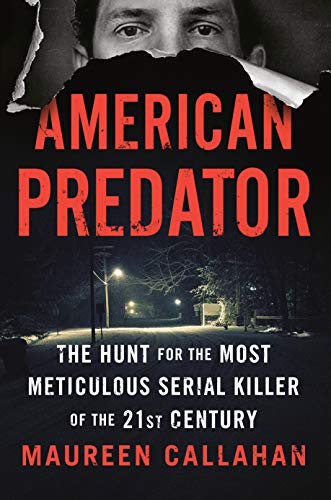
Maureen Callahan’s ‘American Predator’ is a bone-chilling portrait of a monster


https://www.tampabay.com/books/maureen-callahans-american-predator-is-a-bone-chilling-portrait-of-a-monster-20190705/
July 5, 2019

Image result for american predator israel keyes
I sat down with Maureen Callahan’s new true-crime book, American Predator, one night at about 11. The book was getting a lot of buzz, and I wanted to take a quick look to help me decide whether to put it in my review queue.
I jumped when my sleepy dog put his head on my knee. It was almost 1 a.m., and I had read 124 pages without stirring from my chair.
American Predator hooked me first with the disturbing story of the abduction of 18-year-old Samantha Koenig from a coffee kiosk in Anchorage, Alaska, one snowy night in February 2012. At first, police were slow to act, believing the teen had run away after a fight with her boyfriend. Then they got the surveillance video from the shop.
It showed a tall figure, face obscured by a hoodie. The person ordered coffee, then pulled a gun, bound Samantha’s hands, vaulted “like a cheetah” through the kiosk window and walked her away into the dark.
Three weeks after she disappeared, her boyfriend got a text from her missing phone that led investigators to a note demanding ransom, along with photos of Samantha. Now it was a kidnapping, a federal crime, and the FBI joined the Anchorage Police Department in the hunt.
None of them were prepared for what they found.
Use of her stolen ATM card led them to Texas, where they arrested Israel Keyes, a construction worker in his early 30s. He lived in Anchorage with his young daughter and girlfriend; he was in Texas for a family wedding. He had no criminal record, no connection to Samantha. When they searched his rental car, they found a hoodie and mask, a handgun — and Samantha’s driver’s license.
The core of the book is Callahan’s vivid recounting of the interrogation of Keyes once he’s returned to Anchorage. Members of the city’s police department jockey for position on the case, which is now drawing national attention, with the FBI team. Then all of them are bigfooted by the U.S. attorney, whose insistence on leading the questioning is a huge conflict of interest.
But skilled police and FBI interrogators manage to keep some control over the process. Now that he has been captured, Keyes wants to talk. And he has a lot to talk about — all of it the stuff of nightmares.
One of 10 children of parents who followed an assortment of white supremacist and fringe religious cults, Keyes was home-birthed, home-schooled and had little contact with the outside world as a boy. He was bright, resourceful, good at building or fixing anything, attentive to his younger siblings.
He also displayed, from childhood, a tendency toward such crimes as torturing animals, setting fires, committing burglaries and stealing and selling guns.
Callahan writes, “And somehow, in 1998, even without a birth certificate or a Social Security number, he talked his way into the U.S. Army.” There he was praised by superiors, called a “supersoldier” and easily passed the grueling training for Army Rangers. Even to the investigators, some parts of his military career remained obscure.
The interrogations are chilling, first as Keyes gradually reveals the horrific details of Samantha’s fate, then as it becomes clear she was far from his first victim — and might not have been his last, even though he was arrested a month after her disappearance.
Not only was Keyes a serial killer, one who might have been killing — men, women, children — for half his life. He was unique even among that vanishingly small group. Callahan writes, “The Bureau’s top criminal profilers were at a loss. The only thing they could tell the team was that Keyes was one of the most terrifying subjects they had ever encountered. There was no precedent for a serial killer with this MO: no victim type; no fixed location for hunting, killing, and burying; putting thousands of miles between himself and his victims; caches (of weapons and other tools) buried all over the United States. He avoided detection through travel.”
As he gleefully manipulates his interrogators, Keyes also opens up about his methods: flying to other states to find random victims, then transporting their bodies to yet another state for disposal; astonishingly meticulous preparation to avoid leaving DNA and other evidence; maintaining an apparently normal family and work life in between.
“I’m two different people,” he tells them.
Callahan has written for Vanity FairNew York magazine and the New York Post, and she published two earlier books, one about Lady Gaga (Poker Face), another about ’90s fashion icons (Champagne Supernovas).
American Predator is a major shift in subject. It’s also part of the red-hot trend toward true-crime narratives, in podcasts, on television and in books. When you think about it, Callahan’s past reporting about celebrity culture isn’t so different from true crime, especially in a case like this one. In spite of all his efforts to keep his crimes secret, Keyes, like his hero Ted Bundy, craved fame.
So why have you probably never heard of him? Callahan ends the story with a pair of explosive shocks, and with this: “This case provoked the FBI to beg for the public’s help — but just as quickly, they decided to obscure much of the case and Israel Keyes from public view. Approximately forty-five thousand pages of case files remain unreleased by the Department of Justice, under claims of national security.”
In the end, American Predator is unsatisfying in the sense that any nonfiction book about a serial killer must be: Despite all the efforts of his interrogators, we never get inside Keyes’ head. If we come to true crime to try to understand how a monster is born, we finish still in the dark, and maybe it’s darker.
But Callahan’s portrait of this monster, and of the men and women who do their best to uncover his secrets, is one that will keep you up all night.
Contact Colette Bancroft at cbancroft@tampabay.com or (727) 893-8435. Follow @colettemb.
American Predator: The Hunt for the Most Meticulous Serial Killer of the 21st Century
By Maureen Callahan
Viking, 385 pages, $27

‘American Predator’ reveals the chilling playbook of a serial killer


By Dennis Drabelle
https://www.washingtonpost.com/entertainment/books/american-predator-reveals-the-chilling-playbook-of-a-serial-killer/2019/07/02/d4f2b5dc-8224-11e9-95a9-e2c830afe24f_story.html?utm_term=.2fc633141bfe
July 3, 2019

Image result for american predator the hunt for the most meticulous serial killer of the 21st century


The serial killer’s Achilles’ heel is the very thing that makes him so fascinating: his urge to repeat himself. He either stages his murders as rituals, thus providing clues to why he is enraged with the world, or he falls into patterns, because devising a new modus operandi for each killing calls for unsustainable levels of creativity and flexibility.
But what if a serial killer has enough wits and self-control to fashion an amorphous M.O.? What if he reads and learns from FBI profiles of fiends like himself and from fiction such as “The Silence of the Lambs”? What if the very serialism of his “work” escapes notice? And what if he defies the stereotype of serial killers as sullen loners by being a family man?
All these exceptions were true of Israel Keyes, the subject of Maureen Callahan’s riveting book “American Predator.”
And Keyes had something else going for him: He barely left a trace. “No property records,” Callahan writes. “No documentation of parents or siblings. No address history, no gun licenses, no academic transcripts. . . . He had left nearly no digital footprints, no paper trail — and this was a guy with an unusual name.” Later it came out that Keyes had never even applied for a Social Security card, although he had served in the military.
Callahan, an investigative journalist, begins her narrative with the murder that spelled the beginning of the end for Keyes. In February 2012, a high school senior named Samantha Koenig went missing from the kiosk where she worked as a barista in Anchorage. A security-camera video showed her leaving with an unknown adult male. But the transaction looked so ordinary that at first the police wondered whether the girl hadn’t “staged [her own] abduction, and the man in the video was her accomplice.” The man had shown so little of himself to the camera that “tall and athletic” was as much of a description as could be gleaned. (Koenig’s sang-froid may have been an act she put on to keep her abductor calm.)
The first break in the case came when someone began using Koenig’s ATM card to make cash withdrawals in Texas. Then an alert small-town Texas police officer reported seeing a car parked near an ATM at 2:23 a.m. Callahan homes in on the nerve-racking moment when a highway patrol officer spotted the same make and color of car only to realize he lacked probable cause to pull it over. “Find a reason,” the officer’s superior insisted over the radio. He did: The driver exceeded the speed limit — by a measly two miles per hour, but that was enough. At the wheel of the stopped car was Israel Keyes.
Kidnapping is a federal crime, and the FBI had been directing the case from Anchorage. Taken there, Keyes admitted to killing Koenig and to having done this sort of thing before, though how often and who his victims were he wouldn’t say. He was able to take charge of his owninterrogation, largely because of what Callahan sees as the ineptitude of a lawyer from the U.S. attorney’s office in Anchorage who insisted on being the alpha questioner, only to commit one blunder after another. Most damagingly, the bumbling lawyer failed to give the right impression: Make the suspect think you already know far more about him and his actions than you actually do.
Nonetheless, the other interrogators pieced together how Keyes got away with so many murders. He wasn’t picky. With the exception of young children, whom Keyes claimed to have left alone, he would just as soon target a portly middle-aged couple as he would a young woman such as Koenig. This randomness, along with Keyes’s vanishingly low profile, enabled him to kill undetected for years.
Nor was Keyes trying to make a point about his victims’ pasts or sexuality or any other personal characteristic, Callahan deduces after listening to tapes of his interrogation. He was after power and sick thrills. “When Keyes took people,” she writes, “he was acutely attuned to their animal response: the acid flush of adrenaline flooding the brain, color draining from the faces, pupils dilating in fear. He could smell it in their sweat. He liked to extend that response as long as possible.” He also got kicks from watching TV news clips about his murders and commenting on them (anonymously) online. He gloried in his superiority to the police.
Keyes had been raised in a fundamentalist sect, home-schooled and surrounded by guns. As a child, he exhibited the behavior that seems to be a common denominator among adult serial killers: a lust for torturing animals. So how did the grown-up Keyes get caught? Callahan suggests that it was only because he wanted to be, that he made the rookie mistake of repeatedly using Koenig’s ATM card because it was time for his brilliance to be recognized. But we’ll never really know: Keyes killed himself while in police custody awaiting trial for Koenig’s murder.
“American Predator” is a fine book — exhaustively researched and candid without being prurient — that should be as illuminating to law enforcement as it is fascinating to the general reader. If only there were some way to keep it from being read by would-be serial killers.
Dennis Drabelle is a former mysteries editor of Book World.
The Hunt for the Most Meticulous Serial Killer of the 21st Century
By Maureen Callahan
Viking. 285 pp. $27

Tuesday, July 30, 2019

Impeachment Dreams Die; Wall gets Built


By Clarice Feldman
https://www.americanthinker.com/articles/2019/07/impeachment_dreams_die_wall_gets_built.html
July 28, 2019

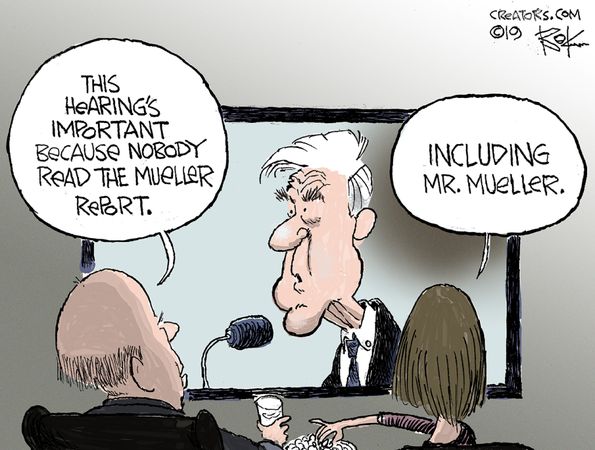
Political Cartoons by Chip Bok

This was a week the President could only have dreamed of. There was the highly promoted appearance of Robert Mueller before two congressional committees in which the impeachment dream of the party with no saleable agenda died in full public view. Egged on by Deep Staters, Guatemala had recently backed off of a deal to keep asylum seekers there, but at the end of the week thought better of reneging (after the President threatened tariffs and other responses if they didn’t follow through on the deal). The week ended with the Supreme Court green lighting the transfer of some funds from the Defense budget to build 100 miles of a wall at the border of Mexico.

Mueller and “His” Report

For two years the mainstream media has been plugging the idea  -- preposterous on its face as it was --that the President colluded with Russia to beat Hillary Clinton. Indeed, the Pulitzer Committee honored the New York Times and Washington Post, leaders of  the collusion band, “for deeply sourced, relentlessly reported coverage in the public interest that dramatically furthered the nation’s understanding of Russian interference in the 2016 presidential election and its connections to the Trump campaign, the President-elect’s transition team and his eventual administration.” 

Television and cable news carried the same tune ad infinitum, as this video clip records in condensed form.

Few people read the Mueller report and the Democrats believed a well-practiced series of soundbites at the hearing would revitalize impeachment impetus. It didn’t. On the contrary, it revealed that the endeavor was corrupt, poorly managed by someone seemingly in the early stages of dementia, and that the special counsel was clearly among those who’d never read the report offered up in his name.  
There was a lot of very good coverage of the Mueller testimony. In my view Kimberley Strassel at the Wall Street Journal and Professor Jonathan Turleyat The Hill did the best job of it.
(a) Strassel 
We’ve been told it was solely about Russian electoral interference and obstruction of justice. It’s now clear it was equally about protecting the actual miscreants behind the Russia-collusion hoax.
The most notable aspect of the Mueller report was always what it omitted: the origins of this mess. Christopher Steele’s dossier was central to the Federal Bureau of Investigation’s probe, the basis of many of the claims of conspiracy between the Trump campaign and Russia. Yet the Mueller authors studiously wrote around the dossier, mentioning it only in perfunctory terms. The report ignored Mr. Steele’s paymaster, Fusion GPS, and its own ties to Russians. It also ignored Fusion’s paymaster, the Clinton campaign, and the ugly politics behind the dossier hit job. [snip]
As Florida Rep. Matt Gaetz asked Mr. Mueller, how could a special-counsel investigation into “Russia’s interference” have any credibility if it failed to look into whether the Steele dossier was itself disinformation from Moscow? Mr. Steele acknowledges that senior Russian officials were the source of his dossier’s claims of an “extensive conspiracy.” Given that no such conspiracy actually existed, Mr. Gaetz asked: “Did Russians really tell that to Christopher Steele, or did he just make it up and was he lying to the FBI?” [snip] The Mueller team, rather than question the FBI’s actions, went out of its way to build on them. That’s how we ended up with tortured plea agreements for process crimes from figures like former Trump aide George Papadopoulos and former national security adviser Michael Flynn. They were peripheral figures in an overhyped drama, who nonetheless had to be scalped to legitimize the early actions of Mr. Comey & Co. Mr. Mueller inherited the taint, and his own efforts were further tarnished. That accounts for Mr. Mueller’s stonewalling.
The appearances reminded me of scenes in Joseph Heller’s novel Good as Gold(less well-read than Catch 22, but a scathing and realistic take on Washington, D.C. culture). Here are two telling quotes from that work. The first about the FBI:
"You’re vulnerable to blackmail in the interests of a foreign power by anyone who knows all the facts.”
“Who knows all the facts?”
“The FBI knows all the facts.”
“Is the FBI likely to blackmail me in the interests of a foreign power?”
The second is paraphrased from memory as I’ve misplaced the book. It clearly was intended as a scathing rebuke of Henry Kissinger, whom the author detested, but the notion of undeserved reputation could apply as well to many others, including Mueller: “He lied under oath before Congressional Committees for three administrations and was widely considered an elder statesman.”
Congressman Louis Gohmert has offered up a detailed view of Robert Mueller’s history and it is far less glorious and ethical than the mainstream press and his admirers has led you to believe.
(b) Jonathan Turley  
The hearing was a disaster for anyone who was hoping for a kickstart to impeachment. Democrats could not produce even a single takeaway moment in six hours of hearings. Instead, Mueller came across more often as befuddled than bemused by the entire exercise. Calling the hearings a “disaster” for Democrats, Harvard law professor Laurence Tribe, a leading advocate for impeachment, declared, “Far from breathing life into his damning report, the tired Robert Mueller sucked the life out of it.”[snip] Democrats did not seem to care that Mueller was in open contempt of Congress by simply refusing to answer questions whenever it suited him. [snip]
He was allowed to discuss the underlying law as well as key decisions on the preparation of the report. All of these areas had been discussed by Attorney General William Barr and were neither privileged nor classified. So why did he not answer these questions? The answer is as simple as it is obvious. He did not want to because he often had no answer. [snip]
…Mueller answered questions about the Office of Legal Counsel when it suited him and then refused when it did not. He started the second hearing before the House Intelligence Committee by withdrawing part of his earlier testimony before the House Judiciary Committee regarding the two memos. [snip] Given his resistance to testifying and his request to have his chief of staff with him, the hearings successfully magnified the lingering questions over his supervision of the investigation. It all was a testament to how a bad movie can ruin a good book. Film critic Joel Siegel once reviewed “The Bonfire of the Vanities” by saying, “This is a failure of epic proportions. You have got to be a genius to make a movie this bad.” If the Democrats wanted to dampen calls for impeachment, they could not have produced a better cinematic suppressant. Call it “The Day Impeachment Died.”
This is not to say that everyone decided it was time to stop beating this dead horse. Hacks Chris Matthews and Rachel Maddow are still at it.
I suppose with them it’s a new kind of psychological therapy for those dumb enough to watch them -- I’d call it “reverse reality therapy” where the therapist enters into the fantasy with the patients and encourages their continued derangement.
The Wall
Friday in a 5-4 decision the Supreme Court determined that the Sierra Club, ACLU, and the Southern Border Communities Coalition had no cause of action to obtain a review of the determination to use $2.5 billion dollars from Defense Department Funds to build sections of the wall on the Mexican Border. (The administration had authorized other funds  -- military construction, Defense department and the Treasury department’s asset forfeiture accounts [seized narcotics funds] -- to supplement the $1.4 billion Congress had allocated for building a wall on the Mexican border, but  only the Defense Department funds were at issue.)
The case arose from -- where else? -- the Ninth Circuit, where a District Court judge  had issued a nationwide injunction against the use of those funds for wall construction.
U.S. Solicitor General Noel Francisco argued that private groups could not challenge this transfer and the majority of the court agreed. He added that even if they had a valid cause of action their “interests in hiking, bird watching, and fishing in designated drug-smuggling corridors do not outweigh the harm to the public from halting the government’s efforts to construct barriers to stanch the flow of illegal narcotics across the southern border.”
Justice Stephen Breyer wanted to lift the injunction but halt construction until the case was heard on the merits but he was outvoted and construction contracts can now be entered into. “While Friday’s ruling isn’t technically on the merits, it is, in practice, a big win for Trump, since there will be no way to 'unspend' the money once construction begins.”
Boris Johnson, who reminds me so much of President Trump, is now the new United Kingdom Prime Minister and the two men are reportedly already discussing a trade agreement, something that should help Johnson immeasurably in his fight for a no deal Brexit. I can’t say the globalists and deep staters are dead yet, but they are mostly dead and as Miracle Max in Princess Bride says of the dead, we’ll soon be able to go through their clothes and look for loose change.

Monday, July 29, 2019

Review: Tarantino’s Lovable Fairy Tale


Paradise Regained


https://freebeacon.com/culture/review-tarantinos-lovable-fairy-tale/
July 26, 2019

Image result for once upon a time in hollywood
Leonardo DiCaprio


If there is any location in the collective American imagination that evokes an Edenic paradise, it would be Los Angeles in the 1960s. To think of it is to dream of it: The sound of Beach Boys harmonies filling the air, the plentiful highways providing traffic-free roadbeds for mammoth convertibles and Woodie station wagons with gas tanks filled up for 22 cents a gallon in a land where oil wells pumped on public high-school campuses, the weather always 72 and sunny, fresh-picked fruit coming down the 101, and money raining down on Californians new and old from aerospace and defense-sector spending… And, of course, all those movies and all those TV shows selling us on the dream.
Quentin Tarantino's Once Upon a Time…in Hollywood is the latest and greatest evocation of that place and time. About two-thirds of the way into the movie, at the beginning of what promises to be a historically terrible evening in the history of the city and the country, Tarantino shows us the twilight moment at which storefronts all over town begin to illuminate their signs—from a Taco Bell to the legendary Hollywood hangout Musso and Frank's to a downtown chili joint to a Mexican restaurant in the valley. The montage lasts all of 30 seconds, and it's quiet and beautiful and funny and iconic all at the same time.
Set in 1969, Once Upon a Time…in Hollywood is a fairy tale of a kind, as its title suggests—but it is also one of the most remarkable acts of historical re-creation in the history of the movies. More important, it is suffused with an unironic love for very nearly every aspect of L.A. it depicts. Tarantino loves the light. He loves the neon. He loves the red-leather banquettes in restaurants. He loves the Beverly Hills houses of old-timey goniff agents (Al Pacino is their representative in the movie) with their wet bars featuring built-in televisions. He makes us love the bad Western TV series and episodes that air on those televisions featuring the movie's protagonist, the rapidly aging TV performer Rick Dalton (Leonardo DiCaprio), who began his career by starring in and now seems to be sliding out of those Westerns by taking guest shots playing the mustache-twirling villain.
Related image
Margot Robbie

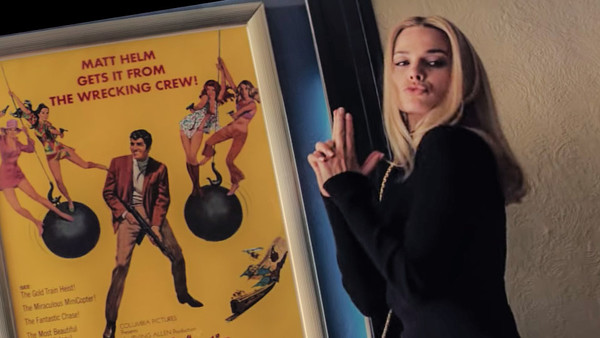
Rick Dalton lives next door to Sharon Tate (Margot Robbie) in the house in which she is to be murdered later in the year, and so we follow her around L.A. too. And here, perhaps, is where Tarantino's love expresses itself in the most poignant way, because he portrays Tate as a kind, blissed-out, life-loving, simple girl—but maybe not so simple, since we see her go into a used bookshop and buy a first edition of Tess and the D’Urbervilles for her husband because she's just read it and loved it. (Her husband, Roman Polanski, made a movie of the novel a decade after the events depicted here.) On those little TVs all over town, we see commercials for forgotten movies like Three in the Attic and Robert Goulet warbling his heart out to "MacArthur Park," the most insane song ever written about L.A. Yes, Tarantino even loves Robert Goulet and "MacArthur Park."
And his love is infectious. Despite some horrifying violence, Once Upon a Time….in Hollywood is gentle in the manner of Jackie Brown, the most uncharacteristic movie in his oeuvre. This is the first lovable movie Quentin Tarantino has ever made, and it remains lovable even when it takes a deft turn straight out of the audacious storytelling he mastered in Inglourious Basterds and Django Unchained. (It also represents a return to form after the misfire that was The Hateful Eight.)

There isn't a bad acting moment in the movie's 157 minutes, and DiCaprio is so spectacular it should end for all time the demented notion that he is some kind of silly man-child, an opinion peddled by those who continue to believe they are somehow speaking truth to power by stupidly opining that Titanic is a bad movie. DiCaprio painstakingly builds Rick Dalton detail by detail until you see this not-very-intelligent but still surprisingly talented and pretty decent man entire.
Image result for once upon a time in hollywood
Brad Pitt

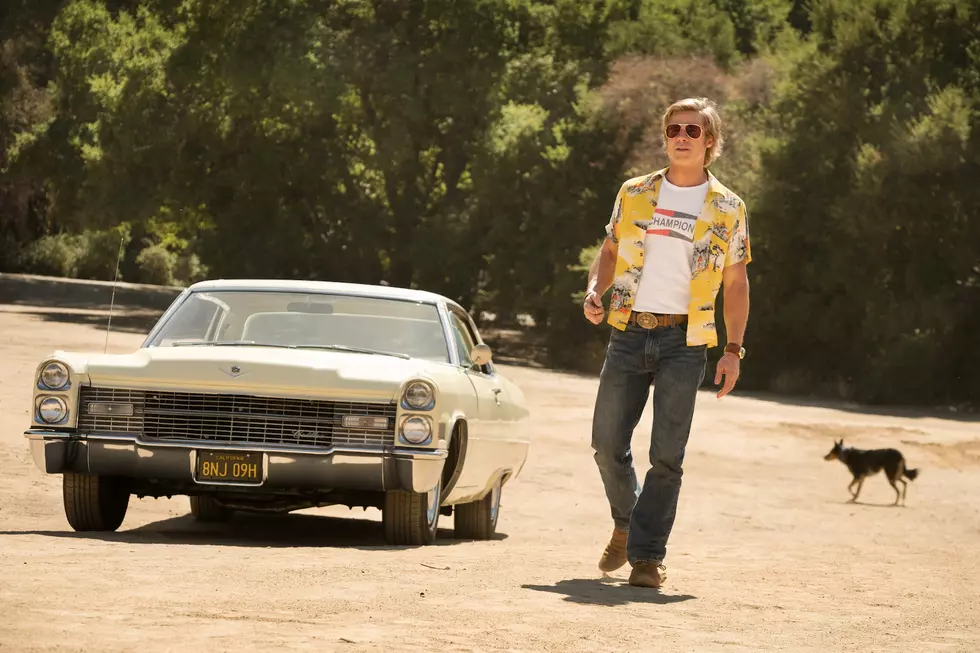
And yet it is Brad Pitt who delivers the performance of the movie, and of the year so far, as Dalton's loyal but enigmatic stunt-man-turned-aide-de-camp, Cliff Booth. Rick is the star and Cliff the guy on the fringes of the entertainment industry—but as things devolve, Cliff is the one who's truly larger than life. Almost by accident, he finds himself in a fight with Bruce Lee and later in an eerie staredown with Charles Manson's crew of psychotic camp followers. He is the last cowboy, the last Westerner.
Pitt's Cliff Booth is the most enduring Hollywood myth made flesh in Quentin Tarantino's glorious vision of a world that didn’t deserve to meet its end—either in the collapse of the old studio system that churned out Rick Daltons by the dozens or in the senseless slaughter of Sharon Tate and her friends on the night in 1969 when the darkness of the counterculture fell upon Los Angeles like a smog and forever poisoned Eden.

Sunday, July 28, 2019

Robert Mueller Can’t Recall


July 26, 2019
Image result for mueller testimony
Even I, as someone who has been blue in the face shrieking that the Mueller inquiry would be an unutterable fiasco since the day it was announced, could not have imagined such a terrible shambles as the world watched, gape-mouthed (like the witness much of the time), when Robert Mueller appeared before the House Judiciary and Intelligence committees on Wednesday.
The Democratic line that began with the president being a traitor who would be removed from office and imprisoned, and descended to impeachment but clinging to the Oval Office furniture by the grace of Republican senators, to general odium for moral turpitude, is now reduced to hypocritical pieties about ethics and the robo-repetition that “No one is above the law.”
Wednesday marks the decisive turning from squeezing the last drop out of the lemon of the president’s alleged crimes, to the long-delayed investigation of the investigators.
The revelation that the Steele dossier—cited in Hillary Clinton’s election memoir as evidence of Trump’s treason—was commissioned and paid for by the Clinton campaign was dismissed as a ”talking point” by the Washington Post and the Democrats generally. The fact that it was the basis of false foreign intelligence surveillance applications was disputed and then allowed to pass and fade with full media silence.
The Strzok-Page text messages revealing a rabid partisanship on the part of some of Mueller’s leading collaborators, the instant transition of Clinton’s official whitewashers into Trump’s defamers and tormentors was dismissed as improper aspersing of distinguished professionals. Mueller was portrayed as a virtual Superman of law enforcement integrity, a “Republican” war hero and peerless exemplar of faithful, selfless public and patriotic service, and the most knowledgeable and formidable of the country’s experts on law enforcement and clean government. He would unmask and destroy the perfidious ogre who had swindled, flim-flammed, and sleazed his way into the White House.
Mueller may once have deserved some of that iconization, though a number of episodes, including his handling of the FBI corruption case in Boston, the Atlanta Olympic bomber affair, and the Uranium One affair, leave room for some reservations. But it became clear on Wednesday that he did not remember much of anything about “his” report, could not even retrieve from memory the much bandied-about word “conspiracy,” contradicted himself, and stonewalled the committees on many questions that appeared to be appropriate for him to answer, (though many questions he rightly declined to answer).
Still, it was a bit rich that Mueller criticized the president in his written answers for stating that he (Trump) did not remember the correct answer to some of the special counsel’s (Mueller’s) questions, given the porosity of his own memory. Never mind the invocation by his successor at the FBI, James Comey, 250 times under oath that he didn’t recall recent matters highly germane to his official duties and actions.
David Axelrod, current spiritual holder of the of the Saul Alinsky Prize for slippery political conjuration, tweeted after a couple of hours that the hearings were “very painful.” They were, and not just for those who were hoping that the hearings would grease the skids for the Democratic presidential impeachment launch. Mueller was drawn, pallid, hesitant, and inarticulate, and very unfamiliar with much of what he had been asked to recall and answer. He appeared to be ill and in no condition to deal with such a challenging session, and implausible as the real guiding force behind this massive and completely redundant inquest.
By the end of the day, there was a general recognition that the page had been turned. The more rabid Democrats may continue to huff and puff and shake their fists at the sky like King Lear, and promise vigilance against the machinations of the Kremlin. But those responsible for this monstrous disgrace to the intelligence services and the FBI that merged parts of them with the dirty tricks division of the Democratic National Committee, cannot delay their day of reckoning much longer.
The Coming Backlash for Democrats
The real origins of this satanic sequence of outrages and the real authors of this ridiculous special counsel report will be unmasked. The Democratic impeachers will be overwhelmed by the gathering backlash.
Mueller has been a respectable front for a ghastly assault on the Constitution, and at the end, he was, understandably, a reluctant witness, but—brave old soldier and Bronze Star winner that he is—he took a bullet for the platoon rather than accept the attorney general’s offer of assistance if he wanted to ignore the House subpoenas to appear. He wanted to retain his professional standing while fronting a horrible mutation of the political system. It was a little like Theresa May, the British prime minister who left office the same day, trying to leave Europe and remain in it simultaneously.
As Washington Dinsdale said in the 1939 Marlene Dietrich-James Stewart film “Destry Rides Again,” one “must choose between the bottle and the badge.” Mueller tried to turn an inability to exonerate—a standard that he admitted has never been asked or expected of any kind of American prosecutor—into something the Democratic congressional allies of his investigative team could use to continue their malicious and illegal harassment of the president. He never should have published the second volume of his report, which is a pastiche of selective and spliced scraps scarcely more rigorously composed than the Steele dossier and apparently intended, with no more success, to serve the same partisan interests.
It is a great sadness, a great victory, and a great irony. The spectacle of a stooped and aged Robert Mueller, after he had (voluntarily) been so dishonestly used by the president’s enemies, was an objectively sad one, a sorry swan-song to a substantial career. The victory of the Trump Republicans is seismic, and announces the imminent exposure and punishment of those who abused the system to attack the president and deform the political system.
The irony is two-fold. If Trump’s enemies had not launched the Russian collusion nonsense, all their pre-electoral skullduggery would not have been unearthed—if they had given him the normal honeymoon for incoming presidents, a serene ambiance would have settled Washington down, at least for a year or so, and they would now be wallowing in their Washington lobbying and other sinecures.
The second irony is that there is plenty of room to attack this president in more traditional and acceptable ways. His policies have mainly been successful; but he is too bumptious, egocentric, and stylistically annoying for many people, and the Democrats could have made something of an issue out of his personality.
Instead, they have struck out, will have no window through which to fire live ammunition at Trump, and will have to take the heat for their corrupt actions. They promised “scorched earth,” and are immolating themselves.
We are now between the lightning and the thunder.

At last the country is run by Leavers


By Brendan O'Neill
https://www.spiked-online.com/2019/07/25/at-last-the-country-is-run-by-leavers/
25 July 2019


Prime Minister Boris Johnson presides over his first cabinet meeting at 10 Downing Street, on Thursday in London.(Aaron Chown/Getty Images)

Remoaners in the media are alarmed at Boris Johnson’s ‘brutal reshuffle’. He is ‘rewarding Hard Leavers’, they claim. His clearout of no fewer than 17 of Theresa May’s 30-strong Cabinet, and his replacement of them with largely pro-Leave and even pro-No Deal ministers, is disturbing and shocking, moans the pro-EU set. Not for the first time they need to get a grip. What is really shocking is that for the past three years Britain was run by Remainers. We often overlook how perverse it was that a nation which voted Leave was so dominated by a Remainer elite. Johnson’s new Cabinet redresses this undemocratic disparity between political-class sentiment and public sentiment and gives rise to a UK that is now run by Leavers. About bloody time.
It is testament to the anti-Brexit elites’ sense of entitlement, to their belief that they were born to rule, that they are so disgusted that pro-Leave people now have the top jobs. There’s the PM himself, of course, who was famously flighty on leaving the EU to begin with, but who then stabbed his flag in the Leave camp and played a key role in Vote Leave. There’s his home secretary, Priti Patel, an implacable Leaver. And his foreign secretary Dominic Raab, a long-time intellectual critic of the EU and literally the only person May ever sent to Brussels who couldn’t be bossed around by Brussels – hence he had to resign as May’s Brexit secretary because he got in the way of her strategy of caving in to every single one of the EU’s demands. And there’s Jacob Rees-Mogg, head of the European Research Group and now leader of the House of Commons, which is hilarious given how many people in the Commons – including on the Tory side – hate how pro-Brexit he is.
Across the Cabinet, there are ministers who have committed to leaving with No Deal if necessary by 31 October. It remains to be seen whether the BJ government can pull this off, and there will be serious repercussions for it, electorally and reputationally, if it fails to. But that we now have a government led by Leavers is perfectly normal. Good, in fact. It means this Cabinet is far more in tune with public sentiment than the Remainer double act of Theresa May / Phillip Hammond ever was, and than Jeremy Corbyn’s Brexit-thwarting, second referendum-backing Labour could ever be. Never forget the most staggering political statistic of modern times – where 52 per cent of the public voted Leave, just five per cent of Labour MPs did. Boris might be Eton, Rees-Mogg might sound like a man from another era, but it is testament to Labour’s stunning drift from its traditional voter base and from the public in general that their Cabinet is more reflective of public opinion than Labour is.
On top of these ministers we have Boris’s new senior adviser, Dominic Cummings, the strategic whizz behind Vote Leave, and his director of policy, Munira Mirza, friend of spiked and a committed Leaver. Downing Street is now a Leave bastion. This is progress. The proof is in the pudding, of course, so Downing Street must make good on its Leave credentials or else the masses’ eyes will roll yet again, as they have many times over the past three years. In some ways the most admirable thing about the appointment of Cummings is that it suggests Johnson doesn’t care that much what the media class thinks. He must have known that having Cummings at No10 would cause a meltdown among those chattering-class muppets who think Cummings is a mad, criminal mastermind who hoodwinked the electorate in 2016 – and yet he still did it. Let’s hope this is a positive sign of a healthy disregard for media-class moaning and Twittermob hysteria.
Here is what is most striking about so many Vote Leave people now playing a key role in government: for three years the anti-Brexit, anti-democratic wings of the establishment have tried to demonise Vote Leave as a criminal enterprise. They have insulted it, demonised it. They have accused it of destroying modern Britain. And yet here it still is, more influential than ever. And that is not down to any peculiar talents on the part of Vote Leave, by the way. It’s down to the fact that Leave campaigns are still necessary. Unbelievably. More than three years after the people voted to leave, the fight actually to leave continues. It must be hoped that Johnson and his team understand what a colossal blow to people’s aspirations and to the democratic spirit itself it will be if they now do not deliver on Leave. It will be a far greater failure than May’s. We always knew she was a Remainer. But they’re Leavers. And if Leavers don’t deliver Leave, then politics will suffer even more than it did under the Maybot regime. No pressure, guys.

You don’t have to have unfettered faith in this Cabinet to see that it feels refreshing. It was always a depressing sign of the times that British politics – not to mention the British media elite, the cultural elite, the university system, the judiciary and all other powerful institutions – were dominated by Remainers. This was a Leave country ruled by Remainer politicians, proof of the chasm that now separates elite opinion from public opinion. The new Cabinet goes some way to rectifying that. Now let’s leave. Properly, fully, with no turning back. Out, out, out.
Brendan O’Neill is editor of spiked and host of the spiked podcast,The Brendan O’Neill Show. Subscribe to the podcast here. And find Brendan on Instagram: @burntoakboy

Saturday, July 27, 2019

Film Review: A Quentin Tarantino skeptic takes great pleasure in ‘Once Upon a Time … in Hollywood’


By Kenneth Turan
https://www.latimes.com/entertainment-arts/movies/story/2019-07-24/once-upon-a-time-in-hollywood-quentin-tarantino-leonardo-dicaprio-brad-pitt-margot-robbie
July 24, 2019

Image result for once upon a time in hollywood

I go back with Quentin Tarantino, way back, starting with being in the room at 1992’s Sundance Film Festival when his debut feature, “Reservoir Dogs,” had one of its very first screenings.
When a visibly pained audience member asked Tarantino in the Q&A how he justified the film’s tidal waves of violence, the director almost didn’t understand the question. “Justify it?” he echoed before just about roaring, “I don’t have to justify it. I love it!”
Over the next quarter-century, little has changed. To enjoy Tarantino was to embrace his preening style, to share his reductive view of cinema and the world and violence’s preeminent place in both.
I was a chronic dissenter — I still get occasional grief about my “Pulp Fiction” review — so how is it that I reacted with distinct pleasure to the writer-director’s “Once Upon a Time … in Hollywood”?
The film toplines Leonardo DiCaprio and Brad Pitt as, respectively, TV star Rick Dalton and his stuntman Cliff Booth, longtime best friends kicking around Hollywood in 1969 with Charlie Manson and company lurking in the background. Had Tarantino changed, had I, or was it both of us?
At age 56 and recently married, Tarantino talked at the film’s Cannes press conference about “taking stock,” and in fact “Once Upon a Time” strikes a chord that is distinctly elegiac and unexpectedly emotional, especially coming from him.
Though florid Italian westerns, primarily those of Sergio Corbucci, one of Tarantino’s idols, are front and center in the story line, the tone of this film owes as much to low-key, end-of-an-era Hollywood westerns like the Joel McCrea/Randolph Scott pairing in Sam Peckinpah’s “Ride the High Country.” Really.
Don’t misunderstand, the familiar Tarantino gut-clenching ultra-violence, especially against women, has hardly disappeared. But it has been in effect quarantined to several wrenching minutes near the end of what is for most of its leisurely two-hour, 41-minute length a tribute to both a bygone era and the kind of masculine charisma and camaraderie the movies have always specialized in.
What this means in practice is that what would be peripheral elsewhere is central here. Things like character moments and quirks of personality as well as detailed specifics of popular culture, whether they be from film, TV, music or commercials, are not window dressing to pass the time until the plot kicks in; they are the essential reason “Once Upon a Time” exists.
When Tarantino says in the press notes “I tried a couple of different stories and then I decided no, I didn’t want to put them [his protagonists] though some typical melodramatic plotline,” he’s not being coy, he’s telling the truth.
With Victoria Thomas as casting director, “Once Upon a Time” is rich in involving acting across the board, including Dakota Fanning as Manson honcho Squeaky Fromme, the ageless Bruce Dern as rancher George Spahn and Margaret Qualley, a would-be nun in “Novitiate” here seen as the inescapably promiscuous Manson follower Pussycat.
Best of all, not surprisingly, are DiCaprio and Pitt, completely at ease with their parts and each other, the joke being that they use their enormous movie star presences to play a below-the-line stuntman and a second-tier star afraid of falling further, characters Tarantino feels unmistakable warmth toward.
Inspired by real-life relationships like those between Burt Reynolds and Hal Needham or Steve McQueen and Bud Ekins, the pair function here a bit like Raymond Chandler’s tarnished knights, doing good despite themselves, an association heightened by a bookstore scene reminiscent of one in Humphrey Bogart’s “The Big Sleep.”
Also front and center is Tarantino’s passion for the late ’60s in general and its popular culture and moviemaking machinery in particular.
The specificity of “Once Upon a Time’s” references to the artifacts of the era is astonishing to the point of obsession, including having production designer Barbara Ling fabricate false fronts to place in front of today’s Hollywood Boulevard establishments and encouraging Musso & Frank to pull period dinnerware out of storage.
Image result for once upon a time in hollywood
Every item we see onscreen, and we see lots of them, from not one but a series of Hopalong Cassidy mugs to a copy of a “Sgt. Fury and His Howling Commandos” comic book, looks like it was carefully selected because of its closeness to the filmmaker’s heart.
Talking to Tarantino about the era, DiCaprio said at Cannes, was “almost like tapping into a computer database — his knowledge is unfathomable,” adding accurately, “He’s made a love letter to his industry.”
After providing us with a brief but pithy introduction to “Bounty Law,” the recently discontinued show that made Rick Dalton a household name, “Once Upon a Time” walks us through three days, two in February and one in August, in star and stuntman’s intertwined lives, starting with Dalton’s Musso lunch with top agent Marvin Schwarzs.
Expertly chewing the scenery like he just came off a hunger strike, Al Pacino brings us up to speed on Rick Dalton’s filmography, lavishing special praise on the action epic “The 14 Fists of McCluskey.” (No one invents names like Tarantino.)
But that career is hanging in the balance, Schwarzs explains, before holding out a lifeline à la Clint Eastwood of doing westerns in Italy, something Dalton, with no love of cinema made by “I-talians,” initially resists.
Introduced at this point are Dalton’s recently moved-in neighbors on Cielo Drive in Benedict Canyon, the glamorous Sharon Tate (Margot Robbie), briefly seen husband Roman Polanski (Rafal Zawierucha) and best friend Jay Sebring (Emile Hirsch).
Also glimpsed momentarily is Charlie Manson (Damon Herriman), though members of his family hanging out at Spahn Movie Ranch (including characters played by Lena Dunham and Maya Hawke) are given more visibility.
While conventional plot elements do appear from time to time, especially toward the conclusion, most of “Once Upon a Time” consists of the string of stand-alone vignettes that Tarantino clearly cherishes.
The most memorable include Sharon Tate spending an afternoon enjoying her performance in “The Wrecking Crew” at the Bruin in Westwood and Rick Dalton having an elaborate heart-to-heart chat with a wise-beyond-her-years 8-year-old actress (wonderfully played by Julia Butters) prior to a big scene.
And then there is Pitt’s Cliff Booth, improbably up on a roof to fix a TV antenna, casually taking off his shirt to reveal a perfectly toned and impeccably lit upper body. Movie star moments don’t get any purer than that.
Also pure and not to be underestimated is how personal so much of what we see is to Tarantino. He’s showcased the massive three-sheet-size poster for “The Golden Stallion,” one of his favorite films; given a cameo to his wife, Daniella Pick; and even found time for a charming montage of great L.A. neon (El Coyote, Musso & Frank, Chili John’s and more) lighting up at twilight.
Tarantino was a boy of 6 in 1969, living far from the center of Los Angeles, and in a sense what he’s done here is re-create the world he’s imagined the adults were living in at the time. If it plays like a fairy tale, and it does, don’t forget the first words in the title are “Once Upon a Time.”