Wednesday, January 02, 2019

New Documents Suggest The Steele Dossier Was A Deliberate Setup For Trump


By Lee Smith
http://thefederalist.com/2019/01/02/new-documents-suggest-steele-dossier-deliberate-setup-trump/
January 2, 2019
Related image
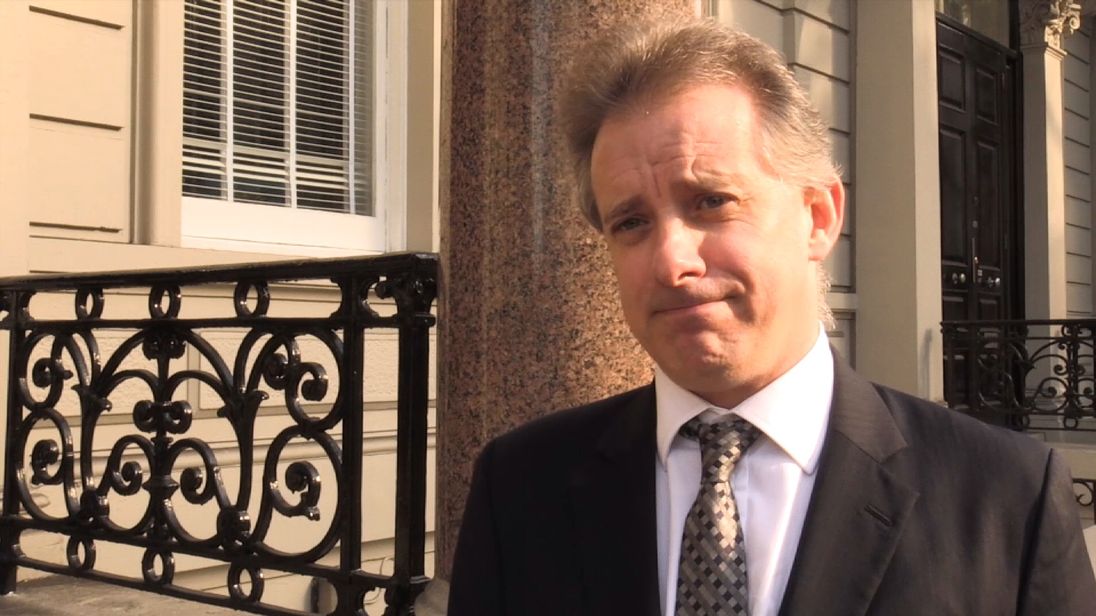
Christopher Steele

A trove of recently released documents sheds further light on the scope and logistics of the information operation designed to sabotage an American election. Players include the press, political operatives from both parties, and law enforcement and intelligence officials. Their instrument was the Steele dossier, first introduced to the American public two years ago.
A collection of reports compiled by former British spy Christopher Steele, the dossier is now engraved in contemporary U.S. history. First marketed as bedrock evidence that Donald Trump colluded with Russia to win the 2016 election, the dossier’s legitimacy took a hit after reports showed the Hillary Clinton campaign paid for the work.
The revelation that the dossier was used to secure a Foreign Intelligence Surveillance Act (FISA) warrant on Trump campaign adviser Carter Page compromised the integrity of the investigation the FBI had opened on Page and three other Trump associates by the end of July 2016. Nonetheless, that same probe continues today as the special counsel investigation.

The dossier plays a central role in Robert Mueller’s probe. In the unredacted portions of Deputy Attorney General Rod Rosenstein’s memo outlining Mueller’s scope are allegations that Trump adviser Paul Manafort colluded with Russian government officials interfering in the 2016 race. That claim is found in no other known document but the dossier. It is unclear whether further dossier allegations are in the redacted portions of the scope memo.
Further, with Mueller in charge, the dossier-won warrant on Page was renewed a third, and final, time in June 2016. It expired in September, when confidential human source Stefan Halper reportedly broke off regular communications with Page.

The Dossier Model Is Being Replicated

Paradoxically, it is the Mueller investigation that has most thoroughly tested the veracity of the dossier’s claims. After the FBI’s monitoring of Page for nearly a year, with access to his electronic communications prior to the warrant, the special counsel has brought no charges against the former Navy officer alleged in the dossier to be at the center of a criminal conspiracy.
Yet the dossier abides. Even as prominent and early collusion theory promoter journalist Michael Isikoff now questions its probity, many still contend that Steele’s reports have not been “disproven.” After nearly two years since the Steele dossier was published, it remains the cornerstone of the case for collusion. Moreover, the dossier model has given rise to similar operations, joining the press, political operatives, and intelligence officials, not all of them American, targeting Trump policies.
The reported murder of Arab intelligence operative and Washington Post contributor Jamal Khashoggi was used as a platform by Turkish intelligence, the government of Qatar, and U.S. operatives to advance a campaign through the press, with the Post playing a leading role, against the administration’s pro-Saudi policies.
Democratic officials teamed with the media to thwart Supreme Court nominee Brett Kavanaugh, also using an FBI investigation as a political tool. “We were very concerned when Democrats on the Senate Judiciary Committee pushed for another FBI investigation of Kavanaugh,” said a congressional investigator on the Republican side familiar with the dossier operation. “We didn’t know who would get it at the bureau and who we can trust over there.”
Cyber-security experts hired by the Senate Intelligence Committee to write a report on how Russian social media accounts helped Trump beat Clinton themselves created fake Russian social media accounts to dirty the GOP Senate candidate in last year’s special Alabama election. As the dossier operation targeted Trump, the bot operation created the impression that Roy Moore was supported by the Kremlin.

Pretext for Two Years of Treason Accusations

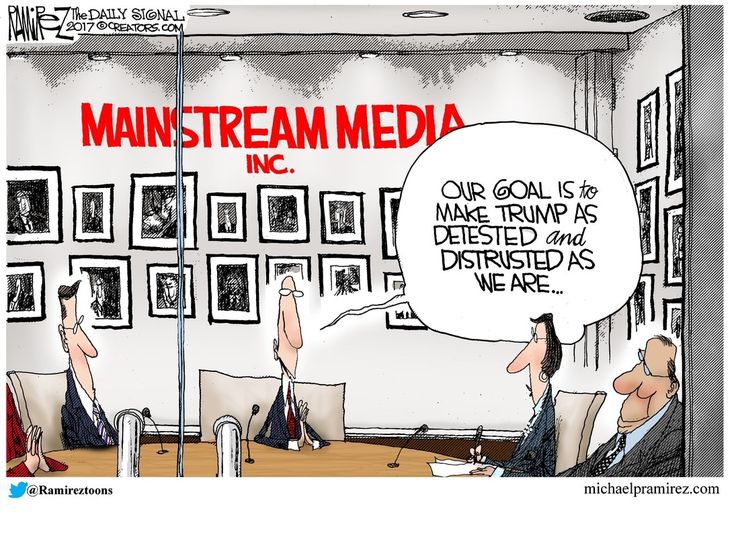
The dossier operation has not only damaged institutions like the FBI and DOJ, it has also poisoned the public sphere, perhaps irremediably. As a result, it is now accepted journalistic practice to print, and reprint, any garish fantasy so long as it’s layered with Russian intrigue and Trump team treason. Even as the rest of the country sees an institution that has made itself a laughingstock, the press continues to salute itself for its bravery—or the courage and industry required to take leaks from law enforcement and intelligence officials and Democratic operatives in an effort to topple a president it doesn’t like, elected by neighbors it holds in contempt.
How did it come to this? Former FBI director James Comey ushered in the era of the dossier when he briefed Trump on January 6, 2017 on reports that “the Russians allegedly had tapes involving him and prostitutes at the Presidential Suite at the Ritz Carlton in Moscow from about 2013.”
Last week, the Department of Justice released a heavily redacted version of the two-page memo on the dossier with which Comey briefed the president-elect. The “source’s reporting,” reads the memo, referring to Steele, “appears to have been acquired by multiple Western press organizations starting in October.”
As Comey later recorded in a separate memorandum documenting the meeting, he told Trump that “media like CNN had [the reports] and were looking for a news hook.” The briefing provided one.
According to Comey’s recent testimony, James Clapper ordered the briefing. The former director of national intelligence is believed to have then tipped off CNN, which later hired him as a commentator. After the award-winning CNN story posted, BuzzFeed published the document, passed to the news organization by Republican aide David Kramer.

The Frame Game Is Bipartisan

In his testimony, Comey again pushed the fiction that Republicans opposed to Trump first paid for the dossier. Congressional Republicans are right that Comey is trying to muddy the waters—the Clinton campaign and the Democratic National Committee funded Steele’s work.
But credit Comey for underscoring, and maybe not accidentally, a larger truth—the operation that sought to defraud the American voter had bipartisan support all along. Court documents released in December show that Steele gave his final report to Republican Rep. Adam Kinzinger and House Speaker Paul Ryan’s chief of staff, Jonathan Burks.
How is it possible that so many people knew and said nothing? Everyone knows it’s impossible to sustain a real conspiracy that size. People in the know talk and the press makes it public. But they did talk—all the time. But the conversations, implicit confessions, of FBI agents and other U.S. officials were hidden by colleagues who classified their talk, or deleted it, like FBI employees Peter Strzok and Lisa Page’s text messages.
The press didn’t report it because the press is part of the operation, the indispensable part. None of it would have been possible, and it certainly wouldn’t have lasted for two years, had the media not linked arms with spies, cops, and lawyers to relay a story first spun by Clinton operatives.
Starting with a relatively small group consisting of Steele, Fusion GPS founder Glenn Simpson, and senior FBI, DOJ, CIA, and State Department officials, the dossier operation gained momentum and adherents, senior officials across the political spectrum, a large part of the press corps, then the many millions of Americans it wound into a frenzied madness. Thus, much of the dossier operation was improvised.
But the core component appears to be the result of a carefully constructed plan requiring technical and legal know-how. Interviews with current and former U.S. officials provide fresh insight into how Clinton-funded operatives and senior law enforcement figures orchestrated a media campaign and weaponized the dossier to obtain the October 21, 2016 warrant on Page.

Fishing for a FISA Warrant

The claim from the recently released two-page Comey memo that Steele’s “reporting appears to have been acquired by multiple Western press organizations starting in October” is inaccurate. The allegations that were eventually rolled into the Steele dossier first started appearing in the press six months previously. Understanding how the company that produced the dossier operates may clarify matters.
Fusion GPS calls the two- to three-page handouts that it distributes to its media customers dossiers. The so-called Steele dossier is a collection of 17 Fusion GPS dossiers apparently written over the period of several months in 2016 and published by BuzzFeed in January 2017.
Fusion GPS started briefing the press on dossiers of Trump-Russia material long before BuzzFeed made the aggregate document public. An echo chamber of Trump-Russia stories (New York MagazineSlate, and two in Politico) that appeared in April shows Fusion GPS was coordinating with the media shortly after it was hired by the Clinton campaign in March.
There is also confusion concerning the dossier’s sources. The Comey memo contends that Steele “collects information from a layered network of identified and unidentified subsources.” Presumably some genuine human sources fed the reporting. The dossier, however, was produced not by an intelligence bureaucracy, but by an opposition research firm whose “research,” according to Simpson’s Senate testimony, “is very document focused.”
The handouts Fusion GPS distributes to journalists are typically sourced to news articles, with footnotes and links, often from foreign or lesser-known media outlets. As another Fusion GPS contractor working on the Trump-Russia project explained, the job was to “produce memos based on information that is in the public record that can be given to the feds or shared with journalists.”

The Making of a Memo

Many of the dossier’s sources are taken from media reports or other documents, without the customary footnotes and links. For instance, it appears that the most notorious Steele memo recycled earlier Trump-Russia reports.
Around the same time Fusion GPS was hired, longtime Clinton foot-soldier Cody Shearer was also probing for ties between Trump and Russia. He, too, was speaking to media figures, like former CIA official Robert Baer. Shearer wrote two reports (“Donald Trump—Background Notes—The Compromised Candidate,” and “FSB Interview”), which are likely sources for the dossier report on which Comey briefed Trump.
Both Shearer memos detail Trump’s alleged sexual proclivities. One claims there is film of a woman urinating on him. The other Shearer report alleges that there is video of Trump caught in a sexual tryst in the presidential suite of the Moscow Ritz-Carlton in 2013. According to Shearer’s FSB source, this is how the Russians compromised Trump.
These are nearly identical to the core findings that Steele seems to have shared with the State Department and FBI in June and early July. The chronology of the BuzzFeed document indicates no other memos existed at that point. It’s not known whether Steele shared reporting with U.S. authorities that was not included in the BuzzFeed version.

Seeding the Media with Collusion Claims

DOJ officials claim that Steele’s reports regarding the Republican candidate’s alleged relationship to an adversarial foreign power were shelved for several months. However, action on the media front in early summer shows this is unlikely.
Shortly after Steele met with an FBI agent in London the first week of July, the press was briefed on his subsequent reporting. On July 26, a Wall Street Journal reportertexted Carter Page to ask for comment on allegations that he had met with Igor Sechin, a Russian energy executive and Putin ally, to discuss “energy deals and the possibility of the U.S. government lifting sanctions.”
The reporter’s queries match allegations made in a July 19 Steele memo that Page met with Sechin, who was sanctioned by the United States in 2014, during a Moscow trip earlier that month to discuss “future bilateral energy cooperation and prospects for an associated move to lift Ukraine-related Western sanctions on Russia.” These claims were entered in the original FISA application and all three renewals.
The FBI terminated its arrangement with Steele after discovering that he had briefed the press for a Mother Jones article published October 31. The House Intelligence Committee’s FISA memo argued that Steele should have been fired for his “undisclosed contacts” with press outlets in September, before the FISA application was submitted to the court. But the exchange between Page and the WSJ reporter shows the press was being briefed on what is said to be Steele’s reporting by the end of July. Page wrote on Twitter recently that Fusion GPS fed the journalist this material.
Page has denied that he knows Sechin, the president of Rosneft (Russia’s major petroleum company), or the Kremlin official named in the memo. He responded to the Journal reporter that the “sanctions lifting point” was “ridiculous.”

The Advantages of Targeting a Normal Person

The former Trump volunteer brecently filed a defamation lawsuit against the Democratic National Committee and the law firm, Perkins Coie, that hired Fusion GPS on Clinton and the DNC’s behalf. “Until then, I was an unknown name,” Page told The Federalist in a recent phone call. “The advantage of smearing a private figure is that you can make up whatever lies you want. If you’re sketching someone on a blank slate, then it’s easy to draw a fictional characterization.”
According to intelligence officials, the fact that Page was relatively unknown made him an attractive target.
“It can be tougher to make a FISA case on a prominent, government-connected figure,” said former Army intelligence officer Chris Farrell, now director of investigations at Judicial Watch. “But you can spin a tale about a guy who is on the margins. You can make sweeping generalizations, you don’t have to be too detailed. And they’d use the lack of information on Page to explain that’s precisely why they need the warrant—to learn more about him.”
Intelligence sources told The Federalist that Page was likely targeted as a means of accessing the Trump team’s communications.
“It’s not just that it would be hard to convince a judge to let you target Trump,” said a former senior U.S. intelligence official who spoke on condition of anonymity. “There’s an upside to going after a middle or lower-level figure in an organizational structure.”
According to FISA’s two-jump protocol, the FBI can monitor the communications of those in contact with the target and those in contact with them. Law enforcement would look for a target likely to provide the largest aperture into an organization.
“The fact that Page was a peripheral campaign figure meant he was in contact with more people than someone like Trump, whose contacts were likely pretty limited,” said the same source. “Trump’s the top guy, so his contacts within the team are through a funnel, a handful of aides. Targeting Page would give them broader ability to hop. His first order contacts within the campaign team were probably limited, maybe 15 people—who knows? But that would give lots of access to other people on the second hop, maybe 30 or 40 times that.”
Page is the dossier’s protagonist. It is the dossier’s account of his actions that earned the October 21 warrant. A former prosecutor familiar with the case told The Federalist that when he first read the dossier, he recognized immediately that Page was the central figure: “All the other stuff isn’t that important. The other characters appear to be secondary. Page is the leading actor, the centerpiece of the dossier. He’s the one who is alleged to have committed a crime.”

Crossing the Criminal Accusation Threshold

To get a FISA warrant on American citizen, there must be probable cause to believe that the subject has or may be about to commit a crime.
Retired FBI agent Mark Wauck enumerated what is required to get a FISA warrant on a U.S. person. “He must be acting as an agent of a foreign power,” Wauck told The Federalist. “He must be engaged in clandestine intelligence activity, and the clandestine intelligence activity involves or may involve a violation of a criminal statute. No crime alleged, no FISA warrant,”
Title I of the 1978 Foreign Surveillance Act—“Electronic Surveillance within the United States for Foreign Intelligence Purposes”—lays it out. Under the definition of “agent of a foreign power,” there are two categories: “any person other than a United States person,” and “any person.” Since Page is an American citizen, he falls into the second category.
According to Wauck, the relevant parts are two paragraphs in Section 101 (b) (2). To obtain a FISA warrant on a U.S. person, the target either:
(A) knowingly engages in clandestine intelligence gathering activities for or on behalf of a foreign power, which activities involve or may involve a violation of the criminal statutes of the United States;
(B) pursuant to the direction of an intelligence service or network of a foreign power, knowingly engages in any other clandestine intelligence activities for or on behalf of such foreign power, which activities involve or are about to involve a violation of the criminal statutes of the United States.

“So to get a FISA on Page,” says Wauck. “They must allege that his clandestine intelligence activities involve or may involve or are about to involve a violation of the criminal statutes of the United States. No exceptions, no way around it. So, rest assured that somewhere in the application–possibly redacted–there is an allegation regarding a criminal violation.”
Former DOJ official Andrew McCarthy made a similar observation in a September 2018 National Review column analyzing the FISA application, with special attention to the probable cause section. Why, asks McCarthy, do Page’s crimes appear to be redacted? “Is it because the ‘crime’ allegations come from the Steele dossier and the FBI would rather not acknowledge that?”
The timeline and composition of the dossier suggest this is the case. Thus it’s instructive to see the narrative constructed around Page—both the media legend and the dossier memos that were fed into the FISA application—as an instrument built for a specific goal: To secure a warrant to spy on the Trump team, using Page as a point of entry.

Using Page to Get Trump

First, Page, all but unknown in foreign policy circles, had to be portrayed as a key member of the Trump team. This was the goal of the media campaign targeting Page.
The Wall Street Journal reporter appears to have been one of several journalists briefed during the same period on Page’s alleged Russian-related activities. Articles published during July and early August (The AtlanticThe New YorkerThe Weekly StandardWashington Post, and Slate) cite Page’s biography and articles as evidence of Trump’s ties to Russia.
An important target audience was the handful of Foreign Intelligence Surveillance Court judges likely to read the application for a warrant on the Trump adviser.
“By the time it got to the secret court,” said a senior congressional source, “it was supposed to be common knowledge that Page was strangely friendly to Russia.”
Page is first identified in the dossier in an undated memo (Report 095), apparently from the mid-July period, as an intermediary used by Trump campaign manager Paul Manafort to manage the “well-developed conspiracy” between Trump and the Russians.
Among other pieces of evidence cited in the dossier to prove Manafort’s connections to the Kremlin is an August 22 report detailing a “secret” meeting the previous week between Putin and former Ukrainian president Victor Yanukovich, a former Manafort client. In their meeting, according to the dossier, Yanukovich confirmed to Putin that he “authorized the kick-back payments to Manafort, as alleged in western media.”
The memo is likely referring to a New York Times article from the previous week sourced to Ukrainian activists. But the August 15 meeting in Volgograd between Putin and Yanukovich is an invention.
Russian government website shows Putin was in Volgograd on that date, for a one-day trip. Yanukovich, however, didn’t get to Volgograd until August 18, three days after Putin left. It would have been hard to miss Yanukovich’s arrival, since he pulled into port on a triple-decker yacht.
It appears that Steele or another Fusion employee had mistaken the date in published reports, like this one from Meduza, a Russian opposition publication based in Latvia.
Thus Page’s alleged interactions with Russian officials were represented as part of a larger clandestine network linking the Trump team to the Kremlin. Press coverage of Page’s July trip to Moscow, and his speech there, proved he was somehow engaged in Russia-related affairs—while the dossier purported to unveil the real, nefarious purpose of his trip.

Ticking Off the FISA Boxes

The July 19 Steele memo alleging that Page had a “secret meeting” with Sechin checked off an important box for the FISA application process.
“It’s to find out about the target’s clandestine activities on behalf of foreign powers. It doesn’t make sense if it’s a public meeting in Red Square,” said Wauck. “Next you’d want to show that the people he met with clandestinely were part of the criminal activity.”
However, there is no crime alleged in the July 19 memo. The substance of Page’s supposed meeting is not criminal. Removing sanctions on Russia in exchange for bilateral energy cooperation would be a matter of policy.
The criminal predicate for the FISA warrant is introduced subsequently, in a memo dated almost exactly three months later, October 18. Report 134 is essentially a revision of the July 19 memo. It discusses the same meeting in early July and appears to be described by the same intimate of Sechin’s who reported the meeting to Steele’s intermediary in July. This time, however, Sechin’s “close associate” gives a significantly different account to Steele’s source—he “elaborated on the reported secret [July] meeting.”
According to the October 18 report, instead of offering bilateral energy cooperation in exchange for convincing Trump to relieve sanctions, Sechin tells Page that he will profit personally. According to the memo, Page was offered “the brokerage of up to a 19% (privatised) stake in Rosneft in return.”
That’s bribery. The scheme would have benefited both men, likely removing sanctions on Sechin and making Page a wealthy man. The brokerage fee would have amounted to at least tens of millions of dollars on a percentage worth more than $10 billion.
The Trump adviser, the report continues, “expressed interest and confirmed that were Trump elected US president, then sanctions on Russia would be lifted.” The memo ties Page’s potentially criminal actions to Trump himself. According to Steele’s source, Page was “speaking with the Republican candidate’s authority.”

The Importance of 19 Percent

Newly incoming House Intelligence Committee Chair Adam Schiff contended back in March 2017 that the fact Rosneft did eventually sell off a 19 percent stake, to Qatar, proves the veracity of the dossier. However, the number would have been easy to find on the internet. By spring 2016 it was widely reported that Russia, hurting from both sanctions and a drop in energy prices, intended to sell off between 19 and 19.5 percent of Rosneft.
Nevertheless, the 19 percent figure may have won the warrant. “Imagine you’re before a judge,” said Wauck, “and you’re making a case that your suspect was involved in a bribery scheme. If you give a real figure, that’s a lot more persuasive than saying he was handed a suitcase full of cash.”
While the allegations from the July 19 memo regarding the Page-Sechin meeting are included in all four FISA applications, the dossier’s allegations of Page’s crime are apparent in neither the original nor the three renewals. Either the warrants failed for some reason to include sensational allegations of a potential crime in connection with the clandestine intelligence activities of a FISA target, or the allegations are redacted. Perhaps that was to conceal evidence that Steele’s October 18 memo secured the FISA three days later.
The rapid turnaround is not typical, says Judicial Watch’s Farrell. “An act of espionage may not be reportable for years. By its nature, you’re talking about clandestine activity, so you may not find out about it until long after it’s happened. Here the operational activity is identified almost immediately. And then it’s followed by a warrant. It suggests that the scenario may have been directed by the FBI.”

Tuesday, January 01, 2019

Batman at His Gritty and Virtuous Best


By BRADLEY J. BIRZER 
https://www.theamericanconservative.com/birzer/batman-at-his-gritty-and-virtuous-best/
November 27, 2018

Image result for batman animated series


Though all of us have watched Christopher Nolan revolutionize Bruce Wayne and Batman, leavening the character to near-cinematic perfection in the Dark Knight trilogy, previous generations were not so fortunate.
Indeed, prior to 1992, no Batman portrayed onscreen, small or silver, had done the character justice. In the 1960s, Adam West’s Batman was painfully campy, though sensationally if briefly faddish. Hanna Barbera’s Saturday morning Batman proved one-dimensionally unattractive, yet another piece to move on a flat tableau of bland storytelling. Even Tim Burton’s Batman and Batman Returns of the late 1980s and early 1990s were carnival-esque and surrealistically exaggerated, revolving around a deco world more Joseph Stalinist than Calvin Coolidge.
Conceived by Bruce Timm, Eric Radomski, and Mitch Brian, Batman: The Animated Series (B:TAS) brought something radically and profoundly new to the character. Unlike previous incarnations, this Batman was moody, brooding, violent, conflicted, driven, and heroic from his opening moments. He did not carry shark spray, dance with go-go girls, crack one-liners, dress down Robin in moral tones, drive the Batmobile through the express window at the local fast food joint, or hire artists formerly known as Prince to write theme music.
Instead, he applied his many finely honed and inherited skills to saving his metropolis from near-certain doom. Though B:TAS drew much of its character inspiration from Frank Miller’s then-recently published graphic novel masterpiece The Dark Knight Returns, it drew even more upon the Batman as re-conceived in the late 1960s and early 1970s by Denny O’Neil, Len Wein, and Neal Adams. Their Batman—remembered as the Bronze Age Batman—was first and foremost a detective in the noir and gothic traditions, searching alleys, apartments, and graveyards. As with many of the best storytellers of the last half century, Timm also found much to love in the pulps of the first half of the 20th century, especially in Doc Savage and The Shadow.
B:TAS also took inspiration from the extravagant animation of the Max FleischerSuperman cartoons of the pre-World War II era. Additionally, the new team behind B:TAS innovated in terms of animation standards by drawing tenebrous and complex backgrounds on black paper using colored pencils, thus adding a gloomy but perfectly hued moody quality to the deco gothic of Gotham and surroundings. Self-taught, Timm’s characters are triangular in shape and fluid in motion. Along with Radomski’s backdrops, B:TAS’s animation—coming just before CGI became widespread and affordable—reveals just how much good and beauty can be accomplished by the human hand, free of pre-programmed algorithms and standardized color palettes. The team called this new design “dark deco.”
B:TAS also added theater cards at the beginning of every episode, giving each 22-minute story a classic and classy atmosphere all its own. “Going with the overall retro-forties feel we were giving the show,” Radomski remembered, “we wanted to treat the episodes as mini-movies. The title cards allowed us to create great drama in a very subtle fashion.” Each card provides a Hitchcockian feel.
Equally important to these fine touches, B:TAS takes place in a timeless world where all the decades of the 20th century seem to have run together not in chaos but in continuity. The cars and attire appear to reflect the 1940s, while much of the technology—such as computing, chemistry, and genetics—comes out of the 1990s. Massive gray blimps patrol Gotham by day and night, and automobile tires still sport white walls. Somehow the temporal jags and displacements all work together in harmony, presenting an imagined universe as coherent as any other in fiction.
When it came to voice actors as well as music and soundtrack, B:TAS spared no costs. While most of the music was written and performed by the now-sadly deceased classical composer Shirley Walker, well-known stage and movie actors such as Kevin Conroy, Mark Hamill, Efrem Zimbalist, Robert Hastings, Brock Peters, Adrienne Barbeau, David Warner, Melissa Gilbert, Michael Ansara, and Roddy McDowell served as the characters. To this day, many argue that Conroy’s Batman and Hamill’s The Joker are the definitive versions of each. Though entrusted with this world when still quite young, Timm, Radomski, and Brian sought quality and artistry above everything else, and their attention pays off in every line of dialogue and every scene of the series.
Most tellingly, though, B:TAS refused to compromise when it came to storytelling and heroic virtue. B:TAS’s Batman is a wonderfully intense and serious Batman, dedicating himself fully and somewhat obsessively to bettering the world of American urban grit, crime, and terror. Significantly, he is first and foremost a vigilante, though one with a strong moral and ethical set of self-imposed rules and limitations. He never kills, though he does terrorize when necessary. “Batman does not work directly with the police. He’s not a member of the force or a deputized agent,” the series’ bible insists. Rather he’s “on a one-man fight against crime.”
While a billionaire, as in the traditional telling of the Batman story, Wayne is more concerned with technique and the art of deception than he is with endless gadgets. He has honed his abilities—in fighting and in perception—to the height of human capability. Gotham as a whole never knows exactly what to make of Batman, unsure of his intentions and his methods, viewing him as neither a patron saint nor a guardian angel.
Equally critical, the villains in B:TAS represent evil, not mere wrongdoing. “Our stories will be hard-edged crime dramas with villains who play for keeps,” says the series’ bible, which describes the bad guys as “wild, dark, and sinister.” Yet, importantly, the writers never made the bad guys absurdly evil. Instead, the best of the B:TAS writers, such as Paul Dini, recognized the necessity of endowing motivation as well as depth to each. “I think the villains are really consumed with personal pain and that pain sort of stimulates a sense of the theatrical and wicked in them,” he told an interviewer.
Though the B:TAS team ultimately made three standalone movies to accompany the series, the recently released deluxe set strangely only includes two of them: The Mask of the Phantasm and Subzero. Missing is the very well done Mystery of the Batwoman (2003), as well as Return of the Joker (2000), which is more tied to the offshoot series Batman Beyond. While both movies are excellent, The Mask of the Phantasm is the better of the two. Many fans believe it to be the best Batman story ever brought to the screen.
Within the B:TAS universe, The Mask of the Phantasm explains the origins of Wayne’s desire to become the Batman, including his first flawed runs as a black-suited ninja. Even more impressively, Wayne finds himself in love for the first time in his life. The feeling of happiness, not surprisingly, confuses him, and he finds himself torn between what he perceives to be his duty to his parents and what he might commit to with his newfound love interest, Andrea Beaumont. “I didn’t count on being happy,” he laments over the grave of his parents. Andrea, however, is more complicated than he or the audience first realize. Truly, the mask is a phantasm and the phantasm is a mask. Amidst Wayne’s struggles run mobsters, corrupt politicians, greedy businessmen, questions of societal progress and regress, and, of course, the chaos of the Joker. Wayne ultimately succumbs to becoming the Batman, though not without regrets. “Vengeance blackens the soul, Bruce,” his mentor and guardian Alfred Pennyworth cautions him. “I’ve always feared that you would become that which you fought against. You walk the edge of that abyss every night, but you haven’t fallen in, and I thank heaven for that.”
When Warner Brothers first previewed The Mask of the Phantasm in 1993, though slated to be a direct-to-video release, the company was so impressed that it released a quickly edited film in movie theaters across the U.S. on Christmas Day. However hastily distributed, The Mask of the Phantasm earned as much as it cost in its theatrical release. It has since appeared in DVD and Blu-ray formats, and has probably earned the company a very tidy sum. After all, the movie has become a cult classic and not just to superhero fans. One hip Austin company and gallery, Mondo, has even sponsored high-end art inspired by the movie. Some of its artwork is simply stunning. To celebrate the release of the new deluxe edition Blu-ray set, Warner Brothers again released a remastered version (the one found in this set) to theaters for a one-day-only viewing on November 12.
As to the new deluxe Blu-ray set, the audio and visual quality of the remastered shows is simply stunning. In no way would one believe that the first episodes originally appeared in September 1992. All of the cell debris and dust (typical for any pre-CGI animated show) has been cleaned, and the visual quality is crisp, with the new sound equally so.
Warner Brothers released close to 70,000 of these deluxe sets, so they’re not as precious and rare as the title would suggest. They also come with some lenticular cards, a heavy cardboard storage packet for the disks, and a few tiny Funko action figures.
Aside from the missing movie Mystery of the Batwoman, the outer packaging is a sorry box thing made of a thin cardboard material with a slight coating of wax. Mine arrived ripped and crumpled. It’s so poorly constructed that I decided to keep the whole thing, as any replacement would be just as nastily constructed. One other complaint. The deluxe package comes with the downloads, too. But be warned, the only downloads are the episodes themselves, absent of all special features, commentaries, documentaries, etc. Frankly, this is a form of fraud. But who is going to complain enough for Warner Brothers to make good? Oh well. I’m willing to put up with a few missing things, some ratty packaging, and some false advertising when it comes to Batman.
“I am vengeance. I am the night. I am Batman.” Well, even a 51-year old man can dream.
Bradley J. Birzer is The American Conservative’s scholar-at-large. He also holds the Russell Amos Kirk Chair in History at Hillsdale College and is the author, most recently, of Russell Kirk: American Conservative.

Monday, December 31, 2018

Our Exhausted American Mediocracy


By 
https://amgreatness.com/2018/12/30/our-exhausted-american-mediocracy/
December 30, 2018

Image result for media trump bias cartoon
The unlikely 2016 election of Donald Trump—the first president without either prior political or military office—was a repudiation of the American “aristocracy.” By “rule of the best” I mean the ancien régime was no longer understood to suggest wealth and birth (alone), but instead envisioned itself as a supposed national meritocracy of those with proper degrees, and long service in the top hierarchies of government, media, blue-chip law firms, Wall Street, high tech, and academia.
The 2016 election and refutation of the ruling class did not signal that those without such educations and qualifications were de facto better suited to direct the country. Instead, the lesson was that the past record of governance and the current stature of our assumed best and brightest certainly did not justify their reputations or authority, much less their outsized self-regard. In short, instead of being a meritocracy, they amount to a mediocracy, neither great nor awful, but mostly mediocre.
This mediocracy is akin to late 4th-century B.C. Athenian politicians, the last generation of the Roman Republic, the late 18th-century French aristocracy, or the British bipartisan elite of the mid-1930s—their reputations relying on the greater wisdom and accomplishment of an earlier generation, while they remain convinced that their own credentials and titles are synonymous with achievement, and clueless about radical political, economic, military, and social upheavals right under their noses.
Remember the “new normal”? Our economic czars had simply decided anemic economic growth was the best Americans could expect and that 3 percent annualized GDP growth was out of the realm of possibility. Big government incompetence combined with Wall Street buccaneerism had almost melted down the economy in 2008. Recent presidents had doubled the debt—twice.
Few could explain how recent agreements such as the Paris Climate Accord or Iran deal could ever have achieved their stated aims, much less were in America’s interest. War planners had not translated interventions in Afghanistan, Iraq, and Libya into strategic advantage—much less lasting victory—and never offered reasons to be in such places that appealed to half the country.
Most elites had assumed the deindustrialized red-state interior was doomed to a sort of preordained and irreversible decline, much of it supposedly self-induced. In more candid moments, elites jested that red-state losers might be better replaced by new immigrants, both legal and illegal.
Our ruling classes either could not or would not defend American traditions and civilization in our colleges, in our government, and in our popular culture—and they were increasingly accepting of the globalist consensus that America had a flawed past requiring some sort of reparatory future.
Our leadership accepted a world in which America’s misdemeanors were the source of global outrage, while China’s felonies were largely exempt from criticism. China’s global hegemony was seen as assumed and fated. Efforts to derail it were near inane or retrograde.
Most Americans figured that those who lectured them on television, in op-eds, and throughout popular culture about guns, open borders, green mandates, fossil fuels, and the public schools, had the money, desire, and clout to live in desirable neighborhoods, sometimes behind walls, with ample taste for fine cars, jet trips, and private academies for their children.
Earned Hypocrisies?
The charge of hypocrisy against the elite was considered juvenile—given that exemptions were needed for the ruling class to serve us all the better.
How could Al Gore save us from our carbon emissions without his private jet? How could Nancy Pelosi craft drastic climate change legislation without flying to a Kona resort over the holidays?
How could Eric Holder stop prejudice without a jet junket to the Belmont Stakes with his kids? How could our Malibu elite nobly sermonize about their loyal gardeners and dutiful maids without walled estates?
How could Silicon Valley wizards pontificate about the evils of charter schools and the need for teacher unions, without private academies for their own? And how exactly could the heads of our intelligence agencies and justice department officials track down the crimes of Donald Trump without committing greater ones themselves?
Much of the Trump agenda, although nominally embraced by the Republican Party after the July 2016 convention, was largely crafted in antithesis to the bipartisan status quo that either could not or would not end illegal immigration, secure the border, call China out on warping world trade, seek greater reciprocity with allies, curtail optional military interventions, massively deregulate, expand fossil fuel production, and return the federal judiciary to a constitutional and constructionist framework.
If such a nontraditional agenda had been advanced by an “acceptable” outsider or billionaire such as Warren Buffett, Bill Gates, or Michael Bloomberg, it would have been seen as eccentric but nevertheless not blasphemous. However, Donald Trump advertised himself as a renegade whose own notorious apostasy was inseparable from his message, and who felt no allegiance to the political protocols and customs that had prepped past presidents. Trump’s often crude demeanor at times seemed to suggest that he was not just interested in revoking the results of status quo policymaking, but the very premises of the status quo itself.
It is easy to suggest that much of the unprecedented hatred shown Trump is the poisoned fruit of his alleged toxic persona. And yet it is hard to calibrate whether any president has faced, from the moment of his election, the level of venom shown Trump by both political parties, and by the elite media, and the centers of progressivism on Wall Street, in Hollywood, Silicon Valley, Washington, and New York.
A country that once banned for life a clown from a state fair for wearing in puerile fashion a Barack Obama mask now ritually talks of impeaching, committing to an institution, overthrowing, or beating, burning, decapitating, blowing up, and shooting the elected president.
Certainly, we have never seen anything like the constant anti-Trump media hatred, the efforts since the election to remove Trump, in slow-motion coup style, by seeking to warp the Electoral College, to invoke the 25th Amendment and the Emoluments Clause, to unleash special counsel Robert Mueller with an unlimited budget, a toadyish media, a team of partisan lawyers and investigators, and prior help from the top echelons at the Obama Department of Justice, the FBI, the National Security Council, and the CIA.
The argument of these elites and their institutions has been not just that Trump is incompetent or inexperienced, but that he is corrupt, perverse, treasonous, criminally minded, and to such a degree that the results of the 2016 should be overturned before the 2020 election. And such an end to Trump’s elected governance is justified not merely by his toxic person, but also by the racist, sexist, nativist, xenophobic Americans—the counterfeit half of the country—who elected him.
A Case Against Trump?
If these arguments of the American aristocracy were valid, we would have to accept three arguments of the best and brightest:
1) There is a clear moral, legal and popular prerogative to remove Trump.
Yet for all the efforts of the professional politicians, the lockstep media, and the elite academic, legal, and financial communities, there is neither a rational nor legal basis to remove Trump. Instead, he enjoys about the general level of support as did many past presidents at this juncture in their administrations. He has survived his first midterm in better fashion than did either Bill Clinton or Barack Obama who were both later easily reelected.
No one has yet argued that the tenures of John F. Kennedy, Lyndon Johnson, or Bill Clinton—still enshrined in the progressive pantheon—were marked by less crudity. The record of the Department of Veterans Affairs, Environmental Protection Agency, General Services Administration, IRS, CIA, and FBI between January 2009 and January 2017 does not qualify as “scandal free.”
It’s unlikely Trump will be convicted of any crimes as outlined by the Mueller collusion investigation. It is more likely he will prove to be the most investigated, probed, and audited president in history. And even more likely, top officials at the Justice Department, CIA, and FBI will be facing eventual legal exposure for unethical and illegal efforts to damage the Trump candidacy, transition, and presidency.
2) Trump has failed.
For all the perceived chaos and disorder in the Trump Administration, it certainly has so far achieved a stronger economic record than did his predecessors, whether adjudicated by GDP growth, unemployment, energy production, or deregulation.
Even a shaky stock market is still much higher than it was when Trump took office. Likewise, abroad, for all Trump’s supposed unpopularity, privately most Americans and many so-called experts agree that the Iran Deal was fatally flawed, the Paris Accord was a charade, the “Palestinian” problem was ossified, a radically new policy toward China was overdue, the Pentagon needed to be recalibrated, and old American partnerships were in dire need of recalibration from NATO to NAFTA.
3) There is a logical and systematic antithesis to Trumpism.
If so, will either primary or general election candidates run on open borders being preferable to secure ones? Eliminating ICE is better than maintaining it? Defense cuts are necessary? Far more gun control? Medicare for all?
There is too much American natural gas and oil production? The economy would be better off with higher unemployment and slower growth? Food stamps need to be increased not reduced by over 3 million recipients?
We are too harsh on Iran and too accommodating of Israel? Taxes are too low, government too small, and entitlements too few? Did Trump appoint too many unqualified strict constructionist judges? Were John Bolton and Mike Pompeo incompetent?
Whom Are We To Trust?
As we look to our celebrities, billionaires, intellectuals and senior statesmen, a sort of American pantheon, do we to find sources of reassurance in Hollywood, perhaps in the statements and behavior of the last two years of Cher, Barbra Streisand, Robert De Niro, Johnny Depp, or Madonna? Do the Oscars, Tonys, and Emmys showcase the expertise, competence, and professionalism of our entertainers?
Do the recent statements of the elite marginalized—a LeBron James, Alice Walker, or Tamika Mallory—remind us to reset our ethical bearings, or do they instead suggest that intersectionality can at times exempt, rather than serve as an impediment to, anti-Semitism? Has Alexandria Ocasio-Cortez shown how superior erudition and common sense?
Perhaps Harvard, now facing allegations that it systematically discriminated on the basis of race, can reassure us of progressive values in these tough times? Can its first Native American professor Elizabeth Warren help us endure Trump? Or maybe Google, Facebook and Twitter can show us the way to protect our civil liberties, free expression, and non-partisanship?
Do the heads of our major entertainment and news organizations, a Harvey Weinstein and Les Moonves, offer sources of refuge in these supposedly dark Trump years? Have trusted journals like The New Republic or Der Spiegel been reliable beacons of truth?
Perhaps we can look to the elite of the media, to the careers of Dan Rather, Brian Williams, Matt Lauer, Charlie Rose, or Mark Halperin, or stellar writers such as Leon Wieseltier, Glenn Thrush, or Garrison Keillor to help us recover our moral bearings. Could a wide array of our best intellectuals, politicians, and activists help find our way home in in the age of Trump, perhaps truth tellers such as Doris Kearns Goodwin, Al Franken, or Dianne Feinstein?
Could not Joe Biden weigh in on the evils of plagiarism, Cory Booker cite the dangers of fabulism, Harry Reid warn of racial stereotyping, or Kamala Harris on the perils of religious bigotry?
Maybe the elites of government will be our touchstones. Trump critic, James Comey, the director of the FBI, has told Congress on 245 occasions during a single appearance that he does not know or cannot remember the answers when asked questions.
The cable television critic and former Director of National Intelligence James Clapper had lied under oath to Congress and fabulously claimed that the Muslim Brotherhood in Egypt was largely secular.
John Brennan, another cable television consultant and the former CIA head, has trumped Clapper by lying twice to Congress. Brennan also claimed that jihad was little more than a personal introspective religious journey.  Are these our watchtowers of sobriety in these dark times?
Both Hillary and Bill Clinton, by education, careers, and service, are advertisements of the ruling class. Yet, she was the godmother of the disastrous Libyan incursion, knee-deep in scandal from cattlegate to Benghazi to Uranium One, and hired a foreign national during the 2016 election to find dirt on her political opponent through the paid services of foreign sources. Bill was impeached and somehow ended up worth well over $100 million largely by selling influence on the premise he and his spouse would one day be back in the White House. The Clinton Foundation is synonymous with corruption.
So do the most acerbic critics of Trump and iconic members of our aristocracy inspire confidence?
Former National Security advisor Susan Rice, to take just one recent example of a prominent critic in the news, lied repeatedly about the Benghazi attacks, about the Bowe Bergdahl swap (the Army deserter  served, she said, “with honor and distinction”), about the sordid details of buying back hostages central to the Iran deal (“And we were very specific about the need not to link their fate to that of the negotiations”), about the elimination of weapons of mass destruction in Syria (“We were able to get the Syrian government to voluntarily and verifiably give up its chemical-weapons stockpile,”) and about the unmasking of names surveilled through FISA court warrants (“I know nothing about this”).
The point of this tour of our elite is not to excuse Trump’s often retaliatory crassness or bombast, but to remind us that our self-righteous anti- and pre-Trump aristocracy was so often a mediocracy. It had assumed status and privilege largely on suspect criteria. Its record abroad and at home inspired little confidence. Doing mostly the opposite of what elite conventional wisdom advocated since January 2017 has made the nation stronger, not weaker.
Strangest of all, the elite’s furious venom directed at Trump, couched in ethical pretense, has had the odd effect to remind the American people how unethical and incompetent these people were, are, and likely will continue to be.

Peter Jackson’s new masterpiece shows the human side of WWI


By Rich Lowry
https://nypost.com/2018/12/30/peter-jacksons-new-masterpiece-shows-the-human-side-of-wwi/
December 30, 2018

Related image

The filmmaker Peter Jackson deserves more than an Oscar; he deserves a medal.
What the director of the “Lord of the Rings” and “Hobbit” movies has done with his World War I documentary, “They Shall Not Grow Old,” is more than restore archival film; he has restored the humanity of men caught up in one of history’s great cataclysms. This is an aesthetic achievement of the highest order, and great service to history.
World War I has always had more than it’s share of historiography, novels, poems, and feature films. Until now what it lacked was video (at least watchable video), the single most powerful medium of the modern era.
It took Jackson and his team five years to make They Shall Never Grow Old. They had to painstakingly remove scratches and other damage from old film belonging to the Imperial War Museum, and slow down the primitive footage. Then it was colorized, with loving accuracy. Forensic lip-readers recovered what soldiers were saying on the film, and actors provided the voices. Finally, it was made 3-D.
The effect is to transform the men originally caught on choppy black-and-white film to relatable, individual human beings, just like anyone else we watch on a screen today.
World War I was such an industrial-scale event that it tends to become impersonal, the men who fought it reduced in our minds to cannon fodder.
Jackson’s artistic choices open up a new vista. He focuses only on British soldiers on the Western front and doesn’t retell the events of the war. There is no narrator and no historians. Instead, the voices of vets interviewed by the BBC in the 1960s and ’70s constitute the narration. They tell the story of their personal experiences from enlistment to the end of the war.
This lends an astonishing cinematic intimacy to life on the front. We hear about soldiers’ preferences in cigarettes, how they fried bacon on the front line, their method of warming up water for tea via machines guns, how they went to the bathroom (the less you know, the better), and their astonishment at the prostitutes in French villages.
There are plenty of hellish details. The constant smell of death. The lice that, after their eggs are meticulously burned off uniforms, return the next morning. The rats, fat from eating corpses, that infest the trenches. The sucking mud of winter that is potentially fatal with the wrong step.
Yet, what is most striking about “They Shall Not Grow Old” is how many grins there are. The vets, who were just kids at the time, say that they joked constantly. Really, what else were they going to do, except try to make the best of it? One vet compares the times of relative quiet to an outdoors trip among friends with just enough danger to make it interesting. That Jackson recovers this neglected part of their story is a key part of his contribution.
Not that there is any stinting on the horrors. The descriptions of battle are unadorned and hauntingly specific — the mind-numbing artillery barrages, the fearful waiting before going over the top, the walking (yes, walking) across no man’s land, the battle plans gone terribly awry, the shattered bodies all around, hand-to-hand combat with the Germans.
Still, amid the carnage, the humanity of the soldiers is undimmed. When they capture Germans, they tend to get along. German prisoners spontaneously take up stretcher duty, carrying the British wounded to make themselves useful. The underlying attitude is that they are all boys, thrown into this maelstrom by forces beyond their control.

When the war ends, the soldiers return to a civilian society that doesn’t know what they experienced. The vets talk of it only among themselves, believing that no one else will understand. A hundred years later, Peter Jackson has set to prove them wrong with a masterly act of filmmaking and historical memory.