Tuesday, October 23, 2018

The Caravan Means the Wall Will Be Built


By Roger L. Simon
October 22, 2018

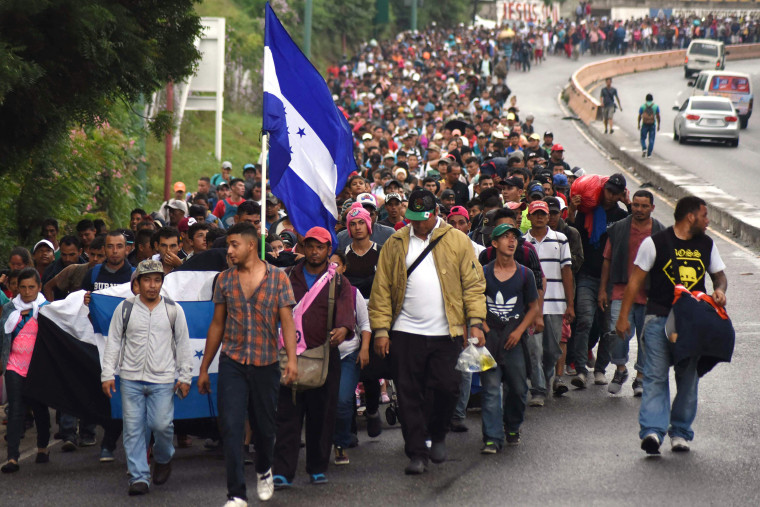
Image result for caravan border
(Getty Images)

If the caravan of thousands of prospective illegal aliens marching for our Southern border like an invading army has succeeded in one thing, it is that the wall finally will be built.

You can book it.  People are fed up. And they damn well should be.  If it gets any worse -- and it could -- we might see an army of of our own citizen volunteers heading down to the border themselves to build it.

Talk about unintended consequences. Try that one on your piano, George Soros or whatever assembled reactionary leftwing creeps instigated this escapade.

And let's not forget Univision's professional prevaricator Jorge Ramos, who insists most of these "caravanserai" are legitimate "asylum seekers," as if there were some kind of genocide going on in Honduras as in Pol Pot's Cambodia.  Yet somehow these same "refugees" are waving the flags of the very countries they are supposedly fleeing while burning ours, the very place they seek succor.  Go figure.

But let's examine the numbers. Since 2005, with only a year or two of minor exceptions, slightly over one million people per annum have been granted lawfulpermanent residence status in our country.  That's a far greater total, year over year, than anywhere else in the world.  In fact, the U.S. has a hair under twenty percent of the world's foreign born population. We're incredibly generous.

But a million people a year being admitted legally is evidently not enough for our friends on the left who seem to favor open, unvetted borders on top of that.

Talk about not fair, the so-called "fairness" crowd is now supporting fourteen thousand or so people who want to enter the U.S. illegally by force while millions of others from all over the world waited, often for years, to get their papers.

Those law-abiding immigrants have a mighty good reason to be pissed and the rest of us have an equally good reason to want to see that wall erected pronto.

Building the wall will also help solve the number one healthcare problem in our country, far beyond insurance difficulties -- fentanyl.  It will simultaneously undercut the world's most powerful terrorist organization, Hezbollah.  For those who missed it, Iran's favorite terror army is heavily involved in the cross-border drug trade, as revealed recently in what may be the year's best piece of investigative journalism -- "The secret backstory of how Obama let Hezbollah off the hook."

Building the wall might take Obama off the hook by cutting the flow of fentanyl that, by itself, is likely responsible for the horrifying slide in life expectancy among Americans the last few years.

But back to the actual construction of the wall.  How will it happen?  If the Republicans hold the House, which is now a possibility thanks to both the caravan and Kavanaugh, Trump will be on the honeymoon he deserved when first elected.  Funding for the wall will be top of the agenda.

 If they lose the House, Trump will be motivated to have the military build it through the defense budget.  The advent of the caravan will give him plenty of justification for that.

As I said, the wall -- book it!

Roger L. Simon - co-founder and CEO Emeritus of PJ Media - is an author and an Academy Award-nominated screenwriter.

Pueblo de los Santos


By Pedro Gonzalez
October 22, 2018
Image result for caravan border
(AFP/Getty Images)
Among the signs carried by the northbound invasion, one in particular stands out: “Pueblos Sin Fronteras.” This is the name of a group that organizes the so-called migrant caravans, but it also doubles as the raison d’être of the mob itself. They are not marching north to become good little capitalist “Americans,” much less citizens of the United States. In fact, they hate capitalism, bellowing socialist chants of: “We are international workers!
They do not march because they look fondly upon our country, its institutions, its values, or its culture. And, no, they are not “fleeing” the violence and poverty of the pueblo. Rather, what they want is to bring the pueblo to us. They are convinced that it is their manifest destiny to do so.
Americans tend to think only we put stock in our destiny, and we don’t like to think of ourselves as conquerable—and certainly not already conquered. But if we cannot control our borders, let alone have a say in who may live among us, what might we call that condition?
Who Are the 14,000 and Counting?
As it has done in so many other Western nations, neo-Marxist education has stripped us of our ability even to conceive of anyone other than ourselves as conquerors (which, ironically, is rather condescending and paternalistic!). We learn to see only the evil in ourselves, and the “good” in everyone else—even those who would destroy our civilization. No people but us hateful and sinful Americans has the capacity to carry out something so incorrigible as “manifest destiny” anyway.
It is beyond the comprehension of our moral betters in the media, academia, entertainment, and government, that Third Worlders are even capable of doing harm—perennially “oppressed,” as we are assured they are, by white men in the midwest who have never even so much as seen the blood soaked streets of Guatemala on TV.
Yet here they come. As of Monday, they were 14,000-strongand screaming: “No one will stop us, only God.” And those Mexicans who we think only wish us well? They’re helping the invasion along, even joining it. Why wouldn’t they? Their president-elect told them that they have a “right” to violate our sovereignty. Moreover, “It’s solidarity,” Maria Teresa Orellana tells a journalist. Orellana handed out free sandals to the the swarm as it passed through her neighborhood. “They’re our brothers,” she said.
Orellana wasn’t alone. As the mob marched through Ciudad Hidalgo, “they drew applause, cheers and donations of food and clothing from Mexicans,” the Washington Times reports.
The majority of Mexicans showed Americans what they thought of them, when they carried the expressly anti-American Andrés Manuel Obrador to Los Pinos by a landslide. “The mass support for the immigrant caravan across Latin America testifies to growing consciousness of the international character of the working class,” writes one socialist reporter. I would add that there is a growing ethno-racial consciousness, too—and it is explicitly anti-gringo. But there are other reasons to fear the swarm surging toward us.
Recently, Prensa Libre, the biggest newspaper in Guatemala, reported that 100 Islamic State terrorists were apprehended by federal agents. Guatemala is a global human smuggling capitalthrough which individuals from Pakistan, Afghanistan, India, Nepal and Bangladesh, and other Middle Eastern and Asian countries, enter the United States illegally.
That said, there is one group of people in the Middle East that we might learn from.
When Palestinians cry, “Death to the Jews,” the Israelis do not muse over what could be the esoteric and defanged meaning of “Death to the Jews.” They do not turn to hierophants to interpret for them the “true” meanings of explicit of death threats. The Israelis do not ask, “but how will we get on without cheap Palestinian labor?” Rather, they built a wall. They reinforce the wall with men. They defend their land and their people. We have we not yet learned this lesson, even as the United States is teetering on the edge of civilizational suicide.
Looking Past the Media Narrative
Looking at pictures not handpicked by the managers of public opinion in the press, one cannot help but notice that these “migrants” are mostly young, military-aged males. Many of them appear angry, shouting, and scowling.
“We are going to stay together, we won’t be broken,” said one Honduran. In other words, the members of the mob intend to break us, like they broke through a steel barrier at the Guatemala-Mexico border. Something about these howling savages ripping through metal with their bare hands doesn’t quite fit with the narrative of them as harmless travelers.
Then there is, of course, the media’s favorite: migrants with children. There are two kinds of people who would subject little children to this ordeal: those who have abducted them to try pose as “family units” at our border (there have been 400 such attempts this year), and failed parents who should be considered hideously immoral. Who else would imperil the lives of their children by reducing them to mere sympathy tokens with which they hope to purchase access our country—a legal and moral discount compliments of the progressives among us.
These “parents” have literally lined up for paychecks from unknown benefactors along with their children in order to participate in this march—just in time for midterms, just when the Left needs a boost. But who paid them is not so important as the fact that they accepted the payment. Mercenaries, then, not “migrants” come our way. Are these the “family values” we want to import?
The northbound invaders will test our societal will to live, without which we may as well consider theReconquista settled. Of course, some would celebrate such a defeat, and they write for the New York Times, claiming that their ancestors were here long before the “white man” set foot on the continent. A scene from “The Year of the Dragon,” a 1985 film directed by the patriotic Italian-American, Michael Cimino, comes to mind.
Playing a Polish-American cop and Vietnam vet, Mickey Rourke returns home from the war to find that America has imported the “diverse” culture he encountered in Asia. Faced with violence and a narcoculture dealt by ethnic gangs, who justify it under the banner of their “thousands of years”-old culture, Rourke responds:
You people think gambling and extortion are kosher because it’s a thousand years old. All this thousand year old stuff is shit to me. This is America you’re living in, and it’s 200 years old, so you better get your clocks fixed.
How we face down the coming mob is the question before us now. Will we be cowed into letting our destroyers among us to “atone” for the historical grievances spread before our feet by the Left? Or will we insist that not a single one set foot on American soil? And that includes children, if we care about the fact that one in four MS-13 gang members arrested or charged with crimes since 2012 entered the United States as an unaccompanied minor. If we cannot ensure that these children do not end up in violent gangs, where their victims, ironically, are typically other minorities and immigrants, then we have no business taking them in—yet the Left insists that we do this in the name of compassion.
What kind of cheap compassion is that?
The “Saints” Go Marching In
The motives of the Left, however well known, are less important than the consequences of their actions. Ultimately, this swarm should serve as a telegram to us of what awaits if we do not change course on immigration.
According to a recent Gallup poll, 13 percent of the world’s adults—or more than 640 million people—say they would like to leave their country permanently, with 150 million responding that they would like to move to America—and that does not not account for the relatives who would invariably accompany them. Whether the United States could comfortably accommodate all those people, is a matter of how one defines “comfortably.” Yet there is more at stake than amber waves of grain.
In 1973, Jean Raspail published the prophetic Le Camp des Saints after one day sitting on a beach in the South of France near Saint-Raphaël, in Vallauris. Raspail recalled looking out across the Mediterranean in 1971 and being struck by the terrible thought: “What if they were to come? I did not know who ‘they’ were, but it seemed inevitable to me that the numberless disinherited people of the South would, like a tidal wave, set sail one day for this opulent shore, our fortunate country’s wide-gaping frontier.”
Raspail’s migrants have no intention of assimilating into French culture, and the French government is unwilling to repel their advance out of “compassion.” The migrants flood France, aided and abetted by the Left, and yet demand First World living conditions even as they reduce it to the Third, victimizing Europeans and non-Europeans who have assimilated into French culture out of patriotism.
The novel has been condemned by some as “racist” and “xenophobic.” Then in 2001, a boatload of Kurdish refugees came ashore in Boulouris, near Saint-Raphaël, just a few yards from the office where Raspail wrote Le Camp des Saints. The present migrant crisis, said Raspail in a 2015 interview, “puts an end to 30 years of insults and slander against me.” It’s worth noting that Saints ends with Westerners, European and non-European alike, as refugees themselves.
Raspail believes that the collapse of the West is inevitable, unless we can put aside our misguided and uninformed sense of “compassion.” Certainly, this premise seems heartless, unless we consider what exactly it is that we are asked to have “compassion” for.
If as in California, for example, Latinos outnumber whites and yet Latino children constitute the greatest number of poor children in the state, can it be said that we are compassionate toward children? If nonwhite immigrants are most likely to victimize other minorities in impoverished communities, can it be said that we are compassionate toward minorities? If immigrants take jobs from unskilled American laborers (blacks, and those who are the children of immigrants included), can it be said that we are compassionate toward our own poor? If every American citizen murdered by an illegal alien, is a murder that could have been avoided simply by enforcing existing laws, can it be said that we are compassionate toward our own citizens?
Our “compassion,” then, is akin to purchasing drugs for an addict as we watch him waste away. Our momentary feeling of pride for our supposed righteousness is the cause of untold suffering for people who have a higher claim to our sympathies.
The mob has made its perception of us clear: “Donald Trump is the antichrist.” But their holy war is not against Trump per se, for they would certainly celebrate him if he held our borders open to them. Rather, Trump is their “antichrist” because he stands for what they and the Left have rejected: sovereignty, the rule of law, nationhood, order itself.
And yes, you, are their adversary, too, if you stand for these things.
As the invading army marches north and the Left, with their Democratic and Republican allies, eggs them on, can Americans put aside their petty differences and unite under a common interest to fight for their right to live, to exist as a civilization? Or will we consign ourselves to quietly acquiescing a Raspailian fate? Immigration is not an issue in our time, it is the issue of our time.

Monday, October 22, 2018

UK: Anjem Choudary Released from Prison


by 
October 20, 2018

Prime Minister Theresa May has downplayed concerns over Choudary's release; British counter-terrorism authorities, however, say they are worried that he will re-exert influence on hundreds of followers upon his release. The cost to British taxpayers of keeping Choudary under surveillance is expected to exceed £2 million (€2.25 million; $2.6 million) a year, compared to the £50,000 (€57,000; $65,000) to keep him in prison.

Choudary, a 51-year-old born in Britain to Pakistani immigrants, has actively been promoting Islamic fundamentalism in Britain for more than three decades. In 1986, Choudary and an exiled preacher, Omar Bakri Mohammed, founded an Islamist group, al-Muhajiroun (Arabic: The Emigrants), a network of Salafi jihadists determined to spread Sharia law across Britain.

Al-Muhajiroun — which hailed the September 2001 jihadi attacks on the United States — was banned under the UK Terrorism Act 2000, in January 2010.

After that, al-Muhajiroun reinvented itself under an array of successor aliases. These included Islam4UK, Call to Submission, Islamic Path, Islamic Dawa Association, London School of Sharia, Muslims Against Crusades and Need4Khalifah, all of which have also been proscribed.

A November 2013 investigative report published by the anti-extremism charity Hope Not Hate concluded that al-Muhajiroun was "the single biggest gateway to terrorism in recent British history."

A September 2014 study published by the London-based Henry Jackson Societyfound that one in five terrorists convicted in Britain have had links to al-Muhajiroun.

In October 2018, during a debate in the House of Lords, Lord Anderson, a former independent reviewer of terrorism legislation, said that existing British law is insufficient to deal with Islamic radicalizers:
"Anjem Choudary has been mentioned, with good reason. As many as 25% of British jihadis convicted between 2001 and 2015 were associated with his organizations, outnumbering the 10% linked to al-Qaeda and the 5% linked to ISIS, or Daesh. His organizations also had great influence in northern Europe, yet although the police reported his activities to the Crown Prosecution Service 10 times between 2002 and 2015, no prosecution could be brought, whether for incitement to religious hatred, indirect encouragement to terrorism, inciting terrorism overseas, incitement to murder or proscription offences."
For years, Choudary, a lawyer by training, managed to stay "just within the law" by treading the fine legal line between the inflammatory rhetoric of Islamic supremacism and the right to free speech. Choudary — who called for the flag of the Islamic State to fly above Downing Street and wanted Buckingham Palace converted into a mosque and the Queen's face to be covered — was never been convicted of any offense, presumably much to the frustration of British authorities.

That scenario changed after the Islamic State proclaimed the establishment of an Islamic Caliphate in Iraq and Syria in June 2014. Police said that Choudary had become far more brazen and repeatedly crossed the legal threshold for criminal prosecution by encouraging terrorism.

In September 2014, Choudary pledged allegiance to the Islamic State anddeclared that the leader of the Islamic State, Abu Bakr al-Baghdadi, is "the caliph of all Muslims and the prince of the believers." Between June 29, 2014 and March 6, 2015, Choudary also uploaded a series of lectures on YouTube in which he invited support for the Islamic State. At the time, Choudary wasbelieved to have had links to as many as 500 jihadis who left Britain to join the Islamic State.

Police said the oath of allegiance was a "turning point" in terms of their ability to prosecute him. On September 25, 2014, Choudary and Mohammed Mizanur Rahman, of Palmers Green in London, were each charged under Section 12 of the Terrorism Act with one offense of inviting support for the Islamic State.Speaking to Sky News before his conviction, Choudary claimed that he was exercising his right to freedom of speech and had not broken the law: 
"If you look at my speeches, I have said the same thing for 20 years. For me, it is a matter of worship. If people are implementing the Sharia, then I cannot shy away from what the divine text says in relationship to that. If you cannot say when you believe in something and you cannot share that view, then you don't really have freedom to express yourself in this country."
Choudary also welcomed the prospect of spending time in prison: "If they arrest me and put me in prison, I will carry on in prison. I will radicalize everyone in prison."
On July 28, 2016, following a trial at the Old Bailey, Choudary and co-defendant Rahman, were found guilty of inviting support for the Islamic State. Both were sentenced to five-and-a-half years in prison.

Choudary spent some of his sentence in a special "separation unit" for dangerous extremists inside Frankland Prison in County Durham, to limit his possible influence over other inmates. He was released from Belmarsh prison in south-east London on October 19.

It is probable that Choudary will carry on as before: During his time in prison,according to the BBC, Choudary refused to take part in deradicalization programs.

Choudary will spend the rest of his sentence on "license" (parole) in the community, as part of attempts to reintegrate him and reduce the risk of reoffending. He must comply with 25 conditions that his release team, made up of probation and police officers, believe are necessary and proportionate to manage the risk he may still pose. If he breaches them, he risks being recalled to prison.

Several British officials downplayed the significance of Choudary's release. Prime Minister Theresa May said that "obviously he's an extremist preacher" but "if and when any terrorist offender is released, well-rehearsed plans are put in place to keep the public safe."

Mark Rowley, the Metropolitan Police's former assistant commissioner and former national lead for the UK's counter-terrorism policing, said it was important not to overstate Choudary's influence:
"At the end of the day he is a pathetic groomer of others.That is what he has done in the past. He is not some sort of evil genius we all need to be afraid of. I think we have to recognize that radicalizers look to generate a profile, look to prey on the vulnerable and we need to be thoughtful about how we report their activity."
Rowley also criticized the media's elevation of individuals like Choudary:
"It's pretty depressing if you Google 'UK Muslim spokesman' and he comes up as the first hit. For goodness sake, we have a very impressive Muslim mayor of London, a Muslim home secretary and he comes up as the first hit. On YouTube he is four of the first 10 videos. 
"That is giving him a profile because these companies chase your attention through the salacious and contentious rather than through anything accurate or responsible.That is the disgrace in this and it gives people like him, who is a sad individual, more credibility and more attention than they deserve."
Others vehemently disagree. Prisons Minister Rory Stewart admitted that Choudary remains a "genuinely dangerous" individual; he added that the "completely pernicious" cleric would be watched "very, very carefully" by police and security services.

Richard Walton, a former head of Scotland Yard's counter-terrorism command, said that British authorities were underestimating the threat Choudary presents:
"I would describe him as a hardened terrorist, somebody who has had huge influence on the Islamist extremist scene in this country over many years. I believe we are underestimating the potency and danger of the radicalizers who don't carry knives, guns and overtly plot terrorist attacks but who pollute the minds of young Muslim men."
A former member of al-Muhajiroun, Adam Deen, who is now a director of the anti-extremist group Quilliam, warned that "it's highly unlikely that he's reformed and being out of prison he would definitely get lots of credence from his followers." Deen added:
"Restrictions are not going to stop Anjem's act. Be it middle-men or whoever, he will find a way to make an impact. I would be very surprised if he has in any way been reformed by prison. He has too much invested in his image. Some think he doesn't mean what he says, but he does. It's the scariest thing about him."
David Videcette, a former counter-terrorism officer, added:
"[Choudary] is aware of what the law allows him to say and what not to say, and he rarely steps over the line. He knows how not to get himself into trouble. We were extremely lucky to find some material showing him promoting IS that allowed us to put him away. He remains a danger to anyone with whom he comes into contact — those who are vulnerable and impressionable. 
"Goading is part of his strategy. He wants to drive a wedge between the Muslim community and the secular community. Terrorism is about polarizing views. Muslims are left alone by the main population and that allows extremists to thrive within that community.
"Choudary is one of the few public faces of Islamist extremism.There are not many people with his public persona, but several hundred who behind closed doors share his views. He is at the top of a hierarchical structure that at its base has about 20,000 people who are known to have contact with these hundreds of advisers."
The head of the anti-extremist group Faith Matters, Fiyaz Mughal, spoke of his interaction with an imam who was brought into prison to try to deradicalize Choudary:
"Choudary was put in containment that stops him engaging with other prisoners, but also given pastoral care to see if they could get through to him. I asked the guy who spoke to him if the de-radicalization program had worked and he said, 'No, he's got worse. He's hardened. He speaks in the mind-set of the victim. He sees himself as a martyr the state tried to silence.'"
"He [Choudary] should have served the full term. It's a terrible day for victims of the attacks he has helped incite. We need a change in the law so that anyone named as the inciter in two terrorist attacks should automatically serve the full sentence."
Only hours after Choudary arrived at a halfway house, where he will spend the next six months before being allowed to return home, he held a staged photo session. Choudary smiled and waved to the cameras — but said nothing, mindful not to breach his parole conditions, which prevent him talking to the media.

Choudary is now considering mounting a legal challenge to the strict conditions of his release, according to the Telegraph. It reported that he has applied for legal aid funding, at taxpayer expense, to bring his action against government ministers, and arguing the parole conditions breach his human rights.

Soeren Kern is a Senior Fellow at the New York-based Gatestone Institute.

The Case against Pope Francis


By Michael Brendan Daugherty
October 11, 2018
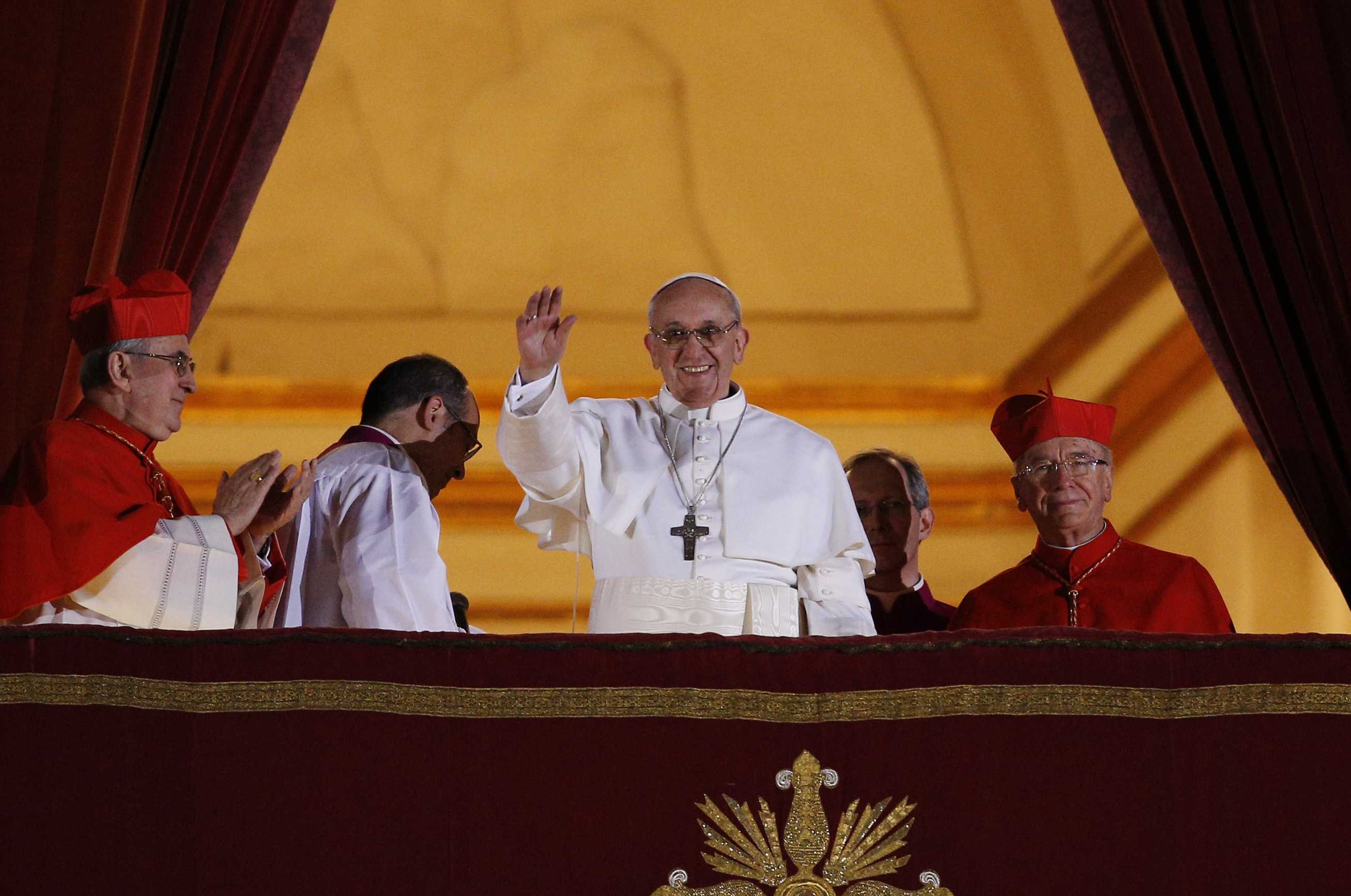
Related image
Pope Francis I appears for the first time on the central balcony of St. Peter’s Basilica at the Vatican March 13. Cardinal Jorge Mario Bergoglio of Argentina was elected the 266th Roman Catholic pontiff. (CNS photo/Paul Haring) (March 13, 2013) 
Just over five years ago, the Argentine cardinal Jorge Mario Bergoglio came out onto the loggia of St. Peter’s as Pope Francis. It is useful to recall the situation of the Church that he inherited.
The sex-abuse scandals that had rocked the Church in America and some European countries at the turn of the millennium were subsiding, or so it seemed. But the dysfunction at the Vatican under Pope Benedict XVI had overwhelmed the scholarly pontiff. Benedict’s chosen reformer for the corrupt Vatican Bank, Archbishop Carlo Maria Viganò, initially had success in turning blood-red deficits toward the black, but he was swiftly undermined and sent packing to be the Vatican’s ambassador to the United States. Benedict’s butler, Paolo Gabriele, was arrested for stealing and leaking to the media documents revealing the intrigue and backbiting within Vatican City. Benedict assigned three cardinals to investigate the VatiLeaks scandal. They returned to the pope a long dossier, which was widely reported to contain an account of the financial and sexual misdeeds of senior officials in the Vatican itself. At about this time European banks began squeezing the Vatican Bank, and by the turn of the New Year the Vatican’s own ATMs stopped working. Their function was restored days after Benedict announced that he would resign the papacy, the first papal resignation in five centuries.
Two storylines emerged out of the election of Bergoglio. The first was that the Church had elected a man who had a common touch and would stop the Church from becoming a museum of dead dogmas. The second is that the Church had chosen him because he had shown the energy to reform the dysfunctional curia.
At first, Pope Francis seized the momentum on both fronts. He quickly earned a great deal of positive media for making symbolic breaks with his predecessor. Some of the more traditional vestments were immediately dropped, along with the red shoes. He decided against taking up residence in the papal apartments. Instead he would live in Casa Santa Marta, a Vatican hotel. And he quickly began making his earthy and endlessly quotable comments to the media. He gave candid interviews to the atheist Italian journalist Eugenio Scalfari. Asked to comment on how he would counsel gays, he responded: “Who am I to judge?” Francis also quickly formed a special group of nine cardinal advisers to help him accomplish the work of reforming the Vatican itself.
The Francis pontificate was to be an era of mercy for sinners at the peripheries and accountability for malefactors at the Vatican. Instead, almost the opposite has taken place.
While trying to please the progressives who elected him, Pope Francis has plunged the Church into acrimony and confusion. He has put forward a revision of the Church’s teaching on the sacraments that puts traditional concepts of Christian virtue out of reach for all but the most “heroic” Christians. It is a theological revolution that not only threatens the coherence of the Catholic faith but has the potential to affect all Christians.

As for reform? Forget it. Nearly half of the members of Pope Francis’s reformist team have been pulled into sexual-abuse scandals themselves. Cardinal George Pell has returned to his native Australia to face charges of fondling children. Cardinal Óscar Rodríguez Maradiaga has been accused of protecting churchmen who fostered a culture of sexual predation in the seminaries of Honduras. The German cardinal Reinhard Marx was revealed to have been negligent in investigating an abusive priest when he was bishop of Trier. American cardinal Sean Patrick O’Malley, who heads the Pontifical Commission for the Protection of Minors, has been exposed as having passed the buck when a priest tried to inform him of the serial sexual predation of Cardinal Theodore McCarrick against seminarians.
These twin scandals of the Francis papacy became intertwined this summer. Reports came out of the Archdiocese of New York that McCarrick had sexually abused a child, and he resigned from the College of Cardinals. But that was not the end of the story. The frustrated reformer of the Vatican Bank, Archbishop Viganò, soon issued a stunning set of public accusations against Francis and his closest collaborators. Viganò charged the pope with having knowingly rehabilitated Cardinal McCarrick and collaborated with other immoral churchmen in order to pursue his progressive theological agenda. Viganò called on the pope to resign in disgrace.
The Vatican’s response to Viganò has been to denounce him forcefully — to accuse him of breaking communion with the pope — while at the same time admitting by inference that his main charge is correct. The Vatican noted that McCarrick had not been formally sanctioned during the Benedict papacy, owing to a lack of evidence — but thereby admitted that McCarrick had at least been restricted. McCarrick took on a larger public profile after the election of Francis, indicating either that these restrictions were lifted or that the Vatican was negligent in continuing to enforce them.
Perhaps we should have seen this coming. The fact is that Pope Francis has conducted his papacy in a way that made Viganò’s claims immediately credible. Francis appointed a bishop in Chile, Juan Barros Madrid, over the loud protests of laity there who accused him of covering up child abuse. Francis scolded these people as calumniators, but eventually the scandal overwhelmed him — and he was forced to send in investigators, who uncovered a Chilean church mired in corruption. In Italy, after interventions by two influential allies of his theological agenda, Francis restored to ministry an infamous priest, Mauro Inzoli, who had molested children in the confessional and who had been defrocked by the relevant Vatican authorities. As civil trials in Italy revealed to the public the depth of Inzoli’s depravity, Francis removed him from ministry again.
There is a type of churchman that Francis seems to favor: the morally compromised and the doctrinally suspect. The archbishop of Bruges, Jozef De Kesel, was known to promote the ordination of women and the making voluntary of priestly celibacy, and was credibly accused of knowingly appointing a pastor who had molested a child. Francis made him a cardinal. There was the archbishop of Stockholm, Anders Arborelius, who ignored calls to investigate a pedophile priest for years. The victim was told to go see a therapist instead. Arborelius is sympathetic to the idea of creating a female version of the College of Cardinals. Francis made him a cardinal, and Arborelius speculated that his elevation was a way for the pope to honor Sweden’s commitment to refugees. There’s also Giovanni Becciu, who was working for the pope’s secretary of state. When the accounting firm PricewaterhouseCoopers began uncovering financial fraud in the Church, Becciu suspended its audit. The auditor general from PwC later said he was forced out on trumped-up accusations; Becciu accused that accountant of being a spy. Francis then made Becciu a cardinal. Another cleric, Archbishop Luis Ladaria Ferrer, is set to stand trial in France for his role in covering up a child-sex-abuse scandal in Lyon. Francis made him the head of the Vatican’s doctrinal office, which adjudicates abuse cases.
Or consider Monsignor Battista Ricca, reportedly Francis’s “eyes and ears at the Vatican Bank.” Ricca was widely known for engaging in affairs with men at different posts during his clerical career. He was attacked in an area of Montevideo known for cruising, and he had to be rescued from an elevator in which he was trapped with a rent boy. (It was a question about Ricca that Francis made the occasion of his headline-grabbing statement “Who am I to judge?”) And finally there is the man known as the “vice pope,” Cardinal Rodríguez Maradiaga, the one being charged by seminarians in Honduras with allowing a culture of predation to flourish. Rodríguez Maradiaga first became famous across the Catholic world for saying that the Church scandals in Boston in 2002 were the invention of Jewish-controlled media who were avenging themselves on the Catholic Church for “confirm[ing] the necessity of the creation of a Palestinian state.”
The truth is that Jorge Bergoglio had another mandate. It is candidly discussed by journalist Austen Ivereigh in his book The Great Reformer. Ivereigh, who has become the Anglo­phone world’s papal hagiographer, details how a group of progressive European churchmen that had been meeting for decades at St. Gallen in Switzerland to discuss their views on the Church had come to see Bergoglio as their candidate. Among these were the archbishop of Brussels, as well as the Belgian cardinal Godfried Danneels and the German cardinal Walter Kasper. What they wanted was a pope who would open up all the theological debates that had been closed by John Paul II and Benedict XVI. Communion for the divorced and remarried. A revision of Church teaching on homosexual relations and relationships.
Kasper was a theological progressive who believed that the Church was no longer able to reach modern man in a pluralistic society. He was also given to sometimes grand pronouncements, writing that “dogma never settles a theological issue once and for all.” Danneels was Belgium’s leading bishop from 1979 to 2010; as it did in Ireland and Quebec, secularization seemed to come almost overnight in Belgium, and Danneels has occasionally been a cheerleader for these changes. He wrote a private letter to his prime minister, Guy Verhofstadt, praising the government’s decision to allow same-sex unions. It was a position he would reiterate emphatically years later, telling two newspapers that the Church “has never opposed the fact that there should exist a sort of ‘marriage’ between homosexuals, but one therefore speaks of a ‘sort of’ marriage. But it is not true marriage, that between a man and a woman, therefore you have to put another word in the dictionary. But that it is lawful, that the law can legitimately provide for it, that’s something about which the Church has nothing to say.” In a major public scandal, Danneels was revealed to have pressured the victim of sex abuse by a Catholic bishop, the victim’s uncle, to remain silent. He was enduring a quiet and disgraced retirement, but after pushing for the election of Bergoglio, he appeared on the loggia next to the new pope. He was also invited by Francis to contribute to the Synod on the Family.
That is why it is easy to credit the allegations against Francis. He’s done it all before. 
What is a pope for Catholics? The Council of Florence said that he is “the true Vicar of Christ, and the Head of the whole Church, and the Father and Teacher of all Christians; and that to him in blessed Peter was delivered by our Lord Jesus Christ the full power of pasturing, ruling, and governing the whole Church.” The first Vatican Council rejected those who claimed the pope can deliver new doctrines, saying that his responsibility was to protect and safeguard the existing truths of the Catholic faith. “To satisfy this pastoral duty, our predecessors ever made unwearied efforts that the salutary doctrine of Christ might be propagated among all the nations of the earth, and, with equal care, they watched that it might be preserved, genuine and pure, where it had been received.”
Francis’s defenders have rejected that modest duty. One of his chief apologists and attack dogs, Father Thomas Rosica, has grandly claimed that “Pope Francis breaks Catholic traditions whenever he wants because he is ‘free from disordered attachments.’” He explains that the Church has entered a “new phase,” and that “with the advent of this first Jesuit pope, it is openly ruled by an individual rather than by the authority of Scripture alone or even its own dictates of tradition plus Scripture.” By this definition, the papacy would be transferred from a guardian of truth to its living oracle. It would be easy to dismiss Rosica as a mere enthusiast but for the fact that Francis openly challenges Church teaching. Most recently, Francis revised the Catechism of the Catholic Church to say that the death penalty had become inadmissible, effectively declaring that the Church had been in error until his arrival.
But most crucially, Francis has worked to undermine the moral teachings of the Church that touch on matters of sex. Francis called the two-year Synod on the Family and immediately reopened a controversy that had seemingly been put to bed. He heavily promoted a thesis of Cardinal Walter Kasper that those who had left their first marriage and made a second one could be admitted back to Holy Communion without re­penting of the second adulterous union.
The synod turned into a rancorous and confusing spectacle, and it ended with Pope Francis hysterically denouncing the conservative faction that was resisting his revisions. The resulting document, Amoris Laetitia, soft-pedaled the change Francis wanted, suggesting only in a footnote that people in unions the Church was obliged to recognize as adulterous could receive Holy Communion.
To most non-Catholic Christians this may seem like the most sectarian of concerns, touching on an obscure matter of discipline that is unique to Catholicism’s particularly exalted view of marriage. But in fact this revision was accomplished by dropping a depth charge into the heart of Christianity.
The pope, with the bishops, had recast adulterous second marriages as “irregular unions,” as if the matter were something to do with paperwork rather than a sacramental reality. And instead of “living in sin,” the remarried were in a state described as “not fully the objective ideal.” The Vatican’s own translation is eye-opening:
Yet conscience can do more than recognize that a given situation does not correspond objectively to the overall demands of the Gospel. It can also recognize with sincerity and honesty what for now is the most generous response which can be given to God, and come to see with a certain moral security that it is what God himself is asking amid the concrete complexity of one’s limits, while yet not fully the objective ideal. 

Beyond this, the pope proposed to judge these cases not by the categories of Christian faith but by bourgeois norms. Pastors are urged to “include” people who are in “irregular” marriages. Instead of seeking signs of penitence, contrition, and a willingness to amend one’s life in confession, pastors are to look for signs of “stability” in the lives of those who are in a non-ideal state.
The logic of transforming commandments that one must obey into ideals that one more or less, but never fully, approximates is to turn all sins into semi-virtues. And the implications of this revolutionary change become obvious when applied to other moral matters. Some Canadian bishops read the pope’s teaching as licensing them to offer the Last Rites to people before euthanasia. After all, who are they to judge whether the soul before them fully understands and is culpable of the sin of suicide? What do you expect them to do, start instructing them in the faith?
It may seem crazy to focus on the footnotes in a mostly unread and forgettable document, but the theological revolution at work can spread across all Christianity. Under Francis the Church now teaches that sometimes God’s commandments are simply impossible to follow, that it would be cruel to urge someone to obey them, and that it would be foolish to tell people that God will generously grant them help in actually obeying them. Cardinal Kasper had occasionally defended this understanding by saying that following the Church’s teaching on marriage required “heroism” in certain circumstances, but that “heroism is not for the average Christian.” Francis was widely reported to speculate privately that perhaps half of all Christian marriages are invalid because modern man is so morally deformed he cannot be expected to understand what a marriage is. This is a kind of B-school Christianity, for moral mediocrities. It is a place where God’s love stops short of transforming your life. It’s a mercy where, in the name of in­clusion, the Church blesses the sins that break up families and create orphans.
Ultimately the vision Francis has promoted presents a God who is not merciful but indulgent, even lazy, and indifferent. It is God as a Baby Boomer parent. He expects less of you, and you can expect less of Him. In this new religion, where our faults become semi-virtues, salvation itself is changed. Instead of a free gift from God, it becomes a debt owed to us. Christ is not moved by an act of love to sacrifice himself as a propitiation for sinners. Instead, he dies on the cross because our human dignity, revealed in our semi-virtues, obliges him to do so.
What Francis is slowly instituting is a religion of presumption. A religion of “good enough,” where our misguided efforts put God in our debt. Communion becomes a participation trophy. And by freeing the Church from its preoccupation with outdated sins such as adultery, Francis can refocus the Church on the things he likes to denounce, such as the building of border walls, or air conditioning.
And no wonder, then, that the Vatican itself is filled with moral mediocrities, with men who are sexually and financially compromised. No wonder the Vatican investigates and inveighs against whistleblowers immediately but waits decades to investigate predator bishops. Believing in sin is now worse than sin itself. No wonder this church has a pope who refuses to wear red shoes. They symbolize martyrdom. That’s for heroic Christians, not for men like Pope Francis.