Monday, February 26, 2018

Book Review: Rise and Kill First by Ronen Bergman

When a nation seals the fate of its enemies

By Joshua Sinai
February 19, 2018
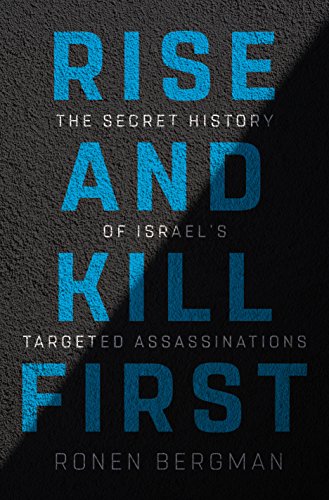
Related image

RISE AND KILL FIRST: THE SECRET HISTORY OF ISRAEL‘S TARGETED ASSASSINATIONS
By Ronen Bergman
Random House, $35, 784 pages
Targeted assassination is a type of premeditated killing of those who pose an imminent threat. It is usually carried out by a covert intelligence or military unit often when the enemy’s capture is made impossible by his protected presence in hostile territory.
Due to the protracted nature of the conventional military and terrorist threats by Israel’s adversaries such as Iran, Syria, Hamas and Hezbollah, the Jewish state has developed one of the world’s top covert special operations capabilities to target selected adversaries for assassination.
As Ronen Bergman writes in “Rise and Kill First,” Israeli covert agencies have conducted targeted assassinations against the country’s Arab adversaries throughout its pre- and post-statehood periods and the total number of these spectacular killings is staggering.
Before the outbreak of the second Palestinian intifada (uprising) against Israel in September 2000, Israel had conducted some 500 targeted killing operations, killing at least 1,000 people. These included the systematic revenge assassinations of the Palestinian Black September terrorists who had murdered Israeli athletes at the Summer 1972 Munich Olympics, and the daring raid in Beirut, Lebanon that killed Ali Hassan Salameh, the terror group’s operations officer in January 1979 — almost seven years after the massacre of the Israeli athletes had occurred.
Other covert operations include the assassination in April 1988 by an Israeli special forces’ team of Abu Jihad, a top Palestinian leader, at his exile home in Tunis, Tunisia, and the use of a remote cellphone miniature bomb, in the Gaza Strip, to kill Yahya Ayyash, known as the “Engineer,” in his hideout in the Gaza Strip in January 1996. Ayyash was responsible for masterminding numerous Hamas suicide bombing attacks against Israel.
Following the second Palestinian intifada, when the Palestinian suicide bombers targeted Israeli citizens on a daily basis, causing the deaths of some 887 Israeli civilians and 250 military personnel (these figures do not appear in the book), Mr. Bergman reveals that Israel carried out some 1,000 targeting operations, of which 168 succeeded in killing their targeted terrorists, with an additional 800 operations conducted against them from 2005 (when the intifada ended) until late 2017.
These killings were directed against leading Hamas operatives, such as the firing by a helicopter gunship of a rocket bomb against Hamas’ leader, Ahmed Yassin in March 2004, at his hideout in the Gaza Strip, as well as revenge targeting of selected senior Hezbollah operatives, such as the notorious terrorist mastermind Imad Mughniyeh, who was killed by a remotely controlled car bomb explosion in Syria in February 2008. This was followed, on Jan. 19, 2010 by a fatal poisoning by an Israeli hit team of Mamoud al-Mabhouh, a Hamas financier, at his hotel room in Dubai.
In an example of “bazaar diplomacy,” and despite international outrage, there were no repercussions against Israel, supposedly due to a “behind the scenes” understanding that let Israel off the hook.
Other operations included a series of killings in Iran by Israeli covert operatives (and, as the author speculates, by Israeli allies in the region) against numerous scientists who were involved in developing Iran’s nuclear weapons program, which was directed against Israel, between the years 2010 and 2012.
About targeted assassinations, the author asks, “First, is it effective? Can the elimination of an individual, or a number of individuals, make the world a safer place? Second, is it morally and legally justified?”
Mr. Bergman writes that Israel’s targeted killing campaign significantly weakened the PLO’s terrorist commanders and greatly diminished the rate of Palestinian suicide attacks. With PLO leader Yasser Arafat repeatedly targeted for assassination, and his ability to continuously evade his assassins, the author reveals that, in the late 1970s the Israeli Mossad intelligence service tried to delegitimize Arafat with evidence of his engaging in homosexual relations with his bodyguards, but they did not go forward with it.
Mr. Bergman also writes when Arafat “succumbed to a mysterious internal disease” that killed him in early November 2004, “traces of polonium, a radioactive material used in assassinations,” were found on his “clothes and remains,” and “the timing of Arafat’s death was quite peculiar, coming so soon after the assassination of Yassin” in March of that year.
Although he may know whether Arafat’s death was a product of an Israeli assassination operation, he writes, “If I knew the answer to the question of what killed Yasser Arafat, I wouldn’t be able to write it here in this book, or even be able to write that I know the answer.”
As for moral justification, Mr. Bergman writes, the target “must be an individual directly linked to terrorism” and that “there should be no killings when there was a ‘reasonable arrest alternative’”
He observes that Israel’s campaign of targeted assassinations “provided Israel’s leaders sooner or later with operational responses to every focused problem they were asked to solve. But the intelligence community’s very success fostered the illusion among most of the nation’s leaders that covert operations could be a strategic and not just a tactical tool — that they could be used in place of real diplomacy to end the geographic, ethnic, religious, and national disputes in which Israel is mired.”
Further, he writes, this “tactical method of combating terror” has been “elevated and sanctified at the expense of the true vision, statesmanship and genuine desire to reach a political solution that is necessary for peace to be attained.”
Highly dramatic and thoroughly informed, “Rise and Kill First” explains Israel’s successes and dilemmas as it confronts the continuous, implacable hostility of its Middle Eastern adversaries.

• Joshua Sinai is a senior analyst at Kiernan Group Holdings in Alexandria, Va.

Related:

How Israel's Leaders use Targeted Killings to try to 'Stop History' -

https://www.timesofisrael.com/how-israels-leaders-use-targeted-killings-to-try-to-stop-history/

Sunday, February 25, 2018

FBI wiretaps show Sean Miller discussed $100K payment to lock recruit

FBI wiretaps intercepted telephone conversations between Arizona coach Sean Miller and Christian Dawkins, a key figure in the FBI's investigation into college basketball corruption, in which Miller discussed paying $100,000 to ensure star freshman Deandre Ayton signed with the Wildcats, sources familiar with the government's evidence told ESPN.
According to people with knowledge of the FBI investigation, Miller and Dawkins, a runner working for ASM Sports agent Andy Miller, had multiple conversations about Ayton. When Dawkins asked Sean Miller if he should work with assistant coach Emanuel "Book" Richardson to finalize their agreement, Miller told Dawkins he should deal directly with him when it came to money, the sources said.
The telephone calls between Sean Miller and Dawkins were among 3,000 hours of conversations intercepted from Dawkins' phone by the FBI.
Arizona released a statement saying that Miller and the school agreed for him not to coach the Wildcats' game on Saturday against the Ducks, citing the "best interests of the University and the basketball program." The school announced that Ayton was eligible to play the game.
The Arizona Board of Regents met in an emergency executive session Saturday "to receive legal advice regarding the issue and plans to reconvene for updates and legal advice in the coming days."
"This is an emotionally charged issue butit is essential that we move forward decisively and based on facts. We must do everything we can to ensure that our programs are of the highest caliber as we must also protect the rights of all involved and respect due process for employees," Regents Chair Bill Ridenour said in a statement.
Ayton, a 7-foot-1 center who was born in the Bahamas, is considered one of the top freshmen in the country and a leading candidate for national player of the year honors. He is averaging 19.6 points and 10.9 rebounds in what is expected to be his only college season, helping the No. 14 Wildcats take a 1½-game lead in the Pac-12 standings with three regular-season games to play.
ESPN analyst Jonathan Givony, in his latest mock selections, projects Ayton as the No. 2 prospect available for this year's NBA draft.
Richardson, who worked for Miller the previous 10 seasons at Xavier and Arizona, was one of four assistant coaches arrested by FBI agents on Sept. 27, after a two-year investigation into bribes and other corruption in the sport.
Richardson is accused of accepting $20,000 in bribes and paying a recruit to sign with the Wildcats. In exchange for the money, the government alleges, Richardson agreed to influence Arizona players to sign with Dawkins and financial adviser Munish Sood, who also was arrested by FBI agents. Arizona formally fired Richardson on Jan. 11.
Richardson is charged with six felonies: conspiracy to commit bribery, solicitation of bribes by an agent of a federally funded organization, conspiracy to commit honest services fraud, wire fraud conspiracy, mail fraud conspiracy and travel act conspiracy. He has pleaded not guilty and faces up to 60 years in prison and $1.5 million in fines.
Oklahoma State's Lamont Evans, Auburn's Chuck Person and Southern Califorinia's' Tony Bland were the other assistant coaches charged in the cases, along with Adidas executives James Gatto and Merl Code and former NBA referee Rashan Michel.
Dawkins, a former AAU director from Saginaw, Michigan, was charged with wire fraud in September after the government accused him of funneling money from Adidas to the families of high-profile recruits. Last week, a federal judge in New York declined to dismiss criminal indictments against Dawkins, Gatto and Code.
On Friday, Yahoo! Sports reported that players from more than 20 Division I men's basketball programs have been identified as possibly breaking NCAA rules through violations that were uncovered by the FBI's investigation into corruption in the sport.
Schools identified by Yahoo! as having players who possibly violated NCAA rules include DukeNorth CarolinaTexasKentuckyMichigan State, Southern California and Kansas. At least 25 players are linked to impermissible benefits, including Michigan State's Miles Bridges, Alabama's Collin Sexton and Duke's Wendell Carter.
The documents detailed the work of Andy Miller and his agency. Yahoo! reported that the documents -- which include paperwork from 2015 through 2017 -- show cash advances as well as entertainment and travel expenses paid for college prospects and their families. They did not mention Sean Miller or Ayton.
Ayton moved from the Bahamas to San Diego, where he played two seasons of high school basketball. As a junior in 2015, he transferred to Hillcrest Prep Academy in Phoenix, where he played with current Duke freshman Marvin Bagley III. Ayton was ranked the No. 3 player in the 2017 ESPN 100, behind Bagley and current Missouri freshman Michael Porter Jr.
Ayton committed to Arizona on Sept. 3, 2016, after also considering scholarship offers from Kansas, Kentucky, Maryland and San Diego State. When Ayton signed with the Wildcats, Sean Miller described him as "one of these once-in-a-generation types of players" because of his size and shooting ability.
After Richardson was arrested in late September, Arizona president Robert C. Robbins announced that the university had hired two law firms to conduct independent investigations into the matter.
Asked for a comment, Arizona reiterated statements issued by school athletic director Dave Heeke and Sean Miller in October when the investigations were announced.
At the time the investigations were announced, Robbins said in a statement, "Head coach Sean Miller has not been charged with -- nor accused of -- any misconduct and he has been fully cooperative and supportive of our efforts to determine the facts in pursuit of the truth. ... Based on the facts that we know at this time, we support Coach Miller and intend to provide him with all of the tools necessary to meet our goals and expectations."
Milwaukee Bucks guard Jason Terry, who played at Arizona under coach Lute Olson from 1995 to 1999, tweeted that it's time to for the Wildcats to "clean house."
@APlayersProgram BearDown it’s time to clean house and bring home our own bloodlines to carry on Lutes Legacy. We have too much pride, too much tradition to allow outsiders to tear down what we built.
Sean Miller, 49, is a three-time Pac-12 Conference Coach of the Year and has a 242-72 record in his ninth season with the Wildcats. The Arizona Board of Regents approved a contract extension for him in February 2017, which increased his annual salary to at least $2.9 million through 2022. He has denied knowledge of Richardson's alleged scheme to bribe players to sign with Arizona.
"As the head basketball coach at the University of Arizona, I recognize my responsibility is not only to establish a culture of success on the basketball court and in the classroom, but as important, to promote and reinforce a culture of compliance," Miller said in a statement released in September. "To the best of my ability, I have worked to demonstrate this over the past eight years and will continue to do so as we move forward."
If Miller is fired for cause, his contract is written in such a way that he would still receive more than 85 percent of the money he is owed through May 31, 2022. However, he would lose a longevity bonus of an undisclosed amount, which Arizona was due to pay him in May 2020.

Miller's contract provides that even if he is fired with cause, the university would have to pay his base salary. The contract defines his base salary as his salary plus his peripheral salary. That adds up to roughly $10.3 million through May 2022. The only part that Miller wouldn't be entitled to is $1.7 million from Nike and IMG that is due to him if he completes his contract.
Keeping such a percentage on a firing for cause would be unprecedented. Most coaches who are fired for cause receive no additional money past their employment date. But the contract has no provision that waives the university's obligation to pay Miller what is owed based on an NCAA violation. The contract makes no mention of the university's recourse if criminality is involved.
In a strange twist, Miller's contract somehow pays him more for getting fired with cause than without cause. The section in his current contract that references him being fired with cause mentions no reduction in base salary upon firing. But if Arizona fires him without cause, there's a 50 percent reduction noted. So if Miller is fired with cause by the university, they will owe him approximately $5.15 million more ($10.3 million versus $5.15 million) than if it fired him for no reason.
The contract also provides that if Miller commits an NCAA violation, he would have to pay up to $300,000 in damages to the university's coffers for the price of defending itself. If an NCAA violation occurs, Arizona has the right to claw back bonuses given to Miller during the time of the violation.
ESPN's Darren Rovell contributed to this report.

Why We Need the Second Amendment More than Ever

BY ROGER L SIMON
https://pjmedia.com/
February 24, 2018

Image result for gun show
Gun and Knife Expo, Jefferson, Texas

While executives at Delta, United, Avis, etc. are virtue signaling as loudly as they can to assure us they want nothing to do with those supposed gun nuts in the National Rifle Association and are ending discounts (such as they were) for members of that organization, a real-world observation of what went on in the Parkland tragedy, not to mention other key contemporary events, might yield a radically different conclusion.

To wit: The Second Amendment of the U.S. Constitution has much to recommend it. Indeed, we may need it more than ever.

Let's start with Parkland.  It's evident now, no matter what you think of current gun laws, that a myriad of governmental bureaucracies and police departments -- from school authorities to social workers to the FBI to the Broward County Sheriff's Office -- screwed up on a level that borders on the incomprehensible. Blinded by a mutually reinforcing cocktail of political correctness and organizational stupidity and ineptitude, they were clueless about the near constant acting out of Nikolas Cruz.

He could have flown across the country in a hot air ballon, dropping buckets of blood and guts and trailing a banner reading "I'm Gonna Shoot Up a School," and these clowns wouldn't have done anything.  When Cruz actually started shooting, they behaved like the most execrable cowards, the police hiding behind cars while students and teachers were dying.  That their boss, Sheriff Scott Israel, still has his job is the most incomprehensible development of all.

Would anybody in his right mind trust these people with his own security, let alone those of his children?

Is it any surprise that when President Trump asked his CPAC audience Friday which was more important to them -- the Second Amendment or tax reform -- they chose the right to bear arms?

The ultimate reason that that amendment came to be was something just as crucial (perhaps more, if that's possible) as personal or family protection -- and I bet almost everyone in that CPAC crowd knew it.

It was for the citizenry to protect themselves against a tyrannical government.

But isn't that from a different era, you might ask, when people were running around with muskets?  Hardly.  In 1938, Hitler forbid all Germany's Jews from having guns.  We know where he went from there.  Stalin and Mao, the two greatest mass murderers of history, controlled the weaponry in their societies.  "Power," Mao famously wrote in the Little Red Book, "comes from the barrel of a gun."

Ironically, it is some of the same people, most specifically the FBI in this case, who allowed the carnage in Parkland that are threatening our democratic republic on a political level.   That organization, we have learned, essentially acted in cahoots with one of our political parties to suborn a court to enable the spying on another of our political parties and later on our president. This weekend we have confirmation that that took place because the memo finally released by the Democratic wing of the House Intelligence Committee shows no evidence that the FISA court was informed that the Steele Dossier was paid for by the Clinton campaign. All that is there are the most tepid of euphemisms.

This is, of course, the stuff of incipient totalitarianism.  This is why James Madison and the other Founders proposed we adapt the Second Amendment from British Common Law.  They saw into a future beyond muskets and AR-15s and Glocks and even drones, lasers and whatever else people will use on each other.

Yes, it's complicated.  And, yes, there are some points to be made on the side of gun control.  I'm one of those who thinks the age of purchase should be raised to twenty-one, in part because we live in era when our children are maturing so slowly. Our college campuses are clear evidence of that.   I'd also be happy with longer waiting periods.  But the right to bear arms is sacrosanct....

Which reminds me.  I'm late with renewing my NRA membership.  Mr. LaPierre, check your mailbox.

Roger L. Simon is an award-winning novelist, Academy Award-nominated screenwriter and co-founder of PJ Media.  His latest book is I Know Best:  How Moral Narcissism Is Destroying Our Republic, If  It Hasn't Already. He tweets @rogerlsimon.

Saturday, February 24, 2018

The State Submits

By Mark Steyn
February 21, 2018

Related image
Arif Qawi, the chairman of governors at St Stephen’s in Newham, east London, has resigned

I've written many times over the last decade and a half about that rare bird the "moderate Muslim". Surely one reason for his scarceness is that, whenever he pops his head above the parapet, he's hung out to dry by craven infidel politicians and bureaucrats, who on the whole find the admirably straightforward demands of your average firebreathing imam more congenial. Hence the pandering to returning Isis warriors: Mods vs Raqqa's - it's no contest.

The latest examples are the headmistress and chairman of the board of governors of St Stephen's Primary School in Newham, East London. St Stephen, you'll recall, was the first Christian martyr, but observant Christians are thinner on the ground in today's Newham than they were in first-century Jerusalem. So St Stephen's School today is mostly Muslim. Nevertheless:
In June last year, [headmistress Neena] Lall removed the hijab from the school uniform for girls aged seven and under and tried to curb young children from fasting at school in case they became unwell.
Good for her. Hijabs for under-sevens? If you're in most Muslim countries, you notice that the gals don't disappear under the veil until puberty: Covered kindergartners is largely a western phenomenon.

So there would appear to be no reason for a "moderate" or any other kind of Muslim to object to what Mrs Lall was proposing. Alas:
St. Stephen's School in East London recently imposed a ban on hijabs (Islamic headscarves), but reversed its decision after administrators received hundreds of threats from enraged Muslims. 
Among the targeted officials from the primary school was the head of governors, Arif Qawi, who had supported the ban on the grounds that the girls wearing hijabs were less likely to integrate socially with their peers. As a result of the outcry, Qawi submitted his resignation, saying that members of the staff were afraid to come to the school. 
Head teacher Neena Lall, whose educational philosophy has turned St. Stephen's into one of the best secular primary schools in Britain's capital -- in spite of its being in Newham, a poor neighborhood where English is spoken predominantly as a second language -- was bombarded with e-mails calling her a "pedophile" who "deserved what she had coming." Lall, of Punjabi origin, was even compared to Hitler in a video uploaded to YouTube.
Mr Qawi's resignation is unfortunate. But sometimes you can speak a little too clearly:
In November Qawi said: "I am on a personal crusade to severely limit the Islamisation process, and turn these beautiful children into modern British citizens, able to achieve the very best in life, without any restrictions and boundaries."
Yeah, well, stick a fork in him, he's done, he's gone, he's toast, etc. Ofsted, the government regulator, has issued some tepid criticism of the local council for failing to support the school, and the Parliamentary Under-Secretary has pledged that next time a school institutes a hijab ban the Government will be far more supportive. Sure, whatever.

But serious persons understand the score here: the ban on hijabs has been reversed, and the "moderate Muslim" has gone - and physical intimidation, nudged and winked at by prominent community leaders and politicians, has been rewarded.

I've written previously how odd it is to stroll around, say, Newham and see a harder, fiercer Islam than one would encounter in Amman or Cairo - like hijab-clad grade-schoolers. But the reasoning lies in Mr Qawi's wish to "turn these beautiful children into modern British citizens". If that is the last thing you want these children to become, then the best way to do it is by segregating them from modern Britain. Which is why primary-school hijabs are necessary in London but not in Tripoli. If you leave it till twelve or thirteen, your daughters may have formed friendships with indifidel girls and be reluctant to climb into their body bags. Better to mandate the shroud in kindergarten - so the friendships never form. Once the transition is complete and Britain is a fully-fledged member of the dar al-Islam, then we can lighten up and let the middle-schoolers enjoy a little sunshine on their faces. But, as long as "moderates" are peddling dangerous talk about "modern British citizens", then the logical answer is to be even more hardcore. Are they wearing hijabs in the maternity ward yet?

~By middle school, anyway, a nice young Muslima should be on her way to children of her own. Thirty-two-year-old Ahmad married his first wife, Lina, when she was thirteen. He married his third, Betool, when she was fourteen. That would have been statutory rape not so long ago, but instead Ahmad gets to live with both wives and his six children in a two-story house in Schleswig-Holstein paid for, like everything else in the illiterate unskilled unemployed refugee's life, by German taxpayers.

If you're wondering what happened to the remaining wife - the one who came in between Lina and Betool - she's still in Syria:
Für eine dritte Ehefrau müsste das Haus größer werden, sagt Ahmad lachend.
"For a third wife, the house would have to grow larger," says Ahmad, laughing - as well he might: Childless Germans pay for the polygamous Muslims that will supplant them - because Mutti Merkel says they're the software designers Daimler and Mercedes urgently need. I think I'll take my chance on Toyotas built by Japanese sexbots.

No advanced nation needs mass unskilled immigration. Unless your politicians are willing to say that, they're consigning you and your family to the status of Ahmad's wives.

~Mark is still feeling under the weather but hopes to keep his Thursday date with Tucker Carlson, live coast to coast across America at 8pm Eastern/5pm Pacific. We hope you'll tune in.

Mark Steyn Club members should feel free to disagree with Steyn on any of the above by logging-in and commenting below. For more on the Steyn Club, please see here: You can sign up for a full year, or, if you're feeling more tentative about the whole business, merely an experimental quarter. And don't forget our Steyn Club gift membership for a friend or loved one. Among the other benefits of membership is our series of audio adventures, Tales for Our Time. Our current serialization is, in fact, also a tale of Britain under foreign subversion.

Friday, February 23, 2018

Inside Red Sparrow: From best-selling spy novel to Jennifer Lawrence blockbuster

February 22, 2018
Image result for red sparrow movie
Next week audiences will see Jennifer Lawrence in her first role since last fall’s infamous-for-all-sorts-of-reasons mother! Depending on each person’s individual appetite for the type of psychological horror she and Darren Aronofsky wrought — and whether they decided to subject themselves to it at all — those audiences will either recognize yet another step in the actress’ move toward more controversial roles or find themselves awash in a brand new J.Law. This is a J.Law who tortures people with her bare hands, a J.Law who gets tortured with other people’s bare hands, a J.Law who does a Russian accent, a J.Law who does nude scenes.
That’s because Lawrence, who — it should be noted simply for the sake of it, is widely agreed upon as one of Hollywood’s biggest talents — has stepped even further away from her Silver Linings Playbook past for the spy thriller Red Sparrow. Much like her highly-anticipated September indieRed Sparrow (and Lawrence’s participation in it) is not for the faint of heart. She plays Dominika Egorova, a Russian ballerina and former star dancer in the Bolshoi who, after a series of unfortunate events including but not limited to beating up her arch-nemesis with a pair of crutches, is forced into joining the SVR (that’s Russian for Foreign Intelligence Service). She winds up as a sparrow (that’s Russian for sex spy) and thus how we collectively arrive at the aforementioned torturing.
But before Red Sparrow was a big screen blockbuster it was, like many of Hollywood’s most anticipated movies, a best-selling novel first.
And in fact it’s part of a trilogy — the third and final edition of the Dominika Egorova novels hit bookshelves last week just in time for the live-action adaptation. The books are written by Jason Matthews, who was a spy himself for 33 years, although his tenure took place within the Central Intelligence Agency, not the SVR. (And he definitely wasn’t a sparrow). Matthews spoke to EW about the long career that led to the much-loved novels, and eventually the film, and it turns out it was all a total (happy) accident.
“I got a master’s degree in journalism and I headed to Washington, D.C. to find what I hoped would be a writing job,” he explains to EW. “I had no idea what I was going to do but I ended up interviewing with the State Department, with Interior and then one very gray day I interviewed with a very gray man from the CIA.”
What followed was 18 months of exhaustive background checks and polygraph tests, but he was eventually offered a job in the clandestine services and sent off to The Farm (what members of The Biz call the CIA academy) for basic training. The gig took him all over the world — mostly to places he’s not at liberty to mention — and after retirement, he realized he had amassed so many anecdotes that they were just begging to be told.
“My career was so experiential and 24/7 that I started writing down everything I did, basically for therapy,” Matthews reveals. “The books are informed by my career, but they’re fictionalized — they’re a mosaic of the people I know and the things we used to do.”
Image result for jason matthews trilogy
Jason Matthews
The first novel, which was adapted into the movie version, follows Egorova as she is tasked with tracking down CIA agent Nate Nash, who she eventually falls in love with — and who eventually recruits her to be a double agent, passing Russian state secrets back to the Americans. The resulting action scenes, both on the page and on screen, are infused with all sorts of industry-favorite spy tactics like surveillance detection runs (what The Biz calls SDRs) to escape enemy tails, dead drops to pass documents back and forth, and of course all the aforementioned torture-by-hand.
“I had to fictionalize what I did during my spying to basically take the teeth out of it,” Matthews says of the writing process. “The agency helped, too, because I had to get every manuscript approved by a review board at Langley to make sure I didn’t inadvertently reveal sources and methods.”
The CIA-approved novel that hit bookshelves in 2013 was so popular that Hollywood quickly came calling — 20th Century Fox bought the rights to Red Sparrow, and Francis Lawrence, who was responsible for the last three Hunger Games installments, signed on to direct. The first thing Matthews did was brace himself.
“When we sold the rights my literary agent warned me,” the author laughs. “He said selling your rights to Hollywood is like dropping your kid off at college: Keep the motor running and don’t look back.”
But his initial caution would prove to be mostly unnecessary — the on screen version is, for all intents and purposes, very similar to the literary version (Revolutionary Roadand Snitch screenwriter Justin Haythe penned the script). Due to time restrictions, (Francis) Lawrence chose to alter the book’s format of jumping back-and-forth between narrators (it tells the story from the point of view of both Dominika and Nate, as well as Dominika’s uncle, who recruited her into the SVR) and focus almost entirely on (Jennifer) Lawrence’s character — Matthews notes he was both taken with the pathos of Dominika’s story and with the idea of putting the blockbuster into the A-list actress’ hands.
Before shooting began the filmmaking team brought on Matthews as a technical advisor, in charge of reading through the script to make sure it held up to real-life spy situations (“I was not bashful in telling them that we wouldn’t do this or say that,” he admitted). Matthews also met with Joel Edgerton, who plays Nate Nash, the American spy who is also J.Law’s love interest, to help the actor get inside the character’s head. “He was very inquisitive,” says the author. “He wanted to understand what the challenges are and how a person lives that spy lifestyle.”
Matthews also visited the Budapest set to observe the filming process — he points out he was most struck by how slow-paced and detailed something as simple as a five-minute scene can be — and to offer clues about how to make the tradecraft more authentic and in line with the vibe of the Cold War. It’s in these moments that the movie feels most different from the novel: While the book doesn’t shy away from the realities (and the violence) that come with stealing Russian state secrets, seeing intimidation tactics and murder-by-cold-blooded-assassins on the big screenm — with all the sights and sounds and blood that comes along with it — can feel very jarring at times. (Again, we can’t mention the torture enough.)
EW’s Leah Greenblatt called it “brutal” and it seems that’s exactly what the team was going for: Matthews noted that the director wanted the shock value and set out to be fairly explicit during the fight scenes. While each viewer will have their own emotional journey during Red Sparrow — especially when it comes to a very specific cheese grater-weapon scenario — it’s worth pointing out that those who are squeamish will feel much more comfortable with the on-paper trilogy.
While the movie ends on what can be described as a twist-meets-cliffhanger, the ensuing novels pick up right where Jennifer Lawrence leaves off. Palace of Treason follows Dominika as she continues to work as a double agent and Nate as he continues to try to bring down the Russians. The Kremlin’s Candidate, which debuted last week, takes the narrative even further; this time around the SVR has its own double agent planted in the States, who is poised to take over the job of CIA Director.
While there’s no official word yet whether the team will be reprising their work for an on-screen franchise, Matthews, for his part, hasn’t ruled it out. (The final decision will, of course, hinge on both next weekend’s box office results and Lawrence’s willingness to jump back into the dark role…and another franchise.) If it does happen, here’s hoping they leave the cheese grater at home.