Tuesday, January 30, 2018

A Classicist’s View of the Cataclysm

Victor Davis Hanson’s magisterial history of the Second World War
January 26, 2018
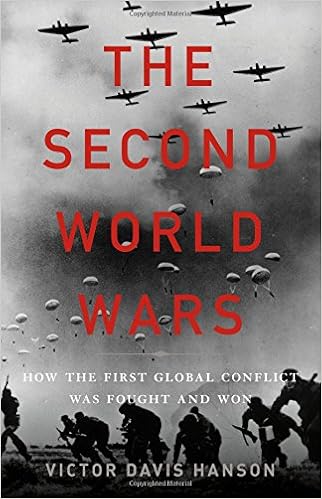
Image result for victor davis hanson ww2
The Second World Wars: How the First Global Conflict Was Fought and Won, by Victor Davis Hanson (Basic Books, 652 pp., $40)
In his six-volume history of the Second World War (1948-53),Winston Churchill gave a well-deserved tribute to Frederick Lindemann, the scientist in the Air Ministry who kept the Conservative M.P. for Epping apprised of Germany’s accelerating air capabilities in the mid-1930s, when the Stanley Baldwin and Neville Chamberlain governments were content to look the other way:
There were no doubt greater scientists than Frederick Lindemann, though his credentials and genius command respect. But he had two qualifications of vital consequence to me. First . . . he was my trusted friend and confidant of twenty years. Together we had watched the advance and onset of world disaster. Together we had done our best to sound the alarm. . . . [Secondly,] Lindemann could decipher the signals from the experts . . . and explain to me in lucid, homely terms what the issues were.
Since Harrow and Sandhurst had taught Churchill nothing about science, let alone the science of air defense, this was crucial. “There are only twenty-four hours in the day,” Churchill reminded his readers, “of which at least seven must be spent in sleep and three in eating and relaxation. Anyone in my position would have been ruined if he had attempted to dive into depths which not even a lifetime of study could plumb.” As it was, Churchill and, indeed, all of the Allies, gained immensely from Lindemann’s briefings, before and during the war.
The general reader, as well as the more scholarly specialist, will feel similarly grateful to Victor Davis Hanson for sharing his insights into the complexities of a war that still has much to teach us. The Second World Wars: How the First Global Conflict Was Fought and Won is scholarly popular history at its very best, offering as it does a brilliant overview of the war. It is also full of fascinating detail. For example, Hanson shows how the Germans invaded Russia without knowing that the Russians had T-34 tanks—proof of how threadbare their pre-invasion intelligence was. “The heavy tanks cannot be beaten by our weaponry,” one German army report complained. “The men have almost no ammunition left and are being run down by Russian tanks.” When the Soviets eventually encircled the German Sixth Army at Stalingrad, sealing Germany’s fate on the Eastern Front, it was largely due to the superior firepower and mobility of their T-34s.
Animated by mastery of both strategy and the ordnance with which strategy is carried out, not to mention the often unedifying psychology of war, Hanson’s book is a summing up that only an historian of great learning and perspicacity could have produced. That the author draws on his enviable knowledge of the military experience of ancient Greece and Rome gives his analysis of the missteps and oversights of his twentieth-century subjects critical perspective. In his dazzling command of the details and sweep of ancient history, Hanson is reminiscent of another crack historian trained in the classics—Peter Green, the biographer of Alexander and chronicler of the Greco-Persian wars.
Hanson writes of how Italy and Japan confirmed Thucydides’ “realist notions of honor and fear” when they threw in their lot with Hitler, convinced that his gamble to make Germany Europe’s leading power would not only pan out for the Germans but also benefit their own expansionist ambitions, though it resulted in redrawing borders, redistributing populations, and killing millions—some 60 million, as it turned out, approximately 80 percent of whom were civilians. The opportunism that impelled the Axis powers had its root in the opportunism of the German people themselves. No one is better on this aspect of the war’s casus belli than Charles Arnold-Baker, the inspired editor of theCompanion to British History (2001), who wrote in his autobiography, For He is an Englishman: Memoirs of a Prussian Nobleman (2007):
[The Germans] had adopted an abomination which promised them benefits in return for the destruction of law, democracy and certain scapegoats. These benefits went far beyond the tearing up of the Treaty of Versailles . . . They would re-establish the frontiers (roughly speaking—what’s a few million Slavs between friends?) of the ancient Reich—meaning something golden, glorious, and predatory. The German word Krieg (war) is connected with kriegen meaning to “get or take,” and Reich (according to the dictionary “empire”) means adjectivally “rich.” The Nazis appealed to the myth of the tribal horde with its roistering chieftains ready to fill your hat with gold.
Hanson confirms Arnold-Baker’s insight by showing how the German generals acquiesced in Hitler’s gambles for their own aggrandizement at the expense of the Wehrmacht. He also shows how “Hitler’s blinkered view of geostrategy was abetted by the blinkers of the German General Staff,” few of whom “were equipped to think of war in terms of grand strategy or geopolitics.” Ben Shepherd’s authoritative Hitler’s Soldiers: The German Army in the Third Reich(2016) exhaustively corroborates this charge. For Shepherd, if Allied superiority in the field, air, and sea finally brought the German army to grief, so too did “the political, economic, strategic and operational failings of the army leadership itself.”
As Hanson shows, the very fact that Germany’s military leadership connived in the disastrous decision to invade Russia confirms this point. Early in the war, Hitler might have appeared a gambler on a winning streak, going from strength to offensive strength, but by 1943, when his invasion of Russia had stalled, his strategic miscalculations came home to roost. From that point on, despite his no-retreat, no-surrender bluster, the Wehrmacht was forced into a defensive position from which it would never escape. For Hanson, only “unquestioning vicious fighters” in the Waffen SS who “fought as savagely without hope of victory as they once had when assured of conquest” kept the German army going. Such “suicidal zealotry” would also contribute to the scale and destructiveness of the war. Knowing that Germany and Japan would not concede defeat unless they were entirely ruined, the Allies had no alternative but to effect that ruin.
This does not let the Allies off the hook for the role they played in failing to prevent the war in the first place. Hanson is unsparing about British appeasement, American isolationism, and Russian collaboration, all of which contributed to making an unnecessary war inevitable. It does, however, explain the necessity of Sir Arthur “Bomber” Harris’s incendiary bombing of German cities and President Truman’s decision to drop the atomic bomb on Hiroshima and Nagasaki. The military justification of these late bombings may remain controversial, but they did shorten the war and save lives. Harris certainly had no doubts about the warrantability of his actions. “I do not personally regard the whole of the remaining cities of Germany as worth the bones of one British Grenadier,” the unrepentant Air Marshal confessed. Even the great Whig historian Lord Macaulay understood that “the essence of war is violence, and moderation in war is imbecility.”
Hanson is eloquent when it comes to the American counterpart to Harris, General Curtis LeMay, who did not shrink from incendiary bombing of Japan once its necessity became clear for the dispersal of the enemy’s industrial war effort. LeMay, he writes, “enjoyed the role of a take-no-prisoners general, but beneath the crusty exterior, like George S. Patton, he was one of the most introspective, analytical, and naturally brilliant commanders of the war. If he was a frightening man in his single-minded drive ‘to put bombs on the target,’ he was also an authentic American genius at war.”
Yet no one can read Hanson’s often harrowing pages without thinking of Thomas Hardy’s lines about the Armistice that ended the Great War—lines that must haunt all historians who write of the essential tragedy of war.
Calm fell. From Heaven distilled a clemency;
There was peace on earth, and silence in the sky;
Some could, some could not, shake off misery;
The Sinister Spirit sneered: “It had to be!”
And again the Spirit of Pity whispered, “Why?”
For the classicist in Hanson, German’s infantrymen recall the Spartans. They were “highly trained and terrifyingly professional” and imbued with “militarist doctrine” but “often deployed for imbecile strategic ends.” At times, it is true, they may have been led by generals of the caliber of “the Spartan maverick generals Brasidas, Gylippus and Lysander,” but “in addition to a rare Manstein or Rommel, there were also more unimaginative versions of dullard Spartan kings (Generals Alfred Jodl, Wilhelm Keitel, and Walter Warlimont) who . . . along with Hitler, would waste their deadly assets.” Shepherd, in his study of the German army, shows how this dullness went hand-in-hand with atrocity. Indeed, “the army as a whole was complicit in terror, exploitation and criminality from the start.”
In reviewing the comparative strengths and weaknesses of the Allies and the Axis as fighting forces, Hanson shows how superior the Allies were, even though, as a result of their combined fecklessness before hostilities began, it took them a fair amount of time to marshal that superiority. “That the Axis produced rockets, jets and superior torpedoes, Hanson points out, “and yet were the most reliant on horse transportation, is emblematic of their lack of comprehensive industrial policy and pragmatic technological planning—an area where America, Britain and the Soviet Union excelled.” When it comes to the upshot of this advantage, Hanson is aphoristic: “We often forget that the Third Reich was postmodern in creative genius but premodern in actual implementation and operations.” He observes that the army that invaded the Soviet Union did so “with fifteen thousand Poland peasant wagons, seventy-five divisions powered only by horses, hundreds of different types of looted and often obsolete European vehicles, seventy-three different models of tanks, and fifty-two different makes of anti-aircraft guns.”
Strategically, Hanson locates the central flaw of the Third Reich’s war plans in Hitler’s contention that he could lead the Fatherland to victory by limiting himself to fighting one front at a time. Poland, in other words, would be a discrete war, followed by other limited border wars. “As a self-taught student of history,” the author writes, “Hitler felt that he had proceeded, in a . . . carefully circumscribed fashion, in direct opposition to Kaiser Wilhelm II’s past nightmare of recklessly incurring an immediate two-theatre war.” Here, again, the classicist in Hanson comes to the fore: “Like Hannibal who thought he could reverse the verdict of the First Punic War, and like Hannibal’s Carthage, which had been defeated but not emasculated in 241 BC, so Hitler and the Third Reich were convinced that the second time around they would not repeat the strategic mistakes of an earlier generation.”
Even after Hitler had entered into a three-front war with Britain, Russia, and the United States, he deluded himself into imagining that he was fighting only a one-front war against Russia, which, once won, would consolidate his gains in Europe. Yet Hanson exhibits his understanding of the complexity of Hitler’s nature by showing how the Führer’s delusions were not unvisited by moments of lucidity. “Hitler,” he writes, “seemed aware of his own failings, manifested in self-doubt,” which his megalomania never entirely concealed. “To Albert Speer, Hitler confessed shortly before his death that he had always known that Hermann Goering was a drug addict . . . but he had been too timid to confront [him] . . . given his earlier key services to the Nazi cause, even as the latter’s buffoonery cost tens of thousands of Luftwaffe air crewmen their lives.”
If Hitler’s definitive biographer Ian Kershaw showed how the Third Reich was often kept going by a kind of rivalrous chaos, Hanson shows that the chaos emanated, to a great degree, from the incoherence and incompetence of Hitler himself, who, the author points out, “had no direct knowledge of anything more than a few hundred miles from his birthplace.” Never having been to Europe, Russia, or any of the other places he opposed, he knew little of them other than what maps could tell him. The footage we have of him in conquered Paris underscores this. The erstwhile Austrian corporal is not so much pleased as overwhelmed by his army’s capture of so glorious a city. Pitted against opponents of the wide experience, knowledge, and sophistication of Churchill and Roosevelt, Hitler was out of his depth.
Hanson rightly regards Churchill as the best of the war’s commanders, whether from the Allied or the Axis camp, because he “possessed the greatest moral courage,” though he recognizes Churchill’s shortcomings, particularly his sometimes-imprudent readiness to allow both Field Marshal Bernard Montgomery and Joseph Stalin free rein and “his constant attention to the effect of operations on Britain’s postwar empire.” This squares with Max Hastings’s overall assessment of Churchill as a war leader: “If the governance of nations in peace is best conducted by reasonable men, in war there is a powerful argument for leadership by those sometimes willing to adopt courses beyond the boundaries of reason, as Churchill did.”
An amusing example of Churchill’s unorthodox approach to war planning was given by Earl Mountbatten, the Supreme Allied Commander of the South East Asia Command who attended war meetings at Chequers after 1942, when the country house was sufficiently camouflaged to protect the prime minister:
At 8.30 p.m. the company assembled for drinks and then at about 9 we went in to dinner and a very good dinner it used to be. It went on a long while and then at about ten or 10:15 the ladies left the room and Winston held forth over brandy and a good cigar. It was most entertaining and amusing. At about 10.40 or so we’d get up and join the ladies and we all went up and saw a film. He had a cinema projector at Chequers and always had a film over the weekends. When the film was over, which would be perhaps about 12.30 a.m., we had a nightcap with the ladies, and at about 1 o’clock we’d start work going through all things he wanted to discuss until 2, 3 or 3.30 a.m. On one occasion General Marshall, the Chief of the United States Army, was in the party. We went through this process and at 12.30, when the ladies went to bed, he got up to go. We all said: “You can’t go now; it hasn’t started yet!”
Hanson also stresses that Churchill, who had fought in the trenches in World War I, was consequently sensible enough never to overrule his chiefs of staff, all of whom had also fought in that war or in Britain’s colonial wars. This gave his conduct of the war a certain hardheaded wisdom, despite his incidental eccentricity. Unlike Roosevelt, Churchill never lost sight of the high price the Allies would pay for allying themselves with Soviet Russia, especially once it came time to sorting out postwar Western and Eastern Europe, though he was the first of the Allied commanders to see the indispensability of what was otherwise a distasteful alliance. As Churchill told his private secretary Jock Colville, “If Hitler invaded Hell, I would at least make a favourable reference to the Devil.”
Churchill also clearly learned from the mistakes of the First World War. He drew on the experience of the Somme to urge against precipitateness in the timing of the D-Day invasion; he drew on his collaborative relationship with Lloyd George (when that wily man was Minister of Munitions) to ensure against inadequate production of war materiel; and he clearly derived the right lesson from Marshal Josef Joffre’s insouciant belief in attrition when he saw to it that the British Expeditionary Force was kept out of the irresistible collapse of France in 1940. In his history of the war, Churchill memorably described how the opening day of the evacuation of Dunkirk affected him and his countrymen: “There was a short service of Intercession and Prayer in Westminster Abbey on May 26. The English are loth to expose their feelings, but in my stall in the Choir I could feel the pent-up, passionate emotion, and also the fear of the congregation, not of death or wounds or material loss, but of defeat and the final ruin of Britain.”
r students of history, both the celerity and the decisiveness with which the Allies defeated the Axis can be misleading precisely because they can suggest that Allied victory was somehow inevitable. Churchill’s recollections nicely explode the falsity of this notion. Many contingencies throughout the war might not have gone the Allies way, and certainly Dunkirk was one of them. In summing up Churchill’s conduct of the British war effort, Hanson makes some revelatory comparisons with Britain’s experience in the Great War:
Britain was to fight much longer than in World War I (roughly 71 versus 51 months) on two distant fronts against a much more formidable coalition of enemies. Yet it suffered far fewer deaths (approximately 450,000 versus nearly one million fatalities) in achieving a far more lasting victory in 1918. This was an extraordinary achievement, given that Britain had a continental army far smaller than those of either Germany, Russia or the United States. Although Churchill may have despaired frequently—after the fall of France when an inglorious defeat seemed likely, the ignominious surrenders at Singapore and Tobruk, and in negotiations about the postwar world with undemocratic Joseph Stalin creating facts on the ground throughout Eastern Europe—he was the first Allied leader to see a way to beat Hitler and the only one to fight from the beginning to the end.
Most of this is persuasive, but surely it is dubious that Churchill “frequently despaired” when setbacks arose. On the contrary, his hallmark as a war leader is precisely that he did not despair, even amid setbacks that would have demoralized lesser men. In this, as Colville recognized, it was the man’s very guilelessness that inoculated him against despair. “Strength often marches with simplicity,” Colville wrote. “In the war Churchill’s burden was lightened and his task simplified by his refusal to be diverted from the single aim of victory; victory at any price, since the alternative was slavery or extinction. This suited his temperament, because although a brilliant tactician and more fertile than most men in imagination and ideas, he was fundamentally a straightforward person . . . In August 1940, he considered the clamour for a Statement of War Aims ill-conceived. We had, he said, only one aim: to destroy Hitler.”
As good as Hanson is on the strategy and tactics of the Second World War, he can be heartbreaking on the millions of civilians who died as a result of the war. Turning to the Holocaust, he cites Hans Frank, the governor-general of Nazi-occupied Poland, who wrote in his diary in December 1939: “We cannot shoot 2,500,000 Jews. Neither can we poison them. We shall have to take steps, however, designed to extirpate them in some way—and this will be done.” Hanson points out a grim irony: “The three major Axis powers directly or indirectly caused about 80 percent of the total World War II dead while suffering somewhere around 20 percent . . . Rarely in any war of the past had the defeated inflicted such carnage, in such lopsided fashion, on the victorious.” In the case of the failed invasion of Russia, the more frustrated the German generals became with what proved an undefeatable Red Army, the more they exhorted their soldiers to gratify their exasperated sadism by slaughtering defenseless Slavs and Jews. If they could not fill their hats with gold, they could spread murder and mayhem.
What ultimately distinguishes Hanson as an historian is his appreciation of the moral dynamics of war. “Men are the city-state,” one of his epigraphs from Thucydides states, “and not walls nor ships empty of men.” At a time when America and her allies need clear-sighted moral decisiveness as never before, Hanson’s book could not be timelier. The way that he sets out his study shows his own moral clarity, which, in a history profession riddled with Marxist determinism and Progressive faddishness, is bracing and salutary:
Why the Western world—which was aware of the classical lessons and geography of war, and was still suffering from the immediate trauma of the First World War—chose to tear itself apart in 1939 is a story not so much of accidents, miscalculations, and overreactions (although there were plenty of those, to be sure) as of the carefully considered decision to ignore, appease or collaborate with Adolf Hitler’s Nazi Germany by nations that had the resources and knowledge, but not yet the willpower to do otherwise.
While excellent general histories on the Second World War abound—those by Martin Gilbert, John Keegan, Max Hastings, and Andrew Roberts come to mind—Victor Davis Hanson’s Second World Wars will not only swell but enhance their distinguished company.

Monday, January 29, 2018

Fresh off his 20th Grand Slam title, it’s time to recognize Roger Federer as the heavyweight champion of sports

By Mike Lupica
January 28, 2018
Image result for roger federer 2018
Saeed Khan/AFP/Getty Images
Next Sunday will be more about Tom Brady, the greatest quarterback of them all, at the Super Bowl. But this Sunday was about Roger Federer, and one more night in an extraordinary career when he looked like the heavyweight champion of sports, here and everywhere else.
In the same era in tennis, we have had Federer playing 30 major singles finals and winning 20 of them, his first in 2003, and Serena Williams playing 29 major singles finals and winning 23, her first in 1999. Serena is scheduled to return to competition at the Federation Cup in February, after giving birth to her first child last year. Federer? He hasn’t gone anywhere. And whether you care a lot about tennis or not, sports is luckier because of that. We come to sports looking for giants like him.
He won another Australian Open on Sunday, in five sets over Marin Cilic, who got Federer once in a U.S. Open semifinal and who played Federer in the Wimbledon final last July. It was Federer’s sixth Australian title, in seven finals. A year after winning the last five games of the last set of an Australian final against Rafael Nadal, being a finisher like that, this year he wins the fifth set 6-1 and wins 12 of the last 13 points of the match. He is 36 years old, going on 37.
A year ago, when he did beat Nadal, it was his 18th major in his sport, tying him with Jack Nicklaus’ 18 in golf. Nicklaus happens to be a huge tennis fan, even has a grass tennis court at his home north of Palm Beach, one on which Serena has even practiced.
I was talking to Nicklaus about Federer the other day, and how Federer getting to 18 at the age of 35 last January felt a little bit like the tennis equivalent of Jack winning his last major, the ’86 Masters, at the age of 46.
“Turned out 18 weren’t enough for him, though, were they?” Jack said.
Were not. Federer then won another Wimbledon last summer. After going more than four years without a major before winning No. 18, he had then won two of the past three. Now he has made it three out of the past four he has played. Again, think about what we have been fortunate enough to witness from Federer and Serena, on their own sides of the sport, 43 majors between them, a record of 43-16 in those finals. Both still here.
If you are looking for comparisons in men’s tennis, there really are none, despite Rafa’s greatness, despite that there was a point when Novak Djokovic looked as if he had passed both Federer and Nadal, and in their primes. We know that Rod Laver, who looked like a kid taking cellphone video of Federer as Federer held the championship trophy in Melbourne, won the Grand Slam in 1962, lost years of his prime in majors because he turned pro before tennis became truly open 50 years ago, and then came back in ’69 and won the Grand Slam again.
But there is no one like Federer, no men’s player who has ever matched his skill and champion’s heart and longevity. And his immense grace. Did win that first major, at Wimbledon, 15 years ago. Still here. Took off the second half of 2016 because of a knee injury, and not only came back to win Australia, but beat Nadal, his greatest adversary, to do it. If Nadal had held on in that final, he would have had 15 majors at the time and Federer would have stayed at 17, and game on, especially since you knew Nadal would win his 10th French Open in a few months and make the scoreboard read 17-16. But so much tennis history changed over those last five games, in about 30 minutes of real time. Mostly Federer’s. Nadal wasn’t going to catch him in major titles because no one ever will.
Think about this: Federer has won those 20 majors. Bjorn Borg and Jimmy Connors and John McEnroe won 26 combined. McEnroe never won another major after the age of 25. Federer is still playing at such a high place — his own — in men’s tennis at the age of 36. You think he can’t get to 21 at Wimbledon if he is blessed with good health? Tell me why not. Djokovic has a sore elbow. Nadal limped away from this Australian, no one knows when Andy Murray will play again.
Here was Roger Federer raising his game again when he had to in Melbourne with another major on the line. He had a chance to go ahead 3-0 in fourth set, ahead two sets to one. He let the set get away from him. Stopped serving well. Cilic, a very tough out, came back and won six of the last seven games of the set and pushed the thing to the fifth.
Then came two break points for Cilic in the first game of the fifth set, and who knows what would have happened if Federer had broken there. But Cilic hit a second serve into the net on the first breaker. Federer found a big first serve and Cilic hit a wild forehand on the second one. He was still Federer. Cilic, game as he was, was not.
I reminded Nicklaus the other day of the ’78 British Open, and being there, and how excited I was to think I could see Nicklaus win at St. Andrews.
“And then you were going to lose to this guy Simon Owen with three holes to play,” I said.
Nicklaus quietly said, “I wasn’t going to lose to Simon Owen.”
Did not. Federer did not lose to Marin Cilic. Heavyweight champion of sports. It will be something if Brady wins his sixth Super Bowl in Minneapolis. Won’t make him Fed. In sports right now, nobody is.

FBI went to great lengths to plot against Donald Trump


By Wayne Allyn Root, Las Vegas Review-Journal
https://www.reviewjournal.com/opinion/
January 27, 2018

Image result for trump fisa

I’d like to write more about the booming Trump economy. About bonuses for 2 million workers and bigger paychecks for 90 percent of taxpayers thanks to the Trump tax cuts. And about Trump’s triumphant appearance at Davos — telling the entire world that America is now open for business.

But there is much more important news involving the exploding FBI/Department of Justice scandal and the shocking, about-to-be-world-famous FISA memo.

Many in the FBI/DOJ leadership will be fired or forced to resign. Many others may wind up serving prison time.

The scandal involving texts from FBI investigator Peter Strzok and his lover, FBI attorney Lisa Page, is so deadly, it goes far beyond the wildest imagination of anything in a Hollywood movie.

FBI agents openly texted about how Hillary was about to win the presidency — and no one wanted to be on her bad side. Page texted to the lead Hillary investigator (her lover): “She might be our next president. The last thing you need us going in there loaded for bear. You think she’s going to remember or care that it was more DOJ than FBI?”

So the intimidated FBI agents rigged the investigation, asked her softball questions, didn’t record her interview, didn’t put her under oath and then changed the wording of the conclusion from “grossly negligent” to “extremely careless.”

Here’s how bad the story gets. Even the crooked FBI agents out to fix the investigation against Hillary believed and recommended that FBI Deputy Director Andrew McCabe could not possibly be in charge of the probe after his wife took a $700,000 donation from Terri McAuliffe, the Clinton’s great friend and financial bagman for decades.

It’s clear top FBI leadership hated Donald Trump, used fraudulent pretenses (a fake dossier paid for by Hillary and her campaign) to get FISA warrants against Trump and were out to stop Trump at all costs. As I’ve warned from Day One, the main purpose of obtaining illegal wiretaps to spy on the Trump campaign was to pass along his campaign plans to Hillary and her team. This was how the FBI leadership tried to guarantee an election victory for Hillary.

It’s also clear top FBI brass formed a “secret society” with the sole goal of destroying the newly elected Trump. A congressman has spilled the beans that this “secret society” didn’t include just FBI agents. It included federal judges, federal prosecutors and at least one attorney general of a large state.

It’s clear this “secret society” met off-site to plot against the president of the United States. These rogue plotters used “burner phones” because they were so afraid their plot could be uncovered. Burner phones? Is this the FBI or the Colombian cocaine cartel?

We have no idea how bad this gets. The FBI suddenly claimed 50,000 texts from Strzok and Page were gone, missing, disappeared. Two days later the DOJ inspector general announced he found them. Of course, he did. FBI forensic experts find missing texts from bad guys every day. That means the FBI was purposely trying to hide these 50,000 texts. Can you imagine what’s in them?

Folks, this is called a coup. This is supposed to happen only in a banana republic. But that’s exactly what America became under Barack Obama — a cesspool of crime, corruption, conspiracy and media/big government collusion.

The infamous FISA memo will soon be released one way or another — whether GOP congressmen read it out loud on the House floor, or President Trump reads it out loud during his State of the Union. We know specific names have been leaked from this memo about terrible crimes committed.

This is bad. This is the worst scandal in U.S. history. The FBI may never recover. Faith in government may never recover. The Democrat Party will never recover.

Contact Wayne Allyn Root at Wayne@ROOTforAmerica.com.

The Jordan Peterson Moment

By David Brooks
https://www.nytimes.com/
January 25, 2018

Image result for jordan peterson

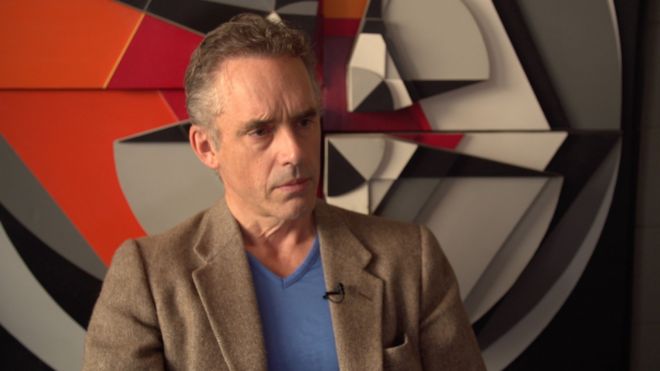
My friend Tyler Cowen argues that Jordan Peterson is the most influential public intellectual in the Western world right now, and he has a point. Peterson, a University of Toronto psychologist, has found his real home on YouTube, where his videos have attracted something like 40 million views.

In his videos, he analyzes classic and biblical texts, he eviscerates identity politics and political correctness and, most important, he delivers stern fatherly lectures to young men on how to be honorable, upright and self-disciplined — how to grow up and take responsibility for their own lives.

Parents, universities and the elders of society have utterly failed to give many young men realistic and demanding practical wisdom on how to live. Peterson has filled the gap.

But what’s most interesting about Peterson’s popularity, especially the success of his new book, “12 Rules for Life,” is what it says about the state of young men today. The implied readers of his work are men who feel fatherless, solitary, floating in a chaotic moral vacuum, constantly outperformed and humiliated by women, haunted by pain and self-contempt. At some level Peterson is offering assertiveness training to men whom society is trying to turn into emasculated snowflakes.

Peterson gives them a chance to be strong. He inspires their idealism by telling them that life is hard. His worldview begins with the belief that life is essentially a series of ruthless dominance competitions. The strong get the spoils and the weak become meek, defeated, unknown and unloved.

For much of Western history, he argues, Christianity restrained the human tendency toward barbarism. But God died in the 19th century, and Christian dogma and discipline died with him. That gave us the age of ideology, the age of fascism and communism — and with it, Auschwitz, Dachau and the gulag.

Since then we’ve tried another way to pacify the race. Since most conflict is over values, we’ve decided to not have any values. We’ll celebrate relativism and tolerance. We deny the true nature of humanity and naïvely pretend everyone is nice. The upside is we haven’t blown ourselves up; the downside is we live in a world of normlessness, meaninglessness and chaos.

All of life is perched, Peterson continues, on the point between order and chaos. Chaos is the realm without norms and rules. Chaos, he writes, is “the impenetrable darkness of a cave and the accident by the side of the road. It’s the mother grizzly, all compassion to her cubs, who marks you as potential predator and tears you to pieces. Chaos, the eternal feminine, is also the crushing force of sexual selection. Women are choosy maters. … Most men do not meet female human standards.”

Life is suffering, Peterson reiterates. Don’t be fooled by the naïve optimism of progressive ideology. Life is about remorseless struggle and pain. Your instinct is to whine, to play the victim, to seek vengeance.

Peterson tells young men to never do that. Rise above the culture of victimization you see all around you. Stop whining. Don’t blame others or seek revenge. “The individual must conduct his or her life in a manner that requires the rejection of immediate gratification, of natural and perverse desires alike.”

Instead, choose discipline, courage and self-sacrifice. “To stand up straight with your shoulders back is to accept the terrible responsibility of life.” Never lie. Tell your boss what you really think. Be strict with your children. Drop the friends who bring you down. Break free from the needy mother who controls you.

Much of Peterson’s advice sounds to me like vague exhortatory banality. Like Hobbes and Nietzsche before him, he seems to imagine an overly brutalistic universe, nearly without benevolence, beauty, attachment and love. His recipe for self-improvement is solitary, nonrelational, unemotional. I’d say the lives of young men can be improved more through loving attachment than through Peterson’s joyless and graceless calls to self-sacrifice.

But the emphasis on strength of will, the bootstrap, the calls to toughness and self-respect — all of this touches some need in his audience. He doesn’t comfort. He demands: “Stop doing what you know to be wrong. … Say only those things that make you strong. Do only those things that you could speak of with honor.”

And Peterson personifies the strong, courageous virtues he champions. His most recent viral video, with over four million views, is an interview he did with Cathy Newman of Britain’s Channel 4 News. Newman sensed that there was something disruptive to progressive orthodoxy in Peterson’s worldview, but she couldn’t quite put her finger on it. So, as Conor Friedersdorf noted in The Atlantic, she did what a lot of people do in argument these days. Instead of actually listening to Peterson, she just distorted, simplified and restated his views to make them appear offensive and cartoonish.

Peterson calmly and comprehensibly corrected and rebutted her. It is the most devastatingly one-sided media confrontation you will ever see. He reminded me of a young William F. Buckley.

The Peterson way is a harsh way, but it is an idealistic way — and for millions of young men, it turns out to be the perfect antidote to the cocktail of coddling and accusation in which they are raised.


Who’s Afraid of Jordan Peterson?

When a British interviewer tried to shut him up, I knew he had something interesting to say.


By 
When I speak with young people beginning their careers I often tell them that in spite of the apparent formidableness of the adults around them—their mastery of office systems, their professional accomplishments, their sheer ability to last—almost everyone begins every day just trying to keep up their morale. Everyone’s trying to be hopeful about themselves and the world. People are more confused, even defeated by life, than they let on; many people—most—have times when they feel they’ve lost the plot, the thread. So go forward with appropriate compassion.

This flashed through my mind when I saw the interview this week between British television journalist Cathy Newman and clinical psychologist and social philosopher Jordan Peterson. It burned through the internet, in part because she was remarkably hostile and badgering: “What gives you the right to say that?” “You’re making vast generalizations.” He seemed mildly taken aback, then rallied and wouldn’t be pushed around. It was also interesting because she, the fiery, flame-haired aggressor, was so boring—her thinking reflected all the predictable, force-fed assumptions—while he, saying nothing revolutionary or even particularly fiery, was so interesting. When it was over, you wanted to hear more from him and less from her.
I wondered when I first read the headlines: What could a grown-up, seemingly stable professor (former associate professor of psychology at Harvard, full professor for 20 years at the University of Toronto) stand for that would make a journalist want to annihilate him on live TV—or, failing that, to diminish him or make him into a figure of fun?
He must have defied some orthodoxy. He must think the wrong things. He must be a heretic. Heretics must be burned.
I had not known of his work. The interview was to promote his second book, “12 Rules for Life: An Antidote to Chaos.” Mr. Peterson is called “controversial” because he has been critical, as an academic, of various forms of the rising authoritarianism of the moment—from identity politics to cultural appropriation to white privilege and postmodern feminism. He has refused to address or refer to transgendered people by the pronouns “zhe” and “zher.” He has opposed governmental edicts in his native Canada that aim, perhaps honestly, at inclusion, but in practice limit views, thoughts and speech.
This is unusual in a professor but not yet illegal, so I bought his book to encourage him.
In it he offers advice, much but not all of it based on decades of seeing patients as a psychologist, on the big eternal question: How to Live.
He is of the tough school: Know life’s limits, see and analyze your own, build on what you’ve got and can create.
And be brave. Everything else is boring and won’t work.
Deeper in, you understand the reasons he might be targeted for annihilation. First, he is an intellectual who shows a warm, scholarly respect for the stories and insights into human behavior—into the meaning of things—in the Old and New Testaments. (He’d like more attention paid to the Old.) Their stories exist for a reason, he says, and have lasted for a reason: They are powerful indicators of reality, and their great figures point to pathways. He respects the great thinkers of the West and the Christian tradition.
More undermining of the modernist project, Mr. Peterson states clearly more than once that grasping at political ideology is not the answer when your life goes wrong. There’s no refuge there, it’s a way of avoiding the real problem: “Don’t blame capitalism, the radical left, or the iniquity of your enemies. Don’t reorganize the state until you have ordered your own experience. Have some humility. If you cannot bring peace to your household, how dare you try to rule a city?”
That is a dangerous thing to say in an ideological age.
What should we do instead? Admit life ain’t for sissies. You will die and on the way to death you will suffer; throughout you will be harassed by evil, both in the world and in your heart: “Earthquakes, floods, poverty, cancer—we’re tough enough to take on all of that. But human evil adds a whole new dimension of misery to the world.”
The only appropriate stance: “Stand up straight with your shoulders back” and “accept the terrible responsibility of life with eyes wide open.” Literally: “Quit drooping and hunching around. Speak your mind.” Competitors and predators will start to assume you’re competent and able. Moreover, it will “encourage the serotonin to flow plentifully through the neural pathways desperate for its calming influence.”
“Aim up. Pay attention. Fix what you can fix.” Respect yourself, take part, keep “the machinery of the world running.”
Don’t be arrogant. “Become aware of your own insufficiency. . . . Consider the murderousness of your own spirit before you dare accuse others, and before you attempt to repair the fabric of the world. And above all, don’t lie. Don’t lie about anything, ever. Lying leads to Hell. It was the great and the small lies of the Nazi and Communist states that produced the death of millions of people.”
He’s suggesting here the personal is political, but not in the way that phrase is usually meant.
If I were of the radical established left, bent on squelching contending thought, I’d hate him too.
Success is a mystery, but failure is not: “To fail, you merely have to cultivate a few bad habits.” Drugs, drinking, not showing up, hanging around with friends who are looking to lose, who have no hopes for themselves or you. “Once someone has spent enough time cultivating bad habits and biding their time, they are much diminished. Much of what they could have been has dissipated,” he writes. “Surround yourself with people who support your upward aim.”
The past is fixed but the future is not. You can learn good by experiencing evil. “A bullied boy can mimic his tormentors. But he can also learn from his own abuse that it is wrong to push people around.” Your future is not preordained by experience; don’t be cowed by the stats. “It is true that many adults who abuse children were themselves abused. It is also true the majority of people who were abused as children do not abuse their own children.”
“Pursue what is meaningful, not what is expedient.”
It is a good book, blunt and inspiring.
We live in a time when so many young (and not so young) people feel lost, unsure of how they should approach their lives, or life in general. Mr. Peterson talks about the attitudes that will help find the path. It is not a politically correct or officially approved path, but it is an intensely practical and yet heightened one: This life you’re living has meaning.
Back to the hostile interview, and the labeling of Mr. Peterson as “controversial,” which is a way of putting a warning label on his work. When people, especially those in a position of authority, like broadcasters, try so hard to shut a writer up, that writer must have something to say.
When cultural arbiters try to silence a thinker, you have to assume he is saying something valuable.
So I bought and read the book. A small thing, but it improved my morale.