Tuesday, January 02, 2018

The Iranian Explosion of Truth


There are many reasons to fear that the protests will fail to achieve their goal of overthrowing the regime.

By Caroline B. Glick
http://www.jpost.com/Opinion/
January 1, 2018
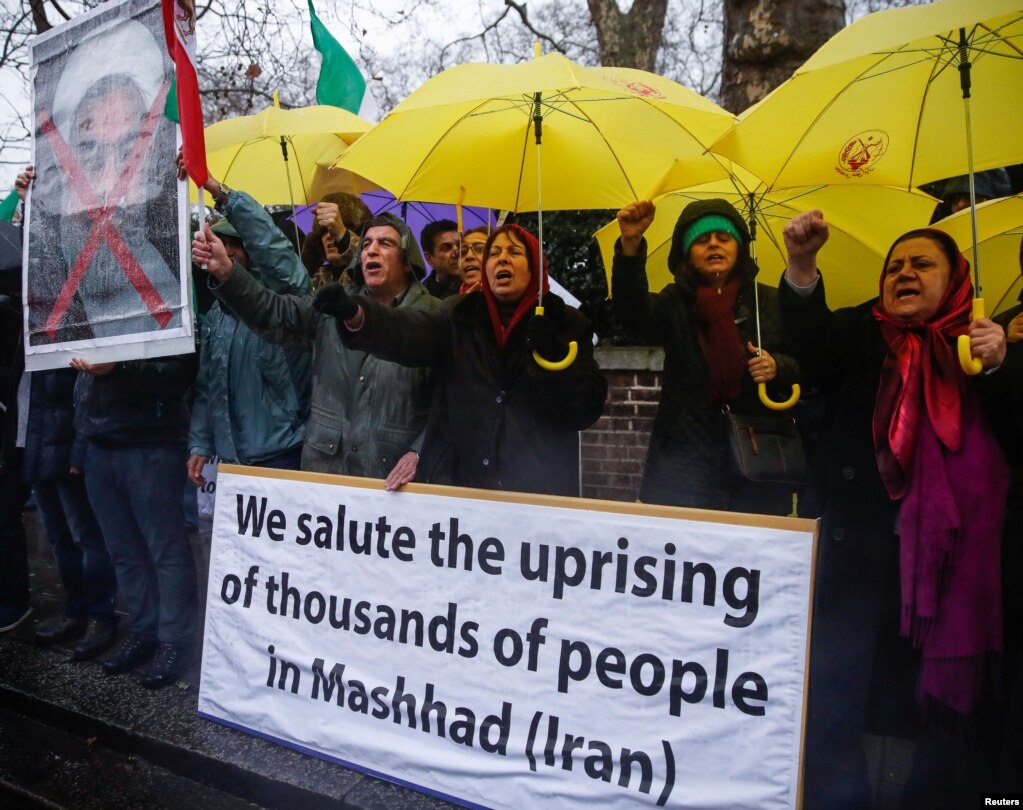
Image result for iran protests 2017
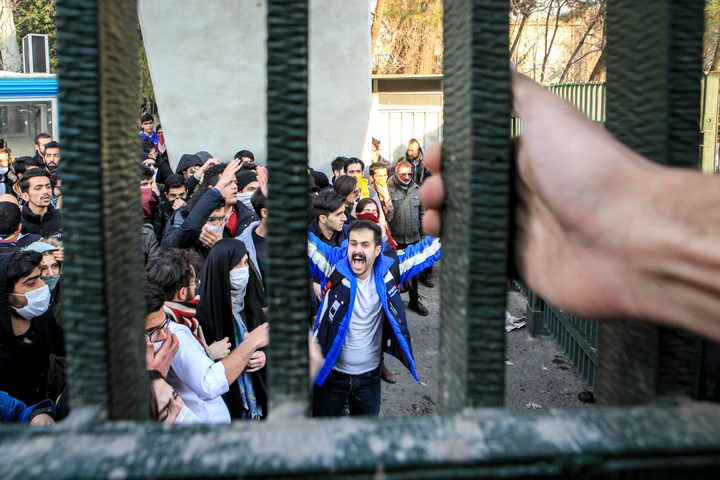
Opponents of Iranian President Hassan Rouhani hold a protest outside the Iranian embassy in west London, Dec. 31, 2017. (Reuters)

If the Iranian regime is unable to brutally stomp out the countrywide protests raging through the country, and if the protesters achieve their goal of bringing down the regime, they will go down in history as the saviors of millions of people not just in Iran but throughout the world.

Given the earth shattering potential of the protests it is extraordinary to see the liberal media in the US and Europe struggle to downplay their significance.


Aside from a lukewarm statement on Twitter from British Foreign Minister Boris Johnson, as of Monday morning – five days into the protests – no senior European official had spoken in favor of the hundreds of thousands of Iranians marching throughout their country demanding freedom.

In the US, former members of the Obama administration and the liberal media have determinedly downplayed the importance of the protests. They have insisted that President Donald Trump should stop openly supporting the protesters and so adopt former president Barack Obama’s policy of effectively siding with the Iranian regime against the Iranian people who seek its overthrow.

These talking points have been pushed out into the media echo chamber by Obama’s former deputy national security adviser and strategic communications chief Ben Rhodes, his former national security adviser Susan Rice and former secretary of state John Kerry.

Obama’s Middle East coordinator Philip Gordon stated them outright in an op-ed in The New York Times on Saturday. Gordon called on Trump “to keep quiet and do nothing” in response to the protests.


In Gordon’s view, no matter how big their beef with the regime, the protesters hate the US more. And they really hate Trump.

Gordon wrote, “Whatever Iranians think of their own government, they are unlikely to want as a voice for their grievances an American president who has relentlessly opposed economic relief for their country and banned them from traveling to the United States.”

Just as Obama’s surrogates have repeated Gordon’s claims, so the Obama-supporting liberal media have gone out of their way to diminish the importance of the protests in their coverage of them and use Obama’s surrogates as their “expert” analysts to explain what is happening (or rather, distort what is happening) to their audiences.

Obama administration officials have been so outspoken in their defense of the Iranian regime because they rightly view the prospect that the protesters will succeed in overthrowing the regime as a mortal threat to their legacy.

Obama’s foreign policy rested on the assumption that the US was a colonialist, aggressive and immoral superpower. By their telling, the Iranians – like the Cubans and the Russians – were right to oppose the US due to its legacy of meddling in the internal affairs of other countries. This anti-American worldview informed the Obama administration’s conviction that it was incumbent on the US to make amends for its previous decades of foreign policy.

Hence, Obama traveled the globe in 2009 and 2010 apologizing for the policies of his predecessors. Hence, Obama believed that the US had no moral right to stand with the Iranian people against the regime in the 2009 Green Revolution. As he saw it, anyone who stood with the US was no better than an Uncle Tom. Truly authentic foreign regimes were be definition anti-American. Since the Green Revolutionaries were begging for his support, by definition, they didn’t deserve it.

Since the current wave on anti-regime protests began last Thursday, the liberal media have parroted the Obama alumni’s talking points because they feel that their war against Trump requires them to embrace Obama’s legacy just as they embraced his talking points and policies for eight years.


After all, if Obama is not entirely infallible, then Trump cannot be entirely fallible. And if Trump may be partially right and Obama partially wrong, then their dispute may be a substantive rather than existential one. And so, the New York Times’ coverage of the most significant story in the world has deliberately distorted and downplayed events on the ground in Iran.

The protests are potentially so important because the Iranian regime is so dangerous. Thanks to Obama, the regime is on a glide path to a nuclear arsenal. Its proxy armies in Lebanon, Syria, Yemen and Iraq possess sophisticated armaments most militaries can only dream of. Its tentacles spread throughout the globe.

The longer the Iranian regime remains in power, the greater the likelihood humanity will soon face a global conflagration that will dwarf World War II.

Nothing any single state does against Iran’s proxies will end Iran’s continued ability to cause mayhem and death on multiple fronts. Every day the Iranian regime remains in place, it will use its power to continue its direct and indirect wars against its enemies in the Middle East and throughout the world.

Gordon argued that Trump’s pro-Israel and pro-Saudi policies since taking office have made him less credible with the Iranian people. All you have to do to understand that this is nonsense is listen to what the protesters are chanting. They insist that they want their country’s money spent at home, on them. They do not want their money used to underwrite Hezbollah, the Assad regime in Syria and Hamas’s regime in Gaza. In other words, they don’t want to make war with Israel – or, presumably Saudi Arabia.

Their criticism is on point.


In 2016, flush with cash from Obama’s nuclear deal, Iran quadrupled its support of Hezbollah from $200 million to $800m. per year.

In 2012 Iran cut off its funding to Hamas in retaliation for Hamas’s support for the Muslim Brotherhood against Iran’s Syrian proxy President Bashar Assad. In the wake of Obama’s nuclear deal, Iran became Hamas’s largest financier.


Last August, Hamas leader Yahya Sinwar said that Iran is Hamas’s “largest backer financially and militarily.”

The $100 billion in sanctions relief Iran received in the wake of the nuclear deal enabled the regime to give hundreds of millions of additional dollars each year to its proxy militias and armies in Iraq, Yemen and Syria.

It is self-evident that if the protesters get their way and the ayatollahs are overthrown, that money would stop flowing to Hezbollah, Hamas, the Houthis and the Shi’ite militias in Iraq. Instead, that money, and billions more, would be spent developing Iran.

There are many ways that the nations of the world can help the protesters in Iran. The US and Iran’s other targets can expose the financial corruption in the Islamic Republic, including the bank account information of everyone from Supreme Dictator Ayatollah Ali Khamenei down to local Basij commanders. They can broadcast anti-regime information into Iran through multiple platforms outside the regime’s control. They can bypass the regime and unblock Twitter, Facebook, Telegraph and other social media platforms.


Aside from that, the Trump administration can take immediate steps to constrain even further the regime’s access to the international monetary system and force European and US firms to cancel their multi-billion dollar deals with the regime.

There are many reasons to fear that the protests will fail to achieve their goal of overthrowing the regime. The regime is already sending its forces out to repress the protesters through killing and mass arrests.

But even if the protesters’ prospects of success are small, there is no excuse for not supporting them, as constructively, enthusiastically and unconditionally as possible. There is certainly no excuse for working to preserve Obama’s foreign policy legacy at the expense of a popular uprising that has the potential to avert a world war.

Sunday, December 31, 2017

Liberal Humiliation: Trump vs. Obama on Iran


December 29, 2017

Related image

Protests in Tehran, December 30, 2017 (AFP)

Back in those pre-9/11 days when I identified as a liberal, the one thing I was sure drew all my then cohort together was opposition to fascism, whether secular or religious.

Boy, was I wrong and never was that more clear than in 2009 when the Green Movement demonstrators were marching through the streets of Tehran and other Iranian cities, demanding freedom from the mullahs. The whole world was watching, as we used to say in the sixties, only their cause was purer than ours was then. The horrifying theocrats who ran the "Islamic Republic" regularly raped women in prison before they killed them, hanged homosexuals in the streets and tortured just about everyone else who didn't comply with the edicts of their Islamofascist regime.

The students and others marching in the streets to overthrow these tyrants desperately wanted America's help, specifically the support of our "oh-so-liberal-progressive" president. They shouted, "Obama, Obama, are you with us or are you with them?"

Obama was silent.

I can't think of a moment I was more disgusted by the acts (inaction actually) of an American president. What did he stand for? What did we stand for?

Well, who knows? What we do know is he wanted to deal with Iran his way — whether to get the glory for himself or for other even less attractive reasons we will never know. He was secretly communicating with Ahmadinejad and Khamenei even before he took office, hinting at accommodation.

He wanted an Iran deal and he got it, the Iranian people and the U.S. Constitution be damned. (I have met several of the student demonstrators from that period who spent years being tortured in Tehran's Evin Prison. Their faces resembled Picassos of the Cubist Period. They were the lucky ones. Their brothers and sisters just disappeared.)

Obama was silent for those students and millions of other decent Iranians. He wanted his deal so much that, as we know, he sent still more millions to the mullahs in cash, so they could use those dollars in any untraceable manner they wished — such as funding Hezbollah and the Houthis.

And speaking of Hezbollah, we all know now, due to reporting about Project Cassandra by Josh Meyer at Politico, that Obama was so determined to make his creepy deal that he acceded to the mullahs' demand to pull the FBI off a detailed investigation of the Hezbollah thugs' extensive involvement in the U.S. drug trade. Are we sick yet?

Now, it is being widely reported, the demonstrators are back in the streets of various cities in Iran. We don't know the extent of the protests or where they are going. I'm a bit skeptical. The time was probably more ripe in 2009, but we can be hopeful. What we do know is that these demonstrators are complaining that money garnered from the Iran nuclear deal is not going to them, the Iranian people, to make their lives better, as promised, but to carry out the mullahs' murderous military adventures across the Middle East. Was anything ever more predictable? (For ongoing updates, I recommend the Islamic State of Iran Crime Research Center.)

What we also know is that the Donald J. Trump administration has taken the exact opposite approach from the Obama administration to events in Iran. They are unqualifiedly — and immediately — supporting the demonstrators and democracy. Bravo!

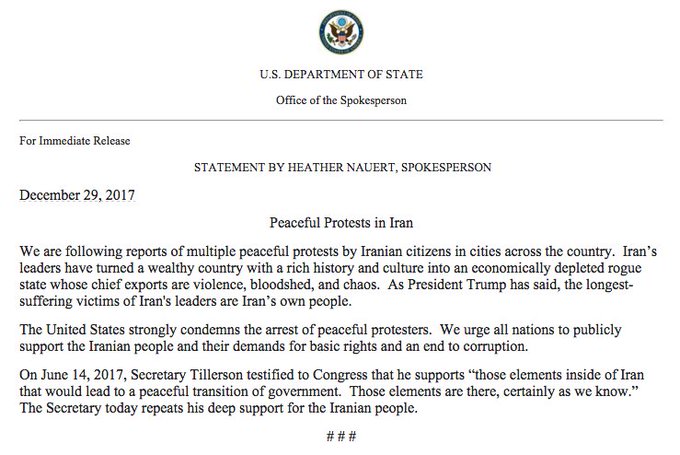
To repeat: "As President Trump has said, the longest suffering victims of Iran's leaders are Iran's own people."

Bravo, again!

When somebody asks me — as they have on occasion — why I am not a liberal anymore, I now have a simple answer: what's that?

UPDATE: Other places to follow the unfolding events are the Twitter feed of the extraordinary Omri Ceren and forthcoming posts — we know they're coming — from PJM's Michael Ledeen. Fingers crossed this time.

Saturday, December 30, 2017

‘The Darkest Hour’ deftly depicts Churchill’s battle to save the world


December 28, 2017
Related image
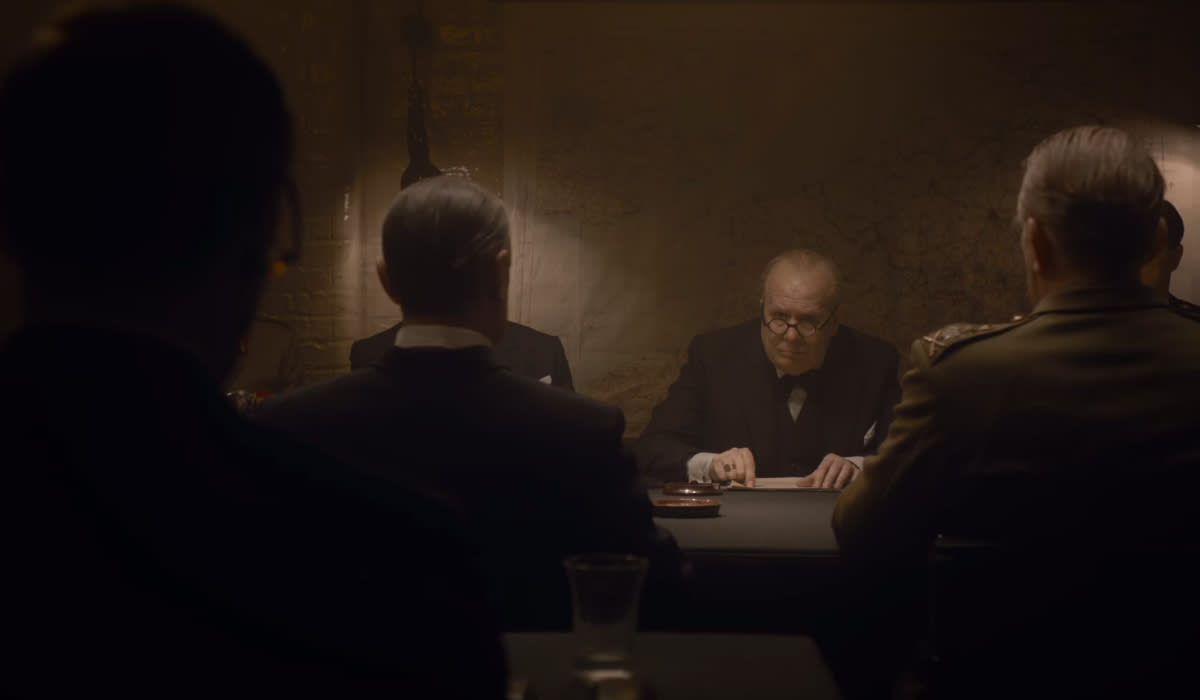
This year’s best movie about a spirited band of resisters fighting an empire of evil isn’t the latest entry in the Star Wars franchise, but “The Darkest Hour,” an extraordinarily deft and moving depiction of the outset of Winston Churchill’s premiership during World War II.
Cabinet meetings and political intrigue aren’t the most natural cinematic material, although the underlying event in “The Darkest Hour” is one of the most dramatic in modern history: One man standing defiant before the onslaught of an enemy army, rallying his nation with his willpower and words.
Discounting for Hollywood embellishments, the movie is worthy of this story, which is high praise indeed. In particular, Gary Oldman’s portrayal of Churchill is so compelling that the Academy Award for Best Actor should be signed, sealed and delivered to him right now.
–– ADVERTISEMENT ––

Upon taking power, Churchill faced disaster on every front in the war, yet bucked internal political pressure to explore a deal with Hitler. In his marvelous history of this crucial interlude, “Five Days in London: May 1940,” the great historian John Lukacs writes, “Then and there he saved Britain and Europe, and Western civilization.”
By his account years later, Churchill felt a sense of relief at being put in charge: “At last I had the authority to give directions over the whole scene.” But his bodyguard reported that when he congratulated Churchill on his ascension and noted the enormous task ahead, the new prime minister replied, tears in his eyes, “God alone knows how great it is. I hope it is not too late.”
In 1937, Churchill’s reputation had been at a low ebb, but he recovered on the strength of his acuteness about Hitler. When Neville Chamberlain returned from Munich, Churchill gave a speech in the House of Commons declaring, “We have sustained a total and unmitigated defeat.” Britain’s position slid downward from there.
The same day Churchill became prime minister, Hitler’s army invaded Western Europe in earnest, sweeping all before it and eventually trapping the British at Dunkirk.
Given the circumstances, the desire of Viscount Halifax, Churchill’s inherited foreign secretary, to explore peace terms wasn’t unreasonable, just profoundly wrong. Lukacs writes that Halifax knew “how to adjust his mind to circumstances rather than attempt to adjust the circumstances to his ideas.”
Churchill thought differently. A contest ensued between the two of them in the war cabinet, where the new prime minister’s position wasn’t unassailable.
Churchill opposed any deal. He was convinced, Lukacs notes, “that such a settlement, under any conditions, could not be counterbalanced by a maintenance, let alone a guarantee, of British liberty and independence.” Churchill bent a little toward Halifax when he initially felt it politically necessary, but ground him down and ultimately outmaneuvered him.
In a key episode, Churchill went to the larger cabinet and won overwhelming approval for his stalwartness. Here, he made his famous statement, “We shall go and we shall fight it out, here or elsewhere, and if at last the long story is to end, it were better it should end, not through surrender, but only when we are rolling senseless on the ground.”
After the war, Churchill wrote of the reaction of his colleagues: “Quite a number seemed to jump up from the table and came running to my chair, shouting and patting me on the back. There is no doubt had I at this juncture faltered at all in leading the nation, I should have been hurled out of office.”
He didn’t falter. Churchill tapped into and built up the resolve of the British people. “There was a white glow,” he wrote later, “overpowering, sublime, which ran through our island from end to end.” Hitler wouldn’t neutralize the British, who escaped Dunkirk and kept up the fight.
The so-called Great Man theory of history might be overly simplistic, but history indisputably has its great men. “The Darkest Hour” does justice to one of them.
Twitter: @RichLowry

Time to Give Clinton’s Server Technician the Mueller Treatment


The Trump Justice Department should reopen the investigation of Paul Combetta.


By Andrew C. McCarthy
December 30, 2017

Image result for paul combetta
Paul Combetta, Platte River Networks, asserts his 5th amendment right while testifying on Capitol Hill in Washington, Tuesday, Sept. 13, 2016, before the House Oversight and Government Reform Committee hearing on ‘Examining Preservation of State Department Records.’ (AP Photo/Molly Riley) 

New Year’s Eve gets people thinking about resolutions. Alas, when a year passes, a mothballed prosecutor finds himself thinking about the statute of limitations. As 2018 beckons, it has me thinking about Paul Combetta — the Platte River Networks technician who used the “BleachBit” program to destroy thousands of Hillary Clinton’s emails when they were under congressional subpoena and preservation orders.

It is not just the tick-tock of the criminal clock that has me thinking about Combetta — about how much longer his obstructive destruction of government files in March 2015 could still be subject to investigation and prosecution. The statute of limitations is five years. Time’s a-wastin’, but there could still be a live case for a while.

The other reason Combetta leaps to the front of the mind is . . . Robert Mueller.

Deputy Attorney General Rod Rosenstein assures us that Special Counsel Mueller is doing a first-rate job probing the possible (but thus far undiscovered) complicity of Trump associates in Russia’s election meddling. That being the case, I’m wondering: Would the Trump Justice Department be up for applying Mueller’s approach to the Clinton caper?

No, I’m not suggesting that DOJ direct the FBI to break into Mr. Combetta’s home with guns drawn in the dead of night, as Mueller did with former Trump campaign chairman Paul Manafort. I’d save the brass-knuckles tactics for hardened criminals, as the law intends. I’m talking about the aggressive but wholly legitimate step Mueller has taken: Calling BS on attempts by criminal suspects to use lawyers to conceal their schemes.

Back in November, we catalogued the stark contrasts between Mueller’s brand of hardball and the kid-gloves treatment given to subjects of the Clinton-emails investigation. The most significant of these involved the attorney–client privilege. Mueller persuaded a federal judge to force an attorney for Manafort and his co-defendant (Richard Gates) to testify against them in the grand jury.

Naturally, the defense attempted to rely on the attorney–client privilege to shield communications between the lawyer and the suspects from disclosure. But Mueller successfully countered that, under the crime-fraud exception to that privilege, communications are not deemed confidential if they are in furtherance of a crime, fraud, or civil wrong — which includes a scheme to dupe the government or undermine an investigation.

Of course, in the Clinton probe — which Attorney General Loretta Lynch instructed FBI director James Comey to refer to as a “matter,” lest anyone get the impression the Federal Bureau of Investigation was doing, you know, an investigation — the Obama Justice Department resisted using the grand jury at all, let alone using it to pry information from lawyers. But hyping the attorney–client privilege into an impregnable barrier was the key to whitewashing the case: Witnesses couldn’t be questioned about the process of reviewing Clinton’s emails and destroying tens of thousands of them, about Clinton’s transferring to them classified emails that they lacked necessary clearances to possess, about their storage of classified emails on their private laptops, and so on — all because they were lawyers and such questioning would purportedly violate the attorney–client privilege.

It was unmitigated nonsense, but very useful nonsense. It enabled the Obama Justice Department to feign the appearance of a thoroughgoing inquiry: No, no, the fix wasn’t in; they tried really hard to make the case but, gee whiz, they ran into some legal restrictions that just couldn’t be overcome.

Mueller, to the contrary, is not merely going through the motions. He is doing what the Justice Department usually does: working hard to make the case and knocking over phony roadblocks placed in his path. When the defense says, “attorney–client privilege,” Mueller responds, “Tell it to the judge.” They lose, as he knew they would; then he marches the lawyer in to the grand jury, gets the testimony, and indicts the clients.

See how this works?

I’m thinking it’s a good time for the Justice Department, under new management (the Trump-appointed management that hired Mueller), to show Paul Combetta how it works.

Let’s review a few key facts.

On March 2, 2015, the New York Times broke the news that Mrs. Clinton, as secretary of state, had used a homebrew server system for all her official email. The House committee investigating the 2012 Benghazi jihadist attack immediately issued letters directing that the emails be preserved, along with a subpoena for them. The server system storing Clinton’s emails was then housed at a private contractor, Platte River Networks (PRN), which by no later than March 9, 2015, was aware of the directive that the emails be preserved. (FBI Clinton File, Part 3, p. 18 — First Combetta FBI interview, p. 5, also paginated HRC-76).

Combetta was the PRN technician who managed the Clinton server system. Throughout March 2015, he communicated several times with Mrs. Clinton’s agents, particularly Cheryl Mills (Clinton’s confidant and her chief of staff at the State Department). With the Obama Justice Department’s indulgence, Mills purported to act as Clinton’s attorney in connection with the emails investigation, even though Mills was ineligible to represent Clinton under legal and ethical rules, and because Mills herself was an actor in the facts that were under inquiry.

It was in the course of these communications with Clinton’s agents that Combetta deleted Clinton’s emails and attempted to destroy them with BleachBit so they could not be fully reconstructed. In a nutshell, Combetta had a call with Clinton underlings on March 25, though he has not disclosed which underlings they were, or what was said in the conversation. Two days later (March 27), Clinton lawyer David Kendall informed the House committee that there were no longer any existing emails from Clinton’s tenure. PRN logs indicate that Combetta deleted emails and installed BleachBit on March 31. On that same day, Combetta had a conference call with Mills and Kendall. (FBI Clinton File, Part 3, pp. 18–19.)

In an early FBI interview on February 18, 2016 (FBI Clinton File, Part 3, pp. 14–20), the recalcitrant Combetta lied to the agents, falsely telling them he did not recall deleting the emails. He also refused to answer questions about his conversations with Clinton’s lawyers, particularly the March 25 and 31 conference calls. Strangely, he invoked the attorney–client privilege. This made no sense: Clinton’s lawyers were not his lawyers, and in any event, the privilege would not cover communications related to the destruction of evidence or obstruction of a congressional investigation.

(Because an FBI report refers to the “Fifth Amendment” (see FBI Clinton File, Part 3, p. 18), there has been some suggestion that Combetta also invoked his privilege against self-incrimination. While not impossible, this would have been inconsistent with Combetta’s approach to avoiding self-incrimination, which was to lie, not to refuse to answer. A more comprehensive FBI report says Combetta actually invoked the attorney–client privilege. See FBI Clinton File, Part 1, p. 19 — also paginated HRC-19.)

In most Justice Department cases, and certainly in the Mueller investigation, lying to the FBI is treated as what it is — a felony. The specter of prosecution is used to pressure low-ranking players to plead guilty to their crimes and cooperate against more culpable suspects. But this was the Obama Justice Department’s “investigation” of Hillary Clinton, so the felony was instead treated as the occasion to reward Combetta with immunity.

Figuring he was home free, Combetta promptly revised his story in a subsequent FBI interview on May 3, 2016. (FBI Clinton File, Part 3, pp. 21–27.) Now he admitted he had destroyed the emails, but claimed he had done it on his own. Like a bolt from the blue (what Combetta called his “Oh s**t!” moment), he suddenly remembered that Mills had told him, five or six months earlier, to “change the retention policy” so that Clinton’s emails would be deleted automatically after 60 days. Because it was beyond this 60-day window by late March, he supposedly took it on himself to delete the emails, and to apply the BleachBit program for good measure. We’re to believe his contacts with the Clinton camp had nothing to do with it.

On the matter of the March 25 call (i.e., shortly before he started deleting and bleaching), Combetta denied being able to remember it — even being shown an email about the call, which made a cryptic reference to “backups,” did not jar Combetta’s conveniently faulty memory. What is more astonishing, assuming the FBI’s report reflects the full scope of the later interview, is that Combetta was not even asked about his conversation with Mills and Kendall on March 31 — the day he (just coincidentally, I’m sure) deleted and destroyed Clinton’s subpoenaed emails.

In other words, once he got immunity, Combetta admitted the thing he had previously lied about (i.e., the only thing he calculated the government might be able to prosecute him for), but claimed not to remember anything that might implicate anyone else in such crimes as obstruction and the destruction of government files. Moreover, it appears that the FBI deferred to Combetta’s prior invocation of the attorney–client privilege to avoid discussing the March 31 conversation with Kendall and Mills. This expansive interpretation of the privilege would be absurd, yet fully consistent with the Obama Justice Department’s indulgence of privilege claims throughout the Clinton probe.

But here’s the thing — two things, actually. First, the Justice Department’s immunity practice is designed, for obvious reasons, to prevent just this kind of gamesmanship. Immunity is conditional on the witness’s providing truthful, accurate, and complete information. If in the judgment of the investigators the witness gives an account that is misleading and withholds information, the immunity can be revoked. The witness may then be prosecuted for his crimes, in addition to any false statements he has made while feigning cooperation.

Second, the crime-fraud exception to the attorney–client privilege is designed, for equally obvious reasons, to prevent the insinuation of lawyers from blocking the discovery of corrupt schemes to destroy evidence, influence testimony, and undermine investigations. As Mueller has shown, even if the lawyer is an innocent dupe rather than a knowing conspirator, communications that further a crime or fraud are not privileged.

Should there be a wholesale reopening of the Clinton investigation? I believe so, but that bridge can be crossed later. For now, how about simply reopening the Combetta investigation?

The Trump Justice Department should appoint a solid United States attorney and some hard-nosed FBI agents from outside Washington, with no prior involvement in the Clinton probe, and instruct them to follow Mueller’s aggressive model in investigating Combetta. In return for the immunity he should never have been granted in the first place, the PRN tech should be compelled to reveal exactly what he was told in these conversations with Clinton lawyers. If he refuses, Combetta should be prosecuted, at a minimum, for lying to the FBI and obstructing Congress’s Benghazi investigation.

As Robert Mueller might say of Paul Manafort: That should get his attention.

— Andrew C. McCarthy is a contributing editor of National Review and a senior fellow of the National Review Institute.

Friday, December 29, 2017

Today's Tune: Bob Dylan With Tom Petty and The Heartbreakers - Hard to Handle (Live)

The Harvard professor of Bob Dylan studies: 'My thesis is that he has become Odysseus'


By Zoe Williams
17 November 2017
Image result for why bob dylan matters
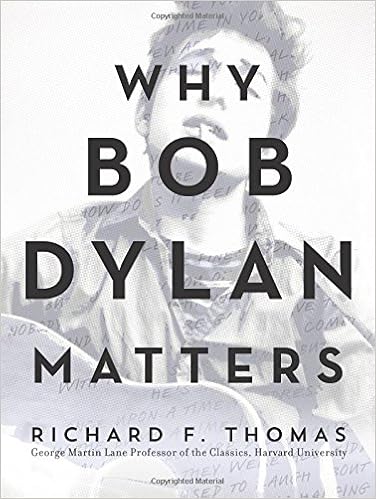
People who know Bob Dylan slightly, or know of him – the book is to help them to understand why he’s important.” With this mildly phrased description, Richard F Thomas, a classics professor at Harvard, originally from New Zealand, born in London, doesn’t quite do justice to Why Dylan Matters. It is a poignant blend of memoir, literary analysis through a classical lens, musicology and, above all, love. He loves Dylan with a passion so selfless and so intense that it’s impossible to emerge from the book, let alone meeting its author, untouched. And I was a fan already – I just didn’t realise until now how second-rate I was at it.
We meet at the Troubadour, in Earl’s Court, London, a cafe rich with the histories of scores of musicians – Jimi Hendrix, Paul Simon – but truly a jewel in the folk revival scene for having hosted Dylan in 1962, when he played under the name of Blind Boy Grunt. Despite the poignancy of the venue, Thomas says it maddens him when people look to Dylan’s songs for autobiographical meaning. He cites a mid-60s press conference: “Dylan became almost angry, very hostile. The established press – their only models were the Beatles and Donovan – whom they didn’t really understand either. But you wouldn’t ask Picasso what his paintings were ‘about’.”
Nevertheless, Thomas is engaged in a decoding of his own, looking for imagery, biblical allusions in the early days, classical references in his later years, Woody Guthrie breaking into a song like a phantom, Ovid blasting into a love stanza. Other times, unable to fathom a source, Thomas gazes in admiration at the poetry. “Where did the music come from? In the 60s, these incredible lyrics, ‘It’s Alright Ma (I’m Only Bleeding)’. The poetry of them, these lyrics, ‘Mr. Tambourine Man’ – ‘dance beneath the diamond sky, with one hand waving free./ Silhouetted by the sea, circled by the circus sands./ With all memory and fate driven deep beneath the waves’. Where does that come from?”
In 2003, Thomas suggested that Harvard should start a Dylan module, and he recalls, with a victor’s grace, that some of his colleagues were against the idea, thinking it too trivial; by 2016, Dylanology was well-established. When news came of his Nobel prize, “the New York Times was in my classroom that afternoon, it was on the front of the arts section of the Times that Saturday, so I had the book contract by Monday”.
As much as Dylan has always resisted the quest for meaning, that’s nothing compared with how he has balked at being used as a poster boy for a political position, whether an anti-war stance or a civil rights agenda. But the fact is – Thomas is quite strict on this point – “he wrote the best civil rights song, ‘Blowin’ in the Wind’, and the best anti-war song, ‘Masters of War’, and all before he was 23 or 24 years old”.
“Masters of War” became a thorn in Dylan’s side, taken as the anthem of the movement against Vietnam. “So people just assumed he was a pacifist, although he never went on a march. My own view is that he’s fairly conservative, although he was against that war. He stopped touring in ’66 until ’74, which is really when Vietnam happened.”
If you’re struggling to compute the idea of Dylan as a conservative, that’s not it exactly: “I think he’s a conservative in the best sense, he wants to conserve and save. What his politics are, nobody knows. But when Obama won, he did say elusively, ‘looks like things might be changing for the better’. So I don’t think he’s a Republican conservative.”
Image result for why bob dylan matters
Professor Richard F. Thomas
Dylan’s career breaks into segments, both musically and thematically: acoustic, then electric, then his Christian period, the unpopular mid-80s, then a rebirth in 1997; his recent work is the richest in classical imagery and according to Thomas as good – particularly Tempest – as anything he’s ever done. But each new phase alienated some of the most diehard fans of the last. “Do you know the Judas story? It was in Manchester Free Trade Hall in ’66, and he does the acoustic half and comes out completely different, wearing different clothes, with this electric band, and people booing, and he’s talking to them, and then there’s this one cry: Judas. To this Jewish singer. And Dylan says: ‘I don’t believe you. You’re a liar.’ And he turns to the band and says, ‘play fucking loud’. And it’s like a machine gun, the opening chords of ‘Rolling Stone’, this incredible electric sound. He knew where he was going, I think. And was always ahead of the fans.”
Fans who left for one reason or another – the Christian era where gigs would start with a full-on, ranting sermon sounds a bit special interest – sometimes never came back. “A lot of them probably think he’s dead.” Which is their loss, as his reinventions have often deepened what went before and, however well you know a song, how it will sound live is completely unpredictable. True Dylanologists listen to official bootlegs, by the way. The studio albums are only there for the copyright.
Does Thomas ever hear a couplet that’s a little bit trite and panic that that’s the real Dylan and the genius is just an accident? Shaking his head confidently, he replies: “Too many accidents.” In a way, the classical allusions of Dylan’s later work bring him back to his earliest roots in blues and folk, albeit in a roundabout way. “Think about melancholy – the song ‘Not Dark Yet’ ends with the singer getting near the end. But it’s just such a beautiful song. The beauty of the song is compensation for the melancholy. We’re all going to die, so how do you deal with that fact? You can believe in an afterlife, or you can focus on the beauty that the human mind can produce through art. I think that’s why, like Eliot or Dante, or my guys, Virgil, Ovid, because of his genius, he’s always hooking into poetic traditions. Gospel, folk, always folk. There are folk traditions in ancient Greece and Rome, they’re what people sing, how they deal with mortality. Take someone like Virgil, whose Eclogues is really at the root of western pastoral poetry: he has these songs, which are shepherds competing with each other, it’s a cultural reality turned into high art. Dylan could hear a song and absorb it probably within a couple of hearings. When he gave the Nobel lecture, he talks about becoming all of these characters, from the ballads, from the folk songs.”
Dylan put the Nobel committee’s nose of out of joint, not replying to them for weeks when they told him he had won (the permanent secretary said, “we’ll give him as much time as he wants”). “I think the real Bob Dylan couldn’t see himself in that room with all of those people”. Then he declined to give the acceptance speech, which had to be delivered by the US ambassador to Sweden, but he did deliver the Nobel Lecture – the $900,000 depended on it – which is probably as full a rumination on his work and influences as he’s ever given. He talks about the books that were most important to him – Moby-Dick, All Quiet on the Western Front and The Odyssey – which Thomas says “really confirmed my thesis that he has become Odysseus. He uses the pronoun ‘you’, ‘you’ve ended up in bed with the wrong woman’, which could be Odysseus and Calypso, or himself, but also could be you or me. It’s part of his genius that nothing is pinnable down but these connections can be made.”
Thomas has been to Dylan’s high school, met his 90-year-old English teacher, has ruminated on the singer’s few months at college surely more deeply than Dylan himself did, and has watched his live performances, often many times in a single tour, with devotional attentiveness. But he’s never met him, and isn’t sure that he’d want to. “First of all he wouldn’t say anything. But also, Virgil is the poet I’ve most worked on. We know where he was born, we know when he was born, we know when he died. There are a few other anecdotes about him but most in a life that was written 100 years after he died. And that doesn’t bother me. I don’t need to know the poet. All I need is the poetry. Besides, what would I say?”
• Why Dylan Matters by Richard F Thomas is published by William Collins in hardback, £12.99.

FRONTPAGE MAGAZINE'S MAN OF THE YEAR: PRESIDENT TRUMP


“Are you better off than you were last year?”


December 29, 2017
Related image
(Getty Images)
It’s that time of the year when media outlets write up the people and trends who defined the year while ignoring the man who redefined it. 
2017 was the year that the United States of America got up off its knees. It was the year that we stopped following the world and started leading it. It was the year that our booming economy accomplished the impossible. It was the year that we became a great nation again.
And one man is responsible for that. 
President Trump promised to make America great again. And every day, it’s happening. Factory workers and small businessmen, farmers and ranchers, soldiers and police officers are waking up to a renewed America. Time chose a social justice hashtag as its ‘Thing of the Year’.  We’re choosing the man who turned the country around as our “Man of the Year”. 
When President Trump promised 4% economic growth, the media herded together economists to prove it couldn’t happen. CNN surveyed 11 economists and Bloomberg asked 80 economists. They agreed it was impossible. 2% growth was the best that we could hope for. And we would have to get used to that.
And then the GDP growth estimate for the fourth quarter of 2017 approached 4%.
Americans are realizing that maybe we don’t have to just get used to dividing up the last torn shreds of a failing economy between leftist crony billionaires and their officially entitled victim groups.
Maybe we can do better.
The S&P 500 Index has gone up 20% this year and the Dow is up 25%. Holiday shopping season sales are up almost 5% over last year. Consumer confidence is at a 17-year high. The unemployment rate is at a 17-year low. The manufacturing industry just had its best month of job gains for the year.
All of this isn’t just a matter of dollars and cents. It’s the knowledge that things are getting better. You can’t fake it. The media spent eight years promising a recovery that no one believed in. Obama announced that the recovery had happened more times than he ended the Iraq War. And just like the end of the war, it never happened. It’s happening now because people are living a better future.
Call it… making America great again. Not for government officials, but for ordinary Americans.
Obama made life great for government bureaucrats. In the era of hope and steal, the bedroom communities of Washington D.C. became the wealthiest counties in the country. Americans lost their jobs, veterans lost their lives and the government bureaucracy grew fat on their misery.
While the VA was killing veterans by putting them on waiting lists to save money, it paid out $142 million in bonuses. The EPA did its best to kill the economy while profiting from its misdeeds. It paid 8 employees $1 million to donothing. One EPA employee managed to rip off the government to the tune of almost $1 million while pretending tobe a CIA agent. Now the free ride for the swamp is finally over.
Under Obama, the IRS handed out $100 million in bonuses to its employees. Tens of thousands of dollars went to Lois Lerner who had targeted conservative groups. Under Trump, the former IRS commish, on whose watch the targeting happened, is warning that tax reform will be a disaster for the IRS. Meanwhile after tax reform, millions of people across the country are getting $1,000 bonuses.
That’s what the Trump economy looks like.
Obama spent us deep into debt and told us to hope. Trump isn’t telling us to hope. He’s actually delivering. That’s why his political opponents are so afraid and so desperate to bring him down. Incumbents rarely lose elections. And incumbents with a booming economy at their backs are bulletproof. The Democrats have bet everything on their Russia conspiracy theories because they know that Trump will be able to ask Americans the same exact question that Reagan did in 1980 and 1984.
"Are you better off than you were 4 years ago?”
And they know what the answer will be. Especially once the tax cuts kick in. That’s why they’re afraid.
“Is it easier for you to go and buy things in the stores than it was four years ago? Is there more or less unemployment in the country than there was four years ago? Is America as respected throughout the world as it was? Do you feel that our security is as safe, that we're as strong as we were four years ago?”
We can see those answers right now. You won’t see them on CNN which is breathlessly thrilling leftist #resistance viewers with the latest Mueller coup leaks. You won’t read about them in the New York Times. But you can see it in shopping malls, at the United Nations, in the front lines of the war against ISIS and Al Qaeda, in the faces of police officers and the bright eyes of children receiving their presents. 
Today we can ask, “Are you better off than you were last year?” And it’s easy to see the answer. You don’t look for it in the soaring rhetoric of a politician or the tea leaves of the experts. It’s there in the busy aisles of big box stores, the crowded planes, the bustling factories and the booming market.
It’s a spirit that’s in the air. It’s not hope. It’s reality. 
And it’s why President Donald J. Trump is Front Page’s Man of the Year.
Obama’s rise to power was a revolution against America. Trump’s first year was an American revolution.
The Obama revolution paid out its benefits in stolen money. Trillions were stolen from taxpayers, homeowners, car owners, workers and small businessmen and redistributed to his friends and political cronies, to migrants and the welfare class, to Iran and other Islamic terrorists, and to the Green Mob.
Trump’s revolution is taking the government boot off American necks. Its benefits are paid out by putting an end to the political oppression, repression, thievery and exploitation of the past. That mea ns lower taxes and fewer regulations. It means that our troops can decide how to kill terrorists and Israel can decide what its capital is. And you can decide how to spend your own money.
Whether you’re in Alaska or Florida, deep in the Maine winter or basking in seventy degree temperatures in Arizona, take a deep breath of that air. It tastes of freedom.
The new American revolution wasn’t accompanied by rifle fire. Instead it came when millions of Americans voted for their freedom. And, for the first time in some time, freedom followed.
That’s why the economy is booming. It’s why there’s a new spirit of confidence in the air.
Free people can solve more problems than any government agency. They can create more wealth than any government bureaucrat. Government doesn’t make America great. Americans make it great.
The Trump revolution has unleashed millions of Americans to renew our nation’s greatness.
And that is why we recognize President Donald J. Trump as the man whose impact on this country defined the past year. It was a year of revolution, of liberation, of industry and achievement. 
It was a year that made America great.