Tuesday, July 26, 2016

Trump’s—and FDR’s—‘Forgotten Man’

Franklin Roosevelt’s forgotten man carried him to victory in 1932. Will it be the same in 2016?


By Amity Shlaes
July 25, 2016
'Yes, You Remembered Me' (The Forgotten Man). Cartoon, 1936, by Clarence D. Batchelor, Stock Photo

"I have visited the laid-off factory workers, and the communities crushed by our horrible and unfair trade deals. These are the forgotten men and women of our country.”
—Donald Trump, July 21, 2016
This year’s Republican presidential nominee is not the first politician to utter the phrase “forgotten man.” The term has periodically surfaced since the late 19th century, when voters learned that the forgotten man opposed the Dingley Tariff. Yet it still resonates today. Two years ago Sarah Palin told the Western Conservative Summit that “what the forgotten man has is belief in this exceptional nation.”
But what do politicians mean by the forgotten man? Two opposing definitions predominate. Which of these Mr. Trump chooses will tell us the kind of president he might make.
The forgotten man emerged in the 1880s in the lectures of a Yale professor named William Graham Sumner. A Thomas Piketty in reverse, Sumner abhorred efforts to equalize society and offered an elegant equation: “As soon as A observes something which seems to him to be wrong, from which X is suffering, A talks it over with B, and A and B then propose to get a law passed to remedy the evil and help X. Their law always proposes to determine what C shall do for X or, in the better case, what A, B and C shall do for X.”
“C” is the forgotten man, declared Sumner, a kind of everyman who falls into no category: “He works, he votes, generally he prays—but he always pays—yes, above all, he pays.”
Sumner, a classical liberal, believed that strong commerce helped the poor better than the best government benefit. “If you do anything for the Forgotten Man, you must secure him his earnings and savings, that is, you legislate for the security of capital and for its free employment,” Sumner wrote.
“Jobbery,” as Sumner called it, also wounded the forgotten man. In the 1870s and 1880s, the era of Tweed and Tammany, municipal and county governments joined private contractors to build public structures. Sumner skewered such projects: “They are carried out, not because they are needed in themselves, but because they will serve the turn of some private interest.” He added that “the biggest job of all is a protective tariff,” which generates forgotten men and forgotten costs to consumers.
Sumner’s forgotten man was a political phenomenon, a warning that supplied arguments for reformers of both parties. His chum William Whitney helped lead anti-Tammany Democrats and served in Grover Cleveland’s cabinet.
That we know so little about Sumner, who died in 1910, is evidence of the thoroughness of the progressive takeover of academic culture. By the early 1930s and the Great Depression, a different forgotten man had stepped onto the political stage. Raymond Moley, campaign adviser to New York’s Gov. Franklin Roosevelt, was drafting a speech that the presidential candidate was to give on the Lucky Strike Radio Hour. “I scraped from my memory an old phrase, ‘The Forgotten Man,’ which has haunted me for years,” Moley later explained.
The forgotten man FDR sketched was not the universal “C” but “X,” the man, as Roosevelt put it, “at the bottom of the economic pyramid.” The key difference was that Roosevelt would single out specific groups, starting with the poor.
FDR’s forgotten man was the opposite of Sumner’s. Roosevelt’s predecessor as the Democrats’ presidential nominee, Al Smith, objected to the switch. Smith, himself from the humblest of backgrounds, warned that highlighting class distinctions divided the country when it needed to pull together. “The Forgotten Man is a myth,” Smith said, “and the sooner he disappears from the campaign the better it will be for the country.”
FDR’s forgotten man carried him to victory in 1932 and defined the platform of his subsequent presidential campaign. As the 1936 election neared, Roosevelt identified and rewarded one group of “forgottens” after another.
Unions received the Wagner Act, the right to bargain collectively. Senior citizens received Social Security. Municipal lobbies got billions for “jobbery.” The unemployed received payments or make-work jobs. At Howard University, Roosevelt thundered that “there should be no forgotten men and no forgotten races.”
This interest-group strategy netted FDR a stunning victory in 1936—46 of 48 states—and provided a template that has since served not only his party but also Latin American governments. The forgotten footnote is that the economic outcome of FDR’s program vindicated Sumner. Remembering so many forgotten men meant forgetting the average worker. The slump that followed FDR’s spending blitz drove unemployment back into the high teens.
Hoisting FDR by his own rhetoric, an Indiana paper asked: “Who is the forgotten man in Muncie? I know him as intimately as my own undershirt. He is the fellow that is trying to get along without public relief.”
More recent sightings include Richard Nixon’s 1968 campaign, when he spoke of “the great majority of Americans, the forgotten Americans—the non-shouters, the non-demonstrators.”
And where stands Mr. Trump? With Sumner’s anonymous crowd, or Roosevelt’s specific groups? That Mr. Trump is by temperament a man of deals suggests he will be inclined toward FDR’s way of thinking. Mr. Trump’s Atlantic City projects fit perfectly into the Sumneresque definition of “jobbery.” Mr. Trump’s unabashed protectionism does not recall Roosevelt, an exception as a free trader, but it does recall the Democratic Party.
But Mr. Trump does not pit rich against poor. He may end up standing more for the universal than the individual.
We’re told this election is “different.” Perhaps different enough that we will get a real discussion of the consequences of rewarding groups. Sumner’s distinction between “jobbery” and true capitalism is one that many voters would be thrilled to see Mr. Trump recognize. And how fabulous it would be if Hillary Clinton took on Mr. Trump over trade with the vigor of a Sumner. Here’s an opening question for the first Trump-Clinton debate: “Who is the forgotten man?”
Miss Shlaes, author of “The Forgotten Man: A New History of the Great Depression” (Harper, 2007), is a presidential scholar at King’s College.

Sunday, July 24, 2016

Trump Is Right about Crime


The media rushes to downplay the post-Ferguson shooting and homicide surge—and its effect on black lives.
July 22, 2016
Donald Trump speaks on the last day of the Republican National Convention on July 21, 2016, in Cleveland. JIM WATSON/AFP/Getty Images.
It is remarkable how little black lives matter when they have not been taken by a police officer. The mainstream media is foaming at the mouth over Republican presidential nominee Donald Trump’s warnings about rising crime during his Thursday night convention speech. Trump pointed out that homicides were up nearly 17 percent in the largest 50 cities. (The latest research actually shows a nearly 17 percent increase in the 56 largest cities). There have been more than 2,000 shooting victims this year in Chicago, he said, and more than 3,600 killed in Chicago since President Obama took office. 
The overwhelming majority of the victims in this post-Ferguson shooting and homicide surge have been black. In Baltimore, for example, 45 people were killed in July 2015 alone; 43 of them were black. Baltimore’s per capita murder rate was the highest in its history in 2015. In Chicago, 2,460 blacks were shot in 2015—lethally or non-lethally—or nearly seven blacks a day. By contrast, 78 whites were shot in Chicago, or one every 4.6 days. Twelve cities with large black populations saw murders rise anywhere from 54 percent—in the case of Washington, D.C.—to 90 percent, in Cleveland. 
Trump’s concern about rising crime is therefore not a concern about white victims and the loss of white life. Rather, it is a concern about black lives. As Trump said: “[Y]oung Americans in Baltimore, Chicago, Detroit, Ferguson . . . have as much of a right to live out their dreams as any other child America.” Hint to the media: He was referring to black children in those cities, such as the ten children under the age of ten killed in Baltimore last year; the nine-year-old girl fatally shot while doing homework on her mother’s bed in Ferguson, Missouri, in August 2015; and the nine-year-old boy in Chicago lured into an alley and killed by his father’s gang enemies in November 2015. 
And yet the media is twisting itself into knots trying to downplay and trivialize the crime increase. Isn’t it white Republicans (and, of course, the cops) who are supposed to be indifferent to black lives? The Washington Post and Vox.com rushed out fact checkers to recycle many of the failed arguments against what I have called the “Ferguson effect”—the crime increase resulting from cops pulling back from proactive policing. Yes, crime is up, these journalists say, but it’s not as bad as it was years ago. “Even if the nationwide murder rate increased by 17 percent in 2015, that rate would remain far, far below the peaks of the 1960s and '70s and below any period in the '90’s,” argues Vox. But a crime decrease that took two decades to achieve is not going to be reversed completely in two years. If present trends continue, however, we could see that unprecedented and unpredicted crime decline of 50 percent disappear in a few more years. 
Vox compares the 1980 murder rate with the much lower 2014 murder rate. But the Ferguson effect kicked in only after the death of Michael Brown in August 2014. The second half of 2014 reversed the crime decline of the year’s first half, but the full Ferguson effect showed up in 2015 and continued at least into the first quarter of 2016, with homicides up 9 percent and non-fatal shootings up 21 percent. 
Confronted with the Chicago bloodshed, Vox changes the subject to America’s high rate of gun ownership. But the number of guns has not changed since Ferguson. What has changed is the willingness of young gangbangers to carry and use guns now that officers are making so many fewer pedestrian stops—90 percent fewer in Chicago this year, for example. 
Vox also argues that there is “no evidence that ‘this administration’s rollback of criminal enforcement’ caused violent crime to rise” in Chicago (or, presumably, elsewhere). The Washington Post likewise challenges Trump’s ascription of the violent crime increase to the Obama administration, pointing out that policing is mainly a local phenomenon. Here, Trump’s critics are on more solid ground. The real action when it comes to policing and crime is at the local level. The federal government has little role in local crime-fighting, except for federal-local task forces on drug trafficking. To be sure, the Obama administration’s drive to slap an unprecedented number of consent decreesand federal monitors on police departments has created enormous headaches and wasteful paperwork challenges. At the margins, those consent decrees could have had an impact on policing and crime, as a recent study found. When the administration’s push for bogus “implicit bias” training kicks in, officers will be diverted from desperately needed tactical training and time spent fighting crime on the streets. 
Yet, while there was no affirmative, policy-driven federal “rollback of criminal enforcement,” a rollback of enforcement at the local level has in fact occurred, with officers backing off of proactive policing. On that front, Trump got the causation absolutely right. “The irresponsible rhetoric of our president, who has used the pulpit of the presidency to divide us by race and color, has made America a more dangerous environment for everyone,” he said. 
President Obama’s relentless accusations that cops are lethally biased, his embrace of Black Lives Matter, and the media’s amplification of thatmendacious movement’s lies about the police have led to the drop in proactive enforcement and the resulting increase in crime. Trump’s recognition of the role that official rhetoric plays in determining facts on the ground is sophisticated. And his unapologetic alarum about the rising threat to law and order signified by the deliberate attacks on police officers is welcome. 
Vox tries to downplay those attacks by noting that all on-duty deaths—including those from traffic accidents—are down 1 percent. But the Black Lives Matter hatred is not causing more car crashes; it is inspiring people to kill cops. Lethal shootings of cops are up 84 percent this year, according to Vox’s source, and up 68 percent according to the Law Enforcement Officers Memorial Fund. Those are chilling numbers. Not to worry, says Vox, “on-duty deaths remain rare, and 2016’s increase in gunfire deaths so far came after decades of decline.” 
If on-duty deaths remain rare, so do police shootings of unarmed black males. In fact, a police officer is 18.5 times more likely to be killed by a black male than an unarmed black male is to be killed by a police officer. And the fact that “2016’s increase in gunfire deaths so far came after decades of decline” is precisely what makes the increase so striking. That it reverses decades of decline is not a point in Black Lives Matter’s favor.  
Not enough attention has been paid to the portent that is this year’s string of attacks on police officers—not only in Dallas and Baton Rouge but also in Georgia, Missouri, Wisconsin, Kansas, Michigan, Chicago, and Tennessee. We could be seeing the start of not just a war on cops, but more widespread racial violence. 
Trump’s speech was a bold and important shift in the prevailing discourse about policing and crime. It couldn’t have represented a sharper distinction from the Obama-Clinton message, relentlessly delivered, that our criminal justice system and our nation’s police are infected with racial bias. Trump is absolutely right that law and order is at stake. The elites hear “law and order” rhetoric as code words for racism. They are the ones, however, who are turning their eyes away from the black bodies piling up on the streets. 

Clinton VP Pick Tim Kaine’s Islamist Ties


July 23, 2016


Sen. Tim Kaine, D-Va., speaks at a roundtable discussion on religious freedom with the regional interfaith community at All Dulles Area Muslim Society (ADAMS) Mosque in Sterling, Va., Thursday, July 21, 2016. (AP Photo/Manuel Balce Ceneta)


Democratic presidential nominee Hillary Clinton’s newly-announced running mate, Virginia Senator Tim Kaine, has a history of embracing Islamists. He appointed a Hamas supporter to a state immigration commission; spoke at a dinner honoring a Muslim Brotherhood terror suspect; and received donations from well-known Islamist groups.

Appointing a Muslim Brotherhood Front Leader Who Supports Hamas

In 2007, Kaine was the Governor of Virginia and, of all people, chose Muslim American Society (MAS) President Esam Omeish to the state’s Immigration Commission. A Muslim organization against Islamism criticized the appointment and reckless lack of vetting.
Federal prosecutors said in a 2008 court filing that MAS was “founded as the overt arm of the Muslim Brotherhood in America.” A Chicago Tribune investigation in 2004 confirmed it, as well as MAS’ crafty use of deceptive semantics to appear moderate. Convicted terrorist and admitted U.S. Muslim Brotherhood member Abdurrahman Alamouditestified in 2012, “Everyone knows that MAS is the Muslim Brotherhood.”
Read our fully-documented profile of MAS here.
According to Omeish’s website, he was also President of the National Muslim Students Association (click there to read our profile about its Muslim Brotherhood origins) and served for two years on the national board of the Islamic Society of North America (ISNA), which the Justice Department also labeled as a U.S. Muslim Brotherhood entity and unindicted co-conspirator in a Hamas-financing trial.
His website says he was Vice President of Dar al-Hijrah Islamic Center, a radical mosque known for its history of terror ties including having future Al-Qaeda operative Anwar Al-Awlaki as its imam and being frequented by two of the 9/11 hijackers and the perpetrator of the Fort Hood shooting. Omeish’s website says he remains a board member.
It says he was chairman of the board of Islamic American University, which had Hamas financier and Muslim Brotherhood spiritual leader Yousef Al-Qaradawi as chairman of its board until at least 2006. Omeish was also chairman of the board for the Islamic Center of Passaic County, a New Jersey mosque with heavy terrorist ties and an imam that the Department of Homeland Security wants to deport for having links to Hamas.
Omeish directly expressed extremism before Kaine appointed him. He claimed the Brotherhood is “moderate” and admitted that he and MAS are influenced by the Islamist movement. In 2004, Omeish praised the Hamas spiritual leader as “our beloved Sheikh Ahmed Yassin.” Videotape from 2000 also surfaced where Omeish pledged to help Palestinians who understand “the jihad way is the way to liberate your land” (he denied this was an endorsement of violence).
When a state delegate wrote a letter to then-Governor Kaine warning him that the MAS has “questionable origins,” a Kaine spokesperson said the charge was bigotry.
Kaine obviously failed to do any kind of basic background checking in Omeish.
Omeish resigned under heavy pressure and Kaine acknowledged that his statements “concerned” him. But, apparently, they didn’t concern him enough to actually learn about the Muslim Brotherhood network in his state and to take greater precautions in the future.
Speaking at a Dinner Honoring Muslim Brotherhood Terror Suspect
In September 2011, Kaine spoke at a “Candidates Night” dinner organized by the New Dominion PAC that presented a Lifetime Achievement Award for Jamal Barzinji, who theGlobal Muslim Brotherhood Watch describes as a “founding father of the U.S. Muslim Brotherhood.”
He first came on to the FBI’s radar in 1987-1988 when an informant inside the Brotherhood identified Barzinji and his associated groups as being part of a network of Brotherhood fronts to “institute the Islamic Revolution in the United States.” The source said Barzinji and his colleagues were “organizing political support which involves influencing both public opinion in the United States as well as the United States Government” using “political action front groups with no traceable ties.”
Barzinji had his home searched as part of a terrorism investigation in 2003. U.S. Customs Service Senior Special Agent David Kane said in a sworn affidavit that Barzinji and the network of entities he led were investigated because he “is not only closed associated with PIJ [Palestinian Islamic Jihad]…but also with Hamas.”  Counter-terrorism reporter Patrick Poole broke the story that Barzinji was nearly prosecuted but the Obama Justice Department dropped plans for indictment.
Barzinji played a major role in nearly every Brotherhood front in the U.S. and was vice president of the International Institute of Islamic Thought, which came under terrorism investigation also. Barzinji’s group was so close to Palestinian Islamic Jihad operative Sami Al-Arian that IIIT’s President considered his group and Al-Arian’s to be essentially one entity.
The indictment of Al-Arian and his colleagues says that they “would and did seek to obtain support from influential individuals, in the United States under the guise of promoting and protecting Arab rights” (emphasis mine).
The quotes about Brotherhood operative Barzinji’s aspirations to use civil rights advocacy as a means to influence politicians are especially relevant when you consider that videofrom the event honoring Barzinji shows Kaine saying that it was his fourth time at the annual dinner and thanked his “friends” that organized it for helping him in his campaign for Lieutenant-Governor and Governor and asked them to help his Senate campaign.
Islamist Financial Support
Barzinji’s organization, IIIT, donated $10,000 in 2011 to the New Dominion PAC, the organization that held the event honoring Barzinji that Kaine spoke at. The Barzinji-tied New Dominion PAC donated $43,050 to Kaine’s gubernatorial campaign between 2003 and 2005. That figure doesn’t even include other political recipients that assisted Kaine’s campaign.
The PAC has very strong ties to the Democratic Party in Virginia, with the Virginia Public Access Project tallying almost $257,000 in donations. This likely explains why Barzinji’s grandson served in Governor McAuliffe’s administration and then became the Obama Administration’s liaison to the Muslim-American community.
The Middle East Forum’s Islamist Money in Politics database shows another $4,300 donated to Kaine’s Senate campaign in 2011-2012 by officials from Islamic Society of North America (ISNA) and the Council on American-Islamic Relations (CAIR). Another $3,500 came from Hisham Al-Talib, a leader from Barzinji’s IIIT organization.
It’s worth noting that Barzinji’s IIIT donated $3,500 to Esam Omeish’s 2009 campaign delegate campaign, tying together the cadre of Muslim Brotherhood-linked leaders who got into Kaine’s orbit.
Conclusion
Kaine has no excuse. If he has an Internet connection, then he and his staff should have known about their backgrounds. They were either extremely careless (something Kaine would have in common with the top of the ticket) or knew and looked the other way in the hopes of earning donations and votes.
Clinton’s choice of Kaine is widely seen as a way of strengthening her campaign’s national security credentials.
How can you trust a candidate on national security who appoints a Hamas supporter to their immigration commission and speaks at a dinner honoring a Muslim Brotherhood terror suspect?
And how can you trust a candidate who picks such a person as their “strong on national security” running mate?

Saturday, July 23, 2016

ANOTHER DAY, ANOTHER JIHAD MASSACRE


This time in Munich.


July 22, 2016

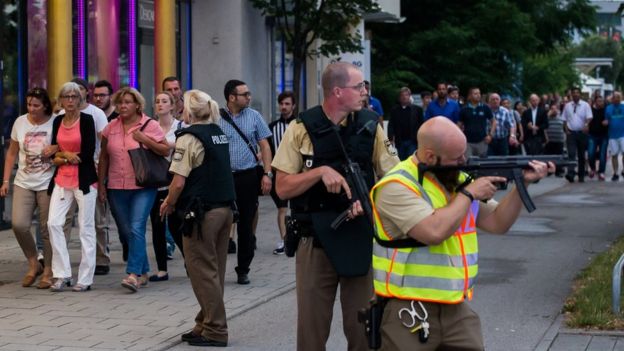
Police protest people evacuated from shopping centre in Munich. 22 July 2016
Armed police escorted people from the shopping centre after the shooting (Getty Images)
The events unfolded in predictable fashion: a young Iranian Muslim opened fire at a shopping mall in Munich while screaming “Allahu akbar,” and initial mainstream media reports were that the gunman was a “right-wing extremist,” lashing out on the fifth anniversary of the Norwegian madman Anders Breivik’s massacre, while screaming out his hatred for foreigners. 
As it happened, it was someone else screaming his hatred for foreigners at the jihad murderer, not the other way around, but once again, the lie had gotten halfway around the world before the truth had a chance to put on its shoes.
And the same old comedy, the familiar one that plays out every week now in modern, multicultural Europe and North America, duly played out again, to an increasingly bored and indifferent crowd. Munich police chief Hubertus Andraeinformed the world that the young jihadi had no known links to jihad terror groups, and added: “The motive or explanation for this crime is completely unclear.” 
Unclear? Really? What is it about “Allahu akbar” and the gunning-down of innocent civilians that you don’t understand, Herr Andrae? And the answer, of course, is: everything. Hubertus Andrae, and Angela Merkel, and Theresa May, and Manuel Valls, and John Kerry, and Barack Obama, and every last one of the other Western leaders are resolutely and determinedly ignorant about what it means when a young Iranian Muslim screaming “Allahu akbar” opens fire in a shopping mall.
What, after all, could it possibly mean? This young man must have come from a troubled home, no? He must have grown up in poverty and been denied access to all sorts of economic opportunities that were open to native Germans of his age, right? He must have been “radicalized on the Internet” by shadowy forces that somehow possess the magic power to turn benign, peaceful Muslims who are a benefit and asset to every Western nation into misunderstanders of their own religion who suddenly and inexplicably discard the peaceful Islamic teachings they have imbibed from youth in their Western mosques, in favor of a twisted and hijacked version of their religion that leads them to think that treason and mass murder are not only commendable, but blessed by the Almighty – isn’t that the case?
The Munich shooter’s motive is completely unclear, because we don’t yet know if he was teased in school or on the job, or if he had trouble getting a job in the first place, or if he had psychological problems, or if he was a brooding loner who always left his moderate Muslim friends disquieted – the only thing we do know is that he couldn’t possibly have been motivated by a religion that exhorts its adherents to “slay them wherever you find them” (cf. Qur’an 2:191, 4:89, 9:5).
No, none of that is true, and one wonders if even the European and North American political and media elites believe in their own nonsense anymore. The Munich mass murderer was motivated by Islam, pure and simple – by its teachings of warfare against unbelievers and the necessity to subjugate them. His war cry of “Allahu akbar,” revered by jihadis for its power to “strike terror in the hearts of the enemies of Allah” (Qur’an 8:60), demonstrates that. 
The Islamic State’s repeated calls for the mass murder of civilians in Western countries also demonstrate that. Hubertus Andrae, and Angela Merkel, and Theresa May, and Manuel Valls, and John Kerry, and Barack Obama, and every last one of the other Western leaders persist in pretending that incidents such as the mass murder in Munich on Friday, and the mass murders in Nice, Orlando, Brussels, Paris, San Bernardino, Chattanooga, and elsewhere recently are all separate, discrete criminal acts, unrelated to one another and all requiring extensive investigation to determine the motives of the perpetrators.
That proposition is not only false; it’s a Goebbelsian Big Lie. These are not criminal acts. These are not the acts of the psychopathic or the disenfranchised. These are acts of war, battles in a larger war that has been going on for 1,400 years and is picking up speed in our own age, courtesy of our willfully myopic and feckless leaders. Unless and until Western authorities begin to treat each of these incidents as part of a larger war, they will continue to misdiagnose the problem and apply the wrong solutions.
And that is the one thing they are certain to do. And so there will be many, many more Munichs. Watch this space next week for my comments on the next jihad massacre and the next flurry of predictable denials and obfuscations. My comments next week will be much like my comments here, because the actions of the elites after the next jihad attack will be much like what they have been today. What is it going to take to get leaders who are in touch with reality? Seriously, is that really too much to ask?

Novelist Daniel Silva celebrates the art world via superspy Gabriel Allon


http://www.dallasnews.com/


Best-selling author Daniel Silva signs copies of his new novel, The Black Widow, before his appearance at the Jewish Community Center in Dallas on Sunday, July 17. (Jewish Community Center/Jewish Community Center)


To say that Daniel Silva is a best-selling author is a bit like saying Henry Aaron was a decent home-run hitter. Before July 12, Silva had written 18 novels, all of which claimed their place on the New York Times best-seller list. He only recently released his 19thThe Black Widow, which brought him to Dallas last Sunday night.
I had the pleasure of interviewing Silva on stage during his sold-out appearance at the Jewish Community Center. During his remarks, I thought, "Wow, he'd be a terrific subject for Art Notes." Art plays a major role, even a critical role, in most Silva novels. 
The character at the heart of 16 Silva classics is superspy Gabriel Allon, who doubles as an art restorer. You could even say that Allon is an internationally renowned art restorer. The crowd at the JCC, which numbered more than 500 adoring fans, beseeched the author: Why did he make Gabriel Allon an art restorer? 
So he told them. Years ago, he was walking the streets of Georgetown with his wife, who reminded him that they were having dinner that night with David Bull, who just happens to be one of the world's most famous art restorers.
"That's it!" Silva said. "Gabriel will be an art restorer."
Silva sounded almost rhapsodic in telling a story about meeting Bull at the National Gallery of Art, where Bull was paintings conservator, and getting to see the work Bull was doing on a masterpiece by Claude Monet. Silva even got to touch the painting. His idea of making Allon an art restorer has both deepened his friendship with Bull and launched a rare collaboration between the two. Silva thanks Bull profusely in the acknowledgements to The Black Widow (and for that matter, several other books). I should note here that restoration is a 21st century endeavor at many major museums, including the Kimbell Art Museum in Fort Worth and the Dallas Museum of Art, where it became a high priority under previous director Maxwell Anderson, whom Silva also knows.
"What has been fascinating is that this has attracted a lot of attention," Bull told me in his British accent, in a telephone call.  
"Once, I was in San Diego, and suddenly, somebody says to me, 'You're Gabriel Allon!' This has happened frequently in various places." About 18 months ago, Bull met a lawyer who wanted him to look at a painting. During their discussion on restoration, the man "mentioned Gabriel Allon and said, 'Have you read those books?' This has happened oh so many times." 
But Bull wants you to know: He is not a spy. "I would be very bad at it. I don't think I could shoot straight. I would be no good at doing what he does." 
So, Silva deemed art restoration to be the perfect foil for the elusive Allon, who is a superspy but also, well, an assassin. As Silva's Facebook page points out, "In one part of his life, Gabriel has to destroy, in the other he is able to restore. Art restoration symbolizes Gabriel's way of trying to make damaged people and the damaged world whole again."
It helps that Silva loves, as in really, really loves, great works of art. It's a passion he can embrace by using Allon as his vehicle of indulgence.
A 2015 story in the Washington Post describes Bull as "Silva's secret weapon. In a way, he's helped the author become the John le Carré of art conservation. Bull's tools have touched Picassos, Monets and even a da Vinci. And while the conservator is nothing if not respectful of his writing friend -- he would never consider meddling with Silva's prose -- there was one proposed twist in The Heist he couldn't accept. Silva wanted Allon to roll up a real van Gogh at one point in the book."
Bull protested mightily. "Never, never, never," he said. "Because Gabriel loves the painting. He would not damage a painting."
In the past, Silva has spoken to hundreds of sold-out crowds, including one several years ago at the DMA, where he riffed on art like a lead guitarist turned loose on stage. Bull shared this about him with the Washington Post
"I might not hear from him in six months and then suddenly there's e-mails and telephone calls because he's hit a certain moment and he just wants to be sure," Bull said. "When it comes to dealing with paintings and the restoration of paintings, he wants everything to be absolutely accurate. Tell him you use a little thing like a stick, like a Q-Tip, then he says, 'What solvents do you use?' He's meticulous in his research."
And when it comes to his followers, Silva enjoys bipartisan adoration. Two of his biggest fans are former President Bill Clinton (he does a darned good imitation of the 42nd president, by the way) and Newt Gingrich, a Republican who served as speaker of the House of Representatives during Clinton's White House years. 
Clinton appeared on the Today show on NBC in 2011 and said his "favorite character in fiction" is -- who else? -- Gabriel Allon, art restorer and superspy. 
Gingrich tweeted this on July 18: 
This is a CBS interview with Silva, who talks about why he used the subject of art theft for the centerpiece of one of his novels: