Monday, February 29, 2016

Hillary vs. The Donald


Patrick J. Buchanan | 
Donald Trump and Hillary Clinton. (Getty Images)

In a Hillary Clinton vs. Donald Trump race — which, the Beltway keening aside, seems the probable outcome of the primaries — what are the odds the GOP can take the White House, Congress and the Supreme Court?
If Republicans can unite, not bad, not bad at all.
Undeniably, Democrats open with a strong hand.
There is that famed “blue wall,” those 18 states and D.C. with a combined 242 electoral votes, just 28 shy of victory, that have gone Democratic in every presidential election since 1988.
The wall contains all of New England save New Hampshire; the Acela corridor (New York, New Jersey, Pennsylvania, Delaware and Maryland); plus Michigan, Minnesota, Illinois and Wisconsin in the Middle West; and the Pacific coast of California, Oregon, Washington — and Hawaii.
Changing demography, too, favors the Democrats.
Barack Obama carried over 90 percent of the black vote twice and in 2012 carried over 70 percent of the Hispanic and Asian votes. These last two voting blocs are the fastest growing in the USA.
A third Democratic advantage is simple self-interest.
Half the nation now receives U.S. government benefits — in Social Security, Medicare, Medicaid, food stamps, welfare, student loans, rent subsidies, school lunches and Earned Income Tax Credits, etc.
Folks who rely on government benefits are unlikely to rally to a party that promises to cut government. And as half the nation pays no income tax, these folks are unlikely to be thrilled about tax cuts.
Bernie Sanders, who promises free college tuition and making Wall Street and the 1 percent pay for it, knows his party.
While these realities of national politics would seem to point to inexorable Democratic dominance in coming decades, there are worms in the apple.
First, there is the strangely shrunken and still shrinking Democratic leadership base. As the Daily Caller reports, under Obama, Democrats have lost a net of more than 900 state legislature seats, 12 governors, 69 U.S. House and 13 Senate seats. Such numbers suggest a sick party.
Republican strength on Capitol Hill is again as great as it was in the last years of the Roaring ’20s.
Second, due to Trump, viewership of the Republican debates has been astronomical — 24 million for one, 23 million for another.
The turnout at Trump rallies has been unlike anything seen in presidential primaries; and what’s more, the GOP voter turnout in Iowa, New Hampshire, South Carolina and Nevada set new records for the party.
Yet voter turnout for the Clinton-Sanders race has fallen, in every contest, below what it was in the Clinton-Obama race in 2008.
Bernie’s millennials aside, the energy and excitement has been on the Republican contest, often a sign of party ascendancy.
Not only would Trump at the top of the GOP ticket assure a huge turnout (pro and con); he is the quintessence of the anti-Washington, anti-establishment candidate in a year when Americans appear to want a wholesale house-cleaning in the capital.
As a builder and job creator, Trump would surely have greater cross-party appeal to working-class Democrats than any traditional Republican politician. Moreover, when Bernie Sanders goes down to defeat, how much enthusiasm will his supporters, who thrilled to the savaging of Wall Street, bring to the Clinton campaign?
This is the year of the outsider, and Hillary is the prom queen of Goldman Sachs. She represents continuity. Trump represents change.
Moreover, on the top Trump issues of immigration and trade, the elites have always been the furthest out of touch with the country.
In the 1990s, when Bill Clinton fought the NAFTA battle, the nation rebelled against the deal, but the establishment backed it. When Republicans on Capitol Hill voted for most-favored-nation status for China, year in and year out, did Republican grass roots demand this, or was it the U.S. Chamber of Commerce and Business Roundtable?
On immigration, where are the polls that show Middle Americans enthusiastic about increasing the numbers coming? Where is the majority demanding amnesty or open borders?
The elites of Europe are as out of touch as America’s.
Angela Merkel, Time’s Person of the Year in 2015, is at risk of being dumped in 2016 if she does not halt the next wave of Middle Eastern refugees who will be arriving on Europe’s shores when the seas calm in the spring in the Aegean and the Mediterranean.
If we believe the immigration issue Trump has seized upon is explosive here, look to Europe. In the Balkans and Central Europe, even in Austria, the barriers are going up and the border guards appearing.
Mass migration from the Third World to the First World is not only radicalizing America. It could destroy the European Union. Anger over any more migrants entering the country is among the reasons British patriots now want out of the EU.
America is crossing into a new era. Trump seems to have caught the wave, while Clinton seems to belong to yesterday.
A note of caution: This establishment is not going quietly.

Marlins' Mattingly Has Nice Ring To It


By Mike Lupica
February 26, 2016
DonMattinglyMarlins
After parting ways with the Dodgers, Don Mattingly will try to help the Marlins contend with the likes of the Mets and Nationals in the NL East. (Getty Images)
JUPITER, Fla. -- He stands on a back field at Roger Dean Stadium wearing his new colors, the colors of the Miami Marlins, and this Friday is just another morning in what has mostly -- but not always -- been a wonderful baseball life for Don Mattingly. The Marlins have him as their manager now because the Dodgers didn't deserve him any longer, or ever fully appreciate what they had. All they really know how to do out there is spend money on players overrated or past their prime. You hardly ever get a World Series trophy for that.
You watched Mattingly try to beat the Mets in the National League Division Series last October and were more convinced than ever that $300 million doesn't buy you nearly what it used to in this world. Well, unless Jeb Bush had stayed in the race.
But all you get out of Mattingly on this morning is all you really got out of him when it was announced that he was leaving the Dodgers after five years managing the team.
"It was time," he says. "I love what I'm doing here. I loved it there, too. But it was just the right time. I got a chance to cut my teeth. We made the playoffs three years in a row. We just couldn't move forward. But everything that happened there brought me here. And I think this place suits me better. I think there's going to be a little more teaching here, a little more development, because we're a little young."
Mattingly has been a gentleman of baseball, out of Evansville, Ind., and honored his game for more than 30 years. He was the great Yankee, one of the most popular of them all, who never got to play in a World Series; the one who showed up at the wrong time, in the 1980s and into the '90s, and didn't make it to the postseason until the October before he retired. Mattingly's back was supposed to be shot by '95, the bad back that kept him from making it to Cooperstown. There had been big noise all year from Yankees fans that Buck Showalter, managing the team then, should stop hitting him No. 3 in the batting order.
And then, in one of the best five-game series of all time, the one that ended with Junior Griffey running all the way from first to score the winning run in Game 5 of the American League Division Series, Mattingly had 10 hits and a home run and six RBIs and ended up hitting .417. He never played another game. He was 34.
But you need to remember this about Mattingly, because too many people have forgotten: At his best, his fellow players once voted him the best player in the game in a New York Times poll. There are a lot of Hall of Famers who were never that.
Mattingly talks a little bit about the Hall of Fame on this beautiful day in Jupiter, no clouds anywhere in a Florida sky.
"You always think about it as you get older," he says. "But you know what? Even if things had worked out different for me, and I had made it to the Hall, I would still have gone back over my career and thought about all the things I could have done better."
He pauses now, mitt under his arm, his new players already on the field in the distance and says, "If I do have one regret, it's that they just didn't know as much about bad backs then as I do now."
We in New York had always believed that there was a cold night in Milwaukee that changed everything for Mattingly, and began all the trouble with his back that finally lent a Koufax quality to his career. But Mattingly just smiles at that notion and shakes his head, saying that he started having problems with his back when he was in high school.
"You'd feel something after a football game, and you'd go see the chiropractor a couple of times," he says, "and he'd pop it back in."
Then all across what was such a splendid career when he was young, Mattingly had no idea that all the insane extra work he was doing was not only beginning a long, slow deteriorating of his back, but also taking years off his career.
"If you'd feel a little stiffness back in those days, you'd basically hear that you need to put your knees to your chest, do some stretching and rest," Mattingly says. "If there'd been the kind of science and information then that there is now, I would have known that maybe 100 swings was more productive than 200."
He pauses and says, "I spoke to [the Mets'] David Wright [who's had ongoing trouble with spinal stenosis] about this last year and told him to make sure to get a program that made sense for him and made him comfortable."
So Mattingly's career ended too soon. He finally ended up sitting next to Joe Torre. The Yankees hired Joe Girardi instead of Mattingly when Torre left Yankee Stadium. Torre and Mattingly ended up with the Dodgers. Mattingly was able to succeed Torre there.
But Torre never had the best team there the way he did in New York. Mattingly never had the best team, unless you subscribed to the boneheaded notion that the biggest payroll still means the best team. Even with Andrew Friedman brought in from the Rays to run baseball operations, the Dodgers remain as overpriced as some of their own baseball players.
The Marlins have had their own problems lately, you can look that up. But Mattingly is right: He's still better off where he is. Maybe here, a long way from Dodger Stadium and Yankee Stadium, the guy who will always be known as Donnie Baseball will end up in the World Series, at last.
***
Mike Lupica is a columnist for Sports on Earth and the New York Daily News. Read his full bio here. Follow him on Twitter @MikeLupica.

Sunday, February 28, 2016

Engagement with Cuba has Failed—Time for Something New


Humberto Fontova Feb 26, 2016

http://townhall.com/


US President Barack Obama (right) and Cuban President Raul Castro shake hands at the start of their meeting at the United Nations General Assembly in New York on September 29, 2015.PHOTO:  EPA/BEHAR ANTHONY / POOL

I trust that anyone that even glances at the fruits of Obama’s 16 month engagement with the Castro-Family- Crime-Syndicate (euphemized as “Cuba” by the media and the Obama administration) marvels.
Because never in the course of U.S. diplomacy has so much been surrendered by so many to so few for so little.
Not a penny of the $7 billion Castro stole at gunpoint from Americans (while torturing and murdering a few Americans who resisted) has been compensated—or even acknowledged. Some of the FBI’s most wanted terrorists still live like celebrities in Cuba. All this after Castro promptly got his murdering (of Americans) terrorists back as bonus to an economic lifeline from Obama—in the nick of time and much of it at the expense of the U.S. taxpayer.
Oh, and by the way: repression in Cuba-- involving everything from thousands, upon thousands of arbitrary arrests by KGB-trained secret police to machete attacks by regime-paid mobs against peaceful women dissidents—has cranked up to a recent record, which is really saying something.
In fact, since Obama began his “opening” to Cuba (which actually commenced the minute he took office in 2009) 6 peaceful Cuban dissident have “mysteriously died” (i.e. been murdered by the KGB-founded and mentored regime.) As usual, the world took no notice of these blatant murders.
This is the same “world,” by the way, that wailed in horror and indignation every time Nelson Mandela complained of a lumpy mattress in his country club prison cell in Apartheid South Africa. Sounds “insensitive,” I know. So have a look at his cell. By Cuban standards Nelson Mandela’s cell looked like a suite at Motel 6. Naturally President Obama is prominent among those who honor Mandela and demonize his jailers.
Never mind that on Obama’s visit to Cuba next month he’ll be honoring and (helping fund) the Stalinist/Apartheid regime that jailed and tortured the most and longest-suffering political prisoners in the modern history of the Western hemisphere—many more than Apartheid South Africa, in fact.
The media mantra that Obama is courageously and innovatively “trying something new” with Cuba is beyond idiotic—for people actually familiar with U.S. history that is. And given the clown show that passes for the current presidential campaign we know such people aren’t overly abundant nowadays, in either party.
In fact, U.S. engagement with the Castro brothers began before they were even in office. "Me and my staff were all Fidelistas." (Robert Reynolds, the CIA's "Caribbean Desk's specialist on the Cuban Revolution" from 1957-1960.)
"Everyone in the CIA and everyone at State was pro-Castro, except [Republican] ambassador Earl Smith." (CIA operative in Santiago Cuba, Robert Weicha.)
Their advice was taken, and January 7, 1959, thus marks a milestone in U.S. diplomatic history. Never before had the State Department extended diplomatic recognition to a Latin American government as quickly as they bestowed this benediction on Fidel Castro's that day.
Nothing so frantically fast had been bestowed upon"U.S.-backed" Fulgencio Batista seven years earlier. Batista had in fact been punished by a U.S. arms embargo and heavy diplomatic pressure to resign for a year. Batista was subsequently denied exile in the U.S. and not even allowed to set foot in the country that “backed" him.
In fact, during Castro's first sixteen months in power, the U.S. State Dept. made over ten back-channel diplomatic attempts to ascertain the cause of Castro's tantrums and further "engage" him. Argentine President Arturo Frondizi was the conduit for many of these and recounts their utter futility in his memoirs.
Result: In July 1960, Castro's KGB-trained security forces stormed into 5,911 U.S.-owned businesses in Cuba and stole them all at Soviet gunpoint -- $2 billion was heisted from outraged U.S. businessmen and stockholders. Not that all Americans surrendered their legal and hard-earned property peacefully. Among some who resisted where Bobby Fuller, whose family farm would contribute to a Soviet-style Kolkhoze, and Howard Anderson, whose profitable Jeep dealership was coveted by Castro's henchmen. Both U.S. citizens were murdered by Castro and Che's firing squads, after torture.
In July 1961, JFK's special counsel Richard Goodwin met with Che Guevara in Uruguay and reported back to Kennedy: "Che says that Cuba wants an understanding with the U.S.; the Cubans have no intention of making an alliance with the Soviets. So we should make it clear to Castro that we want to help Cuba." (How Che managed a straight face during this conversation requires an article of its own.)
Result: Soviet Nuclear missiles, locked and loaded, in Cuba a year later -- and pointed at Goodwin's and Kennedy's very homes.
In 1975, President Gerald Ford (under Kissinger's influence) allowed foreign branches and subsidiaries of U.S. companies to trade freely with Cuba and persuaded the Organization of American States to lift its sanctions.
Result: Castro started his African invasion and tried to assassinate Ford. You read right. On March 19, the Los Angeles Times ran the headline "Cuban Link to Death Plot Probed." Both Republican candidates of the day, President Ford and Ronald Reagan, were to be taken out during the Republican National Convention. The Emiliano Zapata Unit, a Bay Area radical group linked to the Weather Underground, would make the hits.
Jimmy Carter, in a good-will gesture, lifted U.S. travel sanctions against Cuba and was poised to open full diplomatic relations with Castro.
Result: More thousands of Cuban troops spreading Soviet terror (and poison gas) in Africa, more internal repression, and hundreds of psychopaths, killers, and perverts infiltrated the boats and shoved their way on the Mariel Boatlift.
Ronald Reagan sent Alexander Haig to meet personally in Mexico City with Cuba's "Vice President" Carlos Raphael Rodriguez to feel him out. Then he sent diplomatic whiz Gen. Vernon Walters to Havana for a meeting with the Maximum Leader himself.
Result: Cubans practically take over Grenada, El Salvador, and Nicaragua. (But unlike the aforementioned Democrats, Reagan responded to Castro's response -- and with pretty dramatic results.)
President Clinton tried playing nice again in the '90s, removing travel restrictions, etc.
Result: Three U.S. citizens and one resident who flew humanitarian flights over Florida straits (Brothers to the Rescue) murdered in cold blood by Castro’s MIGS. Castro agent Ana Belen Montes moles her way to head of the Defense Intelligence Agency's Cuba division, resulting in the deepest and most damaging penetration of the U.S. Defense Department by an enemy agent in modern history.
Now Obama is outdoing all of the above. Instead, it’s high time to embargo Castro’s Cuba, both economically and diplomatically. Who knows? Just might work?

Stephen Curry's arc of glory raised higher still for soaring Warriors


Ethan Sherwood StraussESPN Staff WriterFebruary 28, 2016http://espn.go.com/nba/

Photo by Layne Murdoch | NBAE via Getty Images
OKLAHOMA CITY -- Golden State Warriors coach Steve Kerr occasionally gets asked to compare his current superstar to his former teammate and basketball demigod Michael Jordan. He draws a distinction, but it's more related to personality than efficacy.
In Miami on Wednesday, Kerr said, "These guys are really competitive, more so than you'd think. I mean, you knew it with Jordan, because he played with an anger. Steph plays with joy, so maybe you don't see it as much. Steph inside is a killer. Really he is."
Michael played with anger. Steph plays with joy. The modality makes no difference to opponents who get killed just the same. On Saturday night though, in a thrilling 121-118 Warriors overtime win over the Oklahoma City Thunder, Golden State needed more of the joy and less of the anger.
The Warriors were down 57-46 at halftime when tensions boiled over. On the television broadcast, ESPN's Lisa Salters said the following:
"One of the players, believed to be Draymond Green, was shouting so loudly and using such profanity in the locker room that it could be heard well outside the locker room. At one point, the player said, 'I'm not a robot. You messed me up right now. If you don't want me to shoot, tell me, and I won't ever shoot again.' As his teammates tried to calm him down, he could be heard saying, 'Come over and sit me down.' OKC police heard it and came to stand outside the locker room, just in case they were needed."
It went from bad to worse when Russell Westbrook landed on Curry's ankle with 10:35 left in the third quarter. Curry limped his way through the tunnel to the locker room, dragging Golden State's hopes with him. This was a game the Warriors were going to lose. Even for a team that has done unprecedented winning, defeat seemed inevitable.
Then, Curry returned and continued unleashing his own brand of inevitability. He simply couldn't be guarded, though many tried. His first seven 3-pointers were defended by, in order: Kevin Durant, Westbrook, Serge IbakaSteven AdamsEnes KanterDion Waiters and Kyle Singler. His long 3 over Adams was right in the big man's mustachioed face. Curry was stopped, 28-feet from the hoop, with Adams standing and staring. Curry arced the ball at an angle inches above the center's outstretched hand. Curry's follow through landed between Adams' fingers before the ball found net.
In the end, Curry hit 12 3-pointers, many of the confounding variety, but none more so than the last. With the game tied and roughly eight seconds remaining in overtime, Westbrook missed a go-ahead bank shot. The ball caromed to Andre Iguodala, who funneled it to Curry. From there, Curry casually, at a jog, dribbled the ball to a spot beyond the hashmark, deeper than 30 feet. At this moment, members of the Thunder bench were wildly gesticulating at Andre Roberson, beseeching him to sprint at Curry. It was too late, and, as the game winner started falling from the sky, frustrated Oklahoma City big man Enes Kanter threw his hands in the air. He didn't need to see it go in. The result was inevitable.
After the splash, a joyous Curry danced as teammates went into a chest-bumping frenzy. There was still a fraction of a second to be played, but most of that timeout was consumed by revelry.
It took some surprising, if not lucky, plays for Golden State to reach that moment of inevitable victory. Golden State was down 11 with 4:51 to go in regulation, before subbing in their Death Lineup (Curry, Klay Thompson, Green, Iguodala, Harrison Barnes). The Warriors roared back, cutting the lead to one before Durant appeared to end the game on a 3-pointer with 14.5 seconds left.
From there, a minor miracle was needed. Thompson, who had hit his first 3 of the game on the previous possession, turned the corner for a fast layup. A quick two might have been an odd choice for a team so skilled beyond the arc, but there was a method to this madness. Defensive-minded Golden State assistant coach Ron Adams likes to spring a surprise trap in these situations, and trap the Warriors did.
Durant's long pass was batted out of the air by Thompson, then saved back to Thompson by Green. Iguodala received the ball, pump-faked Durant into the air and drew the foul with less than a second remaining. The Warriors still needed Iguodala -- a poor free throw shooter -- to make both of his tries. After Iguodala made his second, he shrugged at his jubilant teammates as though overtime was never in doubt.
In overtime, the Warriors fell down by five quickly and had to make up ground. Durant fouled out in the extra period, and Oklahoma City nearly were tugged to victory on Westbrook's shoulders. An and-1 by Thompson set up Curry's final masterpiece on the last Golden State possession, a play Curry described with the languid manner of someone explaining their morning workout routine:
"When I got the ball, I knew coach said if we got a stop and a clean rebound, push it. I looked up when I got the ball, there's about five or six seconds left, and the way they were shuffling around in transition, I was able to kind of just go at my own pace and rise up. And I got my feet set and watched it go in."
After the game, you never would have taken this locker room for a scene that drew an exterior police presence at halftime. Laughter was abundant as players soaked up their coup. The preceding tensions seemed to be an afterthought and taboo subject all at once.
When asked about what happened, Kerr said, "Things get emotional occasionally, and we were all angry about the way we played in the first half and things happen, and there's nothing to it and that's it."
When asked if this was unusual for Green, Kerr said, "Very unusual. Very unusual. But that's all I'm going to say about it, because that's our private business. But, since everybody heard the yelling, you guys can write whatever you want, but I'm not going to comment anymore on that."
While the specifics of that particular locker room blowup aren't yet clear, this much is: Since Kerr's return to the sideline, Green is shooting less often from range. Before Kerr came back, Green was attempting 3.6 3-point attempts, making 41.1 percent. After Kerr's return, Green is averaging 1.6 3-point attempts, making 29.2 percent.
In Atlanta on Monday, ESPN.com queried Kerr about Green's sudden drop in 3-point attempts. The coach said, "He was 0-for-4 tonight, so, that's a lot, isn't it? You know, with Draymond, he's a rhythm shooter. I always tell him, it's not the first one to take. It's the one on the back end of the possession when we've moved the defense around and they're scrambling, and then we might get an offensive rebound or he's more likely to be in rhythm. But the only ones I don't like are the early ones, because early in the possession, why not make them guard Steph and Klay and Andre [Iguodala] cutting and make the defense work a little bit more?"
Green has often been more eager to launch than Kerr would prefer. Whether that's a serious issue remains to be seen, as the Warriors keep winning nearly every game. Issues involving Draymond can also be complicated by how indivisible his ferocity is from his greatness.
As Kerr said after Saturday's contest, "You guys know Draymond, come on. A part of what makes him special is his emotion and his passion. So nothing major happened. Obviously we came out and played great in the second half."
Curry's spellbinding play did much to obscure whatever acrimony flowed freely. On this six-game road trip, he hasn't allowed the Warriors to suffer for their human flaws. Over these six games, he averaged 38.2 points, 7.2 assists and 7.2 made 3s. On nights when the Warriors appeared ragged and sloppy, he has delivered those deus ex machina moments. On this evening, against a hungry, talented opponent, Curry's joyous success washed away the anger.

EDITOR'S PICKS

Saturday, February 27, 2016

Buckley Deserves a Statue


WFB was a frequent visitor to Hillsdale, which does so much to preserve our patrimony.


By Thomas Novelly — February 27, 2016
http://www.nationalreview.com/


In 2004, William F. Buckley Jr. sent Hillsdale College thousands of the columns, speeches, and articles he had written over the years. The founder of National Review donated much of his life’s work to the college for an online database. Today, anyone can access his writings free of charge.

An injury prevented him from attending the unveiling ceremony, but he recorded his remarks for the gala dinner. “Thanks to Hillsdale College, it is all here, a lifetime’s work,” Buckley said. “Necessarily, you will find infelicities here, and maybe a deviation or two, but it is all an earnest attempt to contribute to the patrimony, preserved here thanks to Hillsdale.”

Now it’s time to preserve Buckley’s legacy in something more prominent than pixels. Hillsdale College — where am a student — should commission a statue in his honor.

We’re known at Hillsdale for our campus statues, on what the college calls the Liberty Walk. We have statues of George Washington and Thomas Jefferson. We have a statue of a Civil War soldier representing Hillsdale College students who fought in that conflict, and another of Abraham Lincoln. In May, when the class of 2016 graduates, we’ll put up a statue of Frederick Douglass.

We also have a statue of Ronald Reagan, the only statue of Margaret Thatcher in the Western Hemisphere, and a statue of Winston Churchill, holding a cigar in his right hand.

Buckley would be a fitting addition to this group, to commemorate his devotion to America, his dedication to young people, and his love for Hillsdale College.

Buckley understood the importance of higher education. In his first book, God and Man at Yale, he criticized his alma mater for neglecting its mission. “I believe that the duel between Christianity and atheism is the most important in the world,” he wrote. “I further believe that the struggle between individualism and collectivism is the same struggle reproduced on another level.”

That book launched his career, but he didn’t have to pick that fight or any of the others he would take on as he founded National Review, fought for the nomination of Barry Goldwater, ran for mayor of New York City, started Firing Line, and promoted Ronald Reagan. “Buckley could have been the playboy of the Western world,” historian Lee Edwards said in the new documentary The Best of Enemies, “but chose instead to be the Saint Paul of the conservative movement.”

President Reagan, the guest of honor at the magazine’s 30th anniversary party in 1985, told Buckley and his NR colleagues, “You gave the world something different, something in its weariness it desperately needed, the sound of laughter and the sight of the rich, green uplands of freedom.”

Novelly with the Ronald Reagan statue at Hillsdale College
A statue of Buckley would also salute his impact on young people. In 1960, Buckley invited a group of young activists to his family home in Sharon, Conn., to write down a set of principles. The Sharon Statement, as it was called, begins with words that can still inspire: “We, as young conservatives, believe that foremost among the transcendent values is the individual’s use of his God-given free will, whence derives his right to be free from the restrictions of arbitrary force.”

The Sharon Statement became the founding document of the Young Americans for Freedom. Today, it’s required reading at Hillsdale College. It’s in American Heritage: A Reader, a special compilation of primary documents assembled by our faculty and published for a core course on American history. This big anthology starts with the Mayflower Compact and ends with Reagan’s first inaugural address in 1981 and his speech to the British Parliament in 1982. In between, students encounter the Sharon Statement.

Buckley visited Hillsdale College many times. “Hillsdale is one of the truly exciting liberal-arts colleges in America,” Buckley said in a speech at the college in 1980. “It’s vibrant with a genuine enthusiasm for learning.” In 1996, the college gave him its Adam Smith Award for his dedication to conservative principles and his embodiment of Hillsdale’s values.

When Hillsdale sought a new president in 1999, Buckley formed a special committee to find the perfect fit. The next year, Buckley’s committee selected the college’s current president, Dr. Larry Arnn, one of the founders of the Claremont Institute. “Buckley was a friend of mine for at least two decades,” Arnn said. “He spoke at my inauguration.”

Hillsdale’s statues pay homage to great individuals and great visions. The addition of a statue of Buckley would honor his service to both modern conservatism and a school whose mission he personally embodied and publicly promoted.

When Buckley died, eight years ago today, President George W. Bush honored him. “Bill Buckley was one of the great founders of the modern conservative movement,” said Bush. “He brought conservative thought into the political mainstream, and helped lay the intellectual foundation for the conservative movement that continues to this day.”

The mission statement of National Review, which Buckley wrote, is well known: National Review, it proclaims, “stands athwart history yelling Stop.” A statue of Buckley on the grounds of a college he loved would send a message to the world — that Buckley’s ideas remain very much alive, forever standing athwart history.

— Thomas Novelly is a junior at Hillsdale College, where he serves as assistant city news editor of The Collegian, the campus newspaper. 

Friday, February 26, 2016

Islamist Turkey is Imploding


http://www.americanthinker.com/
February 24, 2016

Turkish President Tayyip Erdogan talks at a business forum during a visit in Lima, Peru, February 3, 2016. REUTERS/Janine Costa


In the past two weeks a number of events have taken place in Turkey that, taken together, indicate that this erstwhile U.S. ally is spinning dangerously out of control with neither Ankara nor Washington and its European allies having the slightest clue of what to do. It started several days ago with the Turkish artillery targeting the Kurdish YPG military units n Syria, a key U.S. ally against ISIS, as they made progress in taking over formerly terrorist-occupied terrain north of Aleppo. This was followed by Turkey enabling thousands of jihadists entering Turkish territory from Syria with all of their weapons and exiting back into Syria from a different border crossing to join the battle against the anti-Assad forces. As if to show on whose side Ankara really is, a local news agency provided pictures of trucks loaded with Turkish ammunition delivered to these very people. It may be recalled that for publishing similar pictures of supplies to Syrian jihadists by the Turkish Intelligence Organization (MIT), in January 2014, two prominent journalists were accused of “treason and espionage” and are facing the prospect of life in prison. In yet another proof of Turkish collusion with ISIS terrorists, wiretaps of phone conversations between Turkish military and ISIS commanders have just been made public that show close cooperation.

The problem that Turkey and its Islamist leadership are now facing is something that has been known for a long time, but is no longer credibly deniable. Under Erdogan, Turkey has never been interested in fighting ISIS, Al-Nusra, and other Sunni terrorists. On the contrary, it has assisted them in every way possible for at least the last three years. Washington under Obama preferred to look the other way, but the latest events have faced it with a stark choice -- either defeat ISIS and limit growing Russian influence in alliance with the Syrian Kurds, or continue to put up with Erdogan’s duplicitous Islamist agenda and lose the last shreds of credibility it has left in the region. With the leader of the Turkish parliamentary opposition, Kemal Kilicdaroglu, now openly calling for the leaders of the AKP to be tried for “aiding and abetting terrorist organizations,” it is high time for Washington to reconsider its failing policies.

There is yet another compelling reason to stand up to what more closely resembles an Islamist dictatorship in Turkey. After suffering a major electoral defeat with the rise of the Kurdish HDP party in parliamentary elections last June, Erdogan opted for new elections that many experts both in and outside of Turkey believe were rigged, along with massive repression of the Kurds. In a number of Kurdish cities in southeastern Turkey, military suppression of the youth wing of the PKK and de facto martial law imposed have been so heavy-handed that civil war is a more accurate description of what’s happening. In the town of Cisre, for instance, after two months of curfew and heavy fighting, the Turkish General Staff announced on Feb. 12 that it had successfully rid the town of terrorists, though it did not lift the curfew. It gave the following figures for terrorists killed and weapons confiscated: 600 terrorists killed, 2 machine guns, 27 AK-47s and 2 RPGs plus ammunition. This, of course, means that all but 31 of the ‘terrorists’ killed were unarmed. No wonder that Selahattin Demirtash, co-chairman of the HDP, has accused the government of ‘mass murder.’ His charges were seconded by the European Parliament’s rapporteur for Turkey, Kati Piri, who on Feb. 22 from Diyarbakir described the operations of the Turkish Security Forces as ‘civil war’ and accused the military of “ opening fire on civilians.”

It is, of course, true that the PKK was a terrorist organization, but times and circumstances have changed and for the AKP to risk a full-fledged civil war with the Kurds now is suicidal. First, the peace process with the PKK, which had progressed well until Erdogan unilaterally cancelled it last June, demonstrated that the Kurds would be satisfied with autonomy within Turkey. Secondly, the previous war with the PKK in the 1980s and 1990s, which claimed 40,000 victims, was fought primarily in rural areas which could be controlled by depopulation. Today, the Kurds make a large percentage of the population in all large towns outside the southeast where it dominates. The HDP also enjoys considerable support among non-Kurds, who appreciate its secular stands against the oppressive and intolerant Islamist dogmatism of the AKP. Finally, the Kurds now have 2 million co-ethnics on the other side of the 565-mile-long Syrian border, who are well-armed and already enjoy wide-ranging autonomy. If Erdogan continues to insist on brutally suppressing the Kurds, Turkey will descend into chaos. As Abdullah Gá½’l, former president of Turkey and founding member of AKP, put it succinctly, “Turkey is going through one of the most difficult days in its history.”

Finally, there is a third and hugely important reason for the United States and its allies to confront Turkey’s Islamist government. Since AKP’s coming to power, virtually unnoticed in the West, Turkey has become a major exporter of radical Sunni extremism in the West. Erdogan’s main instrument for Islamization in Turkey and abroad, the Turkish Directorate of Religious Affairs, better known as Diyanet, has had its budget increased sevenfold since 2003 and now has an army of 150,000 religious functionaries doing its bidding. It is active in promoting radical Islam in virtually every European state and dominates the Islamic establishment in countries like Germany, Austria, Belgium, and in the Balkans. In many of these countries it works in close cooperation with radical Islamist organizations like the Muslim Brotherhood, Hamas, and Milli Gὄrá½’s. It has also begun a program of funding and building mega-mosques worth hundreds of millions of dollars, often in places where there are but few Muslims like Bucharest, Budapest, and Lanham, Maryland.

Unfortunately, it is unlikely that President Obama will do much along these lines for the rest of his term, because he was the one who in 2009 advertised Erdogan’s regime as a model of democratic Islam worth following. Nor are we likely to hear much from the presumptive democratic presidential nominee, Hillary Clinton, who did the same as U.S. Secretary of State. But it is more than curious than we have not heard a single Republican presidential contender mention Turkey’s nefarious role in the disastrous Middle Eastern conflict. Especially because it is certain that one of the first questions the next president of the United States will have to deal will be “Who lost Turkey?”

Alex Alexiev is chairman of the Center for Balkan and Black Sea Studies (cbbss.org). He tweets on national security at twitter.com/alexieff and could be reached at alexievalex4@gmail.com.


Read more: http://www.americanthinker.com/articles/2016/02/islamist_turkey_is_imploding.html#ixzz41H1u6YtA
Follow us: @AmericanThinker on Twitter | AmericanThinker on Facebook

While Obama fiddles ...


February 25, 2016
President Obama Delivers Statement On Plan To Close GITMO Detention Facility
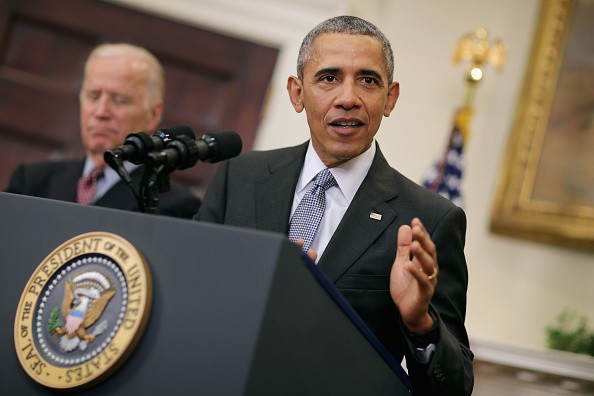
President Barack Obama makes a statement about his plan to close the detention camp at the Guantanamo Bay Naval Base and relocate the terrorism suspects there to the United States with Vice President Joe Biden (L) in the Roosevelt Room at the White House February 23, 2016 in Washington, DC. (Photo : Chip Somodevilla/Getty Images)
State of the world, Year Eight of Barack Obama:
1. In the South China Sea, on a speck of land of disputed sovereignty far from its borders, China has just installed antiaircraft batteries and stationed fighter jets. This after China landed planes on an artificial island it created on another disputed island chain (the Spratlys, claimed by the Philippines, Malaysia, Taiwan and Vietnam). These facilities now function as forward bases for Beijing to challenge seven decades of American naval dominance of the Pacific Rim.
“China is clearly militarizing the South China Sea,” the commander of the U.S. Pacific Command told Congress on Tuesday. Its goal? “Hegemony in East Asia.”
2. Syria. Russian intervention has turned the tide of war. Having rescued the Bashar al-Assad regime from collapse, relentless Russian bombing is destroying the rebel stronghold of Aleppo, Syria’s largest city, creating a massive new wave of refugees and demonstrating to the entire Middle East what a Great Power can achieve when it acts seriously.
The U.S. response? Repeated pathetic attempts by Secretary of State John Kerry to propitiate Russia (and its ally, Iran) in one collapsed peace conference after another. On Sunday, he stepped out to announce yet another“provisional agreement in principle” on “a cessation of hostilities” that the CIA director, the defense secretary and the chairman of the Joint Chiefs of Staff deem little more than a ruse.
3. Ukraine. Having swallowed Crimea so thoroughly that no one even talks about it anymore, Russia continues to trample with impunity on the Minsk cease-fire agreements. Vladimir Putin is now again stirring the pot,intensifying the fighting, advancing his remorseless campaign to fracture and subordinate the Ukrainian state. Meanwhile, Obama still refuses to send the Ukrainians even defensive weapons.
4. Iran. Last Thursday, Iran received its first shipment of S-300 antiaircraft batteries from Russia, a major advance in developing immunity to any attack on its nuclear facilities. And it is negotiating an $8 billion arms deal with Russia that includes sophisticated combat aircraft. Like its ballistic missile tests, this conventional weapons shopping spree is a blatant violation of U.N. Security Council prohibitions. It was also a predictable — and predicted — consequence of the Iran nuclear deal that granted Iran $100 billion and normalized its relations with the world.
The U.S. response? Words.
Unlike gravitational waves, today’s strategic situation is not hard to discern. Three major have-not powers are seeking to overturn the post-Cold War status quo: Russia in Eastern Europe, China in East Asia, Iran in the Middle East. All are on the march.
To say nothing of the Islamic State, now extending its reach from Afghanistan to West Africa. The international order built over decades by the United States is crumbling.
In the face of which, what does Obama do? Go to Cuba.
Yes, Cuba. A supreme strategic irrelevance so dear to Obama’s anti-anti-communist heart.
Is he at least going to celebrate progress in human rights and democracy — which Obama established last year as a precondition for any presidential visit? Of course not. When has Obama ever held to a red line? Indeed, since Obama began his “historic” normalization with Cuba, the repression has gotten worse. Last month, the regime arrested 1,414 political dissidents, the second-most ever recorded.
No matter. Amid global disarray and American decline, Obama sticks to his cherished concerns: Cuba, Guantanamo (about which he gave a rare televised address this week) and, of course, climate change.
Obama could not bestir himself to go to Paris in response to the various jihadi atrocities — sending Kerry instead “to share a big hug with Paris” (as Kerry explained) with James Taylor singing “You’ve Got a Friend” — but he did make an ostentatious three-day visit there for climate change.
So why not go to Havana? Sure, the barbarians are at the gates and pushing hard knowing they will enjoy but 11 more months of minimal American resistance. But our passive president genuinely believes that such advances don’t really matter — that these disruptors are so on the wrong side of history, that their reaches for territory, power, victory are so 20th century.
Of course, it mattered greatly to the quarter-million slaughtered in Syria and the millions more exiled. It feels all quite real to a dissolving Europe, an expanding China, a rising Iran, a metastasizing jihadism.
Not to the visionary Obama, however. He sees far beyond such ephemera. He knows what really matters: climate change, Gitmo and Cuba.
With time running out, he wants these to be his legacy. Indeed, they will be.