Monday, August 17, 2015

COULD THE JIG FINALLY BE UP FOR HUMA ABEDIN?

She should have been removed from all positions of power and influence years ago.


August 17, 2015

Huma Abedin and Hillary Clinton
They got Al Capone for tax evasion, and they may get Huma Abedin for “violating rules regarding vacation and sick leave” and for the “possible exchange of unsecured, classified data.” To be sure, these are serious charges, and the available evidence makes it abundantly clear that there is ample warrant to investigate and perhaps even charge Abedin. However, it is a sign of a serious problem with today’s political culture that even more serious allegations regarding Abedin have never been investigated, and almost certainly never will be.
Huma Abedin’s Muslim Brotherhood connections have been fully exposed by Andrew McCarthy and bruited about for years. The facts are quite public, albeit largely ignored: Abedin’s parents are both members of the Muslim Brotherhood, but her links to the organization are not just familial. Abedin was for twelve years the assistant editor of the Journal of Muslim Minority Affairs (JMMA), which was founded by Abdullah Omar Naseef, a Muslim Brotherhood operative and al-Qaeda financier. Naseef and Abedin both appeared on the JMMA’s masthead from 1996 to 2003.
Consider that Abedin worked closely for seven years with a member of the Muslim Brotherhood who financed al-Qaeda in light of the Obama Administration’s foreign policy during the years that Hillary Clinton was the Secretary of State. Everyone acknowledges that Abedin and Clinton are extremely close, and that Abedin controls access to Clinton and has tremendous influence over her. Hillary Clinton’s tenure at the State Department was distinguished by the remarkable sight of Egyptian anti-Muslim Brotherhood protestors holding signs denouncing the President of the United States for supporting terrorism, and by the Benghazi debacle, when the Secretary of State sat back and did nothing as jihad terrorists murdered four Americans, including an ambassador.
Then there was the Benghazi cover-up, during which Clinton vowed to have a man who made a video criticizing Muhammad arrested and imprisoned for supposedly provoking the riots, thereby placing herself firmly in opposition to the freedom of speech and aligning herself with the Organization of Islamic Cooperation’s efforts to compel Western governments to criminalize criticism of Islam (under the guise of “incitement to religious hatred”).
Is it at all possible that Huma Abedin, whose parents were active in the Brotherhood and who worked for twelve years for a journal closely linked to the Brotherhood, had anything to do with the pro-Muslim Brotherhood orientation of the Obama/Clinton State Department? In today’s poisonous political culture, it isn’t possible even to ask the question without incurring charges of “Islamophobia” – as we saw in 2012, when Representative Michele Bachmann (R-MN) had the temerity to call for an investigation of possible Muslim Brotherhood infiltration of the U.S. government.
Bachmann explained: “The concerns about the foreign influence of immediate family members is such a concern to the U.S. Government that it includes these factors as potentially disqualifying conditions for obtaining a security clearance, which undoubtedly Ms. Abedin has had to obtain to function in her position. For us to raise issues about a highly-based U.S. Government official with known immediate family connections to foreign extremist organizations is not a question of singling out Ms. Abedin.  In fact, these questions are raised by the U.S. Government of anyone seeking a security clearance.” And that was to say nothing about Abedin’s association with Naseef and work with the JMMA.
Now that Abedin is suspected of mishandling classified material, Bachmann’s questions about Abedin’s security clearance are piquant in retrospect. But when she first raised them, Bachmann was ridiculed and vilified, even earning a denunciation from John McCain: “These sinister accusations rest solely on a few unspecified and unsubstantiated associations of members of Huma’s family, none of which have been shown to harm or threaten the United States in any way. These attacks on Huma have no logic, no basis, and no merit. And they need to stop now.”
It was actually about more than just Abedin’s family, and a perfectly sound case could be made, in light of Obama’s foreign policy disasters, that Abedin’s Muslim Brotherhood links possibly did harm and threaten the United States. But Bachmann’s name was dragged through the mud in 2012 for talking about all this, and now none of the new allegations against Abedin raise any issue with her possible Muslim Brotherhood connections.
That few people care about those connections, and that those who do are dismissed as “far-Right bigots,” shows how myopic and foolish our contemporary political culture is. If Huma Abedin had a hand in the pro-Muslim Brotherhood tilt of the Obama/Clinton State Department, that would be a far graver offense than anything she is accused of now, just as old Capone was guilty of far greater crimes than tax evasion. But on the other hand, those tax evasion charges ended Capone’s operations for good, and so if Hillary’s infamous email server does the same to Huma Abedin, no one who values America’s historic role as leader of the free world will have any reason to complain.
 

Sunday, August 16, 2015

Planned Parenthood and the Eugenics Movement


By Joseph Loconte — August 15, 2015


Francis Galton (1822-1911) was an English scientist and cousin of Charles Darwin who coined the term "eugenics".

There is a haunting familiarity to the arguments defending Planned Parenthood’s sale of body parts from aborted babies for medical research: an echo of another era of medical innovation amid moral ambiguity. Then, as now, the response of cultural leaders — especially religious leaders — is a story about the corruption, and potential renewal, of Western civilization.

Today we’re told there is no other way to achieve the research results we desire, because fetal tissue is a “uniquely rich source” of stem cells, which provide invaluable clues to human development. Second, we’re led to believe that research on aborted babies will heal diseases, eradicate physical defects, and greatly enhance the human condition. And finally, we’re warned that prohibiting medical experimentation of this kind would mean “subordinating science to religion.”

Well, now. It ought to give us pause that each of these claims was enlisted a century ago when it was believed that the tools of evolutionary science could be applied to improve the human species. “What Nature does blindly, slowly, ruthlessly, man may do providently, quickly, and kindly,” English anthropologist Francis Galton told a learned society in London in 1909. “As it lies within his power, so it becomes his duty to work in that direction.”

What “duty” did Galton have in mind? It was the obligation to improve the human gene pool through the scientific methods of selective breeding and sterilization. Galton coined the term eugenics — “good birth” — to promote his social vision. What began as a fringe, pseudo-scientific exercise became, in barely a generation, mainstream thinking among scientific and academic elites. “It must be introduced into the national conscience,” Galton said, “like a new religion.”

And so it was. Beginning in 1912, a series of international conferences were held in London and New York, creating a global venue for a burgeoning class of eugenicists and their supporters. No longer on the margins of respectability, they were affiliated with institutions such as Harvard, Princeton, and Columbia; they became leaders in America’s premier scientific organizations.

Religious authorities, especially those in the liberal wing of the Christian church, did not want to be seen as the “enemies” of science. As Christine Rosen explains in her insightful book Preaching Eugenics, many ministers became zealous evangelists for the new gospel of genetic engineering. Prompted by the American Eugenics Society, hundreds of American clergymen participated in a national “eugenics sermon contest.” The Reverend Kenneth Arthur declared in his winning entry: “If we take seriously the Christian purpose of realizing on earth the ideal divine society, we shall welcome every help which science affords.”

Poverty, crime, family disintegration — there were indeed reasons to worry about the quality of the genetic stock of Western societies, thanks to the social breakdown instigated by the Industrial Revolution. Add to this the psychological trauma of the First World War. The supposedly “Christian” nations of Europe — among the most advanced in human history — had nearly destroyed one another in a global suicide pact. In the postwar years, books with titles like The Twilight of the White Races (1926) and Sterilization of the Unfit (1929) typified the mood.

Meanwhile, many Americans watched with deep anxiety as millions of “undesirable” immigrants from southern Europe (including my Italian grandparents) washed across America’s shores in the aftermath of the Great War. Eugenics advocates got the attention of Congress in 1920, when the House held hearings on the “Biological Aspects of Immigration.” The testimony of eugenicist Harry Laughlin included these chilling lines: “Our failure to sort immigrants on the basis of natural worth is a very serious national menace. By setting up a eugenical standard for admission demanding a high natural excellence of all immigrants . . . we can enhance and improve the national stamina and ability of future Americans.”
What began as a fringe, pseudo-scientific exercise became, in barely a generation, mainstream thinking among scientific and academic elites.
Establishing and enforcing a genetic threshold for immigrants proved implausible. So how to best identify and isolate the biological “defectives” among them? Marriage laws were considered ineffective; immigration restrictions couldn’t stop defective people who were already here from procreating.

Thus the United States — with its passion for technological and scientific advances — earned the noxious distinction of becoming the first nation in the West to legalize compulsory sterilization. Beginning with Indiana in 1907, many states passed sterilization laws “to prevent procreation of confirmed criminals, idiots, imbeciles, and rapists.” Supreme Court Justice Oliver Wendell Holmes, a political progressive and eugenics advocate, authored the 1927 Court decision upholding Virginia’s sterilization laws: “Three generations of imbeciles are enough.”

Not everyone succumbed to the siren song of human perfectionism. For conservative and orthodox Christians, the eugenics movement represented a frontal assault on the Bible’s teaching about human nature: a reduction of the individual to mere biology.

Two of the 20th century’s greatest Christian authors, C. S. Lewis and J. R. R. Tolkien, used their literary imagination to launch a counterattack. Both men began their academic careers at Oxford in the 1920s, when the eugenics movement was in full swing. They came to share a deep distrust of scientific progress — the kind of “progress” that threatened to degrade or enslave human beings.
In their epic works of heroic fiction, Lewis and Tolkien depict their characters as physical and spiritual beings, responsible for their eternal souls even as they are constrained by their earthly nature. The worlds of Narnia and Middle-earth are also filled with non-human races — elves, dwarves, hobbits, centaurs, etc. — who nonetheless share this human attribute. The point must not be missed: No creature — no matter how small or apparently insignificant — deserves to be treated as a means to an end. Like no other authors of their postwar generation, Lewis and Tolkien insisted on the unique moral status of the human person.

At its heart, Tolkien’s War of the Ring is a struggle to preserve the essential freedom and humanity of the inhabitants of Middle-earth. Thus, in The Lord of the Rings, we glimpse the frightful prospect of genetic engineering — the creation of robotic orcs — in an effort to extend the dictatorship of Mordor throughout the world. In Lewis’s Perelandra, the second novel in his Space Trilogy, we meet Professor Weston, a physicist and devotee of “emergent evolution,” a quasi-scientific process by which the human species thrusts its way “upward and ever upward” toward physical and mental perfection. “Man in himself is nothing,” Weston explains. “The forward movement of Life — the growing spirituality — is everything.” Weston becomes an essentially satanic figure.

But, some will ask, isn’t conservative Christianity an enemy of scientific progress if it seems to challenge the authority of the Bible? Isn’t the debate over fetal tissue really just another conflict between reason and revelation?
For people of faith, the problem is not science, but scientism: the belief that science can explain every facet of human existence from Nature itself.
It is true that Christian fundamentalists have sometimes discredited themselves in their approach to scientific controversies. But we shouldn’t blame the traditional teachings of the Bible for bad behavior. It’s worth remembering that the “Bible thumpers” at the Scopes “Monkey” Trial were also some of the most vigorous opponents of human eugenics; they were dead right about the morally debased agenda of the eugenicists. As Rosen points out, it was progressive Christianity that portrayed the eugenics movement as a mandate from heaven. “The evidence yields a clear pattern about who elected to support eugenic-style reforms and who did not,” she writes. “Religious leaders pursued eugenics precisely when they moved away from traditional religious tenets.”

The eugenics agenda eventually fell out of favor: The conscience of the West was quickened by the sight of the ovens at Auschwitz, the ultimate manifestation of the logic of eugenics. Yet the scientific community, with its rising cultural authority, had helped to persuade a generation of an urgent biological necessity. Margaret Sanger, the founder of Planned Parenthood, was among the ranks of the true believers. Speaking at Vassar College in 1926, Sanger warned of a social crisis — “an increasing race of morons” — unless sterilization policies were widely implemented.
For people of faith, the problem is not science, but scientism: the belief that science can explain every facet of human existence from Nature itself.

In that worldview, there are few restraints on what science can do — must do — in order to improve mankind’s physical well-being. This is what C. S. Lewis meant when he warned of “the abolition of man” — the negation of human dignity in the name of progress, or compassion, or humanity, or science itself. Lewis lived long enough to witness firsthand the dreadful progeny of this idea: “For the power of Man to make himself what he pleases means, as we have seen, the power of some men to make other men what they please.”

The passage of time, it seems, has only strengthened this power and the fearsome temptation to use it.

— Joseph Loconte is an associate professor of history at the King’s College in New York City and the author of A Hobbit, a Wardrobe, and a Great War: How J. R. R. Tolkien and C. S. Lewis Rediscovered Faith, Friendship, and Heroism in the Cataclysm of 1914–1918.


Hillary Clinton has Democrats in a panic


John Kass

CHICAGO TRIBUNEhttp://www.chicagotribune.com/August 15, 2015
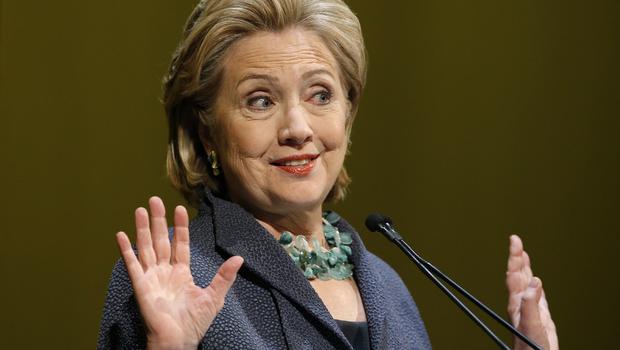
U.S. Democratic presidential candidate Hillary Clinton speaks at the Iowa Democratic Wing Ding dinner in Clear Lake, Iowa, United States, August 14, 2015.(Reuters)

America isn’t yearning for Al Gore, the $200 million man, to run for president and save us from those 1 percenters and their obnoxious carbon footprints.
The same holds true for Crazy Uncle Joe Biden. The vice president has as much bad video in his past as Donald Trump, only his are worse, since Biden's come in strange accents.
But they've been floated out there, listing like balloons in our presidential parade, because the Democrats are in a panic. And you know why:
Hillary Clinton is in the early stages of political sepsis.
Madam Inevitable cut herself with some bad emails. And rather than wash the wound thoroughly with soap that stings, maybe apply a tincture of iodine, she went into deep denial and jammed those fingers in her pockets.
She kept pretending it was nothing, really, and now they're puffy and throbbing and downright uncomfortable, especially for any Democrat who thinks a few months down the road.
But Gore as a candidate? Please. If by some weird happenstance he actually gets in the race instead of merely teasing us, it won't take two minutes before he's puffing up his chest, talking in that scary Foghorn Leghorn voice, flapping his arms like a cartoon rooster.
At the big debate he'll start rolling those eyes, just as he did before, sighing loudly and incessantly like a teenager bent on burning your ears because you said he couldn't go to the concert. And Democrats will turn to each other and say:
Why did we do this again?
The same holds true for Biden. In the end, the grownups will ask that Joe remains locked in the White House basement until this thing blows over.
Hillary was the inevitable one. And a year ago she would have laughed that mirthless Hillary laugh and taken a pin to any Gore and Biden trial balloons. And she'd smile as they made those sad hissing sounds that balloons make when they fly off and die.
Of course the Republicans are enjoying this, even as most of them endure Trump, a man so in love with his own voice that he believes his brain farts are policy.
The other day Trump said he wants to take ISIS' oil wealth. That’s the kind of thing Saddam Hussein wanted to do. It would give Vladimir Putin and every other boss the pretext to do the same. You see something, you grab something and say “President Donald did it too.” Kuwaiti oil, or land, who knows, just take what you want and watch world go away.
Republicans shouldn't enjoy themselves too much, because Sen. Elizabeth Warren is out there. She's silent. When Warren stops being silent, they should worry.
For now, Hillary's political health is a legitimate issue, centering on those tens of thousands of emails she kept on a private server at her home as she went about her country's business as secretary of state.
After denial and stalling, she finally turned her server over to the FBI. Her critics insist this is a criminal issue. But whether it is or isn't, the damage is political because of one simple, non-partisan question: Was her private server compromised by foreign intelligence agencies?
Using private servers helped shield her work product from the public and congressional committees trying to find out more about Benghazi. But her paranoia, and her arrogance, could also very well have put her country at risk.
Every day we learn about secure systems being hacked. Most of us can't write or understand code, but that doesn't stop us from reflexively grabbing our wallets when news breaks about hackers hitting a department store or a gas station chain. We understand that. We know such thieves are out there.
They could be overseas, or sitting a table or two from your iced latte waiting to hack into your checking account. Or, they could be agents of foreign intelligence intent on the servers in the home of Madam Secretary.
And a candidate who puts their own politics over security — especially if that candidate is widely thought by voters to be untrustworthy — has a problem.
Over the weekend in Iowa, she tried to blame the Republicans and everyone but herself. She also tried to turn her email scandal into a joke while talking about her new Snapchat account.
“I love it. I love it,” she said. “Those messages disappear all by themselves.”
Trying to turn national security into a punchline is a stupid thing to do, especially when the FBI has your server.
The political problem for the Democrats is that she might lose the election. But what if she were to win?
We will have elected an imperial personality who felt entitled to use private email for government business — email that, reportedly contained classified information including discussions on secret drone programs and other matters.
The knife turned a bit the other day as her successor, Secretary of State John Kerry, was interviewed by CBS News about his government email.
Kerry was asked, “Do you think China and/or the Russians are reading your email?”
KERRY: The answer is it is very likely. It is not outside the realm of possibility and we know that they have attacked a number of American interests over the course of the last days.
CBS: It's very likely that your emails are being read?
KERRY: It is a possibility, there's no way for me … and I certainly write things with that awareness.”
Enjoy the rest of the summer, Mrs. Clinton. But it's too late to wash your hands of this.

Saturday, August 15, 2015

The Stars and Stripes Surrender to Castro in Havana


Humberto Fontova | Aug 14, 2015
http://townhall.com/

US Marines raise the US flag over the newly reopened embassy in Havana, Cuba
PHOTO: US secretary of state John Kerry stands with other dignitaries as members of the US Marines raise the US flag over the newly reopened embassy in Havana. (Reuters: Pablo Martinez Monsivais)

(“We won the war!” Raul Castro, reacting to President Obama’s announcement, Dec. 20, 2014.)
(“The US and Cuba are no longer enemies or rivals but neighbors. And it is time to let the world know that, we wish each other well.” Sec. of State John Kerry as the U.S. flag was raised in Havana, Aug, 14, 2015.)
**************
“I see that the flagpole still stands,” said a choked-up Gen. Douglas Mc Arthur on March 2, 1945 as he entered devastated but liberated Corregidor. “Have our troops hoist the colors to its peak, and let no enemy ever haul them down. “
A U.S. Army sergeant named Manuel Perez-Garcia was on Luzon during that victorious flag-raising. Perez-Garcia was born in Cuba but immigrated to the U.S. after Pearl Harbor to join the U.S. Army and volunteer for combat. At the time of that flag-raising he’d fought almost constantly for 14 months, through New Guinea and the southern Philippines. His purple hearts, Bronze Star and Silver Star with Oak Leaf Cluster said something about his role in that victory for freedom. We can only imagine how he felt when he finally saw his beloved stars and stripes fluttering over Corregidor.
Upon the Communist invasion of South Korea in June of 1950, Manuel Perez-Garcia rallied to the U.S. colors again, volunteering for the U.S. army again at age 41. It took a gracious letter from President Harry Truman himself to explain that by U.S. law Manuel was slightly overaged but mostly that, “You, sir, have served well above and beyond your duty to the nation. You’ve written a brilliant page in service to this country.”
Mr Perez-Garcia’s son, Jorge, however was the right age for battle in Korea and stepped to the fore. He joined the U.S. army, made sergeant and died from a hail of Communist bullets while leading his men in Korea on May 4th 1952.
When Perez Garcia was 51 years old the Castro brothers and Che Guevara were busily converting his native country into a Soviet satrapy riddled with prison camps and mass graves. So Manuel volunteered for combat again. Like most of his Cuban Band of Brothers he fought to his very last bullet, inflicting casualties of 20 to 1 against his Soviet armed and led enemies. That bitter and bloody battleground is now known as The Bay of Pigs.
When the smoke cleared and their ammo had been expended to the very last bullet, when a hundred of them lay dead and hundreds more wounded, after their very mortars and machine gun barrel had almost melted from their furious rates of fire, after three days of relentless battle, barely 1,400 Cuban freedom-fighters -- without air support (from the U.S. Carriers just offshore) and without a single supporting shot by naval artillery (from U.S. cruisers and destroyers poised just offshore) -- had squared off against 21,000 Castro troops, his entire air force and squadrons of Soviet tanks. The Cuban freedom-fighters inflicted casualties of 20 to 1 against their Soviet-armed and led enemies. But to hear Castro's echo chambers in the mainstream media, think-tanks and academia, Fidel was the plucky David and the betrayed invaders the bumbling Goliath!
The battle was over in three days, but the heroism was not.
Now came almost two years in Castro's dungeons for Mr Perez-Garcia and his captured Band of Brothers, complete with the psychological torture that always accompanies communist incarceration. During these months in Castro's dungeons, the freedom-fighters lived under a daily firing squad-death sentence.
Escaping that sentence would have been easy, as Castro’s KGB-trained torturers “explained” almost daily: simply sign the little paper confessing they were “mercenaries of the Yankee imperialists” or go on record denouncing the U.S. In other words: publicly spit on the U.S. flag. In other words, the same stunt half of Hollywood pulls for the sake of publicity, these men could have pulled to save their lives.
Given these freedom-fighters recent betrayal, you’d think Castro had a cakewalk here, right?
None buckled. None even wobbled. None of these “men” (actually, some were as young as Audie Murphy had been upon trying to enlist in 1941) signed the document--nor uttered a word against the Stars and Stripes.
And I stress: these men were convinced that going on record trashing the U.S. would save their lives. After all, during these very months Che Guevara’s firing squads were murdering hundreds of bound and gagged Cubans weekly, and for “crimes” much less offensive than those of these men and boys.
The Cuban freedom-fighters stood tall, proud, defiant, and solidly with their commander, even sparring with Castro himself during their televised Stalinist show trials. "We will die with dignity!" snapped freedom-fighter commander Erneido Oliva at the furious Castroites again, and again, and again. To Castroites, such an attitude not only enrages but baffles.
Manuel Perez-Garcia passed away in Miami at the tender age of 102 in 2011. Today his ashes along with those of his son rest in Arlington. Maybe he’s lucky not to witness his beloved flag raised in Castro’s Havana, within walking distance of political prisons and torture chambers, a smirking Che Guevara mocking it from banners and murals in every direction.
For Manuel Perez-Garcia and his Band of Brothers that flag symbolized victory and freedom. In Havana today it symbolizes U.S. surrender to the Stalinist cowards who destroyed and defiled their homeland, and craved to nuke their adopted one.
"When at the Bay of Pigs we were abandoned, we were sad,” says Che Guevara’s captor Felix Rodriguez, who today serves as the President of the Bay of Pigs Veterans Association. “And now we feel abandoned again, betrayed by the President."

Spiking for the USA


Olympic volleyball medalist Megan Easy enjoys peace of summer home on the Cape


By Matt Goisman
mgoisman@capecodonline.com
http://capecodtimes.com/
August 8, 2015

U.
U.S. Olympic volleyball star Megan Hodge Easy relaxes with her husband, former NFL player Omar Easy, and their nine-month-old son Easton at their summer home in East Falmouth. Megan won a silver medal at the London 2012 Olympic Games and is a 2016 Olympics hopeful. STEVE HAINES/CAPE COD TIMES

EAST FALMOUTH - When you’re an Olympic indoor volleyball player like Megan Easy, you travel. A lot. The Fédération Internationale de Volleyball (FIVB) World Grand Prix alone took her to Turkey, Russia, Hong Kong and finally Omaha, Nebraska, for the final round, in which the U.S. won gold for the fourth time since Easy joined the team.
Next up for the U.S. is the FIVB World Cup in Japan starting August 22. Easy left last week for two weeks of training with USA Volleyball in Anaheim, California, and then heads to Japan for the 2016 Olympic Games qualifier.
Between competitions, Easy is happy to relax with her husband Omar Easy and 9-month-old baby Easton in their summer home at The Golf Club of Cape Cod.
“It’s where we come to just kind of take our minds off of everything and enjoy it,” Megan said. “That’s kind of what this home, what this area, symbolizes for us, is peace and quiet and time away from everything and everyone. It’s just a beautiful place.”
Omar and Megan bought their home, the backyard of which overlooks the 10th hole, in April 2013, two months before they were married. Megan, 26, was born in the U.S. Virgin Islands and grew up in Durham, North Carolina, before accepting a volleyball scholarship to Pennsylvania State University. So her familiarity with the Cape was limited prior to purchasing the property.
Omar, however, has been coming to the Cape for decades. His guidance counselor at Everett High School, Richard Aliberti, owned a summer home in Cotuit, and Omar would often visit Aliberti.
The two remain friends to this day. Aliberti introduced Omar to golf - Omar won The Golf Club of Cape Cod - championship in 2014 and volunteers with Aliberti’s youth golf program in Hyannis - which in turn helped bring Omar and Megan together.
Omar, 37, was a star football player during his two years at Everett, then went on to play for Penn State until he was drafted by the Kansas City Chiefs in 2002, the start of a four-year NFL career. Omar later returned to Penn State to earn a Ph.D. in education administration and work for the Nittany Lions, and one of his hobbies in State College was playing golf with women’s volleyball coach Russ Rose.
Megan Hodge (her maiden name) played for Penn State from 2006 to 2009, tallying a kill on the final point of the 2009 national championship against Texas, her last collegiate match. The win, PSU’s third national title in as many years, stretched the Nittany Lions’ winning streak to 102 matches, and the team went on to win the first seven matches of the 2010 season before finally losing.
Rose, Omar said, would often talk about Megan when they golfed together. Rose would then often talk to Megan about Omar.
“I actually knew that I was going to marry her after the first date we went on,” Omar said. “We sat in the car and talked for about three or four hours until the battery on my car died and I had to get roadside assistance to come get us started again.”
The two shared a Caribbean heritage, Megan’s parents coming from St. Thomas on the Virgin Islands, and Omar’s coming from Jamaica. Omar had also gone from being a big high school recruit to a Division I athlete to a professional football player, the same career trajectory Megan was pursuing in volleyball.
Megan’s numerous collegiate honors included twice being named NCAA Championship Most Outstanding Player, twice winning Big Ten Player of the Year and four straight years making the All-Big Ten First Team. She was considered the top volleyball player in the country as a high school senior, and despite offers from numerous Division I teams, she chose Penn State -- a program whose only national title before her arrival came in 1999, but has since she graduated won it all in 2010, 2013 and 2014.
Megan said she appreciated being told she’d have to earn her playing time despite her high profile.
“I just wanted go somewhere that I could get a good education and have a good focus on volleyball,” Megan said of Penn State. “I think, especially coming out of high school, a lot of recruits kind of want to be pampered and treated like a princess, and that wasn’t really for me.”
Despite its popularity at the collegiate level and the Olympics - Megan was on the 2012 U.S. team that won silver at the London Games - volleyball has never quite caught on as a spectator sport in the U.S. The Association of Volleyball Professionals, the premier beach volleyball league, filed for Chapter 11 bankruptcy in 1998 but survived. Attempts at pro indoor leagues have been short-lived at best.
Instead, Megan’s made a career out of playing club volleyball all over the world. Her career includes stints in Puerto Rico, Azerbaijan, Poland, Italy and China.
As a national player she’s been to Macau, Peru, Mexico, the Dominican Republic and Brazil, among others.
“It doesn’t ever get old, the travel,” Megan said. “I’ve never actually taken a count, but I’m sure at least 20 (countries).”
Megan is hoping to make a return to Brazil next year for the Rio de Janeiro Olympic Games. The U.S. can qualify by placing in the top two in the World Cup, a tournament in which she helped the U.S. win silver in 2011.
The Americans currently rank first in the FIVB standings, one spot above the Brazilians. While no roster spot on the Olympic team is assured until it is selected next year by USA Volleyball, Megan is easily a front-runner to make the 2016 Olympic team.
“Brazil is the team that’s stopped us from getting a gold medal for the last two Olympics,” Megan said. “Volleyball is one of the biggest sports in Brazil, so I’m sure it’ll be packed every night.”
The U.S. beat Brazil 3-0 at the Grand Prix. The Americans went 13-1 overall in three group stages and the finals, won all five finals matches and dropped just two sets.
Megan, named MVP and Best Scorer at the 2012 Grand Prix, said she was happy with the result but knows the team will have to reach another level at the World Cup, where teams will substitute less and rely more on their starters.
Omar now works as a vice principal at Everett, but he’s been on a year-long leave since the start of July. He said it’s given him a chance to both follow Megan around the world and spend extended time with his son.
“This is probably the most travel I’ve ever done during the USA Volleyball period,” Omar said. “Obviously, with this little guy (Easton), things change.”
Competing at the national level, no matter the sport, requires tremendous time and energy. Megan said it can feel overwhelming at times, trying to balance all the different roles she’s taken on in the last two years.
But when she needs a rest, she can always come back to the Cape.
Megan said, “Being a professional athlete is a challenge in itself. Being a wife is a challenge. Being a mom is a challenge. So combining all of those definitely is a juggling act, but I don’t think I could be happier. … When I’m old and gray, I can look back on and be like, ‘This was a really cool time in my life, where I was doing everything that i wanted to do and had a great support structure around me.’”

Friday, August 14, 2015

Contra Media Spin, It’s Hillary Who’s Being Investigated, Not Her Server


By Jonah Goldberg — August 14, 2015


Former U.S. Secretary of State Hillary Clinton speaks during an event in Chicago, Illinois June 11, 2014.
 
REUTERS


It happened sooner than even the doomsayers predicted. The era of artificial intelligence is here. A computer has become self-aware, a moral agent responsible for its own actions.

This breakthrough didn’t happen in Silicon Valley or at MIT. It happened, of all places, in Chappaqua, New York. And the person responsible isn’t even a computer scientist, but a lawyer and politician: Hillary Clinton.

Clinton’s critics say a lot of things about her, but who would’ve believed she was Skynet’s mother?

A little background. Clinton was forced to turn over her “home-brewed” e-mail server to the FBI this week, along with a flash drive unlawfully stored at her lawyer’s office. The server and the drive are tangible evidence of Clinton’s decision to circumvent laws and procedures designed to preserve government records and keep classified information secret. She says she never knowingly sent classified information, but Clinton leaves out that the whole reason federal officials are barred from using private servers is that such systems are invisible to the classification process.

The Clinton team claims it handed over the server voluntarily — a classic example of Clinton’s penchant for half-truths. For months, they insisted they’d never turn it over. They caved because they had to. The decision was about as voluntary as a bank robber relinquishing his sack of cash to the cops at gunpoint.

Revealingly, many media reports say “the campaign” handed over the server. But the campaign wasn’t in charge of the server — if it was, that’d be a whole other scandal. It was Clinton’s server, full stop. To say otherwise is to protect Clinton, the author of a book called Hard Choices, from her own hard choices.

Which brings us to that evil server.
The first rule of Clintonism is that someone else is always to blame.
The first rule of Clintonism is that someone else is always to blame. That’s why the first iteration of Clinton’s defense was that evil Republicans were simply smearing her. When that didn’t stick, Team Clinton expanded the indictment to include the partisan witch hunt by that famously right-wing organ the New York Times and two independent inspectors general (one at the State Department, the other for the intelligence community).

The reason the intelligence community’s IG referred the case to the Justice Department stems from the apparent fact that Clinton mishandled classified information, which she denied.

An investigation into a random sample of just 40 e-mails from a batch of more than 30,000 revealed that four contained classified information and at least two were “top secret.”

So now that the FBI and the Justice Department, both run by Obama appointees, are on the case, attacking the motives of inconvenient people no longer works. So the Clinton campaign has invoked a little-known codicil to the first rule of Clintonism: Blame an inanimate object.

The amazing thing is that this spin isn’t coming directly from the campaign but from the reporters covering it. National Public Radio’s Tamara Keith reported Wednesday morning that the inquiry “isn’t targeted directly at [Clinton]” and is simply intended to determine whether the server was secure. Business Insider reported that “Clinton’s private server is under investigation by the FBI, though Clinton is not a target of the investigation.” Even the conservative Washington Free Beacon has fallen into using this locution, referring to the “private email server being investigated by the FBI.”

McClatchy’s Anita Kumar, who helped break the story that two of the e-mails were top secret, felt compelled to step on her own scoop. She said on MSNBC’s Morning Joe that “there are several investigations into her conduct, not into her, but into her use of personal e-mail and a personal server.” Go ahead and try parsing the difference between an “investigation into her conduct” and an investigation “into her.”

Clinton, in violation of State Department rules, guidelines from the White House, and all common sense, used her own unsecured stealth server. She sent classified material on it. But it’s the server that’s being investigated?

Hopefully the server will one day be able to testify on its own behalf: “I was just following orders.”
In fairness to the press, even the FBI is publicly toeing this line, saying that the investigation isn’t into Clinton. But on background, federal officials sing a different tune. “It’s definitely a criminal probe,” a government source told the New York Post. “I’m not sure why they’re not calling it a criminal probe.”

I’ve talked to several lawyers who assure me that the FBI doesn’t conduct criminal probes into anthropomorphized IT equipment. The bureau does investigate criminal abuses of them — by people.

— Jonah Goldberg is a fellow at the American Enterprise Institute and a senior editor of National Review. He can be reached by e-mail at goldbergcolumn@gmail.com, or via Twitter @JonahNRO. (C) 2015 Tribune Content Agency, LLC


Wednesday, August 12, 2015

Book Review: 'The Fellowship' by Carol and Philip Zaleski


How J.R.R. Tolkien and C.S. Lewis Revived Modern Myth-Telling


  •  SEPTEMBER 2015 ISSUE


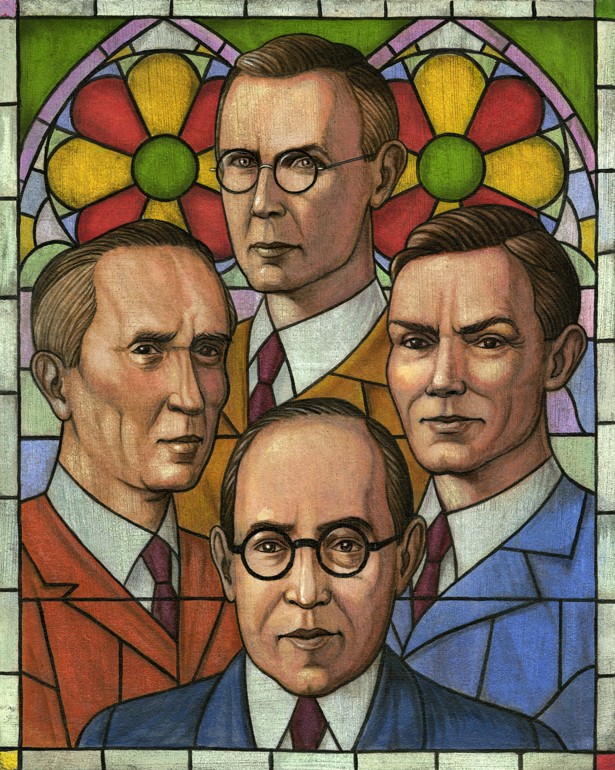
  • Clockwise from top: Charles Williams, Owen Barfield, C. S. Lewis, and J. R. R. Tolkien Marc Burckhardt / The Atlantic

    In this nearly magical room, amid fire-crackle and clink of glass, you can hear them talking. Pipe smoke is in the air, and a certain boisterous chauvinism, and the wet-dog smell of recently rained-on tweed. You can hear the donnish mumbles of J. R. R. Tolkien as the slow coils of The Silmarillion glint and shift in his back-brain. Now he’s reading aloud from an interminable marmalade-stained manuscript, and his fellow academic Hugo Dyson, prone on the couch, is heckling him: “Oh God, not another fucking elf!” You can hear the challenging train-conductor baritone of C. S. Lewis, familiar to millions from his wartime radio broadcasts; hear the unstoppable spiel of the writer/hierophant Charles Williams, with his twitchy limbs and angel-monkey face; hear the silver stream of ideas and argumentation that is the philosopher Owen Barfield. They are intellectually bent upon one another, these men, but flesh-and-blood is the thing: conviviality is, for them, a kind of passion. The chairs are deep; the fire glows gold and extra fiery in the grate. Lewis’s brother, Warnie, rosy with booze and fellow feeling, serves the drinks. And the walls drop away, and the scene extends itself backwards and forward in time …

    Philip and Carol Zaleski’s The Fellowship: The Literary Lives of the Inklings is a mental map, a religious journey, and the biography of a brotherhood. Plenty of distinguished Inklings came and went over the years, padding across the carpets with a Warnie-provided drink in hand, but the Zaleskis zoom in on (and out from) the primary axis of Tolkien, Lewis, Williams, and Barfield, the four among whom the invisible correspondences of thought and affection were strongest. Christians all, these men formed what the Zaleskis call “a perfect compass rose of faith”: Barfield the proto–New Ager, Tolkien the rather prim orthodox Catholic, Lewis the noisy and dogmatically ordinary layman and popular theologian, Williams the ritualistic Anglican with a taste for sorcery.

    “The qualifications … are a tendency to write, and Christianity.” Thus explained Lewis in a letter to Williams in March 1936, inviting him to a session of the “informal club” that had begun convening every Thursday night in his rooms at Oxford’s Magdalen College (and then again, still less formally, at the Eagle & Child pub on Tuesday mornings). The letter was a fan letter; the two men didn’t know each other, but Lewis had found himself compelled to inform Williams that reading his fantasy novel The Place of the Lion—in which comfy England is burst upon by unruly celestial essences—had been “one of the major literary events of my life.” Lewis was an Oxford fellow and tutor in English literature, and a relatively fresh-baked believer: after an arduous wrangle of a conversion, he had arrived at the knowledge of a personal God while sitting in Warnie’s sidecar on a motorcycle ride to Whipsnade Zoo. Williams worked in publishing, wrote feverishly, smoked like a chimney, delivered whirling literary-metaphysical lectures, and indulged in the overheated cultivation of female disciples. (One such pupil, we learn from the Zaleskis, was struck smartly on the bottom with a ruler.) Devoutly churchgoing, he was also of high rank in at least one esoteric mystical order and would make sacred signs while traveling on the London Underground. W. H. Auden thought him nearly a saint. To Lewis’s letter, Williams replied immediately that he had been on the verge of writing to Lewis, in praise of his The Allegory of Love. “It has never before happened to me to be admiring an author of a book while he at the same time was admiring me.” (Not a bad example of the loopy Williams prose style, that.) The serendipity, the crossbeams of appreciation, the ardent encounter at the aesthetic, soon to be spiritual, level—a very Inklings moment.

    And so it began, and so it went on, with additions and diminutions, until the late ’40s. Reading aloud and commenting upon unfinished work was the group’s primary activity. Lewis’s The Great Divorce, Williams’s All Hallows’ Eve, and—most resonantly for us—Tolkien’s The Lord of the Rings all made their debut in this context. Tolkien, like Lewis, was part of the fabric of Oxford University, a philologist and a professor of Anglo-Saxon, teaching Beowulf by day while tinkering at night, at home, with his own made-up languages. Tinkering is of course quite the wrong word: Tolkien was plunging, spelunking, delving, excavating, as pickax-happy as a dwarf in the Mines of Moria, because in the roots of language—the glowing word-cores, the namings—he had found the roots of story. “For perfect construction of an art-language,” he explained in a talk delivered in 1931, “it is found necessary to construct at least in outline a mythology.” And there it is: the DNA of The Lord of the Rings. It was at this level of thinking that Tolkien met the way-ahead-of-the-curve Barfield, for whom language contained “the inner, living history of man’s soul.” Barfield’s brilliant 1926 book, History in English Words, is a work of philosophical archaeology, tracking and illuminating, via the changing meanings of words, the development of Western mental reality. And for Barfield, all reality was mental reality. “When we study long-term changes in consciousness,” he stated unequivocally, “we are studying changes in the world itself … Consciousness is not a tiny bit of the world stuck on the rest of it. It is the inside of the whole world.” (In Barfield’s old age, his theories would gain him a notable acolyte in Saul Bellow.)

    We think of the Inklings as traditionalists, red faces scowling upon modernity. Lewis, in particular, polemicized fruitily against materialism, atheism, 20th-century-man-ism. On the other hand, what more modernist project could there be than Tolkien’s “construction of an art-language,” with the obsessive completeness of its declensions and long-dead kings? Blown sky-high—just like the modernists—by the psychic rupture of the Great War, the Inklings responded not with fragmentation and pessimism but with a redoubled commitment to the world behind the world, freshly visible through this new rip in the fabric. The “intersection of the timeless / With time,” T. S. Eliot called it, and one feels it in the music of the dwarfs that sweeps Bilbo Baggins “away into dark lands under strange moons”; in the “potentialities beyond all knowledge” that bulge and scurry in Williams’s novels; in Lewis’s The Screwtape Letters, that extraordinarily modern primer in everyday spiritual warfare, wherein the devil gets just as personal as God; in what Barfield saw in the shape of the cross, “this intersection of time and eternity, the horizontal and the vertical.”

    Who can compare with these writers? In the intensity of their communion, their accelerating effect upon one another, and their impact on posterity, their only real 20th-century rivals are the Beats. And the Inklings would have detested the Beats. Nonetheless, the two core groups can be mapped onto each other with weird precision: Tolkien would be Kerouac, sensitive maker of legends; Lewis, the broad-shouldered preacher-communicator, would be Allen Ginsberg; Charles Williams, kinky magus, would have to be William Burroughs; and the sagacious and durable Owen Barfield, Gary Snyder. (The Inklings had no Neal Cassady, no rogue inspirational sex idol—they were all too grown-up for that.)

    But the Beats, bless them, consumed the greater portion of their own energies, with the result that their influence went mainly into rock and roll and advertising, and stayed there. The Inklings, on the other hand, are still gathering steam. Tolkien revived in us an appetite for myth, for the earth-tremor of Deep Story. (See: Game of Thrones, and the pancultural howls of pain at the death of Jon Snow.) Lewis invented Narnia—though the exacting Tolkien regarded it as an incoherent mythology—and he may be, write the Zaleskis, “the bestselling Christian writer since John Bunyan.” As for Williams and Barfield, they hang in the tingling future: for the former I prophesy an H. P. Lovecraft–style cult (with creepy folk music), and for the latter, cosmic vindication. And Warnie serves another round of drinks, and the Inklings, huffing and puffing and hurtling through time and space in their armchairs, have their victory.