Tuesday, November 11, 2014

Book Reviews- 'Jerry Lee Lewis: His Own Story' by Rick Bragg


Whole Lotta Killer
An entertaining new biography of Jerry Lee Lewis can’t salvage his disappointing legacy.

By MATTHEW HENNESSEY
November 7, 2014


Jerry Lee Lewis: His Own Story, by Rick Bragg (Harper, 512 pp., $27.99)

In February 1957, mere weeks after the Sun Studios meeting of Sam Phillips’s “million-dollar quartet”—Elvis Presley, Johnny Cash, Jerry Lee Lewis, and Carl Perkins—a package tour featuring Lewis, Cash, Perkins, and a revolving cast of lesser-known acts set out across Canada. “More than one music fan, more than one historian of rock and roll, has wished for a time machine, just so they could travel back to this one time, this one tour,” writes Pulitzer Prize-winning journalist Rick Bragg in Jerry Lee Lewis: His Own Story, his juicy new biography of the piano-hammering wild man of Ferriday, Louisiana. Bragg’s book is based on two summers’ worth of interviews with the 79-year-old Lewis, known to friend and foe alike as “the Killer,” and it will do pretty well for a time machine.

Only 22 and still months away from releasing his career-making hit “Great Balls of Fire,” Lewis used the tour as “a kind of laboratory” for his manic stage act. He routinely ignored his allotment of four songs, whipping the crowd into a nightly frenzy with his unique proto-rockabilly sound. He’d discovered that he could use his hair “almost like another instrument,” shaking his head from side to side, loosening the layered blond waves he had meticulously piled high and combed back. It sent the women in his audience into hysterics.

Lewis came into his own as a performer on that tour. He loved the attention, but he also loved that his growing popularity annoyed Cash, who would become a lifelong rival and whose “I Walk the Line” had topped the charts the previous spring. At the time, Jerry Lee had made only one record, a cover of Ray Price’s “Crazy Arms.” It went over well enough but was far from a hit. Competition between Cash and Lewis for stage time, top billing, and female attention was fierce. Fists flew nightly. So did the Killer’s piano stool.

One night, after obliging the riled-up crowd with two encores, Jerry Lee treated them to a song he considered his “hole card”—the not-yet-released barn burner “Whole Lotta Shakin’ Goin’ On.” It was pure rock-and-roll pandemonium, an exhibit for those who viewed the new music as the devil’s own. A young fan fainted. The Canadian constables at the back of the auditorium feared that a riot might break out. At the rollicking number’s final chord, the crowd called: “More! More! More!” With a wave, Lewis headed triumphantly off stage, where Cash—“sweating and almost white”—waited to go on. “Nobody follows the Killer,” Jerry Lee said over his shoulder as he passed.

Of such stuff are legends made, and Bragg’s prose is pitched at burnishing that legend. His description of Lewis’s mid-fifties musical apprenticeship in the small clubs and beer joints of the Deep South is as rhythmic and musical as that lost world itself: “Instead of parroting a black bluesman, he almost yodeled on the higher, bleaker notes, in a rolling, keening exultation of pain and suffering and lust, something from the other side of town or way out in the lonesome pines, but a place as rough, hard, and mean. His people pulled the cotton sack, too, and walked a chain gang and sat in the hot dark of the federal prison in New Orleans.” There are hot rocks likes this on every page.

Jerry Lee Lewis’s scandalous exploits have been well documented. But the truth, Bragg suggests, is even more outrageous. Why, yes, he did once crash a brand new Lincoln Continental into the gates of Elvis’s Graceland mansion at 2:30 in the morning. And yes, a loaded .38 derringer sat on the dashboard that night. But, no, Jerry Lee never intended to kill Elvis. (“He was my friend. I was his.”) He just misjudged the length of the front end of that enormous car, “’Cause I’s drunk.”

Some of the Killer’s claims seem less reliable than others. Did he really roll an inferior-sounding piano out a Florida stage door, down a sidewalk, and into “the water” as a protest against a promoter for supplying him with a clunker? Did he really do it during the show, with half the audience trailing him and the piano down the street? Did a weeping Elvis, distraught at being drafted into the Army, tell Jerry Lee that he was handing over his crown as the king of rock and roll? Did Elvis really say, “You got it. Take it . . . take the whole damn thing . . . Why do I have to go and do eighteen months and you don’t have to?”

Maybe some version of these things really happened, but Elvis need not have wondered why Uncle Sam took him and not Lewis. For all Elvis’s hip-swiveling sex appeal, Jerry Lee made the kid from Tupelo look like the boy next door. Lewis was a physically unfit, Benzedrine-addicted, long-haired alcoholic with a rage problem and an inability to follow anyone’s orders but his own. The draft board didn’t hesitate to declare him 4-F—unfit for service. “He did not have to act dangerous; he was,” Bragg writes. “He did not need a song to make him inappropriate. Jerry Lee had always been inappropriate, and being a little bit famous did not change it; you can paint a barn white a thousand times, but that won’t make it a house.”

The most “inappropriate” episode of all was Lewis’s 1957 marriage to Myra Gale Brown, his 13-year-old first cousin once removed. The strange union became a public issue—and a PR disaster—when Jerry Lee tried to take her along on a short tour of England in May 1958. The British press—perhaps tipped by an immigration official suspicious of the birthdate on Myra’s passport suggesting that she was 15—was merciless. They pursued the Killer and his entourage with “gleeful malice,” soon discovering that Jerry Lee had not been divorced from his second wife, Jane, at the time he married Myra, making him not just an apparent pedophile, but a bigamist, too. The ensuing outrage forced the tour’s cancellation. The scandal followed the Killer home, and the hits and gigs dried up.

As Elvis and Johnny Cash soared to worldwide fame, Lewis labored in obscurity during the 1960s. It was a tough comedown. A Nashville renaissance as a boogie-woogie outlaw was just enough to keep him flush with money for booze, pills, and alimony during the seventies and eighties. In the 2000s, Lewis even issued a pair of slickly produced albums of duets in the mold of Cash’s late-career, Rick Rubin-produced “American” recordings. Not surprisingly, they were not as good as Cash’s stark, emotionally raw efforts, and barely made a splash.

This is a deliciously written, entertaining book about an important American cultural figure, but even Bragg’s considerable talents cannot rewrite rock and roll history to give Jerry Lee Lewis a higher chart position than he deserves. His recording and performing career might have been more consequential had the unfortunate business with cousin Myra not done so much to color his legacy. But it did, and Lewis will always be at best a second-tier deity in rock’s overcrowded pantheon. Elvis, Johnny Cash, and the British media are not to blame for that. The Killer did it to himself.


Rick Bragg peels back the cover on Jerry Lee Lewis' life in new book


(Getty Images)

One of the dozens of people who Rick Bragg spoke to about Jerry Lee Lewis was struck by actual lightning the first time he listened to "Great Balls of Fire." As for Bragg, his initiation into The Killer's world came more slowly, though it was still electric.

"I grew up with both his rock and roll and his country. ... Country poured out of every truck and souped-up Camaro in Northeast Alabama," Bragg said. "Jerry Lee's piano was just raking in the air in that part of the world."

But Bragg had not delved too deeply into Lewis' discography or followed his rise and fall and rise again beyond the bits and pieces that leaked or slammed their way into headlines. 

That all changed a few summers ago when his phone rang. It was Bragg's agent, presenting him with the challenge to write Lewis' story. 

"What I should have done, in hindsight, was gone and hid under the bed," he laughed. "But instead what I'm thinking is, how could this be dull?"

And it certainly wasn't. Bragg spent the next few summers planted in a rocking chair, hearing and piecing together the stories that comprise the life of Jerry Lee Lewis, the Ferriday native who practically handcrafted the original bad boy persona in rock and roll with all the addictions, women and mug shots to prove it. The end result is Bragg's newest book, "Jerry Lee Lewis: His Own Story."

Bragg heads to the Louisiana Book Festival in Baton Rouge on Nov. 2, where he'll host a book talk and signing, then he's off to New Orleans for appearances at Garden District Books on Nov. 20 and at Octavia Books on Nov. 21.  

In all, the project took Bragg about three years to finish thanks to the number of ailments -- pneumonia, shingles, kicking his lifelong addiction to painkillers -- that Lewis batted away in that time.

("His stomach, I think, is probably pieced together out of aluminum foil and bubble gum," Bragg noted. "I interviewed him day after day after day lying in bed ... and he'd eat Oreos and drink grape soda.") 

There was also, of course, the difficulty of examining nearly eight decades of a lifetime. It'd be a hard task for anyone, but in Lewis' case, that lifetime was hardly ever easy to live, let alone to explain. 

"Some days, he is so defiant he will tell you he has no regrets. And then some days he will think about the human cost, about loving a woman and leaving her, about living a lifestyle that hurt, that wounded people around him, and then he will speak of regret," Bragg said.

Lewis grew up playing piano in church, but eventually his hands found the notes for a kind of music the Assembly of God couldn't stand behind. Much of the rest of the country, however, very well could, and Lewis snagged hit song after hit song after signing to Sun Records in 1956. He befriended Elvis, became known for his raucous live performances, and he personally invented and reinvented his music more times than most current performers can imagine.

Lewis' personal life was fraught with a string of women, marriages that ended in death and/or heartbreak, the drowning of his 3-year-old son and an addiction to pain killers that lasted longer than nearly anything else.

But it was the disparate relationship between the music Lewis loved and what his heart found to be true that has haunted his life and served to inform much of Bragg's approach to the story.

"In the Assembly of God, most people preach so hard, you can't live it. You either walk in righteousness or you burn. Those are the choices. To say he believed it once would be dead wrong. He believes it now, but believing it and sinning anyway? Most people, they put their faith on a shelf, go about sinning and come back when it's convenient," Bragg said. "Jerry Lee never forgot the cost. It was always in his mind he would pay for this."

These days, Lewis spends most of his time in bed. He prays before eating, won't tolerate any cursing and can't handle blasphemy.

"One of the things that terrifies him is, in Jerry Lee's faith, if you go to Hell, it will be as if you never were known, as he quotes it," Bragg said. "What that means is, his kinfolk, the people he loved will not know him. It will be as if he never was, and for Jerry Lee, that is a special kind of Hell."

Bragg is perhaps best known for the stories he's told about his own kinfolk and growing up in the South, and he admits the years spent examining the stories and characters of his own life offered a lens through which he viewed Lewis.

"They're kind of the same people," Bragg said. "There's the faith, then there's the great poverty they grew up in. Then there's the mindset of these people, this kind of martyrdom the women have. They hold up these sorry men, they take care of the family while the men go off to prison. ... My daddy (went to prison, and) Jerry Lee's daddy went to prison twice for making whiskey.

"In a way, every book I've ever written prepared me for doing this. The difference, of course, is that Jerry Lee's blood is not my blood." 

Because of -- or perhaps in spite of that -- Bragg did have a moment or two of worry about what could happen to him during his interviews. This is a man, after all, who at 79 years of age still keeps a .357 magnum under his pillow. 

"People who knew more about Jerry Lee than me told me he shot his bass player ... and I'm sure if happened by accident, but after awhile I got to thinking getting shot by accident ain't much better," Bragg laughed.

During one long day, while Bragg bobbed in the rocking chair and Lewis was propped up in his bed, Judith Brown, who became Lewis' seventh wife in 2012, popped her head in to let the men know she was off to run an errand. 

"It occurred to me, there were no other people in the house. It was just me and Jerry Lee. I heard the door slam, and I thought, Oh God. I am responsible for Jerry Lee Lewis, and it scared me to death," Bragg said. "I wasn't afraid anything would happen to him. I was afraid he would get up out of bed and crawl into his Rolls Royce and go thundering down the highway, and I had to go with him. It could have been the last anyone ever heard of me.

"It was just never dull. Day after day ... it was like any dull life with the dull parts taken out. That's Jerry Lee."

Monday, November 10, 2014

On Flannery O’Connor, Brittany Maynard & the Eclipsing of God

November 7, 2014 by 
http://www.patheos.com/blogs/acatholicthinker/

rechner_oconnor

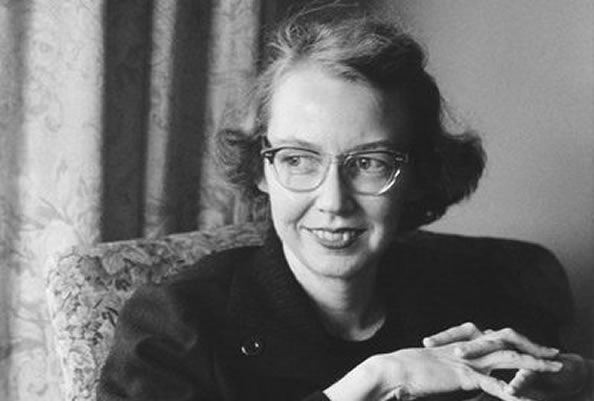
It was 1951 and she was much too young to be so sick. Much too young. And she had her suspicions about what it was. The fevers. The drenching sweats. The profound fatigue and the joint pains – oh, the joint pains. She had her suspicions. After all, Flannery O’Connor had seen her father endure something like it before her…and he died one month into his forty-fifth year. Years later when she fully grasped that she too had the mysterious yet ravaging rheumatologic disease, systemic lupus erythematosis (commonly known as “lupus”), she wryly recalled the treatment – or rather, the lack thereof – available to her father during his final years.
“At that time, there was nothing for it but the undertaker.”
Flannery loved her father. Deeply. And though she spoke little of him, a private reflection scribbled in her college notebook revealed the pain that endured years after his death,
“The reality of death has come upon us and a consciousness of the power of God has broken our complacency like a bullet in the side. A sense of the dramatic, of the tragic, of the infinite, has descended upon us, filling us with grief, but even above grief, wonder. Our plans were so beautifully laid out, ready to be carried to action, but with magnificent certainty God laid them aside and said, ‘You have forgotten – mine?’”
She was much too young to be sick. Convinced she had rheumatoid arthritis, her physician knew otherwise. So did her mother. But they concealed the true diagnosis from her fearing it would devastate her. The truth would come to her from a friend, Sally Fitzgerald, on a car ride running errands in the summer of 1952.

Ponce-de-Leon-North-Highland-Avenue-Georgia-State-University

“On the way back, on a lovely summer’s afternoon, [Sally] glanced over at her passenger, wondering how she could disturb such peace; but she had made up her mind, following much inner struggle, that Flannery should finally know the true nature of her illness. At that instant, Flannery happened to mention her arthritis. ‘Flannery, you don’t have arthritis,’ Sally said quickly. ‘You have lupus.’ Reacting to the sudden revelation, Flannery slowly moved her arm from the car door down into her lap, her hand visibly trembling. Sally felt her own knee shaking against the clutch, too, as she continued driving along Seventy Acre Road.
‘Well, that’s not good news,’ Flannery said, after a few silent, charged moments. ‘But I can’t thank you enough for telling me…I thought I had lupus, and I thought I was going crazy. I’d a lot rather be sick than crazy.’”
- Excerpted from Flannery: A Life of Flannery O’Connor by Brad Gooch
She was much too young to be sick. Flannery O’Connor would struggle through steroids and antibiotics, transfusions and infusions, hospitalizations and bedrest. Biting pain, oppressive fatigue and distracting fogginess would be her constant companions. The vision of her father was always before her. And yet from 1952 until 1964, Flannery wrote her novels, Wise Blood and The Violent Bear It Away. She compiled a series of short stories collected in A Good Man is Hard to Find and Everything That Rises Must Converge and others. She wrote dozens and dozens of book reviews for her Catholic diocesan newspapers.

arts_books1-1_43

Even more, Flannery wrote letters. To friends. To family. To mentors. To aspiring writers. These letters were collected posthumously and edited by her friend, Sally Fitzgerald. The Habit of Being is an extraordinary testimony to the brilliant, witty, confident yet self-effacing, loyal, struggling yet surviving beauty that is Mary Flannery O’Connor. And in those letters she guided Alfred Corn (see my previous post, Dear Ms. Connor:On Writing Letters to Flannery), she sparred with Cecil Dawkins, and she confided in her friend, “A”. And she touched me and thousands more readers to this day. What is more is that during those letters and between those letters, Flannery O’Connor, in her suffering, in her uncertainty and in her fear…was simply there. She was there to feed the peafowl at her Andalusia Farm. She was there to pick up the mail and eat breakfast. And Flannery was there for her aging mother to come late at night into her room to look upon her beautiful, yet dying child. She was there when many in our modern world might argue she didn’t have to be. Her suffering, some would argue, justified her to leave it all behind. Just leave it all behind.


Read more: http://www.patheos.com/blogs/acatholicthinker/2014/11/on-flannery-oconnor-brittany-maynard-the-eclipsing-of-god/#ixzz3IgY72tXK

Sunday, November 09, 2014

The definitive biography of Bob Hope

on November 8, 2014 - 5:58 PM


Jackie Gleason, Gerald Ford and Bob Hope (Ron Watts)
Gerald Ford was in the White House at the time. There were few more famous names and faces anywhere in America than those belonging to Ford’s frequent golfing buddy, Bob Hope – a man known in Hollywood as probably the richest in town.
And now imagine one of the long gate corridors of La Guardia Airport – not its upscale New York counterpart Kennedy Airport, where all the fancy-schmancy international flights took off but budget-rate La Guardia.
Imagine further Bob Hope walking virtually the full length of one La Guardia corridor alone – no entourage, no assistants, no security, just Bob Hope in an immaculate suit and tie with a garment bag slung insouciantly over his shoulder.
Everyone – and I do mean everyone – within 30 yards recognized him. “How ya doin’?” Hope would purr at them when his eye caught theirs. Or “How’s it goin’?” Or “How about that, huh?,” as if sharing with the public the weirdness of their mutual celebrity moment.
For all his fame, few comedians of his era had also been so loathed and reviled by that time as Bob Hope. He hadn’t just tirelessly entertained troops for decades – including in Vietnam – he had sold the Vietnam War to the American people at the request of another presidential pal, Richard Nixon. He’d also taken every opportunity in jokes, comments and interviews to belittle those who oh-so-passionately differed.
By that time, that ubiquitous American face with the ski-jump nose not only became one of the faces of the most unpopular war in American history but of the ideological polarity that war opened up and exacerbated every day it was fought. To some, he had become in one man, the symbol of everything oppressive, hypocritical and stolidly irrelevant in America.
And there he was in La Guardia – completely unprotected and confident that love and recognition would cocoon him everywhere he walked.
It was the boldest exhibition of fame’s magic impenetrability I’ve ever witnessed – especially when all that fame was accompanied by either an equal quantity of cluelessness or raw, naked chutzpah. To manifest such swaggering assurance of the world’s love required almost superhuman insensitivity. (Or brazenness.)
That was then, in another time. In another America – ours – I mentioned his name to two 20-somethings and asked for their associations with Bob Hope. One was “golf.” That’s it. Another was “cigar” – until I informed her that she was confusing him with his older contemporary George Burns. Then she remembered stand-up comedy and his USO tours.
In this world, Hope’s name is far from a household word. His face is no longer as familiar to people as their own family members. (Such was the fame possible when television culture was brought into American bedrooms and living rooms on only three major networks.)
Bob Hope lived to be 100. And even in death he has retained a kind of ubiquity.
Let Richard Zoglin draw it for you in the introduction to what is one of the necessary American books – the definitive biography of one of the holy monsters of American show business, “Hope” (Simon and Schuster, 566 pages, $30):
“The Hope legacy tour made a stop on the deck of the USS Midway in San Diego to mark the introduction of a postage stamp featuring Hope’s likeness. Memorials to Hope proliferated across the American landscape. You can walk down streets named for Bob Hope in El Paso, Texas, Miami, Fla., and Branson, Mo.; cross the Cuyahoga River on the Hope Memorial Bridge in Cleveland; and bypass the congestion of Los Angeles International by flying into Bob Hope Airport in Burbank, Calif. Hope’s name is memorialized in hospitals, theaters, chapels, schools, performing arts centers and American Legion Posts from Miami to Okinawa. The U.S. Air Force named a transport plane for him and the Navy christened a cargo ship in his honor. Bob Hope Village in Shalimar, Fla., provides a home for retired members of the Air Force and their surviving spouses.”
But few writers know better than Zoglin – whose book “Comedy at the Edge: How Stand-Up in the 1970’s Changed America” is equally definitive – that “Hope never recovered from the Vietnam years, when his hawkish defense of the war, close ties with President Nixon (who actively courted Hope’s help in selling his Vietnam policies to the American people), and the country-club smugness of his gibes about anti-war protesters and long-haired hippies, all made him a political pariah for the peace and love generation [and beyond]. His tours to entertain American troops during World War II had made him into a national hero. By the turbulent 1960s, he was a court-approved jester, the Establishment’s comedian – hardly a badge of honor in an era when hipper, more subversive comics, from Mort Sahl and Lenny Bruce to George Carlin and Richard Pryor were showing that stand-up comedy could be a vehicle for personal expression, social criticism and political protest. Even before Hope became a doddering relic, he had become an anachronism.”
And yet, says Zoglin, “the scope of Hope’s achievement, viewed from the distance of a few years, is almost unimaginable. By nearly any measure, he was the most popular entertainer of the 20th century, the only one who achieved success – often No. 1-rated success – in every major genre of mass entertainment in the modern era: vaudeville, Broadway, movies, radio, television, popular song and live concerts.”
Here, then, is one of the undeniably pivotal books of 2014, a portrait of an obscured giant, the most famous estabishmentarian comedian of them all in a way that a huge recent biography of our most famous current establishmentarian comedian – the supremely controversial and increasingly embattled Bill Cosby – was not.
Zoglin’s “Hope” is how it should be done.
The portrait that emerges can be of a man almost transcendently crass, cheap, obnoxious and self-absorbed – a covertly legendary womanizer whose status as a walking talking American monument over many decades covered up his frequent ability to spread mediocrity to almost everything he touched.
Katharine Hepburn said this about making “The Iron Petticoat” with Hope from a script that was going to be by Ben Hecht alone. Hope was “the biggest egomaniac with whom I have worked in my entire life. … I was told this was not going to be a typical Hope movie, that he wanted to appear in a contemporary comedy. That proved not to be the case.”
Hecht demanded that his name be taken off the film after it was made.
The memory of his godawful TV specials and his wretched appearances on Johnny Carson’s “Tonight Show” to plug them – even though Carson was frank about his resentment of Hope booking himself – is still fresh in the minds of many older Americans.
And yet …
That is far from the whole story. It was Hope’s singularly bad luck that the younger comic prodigy who could have singlehandedly rehabilitated the reputation of Hope’s ’40s and early ’50’s films in the 21st century ran himself into a ditch where his own reputation is in constant need of rehabilitation.
Said Woody Allen about Hope’s “Monsieur Beaucaire” and other models for Allen’s own comic persona in his first couple of decades of film: “He was a wonderful comic actor. He’s totally committed to his character: He’s scared when he’s supposed to be scared, leching when he’s supposed to be leching, playing someone more grand than he is. He was not a sufferer, like Chaplin, or even as dimensional as someone like Groucho Marx, who suggested a kind of intellect. Hope was just a superficial, smiling guy tossing off one liners. And he was amazingly good at it.”
A good argument could be made that the fearfulness of Hope’s comic persona was a forerunner of the kind of anti-war chicken-heartedness that James Garner brought to “Maverick” and helped launch “M*A*S*H” in the next decade.
His deepest legacy, then, in entertaining troops in Vietnam and elsewhere couldn’t be more paradoxical.
So too was Hope’s TV legacy of creating some of the worst comedy throwaway “specials” in TV history. With all of that, it was Hope’s name that was front and center on one of the best anthology series of its time, “Bob Hope’s Chrysler Theater,” a TV show that could be so ambitious and good that it could even mount an adaptation of Solzhenitsyn’s “One Day in the Life of Ivan Denisovitch” starring Jason Robards.
His life was huge. So was his achievement. But for decades now, it has been effaced by the generations that came after the one that could no longer abide him – the one that answered emcee Hope’s Oscar-ending plea in 1970 that “Perhaps a time will come when all the fighting will be for a place in line outside the theater” with Shirley MacLaine’s yell to the TV screen “Oh, shut up, Bob Hope.”
For at least one generation, maybe two, Hope’s life and work has been shut up tight. And now, deservedly, it’s been reopened, warts and all.

Julia Lost

Perhaps American women aspire to more than receiving political patronage. 

Gil Hodges overdue for Hall of Fame induction


By Mike Vaccaro
http://nypost.com/
November 8, 2014


Gil Hodges in 1951

On the one hand, there is hope attached to seeing the name again, Gil Hodges’ name included among the nine others who were nominated for the latest incarnation of the Veterans Committee to weigh their credentials for the Hall of Fame.
They labeled these nominees “Golden Era” candidates, and there are a lot of viable possibilities: Tony Oliva and Jim Kaat, Richie Allen and Luis Tiant and Ken Boyer. Minnie Minoso. It’s a fine list.
Still, there ought to be a special force for Hodges. You know his litany of heartbreak by now. The writers, who get first crack at these things, left him short of the necessary 75 percent of the vote all 15 of his years as a candidate (more on why that’s less of a slight than it seems to come).
Then, in the old incarnation of the Veterans Committee, Hodges seemed on the verge of getting the nod several times through the years, one time coming so close an intermediary actually sent word to his widow, Joan, it was about to happen — a cruel twist, as it turned out, because it never did.
The writers get crushed every year when the Hall ballots come clear, and sometimes we deserve that and sometimes we don’t.
A word about Hodges’ exclusion there: The rules of voting determined he only could be considered as a player.
The fact he also pulled off one of the great managerial coups of all time with the ’69 Mets always was excluded, like a TV courtroom show where the jury is asked to “disregard” evidence or testimony they’ve just heard.
The worst of it was the Vets Committee. There have been various and sundry committees formed over the years to judge names that have slipped through the cracks of time, and once in a while they get one right: Ron Santo, for instance, and Phil Rizzuto. More often, they have yielded candidates who weren’t voted in the first time for good reason.
Bill Mazeroski springs to mind, and with all due respect, the fact Pee Wee Reese made the Hall in lieu of Hodges is, at best, highly debatable.
Of course, none of these things was quite as awful as the time the Hall created a committee to select old Negro Leagues players and officials who merited induction, chose 17 of them — seventeen — and somehow failed to include Buck O’Neil, who deserved entry on his merits as a player and absolutely warranted entry because without him, nobody ever would have thought to create that committee in the first place.
So these things can be imperfect. As for the coming vote, to gain entry a candidate will need 12 of 16 voters to select them, and it’s difficult, at best, for anyone to merit that kind of mini-consensus. But here’s hoping in Hodges’ case, they can overcome this.
The one thing that bodes well, potentially, is the 16 men who will vote will have no limitations on how to consider the candidacies.
Taken as either a player or manager, Hodges may still fall outside the line of consideration: his lifetime numbers were too modest by most standards (even though when he retired in 1963, he was the National League’s all-time leader in career home runs for right-handed hitters with 370) and he simply didn’t manage long enough because of his early passing at age 48 in 1972.
But together?
Together you are talking about a man with all those home runs and seven 100-RBI seasons (for the Boys of Summer, no less) and a career OPS-plus of 120 and a lifetime WAR of 44.3 (even though the only war he probably cared about, by the by, was the one he served as a U.S. Marine on Okinawa)…and you are also talking about the man who managed the ’69 Mets!
Come on, committee. Get this right. Please. Finally.

Saturday, November 08, 2014

Churchill Still Stands Alone


Winston Churchill remains a one-man argument for the idea that history is a tale of singular individuals and shining deeds


By 

http://online.wsj.com/
November 7, 2014


When I was growing up, there was no doubt about it: Winston Churchill was the greatest statesman Britain had ever produced.
My brother and I pored over Sir Martin Gilbert ’s biographical “Life in Pictures” enough to memorize the captions. I knew that Churchill had led my country to victory against one of history’s most disgusting tyrannies. I knew that he had a mastery of the art of speechmaking, and I knew, even then, that this art was dying out. I knew that he was funny, irreverent and (even by the standards of his time) politically incorrect.
At suppertime, we were told the apocryphal stories: the one where Churchill is on the lavatory, is informed that the Lord Privy Seal wants to see him and says that he is sealed in the privy. We knew the one where Labour member of Parliament Elizabeth Braddock allegedly tells him that he’s drunk, and he shoots back, with astonishing rudeness, that she’s ugly, while in the morning, he’d be sober.
I knew that he had been amazingly brave as a young man, that he had killed men with his own hand and that he had been fired at on four continents. I knew that he had been a bit of a runt at Harrow, his famous boarding school near London; that he was only about 5 feet 7 inches with a 31-inch chest; and that he had overcome his stammer and his depression and his appalling father to become the greatest living Englishman.
I gathered that there was something holy and magical about him because my grandparents kept the front page of the Daily Express from the day he died in 1965, at the age of 90. I was pleased to have been born a year before his death: The more I read about him, the more proud I was to have been alive when he was too.
Most Americans, when they think of Churchill at all, seem to retain that pride and reverence. So it seems all the more sad and strange that today—nearly 50 years after his death—he seems in some danger of being shoved aside in the memory of the nation he saved. British students who pay attention in class are under the impression that he was the guy who fought Hitler to rescue the Jews. But a June 2012 survey of about 1,000 British secondary school students aged 11 to 18 showed that while 92% of them could identify a picture of a dog named Churchill from a popular British insurance advertisement, “only 62% correctly identified a photo of Sir Winston Churchill.”
That fading memory is a particular shame, since Churchill is so obviously a character who should appeal to young people today. He was eccentric, over-the-top, even camp, with his own trademark clothes and genius.
Of course, a hundred books a year are published on him—and yet we cannot take his reputation for granted. The soldiers of World War II are gradually fading away. We are losing those who can remember the sound of his voice. But we should never forget the scale of his deeds.
These days, we dimly believe that World War II was won with Soviet blood and U.S. money; and though that it is in some ways true, it is also true that, without Churchill, Hitler would almost certainly have won, and Nazi gains in Europe might well have been irreversible.
We need to remember the ways in which this British prime minister helped to make the world in which we still live. Across the globe—from Europe to Russia to Africa to the Middle East—we see traces of his shaping mind.
In March 1921, as Britain’s colonial secretary, he summoned all the key Middle East players to the Semiramis Hotel in Cairo to discuss the running of the region after the Ottoman Empire’s defeat in World War I. T.E. Lawrence (more famously known as Lawrence of Arabia) thought the summit an outstanding success, and 11 years later, he wrote to Churchill that the arrangements it produced had already delivered a decade of peace.
That peace hasn’t lasted, of course. Nor has the empire Churchill loved. He would have been saddened but not entirely surprised by that. He believed that the future of the world lay in America’s hands, and he was right. In our own time, it has fallen to the Americans to try to hold the ring in Palestine, to reason with the Israelis, to try to cope with what Churchill called “the ungrateful volcano” of Iraq. As a British imperialist, trying to salvage an empire destined to fade, he was inevitably a failure. As an idealist, summoning humanity’s grander values and fending off its worst demons, he was lastingly a success.
Churchill is the resounding human rebuttal to all Marxist historians who think history is the story of vast and impersonal economic forces. Time and again in his seven decades in public life, we can see the impact of his personality on the world and on events—far more of them than are now widely remembered.
He was crucial to the beginning of the welfare state in the early 1900s. He helped give British workers job centers and tea breaks and unemployment insurance. He was the dominant force behind the invention of the Royal Air Force and the tank, and he was absolutely critical to the conduct of World War I. He was indispensable to the foundation of Israel (among other countries), not to mention the campaign for a united Europe.
At several moments, he was the beaver who dammed the flow of events; and never did he affect the course of history more profoundly than in 1940, when he and his nation stood alone against Hitler. Without Churchill, Hitler would almost certainly have won, and Nazi gains in Europe might well have been irreversible. Churchill spoke to the depths of people’s souls when Britain was alone, when the country was fighting for survival, and he reached them and comforted them in a way no other speaker could have done. His language—stirring and old-fashioned—met the moment.
What were the elements that enabled him to fill that gigantic role? In what smithies did they forge that razor mind and iron will? “What the hammer? what the chain? / In what furnace was his brain?” as William Blake almost put it.
To try to answer that vast question, I had a long lunch in June 2014 at the Savoy Grill with his grandson, Sir Nicholas Soames, the Tory MP for Mid Sussex. As the waiter produced the bill—fairly Churchillian in scale—I noted that his grandfather was the man who changed history by putting oil instead of coal into the superdreadnoughts, the great battleships of World War II. So what sort of fuel did Churchill run on? What made him go?
Sir Nicholas brooded, then surprised me by saying that his grandfather had been an ordinary sort of chap. He did what other Englishmen like doing: mucking about at home, enjoying his painting and other hobbies. “You know, in many ways, he was quite a normal sort of family man,” he said.
But no normal family man produces more published words than Shakespeare and Dickens combined, wins the Nobel Prize for literature, serves in every great office of state including prime minister (twice), is indispensable to victory in two world wars and then posthumously sells his paintings for a million dollars.
What was the ultimate source of all this psychic energy? Was it psychological or physiological? Was he genetically or hormonally endowed with some superior process of internal combustion, or did it arise out of childhood psychological conditioning or some mixture of the two?
I remember, when I was about 15, reading an essay by the psychiatrist Anthony Storr arguing that Churchill’s most important victory was over himself. He meant that Churchill was always conscious of being small, weedy and cowardly at school. So by an act of will, he decided to defeat his cowardice and his stammer—to be the 80-pound weakling who uses dumbbells to acquire the body of Charles Atlas. Having vanquished his own cowardice, goes the argument, it was easy to vanquish everything else.
I always thought this analysis vulnerable to charges of circularity. Why did he decide to master his fear? Was he really a coward? Would a cowardly schoolboy, as Churchill did, kick an awful headmaster’s straw hat to pieces after the headmaster had given him a thrashing for taking some sugar?
So what else do we have in the mix of Churchill’s psychology? There was the father, no doubt about it: the pain of Randolph Churchill ’s rejections and criticism, the terror of not living up to him, the need after his death both to avenge and excel him. Then there is the mother, who was obviously crucial given the way she pushed and helped Churchill—his glory being at least partly her glory, after all.
There was also the general historical context in which Churchill emerged. He was born not just when Britain was at her peak but also into a generation that understood that it would require superhuman efforts to sustain her empire. The sheer strain of that exertion helped make the Victorians somehow bigger than we are now, constructed on a grander scale.
And then there was the natural egotism, shared to a greater or lesser extent by every human being, and the desire for prestige and esteem. I have always thought Churchill had a secret syllogism in his head: Britain is the greatest empire on Earth; Churchill is the greatest man in the British Empire; therefore Churchill is the greatest man on Earth.
But this is in a way unfair. Churchill did possess a titanic ego, but one tempered by humor, irony, deep humanity and sympathy for other people, and a commitment to public service and a belief in the democratic right of people to kick him out—as they did in 1945.
That is what I mean by his greatness of heart. Just before we left the Savoy, Sir Nicholas told me a last story—perhaps apocryphal—about his grandfather’s sentimentality and generosity.
One evening during the war, a cleaner at the Ministry of Defence was heading for her bus to go home and spotted something in the gutter: a file covered with pink ribbon and notices saying “Top Secret.” She picked it out of the puddle, tucked it under her raincoat and took it home. She showed it to her son, and he immediately realized it was terribly important.
Without opening it, he hurried back to the Ministry of Defence. By the time he got there, it was late, and most everyone had gone home—and this young fellow was treated pretty insolently by the people at the door. They kept telling him just to leave the file there, and someone would deal with it in the morning. He said no and refused to go until he had seen someone of flag-officer rank.
Finally someone senior came down and took the file—which turned out to contain the battle orders for Anzio, in which the Allies planned to try to establish a beachhead on Italy’s west coast.
The war cabinet was called the following day to work out how serious the security breach was and whether the Anzio landings could proceed. They looked at the file carefully and decided that it had only been in the water for a few seconds and that the cleaning lady’s story was true—and so on balance, they decided to go ahead with the invasion of Italy.
Churchill turned to Gen. Hastings Lionel “Pug” Ismay, the chief of the Imperial General Staff, and asked, “Pug, how did this happen?” Ismay told him about the woman and her son, and as he did, Churchill started to cry.
“She shall be a Dame Commander of the British Empire!” he said. “Make it so!”
That story, alas, has withstood all my efforts to verify it at the Churchill Archive or elsewhere. But it illustrates a fundamental truth. Winston Churchill had a greatness to his soul.
It is easy to see why so many historians and historiographers have taken the Tolstoyan line, that the story of humanity isn’t the story of great people and shining deeds. It has been fashionable to say that those so-called great men and women are just epiphenomena, meretricious bubbles on the vast tides of social history. The real story, on this view, is about deep economic forces, technological advances, changes in the price of sorghum, the overwhelming weight of an infinite number of mundane human actions.
The story of Winston Churchill is a pretty withering retort to all that malarkey. He, and he alone, made the difference. There has been no one remotely like him before or since.
Mr. Johnson is the mayor of London. This essay is adapted from his most recent book, “The Churchill Factor: How One Man Made History,” to be published Thursday by Riverhead.