Wednesday, January 23, 2013

"You Let the Consulate Become a Death Trap"


By Katie Pavlich

     http://www.townhall.com

1/23/2013

 
UPDATE: During Clinton's testimony in front of the House Armed Services Committee Wednesday afternoon, Reps. Dana Rohrabacher, Matt Salmon and Mo Brooks mentioned the anti-Islam film originally blamed for the attack. Clinton danced around the subject by saying the investigation into what happened in Benghazi is ongoing. The best exchange was between Clinton and Brooks:

U.S. Ambassador Chris Stevens sent multiple requests for more security to the State Department throughout 2012 and cited al Qaeda threats as a reason why it was needed. The extra security was never sent. Today Rep. Jeff Duncan accused Clinton of gross negligence and of turning the consulate in Benghazi into a "death trap."


After months of waiting, Secretary of State Hillary Clinton has wrapped up her first round of questioning about the 9/11 terrorist attack in Benghazi from lawmakers on Capitol Hill. Testifying in front of the Senate Foreign Relations Committee, Clinton failed to mention both in her opening statement and her answers, the now notorious YouTube video that was blamed by multiple Obama administration officials for the attack. The focus of today’s hearing was supposed to be two things: the Obama administration cover-up of the attack, including the promotion of the false narrative that the attack occurred as a result of a spontaneous protest over an anti-Islam YouTube video and how an attack can be prevented in the future.

“As I have said many times, I take responsibility," Clinton said, adding that she directed the response to the attack on 9/11, briefed President Obama and stood in the Rose Garden with him when he called it “a terrorist attack” on 9/12

Major questions remaining in the aftermath of the Benghazi attack and regarding the coverup still ongoing include who within the administration chose U.N. Ambassador Susan Rice to deliver talking points about the attack to the American people on five different Sunday shows and who within the administration came up with those talking points. Today Clinton washed her hands of the situation, saying she did not choose Rice and did not help with talking points for her media appearances.

“People have accused Ambassador Rice and the administration of misleading Americans...nothing could be further than the truth," Clinton said. “I wasn’t involved in the talking points process.”

Clinton also said that nobody in the administration was or is “stuck on talking points.”

Republican Senators Johnson, Paul and McCain were all tough in their questioning of Clinton, but failed to specifically ask why the administration blamed the YouTube video for weeks, even after intelligence showed within hours the attack was planned and executed by terrorists. Clinton was however questioned about why the administration classified the attack as a result of a spontaneous protest which prompted Clinton to shout, “What difference does it make?”

 “We have no doubt they were terrorists, they were militants, they attacked us, they killed our people but what was going on and why they were doing what they were doing is still unknown,” Clinton said. 


As a reminder:
"I want to take a moment to take moment to address the video circulating on the internet that has led to these protests."
“To us, to me personally, this video is disgusting and reprehensible. It appears to have a deeply cynical purpose: to denigrate a great religion and to provoke rage,” Clinton said. “But as I said yesterday there is no justification, none at all, for responding to this video with violence.”

 
The Obama administration also used $70,000 in taxpayer money to purchase an advertisement apologizing for the video on Pakistani television. The ad included an official message from the President of the United States Barack Obama and Secretary of State Hillary Clinton.

The man who made the YouTube video that had nothing to do with the Benghazi attack, but was used as a scapegoat by the Obama administration after the attack, is still sitting in jail. Clinton will testify Wednesday afternoon before the House Armed Services Committee at 2 p.m. EST.

“We’ve been as transparent as we can,” Clinton said.

Debacle in Benghazi


The Weekly Standard

Book Review: 'The Mad, Mad, Mad World of Climatism'

By Russell Cook
http://www.americanthinker.com
January 23, 2013


Rush Limbaugh speaks frequently about the new breed of "low-information" voter in America handing President Obama a second term in the White House. No doubt a disturbing amount of these voters were unaware that Obama's inauguration on January 21st was a ceremonial re-enactment of the constitutionally required one the day before, and certainly they accepted unquestioningly the line in his ceremonial speech in which he said, "We will respond to the threat of climate change... Some may still deny the overwhelming judgment of science, but none can avoid the devastating impact of raging fires, and crippling drought, and more powerful storms."
But that particular sentence only stays afloat when no one looks any deeper into it. The most damaging thing that can happen to a politicized thesis such as "climate change" is for more people to actually question it and discover for themselves that it looks like indefensible misinformation. For President Obama and others promoting the idea of man-caused global warming, any kind of plausible opposition to this issue imperils it, so they avoid  exploration of critical viewpoints and instead label them as "deniers". Case closed.
That is the hallmark of far-left agendas. The global warming issue showcases how spectacularly this tactic fails.
Steve Goreham's recently published, The Mad, Mad, Mad World of Climatism: Mankind and Climate Change Mania, dives headlong into addressing those who promote the idea of man-caused global warming.
Mad, Mad, Mad World is very effective in revealing the three glaring errors in Obama's climate change inaugural speech statement. Goreham uncovers the false premise of the "denier" label in his chapter about the funding disparity between wealthy green organizations and the significantly less-funded conservative think-tanks. He points out how the "overwhelming judgment of science" myth falls apart in his "Big Whoppers about Climate Change" chapter, and notions about the supposed 'devastating impacts' of global warming crumble apart in his "Wild Weather and Snow Follies" chapter.
The Mad, Mad, Mad World of Climatism addresses all that and more in a very readable way, while placing fun fact tidbits in the page margins which further undermine the global warming crisis narrative from multiple angles. Goreham's book has over thirty pages of chapter endnotes, most of them featuring web site links leading readers on an ever-widening path of discovery about the issue. A particularly inconvenient truth for those pushing the crisis narrative: neither the companion book for Al Gore's film nor his 2010 Our Choice book has a single footnote or endnote. Our Choice has vague source references for a few of its charts. The Mad, Mad, Mad World of Climatism has endnotes on all of the short glosses in its margins.
Informed as I already am on the global warming issue, I still found new information in the book that I can use in debates with people on Al Gore's side. One in particular I hadn't known about: ex-EPA administrator Carol Browner had suggested "an electric company will be able to hold back some of the power so that maybe your air conditioner won't operate at its peak". I did know about the way inquiries into the ClimateGate scandal ended up looking like whitewashes, but Goreham boils that down in a way that any reader can easily understand and use against those who say ClimateGate was an inconsequential matter. Goreham deftly reinforces how the IPCC scientists involved in that matter are still in deep trouble and how the inquiries that supposedly exonerated them have readily-seen faults. I found this refresher especially useful.
As I noted in my review of Goreham's prior book, Climatism!, his label of "climatists" is quite appropriate, more so than the term "warmist". My own earliest notice of the so-called global warming crisis movement was the result of being puzzled about what happened to big concerns over global cooling. Goreham brings up that very topic on page 2, an episode emblematic of the need to solve whatever we are perceived to be doing to the planet.
I strongly urge people to buy and read this book, and to keep it on hand for quick reference when those who unquestioningly follow President Obama's call for action on global warming ratchet up the clamor for action. Allowing such rhetoric to go by without a hitting back is to let the handlers of low-information voters win the day. What these handlers can't tolerate is their minions losing the debate to high-information voters. Such losses breed more high-information voters, an anathema to the so-called global warming fraternity.
Borrowing an Indy-500 witticism about race drivers: there are those "who have hit the wall and those who will hit the wall." I apply it to the global warming issue by suggesting there are those who are skeptical of man-caused global warming, and those who will become skeptics after reading skeptic material. The Mad, Mad, Mad World of Climatism is exactly the kind of book capable of accomplishing that transformation.
Russell Cook's collection of writings on this issue can be seen at "The '96-to-present smear of skeptic scientists." You may also follow him at Twitter via @questionAGW

Page Printed from: http://www.americanthinker.com/articles/../2013/01/book_review_the_mad_mad_mad_world_of_climatism.html at January 23, 2013 - 07:07:28 AM CST

Phil isn't the one who needs to apologize

By Neal Boortz
http://www.townhall.com
January 23, 2013


Please tell me this is some sort of a sick joke.

Phil Mickelson is a professional golfer. He makes boatloads of money. Millions. What’s more, he makes boatloads of money for a lot of other people in the process, including generating massive contributions to charity. He’s a jobs creator and an engine of economic growth, as are many other pro golfers and athletes.

So Mickelson takes a look at his income tax burden, and is displeased. First we have Obama and the Democrats riding roughshod over the GOP and enacting a 4.6% tax increase on the evil rich. Then we have the voters of California doing what the voters of California have been doing – shooting themselves in the foot – by passing a ballot measure to raise state income taxes on the dastardly rich by another 3.32%. Now Mickelson is facing an income tax burden somewhere between 62 and 63%.

Mickelson is a smart guy, and he hires other smart guys to help him make economic decisions. These other smart guys undoubtedly told Phil to put his clubs in a bag and get the hell out of California. Do what most of the other pro golfers have done, more to Florida. No state income tax. Right there his tax burden goes down by 13.3%, not to mention the advantages in estate taxes and ad valorem property taxes. Trust me. I know.

So Mickelson suggests that he is going to have to make some “drastic changes” due to “what’s gone on in the last few months politically” and being “targeted both federally and by the state.” And now – guess what? Phil Mickelson is the personification of evil for suggesting he’s going to do what tens of thousands of Californians have done … cast his next vote with his feet. Mickelson gets hammered by the ObamaMedia and finally sidles up to the microphone and apologizes. He apologizes --- please sit down for this – to anyone he might have “upset or insulted.”

Whisky Tango Foxtrot!

How upside down can things be in America? Mickelson is being called “greedy.” Really? So now we define “greed” as wanting to keep more of the money you earn? If that’s greed, what do you call the moochers who go to the poll to vote for the politician that’s going to take that money away from you and give it to them? Oh wait! I know! Obama voters!

Well … since the proggies are demanding apologies from Mickelson, I think there are a few people I would like to see apologize my own self!

Let’s start with Angel Adams. Maybe you don’t remember her. The lovely and quite fertile Angel was found living in a motel room in Tampa with 12 of her 15 children by three different fathers. When the child welfare folks showed up with TV news crews in tow, she looked into the camera and announced “Somebody needs to pay for all my children. Somebody needs to be held accountable, and they need to pay!” No … not kidding. Here’s the video. Angel, by the way, has now downloaded No. 16 and was charged last October for battery on a police officer. Maybe Angel should be the one to hold a press conference and apologize to America on behalf of every woman who became pregnant by a man to whom she was not married, and then had a baby she knew she could not afford to raise.

I’d like an apology as well from all of those people who have been studiously avoiding taking a job until their unemployment benefits run completely out. You’re bleeding the system dry. So apologize!
An apology is also due from the leaches who have been scamming the IRS for their Earned Income Tax Credit checks. EITC fraud is the most prevalent type of tax fraud in the US, costing the taxpayers hundreds of millions a year. Just fail to declare all your income and claim some extra dependents and the checks come flowing in! We dare not pursue these cheats, though, because that would be insensitive towards the poor. How about an apology you tax cheats!

While we’re at it, maybe the wizened citizens of Boca Raton, Florida who have been shown to treat their weekly visits to their doctor – paid for by Medicare – as really nothing more than a regular social gathering would like to apologize.

Those of you who chose drugs as your escape from reality … would you like to apologize for what you’ve cost society in terms of crime and social services?
Oh yeah … this list could go on for quite a while. The trouble is, the folks who really should be apologizing are favored constituencies of leftist politicians, while the folks we should apologize TO for plundering their wealth are greedy and the objects of constant derision and ridicule.
So, Phil. You’ve learned your lesson, right? Do what you have to do to escape the moochers, leaches and parasites --- but hush about it. The predators get outraged when the prey escapes. I suspect we’ll be seeing you in Florida real soon.

Tuesday, January 22, 2013

40


Jan 22, 2013 
By Kathryn Jean Lopez
http://www.nationalreview.com/corner
Words seem all inadequate today. Though I do hope you’ve read oureditorial.
I stood outside an abortion clinic today, praying. And I couldn’t help but think of the workers in there. Are they mothers? Fathers? Brothers? Sisters? Husbands? Wives? Do they hurt? Are they numb?
They are not evil. All too often we demonize people. How can we reach them? Could we work together?
We have to do better. We have to end this. Where I was, it was an office building. Non-descript, like many. This one, it turns out, also flags a special-ed school within, K-12.
As we walked, praying aloud, I thought of Abby Johnson’s testimony, about clinic workers watching as a nun cried outside their Texas abortion clinic. She wept.
I wrote about it in a syndicated column a while back:
She was “small, bubbly, and joyful. She had a radiant smile . . . ” with a “sweet” face. She was young and Sound of Music–like.
And yet, she wept.
She was a nun — in full habit. Standing outside a Planned Parenthood clinic that Abby Johnson was running in Texas.
The first day Johnson and her staff saw her, they “gawked” through the clinic window. It was nearly 100 degrees, and there she was “in a heavy, dark brown habit that swept to the ground.” Johnson, in her new book, Unplanned, remembers: “Her head and hair were completely covered so that only her face showed, a face lifted toward heaven, eyes closed, clearly praying.”
And then a “client” left the clinic: a woman who had just had an abortion.
The religious sister “fell to her knees and wept with such grief . . . that I couldn’t help but think to myself, She feels something far deeper than I ever will . . . this grief at knowing that client had an abortion.” Sister Marie Bernadette would be back, every week, on the days the clinic performed abortions. And, Johnson writes, “We could continue to see that she was deeply and personally grieved by abortions.”
The weeping sister affected Johnson: “I tried to shake it off but couldn’t get past the fact that a nun was grieving over what was happening inside my clinic.” Johnson asked herself, “How many other people cry outside my workplace because of the work I am doing?”
And she was not alone in her reaction. Writing about the first encounter of a spiritual mother, Johnson writes, “A silence fell over us for a time.” It was “as if we all felt embarrassed or ashamed. We tried to get back to work, but every few minutes someone would look out the window and offer an update on the sister, like, ‘He’s still weeping,’ or, ‘Look, one of the pro-lifers is consoling her now.’ It was agony just knowing she was out there.”
“The truth was, the sister’s simple, prayerful presence bothered most of us, Catholic, ex-Catholic, Protestant, and unchurched alike,” Johnson recalls, “as she somehow represented our consciences.”
The sister was in agony.
I thought about the sister when I heard New Jersey senator Frank Lautenberg rant last week: “If they had their way, the reproductive rights of American women would be tossed away and it sounds to me like a Third World country that’s requiring women to wear head shawls to cover their faces even if they don’t want to do it.” He was responding to a simple funding bill before Congress to keep taxpayer money away from abortion. There is currently no universal, permanent prohibition. The bill would change that. And I’m not going in for burqa measurements because of it. A new senator from Connecticut called the same an “assault” on women.
I wish I could call that the day all the civility talk died, but we know better.
I don’t know Sr. Marie Bernadette, but I know why she cries. Because it’s miserable, our rhetoric and our reality.
More here.
Snowflakes started to fall this morning. I happened to be kneeling next to Sisters of Life. I wondered, as a commuter bus passed: What were they feeling? What are we feeling? Why are we not doing, helping more? Everyone. 
Women deserve better. Children deserve better. Men deserve better. We are better. We must be better. We must be kinder to one another. Welcoming, truly hospitable to life.  
Being on Second Avenue in my New York, I couldn’t help but think not only about the number 40 but the number 41. We end so many lives.
To borrow a phrase: So help us God.

The Star Who Stood Out By Not Standing Out


The New York Times


January 20, 2013

It needs to be said, over and over again, that Stan the Man was voted by The Sporting News as the best baseball player of the postwar decade, from 1946 through 1955. These were the late years of DiMaggio and Feller, the time of Williams and Robinson, the early years of Mays and Aaron. Stan the Man was considered the best, a potent mix of power and consistency.
In the rabid heart of Brooklyn, Dodgers fans called him “that man,” endowing him with a nickname that outlasts his passing Saturday at 92.
How likable was he? In the fall of 1960, Musial was recruited by John F. Kennedy to join a campaign in the Midwest. Nobody called them “red states” back then, but there was considerable disdain for the Democrats who came spilling off the chartered plane — James A. Michener, Arthur Schlesinger, Byron (Whizzer) White, a couple of Kennedy wives, Jeff Chandler and Angie Dickinson.
“We were well aware they were against us,” the thoughtful Dickinson said a few years ago. “That’s why they booed us and threw things at us. That’s why we went to those states.”
The celebrities were stunned to watch the baseball player get up front and remind the crowd how he once struck out in that state; Republicans cheered him.
Stan the Man was loved in clubhouses, too. When I was working on the unauthorized biography “Stan Musial: An American Life,” which came out in 2011, old opponents recalled how Musial knew their names after they had been in the majors only a few days.
He was a lodge member, who acknowledged black players. At All-Star Games, he would see Aaron, Mays, Banks, et al, sitting in a corner, maybe playing a hand or two of cards before batting practice. Deal me in, Musial would say. His place was with the hitters, and they loved him for that.
He had played on a mixed basketball team back in Donora, Pa. Once in Pittsburgh, the hotel put up a screen between the players and other diners. The boys — eight white, two black, including Buddy Griffey of the Donora Griffeys — walked out. In 1947, he declined to strike when some teammates babbled about not taking the field against Jackie Robinson.
Revisionist thought is that Musial did not do enough to force the Cardinals to hire a black player before 1954. He was not Martin Luther King Jr., let’s put it that way. He saw Robinson, Roy Campanella and Don Newcombe and told people close to him that the Cardinals were done. They would not win a pennant from 1947 until 1964, the year after he retired.
“We finally got a left fielder,” he said with his giggle. The left fielder was Lou Brock.
In those days before cable and the Internet, Musial was an icon because of clear-channel radio, from the Midwest to the South to the Southwest. His aura faded over the years, partly because of the inevitability of time, and partly because he lacked some kind of sizzle.
He was a family man who put up his own Christmas lights on his ranch house in a modest neighborhood. A friend of mine recalled going to a department store and seeing Stan and his wife, Lil, testing the mattresses, bouncing up and down.
They were regular citizens in a town that prized approachability.
Around the country, people forgot. The DiMaggio legend included roses on Marilyn Monroe’s grave. The Williams saga included the crash landing of a burning jet during the Korean conflict. Those men were moody, mysterious, sexy.
In 1999, baseball held a gimmick computer-printout vote for the top 25 players of the century. The fans du jour voted for Mark McGwire, for goodness’ sakes, and forgot Stan the Man, with his .331 batting average, 475 home runs, speed and consistency. Fortunately, Commissioner Bud Selig had mandated a 30-player squad, including five committee choices for just such oversights. Musial was the first person included. He never griped.
In flyover country, people entertain the theory that news media strongholds on the coasts are turned off by solid Middle America family guys. Musial drew his strength from his childhood in Donora, home of the murderous smog on Halloween 1948 that killed dozens immediately and hastened the death of Musial’s father.
Lukasz Musial, a Polish immigrant who worked in the zinc mills, was never comfortable in this new land, but his son, sweet and athletic, found mentors, men who taught him how to dress and shake hands and look people in the eye. He wanted to have a good life. In later years, he wore suits and ties and read The Wall Street Journal in his office at Stan Musial & Biggie’s Restaurant. Musial wanted to be a businessman, not a figurehead.
He knew the cuts of meat the way he knew the repertory of Robin Roberts (against whom he had 10 home runs), Newcombe (11) and Warren Spahn (17, the most). Those pitchers loved him, by the way.
In recent years, Musial was visibly slipping, no longer able to gab or play “Happy Birthday” on his ever-present harmonica for the ladies who lunch.
“I anticipated this, and we were fortunate to have him around for 92 years,” James J. Hackett, the former chief of detectives in St. Louis, who lunched regularly with Musial, said Sunday. “But then you think, we’d like to have him around for another eight.”
Hackett said his pal was deceptively astute about people and business, behind the aw-shucks laughter.
Lil Musial, in a wheelchair for 10 years, was still running the household until her death last May 3. They were well cared for by their four children and many grandchildren.
St. Louis will know how to say farewell to its most popular citizen, ever. We will be reminded why he was so loved and so respected, the player of a baseball decade, Stan the Man.
E-mail: geovec@nytimes.com
This article has been revised to reflect the following correction:
Correction: January 22, 2013
An earlier version of this article misidentified the magazine that named Stan Musial the best player of the postwar decade. It was The Sporting News, not Life.

Reconciling Roe v. Wade

By Bob Beauprez
http://www.townhall.com
January 22, 2013


Roe v. Wade, the SCOTUS decision that legalized abortion in the United States, marks a dubious 40th anniversary on Tuesday, January 22, 2013.  According to published data by the Guttmacher Institute more than 55 million abortions have been performed during the last four decades. 


Abortion -- and those children who were never born – exist in a place that is primarily out-of-sight and out-of-mind.  Although legally protected, abortion is among the few unspeakables in American society.  Thus, comprehending the impact on American society is even more difficult.  In a sense, it is hard to understand that which you never see. 


Consider for a moment, however, that the consequences of Roe are deeply into the second generation.  About 30 million of those aborted children would by now be of child bearing age themselves.  New families would have been created resulting in an additional 20 million or more children based on normal demographic statistics.  


So, in just a macro-population sense, the forty years since Roe v. Wade has eliminated a population roughly the size of California, New York, and Florida combined from American society.   If those lost to abortion, including the lost second generation, were a nation, they would be about the size of Germany – the 16thlargest country in the world by population and the fourth largest economically.  
     

America appropriately agonized after the loss of innocent life in Newtown, Connecticut and Aurora, Colorado.  Mothers, fathers, citizens and leaders are still struggling to reconcile those and other tragedies. As a society, we also need to reconcile the tragedies involving the people we never meet, with the faces we cannot see, that happen every day. 

Obama's Anti-Zionism

By Daniel Pipes
http://www.nationalreview.com
January 22, 2013


Were Barack Obama reelected, Ipredicted two months before the November 2012 presidential vote, “the coldest treatment of Israel ever by a U.S. president will follow. Well, the election is over and that cold treatment is firmly in place. Obama has signaled in the past two months what lies ahead by:

  • Choosing three senior figures — John Kerry for State, John Brennan for the CIA, and Chuck Hagel for Defense — who range fromclueless about Israel to hostile toward it.
  • Approving a huge gift of advanced weapons — 20 F-16 fighter jets and 200 M1A1 Abrams tanks — to the Islamist government in Egypt despite the fact that its president, Mohamed Morsi, has become increasingly despotic and in 2010 calledJews “blood-suckers . . . warmongers, the descendants of apes and pigs.”
  • Ignoring evidence that Cairo is importing Scud missile parts from North Korea.
  • Reiterating the patronizing 35-year-old tacticrelied upon by anti-Israel types to condemn Israeli policies while pretending to be concerned for the country’s welfare: “Israel doesn’t know what its own best interests are,” as Obama said“repeatedly and privately” to Bloomberg columnist Jeffrey Goldberg.
  • Rebuffing the 239 House members who calledfor closing the PLO office in Washington in response to the PLO’s drive for state-observer status at the United Nations.
    Asked about Obama’s nomination of Hagel, Ed Koch, the former New York City mayor who despite his astringent criticism of Obama nonetheless endorsed him for reelection, offeredan astonishing response: “I thought that there would come a time when [Obama] would renege on . . . his support of Israel [but this] comes a little earlier than I thought.” Even Obama’s pro-Israel supporters expected him to turn against the Jewish state.
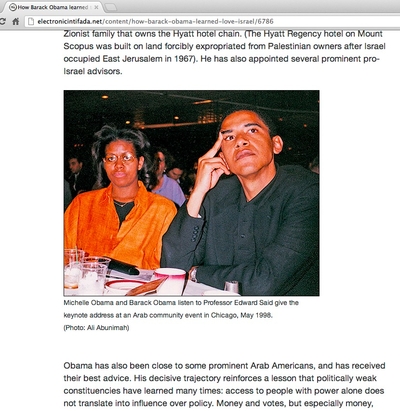
    These anti-Israel steps raise worries because they jibe with Obama’s early anti-Zionist views. We lack specifics, but we know that he studied with, befriended, socialized with, and encouraged Palestinian extremists. Take, for example, anti-Israel theorist Edward Said. A picture from 1998 shows Obama listening raptly to Said as he delivered the keynote speech at an Arab community event in Chicago. Or consider former PLO public-relations operative Rashid Khalidi, then Obama pal. In 2003, at an event to honor Khalidi, Obama sat idly by as speakers accused Israel of waging a terrorist campaign against Palestinians and compared “Zionist settlers on the West Bank” to Osama bin Laden. Ali Abunimah, an anti-Israel agitator, commended Obama in 2004 for “his call for an even-handed approach to the Palestinian-Israeli conflict,” code words for distancing the U.S. government from Israel. In turn, Obama praised Abunimah for his obsessively anti-Israel articles in the Chicago Tribune, urging him to “keep up the good work!”
    Abunimah also reveals that, starting in 2002, Obama toned down his anti-Israel rhetoric “as he planned his move from small-time Illinois politics to the national scene.” Obama made this explicit two years later, apologizing to Abunimah: “Hey, I’m sorry I haven’t said more about Palestine right now, but we are in a tough primary race. I’m hoping when things calm down I can be more up front.”
    And Obama dutifully tacked in the pro-Israel direction, if in a cramped and reluctant manner (“I have to deal with him every day,” he complainedabout Israeli prime minister Binyamin Netanyahu). He supported Israel in its 2008–2009 and 2012 wars with Hamas. His administrationcalled the Goldstone Report “deeply flawed” and backed Israel at the United Nations with lobbying efforts, votes, and vetoes. Armaments flowed. The Israeli exception to the Nuclear Non-Proliferation Treaty remained in place. When Ankara canceled Israeli participation in the 2009 “Anatolian Eagle” air-force exercise, the U.S. government pulled outin solidarity. If Obama created crises over Israeli housing starts, he eventually allowed these to simmer down.
    Returning to the present: Netanyahu’s likely reelection as Israeli prime minister this week will mean continuity of leadership in both countries. But that does not imply continuity in U.S.-Israel relations; after a decade of political positioning, Obama is now freed from reelection constraints and can finally express his early anti-Zionist views. Watch for a markedly worse tone from the second Obama administration toward the third Netanyahu government.
    Recalling what Obama said privately in March 2012 to then-president of Russia, Dmitry Medvedev (“This is my last election, and after my election, I have more flexibility”), there is every reason to think that, having won that reelection, things have now “calmed down” and, after a decade of caution, he can “be more up front” in advancing the Palestinian cause against Israel.
    I also predicted in September that “Israel’s troubles will really begin” should Obama win a second term. These troubles have begun; Jerusalem, brace for a rough four years.
    — Daniel Pipes is president of the Middle East Forum. © 2013 by Daniel Pipes. All rights reserved.

  • Monday, January 21, 2013

    Stan wouldn't want us to be sad

    By Bernie Miklasz
    The St. Louis Post-Dispatch
    January 21, 2013


    We knew this day was coming, because no one lives forever. Not even the seemingly indestructible Stan Musial. But when the word came down, when we learned that the greatest icon in St. Louis history had taken his last breath, the reality was stunning.
    The Man had passed away? No, no, no. This couldn’t be true. This means there would be no more of his traditional rides around the field at Busch Stadium.
    We wouldn’t see Stan waving to the crowd, laughing as he took his customary pantomime lefthanded swing to delight the fans.
    The famous Musial harmonica would remain silent.
    Who, then, would take us out to the ballgame?
    Without Musial’s beaming smile, the world would be a colder place. In a modern sports culture being overrun by charlatans, cheats and frauds, we’d lost one of the truly good guys, a wholly sincere person who was 100 percent worthy of love, respect and trust.
    Baseball’s Perfect Warrior, Baseball’s Perfect Knight, was finally at rest. But don’t be sad in the coming days. Musial, who spent his 92 years making others happy, wouldn’t want anyone to be down.
    Let’s celebrate Musial’s extraordinary life and be thankful for his enduring presence through the decades. Let’s keep it simple in honor of this remarkably uncomplicated man.
    There has never been a more perfect union, a relationship between an athlete and a town, than Stan Musial and St. Louis.
    From the time Stan took his first at-bat as a Cardinal, until his death Saturday at his home in Ladue, he was part of this community’s soul for 71 years, four months and two days.
    With no disrespect to Cal Ripken and Baltimore, Tony Gwynn and San Diego, Ernie Banks in Chicago, Robin Yount in Milwaukee and George Brett and Kansas City, there has never been a better fit than Musial and St. Louis. His personality was the ideal match. His unpretentious style reflected the St. Louis ethos.
    New York sports journalist George Vecsey, who wrote a superb Musial biography, is one who gets it.
    “He was a family man who put up his own Christmas lights on his ranch house in a modest neighborhood,” Vecsey wrote in the New York Times. “A friend of mine recalled going to a department store and seeing Stan and (wife) Lil testing the mattresses, bouncing up and down. They were regular citizens in a town that prized approachability.”
    Musial’s hitting statistics are legendary, and they define his exceptional value as a player. If only we could come up with another set of numbers that tell an even better story of his value as a man.
    How many autographs did Musial sign for awestruck fans? How many times did Stan go out of his way to brighten someone’s day, even if he was battling a cold, or in a hurry to make an appointment on time, or physically drained after playing a Sunday doubleheader in the sweltering St. Louis heat?
    Did Musial ever speak the word “no” when approached by a bashful stranger who wanted a signature, a photo or a handshake?
    Did he ever let anyone down?
    How many people leave a life without a single enemy?
    Musial retired, from life, as baseball’s career leader in kindness.
    I know this town was named for another saint — that would be King Louis IX — but a beloved saint went to heaven at 5:45 p.m. on Jan.19, 2013, so we might want to consider a do-over.
    For the record, that isn’t a serious suggestion. People in other cities will laugh at the notion. It’s corny, hokey and hopelessly provincial. But you had to be here — and know Stan Musial and what he meant to St. Louis — to really understand the symbolic point of renaming the place St. Stan.
    “There’s no perfect human being, but I have not come across anyone in sports who was closer to the image, in reality, than Stan Musial is,” broadcaster Bob Costas said. “Who has ever emanated more decency than Stan Musial does? You could always feel good about cheering him.”
    It’s important to remember that now. Musial’s passing represents a loss to St. Louis, the Cardinals, Major League Baseball and everyone who admired him. But in a grander scope, his death is a loss for civility, sportsmanship and character.
    The sports world has gone mad, with the calculating and insincere Lance Armstrong confessionals, and the craziness of a Notre Dame football player falling for a hoax. The police blotters filling up with the names of athletes gone wild. Retired NFL stars have tragically committed suicide after descending into depression caused, in part, by suffering multiple concussions during their playing days.
    We’re engaged in endless and vitriolic quarrels over steroids, Hall of Fame voting and ethics in sports. Fans and media are more cynical, and suspicious of what we’re watching. The guy hitting all of the home runs: Is he clean? Is he real? Whom can we trust?
    No such questions were asked about Stanley Frank Musial.
    My colleague and friend Dan O’Neill said it best on Saturday night:
    Stan Musial was the Last American Sports Hero.
    There are a thousand stories that define Musial’s persona — and almost supernatural charm — in a variety of ways. Most have been repeated through the years.
    Here are four of my personal favorites.
    First: Musial was inducted into the Baseball Hall of Fame on July 28, 1969. It was an overcast day in Cooperstown, with the crowd subdued and distracted by the threat of rain and thunderstorms. Moments before Musial’s official ceremony, the clouds got out of the way, and sunshine emerged.
    “Stan brought the sun,” said Pat Dean, widow of Cardinals Hall of Famer Dizzy Dean, on that day. “He always does.”
    Second: In the late 1960s, Musial and other major-league stars visited U.S. troops in Vietnam and went to the military hospital to console the wounded. One seriously injured soldier looked up at Musial from his hospital bed.
    “You’re the best,” he told Stan.
    Musial’s response: “No, you are.”
    Third, Brooklyn Dodgers pitcher Joe Black, an African-American, told a story of being racially taunted by players in the St. Louis dugout during a game. Musial, batting at the time, stepped out and angrily kicked the dirt to convey his disapproval. Stan waited for Black after the game, shook his hand and said, “I’m sorry that happened. But don’t you worry about it. You’re a great pitcher. You will win a lot of games.” Black said Musial’s support helped him gain the confidence he needed to become a top pitcher.
    Fourth: Legendary center fielder Willie Mays frequently praised Musial for befriending African-American players during the tense, post-integration period of baseball history. At an All-Star Game in the late 1950s the National League squad included seven black players.
    “We were in the back of the clubhouse playing poker and none of the white guys had come back or said, ‘Hi,’ or ‘How’s it going?’ or ‘How you guys doing?’ or ‘Welcome to the All-Star Game.’ Nothing,” Mays said. “We’re playing poker and all of a sudden I look up and here comes Stan toward us. He grabs a chair, sits down and starts playing cards with us. And Stan didn’t know how to play poker! But that was his way of welcoming us, of making us feel a part of it. I never forgot that. We never forgot that.”
    That’s Musial. He didn’t make fiery speeches. He didn’t “lead” a movement. He didn’t try to promote himself as an angelic humanitarian to grab favorable publicity. He simply handled and defused a difficult situation by being himself: gracious, cordial and warm. He made a positive difference in a subtle but meaningful manner.
    OK, here’s a fifth story.
    A love story.
    Stan and Lil.
    This may be the best Musial stat of them all: They were married for 71 years, four months and two days until Lil’s death May 3. Many years ago, at an after party at the baseball writers’ dinner downtown, I sat with Lil Musial for a while.
    The conversation turned to her romance with Stan.
    I asked her, “Does he bring you flowers?”
    Lil nodded, but said the bouquets weren’t necessary.
    “I don’t need flowers from Stan,” she told me. “Whenever he smiles at me, I fall in love with him all over again — just like the first day we met.”
    (If you believe in heaven, as I do, then please be comforted by this scene: Stan and Lil sitting side by side, smiling and holding hands as you read this.)
    Put into a historical context, Musial’s staying power was astonishing. His career, and life, played out over a considerable and epic sweep of the American experience.
    Think about this timeline: Stan stroked his first major-league hit 69 days before Japan attacked Pearl Harbor. He missed the 1945 season to serve in the military in World War II. His last hit came 54 days before the assassination of his friend President John F. Kennedy.
    On the night he died, Musial became the No. 1 trending topic on Twitter.
    In the late 1950s, Ty Cobb praised Musial for being the (nearly) perfect baseball player.
    Saturday night, after Musial’s death, Washington Nationals pitcher Stephen Strasburg, age 24, offered an appreciation of Stan with a tribute delivered on Twitter.
    Musial was a young player in 1947 when Jackie Robinson broke baseball’s color line. And in his twilight Musial received the country’s highest civilian honor, the Presidential Medal of Freedom, from Barack Obama, the nation’s first African-American president.
    What a life, and what a man.
    Stan Musial belonged to St. Louis, and he will always belong to St. Louis. He’s never going away. So let’s celebrate. We may even hear “Take Me Out to the Ballgame” played for the first time during a Catholic funeral Mass. To quote Stan: Whaddaya say?
    Bernie Miklasz is a columnist at the Post-Dispatch. Follow him on twitter @miklasz.

    Musial on field and off sports may never see again

    By Ben Reiter
    Sports Illustrated
    January 20, 2013


    Stan Musial
    Even after leaving the game in 1963, Stan Musial maintained the values that made him so beloved.
    AP
    Stan Musial played his last baseball game on Sept. 29, 1963. Thousands gathered in the old Busch Stadium in St. Louis that afternoon to watch various groups present the 42-year-old with various gifts -- he received a neckerchief from the Cub Scouts, a statue of Louis IX of France from the Chamber of Commerce, a diamond ring from his teammates -- and to watch him circle the field in a salmon-colored convertible, and to watch him accumulate hits number 3,629 and 3,630, still the fourth-most ever. Among the people in attendance was W.C. Heinz, who was the Musial of sportswriting, a quiet producer of beauty for a very long time.
    We are fortunate that Heinz was there. There are stories in the Oct. 11, 1963 issue of Life magazine that focus on such things as the strange circular postage stamps issued by the island nation of Tonga, and the ascension of Mount Kilimanjaro by the U.S. Secretary of the Interior Stewart Udall, and the increasingly messy situation in Vietnam, which seemed as if it might get even worse.
    The story that has endured, though, is Heinz's three-page account of the day of Musial's retirement, headlined, simply, "STAN MUSIAL'S LAST DAY." Musial died on Saturday at the age of 92, meaning that he had nearly five decades to damage the portrait that Heinz painted of him, more than half a lifetime to undercut, or at least complicate, his image, the way that so many of his contemporaries did through their drinking or womanizing or just their general haughtiness.
    He never did, not once in those 50 years to come in which he remained in the spotlight, beloved in his red sportscoat in St. Louis, respected nationwide. There are probably not many people about whom you can read a piece written so long before their deaths and be sure that their lifelong essence has been captured, but really, almost all you need to know about Musial -- all that Musial would likely care for you to know -- is in Heinz's three pages.
    Also in those pages is a model for all those who are, like him, blessed with great athletic gifts, as far as how to act, and how to be, when those gifts lead the public to want to shower you with attention and adoration. It is a particularly appropriate lesson this week, in which the ugliness that fills the heart of one of the sporting world's greatest heroes of the past two decades was laid bare, and in which another, more recent hero proved himself at the least unprepared to properly handle the public's desire to deify him.
    The central theme of Heinz's piece is that Musial is -- was -- a good man. We can tell that from the very beginning, in which, at 10:29 a.m., he walks out of his house to head to the ballpark for the final time. He is dressed plainly: "black suit, black shoes, a white shirt and a dark tie." He has already been to Mass that morning, with his family. His wife, Lillian, and the youngest of their four children, four-year-old Jean, follow him out the door. He asks Jean where she is going to be that day. "On the field," Jean says. "Good, honey," Musial says.
    Heinz also reminds us just how unusually gifted Musial was. His talents were obvious to everyone from the moment he joined the Cardinals as a 20-year-old in 1941. "You fellas will win it," Boston Braves manager Casey Stengel said to a group of beat writers for the World Series-bound Dodgers after Stengel had gotten his first look at the rookie, "but those Cardinals got a young kid in leftfield you guys are gonna be writin' about for 20 years." Stengel was close. It turned out to be 22.
    The brilliance of Heinz's piece, though, lies in its subtle examination of a third theme: that it is hard to be a good man when you are a star. Musial was both. Throughout the story, people approach him, wanting just a piece of him, and we get the sense that this is not something that happened only on the day of his retirement, but every day of his life. As he is driving to the ballpark in his Cadillac, a man calls out to him. "Hey Stan!" the man yells. "I hope you go out with a homer." "I'll settle for anything today," Musial replies, with a laugh.
    He passes St. Louis University, and the friend with whom he is driving suggests that perhaps he'd now have time to take some classes there. "I can't do anything like that in public," Musial points out. When he gets to the stadium, fans swarm him, each desperate to make some connection. A television director wants him to make his final entrance into the clubhouse a second time, through a door that is better for the camera. Cameras encircle his locker as he is getting dressed, and the director tries to tell him how to do it -- slowly. "How come you got all these guys following you all the time?" a teammate asks. "I don't know," Musial replies, joking. "I can't figure it out."
    By the end of the day, grown men have cried behind their sunglasses because they'd been close to him. And yet, Musial has never acted like anything other than simply who he is, and, for the rest of his life, he never would. It seemed easy for Musial, but then again even things that are very hard for most people seemed easy for him. "Hitting is like swimming," Heinz quotes Musial as saying. "Once you learn the stroke, you never forget it." Of course, there are several orders of magnitude more people who can swim a passable freestyle than can hit a 90-mile-per-hour fastball.
    The life of a professional athlete is, quite obviously, very different than it was on that September afternoon 50 years ago. The glare of the klieg lights is brighter, the money is bigger, the circles of cameras around lockers are deeper, the temptations are more tempting. So it is even harder than it was back then for stars to be like Musial. Which was someone who was actually (not just professedly) humble; someone who actually did value his family (he was married to Lillian for 72 years, until her death in May of last year); someone who was above all else decent, despite how easy it would have been to be otherwise.
    Sports would be less interesting were everyone like Stan Musial, were they devoid of their miscreants and thugs and cheaters and drunks and the rest. There will always be plenty of room for them. But we can also hope that there is room for more Musials, men who are treated as gods among us but have the strength of character to know that they are, simply, one of us. While other athletes might come close, the reality is that we have only ever had one athlete who was as great as he was, and as good as he was, too. After 92 years, he is gone now.