Sunday, October 08, 2006

Book Review: 'The Man Watching'


Concluding his remarks before a game against Villanova during the 2003 season, he said, "My thrill during our games is the understanding that every team that leaves the field against us knows they were beaten by a greater force. No, not a better team. They ran into a force. They found the center of our chest and it was hard and they couldn't knock us down. So when you're tackling out there today, I want you to throw your body at the girl with such a clattering of bones and gristle that she'll be worried about having a scar from her kneecap to her ankle. I want her wondering, 'If I finish this game, will I ever be able to wear a skirt again?'"

-From "The Man Watching" by Tim Crothers


The man who watches 'The Man Watching'
Tim Crothers produces 'the' book on Anson Dorrance

By Nicki Jhabvala, Correspondent
The Chapel Hill News
October 7, 2006

It was 1991. Tim Crothers was on assignment for Sports Illustrated to cover some 15-year-old golf prodigy trying to make it on the PGA tour.

"Standing in the parched fairway on the par-5, 18th hole at Los Serranos Country Club in Chino, Calif., last month," Crothers wrote, "Tiger Woods needed a birdie. So, of course, he wanted an eagle. That's Tiger."

Since Crothers, a UNC alumnus and former senior writer at Sports Illustrated, first noticed Woods, media everywhere have clamored for any chance to get at Tiger. Not only was Crothers to make Tiger's story national, but he did it in such detail that few have yet to match.

It was off-beat to cover a teen golf phenom, but that's Crothers' style. After Tiger, Crothers continued his string of new and even unusual stories, such as features on then-still-up-and-coming stars like Tim Duncan, and curiosities like Louis "Red" Klotz, the losingest coach in basketball.

But in 2001, Crothers started the biggest off-beat piece of his career.

Only this time, he sought out an already established, legitimate legend. One who had earned a dominant reputation far before most outside of his sport had ever heard his name. One who would allow Crothers to follow him around for five years to get the most in-depth story possible.
Crothers' book "The Man Watching" is University of North Carolina women's soccer coach Anson Dorrance, captured in his entirety in 352 pages.

"I met Anson when I went to school here in the early '80s," Crothers said. "He has such an interesting personality that he just kind of sticks with you. ... It was enough to put it in the back of my mind that someday it would be fun to find out what makes this guy tick."

The interest in seeking out Dorrance seems logical. Anyone who can produce a list of national, international, conference and individual records that is long enough for six straight pages of a media guide (a list printed in a point size so small it's barely visible to the naked eye) should be applauded. Coaching a team to 18 national titles, 16 ACC Conference Tournament Championships and a winning percentage of .944 is simply unheard of.

But Crothers' book is unlike any other documentary, in print or film, made about Dorrance and his dynastic program. And there have been more than a few.

See, Crothers didn't just "cover" Dorrance and the UNC soccer team. Nope. He practically followed their every movement and welcomed himself into their daily lives like the human stain.
Crothers got to go behind the scenes for more than just the standard 10 minutes allotted to post-game interviews. He got to know Dorrance and his players as people -- their likes, their dislikes, their mannerisms, their quirks.

Everything.

"Once I started working on it, it was like pulling a thread," Crothers said. "Once you started to pull, it was endless and you could always interview another player. Every time I talked to a player, she would say, 'Oh, well you should talk to so-and-so because she'll have some great stories for you.'"

Before Crothers knew it, he had interviewed 127 players. And those were just the Tar Heels. The number quickly escalated once he added players and coaches at other schools as well as Dorrance's family. The sources for the book total about 200.

"But, honestly, the real reason it took five years (to write) was because it was so freakin' fun," Crothers admitted. "When you've covered pro football, baseball and basketball as much as I did, you start to get jaded about sports and how everyone's just in it for the buck. What I found so refreshing about this, from day one, is that these women just love playing, and maybe more so, they just love hanging out with each other."

For his first six months on the project, Crothers could be found wandering Finley Field watching the team practice every afternoon. Since Dorrance has no qualms about showing off his players' skill or his unbeatable strategy on the field, anyone can watch, and Crothers was just another random face on the sidelines.

Crothers purposely waited until he felt he knew the players and coaches well enough before he hit them with the real, hard-core interviews. After closely observing the team to get a feel for the styles and personalities on the team, Crothers came out of hiding.

"He was just like a part of the team," said former UNC defender Kendall Fletcher. "We kind of accepted him. He was there and he just fit right in."

The games -- he sat on the bench.

The practices -- he was on the sidelines.

The pre-game meetings -- he sat in.

The bus trips to and from nearby games -- he sat in the front seat.

The team huddles -- he listened.

And every spare moment that he wasn't with Dorrance and the Tar Heels, he talked to former UNC players, other soccer coaches around the nation and Dorrance's family.

Fletcher went through her four years at UNC with Crothers along every step of the way. She and her teammates were aware of his presence, but they never made an issue of it. Nothing changed.

"For us, a lot of the stuff is just sheer comedy, and I think he captured a lot of that," Dorrance said. "Anytime someone associated with program reads it, they usually end up screaming in laughter because it reminds us of the stuff that goes on in around here."

But the comedy behind the scenes is only part of it.

Dorrance is a complex man. Crothers, although he was taken aback at times while with the Tar Heels, wanted to give the complete picture of Dorrance and his team -- the good and the bad.
An entire chapter is dedicated to Dorrance's "critics" and allegations against him. Life has not been a "never-ending ascension." The story is not sugar-coated. Dorrance's language is not censored.

The content is balanced; it's raw. But it's stocked to the brim with anecdotes.

Like the time current players Heather O'Reilly and Elizabeth Guess came to Dorrance for advice during their first Halloween in Chapel Hill. Or the time Mia Hamm came into Dorrance's office, a nervous wreck in anticipation of her initial goal-setting meeting with her coach, and he provided the motivation that has stuck with her since.

"Anson is one of the most candid people I have ever talked to, and so was everyone else I interviewed," Crothers said. "I'm not very good at cutting my work, and I'll be the first one to admit that this book could be a good 40 pages shorter. But I just couldn't bring myself to take any more out. I probably have two books this size of more anecdotes sitting on the cutting-room floor."

The details are abundant: Dorrance's posture on the sidelines; he has his players run sprints in a "Big V" as a reference to victory; he pronounces "victory" like VIC-tree; he uses trophies as doorstoppers; the way his leather office chair embodies his "Godfather" qualities.

The book hit stores this week and Crothers is scheduled to do a signing at the Bull's Head Bookshop on Oct. 24. Sports Illustrated columnist and author Rick Reilly has raved about it. Southern California football coach Pete Carroll loves it. But above all, Crothers' biggest critic couldn't be more pleased.

"It shares everything," Dorrance said. "Tim spent a lot of time with us. No one has ever studied us in this much depth. He's the only one who has done this."

Contact Nicki Jhabvala at 932-8743 or chnsports@nando.com.

Mike Lupica: No more excuses for Torre

[I don't know if I'm necessarily in favor of firing Mr. Torre...I have the utmost respect for him as a manager and a man. However, Mr. Lupica does present an impressive case for pulling the trigger. - jtf]

October 8, 2006
The New York Daily News

DETROIT - This is just as bad for the Yankees, losing these last three to the Tigers this way, not even competing in the last two, as losing four in a row to the Red Sox two years ago. These Yankees have now become the biggest postseason flops in the history of the team, maybe any team. This year George Steinbrenner went for a payroll of $213 million and gave Brian Cashman and Joe Torre the run of the place. Here is what that kind of money and that kind of restraint bought Steinbrenner: the most expensive glass jaw of all time, a team that gets knocked out cold in the first round again.

It is why the owner, 76 years old now, desperate to win at least one more World Series, has a perfect right to try it with some new people next season, starting with a new manager. They can't only be Torre's Yankees when they win.

This is now three times in five years, with a payroll three times the size of most playoff teams, that Joe Torre can't make it to the second round. Tell me another manager, no matter how well-respected, no matter how classy, who survives that? Steinbrenner can go hire Lou Piniella tomorrow if he wants to.

And George Steinbrenner ought to do everything he can to try and move Alex Rodriguez, who came here three seasons ago for easy World Series rings and hasn't even played a World Series. He was 2-for-15 against the Angels last season. He was 1-for-14 against the Tigers this time. If somebody will take him and give the Yankees young arms like the Tigers have in return, he goes. You know why Torre batted him eighth yesterday? Because he wasn't allowed to bat him 10th.

When Brian Cashman, the Yankee general manager, was asked yesterday if Torre and A-Rod will be back, outside a Yankee clubhouse as quiet as Yankee Stadium will be today and all through the baseball winter, quiet as an empty locker, he said, "Why wouldn't they?"

Cashman has a lot of power now. He won't make the call on who will manage the Yankees next season. The owner will. If the owner has seen enough since the Yankees beat the Mets to win the 2000 Series, no one can fault him. It has been a long time, more than a decade, since he fired a manager. If he isn't allowed to do it now, then when?

Oh, you bet he has the right to make a change. He has paid through the nose for that right.
Torre has been the best and classiest manager the Yankees have ever had. He has four World Series rings and is going to the Hall of Fame. He has also had more money spent on him, been given more Hall of Fame players and All-Stars, than any manager ever. When he does make it out of the first round now, his team loses four straight to the Red Sox after leading 3-0. Three years ago, his Yankees couldn't beat the Marlins, a team with a payroll of $50 million - tipping money at Yankee Stadium - in the World Series.

For a long time, Torre has been given everything and produced nothing in October, where Yankee managers are measured the same as players like A-Rod are.

"I think I'm part of the solution here," Rodriguez said in the visitors' clubhouse as Randy Johnson walked past him, pulling his carry-on bag. Two years now for Johnson with the Yankees. No postseason victories. They paid $57 million to get Johnson. They picked up A-Rod's contract even if they didn't have to pick up all of it. How has that worked out for everybody so far?

A-Rod thinks he's part of the solution? He's the only one in town right now. A Met town.

It was not just A-Rod. It was all of the Steinbrenner's All-Stars, the Greatest (Regular Season) Show on Earth. Mike Mussina, who thinks he merits another huge contract, could not hold the 3-1 lead in Game 2 the way he could not hold a big lead against the Angels four years ago, in another first-round collapse. From there, the Yankees were outscored 17-1 by the Detroit Tigers before Jorge Posada, who is a truly great Yankee still, hit a meaningless 2-run homer with two out in the 9th yesterday.

The final - so final - was 8-3 for the Tigers. It was 10-3 for the Red Sox in Game 7 of the American League Championship Series of '04. For all these years, when the Yankees go down in the postseason, go down hard, they stay down. It happened yesterday in Comerica Park. Three years running now, this is the most expensive flop in baseball history and sports history. Maybe this is the time to try it without All-Stars at every position on the field.

"For the first time under Joe," one Yankee said yesterday, "I felt like we didn't compete [in Game 3]."

You can talk about the way the Tigers pitched and talk about the way they jumped on the Yankees in both of the last two games. The Yankees, praised far and wide for their patience, finally looked like a bunch of scared, lunging minor-leaguers. If some of this doesn't land at the desk of the manager, when does it?

"I still think we're the best team," Johnny Damon said. "Sometimes the best team doesn't win."

You can say the Red Sox loss in '04 was worse, because the Yankees lost four straight, because no baseball team had ever done that, because it was the Red Sox. This one was just as bad.
Tiger relief pitchers ruined them, Kenny Rogers ruined them, Jeremy Bonderman looked like he might no-hit them yesterday. The best batting order since the '27 Yankees had nothing. They were supposed to make history. Instead they turn New York over to the Mets, and maybe get their manager fired. They can't only be Torre's Yankees when they win.

Adrian Wojnarowski: Time has come to run A-Rod out of town

In the words of Tony Soprano, "Whatever happened to Gary Cooper?"...The quintessential western hero, Cooper's marshal displayed a laconic stoicism in "High Noon" that has lingered in the consciousness of the American male for decades. Will Kane was a tight-lipped, grim-faced warrior who only privately considered the odds against him when preparing for his end-of-film showdown with Frank Miller and his gang.
Derek Jeter is the baseball equivalent of Kane...Alex Rodriguez is the baseball equivalent of Oprah Winfrey. I feel for A-Rod but I'm sick of hearing his bogus stiff-upper-lip equivocations...and comparing himself to the over-rated John Elway just happens to be the last nail in the coffin for me. The Yankees pitching staff is not at all representative of a team with a payroll of $200 million...in fact, it's a joke...but A-Rod's act has become tiresome and his departure would be welcome. Gary Cooper is alive and well and playing shortstop for the Yankees...he needs some teammates with similar grit and determination. - jtf]

October 8, 2006
BERGEN COUNTY RECORD

DETROIT -- Where am I going to do this, were the words Alex Rodriguez mumbled to himself as he walked into the middle of the visiting clubhouse, searching for an open space to give his State of A-Rod Address. In his meticulous, polished way, he had clearly been preparing his concession speech standing out at third base, the loneliest Yankee knowing that the summer and autumn of his unrest threaten to turn into the winter of his New York demise.

The Yankees' collapse was colossal, complete, but Rodriguez knew where the blame goes now, where getting dropped to sixth in the order, and then eighth, and hitting .071 for the American League Division Series gets him: On a rail, getting run out of town. Twenty innings across three games without a run for a lineup that people were calling the best ever, punctuated with a humiliating 8-3 loss to the Tigers on Saturday, didn't sit solitarily on A-Rod's shoulders, but he was the face of the collapse.

In three out of five years now, the American League East champions didn't get out of the division series. Joe Torre should survive this disaster, but he should return with an ultimatum next season of October success or bust. The bottom line: Torre stays, A-Rod goes.

The sheer fact that he takes up too much of the air, suffocating this franchise, himself, with the grandness of his burden, the monumental nature of his frailties, his insecurities, is enough reason for the Yankees to find a trade for him this winter. Even if A-Rod ever produces again in October, it is no longer worth the soap opera that comes with him getting there. He flattered himself, insisting that he finds "inspiration" in the championship chase of John Elway.

"My commitment is 100 percent unconditional," Rodriguez said. "I want to be a Yankee. I don't want to go anywhere else. I hope they don't want to trade me because I don't want to go anywhere.

"I've never ran from problems."

Well, he did run out of Texas, taking the $252 million and discarding last place. Nevertheless, he would repeat his Yankees devotional over and over, but it was hard to tell where the sincerity started and the strategic spin ended. With A-Rod, you always wonder the agenda, the angle.
After all, if he thinks the Yankees want to trade him -- and you'd better believe that his agent, Scott Boras, would have a pulse on it -- Rodriguez can make the case that he is categorically against it.

This way, no one can ever say that A-Rod wanted out because he believed he couldn't process the pressure in his tortured mind. This way, no one could ever call him a quitter. Still, here's the bottom line: A-Rod has a no-trade clause.

The Yankees can't send him anywhere.

This ends the discussion, right?

"If they're dying to get rid of me," A-Rod said, leaving open the possibility that he would agree to a trade. What he was suggesting was that, well, if they're dying to get rid of me, I guess I wouldn't stay where I'm unwanted. There's his out. A-Rod could've insisted that he would never, ever waive his no-trade, but he didn't.

He didn't need to finish his thought. If they're dying to get rid of me, well, you know the rest. A-Rod will go along with it. This is how A-Rod saves face on going hitless in his last 12 playoff at-bats to the Tigers, going 4-for-41 (.098) without an RBI in his last dozen postseason games. He was so unnerved on Saturday, he would boot a two-out grounder, compounding it with a bad throw to first base, an error that would lead to a 4-0 deficit in the third inning.

A-Rod was endemic of a complete Yankees collapse, but he wasn't alone. If people want to fire Torre and replace him with the best manager out of work, Lou Piniella, consider the consequences: The Yankees would be replacing Derek Jeter's guy with A-Rod's guy and it would isolate the captain, promising to polarize the clubhouse.

And make no mistake: Torre has no use for A-Rod. In a most emasculating move on Saturday, the manager dropped A-Rod to eighth in the order. In some ways, it almost looked like a preemptive way for Torre to shift blame away from himself, and thrust it on the lightning rod.

"I've got no one to blame but myself," Rodriguez said. "You've got to look in the mirror and address that. Obviously, I've got to find the success in the postseason. There's a lot to be learned from guys like [Derek] Jeter, [Jorge] Posada and Bernie [Williams] -- the guys who have done it. It seems like they play so relaxed."

Unlike A-Rod, who is a jittery mess. Torre has had it with that, and knows that A-Rod has the potential to pollute his program. Clearly, Torre has picked his spots to embellish his slights of A-Rod. Before Game 1, the manager dropped him to sixth in the batting order. Before Game 3, Torre suggested that A-Rod's mouth invites the trouble that comes his way. And before Game 4, Torre totally emasculated Rodriguez, dropping him to eighth in the order.

If the Yankees had managed to force a Game 5, A-Rod would've been brewing his boss' green tea.

Rodriguez is exhausting this franchise. And he's exhausting himself. If A-Rod comes back next year, the Yankees are inviting this never-ending soap opera to gather steam to the point where it won't just suffocate A-Rod, but the clubhouse. Rodriguez was busy patting himself on the back for persevering the "toughest season of my career," where he says he had to "endure some unbelievable things."

If Jeter was listening, he would've wanted to punch A-Rod in the mouth. More than he ordinarily does, anyway. The Yankees had lost, been embarrassed, and somehow A-Rod had made it all about A-Rod. He's proud he's still standing? That's the kind of self-congratulatory garbage that makes them loathe Rodriguez.

So, the Yankees' season imploded at Comerica Park, the reputed greatest hitting lineup in history turning out to be a bigger October bust than the $252 million man who nearly dropped out of the bottom of it by the ALDS' end. Alex Rodriguez wants to stay a Yankee, he says. He could've ended the discussion by insisting that he would never, ever waive his no-trade clause.

A-Rod wouldn't do it.

He played his final game as a Yankee on Saturday, and no one -- no one anywhere -- deep down was more relieved than him.

E-mail: wojnarowski@northjersey.com

Bill Madden: It will be deja Lou all over again in the Bronx

[The Yankees pitching was certainly not up to snuff...not the starting rotation...not the bullpen. Wang and Rivera are the only two pitchers who did their job consistently all year. That being said, how in the hell can the 'greatest lineup ever assembled' get outscored 22-7 during the last three games of the series? - jtf]

The New York Daily News
October 8, 2006

DETROIT - You can make the case that they didn't have enough pitching to get back to the World Series and a parade up the Canyon of Heroes, but I can assure you, George Steinbrenner doesn't want to hear it.

He may walk a little slower, talk in shorter sentences and seem somewhat detached from the operation he used to rule with an iron hand from the Stadium's boardroom to the bathrooms. But that does not mean there won't be repercussions from The Boss in the face of yet another humiliating early playoff exit by the $200 million Yankees.

Believe it. This time, faster than you can say "Goodbye, Joe. Welcome back, Lou," there will be. Steinbrenner doesn't want to hear about the pitching because in his mind he gave Joe Torre everything a manager could ask for, then had to watch as this modern-day "Murderer's Row" of superstar hitters visited Kenny Rogers' neighborhood Friday night and put on a performance as tepid as the real Mr. Rogers. They topped that by not even showing up yesterday as they skulked out of the playoffs.

Nowhere in sight was the plucky, energetic, opportunistic team that ran roughshod over the Red Sox those five games in August and took command of the AL East. And don't think that Steinbrenner wasn't hearing it from his Tampa player development kitchen cabinet: "Where the hell is Melky Cabrera?"

If nothing else, Torre's unabated loyalty to his veterans led to his - and his team's - undoing.

Everybody knew moving Gary Sheffield to first base was a gamble and that rushing him back into the lineup based on past performance would tamper with the Yanks' chemistry. Even Torre acknowledged that adding Sheffield and Alex Rodriguez to the mix these past couple of years made the Bombers too home-run conscious, with everyone trying to win the game with one swing of the bat. They fizzled those last four games against the Red Sox in the '04 ALCS and against the Angels in last year's division series, and it was the same story this time around: Twenty consecutive innings without a run.

The lack of passion shown by the Yankees was in stark contrast to that of Jimmy Leyland's scrappy underdog Tigers, and that as much as anything is a reflection on Torre, who was given a pass by Steinbrenner after the historic '04 collapse against the Red Sox and the early exit at the hands of the Angels last year. There will be no such pass after this one: Steinbrenner, who has always been a devotee of fiery managers, will undo his admitted biggest mistake as Yankee owner and bring back Piniella, his Tampa neighbor whom he fired twice in the 1980s.

Steinbrenner was never enamored with Torre's laid-back style. But save for those occasional subtle "it's up to Joe . . . it's Joe's team" swipes, he pledged his allegiance to Torre because of all the championships Torre won for him.

Now, the titles have stopped coming, even though Steinbrennner has pumped more and more money into the team, to the point where the bloated payroll is twice as large as any other team's in baseball. He does this because, at age 76, the Yankees are his lifeblood. So, yes, Steinbrenner is upset. He's upset his players have been underperforming for the money he's paying them. He's upset because outwardly his players don't seem to care nearly as much as he does.

In deference to Torre's four World Series trophies, Steinbrenner obliged Torre when the manager told him in their Tampa summit last November that he had to butt out and stop the jibes. In a series of meetings with the fractured Yankee front office last fall, Steinbrenner extended unprecedented power to both Torre and GM Brian Cashman. Ordinarily when things go badly in Yankeeland, no one escapes Steinbrenner's blame. But other than the $17 million spent on Kyle Farnsworth, Cashman's acquisitions - Bobby Abreu and Cory Lidle from the high-end shelf and Brian Bruney and Aaron Guiel from the bargain-basement counter - were important contributors toward winning the AL East.

Even though Steinbrenner lived up to his pledge of silence and support, it was "on Torre" this year.

Torre wanted no interference, no second-guessing or behind-the-scenes sniping from Steinbrenner or any of his minions, and that's what he got. Total support, but it came with a price - winning it all.

Steinbrenner has stayed away, stayed quiet while giving Torre all the resources to make that happen. At Steinbrenner's age, he doesn't want to hear "you can't win every year," and now that his favorite son, Piniella, is out there, a free agent, his managerial batteries recharged, what's another $7 million in severance for Torre going to matter to him on top of another wasted $200 million?

Jeff Jacoby: Undeserved Forgiveness

Boston Globe
October 8, 2006

"THERE WAS not one desk, not one chair, in the whole schoolroom that was not splattered with either blood or glass. There were bullet holes everywhere -- everywhere."

That description is from Janice Ballenger, a deputy coroner in Lancaster County, Pa. She was among the first to enter the West Nickel Mines Amish School after Charles Roberts murdered five girls and severely wounded five others there last week. One of the bodies she examined was that of Naomi Rose Ebersol , a 7-year-old who had been shot 20 times.

How do civilized human beings react to such an atrocity? With horror? Anger? Hatred?
Not the Amish.

Asked by a reporter if the community was angry about the killings, one Amish grandmother, Lizzie Fisher, was adamant. "Oh, no, no, definitely not," she said. "People don't feel that around here. We just don't."

Roberts planned his attack meticulously, making a list of supplies he would need, then gradually buying them over a six-day period. It makes the skin crawl just to read the inventory: nails, bolts, wrenches, bullets, guns, earplugs, wooden planks, rope. Roberts brought plastic ties to bind his victims' feet, chains and clamps for restraint, and tubes of K-Y Jelly, a sexual lubricant. Apparently he "planned to dig in for the long siege," a Pennsylvania State Police colonel surmised, and "intended to victimize these children in many ways prior to executing them."
Confronted with such premeditated malevolence, what decent person wouldn't seethe with fury and revulsion? What parent or grandparent wouldn't regard such a massacre as not only unspeakable, but well nigh unforgivable?

The Amish wouldn't.

"I don't think there's anybody here that wants to do anything but forgive," one Lancaster County resident was quoted as saying. "We don't need to think about judgment; we need to think about forgiveness and going on." Many townspeople announced their forgiveness of Roberts directly to his wife and children .

On CNN, a local pastor recounted how the grandfather of Marian Fisher, one of the murdered girls, told younger relatives not to hate Roberts for killing her.

"As we were standing next to the body of this 13-year-old girl, the grandfather was tutoring the young boys, he was . . . saying to the family, 'We must not think evil of this man,' " said the Rev. Robert Schenck. "It was one of the most touching things I have seen in 25 years of Christian ministry."

I can't deny that it is deeply affecting to see how seriously the Amish strive to heed Jesus' admonition to return good for evil and turn the other cheek. For many Christians, the Amish determination to forgive their daughters' murder is awe-inspiring. In his Beliefnet blog, the eloquent Rod Dreher marvels at CNN's story of the Amish grandfather. "Could you do that?" he writes. "Could you stand over the body of a dead child and tell the young not to hate her killer? I could not. Please, God, make me into the sort of man who could."

But hatred is not always wrong, and forgiveness is not always deserved. I admire the Amish villagers' resolve to live up to their Christian ideals even amid heartbreak, but how many of us would really want to live in a society in which no one gets angry when children are slaughtered? In which even the most horrific acts of cruelty were always and instantly forgiven? There is a time to love and a time to hate, Ecclesiastes teaches. If anything deserves to be hated, surely it is the pitiless murder of innocents.

To voluntarily forgive those who have hurt you is beautiful and praiseworthy. That is what Jesus did on the cross, what Christians do when they say the Lord's Prayer, what observant Jews do when they recite the bedtime Kriat Sh'ma. But to forgive those who have hurt -- who have murdered -- someone else? I cannot see how the world is made a better place by assuring someone who would do terrible things to others that he will be readily forgiven afterward, even if he shows no remorse.

There are indications that the killer in this case may have been in the grip of depression or delusion . Perhaps it was madness more than evil that drove him to commit this horror, in which case forgiveness might be more understandable.

But the Amish make it clear that their reaction would be the same either way. I wish them well, but I would not want to be like them, reacting to terrible crimes with dispassion and absolution. "Let those who love the Lord hate evil," the Psalmist writes. The murder of the Amish girls was a deeply hateful evil. There is nothing godly about pretending it wasn't.

Jeff Jacoby's e-mail address is jacoby@globe.com.
© Copyright 2006 Globe Newspaper Company.

Mark Steyn: Page Scandal Makes America Look Silly

October 8, 2006
Chicago Sun-Times

I'm a foreigner, so I might not be up to speed on how things work around here. But, insofar as I understand it after the last week, American politics is divided between: teenage pages; guys who are hot for teenage pages; guys who are enablers for guys who are hot for teenage pages; guys who devote inordinate time and effort to entrapping guys who are hot for teenage pages; guys who are rattled by guys accusing them of having devoted insufficient time and effort to nailing the guys who are hot for teenage pages and get panicked into holding press conferences where they announce the following:

"As the speaker I take responsibility for everything in the building. The buck stops here. ... That is why I directed the clerk of the House to establish a hotline for reporting any information concerning pages or the page program. As of this morning, the clerk of the House has activated the tip-line. . . . The page program tip line is 866-348-0481."

(If the clerk's not there, you can have him paged.)

J. Dennis Hastert actually stood up in public and made that announcement. And, of course, the Democrats immediately denounced the notorious Gay Pedophile Ringleader of the House for the pitiful inadequacy of his page tip-line: Oh, sure, now he wants to set up 1-800-GAY-PAGE and invite anyone with info to use the secure log-in at www.GOPpredators.com, but where was he when the buck stopped here en route to the end-of-legislative-session communal showers?
Speaker Hastert called in the FBI, the CIA, the DEA and announced an emergency bill to rename the BATF the Bureau of Alcohol, Tobacco, Firearms and Pages. He declared Mark Foley's pants a federal disaster area. He voted a $4 billion reconstruction earmark to the congress- ional page program and invited Dubai Page World to run it. And, with every press conference designed to get himself out of the hole he'd dug at the previous press conference, the 50 percent of Americans who pay minimal attention to politics (which, if there's any justice, will be up to 93 percent by now) caught Hastert floundering on the evening news and thought, "So that's the gay pedophile, eh? Disgusting. There oughtta be a law against it."

Well, there is. Many laws, in fact. And it's not clear any of them were broken. It's a good basic rule of thumb that no matter how bad a scandal is, the political class' response will be worse, largely hysterical and lacking any sense of proportion. But, even by those minimal expectations, this last week has been unbecoming for a serious nation. In London, sex scandals come along every other week. You name it, British parliamentarians do it: three-in-a-bed, auto-erotic asphyxiation, gay teen flagellation, getting your toes sucked while wearing the soccer kit of Chelsea Football Club. But at least at Westminster, sex scandals require actual sex. That the governing party of the world's only superpower could be felled by one creepy pervert's masturbatory e-mails and IMs is an event historians will marvel at. Granted that the Roman Empire in its death throes got hung up on gay sex, the American hyperpower seems set to be the first to collapse over gay non-sex.

And no, I'm not a "typical right-wing pedophile apologist" excusing Foley. But, in case you haven't noticed, he's gone. He quit quicker than his instant message. And, true, he's since done the usual contemptible redemption shtick, announcing he's going into alcohol rehab, etc., when the reality is he'd be a better man if he drank more and IMed teens about the size of their wedding tackle less. And yes, he'll get a book deal, just like New Jersey's revolting ex-governor. But no one will buy the book -- and besides, what do you want? When a member of the House of Lords went abroad after a homosexual scandal, King George V is said to have remarked, "Good God, I thought fellows like that shot themselves." It may, indeed, be a less revolting spectacle for a chap to take a tumbler of whiskey and a loaded revolver into his study than to go on "Oprah" and bore on about his personal demons, abusive father, etc., etc. But we live in different times. Foley's history; he's the first footnote in history to a page in history. So the only question now is whether there is any larger issue here worth spending 10 minutes on.

And the answer to that is obvious. This was a honey trap (as they used to say in the Cold War) designed to leverage one peripheral figure's squalid fantasies into political opportunity. It's as predictable as the leaves falling from the trees, except that it only occurs every other autumn. Still, I take my hat off to the media and Democratic Party. Indeed, in the spirit of Bill Clinton, I take my pants off to them. It is a remarkable achievement to have transformed, in little more than a week, the GOP into the Catholic Diocese of Boston with Speaker Hastert as Cardinal Law and the page program as the massed ranks of 7-year-old altar boys. What an awesome force the Dems would be if only the ruthless skill and cunning that went into this operation could be applied to, say, national security.

But I very much doubt, despite the expertise with which the sheep have been rounded up and set baa-ing, that Showtime at the Foley Bergere will pay off in November. There are many legitimate reasons for electors to toss out the Republican Congress, but the notion that they're a hotbed of gay pedophile enablers is not one of them. Had Foley dug in and attempted to cling on, his GOP colleagues would have been all over TV deploring his behavior, calling on him to step down, expressing outrage, etc. After two or three days, a few lefties might even have piped up to assail the Republican theocrat sexual McCarthyites tormenting the poor chap. Had he actually had sex with congressional pages, affronted gay groups would have pointed out this was perfectly legal in the relevant jurisdictions and would have complained ferociously about the stigmatizing of gay relationships and Democrats would have declared there should be places for all at the American table, especially had Foley done a Jim McGreevey and announced that "my truth is I am a gay American." A few quirks of timing and the parties' respective roles might have been entirely reversed. Scandalwise, the Republicans always play the submissive masochists but the Dems are bi-swingers, happy to flay the GOP as either (a) uptight prudes or (b) pedophile enablers, according to what suits. What would have been consistent in both narratives is the assumption by the Democrats, the media and the Gay Page Tip-Line end of the Republican Party is that the electorate is stupid. In the sense that there's any "child abuse" going on here, the American people are being treated like children and abused by the politico-media class.

This last week is unbecoming of a mature democracy. In the wider world, America can survive being the Great Sa- tan, but not the Great Laughingstock.

©Mark Steyn 2006

Saturday, October 07, 2006

Art Review: 'Cimabue at the Frick'


At the Frick, Another Reunion for Long-Lost Siblings

By ROBERTA SMITH
The New York Times
Published: October 7, 2006

“Cimabue and Early Italian Devotional Painting”runs through Dec. 31 at the Frick Collection, 1 East 70th Street, Manhattan; (212) 288-0700.

Things happen when talent travels. So it was in New York in the late 1930’s and early 40’s, when the Surrealists fled war-torn Europe and helped speed the development of Abstract Expressionism. Or even in the 1590’s, when the Japanese overlord Toyotomi Hideyoshi, on the warpath in Korea, forcibly relocated whole villages of Korean potters to Japan, ensuring his country’s greatness in ceramics.

And so it was, too, sometime in 12th- or 13th-century Florence, when, according to Giorgio Vasari, the city fathers, distressed by an evident dearth of gifted local painters, summoned artists trained in the Byzantine style, and their presence contributed to the early stages of the Italian Renaissance. That at least is how it looks in “Cimabue and Early Italian Devotional Painting,” a jewel-box exhibition at the Frick Collection, organized by Holly Flora, a former curatorial fellow at the Frick and now curator at the Museum of Biblical Art in Manhattan.

Cimabue (about 1240-1302) is one of the Big Three — with Duccio and Giotto — who laid the groundwork for the early Italian Renaissance. His name is as weighty as it is mysterious, partly because so few of his works survive. This tiny exhibition makes his greatness crystal clear. At its center are two small works newly attributed to him, “The Flagellation of Christ,” which the Frick acquired in 1950, and “The Virgin and Child Enthroned With Two Angels,” a recently discovered work that is now in the collection of the National Gallery in London.

The Cimabues are teamed with four other small works, all from local museums. But there is plenty to look at, not the least because each involves multiple images. The Metropolitan Museum of Art has lent a triptych by a Florentine contemporary of Cimabue, known only as the Magdalen Master, and a diptych by Pacino di Bonaguida, a younger follower, also represented by four images on vellum from the Morgan Library and Museum.

The Met has also sent over a beautiful little reliquary diptych whose images are reverse glass paintings in gold and black. They all fit perfectly into the Frick’s small Cabinet Gallery, which is, aptly, the size of a private chapel.

The ensemble conspires to give us a narrow, concentrated view of a turning point in art and religion. It pinpoints a time when the use of Gothic gold was dwindling, one-point perspective was imminent, and artists were approaching a greater range of subjects with a greater degree of naturalism. A more personal kind of worship was on the rise too, one that encouraged the faithful to re-experience the suffering of Jesus’ life less as a path to heaven than to humility on earth. This suffering had to be made real, which is where naturalism came in.

The Frick show is the culmination of a series of recent events that unfolded at a dizzying rate. Previously unknown to scholars, “The Virgin and Child Enthroned” emerged in 2000 from a British private collection, headed for auction. Inklings that it might be a Cimabue quickly emerged. The panel was brought to New York for a side-by-side inspection with the Frick’s similarly small “Flagellation,” where its Cimabue-ness firmed up, as did that of the Frick panel, whose attribution had been cloudy for decades. (Caught between pro-Cimabue and pro-Duccio camps, each led by prominent scholars, the Frick had until recently diplomatically stuck with “Tuscan School” since 1968.)

The two little panels matched in wood and paint composition, in the little pinpricks in their gold backgrounds (defining halos), in their nearly identical measurements. Even the hinge marks and the intermittent red borders agreed. Most important, they were stylistically of a piece, so much so that it seemed likely that they were from the same altarpiece.

Suddenly the world had not one but two new widely agreed-upon Cimabue panels, pushing to six, or maybe eight, a number that had previously hovered between four and six. “The Virgin and Child” was diverted from auction with help from the British government, partly in lieu of estate taxes. Over the last two years the panels have been reunited in exhibitions in London and Pisa, and now it is New York’s turn. It seems doubtful that they will be together again anytime soon.

So savor their mutually illuminating beauty and commonalities while you can, starting with the noticeably sad, noble, carefully shadowed faces of the enthroned Madonna and the adult Jesus, who both look directly toward the viewer, full of tragic foreknowledge. Take in the delicate gestures of flanking figures, whether the angels beside the Virgin’s throne, or the two whip-wielding tormentors in “The Flagellation.”

There are telling details, like the foliate carvings on the Virgin’s throne and the balustrade in the middle ground of “The Flagellation,” or the transparent textiles; the one on which the Virgin sits foretells the one serving as Jesus’ loincloth in “The Flagellation.”

Other garments add atmosphere: the skillfully diaphanous angels’ robes, bordered in a white-on-black-on red geometric pattern, have a regularity that is as reassuring as the asymmetry of the tormentors’ bright clothes is not.

In both these paintings Cimabue zeroes in on an emotional instant that seems to encompass real time, as Giotto did after him. The angels touch the throne as if gently sliding it forward like a gift; the tormentors are prepared to strike.

But the more abstract, shared majesty of space and scale is just as important, as is the way the central figure commands each panel, anchored to something greater that is both worldly and not. In “The Flagellation,” the column to which Jesus is tied bisects the panel from top to bottom. The chassis of the Madonna’s throne is an arching empty hemisphere, suggesting both a basilica and the globe.

The Magdalen Master’s triptych and di Bonaguida’s diptych provide a fascinating before and after for the Cimabues. You may have come across the triptych in the medieval galleries at the Met, but probably not displayed so close-up, or so well lighted. Suggesting an artist made giddy by the attractions of Byzantine formality and the possibilities of naturalism, it is packed with pictorial and narrative events.

The triptych centers on a Madonna and Child Enthroned, surrounded by smaller scenes that culminate in a depiction of Christ in Majesty. He sits before a handsomely striped mandorla edged by an undulating, ribbonlike pink band; both motifs evoke the Ravenna mosaics. The Last Supper, with Judas in a black halo, includes an extraordinarily elaborate repast, including several detailed renderings of knives. A flagellation scene features a tautly twisted white column. In short, this painting is a blast, stoked by a palette limited to gold, white, pink, red and a (by now) blackish blue.

Di Bonaguida’s relatively sedate diptych mainly shows how quickly Cimabue’s influence spread. Yet he comes very close to the master’s emotional and compositional clarity in the works on vellum here. The Morgan manuscript, “Scenes From the Life of Christ,” is without a text. It is temporarily unbound, which is why you can see four images at once. Each image fills a page: a Flagellation, a Mocking of Christ, a Crucifixion and a Lamentation.

The colors are eye-poppingly fresh, especially a nearly fluorescent orange that is distributed judiciously among shades of blue, green and pink — except in the Crucifixion scene, where its absence seems appropriate. Throughout, the figures have a wonderful, slightly rubbery liveliness and stubby, comic-book hands. In the last image the mountains that rise behind the mourners are pale green and pronged; they echo the beseeching hands of the Mary Magdalen.

Together these works highlight the radical simplicity and directness of Cimabue’s art, without letting it completely steal the show.

Friday, October 06, 2006

Kathleen Parker: Abortion Chic

[I appreciate Ms. Parker's thoughtful approach to this issue...warning: plot spoiler ahead...Ms. Parker is "relunctantly pro-choice"...I do not hold with that position...I am a wild-eyed pro-lifer. That being said, Ms. Parker takes a much more compassionate approach to this issue than the vast majority of those who describe themselves as "pro-choice". - jtf]

October 06, 2006
The Orlando Sentinel
Kathleen Parker

WASHINGTON -- As public relations campaigns go, proudly proclaiming "We Had Abortions'' probably isn't going to win any Addy awards.

Such is the gist of Ms. Magazine's current campaign to thwart trends toward curtailment of abortion. The Oct. 10 issue of the feminist magazine features a cover story titled "We Had Abortions,'' as well as a petition signed by thousands of women who, well, have had abortions.
And who are not one bit sorry.

The campaign was organized to put a woman's face on abortion, as Ms. Magazine publisher Eleanor Smeal put it, and as a counterpunch to pro-life testimonials from women who regretted their abortions.

The fact that many women feel shame, guilt and loss -- and are willing to say so -- has created a snag in the fabric of pro-choice arguments that focus only on the technical aspect of abortion.
On Wednesday, Smeal told MSNBC's Tucker Carlson that abortion is "a medical procedure, that's obvious.''

Actually, it's not obvious. Abortion certainly involves medical personnel and equipment, but the result is something more than merely medical. It is also human -- or more to the point -- inhuman.

To put an accurate face on abortion would require something that strict pro-choicers refuse to acknowledge: That abortion really has three faces -- that of the mother, the father, and that of the ... what do we call it? Fetus is so South Park these days. How about the quirky "products of conception from your termination''?

That's how hospital administrators a few years ago in Glasgow, Scotland, labeled the post-abortion remains from Nicola McManus, who had induced the miscarriage of her nine-week-old "baby,'' as I prefer to call it, upon taking the RU486 "abortion pill.''

McManus was startled to discover the remains in a jar resting on a shelf in her hospital room. Her outrage at the careless hospital staff brought tears and the sort of statement Ms. & Co. prefer not to hear: "Women need more counseling before abortions, not less,'' said McManus. "I will never get over what happened to me.''

A nine-week-old fetus, for the record, has a heartbeat, a closed circulatory system, a respiratory system, eyes, ears and brain function. She can't go shopping yet, but she can squint, swallow, move her tongue and make a fist. She is not, in other words, "just a clump of cells.''

The problem with petitions and "I Had An Abortion'' T-shirts, such as those hawked by Planned Parenthood, is that they trivialize the deeply emotional and spiritual consequences many women suffer. They also deny girls and young women access to the nobler feminist position that knowledge is power.

We insist on informed consent for appendectomies or tooth extractions, but not abortions. As a result, American daughters now coming of age will see only the go-girl aspect of sexual freedom without the whoa-mama revelation of maternal awe.

The latter isn't learned from a textbook, but is experienced during that moment of personal reckoning when one realizes that a fetus is unequivocally a baby. My own transformative thinking -- from an unflinching pro-choicer to a disclaiming pro-lifer -- came with childbirth and motherhood.

After experiencing the humbling power of creation, it was impossible for me to view abortion as anything but the taking of a life. That is the truer lesson feminism should impart to its little sisters.

Now for the painful disclaimer I hinted at above. It begins with "Nevertheless,'' and ends with "I am reluctantly pro-choice.'' The very bottom line is that abortion ultimately is a personal decision. That said, I favor far stricter limits than most pro-choicers, beginning with "six weeks and time's up.''

I figure 42 days is enough time for a gal to figure out whether she's up for motherhood. It's not a perfect solution, but it's a sane remedy to appalling recklessness.

As I differ with pro-choicers, I also differ with pro-lifers who insist that once abortion is outlawed, hearts and minds will follow. It is more likely that abortion will continue, but will become more dangerous and even more hideous.

Hearts and minds indeed must be changed, and feminists -- if they really care about women -- should lead the charge. By showing and telling the unfiltered truth, abortion eventually will die of natural causes.

Flaunting abortion on T-shirts and petitions may make for radical fashion, but the models and signatories aren't likely to sway people in the hoped-for way. For beneath the message is a callousness that merely reiterates the lack of empathy implicit in every abortion. Likely few will be inclined to award empathy in return.

kparker@orlandosentinel.com

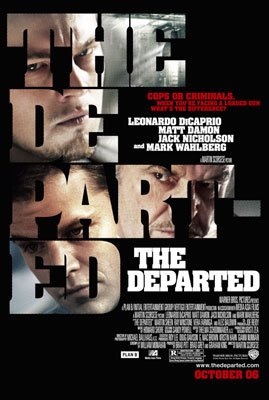
Film Review: "The Departed"


Scorsese’s Hall of Mirrors, Littered With Bloody Deceit

By MANOHLA DARGIS
The New York Times
Published: October 6, 2006

There are almost as many films fighting in “The Departed” as there are guys slugging it out. First among those films is Martin Scorsese’s cubistic entertainment about men divided by power, loyalty and their own selves. Hovering above that film like a shadow is “Infernal Affairs,” the equally sleek Hong Kong assemblage on which it is based and which serves as one of its myriad doubles. And then there is the film conjured up by Jack, as in Jack Nicholson, who when not serving Mr. Scorsese’s interests with a monstrous leer all but subverts those interests with a greedy, devouring hunger.

Each Scorsese film comes freighted with so many expectations, as well as the enormity of his own legend, that it’s a wonder the director can bear the weight. Compared with his last fictional outings, the period story “Gangs of New York” and the Howard Hughes portrait “The Aviator,” this new work feels as light as a feather, or as light as any divertissement from a major filmmaker who funnels his ambitions through genre. What helps make “The Departed” at once a success and a relief isn’t that the director of “Kundun,” Mr. Scorsese’s deeply felt film about the Dalai Lama, is back on the mean streets where he belongs; what’s at stake here is the film and the filmmaking, not the director’s epic importance.

In “The Departed” the camera work and cutting feel faster, lower to the ground, more urgent than they have in his recent films. (Michael Ballhaus shot it; Thelma Schoonmaker edited.) The speed and Mr. Scorsese’s sureness of touch, particularly when it comes to carving up space with the camera, keep the plot’s hall of mirrors from becoming a distraction.

There simply isn’t time to think about the story and whether any of it makes sense, including the astonishing coincidences involving its stealth doppelgängers: Matt Damon’s Colin Sullivan, a bad guy who goes undercover in Boston as a state police officer, and Leonardo DiCaprio’s Billy Costigan, a state cop who infiltrates the underworld. Strangers to each other, Colin and Billy are brothers of a kind when it comes to Frank Costello, the gangster played by Mr. Nicholson. The evil this man does and portends is laid out with precision timing in the hair-raising opening minutes.

As the Rolling Stones wail on the soundtrack (“War, children, it’s just a shot away”), Frank moves through the shadows, his face almost entirely obscured. Dispensing Sun Tzu-like truths as if they were Pez candies, he sets his sights on little Colin Sullivan who, with eyes wide as plates, listens rapt. Frank buys the boy groceries, then leans into the girl behind the store counter, whispering something in her ear. (Her face says it’s something dirty.) Minutes later Colin (now played by Mr. Damon) has graduated from the police academy and is thanking Frank for his graduation gift. With a bag of food, the bad man has bought a soul.

Mr. Damon enters the story about the same time that Mr. Nicholson exits the shadows. Too bad he doesn’t stay there until the final credits. This Janus-like actor has long presented two faces for the camera, the jester called Jack and the actor named Nicholson. He has worn both faces for some of his famous roles, but over time he has grown fond of the outsize persona called Jack, with his shades and master-of-ceremonies sneer, and it’s hard not to think that the man has become his mask. Mr. Nicholson has some choice moments in “The Departed”: he owns the thrilling opening minutes and is persuasively unnerving in his early scenes with Billy, whom he only knows as a neighborhood loser ripe for the plucking.

But as the story twists and twists some more, Mr. Nicholson begins to mix too much Jack into his characterization. In Alexander Payne’s “About Schmidt,” he plays a man whose tamped-down disappointment meant that he had to pull the performance from deep inside; he committed to the part without the help of his sidekick persona. In “The Departed” he’s playing bigger and badder than life with engines roaring. It’s a loud, showy performance. Frank even comes equipped with a trove of gaudy accouterments: a goatee like an arrow, a leopard-print robe, a bevy of babes, a severed hand and a ridiculous fake phallus. Another actor might wear these accessories; Mr. Nicholson upstages them.

Mr. Scorsese, no wallflower himself, spends a lot of time vying for attention with his famous star. Mr. Damon and Mr. DiCaprio serve him better. Mr. Damon does some very good work as the buttoned-down gangster hiding a world of darkness behind a facade of normalcy; his boyish looks have rarely looked creepier than when Colin is eagerly doing Frank’s bidding. And Mr. DiCaprio’s own callow looks fit better with his role than they did in either “Gangs of New York” or “The Aviator.” He falls apart nicely, and in the scene in which he stands, anguished and wrung out, over the body of a fallen colleague, you see what Mr. Scorsese might have seen all along: a vulnerability that seems animal-like in its unknowing.

The role generally works to Mr. DiCaprio’s strengths since he has to keep a lid on the character and his own tendency to go overly big; even his physical performance, the way his arms and legs jangle, is more controlled. Billy melts down, but he melts slowly, his panic leaking through the cracks opened up by his escalating fear. Terrified that Frank will discover his identity, he unloads on a police shrink (Vera Farmiga, working hard to make a nothing role count), who also happens to be Colin’s girlfriend. The plot thickens, then reaches full boil among further complications, dirty dealings, blood on the floor and excellent performances from Alec Baldwin and Mark Wahlberg (as detectives), who own their every scene. As do the rest of the actors, they prove that what really counts here, in the end, isn’t the film, but all its swaggering men.

Fine as Mr. DiCaprio and Mr. Damon are, neither is strong enough to usurp memories of the actors who played the same roles in the original — Tony Leung as the good guy, Andy Lau as the bad — both of whom register with more adult assurance. That’s an observation, not an indictment. Comparisons between “Infernal Affairs” and its redo are unavoidable given how closely the screenwriter William Monahan follows the first film’s beats and scenes. But as fans of “Infernal Affairs” (and its two sequels) know well, the Hong Kong film owes an enormous debt to Mr. Scorsese, whose imprint, along with that of Michael Mann, is all over the trilogy. The Hong Kong and Hollywood action films are themselves doppelgängers of a sort, and Mr. Scorsese, himself larger than life, is one of their biggest, baddest daddies.

“The Departed” is rated R (Under 17 requires accompanying parent or adult guardian). The language is dirty and the action bloody.

THE DEPARTED

Opens today nationwide.

Directed by Martin Scorsese; written by William Monahan, based on the screenplay for the film “Infernal Affairs”; director of photography, Michael Ballhaus; edited by Thelma Schoonmaker; music by Howard Shore; production designer, Kristi Zea; produced by Brad Pitt, Brad Grey and Graham King; released by Warner Brothers Pictures. Running time: 150 minutes.

WITH: Leonardo DiCaprio (Billy Costigan), Matt Damon (Colin Sullivan), Jack Nicholson (Frank Costello), Mark Wahlberg (Dignam), Martin Sheen (Queenan), Ray Winstone (Mr. French), Vera Farmiga (Madolyn), Alec Baldwin (Ellerby) and Anthony Anderson (Brown).

Thursday, October 05, 2006

David McCormick: An African Taliban

The political situation in Somalia degenerates into a nightmare.

http://www.nationalreview.com
October 4, 2006

Thirteen years ago this week, a pitched battle erupted in Mogadishu that led to the deaths of 18 American servicemen. They had been attempting to bring a measure of stability to war-torn Somalia. The determination demonstrated by those soldiers, however, was not matched by politicians in Washington. In the face of public confusion about and congressional outrage over a mission that resulted in American bodies being dragged through the streets of a far-off capital, the Clinton administration decided within days of the battle’s end to withdraw all U.S. forces from the country.

In the ensuing years, the consequences of that ignominious retreat have revealed themselves in spades. Some have simply been ignored, like the enduring humanitarian catastrophe levied on the Somali populace. Others have been disputed, such as the impression left with international terrorists that the United States would run if bloodied — a belief that undoubtedly offered some motivation for the attacks of September 11.

Unavoidable and indisputable progress, however, has been made in only the past few months by Islamic extremists, organized under the banner of the Islamic Courts Union (ICU), toward the consolidation of power in Somalia. Both the ICU’s ideology and the manner in which it is seizing control are eerily reminiscent of the Taliban’s rise in Afghanistan. Should the United States and its regional allies fail to act quickly, a reincarnation of that Islamofascist regime will soon entrench itself in the Horn of Africa. The first Islamic courts emerged at the neighborhood level throughout the country — though administratively and ideologically independent of one another — in the vacuum resulting from the collapse of Siad Barre’s dictatorship in 1991. Confronted by the anarchic warlordism that followed, many Somalis freely submitted to the judicial authority of the courts and took advantage of their ability to offer basic social services. By bringing a degree of order to the lawless country, the courts’ popularity increased over the years.

In the late-1990s, a movement aimed at unifying the disparate courts in order to gain leverage in the nascent national political process began to develop under the leadership of Sheikh Hassan Dahir Aweys. This coalition would eventually become the ICU. Though unknown to most Western observers, Aweys had notoriously served as military commander of al-Ittihad al-Islami (AIAI) — an extremist Islamic organization that seeks to impose a strict version of sharia law on ethnic Somalis, and in parts of Ethiopia and Kenya. Among its terrorist credentials, AIAI has carried out regular attacks against Ethiopia and is linked to al Qaeda’s bombing of the U.S. embassies in Nairobi and Dar-es-Salaam in 1998 (it is believed that elements of the ICU continue to provide shelter to the terrorists responsible for those and other attacks against Western targets).

By the early part of 2006, the level of cooperation attained by the ICU made it appear threatening enough to convince competing Mogadishu warlords — brutal enough in their own right — to partner with one another in The Alliance for Restoration of Peace and Counter-Terrorism (ARPCT). This anti-Islamist coalition, however, badly miscalculated the competence of ICU militias that fought not for money but for ideology, and whose strength was buttressed by Arab jihadis. By late summer, the ARPCT was thoroughly defeated, and the ICU has since determinedly marched from town to town, tightening its hold on the southern part of the country by acquiring the loyalty of militias in those locales — increasingly without having to fire a shot. In areas that the ICU has come to control, it has hardly attempted to disguise its vision for greater Somalia. In a Taliban-like manner, the ICU has closed cinemas and prohibited music and mixed-gender parties. It has banned civic organizations, and it has even begun to execute criminals publicly.

Following the ARPCT’s defeat, commentators heaped opprobrium on the United States for its tacit — and probably material — support of the warlords, with whom U.S. intelligence agencies had worked in the past to capture individual terrorists residing in Somalia. This line of thinking held that such posturing fueled Islamist rage and forced closer cooperation among the Islamic courts. That criticism, however, was badly misplaced.

While U.S. policy certainly bears its share of responsibility for the ascendance of the ICU, its failure lies in an unwillingness to offer greater support to anti-Islamist constituencies. In Somalia, as in many other places around the world, policymakers treated Islamofascism’s advance on the political, cultural, and social order as insignificant and/or as an internal matter not to be meddled with. As such, measures aimed at creating conditions that might have made the broader Somali population — which has historically practiced a moderate form of Islam — more antagonistic toward the ICU’s program were neglected.

Some have expressed hope that there is still time to facilitate negotiations between the ICU and the displaced Transitional Federal Government (TFG). The TFG is holding out — backed by Ethiopian troops — in the city of Baidoa, and some suggest that these two forces could be persuaded to form a unity government. The TFG, however, enjoys almost no support among Somali citizens and is propped up only by assistance from the international community. From its relative position of power, the ICU is unlikely to accept any settlement other than one that achieves its final objective, which was reiterated last June by Sheikh Aweys: “Any government we agree on would be based on the holy Koran and the teachings of our Prophet Muhammad.” It seems, then, that only a decisive blow will uproot the ICU. With pressing commitments elsewhere, the United States cannot afford to participate militarily; it is nevertheless able to make a vital contribution. By all indications, Ethiopia — not keen on Islamofascists setting up shop next door — is preparing to move against the ICU, with or without international collaboration. Therefore, the United States should work to facilitate Ethiopia’s strike and prevent the coming clash from expanding into a region-wide war.

This will involve, at least, mustering diplomatic acquiescence for Ethiopia’s battle against the ICU to ensure the campaign is not prematurely ended in the face of international pressure. More importantly, the United States must put the diplomatic handcuffs on Eritrea, the ICU’s largest patron, which might use Addis Ababa’s decision to attack the ICU as a pretext for resolving unfinished business from its border war with Ethiopia that lasted from 1998-2000 and nearly erupted again earlier this year. To complicate matters further, this conflict could embroil other East African nations, including Kenya, Sudan, and Uganda. In addition to disrupting America’s counter-terrorism activities from its 1,800-strong base in Djibouti, a regional war would likely jeopardize safe passage through the strategically important Bab el Mandeb Strait, which is one of the world’s busiest shipping lanes.

A mess would undoubtedly be left in the wake of the forceful destruction of the ICU, requiring a vigorous effort to rebuild Somalia that would best be led by the United States in partnership with other East African states. But these costs are acceptable in comparison to the consequences that would flow from the establishment of an African Taliban.

— David McCormack is senior associate at the Center for Security Policy, where he directs the African Security Project.

French Police Union: Muslims Are Waging Civil War Against Us


From Robert Spencer's Jihad Watch:

Remember those "civil riots" in France? The ones that Prince Al-Walid of Saudi Arabia compelled Rupert Murdoch to have Fox stop calling "Muslim riots"? The ones that the learned talking heads assured us had nothing to do with Islam? While they were receiving the most press attention they ever got, in November 2005, you could have gotten the real story here and here. You'll note that I began that second article, "Has an intifada begun in France — an all-out jihad?" It's interesting that in this piece the police union uses the same word -- intifada. Now the truth is beginning to come out in the mainstream media, almost a year after you could have read it at Jihad Watch.

"Muslims are waging civil war against us, claims police union," by David Rennie in the Telegraph, with thanks to KM:

Radical Muslims in France's housing estates are waging an undeclared "intifada" against the police, with violent clashes injuring an average of 14 officers each day. As the interior ministry said that nearly 2,500 officers had been wounded this year, a police union declared that its members were "in a state of civil war" with Muslims in the most depressed "banlieue" estates which are heavily populated by unemployed youths of north African origin.

It said the situation was so grave that it had asked the government to provide police with armoured cars to protect officers in the estates, which are becoming no-go zones.

The number of attacks has risen by a third in two years. Police representatives told the newspaper Le Figaro that the "taboo" of attacking officers on patrol has been broken.

Instead, officers – especially those patrolling in pairs or small groups – faced attacks as soon as they tried to arrest locals....

Of course, the French are reluctant to face what is happening, and many will no doubt continue to believe that more welfare benefits will solve the problem, but some seem to be more realistic:

Michel Thoomis, the secretary general of the hardline Action Police trade union, has written to Mr Sarkozy warning of an "intifada" on the estates and demanding that officers be given armoured cars in the most dangerous areas.

He said yesterday:

"We are in a state of civil war, orchestrated by radical Islamists. This is not a question of urban violence any more, it is an intifada, with stones and Molotov cocktails. You no longer see two or three youths confronting police, you see whole tower blocks emptying into the streets to set their 'comrades' free when they are arrested."

He added: "We need armoured vehicles and water cannon. They are the only things that can disperse crowds of hundreds of people who are trying to kill police and burn their vehicles."

But the state of denial also continues:

However, Gerard Demarcq, of the largest police unions, Alliance, dismissed talk of an "intifada" as representing the views of only a minority.

Mr Demarcq said that the increased attacks on officers were proof that the policy of "retaking territory" from criminal gangs was working.

Posted by Robert at 07:04 AM Comments (53) Email this entry Print this entry

Killers find roots in 'Sam's Town'

Updated 10/5/2006 1:01 AM ET
By Edna Gundersen, USA TODAY

The Killers titled their new album, Sam's Town, after an old casino on the outskirts of Las Vegas. Before the freeway was built, singer Brandon Flowers remembers the 20-mile stretch of highway connecting his home in Henderson, Nev., to Sam's place on the eastern edge of a city teeming with thrills and temptation.

"When you got to Sam's, you were almost there," he says. "I feel like that's where the band is now. We're really getting somewhere."

To say the least. On the strength of Grammy-nominated hits Mr. Brightside, Somebody Told Me and All These Things That I've Done, The Killers sold 3.1 million copies of 2004's critically hailed debut, Hot Fuss.

Sam's Town, out this week, could be on a similar course. Mojo dubs it "an action-packed blockbuster." On-the-rise single When You Were Young, which has sold 170,000 downloads so far, is "a cyclone ride of insta-nostalgia that takes in Jesus and the devil, and has a hook as big as both," Blender raves.

That song, plus This River Is Wild and For Reasons Unknown, reflects on values that have faded with passing generations, a theme that emerged as Flowers' globe-trotting instilled both a disquieting worldliness and unexpected homesickness.

A newfound appreciation for the wide open spaces of home is "one reason some songs feel like the desert and the Wild West," Flowers, 25, says. "I was always proud of where I was from, but you always think the grass is greener somewhere else. Because of David Bowie and Robert Smith, I had fantasies of England. Going there was a big eye-opener. It wasn't as mystical as I made them in my mind."

He was dismayed by the unfriendly reception he and his bandmates often received overseas as a result of unpopular U.S. foreign policies.

"In Europe, as soon as people heard my accent, I was treated poorly," he says. "People see us as devils, and we're getting a bad rap because of the war. I wanted to make an album that was human, that reminded people what's great about America."

He turned to his parents for inspiration.

"They're in their 60s. I was raised on the morals and values that seem to be eroding or dying now. We're going downhill, it seems to me. The work ethic has changed. My dad was a hard worker and still is at 64. People today are lazy."

He sees a similar inertia in modern rock and is puzzled when appetite and drive are viewed as unhealthy traits. After wrapping up 400 shows late last year, Flowers, guitarist David Keuning, bassist Mark Stoermer and drummer Ronnie Vannucci returned to Vegas and started recording with producers Flood and Alan Moulder.

"People are putting us down for being ambitious, and there are critics who want us to fail," Flowers says. "A lot of bands are getting cynical about hooks and lazier with lyrics and melodies."

Yet mediocrity sells, he grudgingly concedes. Paris Hilton's CD sails into the top 10 "because people feel like they had something to do with it," he says. "It's reality TV now. You get a vote on American Idol. It's upsetting, and it's hurting bands. I hate it.

"But a good song will still find its place. I knew that about Mr. Brightside. As small as we were, I knew one day a lot of people would hear it."

What may surprise fans of Hot Fuss and its British bent is Sam's Town's heartland core, the result in part of Flowers' rediscovered reverence for Bruce Springsteen.

"It was a matter of me getting older and hearing the songs differently," he says. "I heard them through a man's ears, finally. I hadn't felt like that since I fell in love with The Cars and The Smiths. It gave a new breath of life into this album. I do love Bruce, but I was listening to a lot of stuff: Dire Straits, Peter Gabriel, Tom Petty, ELO."

The Killers will tour the USA through October before heading overseas Nov. 1 for European dates, an itinerary that both excites and distresses Flowers, whose fear of flying is documented in the tune Why Do I Keep Counting?

"As soon as we hit turbulence, I instantly start praying," says Flowers, who never flew until The Killers took off. He began seeing a psychiatrist to learn relaxation techniques. "I'm never going to love to fly, but I can't freak out like I used to. I'd cramp so much that I'd be sore for days."

He happily suffers for his art when the payoff is getting on stage in a packed venue.

"We're from Vegas. The glitz, the glamour. You go into a diner or a 7-Eleven, and there are pictures of Sinatra and Elvis on the walls. Performing is in our blood."

Posted 10/4/2006 11:38 PM ET

Wednesday, October 04, 2006

Film Review: "The Last King of Scotland"


An Innocent Abroad, Seduced by a Madman

By MANOHLA DARGIS
The New York Times
Published: September 27, 2006

Strange to think that the flamboyantly lethal nut job Idi Amin died in Saudi Arabia just three years ago. About 80 at the time, he had fled Uganda in 1979 after murdering upwards of 300,000 souls. Larger than life physically and metaphorically, he was a former heavyweight boxing champion with a brilliant sense of leadership as a performance: as a dictator, his methods were brutally antediluvian, but his public relations cunning was consummately 20th century. Smiling into cameras, he dropped provocations like bombs: “I don’t like human flesh. It’s too salty for me.”

The queasily enjoyable new fiction film “The Last King of Scotland,” based on the novel by Giles Foden and directed by Kevin Macdonald, creates a portrait of this famous Ugandan dictator from inside the palace walls. Furiously paced, with excellent performances by Forest Whitaker as Amin and James McAvoy as the foolish Scotsman who becomes the leader’s personal physician, the film has texture, if not depth and enough intelligence to almost persuade you that it actually has something of note to say. It would make a terrific double bill with Barbet Schroeder’s mesmerizing 1974 documentary, “General Idi Amin Dada: A Self Portrait,” of which Mr. Macdonald has obviously made a close and fruitful study.

As it also happens, “The Last King of Scotland” would make an even better double bill with Stephen Frears’s forthcoming film “The Queen,” a sly peek at the current British monarch in the wake of the death of Princess Diana. (Amin once wrote milady: “Dear Liz, if you want to know a real man, come to Kampala.”) Amin was an amateur merchant of death compared with the historic British monarchy, but he absorbed the lessons of its colonial tyranny fatally well.

“The Last King of Scotland” makes the case that Amin was rational enough to understand his country’s tangled relationship with British imperialism and to inject that sociopolitical understanding into words. If this lecture feels a little too neat and contrived, well, that’s entertainment.

And how! Cannily designed to please and repulse, “The Last King of Scotland” uses a self-anointed outsider, Nicholas Garrigan (Mr. McAvoy), as its initially empathic point of entry.
Arriving in Uganda in the early 1970’s, this young doctor evinces an understandable wide-eyed enthusiasm and wonderment at the sights and sounds around him. He’s alive to his exciting new world, which the exceptional cinematographer Anthony Dod Mantle, who shot Danny Boyle’s “28 Days Later” and Lars von Trier’s recent films, paints in deeply saturated color. The otherworldly Fauvist palette, as well as the interludes of frenetic cutting, at times recall the Brazilian art-house exploitation flick “City of God,” though Mr. Macdonald, who has a background in documentary, proves somewhat savvier about the politics of representation.

Crucial to that savvy is the director’s vision of Amin as Dr. Frankenstein and monster both. A period fiction with a high-gloss historical finish, “The Last King of Scotland” is also a very contemporary, pointedly resonant film about blowback. That said, and despite some background filler, Mr. Macdonald isn’t interested in furnishing history lessons, and the details of Britain’s African adventures remain largely unstated. In 1888, much as it did throughout Africa and the world, the British government gathered together dozens of different ethnic groups and various kingdoms under its control, naming this new protectorate and commercial venture Uganda. Many pounds of profit later, in 1962, Britain granted Uganda its independence; the African nation has been struggling to recover ever since.

In 1971 Amin ousted Milton Obote, who had become president after tossing out the country’s king five years earlier. (Mr. Obote himself may have been responsible for half a million deaths.) “The Last King of Scotland” opens shortly after Amin has seized power, and his madness had yet to take at least visible bloom. After a brief spell working at a clinic run by a white British doctor (Adam Kotz) and his wife (a very fine, almost unrecognizable Gillian Anderson), Garrigan signs on with Amin. The Scot eagerly makes the transition from rural slum to Amin’s Kampala compound, embracing his ready-made privilege as he drinks in the general’s charisma and hungrily feeds on his praise. A master of manipulation, this Amin knows a choice morsel when one flies into his trap.

Despite his vaguely Falstaffian proportions, Mr. Whitaker doesn’t look like the man he’s playing, a point that becomes less crucial as the performance takes root. As much a seducer as a destroyer, his Amin changes moods on a dime depending on the gas percolating in his bowels or the threats on his person, real and imagined. It’s a role rich in gristle and blood, and Mr. Whitaker makes the most of it, even if the performance and the film’s essential conception of Amin never push deep or hard enough. This actor can play devious, as his brilliant turn in “The Color of Money” showed early in his career. But what you need in a film about a man who fed the corpses of his victims to the crocodiles is something more, something hateful and vile.

“The Last King of Scotland” delivers shocks worthy of the horror film it becomes. Garrigan is the kind of man who exploits his own boyishness, successfully with women, perilously with Amin, and Mr. McAvoy expertly makes the character’s naïveté seem at first appealing, then foolish and finally odious in the extreme. As a stand-in for all the white men who have unwisely and cravenly journeyed into the proverbial heart of darkness, the character effectively serves his purposes, and you shake your head, tsk-tsk, right on schedule.

Clearly, the film means this journey to be as inwardly directed as outwardly bound, though the larger message here, one that might make you blanch after you nod, is that the misery of other people makes unsettling entertainment, no matter how pretty the pictures and valuable the players.

“The Last King of Scotland” is rated R (Under 17 requires accompanying parent or adult guardian). There is brutal violence from start to finish, including a scene of very graphic, believable-looking torture.

THE LAST KING OF SCOTLAND

Opens today in New York and Los Angeles.

Directed by Kevin Macdonald; written by Peter Morgan and Jeremy Brock, based on the novel by Giles Foden; director of photography, Anthony Dod Mantle; edited by Justine Wright; music by Alex Heffes; production designer, Michael Carlin; produced by Andrea Calderwood, Lisa Bryer and Charles Steel; released by Fox Searchlight Pictures. Running time: 121 minutes.

WITH: Forest Whitaker (Idi Amin), James McAvoy (Nicholas Garrigan), Kerry Washington (Kay Amin), Simon McBurney (Stone), Gillian Anderson (Sarah Merrit) and Adam Kotz (Dr. Merrit).

Ann Coulter: Who Knew Congressman Foley Was A Closeted Democrat?

October 4, 2006
http://www.anncoulter.com

At least liberals are finally exhibiting a moral compass about something. I am sure that they'd be equally outraged if Rep. Mark Foley were a Democrat. The object lesson of Foley's inappropriate e-mails to male pages is that when a Republican congressman is caught in a sex scandal, he immediately resigns and crawls off into a hole in abject embarrassment. Democrats get snippy.

Foley didn't claim he was the victim of a “witch hunt.” He didn't whine that he was a put-upon “gay American.” He didn't stay in Congress and haughtily rebuke his critics. He didn't run for re-election. He certainly didn't claim he was “saving the Constitution.” (Although his recent discovery that he has a drinking problem has a certain Democratic ring to it.)

In 1983, Democratic congressman Gerry Studds was found to have sexually propositioned House pages and actually buggered a 17-year-old male page whom he took on a trip to Portugal. The 46-year-old Studds indignantly attacked those who criticized him for what he called a “mutually voluntary, private relationship between adults.”

When the House censured Studds for his sex romp with a male page, Studds — not one to be shy about presenting his backside to a large group of men — defiantly turned his back on the House during the vote. He ran for re-election and was happily returned to office SIX more times by liberal Democratic voters in his Martha's Vineyard district. (They really liked his campaign slogan: “It's the outfit, stupid.”)

Washington Post columnist Colman McCarthy referred to Studds' affair with a teenage page as “a brief consenting homosexual relationship” and denounced Studds' detractors for engaging in a “witch hunt” against gays: “New England witch trials belong to the past, or so it is thought. This summer on Cape Cod, the reputation of Rep Gerry Studds was burned at the stake by a large number of his constituents determined to torch the congressman for his private life.”

Meanwhile, Foley is hiding in a hole someplace.

No one demanded to know why the Democrat Speaker of the House, Thomas “Tip” O'Neill, took one full decade to figure out that Studds was propositioning male pages. But now, the same Democrats who are incensed that Bush's National Security Agency was listening in on al-Qaida phone calls are incensed that Republicans were not reading a gay congressman's instant messages.

Let's run this past the Ninth Circuit Court of Appeals: The suspect sent an inappropriately friendly e-mail to a teenager — oh also, we think he's gay. Can we spy on his instant messages? On a scale of 1 to 10, what are the odds that any court in the nation would have said: YOU BET! Put a tail on that guy — and a credit check, too!

When Republicans on the Senate Judiciary Committee found unprotected e-mails from the Democrats about their plan to oppose Miguel Estrada's judicial nomination because he was Hispanic, Democrats erupted in rage that their e-mails were being read. The Republican staffer responsible was forced to resign.

But Democrats are on their high horses because Republicans in the House did not immediately wiretap Foley's phones when they found out he was engaging in e-mail chitchat with a former page about what the kid wanted for his birthday. The Democrats say the Republicans should have done all the things Democrats won't let us do to al Qaida — solely because Foley was rumored to be gay. Maybe we could get Democrats to support the NSA wiretapping program if we tell them the terrorists are gay.

On Fox News' “Hannity and Colmes” Monday night, Democrat Bob Beckel said a gay man should be kept away from male pages the same way Willie Sutton should have been kept away from banks. “If Willie Sutton is around some place where a bank is robbed,” Beckel said, “then you're probably going to say, 'Willie, stay away from the robbery.'"

Hmmmm, let's search the memory bank. In July 2000, the New York Times “ethicist” Randy Cohen advised a reader that pulling her son out of the Cub Scouts because they exclude gay scout masters was “the ethical thing to do.” The “ethicist” explained: “Just as one is honor bound to quit an organization that excludes African-Americans, so you should withdraw from scouting as long as it rejects homosexuals.”

We need to get a rulebook from the Democrats:

Boy Scouts — As gay as you want to be.
Priests — No gays!
Democrat politicians -Proud gay Americans.
Republican politicians - Presumed guilty.
White House Press Corps - No gays, unless they hate Bush.
Active Duty U.S. Military - As gay as possible.
Men Who Date Liza Minelli - Do I have to draw you a picture, Miss Thing?

This is the very definition of political opportunism. If Republicans had decided to spy on Foley for sending overly friendly e-mails to pages, Democrats would have been screaming about a Republican witch hunt against gays. But if they don't, they're enabling a sexual predator. Talk to us Monday. Either we'll be furious that Republicans violated the man's civil rights, or we'll be furious that they didn't.

Music Review: Sam's Town by The Killers


The Killers
Sam's Town
Album Review
http://www.contactmusic.com


The Killers must have finally tired of their persona as one of the campest bands around as they have reinvented themselves far away from their foundation and mascara Hot Fuss days by revealing themselves as moustache and beard wielding cowboys hell bent on rock 'n' roll rebellion. Somewhere along the line from the bands epic debut, Brandon Flowers has realised the importance of a good show tune and their second album, Sam's Town, is full of them from the Meat Loaf/Bat 2 resonating When You Were Young to the rotting drug ranting of Uncle Johnny.

The first single to be snatched from the sure to be jumbo-platinum album is, When You Were Young, a track that's got as much balls as Mr Brightside with as much energy as Glamorous Indie Rock 'n' Roll wrapped up in as much charm and fascination as you'd like from the Las Vegas foursome. Having vanished from English radars for over a year there was always going to be a lot riding on this track to re-establish The Killers as the most essential band around and within the first 10 seconds you can't squabble their ability, and as the album unfolds you find yourself declining into the same depraved state of obsession that many people found themselves during the bands now shadowed debut.

Although the new grungy look will put off some indie-disco kids, the new Springsteen and Depeche Mode sound is stable beyond comprehension with thrice the arrangement and structure of their previous work holding together lyrics with more compassion and capability than ever before. The basic question that needs answering is; is this as good as Hot Fuss? And the answer is so undoubtedly, yes. If Hot Fuss hit the bullseye, this album has split a pin with precision as it's taken the bands raw energy, stripped it down and reassembled it into something much bigger than ever before. Sam's Town is like Hot Fuss on LSD and left in a Wacky Warehouse for a month before being taken for a spin with Evil Knievel and left to its own devices to fester. It's authority and style is equalled by its anger and tracks like Bones have a sinister flail amongst its operatic vocals that harness the darker side of Vegas as indeed the whole album does. "Don't you want to come with me, Don't you want to feel my bones on your bones, It's only natural", Brandon murmurs from behind the Monty Python crossed with Tim Burton instrumentations that gesticulate around from side to side like a pair of baseball boots in a tumble dryer.

Uncle Johnny Did Cocaine starts like a Sonic The Hedgehog theme tune and sadistically shifts into a depressing harangue like an 80s power ballad that's been left to decay in a cupboard for years without sunlight. The Killers of yesteryear would have surely made this a sarcastic song with mischievous riffs and bubbly bass lines, but with their new poise has come a will to expand their sound following on from the fascinatingly perverse Get Trashed that graced the Smile single. With, Read My Mind, Brandon has given himself some room to vocally let go and yowl in a 90s fashion while the atmospheric, end of night, track has done what it took U2 over 20 years to realize. The well oiled Disney-esk soundtrack is a mammoth show tune rather than an indie anthem showing talent throughout its glittering riffs and pumping chorus until its bittersweet closing lines, establishing The Killers as stadium rock gods instead of flouncing grunge venue hanger-ons. The albums title track, Sam's Town, is again a kitsch performance ditty that has a 'live' feel to it in the way that Midnight Show did. Based around a nightclub in Vegas, this track reminds us of where the band came from with all their showmanship and euphoric displays of command and surging vigour which is at last on show in the way it should have been from the offset.

Enterlude and Exitlude add more smoke and mirrors to the floor show of Sam's Town and despite the album not having that same under-produced Brightside indie rock 'n' roll vibe, they have moved on in the way that their fans should, excepting the fruition of a band that's shaped another top quality album. From start to finish there are few limitations and little imperfections on this album and although you could use the phrase 'over produced' you would have to say it's been well 'over produced' and each track crashes into the next with decorum, gravity and majesty and forges a new direction for The Killers who have finally given us their true work.

Alex Lee Thomson.

Click Here for The Killers, When You Were Young Audio