Wednesday, August 07, 2019

Quentin Tarantino’s Cosmic Justice


By David Bentley Hart
https://www.nytimes.com/2019/08/06/opinion/quentin-tarantino.html
August 6, 2019


(This Opinion piece contains spoilers for the Quentin Tarantino film “Once Upon a Time … in Hollywood.”)
Image result for once upon a time in hollywood
Brad Pitt, Leonardo DiCaprio and Al Pacino
I have never exactly been a Quentin Tarantino enthusiast, only because — as far as I can tell — my sensibility rarely coincides with his. But I have never doubted his talent. I applaud his insistence on the endangered cinematic virtue of closely crafted storytelling. And I definitely share his preference for the gorgeously saturated, Chardin-like layerings of color that a great cinematographer can create on real film over the shrill pointillistic sheen and candy-hued incandescences of digital recording. Regarding the richness of his films’ emotional and moral palette, however, I’ve had my doubts.
I admit that it’s very easy to be unfair on this point. Tarantino’s films are often said to be cruel; certainly, they can be extremely brutal. But then again, a similar accusation is often made against the fiction of certain writers — Vladimir Nabokov, Silvina Ocampo, Clarice Lispector — whom I see as deeply compassionate. In reading their work, I’ve been inclined to interpret the unflinching and seemingly cold portrayal of violence and suffering as a kind of morally indignant arraignment of the brutality of the universe we actually inhabit. I hadn’t credited Mr. Tarantino with that much subtlety. Now, I think I may have misjudged him.
At least, Tarantino’s most recent opus, “Once Upon a Time … in Hollywood” seems to me to exhibit a genuine ethical pathos, one that actually brought tears to my eyes. Not that I expect most viewers to respond that way. The particular emotional impact of the film, which takes place in 1969 and involves Charles Manson’s “family,” may be palpable only to persons of a certain age. A viewer born much earlier or much later may not get the point at all. But for me, apparently, it’s a film I had been waiting to see for roughly 50 years without knowing it.
I was four and a half years old in August 1969. It was the first full year in which I was entirely conscious of myself as a distinct human being, or aware of the world around me, or able to learn about the still greater world beyond (if only through the medium of a television or radio overheard by chance, when my parents were caught off guard). It was also in that year, and in the half-decade following, that I came to know of the first monsters who ever truly terrified me and tormented me with nightmares. These were not ridiculous fantasy fiends in the old horror films I caught glimpses of on the local UHF channel but rather very real monsters: the members of the Manson family who had brutally murdered four people in a Hollywood home, including the actress Sharon Tate.
One gets past childhood’s terrors of course (at least, so I hear); other things, however, leave a more indelible impression. For almost all of us, there is that moment early in life when we first discover just how hideously cruel this world and the forces that govern it truly are. We’ve all known — even if most of us suppress the memory — that first trauma of the imagination that initiated us into the mysteries of true cosmic and personal evil. For me, it was learning the whole story about the Manson family murders. In my elementary school, there were children, principally boys, of course, who knew more than they ought to have known about those events and found it exciting to share their knowledge. From them, I learned all the horrific details. And by then I had also heard that those who had known Ms. Tate described her as having a personality of almost ethereal sweetness.
I would not know if that’s true, but that’s certainly how Tarantino depicts her, and how Margot Robbie plays her. It’s impossible not to find the Tate of the film endearing. Whether dancing at a party, singing along with Paul Revere and the Raiders while folding clothes, giving a girl hitchhiker a lift and parting from her with a hug, charming her way into a matinee of the Matt Helm film she appears in, grinning in guileless — almost childlike — delight at the audience’s response to her performance onscreen, she comes across as kind, young, beautiful and happy, and one wants nothing bad to happen to her, ever. But of course, one thinks one knows what’s to come.

Image result for once upon a time in hollywood
Margot Robbie

I knew from certain of Tarantino’s previous films — specifically, “Inglorious Basterds” (2009) and “Django Unchained” (2012) — that he has a fondness for creating alternate, counterfactual histories. Until now, it was not clear to me why. Perhaps the sheer immensity of the evils those films addressed — the Holocaust, slavery — overwhelmed my critical perspicacity. I certainly understand why some find it pointless to pretend even for a few hours that the most gigantic evils of the irrevocable past never occurred because fate took another turn at some crucial juncture. What can it offer, after all, other than a temporary emotional salve?

I admit that it came as a shock of relief and an immense emotional pleasure when, in the much-discussed ending of “Once Upon aTime … in Hollywood,” Tarantino’s version of the story unexpectedly veered away into some other, dreamlike, better world, where the monsters inadvertently passed through the wrong door and met the end they deserved — torn to shreds, bludgeoned to a pulp, burned to a cinder. Even the violence delighted me. I thought it gave glorious expression to a perfectly righteous rage. And I was glad to slip briefly into some other order of reality, if only an imaginary one, where ethereal sweetness had survived and horror had perished. Still, what’s the point?

A deeply moral one, perhaps — though the correct ethical grammar here is somewhat elusive. Over the years I’ve made the acquaintance of many philosophers of religion and a few theologians who dabble in the practice of theodicy: the attempt, that is, to justify “God’s ways” (supposedly) by arguing for some meaning, purpose or metaphysical necessity in the evils of nature and history. Usually, the proposed solution has something to do with the clarifying contrast with goodness that evil provides, its utility in teaching us (or, in some particularly silly theologies, teaching God) compassion or ethical commitment or something of the sort. No light without shadow, no love without hate, no pity without cruelty — that sort of thing. All of which is quite nonsensical.
My own metaphysical dispositions are very different (and, as it happens, of more ancient pedigree). I tend to believe that goodness, love and moral beauty are substantial and eternal realities that attest to themselves quite immediately to any rational nature, without the need for any edifying “contrast” to make them intelligible. No one, I think, actually learns pity from cruelty. The “ontological status” of evil (to use the jargon of the philosophers) is one of pure contingency, inevitable perhaps, but adding nothing necessary to the form and fabric of reality. After all, a good that required evil to become actual would always be only a conditional good at best, one probably not worth its price. Those who argue for the necessity of evil in the abstract, surely, would also generally lament any specific evil in the concrete, and would gladly unmake many evils of the past if only they could. But then, once one grants that it would be virtuous to undo any past evil in particular, one really cannot plausibly argue for evil’s metaphysical necessity in general. And who would be so callous or morally confused as not to want to go back and prevent the evils of the past?
Who would not right now, if he or she could, retreat just a week or so and try to warn the authorities of the impending mass shootings in El Paso and Dayton? When the horror is still so fresh in our minds, and the pain still so palpable, it seems quite obvious that it would be a kind of moral idiocy on our parts to try, through some specious moral metaphysics or some bloodless calculus of the balance between the pain of others and the ethical tutelage it might afford us, reconcile ourselves to the reality of things that simply should never have happened and to which nothing good attaches. It is only the emotional palliative of historical distance that deceives us that the same is true in regard to every evil.

America Is Drowning in the Left’s Lies About Trump


August 6, 2019
Image result for trump fascist protest
Protest in San Jose, 2016 (Reuters)
The president of the United States, Donald Trump, never said there were “fine” Nazis or Ku Klux Klansmen.
This is one of the two great lies of our time—the other being that all Trump supporters are racists—and perhaps in all of American history. I cannot think of a lie of such significance that was held as truth by so many Americans, by every leading politician of one of the two major political parties and disseminated by virtually the entire media.
The major news media need to understand these are important reasons that half of America considers them frauds. And we get no pleasure from this fact. The reason we don’t recoil when the president labels the mainstream media “fake news” is that we know the charge is true. Has one major media news outlet yet apologized to the American people for preoccupying them for nearly two years with the lie of “Trump collusion” with Russia? Has one Democrat? Of course not. Because with regard to the Trump-Russia collusion issue, the news media were never driven by a pursuit of truth; they were driven by a pursuit of Trump.
In my last column, I offered a way of proving Trump supporters are not racists. The timing was, unfortunately, perfect. I could not anticipate how two horrific mass shootings would enable the left—the press, the Democrats, academics and Hollywood—to scream even louder than before that Trump and his supporters are racists and that their racism is why such shootings are taking place.
This is all predicated on what may be the most glaring lie of all: that, after the Charlottesville demonstrations, President Trump said Nazis are “fine people.”
The president never said there were fine Nazis. The left-wing assertion that the president of the United States said there were fine Nazis will long endure as an example of something that has been true since Lenin: Truth is not a left-wing value. Truth is a liberal value, and it is a conservative value. But it is not left-wing value. A leftist says whatever is necessary to gain power.
By remarkable coincidence, this week’s PragerU video is titled “The Charlottesville Lie.” It proves the president never said Nazis were fine people. When Trump said there were “very fine people on both sides,” he was referring to people demonstrating in Charlottesville for and against tearing down a statue of Confederate general Robert E. Lee, not to Nazis and antifa.
The video is presented by CNN political commentator Steve Cortes, a voice of courage in the herd known as the mainstream American media. At this moment, of PragerU’s 325 videos, Cortes’s “The Charlottesville Lie” is the one I most want Americans to watch.
The harm that the media and others on the left have done and continue to do to this country by charging the president with praising Nazis and other white supremacists is incalculable. It has only served to inflame and divide Americans: the tens of millions who believe the lie and the tens of millions who know the truth.
Typical of the former is author Wajahat Ali, whose attack on supporters of the president recently appeared in The Atlantic, which identifies Ali as “the lead author of … Fear Inc.: The Roots of the Islamophobia Network in America.” Ali has the audacity to write: “I feel compelled to ask Trump supporters: Is it worth it? How many have to suffer for you to feel great again?” The Atlantic is proud to publish such hate-inducing mendacity.
And the left accuses conservatives of hate.
Aside from the clear evidence that the president never called Nazis “very fine people,” isn’t the very idea preposterous? Trump has a Jewish daughter, a Jewish son-in-law and Jewish grandchildren. Nazis want Jews dead. How do all the New York Times columnists, CNN anchors and correspondents and Democratic officeholders who say the president called Nazis fine people and who believe the president is a white supremacist reconcile those two facts?
They don’t—because they can’t, and because they can get away with saying anything they want. When a nation’s media and one of the two dominant parties are in lockstep, they can lie all they want.
New York Sen. Kirsten Gillibrand said, referring to El Paso: “(Trump) has created a national emergency of rampant white nationalism across the country. … I think we need to blame President Trump and the rhetoric he’s used since he got elected.”
Beto O’Rourke, in an obscenity-laced statement against the president the day after El Paso:
“He’s not tolerating racism, he’s promoting racism. He’s not tolerating violence, he’s inciting racism and violence in this country. We shouldn’t be asking if … he’s responsible for this when we know the answer.”
Meanwhile, half a day later, there was another mass shooting at a popular nightspot in Dayton, Ohio, resulting in nine deaths, including the shooter’s sister. Not much political hay against the president is being made of that one because, according to early reports, the shooter was a leftist, antifa-supporting Democrat who said he’d be happy to vote for Elizabeth Warren.
It is worth recalling that after the assassination of President John F. Kennedy, the American media blamed the assassination on right-wing bigotry that, they said, permeated Dallas. That Kennedy was murdered by a communist quickly disappeared from media descriptions of the assassination. Today, it is all but unknown to the American people.
Lee Harvey Oswald was a communist. And President Trump is not a white supremacist. No matter what the press says.
P.S. I just learned that within hours of PragerU posting “The Charlottesville Lie,” Google placed it on YouTube’s restricted list—just two weeks after a Senate hearing at which a Google representative swore under oath that Google doesn’t censor on the basis of political views. The ease with which the left lies is breathtaking.

Here's Something You Won't Hear About on the Shootings


By John R. Lott Jr.
https://townhall.com/columnists/johnrlottjr/2019/08/06/heres-something-you-wont-hear-about-on-the-shootings-n2551247
August 6, 2019

Image result for el paso dayton shooter
Connor Betts (Dayton), Patrick Crusius (El Paso)

Here is something that you won’t hear on the news. The Dayton mass shooter who left nine people dead and some 27 people injured was a registered Democrat, a self-described “leftist” who hated Donald Trump, and a strong proponent of more gun control.

If you believe the media, the murderer from the El Paso Walmart killer to the New Zealand Mosque shooter were right-wingers. 

“The white supremacist rantings are only the most recent far-right wing writings to emerge behind senseless mass shooting deaths in the past several months,” according to Time magazine, in reference to both the El Paso and New Zealand mass public shooters. A headline at NBC News proclaims: “After El Paso, Dayton shootings, world media warns about right-wing extremism in U.S.

On Sunday, Democratic presidential candidate Beto O’Rourke blamed President Trump for the violence and agreed with CNN’s Jake Tapper that Trump was a “white nationalist.” One Democratic presidential candidate after another laid the blame at Trump’s feet.

This drumbeat has been going on for awhile. The Washington Post called the New Zealand mosque shooting, “One of the worst cases of right-wing terrorism in years.” CNN’s John Berman, meanwhile, said, “The person giving a sign of allegiance to President Trump is the killer here."

The logic goes that President Trump is a right winger and a racist, and that therefore he is in league with and responsible for mass public shootings by white supremacists. Supposedly, there has been a flood of these mass public shootings because Trump has engendered a culture of hatred.

But Trump’s political views are worlds apart from those of the El Paso and New Zealand killers. Both were extreme environmentalists who opposed immigration because they thought that overpopulation would damage the environment. 

The El Paso killer’s environmentalism was clearly the basis for his anti-immigrant views: “Our lifestyle is destroying the environment of our country. The decimation of the environment is creating a massive burden for future generations. Corporations are heading the destruction of our environment by shamelessly overharvesting resources. This has been a problem for decades. . . . If we can get rid of enough people, then our way of life can become more sustainable.”

Similarly, the New Zealand killer wrote: “The environment is being destroyed by over population, [and] we Europeans are one of the groups that are not over populating the world. The invaders are the ones over populating the world. Kill the invaders, kill the overpopulation and by doing so save the environment.”

The El Paso killer opposed all immigration, and was upset with Trump for advocating merit-based immigration. “Recently, the senate under a REPUBLICAN administration has greatly increased the number of foreign workers that will take American jobs. Remember that both Democrats and Republicans support immigration and work visas.”

Of course, the media is silent about the fact that the Dayton killer was a self-described “leftist,” a registered Democrat, and a gun control proponent. On Feb. 14, 2018, he tweeted at Sen. Rob Portman: “@robportman hey rob. How much did they pay you to look the other way? 17 kids are dead. If not now, when?” That was the date of the mass shooting at a school in Parkland, Florida. He also wrote on Twitter, “I want socialism, and i’ll not wait for the idiots to finally come round to understanding.”

On Sunday, The Washington Post’s Jennifer Rubin claimed: “The facts indicate white nationalists are responsible for more deaths than Islamic fundamentalist-inspired killings under this president.”

The Crime Prevention Research Center (CPRC) collected data on the raceand ideology (political and religious) of mass public shooters. Since 1998, 58% of these killers have indeed been white, but this percentage is smaller than the white share of the US population (64%, as of 2015). Middle Easterners are by far the most overrepresented among mass public shooters, given that they represent about 1% of the US population and 8% of mass public shooters. Blacks, Asians, and American Indians are also overrepresented. Hispanics are the most underrepresented, committing attacks at a rate that is little more than a third of their share of the population.

Environmental extremism is on the rise, and doomsayers on the left should take some responsibility for the unhinged frame of mind that many young Americans now occupy. Trump certainly didn’t inspire this strain of environmental fanaticism. But instead of having an honest conversation about where such fanaticism comes from, the media would rather just stereotype all angry white males as “right-wingers” and warn of a “white nationalist terrorism crisis.” 

Tuesday, August 06, 2019

What’s Really Behind the ‘White Supremacy’ Terrorism Scare


By 
https://amgreatness.com/2019/08/05/whats-really-behind-the-white-supremacy-terrorism-scare/
August 5, 2019

Related image

The anti-Trump forces, now stripped of their Russian collusion ammunition, have invented another imaginary threat they hope to weaponize against the president: The public menace posed by “white supremacist” terrorism.
Much like the collusion conspiracy theory—which relied on random incidents, fictional villains, unconvincing evidence, and the Bad Orange Man in the White House—there is little substance to this purported danger.
Unironically, the whole ruse is being pushed by the same people who foisted the Russian collusion hoax on the American people for three years in the hopes of prompting President Trump’s impeachment and removal. The political agenda behind this manufactured white supremacy crisis is equally sinister because its specific purpose is to influence and undermine the 2020 elections.
The “white supremacy” canard is intended to further demonize Trump; falsely defame his supporters as white supremacists; and pressure nervous voters into defeating Trump and Republican candidates next year. The strategy is as cynical as it is pernicious.

Let’s clear one thing up before I get into the details: There is no systemic threat posed by white supremacy. Domestic white terrorists are not the same as, let alone worse than ISIS Jihadis. There has been no massive “surge” in white supremacy activity, as I wrote in November. These groups remain fringe, disorganized, and unrespected.
In his Senate testimony last month, FBI Director Christopher Wray was intentionally vague when questioned by Senator Dick Durbin (D-Ill.) about the supposed rise of white supremacy.
“In terms of number of arrests, we have, through the third quarter of this fiscal year, had about, give or take, a hundred arrests in the international terrorism side, which includes the homegrown violent extremists,” Wray explained. “But we’ve also had about the same number, again, don’t quote me to the exact digit, on the domestic terrorism side. And I will say that a majority of the domestic terrorism cases that we’ve investigated are motivated by some version of what you might call white supremacist violence but it includes other things as well.”
Some version of what you might call white supremacist violence? Even giving Wray the benefit of the doubt, that means the FBI investigated roughly 50 or so cases of some version of white supremacy. Not exactly solid evidence to justify a law enforcement, political and media war against white supremacy.
But that is precisely what the Left and the NeverTrump Right now are demanding after the horrific mass shooting in El Paso, Texas over the weekend, when an alleged white supremacist murdered at least 22 people at a shopping center; most of the victims are presumed to be Hispanic and law enforcement officials are investigating whether a manifesto posted online was authored by the shooter.
The editors and writers of National Review are comparing the threat of domestic white terrorism with the threat of international Islamic terrorism while blaming Trump for it all. “It’s time to declare war on white-nationalist terrorism,” wrote David French, a NeverTrump promoter of the white supremacy fallacy. “It’s time to be as wide awake about the dangers of online racist radicalization as we are about online jihadist inspiration. And it’s time to reject the public language and rhetoric that excites and inspires racist radicals.”
This, according to French, would include comments made by the president related to immigration policy or criticism of Central American migrants breaking U.S. law to enter the country illegally. In his call for war and his argument that Trump has been breeding white terrorists, French posted this tweet by Trump in support of his claim: “Many Gang Members and some very bad people are mixed into the Caravan heading to our Southern Border. Please go back, you will not be admitted into the United States unless you go through the legal process. This is an invasion of our Country and our Military is waiting for you!”
His editors evidently agree with French’s hysteria, insisting that the country should “crush” the evil of white supremacy; Rich Lowry suggests that the FBI should go after white supremacists just like it went after the Ku Klux Klan in the 1960s.
What could possibly go wrong with a plan to ramp up an agency populated by partisan holdovers from the Robert Mueller-James Comey era? In fact, in a rambling op-ed in the New York Times the morning after the massacre, Comey warned the president, “because of what you have done, you owe us more than condolences sent via Twitter. You must stop trying to unleash and exploit the radioactive energy of racism.”
Democratic presidential candidates quickly exploited the El Paso atrocity and lined up to condemn Trump.
“Donald Trump is responsible for this,” blasted Senator Cory Booker (D-N.J.). Democratic activists compared the shooter to Fox News’ host Tucker Carlson. “If you work for Fox News, advertise on Fox News, or support Fox News in any way, you are enabling the spread of White Nationalism in America and probably making a pretty penny doing so,” tweeted former Obama advisor Dan Pfeiffer on Monday morning.
The former president chimed in late Monday afternoon: “We should soundly reject language coming out of the mouths of any of our leaders that feeds a climate of fear and hatred or normalizes racists sentiments; leaders who demonize those who don’t look like us,” warned Obama in a lengthy screed posted on Twitter. Trump’s predecessor then compared Trump’s language to previous political leaders responsible for the Holocaust, Rwandan genocide and Balkan ethnic cleansing.
What should frighten every American is that the emerging proposals to mitigate “white supremacy” include a jaw-dropping array of strong-arm tactics that will, in short order, violate the free speech rights of millions of Americans as the government and news media malign anyone they identify as sympathizing with “white supremacy.”
If these measures are enacted, they will give legal and political cover to social media platforms to ban Trump officials, his supporters and perhaps even the president himself—they may extend to anyone in the Republican Party. Guns will be confiscated, careers ruined, and reputations irreparably destroyed. It will be the Kavanaugh hearing and show trials on steroids.
Conservative news and opinion outlets such as this one could be placed on some kind of watch list, or worse, shuttered altogether simply for challenging immigration policy or defending the president. Private companies and financial institutions could be warned against doing business with the Trump campaign or Republican candidates and lawmakers. Donors could be censured under the guise of aiding and abetting a domestic enemy.
MSNBC already is advocating on behalf of taking that path: “Because you keep writing checks to this president, it’s on you . . . because you are funding this white supremacist campaign . . . It is your money that is funding this white supremacy,” claimed Joe Scarborough on Monday’s show.
Pending approval of a catalog of harsh policy prescriptions, the Democrats, the news media and NeverTrump Right will continue openly to brand any voter planning to reelect Donald Trump as a white supremacist. The social shame will be as destructive as any measures that could be taken by any law enforcement agency.
And while the Trump haters scream at shadows and unleash the dogs of war, the real danger—how we address the mental, emotional and social defects in a generation of isolated young men—will be ignored just so #TheResistance can move poll numbers before November 2020.
Our inner cities will continue to burn as urban violence destroys families and neighborhoods. The opioid epidemic, a true systemic threat to domestic tranquility, will rage throughout blighted communities unabated. Just like Russian collusion, our ruling class will busy themselves chasing apocryphal demons while America’s legitimate problems go unresolved.
Who, exactly, are the real political terrorists in this scenario?

Sunday, August 04, 2019

The Opioid Epidemic from a Rural Prosecutor’s Perspective


By John Litle
https://amgreatness.com/2019/08/03/the-opiod-epidemic-from-a-rural-prosecutors-perspective/
August 3, 2019

The view of downtown Zanesville from Putnam Hill Park
Zanesville, Ohio (Thesteeleisreal)
I was at the end of a meeting with a mother whose child is a victim of the country’s opioid epidemic. “So, I’m trying to write about how the opioid epidemic is affecting us,” I informed her. She responded immediately: “It touches everyone, it’s everywhere. I mean, how did it get to this?”
“Where do I even start?”
Muskingum County, Ohio, is a typical Midwestern community full of kind, generous, and community-minded folks. Social and volunteer organizations flourish. Local philanthropists have made it a point to invest heavily here, to the entire community’s benefit.
Zanesville, the county’s seat, weathered the storm of the Great Recession better than many Midwestern small towns, but you can still see the scars.
Even so, the county has a little bit of anything you might want. You can live in a historical district, a downtown artist colony, or so far out in the country hills that you’ve got no mobile phone coverage. There’s farm-to-table food, fast-food joints, and Tom’s Ice Cream Bowl, voted USA Today’s “Best Ice Cream Shop in America” as every proud Zanesvillian is pleased to tell you. It’s Midwestern small-town America.
It’s a good community, with 86,000 decent, hard-working people. Yet every person here knows or is acquainted with someone who is affected by what the media calls “the opiate crisis.” It is a scourge our country allows to rage on, unfettered.
It’s been several years since Sam Quinones came through Zanesville to discuss Dreamland, his seminal work discussing the rise and proliferation of America’s opiate epidemic, in large part focusing on my part of the country. Earlier this year, Javier Peña and Steve Murphy, the agents portrayed in Netflix’s “Narcos,” spent a day-and-a-half here discussing their experiences with Columbian, and then later Mexican cartels smuggling mass quantities of narcotics into the United States. Meeting them and hearing their observations was a great opportunity, and very eye-opening.
But what I actually see prosecuting felony drug cases in Eastern Ohio today bears little resemblance to Quinones’s description of overprescribed Oxycontin and specialized Mexican poppy-towns. And for what it’s worth, there are no “Breaking Bad”-style Walter Whites or Jesse Pinkmans cooking meth here anymore, either.
No, what we face is industrially produced meth that makes it all the way to low-level distributors as “big as your thumb” crystals, and uncut fentanyl so dangerous that cops don’t dare touch the drugs they confiscate.
Cheaper and Deadlier
To the uninitiated in this world, some background is illustrative. Let’s say we want to work a drug trafficking case in my county, from a law enforcement perspective. Dope comes in kilos, half kilos, nine packs (nine ounces/quarter kilo), zips (ounces), half-ounces, quarters, eight-balls (1/8 ounce or 3.5 grams), and on down to tenths of grams. An eight-ball gets you to a third-degree felony.
Four years ago, this eight-ball would cost somewhere between $300 and $350, depending on the target and the way you were working the case. Those were Appalachian Ohio prices.
Last month, our department was able to purchase an eight-ball of meth for just $60. At that price, a single hit of meth is cheaper than a cheap cup of coffee in Zanesville.
It pours over the U.S. border with Mexico like a raging torrent. There are no meth labs anymore because no one can afford to make it. The combined price of the components (lithium batteries, Coleman fuel, lye, Sudafed, hydrochloric acid, etc.) is now considerably greater than the cost of the imported Mexican product.
In the early 1990s, major cities fought crack-fueled inner-city gangs. We spent much of 2018, in rural Muskingum County, Ohio, battling a meth-slinging prison gang running wild on our streets. We can strike back against these scourges when we have the will to do it.
The other new development is fentanyl and its derivatives. Fentanyl is a synthetic opioid that can be manufactured with the right chemicals—just like meth—in someone’s bathtub or garage. Fortunately or unfortunately, that’s not actually happening because much like meth, fentanyl is flowing into the country like a river. And it’s a lot more convenient than the heroin it is replacing. Smuggling one kilo of fentanyl across the border is the financial and narcotic equivalent of smuggling thirty (30) kilos of heroin. And fentanyl doesn’t require a field to grow.
Being 30 times as potent as heroin, fentanyl is administered medicinally as a fluid, or as a patch absorbed through the skin. Officers coming in contact with the substance on the streets similarly absorb it through their skin, leading to overdoses. A good friend of mine nearly overdosed after placing a bag of powder into the evidence container in the back of his cruiser and driving back to the station. He had to be “narcanned” on the side of the road.
Narcan is the common term referring to a drug called Naloxone, sometimes considered a “Lazarus” drug for its ability to immediately reverse the effects of an opiate overdose. It is so prevalent that “narcanned” has become common parlance.
Related image
Y-Bridge, Muskingum County, Ohio (Muskingum County)
Fentanyl Reigns Supreme
Drug dealers are smart and ingenious. Today, they’re using fentanyl for, and in, everything. It is so much more potent by weight and consequently so much easier to smuggle, conceal, and cut that it is showing up in a throw-back reference to the original hook of Quinones’s Dreamland, pills. Now, when you buy what is said to be a prescription pill on the streets of Ohio, the chances are good that the pill is actually fentanyl that has been pressed—properly colored, shaped, and marked—into a pill that looks just like your perc 20, (Percocet 20mg) or your Oxy.
Just a year and a half ago, in February and March of 2018, 17 people died in Muskingum County from overdoses related to fentanyl. Many of them I knew as names common from police reports and investigations. One of them I knew as the son of a dear friend, a friend so bent by grief that he died of a heart attack just two weeks later.
With some of the overdoses, the bulk trafficker of fentanyl to my area sent uncut product to his customer, and that man—the dealer selling the poison from a hotel in my community—wasn’t smart enough to compound it correctly in his heroin. This resulted in a string of overdoses among his users. Perversely, in these circumstances word spreads among the opiate addicts that the dealer with the strongest heroin has “the best stuff” creating a greater demand for the most dangerous drugs. Herein lies one of the moral hazards of narcan.
Some of the other overdose deaths had a separate, equally distressing cause, and one related to efforts to treat opiate addiction. Vivitrol is a monthly shot developed to combat opiate addiction. While expensive, vivitrol works pretty miraculously to block the effects of opiates on a person. Much as narcan reverses the effects of opiates acutely, vivitrol makes it so you cannot get high from opiates for up to a month at a time. Unfortunately, it still lets you get high from meth.
And addicts are not so much addicted to a specific drug as they are addicted to getting high.
So when an opiate addict can’t get high from opiates, getting high from meth is the next best thing. Worse, dealers have started making their meth “better” by cutting it with fentanyl. Without a prolonged medical discussion, when a person stops taking vivitrol, or relapses out of a period of recovery, they are significantly more opiate naïve than when they started treatment, and a lesser quantity of opiates than they are in the habit of taking will cause them to have a fatal overdose. For instance, the amount of fentanyl now mixed in with their methamphetamine might kill them, or the fact that they started vivitrol before fentanyl was on the streets might mean their first hit of “fetty” is deadly.
By the end of February 2018, we had the first of several multiple-overdoses in the county jail when an inmate—having hidden fentanyl in his rectum during a traffic stop and arrest—distributed to other inmates the fentanyl he smuggled into the jail.
In March 2018, my office laid down the first indictment for involuntary manslaughter against a dealer we could prove had sold the fentanyl that killed one of his customers. Such prosecutions are exceedingly difficult given that the addict is no longer alive, and fellow addicts tend to steal the evidence, tamper with the scene, and act to defend their drug supplier. Citizens and juries do not seem to be excited about the charges either, given that the drug is something an addict “chose to put in their body.” In contrast, my office views the charges as an opportunity to increase the risks inherent to dealing drugs, provide closure for survivors, and rid the streets of dangerous individuals.
In 2016, my office indicted 420 felony cases. In 2017, it was 500. In 2018, it was 758.
Now we are eight months into 2019, and what a difference a year makes. At this point, opiate users aren’t buying heroin cut with fentanyl anymore. They’re seeking out and buying straight fentanyl.
Hazardous Solutions
We made narcan over-the-counter, and we even give it away for free. Overdose deaths are down. But now addicts are having narcan parties. I am not making this up. Everyone gets their narcan together and sees how close they can get to dying, knowing the narcan is there to save them. EMS crews routinely have to utilize 10 or more doses of narcan to revive an addict for a single overdose, and just as routinely they have to revive the same addict more than once in the same 24 hour period. As I said, it’s creating a moral hazard.
In social circles, and more often in social media, it is not uncommon periodically to hear the refrain that “narcan should be illegal” or that it should be limited to a single use or application. Of course, serious discussion always leads to an acceptance that no decent person could live with allowing someone to die in front of their eyes if it were in their power to stop it from happening. But the expression exposes a deep frustration held by many about the intractable problem created by a cycle of synthetic opiate and methamphetamine abuse by persons with no interest whatsoever in reform, recovery, treatment, or rehabilitation.
The courts are not the solution to addiction. They’re a tool that sometimes helps certain addicts find their bottom, when family, friends, and self-interest have not been enough. Alternatively, the courts can shuffle off those who feast on the sores of addiction to be warehoused in a place where society is protected from their actions.
Cases aren’t just mounting in felony court. They’re mounting in juvenile court where my office takes custody of more and more children every year. They’re mounting at Job and Family Services, where more and more children have a single living functioning parent, or none. Another generation is being raised by grandparents. Children injured or killed due to the actions of their drug-intoxicated parents and caregivers used to be an unfortunate anomaly on the docket. Now it’s a routine problem. Another child died two weeks ago at the hands of a meth-addled assailant.
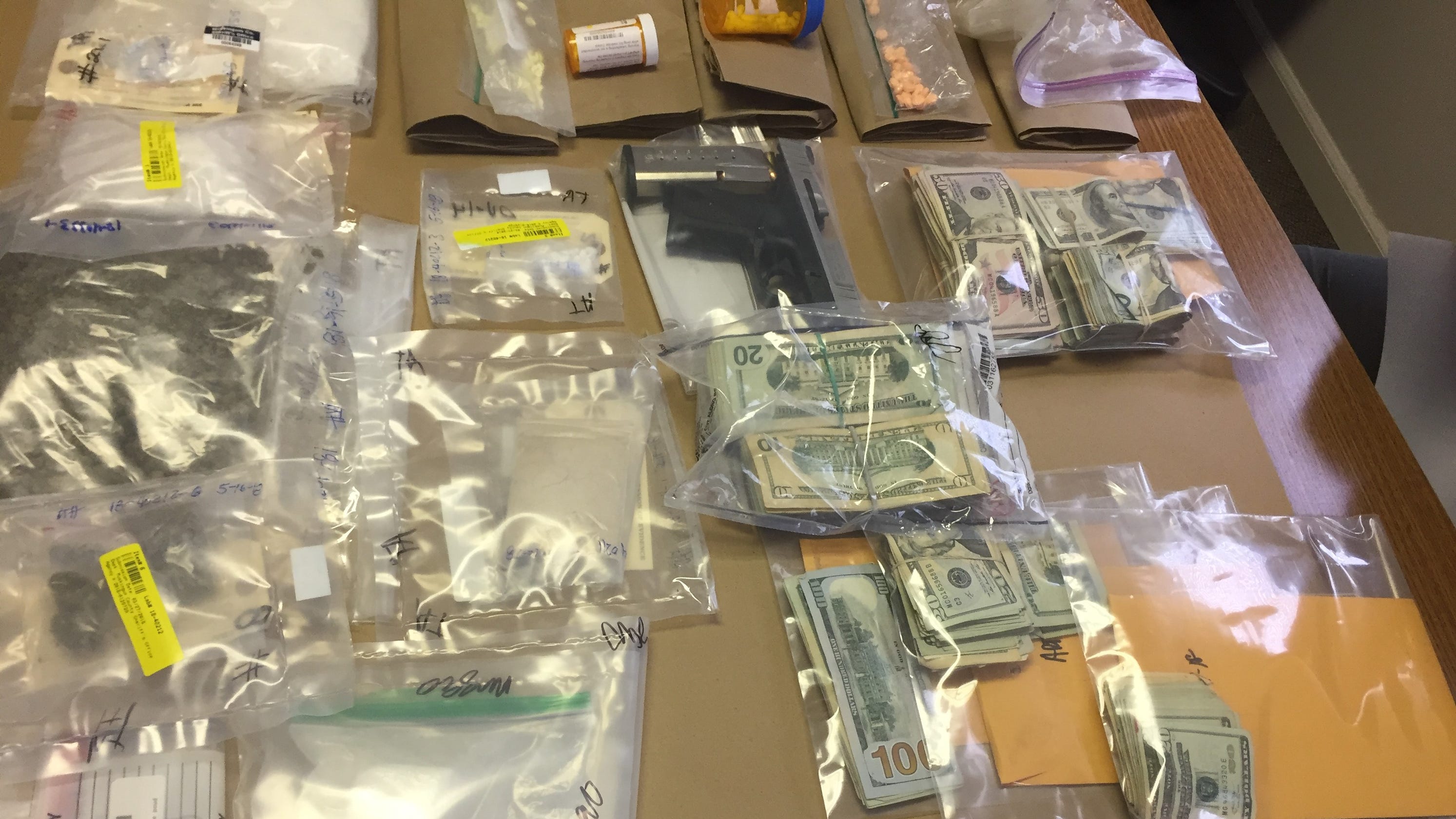
Image result for zanesville ohio drug bust
Drugs, cash and firearms seized in 2018. (Shelly Schultz/Zanesville Times Recorder)
People take it in stride. Ohioans are hardy and good-natured. Two years ago, one community initiative opened a restoration park including communal gardens, fountains, and green spaces for public movies and entertainment. The gardens are a hit, growing every year. Yet recently, caretakers have had to add the weekly chore of removing the needles and detritus left by voluntarily homeless addicts who treat themselves to the free vegetables. As in California, scores of voluntarily homeless people are a new and growing phenomenon in this place. It’s not acceptable. Is this to be the way of things?
There may be solutions. But we don’t appear ready to pursue them.
Give Addicts Shelter
It is rational to accept that drug addicts have an addiction but it is not rational to permit or enable their addiction. In a related matter, as a society, we have come to accept that victims of domestic violence struggle mightily to break free from the pressures of all types which keep them trapped in a hostile, dangerous and oftentimes deadly environment. They know the dangers and still stay. Even so, almost all communities have and maintain domestic violence shelters. These are places safety and confidentiality where a person can go to escape on perhaps the one day they have the strength to leave.
Without a waiting list, without judgment, without barriers, without court orders, and without others who have been ordered by the courts to be there, these shelters offer a haven. These shelters are, importantly, a place of refuge where no one can send a person, and where no one can force a person to stay. We have nothing like this for drug addicts.
This type of no-judgment, non-compulsory, no-wait narcotics shelter is an asset we desperately need. But it’s not as easy to set up a place like this as it is to establish a domestic violence shelter. There are medical needs. It’s far more expensive. Most importantly, people have a natural sympathy for victims of domestic abuse that is often absent in cases of drug abuse. That is to say, people feel a genuine desire to reach out and volunteer their time and effort—the real currency of intervention—to lift up women who have suffered at the hands of an abuser. Moreover, former victims of domestic abuse can intervene to assist others who are struggling to escape without risk of re-entering the danger. Most of these factors do not apply to the opiate epidemic.
Readers, social-media commenters, voters, and legislators believe it is the “right thing to say” that drug addicts should get treatment and care, but few and far between are those with a selfless interest in the vocation. It’s one thing to muse in an academic way over what could be useful in combating this crisis, but someone needs to pick up and carry the flag, and it’s not the type of work that draws out the passionate volunteer.
Addicts aren’t puppies, and if they were, Ohio would be experiencing an opiate rescue, not an opiate crisis. Addicts are liars, thieves, and fiends during their addiction. They will tell you so in recovery. So there’s no wellspring of sympathy or empathy for that.
Ohio’s approach to the opiate epidemic and the roaring return of methamphetamine—like much of the nation’s—has echoed the banal appeal to “treatment” as a cure. Budgets and legislation repeatedly throw money at politically-connected, court-subsidized, compulsory treatment facilities and “specialized docket” courts. The specialized docket courts, which meet weekly with a judge, and more often with counselors and probation officers, are considered the most successful approaches Ohio courts currently use for drug treatment. “Most successful” means at best a 15 percent rate of not returning to drug use or crime within three years. Fifteen percent is better than nothing, but it is not “success.”
What the Crack Epidemic Taught Law Enforcement
When it comes to law enforcement and the courts, we actually already know how to defeat the opiate epidemic. We’ve done it before. We beat the crack epidemic. We drove out the violent insanity which was destroying Ohio neighborhoods and families. And we did that by utilizing the criminal courts to treat people who were caught committing crimes as criminals; by treating people who sold crack as violent poison-pushers, not misunderstood future collegians; and by stemming the tide of drugs flowing into the country with concrete action, rather than spreading out a red carpet along all of our borders for drug cartels to bottom out the price of poison everywhere in the country.
We don’t have crack houses all over the place anymore because we took the people who ran the crack houses and we put them in prison for so long that not only would the crack crisis have passed before they got out of prison, but everyone else was forced to stand up and take note of their sentence. Economics is economics. If you are actually going to attempt to ban a substance that has high demand, you must make the risk/reward calculus obvious and simple. The risk of apprehension multiplied by the likely punishment must exceed in value by orders of magnitude the anticipated reward in light of the alternative opportunities. And in order to make that message heard by all, a multiplication factor must be applied.
Basically, the punishment for selling drugs needs to seem unfair, draconian, and very scary to those likely to deal drugs. It must be sufficient to cause them to forego easy money and choose a life either of legal hard work or, as is the sad reality of our nation, government-funded dependency. In the United States, we did that once, and we won the crack epidemic with a combination of punishment and economic opportunity.
In contrast, today federal lawmakers bicker over palace intrigue and leave the barn doors open while Mexico and China flood our streets with dirt-cheap poison. Ohio lawmakers seem intent on singing kumbaya in a drum circle, hoping it will all go away if we just love the addicts enough. It will not. So, we put on our latex gloves, pick the needles out of the cuke bed, head off to work, and do our best to clean the streets while too many of our friends and neighbors die.
The opiate epidemic is real and it connects with everyone, but the community here is stronger than the dope. Most people here probably rarely give it a thought, until it touches home again.

There Is No Epidemic of Racist Police Shootings


By Heather Mac Donald
July 31, 2019
Related image
The Democratic presidential candidates have revived the anti-police rhetoric of the Obama years. Joe Biden’s criminal-justice plan promises that after his policing reforms, black mothers and fathers will no longer have to fear when their children “walk the streets of America” — the threat allegedly coming from cops, not gangbangers. President Barack Obama likewise claimed during the memorial for five Dallas police officers killed by a Black Lives Matter–inspired assassin in July 2016 that black parents were right to fear that their child could be killed by a police officer whenever he “walks out the door.” South Bend mayor Pete Buttigieg has said that police shootings of black men won’t be solved “until we move policing out from the shadow of systemic racism.” Beto O’Rourke claims that the police shoot blacks “solely based on the color of their skin.”
new study published in the Proceedings of the National Academy of Sciences demolishes the Democratic narrative regarding race and police shootings, which holds that white officers are engaged in an epidemic of racially biased shootings of black men. It turns out that white officers are no more likely than black or Hispanic officers to shoot black civilians. It is a racial group’s rate of violent crime that determines police shootings, not the race of the officer. The more frequently officers encounter violent suspects from any given racial group, the greater the chance that members of that racial group will be shot by a police officer. In fact, if there is a bias in police shootings after crime rates are taken into account, it is against white civilians, the study found.
The authors, faculty at Michigan State University and the University of Maryland at College Park, created a database of 917 officer-involved fatal shootings in 2015 from more than 650 police departments. Fifty-five percent of the victims were white, 27 percent were black, and 19 percent were Hispanic. Between 90 and 95 percent of the civilians shot by officers in 2015 were attacking police or other citizens; 90 percent were armed with a weapon. So-called threat-misperception shootings, in which an officer shoots an unarmed civilian after mistaking a cellphone, say, for a gun, were rare.
Earlier studies have also disproven the idea that white officers are biased in shooting black citizens. The Black Lives Matter narrative has been impervious to the truth, however. Police departments are under enormous political pressure to hire based on race, despite existing efforts to recruit minorities, on the theory that doing so will decrease police shootings of minorities. Buttigieg came under fire from his presidential rivals for not having more black officers on the South Bend force after a white officer killed a black suspect this June. (The officer had responded to a 911 call about a possible car-theft suspect, saw a man leaning into a car, and shot off two rounds after the man threatened him with a knife.) The Obama administration recommended in 2016 that police departments lower their entry standards in order to be able to qualify more minorities for recruitment. Departments had already been deemphasizing written exams or eliminating requirements that recruits have a clean criminal record, but the trend intensified thereafter. The Baltimore Police Department changed its qualifying exam to such an extent that the director of legal instruction in the Baltimore Police Academy complained in 2018 that rookie officers were being let out onto the street with little understanding of the law. Mr. Biden’s criminal-justice plan would require police hiring to “mirror the racial diversity” of the local community as a precondition of federal funding.
This effort to increase minority representation will not reduce racial disparities in shootings, concludes the PNAS study, since white officers are not responsible for those disparities; black crime rates are. Moreover, lowered hiring standards risk bad police work and corruption. A 2015 Justice Department study of the Philadelphia Police Department found that black officers were 67 percent more likely than white officers to mistakenly shoot an unarmed black suspect; Hispanic officers were 145 percent more likely than white officers to mistakenly shoot an unarmed black suspect. Whether lowered hiring standards are responsible for those disparities was not addressed.
The persistent belief that we are living through an epidemic of racially biased police shootings is a creation of selective reporting. In 2015, the year the PNAS study addressed, the white victims of fatal police shootings included a 50-year-old suspect in a domestic assault in Tuscaloosa, Ala., who ran at the officer with a spoon; a 28-year-old driver in Des Moines, Iowa, who exited his car and walked quickly toward an officer after a car chase; and a 21-year-old suspect in a grocery-store robbery in Akron, Ohio, who had escaped on a bike and who did not remove his hand from his waistband when ordered to do so. Had any of these victims been black, the media and activists would probably have jumped on their stories and added their names to the roster of victims of police racism. Instead, because they are white, they are unknown.

The “policing is racist” discourse is poisonous. It exacerbates anti-cop tensions in minority communities and makes cops unwilling to engage in the proactive policing that can save lives. Last month, viral videos of pedestrians in Harlem, the Bronx, and Brooklyn assaulting passive New York Police Department officers showed that hostility toward the police in inner-city neighborhoods remains at dangerous levels.
The anti-cop narrative deflects attention away from solving the real criminal-justice problem, which is high rates of black-on-black victimization. Blacks die of homicide at eight times the rate of non-Hispanic whites, overwhelmingly killed not by cops, not by whites, but by other blacks. The Democratic candidates should get their facts straight and address that issue. Until they do, their talk of racial justice will ring hollow.