Thursday, January 22, 2015

The Attkisson File


The reporter’s computer was hacked, possibly by the feds, but the DOJ and the media turn a blind eye. 

Sharyl Attkisson

Sharyl Attkisson was one of the most distinguished investigative journalists in television news, covering everything from the dangers of certain prescription drugs to mismanagement at the Red Cross to TARP to K Street. Over a career that spanned more than 20 years at CBS News, she received numerous awards for her work, including multiple Emmys.

In her memoir Stonewalled: My Fight for Truth against the Forces of Obstruction, Intimidation, and Harassment in Obama’s Washington, Attkisson looks back on the final years of her network career. One concludes from her book that Attkisson encountered more difficulty practicing her profession at CBS News during Obama’s tenure than at any other time. She reached an agreement for her departure from CBS News in March 2014, well before her contract was to expire.

The book’s subtitle refers to the difficulties Attkisson encountered in “Obama’s Washington.” The term is in part a euphemism for the Obama administration, but it also reflects the support for the administration within CBS News. The head of CBS News is David Rhodes, brother of Obama national-security adviser Ben Rhodes.
Attkisson is a dogged reporter, and Stonewalled is a gripping book, organized around the Obama-administration scandals she covered at CBS News. With the exception of the IRS scandal, she covered just about all of them: Fast and Furious, green-energy crony capitalism, Benghazi, and Obamacare. Attkisson devotes a chapter to her work on each one.

Each of the scandals falls into a larger pattern of scandal management practiced by the Obama White House. (The reader can infer how the IRS scandal fits the pattern precisely to a T.) Her book is invaluable for how it analyzes and exposes this pattern, combining her reportage and her behind-the-scenes work at CBS News.
The pattern begins with blatant denials — bald lies — and stonewalling. Attkisson deftly articulates one of the bona fide occupational qualifications for service as a spokesperson in the Obama administration. Referring specifically to HHS spokeswoman Joanne Peters, whom Attkisson had caught lying to her, she writes: “It takes a certain kind of person to be untruthful and then display utter lack of contrition when caught.”

Next in the pattern, when the lies fail, comes the attribution of responsibility to the lowest level of bureaucrat. Also, rather than responding to straightforward inquiries, administration spokesmen pump reporters for the information they have so they can undermine it. Attkisson calls this technique “pump and mine.” The administration then plants slanted leaks to friendly bloggers and reporters; next, it characterizes any advances in the story as “old news.”

Attkisson also shows how the administration, using a technique she calls “controversialization,” disparages any sources and reporters who move the story forward. As she recounts in the book, Attkisson has extensive personal experience being at the receiving end of this technique.

She singles out Media Matters as the main outlet that moves administration spin into the mainstream media. As Attkisson demonstrates, however, the power of Media Matters derives from the complicity and cooperation of its many allies in the media, i.e., the many Obama allies in the media.
She writes:
Perhaps the greatest PR coup of all is that the administration’s expert spinners successfully lead the media by the nose down the path of concluding there’s no true controversy unless there’s a paper trail that lays blame directly on the president’s desk. Time and again, with each scandal and each damaging fact, Democrats and the White House read from the script that says, “there’s no evidence President Obama knew” or “there’s no evidence of direct White House involvement.” Anything short of a signed confession from the president is deemed a phony Republican scandal, and those who dare to ask questions are crazies, partisans, or conspiracy theorists. . . .  
Under President Obama, the press dutifully regurgitates the line “no evidence of White House involvement,” ignoring the fact that if any proof exists, it would be difficult to come by under an administration that fails to properly respond to Freedom of Information Act requests, routinely withholds documents from Congress, and claims executive privilege to keep documents secret.
Stonewalled covers two kinds of scandal: first, the various scandals within the Obama administration; second, the scandalous treatment of these White House scandals by CBS News. With each White House scandal, Attkisson demonstrates the success, more or less, of the Obama administration’s scandal management inside the newsroom at CBS.

Her account of CBS’s journalistic dereliction culminates in her description of how CBS suppressed a portion of the September 12, 2012, 60 Minutes interview with President Obama — the precise portion in which Obama clearly explained why he did not characterize Benghazi as a “terrorist” attack. The release of this interview might have been of interest, shall we say, in the aftermath of the second Obama–Romney debate, during which Obama successfully promulgated the line — the lie — that he had very quickly characterized Benghazi as a “terrorist” attack, with a timely assist from CNN moderator Candy Crowley, who broke with debate-moderator protocol and backed up Obama’s lie. It was only after Attkisson and others inside CBS News belatedly discovered the relevant portion of the 60 Minutes interview, and after they kicked up some dust about it, that CBS News posted the segment, online only, the weekend before the election — far too late to matter.

Attkisson bookends her accounts of the Obama-administration scandals she covered with the story of what she describes as coordinated intrusions into her telephones and computers. She was working on the Benghazi story when a friendly source “connected to a three-letter agency” offered a surprising observation. “The administration is likely monitoring you — based on your reporting,” the source advised her. She had, in fact, been having troubles with her phones and computers, which were behaving oddly.

Three sets of experts — including experts hired by CBS — examined her computers. All reached the same conclusion: She was the victim of computer intrusion and monitoring. One expert found classified government documents secreted in her hard drive, though she had not placed them there and had nothing to do with them. She believes that they were placed there by the intruders for use against her at an appropriate time.
CBS issued this statement on the intrusions:
Attkisson’s computer was accessed by an unauthorized, external, unknown party on multiple occasions in late 2012. . . . [F]orensic analysis revealed an intruder had executed commands that appeared to involve search and exfiltration of data. The party also used sophisticated methods to remove all possible indications of unauthorized activity, and alter system times to cause further confusion.
The experts retained by Attkisson concluded that the intrusion into her computers was probably perpetrated by a government agency with highly sophisticated software that is proprietary to the government.
The Department of Justice has issued two statements on Attkisson’s case. In response to Attkisson’s first public mention of her experience, in the course of a radio interview, the Department of Justice said:
To our knowledge, the Justice Department has never “compromised” Ms. Attkisson’s computers, or otherwise sought any information from or concerning any telephone, computer, or other media device she may own or use.
Attkisson has called this Justice Department statement “a quasi-denial.” Who is the “we” encompassed in “our”? she asks. She continues:
The entire Justice Department? Did officials really, in the blink of an eye, conduct an investigation and question 113,543 Justice Department employees? That’s impressive! I’m still waiting for answers to Freedom of Information Act requests that I filed with them years ago, but they’re able to provide this semi-definitive statement within minutes of the question being posed.
Oklahoma senator Tom Coburn, just retired, sent Attorney General Holder a letter making broad inquiries on behalf of Attkisson. Attkisson quotes the response submitted to him by the DOJ:
Your letter asks whether the Department is responsible for incidents in 2012 in which the computer of Sharyl Attkisson, a CBS reporter, was allegedly hacked by an unauthorized party. The Department is not. It also does not appear that CBS or Ms. Attkisson followed up with the Federal Bureau of Investigation for assistance with these incidents.
Coburn’s letter to Holder had sought information regarding actions taken “[d]uring your tenure as attorney general,” not during 2012. Attkisson drily observes: “Instead of answering the questions at hand, the administration had posed an entirely different question and chosen to answer that one.”

Coburn issued a follow-up letter to the Justice Department pointing out that none of his questions from the previous July had been answered in its December response. The Justice Department has provided no further response.

Attkisson has not let the matter rest. In January, she filed an administrative claim against the government as a predicate to bringing a lawsuit under the Federal Tort Claims Act; separately, she also filed a lawsuit against the government for violation of her constitutional rights.

One does not need to be a seer to predict that the Obama administration will do its level best to ignore Attkisson and her complaints through Obama’s last day in office. Attkisson will no doubt have to await a new administration before she can obtain legal resolution, but perhaps it would not be amiss for Congress to look for answers right now.

— Scott W. Johnson is a Minneapolis attorney and a contributor to the website Power Line.

Today's Tune: Future Islands - Swept Inside

Wednesday, January 21, 2015

Death of a Prosecutor


Posted By Kenneth R. Timmerman On January 21, 2015 @ 12:35 am In Daily Mailer,FrontPage | 2 Comments

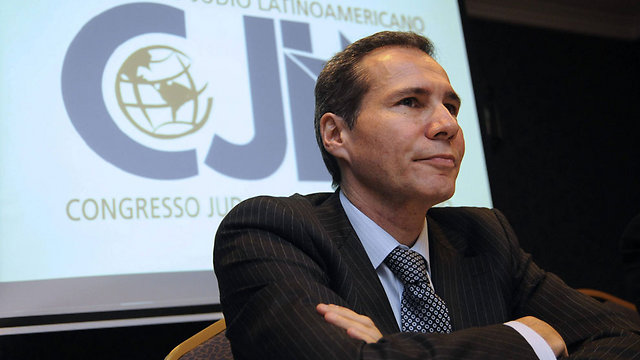
Dr. Alberto Nisman (AFP)


Alberto Nisman, the Argentinean prosecutor who indicted top Iranian regime officials for the July 1994 AMIA Jewish Center bombing in Buenos Aires, was found dead by gunshot in his apartment on Sunday night, in what initially was called a suicide.

Nisman was scheduled to address members of parliament the next day to reveal new information about alleged efforts by Argentinean President Cristina Fernandez de Kirchner and her foreign minister, Hector Timerman, to cover up the responsibility of the Iranian regime in the AMIA bombing that killed 86 people some twenty-one years ago.

Just days before his murder, Nisman publicly accused the President and her foreign minister of taking “the criminal decision to fabricate Iran’s innocence to save Argentina’s commercial, political and geopolitical interests.”

Police found arrayed on a desk in his apartment documents relating to his allegations, but no suicide note.

Nisman issued his initial 801 page indictment in the AMIA case in on October 25, 2006. He asked Interpol to issue international arrest warrants against eight current and former Iranian government officials, including then president Hashemi-Rafsanjani, his foreign minister, the intelligence minister, and the head of the Revolutionary Guards Corps.

He also accused Lebanese Hezbollah leader Imad Mugniyeh, who worked in tandem with the IRGC, of handling the logistics of the truck bomb plot.

Mugniyeh was assassinated in Damascus in February 2008, apparently by Israeli operatives.
Mugniyeh has a long pedigree of killing Americans and killing Jews, which I have written about extensively.

He murdered 241 U.S. Marines in Beirut in 1983, hijacked aircraft, murdered U.S. hostages in Lebanon, and helped recruit the al Qaeda terrorists who carried out the 9/11 attacks.

Early this past Sunday, Israeli helicopters reportedly attacked a Hezbollah outpost in Syria, killing four Hezbollah operatives – including Mugniyeh’s son and terrorist-operative heir, Jihad.

A senior Iranian official told reporters that Israel would be hit at “the right time and right place” in retaliation for the strike.

That same evening, on the other side of the world, the Argentinean prosecutor instrumental in revealing Mugniyeh, Senior’s involvement in the AMIA bombings, died mysteriously of a gunshot wound to the temple, fired from a .22 revolver he did not own, with no apparent powder burns on his hands.

Coincidence? Perhaps.

When police discovered Nisman’s bloody body behind the locked door of his Buenos Aires apartment, they treated the area as a crime scene, not a suicide, and immediately called in forensics investigators.

This and other indicators led the Daily Beast’s Christopher Dickey, a long-time aficionado of Iranian state terrorism, to speculate that Iran might have murdered Nisman to bury the evidence of bigger crimes.

My Iranian sources tell me there is no doubt of Iran’s efforts to coopt Argentinean president Cristina Kirchner, nor any doubt that Nisman’s death was a murder carried out by professionals.

I got involved in the AMIA investigation early on, and corresponded with Nisman’s first boss on the case, Judge Juan Jose Galeano, who eventually traveled to Washington, DC to meet with me. When Nisman ultimately took over the case and issued his indictment against the Iranian regime, he cited my evidence on more than a dozen occasions.

As I reported in 2003, a former Iranian intelligence officer, Abdolghassem Mesbahi, told the court that Iranian officials had paid $10 million into a Banque Degroof Luxembourg bank account in Switzerland that was controlled by then-president Carlos Menem, in exchange for his efforts to impede the AMIA investigation.

Menem’s denials were ultimately put to rest when the Swiss government froze the $10 million in his Banque Degroof accounts. One can only imagine what would have happened to Mrs. Kirschner’s denials had Nisman been able to testify on Monday to the Argentinean parliament.

Nisman has been under pressure from the Argentinean authorities for years. I contacted him again in 2007 to see if he would be willing to testify before the U.S. District for the Southern District of New York about what he had learned of Iran’s overseas terrorist operations, as part of the Iran-9/11 investigation I was involved in.

After several months of back and forth negotiations, he got back to me to say that his superiors had forbidden him from having any contact with the U.S. court, even though we merely wanted him to present the same evidence he had made public in the AMIA indictment.

Nisman had huge amounts of evidence that has not been made public, including transcripts of intercepts between the Iranian cultural attaché and Iranian expat taxi drivers in Buenos Aires who helped transport explosives used in the bombing, and other intercepts detailing the involvement of the Islamic Republic Shipping Lines and their local agents in conveying the explosives to Argentina.

The circumstances of Nisman’s murder – the dubious murder weapon, the door locked from the inside, the apparent absence of a struggle – remind me eerily of the November 2011 murder of Ahmad Rezai, the son of the former commander of Iran’s Revolutionary Guards Corps, Mohsen Rezai.

The younger Rezai was found dead in his room in a residence hotel in Dubai and was immediately declared a suicide by the Dubai police.

Because I had gotten to know him well (so well that he named his first child after my daughter), I flew to Dubai to investigate.

Although Rezai was a U.S. citizen, the U.S. consular authorities had no interest in investigating the case and provided no assistance to me or his U.S. family, who I was representing.

The Dubai authorities stonewalled but I went around them. From the medical examiner, I discovered that the cause of “suicide” – an overdose of anti-psychotic medicine – was not true: the amount found in Ahmad’s blood was normal.

Furthermore, upon interrogating hotel staff, I discovered that a known Russian mafia hitman had checked into a room just down the hall a few hours before Ahmad’s murder and disappeared the next day, even though he had paid a month’s rent in advance.

Needless to say, the Dubai police had never heard of the man, let alone interrogated him.

The morning of Ahmad’s death, an explosion rocked a huge missile facility west of Tehran, killing the father of Iran’s solid-fuel missile programs. I speculated in these pages that rivals of Ahmad’s father suspected father and son of seeking to reform the regime from within, an effort that is rejected by many Iranian opposition activists who believe that reform is impossible.

On Tuesday, an Iranian website controlled by the IRGC, identified the Foundation that I founded and chair as the regime’s Public Enemy #1.

It’s certainly not the first time the IRGC and their allies among the hardliners have identified me personally and my foundation as “enemies” of their revolution, because we support the right of Iranians to choose their form of government by democratic means.

But the timing of this latest version of the anti-jihadi hit parade seems no accident, coming on the heels of the assassination of Jihad Mugniyeh and the apparent murder of Alberto Nisman.

No one should underestimate the determination of the Iranian regime to use any means at its disposal to achieve its ends. Whether that means dispatching thousands of Revolutionary Guards fighters to Syria to prop up Assad, or murdering Americans in Iraq to hasten our departure, or providing safe haven and logistical assistance to al Qaeda, or funneling arms secretly to ISIS to stoke a fire they can boast to the gullible U.S. officials they are uniquely qualified to put out, the Islamic Republic of Iran is playing for keeps.

They have more case officers working for their intelligence services than we do in the United States, and have developed an entire branch of their military – the Quds Force – to carry out overseas terrorist operations.

They will not hesitate to murder people who get in their way, no matter their nationality or where they might be found.

They are playing hardball, and we are playing tiddlywinks. And yet, successive U.S. administration’s have thrown away advantages won by the blood of patriots – both Iranian and American – for empty promises made by known liars, assassins, and cheats.

When will we ever learn?

Freedom Center pamphlets now available on Kindle: Click here.   

Subscribe to Frontpage’s TV show, The Glazov Gang, on YouTube and LIKE it on Facebook.

Article printed from FrontPage Magazine: http://www.frontpagemag.com

The Demonization of Chris Kyle


Morally superior anti-American leftists can’t tolerate an unapologetic patriot willing to fight our enemies. 


In case you didn’t​ know: “​The Real American Sniper Was a Hate-Filled Killer.

So reads the first half of the headline to a January 6 essay by Lindy West at the Guardian’s website. It’s true that writers rarely pen their own headlines, but that one does an apt job of capturing the first part of West’s thesis.

Like other recent Kyle critics, West, a culture writer at GQ, wields quotes from the 2012 autobiography of the late Chris Kyle, America’s deadliest military marksman and the subject of Clint Eastwood’s biopic, American Sniper, to show what a loathsome, morally treacherous character he was. After revealing that she has not read Kyle’s book, West goes on to use misleading quotes, those same ones pounced on by all critics — “I hate the damn savages,” and “I couldn’t give a flying f*** about the Iraqis” — as proof that Kyle at a “bare minimum was a racist who took pleasure in dehumanizing and killing brown people.”

Her assessment was tame compared with that of Max Blumenthal, author at the left-wing blog Alternet, who tweeted in December that Kyle was “the perfect recruiter for ISIS.” Blumenthal likened Kyle to “John Lee Malvo, another mass-murdering sniper.” “John Lee,” for those who might not recall, was one alias of Lee Boyd Malvo, the 17-year-old who, with John Allen Muhammad, murdered ten people and wounded three others in the Washington, D.C., area in October 2002. (They also killed seven people and wounded seven across the country in the months beforehand.)

Others have piled on: Rania Khalek, a freelance journalist, called Kyle an “American psycho” (alluding to novelist Bret Easton Ellis’s fictional serial killer), while filmmaker Michael Moore tweeted that snipers were “cowards.”
“Why,” then, asks the second part of the Guardian’s headline, “Are Simplistic Patriots Treating Him as a Hero?” Why is “the US right wing . . . treating [American Sniper] with the same unconsidered, rah-rah reverence that they would the national anthem or the flag itself?” asks West.

The answer is simple: because the Right is just like Chris Kyle.

West thinks the similarity is racism: The Right has latched on to Kyle “because Chris Kyle is good, and brown people are bad, and America is in danger, and Chris Kyle saved us.”

For Laura Miller, senior writer at Salon, the similarity is stupidity: Kyle was, she writes, afflicted by his “steadfast imperviousness to any nuance, subtlety, or ambiguity, and his lack of imagination and curiosity” — and in that he was “all-too-emblematic of the blustering, tragically misguided self-confidence of the George W. Bush years.”

For the Daily Koswriting back in 2012, admiration of Kyle is Freudian projection:
Chris Kyle was feted by Bill O’Reilly last week: His deeds were recounted, and killing admired by the Fox News faithful. There is an odd homoeroticism (or is it homosocial worship?) in this interview, where O’Reilly as an archconservative is channeling a deep fascination with the “how” of death, and a type of hyper-masculinity that is the bleeding heart of Right-wing authoritarianism. Here, O’Reilly reminds the viewer of why straight men enjoy watching the freakishly large penises that dominate much of American pornography. Hero worship, with no small amount of projection, is, and remains, the thing – it is the means for a visceral thrill.
The above is not satire.

So this is not a new phenomenon. Since Vietnam, the only military men the Left has found to like are those who return to the U.S. and roundly repudiate the war in which they fought. They think the highest form of patriotism is marching before Congress to “blow the whistle” on horrors, real or imagined, being committed by Uncle Sam’s legions against innocents overseas. The only veterans worth honoring with medals are those who will turn and chuck those medals over the Capitol fence, à la John Kerry. The Left has no love — or even tolerance — for unapologetic servicemen who write about “savage, despicable evil” and declare their fidelity to “God, Country, Family,” in that order.

Now, in the wake of the wars in Iraq and Afghanistan, the reflexive anti-war sentiment of the progressive Left has mutated, in certain corners, into full-blown derangement — the sort that can straight-facedly link American military policy with porn-viewing habits. As the Kyle critics have made clear, it is now nothing short of an unassailable truth on the left that the act of criticizing America’s military ventures is in itself an indication of moral and intellectual superiority.

Which is what all of this armchair psychologizing-cum-political commentary about Chris Kyle is really about: He is important because, as a racist, rapacious killer, he is a representation of racist, rapacious America, and how it exported its bloodlust to Iraq and Afghanistan, slaughtering innumerable women and children in the quest to seize Iraq’s oil fields or to expand Dick Cheney’s stock portfolio or to satiate George W. Bush’s Oedipal complex. By pointing this out, West and Miller and Blumenthal and all the others show that they are not fooled. They announce how attuned they are to “moral ambiguity” and “emotional complexity,” how “deeply” they think about war and peace and life and death, how much more sophisticated they are compared with trigger-happy, redneck rubes such as Chris Kyle — or the simpletons who think he might have served his country admirably.
In his autobiography, Kyle wrote of taking the deadly shot: “You do it again. And again. You do it so the enemy won’t kill you or your countrymen. You do it until there’s no one left for you to kill. That’s what war is.”

Yeah, but what did he know?

— Ian Tuttle is a William F. Buckley Jr. fellow at National Review.

Tuesday, January 20, 2015

All Christians Rely on Tradition Rather than Scripture Alone


Evangelicals are more Catholic than they think


January 19, 2015


The Trinity (oil on canvas), Tintoretto, Jacopo Robusti (1518-94) / Galleria Sabauda, Turin, Italy / The Bridgeman Art Library

Tradition matters.
 
As a statement about the making of church doctrine, that comment might not sound too startling, and it is quite obvious to Catholic and Orthodox believers. But it does point to a major paradox in the thinking of that numerous and influential section of the world’s Christians who are evangelicals. Surprised, and even shocked, as they might be to hear it, they are in fact far more Catholic than they might ever have thought.
 
Evangelicals pride themselves on their reliance on Scripture alone, the core Reformation doctrine of sola scriptura. If you look at evangelical debates, the question will soon arise: how do you ground this in scripture? Give me chapter and verse!
 
But here’s the problem. Evangelicals believe absolutely in core doctrines of faith that cannot be derived simply from scripture, but rather grow out of church tradition. Once you have formulated the belief, you can if you wish cherry-pick Biblical verses to support it, but you would never have reached the position through scripture alone.
 
The obvious example is the Trinity itself, which evangelicals regard as a fundamental belief for anyone claiming Christian credentials. Yet it is not found in the Bible. The only scriptural support it ever had was the so-called Johannine Comma, an explicitly Trinitarian line in 1 John 5: 7-8, which is consecrated in the text of the King James Bible of 1611. Unfortunately, scholars have known for centuries that those words were inserted much later into the original text, and no serious writer would today cite it as authentic.
 
Losing the Comma poses no difficulty for anyone believing in the Trinity, which is an idea very deeply rooted indeed in church tradition. The doctrine was certainly held by Christian believers in the second century, especially by Apostolic Fathers such as Ignatius and Justin Martyr. To speak of church tradition does not, of course, mean that such later figures invented doctrines for their own sinister purposes. Rather, as Catholic and Orthodox theologians have always held, the church was, and is guided by the Holy Spirit. But without such a belief in the power of continuing tradition, how can anyone justify the doctrine of the Trinity?
 
No church tradition, no Trinity.
 
Scarcely less fundamental for evangelicals is the belief in Christ’s Incarnation. The New Testament certainly allows us to form ideas of Christ’s divinity, and his becoming human. Relying on those Biblical texts, though, gave early believers huge leeway in how they defined the relationship between human and divine. Was Christ literally God walking on earth in human guise? Did divinity descend on Jesus at some moment in his earthly life, presumably at his Baptism, only to leave him at the Crucifixion? Christians argued about these complex doctrines for centuries, and settled them only at the Council of Chalcedon in 451 AD.  In other words, the doctrine was settled by debate within the Church, on the basis of scripture and tradition, but under the guidance of the Spirit.
 
No church tradition, then, no doctrine of Incarnation.
 
Protestants have always held the early church in high esteem, and distinguished evangelical scholars publish learned works on the early Fathers. The evangelical press IVP has, for instance, presented a wonderful series of volumes under the title Ancient Christian Commentary on Scripture.  Having said this, evangelicals still balk at using the wisdom of the early Church to establish doctrine.
 
But suppose they do acknowledge reality, and admit that key doctrines like the Trinity are in fact grounded on the traditions of that early Church. How do they define “early”? Do they see the workings of the Spirit still in action before the Council of Nicea in 325, or might they extend that latitude to the time of Chalcedon in 451, as they must if they are to accept the Incarnation? If they accept the ideas of St. Augustine as authoritative, then that takes us well into the fifth century.

If they venture into the fourth and fifth centuries, though, they are looking at a church that might, to them, look disturbingly medieval and even Catholic. This was very much a hierarchical church with strong ideas about the status of clergy, and definite rules about clerical celibacy and monasticism. From the second century, moreover, ideas about the exalted role of the Virgin Mary were becoming ever more popular and mainstream in the church. Are they then any less authoritative than doctrines like the Trinity?
 
So why not Mary?
 
Evangelicals, then, should be more explicit about how they are prepared to use tradition. In raising this point, I am not seeking to embarrass evangelicals, but rather to suggest that Christians of all shades are already far closer to doctrinal unity that they might think.


Philip Jenkins is a Distinguished Professor of History at Baylor University and author of The Great and Holy War: How World War I Became a Religious Crusade.

Why 'American Sniper' Is One of the Greatest War Movies Ever


The film is a triumph for Eastwood, Cooper, and America. (Also read: Feminist Mag Complains American Sniper Unfair …to Babies?)


By David Forsmark
http://pjmedia.com/lifestyle
January 19, 2015


With all due respect to Lone Survivor and Zero Dark Thirty (and I have paid mad respect to both), Clint Eastwood’s amazing American Sniper is the film for the war on terror.

But it’s more than that. It is a timeless American war movie that explores the necessity of having men who are–and bear the burden of being–really really good at killing bad guys.
In fact, this is easily one of the ten best American war movies of all time. (I won’t place it any higher than that until I’ve had the chance to see it again and let the initial emotional impact wear off; but right now, I can’t think of three I would rate above it.)
When I reviewed Chris Kyle’s book American Sniper, I called it the most unapologetic account of war since George S. Patton. But it’s not all swagger.
Eastwood both allows the character of Chris Kyle to speak to that unabashed pride in doing a necessary job — his warts-and-all honesty about how he neglected his family while letting the job consume him — and uses the tragic events that followed the publication of the book to show us how doing that job takes a toll.
The result is a shining example of material finding the perfect director. In many ways, Eastwood’s whole career has been leading up to this statement. It’s what Unforgiven couldn’t quite get to because it was merely about a previously vicious man sliding back into his old ways, even if his cause was just.
The film — like the book — opens as newly minted Navy SEAL sniper Chris Kyle takes a bead on a small Iraqi boy whose mother has just handed him a grenade and sent him running toward a squad of American Marines.
Then, while Kyle is waiting for that space between breaths, between heartbeats, that still moment of the trigger pull, we flash back to how he got there.
This is a perfectly executed and superbly made bio-pic. Despite the heroism it shows, it never lapses into hagiography or sappy preaching. Eastwood is clear-eyed throughout, and confident at letting his story tell itself.
American Sniper lives up to its title. This is an intensely American film. Everything about Chris Kyle’s background, from hunting with his father, to the little country church, to wanting to be a cowboy, is not just Texas, it’s America.
From Sergeant York, to Audie Murphy, to Dick Bong (WWII’s ace of aces who also left combat only to die serving on the home front), to Chris Kyle, small-town, do-for-yourself America has produced these men for whom taking up arms to protect their country just comes naturally (even, eventually, for the Quaker, York).
The motivation is summed up in a talk Chris Kyle’s father gives at the dinner table — a speech many American fathers have given their sons (and many more should), but rarely with this perfect an analogy.
Chris has had trouble in school for beating up the bully who was picking on his younger brother — but he is not in trouble at home. His father explains there are three kinds of people in the world: Sheep, who can’t protect themselves; wolves; and sheepdogs, who protect the sheep. He expects his son, who has the ability, to be a sheepdog  – and if he ever becomes a wolf, he will get an ass whooping he will never forget.
Later, when drinking away the memory of a cheating girlfriend and the Khobar Towers bombing news story comes up on television news, a hitherto aimless Chris Kyle knows exactly what he is supposed to do.
While American Sniper takes no firm position on the wisdom of the war in Iraq — various characters express varied opinions on that — it is very clear-eyed about the nature of the enemy, or, as Kyle refers to them as, “the f***ing savages.”
Not since The Deer Hunter has the enemy been as accurately portrayed in an American film as the bestial evil that they are, and without over-the-top Hollywood histrionics. The good guys have their flaws, but these bad guys have to be opposed — and killed in as large a number as possible.
There are four great battle-set pieces in American Sniper that are breathtakingly effective — and, thankfully, Eastwood knows how to give immediacy and a you-are-there feel to the scenes without the herky-jerky handheld camera gimmicks and incoherent quick-cut edits that lesser directors use to pull off a complicated scene.
At one point, Kyle’s sheepdog instincts take him off the rooftops — against orders — and down into the streets with the Marines. He knows his SEAL training has prepared him better for house-to-house combat and he can’t sit by without teaching them how to do it better.
Eastwood has been exploring these themes for years, imperfectly in Heartbreak Ridge, much better in The Outlaw Josey Wales, of course in Dirty Harry, and most recently (showing he understands the protective impulse of the American soldier) in Gran Torino, where this really was the under-explored theme.
The performances are all first rate (I’ll rave about Cooper in a minute) and it’s really about time that people realize the beautiful Sienna Miller is an actress of grit and grace.
So in the pantheon of great American war movies, where does American Sniper place? It’s more personal and emotionally shattering than even The Deer Hunter, because that great film spread its emotions around to the effect of the Vietnam War on a whole town.
It does an even better job of portraying the sacrifices and effects of war on the family of a warrior than We Were Soldiers.
And of course it is a more realistic look at a highly decorated soldier who performed at an almost superhuman level than either Sergeant York or To Hell and Back – and not just because of the allowances of modern filmmaking.
It’s hard to explain the greatness of Bradley Cooper’s performance, unless you have seen Chris Kyle’s interviews. But Cooper does not just inhabit his role, or give a great interpretation of a character — he disappears into it.


Sure, the muscle gain helps, because it keeps us from remembering this is svelte Bradley Cooper who has given so many memorable performances the last few years (and was the softer male character way back on TV’s Alias).
But watching American Sniper, you feel as though Chris Kyle was allowed to play himself — maybe better, since this is a more convincing portrayal than even Audie Murphy gave playing… Audie Murphy.
Which makes the tragic ending of this story all the more shattering. Eastwood’s choice at the end of American Sniperis almost as important as the one he makes at the beginning. At the screening I attended, there were gasps as a credit announced what happened to Kyle, muffled sobs during the real footage of his funeral that ran over the credits, and no one — and I mean no one — moved until the credits were done. As people filed out, it was as quiet and somber as if we had attended the funeral ourselves.
Seeing American Sniper is an American experience. Don’t miss it.

'American Sniper' Has Created a Cultural Moment: Here’s Why


American-Sniper
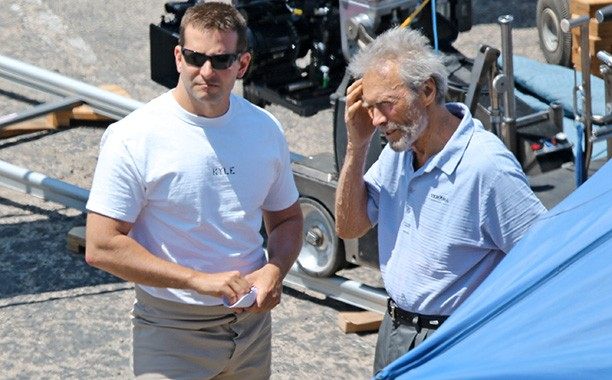
Bradley Cooper and Clint Eastwood on the set of 'American Sniper'.

At 9:30 p.m. on Saturday night, a packed theater in Franklin, Tenn., was completely quiet. As the credits rolled, some folks were filing out, but many more were standing, still looking at the screen, honoring the man whose life they’d just seen portrayed on the silver screen. 

Before the movie, I’d never seen the parking lot so crowded. I had to park more than a quarter-mile away, hidden in the corner of a restaurant parking lot (hoping I wouldn’t be towed), and watched in amazement as people were streaming into the theater from parking spaces scattered far and wide. It almost goes without saying when a January movie releasebreaks $90 million in three days, but I felt as if I was witnessing an important cultural moment. This movie was striking a chord in America beyond any post 9/11 movie — beyond even the best of movies about the War on Terror, including Lone Survivor. I think I know why.

First — and most important — it’s a phenomenal movie. America is awash in “message movies,” left and (recently) on the right. While there are some people who’ll attend movies just to make a statement, most of us want to see good movies, with the right statement merely an optional bonus. American Sniper is better than good. It’s one of the best war movies I’ve ever seen, and is now in the pantheon of my all-time favorite movies of any type. Bradley Cooper is outstanding, and the movie pulls off something I’ve never truly seen in a war film: It creates fully realized characters both inside and outside the combat environment. By the end of the movie, we feel that we understand who Chris Kyle was, who is wife is, what they endured, and what motivated them. They’re not one-dimensional heroes but fully realized people who did heroic things.

Second, it tells a story that America isn’t told. I’ve beaten this drum for a while now, but one of my core criticisms of movies about the War on Terror is that they flinch — not when telling of the horrors of war for American soldiers — but when describing the true nature of the enemy. American Sniper goes where no movie has gone before in showing how the enemy uses children, kills children, and savagely tortures its enemies (Kyle discovers a torture room in Fallujah, and its portrayal is very close to reality). The movie isn’t excessively grisly (so wide audiences can see it), but one doesn’t need to show the close-up of a terrorist killing a young boy with a power drill to understand what just happened. When Kyle describes the enemy as “savages,” you know exactly why, and you agree with him.

But it’s not just telling the story of the enemy, but also of a key reality about our soldiers that many Americans don’t get. Of course war is horrifying. There are real consequences in PTSD and survivor guilt, and for tens of thousands there are real consequences in enduring physical wounds. Your psychological reality can essentially “flip” for a time so that you become a better functioning warrior than you are husband or father (in one telling moment, Kyle lands back in Iraq for yet another deployment, and a fellow SEAL tells him “welcome home”). But here’s the thing: The vast majority of soldiers get through that trauma and emerge on the other side, often better men. At the end of the movie, we see a Chris Kyle who is a good husband and father — who is truly “home” — extending his mission of helping his brothers by helping them heal. 

This is an important story. Yes, there is grief that endures. And, yes, there are often wounds that won’t fully heal. But there is also fierce pride in service, new insights on life and our world, new appreciation for the blessings of liberty and the love of family, and many other perspectives and experiences that enrich the lives of veterans and veterans’ families. It was just as critical to see Chris Kyle heal as it was to see him suffer. 

Finally, the movie gives America something it’s lacked since the start of the war — a war hero on a truly national, cultural scale. Yes, we’ve learned the stories of Marcus Luttrell and others who’ve achieved great and heroic things, but with the success of this movie, Chris Kyle has entered the pantheon of American warriors — along with Alvin C. York and Audie Murphy — giving a new generation of young boys a warrior-hero to look up to, to emulate. After all, our kids’ heroes can’t be — must not be — exclusively quarterbacks, rappers, or point guards.

No one is claiming that Chris Kyle is Jesus. Every human being has flaws. And he risked no more and no less than the thousands upon thousands of anonymous soldiers and Marines who fought house-to-house during their own turns downrange, but he undeniably did his job better than any man who came before him — or any man since — and he did that job as part of his selfless service to our nation. I’m thankful that my own son counts Chris Kyle as a hero. 

Leftists such as Michael Moore will rage on, and professors will judge the movie without seeing it — and all that backlash may cost the movie an Oscar — but Clint Eastwood has done something far greater than win an Oscar. He reached a great nation with a story it needed to hear.

No No-Go Zones? Really?


Posted By Robert Spencer On January 20, 2015 @ 12:54 am In Daily Mailer,FrontPage | 3 Comments

The controversial 'Sharia Controlled Zone' poster that went up in several East London boroughs in 2011.

The Leftist media and Islamic supremacist groups have been doing a victory dance ever since Saturday night, when Fox News issued an apology for statements made on the air by terror expert Steve Emerson and others about Muslim no-go zones in Britain and France. However, the apology doesn’t say what it has widely reported as saying – and there is considerable evidence that Muslim areas in both countries are a growing law enforcement and societal problem.

Fox Report host Julie Banderas stated:
Over the course of this last week we have made some regrettable errors on air regarding the Muslim population in Europe, particularly with regard to England and France. Now, this applies especially to discussions of so-called ‘no-go zones,’ areas where non-Muslims allegedly aren’t allowed in and police supposedly won’t go.
To be clear, there is no formal designation of these zones in either country and no credible information to support the assertion there are specific areas in these countries that exclude individuals based solely on their religion. 
There are certainly areas of high crime in Europe as there are in the United States and other countries — where police and visitors enter with caution. We deeply regret the errors and apologize to any and all who may have taken offense, including the people of France and England.
The Atlanta Journal-Constitution’s joyous headline read: “Fox News admits ‘no-go zones’ are fantasy.” The far-Left Crooks and Liars blog exulted: “Fox Pundits Finally ‘Apologize’ After A Week Of Being Mocked For ‘No Go Zones’ Claim.” More restrained but still unmistakably gleeful was the New York Times: “Fox News Apologizes for False Claims of Muslim-Only Areas in England and France.”
The Leftist media has seized on Fox’s apology to declare that there are aren’t any no-go zones in France or Britain – and by extension that there is no problem with Muslim populations in Europe. NewHounds’s summation was typical: “Fox News has become the laughingstock of Europe this week as first England and then France lampooned its ignorant, Islamophobic reporting.”

The only problem with all the cork popping around Fox’s apology was that there is a problem with Muslim areas in Europe – and the Fox apology didn’t go so far as to say there wasn’t. To be sure, the controversy began with undeniably inaccurate statements from Emerson. He said on Fox on January 11 that “there are actual cities like Birmingham that are totally Muslim, where non-Muslims just simply don’t go in.” That is false, and Emerson has acknowledged that and apologized.

However, Emerson was not guilty of fabrication, just of overstatement. Some of the comments on a piece in the UK’s Daily Mail about his gaffe and British Prime Minister David Cameron’s reaction to it (he called Emerson a “complete idiot”) insisted that Emerson was at least partially right: “Just shows cameron doesn’t even know what is happening in this country , as the news presenter is totally correct , its a no go zone .” “There ARE some parts of Birmingham where you darent or shouldn’t go !” “Is he far off the truth? Maybe it’s not true for Birmingham as a whole but there are certain areas where it is true. Certainly it is true of certain other Towns in the UK. Bradford, Leicester, Luton spring to mind.”

Fox’s apology stated that,
“To be clear, there is no formal designation of these zones in either country and no credible information to support the assertion there are specific areas in these countries that exclude individuals based solely on their religion.”
That says as much as it says, and no more. It says that neither the British nor the French government has designated any areas to be no-go zones where non-Muslims aren’t allowed in, and that there is no evidence that non-Muslims are not allowed into any areas in either country.

But this carefully worded statement does not actually say that there aren’t areas in Britain or France in which non-Muslims are menaced for not adhering to Islamic law. That is a real and abundantly documented problem. Emerson pointed to it when he said:
“In parts of London, there are actually Muslim religious police that actually beat and actually wound, seriously, anyone who doesn’t dress according to Muslim, religious Muslim attire.”
While Emerson’s implication that this was an ongoing phenomenon was false, there were indeed such Sharia enforcers in London between 2011 and 2013. In July 2011, the UK’s Daily Mail reported:
“Islamic extremists have launched a poster campaign across the UK proclaiming areas where Sharia law enforcement zones have been set up. Communities have been bombarded with the posters, which read: ‘You are entering a Sharia-controlled zone – Islamic rules enforced.’”
In December 2013, members of one of these self-styled “Muslim patrols” were imprisoned; according to the Guardian, in London they
“harassed people, berating them with shouts of ‘this is a Muslim area!’ They forced men to dump their alcoholic drinks, instructed women on the appropriate way to dress, and yelled insults at those they perceived to be gay.”
They didn’t just berate people; as Emerson said, they beat them. In YouTube videos, they threatened to do so, saying: “We are coming to implement Islam upon your own necks.” In June 2013, Muslims attacked an American who was drinking on the street, grabbing the bottle out of his hands and smashing him in the eye with it, causing permanent injury. In August 2013, according to the Daily Mail, “two brothers in law who went on a sponsored walk wearing comedy mankinis had to be picked up by police – after they were pelted with stones and eggs by residents who told them ‘this is a Muslim area’ and demanded they leave.”

A “Muslim area” – maybe even a “no-go zone.” Not in the sense that non-Muslims are barred from entering, but in that, if they do enter, they have to adhere to Sharia restrictions.

The Fox apology is all the more curious in light of the fact that others, even on the Left, have noticed the no-go zones in France before some Fox commentators began talking about them in the wake of the Charlie Hebdo attacks. David Ignatius wrote in the New York Times in April 2002:
“Arab gangs regularly vandalize synagogues here, the North African suburbs have become no-go zones at night, and the French continue to shrug their shoulders.”
Newsweek, hardly a conservative organ, reported in November 2005 that
“according to research conducted by the government’s domestic intelligence network, the Renseignements Generaux, French police would not venture without major reinforcements into some 150 ‘no-go zones’ around the country–and that was before the recent wave of riots began on Oct. 27.”
The police wouldn’t venture into these areas without major reinforcements in 2005. Does anyone really think that the situation has improved in the intervening years?

And the day after the Charlie Hebdo massacre set off Fox’s discussions of no-go zones in France, the reliably Leftist New Republic wrote:
“The word banlieue (‘suburb’) now connotes a no-go zone of high-rise slums, drug-fueled crime, failing schools and poor, largely Muslim immigrants and their angry offspring.”
So something the New York Times noted in 2002 and Newsweek in 2005, and that the New Republic reported was still a problem in January 2015, is now something that Fox News has to apologize for discussing?

Clearly there is a problem in these areas. Two of the three Charlie Hebdo murderers were born and raised in France. Where did they get their ideas about killing blasphemers? Not from French schools. They learned them in the Muslim areas where they were born and raised. What’s more, France leads the West in the number of Muslims who have traveled from there to wage jihad for the Islamic State, with well over a thousand Muslims leaving France to join the caliphate. Where did they get their understanding of Islam?

In objecting to Fox’s coverage, the French government objected to claims that these areas were outside their control and subject to Sharia, but it is obvious that whatever control they do have over these areas is not enough to prevent the indoctrination of all too many young Muslims into the jihad ideology.

There needs to be a balanced, honest public discussion of these Muslim areas in Britain and France. The controversy over what has been said on Fox in recent weeks only obscures the need for that discussion. And Fox’s apology, however carefully worded, only plays into the hands of Leftists and Islamic supremacists who have a vested interest in rendering people ignorant and complacent about the reality of what is going on in these areas.

So now would be a good time for Fox to apologize for its apology – and to devote extended attention to the Muslim areas of Britain and France, and shed light on what is really going on in them. That would be to provide a service far greater than the usual surface-scratching of television news.

Freedom Center pamphlets now available on Kindle: Click here.

Subscribe to Frontpage’s TV show, The Glazov Gang, on YouTube and LIKE it on Facebook.

Article printed from FrontPage Magazine: http://www.frontpagemag.com

Today's Tune: The War on Drugs - Live at the Best Kept Secret Festival (2014)


An Ocean in Between the Waves 
Baby Missiles 
Eyes to the Wind 
Under the Pressure 
Burning 
Red Eyes 
Your Love Is Calling My Name 
The Animator 
Come to the City 
Lost in the Dream