Tuesday, December 26, 2006

Appreciation: James Brown


Eternal Soul
James Brown's Musical Impact Is Everlasting

By Richard Harrington
Washington Post Staff Writer

Tuesday, December 26, 2006; Page C01

This time James Brown is gone. No more faux faints to the floor, no more hasty cape-covering or furious cool-down fanning by concerned band members trying to get the inevitably, and dramatically, exhausted Godfather of Soul to leave the stage. Death chose Christmas Day to declare that 73 years was enough for one rhythm revolutionary who danced and sang America though cultural changes in the '60s and '70s.

Last Christmas, Brown and Washington's Chuck Brown, the Godfather of Go-Go, shared a bill at the 9:30 club -- a Godfather Summit, as it were -- marking James Brown's return to the stage following a short retirement after prostate cancer in 2004. Just a few days earlier, he had called from Augusta, Ga., and asked me to "tell Chocolate City I'm on my way! And I'm ready! We're goin' to take care of business. I feel great."

On Thursday, NPR.org will offer the full performance of last December's concert by James Brown and Chuck Brown at the 9:30 club. It was originally webcast as part of NPR Music's live concert series from "All Songs Considered"; an MP3 version is also available for download.

While that gig clearly wasn't the Apollo or the Howard Theater in the '60s, the fact that James Brown could still command a stage in his 70s was astonishing.

The first time we'd talked was in 1986, when Brown was a charter inductee into the Rock and Roll Hall of Fame and was also enjoying an increasingly rare visit to the pop charts with "Living in America" from "Rocky IV."

"It seems like I've been around a long time," Brown conceded then. "Hey, I'm here and I thank God I'm here. Thank God the people still want me. Thank you for having me in your life so long."

He said it personally but meant it universally.

Awaiting the ceremony, the Godfather seemed larger than life: stocky, sweaty in his form-fitting suit and silk shirt, sturdy in the manner of someone who knows what he's done and what it's meant. Almost 20 years later, Augusta's city fathers unveiled a 6-foot, 600-pound bronze likeness of Brown on James Brown Boulevard near the park he once danced in for spare change. Even with a cape and microphone, the statue was nowhere near as imposing as its inspiration, and even a million watts could not have matched his natural smile.

At the 9:30 a year ago, Brown understandably was not up to the pure, relentless physicality of past performances. He let the band carry much of the show, but he still projected more raw power than performers a third his age as he tapped into his sometimes-overlooked roots as a soul singer and balladeer extraordinaire on "Please, Please, Please" and "It's a Man's Man's Man's World."

But Brown understood that folks were there to experience firsthand the funk he pretty much invented in the same way Ray Charles invented soul. "Papa's Got a Brand New Bag," "The Payback," "I Got You (I Feel Good)," "Get Up (I Feel Like Being a) Sex Machine," "Cold Sweat" -- there were lyrics, but Brown's guttural growl was mostly given to a symphony of shouts, grunts and slogans. As usual, he kicked off the show with a jubilant invitation to "Get Up Offa That Thing," but, really, was there a choice? As for Brown's frequent query, "Do you wanna get funky?" -- it ranks as one of the most rhetorical questions of our time.

Only James Brown could turn a simple Huh ! into something with multiple meanings -- all of them thoroughly convincing.

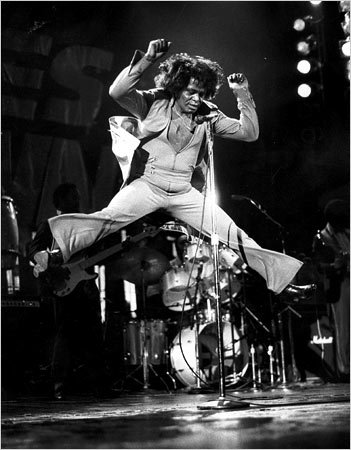
Thankfully, whether 40 years ago or 40 years from now, you never just hear James Brown. Whether on the radio or whatever big playback machine you choose, you'll feel his sweat as any of several dozen songs conjure images as timeless as the music: J.B. gliding on a cushion of air, moonwalking decades before Michael Jackson or Neil Armstrong; J.B. slamming to the floor in seemingly painful acrobatic splits, yet popping up immediately in full spin; J.B. falling to a knee, microphone in hand, a beggar man for love or attention. There will still be nonstop flash in the feet, fire in his soul.

Generations of musicians listened to James Brown, looked at him and took what they could, regardless of the kind of music they played. Much imitated, he was ultimately inimitable.
Someone once suggested Brown was to rhythm what Bob Dylan was to lyrics, and there's no arguing that when it comes to foundations of American popular music, Brown is right there with Louis Armstrong, Duke Ellington, Jimmie Rodgers, Hank Williams, Elvis Presley and Dylan -- creators whose innovations changed everything around them.

But first Brown had to find his own sound, which would come out of the ongoing collision of gospel and rhythm and blues in the mid-'50s. Tellingly, his first group, the Gospel Starlighters, would evolve into the Famous Flames, though with Brown writing or co-writing most of the group's material and proving from the start to be a superb showman, it was inevitable that he would become a solo act, albeit always closely tied to one superb backing band or another.

The early years are populated by classy but not quite classic R&B songs like "Please, Please, Please" and 1958's "Try Me," which sounded equal parts early career frustration and invitation. The first hint of the future -- pressure-cooked grooves, skintight arrangements and brain-melting horn blasts -- was 1962's "Night Train." Three years later, "Papa's Got a Brand New Bag" articulated a new musical and cultural soundscape. Along the way, Brown earned the titles: Soul Brother No. 1, the Sex Machine, Mr. Dynamite, the Heavyweight Champion of Soul, the Hardest Working Man in Show Business, the Funky President-- that fitted him as well as any of his body-hugging suits.

By the late '70s, Brown's hitmaking had pretty much ground to a halt, superseded by genres that were essentially his progeny: funk, disco and, later, hip-hop. Disco was more palatable to the mainstream, while funk's freakiness seemed more appealing to new generations. As for hip-hop, it would have happened even without James Brown, but it would never have sounded so compelling or rhythmically taut had not rappers in the late '70s and early '80s made him the world's most sampled artist -- although Brown seldom got paid for his "contributions," an ongoing source of irritation, along with unhappiness over some of rap's message.

"I didn't really mind rappers," he told me in 1993. "I didn't like what they were saying, and I have very strong feelings about the lyrics. I wanted to see some conscience in our lyrics, to prepare a future for our kids and not tear it down in lyrics. Vulgarity got too far gone, and we've got to withdraw from that." That was particularly important to a man who in the '60s had crafted messages of black pride and self-sufficiency with "I Don't Want Nobody to Give Me Nothing" and "Say It Loud (I'm Black and I'm Proud)."

In the afternoon hours before the 9:30 club show, Brown was still rigorously putting the band through its paces, sharpening the dynamics, tightening the focus, deepening the groove. It was as if that night's show was a debut, not the career celebration everybody in the audience clearly envisioned.

When his statue was dedicated, Brown had told the crowd, "God bless you and God is good, and please, please, please don't forget me."

Never going to happen.

James Brown, the 'Godfather of Soul', Dies at 73


By JON PARELES
The New York Times

Published: December 26, 2006

James Brown, the singer, songwriter, bandleader and dancer who indelibly transformed 20th-century music, died early yesterday in Atlanta. He was 73 and lived in Beech Island, S.C., across the Savannah River from Augusta, Ga.

Mr. Brown sold millions of records in a career that lasted half a century. In the 1960s and 1970s he regularly topped the rhythm-and-blues charts, although he never had a No. 1 pop hit. Yet his music proved far more durable and influential than countless chart-toppers. His funk provides the sophisticated rhythms that are the basis of hip-hop and a wide swath of current pop.

Mr. Copsidas said that Mr. Brown had participated in an annual Christmas toy giveaway in Atlanta on Friday but had been hospitalized on Saturday. After canceling performances planned for midweek, Mr. Brown on Sunday night got his doctor’s approval to perform on Saturday in New Jersey and on New Year’s Eve at B.B. King’s nightclub in New York.

Mr. Copsidas said Mr. Brown used one of his best-known slogans to convey his dedication to his fans: “I’m the hardest working man in show business, and I’m not going to let them down.”

Through the years, Mr. Brown did not only call himself “the hardest working man in show business.” He also went by “Mr. Dynamite,” “Soul Brother No. 1,” “the Minister of Super Heavy Funk” and “the Godfather of Soul,” and he was all of those and more.

His music was sweaty and complex, disciplined and wild, lusty and socially conscious. Beyond his dozens of hits, Mr. Brown forged an entire musical idiom that is now a foundation of pop worldwide.

“I taught them everything they know, but not everything I know,” he wrote in an autobiography.

The funk Mr. Brown introduced in his 1965 hit “Papa’s Got a Brand New Bag,” was both deeply rooted in Africa and thoroughly American. Songs like “I Got You (I Feel Good),” “Cold Sweat,” “Get Up (I Feel Like Being a) Sex Machine” and “Hot Pants” found the percussive side of every instrument and meshed sharply syncopated patterns into kinetic polyrhythms that made people dance.

Mr. Brown’s innovations reverberated through the soul and rhythm-and-blues of the 1970s and the hip-hop of the next three decades. The beat of a 1970 instrumental “Funky Drummer” may well be the most widely sampled rhythm in hip-hop.

Mr. Brown’s stage moves — the spins, the quick shuffles, the knee-drops, the splits — were imitated by performers who tried to match his stamina, from Mick Jagger to Michael Jackson, and were admired by the many more who could not. Mr. Brown was a political force, especially during the 1960s; his 1968 song “Say It Loud — I’m Black and I’m Proud” changed America’s racial vocabulary. He was never politically predictable; in 1972 he endorsed the re-election of Richard M. Nixon.

Mr. Brown led a turbulent life, and served prison time as both a teenager and an adult. He was a stern taskmaster who fined his band members for missed notes or imperfect shoeshines. He was an entrepreneur who, at the end of the 1960s, owned his own publishing company, three radio stations and a Learjet (which he would later sell to pay back taxes). And he performed constantly: as many as 51 weeks a year in his prime.

Mr. Brown was born May 3, 1933, in a one-room shack in Barnwell, S.C. As he would later tell it, midwives thought he was stillborn, but his body stayed warm, and he was revived. When his parents separated four years later, he was left in the care of his aunt Honey, who ran a brothel in Augusta, Ga. As a boy he earned pennies buck-dancing for soldiers; he also picked cotton and shined shoes. He was dismissed from school because his clothes were too ragged.

He was imprisoned for petty theft in 1949 after breaking into a car, and paroled three years later. While in prison he sang in a gospel group. After he was released, he joined a group led by Bobby Byrd, which eventually called itself the Flames. At first, Mr. Brown played drums with the group and traded off lead vocals with other members. But with his powerful voice and frenzied, acrobatic dancing, he soon emerged as the frontman.

In 1955 the Flames recorded “Please Please Please” in the basement studio of a radio station in Macon, Ga. A talent scout heard it on local radio and signed the Flames to a recording contract with King Records. A second version, recorded in Cincinnati in 1956, became a million-selling single.

Nine follow-up singles were flops until, in 1958 a gospel-rooted ballad, “Try Me,” went to No. 1 on the rhythm-and-blues chart. Mr. Brown followed up with more ballads, although the Flames’ stage shows would turn them into long, frenzied crescendos. His trademark routine of collapsing onstage, having a cape thrown over him and tossing it away for one more reprise, again and again, would leave audiences shouting for more.

In 1960 Mr. Brown’s version of “Think” put a choppy, Latin-flavored beat — hinting at the funk to come — behind a sustained vocal and pushed him back into the R&B Top 10 and the pop Top 40.

Mr. Brown had his first Top 20 pop hit in 1963 with “Prisoner of Love,” a ballad backed by an orchestra. But before those sessions he had done a series of shows at the Apollo Theater in Harlem and the one on Oct. 24, 1962, was recorded. His label had not wanted to record the shows; Mr. Brown insisted. Released in 1963, “Live at the Apollo” — with screaming fans and galvanizing crescendos — revealed what the rhythm-and-blues circuit already knew, and became the No. 2 album nationwide.

James Brown and the Famous Flames toured nonstop through the 1960s. They were filmed in California for the “The T.A.M.I. Show,” released in 1965, which shows Mick Jagger trying to pick up Mr. Brown’s dance moves.

By the mid-1960s Mr. Brown was producing his own recording sessions. In February 1965, with “Papa’s Got a Brand New Bag,” he decided to shift the beat of his band: from the one-two-three-four backbeat to one-two-three-four. “I changed from the upbeat to the downbeat,” Mr. Brown said in 1990. “Simple as that, really.”

Actually it wasn’t that simple; drums, rhythm guitar and horns all kicked the beat around from different angles. “Papa’s Got a Brand New Bag” won a Grammy Award as best rhythm-and-blues song, and it was only the beginning of Mr. Brown’s rhythmic breakthroughs. Through the 1960s and into the ’70s, Mr. Brown would make his funk ever more complex while stripping harmony to a bare minimum in songs like “Cold Sweat.” He didn’t immediately abandon ballads; songs like “It’s a Man’s Man’s Man’s World,” a No. 1 R&B hit in 1966, mixed aching, bluesy lines with wrenching screams.

Amid the civil rights ferment of the 1960s Mr. Brown used his fame and music for social messages. He released “Don’t Be a Dropout” in 1966 and met with Vice President Hubert H. Humphrey to promote a stay-in-school initiative. Two years later “Say It Loud — I’m Black and I’m Proud” insisted, “We won’t quit movin’ until we get what we deserve.”

When the Rev. Dr. Martin Luther King Jr. was murdered in 1968, Mr. Brown was due to perform in Boston. Instead of canceling his show, he had it televised. Boston was spared the riots that took place in other cities. “Don’t just react in a way that’s going to destroy your community,” he urged.

By the late 1960s Mr. Brown’s funk was part of pop, R&B and jazz: in his own hits, in songs by the Temptations and Sly and the Family Stone, and in the music of Miles Davis. It was also creating a sensation in Africa, where it would shape the Afrobeat of Fela Kuti, the juju of King Sunny Ade and the mbalax of Youssou N’Dour.

Musicians who left Mr. Brown’s bands would also have a direct role in 1970s and 1980s funk; the saxophonist Maceo Parker, the trombonist Fred Wesley and the bassist Bootsy Collins were part of George Clinton’s Parliament-Funkadelic, and Mr. Parker also worked with Prince.

Through the early 1970s Mr. Brown’s songs filled dance floors. His self-described “super heavy funk” gave him No. 1 R&B hits and Top 20 pop hits with “Give It Up or Turnit a Loose” and “Mother Popcorn” in 1969, “Super Bad Pts. 1 & 2” in 1970, “Hot Pants” and “Make It Funky” in 1971, “Get on the Good Foot Pt. 1” in 1972 and “The Payback Pt. 1” in 1974. He provided soundtracks for blaxploitation movies like “Black Caesar” and “Slaughter’s Big Rip-Off,” and performed at the 1974 “Rumble in the Jungle” boxing match between Muhammad Ali and George Foreman in Zaire.

The rise of disco — a much simplified version of Mr. Brown’s funk — knocked him out of the Top 40 in the late 1970s. But an appearance in “The Blues Brothers” in 1980 started a career resurgence, and in 1985 Mr. Brown had a pop hit, peaking at No. 4, with “Living in America,” the song he performed in the movie “Rocky IV.” It won him his second Grammy Award for Best Rhythm and Blues Recording. That year he was inducted into the Rock and Roll Hall of Fame as one of its first members.

Meanwhile hip-hop had arrived, with Mr. Brown’s music often providing the beat. LL Cool J, Public Enemy, De La Soul and the Beastie Boys are among the more than 100 acts that have sampled Clyde Stubblefield’s drumming on “Funky Drummer” alone. In 1984 Mr. Brown collaborated with the influential rapper Afrika Bambaataa on the single “Unity.” He kept recording into the 21st century, including a 2002 studio album, “The Next Step.”

Mr. Brown maintained a nearly constant touring schedule despite a tumultuous personal life. During the 1970s the Internal Revenue Service demanded $4.5 million in unpaid taxes; the jet and radio stations were sold. His oldest son, Teddy, died in a car accident in 1973.

In 1987, intoxicated on PCP, he burst into an insurance seminar adjoining his own office in Augusta, then led police on a car chase across the South Carolina border. He was sentenced to prison for carrying a deadly weapon at a public gathering, attempting to flee a police officer and driving under the influence of drugs, and was released in 1991.

In 1998 after discharging a rifle and another car chase, he was sentenced to a 90-day drug rehabilitation program. He was officially pardoned by South Carolina in 2003, but arrested again in 2004 on charges of domestic violence against his fourth wife, Tomi Rae Hynie, a former backup singer. “I would never hurt my wife,” he said in a statement at the time. “I love her very much.”

She survives him, along with their son, James Brown II, and at least five other children.
In 1999, Mr. Brown made a deal to receive more than $25 million in bonds against advance publishing royalties. This year, however, he sought to refinance the bonds with a new loan. The banker who had made the original deal, David Pullman, objected to the terms, and Mr. Brown filed a lawsuit against him in July.

But Mr. Brown’s status as an American archetype had long since been assured. A definitive collection, “Star Time” (Universal), was released in 1991. He received a Grammy Lifetime Achievement Award in 1992 and a Kennedy Center Honor in 2003, the same year that Michael Jackson presented him with a BET Award for lifetime achievement. In a 1990 interview with The New York Times, he said, “I was always 25 years ahead of my time.”

John O’Neil contributed reporting.

Sunday, December 24, 2006

Wilfred McClay: God Rest Ye Merry


On Celebrating the Darker Meaning of Christmas
http://www.touchstonemag.com

A number of years ago, our friend Joseph Bottum, editor of First Things, made a nice observation about his experiences of successive Christmases, one that has stuck in my mind as equally true for me, and perhaps for many of us. He observed that every year there seems to be a particular Christmas carol that grabs his attention early in the season, often because one particular line or image in that carol suddenly opens itself, revealing a fresh meaning that he’d never before noticed.

I’ve had the same experience. I remember being struck a couple of years ago when, in listening to the French carol we call “O Holy Night,” a song I always tended to find both schmaltzy and tedious, I noticed the words “Long lay the world in sin and error pining,/ Till he appeared, and the soul felt its worth.”

Maybe it was just a quirk of timing, but those last six words hit me with unexpected force, and I wondered why I had never noticed them before, even though I’d long ago committed the lyrics to memory. It could have been partly because there are several extant “translations” into English, which vary in the way they render that phrase (and bear little resemblance to the French). But the more general point stands. And I now listen to “O Holy Night” with new respect.

I believe others have similar tales to tell, of carols that somehow come suddenly to life for them. The experience of hearing and singing and sharing these familiar carols every year, year after year, is like the best experience of liturgy, in its combination of familiarity and fresh moments of discovery, when universally known words that have for years passed through one’s lips in rote repetition suddenly blaze forth with meaning, vividly and achingly true.

Like the oldest and best liturgies, these songs are no one’s personal property, time and usage having wiped away nearly all distracting fingerprints of authorship and “originality.” Instead, they belong to all of us. They are old friends to us, and like the best old friends, they are comfortable and reassuring, and yet also full of mysteries and surprises and strange, hidden delights. Our Christmas carols are among the most precious shared possessions of our fragmenting, fraying culture, and for all that we abuse them and demean them, they seem to remain imperishable.

This year, somehow it’s been “God Rest Ye Merry Gentlemen” that has stuck in my brain, and particularly these words, in the first verse: “To save us all from Satan’s power/ When we were gone astray.” We move through these sibilant words so quickly and rhythmically. I know I always have. And yet how plainly those few words sketch in a somber background, a whole universe of presuppositions without which the song has a very different, and diminished, meaning.

The merriness being urged upon the gentlemen (one should always remember that, in the lyrics, there is a comma between “merry” and “gentlemen”—they are not “merry gentlemen” being encouraged to “rest”) comes amid a great darkness, a darkness that never disappears, that beckons and threatens, a darkness whose presence is subtly conveyed by the minor key with which the song begins and ends. The black ship with black sails lingers on the far horizon, silent and waiting.

Dark Reminders

There are constant reminders of this darkness, if one has ears to hear them, running through the great liturgy of our Christmas carols, with their memorable evocations of bleak midwinter, snow on snow, sad and lonely plains, the curse, the half-spent night. The spooky and antiseptically sterile depiction of winter in C. S. Lewis’s The Lion, the Witch, and the Wardrobe and its cinematic adaptations is, in that sense, very close to the spirit of the older carols, and to the biblical account of the matter—much closer than the hearty merriment of rosy-cheeked seasonal songs like “Sleigh Ride” or “Let It Snow, Let It Snow, Let It Snow.”

The older lyrics are laced with just such evocations of darkness. They help us remember why it is symbolically right, even if historically wrong, to celebrate Christ’s birth in winter.

We are constantly reminded to “keep Christ in Christmas” and to remember “the reason for the season.” And of course we should. But, if I may be permitted to put it this way, we must also keep Satan in Christmas, and not skip too lightly over the lyrics that mention him.

For he and the forces he embodies are an integral part of the story. It utterly transforms the way we understand Christmas, and our world, when we also hold in our minds a keen awareness of the darkness into which Christ came, and still must come, for our sake.

Later in “God Rest Ye Merry Gentlemen” the visiting angel tells the shepherds in the field that Christ has come “To free all those who trust in him/ From Satan’s power and might.” Being subject to that “power and might” is, as we are likely to put it these days, the default setting of our human existence. But the Christmas story plays havoc with all such defaults.

It reveals the putatively normal and settled features of our world to be something very different: the ruins and aftereffects of a great and ancient calamity, the tokens of a disordered order. It lifts the veil of illusion about who we are and what we were made to be. Which means that the “comfort and joy” of which the song speaks are not merely outbursts of seasonal jollity.

Captives’ Gratitude

They bespeak the ecstatic gratitude of captives and cripples who recognize that, in and through Christ, the entire cosmos has been transformed, and their lives have been made new. Nothing can ever be the same again.

The darkness does not go away. Not now, not yet. But the light that shines into it can make even the bleakest midwinter into a landscape glistening with promise. So may it be for each of us, this and every Christmas.

—Wilfred M. McClay, for the editors

“God Rest Ye Merry” first appeared in the December, 2006 issue of Touchstone.

Notes on above painting:
“The Nativity at Night,” oil painting by Geertgen tot Sint Jans, late 15th century; in the National Gallery, London

Saturday, December 23, 2006

Knight ties Smith with 879 wins


By JAIME ARON, AP Sports Writer
December 23, 2006

LUBBOCK, Texas (AP) -- Add this to the list of things you can say about Bob Knight: Nobody has ever won more Division I men's basketball games.

Knight matched Dean Smith's record of 879 victories when Texas Tech beat Bucknell 72-60 on Saturday.

Knight's first chance to own the top spot all by his sweater-wearing self comes Thursday night at home against UNLV.

"Any time a coach is given an award or honor the great thing about it is that it recognizes everyone involved -- the players, the assistant coaches," Knight said. "I know that Dean Smith felt exactly the same way because he epitomized what coaching is all about."

Already a Hall of Famer, Knight now has a share of the record some believe drove him back to coaching after being fired by Indiana after 29 years, three national titles and one too many run-ins with players, bosses and fans. Since resurfacing in 2001 at this West Texas school in the heart of football country, "The General" hasn't changed much.

He's still fiery, as evidenced by him jerking up a player's chin earlier this season. He still runs a motion offense and tight man-to-man defense. And he's still winning: a 115-64 record with three trips to the NCAA tournament in five full seasons at a school that went twice the previous 15 years.

About all that's changed is the color of his sweater (black, instead of Hoosiers red) and the importance of the milestones, none bigger than this one, no matter how much Knight has tried to downplay it.

In his 41st year of coaching, Knight has a career record of 879-353. Smith went 879-254 over 36 years, all at North Carolina. Knight and Smith also are the only men to have won national championships as players and coaches. They also share the record for coaching in the most NCAA tournaments (27).

Tennessee women's coach Pat Summitt is the overall leader in major-college victories with 913 going into Saturday.

Playing before 11,561 fans, the second-biggest crowd in the campus arena's history, and without third-leading scorer Charlie Burgess (groin), Tech led for all but a couple possessions in the opening minutes.

Bucknell (5-6) got within 42-39 early in the second half, but missed 13 straight shots starting with a 3-pointer that could have tied it. The Red Raiders capitalized with a 17-0 run and it wasn't close again.

Jay Jackson scored 10 straight points during the game-breaking spurt and scored 18 points for Tech (10-3). Martin Zeno also had 18, while Alan Voskuil scored a season-high 15 and Darryl Dora added 14.

John Griffin scored 16 points for Bucknell, which had won five of six. Donald Brown had 13 and Chris McNaughton added 12.

Although the blowout drove away most fans, those who stayed were standing when time ran out, with three of them holding up black posters with the numbers 879.

There was no postgame announcement of the feat, and it was hardly acknowledged by his five assistants. Only Chris Beard patted him lightly on the back as he walked by, although Tim Knight, one of the coach's sons, went to get the ball from Dora.

Some fans stuck around while Knight did a postgame television interview, but it wasn't heard in the arena and he treated it as just another win as he walked to the locker room.

Karen Knight, a former girl's high school basketball coach in Oklahoma, sat in her usual seat about 20 rows up from the Tech bench. She declined to comment about the impending win record but said she is "absolutely" proud of her husband.

"Always proud of him," she said.

Updated on Saturday, Dec 23, 2006 6:40 pm EST

Dan Wetzel- Bob Knight: Doing it his way


By Dan Wetzel, Yahoo! Sports
December 21, 2006

LUBBOCK, Texas – Leaning back on a couch in the coach's locker room here, Bob Knight is running through Bucknell tape on his big screen TV, back and forth as Texas Tech's next opponent runs a well-executed ball screen.

As sleet and freezing rain slam the South Plains here on Christmas week, Knight is huddled deep inside United Spirit Arena, one thought on how to get career victory No. 879, and one thought on the media that has been hounding him for nearly all of the previous 878 – most recently when he clipped player Michael Prince on the chin last month.

It is that thought that makes him hit pause and fire off a glare.

"That is why I have such a bad (expletive) feeling about all of you (expletive)," he says.

Knight still wonders how things could get so mixed up with the media, with some of the public.
Actually, he doesn't wonder.

He is fairly convinced that, like a lot of things in college athletics, like a lot of things in the world today, common sense, perspective and the ability to separate the important big things from the superfluous little ones is lost.

While he is not inclined to discuss that a victory Saturday over Bucknell can tie him with Dean Smith as the winningest coach in Division I history, human nature suggests that deep down the record brings additional validation to his methods, to his success.

Bob Knight, no matter what they say, will be on top, without peer, without apology.

Knight, 66, hasnt changed a bit and isn't planning on it. He still is the unapologetically demanding coach. He still is a profound stickler for NCAA rules – no matter how disdainful he can find them. He still is the industry leader in demanding academic success and ultimate graduation of his players. And without question his competitive desire to win has not waned one bit.

He was that way at Army in 1965, where he started his head coaching career at age 24. And he will be that way when he eventually retires on top of his profession. He has no regrets, no remorse – no matter what the media says.

"I've done it my way and I think we've been pretty successful the way I've done it," he said.

One of Knight's prized possessions is a letter from Walter Byers, the pioneering former NCAA executive director who from 1951 to 1988 built the Association into the billion-dollar powerhouse it is today. Byers was a no-nonsense guy who ruled the NCAA with an iron will and an uncompromising vision. It is little surprise he and Knight were friends.

The letter arrived when Knight came here to Tech, when there was still so much fallout from his dismissal at Indiana, still so much negativity. One line in particular is Knights favorite:

"Every game has its rules," wrote Byers, "and over time you've played the game on the important points as cleanly and openly as anyone I've known."

"I don't think," said Knight, "there is anything I have received I appreciated more than that."

To Knight it isn't so much the ultimate vindication as much as it is the proof that someone smart, someone with principle and someone who clearly knows what goes on in college athletics was paying attention and recognized the big stuff.

In terms of the purpose of college sports, Knight's view (which most would agree with) falls into three main categories.

1. Assure an education (both academically and in life skills) for student-athletes.

2. Follow the NCAA rules.

3. Win.

After that, it's all small stuff. After that, what really matters? If you happened to be the coach who has a near 100 percent graduation rate, who has hundreds of former players who swear your teaching drove them to success – and if you happened to do all this while following NCAA rules as well as anyone and you won more games than anyone, would you want to hear about flipped chins, thrown chairs and press conference meltdowns?

But the media coverage of Knight is about the sensational, about the controversial, in part because Knight keeps providing new material. There is little question he is held to a double-standard, but much of that is his own creation.

While almost every news account mentions his successes, it inevitably ends with but … And Knight can't quite figure out why there is the need for the but …

Like Byers, he has been in college athletics a long, long time and he knows as well as anyone that the coaches who don't cheat and who do care are significantly fewer than the public believes.
The NCAA's system of selective enforcement inadvertently convinces the public the cheaters are few and far between – that there are white hats and black hats out there.

Reality is just the opposite. Just about everyone wears grey.

"I would say the majority of major college basketball programs break the rules," said Sonny Vaccaro, the long-time shoe company czar who by operating summer basketball camps, tournaments and all-star games since the 1960s has been privy to about every under-the-table dealing that ever went down.

"Because of my role and because I've been, I guess, a sounding board for these things, I know these things. I've heard it all. I've been there for these things. And with Bob Knight I've never heard a single thing, not first hand, second hand, third hand. Nothing. Not ever."

What Vaccaro knows is that rampant rule breaking takes place not just among the usual suspects, but also within programs run by the game's Mount Rushmore figures, the ones with the most pristine reputations, the guys fans just don't want to believe could be corrupt. He is forever laughing at the disparity between reputation and reality with some of these guys, the ones who employ sugar daddy boosters or whose recruits' parents magically move near campus or offer big money "graduation" gifts for players. But that stuff, he says, has powered some of the dynasties in this sport.

"You'd be disgusted with the number of coaches in the Hall of Fame who got there by cheating," he said. "The American public wouldn't believe it."

Which is why Vaccaro, who has never been close with Knight and whose summer basketball world has been the brunt of many a Knight diatribe, says you can't just dismiss the big stuff because doing it is so, so rare.

"What the fans should realize is that if this is about the student-athlete, about education and following the rules, if that is what matters, then I am saying Bob Knight is the greatest of all-time. And there is no one even close. And there never will be."

Yet as ESPN previews the upcoming Tech games that will propel Knight to the record, the videos that flash across that big screen TV are him getting into it with officials, players and reporters. Following the rules doesn't make for a great highlight. Nor do graduation ceremonies.

"You get tired (of the press)," said Knight. "You get tired of all that. Because I yelled at somebody that supersedes everything else?"

Knight says "I am not my brother's keeper." He says, "I'm not a policeman." He says that while he decided early on to place more value on academics and compliance, it doesn't bother him that so many others in college athletics didn't. Even if it has affected him many times in recruiting.

Knight has been able to recruit and coach some very good players during his career, particularly during his run at Indiana. But the truly great players often eluded him. In his entire career he coached just one NBA All-Star (Isiah Thomas from 1979-81). By comparison, Dean Smith coached 12 who appeared in a collective 61 All-Star games.

For the most part he targeted the guys he thought he could get and went from there. He didn't bother with the ones that wanted more than tuition, room and board; the ones that didn't want any part of actually attending class.

At IU he was literally surrounded by scoundrels – Illinois, Louisville (twice), Kentucky (three times), Cincinnati (three times), Ohio State, Michigan and Purdue – a perfect circle around Bloomington – who all were hammered with major infractions during his time with the Hoosiers. During his five seasons so far in the Big 12, three of the regular season champions (Kansas and Oklahoma) are already on NCAA probation for major rule violations.

"How many people cheat today?" Knight said. "I don't know. I've had one concern as long as I've been coaching and that is how we do things, period. If they put me in charge of it, and that was my job, then I'd bust up a lot of things.

"It's everybody's choice. My choice is there are rules there so we'll try to follow the rules. And that is the way I was taught and that's the way my parents taught me – that there is a right way and a wrong way.

"The kid that goes (to a school that cheats), that's the chance he takes, that (he goes where) it is just about playing four years of basketball or whatever.

"If I broke rules to win games I wouldn't get anything out of them. You know, what games we've won, we've won totally within the rules."

Yet for years he watched as cheaters succeeded, watched them receive glowing praise in the press. For years he received phone calls and letters from players, who after playing for coaches with better reputations, were asking him for help, advice, and guidance.

"Over the years I have had a lot of kids at other schools call me to help them get jobs," Knight said. "So when kids from other schools, kids we played against or I have met somewhere along the way, are calling me to help them, I think that is an indication that their schools don't much give a damn about the kids. And there are a lot of those.

"To me, that's academic fraud."

He sighed and went back to the Bucknell tape for a minute, watching an inbound play closely for some flaw his 9-3 team can exploit. He sat up for a second to get a closer look and then leaned back in the chair.

"I don't have a bad feeling about the guys who want to cheat," he said. "I have a bad feeling for people in your profession who don't recognize what's important and what isn't – and fail to recognize what has been good and what hasn't. That is why I have such a total lack of regard for most people in your profession.

"He threw a chair. What difference does it make if you threw a chair? How (expletive) many guys have thrown things? Bats out on the field, balls, picked up bases, water coolers, thrown coats? How many guys have kicked something over?

"I'm tired of that. That's what Im tired of."

Dating all the way back to his playing days at Ohio State, where he was John Havlicek's teammate on the 1960 NCAA championship team, Knight has questioned the decision making of the NCAA. He's watched the game get bigger, grander, more professionalized and more competitive. Often for the good, he notes, but sometimes for the bad.

The latest trend he can't comprehend is the NCAA's willingness to be used by the NBA as a one-year way station for top pro prospects. NBA Commissioner David Stern instituted a 19-year-old age limit to stop the preps-to-pros trend. It forced the best high school players into college, such as Ohio State's superb center Greg Oden.

But for whatever excitement that brings the fans, such a decision stands in stark contrast to what the NCAA is supposed to be about. Many of the top prospects openly claim they are only going to attend school for one year, no one even pretends that graduating is a goal anymore.

"These rent-a-players, that's the worst thing I've seen happen in college basketball," Knight said. "These guys who can come in for one year and play, that's not college basketball. College basketball is a game for kids that are going to college to graduate not going to college for one year and then move on."

In fact, the one and done student-athlete doesn't have to be much of a student at all under current rules. For a freshman to retain his eligibility into the second semester he needs to earn a meager D in just two classes and flunk the other two. A player could do virtually no academic work in the fall semester and then not attend a single class the spring semester before dropping out the day after the season is over to turn pro.

"So I can come in and (learn nothing) the first semester and then play the second semester without ever going to a class and then quit," said Knight. "Is that what college basketball is all about?"

Knight believes the NCAA is being duped by the NBA because it is so desperate for the talent infusion that they'll compromise all logic.

"(David) Stern doesn't give a damn about college basketball. The NBA saves a hell of a lot of money with these kids coming in early like they do."

Knight's suggestion is to make players who want to attend college sign an agreement that will keep them on campus at a minimum of two years. Or else take a scholarship away from schools that recruit these kinds of players. Anything else is ridiculous and hypocritical.

"It is ludicrous (to allow a) kid who is only going to be there one year have a real effect on the outcome of an entire season of college basketball. And these people talk about academics and graduation rates."

Knight's record of compliance is pristine, yet he hates the NCAA rule book for its arcane and confusing items. He has volunteered to tear it up and turn it into a 10- to 20-page document. He considers the NCAA's new academic requirements that force schools to graduate athletes at a higher rate than the student body or face sanctions to be illogical. He doesn't believe morality can be legislated.

"The rules are not going to keep people from violating them."

Mostly he can't believe how little common sense is being applied.

"I don't think there is anybody in the NCAA hierarchy who has ever coached and very few who have ever played. And it is the same with presidents. How many of them have ever coached? How many of them have ever played? It is amazing.

"The person that through the years the NCAA has gotten furthest away from is the kid," he said. "(They never consider) what's best for the kid."

The three-second clip of Bob Knight flipping Michael Prince on the chin is a snapshot of a full-time, lifetime interaction between coach and player, teacher and student, mentor and protégé. That's how Knight sees it. That's what he believes.

It was just one moment, one interaction. All the other days, the games, the practices, the meetings, the bus trips, the late-night phone calls when the player is long since graduated are missed.

Most people see the footage and see it the other way: Knight once again out of control. But if you can't imagine why he keeps doing these things, why he keeps making it difficult for people that want to support him, want to hold him up as what is good in college sports, then you don't understand Knight. For Knight, the end justifies the means because the end result is so good.

"If I didn't do things like that my kids wouldn't be as successful as they have been," he says.
Knight pauses the Bucknell tape again, turns and makes sure he is getting this message across clearly. This, he believes, is the entire point, the entire missed point when it comes to his career. Never mind the acts that don't seem proper. They are proper because they produce the proper results.

"If I didn't yell, if I didn't demand, if I wasn't tough, if I didn't have the stringent rules, my kids wouldn't be as successful," he said. "You don't graduate players today in college without getting on their ass. You don't make kids better people without getting them out of their comfort zone.
"Why do I have as many kids graduate as anyone? Why are our kids so successful? If I did things the way you'd like me to do them, that are politically acceptable to everybody, then we wouldn't beat anybody, we wouldn't accomplish anything.

"See, that is the thing guys don't grasp."

His mind goes right back onto the game tape, about the next opponent, about the next victory.
After four decades, he is about done even trying to explain all this stuff. He knows, at this point, he probably isn't changing any minds. And his is certainly not going to change, an all-time wins record of not.

As always, he wonders why the world just doesn't always think like he does.

Dan Wetzel is Yahoo! Sports' national columnist. Send Dan a question or comment for potential use in a future column or webcast.

Updated on Friday, Dec 22, 2006 1:47 am EST
Rich Lowry: Christmas at the Battle of the Bulge


December 22, 2006 12:00 AM
http://www.nationalreview.com
Won’t Be Home for Christmas
Spending the holiday at the Battle of the Bulge.


“Sir, this is Patton talking … You have just got to make up Your mind whose side You’re on. You must come to my assistance, so that I may dispatch the entire German Army as a birthday present to your Prince of Peace …” — Prayer of Gen. George S. Patton, Dec. 23, 1944

It is with Patton’s plea to the Ultimate Commanding General that Stanley Weintraub opens his new book, 11 Days in December: Christmas at the Bulge, 1944. The tale of the worst Christmas for American soldiers since Valley Forge, as Weintraub puts it, is especially resonant with American troops again in harm’s way on Christmas, this time in Iraq and Afghanistan, where they call on the same resources of bravery and perseverance as their forebears.

The Allied breakout from Normandy in the summer had convinced Gen. Dwight Eisenhower that the war with Germany would be over by Christmas, but as the Allied advance slowed, the Germans hatched a plan to counterattack through the Ardennes forest. They hoped to punch though the thin Allied lines there and surround four Allied armies. In Hitler’s desperate delusion, the Allies in the West would be forced to come to terms. Behind the cover of the thick forest and the horrid weather, the Germans scored initial successes, creating the “bulge” in the Allies’ line. American casualties reached at least 80,000 throughout the course of the battle. The troops fought in conditions that would, in other circumstances, have been a winter wonderland, among evergreen trees freshly covered in snow. American troops suffered frostbite, and the inclement weather favored the Germans, delaying reinforcements and neutralizing American air superiority.

Soldiers who were lucky created makeshift Christmas trees by hanging grenades on pine trees. But GIs who were captured by the Germans were packed into boxcars in unsanitary conditions and got almost nothing to eat. “They filled the time wanly singing carols,” Weintraub writes. “The Germans complained that it kept them awake and threatened to shoot if the songs didn’t cease.” At the front, German loudspeakers broadcast across the lines, “How would you like to die for Christmas?” Americans didn’t intimidate so easily. One American soldier in the encircled city of Bastogne commented to another, “They’ve got us surrounded — the poor bastards.”

When a German commander demanded the surrender of the Americans at Bastogne, Gen. Anthony McAuliffe famously responded in a note, “To the German Commander: ‘Nuts!’” It became clear that the Germans weren’t going to achieve a quick breakout. “Even broken American divisions,” Weintraub writes, “evidencing courage and resourcefulness, had slowed, if not blunted, the German offensive beyond expectations on both sides. The Bulge was producing little strategic benefit.”

Gen. Patton, who had been looking forward to thrusting toward the Saar region of Germany, instead had to relieve Bastogne. Earlier, he had badgered his chaplain to pray for optimal conditions for an offensive. The chaplain noted “that it isn’t a customary thing among men of my profession to pray for clear weather to kill fellow men.” Undeterred, Patton asked, “Are you teaching me theology or are you the chaplain of the Third Army?” Patton distributed a printed prayer for good weather to his troops and made his own appeal, noted above. The weather improved, and Patton wrote in his diary, “A clear, cold Christmas, lovely weather for killing Germans, which seems a bit queer seeing Whose birthday it is.” By early January, the Germans were forced to withdraw from the Ardennes, and the Allies were at the Rhine by March.

One schoolmaster returning to his blasted classroom after the battle found a message scrawled on the blackboard from a distraught German officer: “From the ruins, out of blood and death shall come forth a brotherly world.” Unlikely as it seemed at the time, he was right. The Allied victory created the predicate for a free Europe at peace. One prays that the Christmastime exertions by today’s American troops eventually create equally beneficent results.

Notes on the above picture:
Members of the 101st Airborne Division walk past dead comrades, killed during the Christmas Eve bombing of Bastogne, Belgium, the town in which this division was besieged for ten days. This photo was taken on Christmas Day. 1944

Travel year in review: Springsteen show renews heart in New Orleans


Travel year in review: Springsteen show renews heart in New Orleans
Updated 12/21/2006 5:34 PM ET
By Jerry Shriver, USA TODAY

Best experience

"Brothers and sisters, don't you cry, there'll be better times by and by," implored Bruce Springsteen during the opening song of his performance at the New Orleans Jazz & Heritage Festival in April.

But most of us 50,000-plus disciples who had gathered at the fairgrounds to hear him that afternoon couldn't help it. Tears of sorrow, anger, joy and release dripped freely onto soil that nine months earlier had been swamped beneath Katrina's aftermath. In those desperate days, few believed that America's greatest cultural festival would ever be staged again, let alone in its normal slot the following spring.

Yet during the opening weekend a near-record, ebullient crowd, drawn from across the country, flowed through the gates to embrace all of those devastated but resilient food vendors, musicians, craftsmen and behind-the-scenes workers who had returned. The initial sight of that outpouring set my wife to sniffling.

I held off until Springsteen's show, which closed the opening weekend. This was the public debut of Bruce's boisterous 17-piece ragtime/Dixieland/oompah/rockabilly band that he assembled to play spirituals, protest songs and feisty American ballads written or popularized by Pete Seeger.
From the opening piano and fiddle runs of Oh, Mary Don't You Weep to the hymn-like version of When the Saints Go Marching In 2½ hours later, the group created the most powerful musical performance I have seen in 35 years of attending concerts.

Every probing lyric and urgent arrangement seemed tailored to the region's and the country's plight. And when coupled with Springsteen's poignant spoken tributes to the city and his expressions of outrage and hope, the effect was pure catharsis. It's a sound I am still replaying in my heart.

READ MORE: Springsteen helps Big Easy overcome Food will be jazzing up New Orleans' spirit

Steve Popper: Memories lured Pettitte back


Friday, December 22, 2006
Bergen County Record

Andy Pettitte had already gone through the heart-wrenching decision to leave New York -- his baseball home -- three years ago, so he had no intention of contemplating leaving his real home again. He was convinced he would either return to the Houston Astros for another season or just hang it up, ending his career at age 34.
document.write('');

And then in November he went to Joe Torre's Safe at Home Foundation Dinner in New York, which happened to feature a 10-year reunion of the 1996 Yankees. He mingled with his former manager and listened to his old friends implore him to return. And he began to wonder.

"I got to see a bunch of the guys," Pettitte said. "They were talking to me about coming back. At that time there was no chance. It was Houston or nowhere -- retirement. It was out of my mind, but all the guys were talking to me. I would kind of smile at them. They were excited and I was excited.

"I had the opportunity to see everybody, see all the guys on the team and talk. I actually had to leave right after the dinner and wasn't able to spend Saturday with them. My son had a playoff football game. Everybody knew I was a free agent. They were planting the seed, but at that time there was no chance."

Having been drafted by the Yankees and been a key part of the franchise's success during his nine seasons in New York, the memories pulled at Pettitte as much as Houston and family had for him when he left New York.

He returned home and spoke with his family and found that, unlike three years ago, his wife and children were not opposed to him returning to New York. On Thursday, the Yankees finally officially welcomed Pettitte back with a $16 million one-year deal and a player option for 2008.

The longing for New York was no more powerful than the longing the Yankees felt for Pettitte, who was everything that his replacements were not -- a big-game pitcher who was at his best in the postseason. So once the seeds were planted, the Yankees put on a full-court press.

"Coming back to the New York scene, seeing lot of former teammates, rustled up emotions of what he felt like here," Brian Cashman said. "Being in New York City, under the Yankee umbrella, stirred some emotions. It was something he cherished. It was a hard decision to leave, just like the decision to come back up here."

But will Pettitte's decision affect the decision of his pal, Roger Clemens?

"He was excited," Pettitte said. "He said he'd like to see me go to New York. My gut feeling, I would imagine, is that he's going to play. I have no idea where. But he's continued to come back and continues to be the best pitcher in the league, so why wouldn't he play? Who with, I have no idea. I know that'll be a major decision he has to make in his life."

Fr. Stylianos Muksuris: God's Greatest Gift at Christmas


God's Greatest Gift at Christmas
Fr. Stylianos Muksuris
http://www.orthodoxytoday.org

". . . all celebrate seeing God on earth and man in the heavens; because of his condescension they see down on earth him who, through his philanthropy, is found in heaven" (St. John Chrysostom, Second Homily on the Nativity).

Why is Christmas important to you? Undoubtedly, people of all ages and different backgrounds will answer this seemingly uncomplicated question in their own unique way. Many express contentment about receiving gifts during this season, while others look forward to sharing their time and resources with others. Some find excitement knowing that the holidays will provide them with some much needed respite from work or school, while still others anticipate being surrounded by good friends and food - and not necessarily in that order! Realizing then the great diversity of such views, I have attempted to avoid transforming this present contribution into one more personal opinion about the significance of Christmas.

As Christians, we believe that the birth in the flesh of the Second Person of the Holy Trinity, our Lord Jesus Christ, has set into motion the process of salvation. St. John Chrysostom's insightful characterization of the Nativity feast as "the center of all festivals" indicates that all subsequent events in the life of our Lord, celebrated liturgically by the Church, find their commencement with the human birth of Christ (On the Incomprehensible Nature of God, Homily 6, PG 48.752). In other words, had Christ not been born in the flesh, He would never have been baptized, crucified, or resurrected in the flesh.

Nevertheless, the Nativity does more than set a sequential basis for the other Christian holidays. More importantly, it imbues the other feasts of the Church with a profound realism, linking the incarnated God with every aspect and phase of human life. In other words, since God is now tangible, He is finally understandable in the full breadth of His love and compassion for the world. Likewise, man perceives that God, through Jesus Christ, has finally visited His people in the most special of ways and has comprehended and assumed in toto the human condition (despite the fact that God's awareness and concern for man has always far surpassed man's own expectation).

This ability then to understand and be understood lies at the very core of the Christmas message, and it is precisely this model of Christian life that our Lord offers to each of us this holy season as His gift of love. Though the Wise Men from the East offered the innocent Babe wrapped in swaddling clothes precious material gifts of gold, frankincense, and myrrh, the Lamb of God offers to His worshippers a spiritual gift far more precious than money can buy. Man adorns the Christ Child with the material best of his world; God adorns man with the spiritual wealth of His heavenly Kingdom. And this gift of God comes complete with the following simple directions: "I have entered your beautiful world, the work of My hands, and have embraced you, My people. It is now your turn to learn from My humble example, to enter My Kingdom and embrace God."

What our Lord offers us at Christmastime is the opportunity to essentially adopt a new approach to life and people, His approach. He invites us to incarnate ourselves into the very fabric of our neighbor's reality, to understand and love him rather than to despise him, to forgive her rather than to judge her, and to support rather than to humiliate. In assuming this 'incarnational approach' to life, we would indeed be fulfilling the will of God and living up to the noble motto which proudly graced and still graces the halls of my old Catholic high school: Efficiamur Christiferi ("Let us become Christbearers").

This "foreign and strange mystery" of Christ's birth in the flesh beholds the powerful union of both the heavenly and earthly realms, "the cave as heaven, the Virgin as a Cherubic throne . . . upon which reclined the Boundless One, Christ God" (9th Ode of the katavasiai of the Nativity). Chrysostom makes a most interesting observation, namely, that the Incarnation was necessitated by a "lack of space in heaven", so to speak: "This is why he became flesh, so that the manger could accept him whom heaven cannot contain" (St. John Chrysostom, Second Homily on the Nativity). Put otherwise, God's limitless love for man overflowed from heaven and trickled down upon the earth, making our world, with the divine presence of the incarnate Logos, an extension of God's super-celestial Kingdom. And this expression of divine agape took the form of One who not only fully understood but was fully understood by others, giving to the world a model of living capable of transforming man into god, in St. Athanasius' estimation (On the Incarnation 54).

Christmas is indeed a time of warmth, togetherness, and sharing. However, we cannot and should not overlook the greatest gift God gives to each of us, which is Himself and the model of life He taught us through His humbling condescension and daily example of genuine concern and charity. It is in this 'incarnational approach' that the secrets of true happiness, joy, and peace - sought by people the world over -- are made manifest in their entirety.

Fr. Stylianos Muksuris, BA, MDiv, MLitt, PhD (cand.), is a graduate of Hellenic College and Holy Cross Greek Orthodox School of Theology, Brookline, MA, and the University of Durham, Durham, UK, and specializes in Eastern Liturgy and Theology. His doctoral dissertation is entitled "Economia and Eschatology: The Mystagogical Significance of the Byzantine Divine Liturgy's Prothesis Rite in the Commentaries of Sts. Nicholas Cabasilas and Symeon of Thessalonike". He has also authored "The Anaphorae of the Liturgy of Sts. Addai and Mari" and the "Byzantine Liturgy of St. Basil the Great: A Comparative Study" (unpublished MLitt thesis). He may be reached at: profsgkm@yahoo.com.

Posted: 21-Dec-06

* Information on the above painting:
The Nativity with Donors and Saints Jerome and Leonard, ca. 1510–15
Gerard David (ca. 1455–1523)
Oil on canvas transferred from wood
The Jules Bache Collection, 1949 (49.7.20a–c)

Film Review: "The Good Shepherd"


Company Man: Hush, Hush, Sweet Operative
By MANOHLA DARGIS
The New York Times
Published: December 22, 2006

“The Good Shepherd,” a chilly film about a spy trapped in the cold of his own heart, seeks to put a tragic human face on the Central Intelligence Agency, namely that of Matt Damon. The story more or less begins and ends at the Bay of Pigs. In between there is a spicy, lively interlude in the 1930’s at Yale University, where little boys are made of skull and bones and secret societies. Yale leads to World War II, cloak and dagger and a British spy cut from the same bespoke cloth as Kim Philby. Then it’s over to Washington, where the citadels of power loom against the cheerless sky like tombstones.

Mr. Damon, who plays a super-spy warrior in the “Bourne” films, excels at secretive men, and few are as mysterious as Edward Wilson, the spy catcher in “The Good Shepherd.” (The title refers to the Bible passage in which Jesus says: “I am the good shepherd. The good shepherd lays down his life for the sheep.”) Though a composite, Wilson seems largely based on the fascinating, freakishly paranoid James Jesus Angleton, a Yale graduate and poetry lover who served in the Office of Strategic Services during World War II and ran C.I.A. counterintelligence from 1954 to 1974. Mr. Angleton cultivated orchids; Wilson builds the more prosaically symbolic miniature ships in bottles.

Mr. Angleton is now widely thought to have hurt the C.I.A. more than he helped it, and articles on the agency’s Web site (cia.gov) frame his tenure in generally unfavorable terms (it had “devastating results,” for one). Written by Eric Roth and directed by Robert De Niro, “The Good Shepherd” doesn’t address the full consequences of that devastation, partly because it wants to take on the institution as well as the man, and partly, one imagines, because Mr. Angleton’s crippling paranoia would have been too difficult to shape into a neat narrative. “The Good Shepherd” is an origin story about the C.I.A., and for the filmmakers that story boils down to fathers who fail their sons, a suspect metaphor that here becomes all too ploddingly literal.

Certainly fathers and sons offer a serviceable alternative to martinis and Aston Martins.
Created in 1947, the C.I.A. has been responsible for many deeds, including our abiding fascination with spooks. No matter which way public sentiment shifts about the agency and its handiwork (Chile, Nicaragua), we remain fascinated with spies, or at least an idea of them, an idea in which matchbox cameras and microphones invariably figure more prominently than miles of locked filing cabinets. Secrets make agencies like the C.I.A. sexy, no matter how rumpled the raincoats. The most interesting thing about “The Good Shepherd” is how hard the filmmakers work not only to demystify the agency, but also to strip it of its allure, its heat.

In “Betrayal,” a book about Aldrich Ames, the double agent who for years ferried C.I.A. secrets to the Soviets, the agency is characterized as “a cross between Yale’s secret Skull and Bones society and the post office.” In its basic outline Mr. Roth’s overly busy screenplay takes the same approach to the agency as it follows Wilson’s journey through institutions of power. At Yale he joins the Skull and Bones, where the power elite helps reproduce itself by bonding and dressing like the orgiastic partygoers in “Eyes Wide Shut.” The all-male members of this clandestine group don’t have sex with one another, at least on screen, but they do mud-wrestle naked, a ritual that underscores the homosocial nature of Wilson’s world.

Yale and World War II are the juiciest bits of the story, partly because they involve the charismatic Dr. Fredericks, played by a superb Michael Gambon. A Yale professor with a leer as insinuating as his walking stick, Dr. Fredericks tries to seduce Wilson into some antidemocratic chicanery through their shared love of poetry. (At Yale, Mr. Angleton helped found a poetry magazine in which he published Ezra Pound, a family acquaintance.) This attempted seduction parallels a rather more comical one involving Angelina Jolie, who plays Margaret Russell, the sister of another Yale student. With her poppy-red lipstick and raucously aggressive sexuality, Margaret proves a far more successful seducer than Dr. Fredericks, as female pulchritude and power triumph over manly poetry and secrets.

Ah, but not for long. This is a man’s world, after all, filled with specters skulking through alleys with blood on their hands and the world on their shoulders. Conscripted into the O.S.S., Wilson travels to London, where he apprentices in espionage and intelligence and meets Arch Cummings (Billy Crudup), a fop with a posh accent patterned on Kim Philby. The film shies away from the more provocative aspects of Mr. Angleton’s long acquaintance with Mr. Philby, and the years they lunched together while Mr. Philby worked for the Soviets. Whatever its true nature, the friendship hurt Mr. Angleton’s marriage, as he later admitted: “Once I met Philby, the world of intelligence that had once interested me consumed me. The home life that had seemed so important faded in importance.”

That spells trouble for Ms. Jolie, alas, who after her spectacular entrance has to spend most of the film as the aggrieved, abandoned wife. It is not a good fit. A force of nature, Ms. Jolie reads more believably when she’s running through the jungle in boots and a bikini, as she does in the “Tomb Raider” flicks, than when standing on the sidelines in a domestic nightmare. But stand and screech and gamely slosh the booze she does while Mr. Damon’s spy helps win the war and later helps turn the C.I.A. into a shadow empire with some dependable character actors: Mr. De Niro as one of the agency’s founders, the dependably great Alec Baldwin as an F.B.I. agent and an equally fine William Hurt as the pipe-smoking head of the C.I.A.

Mr. De Niro does fine in his avuncular role and, in the main, even better as the film’s director. He imbues “The Good Shepherd” with a funereal vibe that works especially well on the dark, dank streets of London, where Wilson learns his first repellent lesson in spy-catching, and during his early years in Washington. Among the film’s most striking visual tropes is the image of Wilson simply going to work in the capital alongside other similarly dressed men, a spectral army clutching briefcases and silently marching to uncertain victory. In silhouette the men recall the gangsters in a Jean-Pierre Melville film, even as their anonymity evokes the drones in Madeleine L’Engle’s book “A Wrinkle in Time” who are ruled by an evil disembodied brain called IT.

Who rules the drones in “The Good Shepherd”? Who is IT? The president, the people, American mining and banana companies, the ghosts of fathers past, the agency itself? It’s hard to know, though now the C.I.A. answers to the Office of the Director of National Intelligence. These are hard questions, but they are also too big, too complex and perhaps too painful for even this ambitious (2 hours, 37 minutes) project, which can only elude and insinuate, not enlighten and inform. Although the film seems true in broad outline and scrupulous detail, and the postwar Berlin rubble looks as real as the documentary footage of Fidel Castro slipped between the lightly fictionalized intrigue, there is something ungraspable and unknowable about this world, even if it is also one we ourselves have helped create.

“The Good Shepherd” is rated R (Under 17 requires accompanying parent or adult guardian). There is some violence, including a scene of torture, as well as adult language and tactful sex.

THE GOOD SHEPHERD

Opens Friday nationwide.

Directed by Robert De Niro; written by Eric Roth; director of photography, Robert Richardson; edited by Tariq Anwar; music by Marcelo Zarvos and Bruce Fowler; production designer, Jeannine Oppewall; produced by James G. Robinson, Jane Rosenthal and Mr. De Niro; released by Universal Pictures. Running time: 157 minutes.

WITH: Matt Damon (Edward Wilson), Angelina Jolie (Clover/Margaret Russell), Alec Baldwin (Sam Murach), Tammy Blanchard (Laura), Billy Crudup (Arch Cummings), Robert De Niro (Bill Sullivan), Keir Dullea (Senator John Russell Sr.), Michael Gambon (Dr. Fredericks), Martina Gedeck (Hanna Schiller), William Hurt (Philip Allen), Timothy Hutton (Thomas Wilson), Mark Ivanir (Valentin Mironov No. 2), Gabriel Macht (John Russell Jr.), Lee Pace (Richard Hayes), Joe Pesci (Joseph Palmi), Eddie Redmayne (Edward Wilson Jr.), John Sessions (Valentin Mironov No. 1/Yuri Modin), Oleg Stefan (Ulysses/Stas Siyanko), John Turturro (Ray Brocco), Laila Robins (Toddy Allen), Christopher Evan Welch (Photography Technical Officer), Neal Huff (Teletype Operations Officer), Jason Butler Harner (Teletype Communications Officer), Amy Wright (Safe House Operations Officer) and Ann Hampton Callaway (1961 Deer Island Singer).

Bob Knight: On the brink of history


Knight's son assists in coach's success
Saturday, December 23, 2006
By Betsy Blaney, The Associated Press

LUBBOCK, Texas -- Bob Knight talks to his son every day about coaching.

It isn't always about offense, defense or even recruiting. Sometimes it's about dealing with a particular player or the media.

But one topic they discussed last season surprised Pat Knight, who will take over at Texas Tech whenever his father retires.

"Believe it or not, my use of language," said the younger Knight, noting the irony of the conversation given his father's penchant for spewing expletives. "He just brought it up."
Pat Knight will be beside his father today, his first chance to tie Dean Smith as the all-time winningest Division I men's coach with 879 victories. Texas Tech (9-3) plays at home against Bucknell (5-5).

Since his father arrived at Tech in 2001, Pat Knight has been taking notes, literally. Bob Knight suggested his son keep a notebook and jot down coaching tidbits and inspirational fodder to motivate players.

But the learning began years earlier.

"I think it really started when I played for him at Indiana," said Pat Knight, who played for the Hoosiers from 1991-95. "But it's been even better being a coach."

It's not all sweetness, though. Sometimes their discussions turn into head-butting sessions.
"It gets heated at times but at least we get all our ideas on the table," Pat Knight said. "We each want to get our point across."

The senior Knight downplayed the help he gives his son, other assistants and players.

"I just teach them the little I know and hope it helps them become better," Bob Knight said.
Texas Tech athletic director Gerald Myers, who brought Knight to West Texas after he was fired from Indiana University, said the father and son work well together.

"I think it's been good for Bob," Myers said. "I can't imagine any of his former assistants having more input or influence than [Pat] has as far as game preparation and recruiting."

Bob Knight's knowledge has been amassed through 41 years of coaching. During that time he's won three national championships, 11 Big Ten Conference titles and an Olympic gold medal in 1984. Earlier this month he took over the No. 2 spot on the victory list from Kentucky legend Adolph Rupp, who held the No. 1 spot for 25 years until Smith, who coached his entire career at North Carolina, topped him in 1997.

Knight has garnered headlines for his accomplishments and for his volatile temper. His disdain for reporters, the media in general, is well-known. He's talked about it that, too, Pat Knight said.
"It's amazing the different aspects he talks to me about," like "dealing with the press better than he has," the younger Knight said.

Side-by-side on the bench, there have been moments when Pat Knight bounds up just after his father when he looks as if he's about to unleash his well-known temper. Pat Knight tries to calm him, the son said.

"You got to," Pat Knight said. "If I didn't do it no telling what would happen."

Some say the time at Texas Tech is a second chance for father and son to spend time together. Before his divorce in 1986, Bob Knight was often on the road. After the split, Pat Knight lived with his mother.

"It's a great opportunity to have a relationship with his kids, a second opportunity, and in a different way, too," said Steve Downing, who played for Knight at Indiana and is an associate athletic director at Tech. "I don't think you can put a price on that type of relationship."

Friday, December 22, 2006

Russell Moore: Cash Refund


From Touchstone Magazine's "Mere Comments"

A year ago I wrote in Touchstone about the haunting Christian imagery of the music video of the late Johnny Cash's cover of Nine Inch Nails' song "Hurt." The article noted the contrast of this video, which featured images of an dying, weakened Cash and his wife June shortly before their deaths, losing at the MTV Video Awards to bubblegum pop-star Justin Timberlake. This year, Timberlake and Cash are together again, in a way that almost completely evacuates Cash's music of what made it unique.

It is hard to see how the video of Cash's song "God's Gonna Cut You Down" from his posthumously released American V: A Hundred Highways album could be more out of place. The song is a chilling reminder of God's final judgment, of His all-seeing evaluation of human action, of His eschatological justice. Cash sings:

You can run on for a long time
Run on for a long time
Sooner or later God'll cut you down
Go tell that long tongue liar
Go and tell that midnight rider
Tell the rambler, The gambler, The back biter
Tell 'em that God's gonna cut 'em down


These lyrics, explicitly Christian in their message, come with added emotional momentum precisely because they are sung by a dead man, or rather by a man who was living when he recorded them but who now has faced the judgment himself. The video of "Hurt" communicated exactly what the dying Cash seemed to understand, echoing Solomon of old: wealth, celebrity, fame, all of it is vanity in the maw of the grave. By contrasting images of the young celebrated Cash with images of the old, gasping, arthritic Cash, his "House of Cash" closed down and boarded over, the video turned then to what Cash saw as the only real alternative to his empire of dirt: the cross of Christ Jesus.

The video for "God's Gonna Cut You Down," however, is a "Where's Waldo" of youth and celebrity. Cash's voice sings of human inability to escape the wrath to come while the images run past of current celebrities: Timberlake, Sheryl Crow, Chris Rock, Bono, Johnny Depp, Lisa Marie Presley, the Dixie Chicks.

On the one hand, there is something jarring about seeing the most celebrated "stars" of the moment mouthing words about God "sooner or later" cutting us down. The vanity of the celebrities themselves is evident up against these sober words. But what is missing here, at least visually, is the warning of the song itself: the inevitability of death.

The celebrities who agreed to show up in this video probably saw this as a good career move, or perhaps as an afternoon's tribute to the "Man in Black." I wonder if any of them realized, as they lip-synced Cash's song, what he came to see. God doesn't subscribe to Us Weekly. If there is Botox, it will fail. If there is silicon, it will cease. If there are groupies, they will leave. If there are royalties, they will wither away. Only love is as strong as death (Song of Songs 8:6).

And love isn't a commodity to be sold, or a song idea to be packaged. He's a Man in White.

Posted by Russell D. Moore at 11:34 AM Permalink Comments (12) TrackBack (0)

Patrick Buchanan: The real schismatics and bigots

http://www.townhall.com
Friday, December 22, 2006

"I grew up in the Episcopal church. I hope I don't cry when I talk about this. But the issue is: Are we going to follow Scripture?"

So an anguished Katrina Wagner, a member of the leadership of Truro Episcopal parish, told Washington Post reporters Bill Turque and Michelle Boornstein. They have been covering the sad Christmas story of the breakup of the Episcopal Church in Northern Virginia. Nine parishes have voted to secede from the American church.

What forced the break was the installation at the National Cathedral of Katharine Jefferts Schori of Nevada as presiding bishop of the U.S. Episcopal Church. Schori has blessed homosexual unions and supported the consecration as Episcopal bishop of New Hampshire of V. Gene Robinson, a priest who had left his wife to enter a homosexual union. At last report, Robinson was cohabiting with his gay lover.

Traditionalists have had it with the hierarchy, and the in-your-face elevation of a green and trendy liberal prelate to lead them broke it. Not only have the nine parishes severed ties, with more considering secession, seven of 111 Episcopal dioceses have rejected Schori's authority. Sad as the story seems, however, it produced mirth and mockery from Washington Post columnist Howard Meyerson.

"Whether it was the thought of a woman presiding over God's own country club or gays snuggling under its eaves, it was all too much" for the "Fairfax Phobics," wrote Meyerson. This is "just the latest chapter in the global revolt against modernism and equality and, more specifically, in the formation of the Orthodox International."

And what, exactly, is the "Orthodox International"?

"The OI unites frequently fundamentalist believers of often opposed faiths in common fear and loathing of challenges to ancient tribal norms. ... The OI's founding father was Pope John Paul II, who ... sought to build his church in nations of the developing world where traditional morality and bigotry, most especially on matters sexual, were ... more in sync with the Catholic Church's inimitable backwardness. Now America's schismatic Episcopalians are following in (John Paul's) footsteps -- traditionalists of the two great Western hierarchical Christian churches searching the globe for sufficiently benighted bishops."

The reference to "benighted bishops" is to Archbishop Akinola, who believes, as the 13 colonies and 50 American states did up until the late 20th century, that homosexual sodomy should be a crime. Jefferson, the patron saint of liberals, thought active homosexuals should be emasculated.
Meyerson dismisses the Fairfax dissenters as a "distinct minority." Yet, he concedes that only 13 of 38 national churches in the Anglican communion ordain women, and only three -- the United States, Canada and New Zealand -- permit the consecration of women bishops.

So who are the real schismatics, the real heretics?

In rejecting the authority of Schori and refusing to bless homosexual unions, the dissenters have God, Scripture, and church teaching and tradition on their side. Did not Christ Himself say to the Pharisees of his day: "Have ye not read that He who made man at the beginning 'made them male and female'? And He said, 'For this cause shall a man leave his father and mother, and shall cleave to his wife, and they two shall be in one flesh.'"

As for the Old Testament, Leviticus is a good deal rougher on the Mattachines than even Archbishop Akinola.

And, tell us, Meyerson, if the dissenters believe in their hearts that Christ restricted the priesthood and apostolic succession to men and that homosexual sodomy is a sin against God, which, persisted in, corrupts the soul and can bring eternal damnation, should they stand firm in the faith -- or should they conform to the commands of "modernity"?

Meyerson is particularly upset that Pope John Paul's "Orthodox International" -- Israeli rabbis, Christian and Islamic clergy -- came forward to "bury ancient enmities and to jointly condemn a gay pride festival" in Jerusalem. Yet one need not be a raging homophobe to think it probably not a good idea -- in the middle of a Moslem intifada that may lead to a war of civilizations between Islam and the West -- not to have 100,000 Sodomites cavorting in the Holy City.

In discussing the late pope and traditional Christians, Meyerson tosses about insults like "benighted," "tribal" and "Phobics." He charges the Catholic Church with "backwardness," and draws a direct parallel between Catholic teaching and "tribal norms" and "traditional morality and bigotry."

Meyerson's is the authentic voice of an anti-Catholicism that is out of the closet and on the op-ed pages of the national press.

"Episcopalians Against Equality" is the title of Meyerson's piece. But this is surely unjust. None of these folks has called for the denial of any rights to homosexuals. They are simply saying that, as faithful Christians, they cannot elevate to the same moral plane as Christian marriage, which the Lord commends, the homosexual unions Scripture condemns.

God bless these brave Episcopalians at Christmas -- and a very Merry Christmas to you, too, Meyerson.

Pat Buchanan is a founding editor of The American Conservative magazine, and the author of many books including State of Emergency: The Third World Invasion and Conquest of America .

Jay Nordlinger: Bergergate


December 21, 2006 6:15 AM
Bergergate
http://www.nationalreview.com

Call me a right-wing paranoid – it’s been done before! – but I think that, if Sandy Berger were a conservative Republican, the story of his criminality would be a really, really big deal. Bear in mind that the man was national security adviser. Do you know about his criminality? You may read about it here. Let me provide just a taste:

In October 2003, the [inspector general’s] report said, an Archives official called Berger to discuss missing documents from his visit two days earlier. The investigator’s notes said, “Mr. Berger panicked because he realized he was caught.”The notes said that Berger had “destroyed, cut into small pieces, three of the four documents. These were put in the trash.”

As I said, that’s just a taste.

If Berger were a Republican, the word “Nixonian” would be making a big, big comeback – at a minimum.

Remember how President Clinton and his people reacted shortly after the first news about Berger and the Archives came out? Oh, that’s just Sandy, ha, ha, ha – didn’t surprise any of us, when we heard about it. You should have seen his desk at the White House! Sloppy Sandy – ethical as the day is long, though.

Yeah, what a crock.

It could be that Berger performed a real service in stealing and deep-sixing documents – that is, a service to the Clinton administration. (I warned you this would be a paranoid item.) Berger’s lawyer – remember Lanny Breuer, of Lewinsky fame? – says there’s no need to fret: The 9/11 Commission received all the documents it should have; Berger deprived the commission, and therefore the nation, of nothing.

Tom Davis, the Republican congressman – and chairman of the House Government Reform Committee – isn’t so sure. Here’s what he says: “There is absolutely no way to determine if Berger swiped [certain] original documents. Consequently, there is no way to ever know if the 9/11 Commission received all required materials.”

Berger got off pretty lightly: $50,000 fine, 100 hours of community service, no access to classified documents for three years. Whoop-de-doo.

It seems we will never know whether Berger destroyed inconvenient documents. From the look of it, he was trying to avoid embarrassment to himself and the Clinton administration, at the expense of the public’s right to know. To know what? How our government treated al Qaeda before 9/11. In any event, Berger did a lousy, lousy thing.

As would be clear to one and all, in every village and hamlet of this country – if only he were a “neocon” from Texas. (Preferably evangelical!)

Oh, have a little more of the story re Berger:

Berger took a break to go outside without an escort while it was dark. He had taken four documents in his pockets.

“He headed toward a construction area. . . . Mr. Berger looked up and down the street, up into the windows of the Archives and the DOJ (Department of Justice), and did not see anyone,” the interview notes said. He then slid the documents under a construction trailer, according to the inspector general.

Berger acknowledged that he later retrieved the documents from the construction area and returned with them to his office.

“He was aware of the risk he was taking,” the inspector general’s notes said. Berger then returned to the Archives building without fearing the documents would slip out of his pockets or that staff would notice that his pockets were bulging.

The notes said Berger had not been aware that Archives staff had been tracking the documents he was provided because of earlier suspicions from previous visits that he was removing materials. Also, the employees had made copies of some documents.

But only some.

Remember that Condoleezza Rice has been national security adviser – just like Berger. Can you imagine her doing that? I mean, “the whole bitsy,” as my grandmother would say? Looking up and down the street, up into the windows of the Archives and the DOJ, etc.?Anyway . . .