Wednesday, April 03, 2019

Two Tolkiens, One Better World


In his last faithful rendering of his father's vision, Christopher weaves new myth into Middle-earth's rich tapestry.
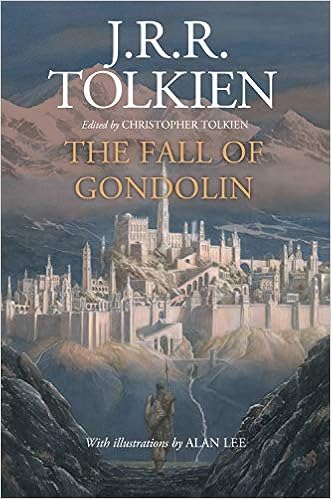

Image result for fall of gondolin
Though he very rarely talked about his service in the First World War—his silence most likely the result of survivor’s guilt, something he shared with most of his post-war friends—J.R.R. Tolkien said that his invented worlds really took form in “army huts, crowded, filled with the noise of gramophones.” The war, he realized in hindsight, had forced him to imagine a beauty and wonder beyond the brutal life of the trenches.
Because of Tolkien’s adamant rejection of formal allegory in his own writings, many of his greatest supporters denied for years that any passage (or passages) in The Lord of the Rings had anything to do with the war itself, at least directly. As early as the 1950s, however, Tolkien’s good friend, C.S. Lewis, was challenging this view, (he had also gone through the war, a volunteer despite being Irish).
Though Lewis remembered the fonder parts of it in his autobiography, especially the friendships he formed, the first bullet that flew past his head roused him to think, “This is war. This is what Homer wrote about.” No doubt the two survivors had talked innumerable times—privately—about their own experiences in the war. In his praising review of Tolkien’s trilogy, Lewis wrote that the battle scenes have “the very quality of the war my generation knew. It is all here: the endless, unintelligible movement, the sinister quiet on the front when ‘everything is now ready,’ the lying civilians, the lively, vivid friendships, the background of something like despair and the merry foreground, and such heaven-sent windfalls as a cache of choice tobacco ‘salvaged’ from a ruin.”
Still, it must also be noted that Tolkien revealed in a speech at the University of St. Andrews in 1939 that the Great War had “awakened” his imagination. Certainly, in the trilogy itself, as he admitted toward the end of his life, the crossing of Frodo, Sam, and Gollum into the region of Mordor mirrored much of what he had seen in the Great War. “Dreadful as the Dead Marshes had been, and the arid moors of the Norman-lands, more loathsome far was the country that the crawling day now slowly unveiled to his shrinking eyes,” Tolkien writes. “Here nothing lived, not even the leprous growths that feed on rottenness. The gasping pools were choked with ash and crawling muds, sickly white and grey, as if the mountains had vomited the filth of their entrails upon the lands about.” Though the horrifying imagery continues in the story at some length, it is worth noting here that few passages in 20th-century literature so perfectly captured the feeling and atmosphere of the Great War.
Having already lost his mother and his father at a young age, Tolkien also lost two of his three closest friends during the war. Prior to that war, he and his three friends had dedicated themselves to sanctifying the world through poetry and literature. We had, Tolkien believed, “been granted some spark of fire—certainly as a body if not singly—that was destined to kindle a new light, or, what is the same thing, rekindle an old light in the world.” Given the depth of feeling Tolkien possessed toward his friends and the burdens of the Great War, there is no reason to underplay his words. By 1916, he had already begun his Elvish languages as well as his first stories for those languages, in addition to writing much poetic verse. “The greatness [of the four friends] I meant was that of a great instrument in God’s hands,” Tolkien wrote in 1916, as “a mover, a doer, even an achiever of great things, a beginner at the very least of large things.”
♦♦♦
Of the original stories that Tolkien wrote for his nascent mythology, the first real attempt at depth as well as breadth was The Fall of Gondolin, most likely begun in 1916. From there, the story took on an unwieldy and unpredictable life of its own, like many of Tolkien’s writings. Tolkien’s wife, Edith, wrote out the story sometime in 1917 after he had first written it, and Tolkien offered a version of it as a public essay in 1920 at Exeter College, Oxford. The story appeared as one of the most drawn-out of Tolkien’s Lost Tales (the first version of the larger mythology that would one day become The Silmarillion); in slightly different form in the 1926 “Sketch of the Mythology”; in yet again slightly different form in the 1930 Quenta Noldorinwa; and, finally, in 1950 and 1951, as Tolkien was trying to write the history of the ages preceding the now completed but yet unpublished The Lord of the Rings. The final 1951 version ended up, more or less, in the 1977 Silmarillion.
While one should accept Tolkien’s claim that he disliked and did not intentionally employ formal allegory, it would be foolish to assume that the loss of family and friends, the Great War, and the advent of the modern world did not profoundly influence his writings. These events all shaped his mythology, which he used as a way, as he noted to his friends, to sanctify the world and to correct that which had gone wrong. The Fall of Gondolin, in particular, considers issues of prophecy and calling, friendship and betrayal, loss, acceptance, love, pride, and, most importantly, perseverance. In it, one finds passionate love stories, heroic battles to the death, prophets lost and distracted, organic machines of immense power, distraught gods full of charity, confusion of purpose, kings living as outlaws, and soul-piercing beauties.
A secret city of the Elves, Gondolin served as the only significant safe haven during the ravages and tyranny of the devil figure of the mythology, Morgoth (aka Melko, aka Melkor), the brightest of created powers who came to resent his maker, Iluvatar (God the Father). Alone in the East of the world—Beleriand and Middle-earth—the Elves continued the traditions of the holy powers in the West in Valinor, even in their exile. From the hidden realm, the Elves could live, but they could also use it as a base to reclaim the lands from evil and ruin:
In those days Ulmo was filled with pity for the exiled Elves in their need, and in the ruin that had now almost overwhelmed them. He foretold that the fortress of Gondolin should stand longest of all the refuges of the Elves against the might of Morgoth, and like Doriath never be overthrown save by treachery from within. Because of his protecting might the spells of concealment were strongest in those parts nearest to Sirion, though there the Encircling Mountains were at their lowest.
In that same version, Tolkien described Gondolin in idyllic terms:
Upon Amon Gwareth, the Hill of Defence, the rocky height amidst the plain, was built Gondolin the great, whose fame and glory is mightiest in song of all dwellings of the Elves in these Outer Lands. Of steel were its gates and of marble were its walls. The sides of the hill the Gnomes polished to the smoothness of dark glass, and its top they levelled for the building of their town, save amidmost where stood the tower and palace of the king. Many fountains there were in that city, and white waters fell shimmering down the glistening sides of Amon Gwareth. The plain all about they smoothed till it became as a lawn of shaven grass from the stairways before the gates unto the feet of the mountain wall, and nought might walk or creep across unseen.
For better or worse, the Elves chose the comfort of isolation rather than the mission of world redemption. Meanwhile, Morgoth’s reign grew, and, ultimately, he laid siege to the city. In one version of the story, the water god Ulmo offers aid to the Elves by giving them the city.
Image result for fall of gondolin alan lee
Ulmo and Tuor by Alan Lee
More moving, yet deeply disturbing, is Tolkien’s description of the perversions wrought by Morgoth:
Then on a time Melko assembled all his most cunning smiths and sorcerers, and of iron and flame they wrought a host of monsters such as have only at that time been seen and shall not again be till the Great End. Some were all of iron so cunningly linked that they might flow like slow rivers of metal or coil themselves around and above all obstacles before them, and these were filled in their innermost depths with the grimmest of the Orcs with scimitars and spears; others of bronze and copper were given hearts and spirits of blazing fire, and they blasted all that stood before them with the terror of their snorting or trampled whatso escaped the ardour of their breath; yet others were creatures of pure flame that writhed like ropes of molten metal, and they brought to ruin whatever fabric they came nigh, and iron and stone melted before them and became as water, and upon them rode the Balrogs in hundreds; and these were the most dire of all those monsters which Melko devised against Gondolin.
While one might readily find such a description of organic machinery later in the 20th century, to describe it as such in 1917 is somewhat bewilderingly advanced. Equally important, one can readily imagine Tolkien’s creations as something that might appear from the German advance, as tanks replaced cavalry. True to Tolkien’s romanticism, machinery almost always appears as tyrannical and anti-humane in his literature.
Additionally, following the Western tradition going back to St. Augustine and Boethius, Tolkien believes that evil exists not as a thing in and of itself, but as a rape, an imitation, and a desecration of an original good. Orcs, for example, are tortured and inverted Elves:
How it came ever that among men the Noldoli [one form of Elf] have been confused with the Orcs who are Melko’s goblins, I know not, unless it be that certain of the Noldoli were twisted to the evil of Melko and mingled among these Orcs, for all that race were bred by Melko of the subterranean heats and slime. Their hearts were of granite and their bodies deformed; foul their faces which smiled not, but their laugh that of the clash of metal, and to nothing were they more fain than to aid in the basest of the purposes of Melko. The greatest hatred was between them and the Noldoli, who named themGlamhoth, or folk of dreadful hate.
One might also think of the Hebraic tradition of God as the all being—I Am That I Am—with all else radiating from him in what later thinkers might call the “economy of grace” or “great chain of being.”
And yet, true to Tolkien, those most misunderstood, ignored, or mocked in the world often, at some unexpected point, find their true natures revealed to the world and, most importantly, to themselves. Tuor, the outlaw turned heroic king in The Fall of Gondolin, becomes fully himself at one moment as he looks toward the sacred West:
Then Tuor arrayed himself in the hauberk, and set the helm upon his head, and he girt himself with the sword; black were sheath and belt with clasps of silver. Thus armed he went forth from Turgon’s hall, and stood upon the high terraces of Taras in the red light of the sun. None were there to see him, as he gazed westward, gleaming in silver and gold, and he knew not that in that hour he appeared as one of the Mighty of the West, and fit to be the father of the kings of the Kings of Men beyond the Sea, as it was indeed his doom to be; but in the taking of those arms a change came upon Tuor son of Huor, and his heart grew great within him. And as he stepped down from the doors the swans did him reverence, and plucking each a great feather from their wings they proffered them to him, laying their long necks upon the stone before his feet; and he took the seven feathers and set them in the crest of his helm, and straightway the swans arose and flew north in the sunset, and Tuor saw them no more.
♦♦♦
When Tolkien published his massive three-volume trilogy, the masterful The Lord of the Rings, in 1954 and 1955, he was originally hoping to complete an even longer version, all in one volume. The hoped-for book would have been almost double the size of The Lord of the Rings and would include a fleshed-out version of The Silmarillion, to be called The Saga of the Jewels and the Rings. Those familiar with The Lord of the Rings know how often the stories of the Elder Days appear at critical moments in the trilogy. When the Ringwraiths are about to attack the hobbits and Aragorn on Weather Top, the ranger tells the ancient and timeless story of Beren and Lúthien, almost as a preparatory prayer in anticipation of battle. Galadriel, in a moment of confession, admits she has lived in Middle-earth since before the fall of Gondolin. When Sam and Frodo wonder what their fate is as they approach Mount Doom, they compare their own experiences with those of a previous age, recognizing that they exist in the same story, just at a later time.
Indeed, the very phial of Galadriel, which proves critical in the suffocating darkness of Shelob’s lair, contains the very light that had first existed close to the time of creation itself. Truly Frodo and Sam occupy the same story as Beren and Lúthien.
Yet Tolkien’s inability to finish the stories of the Elder Days, The Silmarillion, along with his exhaustion after 11 years of writing The Lord of the Rings, frustrated his own desires. Additionally, the British government continued to impose its own wartime restrictions on paper, even into the 1950s. Tolkien’s publisher had originally wanted and expected a sequel to The Hobbit, not an epic covering thousands and thousands of years, written with the depth and feeling of The Aeneid.
Even after the successful publication and critical reception of The Lord of the Rings and his own retirement from teaching, Tolkien found it painful to finish The Silmarillion and his own mythology. He often spent his time instead on questions best left to his publisher and writing gorgeous essays on the philosophical and theological implications of his created world.
It would take Tolkien’s son, Christopher, four years after his father’s death to compile and publish The Silmarillion. Even then, in 1977, it remained more a beautiful outline than a true representation of the early mythology. From there, though, Christopher’s output was nothing short of stunning. In 1980, he published Unfinished Tales and, between 1983 and 1996, the 12 volumes of The History of Middle-earth, a massive undertaking of love and piety. Silent for almost a decade, but infuriated by the travesty of the Peter Jackson movies, Christopher reappeared in the publishing world, hoping to reclaim his father’s ideas, words, characters, and stories for an audience desiring more than action sequences and computer generated eye candy. He hoped an audience for poetic wonder still existed, even in the 21st-century wasteland of modernity. Over the last 12 years, Christopher has come back with a vengeance, publishing his father’s scholarly work on his many varied mythologies as well as specific stories from The Silmarillion, but, most notably, the three that mattered most to his father: the tale of Beren and Lúthien,The Children of Húrin, and, as of last fall, The Fall of Gondolin.
As with the other books that Christopher has edited, this latest Tolkien release, The Fall of Gondolin, follows the chronological evolution of J.R.R. Tolkien’s various tales. As always, Christopher offers not just the chronology but an insightful examination of why his father chose this or that, as opposed to that or this. Presumably, The Fall of Gondolin is the son’s last, though not all of the father’s writings have yet seen print.
Now aged 94, Christopher must be praised mightily and in every way for his service not only to his father, but, frankly, also to Western civilization. After all, it would not be too much of a stretch to compare his father’s mythology to that of Homer, Virgil, and Dante. And, it bears repeating: though J.R.R. Tolkien despised formal allegory, his created mythology, begun sometime around 1913 and still not completely finished—despite the work of father and son—reflects all of our anxieties and desires in the modern and postmodern worlds. If we speak exclusively of J.R.R. Tolkien in relation to the mythology of Middle-earth, we have created a grave error. Truly, we must properly speak of the Two Tolkiens: J.R.R. and Christopher.  
Bradley J. Birzer is The American Conservative’s scholar-at-large. He also holds the Russell Amos Kirk Chair in History at Hillsdale College and is the author, most recently, of Russell Kirk: American Conservative.

Tuesday, April 02, 2019

'Unplanned' Helps Pro-Lifers Tell the Truth about Abortion


By Abby Johnson and Lila Rose
https://www.nationalreview.com/2019/04/unplanned-helps-pro-lifers-tell-the-truth-about-abortion/
April 1, 2019

Image result for unplanned
Ashley Bratcher (left) as Abby Johnson in 'Unplanned'

Abortion may be one of the most hotly debated topics in America, but it’s a word that not many people can readily — and accurately — define. The abortion industry uses vague terms like “choice,” “autonomy,” “reproductive rights” or “reproductive health,” “essentially a miscarriage,” and “gently emptying the uterus” to cloud the conversation. In a discussion of abortion, we are told to consider only the mother and her choice. The other party is only a “product of conception” or an “undifferentiated mass of uterine matter.”


Equally vague is our language about the way abortions are performed, which we hardly ever hear described in medical terms. That is why the recently released film Unplanned is so important. Seeing the truth about abortion will change people’s minds on the procedure and society’s view of this heinous human-rights abuse. It did for us.
Abby Johnson

Unplanned tells the story of a former Planned Parenthood clinic director who comes face to face with the reality of abortion. That director was me. I worked for Planned Parenthood for eight years but, mid-career, I began to have misgivings. I saw that Planned Parenthood was willing to fire employees if they did not meet their abortion quotas and that there were monetary bonuses for directors who did meet the quotas. I saw how that lent itself to the pressuring and manipulation of pregnant women in our clinics.
I reached the breaking point on September 26, 2009, when a doctor asked me to help with an ultrasound-guided abortion. I had never seen one performed. I watched in horror as a 13-week-old baby fought for its life . . . and lost. An abortion doctor connected one end of tubing to a suction machine and inserted the other end into the pregnant woman lying in front of us. “Beam me up, Scotty,” the abortionist said, and the machine turned on. I saw the tiny baby began to squirm.


I remember it so clearly. The suction machine used in an “aspiration (D&C) abortion” has ten to 20 times the force of a household vacuum cleaner. For the briefest moment, the baby looked as if it were being wrung like a dishcloth, twirled and squeezed. And then it crumpled and began disappearing into the tubing before my eyes. The last thing I saw was the tiny, perfectly formed backbone sucked into the tube, and then it was gone. And the uterus was empty. Totally empty. After that, the abortionist used a sharp metal device called a curette to remove the baby’s remains from the mother’s uterus and completed the abortion.


I knew then that I had to expose the truth about Planned Parenthood and the violent death from which the group profits. My life would never be the same. I left Planned Parenthood and soon after started a group called And Then There Were None to provide counseling and clear action steps for those seeking to leave the abortion industry. Now I travel the country speaking the truth about Planned Parenthood and encouraging Americans to call for an end to government support of this unsavory organization, which has been implicated in potentially criminal behavior.

Lila Rose
Abby is not the only woman whose life was changed by witnessing the harsh reality of abortion. As a young girl, I saw a photograph of an aborted baby, only ten weeks old, in a pro-life book tucked away on my family’s bookshelf. That image stuck with me. I saw the image of tiny arms and legs, torn apart by a powerful suction abortion, and I remember thinking, “Is this real?”
I soon found that it was indeed real, and worse, that the baby pictured there was one of the millions killed in similar ways. I knew I had to do something to make sure as many people as possible knew the truth about abortion.
But that turned out to be difficult. The abortion industry has a vested interest in keeping the gory details about abortion under wraps. In an effort to document what goes on behind Planned Parenthood’s doors, I began working as an undercover investigative journalist, bringing the grim reality of the abortion industry to light by recording conversations with clinic workers. I actually earned a reputation among Planned Parenthood staff; I learned later that while still working as a clinic director, Abby Johnson had a poster of me up in her clinic, warning front-office staff to be on the lookout for me. (An “unplanned” friendship formed when she left and now we work together to end abortion.)
I was able to expose Planned Parenthood staff engaging in illegal and dangerous activity, including aiding and abetting child-sex traffickers, failing to report sexual abuse of underage girls, and lying to women about their preborn child’s development — all in order to perform abortions and procure the money that comes with them, at the expense of the women involved. My non-profit, Live Action, has exposed Planned Parenthood committing sex-selective abortions, accepting racially motivated donations that target black women and babies, and discussing how they’d leave babies born alive after abortions to die. I have seen inside these abortion facilities, and it changed my life to see how they treat women. That’s exactly what you’ll see in Unplanned — the stark reality of what happens behind closed doors. Even after all this, Planned Parenthood continues to receive our taxpayer dollars and claims to be a respectable organization.
Telling the Truth

Society’s best chance at ending the abuse of abortion and the abuse that surrounds abortion is to eradicate the idea that abortion is harmless. That takes education and a glimpse into how and where the abuse takes place. Live Action shared a medically accurate video detailing the most common abortion procedures and showed it to people in Los Angeles, San Francisco, and New York. For many of the viewers who described themselves as “pro-choice,” the video was “eye-opening” and “distressing.” When people watch what happens as an abortionist tears a baby limb from limb during an abortion, what Abby Johnson and I saw at a younger age, viewers respond that abortion should not be legal, that these videos should be shown in educational settings, and that our country’s leaders should all be required to know the facts of abortion.

The truth is there, a preborn child is a human life, and abortion horrifically destroys that human life. Films like Unplanned and groups like And Then There Were None and Live Action make that truth available to millions. That is an essential service to the global conversation about abortion. How can we adequately discuss a topic about which we know nothing? Every American has a responsibility to be informed about abortion, as the discourse will surely continue. See the film. Watch the videos. And, knowing the truth, enter the conversation boldly.
Abby Johnson is the founder and director of And Then There Were None and author of Unplanned and The Walls are Talking. You can follow her on Twitter at @abbyjohnson. Lila Rose is the founder and president of Live Action. You can follow her on Twitter at @lilagracerose.

Monday, April 01, 2019

HOW MUCH LONGER WILL ALEX OVECHKIN CONTINUE TO SPOIL US WITH 50-GOAL SEASONS?


March 31, 2019
ovechkin-50-usat.png
USA Today Sports
TAMPA – On a night when Alex Ovechkin became the third-oldest player in NHL history – after Johnny Bucyk and Jaromir Jagr – to record a 50-goal season, his coach made a remarkable observation regarding arguably the greatest pure goalscorer of all time.
“His energy level is at an all-time high this year,” Washington Capitals coach Todd Reirden said of Ovechkin. “I think he’s really been a driving force for our team.”
Think about that for a minute. The man who sees Ovechkin play and practice day-in and day-out believes his superstar is playing with a higher energy level than ever these days. To be sure, winning the Stanley Cup last season took an enormous load off Ovechkin’s shoulders and, as a result, both he and the Capitals are playing with much more of a spring in their step. You could see their swagger when they jumped out into a 4-0 lead over the Tampa Bay Lightning Saturday night before Ovechkin sealed the deal with his 50th and 51stgoals in a 6-2 victory.
In light of Reirden’s observation, you have to wonder how many more 50-goal seasons Ovechkin has left in him. This season represents his eighth, which puts him one behind both Wayne Gretzky’s and Mike Bossy’s totals. He has all but clinched his eighth Rocket Richard Trophy, which would establish an NHL record for the number of seasons leading the league in goals. Jagr was 34 when he recorded his last 50-goal season and Bucyk was almost 36 when he hit the mark for the only time in his career. The way Ovechkin is scoring this season, he certainly doesn’t look as though his scoring touch is about to subside anytime soon.
“You think I know?” Ovechkin said when asked how many more 50-goal seasons he might have in him. “I don’t know. I just enjoy my time and enjoy playing hockey.”
With his two goals, Ovechkin moved ahead of Brendan Shanahan for 13th all-time in career goals, 10 behind Luc Robitaille. Another 50-goal season next year would vault him into seventh all-time. With three years left on his contract with Washington, Ovechkin will likely at the very least pose a serious threat to Jaromir Jagr at No. 3, who is only 35 goals behind Gordie Howe at No. 2. Ovechkin currently sits 143 goals behind Howe’s total of 801, which would mean he’d have to average 48 goals a season over the next three to catch Mr. Hockey. If he were to play another five seasons, that per-season total would drop to just 29.
“He never surprises me with what he does,” Reirden said. “Every day it’s something different. You see him the other night blocking shots 5-on-6, you see him being physical, you see his wall play and two-way play and when he gets his chance to convert, there’s very few like him for sure, if any. He has that knack for being able to find the back of the net and I think if he continues to stay healthy, which he’s been very fortunate to do, who knows where it will take him? He seems to be really enjoying the game and he’s enjoying our team and what we have going here.”
It was only fitting that in the second after Ovechkin scored his 50th Saturday night, he wiped out Lightning defenseman Braydon Coburn, a 6-foot-5, 223-pounder, as though he were a lightweight. Earlier in the game, Ovechkin backchecked hard to catch Cedric Paquette on a shorthanded breakaway and the Capitals scored with the extra man 40 seconds later. As much as the goalscoring, teammates are marveling at how Ovechkin’s game has gained so much texture.
“What I admire about him is his ability to play so many types of games,” said linemate Tom Wilson. “He’s strong. He can finish checks, he’s dynamic. And on top of it, a pure goalscorer and probably the best goal scorer of our time and maybe of all-time. It’s a huge privilege to watch what he does. And I think something that goes under the radar a little bit how many games he’s played. He’s always in, he’s always playing hard. They haven’t been easy miles on him. He’s done it hard and he’s played that way for a long time and continues to blow the roof off as a goalscorer.”
Wilson is spot-on about Ovechkin when it comes to his durability. He has missed just 30 of the 1,111 games in which he’s been eligible to play in his career. That’s an attendance record of 97.3 percent. If he continues to show up for class that regularly and his scoring touch doesn’t abandon him, perhaps a run at Gretzky at No. 1 isn’t that far-fetched a notion after all.

The Tables Turn in Russian Collusion Hunt


March 31, 2019
FBI Director James B. Comey, left, Director of National Intelligence James R. Clapper Jr. and CIA Director John O. Brennan  testify before the Senate Select Committee on Intelligence in the Dirksen Senate Office Building on Capitol Hill on January 10, 2017. (Joe Raedle/Getty Images)

The irony of the entire Russian collusion hoax is that accusers who cried the loudest about leaking, collusion, lying, and obstruction are themselves soon very likely to be accused of just those crimes.
Now that Robert Mueller’s 674-day, $30 million investigation is over and has failed to find the original goal of its mandate—evidence of a criminal conspiracy between the Trump presidential campaign and the Russian government to sway the 2016 election—and now that thousands of once-sealed government documents will likely be released in unredacted form, those who eagerly assumed the role of the hunters may become the hunted, due to their own zealous violation of the nation’s trust and its laws.
Take Lying
Former FBI Director James Comey’s testimonies cannot be reconciled with those of his own deputy director Andrew McCabe. He falsely testified that the Steele dossier was not the main basis for obtaining FISA court warrants. On at least 245 occasions, Comey swore under oath that he either did not know, or could not remember, when asked direct questions about his conduct at the FBI. He likely lied when he testified that he did not conclude his assessment of the Clinton illegal email use before he had even interviewed Clinton, an assertion contradicted by his own written report. I guess his credo and modus operandi are reflected in the subtitle of his recent autobiography A Higher Loyalty: “Truth, Lies, and Leadership.”
Andrew McCabe currently is under criminal referral for lying to federal investigators about leaking to the media. He and Deputy Attorney General Rod Rosenstein each have accused each other of not telling the whole truth about their shared caper of trying to force President Trump out of office by invoking the 25th Amendment.
Former Director of National Intelligence James Clapper has admitted to lying under oath to Congress—and since lied about his earlier admission of that lying. His recent sworn congressional testimony of not having leaked information about the Steele dossier to the media is again likely to be untrue, given that Clapper had admitted to speaking to CNN’s Jake Tapper about the dossier’s contents. CNN, remember, would in turn go on to hire the mendacious Clapper as an analyst. And once on air, Clapper would insist that Trump was both a Russian asset and thus guilty of collusion crimes greater than those of Watergate. Lies. All lies.
Former CIA Director John Brennan has admitted to lying under oath to Congress on two occasions. He may well face further legal exposure. When he lost his security clearance, he repeatedly lied that Trump was guilty of collusion, however that non-crime is defined. And as the Mueller probe wound down, Brennan with pseudo-authority and trumped-up hints of phony access to secret intelligence sources deceitfully assured the nation that Trump within days would face indictment—perhaps along with his family members.
Brennan in 2016 also reached out to foreign intelligence services, primary British and Australian, to surveille and entrap Trump aides, as a way of circumventing rules preventing CIA monitoring of American citizens. And he may well have also reverse-targeted Americans, under the guise of monitoring foreign nationals, in order to build a case of so-called Trump collusion.
Finally, Brennan testified to Congress in May 2017 that he had not been earlier aware of the dossier or its contents before the election, although in August 2016 it is almost certain that he had briefed Senator Harry Reid (D-Nev.) on it in a spirited effort to have Reid pressure the FBI to keep or expand its counterintelligence investigation of Trump during the critical final weeks of the election.
Clinton aides Cheryl Mills and Huma Abedin likely also lied to FBI investigators when they claimed they had no knowledge while working at the State Department that their boss, Secretary of State Hillary Clinton, was using an illegal private email server. In fact, they had read her communications on it and actually inquired about its efficacy.
Samantha Power, the former U.N. ambassador, in her last year in office requested on more than 260 occasions to unmask names of Americans monitored by the government. Yet Power later claimed that most of these requests were not made by her. And yet she either does not know or does not cite who exactly used her name to make such requests during the election cycle. In any case, no one has come forward to admit to the improper use of Power’s name to request the hundreds of unmaskings.
Susan Rice, the former Obama national security advisor, could have made a number of unmasking requests in Power’s name, although she initially denied making any requests in her own name—a lie she immediately amended. Rice, remember, repeatedly lied on national television about the cause and origins of the Benghazi attack, denied there were cash payments for hostages in the Iran deal, misled about the conduct of Beau Bergdahl, and prevaricated over the existence and destruction of weapons of mass destruction in Syria.
Deputy Attorney General Bruce Ohr did not tell the truth on a federal written disclosure required by law when he omitted the key fact that his wife Nellie worked on Christopher Steele’s Fusion GPS dossier. Ohr’s testimony that he completely briefed key FBI officials on the dossier in July or August 2016 is not compatible to what former FBI attorney Lisa Page has testified to concerning the dates of her own knowledge of the Steele material.
Take Foreign Collusion
Christopher Steele is a foreign national. So are many of the Russian sources that he claims he had contacted to solicit dirt on Donald Trump and his campaign aides. In fact, John Brennan’s CIA, soon in consultation with the FBI, was used in circuitous fashion to facilitate surveillance of Donald Trump’s campaign through the use of foreign nationals during the 2016 campaign.
Foreigners such as Maltese professor Josef Mifsud, and former Australian minister for foreign affairs Alexander Downer and an array of intelligence contractors from the British Foreign and Commonwealth Office (FCO) mysteriously met with minor Trump aide George Papadopoulos and others. It is likely that to disguise American intelligence agencies’ efforts to besmirch, surveille, and leak to the press damaging unfounded rumors about the Trump campaign that John Brennan enlisted an entire cadre of foreign nationals. And it is likely to be the most egregious example of using non-U.S. citizens to affect the outcome of an election in our history. If there is a crime of foreign collusion—a conspiracy of U.S. officials to use foreigners to interfere with an American election—then Brennan’s efforts are the textbook example.
Take Leaking
Many of the names unmasked by requests from Samantha Power and Susan Rice were leaked illegally to the media. James Comey himself leaked confidential memos of presidential conversations to the press; in at least one case, the memo was likely classified.
Former FBI general counsel James Baker is currently under criminal referral for improperly leaking classified documents. He seems to have been in contact with the media before the election and he may have been one of many FBI officials and contacts, along with Christopher Steele, that reporters such as David Corn, Michael Isikoff, and Julia Ioffe anonymously referenced in their pre-election published hit pieces on Russian collusion—all the result of the successful strategies of Fusion GPS, along with some in the FBI, to seed unverified anti-Trump gossip to warp the election. Andrew McCabe also is under criminal referral both for leaking classified information and then lying about it.
In a fashion emblematic of this entire sordid mess, the always ethically compromised James Clapper in January 2017 had leaked the dossier to Jake Tapper of CNN and likely other journalists and then shortly afterwards publicly deplored just this sort of government leaking that had led to sensational stories about the dossier.
Take Obstruction of Justice
A number of FBI and Department of Justice high ranking employees such as James Comey, Andrew McCabe, Rod Rosenstein, and Sally Yates all signed off on FISA warrants to surveille Carter Page without apprising the courts that they knew that their chief evidence, the Steele Dossier, was unverified, was paid for by Hillary Clinton, and was used in circular fashion as the basis for news accounts presented to the court. Nor did the Justice Department and FBI officials apprise the FISA justices that Christopher Steele had been terminated as a FBI source.
No one believes that former Attorney General Loretta Lynch just happened to meet Bill Clinton on a Phoenix airport tarmac and confined their conservations to a variety of topics having nothing to do with Hillary Clinton—at a time when Lynch’s Justice Department was investigating her. Note the meeting was only disclosed because a reporter got a tip and arrived on the scene of the two adjoining Lynch and Clinton private jets—which suggests that the only thing Lynch and Clinton regretted was being found out. Few believe that Lynch had recused herself as she promised, given her strict oversight of the sort of language Comey’s FBI was allowed to use in its investigation of Clinton.
Take Conflict of Interest
Andrew McCabe never should have been in charge of the FBI investigation of Hillary Clinton, given that just months earlier his wife had been the recipient of $675,000 in campaign cash donated by Clinton and Democratic Party-affiliated political action committees. And the apology of a “time line” that suggests conflicts of interest like McCabe’s expired after an arbitrary date is specious. McCabe knew his spouse had been a recent recipient of Clinton-related money, knew that he had substantial influence on the fate of her email investigation, and hoped and assumed that she was likely to be the next president of the United States quite soon.
Rod Rosenstein never should have been appointed acting attorney general in charge of oversight of the Mueller investigation. He knew Mueller well. In circular fashion, he had drafted the rationale to fire Comey that had prompted the Mueller’s appointment. He had signed off on a FISA warrant request without apprising the court of the true nature of the Steele dossier’s origins and nature. He had met shortly before the Mueller appointment with acting FBI director Andrew McCabe to investigate the chance of removing Trump under a distortion of the 25th Amendment. So, in essence, Rosenstein had been one of the catalysts for McCabe to investigate removing Trump for his own part in the removal of Comey and then in Orwellian fashion joined McCabe’s efforts.
Comey deliberately leaked a classified memo of a presidential conversation, in which he had misled the president about his actual status under FBI investigations, in order to cause enough media outrage over his firing to prompt the hiring of a special counsel. That gambit succeeded in the appointment of his own longtime associate Robert Mueller, who would be charged to investigate “collusion,” in which Comey played an important role in monitoring the Trump campaign with the assistance of British national Christopher Steele.
Robert Mueller did not need to appoint a legal team inordinately Democratic, which included attorneys who had been either donors to the Clinton campaign, or had been attorneys for Clinton aides, or had defended the Clinton Foundation. And he certainly should not have included on his investigative team that was charged with adjudicating Russian collusion in the 2016 election both Zainab Ahmad and Andrew Weissman, Obama Justice Department officials, who had been briefed by Bruce Ohr before the election on the nature of the Steele dossier and its use of foreign sources.
It will be difficult to unravel all of the above lying, distortion, and unethical and illegal conduct.
The motives of these bad actors are diverse, but they share a common denominator. As Washington politicos and administrative state careerists, all of them believed that Donald Trump was so abhorrent that he should be prevented from winning the 2016 election. After his stunning and shocking victory, they assumed further that either he should not be inaugurated or he should be removed from office as soon as they could arrange it.
They further reasoned that as high and esteemed unelected officials their efforts were above and beyond the law, and rightly so, given their assumed superior wisdom and morality.
Finally, if their initial efforts were predicated on winning not just exemption from the law, but even promotions and kudos from a grateful President Hillary Clinton, their subsequent energies at removing Trump and investing in the collusion hoax were preemptive and defensive. Seeding the collusion hoax was a way either of removing Trump who had the presidential power to call them all to account for their illegality, or at least causing so much media chaos and political havoc that their own crimes and misdemeanors would be forgotten by becoming submerged amid years of scandal, conspiracies, and media sensationalism.
And they were almost—but so far not quite—correct in all their assumptions.
Victor Davis Hanson is an American military historian, columnist, former classics professor, and scholar of ancient warfare. He was a professor of classics at California State University, Fresno, and is currently the Martin and Illie Anderson Senior Fellow at Stanford University’s Hoover Institution. He has been a visiting professor at Hillsdale College since 2004. Hanson was awarded the National Humanities Medal in 2007 by President George W. Bush. Hanson is also a farmer (growing raisin grapes on a family farm in Selma, California) and a critic of social trends related to farming and agrarianism. He is the author most recently of The Second World Wars: How the First Global Conflict was Fought and Won (Basic Books).

Sunday, March 31, 2019

Does Kiev Hold the Key to the Russian Collusion Hoax?


By 
https://amgreatness.com/2019/03/28/does-kiev-hold-the-key-to-the-russian-collusion-hoax/
March 28, 2019

Image result for Alexandra Chalupa
Alexandra Chalupa

The Russian probe is the greatest American political scandal ever because it began with the worst political felony there could be, short of assassination.

Petty bureaucrats fabricated high crimes and misdemeanors to sway an election and then, failing in that, they attempted to thwart a duly elected president.
It was an attempted coup in the way a pot-bellied demagogue in a banana republic orchestrates one, by using the government’s power to defeat its authority.
Here is what we know, so far, about how they did it.
In a newly relevant piece first published on January 11, 2017, headlined “Ukrainian Efforts to Sabotage Trump Backfire,”Politico reported that Alexandra Chalupa, a Ukrainian-American operative, began doing opposition research for the Democratic National Committee about Donald Trump and Russia in late 2015.
Her efforts increased when Paul Manafort joined the campaign. Manafort had done work for pro-Russian Ukrainian president Viktor Yanukovych before he was deposed in 2014, but so had Hillary Clinton’s campaign manager, John Podesta.
DNC contractor that she was, Chalupa was selective in her ire. She sent emails to highly placed Democrats and members of the media accusing Manafort of being Putin’s puppet.
The Ukrainian embassy worked closely with Chalupa in her efforts to undermine Trump’s campaign. AsPolitico noted, “The Ukrainian efforts had an impact in the race, helping to force Manafort’s resignation and advancing the narrative that Trump’s campaign was deeply connected to Ukraine’s foe to the east, Russia.”
Chalupa was so successful in fanning the Russian nonsense that on October 24, 2016, reporter Michael Isikoff portrayed her work as pivotal in a premature victory lap for the Clinton campaign at Yahoo News.
The work of a single uncredentialed agitator, though, could not have had that much of an impact. Which is the best explanation for why the Clinton campaign commissioned the Steele dossier, to give British spy credibility to Chalupa’s Chicken Little act.
One person influenced by this Ukrainian interference was Obama CIA Director John Brennan. He could not, though, investigate the Republican presidential campaign, because there are rules against spying on Americans.
A formal alliance permits intelligence agencies from the United Kingdom and the United States to engage in common spying in limited circumstances. Called “Five Eyes,” the alliance also includes Australia, Canada and New Zealand.
Brennan could seed the investigation to foreign intelligence services.
Suddenly, minor members of the Trump campaign, including Carter Page and George Papadopoulos, were invited to London to talk to Cambridge professor Stefan Halper. An Australian diplomat, Alexander Downer, recorded a drunken conversation he had with Papadopoulos.
The Russia stuff probably would have remained innuendo and rumors parroted occasionally by Democratic shills in the media. But then something extraordinary happened.
Hillary Clinton’s campaign lost all of its emails in phishing scheme. John Podesta fell for a ridiculous contrivance and disclosed to unknown actors that his email password was “PASSWORD.”
The emails revealed coordination between the Clinton campaign and the Democratic party to fix primaries against Bernie Sanders. These people needed a cover story, quickly.
The Steele Dossier, which the FBI would have seen right about this time, reported among other falsehoods that, “TRUMP associate admits that Kremlin behind recent appearance of DNC emails on WikiLeaks . . . .”
Suddenly, FBI agents were flying to London to check in on the existing Russian investigation. The FBI opened “Crossfire Hurricane” seeking to connect Trump to the lost emails.
Two lovestruck agents instrumental in the FBI’s efforts would text one another a short time later that “we’ll stop” Trump and calling the investigation an “insurance policy” against his presidency.
Shockingly, the FBI never examined the compromised computer servers, delegating its investigatory function to CrowdStrike, whose CTO and co-founder, Dmitri Alperovitch, is a Russian expat and a senior fellow at an anti-Putin think tank, the Atlantic Council.
The Atlantic Council is funded by Ukrainian billionaire Victor Pinchuk, a $10 million donor to the Clinton Foundation. Clinton’s paid consultant found evidence of a Russian hack even though it is ontologically impossible to determine the source of a phishing scheme by mere computer examination.
(For more complete and incisive analysis of the hack that wasn’t, please read Michael Thau’s series here at American Greatness.)
Instead of “Hillary fixed the primaries” the story became “Trump and Putin stole her emails.”
Trump was placed on the defensive. He protested by stating that the federal government has “no idea” who was behind the hacks.
Obama’s FBI and CIA called him a liar, issuing a “joint statement” that falsely suggested 17 intelligence agencies agree that it was the Russians.
Hillary Clinton cited this “intelligence assessment” in the crucial October presidential debate to portray Trump as Putin’s stooge. The media’s fact checkers blasted Trump for not conceding Russian interference.
Trump won anyway. The response to his victory among his political opponents ranged from apoplexy to hysteria, and the Russian collusion story became the preferred form of denial.
A special counsel, Robert Mueller, was appointed to investigate Russian interference. Curiously, it appears that he never examined the servers that the Russians allegedly hacked, deferring instead to the conclusions of CrowdStrike.
Mueller arrested Paul Manafort as well as minor functionaries associated with Trump’s campaign, accusing them of things unrelated to Russia and process crimes, and offered to cut favorable deals if any would admit to Russian collusion; or to “compose” as U.S. District Judge T.S. Ellis III put it.
In the end, nobody played along. They suffered their punishment rather than lie for Mueller. His investigation ended last week not with a bang, but with a whimper.
Ironically, the only nation that has been cleared for colluding with an American political campaign in the 2016 election is Russia. Great Britain, Australia, and especially Ukraine (which recently opened an investigation into its hand in the charade) have some explaining to do.
It is time for a reckoning.