Monday, February 25, 2019

With 'The Border,' Don Winslow closes modern literature's most important crime saga


By Robert Anglen
https://www.azcentral.com/story/entertainment/books/2019/02/21/don-winslow-launches-book-tour-the-border-scottsdale/2906670002/
February 21, 2019

Image result for don winslow

We are the cartel.

This simple, angry declaration forms the connective tissue of Don Winslow's searing trilogy chronicling decades in the drug-war.

America's voracious appetite for drugs is the rocket fuel powering an economic engine of misery, violence and death. You may not snort, shoot or smoke, but you're complicit in the industrialized-addiction market of prisons, pharmaceuticals, finance and politics. 

It's the point Winslow drives home with a sledgehammer of rage in "The Border,"  the eerily prescient and scathing climax to what is quite simply the most important crime saga in modern literature.  

"The Border" officially hits shelves Tuesday, Feb. 26. But Winslow will launch his national book tour from Scottsdale on Monday, with a signing and discussion at the Poisoned Pen bookstore.

Unforgettable scenes

If Dostoevsky slung dope, he might have written the fierce morality tale that Winslow began with "The Power of the Dog" in 2005 and followed with "The Cartel" in 2015 (a sequel he swore he would never write).

Winslow's fiction has always been contemporaneous, immediate. Truth compacted into narrative by way of meticulous research.

The massacre of 19 women and children in a Baja beach town that served as the jumping off point for "The Power of the Dog" was based on actual events. As were the decapitations, dismemberments, gang rapes, tortures, executions, overdoses and two unforgettable scenes — one involving a bridge, the other a soccer ball — that followed.

Winslow synthesizes news reports into cohesive storylines. Not for exploitation, but for explanation. He wants to make sense out of horror. Give it context. 

And he does it without forgetting the blood price real people have paid — journalists, law enforcement officers, ranchers, politicians, users. As he did in "The Cartel," Winslow opens "The Border" with a list of the dead; journalists murdered for telling the truth of the drug war. 

But never before has Winslow served as a kind of cultural soothsayer the way he does in "The Border." And that is saying something. This is the guy who wrote a fictional account about the head of the Sinaloa cartel "escaping" (buying his way out) from a Mexican prison a month before drug kingpin Joaquin "El Chapo" Guzman did it in real life. 

This time it feels as if Winslow is breaking news, scenes seemingly play out in real time: Partisan politics that have turned the Mexican-American border into a wedge issue; the migrant caravan; the separation of children from their parents; the cartel's transition to heroin from coke; a president who commands by Twitter (so closely modeled on Donald Trump that they share the same tweets).

"The Border" offers dozens of story arcs. We follow an undercover cop in New York City, an inmate forging new allegiances among prison gangs, the up-and-coming kingpins who play tough in emulation of their fathers with terrible results and the Wall Street hedge fund manager coerced into flipping.

Harrowing, but with hope

But the most haunting and beautifully rendered scenes take us deep into Guatemala City slums, where a 10-year-old boy ekes out a living fighting other denizens for trash treasures at the dump. When the deadly street gangs tap him for servitude (at the threat of his mother's rape), the boy escapes on La Bestia,the migrant train that carves its way through Central America and into Mexico. It's a harrowing journey, but not without hope.

The book's primary set piece is once more taken from real-life events, the disappearance of 43 students during a 2014 protest at a teaching college in the Mexican state of Guerrero. Officially, the students are missing, their remains never found.

Winslow borrows accounts from investigative journalists who say the students were murdered by federal and state police after they commandeered a bus that was being used to transport $2 million dollars worth of heroin for the cartel: Their bodies were incinerated, pieces scattered in a river.

"The Border" spans five years beginning in 2012. It opens where "The Cartel" left off, with defrocked DEA agent Art Keller walking out of a Guatemalan jungle and away from a massacre he helped orchestrate (again).

It's a devil's bargain. To end the sectarian violence that made Mexico into an abattoir (100,000 dead), Keller devised a scheme to take out the heads of the warring cartels. In so doing, he created a vacuum of power that the next generation of cartel leaders will fight to fill. And fight they do.

Keller is nobody's fool. He accepts what he's done and wants nothing more than to retreat to a Mexican town near ravaged Juarez and live out his days with Marisol Cisneros, a former politician who was brutalized for opposing the drug lords.

But the drug-war isn't done with Keller. The cartels are taking notice of America's new love affair with opiates and have decided to undercut the pharmaceutical market with cheaper, more powerful drugs: heroin with a fentanyl twist. Almost overnight, cartels abandon marijuana and cocaine and shift focus to poppy fields.

A politician offers Keller a chance to assuage his guilt, an assignment not on the front lines of the drug war but as a general heading the U.S. Drug Enforcement Administration. Jump to Washington DC.

Keller takes his brief seriously. He puts in motion a two-pronged plan to trace the heroin pipeline from street dealers in New York City to suppliers in Mexico while simultaneously targeting the banks and investment firms laundering drug money. Drugs come north, money goes south.

That puts him on a collision course with TV-reality star turned presidential candidate John Dennison and his son, real estate investor Jason Lerner. While Dennison vilifies Mexicans as "bad hombres" (yes, that verbiage makes it into the book), Lerner desperately tries to salvage a highly leveraged New York City plaza development.

Dennision stokes his base with rhetoric while Lerner turns to Mexican lenders to create a syndicate of investors and launder a hundred million dollars for the cartel. 

It's impossible to ignore the parallels to Trump and his son-in-law, Jared Kushner. And agree with it or not, it makes for heady political fiction, for which Winslow is fearlessly unapologetic.

Political fire

Winslow in the past year has waged a one-man Twitter war against Trump over his border policies, with near daily Tweets criticizing the administration. Winslow's position after 20 years researching and writing about the drug war: The Wall is a stunt that won't stop the flow of drugs into America. Walls have gates, he says.

"The Border" could easily have been called "The Wall." It is to Winslow's credit that he opted for something less divisive, interpretative. Walls are fixed in place, solid barriers. Borders are ephemeral, laws scratched in sand, moral boundaries we choose to cross. 

Each of the books in Winslow's drug-war saga has a different focus. "The Power of the Dog" was about interdiction. It offered a front-line perspective, from the burning of poppy fields in the 1970s to the early days of the cartels and the crack epidemic that made kingpins out of cocaine cowboys.

"The Cartel" documented the toll of the drug wars. More than anything, it was about consequences of failed policies. Visceral and terrifying, it offered an experience through the eyes of victims on both sides of the border. 

"The Border" puts politics front and center. As equally unforgiving as its predecessors, it puts the onus square on the shoulders of the American public and asks you to consider some hard truths about addiction.

Part two of the book opens with a chapter called "The Acela," which should be considered essential reading, if not required reading, for every American. It's here that Winslow diagrams the intersection of drugs and money and lays it out with a simple equation. 

Keller is on a train blowing through a landscape of urban decay; closed mills, abandoned buildings, graffiti-tagged billboards.

"It's tempting to think the root causes of the heroin epidemic are in Mexico...but the real source is right here and in scores of smaller cities and towns."Opiates are a response to pain.

"Physical pain, emotional, economic pain.

"He's looking at all three.

"The Heroin Trifecta."

Don Winslow 

What: Join Arizona Republic reporter Robert Anglen with author Don Winslow, who will discuss and sign his new book, 'The Border' 

When: 7 p.m. Monday, Feb.. 25. 

Where: The Poisoned Pen Bookstore, 4014 N. Goldwater Blvd, Scottsdale

Admission: Free, $28.99 for the book

Details: 480-947-2974, poisonedpenevents.com.


RELATED: An interview with Don Winslow

Today's Tune: Tom Petty & The Heartbreakers 2006-09-21 - Gainesville, FL

Pope Francis Declares War On Sex Abuse


February 24, 2019
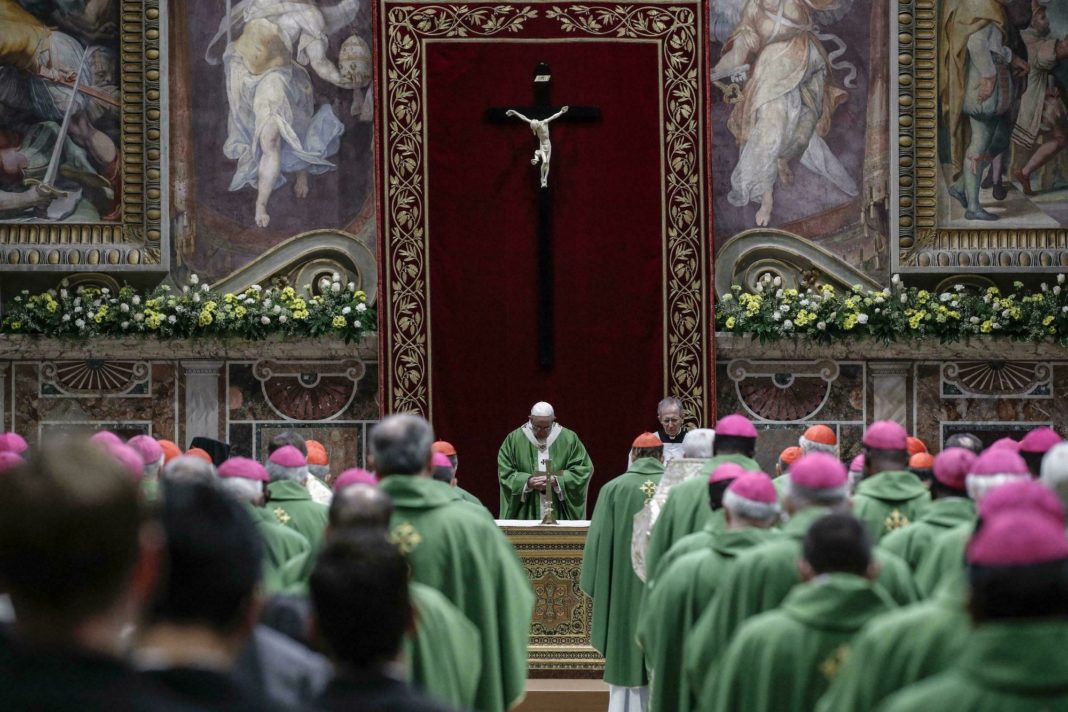
Pope Francis celebrates Mass at the Vatican, Sunday, Feb. 24, 2019. Pope Francis celebrated a final Mass to conclude his extraordinary summit of Catholic leaders summoned to Rome for a tutorial on preventing clergy sexual abuse and protecting children from predator priests. The Mass was celebrated Sunday in the Sala Regia, one of the grand, frescoed reception rooms of the Apostolic Palace. (Giuseppe Lami/Pool Photo via AP)
Pope Francis ended a landmark Vatican meeting on clerical sexual abuse with an appeal “for an all-out battle against the abuse of minors,” which he compared to human sacrifice, but his speech did not offer concrete policy remedies demanded by many of the faithful.
In the speech at the end of a Mass in the Apostolic Palace’s frescoed Sala Reggia hall, Francis argued that “even a single case of abuse” in the Roman Catholic Church — which he said was the work of the devil — must be met “with the utmost seriousness.” He said that eradicating the scourge required more than legal processes and “disciplinary measures.”
“To combat this evil that strikes at the very heart of our mission,” the pope said, the church needed to protect children “from ravenous wolves.”
Right. You been following the new scandal with Francis protege Bishop Gustavo Zanchetta of Argentina? Francis knew that this guy was a sex maniac, but brought him to Rome anyway. The other day, an Argentine newspaper published photos proving that the matter went all the way to Rome — in other words, that the Pope knew that he was dealing with a bishop who, among other things, molested seminarians under his authority.
True, Francis in his Rome speech today focused on the sexual abuse of minors. And, according to reporting in National Catholic Register, the guidelines the pontiff offered in his speech are sensible. They are:
Building upon the World Health Organization’s “Seven Strategies for Ending Violence against Children,” the pope presented eight guidelines to aid the Church in “developing her legislation” on the issues.
The eight guidelines can be summarized as follows:
1. A “change of mentality” to focus on protecting children rather than “protecting the institution.”
2. A recognition of the “impeccable seriousness” of these “sins and crimes of consecrated persons.”
3. A genuine purification beginning with “self-accusation.”
4. Positive formation of candidates for the priesthood in the virtue of chastity.
5. Strengthening and reviewing of guidelines by episcopal conferences, reaffirming the need for “rules.”
6. The accompaniment of those who have been abused with an emphasis on listening.
7. Ensure that seminarians and clergy are not enslaved to an addiction to pornography.
8. Combat sexual tourism around the world.
Fine. But as we know from the McCarrick story, seminarians are at the complete mercy of their bishop. Who gains by Francis focusing narrowly and exclusively on priests who prey on minors, and only on minors?
Just before this meeting, the Catholic journalist Phil Lawler wrote about how it was going to be primarily a public relations exercise, and identified the aspects of the scandal that Francis and his Rome meeting would avoid talking about:
  • homosexual influence within the clergy;
  • why the Vatican has eased penalties on abusive priests;
  • why the Pope himself has promoted bishops accused of covering up—and in some cases actively engaging in—sexual abuse;
  • canonical structures to hold bishops accountable for negligence;
  • how Theodore McCarrick rose to ecclesiastical influence, and who protected him.
We are seventeen years past the Boston scandal revelations, which brought this crisis to public view. There have been many good words spoken by popes. Here’s Pope John Paul II, from his address to the US cardinals on April 23, 2002, with the abuse scandal mushrooming in the US:
The abuse which has caused this crisis is by every standard wrong and rightly considered a crime by society; it is also an appalling sin in the eyes of God. To the victims and their families, wherever they may be, I express my profound sense of solidarity and concern…
It must be absolutely clear to the Catholic faithful, and to the wider community, that Bishops and superiors are concerned, above all else, with the spiritual good of souls. People need to know that there is no place in the priesthood and religious life for those who would harm the young. They must know that Bishops and priests are totally committed to the fullness of Catholic truth on matters of sexual morality, a truth as essential to the renewal of the priesthood and the episcopate as it is to the renewal of marriage and family life.
At this point, though, do people take words from popes seriously? I’m not asking in a trolling way. How are people to believe that the pope is really serious this time about cracking down on clerical sex abuse when he behaves the way he has done in the Zanchetta affair. It suggests pretty clearly that the abuse Francis cares about is abuse of minors. If bishops want to force themselves on seminarians, well, that’s not such a big deal, is it? Just to make clear you understand what the Zanchetta affair involves, the Associated Press reports today:
The Associated Press has reported that the Vatican knew as early as 2015 about Bishop Gustavo Zanchetta’s inappropriate behavior with seminarians. Yet he was allowed to stay on as bishop of the northern Argentine diocese of Oran on until 2017, when he resigned suddenly, only to be given a top job at the Vatican by Francis, his confessor.
New documents published by the Tribune of Salta newspaper show that the original 2015 complaint reported that Zanchetta had gay porn on his cellphone involving “young people” having sex, as well as naked images of Zanchetta masturbating that he sent to others.
The age of the “young people” isn’t clear. But Francis told his summit Sunday that Vatican legislation criminalizing possession of child porn involving children under age 14 should change to include older victims.
“We now consider that this age limit should be raised in order to expand the protections of minors and to bring out the gravity of these deeds,” Francis said.
It wasn’t clear if Francis was referring to the Zanchetta case, which is now under investigation by both the Vatican and Argentine judicial authorities after alleged victims came forward accusing Zanchetta of sexual abuse.
The Vatican has insisted that Zanchetta was only facing “governance” problems at the time of his 2017 resignation and appointment at the Vatican, and that the first sexual abuse allegation was made in late 2018.
The documents, however, make clear that the Vatican was aware of inappropriate sexual behavior by Zanchetta two years before he resigned.
For those keeping score, I am getting close to the end of Frederic Martel’s In The Closet Of The Vatican. His reporting on corruption under the pontificate of John Paul II is at times based on more solid ground than what I’ve read previously in this book, but the whole thing is still deeply compromised by Martel’s stunning lack of journalistic professionalism. A small note: I know almost nothing about Spain, but I found three errors of fact in his chapter on the Spanish church. He keeps reminding us in his narrative about how many researchers he had on this book. Either he’s lying about that, or they did a very poor job, or the publisher rushed it to publication.
I’ll write more about the book when I complete it, but here is a harsh critique of it from the Catholic left; I am not a fan of Michael Sean Winters’s commentaries, but in this case, he’s right about how bad this book is. I predicted — wrongly, as it turns out — that In The Closet Of The Vatican would overshadow coverage of the Rome meeting. Had it been a more credible book, it would have. But it didn’t for the same reasons that The New York Times is not the same thing as the National Enquirer.
Anyway, I recognize that I’m very, very jaded about this topic, but I don’t understand how Catholics can take their leadership seriously on this issue anymore. If you are a Catholic who does believe that the pope and the bishops can be trusted now to get it right, I invite you to explain why. To be perfectly clear: I’m not taunting at all; I honestly want to know.
The loss of credibility of the hierarchy is one reason why I believe faithful Catholics have got to take some form of the Benedict Option. That’s what the young Catholic of the self-described “Resistance” in Spain are doing. They do not repudiate the institutional Church — if they did, they would cease to be Catholics — but they no longer expect anything from them. Instead, they are taking responsibility for educating and forming themselves as faithful orthodox Catholics, and building community. From that post:
“We used to be the defender of all this,” Ramon said. “The church is mediocre. The church was the first to betray the true Spanish spirit. … The Church has been unfaithful to its mission many times. Who abandoned the Cristeros? The Church. We know the Church is made of men, and they betray Christ constantly. We are men, and we betray Christ constantly. We have a lot of history of the betrayal of clerics. We don’t care now.”
We don’t care now. Those words struck me like a gong. These young men struck me as pious and sincere Catholics who, because of their piety and sincerity, don’t really care what their bishops think of them.
In his speech in Rome today, Francis called for an “all-out battle” against sexual abuse of minors, but the metaphor rings hollow for these young Spanish Catholics I talked to last month. More:
Ramon told me that “the deeper battle is the one people can’t see.” The battle for authority, he says, is lost. Though all the young men I spoke with are strongly Catholic, they have given up expecting their bishops to do anything about the crisis. They feel like spiritual orphans.
“We have no shepherds right now,” he said. “What would a soldier do if he can’t see the captain? He would be a guerrilla. He would assemble all those who fight for the flag, even if they’re under different uniforms. [For us, it’s] the Cross, and Spain, and Tradition.”
UPDATE: Ramon e-mails to emphasize that he and his friends are faithful Catholics who believe the Church is holy. It’s only that they have no faith in the competence of the current generation of hierarchical leadership. That is not the same thing as disbelieving in the authority of the hierarchy itself. As Catholics, they accept the legitimacy of the hierarchy … but think the current hierarchy is a mess.
It seems to me that this, and some version of the Benedict Option, is the only reasonable conclusion left to Catholics who still believe in Catholicism, and want to see it prevail through this great crisis, of which the sexual corruption of the clergy is only one manifestation. Tell me what you think. Catholic readers, did the Rome meeting, and the pope’s closing speech, make you more confident that the institutional Church is going to get itself sorted out?

Sunday, February 24, 2019

The Roman Farce


The Catholic Church’s sexual-abuse scandals, its inadequate response, and a salacious book all reveal a deep moral rot.


By Michael Brendan Dougherty
https://www.nationalreview.com/2019/02/catholic-church-sex-abuse-scandal-pope-francis-weak-response/
February 22, 2019

Image result for pope francis sex abuse summit

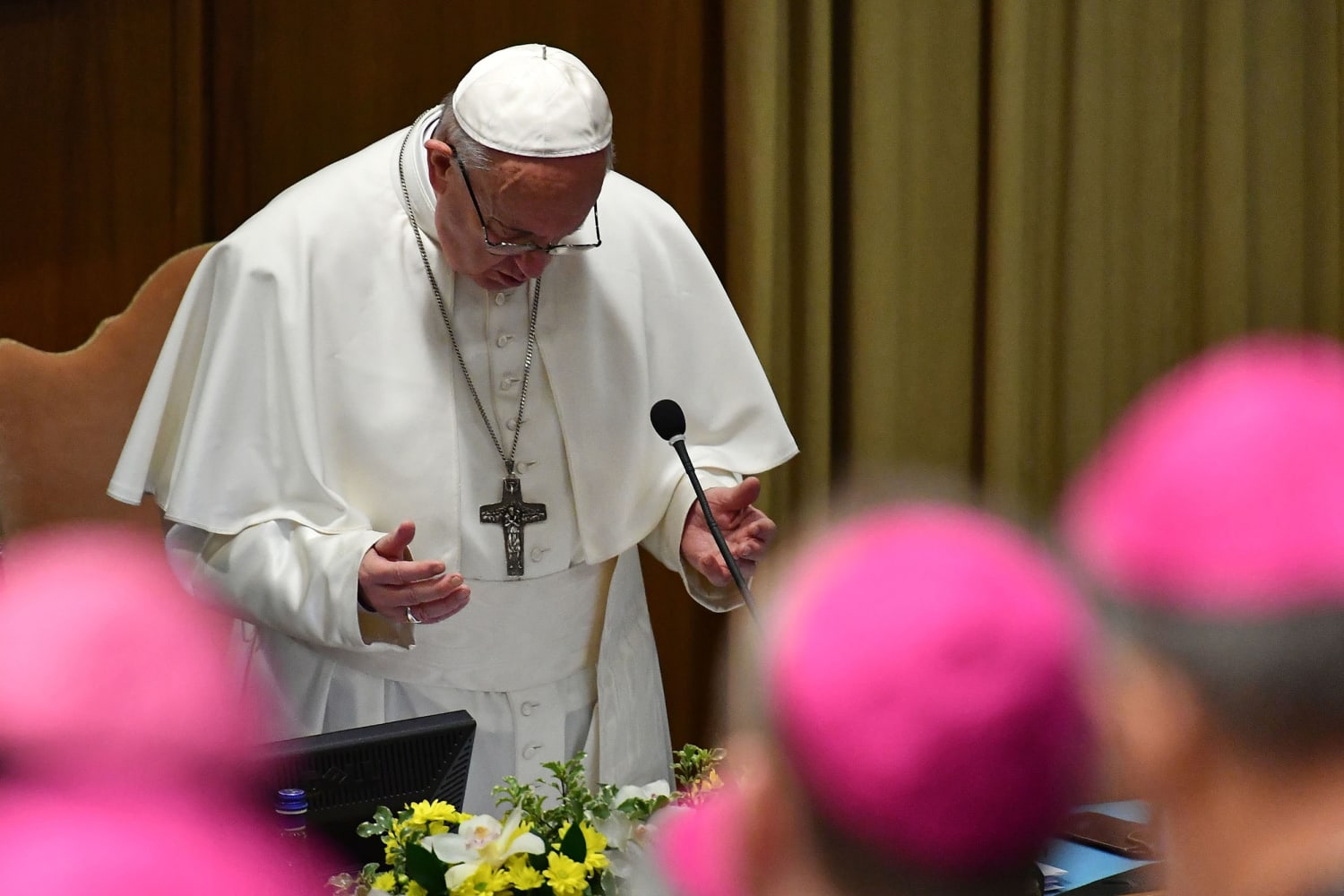
Pope Francis prays during the opening of the the sex abuse summit on Thursday at the Vatican. (Vincenzo Pinto, AFP/Getty Images)
Pope Francis is conducting his extraordinary summit with cardinals on the problem of sexual abuse in the Church. And we can expect it will go nowhere.
The summit is happening in light of two events outside of it. The first was Pope Francis’s recent laicization of the former cardinal archbishop of Washington, D.C., Theodore McCarrick, a man who was notorious for his sexual abuse of seminarians and other priests, while at the same time he was the public-relations face of the Church’s response to sexual abuse and cover-up in the early 2000s. McCarrick was finally publicly exposed when an investigation into his abuse of a minor became public last year.
The second is the publication of a sensationalist book by sociologist Frédéric Martel, In the Closet of the Vatican, which claims to document the sexual hypocrisy at the top of the Roman Catholic Church. The book is fascinating because it relies on scores of interviews with cardinals and is written in a loose, gossipy style. Some of the pope’s trusted confidantes were sources for the book. We’ll come back to that in a minute.
These two events also reveal the problems inherent to Pope Francis’s summit. The laicization of McCarrick is held up as a victory of accountability, even justice, but actually amounts to a public-relations move. McCarrick was not afforded the normal forms of defense given to men in his position. And far from solving the McCarrick issue, his laicization avoids the main question: How did McCarrick rise to his position while “everyone knew” of his sordid reputation? Why was he able to maneuver around the restrictions put on him by Benedict XVI? Why did Francis make him an informal adviser in his anxious desire to reshape the American episcopate? And how is it that his associates (co-conspirators?) continue to rise in the Church? Cardinal Kevin Farrell, who lived and worked with McCarrick for years (and claims to have noticed nothing unusual), was recently appointed cardinal camerlengo, who will govern the Vatican during the next interregnum.
Francis’s preferred bishops have also been promoting their own line on the abuse crisis at the summit. In their eyes, the problem is not rampant immorality, a network of moral blackmail, and moral conspiracy but what they call “clericalism.” The term is used in two senses. The first, the one that makes it plausible to some as a problem, is the idea that bishops and priests protect each other. That’s true. But what Francis’s men mean by clericalism is the idea of a Church where a hierarchical priesthood plays a role in safeguarding the Church’s traditional doctrine. They believe that this conception of the priesthood, as having real moral responsibility for handing on the faith as they received it, makes priests irresponsible. It is in this way that they transmute the failure of bishops to exercise authority to remove abusive priests into a problem of “excessive authority.” And thus sexual immorality is blamed, not just on moral and doctrinal conservatives, but on moral and doctrinal conservatism itself.
Then there is the matter of the book, which replicates the same error. Martel’s methodology for determining whether certain churchmen are gay is to stereotype them. Churchmen whom he deems to oppose homosexuality too much are deemed homosexual themselves. This logic does not apply, however, to Pope Francis, who has occasionally urged gay men to leave the priesthood or not enter it at all. Francis is held up as a hero to Martel. But the influence of Francis’s inner circle is evident in the choice of targets.
Martel meets with the German conservative cardinal Gerhard Ludwig Müller and insinuates that the cardinal’s “perfumed voice” gives him away as a homosexual. Pope Benedict XVI is deemed a homosexual because he likes opera. The traditionalist cardinal Raymond Leo Burke is deemed homosexual or even transsexual because he prefers the Church’s most elaborate vestments. Just as the Vatican summit limits its scope to avoid addressing the culture of abuse in seminaries, so Martel avoids discussing the documented abuse at the seminary of the so-called “vice pope,” Cardinal Óscar Rodríguez Maradiaga.
Martel’s preferred story is one of moral hypocrisy. That may be a real moral problem for some churchmen. But because this is Martel’s bias, he is incapable of looking at the crisis through the lens of moral indifference, moral lassitude, and moral cronyism, which are the major factors in the crisis of sexual abuse and predation in the Church.
That Martel was helped in this sordid endeavor of cover-up and baseless accusation by the pope’s closest advisers should be a source of immense scandal to those in the Church and outside it. He likes opera. He must be gay. He likes vestments. Must be gay. He has a pleasant voice. Gay. This is the kind of moral enlightenment that Pope Francis’s allies have brought to the Church? The only stereotype that Martel doesn’t use is the one about men who engage in constant salacious sexual gossip and speculation, as it would indict all his sources.
The book is trash. The supposed justice meted to McCarrick amounts to a cover-up. The pope’s summit is trash and a coverup. These men do not fear the justice of God or men. All their training in theology, and their great insight about man’s depravity, is the schoolyard taunt “Whoever smelt it, dealt it.” To hell with them all.

Jordan Peterson, PC's Fiercest Critic, Explains Why You Should Stand Up Straight


https://www.haaretz.com/magazine/.premium.MAGAZINE-jordan-peterson-pc-s-fiercest-critic-explains-why-you-should-stand-up-straight-1.6957805
February 24, 2019

Image result for jordan peterson 2019

ZURICH – What does it mean to be a star in the intellectual world? If an academic is a star in his lifetime, it usually means that he’s invited to lots of conferences, cited in professional journals or even in the public media. Sometimes, more rarely, he also writes books that reach an audience beyond a small circle of experts. Say, someone like Yuval Noah Harari or Francis Fukayama. But Jordan Peterson, the Canadian psychology professor from the University of Toronto, has gained fame on a much larger scale. We’re talking rock star, a bona-fide celebrity.

His 2018 book “12 Rules for Life: An Antidote to Chaos” has sold two million copies in 45 languages. The accompanying lecture tour has been selling out worldwide. But YouTube is Peterson’s main platform and his videos rack up tens of millions of views.

We caught up with him in Zurich a few weeks ago where his daughter Mikhaila (named for Gorbachev) had surgery. Mikhaila is also his business manager, which is quite a job. This is an international operation that involves event production, marketing and PR. Haaretz was given a limited window between media interviews and a lecture Peterson was due to give that evening.

The 1,200-seat Volkshaus concert hall is sold out. At 7:45 P.M., 1,200 Swiss men and women wait in an orderly line that winds down the block. Across the street, there is a protest against Peterson, so the Zurich police are deployed there.

The doors open and the hall quickly fills. Security personnel with walkie-talkies roam the aisles, alert for possible disrupters willing to pay $75 a ticket for the chance to interrupt Peterson’s talk. Finally, an unseen announcer intones, “Ladies and gentlemen … Jordan B. Pe-ter-son!!!” and a hearty round of applause erupts. Then Peterson, tall and slim, wearing a three-piece suit, takes the stage, wearing one of those Madonna-style cheek mics.

Then comes a 90-minute lecture about why, in so many folk tales, femininity symbolizes chaos while masculinity symbolizes order, one of Peterson's main themes. Like many other lectures by him, this one too features his idiosyncratic mixture of evolutionary biology, empirical social sciences research, his experiences as a practicing clinical psychologist and Jungian cultural analysis.

The components are integrated conversationally, with passion, for Peterson comes across as a sensitive and emotional man (at the end of the interview, we had to stop for a moment when he got choked up while speaking about his children).

But ultimately, if you consider his profound respect for religious faith, his dislike of revolutions and social engineering, his faith in meritocracy, and what Unamuno called “the tragic sense of life” – Peterson can be seen as following in the tradition of Edmund Burke: conservatism that is anti-revolutionary but not anti-liberal. And yet, labeling him a conservative, as so many of his detractors do, is also imprecise. In his view we can't make do with order, for a measure of chaos is essential to innovation, creativity, adaptability.

Peterson has a simple explanation for his extraordinary popularity: In a culture that sanctifies victimhood, he proposes that people confront life’s inevitable pain unflinchingly. So here is Peterson in a nutshell: Life is suffering. We can only bear it if life has meaning. And meaning is created when you take responsibility – by confronting hardship and firmly steering your ship forward, even against waves that will, ultimately, overwhelm it. This is a message people are “hungry for” in our times, he says.

Peterson has focused on the subject of meaning for many years. His previous book was entitled “Maps of Meaning: The Architecture of Belief.” We’ll come to this. But first, I suggested to him another reason for his celebrity: We're all living under a tyranny of political correctness and not only did you defy it, you also never cede the higher moral ground to its champions. You’re not apologetic in front of the identity crowd.

“No, I’m not I’m not a fan of the identity crowd people… Learning an ideology that a halfwit could master in two weeks doesn’t make you moral.”

But that’s the spirit of the times. For example, students increasingly begin questions with "as a": "As a member of this group, I am offended that you say this or that."

“I’d say I don’t answer questions formulated in that manner. Let’s say your goal is to tell the truth and someone asks you a question that has a trap in it. I’m not playing that game. That doesn’t mean I would necessarily be smart enough all the time to notice that was happening and to formulate that response; it's happened to me with journalists all the time.”

The American Psychological Association recently published new guidelines for psychological practice with boys and men that says “traditional masculinity" is "harmful.” You were not very happy with this.

“I’m absolutely ashamed to call myself a psychologist in the aftermath. They said it was guidelines for the psychological treatment of boys and men, but that isn’t what it is; it’s a social justice treatise on how you better think if you’re a psychologist if you don’t want to be pursued.”

But is there really nothing to be said for this approach? How about curbing aggressive instincts?

“Definitely not! You just can’t damn instincts. It’s not helpful. You’re going to get rid of aggression? You don’t like ambition? You don’t like purpose? You don’t like persistence? … I think [the authors of the APA article] justify reprehensible weakness by an all-out assault on the idea of strength and competence, and that they clothed that in virtue… It’s a nauseating document.”

Peterson returns to this topic during his talk at the Volkshaus. An excess of masculinity isn’t the problem – that is an “anti-truth,” he says. Because one of the most reliable predictors of criminal behavior is fatherlessness. That is by far “the biggest risk factor for long-term delinquency antisocial behavior and violent criminality.”

No, I won’t shut up!

Jordan Peterson was born in 1962 in Edmonton, Alberta, and grew up in Fairview, in the far north of Canada. The winters of his youth were long, dark and difficult, with Siberian temperatures lasting for days on end. Perhaps that's one key to his tragic outlook on life.

His father Walter, a taciturn teacher, used to go hunting in the Northern Plains and sometimes took his son along. Jordan’s father taught him to read when he was just 3, which he remembers as a pleasant experience. His mother Beverley was a nurse but worked as a librarian. A woman with a good sense of humor, her son liked to make her laugh. Peterson has described her as agreeable, to the point where she often finds it hard to stand her ground.

As he describes his own practice as a therapist, he is out to help his patients learn to do just that: stand their ground.

At college, Peterson became enchanted with literature and philosophy, and was drawn to the works of thinkers with a profound sense of the tragic: Solzhenitsyn, Dostoevsky, Nietzsche, Carl Jung. The first subject he researched was modern totalitarianism, in an effort to understand how human beings could perpetrate such monumental horrors upon one another. The huge "piles of corpses” in the 20th century immunized him against utopian temptations. Then he turned to other subjects. He wrote his doctoral thesis in psychology on alcoholism, but became increasingly interested in culture and mythology, in the tradition inaugurated by Italian philosopher Giambattista Vico.

For years, Peterson has been filming his courses and posting the videos on YouTube. One can thus join his University of Toronto students in pondering the deep and common patterns of meaning which, he believes, underlay all civilizations.

But he really gained renown following Canada’s passage of Bill C-16 in 2017, which added “gender identity or expression” as a prohibited basis for discrimination, and advanced the demand that transgender people be addressed by their preferred pronoun. Peterson posted an hour-long YouTube video explaining why he wouldn’t agree to be told how to speak. In no time, of course, he was accused of being a transphobe, a misogynist, a racist, and later also an “mean white man.”

It helped little that he said – repeatedly – that he addresses transgender students in his class in their preferred pronoun. He just would not accept the law that dictated how to speak. A huge uproar ensued. But Peterson's tone – at once assertive, unapologetic and patiently polite – effectively withstood the shrill self-righteousness of the guardians of the faith. To everyone's surprise, he never lost his balance.

That took a lot of fortitude. In the dozens of interviews with him on YouTube, many of them hostile, the most recurring theme is probably this: “That’s not what I said.” Since political correctness is largely a game of exposing real and imagined prejudices – Aha! Gotcha! – putting words in someone’s mouth it is the name of the game. And so Peterson was accused of thinking, feeling and saying much that he never thought, felt or said.

What was surprising about all this, was that the progressive tsunami failed to drown him. Instead, he surfed into the limelight. The tsunami actually made him a mega-celebrity.

How is it that something meant to silence him ended up doing the opposite? I think this was, roughly, what was at work: Anyone who has listened to Peterson honestly knew he harbored no hatred of transgender people, gays, women or minorities. This was most obviously a false, and malicious, accusation. Peterson the therapist is against the cult of victimhood – not against victims. Because, in his view, making victimhood the center of identity is bound to backfire. It traps you, and prevents you from overcoming whatever your predicament may be.

This being the case, the attempt to frame his critique of victimhood as a kind of defense of his "white male privilege" smacked of dishonesty. And so the more he was absurdly accused of racism or misogyny, the more it seemed to many that he was right. It became plain that social justice warriors were actually advising us all not to improve our lot, so as not to lose our precious victimhood.

This was no longer just an argument: It morphed into political theater, a scene that repeats itself in numerous interviews as, resolutely and unapologetically, Peterson rebuffs attempts to attribute to him a position that is not his, malice that he does not harbor, mistakes he did not make. Again and again, he patently corrected his interlocutors: “That’s not what I said.”

These endlessly repetitive verbal battles also illustrated the growing gap between the literal meaning of words like “racist,” “transphobe” and “misogynist,” and their function in popular discourse. They’ve become a means of silencing, rather than labels for actual opinions. As Israeli political scientist Dan Schueftan has quipped: The new meaning of the word “racist” is "I have no answer to your argument, but I demand that you shut up."

And as the progressive attacks increasingly seemed less like arguments and more like attempts to silence Peterson, more and more people came to feel that his opposition to C-16 and his insistence on freedom of speech were not just necessary but actually urgent. After a while the subtext subsumed the text and it all boiled down to this: "Shut up!" and then, "No, I won’t shut up."

Political correctness is a direct and steep slope from politeness to dishonesty and lies. And Peterson esposed the fact that we have begun to swear at truths we don't like, rather than facing them.

And so between one “That’s not what I said” and another (“I didn’t say women are chaotic, I said that in many mythologies femininity symbolizes chaos”), Peterson has exposed the shame and self-censorship, the depth of conformism, and the lack of honestly and courage in our academia, our press, our political discourse. Which explains the tremendous hostility that he elicits.

Capitalism vs. serotonin

The social media era has spawned the horror of online witch hunts, where anonymous accusations fly and virtual public executions proceed at lightning speed without anything like due process. But it has also opened up new options for defending oneself. When you have an audience like Peterson’s and the ability to reach it over the heads and under the noses of established media, when you’re borne aloft on huge waves of popularity – you can’t be easily silenced. Even a petition signed by 200 faculty members in 2017, calling for his dismissal from the University of Toronto, couldn’t budge him from his job.

Not that he doesn't invite trouble, as with his recurrent attacks on the very heart of the contemporary hegemony. For example, the feminist axiom that we, in liberal democracies, live under an oppressive patriarchy. I didn’t ask him about this since it was a shame to waste our time on this conversation, which, I think, I can fake reasonably well by now, having heard him go through it so many times. It usually goes something like this:

Peterson: Western society is not an oppressive patriarchal structure.

Journalist: But don’t you agree that men hold most of the political power and most of the property?

Peterson: A small group of men hold it. Most men have little power, if at all. In fact, they are more disproportionately represented at the bottom of the social ladder. Nearly all deaths on the battlefield are of men. The vast majority of fatal workplace accidents – men. The vast majority of suicides, of homeless people, of prisoners – men. You want equal representation? How about equal representation in jail, or among coal miners or repairmen working with high-voltage wires?

Then the journalist would ask: What about the gender pay gap?

And Peterson would respond: There is no gender pay gap. That’s a statistical fiction.

Journalist: Are you denying the fact that women earn less than men?

Peterson: There is a discrepancy between because women work fewer hours on average, in professions that pay less, in less senior positions, and because they devote more time to their family. Very few men, and even fewer women, are prepared to sacrifice everything for the single-minded pursuit of a career.

Journalists: Because our education system creates gender bias.

Peterson: No. As freedom of choice increases, women turn more, not less, to "female" professions, as studies in Scandinavian countries have repeatedly shown.

Journalist: So you’re saying that women are less talented.

Peterson: That’s not what I said.

And so on.

The anger Peterson arouses derives in part, undoubtedly, from his rejection of the idea that gender roles are wholly the result of social construction. The insistence that they are to a large extent biologically determined strikes at the heart of progressive optimism. That optimism presumes that anything can be changed with the aid of enlightened social engineering, that nothing about us is immutable.

Peterson is, of course, not the first to note that such utopian visions have spawned some of history’s greatest atrocities. Anyone who thinks that Marx's egalitarian utopia can be realized without Stalin's or Mao's violence, he thinks, is either unbelievably arrogant and foolish. Though any decent person, Peterson thinks, should strive for equality of opportunity, equality of outcome can only be achieved with brutality. Hierarchies are natural, and are not just older than capitalism, they are far older than humanity.

If you want to understand their origin, you must go back some 350 million years at least, before the dinosaurs, to serotonin-based nervous systems, like that of lobsters, which react to relative social standing: Climbing up the social ladder, via competition, causes a release of serotonin and boosts the lobster’s vitality, like it does to us. And like us, lobsters respond to treatment with medications like Prozac. Hierarchies emerge from our most basic and natural strivings. We cannot eliminate them, nor should we try. We should only aspire to keep them based on competence, not domination.

You mentioned that chimpanzees can tear each other apart. Their violence is natural. Are human impulses also inherently bad?

“Human beings are inherently good and evil and society is inherently good and evil and nature is inherently benevolent and rapacious, and that’s paradoxical and it’s terrible, but you’re stuck with it.”

How would you describe the kind of therapy you do?

“Mostly behavioral. I’m a very practical person so I always look for the simplest possible approach to a problem.”

Suppose I came to your office for the first time. What would that first session look like?

“The first thing I’m going to do is assume the position of rather radical ignorance, which is what behavioral psychologists do… I’m going to listen to you for a long time before I dare to specify what the problem might be, and we’ll decide that together dialectically.”

Stand up straight

At first glance, Peterson’s book “12 Rules for Life” – which just came out in Hebrew translation (Shibolet Press) – looks like a natural follow-up to behavioral therapy. Ostensibly, it’s a self-help book full of practical advice, some of it quite banal. The rules range from “Stand up straight with your shoulders back” (Rule 1), to the more surprising “Do not let your children do anything that makes you dislike them” (Rule 5).

Reviews, predictably, run the full gamut: from fans who view Peterson as a guru, to detractors who see him as evil, a charlatan, a reactionary or the opposite – just another optimistic and sentimental North American psychologist telling you to listen to others, the think positive and set small achievable goals. “Compare yourself to who you were yesterday, not to who someone else is today,” Rule 4 suggests. And “Pet a cat when you encounter one on the street,” says Rule 12 (which obviously wasn’t born of experience with Israeli felines).

But the rules really act as pegs on which to hang discussions that, as usual with Peterson, combine various disciplines and genres. So we get neurology and hermeneutics blended with free association, literature, evolution, politics and philosophy. They are highly accessible and mostly popular without being dilettantish.

Every chapter is like a sermon, a conversation. The depth is not uniform, but the prose flows and exudes the author's clear, friendly voice. But above all, here too, Peterson is preoccupied by the question of meaning and how it makes us see life as worth living, despite suffering. This is, for him, the ultimate question. And on this subject he has a wealth of fascinating thoughts and surprising associations, alongside logical (or faith-based) leaps. It is still a work in progress, with many tributaries still in need of being worked out.

Your argument that we need meaning to cope with suffering – is it a philosophical argument or…

“No, it’s a theological argument.”

I’ll rephrase then: Is it a theological or a psychological argument? Do we need meaning or do we need a sense of meaning?

“We need real meaning; meaning is real.”

The illusion will not help.

"No, the illusion will hurt. Illusions don't help."

But can’t the sense of meaning stem, for example, from belonging to a group?

“Yes, definitely. What I'd say is: The sense of meaning or the purpose is implicit [in the group's activity]. You don’t know what it is, but it’s in there. It’s like, you’re a member of a wolf pack and the pack is doing something; you don’t know what it is, you’re just a wolf. But if you’re a person and you’re associated with a bunch of other people, you find meaning [but] it doesn’t mean you can articulate it.”

It’s not certain that that’s enough for making the leap from the subjective feeling to the objective answer. But for Peterson, in a profound sense, there’s an answer, and it can be called “God.” In any case, it is inseparable from faith, which in his opinion is essential, for both meaning and in order.

In “12 Rules for Life,” he writes that faith is the understanding “that the tragic irrationalities of life must be counterbalanced by an equally irrational commitment to the essential goodness of Being.” I was sorry after meeting him that I did not cite this in answer to his argument about the harmfulness of illusions of meaning.

So do you – like Rousseau, or Kant, or even William James – in effect offer a pragmatic argument for God’s existence? Do we have to believe in God because it’s beneficial?

“That question always stops me,” he says, after a silence. “You need to aim at some transcendent ethic, you have to do that, and the reason is that the transcendent ethic is the way that things are put right. It’s not an illusion, it’s not a mere rational construct, it’s not an invention, it’s none of those things. It’s something that you discover, and you discover it despite yourself.”

Because the concepts Peterson uses are taken from a host of disciplines, they are not easy to place. But they are what his intellectual project has been based on. Its aim: to come up with a shared pattern of meaning, which the biological, the psychological and the cultural-theological all reflect in different ways.

The mythopoetic truth in folk tales is found in archetypes in the unconscious, which are in turn based on our biological makeup. In other words, within our nervous system, subconsciously and beyond our control, meaning is embedded, grafted onto our hardware. And that meaning assumes narrative patterns in the psyche, expressed through archetypes that reflect our system of urges. They in turn find an echo, a reflection in the formative narratives of every culture, throughout generations. Peterson's quest for the underlying maps of meaning is by no means a modest one.

Peterson: “One thing Nietzsche proposed when he talked about the death of God and the potential for catastrophe that would emerge as a consequence was that people would have to create their own values. We would have to replace the external valuation scheme that religion provided with something that was psychological, let’s say. And Jung knew where Nietzsche was wrong because of what he learned from Freud.

“What Jung learned from Freud was that we weren’t masters in our own house. That we’re beholden to psychological phenomena that are beyond our voluntary control. We have a nature and that expresses itself within us, in ways that we cannot control rationally. It’s phenomenological reality, but it’s reality nonetheless, like the reality of a dream. You don’t invent your dreams. Like an involuntary sense, they manifest themselves in the field of your imagination.”

But Freud was secular. Freud thought God is a childish invention of those who refuse to grow up and give up their father.

“Yes, he thought religion was a grand wish fulfillment. But it’s a very shallow criticism and that’s why Jung and Freud broke and Freud produced what’s essentially a religious system as a replacement [in the guise of his psychoanalytic theory].”

According to Jung, says Peterson, you don’t just discover your own values: “They manifest themselves to you. Jung felt that the religious instinct is operating within the psyche. You can understand this if you start to watch yourself. You’ll see that you’re guided by forces that operate within you that you do not control. You can bargain and negotiate with them like Abraham negotiated with God in the Old Testament [about the fate of Sodom]. You’re not passive, you’re not the passive puppet of your own intrinsic desires. But you’re not the master of them by any stretch of the imagination, so you have to cooperate with them.”

So between the archetypes and culture, on one hand, and natural impulses on the other, is there room for free will and agency?

“It’s bargaining. It’s a struggle. You’re contending with Titans.”

I want to end on a personal note. Is there a moment that you particularly remember that represents your fatherhood, your way of being a father?

“All the time.”

That was when we paused. His eyes welled up and his voice cracked.

“A sensitive subject this week, because I was in the hospital … with my daughter, and we were not sure how the surgery would go and… it’s kind of an overwhelming experience.” (The surgery was an ankle replacement, which was being done for the second time.) "My daughter was unbelievably ill for like decades. It’s been brutal.”

Mikhaila Peterson has an autoimmune disease with very serious symptoms and psychological effects whose origin is also partly physiological. The disease, which attacks the joints, is accompanied by paralyzing depressions. During certain periods could stay awake only with the help of Ritalin, for a few hours.

Her parents went crazy, her father recalls. “We used to give her hell: ‘Why the hell can’t you get up?’ ‘You’re sleeping your life away.’ It’s like while she was sleeping 8-10 hours a day, we didn’t know exactly where the weakness of character ended and the physiological degeneration began; neither did she. You fight to find that line. One of the terrible things about having a chronic illness is that you also get hell for it all the time because people mistake it for weakness of character.”

In a podcast interview with Joe Rogan, Peterson said that the family were convinced Mikhaila was dying. But she didn’t give up. She began to experiment with nutrition, and reached a curious conclusion that's been mentioned in interviews with Peterson ever since: After a roller coaster of skin rashes, depression, paralyzing infections and other symptoms, she found a solution on her own: a diet of only red meat and water. Nothing else. Not even salt.

The symptoms disappeared. Peterson, the scientist, is awestruck because there is no explanation as to why this works as it does. But Mikhaila convinced even him to try the diet. He’s been on it for some months, but is less strict than she: He salts his meat and drinks sparkling water, too. It has had a great effect, he reports. His proclivity to depression, the unreasonable difficulties he had getting up in the morning, the extra weight – they've mostly disappeared. Still, he stresses that he doesn’t recommend the diet to anyone.

But the struggle to restore Mikhaila’s health also opens a window on Peterson’s battle against victimhood as a basis for identity. The entire issue seems much more personal when you think about a parent fighting for his daughter’s life, who's realized that in order to continue the battle, she must not sink into an abyss of self-pity, at the bottom of which there can only be despair, perhaps even death.

So here is your first rule for life: Stand up straight with your shoulders back.