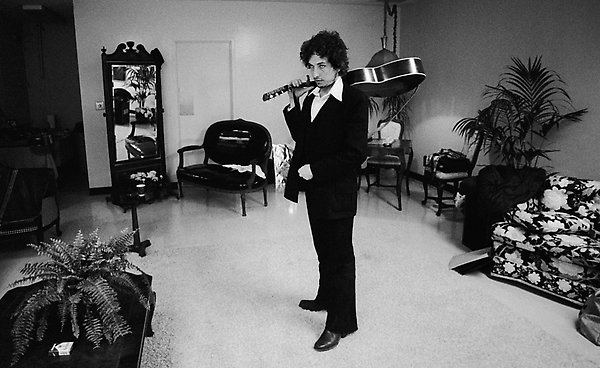
By Chris Jordan https://www.app.com/story/entertainment/music/2018/11/18/bob-dylan-atlantic-city-classics-reimagined-boardwalk-review/2047942002/ November 19, 2018 Bob Dylan in Tuscon Bob Dylan will dance for your entertainment pleasure. Well, it sure looked like Dylan started to dance a little jig after performing a set-closing “Gotta Serve Somebody” Saturday, Nov. 17, at the Hard Rock Hotel and Casino in Atlantic City. The original version of the track from his 1979 studio album “Slow Train Coming” was mid-tempo blues. Here, it was played as upbeat rock 'n' roll with a punchy rhythm. The crowd got up to dance and Dylan did something on stage that resembled a quick dance. More: We reveal the truth behind Bob Dylan's New Jersey myths and legends An arm was raised. A leg was lifted. Bob Dylan, the 77-year-old Nobel Prize winner and American cultural icon, is not going through the motions. He and “His Band” — Charlie Sexton, guitar; Donnie Herron, pedal steel; Tony Garnier, bass; and George Receli, drums — delivered two robust hours largely of revamped Dylan classics. The verses before “Like a Rolling Stone” were dramatically paused; “Don't Think Twice, It's All Right” was given a regal gospel standing; and “Blowin' in the Wind” was delivered in a mournful country style, thanks in part to Herron's sweet sawing in the violin. The characters in Dylan's songs stood out in vivid technicolor. The resolute, the renegades, the romantics, the broken-hearted and the dreamers looking for a better tomorrow came rolling out on the stage, thanks to Dylan’s vibrant lyricism. As for Dylan's singing, he's got some pair of lungs. His (very) crushed velvet vocals came through loud and clear from the stage of Hard Rock's Etess Arena, thanks in part to a crystal sharp sound mix. All the vocal nuances and tics that make his voice so distinctive were present, and then some. Dyan stood and sat behind a grand piano for most of the night, venturing to the middle — not the front — of the stage to sing several songs. He did not play guitar once in the evening. Nor did he address the audience. The band wore white dinner jacket and black slacks while Dylan wore a silver jacket with black slacks. The untamed Dylan locks, with the stage's backlighting, still look like a fuzzy halo even after all these years. Seeing this show, part of Dylan 's “Never Ending Tour,” which comes to the Beacon Theater in New York City Nov. 23 through Dec. 1, was like entering the Sistine Chapel in the early 1500s, looking up and seeing Michelangelo on his back on scaffolding near the ceiling with a paintbrush in his hand. Chris Jordan: cjordan@app.com. Twitter: @chrisfhjordan Bob Dylan Atlantic City set list
Things Have Changed It Ain't Me, Babe Highway 61 Revisited Simple Twist of Fate Cry a While When I Paint My Masterpiece Honest With Me Tryin' to Get to Heaven Scarlet Town Make You Feel My Love Pay in Blood Like a Rolling Stone Early Roman Kings Don't Think Twice, It's All Right Love Sick Thunder on the Mountain Soon After Midnight Gotta Serve Somebody
In September, 1974, Bob Dylan spent four days in the old Studio A, his favorite recording haunt in Manhattan, and emerged with the greatest, darkest album of his career. It is a ten-song study in romantic devastation, as beautiful as it is bleak, worthy of comparison with Schubert’s “Winterreise.” Yet the record in question—“Blood on the Tracks”—has never officially seen the light of day. The Columbia label released an album with that title in January, 1975, but Dylan had reworked five of the songs in last-minute sessions in Minnesota, resulting in a substantial change of tone. Mournfulness and wistfulness gave way to a feisty, festive air. According to Andy Gill and Kevin Odegard, the authors of the book “A Simple Twist of Fate: Bob Dylan and the Making of ‘Blood on the Tracks,’ ” from 2004, Dylan feared a commercial failure. The revised “Blood” sold extremely well, reaching the top of the Billboard album chart, and it ended talk of Dylan’s creative decline. It was not, however, the masterwork of melancholy that he created in Studio A.
For decades, the first “Blood” circulated on a bootleg called the New York Sessions. The compact disc that I picked up in a basement Greenwich Village store had a pleasant overlay of vinyl noise—the result of a transfer from a test pressing. Although several of the tracks have shown up in Columbia’s long-running Bootleg Series, the perennial absence of the full album has made fans wonder whether Dylan is wary of revisiting a turbulent time of his life, when his first marriage, to Sara Lownds, was dissolving. Dylan has denied that “Blood” is autobiographical; in his memoir, “Chronicles: Volume One,” he suggests that the songs were based on Chekhov. Artists tend to dislike personal readings of their most personal work.
Last month, Columbia issued “More Blood, More Tracks: The Bootleg Series, Vol. 14.” Available both as a single-disk compilation and as a six-CD “deluxe edition,” it is both more and less than what Dylan obsessives have been tiresomely clamoring for. The logical move would have been to include the entire album in its initial guise. Yet the single disk gives you only two of the test-pressing tracks, alongside some admittedly riveting outtakes. The box set has all of the discarded tracks, but they are scattered through a complete chronological survey of the four days of sessions—five and a half hours of Dylan at the height of his powers. You will have to study the track listings to assemble the original record. The elusiveness of “Blood on the Tracks” has been integral to its allure, and so it remains.
The Morgan Library, which owns the autograph manuscript of “Winterreise,” also possesses a five-inch-by-three-inch red spiral notebook in which Dylan wrote down lyrics for “Blood on the Tracks.” A hardback book included with Columbia’s “deluxe edition” reproduces forty pages of sketches. Some of them are sung more or less as written on both incarnations of the album:
He woke up, the room was bare He could didn’t see her anywhere He told himself he didn’t care, pushed the window open wide Then felt an emptiness inside to which he just could not relate Brought on by a Simple Twist of Fate
Other lyrics never saw the light of day, and are brutally confessional: “Doomed (led) by a heart that wanders astray / Trapped by a brain that I can’t throw away . . . Was it really 12 years ago, well, it seems like just the other day . . . And it’s Breaking me up with only myself to blame.”
Clichés about heartbreak feeding genius fail to explain the singular potency of “Blood on the Tracks.” The rawness of feeling is certainly there, but it is joined to meticulous craftsmanship in the working-out of words and music. The notebook shows constant, obsessive revision—a sort of perfectionism of disaster. “Idiot Wind,” the extended primal scream at the heart of the album, is seen in drafts so crowded with marginal additions that they are hardly legible. Often Dylan doesn’t cross things out, instead superimposing alternatives:
The priest wore black on the seventh day and waltzed around on a tilted floor stepped all over me After you (came down on me) you said you never saw my face before did me in done (After you stepped all over my head, you said ya never wanted to see my face no more) I BEG YOUR PARDON MADAM (thru the circles round your eyes) IDIOT WIND – BLOWIN EVERY TIME YOU MOVE YOUR JAW FROM THE GRAND COOLIE DAM TO THE MARDI GRAS (blowing thru the hot and dusty skies)
Such collisions of hallucinatory images and dour realism—the waltzing priest, the marital argument—are common in Dylan’s work, yet here the literary touches seem less an artful device than a form of extreme emphasis. What’s more, the writing process is open-ended: images are shuffled around through successive drafts and, later, through successive takes in the studio. That priest waltzes on a tilted floor; then he waltzes while a building burns; then he sits stone-faced. The wind blows from the Grand Coulee Dam to the Mardi Gras, then to the Capitol.
The music that Dylan wrote for these lyrics has a chilly, clammy air. His guitar is in open-E tuning, meaning that all six strings of the guitar are tuned to notes of the E-major triad: E, B, E, G#, B, E. As a result, the tonic chord rings rich and bright. But each verse begins with a jarring A-minor chord, which tends to land awkwardly. The middle note easily strays off center, souring the sound. Occasionally, a stray F-sharp bleeds through, adding a Romantic tinge. The unwieldiness of the progression is at one with the fraught atmosphere of the text.
The emotional violence is troubling. The word “idiot” is flung down twelve times. Some lines are openly assaultive: “One day you’ll be in the ditch, flies buzzing around your eyes, / Blood on your saddle.” Here, Dylan’s original approach makes a substantial difference. He made four complete takes in New York, plus several rehearsals and false starts. Each time, he has only a quiet bass guitar backing him. (A ghostly organ was later overdubbed.) The tempo is slow, the delivery subdued. All this is at odds with the song’s smoldering rage, and the contradiction gets resolved in the final chorus, where Dylan shifts from the second person to the first-person plural: “Idiot wind, blowing through the buttons of our coats / Blowing through the letters that we wrote . . . We’re idiots, babe, it’s a wonder we can even feed ourselves.”
Many Dylanists will disagree with me—the second “Blood” has eloquent defenders—but to my ears the later version, recorded with six pick-up musicians in Minnesota, cuts out much of the complexity. Mannerisms overtake the singer’s delivery. “Idiot” becomes “yidiot,” and a goofy pirate yowl periodically intrudes: “I woke up on the roadside, daydreaming about the way things sometimes aaahhhhhrrrre.” (When he does this on one of the New York takes, Tony Brown, the bass player, laughs out loud.) The admission of shared responsibility at the end doesn’t register: you’re carried away by the momentum of the band.
All through the New York sessions, you hear a persistent downward tug in the voice, a grimace of regret. Even the album’s livelier numbers, such as “You’re Gonna Make Me Lonesome When You Go,” can be wrenched into the abyss; on one take, the tempo drastically slows, giving an almost tragic tinge to a line like “I’ve only known careless love.” The potential downside is a tendency toward relentlessness: one piece after another in the key of E, spiralling through love and loss. The final album offers more variety. The Minnesota band gives a rollicking energy to the cinematic yarn of “Lily, Rosemary and the Jack of Hearts.” Arguably, that song suffers under the austere New York style, though I love it anyway.
Ultimately, the long-running debate over the competing incarnations of “Blood on the Tracks” misses the point of what makes this artist so infinitely interesting, at least for some of us. Jeff Slate, who wrote liner notes for “More Blood, More Tracks,” observes that Dylan’s work is always in flux. The process that is documented on these eighty-seven tracks is not one of looking for the “right” take; it’s the beginning of an endless sequence of variations, which are still unfolding on his Never-Ending Tour. In an article from 1999, I notated some of Dylan’s live revisions of “Simple Twist of Fate.” The “More Blood” book reproduces alternate lyrics that were written on stationery from the Hotel Drei Könige am Rhein, in Basel. Dylan is still at it. The other night, in Durham, North Carolina, he sang:
He woke up and she was gone He didn’t see nothing but the dawn Got out of bed and put his shoes back on Then he pushed back the blinds Found a note she left behind What’d it say? It said you should have met me back in ‘58 We could have avoided this, ah, little simple twist of fate.
To assemble the original “Blood on the Tracks” from the eighty-seven takes on “More Blood, More Tracks,” select tracks 69 (CD 5, No. 3), 71 (CD 5, No. 5), 34 (CD 3, No. 3), 76 (CD 5, No. 10), 48 (CD 4, No. 2), 16 (CD 2, No. 5), 11 (CD 1, No. 11), 59 (CD 4, No. 13), 46 (CD 3, No. 15), and 58 (CD 4, No. 12).
By Thomas Sowell https://townhall.com/columnists/thomassowell/2018/11/19/moral-bankruptcy-n2536212 November 19, 2018 Martin Berhman Charter School, New Orleans People who follow politics, even casually, learn not to expect high moral standards from politicians. But there are some outrages that show a new low, even for politicians. Among the consequences of Democrats' recent election victories, especially at the state and local levels, is the election of officials who have publicly announced their opposition to charter schools, and their determination to restrict or roll back the growth of those schools. What have the charter schools done to provoke such opposition? Often located in low-income, minority neighborhoods, these schools have in many cases produced educational outcomes far better than the traditional public schools in such neighborhoods. A Success Academy charter elementary school in Harlem had a higher proportion of the children in one of its classes pass the statewide math exam than in any other class at the same grade level, anywhere in the state of New York. As a result of the charter schools' educational achievements, it is not uncommon for thousands of children to be on waiting lists to get into such schools -- in New York City, tens of thousands. This represents a huge opportunity for many low-income, minority youngsters who have very few other opportunities for a better life. But, to politicians dependent on teachers' unions for money and votes, charter schools are expendable. In various communities around the country, charter schools are already being prevented from moving into empty school buildings, which would allow them to admit more children from waiting lists. Denying these children what can be their one chance in life is a new low, even for politicians. Political rhetoric can camouflage what is happening. But the arguments against charter schools are so phony that anyone with a decent education should be able to see right through them. Unfortunately, the very failure of many traditional public schools to provide a decent education enables their defenders to get away with arguments that could not survive any serious analysis. Consider the incessantly repeated argument that charter schools are "taking money away from the public schools." Charter schools are themselves public schools, educating children who have a legal right to be educated with taxpayer money set aside for that purpose. When some fraction of children move from traditional public schools to charter schools, why should the same fraction of money not move with them? What is the money for, if not to educate children? The amount of taxpayer money spent per child in charter schools is seldom, if ever, greater than the amount spent per child in traditional public schools. Often it is less. Another argument used in attacking charter schools is that, despite particular charter schools with outstanding results, by and large charter school students' results on educational tests are no better than the results in traditional public schools. Even if we accept this claim, it leaves out one crucial fact. White students and Asian students together constitute a majority of the students in traditional public schools. Black students and Hispanic students together constitute a majority of the students in charter schools.On virtually all educational tests, black and Hispanic students score significantly lower than white and Asian students. If charter schools as a whole just produce educational results comparable to those in traditional public schools as a whole, that is a big improvement. If you want to make a comparison of educational results with comparable students, you can look at results among children living in the same neighborhood, at the same grade levels -- and with both charter school children and children in a traditional school being educated in the very same building. Such comparisons in New York City showed, almost every time, a majority of the students in the traditional public school scoring in the bottom half in both math and English, while the percentage of charter school students scoring in the top half was some multiple of the percentage of other students scoring that high. This is what the teachers' unions and the politicians want to put a stop to. Who will speak up for those children?
By Rachel Alexander https://townhall.com/columnists/rachelalexander/2018/11/19/mexican-journalist-reveals-the-truth-about-the-caravan-n2536154 November 19, 2018 Migrants climb the wall in Tijuana as caravan arrives. (KGO TV) Mexican journalist Alex Backman has released a stunning exposeon the caravan from Central America. He says the migrants are robbing and stealing in Mexico. They carjack cars containing just one occupant. There are even accounts of rapes. Many of the migrants will not let people film them. If they see someone filming them through a car window, they stop the car and demand the phone. Backman suspects the reason they don’t want to be filmed is because they have criminal histories. He said the Mexican president hasn’t done anything to stop it. The Mexican government is instead providing them with necessities including medical aid. This despite the fact that 48 percent of Mexicans disapproveof the caravan. Almost 2,700 Central Americans have appliedfor asylum in Mexico since the caravan started. However, the Mexican government says it does not have the resources to house all the caravan members for six months. Honduran President Juan Orlando HernándeztoldVice President Mike Pence that “the caravan was organized by leftist organizations.” Left-wing organizations are providing assistance. They include the coalition CARA Family Detention Pro Bono Project, which stands for the Catholic Legal Immigration Network, the American Immigration Council, the Refugee and Immigration Center for Education and Legal Services and the American Immigration Lawyers Association. At least three of the groups arefundedby George Soros’ Open Society Foundation. Of course, exposing this is risky, because the left is fond of denying that Soros funds its ventures, labeling anyone who points out the connection as a conspiracy theorist. Kelly Johnston, a vice president at Campbell Soup, was fired after he tweeted about Soros funding the caravan. Backman says the rocks being thrown by caravan members are not just little rocks, but large ones that can kill people. Mexican law enforcement vehicles have iron mesh over all of their windows due to the rock throwing. Unfortunately, law enforcement is armed with guns that are little more than paint guns. The rock throwing escalated in recent days as the caravan reached Tijuana. The migrants are clashingwith the locals, who are marching in the streets demanding that they leave public spaces and report to shelters. The localsyell “Go home. We don’t want you here!” Tijuana Mayor Juan Manuel Gastelumreferredto the arrivals as “bums.” “Human rights should be reserved for righteous humans,” he said. At least three journalists were injuredin fistfights and other violence. Some of the migrants refuse to stay in the shelters, comparing them to jails. According toThe New York Times, the caravan “is already threatening a potential crisis for Tijuana and the surrounding state of Baja California.” Instead of trying to illegally cross the border into California, the caravan members are waiting at the border to apply for asylum. But they don’t qualify for asylum under international law, Backman observes. There’s no war going on in Honduras. At least 1,400 have applied for asylum in the U.S. It will be weeks before their turn to present their case comes. Meanwhile, they are remaining in Tijuana near the border, where locals and churches are providing them with food and clothes. The U.S. Border Patrol is out in force along the Tijuana-California border. American workers rushed to complete the border wall there. President Trump is sending the military to the border merely as assistance to the National Guard — he’s not militarizing the border. But the Mexican media is warning that Trump is going to use force on the border. They are also falsely attempting to portray the caravan as primarily women and children. President Trump tweeted about the caravan, “Isn’t it ironic that large caravans of people are marching to our border wanting U.S.A. asylum because they are fearful of being in their country – yet they are proudly waving their country’s flag,” he wrote. “Can this be possible? Yes, because it is all a BIG CON, and the American taxpayer is paying for it.” Trump refers to the caravan as “an invasion.” It is no way near over. A man within the Mexican government told Backman there are more caravans coming from three other countries; Brazil, Columbia and Venezuela. Officials in Baja Californiasaythere are currently 9,000 migrants moving through Mexico in caravans.
George Monbiot, the man who gave his name to the term "moonbat," is back, like some hair-shirted lunatic screaming on a street corner, saying that we're all doomed:
It was a moment of the kind that changes lives. At a press conference held by climate activists Extinction Rebellion last week, two of us journalists pressed the organisers on whether their aims were realistic. They have called, for example, for UK carbon emissions to be reduced to net zero by 2025. Wouldn’t it be better, we asked, to pursue some intermediate aims?
A young woman called Lizia Woolf stepped forward. She hadn’t spoken before, but the passion, grief and fury of her response was utterly compelling. “What is it that you are asking me as a 20-year-old to face and to accept about my future and my life? … This is an emergency. We are facing extinction. When you ask questions like that, what is it you want me to feel?” We had no answer.
Softer aims might be politically realistic, but they are physically unrealistic. Only shifts commensurate with the scale of our existential crises have any prospect of averting them. Hopeless realism, tinkering at the edges of the problem, got us into this mess. It will not get us out.
Now that there is some prime moonbattery, even by Monbiot's soaring standards. What a 20-year-old female knows about anything is moot, but her notion that she is "facing extinction" is beyond delusional; in fact, it's the product of having her head stuffed with the most self-evidently arrant nonsense of the modern era: "climate change."
Since at least 1970, when the not-yet-late great Hal Lindsey told us we were all going to die in The Late Great Planet Earth, snake-oil salesmen and Chicken Littles around the world have joined forces to convince the rubes and the suckers that the Earth is, so to speak, on her last legs unless we do something right now. Lindsey's book employed Bible "prophecy" to limn our destruction at the hands of the Antichrist and the return of Jesus sometime in the 1980s.
Well, you can't go wrong betting against religious crackpots, and while the climate-change freaks are ostensibly secular, their approach to their unalterable dogma has all the hallmarks of a particularly nutty faith. Never mind that the data to which they so fearfully cling is either bogus or misinterpreted; combine that with the natural human tendency to think that the world as we know it began, and will end, with us -- that everything is, to use one of their favorite words, "unprecedented" (if you pay no attention to history) -- and you have a rich field for superstition wedded to calls for (what else?) immediate governmental action.
Researchers with UC San Diego’s Scripps Institution of Oceanography and Princeton University recently walked back scientific findings published last month that showed oceans have been heating up dramatically faster than previously thought as a result of climate change.
In a paper published Oct. 31 in the journal Nature, researchers found that ocean temperatures had warmed 60 percent more than outlined by the United Nation’s Intergovernmental Panel on Climate Change. However, the conclusion came under scrutiny after mathematician Nic Lewis, a critic of the scientific consensus around human-induced warming, posted a critique of the paper on the blog of Judith Curry, another well-known critic.
“The findings of the ... paper were peer reviewed and published in the world’s premier scientific journal and were given wide coverage in the English-speaking media,” Lewis wrote. “Despite this, a quick review of the first page of the paper was sufficient to raise doubts as to the accuracy of its results.”
Co-author Ralph Keeling, climate scientist at the Scripps Institution of Oceanography, took full blame and thanked Lewis for alerting him to the mistake. “When we were confronted with his insight it became immediately clear there was an issue there,” he said. “We’re grateful to have it be pointed out quickly so that we could correct it quickly.”
Keeling said they have since redone the calculations, finding the ocean is still likely warmer than the estimate used by the IPCC. However, that increase in heat has a larger range of probability than initially thought — between 10 percent and 70 percent, as other studies have already found.
In other words, never mind. But that won't stop the moonbats from flapping ever more vigorously. I just shoveled six inches of global warming off my patio here in rural New England, while California continues to burn -- but all weather and weather-related events are of a piece with the Unified Field Theory of Everything: evil mankind (white, male, middle-aged) is killing Mother Gaia. Hence, the calls for "environmental justice," which like all modified forms of "justice" equals punishment and payback. Guru Monbiot again:
Public figures talk and act as if environmental change will be linear and gradual. But the Earth’s systems are highly complex, and complex systems do not respond to pressure in linear ways. When these systems interact (because the world’s atmosphere, oceans, land surface and lifeforms do not sit placidly within the boxes that make study more convenient), their reactions to change become highly unpredictable. Small perturbations can ramify wildly. Tipping points are likely to remain invisible until we have passed them. We could see changes of state so abrupt and profound that no continuity can be safely assumed.
Only one of the many life support systems on which we depend – soils, aquifers, rainfall, ice, the pattern of winds and currents, pollinators, biological abundance and diversity – need fail for everything to slide. For example, when Arctic sea ice melts beyond a certain point, the positive feedbacks this triggers (such as darker water absorbing more heat, melting permafrost releasing methane, shifts in the polar vortex) could render runaway climate breakdown unstoppable. When the Younger Dryas period ended 11,600 years ago, temperatures rose 10C within a decade.
Okay, George, who's to blame?
The oligarchic control of wealth, politics, media and public discourse explains the comprehensive institutional failure now pushing us towards disaster. Think of Donald Trump and his cabinet of multi-millionaires; the influence of the Koch brothers in funding rightwing organisations; the Murdoch empire and its massive contribution to climate science denial; or the oil and motor companies whose lobbying prevents a faster shift to new technologies.
Sort of gives the game away, doesn't it?
Two tasks need to be performed simultaneously: throwing ourselves at the possibility of averting collapse, as Extinction Rebellion is doing, slight though this possibility may appear; and preparing ourselves for the likely failure of these efforts, terrifying as this prospect is. Both tasks require a complete revision of our relationship with the living planet.
Because we cannot save ourselves without contesting oligarchic control, the fight for democracy and justice and the fight against environmental breakdown are one and the same. Do not allow those who have caused this crisis to define the limits of political action. Do not allow those whose magical thinking got us into this mess to tell us what can and cannot be done.
In other words, the sky is falling so we need nothing short of a Leftist political revolution to save ourselves, and even then it may be too late. As I often say on Twitter, I never take political advice from small children, and certainly not from 20-year-old hysterics. Besides, the world has weathered worse patches than this before:
Bubonic plague, famine, war and flu pandemics have made some periods of human history infamous for death and suffering but one year stands above the rest in terms of misery; 536 AD. According to research from a Harvard professor, it is a prime candidate for the unfortunate accolade of the worst year in the entirety of recorded history.
Europe, the Middle East, and parts of Asia were plunged into 18 months of solid darkness by a mysterious fog. It caused snowfall in China, continental-scale crop failure, extreme drought, famine and disease throughout most of the northern hemisphere. The bleak year was triggered by a cataclysmic Icelandic eruption, scientists say, and was an ominous omen for a bleak century of suffering and death.
The eerie fog created a drab world with darkness residing over the northern hemisphere for 18 months, with an unrelenting dusk persevering through day and night. Effects on the climate were so severe that the Irish chronicles tell of 'a failure of bread from the years 536–539'. Temperatures in the summer of 536 fell between 1.5°C (2.7°F) and 2.5°C (4.5°F), initiating the coldest decade in the past 2,300 years.
And nary an SUV or a fossil fuel to blame, unless you count wood and turf. The blackout seems to have been caused (as subsequent, similar events like the 1816 "year without a summer" were) by a volcanic eruption, this one in Iceland. Amazing what climatological havoc Gaia can wreak when she puts her mind to it.
God knows whom or what the poor sods living in the ruins of the Roman Empire in the 6th century blamed for the weather -- probably God, possible cow farts -- but today's True Believers no longer believe in God; rather, they believe in Man, as both the root of all evil and the last best hope of Earth, if only Man would have the decency to kill himself. Or at least kill the conservatives, so that poor little Lizia Woolf may thrive without fear of imminent extinction or another Orson Welles documentary.
'Extinction Rebellion' protestors gather for a sit in at the Blackfriars, Waterloo, Westminster, Lambeth and Southwark bridges to urge politicians to take action on climate change Featuring: Atmosphere Where: London, United Kingdom When: 17 Nov 2018 Credit: Luke Hannaford/WENN
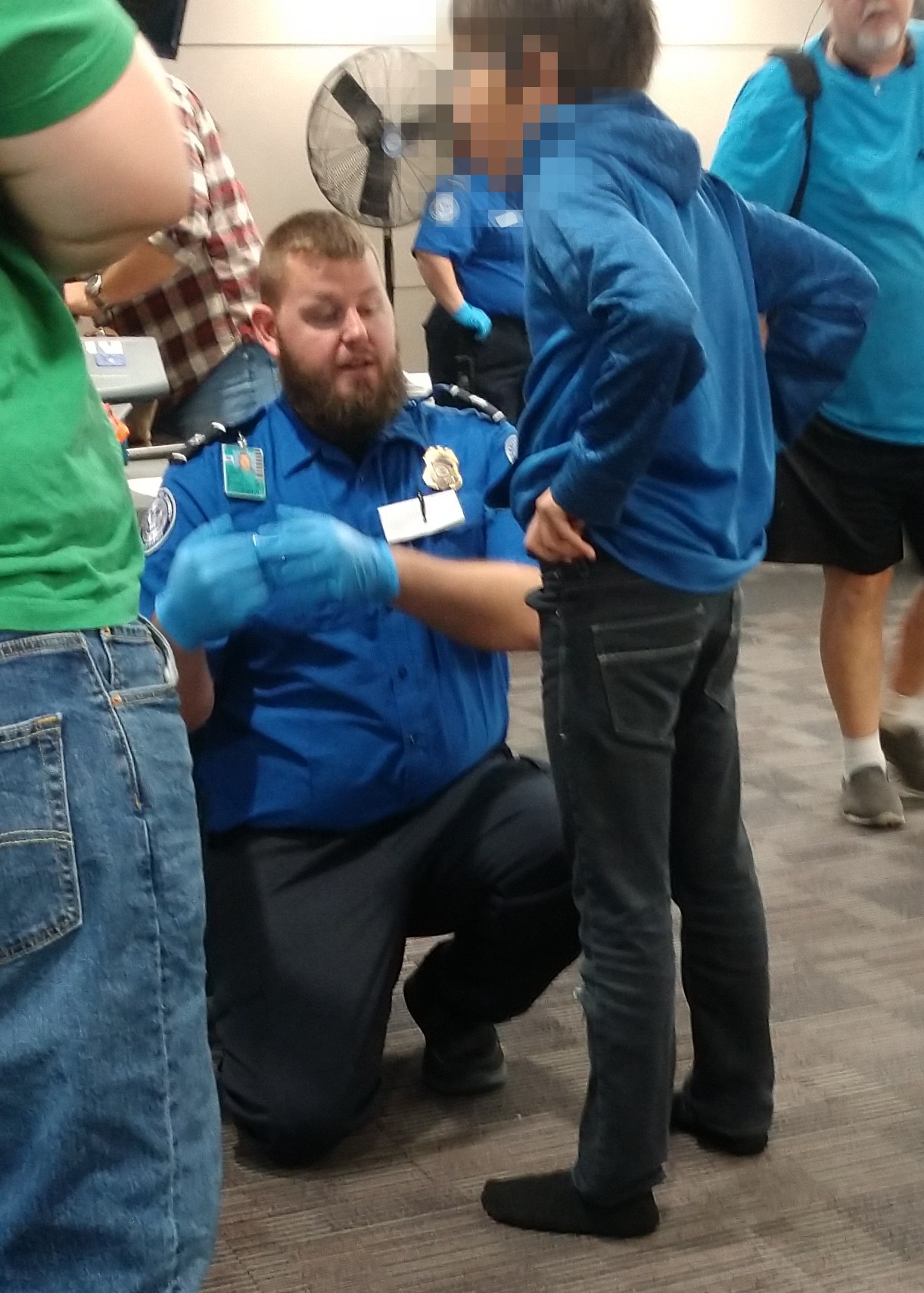
The other day, after slogging through a check-in line at one of the nation’s busiest airports, dutifully removing my shoes and belt and checking my bag and pockets for other potentially dangerous items (water and loose change), I was pulled aside by a crack Transportation Security Administration (TSA) agent so he could further investigate the contents of my carry-on. While waiting, I took this picture of what looked to be a ten-year-old boy being molested by a 250-pound man.
Now, normally I would have reported this incident to the proper authorities. Inappropriate contact with a child, inside or outside his clothing, is a criminal act. But, in this case, the proper authorities were the ones feeling up the kid and the father had already protested the frisking—although, like all of us, he probably understood that no matter how vociferously he objected to this bit of state-sanctioned criminality it wasn’t going to change anything.
Who knows? Maybe the kid had earned the attention of TSA by sporting that Minecraft hoodie? Or maybe his laptop had set off the explosive trace detection machine? Or maybe he was randomly picked. The boy looked innocent enough to me—which might be exactly what the little would-be villain had in mind. When the father inquired, the agent told him, right before touching his son’s crotch, that this sort of thing had become necessary due to drug mules using children.
If you don’t think the terrorists have won, you probably haven’t visited an airport in a while. Not only do these places needlessly gobble up hours of our day and billions of our dollars, but here that we collectively lose all dignity and act like a bunch of automatons just so they’ll let us out of the place. Though sometimes it seems like we might never escape. If we really wanted to slow the caravan from Central American down, we would make them enter through a TSA checkpoint.
It is at those checkpoints that we suspend our disbelief and pretend that (often) disheveled and (very often) rotund government agents who separate us from our water bottles possess the expertise to ferret out terrorist plots. (By the way, is there not a single physical requirement needed to hold this allegedly vital security job? There are many good reasons I’m not a pro-basketball player or a male model. If you’re not in relatively good physical shape, maybe law enforcement isn’t the profession for you. The only way these agents are the “the last line of defense against terrorism” is if the terrorists are unable to squeeze by them to get on the airplanes.)
Then again, it’s one thing to force millions of adults to schlep through these slow-moving lines so their toiletries can be scanned by some disinterested government worker—on occasion, sharing a few moments of rough intimacy with a blue-gloved stranger—and another for kids to be used as props in this production of Security Theater.
If you’re thinking, “Hey, David, you have no expertise on issues of security and you know nothing about how to stop bad people from getting on planes,” you’re 100 percent correct. That only means I could probably work for the TSA.
Let’s not forget that in 2015, the TSA sent internal investigatory units, “red teams,” to airports around the nation to see if they could sneak explosives and guns through the screening process and onto planes—which they did 67 out of 70 times. Although I’m no security specialist, by my rough calculations that means that the terrorist success rate was over 95 percent. Maybe the 5 percent who were nabbed by TSA agents posing as preteens.
This information, incidentally, was only leaked to the public. We have no idea if the TSA is performing any better today. But even if it had vastly improved—say, they are now stopping 70 percent of fake terrorists—it would mean the billions of dollars spent on airport security is still being wasted. In a merit-based environment, this would result in mass termination and a complete overhaul of the system. Instead, the Department of Homeland Security –a cabinet department formed in 2002 to ensure that a number of inept agencies could work together incompletely—is still patting down old ladies and pre-teens. Nothing has changed.
The TSA claims that it has employed “modified screening procedures for children 12 and under that reduce the likelihood of pat-down.” Is there any evidence of this? And why do we allow any children to be patted down after they’ve walked through body scanners and metal detectors, anyway? There is no plausible reason for a grown man or woman to put their hands on a child in this way.
Obviously security isn’t going anywhere. Obviously security measures also act as a deterrent and can’t always be properly measured. Of course, I understand the agent was only doing his job. Whether his contention about drug mules was true or not, though, you might not be surprised to learn that this kid didn’t end up having heroin stuffed in his underwear. Even if he did, is it really worth subjecting hundreds (thousands?) of boys and girls—not to mention septuagenarians, the disabled, etc.–to this kind of search on a daily basis? There has to be a better way.