Saturday, June 27, 2015

Fear Not, Faithful Catholics

PAUL KENGOR
http://www.crisismagazine.com/
June 25, 2015

Pope Francis blesses a child in St. Peter's Square after celebrating Palm Sunday Mass at the Vatican March 24. (CNS photo/Paul Haring) (March 25, 2013) See POPE-PALM March 25, 2013.

Many Catholics, especially conservative ones, obviously aren’t thrilled with the pope’s new encyclical. I find myself once again spending a lot of time explaining to non-Catholics why the current pope is either not a Marxist or is being yet againmisunderstood for the 999th time. Frankly, I’ve lost most of my credibility with these folks, who surely see me as a hopelessly blind Catholic.
This constant defense-mode has been unique in the case of this particular pope. Sure, much of the fault is with those looking to remake this pope and this Church in their own image, and I’d even add (in Francis-like thinking) that the Devil himself has made a mess of things. Yet, much of it is absolutely the pope’s own doing, as Francis is the master of the imprecise word and off-the-cuff sloppy statement. He—and they—keep us faithful Catholics busy. All of which brings me to the new encyclical on “climate change.”
The secular left, of course, loves this encyclical. As I write, the farthest reaches of the left, People’s World, house organ of Communist Party USA, has two articles singing atheistic hosannas to the bishop of Rome. This has become common at People’s World. The successor to the Soviet-directed Daily Worker is a vigorous champion of this pope. There truly has never been a pope that communists have embraced like Pope Francis. Believe me, I research this, I know.
“The Roman Catholic Church and the U.S. labor movement are working more closely together than ever,” celebrates a feature article at the current People’s World.
“The Pope calls for serious and immediate action to address climate change and other environmental crises,” crows a second article. “The encyclical addresses issues of water stress, biodiversity, pollution, the declining quality of life, economic inequality, and more.”
Noticeably absent among the “more” were Pope Francis’ eloquent statements about protecting other of God’s creation, such as unborn babies, the most innocent victims of secular progressivism’s “throwaway culture.” That’s one aspect of the encyclical that the left is avoiding like toxic waste. Indeed, the People’s World article closes: “while the Pope is progressive on many issues including climate, the Catholic Church continues to be backward on issues of reproductive health, women’s choice, same sex marriage, and other issues.”
That brings me to the reason I’m writing today. I write with encouragement to faithful Catholics who understand that the elephant in the global living room right now—especially in the West—is not carbon emissions or fossil fuels but family and marriage. And in that area, here’s the crucial point: this pope has been superb and seems to be growing steadily stronger. It is the main issue, the issue of our time, and it’s the main issue for this pope.
It is more than ironic that in Pope Francis’ Wednesday general audience announcing the release of his encyclical he talked mostly about family and marriage. He mentioned the encyclical only at the end. He noted it was his nineteenth (yes, nineteenth) general audience on family and marriage. He has been hammering this issue non-stop. I’veshared here his many excellent statements, everything from his January warning on the “forms of ideological colonization which are out to destroy the family” and “redefine the very institution of marriage,” to his November remarks on how “children have a right to grow up in a family with a father and a mother,” to his complaint just after last fall’s synod: “What they are proposing is not marriage, it is an association, but it is not marriage! It is necessary to say things very clearly and we must say this!” That’s a mere snapshot of the man who once declared same-sex “marriage” a diabolical effort of “the Father of Lies.”
It was fitting that on the Sunday before the release of the environmental encyclical, Francis was again talking family. He spoke to the families of Rome, his diocese, where he celebrated the “diversity” and “difference” of male and female before a crowd of 25,000 at the opening of the annual Ecclesial Convention, which this year is dedicated to (you guessed it) the family. He exhorted parents to (again) protect their children from “ideological attacks” that “destroy society, the nation, [and] families.”
Particularly notable is Francis’ constant emphasis on the complementarity of men and women. His condemnation of “so-called gender ideology” has been downright extraordinary. “Gender ideology is demonic!” Francis shouted at one interviewer, saying it fails to recognize “the order of creation.” He has compared gender ideology to “the educational policies of Hitler.”
In this, Francis has even taken an activist role. There was a huge demonstration in Rome this week (June 20) protesting attempts by Italian leftists to promote gender theory in schools. As one article reported, “Hundreds of thousands of people from all over Italy responded to Pope Francis’ repeated warnings about gender ideology, by taking part in an enormous demonstration in the square of St. John Lateran in Rome on Saturday. The ‘Family Day’ was aimed at defending the traditional family and stopping the spread of gender ideology in schools.”
Some estimates were higher, as organizers had hoped to draw a million marchers. “It’s fantastic,” said one attendee, a father of six from northern Italy. “Finally, people have gathered to fight this terrible ideology.” One organizer celebrated from the stage, “The Holy Father is with us,” as indeed he was, being the event’s spiritual inspiration.
Think about it: Just four days after the pope’s encyclical, they were marching at St. John Lateran not against global warming but gender ideology. Does that not say something?
Really, this is just the start. In fact, whatever momentum the environmental issue picked up at the Vatican will evaporate into the ozone when Francis comes to America for the synod on family and marriage. Actually, that ball is already rolling. On Tuesday, the Vatican released its much-anticipated “working document” for the October synod. A hefty 21,000 words, and thus far only available in Italian, it is intended to serve as the statement of record for the bishops. What it says on same-sex “marriage” is very good news. As Edward Pentin reports, “On the issue of homosexual relationships, the document firmly rejects same-sex unions, saying that ‘there are absolutely no grounds for considering homosexual unions to be in any way similar or even remotely analogous to God’s plan for marriage and family.’” This, Pentin notes, is a quote taken from the authoritative but much-reviled (by liberals) 2003 document from Cardinal Ratzinger’s Congregation for the Doctrine of the Faith. Pentin adds that the document “also speaks strongly against pressure exerted on clergy to accept same-sex ‘marriage,’” and even condemns as “totally unacceptable” the demand by certain international organizations that poor countries receive aid only if they establish laws inventing same-sex “marriage.”
Again, given Pope Francis’ many previous statements on family (I haven’t even mentioned his numerous comments blasting abortion) none of this is a surprise. This is the leadership we need right now, globally, in the West, in America.
So, in sum, I urge faithful Catholics to take heart. A faithful Catholic, after all, has faith in the chair of St. Peter and the Holy Spirit-led cardinals who chose the occupant. Looking back, one can discern a Providential hand in certain popes being where they were at pivotal times. And right now, the issue is family and marriage. This pope gets that. His common cause with liberals on the environment should earn him at least a drop of trust and moral authority with them on these other issues.
To be clear, I’m not saying that faithful Catholics should ignore their pope’s passion for “climate change.” Let the liberal Catholics be cafeteria Catholics. Let them pick and choose what to take seriously. My very fallible sense, however, is that the burning issue of our day is the “forces of ideological colonization” hellbent on taking down family and marriage. “The future of humanity,” says this pope, “passes through the family.”
Fear not, faithful Catholics. Keep your eye on the ball. It’s less the future of fossil fuels than the future of the family.
(Photo credit: CNS photo/Paul Haring) (Pope Francis taken on March 25, 2013.)

Today's Tune: Radney Foster - Texas In 1880 (feat. Pat Green)

Friday, June 26, 2015

On Obamacare, John Roberts helps overthrow the Constitution

By George F. Will
http://www.washingtonpost.com/opinions/
June 25, 2015


Supreme Court Chief Justice John G. Roberts Jr. (Larry Downing/Reuters)
Conservatives are dismayed about the Supreme Court’s complicity in rewriting the Affordable Care Act — its ratification of the IRS’s disregard of the statute’s plain and purposeful language. But they have contributed to this outcome. Their decades of populist praise of judicial deference to the political branches has borne this sour fruit.
The court says the ACA’s stipulation that subsidies are to be administered by the IRS using exchanges “established by the State” should not be construed to mean what it says. Otherwise the law will not reach as far as it will if federal exchanges can administer subsidies in states that choose not to establish exchanges. The ACA’s legislative history, however, demonstrates that the subsidies were deliberately restricted to distribution through states’ exchanges in order to pressure the states into establishing their own exchanges.
The most durable damage from Thursday’s decision is not the perpetuation of the ACA, which can be undone by what created it — legislative action. The paramount injury is the court’s embrace of a duty to ratify and even facilitate lawless discretion exercised by administrative agencies and the executive branch generally.
The court’s decision flowed from many decisions by which the judiciary has written rules that favor the government in cases of statutory construction. The decision also resulted from Chief Justice John G. Roberts Jr.’s embrace of the doctrine that courts, owing vast deference to the purposes of the political branches, are obligated to do whatever is required to make a law efficient, regardless of how the law is written. What Roberts does by way of, to be polite, creative construing (Justice Antonin Scalia, dissenting, calls it “somersaults of statutory interpretation”) is legislating, not judging.
Roberts writes, almost laconically, that the ACA “contains more than a few examples of inartful drafting.” That is his artful way of treating “inartful” as a synonym for “inconvenient” or even “self-defeating.”
Rolling up the sleeves of his black robe and buckling down to the business of redrafting the ACA, Roberts invents a corollary to “Chevron deference.”
Named for a 1984 case, Chevron deference has become central to the way today’s regulatory state functions. It says that agencies charged with administering statutes are entitled to deference when they interpret ambiguous statutory language. While purporting to not apply Chevron, Roberts expands it to empower all of the executive branch to ignore or rewrite congressional language that is not at all ambiguous but is inconvenient for the smooth operation of something Congress created. Exercising judicial discretion in the name of deference, Roberts enlarges executive discretion. He does so by validating what the IRS did when it ignored the ACA’s text in order to disburse billions of dollars of subsidies through federal exchanges not established by the states.
Chevron deference does for executive agencies what the “rational basis” test, another judicial invention, does for legislative discretion.
Since the New Deal, courts have permitted almost any legislative infringement of economic liberty that can be said to have a rational basis. Applying this extremely permissive test, courts usually approve any purpose that a legislature asserts. Courts even concoct purposes that legislatures neglect to articulate. This fulfills the Roberts Doctrine that it is a judicial function to construe laws in ways that make them perform better, meaning more efficiently, than they would as written by Congress.
Thursday’s decision demonstrates how easily, indeed inevitably, judicial deference becomes judicial dereliction, with anticonstitutional consequences. We are, says William R. Maurer of the Institute for Justice, becoming “a country in which all the branches of government work in tandem to achieve policy outcomes, instead of checking one another to protect individual rights. Besides violating the separation of powers, this approach raises serious issues about whether litigants before the courts are receiving the process that is due to them under the Constitution.”
The Roberts Doctrine facilitates what has been for a century progressivism’s central objective, the overthrow of the Constitution’s architecture. The separation of powers impedes progressivism by preventing government from wielding uninhibited power. Such power would result if its branches behaved as partners in harness rather than as wary, balancing rivals maintaining constitutional equipoise.
Roberts says “we must respect the role of the Legislature” but “[A] fair reading of legislation demands a fair understanding of the legislative plan.” However, he goes beyond “understanding” the plan; he adopts a legislator’s role in order to rescue the legislature’s plan from the consequences of the legislature’s dubious decisions. By blurring, to the point of erasure, constitutional boundaries, he damages all institutions, not least his court.
Read more from George F. Will’s archive or follow him on Facebook.

Thursday, June 25, 2015

No, Pope Francis, it is not hypocritical for the good to make weapons


By 
https://www.bostonglobe.com/
June 24, 2015

Pope Francis gestures as he speaks during a meeting with the youth on Piazza Vittorio in Turin on June 21, 2015. The pontiff is on a visit to Turin to venerate the Holy Shroud, believed by some Christians to be the burial shroud of Jesus of Nazareth, after which the pope will meet prisoners, young people and the sick in his first pastoral trip to northern Italy. AFP PHOTO / ALBERTO PIZZOLI        (Photo credit should read ALBERTO PIZZOLI/AFP/Getty Images)
Getty - Alberto Pizzoli/AFP
POPE FRANCIS had harsh words for the arms industry on Sunday, condemning as “two-faced” those who claim to be Christian while manufacturing weapons or investing in companies that produce them. “It is hypocritical to talk about peace and make weapons,” the pope told an audience of young people in Turin. “Doing one thing and saying another. What hypocrisy!”

It’s not the first time Francis has blasted the defense industry. In May, he denounced the arms business as an “industry of death,” run by people who “don’t want peace.” In February, he labeled weapons dealers “merchants of death” and blamed them for “furthering a cycle of hate, fratricide, and violence.”
So sweeping a calumny would be unworthy coming from anyone; from the Bishop of Rome, it is inexcusable. Of course there are hypocrites in the arms trade, as there are in all professions. But to smear everyone in the weapons business as unethical and antipeace is sheer demagoguery.
The pope needs no lessons in theology from me or anyone else, but if Francis really means to execrate all commerce in weapons, he goes further than even Jesus did. “Let him who has a purse take it and also a bag,” Jesus instructs his apostles in the Gospel of Luke, “and let him who has no sword sell his garment and buy one.” In both the Catholic and Orthodox traditions, Saint Adrian of Nicomedia has long been honored as the patron saint of arms dealers. There is room for good Christians, the church seems to believe, even in the weapons business.
And, seriously, would the pope want it any other way? Would the world be improved if the industries that make weapons and military equipment didn’t employ people who aspire to live ethically? The Vatican itself is defended by a military force, the Swiss Guard, that is well-supplied with sophisticated firepower, including assault rifles and submachine guns. When Francis slams weapons-makers and firearms-sellers as “hypocrites” and “merchants of death,” does he include those who provide the guns that keep him and the papal offices safe?
In Isaiah’s messianic vision of a world in which universal peace and goodness reign, human beings will “beat their swords into plowshares/And their spears into pruning hooks.” But until that utopia arrives, there is nothing moral about pacifism. In the here and now, evil exists and the decent must fight it. And unless they are to fight unarmed, they will need the tools of violence.
The pope knows only too well what happens when good people — or good nations — aren’t willing to fight the world’s monsters with every available weapon.
At the very same rally in Turin in which he excoriated those who make and sell munitions, Francis retroactively decried the failure of the Western democracies to do more to stop the Nazi genocide and Stalin’s terror. “The great powers had photographs of the railway routes that brought the trains to the concentration camps,” he said. “Tell me, then: Why did they not bomb them?”
Does the pontiff hear his own words? He laments the failure to bomb the rail lines and save millions of lives. Who would have made those bombs? Who would have made the bombers to deliver them? Who made the guns and tanks and missiles that did, in the end, defeat Nazi Germany and Imperial Japan? Were all of them conniving merchants of death?
No, Pope Francis, it is not hypocritical to talk about peace and make weapons. For if the peaceable cannot defend themselves, they will have no peace. “Praise the Lord and Pass the Ammunition,” Americans sang during World War II. A moral world requires moral violence, and the wisdom to know when to use it.
Jeff Jacoby can be reached at jacoby@globe.com. Follow him on Twitter @jeff_jacoby.
Related:

Tuesday, June 23, 2015

The Two Popes and Climate Change


Posted By Joseph Klein On June 23, 2015 @ 12:09 am In Daily Mailer,FrontPage | 11 Comments
we[1]Pope Francis issued a lengthy encyclical last week calling for radical change in human behavior to confront climate change. He presented climate change as the moral issue of our time. “Humanity is called to recognize the need for changes of lifestyle, production and consumption, in order to combat this warming or at least the human causes which produce or aggravate it,” the pope declared. “It is a mistake to rely on the ‘myths’ of a modernity grounded in a utilitarian mindset (individualism, unlimited progress, competition, consumerism, the unregulated market),” he added. While denying that anyone is suggesting a return to the Stone Age and conceding that “[T]echnoscience, when well directed, can produce important means of improving the quality of human life,” Pope Francis refused to dismiss doomsday predictions if society continues along its present path.

The United Nations Secretary General position has been referred to by some as that of a “secular pope,” because he is expected to speak out on issues of public concern as the moral conscience of the world. On the issue of climate change, the current “secular pope” at the UN, Ban Ki-moon, spoke strongly in support of Pope Francis’s encyclical and said that he is looking forward to Pope Francis’s address to the United Nations General Assembly this September. Ban Ki-moon has made climate change his own number one issue and attended a summit on climate change hosted by the Vatican last April. He has called climate change “a true existential threat to the planet.” Ban Ki-moon is pushing for all UN member states to complete a legally binding global agreement to curb carbon emissions in Paris this December.

Assuming for the sake of argument that the problem of climate change is as serious as both the religious and secular popes think it is and that human activity is largely responsible for it, the question is how to address the problem without destroying the global economy in the process. Pope Francis rejects free market economics and technology as solutions. Ban Ki-moon is more ambivalent.

Stepping beyond his realm of religious authority, Pope Francis has taken sides in the policy debate regarding how best to reduce reliance on fossil fuels that are creating heat-trapping gasses. Don’t rely on free market mechanisms such as cap and trade, he warns.

“The strategy of buying and selling ‘carbon credits’ can lead to a new form of speculation which would not help reduce the emission of polluting gases worldwide,” Pope Francis said. “This system seems to provide a quick and easy solution under the guise of a certain commitment to the environment, but in no way does it allow for the radical change which present circumstances require. Rather, it may simply become a ploy which permits maintaining the excessive consumption of some countries and sectors.”

This portion of the encyclical flies in the face of sound economic analysis and common sense. Carbon trading systems, which Pope Francis has specifically singled out for criticism, and carbon taxes are two ways to put a specific price on carbon that would have to be paid for one way or the other directly by the carbon emitter rather than indirectly as a negative externality by society as a whole.

As the World Bank explains:
“A price on carbon helps shift the burden for the damage back to those who are responsible for it, and who can reduce it. Instead of dictating who should reduce emissions where and how, a carbon price gives an economic signal and polluters decide for themselves whether to discontinue their polluting activity, reduce emissions, or continue polluting and pay for it. In this way, the overall environmental goal is achieved in the most flexible and least-cost way to society. The carbon price also stimulates clean technology and market innovation, fuelling new, low-carbon drivers of economic growth.”
Pope Francis is not swayed by such arguments. Technology is no answer to the problem of climate change, according to his encyclical. “To seek only a technical remedy to each environmental problem which comes up,” he said, “is to separate what is in reality interconnected and to mask the true and deepest problems of the global system.” Continuing this theme, the pope added that the “alliance between the economy and technology ends up sidelining anything unrelated to its immediate interests.”

Pope Francis’s prescription is more stringent and enforceable global governance. He calls for “global regulatory norms” and “stronger and more efficiently organized international institutions, with functionaries who are appointed fairly by agreement among national governments, and empowered to impose sanctions.” He also espouses “a better distribution of wealth,” which would include a massive transfer wealth from developed countries to the less developed countries on the theory that the richer countries are largely responsible for the plight of the poor and owe them an historical debt. The pope does not use the term “reparations,” but that is for all and intents and purposes what he is calling for.

Secretary General Ban Ki-moon cannot afford to be as dismissive as Pope Francis is of market place carbon pricing mechanisms or of the importance of innovation as part of the solution to any environmental problems created by climate change and human activity. Nor would he be wise to push the notion of a global environmental authority with enforcement teeth.

The global agreement that the Secretary General is seeking by the end of this year is premised on national commitments to carbon reduction targets, which are to be accomplished through nationally crafted solutions that may or may not embrace market incentives and technology, depending on their particular economic, social and cultural circumstances. The World Bank, with whom the Secretary General has partnered, supports carbon pricing to bring down fossil fuel carbon emissions and make cleaner options more competitive. According to the World Bank, as of last September “[S]eventy-three countries and 11 states and provinces – together responsible for 54 percent of global greenhouse gas emissions and 52 percent of GDP – joined 11 cities and over 1,000 businesses and investors in signaling their support for carbon pricing.”

Choice of means to reduce carbon emissions at the national level, not top-down dictates from global bureaucracies, will be the only viable path if any sort of meaningful climate change agreement at all among UN member states is to be achieved.

Thus, if Ban Ki-moon were to come out and reject market place carbon pricing mechanisms such as cap and trade, he would be working at cross-purposes with his stated goal of moving the member states towards declaring their national commitments to carbon reduction as part of a year-end binding global agreement. In fact, he has in the past come out in support of putting an explicit price on carbon as one option for consideration.

Yet Ban Ki-moon does not want to publicly disassociate himself from the portion of Pope Francis’s encyclical that rejects free market solutions. In response to my question on this point at the daily press briefing at UN headquarters on June 12th, the spokesperson for the Secretary General minimized any differences between the religious and secular popes:
“I think the Secretary‑General very strongly supports the Pope’s efforts to ensure that climate change remains at the top of the global agenda and to mobilize his authority, his moral authority, in that regard. The fact that the Pope and the Secretary‑General may not agree on every line, on every approach, I think, doesn’t take away in any way the Secretary‑General’s support for the encyclical… we are not dissecting the encyclical to see where we differ with the Pope… overall I think the Secretary‑General spoke strongly in support of the encyclical and continues to do so.”
Pope Francis would have been more credible if he had not tried to cross the line from religious leader to secular public policy opinion maker in his encyclical. And the UN Secretary General will be more credible if he sheds the role of “secular pope” who over-moralizes the issue of climate change. Instead, Ban Ki-moon should stick to the fine art of quiet diplomacy and negotiation facilitation. He can provide member states and the private sector with a global perspective on the effects of climate change, including the assembly of data and more balanced scientific analysis. He and his expert staff can help the member states try to devise practical and efficient targets and means to achieve them within their respective capabilities. He can help encourage businesses to make investments in alternative energy sources and cleaner fossil fuel technologies. He can suggest how developed countries could partner with less developed countries in overcoming obstacles to beneficial change and coming up with smart carbon emission mitigation strategies, without insisting they owe an enormous debt to developing countries as Pope Francis has done. Without the greatest engine for betterment of the human condition that the world has ever known – the free market and its concomitant of technological change – much of the world today would be living in far more dire circumstances reminiscent of the rigidity, disease and poverty of pre-Renaissance feudal society.

Economic freedom and individual liberties must not be sacrificed at the altar of religious or secular dogma, including the dogma that climate change is an immediate existential crisis and that it can only be solved by top-down dictates and government-controlled wealth redistribution.

Freedom Center pamphlets now available on Kindle: Click here [2].

LIKE [3] Frontpagemag.com on Facebook and Subscribe [4] to Jamie Glazov Productions [4].

Article printed from FrontPage Magazine: http://www.frontpagemag.com


URLs in this post:


[4] Subscribe: http://jamieglazov.com/

Monday, June 22, 2015

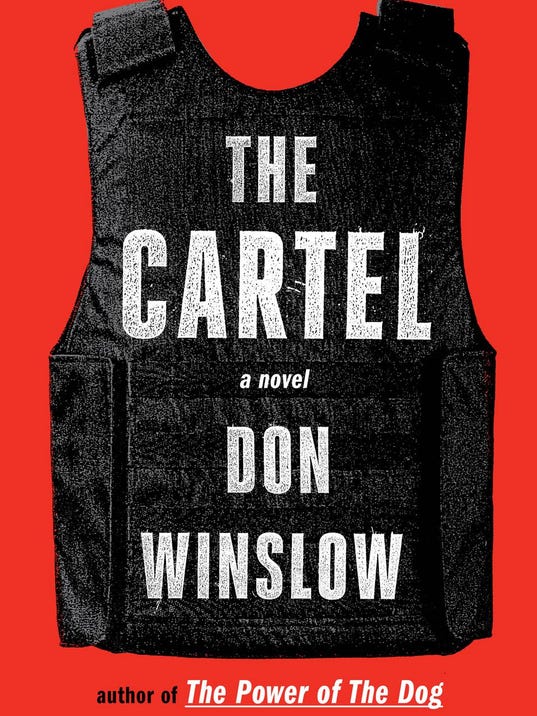
Review: Don Winslow's 'The Cartel' is the most important crime saga of the millennium

 Robert Anglen, The Republic | azcentral.com
June 19, 2015

The Cartel
It started with a massacre and a question about the nature of evil. It has evolved into the most important crime saga of the new millennium. Think "The Godfather" of the recreational-drug generation.
In 1998, crime writer Don Winslow set out to find what would compel someone to line up 19 women and children against a wall in a town just south of the California border and machine gun them.
His answer came seven years later with "The Power of the Dog," an epic, soul-searing novel chronicling three decades of the Mexican-American drug war. A fictional account of the massacre became the book's set piece. At the time, it was hard to imagine a more savage act of violence.
Jump ahead 10 years and 100,000 bodies. Mexico's drug war has turned the country into an abattoir, and Winslow is about to release "The Dog's" long-anticipated follow up, "The Cartel."
The 19 murders so shocking in 1998 have become drops in a vast bloody bucket of human misery spilling across the Mexican landscape.
To call the "Cartel" a sequel is a misnomer. It better serves as a 640-page climax to "The Dog," a stunning denouement of America's failed interdiction policies as told through the eyes of people on both sides of the border who have suffered its consequences.
"The Cartel" is fiction in the same way Upton Sinclair's "The Jungle" is fiction. This is reporting and expose built around an intricate plot, finely etched characters and whip-crack dialogue. Storytelling that matters.
Winslow sets the tone before the first page, with a dedication listing the names of 128 Mexican journalists who were murdered or "disappeared." Winslow uses their work like an avenging angel, wrapping their headlines and stories around his narrative to give the violence context.
You want to understand the short, terror-filled life of a drug mule? What traumas will turn a teenage boy into a sociopathic killer? The pressures that make an honest cop take a bribe? Why a friend would sell out his friend? Winslow doesn't just tell you, he makes you eat their pain.
He also makes you witness to their courage. An aged rancher willing to fight and die rather than turn over his land to the cartel. Women who accept jobs as police officers, council members and mayors knowing their predecessors were murdered. Journalists who keep writing the truth amid threats of death.
There are beheadings, acid baths, shootings, stabbings, dismemberments, beatings, torture, gang rape, robberies, overdoses, eviscerations and assassinations. But, and this is important, "The Cartel" never loses its soul.
Unlike Robert Bolano's crushing roll-call of the dead in his book "2666", centered on the murdered women of Ciudad Juarez, Winslow never descends into morbidity. He's too busy riding the rage of his characters.
"Mexico, the land of pyramids and palaces, deserts and jungles, mountains and beaches, markets and gardens, boulevards and cobblestoned streets, broad plazas and hidden courtyards, is now known as a slaughter ground. And for what? So Americans can get high."
"The Cartel" seamlessly picks up where "The Dog" left off in 2004. Former DEA agent Art Keller has retreated into physical and emotional isolation after abandoning any shred of idealism to capture cartel kingpin Adan Barrera.
But from inside his San Diego prison cell, Barrera puts into motion a long-range plan that will get him transferred to Mexico, allow him to rebuild his empire and, as a sweetener, kill Keller.
Winslow uses their personal vendetta, of move and counter move, as a backdrop for details of cartel politics, military planning, smuggling operations and the banal bureaucracy of drug policy.
Winslow was an accomplished crime writer before "The Power of the Dog." In the early 1990s, he wrote a memorable, darkly comic series featuring a hip reluctant private investigator whose debt to mysterious corporate benefactors led him around the globe.
He followed with stories steeped in the Southern California surf ethos, virtually creating a coastal-noir genre with "California Fire and Life" and "The Death and Life of Bobby Z."
"The Dog" was a departure; call it ascendance. Winslow said he always felt "The Dog" was more about religion than drugs. But drugs fueled the narrative — and influenced his writing. He delivered the nihilistic and appropriately named "Savages," which Oliver Stone faithfully adapted into a 2012 film (forgive the last two minutes), and a prequel, the "Kings of Cool."
These were decidedly different books. Both dealt with the costs of recreational drug use. Social commentaries. Crime stories with an edge of humor sharp enough to flay.
Winslow said most Americans don't understand the drug war. But "The Cartel" provides an uneasy truth about America's addiction. Who is the cartel? We are.
"We buy this (stuff)," Winslow said. "I've never seen a cartel member hold a gun to an American's head and say do this coke. That doesn't happen. It's voluntary."

Review: ‘The Cartel,’ by Don Winslow, Continues a Drug Saga

By Janet Maslin
http://www.nytimes.com/
June 18, 2015
On the opening page of “The Cartel,”Don Winslow mixes a baby’s cry with the sound of a helicopter’s blades in a predawn raid. That’s reminiscent of his 2005 novel, “The Power of the Dog,” which also used a baby on its opening page. “The baby is dead in his mother’s arms,” that book began, and went on to describe the horrific image of a bullet-riddled Madonna and child in Mexico. It was the first step into what would become Mr. Winslow’s drug war version of “The Godfather,” with all the grand ambition that implies.
“The Cartel” is a big, sprawling, ultimately stunning crime tableau that can be read as a stand-alone. But the ideal approach, if you can make the leap and commitment, is to read the two books in sequence as a Part 1 and a Part 2. Together, the two span nearly 1,200 pages and 40 years and present a multifaceted view of what is, in Mr. Winslow’s opinion, America’s longest war: the war on drugs. “The Power of the Dog” covers the first 30 years, during which the war was fought on a much more intimate scale than it was from 2004 to 2014, the period covered by “The Cartel.”
Though the two books are filled with equally vicious reality-based events, “The Cartel” reflects the grim latter-day shift from traditional gangster tactics to those of global terrorism. The new book’s cartels have their own private, monstrously media-savvy armies that reflect the basic thinking of Al Qaeda. As one of Mr. Winslow’s characters puts it: “What good is an atrocity if no one knows you did it?”
“The Cartel” picks up at a relatively easy entrance point in this crowded and complicated story. The first book’s main characters, Art Keller and Adán Barrera, who met young and went on to become a Drug Enforcement Administration agent and a Sonora cartel kingpin, remain sworn enemies. Much of what happened in the first book guarantees that they will stay that way. One, as a private joke, has sworn to himself that he will put poppies on the other’s grave.
As “The Cartel” begins, Barrera still holds court and runs an empire with a mannerliness that recalls Corleone-style noblesse oblige. But he does it from inside the Metropolitan Correctional Center in San Diego, where, at 50, he faces multiple lifetime sentences. Even the quick synopsis of what Keller did to trick Barrera onto United States soil is enough to justify the undying enmity between them. They have no intention of ending their grudge match, just as Barrera has no intention of staying incarcerated for very long. (Certain details, like how the Barrera clan celebrates Christmas in prison, comes from Mr. Winslow’s extensive research into real figures in the drug war.)
“The Cartel” has so many moving parts that there is reason to envy Keller the Christmas he spends all alone, eating a frozen dinner, studying the spreadsheets and background data the book never provides in consolidated form. There are so many murderous grudges and so many shifting gang allegiances that parts of the book require close attention; you may even find yourself backing up a time or two.
What is never confusing, though, is the degree of vengefulness and corruption that has been bred into some of the cartel’s soldiers at shockingly early ages. And since the command of choice here is to inflict pain as frighteningly as possible, there are no scarier words a captive can hear than “you’re next.”
Mr. Winslow, a cult favorite for many reasons, has written about a different milieu — California’s surf and drug culture — much more stylishly (“The Dawn Patrol”) and conversationally (“Savages”) than he writes here. “The Cartel,” like “The Power of the Dog,” can be better appreciated for its gritty, gasp-inducing knowledge of true crime’s brutal extremes, and for its unflinching awareness of what Mr. Winslow calls “evil beyond the possibility of redemption.”
Even tougher than the outright violence is the slow destruction of idealists — be they in journalism, medicine, intellectual life, government or just in search of a more lawful Mexican society — who think they can escape the long shadow of this ugliness, and who one after another are proved horribly wrong. “The Cartel,” which involves graphic beheading and dismembering, is dedicated to a long list of journalists who have been killed or have “disappeared” in the Mexican drug wars.
But there are high spirits and comic relief to be found in the way that much of the drug lords’ and want-to-bes’ self-images come from American popular culture. Many of the characters seem to think of themselves à la “The Godfather,” to the point where “Al Pacino” can be used as a verb, however badly. To “Al Pacino him” seems to denote a revenge killing in a restaurant, even if the crucial gun-hidden-in-the-bathroom part is skipped to save time. To become a famous gangster means to have a movie made about you, although one of the most appealingly thickheaded killers here doesn’t understand why he needs to be punished at the story’s end.
Mr. Winslow, who has rightly been compared to James Ellroy (and praised by Mr. Ellroy) for his ability to capture an entire crime culture in the sweep of “The Cartel,” leaves room for at least one smart, interesting woman to play the drug lords’ game better than the men do. But as in all great crime fiction, the game is as damning as it is seductive and not conducive to happily-ever-afters. “The Cartel” culminates in a near-symphonic array of lethal coups de grace, written with such hallucinatory intensity that the whole book seems to have turned into a synchronized fireworks display. And still Mr. Winslow adds one last, hellish image that “takes the freakin’ cake.” To make sure this story is something you won’t forget.

THE CARTEL

By Don Winslow
Illustrated. 616 pages. Alfred A. Knopf. $27.95.

Sunday, June 21, 2015

Stella McCartney’s New “Anti-Cruelty” Fashion Line Celebrates Fidel Castro and Che Guevara

Humberto Fontova | Jun 19, 2015

Fashionistas attend garden party with ‘Guevara’ and ‘Castro’
Stella McCartney attends her Resort Presentation in New York.Photo: Getty Images
With a little help from her friendly Dad (Paul) Stella McCartney has made quite a name for herself as an ultra-chic fashion designer. This week she introduced her spring line on Manhattan’s Elizabeth Street with a Cuba-themed garden party where Fidel Castro and Che Guevara featured among the main props of the cheeky soiree.
The Stalinist mass-murderers featured both as mannequins and as live costumed humans who walked around posing for pictures with the ultra-chic models and guests along with the delighted (and scrupulously vegetarian) hostess.
In keeping with Stella McCartney’s “anti-cruelty” beliefs the event featured strictly vegetarian foodstuffs. None of that musty “generation-gap” stuff for Stella. That stuff is “SOOOO 60’s” after all. Instead she’s a proud Daddy’s girl, and as such a proud vegetarian and PETA spokesperson. Indeed, Stella ritually denounces many fellow fashion designers as “heartless” should leather or-- heaven forbid!—fur show up in any of their creations.
“The collection is a celebration of spring: new life, color, hope, energy and fun!” gushed McCartney about her spring line. “It’s about flowers and color and I love designing spring. Cuba is just to have some fun. Fun on top of fun!”
“Cuba libre!” was how Style titled the event.
In case any Saturday Night Live or Comedy Central writers are perusing Townhall today here's a few ideas for scripts and skits:
The main props to Stella McCartney’s “Fun, Joy, Life and Anti-Cruelty!”- themed garden party founded a regime that jailed and tortured political prisoners at a higher rate than Stalin’s during the Great Terror and murdered more Cubans in his first three years in power than Hitler’s murdered Germans during his first six. Her “Peace & Love” icons also craved—and came closest of anyone in history-- to wantonly igniting a world-wide nuclear war.
In the above process the props to Stella McCartney’s “Fun!” themed party converted a nation with a higher per-capita income than half of Europe and a huge influx of immigrants into one that repels Haitians and boasts the highest suicide rate in the Western Hemisphere.
Over twenty-times as many Cubans have died attempting to escape the “Fun!” Cuba of Stella McCartney’s garden party props as Germans died trying to escape East Germany. And the Cubans died much more horribly; of exposure, thirst, drowning or eaten alive by sharks. The (relatively) lucky ones were machine-gunned to death much like East Berlin escapees.
Fidel Castro and Che Guevara also made it a criminal offense for their Cuban subjects to listen to Stella's Dad's music. During the mid 60’s Castro and Che’s ever-vigilant STASI-trained secret police was very scrupulous in ferreting out the counter-revolutionary crime of listening to the Beatles. The hapless Cuban youths detected in this crime were herded into forced labor camps at Soviet bayonet point (Full documentation for these seemingly preposterous claims, including accounts by Cuban torture-victims themselves can be found here.)
Among Stella's Dad's most famous quotes we find: "All You Need is Love!"
Well, among the cheekiest quotes by her garden-party props and icons we find these:
* “My nostrils dilate while savoring the acrid odor of gunpowder and blood!"
* “Crazy with fury I will stain my rifle red while slaughtering any surrendered enemy that falls in my hands! With the deaths of my enemies I prepare my being for the sacred fight and join the triumphant proletariat with a bestial howl!”
*“I’d like to confess, papa, at that moment I discovered that I really like killing.”
*“Hatred is the central element of our struggle!... Hatred that is intransigent…Hatred so violent that it propels a human being beyond his natural limitations, making him violent and cold- blooded killing machine…We reject any peaceful approach. Violence is inevitable. To establish socialism rivers of blood must flow. “
* If the nuclear missiles had remained (in Cuba) we would have fired them against the heart of the U.S. including New York City. The victory of socialism is well worth millions of atomic victims!” (Full documentation for all of the above quotes can be found here.)
Thus spaketh the icon of flower-children, and apparently of the daughter of one very famous flower child. Please note: had Nikita Khrushchev had not yanked the nuclear missiles from her garden party icon in the nick of time on that fateful October 28th of 1962, the very site of Stella McCartney’s garden party would be radioactive.
The regime founded by Stella McCartney’s fun-loving party props jailed and tortured 35,150 Cuban women for political crimes, a totalitarian horror utterly unknown—not only in Cuba—but in the Western Hemisphere until her party icons assumed absolute power to world applause. Some of these Cuban ladies suffered twice as long in Castro’s Gulag as Alexander Solzhenitsyn suffered in Stalin’s.
Their prison conditions were described by former political prisoner Maritza Lugo. “The punishment cells measure 3 feet wide by 6 feet long. The toilet consists of an 8 inch hole in the ground through which cockroaches and rats enter, especially in cool temperatures the rat come inside to seek the warmth of our bodies and we were often bitten. The suicide rate among women prisoners was very high.” When suffering their tortures most of these women were in their 20’s.
An estimated 16,000 Cubans were murdered by firing squad by Stella McCartney’s garden party icons. Here we see videos of Stella's fashion icons putting their words into action. (Warning, graphic content.)
Murder on video hardly started with ISIS. The ones above on the orders of Che Guevara and Fidel Castro date from 1959. Some of Fidel Castro and Che Guevara’s murder victims were women much younger than Stella McCartney. On Christmas Eve of 1961 a young Cuban woman named Juana Figueroa Diaz spat in the face of the executioners who were binding and gagging her. Castro and Che’s Russian-trained secret police had found her guilty of feeding and hiding “bandits” (Cuban rednecks who took up arms to fight the Stalinist theft of their land to build Soviet –style Kolkhozes.) When the blast from Castroite firing squad demolished her face and torso Juana was six months pregnant.
Thousands of Cuban women have drowned, died of thirst or have been eaten alive by sharks attempting to flee the horrors imposed on the Cuban people by Stella McCartney’s “FUN(!)” party icons. This from a nation formerly richer than half the nations of Europe whose citizens considered the U.S. their “vacation playground.” Yes in 1953 more Cubans vacationed (then voluntarily returned home) from the U.S. than Americans vacationed in Cuba.
Alas! The above item doesn’t appear in Godfather II so it’s mostly unknown.