Wednesday, February 04, 2015

Film Review: 'A Most Violent Year'

BY 

January 12, 2015 Issue


Abel Morales (Oscar Isaac), the hero of J. C. Chandor’s “A Most Violent Year,” was born in Colombia, but when we meet him, in 1981, he’s living in Westchester, a wealthy businessman in his late thirties, swathed in double-breasted suits and a camel-hair coat. Emerging from his Mercedes coupe, he speaks decisively but quietly, as if raising his voice would signal a loss of authority. Abel started out driving a truck for a heating-oil-delivery business in Greenpoint, Brooklyn. He has since taken over the company and enjoys the love of the people who work for him, but he wants more: more money, more power—and some respect from his rivals, Jews and Italians who have worked the trade for decades. He conducts himself like a suavely intelligent young gangster, and, for a while, you can imagine that he really is a gangster. It was a particularly lawless moment in New York City, and, as Chandor, who also wrote the screenplay, tells it, few people in the oil-delivery business could avoid moral compromise, if not outright fraud and violence. How do you rise in such a business without licensing mayhem or becoming an ally of the Mob, which controls a good part of the playing field? The movie is an entrepreneurial fable, set in a specific time and place, but it’s also a timeless portrait of a hard-charging immigrant American. Some of the menacing atmosphere, and even a few scenes, descend from the first two “Godfather” movies. But, in fact, Chandor has done something startling: he has made an anti-“Godfather.”
His first feature, “Margin Call” (2011), was by far the best—the savviest and most emotionally resonant—of the films and TV dramas devoted to the financial crisis of 2008. Chandor, whose father worked in finance in New York, demonstrated a forceful and sensitive understanding of such things as the protocols of hierarchy in the financial world and the dramatic significance of decorum, diction, glances, silences. He seemed fascinated by power and, at the same time, ardently appreciative of decency and small acts of compassion. Set at a big investment bank on the day subprime-mortgage assets imploded, “Margin Call” has a pungent aura laced with melancholy. Chandor blended together strong performances by Kevin Spacey, Paul Bettany, Jeremy Irons, Zachary Quinto, and even Demi Moore and Simon Baker, as the panic that begins at night gives way to a foul dawn of recrimination, disillusion, and desperate strategy.

That film followed a downward plunge; this one charts an upward surge. Abel, with his thick dark hair, his classic profile, and his refined manners, drives through derelict, graffiti-covered industrial buildings in Brooklyn, and sees money in the crumbling walls. He buys a loading and storage dock adjacent to his own property, but on the East River, which will allow him easy access to oil barges, and greatly expand his operation. The sellers, garment-district Orthodox Jews, accept a cash down payment and demand the rest of the money—a million and a half dollars, also in cash—within thirty days. They’re puzzled: they don’t want the dock, and they don’t know why Abel does, but a deal is a deal. If they don’t get the money, they can sell the property to one of his rivals and keep his down payment. (Those were the days! Making big off-the-books transactions without fear of being surveilled, or tracked by G.P.S.) The movie chronicles a frantic period in Abel’s life, as he tries to raise the cash at the same time that an ambitious assistant district attorney (David Oyelowo) is looking to charge him with fraud (for rigging scales and underreporting income); rivals are attacking his fleet drivers and draining the oil from his trucks; and the head of a truckers’ union (Peter Gerety) is pushing him to arm the drivers with revolvers. Abel is a true capitalist hero: as the pressures on him mount, he delves deeper into risk. According to entrepreneurial logic, he can’t get ahead unless he courts disaster.
Seventy years ago, a story of ambition, temptation, and violence would have been made as a fast-paced noirish melodrama, starring John Garfield; sixty years ago, it would have been a psychological thriller, with Kirk Douglas; forty years ago, a furious anti-corruption rant, with Al Pacino. Chandor’s way with the material is drier, subtler, more realistic and more morally nuanced than those earlier modes. He’s actually interested in high-stakes business and what it can do to people. The fear never lets up—assaults arrive out of nowhere—but much of the action consists of hooded banter, dealmaking, and sharp elbowing. Chandor begins many of these scenes with wide-angle shots that set the context—on warehouse-lined streets or inside spacious homes—before he moves to medium shots and closeups. Bradford Young’s cinematography captures the yellowish early-morning light when the drivers set out, but, at times, the wide shots make the movie feel distant; it lacks both the visual excitement that Martin Scorsese or David Fincher would have built into it and the momentum and the rhythm that David O. Russell would have provided. When Abel finally loses his temper, there’s a prolonged chase (car, foot, and subway) that’s exciting enough, but the glory of “A Most Violent Year” lies in Chandor’s sense of how a certain corner of the world (and, by implication, a much larger portion of it) works, for ill or for good. The movie is devoted to the scrappy side of fortune-building at the end of the industrial age. (Manhattan’s towers beckon in the background of many shots.) As Abel makes his rounds, borrowing from everyone he can while trying to hold on to his pride, Chandor gives us bits of New York ethnic lore, including visits with a disarmingly mild, second-generation Mafia plutocrat (Alessandro Nivola), who has his own fleet of trucks and lives in a guarded fortress. The milieu is so thick with ambiguity that this charming man, who has been plotting against Abel, warns his rival not to borrow money from people like him.

Abel confides in only two people: his lawyer, Andrew Walsh (Albert Brooks), who is the voice of caution, and his show-me-buster wife, Anna (Jessica Chastain), who keeps the books—in a fashion—and who is attracted to danger. Anna, from Brooklyn Mafia stock, is aspirational, with long nails, perfect blond hair, and figure-clinging Armani dresses; she also has a thing about guns. Chastain, sidling up to Isaac, makes Anna a cross between a forties-movie good-bad girl and Lady Macbeth, ready to taunt her husband the minute his boldness fails him. Some of Chandor’s dialogue for her is slightly tinny and movieish. “You’re not going to like it when I get involved,” Anna says to Abel, by which she means that she will call on her gangster family for help. Chastain may be too serious an actress to give a line like that its full, campy lilt, but she’s entertaining as a wife who would rather be a moll, and Anna and Abel, fighting, making love, defending their uncomfortable glass-and-steel suburban home, are a rare team in movies, a partnership sealed with sex and money-hunger.
In “Inside Llewyn Davis,” Oscar Isaac’s handsome looks were intentionally muted by surly narcissism. He gave a borderline dislikable performance, hewing almost too faithfully to the Coen brothers’ idea of the character as a self-destructive second-level artist (a folksinger), a man incapable of receiving or expressing affection. Llewyn was a grouch of modest talent, and Isaac remained inflexibly angry and distant. But, in “A Most Violent Year,” he does more than fill out a starring role. He gives a movie-star performance, drawing the audience to him. His dark features, his concentration, and his formal speech recall (intentionally, I think) Pacino as Michael Corleone in “The Godfather: Part II.” But he adds touches of his own—for instance, a slight pause before answering a direct question, which makes the exchange, however small, seem grave.

If you’re a rising entrepreneur, you have to impress people, even a confused, impulsive young immigrant like Julian (Elyes Gabel), one of Abel’s drivers, whom he tries to help. In Julian, Abel sees a version of his younger self, but the flip side to his success story, a nervous guy who can’t take the pressure; the character is Chandor’s way of reminding us that most immigrants don’t wear camel hair. Michael Corleone doesn’t help anyone outside the family, and it’s the ways in which Abel differs from him that make the movie special. Chandor holds Abel back from operatic violence, which may be a commercial mistake, but it’s the appropriate strategy for this story, since Abel’s success as a gangster would lead to his destruction as a man. “You must take the path that is most right,” he tells the assistant D.A. who tries to bring him down. Chandor suggests that there is no absolute right, except possibly in the fantasies of moralists and the deluded. But everyone has the chance to take the path that is most right. As a moral guide, the phrase is hardly a clarion call, but in a fallen world, ruled by money and compromise—our world—it’s almost good enough to become a meme.

ISIS video of burned pilot shows they‘re serious — and we aren’t

4 February 2015

pilot cage ISIS

The sheer professionalism of ISIS’s latest snuff video is an indication that if anyone is kidding about the war on terror, it isn’t the terrorists.

The horrific video of Muath al-Kasaesbeh being burned alive in a cage, then crumpling to his knees and turning as black as charcoal before collapsing in a heap, is a sophisticated production. It uses advanced editing, camera movements and use of sound effects and music. This isn’t a crude piece of work any more than ISIS is, as President Obama once derided them, a “JV team.” No, these are big-leaguers, all-stars of savagery.

ISIS hopes the video will serve equally as a lesson (the pilot is made to look as if he is contemplating the horrible crimes he has committed in fighting the Islamist terrorists) and as entertainment to draw in the masses and make being tortured to death look like just deserts. It looks like the work of a director who grew up on “Rambo” films, but thought they were documentaries.

To ISIS, of course, even an Arab Muslim deserves the most grisly of fates if he is fighting the medieval, caliphate-seeking Islamist terror outfit.

In ISIS propaganda footage released earlier, citizens take part in a mock trial of al-Kasaesbeh. They say things like, “If he was a Muslim then he should not help the infidels. His missiles hit Muslim cities, mosques and civilians. He should be killed.” A boy adds, “We want to slaughter him. He hit the Muslim people and he is an apostate.”

Obama, in the manner of a bored professor who can’t believe he really has to spend any more time repeating the obvious to the remedial students, weighed in: “It’s just one more indication [pause] of the viciousness and [pause] barbarity of this organization. [pause] Aaand it, I think, will redouble [pause] the vigilance aaand determination on the part of our global coalition to, uh, make sure that they are degraded and ultimately defeated. Ummmm. [Adopting a whimsical look] It also just indicates the degree to which whatever ideology they’re operating off of, it’s bankrupt. [Suppressing a smirk, pivoting to a much more important subject.] We’re here to talk about how to make people healthier and make their lives better.”

Cue more happy talk about ObamaCare. You know, the important stuff on the agenda.

You can picture ISIS chortling at the limp and feckless way Obama delivered his tough talk. It’s like when a toy poodle barks at you.

So the president who walked away from the Iraq War that had already been won, thus creating the vacuum into which ISIS rushed, is responding with his usual vague promises to someday get serious.

How long will it be before the first captured American pilot is given the full ISIS treatment? Will Obama realize then that the JV team in this game is the one playing in Washington? President Ronald Reagan once said, “Here’s my strategy on the Cold War: We win. They lose.” Obama won’t even acknowledge the war we’re in.

Obama Bolsters the Brotherhood


Posted By Joseph Klein On February 4, 2015 @ 12:40 am In Daily Mailer,FrontPage | 6 Comments

Muslim-Brotherhood-Judge-State-Department-HP
NOTE ON THE IMAGE: the man in the image is Waleed Sharaby, is a secretary-general of the Egyptian Revolutionary Council and a spokesman for Judges for Egypt, a group reported to have close ties to the Brotherhood. The hand sign he is flashing is the R4bia sign which expresses solidarity with the Muslim Brotherhood.


The Obama administration has a soft spot in its heart for the jihadist Muslim Brotherhood.

Just last month, the U.S. State Department went out of its way to insult the president of Egypt, Abdel Fattah al-Sisi, whom the Obama administration should be treating as a valuable ally in the fight against global jihadism, by hosting a delegation of leaders who have been aligned with the Muslim Brotherhood. The State Department’s guests at the meeting, whose visit was arranged and paid for by Georgetown University, included former Freedom and Justice Party members (the Muslim Brotherhood’s political party). One of the State Department officials who met with the delegation was the deputy assistant secretary for democracy, human rights, and labor.

State Department spokesperson Jen Psaki downplayed the importance of the meeting, which she said was “routine at the State Department as they meet political party leaders from across the world.” But the Muslim Brotherhood-aligned guests lost no opportunity to propagandize their grand reception at the State Department. One of them posed for a picture in front of the State Department’s logo, proudly displaying the jihadist group’s notorious four-finger symbol of defiance, known as the R4BIA salute.

Meanwhile, following the State Department meeting, the Muslim Brotherhood in Egypt called on its supporters to prepare for “a long, uncompromising jihad.”

Egyptian Foreign Minister Sameh Shokry said that the meeting, far from being routine, was “not understandable as they are not a political party, and according to the Egyptian law they should be treated as a terrorist group.”

Saudi Arabia and the United Arab Emirates, which are certainly in a position to know first-hand, have also declared the Muslim Brotherhood to be a terrorist group.

President Obama evidently believes otherwise. His favorable attitude towards the jihadist organization goes back to the earliest days of his first term as president, evidenced by his administration’s invitation to Muslim Brotherhood leaders to attend his speech to the Islamic world in Cairo on June 4, 2009. The administration’s outreach to the Muslim Brotherhood has continued unabated ever since.

Back in 2012, for example, members of Egypt’s Muslim Brotherhood met with U.S. officials including White House staffers. “Following Egypt’s revolution, we have broadened our engagement to include new and emerging political parties and actors,” White House spokesman Tommy Vietor told POLITICO at the time.

In 2013, Mohamed Elibiary, a Muslim Brotherhood supporter who served as a member of the Obama administration’s Homeland Security Advisory Panel, tweeted that America is “an Islamic country” with an “Islamically compliant constitution.” He has argued that the Muslim Brotherhood is comparable to Christian evangelicals. He also displayed the “R4BIA” four-finger salute symbol associated with the Muslim Brotherhood on his Twitter profile.  Elibiary quit his post a year later after questions were raised about his alleged radical Islamist ties.

In early 2014, a UK-based Muslim Brotherhood leader met with President Obama and Vice President Joe Biden at the White House, accompanying a delegation of the Speaker of the Iraqi Council of Representatives.

In late 2014, the White House issued a statement claiming that “We have not seen credible evidence that the Muslim Brotherhood has renounced its decades-long commitment to non-violence.” Apparently, the Muslim Brotherhood’s active support for Hamas, itself an offshoot of the Muslim Brotherhood and still recognized by the U.S. government as a terrorist organization, does not constitute “credible evidence” to the Muslim Brotherhood’s boosters in the Obama White House.

Indeed, the Obama administration is convinced to this day that the Muslim Brotherhood’s participation in Egypt’s political process should continue to be recognized as a legitimate path to genuine democracy in Egypt. On the other hand, they apparently question the legitimacy of President al-Sisi, whom they hold responsible for engineering the overthrow of the elected Muslim Brotherhood-supported former President, Mohamed Morsi.

Never mind that Morsi was usurping powers in his single-minded drive towards imposing a strict code of Islamic law on millions of unwilling Egyptian citizens, who rose up against him in a popular rebellion.

Never mind that President al-Sisi, whatever his own flaws may be, has reached out to the Egyptian Christian community and warned Islamic leaders, whom he addressed last month at Al-Azhar University, the oldest and most prestigious Sunni religious school, that “we are in need of a religious revolution.” He exhorted the imams to act because “this umma is being torn, it is being destroyed, it is being lost – and it is being lost by our own hands.”

Obama did not embrace President al-Sisi’s call for Muslim scholars and religious leaders to examine their own “corpus of texts and ideas that we have sacralized over the years” as the dangerous ideological source of the global jihadist scourge. To the contrary, the Obama administration has embraced the embodiment of the jihadist ideology – the Muslim Brotherhood.

“What this shows is that the widespread rejection of the Muslim Brotherhood across the Middle East, particularly the largest protests in recorded human history in Egypt on June 30, 2013, that led to President Morsi’s ouster, is not recognized by the State Department and the Obama administration,” said Patrick Poole, a terrorism expert and national security reporter. “This is a direct insult to our Egyptian allies, who are in an existential struggle against the Muslim Brotherhood, all in the pursuit of the mythical ‘moderate Islamists’ who the D.C. foreign policy elite still believe will bring democracy to the Middle East,” Poole added.

One of the State Department’s guests last month was Mohamed Gamal Heshmat, an exiled member of the Muslim Brotherhood’s shura council and former parliamentarian. Heshmat claimed he also met with “a representative of the White House.”  He added that “The voice of the Egyptian revolution must be loud everywhere.” Heshmat has in the past posed with Hamas Chairman Khaled Meshaal.

Even in its non-violent pose, the Muslim Brotherhood engages in stealth jihad. Its document entitled “An Explanatory Memorandum on the General Strategic Goal for the Group in North America,” which was published in 1991, declared: “The Ikhwan [Muslim Brotherhood] must understand that their work in America is a kind of grand Jihad in eliminating and destroying the Western civilization from within and ‘sabotaging’ its miserable house by their hands and the hands of the believers so that it is eliminated and God’s religion is made victorious over all other religions.”

That central goal of the Muslim Brotherhood has not changed in the nearly a quarter of a century since it was enunciated. President Obama, meanwhile, is serving as its enabler.

Freedom Center pamphlets now available on Kindle: Click here.

Subscribe to Frontpage’s TV show, The Glazov Gang, on YouTube and LIKE it on Facebook.

Article printed from FrontPage Magazine: http://www.frontpagemag.com


Tuesday, February 03, 2015

Why Harper Lee remained silent for so many years

Harper Lee wrote To Kill A Mockingbird and then remained silent for 55 years, Philip Hensher examines the trouble with being a literary heavyweight


By Philip Hensher
3 February 2015


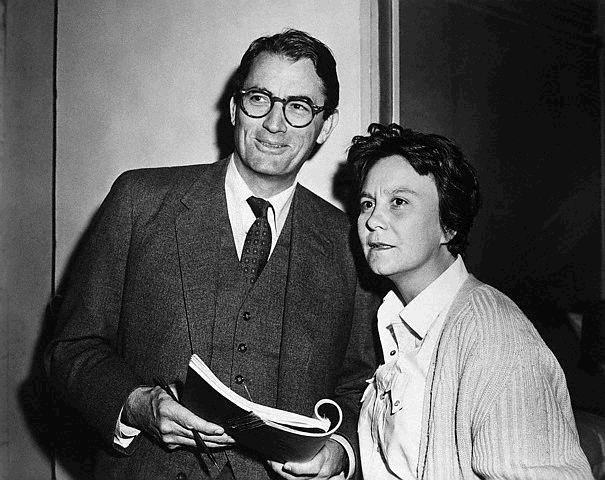
Gregory Peck with Harper Lee.

The professional lives of most novelists closely resemble each other. They write a novel; it is published; they embark on a round of publicity. They appear at literary festivals, where they garner a quarter of the audience of some television chef in the tent next door, and at signings in bookshops, with the aim of signing as much stock as possible.
Through it all, the novelist attempts to remain amusing, affable and patient. Three years later, he will publish another novel, and the whole experience repeats itself. As Samuel Beckett wrote in Worstward Ho: “All of old. Nothing else ever. Ever tried. Ever failed. No matter. Try again. Fail again. Fail better.”
For some writers, however, the need to try again, to fail again, hardly arises. The extraordinary career – or perhaps non-career – of Harper Lee bears witness to a quite different way of conducting a writing life. She wrote one novel, an immediate classic and perhaps the best-selling novel of the 20th century, To Kill a Mockingbird. Since its publication in 1960, Lee has published no other book. A second novel, entitled The Long Goodbye, apparently came to an abrupt end on the day her agent, JP Lippincott, expressed an interest in her first. “Her pen froze,” he said.
Lee, who turned 85 in 2011, has not been entirely absent from the public record since, and her neighbours in Monroeville, Alabama, wouldn’t agree that she is a recluse, either. Politely refusing to talk to journalists since 1964 is not the same thing as withdrawing from society. Since that has been her policy, her agreeing to co-operate with a new literary biographer, Marja Mills, who claims to tell the true story behind her years of silence, is important and surprising news. Will this biography tell the whole truth? Can anyone ever really know why an author falls silent – even the author herself?
Lee came from one of the 20th century’s richest literary schools, the American South. Work by Faulkner, Tennessee Williams, Carson McCullers, Eudora Welty and Flannery O’Connor examined the South’s flavour of intense, self-regarding decorum and passionately defended injustice and violence.
It is sometimes regarded as extraordinary that Nelle Harper Lee came from the same small town as another great Southern writer, Truman Capote – that, indeed, they were neighbours as children. Some have gone as far as to speculate wildly that To Kill a Mockingbird might actually have been a near-collaboration between the pair, as Capote’s documentary study In Cold Blood seems to have been.
The idea that a coincidence of implausible proportions would be needed to explain the emergence of two such gifted writers from a small place ignores how different their style is. It also ignores the way in which writers encourage, criticise, develop each other by proximity. That is true not just of Lee and Capote, but of Lee and the whole Southern school of novelists. She could hardly have predicted that she would quickly come to be seen as the epitome and climax of the grand Southern tradition.
To Kill a Mockingbird is a great novel and, unusually, was quickly made into a great film (Gregory Peck and his family subsequently became close friends with Lee). But then, everything stopped for Lee’s writing. She spoke in an early Sixties interview, the last she ever gave, of wanting “to leave some record of small-town, middle-class Southern life”, apparently thinking of the novels she wanted to write in the future.
What stays in the memory of To Kill a Mockingbird are the grand coups – Scout unknowingly deflecting a lynching, or the great moment when the Reverend Sykes, after the verdict, says to Scout: “Miss Jean Louise, stand up: your father’s passing.” But the rich texture of the novel comes from its loving delineation of the relationships and tensions in a small town. That is the direction she would have gone in, and what we have lost in her subsequent silence.
The novelist of social texture, of the quiet relationships between people, is perhaps one peculiarly vulnerable to the impact of fame. We have plenty of witnesses to Jane Austen’s personal modesty, the way in which she would hide her writing at anyone’s approach. A novelist who had become a celebrity would find it almost impossible to pursue their task of listening, of modest disappearance into the background, of observation. Some writers manage to tough it out; others find the weight of expectation impossible to manage.


Harper Lee GETTY IMAGES
The cynic would say that Harper Lee, with a novel which still sells millions every year, over half a century after its publication, hardly needed to go on writing anyway. Would she have wanted her career to work out like this? But writing is not like hedge-fund trading. The author who voluntarily retires from writing, after having made a pile, is a rare creature; it is the strangest of facts about Shakespeare that he stopped writing, apparently of his free will, at the height of his artistic powers afterThe Tempest, and retired to Stratford.
Much more common is the writer who is effectively destroyed by a single huge success. The burden of fame and acclaim weighs down particularly on the creative faculties. Ian McEwan has spoken of feeling, when he embarks on promotion of his books, like “an employee of his own former self”.
The task of balancing the awareness of past success with the necessary task of producing new work is not one that every writer can achieve. And, perhaps, these single huge successes are much harder to deal with when they come early on in a writer’s career, before they have learnt to, in Kipling’s words, “treat the two impostors” of triumph and disaster “just the same”. It’s striking that out of the four novelists, for instance, who have won the Booker Prize in the last 40 years with a first novel, none has so far managed to write a successful follow-up.
Lee has succeeded in protecting herself over the last half-century, and living a life which is of her choosing. In a rare statement recently, a letter to Oprah Winfrey’s magazine, she suggested how out-of-touch with modern life she has become: “In an abundant society where people have laptops, cellphones, iPods and minds like empty rooms, I still plod along with books.” That detachment is, clearly, necessary to her. It is the paradox of the novel that it could not have been written by someone in love with literary fame; that the fame it achieved and deserved killed off any prospect of a succeeding masterpiece.
This piece was originally published in 2011. On February 3 2015, Harper announced that Go Set a Watchman, a novel the Pulitzer Prize-winning author completed in the Fifties and put aside, will be released July 14. Rediscovered last autumn, Go Set a Watchman is essentially a sequel to To Kill a Mockingbird, although it was finished earlier. The 304-page book will be Lee's second, and the first new work in more than 50 years.

Second Harper Lee novel to be published in July

 February 3 at 10:59 AM


NEW YORK — “To Kill a Mockingbird” will not be Harper Lee’s only published book after all.
Publisher Harper announced Tuesday that “Go Set a Watchman,” a novel the Pulitzer Prize-winning author completed in the 1950s and put aside, will be released July 14. Rediscovered last fall, “Go Set a Watchman” is essentially a sequel to “To Kill a Mockingbird,” although it was finished earlier. The 304-page book will be Lee’s second, and the first new work in more than 50 years.
The publisher plans a first printing of 2 million copies.
“In the mid-1950s, I completed a novel called ‘Go Set a Watchman,’” the 88-year-old Lee said in a statement issued by Harper. “It features the character known as Scout as an adult woman, and I thought it a pretty decent effort. My editor, who was taken by the flashbacks to Scout’s childhood, persuaded me to write a novel (what became ‘To Kill a Mockingbird’) from the point of view of the young Scout.
“I was a first-time writer, so I did as I was told. I hadn’t realized it (the original book) had survived, so was surprised and delighted when my dear friend and lawyer Tonja Carter discovered it. After much thought and hesitation, I shared it with a handful of people I trust and was pleased to hear that they considered it worthy of publication. I am humbled and amazed that this will now be published after all these years.”
Financial terms were not disclosed. The deal was negotiated between Carter and the head of Harper’s parent company, Michael Morrison of HarperCollins Publishers. “Watchman” will be published in the United Kingdom by William Heinemann, an imprint of Penguin Random House.
According to publisher Harper, Carter came upon the manuscript at a “secure location where it had been affixed to an original typescript of ‘To Kill a Mockingbird.’” The new book is set in Lee’s famed Maycomb, Alabama, during the mid-1950s, 20 years after “To Kill a Mockingbird” and roughly contemporaneous with the time that Lee was writing the story. The civil rights movement was taking hold by the time she was working on “Watchman.” The Supreme Court had ruled unanimously in 1953 that segregated schools were unconstitutional, and the arrest of Rosa Parks in 1955 led to the yearlong Montgomery bus boycott.
“Scout (Jean Louise Finch) has returned to Maycomb from New York to visit her father, Atticus,” the publisher’s announcement reads. “She is forced to grapple with issues both personal and political as she tries to understand her father’s attitude toward society, and her own feelings about the place where she was born and spent her childhood.”
Lee herself is a Monroeville, Alabama native who lived in New York in the 1950s. She now lives in her hometown. According to the publisher, the book will be released as she first wrote it, with no revisions.
“To Kill a Mockingbird” is among the most beloved novels in history, with worldwide sales topping 40 million copies. It was released on July 11, 1960, won the Pulitzer Prize and was adapted into a 1962 movie of the same name, starring Gregory Peck in an Oscar-winning performance as the courageous attorney Atticus Finch. Although occasionally banned over the years because of its language and racial themes, the novel has become a standard for reading clubs and middle schools and high schools. The absence of a second book from Lee only seemed to enhance the appeal of “Mockingbird.”
Lee’s publisher said the author is unlikely to do any publicity for the book. She has rarely spoken to the media since the 1960s, when she told one reporter that she wanted to “to leave some record of small-town, middle-class Southern life.” Until now, “To Kill a Mockingbird” had been the sole fulfillment of that goal.
“This is a remarkable literary event,” Harper publisher Jonathan Burnham said in a statement. “The existence of ‘Go Set a Watchman’ was unknown until recently, and its discovery is an extraordinary gift to the many readers and fans of ‘To Kill a Mockingbird.’ Reading in many ways like a sequel to Harper Lee’s classic novel, it is a compelling and ultimately moving narrative about a father and a daughter’s relationship, and the life of a small Alabama town living through the racial tensions of the 1950s.”
The new book also will be available in an electronic edition. Lee has openly started her preference for paper, but surprised fans last year by agreeing to allow “Mockingbird” to be released as an e-book.

Seahawks lost because of the worst call in Super Bowl history


The Seahawks blew a chance to make Super Bowl history with another improbable comeback because of an inexplicable decision to pass instead of handing the ball to Marshawn Lynch.

Times staff columnist
1 February 2015

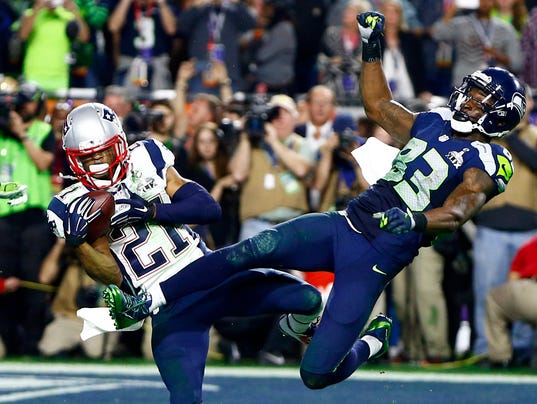
New England Patriots cornerback Malcolm Butler (21) intercepts a pass intended for Seattle Seahawks wide receiver Ricardo Lockette (83) in the fourth quarter of Sunday's Super Bowl.
(Photo: Mark J. Rebilas, USA TODAY Sports)
GLENDALE, Ariz. — A second straight championship rested at the 1-yard line. The Seahawks needed to move the football a mere 36 inches, maybe less, to defeat improbability one last time and end this taxing season with a champagne shower. The situation called for Marshawn Lynch.
You could almost see the eccentric running back nicknamed Beast Mode diving into the end zone and doing his handshake celebration. You could almost see the blue and green confetti falling at University of Phoenix Stadium. Instead, in one moment, the Seahawks forgot who they were. And Super Bowl XLIX turned into the most painful loss in franchise history.
It happened because of the worst play call in Super Bowl history, a decision that will also go down as one of the most regrettable ever in Seattle sports. With 26 seconds remaining, Russell Wilson took a shotgun snap and threw a quick slant intended for wide receiver Ricardo Lockette. New England cornerback Malcolm Butler jumped in front of the route, however, and intercepted the pass in the end zone.
Game over. History delayed. Legacy unfulfilled.
A few minutes later, the Patriots celebrated a 28-24 victory that should have ended with another of the Seahawks’ miraculous comebacks.
“We had it,” linebacker Bruce Irvin said. “I don’t understand how you don’t give it to the best back in the league on not even the 1-yard line. We were on the half-yard line, and we throw a slant. I don’t know what the offense had going on, what they saw. I just don’t understand.”
Irvin isn’t the only one confused. The Seahawks have the best power running back in the NFL, and Lynch had rushed for 102 yards and a touchdown. He’s built for those short-yardage street fights. And he wins more than he loses.
The Seahawks returned to the Super Bowl this season by staying close to their identity. They ran the ball better than any team in the league. They played punishing defense. They won close games by thriving in tense moments.
They needed to do that one more time to become the first back-to-back NFL champion in 10 years. Instead, offensive coordinator Darrell Bevell called a dangerous play that ended in disaster.
You’re left to shake your head at this loss and ask why.
But the explanation is only more maddening.
Seahawks coach Pete Carroll said the Seahawks didn’t have the ideal personnel on the field to run the ball. They had three wide receivers, a tight end and Lynch as Wilson’s weapons. The Patriots countered with their goal-line defensive package. Bevell didn’t think it was wise to run against New England’s defensive personnel, and Carroll agreed. So on second down and goal from the 1-yard line, the Seahawks threw a slant to Lockette, a receiver with 25 career receptions.
“It’s not the right matchup for us to run the football,” Carroll said. “So on second down, we throw the ball, really to kind of waste that play. If we score, we do. If we don’t, then we’ll run it on third and fourth down. Really, with no second thoughts or hesitation in that at all.”
We throw the ball, really to kind of waste that play.
It’s an incomprehensible and inexcusable explanation. Carroll should’ve chosen his words more carefully. It sounds as if the Seahawks weren’t even valuing that second-down opportunity.
They could’ve run the football with the personnel mismatch. They’ve done it before. What’s the worst that could happen? Maybe Lynch, who doesn’t have many negative runs, loses a yard or two. The Seahawks would still be at the 2- or 3-yard line. They could’ve used their last timeout and still had time to run two more plays. Or Lynch could’ve plowed his way to a touchdown that surely would’ve made the ground shake in Seattle once more.
“We’ve done it before, and we’ve scored,” offensive tackle Russell Okung said of running despite the personnel mismatch. “We’ve also passed the ball in that same situation and scored. We just didn’t deliver. Sometimes, that’s football.”
The decisive play overshadows a wonderful Super Bowl. It was a fantastic display of momentum swings and explosive offensive plays in the face of great defense. The Seahawks scored on four straight possessions in the second and third quarters to take a 24-14 lead. Doug Baldwin pretended to go potty after scoring a touchdown. Richard Sherman made a “24” gesture to the television cameras, likely taunting rival New England cornerback Darrelle Revis for giving up a score.
But Tom Brady, the Super Bowl MVP who threw 50 passes and managed 328 yards and four touchdowns, led the Patriots back. But with 2:02 remaining, Wilson had the ball and the opportunity to stage his greatest fourth-quarter comeback.
When Jermaine Kearse made an unbelievable, juggling 33-yard catch with 1:06 remaining, it seemed the Seahawks were poised to pull off a stunning comeback to rival their NFC Championship Game rally.
But they couldn’t finish. The defense couldn’t stop Brady. And the offense didn’t keep it simple at the 1-yard line.
“It didn’t turn out the way I hoped it would,” Bevell said.
Said Wilson: “We were right there, so I put the blame on me. I’m the one that threw the ball.”
Carroll also took responsibility afterward, telling his puffy-eyed players, “There’s really nobody to blame but me.”
“I don’t want them to think anything other than that,” Carroll said. “A very, very hard lesson. I hate to learn the hard way, but there’s no other way to look at it right now.”
It’s a haunting moment for a franchise that was so close to bliss.
Jerry Brewer: 206-464-2277 or jbrewer@seattletimes.com. On Twitter @JerryBrewer

The Truth About 'American Sniper'


Chris Kyle wasn’t a savage; he killed savages.

MICHAEL J. TOTTEN
30 January 2015


Clint Eastwood’s new film, American Sniper, is a blisteringly accurate portrayal of the American war in Iraq. Unlike most films in the genre, it sidesteps the politics and focuses on an individual: the late, small-town Texan, Chris Kyle, who joined the Navy SEALs after 9/11 and did four tours of duty in Fallujah, Ramadi, and Baghdad. He is formally recognized as the deadliest sniper in American history, and the film, based on his bestselling memoir, dramatizes the war he felt duty-bound to fight and his emotionally wrenching return home, with post-traumatic stress.

The movie has become a flashpoint for liberal critics. Documentary filmmaker Michael Moore dismissed the film out-of-hand because snipers, he says, are “cowards.” “American Sniper kind of reminds me of the movie that’s showing in the third act of Inglorious Basterds,” comic actor Seth Rogen tweeted, referring to a fake Hitler propaganda film about a Nazi sniper, though he backtracked and said he actually liked the film, that it only reminded him of Nazi propaganda. Writing for the Guardian, Lindy West is fair to Eastwood and the film but cruel to its subject. Kyle, she says, was “a hate-filled killer” and “a racist who took pleasure in dehumanizing and killing brown people.”

The Navy confirms that Kyle shot and killed 160 combatants, most of whom indeed had brown skin. While he was alive, he said that he enjoyed his job. In one scene in the movie, Kyle, played by a bulked-up Bradley Cooper, refers to “savages,” and it’s not clear if he means Iraqis in general or just the enemies he’s fighting.

But let’s take a step back and leave the politics aside. All psychologically normal people feel at least some hatred for the enemy in a war zone. This is true whether they’re on the “right” side or the “wrong” side. It’s not humanly possible to like or feel neutral toward people who are trying to kill you. Race hasn’t the faintest thing to do with it. Does anyone seriously believe Kyle would have felt differently if white Russians or Serbs, rather than “brown” Arabs, were shooting at him? How many residents of New York’s Upper West Side had a sympathetic or nuanced view of al-Qaida on September 11, 2001? Some did—inappropriately, in my view—but how many would have been able to keep it up if bombs exploded in New York City every day, year after year?

Kyle had other reasons to hate his enemies, aside from their desire to kill him. In American Sniper, we see him in Fallujah and Ramadi fighting Abu Musab al-Zarqawi’s Al Qaeda in Iraq, the bloody precursor to ISIS. His immediate nemesis is “the Butcher,” a fictional character whose favorite weapon is a power drill. The Butcher confronts an Iraqi family who spoke to Americans and says “if you talk to them, you die with them.” He tortures their child to death with his drill.

Kyle kills a kid, too, but in a radically different context. The boy is running toward Americans with a live grenade in his hand. “They’ll fry you if you’re wrong,” his spotter tells him. “They’ll send you to Leavenworth.” He’s right. Kyle would have been fried, at least figuratively, if he shot an innocent, unarmed civilian—regardless of age—with premeditation. In a later scene, he has another child in his sights: the child picks up a rocket-propelled grenade launcher and aims it at an American Humvee. “Drop it,” Kyle says under his breath from far away. He doesn’t want to pull that trigger. He’ll shoot if he must to protect the lives of his fellow Americans, but the kid drops the RPG and Kyle slumps in relief. How different he is from the Butcher, who takes sadistic pleasure in torturing children to death—not even children of the American invaders, but Iraqi children.

So yeah, Kyle thought his enemies were savages and didn’t shy away from saying so. There are better words—I’d go with psychopaths myself—but do we need to get hung up on the semantics? Kyle, along with everyone else who fought over there, should be judged for what he did rather than what he thought or what he said. Had Kyle chosen to murder innocent women and children with his rifle, then we could call him a hate-filled killer with justification. But as far as we know, everyone he shot was a combatant.

We do see actual hate-filled killers in this film, and none of them are Americans. The man who shot them did everybody a favor, and that can’t be undone by his vocabulary. What would you think of a man who kills a kid with a power drill right in front of you? Would you moderate your language so that no one at a Manhattan dinner party would gasp? Maybe you would, but Kyle wasn’t at a Manhattan dinner party.

No experience produces as much anxiety as going to war, and anxiety changes the brain chemistry—sometimes temporarily, other times indefinitely. When the sympathetic nervous system kicks in, it strips away our ability to think in shades of gray. It’s a survival mechanism that evolved to keep us alive; it’s older and more primitive than human consciousness itself. Complex and slow higher-brain reasoning inhibits the fight-or-flight response necessary in times of imminent danger, so the brain is hard-wired to short-circuit around it.

As a journalist in various combat zones, sometimes embedded with the U.S. military in Iraq and other times working solo, I’ve spent time in that mindset. It’s not pleasant and it’s not pretty, but there’s nothing immoral about it. Nearly everyone is susceptible to it. Don’t believe me? Try spending a few months being hunted by ISIS in Syria and watch what it does to your mind. A left-liberal friend of mine in the media business who spent years in the Middle East put it to me this way over beers in Beirut: “I get a lot less liberal when people are trying to kill me.”

I managed to pull myself out of that mental state fairly easily, partly because I experienced no personal trauma and partly because I never spent more than one month at a time in a war zone. But Kyle spent years in that state, and it persisted after he left Iraq and returned home with at least some of the symptoms of post-traumatic stress disorder. After his final tour, we see him go straight to a bar and order a beer. His wife calls him and is shocked to discover that he’s back in San Diego rather than still overseas. When she asks why he didn’t come home, he says, “I guess I just needed a minute,” and breaks down in tears. Later we see him in his living room staring at a dead television set while horrific sounds of war explode in his head. Kyle absorbed an extraordinary amount of mental and emotional trauma, stress, and anxiety. This makes him a coward? A psychopath? A hate-filled killer? A Nazi? Seriously?

Here’s a medical fact: psychopaths don’t suffer from post-traumatic stress or any other kind of anxiety disorder. And cowards don’t volunteer for four tours of duty in war-torn Iraq. I live in a coastal city in a blue state, like most of the critics of American Sniper. I was raised with the anti-military prejudice common in my community, despite having a military veteran and Republican for a father. (He served in the army during the Vietnam War, on the Korean DMZ, and to this day has a hard time saying anything positive about the military.)

Spending months with the U.S. military in Fallujah, Ramadi, and Baghdad—the cities Chris Kyle fought in—shattered every stereotype about soldiers and war I had in my head. Michael Moore, Seth Rogen, and Bill Maher likely wouldn’t change their views of war and foreign policy had they done what I did, but they almost certainly would moderate their view of the men and women who fought on our side, if for no other reason than that the words they use to describe men like Chris Kyle apply tenfold to the killers Chris Kyle brought down with his rifle. The people complaining about this film are those who most need to see it, even if watching American Sniper can’t compare with time in the field with the army and the Marine Corps.

I lost track of how many soldiers and Marines told me of their frustration with an American media that so often describes them as either nuts or victims. If we don’t want to lionize them as heroes—Eastwood doesn’t, and Kyle himself is portrayed as uncomfortable with that kind of praise—we should at least understand and respect what they’ve gone through and save our rhetorical ammunition for the other side’s head-choppers and car-bombers.

Monday, February 02, 2015

Why Obama Needs to Pretend the Taliban Aren’t Terrorists


The administration makes a desperate and indefensible claim.