Tuesday, September 23, 2014

The Derek Jeter nobody knows


Yankees captain lets fans in Monday and reveals he's not the man we thought


September 23, 2014

NEW YORK -- The 700 or so people had paid from $125 to $2,000 per ticket to squeeze into the Hudson Theatre, a little jewel box of a venue in midtown Manhattan, early Monday afternoon. Now, for the better part of an hour, Derek Jeter was being interviewed by Brandon Steiner, a longtime friend who runs a memorabilia business that is so efficient at confiscating collectibles, Jeter joked if he wants to keep any mementos from this last week of his career, "I'm going to have to walk out of the stadium in full uniform."
And the audience laughed.
"I'm not making this up," Jeter needled, his voice almost plaintive now.
The Jeter farewell tour has been alternately nostalgic and heartfelt, awkward and funny, over-merchandised and occasionally underwhelming if the measure is waiting for Jeter to cut open a vein and bare his soul about what he expects to feel like by Thursday, when he plays his last game at Yankee Stadium. Or by Sunday, when he says goodbye for good in the Yanks' regular-season finale at Fenway Park.
[+] EnlargeDerek Jeter
Michael Priest PhotographyFans saw a rare side of Derek Jeter Monday at Hudson Theatre.
"No, that ain't right! Fenway? C'mon," joked former Yankee Bucky Dent.
Dent, who was seated at one of the tables of honor Monday along with former Yankees Hideki Matsui and Chris Chambliss, added: "Can't they turn it around and play his last game here?"
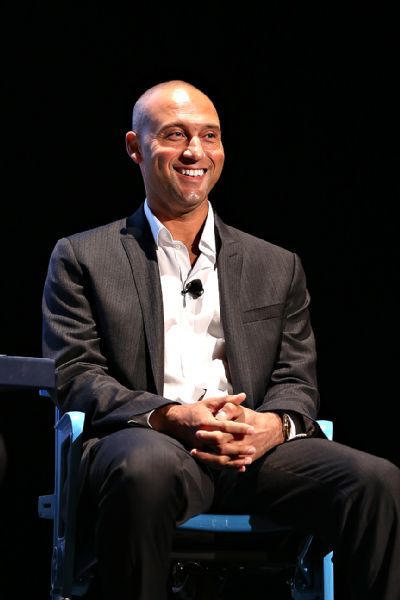
But Jeter said he's fine with it. As he sat on the stage Monday in a sharp white shirt and black suit, happily away from the usual sports media types who stand two or three deep around his locker most nights, Jeter fielded Steiner's questions and gave fans a little glimpse of the Jeter nobody knows. And, like the New York magazine article that posted online earlier in the day ("Oh? Didn't read it," Jeter shrugged), it turns out Jeter has had some surprises up his sleeve all along. And not just, as he told the magazine, the fact he didn't like that story way back when that suggested he gives his romantic conquests a gift basket as a parting gift the morning after sleepovers.
For starters, how about the wide presumption that they'd have to tear the uniform off Jeter to get him to go? How about the way Jeter is considered a New Yorker now to the bone, an iconic part of the city fabric, same as DiMaggio or Mantle? The real truth is, everything about this last year of Jeter's smacks of impermanence, not clinging to each precious moment: He sold his longtime East Side apartment a while ago and has been living all season in a West Village rental. He often flies to his newly built mansion in Tampa for the day during the season when the Yanks have an off-day. And when asked if he could play another year, he told Steiner, "I feel like I could.
"But I don't want to."
Wait.
Derek Jeter has had enough baseball?
"I'm making no plans in the beginning," Jeter said. "I've been on a schedule my entire life. I'm looking forward to not being on a schedule."
Jeter went on to talk about other things beyond the field. He reached back into his childhood and said he very much liked basketball as a kid but, "I was scared to play football. It was just too much." He tweaked what the media has said about him at times ("Don't believe everything you read."). Several times he stressed how he always thought the way a player comports himself is as important as what he does on the field. But when asked what influence his parents had on how well he has turned out, Jeter deadpanned, "They've had nothing to do with it." Then he laughed and went on to praise what terrific people they are, and how he expects to be a "strict dad," same as his dad was.
Jeter has long been one of sports' most active bachelors. But as it turned out, he said there was something else at work all these years in which he's dated starlet after starlet: He never tried to settle down and start a family sooner, because "I just know that I personally couldn't have done it while I was playing. I was you, know, too selfish, I guess.

"I was too selfish to be able to juggle a family and kids. But I look forward to it happening."
What else does he see himself doing in 10 years?
"I'd like to own a team some day," he said.
Jeter's answer as to why he's not married with kids at 40 was not the answer you expect from the city's most tracked playboy since Joe Namath. Isn't Jeter the same man who made a Visa commercial with George Steinbrenner spoofing his late-night habits?
"I go to bed by 9 and I get up at 5:30 a.m. every day to work out," Jeter insisted.
So, to recap: Derek Jeter, star of the Yankees, the man whose just-released sports drink commercial is scored to Frank Sinatra's rendition of "My Way," is actually a man who doesn't even own a home in Manhattan. He often bolts town on off-days the first chance he gets. He has played two decades and is often considered one of the great gamers of all-time -- he said yesterday he kept the seats he famously crashed into from old Yankee Stadium when it was torn down -- but he is more than ready to walk away from baseball, thanks. And he would've settled down sooner if he hadn't betrothed his life to baseball first.
Jeter was fine with all of that coming out in the course of Monday's conversation.
But when Steiner explicitly asked Jeter if there was anything more he could tell the crowd that "someone might not know about you," the Jeter we're used to came back. The shutters slammed shut again.
"Well, if you don't know, it's by design, so ... I don't want you to know," Jeter smiled.
Then, his face growing serious, Jeter added: "I just think that your private life is private. What I do [as the Yankees' shortstop] is obviously public. I get that. I get the fact that people are interested. I'm interested in what people are doing.
"But I've chosen to stay private."
Jeter was long ago assured of heading to the Hall of Fame. His baseball legend will always be gilt-edged. People will always talk about what a winner and a class act he was. How that home run he hit for his 3,000th career hit was just more proof of his flair for the moment. And yet, he also took pains several times Monday to insist the wonder of it all has never worn off for him. And he never, ever took a bit of his journey for granted.

People keep asking Jeter, as his career has funneled down to this last week, to pick a few moments that stand out to him as more "amazing" or "surreal" than the rest.
And Jeter just keeps stubbornly insisting he doesn't think that way.
"It's all of it -- [but] I'm trying not to reminisce yet, you know?" Jeter said. "I play a game where you're supposed to control your emotions. It's a game of failure and success. And you have to be able to control it. That's why at times this year it's been difficult, because you go places and they're showing video montages and you feel like, like, you're dying or something."
Again, the crowd laughed.
"It's the whole thing," Jeter repeated. "When you're a kid, it's like, 'I dreamed of playing shortstop for the Yankees.' But that's where the dream stopped. Then you just want to make it to the major leagues. And everybody pictures themselves hitting a home run in the World Series. But everything else that's come along with this, I never could have dreamt this."
Nobody has to tell him he has seven games in these next seven days to go, starting Monday night against Baltimore. Jeter was in a horrible 0-for-24 slump just before the Yanks got back to town. He seemed to be playing on fumes. It was said he picked the right time to quit, all right. Then -- what do you know -- his clutch gene seemed to kick in, as if he refused to go out like that. He began this last homestand at the Stadium hitting 6-for-13, with his first home run at home in ages.
The Jeter nobody knows will deal with whatever roiling feelings he's fighting inside. But that was the same damn Jeter of old down on the field these last few nights. And he doesn't need any reminders that the end is near.
As Jeter said before he left Monday to head out to the Stadium, "I don't have to wake up for a few more games, so ..."


Related:
Derek Jeter Opens the Door:

Monday, September 22, 2014

Book Review: 'Agent Storm' by Morten Storm

- - Tuesday, September 16, 2014


AGENT STORM: MY LIFE INSIDE AL QAEDA AND THE CIA
By Morten Storm with Paul Cruickshank & Tim Lister
Atlantic Monthly Press, $26, 404 pages, illustrated
In the 1949 book “The God That Failed: A Confession,” prominent ex-communist intellectuals recounted their disillusionment with and abandonment of communism. What also made that book noteworthy was its running concept of “Kronstadt” as the defining moment in which these ex-communists decided not merely to leave the Communist Party, but to actively oppose it as anti-communists.
“Agent Storm: My Life Inside Al Qaeda and the CIA” is Morten Storm’s authoritative account of how he was radicalized as a young Danish convert to Islam into ultimately becoming a trusted member of al Qaeda’s inner circles and how his subsequent disillusionment with its genocidal ideology and violent tactics led to his own “Kronstadt” moment, in which he decided to become a double agent on behalf of the Danish, British and American intelligence services.
Although there are other examples of European Muslim extremists who lost faith with jihadi Islam and al Qaeda and its affiliates and became prominent critics of radical Islam, Mr. Storm’s is the most recent case. Moreover, while the others were at the margins of al Qaeda’s operations, Mr. Storm represents the most high-level Western intelligence penetration of al Qaeda in the Arabian Peninsula (AQAP) — considered al Qaeda’s most dangerous affiliate. His assistance to American intelligence, according to his account, helped lead to the targeted killing in late September 2011 of Anwar al-Awlaki, one of al Qaeda’s top spiritual and operational leaders in Yemen, who had inspired many Western jihadi terrorists, including Maj. Nidal Hassan, the Fort Hood murderer, and the Tsarnaev brothers, who conducted the Boston Marathon bombings.
The book is filled with many dramatic accounts of Mr. Storm’s involvement in these Western intelligence penetrations of al Qaeda and its affiliates, whether in Yemen or Somalia, as well as with its extremist adherents in Europe. Written by Mr. Storm and his two collaborators, Paul Cruickshank, a top CNN investigative journalist on al Qaeda, and Tim Lister, who has worked for CNN and the BBC in the Middle East, the book reads like a first-rate spy thriller, but it is in fact a stunning and true inside account of the workings, personalities and mindsets of the leaders and operatives of al Qaeda and its worldwide operations.
In one of the book’s most dramatic segments, in September 2009, Mr. Storm was asked by al-Awlaki, his “mentor” — who had a history of procuring prostitutes while earlier living in America and at the time in Yemen was married to two wives, one older and the second much younger — “to find him a wife in the West.” Mr. Storm, who had divorced his first Muslim wife and was living in England with his second, found in a radical Muslim Facebook forum a suitable potential bride for al-Awlaki: a beautiful, blonde 32-year old Muslim convert from Croatia named Aminah, who was willing to travel to Yemen to meet and marry the already married al-Awlaki, whom she had idolized. At this point, no one in his family knew about his double-agent status.
What neither Aminah (real name Irena Horak) nor al-Awlaki knew was that this “matchmaking” was being orchestrated and financed by the British and American intelligence services who had planted tracking devices in her suitcase and an electronic Arabic pocket dictionary that they hoped would lead them to al-Awlaki’s whereabouts in Yemen’s lawless tribal areas. The details of how Mr. Storm arranged for Aminah’s travel to meet al-Awlaki, how American intelligence eventually located al-Awlaki’s whereabouts (this time via a different courier in a later meeting arranged by Mr. Storm) to kill him, and her ultimate fate in Yemen (she was unaware of Mr. Storm’s involvement in setting the trap for al-Awlaki) are riveting. All is backed up by extensive evidence in the form of travel and financial documents and videos Mr. Storm provided his co-authors, including the actual video of al-Awlaki proposing marriage to his prospective Croatian bride.
Aside from bringing readers close to the workings of high-stake intelligence operations, Mr. Storm’s book is important for other reasons. It is a first-rate account of how a troubled young Danish Christian, with a history of petty criminality, incarceration and drug use was drawn to convert to Islam and was radicalized into its most extremist jihadi circles in Denmark and Britain. It illustrates how recruiters in such jihadi circles in Europe identify and send their promising convert adherents to “study” at jihadist religious schools such as the Dammaj Institute in Yemen, where, upon their return to their countries of origin, they are expected to further radicalize others into pro-al Qaeda violent extremism and martyrdom.
In what is the book’s most telling and hopeful segment, Mr. Storm discusses his “Kronstadt” moment in early 2007, when he rejected radical Islam’s “justifications made for the murder and maiming of civilians,” and the steps he took to contact PET, the Danish intelligence service, to offer his services to counter and betray his former comrades in European jihadi circles and al Qaeda around the world because, as he writes, “I knew the murderous worldview of al Qaeda, and I wanted to play a part in stopping them.”
While today Mr. Storm is relieved to have given up jihadism (as well as Islam) and is proud of his previous work in support of Western intelligence in fighting al Qaeda and its sympathizers, these undercover activities took a toll on him and his family. He currently resides in undisclosed whereabouts in England under the protection of British authorities (or others operating on their behalf) because of constant death threats against him by his former jihadi comrades.
The drama of “Agent Storm” will no doubt attract Hollywood’s attention (it’s already an hourlong CNN documentary), but bright lights aside, the book is an indispensable guide to how the West can counter the appeal of violent jihadism. Today, when so many young Western Muslims are flocking to Syria and Iraq to join the ranks of genocidal insurgents, this book’s insights could not be more important.
Joshua Sinai is a Washington, D.C.-based consultant on terrorism and counterterrorism studies. He is the author of “Active Shooter: A Handbook on Prevention” (ASIS International).


Read more: http://www.washingtontimes.com/news/2014/sep/16/book-review-how-a-former-western-jihadi-renounced-/#ixzz3E2zS14YJ 
Follow us: @washtimes on Twitter

The Crumbling Climate-Change Consensus

Extremists’ rhetoric heats up as their case falls apart. 

Sunday, September 21, 2014

Today's Tune: Bruce Springsteen - Roll of the Dice (Live May 2014)

College freshmen women targeted for sexual assault

jdrescher@newsobserver.comSeptember 19, 2014 


0.jpeg
For young women, the first semester of college can be a perilous time.
Older college guys target them as inexperienced drinkers and, therefore, less likely to resist sexual advances. One University of Massachusetts male student explained the strategy, as reported in Time magazine: “They were easy prey, and they wouldn’t know anything about drinking or how much alcohol they could handle, so you know they wouldn’t know anything about our techniques.”
The technique: Invite younger female students to a party. Have plenty of beer but also a sweet-tasting punch loaded with alcohol. When a young woman is impaired, get her alone and make your move. The UMass student admitted to pinning down a young woman by placing his arm across her chest so he could force her to have sex.
Sexual assault on college campuses is getting a lot of media attention these days. We recently published two front-page stories on back-to-back days about the subject.
There’s good reason for all the coverage. Various studies provide conflicting evidence about whether first-year women are more vulnerable in a “red zone” from August to Thanksgiving. What’s not in dispute is that sexual assault is widespread at colleges and universities – and that administrators aren’t sure what to do.
Women sharing stories
Jane Stancill, who covers higher education for The News & Observer, reported recently about a 2007 survey at two large universities. It found that 19 percent of female students experienced an attempted or actual sexual assault. Other surveys have reported similar percentages.
Universities have been criticized for minimizing crime reports about sexual assault to protect their images. U.S. Sen. Claire McCaskill, a Missouri Democrat, recently surveyed 350 colleges and universities. She found that 41 percent hadn’t conducted a sexual-assault investigation in the past five years.
As of late August, 76 colleges are being investigated under the federal Title IX gender equity law, including UNC-Chapel Hill and Guilford College. Universities are required to have grievance procedures to respond to reports of sexual violence.
Stancill cites two reasons why there has been so much coverage recently.
First, the federal government is taking a stronger stance. Many colleges, such as UNC-CH, also face allegations that they failed to report accurate crime statistics required by federal law.
Second, students who have been sexually assaulted have become empowered to share their stories publicly, especially through social media.
“They have formed networks with other victims across the country to get the word out about how they believe universities mishandled their cases or swept the problem under the rug,” Stancill said.
Colleges ill-equipped
The schools are compelled by federal law to respond to sexual misconduct. But Stancill points out that in many ways they are ill-equipped to do so.
Until recently, sexual-assault cases were sent to student honor courts or disciplinary hearings, where students sometimes sat in judgment of other students. Accused assailants were rarely found responsible or punished.
On the other hand, some students who have been expelled after guilty findings have later sued universities, saying the process was unfair. Universities can face lawsuits on both sides.
UNC-CH has adopted new policies that say a student who is incapacitated by alcohol or drugs can’t give consent. Consent has to be an affirmative choice. Only faculty and staff (not students) would serve on panels that hear the cases.
All of this media attention has been disruptive for university administrators. But this conversation needs to happen. If it leads to a better awareness of consent and a reduction in assaults, it is a conversation worth having.


Read more here: http://www.newsobserver.com/2014/09/19/4164966/drescher-college-freshmen-women.html#storylink=cpy

The Islamic State . . . of Saudi Arabia

Between beheadings, they’ll help train the “moderate” Syrian rebels.