Tuesday, August 12, 2014

Obama vacations as the world burns

By Dana Milbank
http://www.washingtonpost.com/opinions
August 11, 2014


President Barack Obama follows through on a swing while golfing at Farm Neck Golf Club as golfing partner former NFL player Ahmad Rashad, right, sits in a cart, Sunday, Aug. 10, 2014, in Oak Bluffs, Mass., on the island of Martha's Vineyard. President Obama on Saturday left Washington for his familiar spot on Martha's Vineyard for a two-week summer vacation. (AP Photo/Steven Senne) 
President Obama must really be teed off.
Hillary Rodham Clinton, his once-loyal secretary of state and his likeliest successor, has gone rogue, criticizing his foreign policy as too timid.
Obama responded with not one but two rounds of golf.
Clinton, in an interview with Jeffrey Goldberg published by the Atlantic over the weekend, offered a withering comment on the Obama doctrine, described in shorthand by White House officials as “don’t do stupid s---.” Said Clinton: “Great nations need organizing principles, and ‘Don’t do stupid stuff’ is not an organizing principle.”
As the criticism became public, Obama was doggedly sticking with his plans to go on vacation — a decision that, if not in the category of stupid stuff, could fit under the heading of “tone deafness.”
Obama stood on the South Lawn on Saturday updating Americans on the new bombing campaign in Iraq — and then he boarded Marine One for atwo-week trip to Martha’s Vineyard. There, half an hour after arriving at his vacation home, he was already on his way to a golf course. He played again Sunday, then had a beach outing Monday followed by a political fundraiser.
Even presidents need down time, and Obama can handle his commander-in-chief duties wherever he is. But his decision to proceed with his getaway just 36 hours after announcing the military action in Iraq risks fueling the impression that he is detached as the world burns.
The highly visible wartime vacation (Obama allowed himself to be photographed on a putting green Saturday with NBA star Ray Allen and retired pro-football player Ahmad Rashad) was not looking any better Monday as Iraq’s political crisis worsened, NATO’s chief declared a “high probability” of Russian military intervention in Ukraine and Gaza remained on a knife edge.
By Monday afternoon, the crises had forced Obama to revise his schedule. The White House announced that the president, after returning from the beach, would make an unscheduled statement about Iraq. He freshened up at his 8,100-square-foot vacation home, then stepped outside, in a blue blazer and open collar; his aides wisely chose a wooded backdrop rather than one with the infinity pool and the sweeping water views. Obama finished his four-minute statement and then hopped in his motorcade for the ride to a Democratic fundraiser.
Such visuals probably won’t help Obama with the 60 percent of Americans who disapprove of his handling of foreign policy. Even his former secretary of state is registering her disapproval.
Clinton, in the interview, took a harder line than the administration has on Iran, the Israeli-Palestinian conflict and Syria, saying she argued unsuccessfully for earlier arming and training of the Syrian opposition. “I know that the failure to help build up a credible fighting force . . . left a big vacuum, which the jihadists have now filled,” she said.
She applied a bit of Clintonian triangulation to the foreign policies of Obama and George W. Bush, suggesting that there’s a just-right medium between the too-hot Bush policy and the too-cold Obama approach.
“I think part of the challenge is that our government too often has a tendency to swing between these extremes,” she said. She later added: “You know, when you’re down on yourself, and when you are hunkering down and pulling back, you’re not going to make any better decisions than when you were aggressively, belligerently putting yourself forward.”
The no-confidence vote from Clinton (who, as luck would have it, also will be on Martha’s Vineyard this week) comes as Obama is smarting from criticism by hawks that the current mess in Iraq might not have occurred if he had kept U.S. troops there. “That entire analysis is bogus and is wrong,” the president said Saturday. “But it gets frequently peddled around here by folks who oftentimes are trying to defend previous policies that they themselves made.”
It’s understandable that Obama would want to get away from it all, but for a president struggling to build support for his foreign policy, vacationing during a crisis is no day at the beach.
White House press secretary Josh Earnest reminded reporters Friday that Obama was traveling to the Vineyard “with an array of communications” and advisers. But when it came time for the president to speak, there was a 20-minute delay because the TV feed didn’t work, and when he finally spoke, the audio and video quality was poor.
Obama gave an update on progress toward “the limited military objectives” against the Islamic State in Iraq, and he praised the naming of a new prime minister. But he didn’t mention that the current one, Nouri al-Maliki, is refusing to surrender power, setting up a showdown.
Criticism from Clinton. War with the Islamic State. Trouble with Maliki. It’s enough to make a man hook his drive into the sand trap.
Twitter: @Milbank

Today's Laugh Track: Robin Williams - Golf

Robin Williams, an Improvisational Genius, Forever Present in the Moment

By A.O. Scott
http://www.nytimes.com/
August 11, 2014
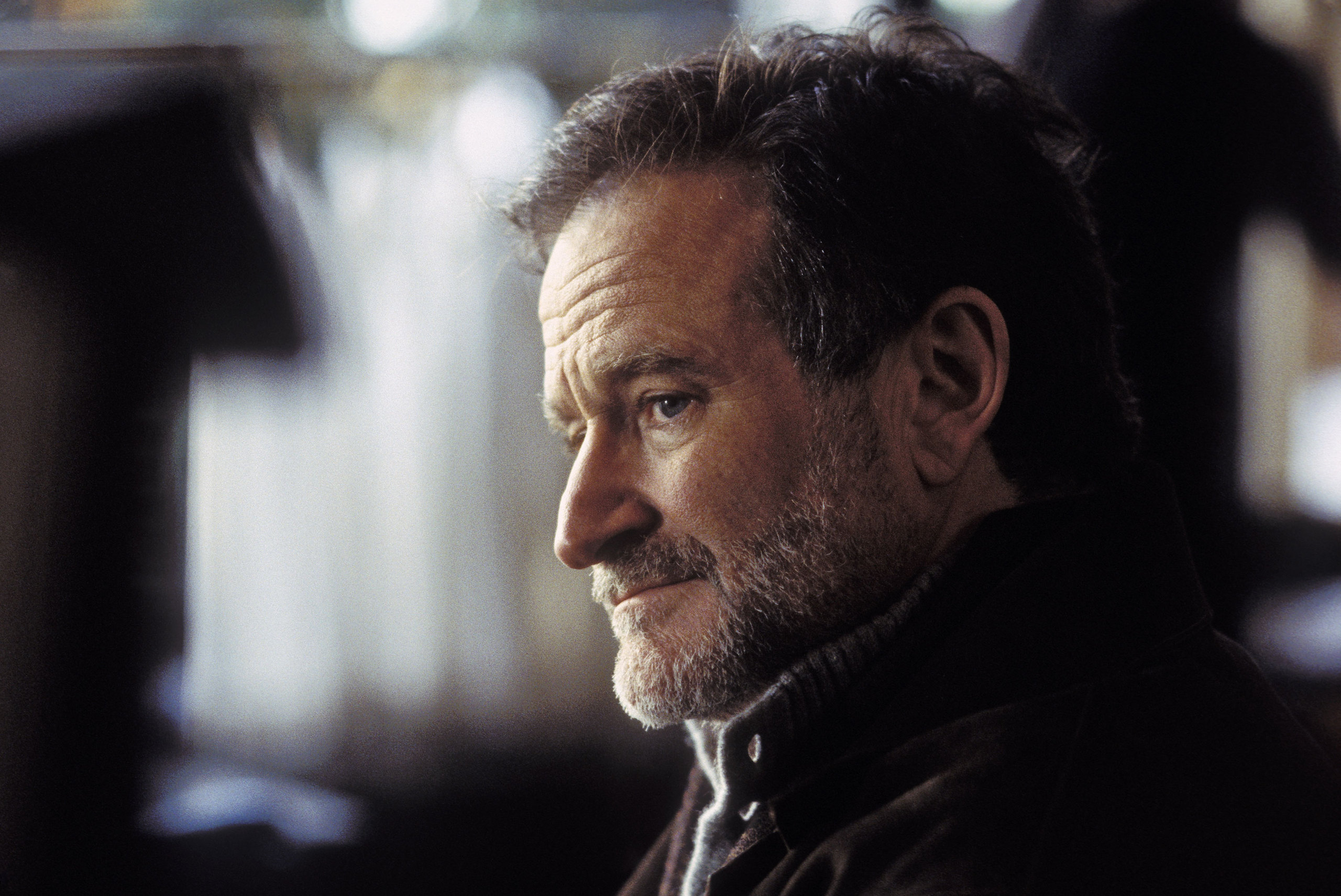
Robin Williams in "The Night Listener"
Some years ago, at a party at the Cannes Film Festival, I was leaning against a rail watching a fireworks display when I heard a familiar voice behind me. Or rather, at least a dozen voices, punctuating the offshore explosions with jokes, non sequiturs and off-the-wall pop-cultural, sexual and political references.
There was no need to turn around: The voices were not talking directly to me and they could not have belonged to anyone other than Robin Williams, who was extemporizing a monologue at least as pyrotechnically amazing as what was unfolding against the Mediterranean sky. I’m unable to recall the details now, but you can probably imagine the rapid-fire succession of accents and pitches — macho basso, squeaky girly, French, Spanish, African-American, human, animal and alien — entangling with curlicues of self-conscious commentary about the sheer ridiculousness of anyone trying to narrate explosions of colored gunpowder in real time.
Very few people would try to upstage fireworks, and probably only Robin Williams could have succeeded. I doubt anyone asked him for his play-by-play, an impromptu performance for a small, captive group, and I can’t say if it arose from inspiration or compulsion. Maybe there’s not really a difference. Whether or not anyone expected him to be, and maybe whether or not he entirely wanted to be, he was on.
Part of the shock of his death on Monday came from the fact that he had been on — ubiquitous, self-reinventing, insistently present — for so long. On Twitter, mourners dated themselves with memories of the first time they had noticed him. For some it was the movie “Aladdin.” For others “Dead Poets Society” or “Mrs. Doubtfire.” I go back even further, to the “Mork and Mindy” television show and an album called “Reality — What a Concept” that blew my eighth-grade mind.
Back then, it was clear that Mr. Williams was one of the most explosively, exhaustingly, prodigiously verbal comedians who ever lived. The only thing faster than his mouth was his mind, which was capable of breathtaking leaps of free-associative absurdity. Janet Maslin, reviewing his standup act in 1979, cataloged a tumble of riffs that ranged from an impression of Jacques Cousteau to “an evangelist at the Disco Temple of Comedy,” to Truman Capote Jr. at “the Kindergarten of the Stars” (whatever that was). “He acts out the Reader’s Digest condensed version of ‘Roots,’ ” Ms. Maslin wrote, “which lasts 15 seconds in its entirety. He improvises a Shakespearean-sounding epic about the Three Mile Island nuclear disaster, playing all the parts himself, including Einstein’s ghost.” (That, or something like it, was a role he would reprise more than 20 years later in Steven Spielberg’s “A.I.”)
Onstage, Mr. Williams’s speed allowed him to test audience responses and to edit and change direction on the fly. He simultaneously explained and acted out this process in “Come Inside My Mind,” a two-and-a-half-minute tour de force of manic meta — “I’m doing great! I’m improvising like crazy! No you’re not, you fool! You’re just doing pee-pee-ca-ca, no substance!” But if Mr. Williams was often self-aware, commenting on what he was doing as he was doing it, he was rarely arch or insincere. He could, as an actor, succumb to treacliness sometimes — maybe more than sometimes — but his essential persona as an entertainer combined neediness and generosity, intelligence and kindness, in ways that were charming and often unexpectedly moving as well.
In his periodic post-“Mork and Mindy” television appearances (on “The Larry Sanders Show” and more recently on “Louie”), he often played sly, sad or surprising versions of himself, the Robin Williams some of us had known and loved since childhood, which means an entertainer we sometimes took for granted or allowed ourselves to tire of. Many of his memorable big-screen performances were variations on that persona — madcap, motor-mouthed, shape-shifting jokers like the genie in “Aladdin,” the anti-authoritarian D.J. in “Good Morning Vietnam,” Parry in “The Fisher King”and even the redoubtable Mrs. Doubtfire herself.
That was a role within a role, of course, and Mr. Williams’s best serious movie characters — or maybe we should say the non-silly ones, since an element of playfulness was always there — had a similar doubleness. Watching him acting in earnest, you could not help but be aware of the exuberance, the mischief, that was being held in check, and you couldn’t help but wonder when, how or if it would burst out. That you knew what he was capable of made his feats of self-control all the more exciting. You sometimes felt that he was aware of this, and that he enjoyed the sheer improbability of appearing as the straight man, the heavy, the voice of reason.
He was very good at playing it cool or quiet or restrained as other actors in his movies — Nathan Lane in “The Birdcage,” Robert DeNiro in“Awakenings,” Matt Damon in “Good Will Hunting” — brought the heat, the noise or the wildness. He was an excellent and disciplined character actor, even as he was also an irrepressible, indelible character, a voice — or voices — that many of us have been hearing for as long as we can remember.

Monday, August 11, 2014

Book Review: 'The Heist' by Daniel Silva

The Heist Provides Readers With a Perfect Visit From Gabriel Allon


July 18, 2014

(UK Cover)
Summer offers many nice things. Among them are trips to the beach, cookouts with the family, visits from old friends. It is especially nice when the visit from an old friend is one involving Gabriel Allon, the Israeli master agent created by Daniel Silva. This summer Allon drops by with a new adventure and it is all captured in the novelThe Heist. This book has all the elements you love about Silva's writing - his way with a plot, his incomparable characters, and the range of emotions he piles into his pages.
This time out Allon is still working as an art restorer. He is on his last commission before he becomes the head of the "the office," the Intelligence Agency in Israel. He is using this last job as a time to spend doing something he loves and also nesting with his wife Chiara who is carrying twins. Allon had a child with his first wife but that child is tragically deceased.
This serene time of his life is disturbed by news of a man's death at Lake Como. The "victim" was found out to be a purveyor of stolen art. General Ferrari, the head of the branch of the Italian police that tracks down lost art, convinces Gabriel to investigate the murder and to try and relocate some of the art stolen in Italy. Allan's efforts to do this take up the first half of the book.
The second half of the book has Allon masterminding a scheme that will allow him to seize monies stolen by the Syrian government. It is tied in with the lost art aspect of the first half of the book but shifts the story into a higher gear. It also allows Allon to regroup his team of spies and agents for another job. And nothing is better than when the old gang is doing their thing.
This plan brings in a new player, Jihan Nawaz. She was born in Hama, Syria and is a key component in the scheme Allon is attempting to affect. Last year Silva created "the English Girl" and she was a fascinating character, but the "child of Hama" is even more enchanting. She brings out Allon's protective instincts and he becomes her user as well as her protector.
Gabriel Allon is a man who has known much tragedy in his life. His first wife lives in a world in her mind that he cannot enter. He still visits her but she only comes to reality on rare occasions. The scenes describing his visits to see her are heart wrenching, but Allon's tragedies have made him a better man. He shows this in his life with Chiara, and most tellingly in his relationship with Jihan.
Daniel Silva has long known how to create plots that bring the reader back time and time again. He also knows how to create characters who go inside the brain and work their way down to the heart. He has done this with Allon over the period of several books. Silva fans know just about everything there is to know about him. Still it is surprising to see a different side of this man when he is dealing with the vulnerable but assertive Jihan.
The Heist is a magnificent combination of the old and the new. It is a comfortable read because we are so familiar with the basic characters; it is an enlightening read because of the new characters and Allon's reaction to them. The excitement of the story combined with the beauty of the characters make you more than happy Silva brought Allon along for another summer visit.
The Heist is published by Harper. It contains 496 pages and sells for $27.99.
Jackie K Cooper -- www.jackiekcooper.com

Declare a Ceasefire in EPA's War on Coal


August 11, 2014


Before we become too optimistic about the prospects for using renewable energy sources to curb carbon emissions, it’s worth looking at a study commissioned by the U.S. Chamber of Commerce, which should give pause to even the most confident advocate of action against climate change.

The study forecasts that new EPA regulations -- regulations intended to cut carbon emissions by 30% from coal-, oil- and natural gas-fired plants by 2030 -- will lead to higher energy costs, fewer jobs, and slower economic growth in the United States. That, in turn, will lower Americans’ standards of living. A typical household could lose up to $3,400 in disposable income annually by 2030.

With carbon emissions projected to rise 31% worldwide by 2030, the study estimates that EPA regulations would reduce emissions here at home by just 1.8%. In other words, American consumers" especially working people" and businesses will bear huge costs for trivial reductions in the U.S. contribution to “global warming.”

President Obama’s EPA is pushing to speed up the substitution of fossil fuels by “renewable” energy sources, such as the sun, the wind, the Earth’s own geothermal heat, and plant-based ethanol. But he and others who insist that those renewable energy sources can replace fossil fuels in generating electricity are engaged in economically costly wishful thinking.

Less than 4% of the nation’s electricity is produced by solar and wind power, despite tax credits and mandates in many states requiring their use. The bald truth is that, while solar and wind power can help satisfy peak demands for electricity, they simply are too undependable to provide “base-load” power and therefore can’t get us anywhere close, anytime soon to the goal of reducing greenhouse gas emissions significantly.

Reaching that goal and meeting a growing demand for power requires new electricity generating capacity to replace aging power plants with low-carbon energy sources, the most cost-effective of those now being natural gas, nuclear power, energy-efficiency improvements, and advanced coal combustion technologies. One such technology" ultra-supercritical pulverized coal plants" can burn coal as much as 30% more efficiently than conventional coal plants and therefore cut carbon emissions significantly. Unlike the “green” alternatives, that technology is proven on a commercially viable scale: power plants of that design already are producing electricity in the United States and Europe.

Yet EPA has proposed two regulations on new construction and upgrades of existing power plants that are designed to dramatically reduce the use of coal, which generates 40% of the nation’s electricity. The agency’s forthcoming restriction on carbon emissions actually would block the construction of coal plants using advanced, environmentally friendly coal-burning technologies.

Coal gasification, now up and running in Sasol, South Africa, transforms coal into everything from gasoline to other petrochemicals; the ashy byproduct of that process is used in farming.

The EPA is waging a ruthless war on coal, which will have untold adverse consequences for millions of Americans, especially those living in Appalachia and other economically depressed areas where coal historically has been the fuel of choice for generating electricity. Electricity prices will be forced up both there and nationwide.

At one time, the politics of coal was a contest between West Virginia, Pennsylvania, and other eastern states where coal is high in sulfur, versus the West, where the sulfur content of coal is far lower. Nowadays, the political contest pits fossil fuels against the sun and the wind, but is no less contentious. But Washington, not economics, still will determine the political winner.

China has just issued an order banning coal in Beijing by 2020. But our president is not an autocrat.

No matter how much he may want to go “green”, Mr. Obama should not ignore the market forces that will, left unimpeded, select the most cost-effective mix of energy sources and the best-available technologies for generating electricity. His job is to promote the general welfare and not the special interests of bureaucrats or other groups that lobby for government handouts to finance electricity production by demonstrably inefficient means.

Perhaps Mr. Obama should ask Secretary of State John Kerry to negotiate a truce.

William F. Shughart II, J. Fish Smith Professor in Public Choice at Utah State University’s Huntsman School of Business, is research director and senior fellow of the Independent Institute

Page Printed from: http://www.americanthinker.com/2014/08/declare_a_ceasefire_in_epas_war_on_coal.html at August 11, 2014 - 06:50:20 AM CDT

Was General Greene a Victim of ‘Workplace Violence’ Too?


The global jihad is not nearly done with us, even if the president thinks he can wish it away. 

The two-star general was killed, and 15 fellow allied soldiers wounded, not on the battlefield but in the seemingly secure confines of a military base — in this instance, a training school outside Kabul. The shooting spree was carried out not by honorable combatants wearing an enemy uniform but by a stealth terrorist dressed as a member of the allied force whose treachery enabled him to kill and maim.

That makes it eerily similar, although considerably less bloody, than the Fort Hood massacre. In that 2009 attack, 13 American soldiers were murdered, and dozens wounded. The assassin was Nidal Hasan, who was formally a commissioned U.S. Army officer, but in reality a stealth terrorist — the “Soldier of Allah” described on the business cards he carried inside his soldier-of-America camouflage.

At the moment they were killed and wounded, the Americans in Fort Hood were being processed for imminent deployment to Afghanistan. They were headed to fight in the same war in which General Greene was killed by our jihadist enemies — the same “Muslim brothers” Hasan admitted mass-murdering our troops to protect.
Hasan, who screamed “Allahu Akbar!” as he mowed our troops down, acted while in communication with, and under the influence of, Anwar al-Awlaki, a notorious al-Qaeda operative. By 2009, Awlaki was known to have held furtive meetings with two of the principal suicide-hijackers in the days before the 9/11 attacks. He was adept at recruiting and inciting anti-American jihadists, like Hasan. Indeed, he is believed to have inspired other anti-American terror attacks and attempts.

That is why the commander-in-chief, relying on the law of war, authorized Awlaki’s killing by a drone strike in Yemen. Yet the same commander-in-chief and his Pentagon yes-men have adamantly refused to categorize the Fort Hood shootings as related to war and armed combat.

Twice as many Americans were killed at Fort Hood in 2009 while preparing to fight the enemy than at the World Trade Center in 1993 while working at their jobs. The WTC bombing is appropriately remembered as a jihadist attack and was prosecuted under terrorism charges — I was the prosecutor of the cell convicted of “conspiracy to wage a war of urban terrorism against the United States.” Yet, the Obama administration has categorized the Fort Hood massacre at a military installation as mere “workplace violence.” It was prosecuted as simple homicide, not terrorism. Our killed and wounded have been denied purple-heart medals, the honor due to combat casualties of the jihad.

The “workplace violence” tripe is based on the fiction that Hasan was a “lone wolf.” In part, this is a cover-up of fatally reckless government incompetence. Hassan’s military superiors knew he was an Islamic supremacist. The ostensible U.S. Army psychiatrist was quite open about it, even incorporating jihadist ideology into his academic lectures. More to the point, the army was alerted by the FBI and its Joint Terrorism Task Force about Hasan’s contacts with Awlaki. Still, the brass took no preventive action. Instead, they dismissed Hasan’s terrorist contacts as “professional research”; promoted Hasan from captain to major and, ultimately, to lieutenant colonel; and left American soldiers at risk even though the phenomenon of deadly jihadist infiltration — what the military calls “green-on-blue attacks” of the type that killed General Greene — was well known.

But there is much more to this most self-destructive side of willful blindness. Initial reporting from the Associated Press regarding General Greene’s murder elaborated that, while credit for “insider attacks” is sometimes claimed by the Taliban in Afghanistan, other “green on blue” killings
are attributed to personal disputes or resentment by Afghans who have soured on the continued international presence in their country more than a dozen years after the fall of the Taliban’s ultra-conservative Islamic regime. Foreign aid workers, contractors, journalists and other civilians in Afghanistan are increasingly becoming targets of violence as the U.S.-led military coalition continues a withdrawal to be complete by the end of the year [emphasis added].
Now, why would Afghans be “resentful” about the presence of American forces whose mission, for the last decade, has increasingly shifted from promoting American national security to making a better life for Afghans? Why would not only soldiers but civilian contractors and foreign-aid workers — all there to build Afghan democracy and civil society — be “targets of violence”?

The answer is a simple one, albeit one we mulishly refuse to confront.

Under the scripturally based Islamic-supremacist ideology endorsed by some of the world’s most influential Muslim scholars, an infidel force that enters Islamic land for the purpose of installing non-Muslim institutions, precepts, and law must be violently opposed and driven out. That such a Western force has humanitarian motivations, that it seeks to spread liberty not seize territory, is irrelevant. Our sharia-driven enemies have very different notions about what “humanitarian” means; and our idea of liberty — the antithesis of sharia totalitarianism — is not a blessing but a form of blasphemy.

Idealizing liberty as a desire inscribed on every human heart, we act as if it can win on its own. It can’t. Those who have it have to defend it; those who want it have to fight for it. Its committed enemies have to be defeated for it to have a chance.

If Nidal Hasan is a “lone wolf,” then there are millions of them. He is a jihadist operative of this ideological movement, just like al-Qaeda, the Taliban, Hamas, Hezbollah, the terror masters in Tehran, the World Trade Center bombers, and the infiltrator who murdered General Greene.

This ideological movement and the global jihad it fuels cannot be wished away by pretending Nidal Hasan was a “lone wolf”; that terror attacks are “workplace violence”; that a transcontinental terror network can be miniaturized into “core al-Qaeda” and various local franchises with parochial agendas unconnected to the anti-American ideology of Islamic conquest; that the war is happening only in Afghanistan; that the Taliban, Hamas, and Hezbollah are not terrorist organizations — just political parties that happen to have their own military brigades for those occasional times when a stump speech won’t do; or that an American president can “bring an end” to war by withdrawing forces while the enemy is still plotting against our citizens, besieging our troops, and now murdering our generals.

The global jihad is not nearly done with us, even if the president thinks he can make it go away by claiming, repeatedly and delusionally, to have “decimated” it. It is a battle that can end only when one side’s will is broken. There is no middle way with it: You win or you lose. Right now, we are losing.

— Andrew C. McCarthy is a policy fellow at the National Review Institute. His latest book, Faithless Execution: Building the Political Case for Obama’s Impeachment, was released by Encounter Books on June 3.

Sunday, August 10, 2014

Hamas Tells the Truth about Itself

August 10, 2014


 In this Sunday, Oct. 13, 2013 file photo, Israeli soldiers enter a tunnel discovered near the Israel Gaza border. They'€™ve been dubbed 'lower Gaza',€ compared to the Underground, the Metro or the subway and depicted as a bone-chilling, strategic threat to Israel. Hamas' web of tunnels is taking center stage in the relentless conflict between the militant group and Israel, with Israel's ground offensive placing their destruction as a key objective. (AP Photo/Tsafrir Abayov, File)


The truth about Hamas sometimes emerges from the hidden tunnels in which the terrorist group has concealed it.  After numerous appearances by Hamas political leader Khaled Meshaal on CNN television denying that Hamas uses people as human shields to protect its fighters, a Hamas publication found in a tunnel states the opposite.

Among the documents seized by the Israel Defense Forces (IDF) in Gaza is a handbook on urban warfare issued by the Shuja’iya Brigade of the Al-Qassan Brigades of Hamas.  It issues instructions to citizens on how to make explosives, on hiding them in places such as television sets and wall mounts, and on planting them in locations that IDF personnel were unlikely to expect.

The handbook recognizes that Israel tries to minimize Palestinian civilian casualties and limits its use of weapons to avoid this.  It also realized that information about such casualties and the destruction of civilian facilities increases the hatred of Israel by Palestinians.  Not surprisingly, except perhaps to some in the mass media, Hamas instructs Palestinians to describe their dead always as “innocent civilians,” and to refrain from indicating that rockets are being launched from populated civilian areas.  No pictures must be shown of rockets fired into Israel from Gaza cities.  A Hamas video directs individuals, “Be sure to humanize the Palestinian suffering.”

Many in the “international community” are hesitant to acknowledge the reality of the tactics of Hamas.  This was noticeable in the remarks of House Minority Leader Nancy Pelosi, who informed CNN that the Qataris have “told me over and over again that Hamas is a humanitarian organization.”  Unstated is the fact that this information may come from the heroic Hamas leader Khaled Meshaal, who lives and operates in Qatar, not in Gaza.  It also ignores the fact that the U.S. administration designated Hamas as a “foreign terrorist organization” in 1997.

The mainstream media persist in viewing acceptance of the Hamas conditions, the end of the Israeli “blockade” of Gaza and of limits on border crossings, and the release of prisoners in Israeli jail as essential for a ceasefire to last.  Much sympathy has resulted for an end to the “blockade.”  But two things are pertinent.  One is that the blockade was imposed to prevent the import of material, cement as well as arms, that Hamas might use for military purposes.  The extraordinary discovery of more than thirty tunnels – a sophisticated military infrastructure that has used thousands of tons of cement – for infiltrating Israel amply shows the problem.  In addition, while the terrorists hide in the tunnels, civilians have been used as human shields to prevent Israeli attacks on mosques, hospitals, and schools.

A second issue relates to the thousands of rockets, the exact number perhaps more than 10,000, that Hamas possesses, and more than 3,500 of which have been used in attacks against Israel in the month of July.  The question arises: how did Hamas get those rockets, and from whom, if there was a complete blockade?

Apart from these specific issues, the most important gap in much of the commentary on the Gaza situation is the clear statement on the nature of Hamas and the Islamic Jihad (IJ) movement in Palestine – regardless of whether one considers what is supposed to be the “political wing,” which is supposed to be a moderate, restraining element, or the military units (namely, the Al-Qassam Brigades and the Al-Quds [Saraya al-Quds] Brigades).  Who is responsible for firing the thousands of rockets, and which group has the main stockpile of weapons?

There is no secret of the objective of these related groups: the destruction of the State of Israel, and the creation of an Islamic state within the borders of the pre-1948 British Mandated Palestine.  The secretary general of Islamic Jihad, Ramadan Shallah, has declared that he will never accept the existence of the state of Israel, and that “it is our sacred duty to fight.”  The field commander of IJ, the 26-year-old Abu Malek, promotes “the liberation of all Palestine from the sea to the river.”

The clue to the intentions of Hamas is given in the Hamas Charter of 1988, a mixture of anti-Semitism and hatred of Israel.  Using the Avalon Project translation of the Charter or Covenant, one can discern the stated objectives of Hamas.  Only a few selections, sometimes in oblique language, are necessary to understand this.  Israel will exist and will continue to exist until Islam will obliterate it, just as it obliterated others before it.  Hamas (the Islamic Resistance Movement) strives to raise the banner of Allah over every inch of Palestine.  The Day of Judgment will not come about until Muslims fight the Jews (killing the Jews), when the Jew will hide behind stones and trees.  The stones and trees will say, "There is a Jew behind me; come and kill him."

The Hamas Charter gives an answer to all the well-meaning groups and individuals who call for a peace conference.  It declares that the land of Palestine is an Islamic Waqf consecrated for future Muslim generations until Judgment Day.  Rejecting calls for an international conference to solve the “Palestinian” question, it declares that there is no solution for the Palestinian question except through jihad.  Initiatives, proposals, and international conferences are all a waste of time and are vain endeavors.

The mass media will perhaps be surprised to learn from the Charter that Jews have taken control of the world media, news agencies, publishing houses, and broadcasting stations.  Objective historians may be surprised that Jews have stirred revolutions in various parts of the world and were behind the French Revolution, the Communist Revolution, and most others.  All this for “sabotaging societies and achieving Zionist interests.”

The Charter informs us of future developments.  The Zionist plan is limitless.  After Palestine, the Zionists aspire to expand from the Nile to the Euphrates.  The Islamic Resistance Movement must prevent this, and to leave the “circle of struggle with Zionism is high treason.”

The question arises: can members of Hamas, who believe that the “Jews are behind each and every catastrophe on the face of the earth,” be genuinely interested in any possible reconciliation with Israel when destruction of the Jewish state is at the core of their concern?

Page Printed from: http://www.americanthinker.com/2014/08/hamas_tells_the_truth_about_itself.html at August 10, 2014 - 08:15:34 AM CDT

Why Paul O’Neill’s glory days can be relived, but not replicated

By Kevin Kernan
http://nypost.com/
August 9, 2014


Why Paul O’Neill’s glory days can be relived, but not replicated
Paul O'Neill, Mariano Rivera and Tino MartinezPhoto: Neil Miller
Celebrations are good for the baseball soul.
They are a gentle reminder that eras come and go. And when they are gone, they are gone forever.
The Yankees celebrated Paul O’Neill on Saturday, letting the world know what he meant to the organization and unveiling his Monument Park plaque.
Afterward, O’Neill let the world know what this organization meant to him, and the hard truth is, the Yankees probably never again will see the success they had from 1996-2000 — winning four World Series in five years.
The new business model throughout baseball is to just get to the playoff dance. The Yankees are trying to cobble together such a team.
“Looking back you kind of take that for granted when you are going through it, but you know how hard it is to win four championships in five years? It’s almost unheard of,’’ O’Neill said after the ceremony. “It was just an unbelievable special time in New York.’’
Those Yankees dominated. And they learned from their crushing 1997 October ouster by the Indians to be stronger.
These Yankees are doing the best they can just to survive day-to-day.
On Saturday the bats were completely shut down by Cleveland’s dynamic Corey Kluber and the Indians’ bullpen in a 3-0 loss at Yankee Stadium before a capacity crowd of 47,376 fans who came to relive the glory days.
Cue Springsteen.
“I think the fans, the players, the media are starting to figure out that you just can’t hang onto those times, they don’t happen all the time,’’ O’Neill said. “Twenty years from now the generation of baseball fans that grew up during that era are still going to be talking about those late-90s teams.’’
O’Neill was gracious in every way.
“You can’t say enough about Mr. Steinbrenner, about keeping those teams together and you see in this day and age in sports, teams win and you don’t see the same players out there,’’ O’Neill said. “Mr. Steinbrenner brought those teams back and added to them and continually made them better because you’ve got to be better to continually win because everybody is out to get you.’’
Warriors just don’t come along every day.
“I think it is an end of a time, but it is a time that people remember, and that’s what’s neat about it,’’ O’Neill said. “Without world championships, without the teams that were here in the late ’90s, none of this would have happened.’’
The biggest ingredient to such success is talented players, of course.
“It takes talent, you might get away with it for a while, but it catches up with you,’’ O’Neill said. “This is starting to look like this was an era that you are not going to replicate soon. It was just the perfect people together and obviously the perfect manager, everything came into play at once.’’
Joe Torre was there to celebrate along with Mariano Rivera, Jorge Posada, David Cone, Tino Martinez, and, of course, Derek Jeter, who moved past Honus Wagner into sixth place on the all-time hit list with an infield single in the sixth, hit No. 3,431.
Torre will get his number retired later this month. Martinez got his plaque in June.
O’Neill was about perfection, Jeter said.
“He expected a lot of himself,’’ the Captain said. “He was intense and expected perfection. He was a guy who really couldn’t understand the fact if you hit a ball hard how it could not be a hit. He was going to battle and have good, quality at-bats.’’
Torre said he knows how good he had it with those players and Don Zimmer as his bench coach.
“Paul was part of the glue that kept this thing together,’’ Torre said. “He was just relentless. He took everything very seriously. I remember one time saying in a meeting, ‘We’ve got to have a little fun guys, we’re not having any fun.’
“So he waited and got me alone and said, ‘Skip, it’s not fun unless you win.’ ”
This day was just another reminder how long ago those fun times were for the Yankees and their fans.

The World the Great War Swept Away

In 1914, Europe was prosperous and what followed was unimaginable.

By Peggy Noonan
August 8, 2014

In this centennial year of the Great War some things have not been said, or at least I haven't heard them. Among them:
All the smart people knew the war would never come. The continent to which war came was on such an upward trajectory in terms of prosperity, inventiveness and political culture that it could have become—it arguably already was—a jewel of civilization. And the common man who should have wept at the war's commencement instead cheered.
John Keegan went into these points in his classic history "The First World War," published in 1998.
His first sentence is beautiful in its simplicity: "I grew up with men who had fought in the First World War and with women who had waited at home for news of them." His father and uncles saw combat, his aunt was "one of the army of spinsters" the war produced.
His overall assessment is blunt: "The First World War was a tragic and unnecessary conflict." Leaders who lacked "prudence" and "good will" failed one after another to stop an eminently stoppable train of events that produced a conflagration. That was tragic not only in terms of loss of life, and psychological, physical, emotional and even spiritual injury to survivors, but because the war destroyed a rising, bettering world: "the benevolent and optimistic culture of the European continent." It of course also left "a legacy of political rancor and racial hatred so intense" that it guaranteed the world war that would follow 20 years later, which by Keegan's calculation was five times as destructive of human life. Auschwitz and the other extermination camps "were as much relics of the First as the Second world war." "They have their antecedents . . . in the fields where the trenches ran."
A park promenade at Boulogne Wood in Paris in 1900.Getty Images
World War I didn't do nearly as much material damage as World War II. No big European city was destroyed in World War I, and the Eastern and Western fronts ran mostly through forests and farmlands, which were quickly returned to use at the war's end. "Yet it damaged civilization, the rational and liberal civilization of the European enlightenment, permanently for the worse and, through the damage done, world civilization also."
Prewar European governments, imperial ones included, paid formal and often practical respect "to the principles of constitutionalism, the rule of law and representative government." Confidence in those principles all but collapsed after the war: "Within fifteen years of the war's end, totalitarianism, a new word for a system that rejected the liberalism and constitutionalism which had inspired European politics since the eclipse of monarchy in 1789, was almost everywhere on the rise." To Russia came communism, to Germany Nazism, to Italy fascism and Spain Francoism. All these infections spread from a common wound: the dislocation and death of the great war.
The world swept away had been a rising and increasingly constructive one, where total war was unimaginable: "Europe in the summer of 1914 enjoyed a peaceful productivity so dependent on international exchange and cooperation that a belief in the impossibility of general war seemed the most conventional of wisdoms."
Informed opinion had it that the disruption of international credit that would follow war "would either deter its outbreak or bring it speedily to an end." And the business of Europe was business. Industrial output was expanding; there were new goods and manufacturing opportunities, such as the production and sale of internal-combustion machines. There were new profit centers, new sources of raw materials, including precious metals. Populations were increasing. Steamships and railways were revolutionizing transport. Capital was circulating. "Belgium, one of the smallest countries in Europe, had in 1914 the sixth largest economy in the world," thanks to early industrialization, new banking and trading methods, and industrial innovators.
Europe was increasingly international—independent nations were dealing and trading with each other. "Common Christianity—and Europe was overwhelmingly Christian by profession in 1914 and strongly Christian in observance also"—found frequent expression in philosophical and political pursuits, including the well-being of labor. Movements to restrict working hours and forbid the employment of children were going forward. European governments were spurred by self-protectiveness: Liberalized labor laws were a way to respond to and attempt to contain the power and appeal of Marxism.
"Europe's educated classes held much of its culture in common." They knew Mozart and Beethoven and grand opera. " Tolstoy was a European figure," as were Victor Hugo, Balzac, Zola, Dickens, Shakespeare, Goethe and Dante. High-school students in England were taught French, and French students German. Study of the classics remained universal, scholars from all the countries of Europe knew Homer, Thucydides, Caesar and Livy. All shared the foundational classics of philosophy, Aristotle and Plato.
Europe as a cultural entity was coherent and becoming more so. By the beginning of the 20th century tourism "had become a middle-class pleasure" because of railways and the hotel industry that followed.
But Europe was also heavily armed. All countries had armed forces, some large and costly ones led by influential, respected figures. What do armies in peacetime do? Make plans to kill each other just in case. Keegan: "[A] new era in military planning had begun; that of the making of war plans in the abstract, plans conceived at leisure . . . and pulled out when eventuality becomes actuality." What do soldiers who've made brilliant plans do? Itch to use them. Europe's armies came to see their jobs as "how to assure military advantage in an international crisis, not how to resolve it."
Soon enough they had their chance.
As you read of the war and its aftermath, you are always stopped by this fact: There is no recorded instance of masses of people gathering together to weep the day it was declared. They should have. The beautiful world they were day by day constructing was in jeopardy and ultimately would be consumed. Yet when people heard the news they threw their hats in the air, parading and waving flags in every capital. In Berlin "crowds thronged the streets shouting, cheering, singing patriotic songs." In London the same. In St. Petersburg thousands waved banners and icons. In Paris, as the city's regiments pushed off, "an immense clamour arose as the Marseillaise burst from a thousand throats."
Western Europe hadn't had a big and costly ground war since 1871. Maybe they forgot what war was. Surely some would have liked the drama and excitement—the interruption in normality, the break in the boring dailiness of life. Or the air of possibility war brings—of valor, for instance, and shown courage. Camaraderie, too, and a sense of romantic engagement with history. A sense of something to live for—victory.
Once a few years ago a reporter who had covered wars talked about this with a brilliant, accomplished, famously leftist editor in New York. At the end of a conversation on a recent conflict the reporter said, quizzically: "Why is there so much war? Why do we do that?"
"Because something's wrong with us," the editor replied.
I told him it was the best definition of original sin I'd ever heard.