Wednesday, July 09, 2014

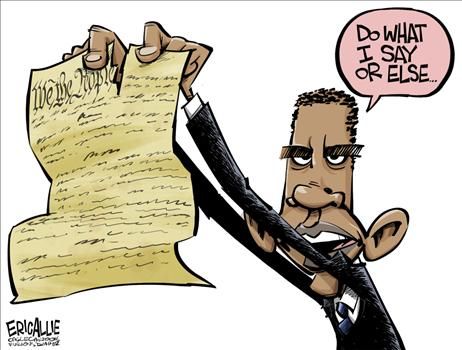
Spending and Morality

July 9, 2014

John Boehner and Barack Obama
During last year's budget negotiation meetings, President Barack Obama told House Speaker John Boehner, "We don't have a spending problem." When Boehner responded with "But, Mr. President, we have a very serious spending problem," Obama replied, "I'm getting tired of hearing you say that." In one sense, the president is right. What's being called a spending problem is really a symptom of an unappreciated deep-seated national moral rot. Let's examine it with a few questions.
Is it moral for Congress to forcibly use one person to serve the purposes of another? I believe that most Americans would pretend that to do so is offensive. Think about it this way. Suppose I saw a homeless, hungry elderly woman huddled on a heating grate in the dead of winter. To help the woman, I ask somebody for a $200 donation to help her out. If the person refuses, I then use intimidation, threats and coercion to take the person's money. I then purchase food and shelter for the needy woman. My question to you: Have I committed a crime? I hope that most people would answer yes. It's theft to take the property of one person to give to another.
Now comes the hard part. Would it be theft if I managed to get three people to agree that I should take the person's money to help the woman? What if I got 100, 1 million or 300 million people to agree to take the person's $200? Would it be theft then? What if instead of personally taking the person's $200, I got together with other Americans and asked Congress to use Internal Revenue Service agents to take the person's $200? The bottom-line question is: Does an act that's clearly immoral when done privately become moral when it is done collectively and under the color of law? Put another way, does legality establish morality?
For most of our history, Congress did a far better job of limiting its activities to what was both moral and constitutional. As a result, federal spending was only 3 to 5 percent of the gross domestic product from our founding until the 1920s, in contrast with today's 25 percent. Close to three-quarters of today's federal spending can be described as Congress taking the earnings of one American to give to another through thousands of handout programs, such as farm subsidies, business bailouts and welfare.
During earlier times, such spending was deemed unconstitutional and immoral. James Madison, the acknowledged father of our Constitution, said, "Charity is no part of the legislative duty of the government." In 1794, when Congress appropriated $15,000 to assist some French refugees, Madison stood on the floor of the House of Representatives to object, saying, "I cannot undertake to lay my finger on that article of the Constitution which granted a right to Congress of expending, on objects of benevolence, the money of their constituents." Today's Americans would crucify a politician expressing similar statements.
There may be nitwits out there who'd assert, "That James Madison guy forgot about the Constitution's general welfare clause." Madison had that covered, explaining in a letter, "If Congress can do whatever in their discretion can be done by money, and will promote the general welfare, the Government is no longer a limited one possessing enumerated powers, but an indefinite one." Thomas Jefferson agreed, writing: Members of Congress "are not to do anything they please to provide for the general welfare. ... It would reduce the (Constitution) to a single phrase, that of instituting a Congress with power to do whatever would be for the good of the United States; and, as they would be the sole judges of the good or evil, it would be also a power to do whatever evil they please."
The bottom line is that spending is not our basic problem. We've become an immoral people demanding that Congress forcibly use one American to serve the purposes of another. Deficits and runaway national debt are merely symptoms of that larger problem.

Chicago Democrats a protected species on the national stage

By John Kass
http://www.chicagotribune.com/
July 9, 2013

Chicago Mayor Rahm Emanuel and Jimmy Fallon discuss their polar plunge earlier this year on Tuesday night's "Tonight Show Starring Jimmy Fallon."
( NBC / June 3, 2014 )
Chicago Mayor Rahm Emanuel and Jimmy Fallon discuss their polar plunge earlier this year on Tuesday night's "Tonight Show Starring Jimmy Fallon."

Prominent Chicago Democrats have had an easy time with the national media for decades — as easy as shaking a ring of keys to distract an anxious child in church.
Former Mayor Richard M. Daley rode a bicycle in photo ops and put a few plants on the roof of City Hall, leading the national news networks to cast him as the "green" mayor, not as the absolute boss of a broken and corrupt political system that piled debt on the city and drained its future for the benefit of the insiders.
President Barack Obama appeared on the late-night talk shows as the mystical healer of America's broken politics, not as some untested suit who held the hand of now-imprisoned bagman Tony Rezko while learning to cross Chicago's political streets.
And Mayor Rahm Emanuel, Obama's former chief of staff?
He hangs with Jimmy Fallon and they tell jokes about jumping into a freezing Lake Michigan. Emanuel is as cool and practiced a media manipulator as the fictional Frank Underwood in "House of Cards."
But a headline of 82 people shot in Chicago in 84 hours is embarrassing to the mayor, particularly for a mayor who sees the fifth floor of City Hall as a mere stop on the road to his national political destiny.
So he held a news conference on the Far South Side this week, a familiar exercise, full of the necessary archetypes:
Wise neighborhood matrons flanking the mayor and nodding their heads in agreement. Grieving families in support, better there at his side than out on the street asking angry questions.
They talked of the need for everyone to step up to face the crisis, from community leaders to parents, federal officials, judges — everyone except, of course, the mayor of Chicago.
And he avoided the overriding question, again and again: When are we going to hire more police officers?
"Now, a lot of people will say, 'Where were the police? What were the police doing?' That's a fair question, but not the only question," the mayor said.
"Where are the parents? Where is the community? Where are the gun laws? Where are the national leaders, so we don't have the guns of Cook County, Indiana and downstate Illinois flowing into the city?"
Rattle those keys, Mr. Mayor.
A TV reporter asked him about tired police officers who've been working overtime because he won't hire more. Another reporter asked why New York and Los Angeles have lower homicide rates than Chicago.
"Well, thank you (for) your question," Rahm said, launching into a diatribe on gun laws, rather than on police staffing.
He's good at shaking keys. And some analysts bought his talking points, agreeing with City Hall that talking of police manpower was just too easy.
Too easy? What else is left? A miracle?
According to city data, overall Police Department staffing was about 12,250 at the start of this year, down almost 900 officers from the end of 2009. The Rahmfather has been hiring police, but not at a fast enough rate to keep up with attrition.
Just about every police officer I've talked to feels overworked and tired. They're worn thin. Morale is down. That's what month after month of overtime can do.
On Wednesday, Pat Camden, spokesman for the Fraternal Order of Police in Chicago, wasn't receptive to the mayor's policies during an interview with me and Lauren Cohn on WLS-AM 890.
"It would have been nice to hear the mayor saying, 'Where were the police? The police are out there doing their job, and if I had more police maybe we wouldn't have had so many shootings.' But that's not the way he operates," Camden said.
There's always money to be found when the politicians want to find it.
Some $50 million has been set aside for yet another monument to a Daley, a park named for the former mayor's late wife. And there's about $600 million or so for a lakefront project that includes a new athletic venue for DePaul University, although the Bulls and Blackhawks offered the use of the United Center rent-free.
And just before his last election, Gov. Pat Quinn found $54.5 million in state cash for a violence-reduction program now being investigated by the feds as a possible political slush fund.
There are not enough good-paying jobs on the predominantly African-American South and West sides. But there seems to be plenty of political cash to toss around.
Meanwhile, Democrats are encouraging waves of unskilled labor from south of the border to compete for what few low-skilled jobs still exist.
Families already savaged by decades of dependency on government programs continue to dissolve. Violence reigns. The giant street gangs have broken up into small and viperous neighborhood cliques.
Many children aren't allowed outside. I remember a detective telling me that for such children, it's like the "Hunger Games" out there.
But the political class in charge for decade after decade after decade — the Chicago Democrats — isn't ever held to account nationally.
When seen in the national news, they're about as green as forest ferns. Or they're all about soothing old political scars and healing divisions.
Or they're hip and they know Hollywood and can jump into icy lakes with late-night TV personalities.
All they have to do is rattle the keys, misdirect, smile and turn on the charm.
Twitter @John_Kass

Tuesday, July 08, 2014

Why Congress Must Reopen the TWA 800 Investigation

July 7, 2014

The partially reconstructed fuselage of TWA Flight 800 is pulled out of a hangar in Calverton, New York, on September 14, 1999.

On July 2, the National Transportation Safety Board (NTSB) announced that it would not reopen the investigation into the destruction of TWA 800.  This was the Boeing 747 that was blown out of the sky ten miles south of the Long Island coast on July 17, 1996, killing all 230 people on board.

The TWA 800 Project, a team of former aviation investigators and scientists, had petitioned the NTSB to examine evidence that pointed toward a missile strike on the airline.  Not surprisingly, the NTSB, which had invested four years of resources to prove some other theory, any other theory, chose to stick to its original findings that flammable fuel/air vapors somehow caused the explosion.

Books have been written on this subject – I co-authored one of them with James Sanders, First Strike – so readers can access the body of evidence for a missile strike on their own.  An excellent point of entry is the documentary produced last year by the TWA 800 Project, simply called TWA Flight 800 and now available via streaming on Netflix.

One of the six whistleblowers profiled in that documentary deserves special attention.  His name is Hank Hughes.  At the time of the explosion, he was a senior accident investigator for the NTSB and was a member of the “Go-Team” that headed immediately to the crash site.

Hughes was responsible for determining whether or not any proposed scenario for the cause of the crash was consistent with the damage to the airplane interior.  So disturbed was Hughes by what he calls an “egregiously conducted investigation” that he attached a detailed affidavit to the TWA 800 Project’s petition to re-open the investigation.  What follows is a summary of that affidavit.

As Hughes points out, Title 49 of the U.S. Code gives the NTSB full authority to investigate all commercial airplane crashes.  That did not happen with TWA 800.  The FBI was “immediately and overwhelmingly present” at the site and quickly took control of the investigation.  Initially, the agency did so, says Hughes, “under the presumption that a criminal act had occurred.”  Even in these circumstances, however, the FBI had no lawful authority over the NTSB.  Indifferent to the law, the FBI seized control, and the NTSB leadership yielded without protest.

As it happened, the FBI agents had so little experience in aviation disasters that Hughes had to give them a tutorial on evidence handling.  By that time, however, much of the damage had already been done.  Unlike the NTSB, which records interviews, FBI agents simply take notes.  As a result, the interviews the agents conducted with the hundreds of eyewitnesses were “neither thorough nor reliable.”  That notwithstanding, the FBI would not allow the NTSB to talk to the witnesses for months, and only then under strained circumstances.

Despite its collective lack of know-how, the FBI also kept NTSB investigators away from various pieces of wreckage.  FBI agents made a practice, in fact, of screening physical evidence before NTSB investigators could see it and “withheld wreckage with suspicious damage patterns for unknown periods of time.”  In some instances, the FBI took evidence from the reconstruction hangar in Calverton, NY without allowing the NTSB to see it or analyze it.  “These prohibitions were tantamount to undermining a federal investigation,” says Hughes, “and violated NTSB standard operating procedures and regulations.”

FBI agents were not the only culprits.  Hughes openly accuses the NTSB’s Dr. David Mayer of changing location recovery tags on the wreckage.  By reclassifying where in the debris field an item was recovered, a dishonest investigator could create a crash scenario to fit a more politically acceptable outcome.

“I personally witnessed Dr. Mayer changing wreckage recovery tags on interior wreckage components without proper authority,” says Hughes.  “Mayer’s changes falsified the factual record of the actual physical locations from which those components were recovered.”  When Hughes challenged Mayer, Mayer told him, “I didn't want to confuse the Chairman.”  That chairman was Jim Hall, an experience-free political appointee.

TWA investigators had independently come to distrust Mayer and made their objections known as well.  It troubled them and Hughes that several NTSB officials signed off on Mayer’s report despite the accusations of tampering.  These officials solved the problem by having a Navy captain, who knew little about the database problems, testify at a December 1997 NTSB hearing instead of Mayer.  In this way, says Hughes, NTSB brass “curtailed all meaningful discussion of the database details while protecting Mayer from being held accountable, criticized and/or embarrassed.”

The International Association of Machinists and Aerospace Workers (IAMAW) also expressed concern about the efforts of Mayer and others to alter the database.  Its coordinator, Rocky Miller, was told ominously by a top NTSB official, “If you believe in corporate memory, you will keep your mouth shut.”  To its credit, the union did not shy from telling the truth in its final report: “A high pressure event breached the fuselage and the fuselage unzipped due to the event. The explosion [of the tank] was a result of this event.”

Contrary to NTSB regulations, Hughes, although a group chairman, was not allowed to write an analysis of what he found.  The evidence his group gathered led him to much the same conclusion as the IAMAW’s.  The pattern of seat damage and passenger injuries strongly suggested not a low-speed fuel tank explosion, as the NTSB would later insist, but “a high-order explosion from a military-type explosive detonating a significant distance away from the airframe.”  Says Hughes, “This was the first time in my 26 years as an NTSB accident investigator that I had been ordered not to write an analysis.”

Hughes was not the only high-level investigator whose analysis was suppressed.  As he notes, Chief Medical Examiner Dr. Charles Wetli and the NTSB’s Aero-Medical Forensic Consultant, Col. Dennis Shanahan, M.D., were also told not to submit analyses of their findings.

The most spectacular bit of mischief involved the CIA.  The FBI had, for no good reason, commissioned the CIA to create an animation to prove that the 270 eyewitnesses who reported seeing something like a missile saw something other than a missile.  The CIA analysts concluded that what they saw was a noseless aircraft rocketing into space for another 3,500 or so feet before crashing into the sea.  This scenario, says Hughes unequivocally, “is physically impossible given what the FAA radar tracking data shows.”

According to Hughes, the CIA analysts knew this was impossible, but FBI honcho James Kallstrom went ahead and showed the animation at a wrap-up press conference to prove that there was “absolutely no evidence” that a criminal event destroyed the aircraft.

At both public NTSB hearings, the first in 1997 and the second in 2000, Kallstrom made sure there was no eyewitness testimony.  “The suppression of eyewitness accounts at an NTSB hearing was unprecedented,” says Hughes.  “This has never occurred before or since the NTSB investigation of TWA Flight 800.”  The aforementioned Dr. Mayer worked with the lead CIA analyst for sixteen months to align the witness accounts with the CIA’s impossible zoom-climb scenario.

There is much more, and I would invite those interested to read Hughes’s testimony in full.  “During the course of my 42-year career as an investigator,” Hughes concludes, “the investigation of TWA Flight 800 was the only case in which I witnessed deception, lies and corruption on the parts of investigators and their management. The extraordinary measures to which the NTSB, FBI and CIA went to falsify and distort witness statements or accounts of what occurred, to alter and hide physical evidence and to mount a false public relations campaign to misinform the public, was unconscionable.”

Given its need to protect the “corporate memory,” no one really expected the NTSB to open this potentially criminal can of worms on its own.  Now it is left to Congress, and if Congress does not act, no one will.

Page Printed from: http://www.americanthinker.com/2014/07/why_congress_must_reopen_the_twa_800_investigation.html at July 08, 2014 - 06:22:55 AM CDT


Not on Obama’s Texas Itinerary: The Border

The president is behind on the immigration crisis, but so is Congress. 

Monday, July 07, 2014

Today's Laugh Track: Stephen Merchant Presents: "If We Won" with Newcastle Brown Ale

'None of our business’ is no answer to Islamist terror

Syria is now a bloodstained souk for terrorist tradecraft – a steady stream of young British Muslims head to the Levant to train as holy warriors


By 
Ibrahim Hassan al-Asiri has been pegged by Western intelligence as the most dangerous man in the world. Al-Asiri, particularly skilled at devising tiny bombs, has been behind all the recent attacks conducted by AQAP. 

Tomorrow marks the ninth anniversary of the 7/7 bombings in London, in which 52 civilians were killed and more than 700 injured. I vividly recall the first reports of a “power surge” on the Tube reaching The Sunday Telegraph newsroom – and then the sickening reality dawning upon us by stages that the capital, still celebrating the previous day’s news that it was to host the 2012 Olympics, had been struck by a serious atrocity.
Tony Blair did his best to continue hosting the G8 Summit at Gleneagles while leading the country in grief and resolve. Less than a month later, he declared: “Let no one be in doubt. The rules of the game have changed. If you come to this country from abroad, don’t meddle with extremism, because if you do, or get engaged with it, you are going to go back out again.”
Nine years on, David Cameron’s Government is still struggling with the implications of that statement, tangled in the poison ivy of the European Convention on Human Rights and the controversies spawned by every attempt to define “extremism”.
And – despite occasional assertions to the contrary – the terrorists have not retreated, or been vanquished. On the eve of a bleak anniversary for London, its airports – and other airports handling Atlantic flights – have imposed a security clampdown at the request of the US authorities. In this instance, the Department of Homeland Security is acting upon intelligence suggesting a link between foreign fighters in Syria and the group operating in the Yemen, al-Qaeda in the Arabian Peninsula (AQAP).
Strategically, Islamic fundamentalism is awesomely adaptive, as resourceful in its use of digital propaganda – look at the flashy videos produced by the Islamic State of Iraq and the Levant (Isis) – as it is geographically mobile. It is one thing to target a training camp. Quite another to tackle a downloadable ideology, available on any laptop or smartphone.
The proximate cause of the present crackdown is a senior AQAP operative, Ibrahim al-Asiri, also known as Abu Saleh, a Saudi national and notoriously skilled bombmaker. Al-Asiri’s specialism is the construction of explosive devices using non-metallic components that evade airport detection machines. He was notoriously responsible for the underpants bomb worn by a young Nigerian man that failed to detonate on a Northwest airlines flight in 2009.
While Western wits sniggered at the idea of “boxer shorts that go bang”, al-Asiri pursued his researches relentlessly and is believed by several intelligence agencies to have made considerable technical progress. He exemplifies what John Reid, the former home secretary and one of the most intelligent occupants of that office, called the “fascist individual” – the new threat to our era, as Reid saw it, just as the fascist state imperilled the 20th century.
These antagonists work ceaselessly to exploit the structural frailties and loopholes of the Western system; to prove that their patience and ingenuity will always, sooner or later, defeat whatever measures we take to protect ourselves.
What is certain is that Syria is now the hub of global Islamist exchange – a bloodstained souk for terrorist tradecraft. Since the uprising against Assad began in 2011, there has been a steady stream of young British Muslims heading to the Levant to train as holy warriors and to undergo a rite of passage that will transform their status when they return to their radical groups in the UK.
Apart from anything else, it is easier to get into Syria than to make the long journey to Pakistan and thence to the Afghan borderlands – formerly, the principal home of these terrorist finishing schools. The aspirant British jihadi now sets off for Syria – often via Lebanon – to do what he sees as his Koranic duty.
He also makes contact with brother-fighters from all over the world. And it is this which troubles those engaged in counter-terrorism: the strengthening of a supply line between groups such as al-Asiri’s and smaller cells in this and other Western countries: a fizzing cable of human capital, knowledge and technical know-how.
These preparations for fresh terrorist attacks show how ridiculous is – and has always been – the claim that Islamist violence is a direct consequence of “Western foreign policy”. It is true enough that the fundamentalists object to “the Crusaders” and their military actions. But they also object to the West’s refusal to embrace sharia; to the fall of the caliphate; to the freedoms enjoyed by women and gay people in the West; to music (in the case of the Taliban); to Jews; to pluralism; to movies, television… and much, much else.
For Islamists, all war is “culture war”. To perceive their mission as simply a defensive response to military interventions is both historically illiterate and morally pusillanimous. Those who blamed the Iraq War for the 7/7 attacks missed the point spectacularly.
Indeed, if there is any connection between Western military action and the level of Islamist terror, it suggests, tentatively, a contrary trend. The 9/11 atrocities followed a period of relative inaction by the West, and certainly reflected al-Qaeda’s belief that the US was, in Osama bin Laden’s famous image, “a weak horse”.
One struggles to link al-Asiri’s apparent ambitions to a specific act by the West. Indeed, if anything, neo-conservatism and liberal interventionism are in general retreat. Barack Obama remains wedded to the principle that his presidency will be remembered for “ending wars, not starting them”.
The Commons vote against action in Syria last August was, in my view, a shameful moment. But it certainly chimed with a growing mood of isolationism and disengagement in this country and across Europe. Nigel Farage’s most reliable applause line was: “None of our business! None of our business!” Whether such rhetoric means very much in a globalised, interdependent world is open to question. But it certainly reflects the mood of the times. Ibrahim al-Asiri has no need to fear a fresh wave of “crusaders” marching towards him.
Even so: he still wants to kill us all. It has been bitterly ironic during the events to mark the centenary of the First World War to hear so many discussions about the errors made in the prelude to July 1914 and the failure during the conflict to understand its sheer novelty and the futility of applying old answers to new questions. In 2014, we are making mistakes that are grimly similar – refusing to acknowledge that this is a quite different form of battle, fought intermittently on many fronts, requiring stamina and patience of a sort that modern culture hardly encourages.
How much easier to dismiss the man in the hills of southern Yemen, laugh at the exploding underwear, and forget the whole thing. Meanwhile, like Conrad’s Professor in The Secret Agent, always armed with an explosive device “in a thick glass flask” to be detonated by an India rubber ball in his right hand, al-Asiri marches on: “He had no future. He disdained it. He was a force. His thoughts caressed the images of ruin and destruction.”

Sunday, July 06, 2014

The Supreme Court reins in government bullies

By George F. Will
July 4, 2014
Political Cartoons by Eric Allie
Two 5 to 4 decisions this week, on the final decision day of the Supreme Court’s term, dealt with issues that illustrate the legal consequences of political tactics by today’s progressives. One case demonstrated how progressivism’s achievement, the regulatory state, manufactures social strife and can do so in ways politically useful to progressives. The other case arose from government coercion used to conscript unwilling citizens into funding the progressives’ party.
Under the 1993 Religious Freedom Restoration Act (RFRA), any government action that substantially burdens religious practices will be subject to strict judicial scrutiny to determine if it, rather than some less intrusive measure, is necessary to achieve a compelling government interest. The Affordable Care Act, as supplemented by regulations, requires for-profit employers to provide health-care coverage that includes all 20 Food and Drug Administration-approved birth control methods.
These include four that prevent a fertilized egg from being implanted in the uterus. Some persons consider this tantamount to abortion and oppose these abortifacients for religious reasons. Why did Congress, having enacted RFRA, write this clearly incompatible birth control mandate? Congress didn’t.
In the ACA, Congress simply required health plans to provide “preventive care” for women. An executive branch agency decided this meant the full menu of 20 technologies. So, during oral argument in March, Justice Anthony M. Kennedy asked: “What kind of constitutional structure do we have if the Congress can give an agency the power to grant or not grant a religious exemption based on what the agency determined?”
The answer is: The constitutional structure we have is the kind progressives prefer, wherein more and more decisions are made by unelected and unaccountable executive-branch “experts” exercising vast discretion. In this instance, the experts were, to say no more, willing to provoke a predictable controversy that would be convenient for the Democratic Party’s “war on women” trope. Today, this war consists of subsidizing only 16 of 20 birth control methods. The court has held that some “closely held” businesses — often family-owned and adhering to religious practices — have a right under RFRA to wage this war.
The court’s other end-of-term case arose from overreaching by government employees unions and their Democratic allies. At issue were the First Amendment rights of people herded into unions after being made into government employees by government’s semantic fiat.
In the 1950s, about 35 percent of the private-sector workforce was unionized; today just 6.7 percent is. The labor movement and the Democratic Party’s funding depend on government employees, 35.3 percent of whom are unionized. So, in Illinois, two Democratic governors manufactured government employees out of home health-care workers, a growing cohort — and a tempting target for dues-hungry unions — in a nation with an aging population and many infirm elderly.
In 2003, an executive order from Democratic Gov. Rod Blagojevich, of fragrant memory, decreed that thousands of home health-care workers are government employees, which resulted in the Service Employees International Union being recognized as their representative. In 2009, anexecutive order from the current Democratic governor, Pat Quinn, designated even more home-care providers, who essentially are independent contractors, as government employees. The tenuous theory was that they are government workers because their pay comes indirectly from government — from the Medicaid funds received by the people who hire them.
Under a 1977 Supreme Court decision, which 26 states take advantage of, government employees can be forced to pay certain fees to unions even if the employees do not wish to be in the union and disagree with its positions. In last week’s case, the court carved out an exemption for people such as the home-care providers who are not “full-fledged” government employees.
This certainly seems sensible as applied to the lead plaintiff, a woman caring for her severely disabled son. Because the court has now recognized her First Amendment freedom of association — which includes the freedom not to associate — and freedom from compelled speech, she no longer will be required to pay fees to a union she refuses to join. SEIU will have to look elsewhere for the approximately $10 million in fees it has siphoned annually from people like her. This is real campaign finance reform.
Today’s court — nine fine minds producing written explanations of their reasoning about important principles — has its own discord. It is, nevertheless, a lagoon of logic in the forest primeval of today’s overheated politics and overbearing government. Twice this week the court played its indispensable role as constable, policing portions of this forest where progressivism has produced government guilty of gratuitous bullying.
Read more from George F. Will’s archive or follow him on Facebook.

How Not To Indict a Terrorist

The Justice Department’s charges against Khatallah are curiously sparse.