Tuesday, June 24, 2014

How are Obama and the IRS getting away with a blatant coverup?

By Kyle Smith
http://nypost.com/
June 21, 2014

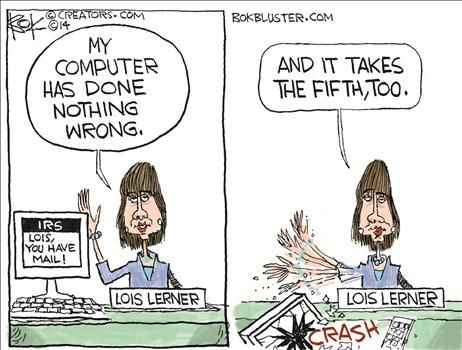
Political Cartoons by Chip Bok

To understand the latest outrage in the IRS scandal, mull over what might happen if regulators found significant evidence to implicate Goldman Sachs CEO Lloyd Blankfein in an insider trading scheme.
Let’s say Blankfein asserted his Fifth Amendment right not to answer any questions. Say Goldman was subpoenaed to provide all of Blankfein’s emails. Goldman replied that, instead of complying with the subpoena, it was itself reviewing the emails in question and was considering which ones to release.
Now imagine that, nearly a year later, Goldman admitted that it had not, in fact, reviewed the emails in question, because they had been lost in a computer crash two months before it claimed to be reviewing them. Imagine Goldman also said copies of the emails were lost, because while under subpoena, it had destroyed the “backup tapes” (whatever those are) that held them and that it had also thrown away Blankfein’s actual hard drive.
The thing about dogs eating homework is, it could actually happen. This can’t.
This is “The dog ate my hard drive, broke into another building, ate the backup of the hard drive, then broke into six other top officials’ offices and ate their hard drives also.”
What we learned about the IRS this week is that there is an obvious criminal coverup that comes in addition to the possible underlying crimes. Prosecutions need to be brought against all of those involved.
Why isn’t this happening already?
Remember the O.J. Simpson trial, the one that consumed seemingly the entire mid-’90s? From crime to verdict, the whole thing took 16 months.
The IRS scandal? It’s already been 13 months, and no one has even been charged. And no one will be charged. Congress has called the cops — the Justice Department — and the cops simply don’t care.
It’s as if Goldman’s only regulator was an SEC that was being run by Blankfein’s poker buddies.
Yes, the IRS scandal differs from Watergate. In Watergate, the president appointed an independent-minded special prosecutor to investigate. It was considered a scandal when the president fired that special counsel, Archibald Cox, even though Cox was succeeded within less than two weeks by an equally ferocious prosecutor, Leon Jaworski.
President Obama? He hasn’t even appointed a special prosecutor in the first place. That’s far worse.
In Watergate, we were outraged that President Richard Nixon ordered the IRS to go after political foes — even though the IRS refused to do his bidding. A Nixon ally was forced to whine that the IRS was controlled by Democrats.
There was evidently little or no evidence that IRS power was abused, because the second Article of Impeachment against Nixon charged merely that he “endeavored” to sic the IRS on enemies.
In the Obama administration, on the other hand, we know that the IRS went after political foes. We don’t know whether the president was involved, but if Nixon’s IRS had targeted liberals because it believed it had an implicit go-ahead from the boss, wouldn’t that be fairly disturbing also? Would a breezy dismissal from Nixon make you feel better?
Obama’s assertion that there was “not even a smidgeon of corruption” in the IRS’ attacks on right-wing groups does not reassure. Obama cannot have known there was no corruption given the mountain of evidence that has yet to be produced and now appears to have been destroyed. He could believe there was no corruption because he has faith in everyone who works under him, or he could know there was corruption and be lying about it, but he can’t know there was no corruption. It’s impossible.
For all he knows, there’s a Lois Lerner email that says, “I want you to go after these Tea Party bastards with everything you got. Use every trick you can to keep them on the sidelines for this election cycle. Nuke those fascists.”
Modal Trigger
IRS Commissioner John Koskinen is sworn in during a congressional hearing on the missing emails from the hard drive of former director Lois Lerner.Photo: Getty Images
Lerner wouldn’t have pleaded the Fifth unless she had reason to believe that there was potential illegality and it could be tied to her.
A likely explanation for Obama’s bizarre “smidgeon” remark is that his well-known fondness for left-wing opinion writers led him to simply parrot their dismissal of the scandal: If it’s good enough for Jonathan Chait, our president thinks, it’s good enough for me!
And here we come to a third major difference between the IRS’ apparent gross abuse of power and criminal coverup and Watergate: Watergate was a much bigger deal simply because the press was relentless about following up on every detail.
Today the media’s reasoning is roughly as follows: The IRS went after some conservative groups and is engaged in an illegal coverup. We also don’t like these groups, also believe they deserve special scrutiny, and also think there’s something inherently shady about conservatives (but not liberals) who try to buy political influence. If White House staff says they weren’t involved, we’ll take their word for it. Pardon us if we’d rather cover something more relevant to American lives today. Like the 82-year-old name of the football team that plays in DC.


Our Vacuous Foreign Policy

Our enemies have a strategic vision for a global conflict, but we don’t. 

Tony Gwynn: A superhero in the batter's box

Tony Gwynn, 54, gladly shared the science of his hitting with the world


June 16, 2014


As you walked through the doors of the San Diego Padres' clubhouse at Jack Murphy Stadium, into a rectangular room, Tony Gwynn's locker was in the far right corner, right next to the manager's office. Behind that, there was a small space, like a personal library, that served as Tony's science lab of hitting.
All were welcome, including reporters -- like me, when I was assigned to cover the Padres for the San Diego Union-Tribune in 1993 and 1994. Tony was one of the greatest hitters of all time, in the midst of a career in which he won eight batting titles and finished with a .338 lifetime average. But he also understood that if he made the game accessible to reporters through him, then that meant fans were included, too.
These days, every team in the majors has a mountain of video equipment and video operators. But Tony may well have been the first player to consistently use this technology in his constant search for hits. In fact, the video equipment that was in that little roombelonged to Tony; he had bought it with his own money.
[+] EnlargeTony Gwynn
AP Photo/Lenny IgnelziShortly after his election to the Hall of Fame in January 2007, Tony Gwynn acknowledged his fans.
So if you asked him a question about an at-bat, or something that he was doing at the plate, Tony would pull you into a side room and run back the video and narrate what was on the screen for you. Once, he mashed a pivotal hit against the Dodgers, and afterward, he explained to me exactly what he had said to a teammate in the on-deck circle --- that Omar Daal would try to beat him with his little (expletive) slider and then he would turn on it and drive it into the gap. He spoke anecdotally, with exceptional recall of context and words, and painted pictures. When he laughed, his shoulders shook, and he laughed a lot when talking about the daily challenges of playing a game filled with failure.
No wonder Ted Williams loved talking with him and Tony loved talking with Ted; they spoke the same language, had the same precise understanding of what they wanted to do with each pitch of each at-bat.
Gwynn had chronic knee troubles in the early '90s; but in 1994, he was relatively healthy, and he was hitting better than he had in any season of his career. In late July, the Padres took a trip through Los Angeles, Chicago and Houston; during those 10 games, he had 19 hits in 40 at-bats, with one strikeout, pushing his batting average from .386 to .394.
He had a bat that he used only against pitchers who relied on soft stuff -- a special bat because it had so few grains. "Nine Grains of Pain," he called it, and he told me that if he got to the final weeks of the season and he had a shot to reach .400, he intended to use that bat in every game. In the world of hitters, this was like Clark Kent telling you he was about to jump into a phone booth. He had the smallest bat in the league, maybe the smallest hands, the softest handshake -- as if he were protecting the tools of his trade -- but the man was a superhero in the batter's box.
The players went on strike in August of '94 and Tony didn't get the chance to do the same thing his friend Ted had done. Whenever an athlete nears an achievement, part of the conversation is whether he or she will melt under pressure, whether the scrutiny will reduce them. Tony would've loved the pressure of a chase at .400. He would've held court before the game and after, talking baseball, and in between he would've gotten one or two or three hits. I will always be convinced that he would've hit .400 that season. I'm sure of it. He loved the stage.
He played in one more World Series after that, in 1998, and naturally, he had eight hits in 16 at-bats. Perhaps he could've steered his career to a bigger market and had more postseason opportunity, but Tony and his wife Alicia had long since decided that he would stay in San Diego. He had been born in Southern California, set the all-time assist record on San Diego State's basketball team, and time and again he had signed long-term, team-friendly deals to stay with the Padres. He told me about angry phone calls with union leaders who wanted him to push the market; but as genial as Tony could be, he was stubborn and independent and nobody was going to tell him what to do. He wanted to play in San Diego and he never wore a uniform other than that of the Padres.
[+] EnlargeTony Gwynn
AP Photo/Kent HornerTony Gwynn played 20 years in the majors and finished his career with a .338 batting average.
After 1992, the Padres ownership decided to dump almost all of its best players, believing they couldn't support their salaries. And so one after another, Tony Fernandez and Darrin Jackson and Gary Sheffield and Bruce Hurst and Greg Harris and Fred McGriffwere swapped in what became known in San Diego as the fire sale. Only Gwynn and Andy Benes were left among the team's established players, and the team went 61-101. The morning after the McGriff trade, my responsibility was to find Gwynn and ask him about the franchise being stripped down. I knew he was disgusted, but didn't know whether he would want to talk.
"Buster, are you looking for me?" Gwynn said, after I stepped into the clubhouse, and then he led me to his science lab of hitting and spoke for 30 minutes -- honestly, plainly, in his distinct high-pitched voice.
Tony got mad at me once that I recall. His father passed away during the offseason, and the following spring, I wrote a long story about it. So many of the people that I spoke to about his dad referred to him as Charlie, in conversation, and this is how I referred to him in the article. It turned out that Charles Gwynn did not like the nickname, and because he didn't, Tony didn't. It was a mistake that hurt, because Charles Gwynn was just 57 when he passed away, and was gone far too soon.
I had thought of Charles Gwynn a lot through the years, fearing for his son's health; and after Tony was diagnosed with cancer, his former players and friends provided updates.Stephen Strasburg, who played for Gwynn at San Diego State, was worried about him, and so was John Kruk, who couldn't get a phone call returned recently. Tony was open in talking about baseball, but he hated anybody feeling sorry for him, and his fight with cancer was private.
Last Thursday, John Boggs, Gwynn's close friend and longtime agent, spent some time with him; and Sunday, he had called Gwynn to wish him a happy Father's Day. The phone was put on speaker, and Gwynn's family told him: "Speak up, he can hear you."
Boggs received a call from Alicia Gwynn at 1:15 a.m. Monday, as he recalled tearfully over the phone. He paused and said, "It hits me in waves."
Tony Gwynn was 54, at the end of a gifted life that he shared with so many others.


http://espn.go.com/mlb/story/_/id/11092918/mlb-tony-gwynn-love-hitting

Tony Gwynn was a joy to watch at the plate, and in life

By Tom Verducci
June 16, 2014


What Tony Gwynn did even better than "carving" base hits through "the 5.5 hole" between third base and shortstop -- something he did so often and so well he owned the concept the way Willie Mays did the basket catch and Sandy Koufax the curveball -- was to make people smile. Gwynn loved baseball through and through. He could not hide his enthusiasm for feeling the dirt and grass under his feet, which is why after hitting .338 over 20 years of major league baseball and earning $47 million he went to San Diego State to coach college kids on how to play and love this beautiful game.

Quick: name another Hall of Famer in baseball's era of economic boom who took to coaching college kids. Stuck? Thought so.

Today baseball is a little less beautiful. Tony Gwynn and that sweet smile and infectious, childish giggle of his are gone. Gwynn died at age 54 after a four-year battle against cancer in his salivary gland, a vicious disease that people will connect to his use of smokeless tobacco, the vile habit that is still too common in the game.


Gwynn's Hall of Fame plaque calls him "an artisan with the bat," and one of the great pleasures for anybody covering baseball in the 1980s and '90s was to sit down with the artisan and talk hitting. Gwynn was as prolific a talker as he was a hitter, the observations and theories flying from him like line drives sprayed around the outfield.


Only once did I see Gwynn's cherubic face turned sour. It was after Game 1 of the 1998 World Series. Batting against New York's David Wells in a tie game in the fifth inning, Gwynn crushed the first pitch into the upper deck in rightfield at Yankee Stadium. The renowned singles hitter had just made like the Bambino himself. Jaws dropped in the press box. The Padres would lose the game, but the writers made their way to Gwynn afterward to learn more about this uncharacteristic home run. Now, Gwynn was the go-to guy in the San Diego clubhouse whether the Padres won or lost, whether he went 4-for-4 or 0-for-4. He was always available, insightful and courteous. And yet this time, when reporters didn't hide their astonishment that Gwynn had hit a ball so high and so far, Gwynn barked back a bit. He barely looked up and gave a clipped answer. His pride was hurt.

After the group session broke up, I walked up to Gwynn and complimented him on showing the restraint that he did.

"Have they seen me play before?" he said to me. "It's not like it's the first home run I've ever hit. I've hit a few before and I've hit a few longer than that. Give me a break."


Indeed, while the singular skill of shooting line drives through the hole into leftfield defined him, it also overshadowed his athletic excellence. In 1987, Gwynn hit .370 while stealing 56 bases. It remains the only time in the past 92 years anybody hit .370 with at least 50 steals. The only other players to ever do so were George Sisler, Ty Cobb, Tris Speaker and Benny Kauff.

Gwynn played 20 years and never struck out more than 40 times. He had more doubles than strikeouts in his career. In fact, he is one of only five players in the history of the game with more than 500 doubles and fewer than 500 strikeouts, keeping company with Hall of Famers from eras long gone: Paul Waner, Charlie Gehringer, Tris Speaker and Nap Lajoie. He had the bat control of a deadball star in the modern game while still flashing extra-base power.


Gwynn enjoyed a great friendship with Ted Williams and talked hitting with his fellow San Diegan on levels only the virtuosos understand. Williams loved to talk about the barrel of the bat coming up to meet the baseball with a slight angle; Gwynn simply dropped the barrel down and through the baseball with a bat so small he used to refer to it as his "peashooter."

Gwynn was a fervent student of the game. He was one of the first players who dove into the video age. His wife would travel around with a video cassette player -- the old Betamax used in those days was as big as a suitcase -- and tape his at-bats. Gwynn would watch the tapes after games in his hotel room on the road. Sometimes he would cover the TV set with a sheet of plastic wrap and draw with a wax marker, often to make sure his head didn't move during his swing or that his body kept its center of balance.

Gwynn seemed to have the mysteries of hitting figured out better than most, like one of those Rubik's cube masters who can solve the puzzle blindfolded in seconds. And yet he worked and studied at his craft more than most. Baseball never seemed to be work for the man who was called "Mr. Padre."

All of his amazing numbers, however, don't tell the true story of Tony Gwynn. He was an ambassador not just for the game of baseball but for mankind. His dignity and modesty were remarkable in any age, but especially this one, in which the individual who shouts the loudest about himself gets the most fame, and we have confused fame with character. Gwynn won the 1995 Branch Rickey Award, the 1998 Lou Gehrig Award and the 1999 Roberto Clemente Award, all honors given to baseball players for their character and humanitarianism, not just their batting skills.

Gwynn will be missed by those who never met him for his extraordinary skills at a very difficult game. He will be missed by those who knew him, whether for a minute or a lifetime, for his smile and his generosity. He is gone much too soon, and deserves every one of the tributes and honors that will mark his passing, none of which would be greater than the next ballplayer who gives up smokeless tobacco.


Read More: http://sportsillustrated.cnn.com/mlb/news/20140616/tony-gwynn-obituary-san-diego-padres-hall-of-fame/#ixzz35YOZvDX2

Tony Gwynn used fear as motivation

But the pressure he put on himself led to an addiction to chewing tobacco


June 17, 2014


SAN DIEGO -- In late April, I surprised him at the hospital. He was in a wheelchair. His hair was fully gray. He couldn't open his right eye. He could only halfway open his mouth. He was on oxygen. The purest hitter of our generation was dying.
You can't prepare yourself for that. Not when you knew him like I did. I was a rookie Padres beat writer in 1985; he'd won his first batting title in 1984. I knew him when his vision was 20-10, when he considered 1-for-4 a bad day at the office, when he used to write "5.5 hole" on his cleats. That day in the hospital, I would have done anything to see a youngTony Gwynn again. And then I looked down at his feet. He was wearing his old baseball shower shoes. On them was his scribbled number: 19. He was 19 to the end.
•  •  •
He thought I came to write about him that day. But I was really there to cheer up the man who spent 20 seasons cheering up a city. To live in San Diego is to live and breathe Tony Gwynn. My 12-year-old son, born a year after Gwynn retired, wore No. 19 in Encinitas Little League. He and a thousand other kids in town. Petco Park's address is 19 Tony Gwynn Way. His statue sits right behind where he played: right field. If the name Cal Ripken says Baltimore, then the name Tony Gwynn says San Diego.
[+] EnlargeTony Gywnn
Andy Hayt/MLB Photos/Getty ImagesSince the day his career began, Tony Gwynn was the face of San Diego baseball.
He played basketball and baseball at San Diego State. He was drafted by the Padres and the San Diego Clippers on the same day. He played here 20 seasons. He could have left via free agency any number of times -- because the Padres are in a small market and let player after player walk -- but Gwynn always took "the hometown discount.''
Other Gwynns kept following him to the club. His brother, Chris, had an RBI for the Padres on the last day of the '96 season to beat the Dodgers and clinch the division. Tony's son, Anthony, would later roam the outfield for the Padres, too. Tony's daughter, Anisha, sang the national anthem here.
This may be a beach town, but Tony made it blue collar. He was the first big league hitter to videotape and watch every one of his at-bats. I would get to the ballpark at 2:30 p.m. for a 7 o'clock night game, and there was Tony, all alone, taking early batting practice. He thought he was a terrible hitter; that's what made him a Hall of Famer. That's why he was able to win eight batting titles and have a career average of .338, the highest since his friend and fellow San Diegan Ted Williams. Tony always told me he was motivated by fear -- fear of going 0-for-5. At 2:30, every day, he'd hit upward of 100 balls to the 5.5 hole -- between shortstop and third -- and then lope back to the clubhouse ...
For another pinch of chewing tobacco.
•  •  •
I guess, if you want to get technical, baseball killed him. Because he first began to chew at rookie ball in Walla Walla, Washington. He was so paranoid that his swing would fall to pieces overnight that he would dip smokeless tobacco to take the edge off.
He told me he had the same morning habit for years -- brush your teeth, then fire in a dip -- and that he would go through a can and a half of Skoal a day. I remember the cup he used to keep by his locker to spit into. One day at home, his young son, Anthony, thought that cup was full of juice and took a sip. "It was gross,'' Anthony told me once. From that moment on, Anthony vowed he'd never chew.
But it was too late for Tony. "I was addicted," he once told me. He would sneak out of his house late at night -- "like a criminal,'' he said -- to buy his tobacco at a convenience store. If his wife, Alicia, had known, she would've socked him. She wanted him to quit, begged him to quit, threatened to leave him if he didn't quit. He tried bubble gum, sunflower seeds, pumpkin seeds and synthetic chew, but baseball wasn't baseball without the real stuff.
"I'm a tobacco junkie,'' he told me.
Until it gave him cancer of the salivary gland in 2010.
•  •  •
Cancer -- talk about a fastball to the head. He worked to beat it the same way he worked to go to the 5.5 hole. At the time of his diagnosis, he was the head baseball coach at San Diego State and promised them he'd be back after facial surgery, chemo and radiation. But when he returned, his face partially paralyzed, it was hard to look at him, hard to face this fact: Tony Gwynn didn't have the strength to smile. What had made him special -- and this may be part of his legacy -- is that he was the most congenial superstar I ever came across in my 30-year career. His laugh -- part hyena, part grammar school -- would enter the room a minute before he did. You could hear his giggle a half-mile away. Cancer took that away.
He beat it temporarily, but then the growths came back ... and came back again. His father, Charles, had died young of heart problems. Death crossed Tony's mind a lot. When I visited with him at the hospital, he thought I had come to write his obit. About a week earlier, there'd been a mishap during one of his cancer treatments. From what I'm told, he'd lost oxygen and was suddenly barely able to move. It was almost like a stroke, and he was sent to a rehab hospital to learn how to walk again. He knew his body was failing. He knew something perilous had happened to him, and he wasn't going to lie: He was scared.
I wanted to change the subject, so I brought up baseball. For the first time all day, he lit up. His greatest moment was his home run at Yankee Stadium in Game 1 of the '98 World Series, off of David Wells. His most disappointing was the '94 baseball strike. His batting average was .394 on Aug. 11, 1994, the day the players went on strike. If he'd had four more hits -- either four dying quails or four lucky nubbers -- he would have finished at .400, the first hitter to do so since Williams. Without the strike, I believe Gwynn would have done it, and he did too. He could've handled the media scrutiny. He would've taken his early BP at 2:30 and been all smiles at 6:30.
[+] EnlargeTony Gwynn
Ron Vesely/MLB Photos/Getty ImagesIf not for the MLB strike, there was a good chance Tony Gwynn would have hit .400 in 1994.
So his baseball life hadn't been perfect. Over the years, teammates were jealous of his popularity (see Jack Clark), and even upper management seemed threatened by him. Maybe he'd gotten too big in town for them. How he was never hired as the Padres' hitting coach is beyond me. They could've talked him out of coaching at San Diego State. They could've done more than just hire him as a broadcaster. John Moores, the owner when Tony retired, promised him a lifetime contract in 2001. But over the years, the two drifted apart.
It has ended badly and sadly. But I choose to remember the young Tony Gwynn, who despite his cherubic appearance, once stole 56 bases in a season. I remember him working on his defense in the offseason -- the same way Michael Jordan worked on his jumper -- and then earning five Gold Gloves. I remember doing a story on him and Don Mattingly in 1986, about a contest in which they were both supposed to hit a button when lights flashed -- to see who had the quickest reactions and the keenest eyesight. They were both in their prime at the time, and Mr. Padre whipped Mr. Yankee.
But I also will never forget that day at the hospital this April. Tony was trying to get his hands and arms to work again, and a therapist sat him in front of a series of lights -- just as he and Mattingly had done in '86. It had been 28 years. There had been three cancer surgeries, there had been weight gain. Tony was slow. He was frustrated. It wasn't fair. He used to have 20-10 vision; now he could barely see out of his right eye.
But he said he was hanging in, that he was looking forward to watching his Anthony play for the Phillies that night on TV. Just the sight of his kid trying to go to the 5.5 hole was enough to keep him upbeat. But first he wanted to take a rest. He was tired. So I said goodbye for the last time.
It was 2:30.

I Was Tony Gwynn's Bat Boy

June 17, 2014
The baseball-card collection I had as a teen—145,000 cards in all when I last bothered to count, 800-count box after 800-count box, all of them occupying a dusty bookcase in my bedroom—was sold years ago. Some random stranger now owns that collection of 400 Tom Glavine rookie cards I bought on speculation at $.04 each. (I haven't checked Beckett recently, but I'm sure that investment has more than doubled.) The tiny handful of cards I kept each serve a purpose. Some remind me that people are idiots (Bill Ripken's "Fuck Face" card); some remind me that we all start somewhere (Ken Griffey Jr.'s San Bernardino Spirit card), and others remind me, as if I need reminding, that Tony Gwynn was one of the finest human beings I've ever met, and that the world is cheaper without him in it.
Most 10 year-old boys walk through life searching for a hero. I found mine in the form of a chubby singles hitter from San Diego State University. I began to actively idolize Tony Gwynn in 1984, the year the unassuming team in Mission Valley put together something magical and made lifelong fans of a collection of people who mostly thought of the ballpark as somewhere to hang out on Sunday afternoon if you were tired of the beach.
I wasn't alone in my worship among my friends, but I tried to do it best. Most of my friends had a Tony Gwynn poster on their walls—I had at least eight. Tony Gwynn growth charts. Tony Gwynn sliding into home. Tony Gwynn in a "Hitting Machine" poster, done up in the style of architectural renderings to capture the mechanics of his swing. Newspaper clippings covered my door. Shirts, mugs, hats, you name it—all bore Tony's face. I would mentally recite Tony's biography to myself each night instead of counting sheep. ("Anthony Keith Gwynn was born on May 9, 1960. His parents were Charles and Vandella Gwynn. He had two brothers, Charles and Chris …").
These were the late 1980s. Back then, a kid's illusions about his sports heroes were much harder to shatter. There was no social media to lift the veil and let you see the plain truth. Talk radio was fairly sanitary, especially in sleepy little San Diego. The local newspaper may have had harsh words, but those were reserved for upper management—the players, especially Tony, were granted a decorous exemption. So my idolatry continued unchecked. I collected Tony's cards and had a few chance encounters with him over the years, like the time I was introduced to him by my neighbor's ex-husband who happened to be his college roommate. (I told you San Diego was a sleepy little town in those days.) I continued to recite his bio, which I updated to include each passing season, the birth of his kids, his stats, to get myself to sleep. "Tony's son, Anthony Gwynn Jr., was born on …"
In 1988, I wrote a letter to the San Diego Padres, saying I wanted to be a bat boy. I was 13. "Write back when you're 16," they replied. I did, and, miraculously, I got an interview. Utterly lacking the connections that land most bat boys the job, I put together a "résumé" (work experience: mowing lawns; education: 3.67 GPA through 11th grade), letters of reference (from a soccer coach, my fifth-/sixth-grade teacher, and my science teacher), and a personal statement. Somehow, I got the job. My first day of work was March 31, 1991, and I was tasked with unloading the team truck, freshly arrived from spring training in Yuma, Ariz. I spent seven hours that night hauling huge boxes out of a semi truck. I drove home covered in sweat and moths. I loved every minute.
My title was "Bat Boy, San Diego Padres." It was a primo job for a 16-/17-year-old. Free parking pass! Free tickets to every game! Free team ID card! Seats in the dugout for half the game, seats down the foul lines for the other half! None of that mattered—leading up to the season, the only thing I knew was that I was going to be working alongside Tony Gwynn. We were going to be co-workers! If any teammates tried to cut him down, like the treasonous Jack Clark had years before, I'd stand up in the locker room and defend him! We'd become friends! These are the thoughts of a 16-year-old kid about to work within spitting distance of his hero.
You know where this story ends for most kids. They idolize a figure they know from afar, they get an improbable chance to meet the guy, and he turns out to be a bum. He cheats on his wife. He kicks over trashcans. He shouts at clubhouse attendants. My first day at the stadium, I stood getting dressed in my sparkling new uniform in the bat-boy locker area, which was tucked around a corner from the main locker room, and located about 10 feet from the bathroom. Players filed by, most of them ignoring us. Suddenly, he appeared.
"Hey," he said to me, holding out his hand. "I'm Tony. How are you?" Flustered, I stammered, "Uh, nothing much." He laughed.
He laughed! Have you noticed that the tributes to Gwynn all seem to mention his laugh? The man's laughter illuminated the room. "Best sound I've ever heard in my life," ESPN's Chris Berman said in the locker room one day, after I'd sheepishly hauled out my Chris Berman baseball card and asked for his autograph. Somebody—my memory says it was Bruce Hurst—said, "I know that's your rookie card, Chris, 'cause you've got hair in that photo." Tony laughed for the next five minutes straight, literally holding his sides he was laughing so hard. The joke was lame, but who cares? If the payoff is hearing Tony Gwynn laugh for five minutes, I'll sit through anything.
One day, one of the bat boys showed up wearing an earring. Bright gold and massive. The Giants were in town. During batting practice, Will Clark walked by and sneered, "Nice earring,faggot." The words were stunning, but we knew we had to react like it was no big thing. News must've gotten around, though, because before the next game, Tony walked back to the locker room area with Bip Roberts and performed an entire routine for us. They had evidently practiced it during batting practice. They stood lecturing us, using every "how to talk like an older white guy" cliché in the book. "Now listen, son," Tony started, stopping periodically to catch his breath, as he was laughing too hard. "You're bringing down the team here, with that earring." "Very, very unprofessional," Bip added, haughtily. They walked away, howling with laughter, the point made: Will Clark was a dick.
Before one game, early in the season, I stood out in right field during batting practice, arms folded. Tony walked over. "Want to toss?" he asked. Trembling with nervousness, I said, "Yeah," and tried to act like this was nothing to me. My first toss went about 30 feet over his head. He laughed and ran after it. Second toss, only 15 feet over his head. He jogged over to me. "How are you holding that ball?" he asked. I showed him my grip. "Well hell, that's all wrong." A 10-second lesson, and we were good to go. He fired a rocket to me. I fielded it cleanly and threw it back using my new grip. This time only five feet overhead. He laughed again, harder this time. I got myself under control, and we threw for 10 minutes, just us. At one point I stopped, realizing that some kids were watching. They were watching me. They were watchingme playing catch with Tony Gwynn. I could read their thoughts: "That kid is so lucky." I was. On my way back to the clubhouse, one of the kids, some poor 6-year-old totally overcome by the moment, asked me for my autograph. I signed his program. Tony watched. He laughed the whole time.
I wonder what it must be like to know that you have a destabilizing effect on people. Some people use this knowledge to their own benefit. The Padres' catcher that season, Benito Santiago, was a renowned curmudgeon—that's a polite way to say he was a complete and unrepentant asshole—and he relished his bad reputation. "You can tell the manager that he may suck Benito's ass," he told me one day when I brought around a dozen baseballs the manager wanted signed for a charity auction. "Um," I told the manager, "Benito was busy."
Tony went the other way—he knew he had a profound effect on us, and he embraced it. He talked to us. He asked us about classes. He asked us if we were dating anybody. (Hey, Tony, I never told you this, but that girl I told you about, the one I said I really liked but who didn't like me back? We've been married for 12 years. We've got two kids. You were right.)
The last homestand of the season, Tony's official Nike catalog showed up in our locker one day, with a note in his familiar handwriting. "Pick a pair," the note said. We each happily circled a pair with the pen he provided. Later that week, before a game, the shoes appeared in our locker, along with a check for $500 for each of us. I didn't even care about the money itself—THIS WAS A HANDWRITTEN CHECK FROM TONY GWYNN. ADDRESSED TO ME. (I think I waited five months to cash that damn check. When I did, the bank teller's eyes got big and she looked down at the check, up at me, down at the check.) A few games after the shoes appeared, the equipment manager, our boss, told us: "You know, Tony drove down to Foot Locker himself and bought those shoes for you guys. You probably thought he had them delivered or something. But he went down there. That's what he does."
When kids have heroes, they tend to build them up into something unsustainable, something doomed to crumble, and years later, as adults, they look back on the their old enthusiasms with gentle condescension. On Monday, I turned on my computer and the words "Hall of Famer Tony Gwynn dies at 54" hit me square in the chest. I lost my breath for a minute. In that instant, dozens, hundreds of memories of Tony flashed through my mind. And each one remains good, clean, and perfect in its own way.
Here's one: I was 12 or 13, hanging out near the player's parking lot after the game, waiting for autographs. Tony was the big "get," and I sat there for a good three hours after the game. Suddenly, he appeared. He looked so normal, wearing jeans and a polo shirt. He walked over to his truck, a 4x4 with PADRE19 as the license plate. "Tony! Tony!" I and a few other die-hards shouted. He walked over cheerfully and signed stuff we could fit through the fence. He signed my baseball card and handed it back to me. "Tony," I said. "Thank you." He looked right back at me: "You're welcome." That killed me. It still kills me. It was the simplest gesture; it was the kindest.

David Johnson was born in San Diego in 1974, spent the 1991 season as a bat boy for the San Diego Padres, went to college in Minnesota, and has been slowly drifting back West ever since. He currently divides his time between Portland and Eugene, Ore. (Go Ducks!), where he toils in the salt mines of academia.