Monday, May 19, 2014

Lessons of the VA Scandal


Lengthy wait times, bureaucratic abuse, rationed care: par for the course in government-run health care. 

By John Fund
http://www.nationalreview.com/
May 19, 2014


If our government has any obligation to fulfill its many promises on health care, it should be first and foremost to the men and women who served in our armed forces. But the scandal over hidden waiting lists at a growing number of veterans’ hospitals (seven so far) — wherein dozens of veterans died while waiting months for vital treatment, and the VA covered up the lengthy wait times — should make everyone wonder whether we can place our trust in a government-managed health-care system. The Dayton Daily News reported on Sunday that its investigation of a database of claims paid by the Department of Veterans Affairs shows that the words “delay in treatment” were used 167 times. The VA paid out a total of $36.4 million to settle the claims. There could well be many more cases of “death by delay” at the VA that never came to light.

Are there lessons in the VA scandal for the rest of us if Obamacare survives and even expands?

You betcha. The first lesson is that as government expands taxpayer subsidies for health care, the demand will always outstrip supply. Here is President Obama in a speech to disabled veterans in August 2013:
The last time I was with you, I pledged to cut the backlog, slash those wait times, deliver your benefits sooner. And I’m going to be honest with you; it has not moved as fast as I wanted. Part of it is all these new veterans in the system who came in — Agent Orange, PTSD. It means a lot more claims, and despite additional resources, it’s resulted in longer waits. And that’s been unacceptable — unacceptable to me, unacceptable to [Department of Veterans Affairs] Secretary [Eric] Shinseki.
A few weeks later, President Obama had to admit that he found the fiasco of the HealthCare.gov website also “unacceptable.” Last week, his aides told reporters he was “madder than hell” over the veteran waiting-list scandal.

There’s a lot to be mad about at the Department of Veterans Affairs. Michael Tanner of the Cato Institute notes that more than 344,000 claims for veterans’ care are backed up and waiting to be processed. 
It takes an average of 160 days for a veteran to be approved for health benefits, and the VA itself estimates that is has an error rate of at least 9 percent in processing claims. According to VA figures for 2012, as reported by the Washington Post, “a veteran who takes an appeal through all available administrative steps faces an average wait of 1,598 days.” That’s more than four years of waiting.

Obamacare will dramatically expand access to the health-care system at the same time that many surveys show doctors are likely to retire or cut back their hours. It is almost inevitable that we’ll see more waiting-list scandals as the need to ration care grows.

This is the record of many single-payer health-care systems, and both Obama and the Senate majority leader, Harry Reid, have said that establishing a single-payer system is their long-term goal. In 2003, Obama, then an Illinois state senator, told an AFL-CIO conference: “I happen to be a proponent of a single-payer universal health-care program. . . . But as all of you know, we may not get there immediately.” Similarly, Majority Leader Reid told a PBS interview show in Nevada, in October 2013: “What we’ve done with Obamacare is have a step in the right direction, but we’re far from having something that’s going to work forever.” When he was asked by a panelist whether he meant that ultimately the country would need a health-care system that abandoned insurance as the means of accessing it, Reid said: “Yes, yes. Absolutely yes.”

But, if the experience of other countries is any guide, a single-payer health-care plan or even government-managed care brings all kinds of waiting lists with it. In 2012, it was discovered that more than 7,000 patients in just a few Scottish hospitals had been wrongly removed from waiting lists for surgery in order to pretend to meet government targets for treatment. One trick was offering to perform surgery on a date when hospital officials knew a patient would be away on holiday, then dropping the patient from the wait list for “refusing” the date.

Sarah Boyack, a member of the Scottish Parliament, called the figure of 7,000 “astonishing,” given that “an extra five million pounds [$8 million] has been pumped into the NHS [National Health Service] to help cut the waiting list” in the affected hospitals. 

Not that NHS patients in hospitals without waiting-list scandals are that much better off. In all of the United Kingdom, NHS patients wait an average of about eight weeks for treatments that require admission to a hospital, four weeks for out-patient treatments, and two weeks for diagnostic tests. While NHS patients have a choice of hospitals, they cannot always choose their specialist.

The situation in Canada, a nation whose government-run health-care system has long been touted by liberal supporters of government in health care, is also dire. Last year, the respected Fraser Institute published a study on Canadian wait times for surgery. Among its finding are these:
In 2013, those requiring orthopaedic surgery were forced to endure waits of more than nine months (39.6 weeks) to receive treatment, while others had to wait for slightly more than four months (17.4 weeks) just to receive an appointment with a neurosurgeon. On the other hand, cancer patients in line for radiation therapy faced the shortest expected wait times for treatment after referral by a general practitioner (3.5 weeks). 
Currently, one in 34 Canadians may be in pain, off work, or suffering from depression as they wait their turn for treatment. 
The 2013 median waiting time of 18.2 weeks is about three days longer than 2012, and substantially longer than 1993 when it was just 9.3 weeks. 
Bacchus Barua, the Fraser Institute’s senior health-policy analyst and the report’s lead author, writes: “Simply putting someone on a list is not the same as providing necessary medical attention in a timely manner.”

The veterans’ hospital scandals now in the news in the United States show just how bad things can get when the pressure of patient demand and waiting lists affects bureaucratic behavior. As many as 40 veterans reportedly died at a Phoenix veterans’ facility because they couldn’t get the care they needed. VA administrators there and at other hospitals apparently covered it up by establishing secret waiting lists and falsifying reports.

No one is suggesting that such scandals are widespread in the general health-care system. But they should serve as a warning sign of what could happen as the pressure to ration, inherent in all government-managed health care, is applied to the general population.

— John Fund is national-affairs columnist at National Review Online.

Whittaker Chambers's Anxious Age


May 19, 2014

Whittaker Chambers

In his compelling recent book, An Anxious Age: The Post-Protestant Ethic and the Spirit of America, Catholic author Joseph Bottom argues that the modern left is a religious movement.Liberals, like everyone else, crave the self-esteem that comes with being virtuous. It's just that their virtue comes from dogmatic adherence to and promotion of the canon of the modern left: environmentalism, feminism, and socialism.
Bottom traces the religious urge of the modern left back one hundred years to Walter Rauschenbusch, the Baptist minister who helped promote the Social Gospel movement that held that there were six key sins: bigotry, the arrogance or power, the corruption of justice for personal ends, militarism, the madness of the mob, and class contempt. For today's left, the great Satanic evils are racism, homophobia, classism, white privilege, etc.
This might be the reason modern liberalism is so terrifying. For the left, the religious conviction at the heart of their philosophy means that there is no limiting principle to their demands. Whereas an atheist or libertarian might not like conservatism, he can easily acknowledge that the world is not perfect, that we are mortal, and that there are limits to what we can achieve in this life. For today's liberals no such barrier exists -- indeed, even the suggestion that a limit exists is itself blasphemous.
Although it is a perceptive argument, Bottom leaves out one of the best examples of the left's religious zealotry -- the attempted destruction of Whittaker Chambers, which was the beginning of the modern culture war. Chambers is remembered as the American writer who joined the Communist Party in 1925, but then defected in the late 1930s. Chambers fingered Alger Hiss, a New Deal darling and president of the Carnegie Endowment for Peace, as a communist spy. It is now known that Hiss was guilty, but in the late 1940s when there were hearings and then two trials involving the case, liberals were bitter and vociferous in their defense of Hiss. Their condemnations of Chambers -- and this is where Joseph Bottom's thesis comes into play -- were often religious jeremiads.
One of the most ardent, and appalling, occurred during one of the trials. Hiss's lawyer, Lloyd Paul Stryker, described Chambers as "an enemy of the Republic, a blasphemer of Christ, a disbeliever in God, with no respect either for matrimony or motherhood...he believes in nothing...and there is not one decent thing that I can think of that Whittaker Chambers has not shown himself against...Roguery, deception and criminality have marked this man Chambers as if with a hot iron. He shows the pattern of an unusual personality, and his life is filled with strange incidents. He began as a petty larceny thief, and was dismissed from his library job for stealing books from Columbia University. He believed as a Communist Party member in lying, stealing and fighting as tenets of that party."
In another part of the trial Stryker offered the jury this: "In the warm southern countries, you know, where they have leprosy, sometimes you will hear on the streets, perhaps among the lepers, a man crying down the street, 'Unclean! Unclean!' at the approach of the leper. I say the same to you at the approach of this moral leper."
Hiss was found guilty of perjury. But Chambers always suspected that the left would be on the winning side of history. They were zealous, true believers, whereas the conservatives and traditionalists had grown soft in their defense of genuine freedom and true faith. At one point just before the trial Chambers was interviewed by a reporter from the Baltimore Sun. To prepare for the trial, Chambers was reading two books: the Dostoyevsky's The Possessed and The Age of Anxiety by W.H. Auden. The former was about the demonic fury of the revolutionary; the later, whose title was a reference for Joseph Bottom's An Anxious Age, concerned the loss of faith in the Western world. "The world has always been in turmoil," Chambers told the reporter. "But the disturbances are getting considerably worse -- and now are of seismic proportions. The vibrations are felt everywhere."
This observation was made in 1949, at least ten years before the full Cultural Revolution. Chambers never lived to see feminism, the drug epidemic, Vietnam, or gay marriage. But one thing he would certainly recognize -- the left's use of moral language to cast the other side into hell. Whereas Hiss's lawyer once called Chambers a leper, today's liberal intellectuals condemn Republicans as evil. Chambers was a "blasphemer of Christ"; Paul Ryan is the author of an evil budget. A scroll through the comments section of the Huffington Post reads like the Old Testament -- to hell with the right wing and the Koch brothers, those two Great Satans!
As Joseph Bottom observes in An Anxious Age, people seem to be hardwired to want to feel virtuous. When major religions collapse, as many did in the later twentieth century, they will still worship, even if they only praise themselves. They are still believers in utopia, even if it is of a different kind from the one dreamt of by Alger Hiss. Whereas once communists waited for the new world of a worker's paradise, now liberals pine for a kind of free-floating bliss, a world free of white privilege, individuality, heterosexuality, racial micro-aggressions, or really any limits on anything that would cause them discomfort. Those who question this goal, and the attendant dogma that goes with it, not matter how irrational that dogma is, cannot be reasoned with. And they should not be reasoned with, because there is nothing to reason about. Conservatives are blasphemers against the sacred: the New Deal, gay marriage, and identity politics.
It's a twist on the old joke about the Bible and fundamentalist Christians: The New York Timessaid it, they believe it, and that settles it.

A Dishonest Rewrite of the Duke Lacrosse Case

On an author's publicity tour, he's even more explicit in trying to taint the students who were falsely accused.

By 
http://online.wsj.com/
May 18, 2014

In the outpouring of praise for William D. Cohan's new book "The Price of Silence"—a work, remarkably enough, being celebrated as a model of evenhandedness, scrupulous objectivity, etc.—one essential has gone overlooked. Namely, the central point of this tale about the Duke lacrosse case and accusations against three players of rape and assault at a house party. It takes no close reading to see that the book is meant to recast the story so as to nullify the outcome Americans thought they knew—that the players were exonerated and had been falsely accused. In Mr. Cohan's portrayal, the workings of decency and justice were undone by malign forces—among them, it would seem, the ability to hire defense attorneys.
The three members of the Duke lacrosse team charged with attacking a hapless black woman—a stripper hired to perform at their March 2006 house party—were ultimately cleared, after enduring months of public vilification by District Attorney Mike Nifong, when the attorney general who replaced him dropped the case and declared the young men innocent. They had been the subject of wholly incredible allegations by the accuser, as DNA findings confirmed.
Durham County District Attorney Mike Nifong listens during a North Carolina State Bar trial in Raleigh, N.C., Thursday, June 14, 2007. Associated Press
The book's pro forma declarations that the accused were, yes, exonerated come surrounded by a far stronger drumbeat of doubt that their exoneration could conceivably have been just. No surprise the accused beat the charges, Mr. Cohan is regularly at pains to make clear: These were white sons of privilege, from families who could pay for their excellent defense lawyers.
In Mr. Cohan's revisionist history we find a new moral hero—none other than Mr. Nifong, the prosecutor who brought the case and was disbarred for his actions during the investigation. "The Price of Silence" gives us a man mistreated and misunderstood, ruined for his efforts to do justice.
Such is the book's view of the prosecutor whose prime activity, upon taking the case, consisted of nonstop media interviews in which he denounced the evil of this racist sex assault by the lacrosse players—"hoodlums," as he referred to them—whose guilt, he emphasized, was unquestionable.
That this protracted pretrial outpouring might be unwise—in addition to being a clear violation of the requirement that prosecutors make no statements prejudicial to a fair trial—did not apparently trouble Mr. Nifong, who relished his turn on the national stage. Mr. Cohan rationalizes this bizarre prosecutorial behavior as a strategy to pressure members of the lacrosse team who had attended the party to tell what they knew—to break their "wall of silence."
In Mr. Cohan's interviews as he promotes his book, we hear much the same. Along with the author's repeated dark assertions that "something happened in that bathroom," we also hear, ominously, that "we will never know" the facts because "nobody in that bathroom is talking." District Attorney Nifong's career may have been undone but its spirit lives on.
Among Mr. Nifong's violations of acceptable standards—no small assortment—none was more consequential than his contriving, with his lab director, to leave out the results of the lab report showing that DNA from four men who were not the students was found on the accuser—indicating that she had had sexual relations with them before the alleged attack. That no Duke player's DNA was found on her was all the more probative of innocence.
Of this long withholding of crucial evidence, in violation of state law, Mr. Cohan argues in his book that the district attorney had "cogent" reasons. In a radio interview on NPR's "The Diane Rehm Show" last month, Mr. Cohan asserted that Mr. Nifong had certainly not withheld the test results—he had delivered them. In his characteristically sympathetic grasp of Mr. Nifong's thinking, the author explained that the district attorney just "didn't make it easy for them. He didn't put a nice bow around it. He made them dig through it and find out there was DNA evidence from other men."
Mr. Cohan failed to mention that what the district attorney sent for the defense attorneys to dig through was nearly 2,000 pages of raw DNA files. In 2007 the North Carolina State Bar, the agency regulating law practice in the state, found Mr. Nifong guilty of 27 of the 32 ethical charges lodged against him in the case. He would lose his license to practice law. He was found guilty, at a separate contempt hearing, of having lied about the DNA evidence to the presiding judge in the criminal case.
In Mr. Cohan's claims of justice gone wrong in the Duke case—claims louder and more explicit on his publicity tour than in his book, though they are clear enough there—Mr. Nifong is Exhibit A: "an honorable man" who tried his best to "get to the bottom of the case."
An odd way to describe Mr. Nifong's methods. Few facts would be as startling, after the case unraveled, as the revelation that the district attorney had never himself interviewed the alleged victim, Crystal Mangum, about the charges. Clearly the district attorney didn't relish questioning this problem witness—not the first prosecutor to have concluded that ignorance is bliss. He had no need to talk to her, Mr. Nifong tells Mr. Cohan, because the important thing was that he found her story credible. Mangum is today serving 18 years for the murder of her boyfriend in 2011.
On the NPR show, things were going swimmingly as Mr. Cohan presented his version of the Duke case, which included playing the race card. The parents of the three accused, he said "of course had a bottomless pit of money to spend on the defense . . . had it been, you know, black players . . . they would not have had the money for this defense."
As he has done regularly, Mr. Cohan named one of the exonerated students who, he said, left his DNA in one of the alleged victim's plastic fingernails, fallen off as "she was fighting for her life." State investigators dismissed the evidence as the likely result of contamination from other items in a trash bin at the house. As ever, Mr. Cohan emphasized that he had treated everyone in the book in a fair and balanced way.
During the broadcast a call came in from legal writer Stuart Taylor Jr. , who is the co-author, with historian KC Johnson, of the 2008 book "Until Proven Innocent"—a powerful assault on Mr. Nifong's handling of the Duke case. Mr. Taylor took issue with, among other points, Mr. Cohan's claim that he was the first to publish a nurse's sex-assault report on the case. The key findings of that report had been published numerous times before, including in Mr. Taylor's book.
The caller having departed, Mr. Cohan responded with the observation that "the haters like Stuart Taylor" don't want anything to do with "a fair and dispassionate assessment of the case."
Two weeks later, on April 28, when Mr. Cohan was asked during a WAMC radio interview in Albany, N.Y., why the nurse's report had never before been published, the author answered, remarkably, that it was the sort of thing that was sealed: "Nobody made that public till now. I got my hands on it and reported it faithfully in the book."
The report's contents had been published earlier in the New York Times, described on CBS's "60 Minutes," in addition to appearing in the Taylor and Johnson book, among other places. That Mr. Cohan would continue to repeat his claim publicly, despite all evidence to the contrary, is inexplicable.
In Mr. Cohan's fair-to-everyone tome, spoiled white males, arrogant athletes, the entitled affluent all prevailed against the forces of light. Against this golden-oldie pack of villains stood Mr. Nifong, a man of honor unable to succeed in his search for justice thanks to the deep pockets that paid for sharp lawyers. He wrote this book, the author told his WAMC interviewer, as a way of having the trial that was never allowed to take place.
To Mr. Cohan, apparently, true justice is served by allowing a prosecutor oblivious to ethical constraints to bring a groundless case in the hopes of winning a jury conviction. And by the writing of his book attempting to restore the taint of guilt and suspicion on three young men who had been cleared despite all Mr. Nifong's fraudulent effort. Mr. Cohan's grim refrain, "We will never know what happened in that bathroom"—a faithful image of the substance Mr. Nifong brought to his case—stands as a perfect tribute to that predecessor.
Correction
Correction: An earlier version of this article suggested incorrectly that then-District Attorney Nifong's lab report omitted evidence that no DNA from the accused Duke lacrosse players was found on the accuser.
Ms. Rabinowitz is a member of the Journal's editorial board.

Sunday, May 18, 2014

How VA hospitals are a government-run disaster


May 16, 2014

Eric Shinseki and then-Veterans Affairs Undersecretary for Health Robert Petzel are sworn in before testifying to the Senate Veterans’ Affairs Committee about veterans’ access to healthcare.Photo: Getty Images

The news is shocking: Patients dying on the waiting list for government-provided healthcare. But this is not a report from Canada or the British National Health Service. It’s right here in America, in the health system administered by the Department of Veterans Affairs.
The problems first surfaced in Phoenix, where the wait to receive care at VA facilities had grown so long that 1,400 to 1,600 sick veterans were forced to wait months to see a doctor. As many as 40 veterans reportedly died because they couldn’t get the care they needed. VA administrators tried to cover up the problems by establishing secret waiting lists and falsifying reports.
The scandal has now spread to other veteran facilities. VA employees at an outpatient clinic in Fort Collins, Colo., falsified appointment records to hide the fact that as many as 6,300 veterans treated at the outpatient clinic waited months to be seen for treatment. In Wyoming, whistleblowers have accused officials of manipulating records to hide wait times.
VA officers in San Antonio and Austin, Texas, have been accused of similar efforts to hide long waits. And in Pittsburgh, VA officials are accused of covering up the death of several patients after the water in a VA hospital became infected with bacteria. The officials reportedly tried to hide the information not only from patients and superiors, but even from hospital staff.
Earlier this month, the American Legion called for Secretary of Veterans Affairs Eric Shinseki to resign. No doubt Gen. Shinseki was asleep at the switch. But the problem goes well beyond an incompetent cabinet secretary or a few corrupt local bureaucrats.
Nobel Prize-winning economist and New York Times columnist Paul Krugman has long touted the VA system as the epitome of government-run healthcare. “Exhibit A for the advantages of government provision [of healthcare] is the veterans administration, which runs its own hospitals and clinics, and provides some of the best-quality healthcare in America at far lower cost than the private sector,” Krugman claims.
And he is right . . . at least about the VA being exhibit A for government healthcare.
Like all single-payer health systems around the world, the VA controls costs by imposing a “global budget” — a limit to how much it can spend on care. Thus year-to-year funding varies according to the whims of Congress, not according to what consumers want or are willing to spend.
With tens of thousands of wounded soldiers returning from the wars in Iraq and Afghanistan, the demand for care is rising dramatically. Enrollment in VA services has increased by 13% from 2007 to 2012. Despite a 76% increase in expenditures ($24 billion) over that period, the program still suffers from chronic budget problems. In fact, the Congressional Budget Office estimates that it would require as much as a 75% increase in inflation-adjusted funding for the VA to treat all veterans.
When resources can’t meet demand in a given year, the VA does what other single-payer systems do: It rations.
Even accessing the system can be a major problem. Currently, the case-processing backlog exceeds 344,000 claims. Although the VA says it has a policy of processing claims within 125 days, it actually takes an average of 160 days for a veteran to gain access to his health benefits. Moreover, the VA itself estimates that it has at least a 9% error rate in processing claims. Outside groups claim the error rate is much higher.
Appealing a VA decision can be an even more arduous process. A veteran who takes an appeal through all available administrative steps faces an average wait of 1,598 days, according to VA figures for 2013.
Moreover, because funding decisions are determined through the political process rather than by patient preference, the money is often misallocated. VA hospitals with low utilization rates are built or kept open not out of need, but because they reside in the districts of powerful congressional committee leaders. At the same time, other hospitals without political clout are overflowing.
The same issues beset other government-run health-care programs.
Take Medicaid. A study in the New England Journal of Medicine found that Medicaid recipients were six times more likely to be denied an appointment than people with private insurance. And according to a second study, when they do get an appointment, they wait an average of 42 days to see a doctor, twice as long as the privately insured.
In fact, Medicaid may not even be better than being uninsured altogether. The Oregon Health Insurance Exchange study, the first randomized controlled study of Medicaid outcomes, recently concluded that “Medicaid coverage generated no significant improvements in measured physical-health outcomes.”
Even Medicare, by far the most popular government-run healthcare program, has problems with access and quality. Studies have long shown that there is little correlation between Medicare spending and healthy outcomes. In fact, some of the regions where Medicare spends the most per patient have the poorest results.
As Harvard economists Katherine Baicker and Amitabh Chandra point out, higher Medicare spending “is not merely uncorrelated with the quality of care provided” but “negatively correlated with the use of effective care.”
Moreover, the Federal Trade Commission and Department of Justice have found that one “unintended consequence of [Medicare’s] administered pricing systems has been to make some hospital services extraordinarily lucrative and others unprofitable. As a result, some services are more available (and others less available) than they would be in a competitive market . . . which may or may not reflect consumers’ needs and preferences.”
As the federal government takes over more and more of the healthcare system, there should be a lesson for us. Simply promising more healthcare does not mean delivering more healthcare. And government healthcare systems have a very poor record of delivering what they promise.
Michael D. Tanner is a senior fellow at the Cato Institute.

Saturday, May 17, 2014

The Internal Repression Service


The revenue agency has become a tool for suppressing speech. 


Through months of Obama administration stonewalling, the redoubtable Judicial Watch perseveres in a Freedom of Information Act lawsuit, finally uncovering bombshell documents that have eluded several congressional investigations. For the second time in a matter of days, we find that standing oversight committees with competing subject-matter jurisdictions and limited attention spans are incapable of the grand-jury-style probe needed to get to the bottom of administration lawlessness. For that, in the absence of a scrupulous special prosecutor reasonably independent from the Obama Justice Department (not gonna happen), it becomes clear that a select committee will be necessary.

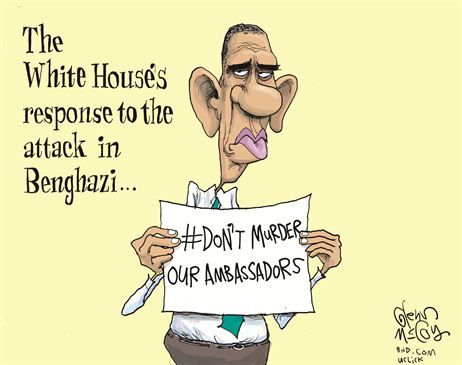
Just two weeks ago, the scandal involved the cover-up of administration duplicity regarding the Benghazi massacre. (See my related article in the new edition of National Review.) Now, it is the targeting of conservative groups by the Internal Revenue Service.

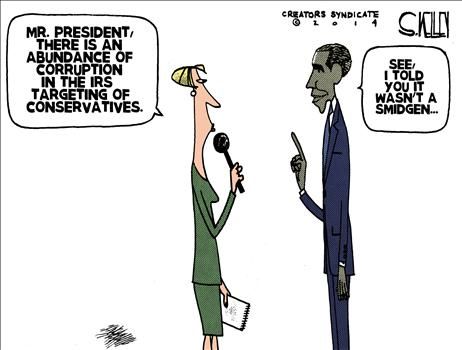
For a year, the administration and IRS headquarters in Gomorrah by the Potomac have attempted to run an implausible con-job: The harassment of organizations opposed to Obama’s policies by an executive-branch agency had nothing to do with the Obama administration — it was just a rogue operation by an IRS office in Cincinnati which, though regrettably overzealous, was apolitical, non-ideological, and without “even a smidgen of corruption.”

The story had about as much credibility as the administration’s “blame the video” script that Susan Rice dutifully performed on the post-Benghazi Sunday shows, or the Justice Department’s 2011 assurance to Congress that its agents would never knowingly allow the transfer of a couple of thousand guns to criminal gangs in Mexico. The “Cincinnati did it” yarn has been unraveling since it was first spun by IRS honcho Lois Lerner and, soon afterwards, by President Obama himself. The lie has now been exploded by e-mails clawed from the IRS by Judicial Watch’s Freedom of Information Act suit.

These include one from a top IRS lawyer in Washington succinctly explaining that “EOT [i.e., the revenue agency’s “Exempt Organization Technical unit” in Washington] is working Tea party applications in coordination with Cincy.” This was in July 2012, which is to say, in the key final months of Obama’s reelection campaign. “Tea party applications” were requests by conservative groups to be granted tax-exempt status under Section 501(c)(4) of the Internal Revenue Code. By selectively setting aside their applications, delaying the conferral of tax-exempt status to which the law entitled them, and putting them through inquisitions that violated their constitutional rights to political speech and association, IRS headquarters prevented them from raising funds and organizing as an effective opposition.

The e-mails elucidate that Cincinnati’s strings were being pulled in Washington: “We are developing a few applications here in DC and providing copies of our development letters with the agent [in Cincinnati] to use as examples in the development of their cases.” “Tea party applications,” IRS headquarters elaborates, have been isolated as “the subject of an SCR” — meaning “sensitive case report.” To “resolve” such cases would require “coordination with Rob” — a reference, Judicial Watch contends, to Rob Choi, who was then a high-ranking IRS official in Washington.

It is no more conceivable that IRS headquarters was off on its own anti–Tea Party witch-hunt than that the subordinate Cincinnati office was. The fuse, it must be recalled, was lit by the Supreme Court’s Citizens United decision in 2010, affirming the First Amendment’s prohibition against government restrictions of political speech by corporations. The ruling enraged the Left and prompted the president’s tongue-lashing of the stunned justices during the 2010 State of the Union address.

At this point, it remains unclear which, if any, administration officials were — to borrow the delicate term — “coordinating” with the IRS. It is manifest, though, that in the atmosphere charged by Obama’s impertinence, congressional Democrats felt empowered to push the IRS to undermine free political speech through administrative intimidation. Judicial Watch’s FOIA suit reveals correspondence in which Senator Carl Levin, the powerful Michigan Democrat, agitates for IRS action against several conservative groups. In accommodating responses, then-IRS deputy commissioner Steven Miller takes pains to assure him that flexible regulations enable the revenue agency to design “individualized questions and requests” for targeted Section 501(c)(4) applicants.

After a damning Treasury inspector-general report last year, even the IRS concedes that its singling out of conservative groups and obnoxiously intrusive demands for information were “inappropriate.” In truth, they were blatantly unconstitutional. As is always the case in Washington scandals, the question of whether crimes were committed arises — and now, the companion question of whether lawmakers who encouraged executive lawlessness are guilty of crimes.

For the time being, the lawsuits brought by conservative organizations victimized by the IRS have alleged only civil wrongs: principally, the deprivation of their constitutional rights to free speech and association, and of their statutory right to tax-exempt status. Nevertheless, these claims could trigger criminal jeopardy. For example, federal law (specifically, Section 242 of the penal code) makes it a crime for a government official to “willfully subject[] any person . . . to the deprivation of any rights, privileges, or immunities secured or protected by the Constitution or laws of the United States.”

Without a competent, impartial investigation, it will be tough to amass sufficient evidence to prove a willful violation of law. The officials implicated would surely claim — however dubiously — that they were just trying to enforce ambiguous regulations. Moreover, even if executive-branch officials could be proved criminally culpable, any prosecution of members of Congress would face a severe roadblock: the broad constitutional immunity lawmakers enjoy whenever arguably engaged in “legislative acts.” Remember Representative William Jefferson, whose crass acceptance of bribes did not stop a federal appeals court from invalidating an FBI search of his Capitol Hill office.

In any event, as I argued here last weekend, to focus on criminal or civil liability is to miss the point. The importance of government officials lies in the public trust reposed in them and the awesome power it entails. When they demonstrate themselves to be unworthy of that trust, the imperative is to take the power away.

The IRS has become a vehicle of repression — one that Democrats have further empowered through Obamacare. Its budget should be slashed, and we should figure out better ways to raise revenue. In addition, government officials have engaged in conduct that, at a minimum, grossly disregarded the constitutional rights our government exists to safeguard. Whether such serious misbehavior is attributable to incompetence or corruption, the officials who engaged in it should be defrocked. Most of us couldn’t care less whether they are sent to jail or successfully sued, but we should all insist that they no longer wield power.

The most ominous development in the IRS scandal is the confederation of executive and congressional authority in opposition to our fundamental rights. The accumulation of all government powers in the same hands, Madison warned, “may justly be pronounced the very definition of tyranny.” In a free society, powers must be separated. The Framers thus gave us a Constitution that heeded the wisdom of Montesquieu:
When the legislative and executive powers are united in the same person, or in the same body of magistrates, there can be no liberty; because apprehensions may arise, lest the same monarch or senate should enact tyrannical laws, to execute them in a tyrannical manner.
The IRS scandal presents a textbook case of tyrannical execution. It is fraught with peril. We are dealing not merely with a single president, who presumes to rule by decree; nor just with his congressional partisans, who presume to pull the executive bureaucracy’s coercive levers. Enormous power is cumulating in an ideological movement that is hostile to free expression, one that views its political opposition not as fellow citizens with a different point of view but as enemies to be silenced and destroyed.

Frightening times.

— Andrew C. McCarthy is a policy fellow at the National Review Institute. His next book, Faithless Execution: Building the Political Case for Obama’s Impeachment, will be released by Encounter Books on June 3.

Today's Tune: The Mavericks - What a Crying Shame (Live, BBC)

Friday, May 16, 2014

The Emerging Junta


The IRS’s illegal actions — and its efforts at cover-up — undermine the foundations of our government. 

I will confess to a little despair over the relatively mild reception that has greeted the evidence, now conclusive and irrefutable, that the Internal Revenue Service, under the direction of senior leaders affiliated with the Democratic party, was used as a political weapon from at least 2010 through the 2012 election. It may be that the American public simply does not care about the issue; it is always difficult, if not impossible, to predict what issues will seize the electorate’s attention, or to understand why after the fact. It may be that the public does not understand the issue, in which case a brief explanation of the known facts may be of some use.

Here is what happened. In the run-up to the 2012 election, senior IRS executives including Lois Lerner, then the head of the IRS branch that oversees the activities of tax-exempt nonprofit groups, began singling out conservative-leaning organizations for extra attention, invasive investigations, and legal harassment. The IRS did not target groups that they believed might be violating the rules governing tax-exempt organizations; rather, as e-mails from the agency document, the IRS targeted these conservative groups categorically, regardless of whether there was any evidence that they were not in compliance with the relevant regulations. Simply having the words “tea party,” “patriot,” or “9/12” (a reference to one of Glenn Beck’s many channels of activism) in the name was enough. Also targeted were groups dedicated to issues such as taxes, spending, debt, and, perhaps most worrisome, those that were simply “critical of the how the country is being run.” 
Organizations also were targeted based on the identity of their donors. Their applications were delayed, their managements harassed, and the IRS demanded that they answer wildly inappropriate questions, such as the content of their prayers. When an internal review threatened to expose the fact that, in the words of the IRS’s inspector general, the agency was “using inappropriate criteria to identify organizations applying for tax-exempt status,” Ms. Lerner staged an event at a tax-law conference at which she used a planted questioner to preemptively disclose the issue on her own terms, and the agency began claiming that the tea-party targeting, while regrettable, was the work of a few misguided agents at a satellite office in Cincinnati. In fact, the direction came from Washington and was, in the words of the agency’s own e-mails, “coordinated with” a senior manager there, Rob Choi, director of rulings and agreements. This began at the behest of Democratic officeholders, including Senator Carl Levin of Michigan, who requested that the IRS disclose to him information about tea-party groups that it would have been illegal for the IRS to disclose. It subsequently emerged that IRS officials had intentionally misled members of Congress and investigators about the matter.

During this period, IRS operatives were, according to the Office of Special Counsel, openly campaigning for the reelection of Barack Obama on IRS time using IRS resources. A few were later disciplined for their actions, but the extent of the political activity of IRS agents remains unknown.

The IRS is not just a revenue agency — it is a law-enforcement agency, a police agency with far greater powers of investigation and coercion that any normal police force. Its actions in this matter are not only inappropriate — they are illegal. Using government resources for political ends is a serious crime, as is conspiring to mislead investigators about those crimes. But so far, other than holding Lois Lerner in contempt for refusing to comply with the demands of congressional investigators, almost nothing has happened. The characteristic feature of a police state is that those who are entrusted with the power to enforce the law are not themselves bound by it.

Context is again here important. The IRS scandal is not a standalone issue but comes at a time when the Democratic party is seeking to radically expand the power of the federal government to regulate political speech; we can safely assume that the same people who were using the IRS’s political-speech regulations for political ends will have precisely the same motives and precisely the same opportunity to use other political-speech regulations for precisely the same political ends: to benefit their allies and persecute their enemies. So committed are the Democrats to keeping their critics under the thumb of federal police powers that they have introduced an amendment in the Senate that would effectively repeal the free-speech provisions of the First Amendment, those having proved inconvenient to Democrats in Supreme Court rulings such as McCutcheon and Citizens United, the latter case involving a federal attempt to make it a crime to show a film critical of a political figure under unapproved circumstances.

The most important question that must be answered in this matter does not involve the misbehavior of IRS officials and Democratic officeholders, though those are important. Nor is it the question of free speech, vital and fundamental as that is. The question here is nothing less than the legitimacy of the United States government. When law-enforcement agencies and federal regulators with extraordinary coercive powers are subordinated to political interests rather than their official obligations — to the Party rather than to the law — then the law itself becomes meaningless, and the delicate constitutional order we have enjoyed for more than two centuries is reduced to a brutal might-makes-right proposition. Elected officials and public servants of both parties take an oath to uphold the Constitution of the United States and to faithfully discharge the duties of their office. That oath is now being tested. The IRS investigation is no mere partisan scandal, but a moral challenge for the men and women who compose the government of this country. Whether they are sufficient to meet that challenge is far from obvious, but the evidence so far is not encouraging. 

— Kevin D. Williamson is roving correspondent for National Review.

The sound and the fury — and the tweet

Mass schoolgirl kidnapping in Nigeria — to tweet or not to tweet? Is hashtagging one’s indignation about some outrage abroad an exercise in moral narcissism or a worthy new way of standing up to bad guys?
The answer seems rather simple. It depends on whether you have the power to do something about the outrage in question. If you do, as in the case of the Obama administration watching Russia’s slow-motion dismemberment of Ukraine, it’s simply embarrassing when the State Department spokeswoman tweets the hashtag #UnitedForUkraine.
That is nothing but preening, a visual recapitulation of her boss’s rhetorical fatuousness when he sternly warns that if the rape of this U.S. friend continues, we are prepared to consider standing together with the “international community” to decry such indecorous behavior — or some such.
When a superpower, with multiple means at its disposal, reverts to rhetorical emptiness and hashtag activism, it has betrayed both its impotence and indifference. But if you’re an individual citizen without power, if you lack access to media, drones or special forces, then hashtagging your solidarity with the aggrieved is a fine gesture and perhaps even more.
The mass tweet is, after all, just the cyber equivalent of the mass petition. And people don’t sneer at petitions. Historically, they’ve been a way for individuals, famous or anonymous, to make their views known and, by weight of number, influence authorities who, in democratic societies, might respond to such expressions of popular sentiment.
The hashtag campaign for the Nigerian girls — originated in Nigeria by Nigerians — was meant to do exactly that: pressure the Nigerian government to respond more seriously to the kidnapping. It has already had this effect. And attention from abroad has helped magnify the pressure.
As always, however, we tend to romanticize the power of the tweet. For a while, Twitter (and other social media) was seen as a game-changer that would empower the masses and invert the age-old relationship between the ruler and ruled.
This is mostly rubbish. Yes, the tweet improves upon the mass petition because tweets contain an instant return address that allows for mass mobilization. People can be summoned to gather together somewhere — Tahrir Square, for example.
At which point, alas, the age-old dynamics of power take hold. If the tyrant, brandishing guns and tanks, is cruel and determined enough, your tweets will mean nothing. Try it at Tahrir or Tiananmen, in Damascus or Tehran. They will shoot and torture you, then maybe even let you keep your precious smartphone.
Michelle Obama’s tweeting #BringBackOurGirls for the nearly 300 schoolgirls kidnapped by Boko Haram terrorists poses an interesting case of the semi-official tweet. This was no exercise in vanity. She does advise the man who does deploy the forces and who in this case provided serious concrete support — intelligence, reconnaissance, on-the-ground advisers — to help fight the evil.
What was peculiar about her tweet, however, was its uniqueness: It’s the first time she’s expressed herself so personally and publicly about a foreign crisis. And she was nicely candid about the reason: “In these girls, Barack and I see our own daughters.”
The identity of the victims here — young, black and female — undoubtedly helps explain the worldwide reaction. Two months earlier, Boko Haram had raided a Christian school and, after segregating the boys, brutally murdered 59 of them. That elicited no hashtag campaign against Boko Haram. Nor was there any through the previous years of Boko Haram depredations — razing Christian churches, burning schools, killing infidels of all ages.
Nonetheless, selective outrage is not necessarily hypocrisy. There are a million good causes in the world, and one cannot be devoted to all of them. People naturally gravitate to those closest to their heart. Thus last week’s unlikely sight: a group of congresswomen holding a news conference demanding immediate U.S. action — including the possible use of drones— against Boko Haram.
These were members, like Sheila Jackson Lee, not heretofore known for hawkish anti-jihadist sentiments. No matter. People find their own causes. Their sincerity is to be credited and their commitment welcomed.
The American post-9/11 response to murderous jihadism has often been characterized, not least by our own president, as both excessive and morally suspect. There is a palpable weariness with the entire enterprise. Good, therefore, that new constituencies for whom jihadism and imposed Shariah law ranked low among their urgent concerns should now be awakening to the principal barbarism of our time.
Trending now (once again): anti-jihadism, a.k.a. the War on Terror.