Tuesday, August 20, 2013

Cairo Is Burning. Where Is President Obama?


By Roger Kimball
August 19, 2013
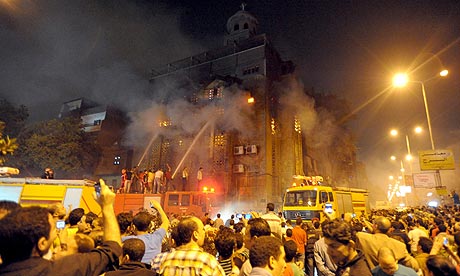
Church burned in Cairo
On the links, naturally. Cairo is a long way away. No one there votes in the U.S. presidential election (not yet, anyway), so why shouldn’t the Leader of the Free World respond to the crisis in Egypt by decamping to Martha’s Vineyard, thus reinforcing his reputation as a latter-day Alfred E. Neuman? Why should he worry about Egypt, the churches being burned, the Christians being murdered, the chaos in the streets as the Egyptian military desperately attempts to deal with the anarchy that the Obama administration helped midwife with its support of the Muslim Brotherhood?
As Youssef Ibrahim noted yesterday, one of the many things going up in flames because of the conflagration in Cairo is the reputation of President Obama. “In the past 48 hours alone,” Ibrahim reported, “some 57 Egyptian churches have been burned to the ground in the Nile valley. It will not be lost on the Egyptians that Mr. Obama has spent the crisis playing golf at Martha’s Vineyard.”
Obama took a moment from his days of fun and frolic to hint that the $1.5 billion in aid that the U.S. supplies to Egypt might be in jeopardy if the Egyptian military continues to take its hard line against the Muslim Brotherhood and its effort to establish Islamic totalitarianism in Egypt. But as Ibrahim notes, that threat loses a bit of its sting when placed against the $12 billion committed by Saudi Arabia, Kuwait, and the United Arab Emirates last month.
Near the beginning of his first term, Obama, a bit like Cleopatra on her barge of burnished gold, floated into Cairo and told the world that he had come “to seek a new beginning between the United States and Muslims around the world; one based upon mutual interest and mutual respect; and one based upon the truth that America and Islam are not exclusive, and need not be in competition. Instead, they overlap, and share common principles — principles of justice and progress; tolerance and the dignity of all human beings.”
Tolerance and dignity for all human beings, except for Jews, Christians, and other infidels, not to mention women, homosexuals, and those who have been enslaved by Muslims. Apart from them, there’s tolerance and dignity galore.
I have long been fascinated by the spectacle that Barack Obama presents to the world. I do not, it pains me to acknowledge, understand the nature of the spell he exerts over otherwise intelligent and well-meaning people. Where some of my left-leaning friends see a cool-headed pragmatist (“pragmatist” is the accolade of choice for reasons I find puzzling), I see horrifying failure that I have alternately put down to stupefying incompetence, on the one hand, and Alinskyite malevolence, on the other hand. It was a sobering day when I realized that incompetence and malevolence, far from being mutually exclusive, could easily cohabitate and nurture each other.
But back to Cairo. I was sitting in Judge Robert Bork’s living room a couple of Februarys back when the Muslim Brotherhood took to the streets to demand Hosni Mubarak’s ouster. The television was on and it was then that I was treated to my first exposure to James Clapper, our “director of National Intelligence,” who was briefing members of Congress on the nature of the Muslim Brotherhood. It is, he explained with a straight face, a “largely secular organization,” with no “overarching agenda.”
Ha, ha, ha! What a card. Clapper of course had to know that an organization called the Muslim Brotherhood — theMuslim  Brotherhood, Kemo Sabe, not the Friends of Egypt or the Cairo Clan or the Alexandrian Quartet — he had to know that the Muslim Brotherhood was a fraternity of Muslims, i.e., that it was not, by definition, “largely secular,” but on the contrary was explicitly committed to advancing Muslim, i.e., religious, i.e., non-secular ends. Clapper recently admitted to lying to (“misleading”) Congress about the extent of NSA domestic surveillance. But was his testimony about the Muslim Brotherhood another example of mendacity, or was it merely incompetence? Again, I do not present these possibilities as mutually exclusive.
Absent countervailing evidence, I assume that Clapper knew better about the character of the Muslim Brotherhood, just as I assume he must have known, since he was director of National Intelligence and was steeped to the gills in things Muslim, that the Muslim Brotherhood subscribed to one of the most overarching of overarching agendas, namely the imposition of Sharia, i.e., Islamic law, everywhere. How do we know this? The Brotherhood has been very accommodating in explaining its goals. You don’t need an advanced degree in hermeneutics to unravel their credo. They spell it out clearly for you: “Allah is our objective. The Koran is our law. The Prophet is our leader. Jihad is our way. Dying in the way of Allah is our highest hope. Allahu-Akbar!”
Allahu-Akbar: where have you heard that before? Oh right. Someone shouts “Allahu-Albar” (“Allah is the greatest”) and then opens fire, killing as many infidels as he can. Not to worry, though. What we’re dealing with here is notIslamic violence.  No, no. Take Fort Hood, for example, where thirteen people were slaughtered (and another 30 wounded) by Major Nidal Hasan. “Allahu Akbar,” he said, and then bang, bang, bang.
Just as James Clapper described the Muslim Brotherhood as “largely secular,” so the Obama administration has insisted on denominating the Fort Hood massacre as an instance of “workplace violence,” not a terrorist act, thus depriving its victims of Purple Hearts. Major Hasan, who is acting in his own defense, seems to disagree: “We mujahedeen,” said this Muslim member of the U.S. Army, “are trying to establish the perfect religion.” Ergo? Ergo, he had to murder as many U.S. soldiers as he could.
It is impossible to regard the events unfolding in Cairo without profound misgivings. But the sad truth is that the Obama administration, through its thoughtless Islamophilic posture, has helped precipitate the chaos the Egyptian military is now endeavoring to contain. Hosni Mubarak was not George Washington. But he was a friend of order who made peace with Israel and was a reliable ally of the United States. His successor, Mohamed Morsi, was an Islamic totalitarian. The military coup displacing Morsi — and let’s be clear: it was a coup — may be the best chance for any real liberalization of Egyptian society. The army, as Robert Reilly observes, is doing what the Wehrmacht ought to have done in the 1933: overturned a popularly elected government whose goal was to end popular elections. As Andy McCarthy put it with his customary cut-to-the-chase, “a pro-Western military may be the best chance for sowing true democracy” in Egypt. The harvest, if it comes, will be a long way off. It may be news to the Obama administration, but McCarthy is right:
Egypt has never had a democracy, so there is no “restoring” it. Pragmatically speaking, the country has two alternatives: (a) a rapid resort to popular elections, which are certain, once again, to empower Islamic supremacists (who have proved, in election after election, that they appeal to a significant majority of the populace); or (b) military rule through an appointed technocratic government. The former would crush any hope for real democracy. The latter, at least potentially, could force a new consensus constitution that requires equality under the law and respect for minority rights; that delays popular elections until secular democrats are better positioned to compete with Islamic supremacists; and that requires convincing acceptance of the new constitution and renunciation of violence as a precondition to participation in elections.
When it comes to Egypt, there is a lot of blame to spread around. The American people seem to be waking up to the shocking news that a large part of the blame for what is happening on the streets of Cairo — and for what happened in Benghazi and what is about to happen in Syria and Iran — must be laid at the door of the stupid “smart diplomacy” promulgated by the Obama administration.
They eagerly embraced the fairy tale of the “Arab Spring.” When that spring turned out to be blood-red instead of pacifically verdant, their reaction has been one of confusion, obfuscation, scapegoating, and denial. America’s reputation has probably never been lower in the Middle East than it is now. It turns out that there is leadership, on the one hand, and “leading from behind,” on the other. Obama explicitly embraced the latter. The ensuing catastrophes are too multifarious and too profligate of blood and treasure to conceal for long. In the case of Obama, anyway, incompetence and malevolence have shaded into each other to form a single toxic confection. The narcissist-in-chief still moves from playground to playground in the world’s most extravagant caravan. But his distance from the realities he has foisted upon the world is exceeded only by an arrogance bordering (on the wrong side of the border) on hubris. Hubris, as the Greeks knew, is followed reliably by Nemesis. A foreign policy that has sparked chaos in the Middle East, resentment among our allies, and belligerence among states like Russia and China, a domestic policy that nurtures the fiscal madness of “green energy” and and the statist innovations of Obamacare: Nemesis cannot be far off.

Photograph: AFP/Getty Images

Egypt’s Anti-Christian Pogrom


Islamists are attempting to cleanse the country of Christians. 

Monday, August 19, 2013

Jean Bethke Elshtain, 1941-2013

A Christian Realist, par Excellence


AUG 26, 2013, VOL. 18, NO. 47 
Jean Bethke Elshtain may have been the busiest woman many of us had ever met. Shuttling back and forth between her regular teaching appointment at the University of Chicago and her settled home in Tennessee, she wrote and wrote—and wrote and wrote. Essays, talks, books, memos to fellow directors on the almost endless number of boards on which she served. Letters, emailed comments about her friends’ latest work, notes on current theological and political issues: a ceaseless flow of words.
Jean Bethke Elshtain
JEAN BETHKE ELSHTAIN
Along the way—and what a way, producing 21 books and more than 600 journal articles in her fields of theology and political theory—she helped bring up her grandchildren and planned her courses and delivered lectures everywhere from a visiting professorship at Baylor to the famous Gifford Lectures in Scotland. When she slipped away on Sunday, August 11, dying of congestive heart failure at age 72, American public life lost what had seemed almost a force of nature. And nearly everyone who knew her lost a friend.
In many ways, Jean’s life was defined by the polio she had while young and the child she bore at age 19. From the beginning, she had experienced the world as a deeply physical place, and it showed in her first, curiously both feminist and conservative book after graduate school, Public Man, Private Woman, in 1981. 
But what made her most interesting as a thinker was the conclusion she drew from it all, particularly in her breakthrough books Women and War in 1987 and Augustine and the Limits of Politics in 1996. Her recognition of the physical nature of the world gave her the intellectual resources to reject all notions of earthly perfection, and she became a Christian realist of a profoundly Augustinian kind—perhaps America’s most prominent Christian realist since Reinhold Niebuhr. 
Her realism was a key part of her teaching, manifest in her joint appointment in the political science department and the Divinity School at the University of Chicago. And it guided her 2003 Just War Against Terror, a book that was, to her hurt and surprise, brutally and often unfairly attacked by her fellow academics in the context of the agitation over the Iraq war. Her writings for this magazine on Louisa May Alcott and the Puritans show the same hard-headed refusal to warp actual history or the world as it is experienced to match an idealistic, utopian thesis. 
Jean had a bit of contrarianism built into her nature, and she delighted in assigning John Calvin to her political-theory students and Machiavelli to her divinity students. She enjoyed, for that matter, sounding like a conservative while talking to liberals, and a liberal while talking to conservatives. In an age dominated by idealism, she once told me, she would have been a cynic—while in an age dominated by cynicism, she would have been an idealist. But in our own age, which she saw as somehow both deeply idealistic and utterly cynical, she looked to a realistic account of the fragility of the body, the weakness of human nature, and the difficulty of the political order as the best description of this hard world as we actually find it.
She once instructed me on that point while playing with my toddler daughter on her lap—the little girl’s delighted laughter tending to undermine the grim message. But then, as I also remember, the play that so made my daughter laugh was Jean’s opening and closing the folding cane that her childhood polio had left her needing as an adult.
And perhaps that was the real message. Jean never denied that the world offers bright moments. We know them as bright, however, because they occur in a physical and moral landscape that nothing short of the end time can fully redeem. She understood the Augustinian truth that all attempts at human perfection fail to grasp—for every supposed utopia, she knew, would eventually issue in its own deadly night, murdering to keep its false light burning.
Her suspicion of grand political programs is part of what kept her focused on the particular throughout her life—a particularity found, for instance, in her 2002 book Jane Addams and the Dream of American Democracy. This is why, in the end, Jean Bethke Elshtain may be best remembered for her friendships and the personal suasion she brought to her ideas. 
Brought up a Lutheran, she converted to Catholicism in 2011, and she died in the fullness of her Christian faith. It was an admirable, serious life she led: both happy and important. That is as much as anyone can ask in this world she knew was a fallen one. A good deal more, in fact, than anyone can ask. 
Joseph Bottum is a contributing editor to The Weekly Standard.

Israel’s Heroic Restraint

They put their own security at risk all the time to protect innocents — and prospects of peace. 

Sunday, August 18, 2013

Today's Tune: Keith Richards - Eileen (Live)

How Penn State Football Survived


Egged On by the NCAA, Rival Teams Tried Raiding the 2012 Nittany Lions


By John U. Bacon
August 15, 2013

[image]
Penn State coach Bill O'Brien (front row, center) and the Nittany Lions waiting to get their photo taken before the 2012 season. (AP)
To write his forthcoming book "Fourth and Long: The Fight for the Soul of College Football," author John U. Bacon embedded himself with four Big Ten programs—Penn State, Ohio State, Michigan and Northwestern—in search of the sport's old ideals as it is roiled by money, greed and scandal. In this excerpt, he offers a behind-the-scenes look at how Penn State's team reacted to the Jerry Sandusky sex-abuse scandal last year.
On July 23, 2012, Penn State's football players gathered in their lounge to watch on television as NCAA president Mark Emmert walked to the podium for a news conference.
Eight months earlier, prosecutors had arrested Penn State's former defensive coordinator Jerry Sandusky on 40 criminal counts, including the sexual assault of several boys over a 15-year period, one of them in the showers of Penn State's football building. Within three months of Sandusky's arrest, Penn State trustees released their president, a senior vice president and their Hall of Fame coach, Joe Paterno, who died soon afterward. The athletic director also ultimately lost his job. Then a report commissioned by the university found that those leaders knew enough of what Sandusky had done to report him to the authorities, but cared more about protecting the university's image than his victims.
John U. Bacon, the author of 'Fourth and Long: The Fight for the Soul of College Football', sits down with Rachel Bachman to discuss Johnny Manziel, Penn State, and fate of college football.
Most Penn State players didn't know who Sandusky was until they saw his picture on TV. Only then did some recognize him as the "old guy who worked out here once in a while."
Their reactions were swift. "They used to hang people at the Centre County courthouse," linebacker Mike Mauti told me, "and frankly, I would have been OK with that. Hell, give us the rope, and we'll do it for you."
Now it was time for the team to pay for Sandusky's sins.
Emmert laid out a series of penalties. One erased a wide swath of Penn State's rich history, vacating all victories from 1998 through 2011. The sanctions also threatened Penn State's future, with a $60 million fine, a four-year postseason ban and a drastic reduction in the number of scholarships from 25 to 15 a year, with a maximum of 65—20 fewer than Penn State's rivals could give out. Emmert declared Penn State's penalties might be considered "greater than any other seen in NCAA history."
But the players, coaches and staffers in Penn State's players' lounge that Monday morning understood immediately that another stipulation of the NCAA's sanctions, which got far less attention outside that room, threatened Penn State's season opener, just six weeks away: The NCAA would allow other schools to recruit Penn State's current players, who would be permitted to play for another team that fall without having to sit out a season for transferring. In practice, Emmert had declared open season for opposing coaches to cannibalize Penn State's roster, and all but prodded Penn State's players to run for the hills.
Associated Press
Linebacker Mike Mauti walking off the field at Beaver Stadium after a win over Temple in September 2012.
Within minutes, Mauti recalled, "our phones were ringing—blowing up. My high-school coach had to turn his phone off because he got 40 calls that day asking if I wanted to jump."
Bill O'Brien, a former New England Patriots offensive coordinator hired just six months earlier as Paterno's replacement, immediately called a meeting. "We're not here to understand the rules," O'Brien told the players. "We're here to follow them. It's my obligation to tell you that you are free to go anywhere you want, with no penalties. However, if you stay, I promise you, you will never forget it."
But that didn't stop running back Silas Redd—who had run for over 1,000 yards his sophomore year—from taking a flight to Los Angeles to check out Southern California.
Penn State players assumed that if the popular and talented Redd left State College, Pa., the floodgates would open. That same day, recalled starting senior defensive end Pete Massaro, an academic All-American majoring in economics, a freshman "started listing a ton of guys in the freshman and sophomore classes who were going to leave, too. I was freaking out. Next thing he said to me was 'Penn State football is dead.'
"I thought it was the end of Penn State football."
The Paterno Way

Sometime after Penn State's undefeated 1994 season, Paterno's passion for coaching began to wane. In 2006, after a Wisconsin player ran into him on the sidelines and injured his leg just below the knee, he hardly coached at all, watching games from the press box without a headset. After he recovered, he returned to the sidelines, but he still didn't wear a headset or carry a clipboard, and he rarely attended team meetings. Privately, the staff joked that the less the 84-year-old Paterno got involved, the better things usually went. When Paterno did weigh in, he often confused the situation, got players' names wrong or just yelled at them by their numbers.
Still, his assistants clung to certain symbols of the Paterno Way. "Shave your face, cut your hair," Mauti said, recalling the mantra. "If we weren't shaved for a practice, we would have to work out on Saturdays in the off-season. It got almost to the point where that's all that mattered."
Few programs in college football at the time could have claimed a richer tradition than Penn State's. It looked like Camelot—but only from the outside. Almost every Penn State senior I talked to last season repeated some version of the following: "We felt like we were protecting an image. And only we knew it."
Through a spokesman, Paterno's son Jay Paterno called the characterizations inaccurate, saying Joe Paterno scripted every practice to the minute, led every team meeting and had "direct play-calling input" on game-winning or clinching drives in five close games during his last season (2011).
'We're Screwed'

The morning after Emmert's announcement, after barely sleeping, Penn State fullback Mike Zordich got up to work out at 7 a.m. "First thing I do, I look at my phone, and I already had a bunch of calls from [opposing] coaches," he said. "That meant everyone else was getting them, too."
He walked out to the living room to see Mauti, his roommate and best friend, looking at his phone, too. "He's got the same thing happening," Zordich recalled. "And I said, right then and there, 'Look. I'm staying,'" he recalled. "And once I'm staying, he's staying, so now the question is: Who else is going to stay?"
The two went straight to their sanctuary: strength coach Craig Fitzgerald's office.
"What are you guys hearing?" Fitzgerald asked.
The two seniors cut to the chase, rattling off all the teammates they'd heard were leaving. "We just started writing names on legal pads," Zordich said, "listing who was in and who was out, trying to figure out if this guy leaves, is this guy going to follow, so will it trickle down? We practically made a playbook of who's getting calls, from where, and who's going to stay."
Fitzgerald looked at the list. If even half the players on the "gone" side of the ledger left, Penn State might not have enough players to run a decent practice, let alone suit up for opening day. Fitzgerald grabbed his phone to call O'Brien in his upstairs office.
"I'll be right down," O'Brien said.
O'Brien saw Mauti and Zordich, normally upbeat, slumped in the couch against the window. "When Coach showed up, our body language, sitting around, was basically 'We're screwed,'" Mauti recalled. "We weren't hiding anything. It was too late for that."
While O'Brien and Fitzgerald listened, the two seniors read the names of teammates they'd heard were about to bolt. O'Brien had coached these players for only six months, but he had no reason to doubt them. He'd been hearing most of the same things they had, and some they hadn't. He looked at them, then at Fitzgerald, then exhaled. He knew he had to make some big decisions—decisions that could determine the very fate of Penn State's football program—and he had to make them fast.
O'Brien made many that week, and his instincts in uncharted waters proved almost unerring, but one decision gave his captains pause.
"Coach was saying, 'We need to make a hard deadline,'" Zordich recalled. "'This can't go on forever. So I'm going to tell them, 'By Aug. 1, you're either with us or you're not.'"
"I'm thinking, Aug. 1?" Zordich said. "That's one week. This dude's got (guts)."
Zordich soon proved he had some guts, too. After initially agreeing, he said: "I don't think that's a good idea. The players here don't know you well enough yet."
As soon as Zordich said it, Mauti decided his teammate was right, and they explained why. They believed the more players got to know O'Brien and his program—which they viewed as a long-overdue step toward the future—the more likely they would stay.
And second, if O'Brien threatened them with a deadline, it might incite a rush to the doors. "You say, 'Now or never,'" Zordich said, "you're going to lose a lot of guys. They'll get scared."
"And make an irrational decision," Mauti added. "If we've got a deadline, word's going to get out to (opposing) coaches, and (players') phones are going to blow up all over again the night before the deadline."
At that moment, Zordich and Mauti might have been the only college football players in the country with the temerity to question the decision of their head coach. And O'Brien might have been the only college-football coach willing to listen.
After scanning their faces one more time, O'Brien started nodding. "OK," he finally said. "Then that's what we'll do."
The four men started working their phones, contacting every member of the team, their parents, their roommates, even their girlfriends—some several times. They started at 7 a.m. Tuesday and went to 10:30 that night—and did it again, all week. "We had a whole operation going," Zordich said. "This was nuts."
For all of the calls they made, Mauti and Zordich received almost as many from coaches across the country—including some former Penn State staffers, who wanted to see if anyone wanted to transfer.
On July 25, two days after the sanctions were announced, Penn State cornerbacks Adrian Amos and Stephon Morris both tweeted: "We have chosen to stay at Penn State and opposing coaches are outside our apartment, was that the intention of the NCAA?"
But Penn State's fate ultimately would be determined not by the NCAA or the scavengers on the phone or in the parking lot, but by Nittany Lion players, who would vote with their feet.
The Speech

On July 26, three days after the sanctions were announced, O'Brien decided to invite every member of Penn State's Letterman's Club to meet with the players "to talk about what it means to play here," he said. O'Brien's secretary sent out more than 1,000 old-fashioned letters asking the lettermen to come to campus that coming Tuesday—just five days' notice. O'Brien had no idea what the response would be. "Let's be honest," he told me, "State College is still not exactly the easiest place to get to." But on Tuesday night, roughly 500 lettermen showed up. "The airport was packed with private jets," he said. "It was a scene, man. Amazing."
O'Brien asked Franco Harris, Todd Blackledge, Jack Ham and some players who had become business successes to speak. All of the talks were fast and fiery, but most agreed the most powerful speaker was the last one, former star player and NFL team executive Matt Millen. "Forget about what you lost," he told them. "This is what youhave. I can only promise you, you will have a brotherhood. You may not realize it now, but that's worth more than anything."
When Millen finished, the players jumped to their feet and cheered for a solid minute. "If someone doesn't want to stay after that," Fitzgerald told the lettermen, "they weren't Penn State guys in the first place."
A Domino of One

Several days later, a few players did leave, including kicker Anthony Fera, who transferred to Texas to be closer to his mom, who suffers from multiple sclerosis, and Justin Brown, a wide receiver and kick returner who transferred to Oklahoma.
But the key, everyone agreed, was Silas Redd. A week after the sanctions, he still hadn't left—but he hadn't committed to staying, either. "We figured," Mauti told me, "the longer he drew out that process, the more he isolated himself from the rest of the team."
The suspense finally ended the day after the lettermen spoke, when Redd decided to transfer to USC.
Losing their best offensive player was undeniably bad news, but they could accept it if Zordich and Mauti's theory proved true—and O'Brien was right to take their advice. Eight days after the sanctions hit, Redd proved to be a domino of one. No one followed that day, or the next.
No Regrets

In the midst of this media frenzy, none of the Penn State players had time to ponder the irony.
An NCAA spokesperson said the organization "worked to minimize the impact of its sanctions on current and incoming football student-athletes."
But the NCAA sanctions were encouraging "student-athletes" to behave like athlete-students. They were putting the lie to the NCAA's own propaganda, which officially discouraged transfers because "student-athletes" are supposed to pick their schools for the education, not the athletic opportunities.
But there Emmert was, inviting Penn State's student-athletes to jettison the university that graduated 91% of its student-athletes—a big reason many of them chose Penn State in the first place—to transfer penalty-free to bowl-eligible football programs, whose graduation rates were often much lower.
Not only did it suddenly fall to O'Brien, Mauti, Zordich and every Penn State player who stayed to protect their storied program from disintegrating, they could only do so by upholding the very values the NCAA itself could apparently no longer proclaim with a straight face.
As Zordich told me, "I've never been closer to any team in my life than this one."
At the end of the season I asked Mauti to look back on his decisions to commit to Penn State in July of 2008, and to stay after the NCAA sanctions hit. Did he think he made the right decisions? He grinned very slowly, nodded, then said, "Oh, yeah. Oh, yeah."
—Excerpted from "Fourth and Long" (Simon & Schuster).

Egypt’s One Chance for Democracy


Only capable armed forces can check the violent proclivities of Islamic supremacism. 

As Egypt began to implode, yet again, John Kerry inadvertently stumbled into something a lot closer to the truth than the delusional “Arab Spring” narrative that has guided Obama-administration policy. The secretary of state, tied in knots by congressional foolishness that mandates terminating U.S. aid when a foreign government is ousted by a coup d’état, rationalized that, quite contrary to a coup, the Egyptian military’s ejection of President Mohamed Morsi was an exercise in “restoring democracy.”

None of this was quite right, although that is to be expected. After all, the C-word on Kerry’s mind was not “coherence”; he was struggling to avoid saying “coup.” But let’s face it: Morsi was forcibly removed from power, and he is being detained, along with other major Muslim Brotherhood figures. That is a coup to most sensible people — people who are not paid to fret over the statutory ramifications of admitting reality, and who have no patience for fastidious distinctions like whether the generals have actually taken over the government or are “merely” backing the civilian technocrats they’ve put in place.

More to the point, Egypt has never had a “democracy,” so the military cannot be said to have “restored” one. Yet there was a welcome bit of common sense in Kerry’s declaration, even if it eluded the declarant.

The defining mission of the Muslim Brotherhood is the implementation of sharia, as noted for several years by a hardy few of us Islamophobes. An “Islamophobe,” by the way, is someone who takes seriously the things Muslim Brotherhood operatives say and the scriptures on which they rely; the Muslims who say the things that Islamophobes have the temerity to mention are called “moderates” — see how this works?

Sharia is Islam’s societal framework and legal code. Particularly as construed by Islamic supremacists, whose ideology dominates the Middle East, sharia is authoritarian, anti-liberty, anti-equality, and intolerant of minority rights. Indeed, in 1990, Islamic supremacists felt the need to issue their own “Declaration of Human Rights in Islam,” precisely because they cannot abide the aspirations laid out in the purportedly “Universal Declaration of Human Rights” promulgated by the United Nations in 1948. Human rights, for the Islamist, must bow to the repressive injunctions of sharia.

Consequently, in a couple of books that are largely about the history, ideology, methodology, and goals of the Muslim Brotherhood — The Grand Jihad and, last year, Spring Fever: The Illusion of Islamic Democracy— I tried to establish two premises. The first is that Islamic supremacism is fundamentally anti-democratic. That proposition cannot be too Islamophobic since influential Islamic supremacists themselves freely concede that sharia cannot coexist with a secular civil society or with any system in which people are free to ignore sharia in enacting their own law.

The second is that elections do not equal democracy. To the contrary, democracy is a culture of governance committed to the protection of minority rights and equality of opportunity. Sharia abides neither of those principles.

Taken together, these two premises lead, inexorably, to this conclusion: In a sharia culture, popular elections inevitably empower anti-democrats. I began Spring Fever with a quip by Turkey’s Islamic-supremacist prime minister, Recep Tayyip Erdogan, that ought to be a lot more notorious: “Democracy is just the train we board to reach our destination.” Islamists step off the train at sharia station, which is a civilization’s distance away from liberty and equality. In a sharia society, “democracy” — taken to mean mere voting — is not a culture. It is just another means of imposing totalitarian sharia. To be sure, it is a means less brutal than violent jihad, but a means to the same sorry end.

Western commentators should thus stop mindlessly repeating the Brotherhood mantra that Mohamed Morsi is, or was, the “democratically elected” president. He was the popularly elected president of an overwhelmingly anti-democratic society — the same society whose citizens, only eight months ago, voted to approve a sharia constitution by a two-to-one landslide. The Brothers rhetorically tug at our pro-democracy heartstrings, but the fact remains that installing anti-democrats in positions of power, even if done by a popular vote, is the antithesis of real democracy.

That brings us to the aspect of coups most reviled in the West: military control of the government.

The United States has a democratic culture that long predates our national government. Our constitution, in fact, is a reflection of our core principle that fundamental minority rights must be safeguarded. The protection of minority rights is a far more reliable indicator of democracy than are elections. Even totalitarian states hold elections (Iran, for example, just had one). In a society that has an authentic democratic culture, the understanding that the people, not the government, are sovereign is basic. Therefore, civilian control of the armed forces is the mandatory state of affairs. The Constitution, in fact, limited congressional appropriations for a national army to two years precisely because many of the Framers considered permanent standing armies a threat to liberty.

But to break Spring Fever, we must finally stop projecting our values on other cultures as if they were “universal,” to borrow the U.N.’s supercilious claim. The Muslim Middle East is part of a different civilization and does not share our core beliefs. Adherent to supremacist Islam, it rejects equality under the law (the rights of non-Muslims are inferior to those of Muslims, and those of women to those of men). In Muslim countries, religious minorities are systematically oppressed and persecuted. The sovereign is deemed to be Allah, acting through the Muslim ruler or caliph. There are no “constituents” to “represent”; the people are subjects who owe the caliph obedience and whose only legitimate expectation of the caliph is his fidelity to sharia.

In such an anti-democratic society, a pro-Western military may be the best chance for sowing true democracy. Only capable armed forces can check the violent proclivities of Islamic supremacism. The Coptic Christian minority, which makes up a fast-diminishing 10 percent of Egypt’s population, supported the military’s ouster of Morsi not because Copts reject democracy but because only the armed forces can protect them. Under the governance of Islamic supremacists, and now in the crosshairs of incensed Brotherhood thugs, the Copts are targets of murder and mayhem while their churches are being torched across the country.

As I explained in a column earlier this week, sharia dictates the persecution and killing of gay people. Women, too, stood to lose human-rights protections under Egypt’s Islamic-supremacist rule. Putting aside the many other sharia provisions that reduce women to chattel, a prohibition against female genital mutilation, put in place by Mubarak’s military-backed dictatorship, was certain to be scrapped — mainstream constructions of sharia hold that “female circumcision” is mandatory, and even “more enlightened” interpretations call for it to be permitted and thus reject an outright ban.

Pace the secretary of state, Egypt has never had a democracy, so there is no “restoring” it. Pragmatically speaking, the country has two alternatives: (a) a rapid resort to popular elections, which are certain, once again, to empower Islamic supremacists (who have proved, in election after election, that they appeal to a significant majority of the populace); or (b) military rule through an appointed technocratic government. The former would crush any hope for real democracy. The latter, at least potentially, could force a new consensus constitution that requires equality under the law and respect for minority rights; that delays popular elections until secular democrats are better positioned to compete with Islamic supremacists; and that requires convincing acceptance of the new constitution and renunciation of violence as a precondition to participation in elections.

It might take a number of years, and the Egyptian military — like Turkey’s Kemalist army before it was gutted by Erdogan — would have to make clear its determination to uphold minority rights. But if we really care about promoting democracy, the coup against Morsi is Egypt’s only hope. Rule by the Muslim Brotherhood and its allies leads to tyranny; the army’s removal of the Brotherhood government is a chance — and only a chance — for Egypt to stabilize, recover, and eventually prosper. It is a shame that there is any doubt about what side America is on.

— Andrew C. McCarthy is a senior fellow at the National Review Institute. He is the author, most recently, of Spring Fever: The Illusion of Islamic Democracy.

Photo: AP